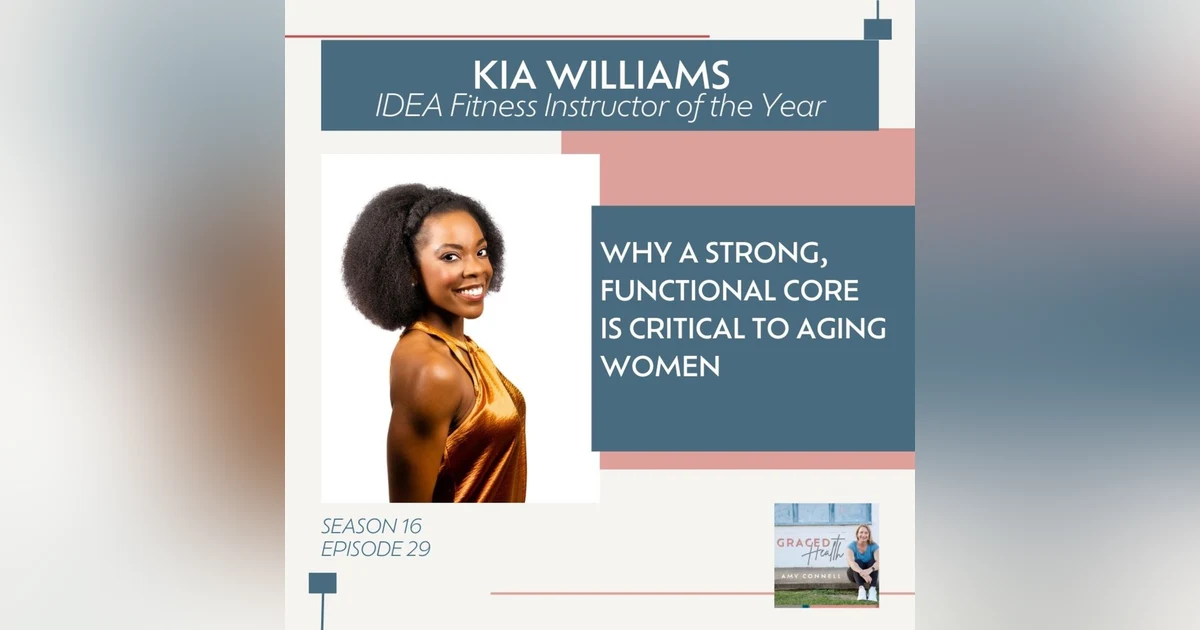
Why a strong, functional core is critical to aging women with Kia Williams

 Apple Podcasts
 Spotify
 RSS Feed
 Goodpods
 Amazon Music
 iHeartRadio
 I’m thrilled to have Kia Williams join the show and help us understand the holistic application of core work. Kia has such deep knowledge and experience with educating women about their core, and it’s demonstrated in her book Functional Core for Women.
Kia shares some of the myths surrounding core work, indicators that we need to strengthen our core, and shares two movements she believes are impactful to strengthening the core.
Kia Williams, MBA, MS, is a JEDI (Justice, Equity, Diversity and Inclusivity) advocate, global fitness presenter, published author, program specialist, wellness service provider, and the 2022 IDEA Fitness Instructor of the Year. Kia is the youngest person and first Black person awarded this highly acclaimed recognition. Kia’s heart dedications are for serving as the Wellness Chairwoman for the NAACP Fort Worth-Tarrant County Chapter, founding board member of Striking + Strong hair care brand, Fit4Mom board member, an executive board member for Jeremiah 33:6, a not-for-profit holistic health education and preventative medicine corporation. Kia's career mission is to support people who are affected by marginalization in jobs, education, healthcare, and lack of representation in the fitness industry.
We discuss:
- Her path to becoming a fitness instructor
- What our core actually is
- Indicators we need to strengthen our core
- Myths surrounding core strength
- Recommended movements for someone who wants to strengthen their core
Purchase Functional Core for Women at Human Kinetics or Amazon
Connect with Kia:
atthecoreofitall.com
Instagram: @kiawilliams.fitness
Facebook: Kia Williams Fitness
Connect with Amy:
GracedHealth.com
Join the Graced Health community on Facebook!
Instagram: @GracedHealth
YouTube: @AmyConnell
Join GracedHealth+ for virtual community meetups and bonus episodes
Check out my book Your Worthy Body and signature online class B.COMPLETE
Amy: [00:00:00] Kia, welcome to the Graced Health Podcast.
Kia: Hello, Amy. Thank you for having me. Thank you.
Amy: You are so welcome, and it is truly an honor to have you here. I mean, I know I just mentioned that, but that you have so many things that you have done and so many accomplishments and I am thrilled for you and so happy for you that that was recognized, that the culmination of all of that was recognized in that idea Presenter of the year.
So congratulations on that.
Kia: Thank you so much. You just made me tear up a little bit. Thank
Amy: you. It's hard work. It's, you're doing some hard work and you're doing some great things and I'm glad that it's being recognized on a national level. Thank you. Now we talked a little bit before we hit record and we wanted to just really focus in on your new book.
I recognize how hard it is to to publish a book, man, that's a, there's a lot that goes into that, so congratulations on that. And I [00:01:00] want to start this conversation by just sharing that whenever I, you know, I'm a personal trainer. I've been a fitness professional for 18 years, something like that.
Yeah. 18 years. Mm-hmm. I've been doing fitness group fitness so long that I used to do like I. Stair mass or step aerobics and thong leotards like I am, I'm showing my age here, but that's okay cuz most of my community is with me. And when I onboard a new client or have any kind of survey, I will say what are some of your goals?
Sure. Almost without fail, they say, you can probably guess what it is. I want to strengthen my core. Yes. And clearly you recognize that this is that this is a focus for women and, and, and how important it is. So I wanna back up a little bit and I would love to hear about your journey or path to becoming a fitness professional before we get into all the core stuff.
Kia: Absolutely. Sure thing I would say, and you just [00:02:00] made me have a flashback when you talked about thong leotards and working out I have to credit my mother. She would be very upset if I didn't. To my first introduction to organize or group fitness or structured fitness programming, we would do Denise Austin videos on lifetime tv.
In our living room, we had all of Billy Blank's VHS tapes. Typo. Yes, I have a record. From, I wish I would've brought it over because I'm gonna have, have that autograph for me. But a record player, we had a record player in which we would listen to the, the fitness instruction on the record player, Lord, how far we've come in the fitness industry and in technology.
So I have to give homage to my mother for introducing me to, to fitness. But I would say more realistic. I was a child athlete. I ran competitively, track and field, played competitive volleyball from like the age of nine all through high school. And then I obtained [00:03:00] abstain, a pretty gnarly ankle injury, a broken bone split tear tendon, and had to go through physical therapy and.
What we didn't really talk about at the time was how something so traumatic for me to have so much athletic identity that sports was my world, moving my body to win games was all that I I focus on for the most part for that to have been interrupted and then taken away because with. My recovery through physical therapy, I just wasn't able to get back on the courts the way that I was.
How that messed with my psyche, you know? We didn't talk a lot about mental health at that point in time as a community. So it was a lot of things that I was facing that I didn't understand and that I, I masked and I hid because I was a strong kid. I was a strong person, a strong athlete, and I was secretly crying in the bathroom because, Sure I was in pain, but I couldn't understand is it physical pain?
Is it mental pain? Is [00:04:00] it in my heart? Is it in my spirit? What is this? What am I balancing? Who do I talk to about it? So from physical therapy, I was introduced to gyms like Your Gold Gym. Shout out to Gold's Gym. In which I was given a, a, a workout program from my physical therapist to continue on my journey of rehabilitating myself from the injury and being in the weight room, which felt familiar to me because I was in a strength and conditioning type setting, playing competitive sports.
I kind of knew what I was doing, but I was opening my eyes to something brand new, a whole new world. People that look different from the athletes that I was used to being around on a daily basis. And then I took a peek into this, this glass or windowed room where there were mostly women exercising together at the time.
It was a step aerobic class, and I was like, oh. I remember that. I remember that I did that with Sharon Mann on tv. I did that with Gela on Fit tv. I know what that is. I could do that too. But there was still [00:05:00] just a little bit of insecurity or trepidation going into it. But I snuck into it because they were playing really good music that Oh, I get down to music.
Yeah. So I, I was. Hooked. You know, I was like, so this is what other gyms look like. Gyms separate from, you know, the volleyball camps that I've been to. Like, I think this is home for me. So I, I kept taking classes as a teenager and getting to know the instructors who took me under their wing, who had a lot of maternal instinct when it came to seeing a very young individual in their classes and spaces, but also the personal trainers who were like, This, this little person can squat.
Like, what is this? So I just felt right at home. My new home, my new family, and from there I started mentoring under some great people who taught me how to teach yoga and step aerobics. And then I learned about certifications. Then I went on to college and became a group fitness instructor. I'm like, yeah, I'm getting paid to do [00:06:00] this.
And just from there, More opportunities came. It's, I would say it's almost kismet. It was written before I even know, knew it, that this was my life's journey.
Amy: Oh my goodness. That's so good. You know, I think you touched on so many of those things that I wanna pull the thread, but I won't cuz I know we're here to talk about core strength.
But you know, the, I think it's so easy when you're young to get caught up in that identity as an athlete. And this is what I do. And so what I wanna do is kind of marry that with that, what you just shared about ex being exposed to something different and then realizing that we can still move, we can still find that joy in that.
But it might be different than what we know or what we expected. Precisely. Exactly. I have to ask what events you ran in track.
Kia: I ran the 200 and for a little bit I was on hurdles. Hurdles was quite intimidating. Oh, hurdles.
Amy: One of my kids runs track and [00:07:00] I could sit there all day and watch. All of the events.
I just, they're so fun to watch. They're so
Kia: fun. Oh, it sure is. And my nephews are in high school now, and they, they both run track and, oh, I just have to be at the meats and I eat the stale, the stale nachos and everything because it just takes, it just takes me back.
Amy: Yeah, the stale nachos with the, whatever the yellow stuff is that goes on top of it. I mean, can we even call it cheese?
Kia: Right. One of my friends this years ago, she brought some cheese and stuff and I was joking with her. I was like, I don't want this food coloring then and oil. What is this? And so that our running joke in our friendship of remember the cheese?
Yeah, that's exactly what that cheese is just. Oil, food coloring and whatever else. And every now and then they'll sprinkle on a few jalapenos. Yes. You know that right?
Oh, I miss it. I miss it [00:08:00] so
Amy: much. They are great. Oh goodness. Okay, so let's kinda pivot a little bit and talk about your book. So you have written this wonderful book that I have had the pleasure of reading and perusing. It has so much. Quality content in there, and it's called Functional Core for women, targeted training for glutes and abs.
So let's back up a little bit, and I would love for you to describe Core strength for us. Absolutely.
Kia: I feel like Amy, you and I are gonna be doing a lot of backing up because we just get off on a tangent. We're just really enjoying each other's. Company. But your question, how would I define core strength?
First the core is a collective of muscles that stabilize and control or support the pelvis, support and protect the pelvis and spine. So let's be clear about that. And therefore, these muscles collectively influence the arms and the legs, the upper body to move. However, neuromuscularly we. [00:09:00] We tell it to mu, these are muscles that make up the torso mostly, but for this installment of the book, and I'm hoping that there will be more, we're gonna focus on the glutes and the abs.
All right? When we're talking core and core strength, I would define core strength as the strength of the underlying muscles of the torso which helped to determine our posture. Stability of the body and how we react, whether it is with our agility response, and space and time and everyday life functional training, or even in sports, just to name a few.
Amy: And I love that you focused or that you brought out that agility, that functionality, the everyday aspect of it, because you know, unfortunately not to throw any. Any entity or person under the bus, but so often we think of core and not we, but a lot of people think Crunch, crunch, crunch. Set up. Set up, set up and maybe a plank.[00:10:00]
Kia: That's true. And you say we like I do, because we speak inclusive language. Yeah. We wanna be a part of the community. So I get that. But that's very true and that's why this book is so important. Why it was important for me to write and put the words on page. Because as a professional group fitness instructor, to your point, Almost every day that I'm teaching a class, at least one person will come up to me and say, you know, can we do more core?
And what they really are asking me is, can we do more abs? And then what they're really asking me is, can we do more crunches? I'm just like, I just wish you knew what I learned from reading all the, all of these marvelous manuscripts and books about. What our true core is and how is, how it works to support our daily living and longevity in life and make us even more or improve our athletic performance, make us stronger as athletes if that's, if that's our identity, if that's our jam.
But yeah, we do hear that quite [00:11:00] frequently about. Core being misunderstood as just our apps and not just the apps. The six pack ab, the rectus and dominance. That's the core. Apparently. That's it. That's the.
Amy: Oh my gosh. If you're watching this on YouTube, you've just seen me going, b, be bonkers over here. But if you're listening in your ears, I just want you to imagine me like nodding my head and laughing silently because all of what Kia said is so, so spot on. I can't even tell you. Amy
Kia: was giving me all the visual amens.
We relate on this topic. Got it.
Amy: Yes, exactly. Exactly. Okay. So some people do need, I mean, I have trained many a client, mm-hmm. Who truly do need to focus on core strength, and I can tell Yeah. Just from the, the years, but, and some people know that as well, for whatever reason. So I would love if you could give us some indicators on What, [00:12:00] what are some indicators on how that we need to strengthen our court, not our rectus abdominous six pack abs.
Kia: The entire core, the collective of muscles. I got you. Oftentimes I've experienced in my counterparts, my peers, colleagues, and even individuals who I have the pleasure of supervising, have experienced our, our clients come into us after some kind of traumatic event or injury in which their doctors, physical therapists, or even chiropractors are telling us.
Go take group fitness classes or go get a personal trainer because you need to strengthen their core, your core. And they don't always know what that means. So we proudly, as fitness instructors and responsible service providers in the fitness industry, and I say we meaning everyone listening or watching to this episode, collectively, we get so excited, don't we?
We get so excited to say, Ooh, lemme show you, lemme teach you, lemme share with you. What I've learned, what I've done, my due diligence to learn about the body [00:13:00] kinesiology exercise science, because I want to better serve you. I want us all to be smarter movers and again, have longevity in life. So some indicators that we are witnessing, that we have been witnessing around the need to strengthen core, a lot of people are having lower back pain and don't understand why that is.
Some people have lack of stability or balance or even coordination, and that could correlate to a weakened core. Of course, I recognize and understand that there are external extremity or other outliers, but we're. Focusing specifically on what we wrote in this book. So lack of balance and lack of coordination or troubled coordination in inability to stand or even squat without support.
Yeah. Getting up from a chair and having to use a table to lift ourselves up. Walking upright. May be challenged because a person has a weakened court or have opportunity to strengthen their existing court. We touch on individuals recognizing that having a [00:14:00] stronger CO can help us better carry our groceries with lifting a child or our children.
If you have a pet carrying your pet walking up and down stairs just to name a few yeah.
Amy: Okay, those are so good. It doesn't necessarily mean that you're going to identify a weak core in the gym doing something that someone has told you to do. It might just be your natural functional movements throughout the day.
So those are great examples. Thank you for that. What about some of the myths surrounding core strength and we talked about the rectus a dominance. We talked about a six pack abs. Sure. And if you wanna expand on that anymore, you can, but tell, talk to us some about some of those myths.
Kia: One of the most common myths that we are facing in our industry is that the strongest cores have the most prevalent or obvious cuts, and we know that that's not true in the dance world that I've dabbled in and throughout my, my childhood and [00:15:00] adult life People who appear based on American standards of what is a fit body.
So prominent muscles and cuts and strength don't always have the best turnouts as other dancers who don't appear or show up that way, or the best pirouettes staying on point because they have lack of balance for something like that. Or even in those who identify as male men who have eight packs and all the, the sexy cuts, people say whatever the word sexy means subjective at this point.
So we challenge, we, right, we challenge the myth of the myth. Behind core strength is all about aesthetic and appearance. We know that that is not true. We don't know the inner function. We can't see the inner function of the body to a neck. To the naked eye. So we're up against that myth when it comes to core with the abs mostly, but then also with the glutes.
Now that big butts are in style, I mean sir, mix a lot, may have been the first to make that a cool thing to talk [00:16:00] about. People think that just because you have a large dairy area that makes you, that, that enables you to jump higher. I did experience that once and that this thought just came to me just now in.
My early ages in college because my quads and my glutes are quite large. I mean genetics for the most part. But this person came up to me and said, I bet you're the fastest track and field runner. And I was like, well, yes,
huh? I haven't run in many years, so I'm probably not the fastest. I never was the fastest person by Guinness World Records. But I just saw, huh? You just assumed that by my appearance, how I show up in space, not even contributing that to, you know, just genetics or the fact that I've been eating quite a few carbs, so I've got a bit, and by my definition and only my definition, I've become a little fluffy in [00:17:00] those areas.
So thank you, my dear. But just, just assumption, myths of assumptions that people have about. What the aesthetics and appearance is. That must mean you are athletic. That must mean that you have the strongest of core you can hold the, a plank. The longest time I saw, I observed a, a plank competition, and even the, the judge, the self-entitled judge said to these people who are like, yeah, I'll volunteer to hold a plane for as long as I can.
He said to one. Person who appeared to be fit because of their muscular appearance. Oh, I bet you're gonna win this. This is unfair. You shouldn't be able to compete because you, you clearly work out. Well. That person didn't win that plank competition. I was like, hmm. Gotcha. Told you, you know that's just one myth.
Another myth, or no, that was too about the rectus a dominance or six packs eight packs and glutes, the size of glutes and what that could mean about your athletic performance. [00:18:00] But I, I've also enjoyed spending time with body builders. Who, not all, I'm not general generalizing, but some who I have been very interactive with have said, you know, I am not as coordinator as a dancer.
I am not as coordinated as a cheerleader. I'm not as coordinated as just people who like to move, who are rhythmic movers who can move to the beat of music. But people think because I lift heavy weights, that must mean I'm able to throw a baseball far. Kick a soccer ball and score a goal every single time.
Like, no, you're making assumptions based on whatever influences that tell you the way I show up equates to X, y, and z. So those are just a few myth, but if you read my book, there are quite a few others that we detail.
Amy: Yes, yes you do. And I completely echo and agree with all of what you said. For sure.
And I would add my own little story. I, you [00:19:00] know, I've been a group fitness instructor forever and mm-hmm. Or it feels like a forever. And I used to run a lot, like I did half marathons and triathlons and all of that kind of stuff. And I got injured and I, like, I was known as the leg lady. Like in, in group fitness, they knew that when, when they came to see me, we were doing squats and lunges and lunges and squats.
So I got injured and I the person who was kind of helping me with this did this assessment and she could see that my knees were caving in when I was doing squats. Yep. So, and you, you just responded to that, that means if that's happening, that means that your gluteus medias is weak. That means that some of those smaller.
Glute muscles are weak because I wasn't holistically training all of my glute muscles. I was just doing the big sexy ones. And so we could assume that those were, that I was, you know, that I had great glute strength when in fact I didn't, which is what caused the injury. So just as a little personal anecdote to that, so I [00:20:00] now.
Preach all about what I call the mini muscles,
Kia: right? All the imbalances that we could be facing. Very good points. Thank you for adding
Amy: that. Absolutely. Yes. That was before I was a personal trainer. Just in full disclosure, I, I was doing group fit, but I hadn't, I hadn't been fully educated in the next level.
Okay, so let's talk about some applicable things. I know my community is always loving it. You know, if they're listening and thinking, okay, I need to do some more core work, or maybe I need to back off the Crunch, crunch, crunch and do some things a little more holistically, can you offer us a few movements that you would recommend to someone who wants to do a little bit more?
Kia: Right. First something you just said about the Crunch, crunch, crunch, there's a lot of literature coming out now that's saying crunches are not good for us, not good for our spine and our back. And I encourage everyone to read and challenge anything that you read, anything that you consider credible or incredible [00:21:00] or.
Science-based or not, challenge it with the smarts and the knowhow that you have and always fact checked and look for other research to support or disprove it. But we do mention that in this book, functional Core for Women. Why? This narrative, why this language is being used. And I challenge back that crunches aren't necessarily bad because there are functional movements that we do in our daily life that is forward flexion, which is the crunch.
But perhaps just perhaps. The crunch has been done incorrectly, which has equated to injuries made injuries happen within the bodies, especially in the neck and the spine. So maybe it's on us responsible service providers to correct the exercise to better cue and coach it as opposed to encouraging people to throw it out.
But there may be some bodies that should not. Do it for many reasons, but that's up to us and other medical [00:22:00] service providers to say, Hmm, maybe your body is no longer adapting to or welcoming this type of movement. But read up on it. I found some really interesting literature on why we are anti crunch these days.
But yeah. Some exercises. The question, go ahead.
Amy: Oh, I just wanted to, I just kind of wanted to, to, to close that with me. I agree. I, I, I think what I'm challenging is people's the mindset of I wanna strengthen my core, so this is the only thing I'm gonna do. And, and absolutely overuse to over training.
Absolutely. Any particular muscle group is going to be problematic in the long term. So I agree. I did wanna clarify that I'm not, I'm not saying they're terrible, but I'm just saying that what I, I'm excited about with this conversation is it's to raise the awareness of, yeah. The breadth of things that we can do for our
Kia: core.
Right on. No, I did not assume that for you from you at all. Thank you for, for clarifying that for me and for our listeners. Just reflecting back on a lot of new literature that is hitting the [00:23:00] market on why I wanted to touch on the crunches, but yes. Can, can I offer one or two movements you please said?
Please that I recommend my, go-to my personal favorite squat. It recruits the muscles of the entire lower half, mainly the gluteus maximus, which we, or the glute region period that we're talking about in this book, but also planks. A personal trainer of mine in the past said and I keep this with me nearly every single day that I coach a plank, the most effective way to work the entire abdominal wall.
Is a plank, and I really do agree with that. I mean, one, just get on the floor and try to hold a plank. Whatever a plank looks like to you on your forearms, on your palms knee. Both knees down, one knee down, both knees up. Challenge yourself, hold a plank and really dial into. Now we use a word Dr. Stewart McGill gave to us in this industry called gauging or bracing rather, brace.
Embracing of the entire abdominal wall we brace before we [00:24:00] move. So with re, with reading this book and understanding even more what the word brace means and how you equate that to the practicality of of functional movement, you start to really understand what is happening to your body. Or even asking yourself, why am I doing this exercise?
What am I looking to? Feel, what is working, what muscles are primarily, primarily active or stabilizing my body. What do I feel again? What is this burn? What is this heat that I'm creating in my body? And you start to get even more response and understanding and you even perform those exercises better.
So my two go-to for entire core training, the squat and the plank. Working into every, every exercise day. And I think you'll enjoy yourself way more. You'll, you'll enjoy exercise way more.
Amy: And I appreciate that encouragement to start kind of asking a little bit deeper, [00:25:00] right? Like, why are we doing that?
What are we looking to feel? What's going on? Because I think. It's important for us to start making that mind body connection and that's beyond Yoga. Yoga's wonderful, but it's, it's anytime we're doing something really kind of getting our mind clued into and attuned to our body and how we're feeling, and I think that will help us perform those movements correctly too.
Absolutely. I agree. Yeah. Now let's talk specifically about glute training. We've talked some, a little bit about it. My community is women in their forties, fifties, sixties, maybe a little bit beyond. Talk to us about how glute training can be helpful as we age.
Kia: Glute training, developing or strengthening our glute region or the muscles of the hip can certainly help us.
And this has been proven and supported through research. Help us to avoid or even mitigate injury help us to recover. Faster [00:26:00] from injuries, especially those of the back, the hips, the knees the ankles. This training, our glutes help us to create proper body alignment and stability. It helps us to prolong our physical activities, so as we age, we're still able to swim and run and bike.
Sometimes the way that we do those exercises or those activities may show up different as we age, but as we're talking about accessibility to exercise and activities with having a stronger body, especially focusing on our group glutes, to the point of your question, can help us to continue to exist and participate in those sports.
Strengthening our glutes gives us even more confidence. Confidence in sure our appearance. But how we, we stand, we perform, we step up, we go upstairs, we come downstairs. What we've been studying and recognizing in the aging body is sometimes we develop a fear of falling. Yeah. And then we start to [00:27:00] hunch over because we wanna get closer to the floor because if we fall, at least we're already close there.
We can catch ourselves, pick ourselves up. But with having stronger core muscles, including the glutes, of course, gives us way more confidence in standing prouder taller and recognizing that these help us, these strength and muscles help us with our stability. So, one. If we trip, maybe we won't fall or if we do fall, oh, so what I bounced back every single time.
Yeah. I recover quick, quicker, stronger loops also help us to minimize that swaying of the lower back. Did I mention lower back pain earlier? Helps us to lessen that lower back pain. But even humping over, rounding through our shoulders, we think that, oh, we just need to work on the muscles of our backs, our chest, our ass, because those are the surrounding regions.
But your glutes also helps. Support in how the spine is aligned.
Amy: I really like how you say it can just give us more confidence as we get going or as we just go throughout our day to [00:28:00] not fall, to be able to catch ourself. Rather than kind of that hunching over protective measure, it will allow us to.
Keep our kinetic chain upright, so that way that will also help prevent other issues like what you were talking about with that lower back and everything else. So I, I think that's, that's wonderful. So your book, fun, functional Core for Women has, I'm, do you know, happen to know off the top of your head like how many exer like movements you describe demo?
Tell us how to do. I mean, it's right,
Kia: like, There's a lot. There's wanna
Amy: say like 50, I mean, there's a ton in there.
Kia: Yeah. At at least 50. We, but because we provide so many, many variations and alternatives to each exercise, we say at least 49. But there are way more because the exercisers can do these differently.
I can perform a squat. A squat is a squat is a squat, [00:29:00] but with variations by adding different tools or toy exercise toys or, you know, doing it unilaterally staggered, it just gives us way more options. So it is, there are endless possibilities I say in this book. So many different opportunities for, for exercise.
Amy: Absolutely. So if you're listening to our conversation and thinking, well, how do I wanna make sure I'm doing a squat writer? I wanna make sure I'm doing a plank right? Grab this book. Because Kia not only gives you guidance with that, but it also gives you other ways of moving because it can get boring if you're just doing squats all the time.
I, you know, let's be honest. So I, I love that you do that.
Kia: Yeah, we have lots of variations and that's true. That's something that we touched on. When we talk about exercise adherence or even motivation, why people get bored with us in our exercise classes. We need variety. We need options. Change it up, make the tempo change.
[00:30:00] Progressive overload. Yeah. We talk about all of that. Mm-hmm.
Amy: Yes. It's so good. Okay, so tell people where they can can get functional core for women, and we will have a link in the show notes. But if they're listening and can't access that, please tell 'em how they can get that book.
Kia: Sure you can go to human kinetics.com, human kinetics.com.
That's the publishers of this book. You can just type in Kia Williams or even functional core for women in the search engine and the book will come right up. You can also find us on amazon amazon.com. Again, you can search functional core for women targeted training for glutes and apps, or even type in Kia Williams and I come up.
Yeah, if you'd love, I would love your support and I would love your. Your feedback and review. We can keep the conversation going about this book and I really do inspire for there to be more. Absolutely.
Amy: And I know before we got going, you had mentioned that you have a very special dedication, so I would you [00:31:00] be willing to read that dedication to us and explain a little bit about it?
Kia: I certainly will. Thank you for that invitation. The dedication to this book. This work is dedicated to anyone who allows themselves to be malleable and open to learning something different from someone. Different exercise is evolving on a daily basis. The human body, we are learning more and more about.
We know that we are not one size fits all. We are learning more about adaption accessibility learning, asking ourselves, challenging ourselves, can we do better? And the answer is always yes. So I really do dedicate this book to individuals who wanna think outside of. Their own parameters, their own box.
Recognizing that we all have what some, some constructs call blinders. Blinders of we only know what we know sometimes in industries in life. It's hard to accept the [00:32:00] advice of someone we don't. No, who isn't who we see or the type of person we see show up in spaces on a regular basis where I'm touching on diversity right now.
And not just diversity of what you see on the outside, but as you dive deeper To a person's experience with this book title being Functional Core for women, and yet for me to be a person who practices and advocates for inclusion, some people may challenge me and say, wait, that's an exclusive title.
That's only for women. Listen, if you have a body or human body of any way shaped form, ability, or if you label it disability, there. There's something, at least one thing I promise you, if you open your eyes and hearts to receiving the message of this book, there is something for everyone. A lot of men, people who identify as men, have come to me and say, you know, I use this book and reference this book for my own exercise journey, but to apply to my clients in the way that you communicate has allowed me [00:33:00] a new opportunity of.
Communicating with my women clients in a way that they better understand what I'm coaching, what I'm, and helping me to understand their experience with me as their coach, but also in exercise. But what we also know with choosing this title, the publishing company, and me for choosing this title is that we women.
Have been subjected to a lot of criticism and critique when it comes to our bodies and in exercise. Me as a writer, as a service provider oftentimes I feel myself being scrutinized even more so than my male counterparts when it comes to what I know. What I'm confident, I know what I've studied with my degrees and certifications have given me credibility in my note.
I was just reflecting on this this morning when making a post on Instagram. How I, I nerd out in a way of always. Including my references on Instagram, Kia. No one does that on Instagram. Like [00:34:00] don't make it weird, like this is not a manuscript, this is not your book for a bibliography and citation. But because of my experience in my career, oftentimes I'm challenged way more with what I'm saying, sharing or reflecting on in my male counterparts.
So a lot of influence of this book is to. Give even more encouragement to women that you are welcome in the weight room. You are welcome into exercise physiology conversations. You are important. Your experiences are important to beefing up. Huh? A play on words, I guess Beefing up. Muscular development or hypertrophy.
Your experience, your knowledge, your background is important to all aspects of what is exercise and what is functional movement. So yeah, I dedicate this book to anyone, anyone who, who will allow themselves to be open to learning [00:35:00] from someone with a different point of view.
Amy: You've kind of left me speechless on that.
Thank you for that. You are right. And I just honor the work that you have done. And I know it is so hard as a woman and also as a woman of color in this industry, and I am hopeful that maybe we can have an expanded conversation about that here on the show another time. But I really appreciate your invitation to us and to our community to learn from someone who maybe they haven't yet.
And I think you are the perfect person for this role, and I just thank you for your work and your advocacy.
Kia: Thank you. Thank you, Amy. And thank you all for having me.
Amy: Yes. Okay. I want, do want, I have two more questions for you. Number one you mentioned Instagram. How can people connect with you?
Kia: Yeah, I'm on that.
That wild [00:36:00] world of Instagram. Lots of traffic there. I tell you. Traffic jams, but you can find me at Kia Williams Fitness. I'm the only one with that name right now on there. I think that's only allowed with Instagram, Kia, k i a, Williams. Fitness. I'm still holding onto my Facebook page, although the cool cats tell me that's so out, but I'm on Facebook again, Kia Williams Fitness my website at the core of it all com.
Yes, it's a mouthful, but it has meaning at the core of it all com.
Amy: Perfect, and we will link to all of those in the show notes. And then what is the one simple thing you would like my community to remember about our conversation today? It can be big, it can be small, but just one little nugget for them to take with them.
You have permission.
Kia: If you've been waiting for someone to give you permission, well shame on you, but if you need it, I'll give it to you. You have permission to show up in spaces just as you are. You [00:37:00] are good enough. There's nothing on in marketing, advertisement, social media that says your body, your core must look a certain way.
To be acceptable. As long as you feel good in the movements that you do, you deem it well, that you're able to get outta, outta bed and, and move, then fine. Accept that.
Amy: Amen. Okay, that is all for today. Go out there and have a graced day.