Make Peace with Food with Kristen Bunger (Inutitive Eating #3)

 Apple Podcasts
 Spotify
 RSS Feed
 Goodpods
 Amazon Music
 iHeartRadio
 Send some quick feedback! Click here.
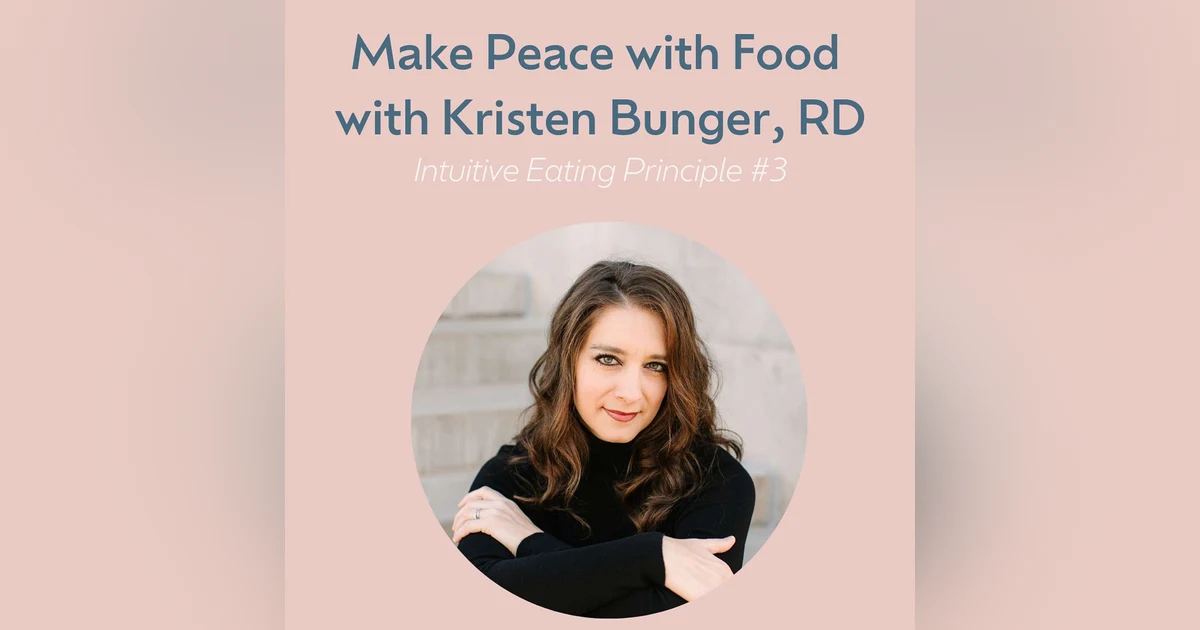
Registered Dietitian and author Kristen Bunger joins the show today to discuss the third principle of intuitive eating: making peace with food.
Kristen shares her insights on overcoming diet culture, addressing food-related fears, and achieving true peace with food. The conversation delves into practical steps for incorporating intuitive eating, handling ultra-processed foods like Cheez-Its, and the role of faith in finding healing and fulfillment. Listen in for encouraging advice on navigating your journey towards a holistic and grace-filled approach to health.
We discuss:
- Giving up the battle against diet culture to win the war
- The fear of if we give ourselves permission to eat everything, we will go out of control
- How we can get over years of food rules
- Where ultra-processed foods fit into making peace with food
Get Kristen's Book Feed My Soul
Connect with Kristen
www.bodyandsoulnutritioncounseling.com
Instagram: @kristenbunger.rd
Facebook: Body and Soul LLC
YouTube
Kristen Bunger, MS, RD is a Christian registered dietitian, and author passionate about helping clients and readers find peace with food and their bodies. She has been practicing as a dietitian for 16 years at all levels of care with clients struggling with eating disorders, disordered eating, yo-yo dieting, and body image dissatisfaction. Kristen is the owner of Body and Soul Nutrition Counseling where she helps clients discover the origin of food and body disorders and what they need to heal. As a Christian, she uses God’s word to guide her clients to understand how God is the ultimate source of healing and fulfillment. Kristen lives in Peoria, Arizona, with her husband, Keith, and their two boys.
Join The Stronger Collective today for a holistic app focusing on faith and health.
Join The Stronger Collective
What I'm loving newsletter
Core Essentials: Episode 1 2 3 4
30+ Non-Gym Ways to Improve Your Health (free download)
Connect with Amy:
GracedHealth.com
Join the Graced Health community on Facebook!
Instagram: @GracedHealth
YouTube: @AmyConnell
Join GracedHealth+ for virtual community meetups and bonus episodes
Leave a one-time tip of $5
Make Peace with Food with Kristen Bunger (Intuitive Eating Principle #3)
Amy Connell: Hey there, welcome to the graced health podcast, your source for aging strong in your physical, mental, and spiritual health. My name is Amy Connell. I'm a weight neutral certified personal trainer and nutrition coach who loves walks with friends, chocolate, and Jesus. Whether you're looking to grow stronger as you age, nourish your body, mind, and spirit, or fit all the pieces of your health together to holistically thrive.
This is the place for women over 40. I'm here to guide you in the areas I can and bring on experts in the areas I'm seeing. Still learning. And of course we cover it all in a whole lot of grace. I'm glad you're here. And by the way, if you're new here, welcome. I'm super glad you have joined us for this intuitive eating series.
And I invite you to check out season 19, which started January 9th, 2024 to fully understand the foundation of this show in short, this is a grace filled Christ centered show. Focusing on women over 40 who want to age resiliently in a holistic way. And then be sure to check out the episode 30 plus non gym ways to improve your health and grab the free download that goes with it.
So all of those links are in the show notes. As I mentioned, we are in a series focusing on. Intuitive eating. So I am taking 10 weeks to dive into each of the 10 principles of intuitive eating. And today I have with me, Kristen Bunger. Let me tell you a little bit about Kristen before we jump in. She is an MSRD registered dietitian, a Christian registered dietitian and author.
She's passionate about helping clients and readers find peace, with food, which is what we're talking about today. Spoiler alert and their bodies. She's been practicing as a dietitian for 16 years at all levels of care with clients, struggling with eating disorders, disordered eating, yo yo dieting, and body image dissatisfaction.
Kristen is the owner of Body and Soul Nutrition Counseling, where she helps clients discover the origin of food and body disorders and what they need. They need to heal as a Christian. She uses God's word to glide, guide her clients to understand how God is the ultimate source of healing and fulfillment.
Kristen lives in Peoria, Arizona with her husband, Keith, and their two boys. Kristen, welcome to graced health.
Kristen Bunger: Thank you so much having me, Amy.
Amy Connell: And thank you for listening to that very long opening spiel. I, I know it's a lot of just sitting there for a little bit. First tell me real quickly where Peoria is, because I'm not familiar with that.
I guess where I'm getting at is how close is it to Phoenix?
Kristen Bunger: Phoenix is just right around the corner. So we are just a suburb of Phoenix.
Amy Connell: Got it. Got it. Okay. I have a dear, dear friend who lives in Phoenix and I make it over there. A decent amount, a decent amount. So.
Okay. I'm really excited about talking about intuitive eating principle. Number three today, make peace with food. So first I would love it. If you can just give us a high level explanation of this.
Kristen Bunger: Yes. So basically I look at this principle of intuitive eating as the surrender principle. So we're waving the white flag. I tell my clients diet culture is never going to surrender. And so for the war to be over, we have to surrender. have to, we have to give up the the battle, um, so that we can actually win the war.
And, and the only way to do that is to actually, like, just leave the battlefield and just retreat and surrender and do it, do it differently. So this is the surrender step. This is the surrender principle. And it's a very difficult and a very powerful game changing way to handle the years and years of buildup and residue of diet culture and, and grief over body and weight and all of those things.
So I think, I think that the highest level of explanation that I can, and just the simplest way to say this is it's the surrender step. It's, it's coming to a place where you say, I am no longer going to use food to try to change my body. And I think that's where it ultimately goes to, right, is with body image, because so much of intuitive eating is directly related to body image. I'm actually going to think about nourishing my body and honoring my body instead of what is this going to do or not do to change the way that I look.
Amy Connell: That is really scary for someone, especially from my community. We've been entrenched in diet culture for so long, and we are at varying phases of letting that go. Surrendering is I, I like how you said, you know, you got to give up the battle so you can win the war. Cause it's really scary. I mean, there's a, there's, there's a loss of control that comes with that.
There's, Like the, what if, you know, because I think, I think a lot of things, I think a lot of us conceptually really like this idea of intuitive reading.
Kristen Bunger: Absolutely.
Amy Connell: And then there's this added element of like, but what if it changes my body?
And what if I'm getting, you know, what if I, and obvious oftentimes that's, what if I get bigger?
Kristen Bunger: Right.
Amy Connell: So it is, I'm curious, what do you typically guide your clients with to have that first step? I mean, is it just looking at the flag?
I mean, what, what's that, you know, to keep that metaphor going? What's that first step that you recommend?
Kristen Bunger: Yeah, there's lots of different ways that we can look at that, Amy, but I think, you know, the first step of surrender oftentimes is just getting to the point of Of saying I actually do want this. I'm not just at the exploration stage. I'm not just listening to the podcast. I'm not just Sitting in the office with the dietitian and just kind of evaluating like am I at that Pre contemplative stage of change or am I ready to take some action because we learn one of my favorite scriptures in the Bible is Faith without actions is dead Right?
And so I, I oftentimes think about that if I have faith, but I don't have any actions associated with it. That it's not alive. It's not living. It's not a living word that's inside of me. And so I think oftentimes I'll tell my clients if you're interested in intuitive eating and if this sounds really appealing to you, what are you willing to do?
And what is the least scary way to do it at first? I think of making peace with food and finding freedom with food as a hierarchy. We have to go slow and steady wins the race every time. And we have to, we have to start with the things that are the least scary. And what happens is all of those what ifs that are so demoralizing and, and just and just utterly terrifying, those begin to melt away as we do the scary things and we see that nothing horrible is happening. Or we do the scary things and maybe there is still a really high level of discomfort around the what ifs around weight gain associated with intuitive eating or or just this loss of control. Maybe there is still that very really difficult tension, but there's also the enjoyment of not obsessing about food, and there's also the enjoyment of increasing your variety in what you're eating.
There's also, you know, these benefits that come with waving the white flag, and so I think Oftentimes we think in in, in extremes. If I, if I stop the dieting or if I stop the, you know, the controlling of my food and, and the micromanagement of nutrients going into my body, then I will gain 20 pounds and I will look horrible and I will hate myself, right? But it's actually more about, I think surrender is more about taking one small step After another after another after another and instead of like jumping off the cliff, right? And so it's like what is that small step for you? What is the hierarchy look like for you? And I actually give my clients a hierarchy of food fears and of steps towards making peace with food So that they can see like this is this does not have to be jumping off a cliff without a parachute.
This is actually just a very, it's just a, it's a very stepwise process that we can take.
Amy Connell: That is really good. And I think about, you know, on my journey, I think you've just given me language for how this has kind of worked in my life of just the, of a hierarchy of a small step. And you know, it started with, Oh, I'm hungry at 10 a. m. You know, breakfast is long gone. Lunch isn't until later. Oh, I actually can't have a snack.
Like I can't eat. And, and. I can have some cheez its because, you know, and we, we, we're going to get into the piece with cheez its here in a second, but that it was not these.
I've really struggled with social media lately because I just feel like there are so many rules that just all kinds of people are putting out there. I mean, with the wellness industry has just lost its mind and is not doing any help with giving us peace with food. Yeah. Well, with, with regard to that and I need to be careful about how I word this because I know that there's a book out there.
But a lot of us have grown up with, you need to eat this particular food and don't eat these types of food.
Kristen Bunger: hmm.
Amy Connell: So what do we, how can we get over that? There's a lot of those neuro transmitters are locked in. And we've got some really big, deep grooves in our brain with that. Like, Oh no, I can't have that.
I can't have the cheese. It's I'm going to keep using that in today's example. I can't have the cheese it's, but I can have some raw almonds, which really actually aren't the same thing. I'll eat almonds, but it's,
you know, it's not the same thing. So talk to us about how we can get over the years of all of that.
Kristen Bunger: yeah. I think you just talking about the neurotransmitters in the brain is like, is so powerful, and I give this example a lot. Um, we do have very well worn paths in our brain with our food rules. and what we grew up hearing. And there, they're so well warned not because they're just habitual but because they're tied to worth and value. And if you're here listening to this podcast, if you're reading books about intuitive eating, if you're in any sort of nutrition therapy trying to these messages. I just, I want your listeners and even you, Amy, just to picture yourself like in, like deep, deep, deep in the jungle. And on the right hand side, there's two paths that are extremely well worn.
They're wide. None of the jungle creatures or the jungle plants are you know, are in the way. It's just very, very smooth and you can see clearly and you can walk clearly. And then on the left hand side, there's this huge just mass of trail heads, right? And so there's three or four different trail heads and all of them represent just different ways of getting to peace with food because there's not just one way to do it. Everybody's story is going to look different. And you have a machete in your hand. And there, but there is no clearing at all in any way and you have to begin the process of of like hacking through the muck and the mire to find a new way through it and I don't think it's actually this difficult. I don't know that it's it's that physically laborious, but it is mentally very laborious and so I use this example because I think everybody can kind of Think about like how sticky and gross and like pokey and scary it would be of like what is even behind any of this like tropical Like whatever I'm hacking into right with this machete, but that's what it's like It's it's trying to forge new pathways that you know are there That you conceptually and logically know are better safer more enjoyable way to go But you have a lot of work to do to get through that first initial Kind of, you know, paving the way there, and I, I think that comes, so, so that's kind of the analogy, but in, in real life, we're not like, obviously, in the depths of a jungle.
In real life, it's, you get to that, that empath, where, or the crossroads rather where you are hungry and it's 10 a. m. and you are thinking, I could have this, I could have this, I could have this, or I could wait until lunch, right? And it's giving yourself these options. And I think that's also where the hierarchy comes in, right? I could have Cheez Its and an apple, maybe. I can have I can have a cheese stick and some wheat or I could have an apple with peanut butter. What? sounds the easiest for me to do. All of them are different than not eating anything. And typically I wouldn't eat anything, right? Or I would just have an almond, you know, a few almonds. But what if I have almonds and something with it? Right. Or what if I have the cheese, it's with an apple. Oftentimes I'll tell my clients, like, if you're not ready to just go like full bore with eating exactly what you would really like to eat and not have any issue with, um, start with what's easiest.
And also if you really want the cheese, it's, and you're just not going to be satisfied without them pair it with something that's safer for you pair it with something like an apple or a banana or a few almonds, right? So do the hard thing with the easy thing and let that be. You know, kind of your gateway into some of those, those neuropathways that just seem so impossible to get to, but they're, they're not impossible.
And that's the most fun part about all of this, is that it's not impossible.
Amy Connell: That's really good. And as you're talking, you know, when you were talking about when you were giving us that visual with the jungle and that there's all these little trail heads, but we're going to have to, we're going to have to hack through it. I mean, that's work and that's hard work. And I think that that's the other end of what we want, which is, I want something simple,
which is why like eat this, eat
Don't eat that,
you know, follow these rules. Like that's simple because, you know, I think there's this concept too, that has to fit somewhere into it. And I'm not really sure where, where I'm sure you will, Kristen, but like this decision fatigue and the fact that we are making so many decisions in a day and we just want someone to tell us what to do so we can do it.
And then we can know that we've done it right. Because it's so hard sometimes to. To muddle through or in this analogy to hack through to make it right for us.
Kristen Bunger: Right. Right. I think that's a very, I mean, decision fatigue is so real, no
matter what you're going through. Um, I think that's all, that's where the hierarchy comes, comes in. That's also where a meal plan based on the hierarchy can really help because it just takes away some of that decision fatigue. Or even if you don't have a meal plan, you could say like, you know, in my first two levels of hierarchy where I'm trying to incorporate more.
More variety and, and trying to push past some of this fear and, and face the fear. I'm gonna, I'm gonna select five things for breakfast, five things for lunch, five things for dinner, and five snacks to work on and to have in rotation this week. And that's just kind of where I'm gonna stay. So there are, absolutely, there are ways that you can Recognize that the decision fatigue is real.
It's really difficult for me right now to do this. It feels so overwhelming mentally and I need to take some of that mental load off. And then also, obviously this is not just a plug for my business or your business, but it's just a plug for our clients and our listeners. If you are struggling with this, I just don't, I tell my clients this all the time.
I've never been able to do anything wonderful. Alone. I've never been able to do anything wonderful.
Amy Connell: That's a great point.
Kristen Bunger: So, I've never been able to do anything alone that's, that's been remarkable in my life. And so they're, they're going to probably need some sort of accountability coaching nutrition therapy, something to help them through that. And it's, I think it's a really good investment.
Amy Connell: no, that's a really great point. I can definitely attest to that. Getting out, creating community, getting other people who are focused on the same things that you are. I mean, even just like I met you through this online Facebook community of other Christ centered health professionals who are intuitive eating based and it's been so helpful for me.
I mean, in many, many ways,
um, And I've had, I mean, a couple of them put their eyes on my book, your core strength. And that was really helpful. Leslie Schilling was really helpful in flagging diet culture. I thought it was diet culture free. Apparently it was not. So, you know, like, but it made it better. I mean, everything remarkable that came from that book was because of the, the women who have helped make it better.
So, yeah. Okay. So let's talk about the cheese. It's really quickly. Cause like,
Kristen Bunger: Mm hmm. They are so good, aren't they? Mm hmm. Me too.
Amy Connell: They're just that perfect combination of like crispy and salty. And then of course you have that cheese flavor. However, they are classified as an ultra processed food,
which is, you know, there I have one thing I have not talked about on this show yet, which I will at some point is the kind of the hierarchy of processing food that we're But they are the highest level of processing.
And there's some pretty compelling evidence out there that ultra processed food is detrimental to our health. So how can we enjoy the Cheez Its when we want them, be at peace with them and hold that in the same hand as I know this is really not what's best for my health,
like my physical health.
So walk us through that.
Kristen Bunger: Yeah, I think it's it's this beautiful place, um, that we're trying, that we're all trying to get to called Peace With Food, where Cheez Its and all of the other foods that we know scientifically benefit our bodies more than Cheez Its, right? They, they're all in the same place and they're all, they're all neutral.
And so making peace with food is actually the thing that is going to help most. I think, I think this is the, this is the irony of this step is everybody thinks if I make peace with food and if I let myself eat what I actually really want to eat, I'm never going to be healthy because I'm only going to eat ultra processed food.
And The irony of that is when we give ourselves permission to eat whatever we want. with mindfulness and moderation and just balance in mind. And we do it in a stepwise way, and we do it with accountability and in community with other people. What actually ends up happening is we eat less highly processed foods, and we, and we eat better.
More of the of the fresh and the whole foods and we have the highly processed foods Actually in moderation when we don't have permission with them we eat them I think much more erratically and we overeat on them at times and that sort of thing, but In the great scheme of things, when we actually make peace, truly make peace with food, the Cheez Its don't have that zing anymore.
They don't have quite as much of an urgency around them anymore. I've had so many clients say whatever the food is for them, whether it's Cheez Its or Oreos or, you know, these like very highly processed packaged foods I've had so many clients get to the point where they're like, I had to throw half a pack of food away. Oreos away because they were stale, right? Because they just, I still like them. I'll still buy them from time to time. But I just don't have the urge to consume them. I'm not preoccupied by them anymore. They're just Oreos, and I think the key, like our greatest fear is actually, is actually, and just completely embraced with peace when we go, actually, It's not going to be just eating them constantly all the time.
It's going to be eating them in moderation, variety, and balance when it's just not that big of a deal anymore. So,
Amy Connell: I love the word you used with erratically because I think that that highlights exactly what happens. I can't have it. I can't have it. I can't have it. Oh, I'm going to have a little bit. Well, I had a little bit, so I'm just going to have the whole box or I'm going to have way more than I want rather than just having.
A few. And it's funny. You bring up Oreos next week. Kristen Williams is coming on and we talk about Oreos.
Kristen Bunger: That's
Amy Connell: Oreos are kind of a staple at my house and it's funny. I rarely eat them. I don't, I don't even know. I just, they're just not appealing to me. And the other conversation that is coming to mind is that with Jenny Eden Burke, who is not in this series, but she's she's also she practices intuitive eating she's, and she was talking about wheat thins and how she would just go bananas on wheat thins.
And then when she slowed down and started being mindful about it, she said, I realized I didn't even like wheat thins. I just thought I did.
And she said, I don't even eat them anymore. So I, I, I think that we definitely have some anecdotal experiences
just here on the show of exactly what you're talking about.
Kristen, I know you have a book called Feed My Soul. Can you tell people about that and where they can get it if they're interested in learning more from you?
Kristen Bunger: Yes. So I I wrote the book several years ago and published it last year. It is, it's a guide to creating and establishing peace with food, movement, rest, and body image from a Christ centered perspective. So I break down all four of those pillars of recovery and I use biblical for all of it.
Biblical encouragement and prayers throughout the book and you can find it on Amazon or anywhere that you like to buy books.
Amy Connell: Great. Awesome. Anything else that we haven't covered yet that you're thinking, okay, I want to make sure that the Grace Health community knows about making peace with food.
Kristen Bunger: Yeah, I think one of the biggest fears and I think we've we've touched on it a little bit But I think one of the biggest fears is if I allow myself to make peace with food if I really do Surrender, I'm not going to win the war. I'm just gonna be overcome They're literally like diet culture food You all of my urges to eat these foods that I can't have or that I shouldn't have are going to completely over overwhelm me and overcome me. And I just want to encourage your listeners. If that were the case, so many of us would not be preaching this message. If, if we, if we, as, as professionals we're setting you up for complete and utter defeat, we would not be. We would not be in business and we ethically wouldn't, we wouldn't be able to do it.
Also, I've been practicing for 17 years and I've seen this happen over and over and over again, that those are the biggest fears that come up. And then as we. Surrender little by little day by day as we continue to wave the white flag of like, okay I am going to have like a handful of cheeses with an apple and I am just going to see how that feels Okay, that was really satisfying and I'm actually hungry for lunch two and a half hours three hours later, right?
Like as you continue to surrender and and win these battles The war is going to be won and you are not going to be completely overtaken You By your desire for food because it as we know it's all about the food and it's not about the food at all and so as we as we manage and Continue to address our issues with food.
What is actually going to happen is the grace and mercy of the Holy Spirit is going to actually Get be able to get behind all of because the food oftentimes is like oh, it's like a it's a dam, right? There's there's all of this emotional And mental And even trauma, there's all, there's all of, all of these issues that are going on behind the food.
The food is just kind of in the way of us getting to the, to the root issues. And once we remove the food, and we are actually at peace with the food, then the Holy Spirit can begin to do a work in us where we really actually need it the most, right? Because our body image issues are not about Cheez Its. Really nothing's about Cheez Its. Cheez Its are wonderful and they're great to eat off and on throughout your life, right? Like it's really not about the Cheez Its. So I think if I could encourage your, your listeners to remember that to know that the food piece is actually going to be the first and foremost thing. It will not overwhelm you and overtake you. It probably will feel like that but At times, but with the help of, of the Holy Spirit and with the help of community and slow and steady steps of surrender, it will not overtake you. And what's waiting for you at the, at behind all of that is just incredible healing that you cannot even imagine. to fathom.
Amy Connell: That's wonderful encouragement. Thank you. Kristen, tell people how they can connect with you and then I would love for you to offer the one simple thing from our conversation that you would like us to remember today.
Kristen Bunger: Yeah. So you can connect with me on Instagram. At Kristen Bunger RD or at my website, which is bodyandsoulnutritioncounseling. com. And I would love to hear from any and all. And I think the, the one thing that I would love to leave all of your listeners, it's just a hopeful message that if you're here and you're listening, If you are engaged at all, or even if you're in that preliminary stage of change of like, I think I might want this.
I'm not sure. it's all about the food and it's not about the food at all. So if you have the courage, if you decide, cause it's, it's, it's absolutely an individual process. It's an individual decision. If you decide, I am going to just start this process. I want you to know. that there is a community of believers out, out here, out there that is willing to work with you and wanting to help you with podcasts, with books, with coaching, with all of the things that we have to offer. So I guess the one thing, one of the things that I would like to highlight is that you're not alone. And, and the second thing is that it is all about the food, but it's not about the food at all. And so, um, in the process of addressing the food piece, you're going to find even more that God has for you, even more healing, even more peace, even more surrender that will probably be required.
But it's it's just a beautiful, a beautiful process to walk through. So we are here for your listeners. And, and like you said, we're here for each other. We have a whole community that's working together on this, which is so exciting and beautiful too.
Amy Connell: It is, I'm in. Thank you for that. Okay. That is all for today. Go out there and have a graced day.