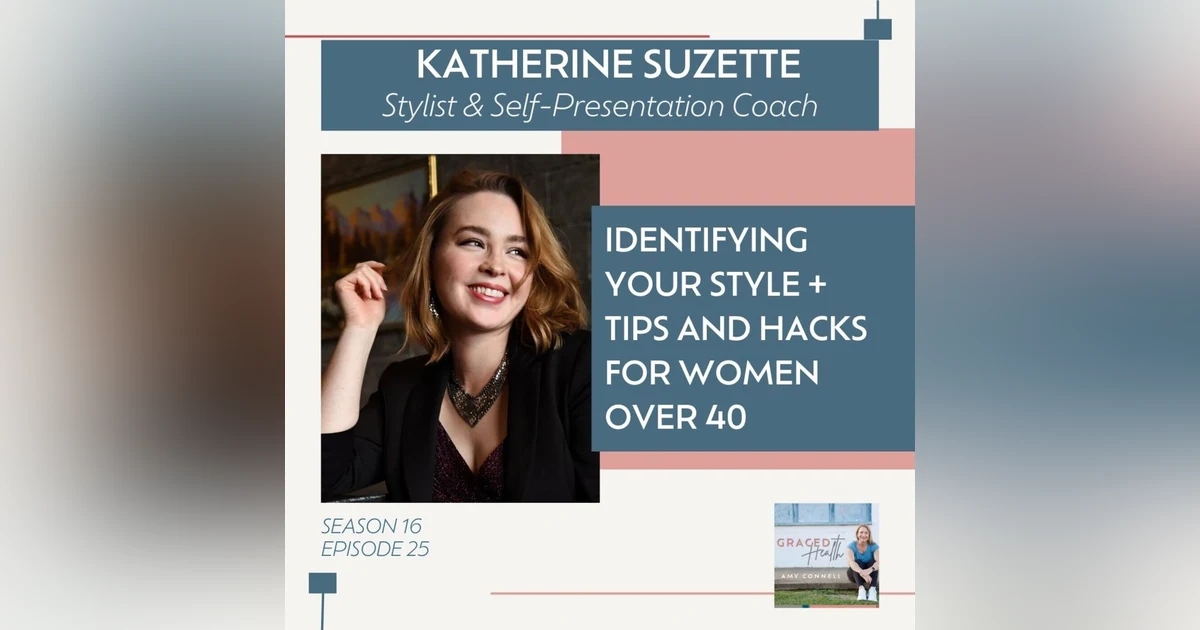
Identifying your style + tips and hacks for women over 40 with stylist Katherine Suzette

 Apple Podcasts
 Spotify
 RSS Feed
 Goodpods
 Amazon Music
 iHeartRadio
 Have you ever seen a picture of yourself and thought, "something just looks off about that outfit?"
Or maybe you don't quite feel confident in what you are wearing out of the house (or even in the house or over video)?
That's where I've been. While I always show up as my authentic self, I'm not always confident in how I look showing up.
Today's episode is with stylist Katherine Suzette to help us with these challenges.
We discuss:
- What a stylist does and why we need one
- Identifying a style code and keywords
- How we can exhibit our personality in our style
- Tips for shopping aline
- General tips for choosing clothes that you feel good in.
Get Katherine's Online Mini Course: The Art of Self-Presentation
Get 15% off using the code GRACEDPOD
Connect with Katherine
https://www.impressioncode.com/
Instagram: @theimpressioncode
YouTube: https://youtube.com/@katherinesuzette
If you’re looking for a boost of fitness motivation, join Dave for a daily ten-minute...
Listen on: Apple Podcasts
Wits & Weights: Strength and Nutrition for SkepticsFor skeptics of the fitness industry who want to build their best body using science.
Listen on: Apple Podcasts Spotify
Support the showConnect with Amy:
GracedHealth.com
Join the Graced Health community on Facebook!
Instagram: @GracedHealth
YouTube: @AmyConnell
Join GracedHealth+ for virtual community meetups and bonus episodes
Check out my book Your Worthy Body and signature online class B.COMPLETE
Identifying your style + tips and hacks for women over 40 with stylist Katherine Suzette
Amy: [00:00:00] Katherine, welcome to the show.
Katherine: Thank you. I am excited to be here.
Amy: I wanna start somewhat broadly in this conversation. Tell us what a stylist does and why we need one. And before you answer that, because this is kind of how I have always felt like a stylist is like something for the rich and famous and something that. Is, you know, they just put everything together and it was totally beyond my reach.
And then you and I met at a local Women's Chamber of Commerce meeting and you really pulled it in like, oh, this might be something that I need, not because you told me I needed it, but as you were explaining what you do, I thought, this is interesting and this might help me in communicating my own. Mission and values.
So going back to the question tell us what a stylist does and why we need one.
Katherine: That is a great perspective and a great jumping off [00:01:00] point because it is accessible to everybody. However, every celebrity and super famous person, Probably has a stylist, so you're not wrong. But there are a lot of options for those of us who don't consider ourselves to be of that particular status. And I will say that a stylist, our main job is to take image goals that a person has and make them reality.
And that generally means. Going through a person's wardrobe and helping them to identify problem areas or gaps or ways to explore and show up a little bit more authentically and in the ways that match their image goals.
Amy: You talked about really identifying. Style, and one of the things that you encouraged me to do before we worked together was to identify some keywords for what you [00:02:00] called a style code. Now I have to admit, I was like, I don't feel like doing this, but I did because I am a rule follower.
And I found that that was very helpful when you and I actually got together face-to-face and started drilling down. So tell us why it's important to pin those keywords down to figure out our style code and give us some examples too, if you don't mind of what those might be.
Katherine: I use a style code personally with clients to guide me and. So therefore it's less about the words for the human finding them and it's more about the guidance. Just like you said, you're a rule follower, so it gives you that option. However, I have some clients who use their style code in a little bit of a different way, and I tend to tell them to use it a different way cuz this is where the coaching comes in handy, is that I can identify who needs it in this way.
They use them as affirmations and goals and [00:03:00] encouragements and things like that. So it's, it's less about the rules for some, and it's more about the rules for others, but what it does do is it gives us options to explore that goal, that image goal, and our deeper desires. And I mentioned a few minutes ago, authenticity. It's so hard for so many people to figure out what that means for them. But having an exploring a style code and also being okay with the evolution of it, that it, that it changes is. Very helpful for those of us who need to bring in some more authenticity to our message. And like you said, I serve leaders and coaches in different ways, and authenticity is our main seller these days.
People wanna know, like, and trust us, so we need to show them who we are. So style Code helps us to identify those things and kinda gives us permission to explore them in a way that we may have never thought of before.
Amy: I love that. I think that's That's, [00:04:00] that was really helpful. And in fact, while you were talking, I thought, you know, what I should do is I should pull up my, my style code and the words that I did, cuz I think if nothing else, it's just fun to share 'em. So I don't know if you remember the ones that you and I put together, but you talk about authenticity and that was the first word that I think I gave you was authentic.
And then I did relatable, simple athletic, and. I think maybe you added in natural, which is a very fair word to add, because I am not, I mean, again, like this whole concept of using a stylist seems strange to me. However, what I like is that you were able to help me zone in and pull out all of the excess stuff to really focus in on the things that do communicate that for me when I am.
Specifically speaking, cuz that's why I wanted you to help me, is I get on stage and I take pictures and I'm like, this just does not work out well. This is not, so I needed help with that, but [00:05:00] also just kind of communicating that. So I think that was really helpful. I was wondering, I'm gonna kind of pull this off the cuff.
Do you, I know you have shared in the past your words, do you mind sharing one or two of the, of your style code?
Katherine: Oh, sure. Elegance is an almost constant one for me because even when I'm not dressed in the. Very typical, elegant manner, like people tend to relate a lot of modesty with that. And for example, while all the main bits are covered here, I am displaying a little bit more than I may normally with my shoulders being exposed.
I still think this is very elegant cuz when you look at the full appearance, it's all put together in a very polished and intentional way. And the human inside the clothes is also incredibly elegant. And that's, that's the other part of the style code that gets into my communication coaching stuff. But, I use the word elegance for myself most often.
And then the other one is eclectic. And I use that [00:06:00] because my style has evolved so many times over the years that I went from like very gothic, almost in in high school to, to this like I am, I'm not wearing a little bit of black right now. I am not wearing any and. That evolution was hard to give myself permission to explore.
So by saying that I am eclectic, I give myself permission to be in that realm of exploration. And you know, like many people, I also wanna be approachable and relatable in all of that. But those are my two most consistent words.
Amy: Yes. Well I would agree with that just in my time with you and just for those listening. So we do have this on YouTube and you can go see what Catherine is wearing on the top, which is this really pretty coral off the shoulder. You're gonna have to explain it more cuz I have I'm, I'm u terrible using words, so explain it real quickly.
Katherine: I'm actually happy to, you know, you guys might see a little bit of my messy [00:07:00] office back here, but. It's actually kind of this beautiful, cropped top here. It's a little bit wrinkly because I have been sitting most of the day, and then I've paired it with some very elegant satin pants and some heels, and these pants just hit me in the right place.
The shirt hits me in the right place. I am still very modestly covered. I mean, except for the very tops of the shoulders, but it is incredibly elegant because of the way it fits and the way that it's polished, the way that it all works together and works for my body.
Amy: It looks fabulous on you. Yes. And while I would not gravitate toward a crop top it looks fantastic on you and the colors. Also are great. Okay, so Taal, let's talk about, now that we've kind of talked about some style codes and some words, and so I'm hoping that if you're listening, you're kind of thinking about, well, what would, what would my words be?
And, and Catherine, I think you would agree it when I say it might just be worth. A minute to pause this and just think about it. Doesn't mean those have to be the words that are with you [00:08:00] forever, but just kind of start thinking about how you might start to pull that in, which would lead into the next question, which is how we can take those words and exhibit our personality in our style.
Katherine: So I guess I'd wanna kind of hit that a little bit from a different angle in that every time you present yourself, whether to yourself in the mirror or to another human, you are showing some aspect of personality. There is a message there, whether or not it is your personality is up to whether or not you feel well represented in it.
When you go back and you look at those images That you said you would get from your speaking engagements and things, you don't feel like that was consistent with who you are or the message you wanted to represent? Correct?
Amy: Yeah, I mostly, I just felt like I could look at it and see that something [00:09:00] wasn't going, something was wrong or something was off. It's kind of like any, you know, I'm trying to think of examples of pictures or other things that you could just look at it and tell that something's off and that's where, that's what I felt when I was looking at myself in the midst of a speaking engagement.
Katherine: Okay, so that's fair. And that seems to have more to do with the rules and the style rules and whether or not you're doing it correctly. But I guess I would say that for most people, they feel like it doesn't represent them somehow and. For that person who doesn't see themselves, their personality represented in their image, then I would challenge them to find where that inconsistency seems to be coming from.
That can be a huge challenge. And having a moderator to help one explore that is really helpful. like, just like with almost anything else, having somebody, a third party who is not you, who is not feeling all of the same emotions and reactions and all of that, and who can see the bigger [00:10:00] picture. To help you in that is very like stress relieving for many, many, many folks.
But I would say that to encourage more personality, what usually happens is that I encourage color exploration and for that matter exploration at all. Just like I said with my style, I like to explore and evolve. I need to encourage that in some people, cause they get very. Stuck and then they wanna keep going in that same way, but they know they need help.
They just, they don't wanna actually go outside of that comfort zone and I need to be there encourage them out of it. Yeah, just a little bit. But you have been fun to work with because you still take my advice and you like critically think about it and then you apply the pieces one step at a time and seeing the way that you have altered the way that you talk about your style and.
Even your code and things like that over time has been really fun.[00:11:00]
Amy: Well, thank you for that. You talk about color. Was there anything else that you might add to that in terms of exhibiting our personality?
Katherine: I love color. I also love accessorizing, and that is not something that most stylists. I should take that back. I don't really know. I am not most stylists, but I don't see it happen very often that a person who is talking about clothing also talks about their accessories and that is an easy way to explore without over-commitment or, you know, you and I were just talking about clothing rentals.
I think that's another great way of exploration for that personality. So, Having the ability to explore without commitment is really important for finding a personality when you don't know what it is. If you do know what it is like for example, one of my clients is incredibly funky and playful, but they didn't know how to represent that.
Having somebody come in and tell you how [00:12:00] to find that and find the pieces that light you up, that you're like, oh, oh, oh, in the mirror, that's what you need to do. You need to find. That person who's gonna help you with that?
Amy: You know, when you were talking about having a third party in, I thought you know what this is like, is this is like a clothed therapist, like having a third party say, okay, well this is what I'm hearing you say, and so let's put some of this together and, and make it work for you. Now I know this next question is a hard one because we all have, I mean, we have different body shapes.
We have different body sizes. We have different body heights and different colors in our skin. And I mean the, the list is quite endless. I. So I get that, but I was wondering if you could share two to three just style tips that we can take with us next time we shop. Keeping in mind that most of my community are women in their forties, fifties, . Sixties.
We [00:13:00] either, let's face it, a lot of people are shopping on Amazon now or actually going in person or the clothing rental, but something that we can think about next time we are picking out some clothes to explore and maybe to experiment with.
Katherine: Yes, I always have advice on this one. Let's start with shopping online, because this is something that people tend to ignore. They see a good photo or even a body type that is similar to theirs in the advertisement and they're like, oh, I could wear that. Or The color looks just right. And I know color is a big deal for you, finding your correct tone and value in all of that in your color, but the virtual space gets that wrong a lot of the time, and it is incredible what we can do with our editing techniques to make things look right on a body.
That is not ours. So [00:14:00] especially with something like Amazon, pay attention to reviews and that is where the exhaustion comes in. Then you have a lot of decision fatigue and then you decide, I really wanted to buy something and now I'm just over it. I am done. I am putting the computer down. I'm not going there.
Again, it's the reviews. They are incredibly important, and if you buy something and you review it, it is helping somebody else because. Seeing it on somebody else's body or seeing the quality is really important. Now, that said, when you're shopping, whether online or in person, something I wanna encourage is higher wasted pants.
Amy: I know and that because a lot of us grew up, like in the eighties and the, you know, and it's like, no, we don't wanna go back there. But I'm listening. I'm listening to you.
Katherine: In high school, I refused pants that were not low cut, and it was such a bad decision for my body. But at the time, that was the style. That's what I liked. That's what I felt the best in. That's what I was [00:15:00] most confident in. So I get it, but thank heavens, I explored out of that and saw my body in a different shape and was like, oh, this is why we wear high waisted pants.
But especially for women who want to accentuate their feminine profile, wearing a higher wasted pant brings their waist in right where they want it to be. And that is also why I encourage the crop tops, or at least tucking in a top, whether it's just a little front tuck or a full tuck or side tuck, or tying a bow knot, whatever, something to accentuate that waist, that natural waistline is your best friend and.
That is a great way of shedding 10 to 15 pounds without, without actually doing it. But you look like it and then you feel like it. And when you feel like it and you feel really good about your body, you are that much more likely to actually lose that five to 15 pounds, which is a fun psychology trick.[00:16:00]
But people are surprised all the time by how much I weigh. And like, I know it's not about the number at all. So I, I've only weighed myself like once or twice a year just to like check in. But knowing that number and then like seeing my body is very different because I dress it correctly. So higher wasted pants, check reviews, explore crop tops, and accentuating your waste.
I'd say that as far as crop tops and things go too, I want more women to explore petite cuts for their upper body. That just means they're a shorter cut and that the seams are more likely to be around their natural waste. Like in a blazer, it's more likely to be cut in the correct place, but explore.
Amy: So as you're saying that, I'm thinking, you know, that's probably something I should think about. I'm five four, so I've always been on that borderline with the petite. When we do that, do we need to alter our [00:17:00] size at all? Like go up a size if it's petite, or how does that work?
Katherine: that has more to do with the brand than qualifying it as petite or regular or tall. It's like if you're super long-legged, you're probably gonna wanna look at a tall pant, but I still recommend looking at a petite top. And if you are a super long torso, then you could go regular or long. But most of us women are petite, wasted.
Our hips are really high and our Rib cages come pretty low. So we have this small window for our natural waist and that shortens just the torso area. Even if we look like it's taller, it kind of shortens us and we want to find our seam and everything that we, that has a cut in it, like we're pants and tops meat.
We want that to be as close to that natural waste as possible to give us that feminine profile in our shape.
Amy: So it's all about accentuating, that feminine profile [00:18:00] for sure. What about women who will carry more of their weight, like in their torso area. So what kind of suggestions would you have for a body shape like that?
Katherine: Yeah. That is a fantastic question and. The answer doesn't change that much. So I have worked with some very more rounded women in particular areas, and they are very uncomfortable with that fact. But finding a way to create a silhouette in the eye of the viewer, whether that's them viewing themselves in the mirror or somebody else seeing them, is the factor here that you want to put emphasis on.
Even if it's a full monochromatic look, like, say you are all pink or orange today, if there are seams in the outfit, make sure the seams hit you where you want to draw attention to a natural waist. So you know whether or not you, you've had three kids and you haven't ever lost the [00:19:00] extra, the extra weight from that process, or you've just.
You're post-menopause, you've had a couple surgeries. You know, life is, you're always getting through life and you're not doing as much for your body, but you clearly, if you're here, you're starting that process at least. But for those women, I still want them to explore these different shapes, creating a different silhouette or profile.
That said, don't run away from breaking the rules if the rule doesn't work. So, I have one client who, for whom that shape just doesn't do it for them. They don't like it, it doesn't work. They're uncomfortable, and that is the last thing you want, is to feel uncomfortable with yourself in whatever you're wearing.
So this particular client tends to wear longer items, and we find items that accentuate her waist with the outerwear [00:20:00] or accessories. So, There are ways of breaking the rule or going around it, and it really does just come down to permission to explore.
Amy: One of the things that I was reminded of that you recommended to me that I think is Was a good, was good guidance is when ordering online to order several different sizes.
Katherine: Mm-hmm.
Amy: That's for it is a bit of a pain I will admit.
Katherine: Yes.
Amy: However, I think it's good to at least give yourself an option rather than saying an unequivocal, yes, this works, or no, this doesn't.
And helps you kind of see where things fit. And I have also noticed, I mean, it is no secret that sizing has, inched up over the last 15 to 20 years. I think I read just the other day that a six today is somewhat equivalent to a 10 from 20 years ago. And I'm like, that makes a lot of sense to me in a lot of different ways, but also just the [00:21:00] sizing between brands is, is huge.
I bought a jumper. I think I showed you, and it was a bigger size than what I normally did, but I was like, well, dang, this fits though. Like it fits. And so who gives a flip? What, what the number says on there?
Katherine: Yeah, I mean, just like my comment about. The numbers on a scale, not meaning everything about your body, like that's not what you base all of your decisions and worth and value and everything off of. It's the same for choosing your sizes, like you said, for when you move to a petite. Do you also have to go up in numbers?
There are gonna be brands that might do that, and I, I have run across them, but they're less common today. The problem is that the brands have different sizing, so when you're shopping online or in person, Choose a couple of different sizes, but if they offer a sizing guide and it's actually accurate, that also really [00:22:00] helps pay attention to returns though.
So, for example, I got styled by a friend of mine because I also love it to break out of my comfort zone and to explore and teach myself something new and. She was adamant that something was gonna fit me from this particular online store that only took credit for returns. Or, you know, there are some boutiques and things that don't do returns at all.
And so for a year and a half, I have been in this cycle with this particular online shop where I have this credit. So I purchased something and I'm like, okay, I did a good job this time. This one's gonna work. I put it on at home and I'm like, What the heck I don't understand, and it's an over and over.
And then I have to pay shipping costs to get it back. And by this time I have spent twice the amount of the outfit just to look and find something that works. And I still don't own anything from this store. Like their pictures are great, [00:23:00] their reviews are fantastic. It didn't work for my body, and I hate dealing with returns.
That do not give money back to you, like for credit is not for me.
Amy: I agree. I just discovered this new place and I like exactly what you just talked about., I like the clothes and great reviews. It looks great on the models and they use lots of different shapes of bodies and it, I returned it, not realizing that I only get credit and I'm like, ah.
So what I decided is I'm just going to get something that is. Like a top, because I feel like tops are more forgiving rather than trying to get something that works on the bottom with pants or, or a jumper or something like that. Like, I'm just gonna go with the top. So when I find a couple tops that fit that credit amount, I'm gonna do that.
And it might be that I, I might be done with that place, even though it was great. I just wasn't, I don't like the credit for the returns. I have to agree. So get [00:24:00] know what you're getting into for sure.
Katherine: absolutely. And speaking of just doing something you know will work. Another tip for those shopping online or in person is remember that tailoring is an option. Especially for that petite waist or something that doesn't cut at the right place or pants, like I have to go up a couple of sizes because I am very para shaped, I guess is the right word.
So I'm, I need pants that fit me and the particularly whitest place in my body, but then because of that I have to get the waist tailored in all the time, and that is pretty easy. It's pretty straightforward. Get a good tailor. Hemming though, I hear people complain all the time about needing something the right length and why don't people make it in the right length, and I'm like, buy it longer, get it hemmed.
It's 15 bucks. Honestly, just it's not the big deal. Biggest deal.
Amy: And then especially when you know it fits you well and it, you know, it fits you in the right place, then you're more apt to buy it. I have done that too. I'm, and I'll put something on, I'm like, ah, it's too long. It's too [00:25:00] long. I'm not gonna wear it and like just go to the stink and tailor and get it taken care of.
I mean, yeah, I agree with that for sure. I. Okay. Now I know you do virtual, or I know you do in-person style sessions, so tell us what we can expect if we were to have you help us with our style.
Katherine: Yeah, thanks for that question. I would say there's a little bit of alteration per client needs. Everything that I do has like a particular. Basis like but then I custom off of that for the client's needs. Basically my main package is that we go through your wardrobe, then we go shopping for missing or desired pieces, and then I create a lookbook in my app and you download that app on your phone and you can access your looks from there.
Like I just dressed a client for a couple of weeks abroad. And for every single day of her trip, she had her outfit pre-planned. And so therefore, when she was there, she knew exactly what she was wearing. She knew how she was wearing it. [00:26:00] Cause I told her how to wear everything. And then she came back and she was like, that was the easiest way to wear clothes ever.
Easiest way to pack, not think about it,
Amy: Yeah, that's a great
Katherine: follow the rules.
Amy: That's very good. Now, do you do virtual sessions at all?
Katherine: I do. Yeah, they work a little bit differently because of the returns, and my clients will have to buy more upfront in the multiple sizes and then deal with the returns. Now, if we're doing virtual and I am relatively local, then I can run by and handle the returns, and if not, then I send ups if possible, like I schedule a pickup and then the client can repack their boxes and leave them on the porch during the pickup time.
However, the main difference with doing virtual is that going through the wardrobe, the client's gonna be doing all of it. I'll be standing here talking, but [00:27:00] the action and the pulling things out and trying things on, that's all gonna be on the client. So there are pros and cons, and I love doing both of them.
It's really just what a client needs and where they are in the world.
Amy: That makes sense. Okay. Now for those who maybe aren't quite ready for an individual style session, but they want to learn more, I know you have a mini course called the Art of Self Presentation, so tell us some about that and how they can get it.
Katherine: Yes, I loved running that. So you can find it on my link tree or off of my Instagram page or even on my website, and it's just a. Collection of recordings, both of myself and of other big professionals in re related fields that all present on ways to present oneself better or more authentically. So, how to become more authentic.
What does it mean? What does finding or why have to do with it? How [00:28:00] to go through a closet better, how to choose the correct colors, how to create a lasting impression or. On the other side of that is the communication. And I interviewed people in the realms of nonverbal communication, verbal and behavioral communication.
And it just was the most fulfilling thing I've done to date with my business because now people, I can recommend this to clients too. I'll be like, okay, I love what you're saying and I hear you, and we can make a class out of this. You can come get a a one-off session with me. However, if you go and watch this 30 minute interview, I think you're gonna get at least most of what you want and then you can come back and discuss with me, and so people can, or the followers here, whomever, can go and find that there.
On the Instagram links or my website, and I have a discount for this podcast and it's called Graced Pod. All caps most faces. So go get a 15% discount on that and. Live up to your heart's content. Go [00:29:00] explore, go get to know your, your authenticity and get some really cool, applicable tips that you can DIY for yourself.
Amy: I love that. Thank you. And that's very generous. Thanks for the link, which we will include all of that in the show notes, so thanks for that. Okay. I have a couple questions I ask all my guests. Number one is I enjoy learning about people's tattoos. Because I've found that when people choose to put something on their body for the rest of their life, they often have a meaning behind it.
And so I was wondering if you have a tattoo, if you would mind sharing what it is and the meaning behind it. And if you don't have one but you had to get one, what would it be and where would it go?
Katherine: So I do not have one. I am commitment shy when it comes to tattoos, and part of that is in that part of me that is eclectic. I like to change. I like to evolve. I like to explore. So committing to that level of permanence on my body. It's just a level I'm uncomfortable with [00:30:00] that said, if I had to get one, there is one that I've always wanted and it does have a story.
I used to sit and read aloud to my friends all the time. I love to read aloud and one of these days I'd love to read a book on, on Audible or something, but you know to be T B D. I will let you know if that happens, but. I used to sit and read all the time and there was this tattoo that the character in the book got.
So it was an anchor and it was on her hip, and I would love to get that with my friends, but a little bit differently than that. I would get floral down my hip and onto like Midt thigh and I just think it's so beautiful, but I can't commit to it, especially, I would have to have the right designer do it cuz it has to be that super fine Japanese line.
I'm not going for any thick lines here and. Just that level of nitpickiness has made me uncomfortable of doing it.
Amy: That's fair. But we can always, we can always talk about it.
Katherine: Oh yeah. Dreaming is fun.
Amy: Yes. Dreaming is fun. It's, it's [00:31:00] part of the exploration. Right. Okay. Do you have a meaningful Bible verse that you would like to share? I.
Katherine: I know you asked me this a while back and I was like, well, I have favorite stories but not verses and it's just part of me. I don't remember the numbers, so I went and found. The one that I think runs my life the most, and it is Esther four 14. You were called for such a time as this, because I get so caught up in the weeds of why me or why now, or how being, how am I supposed to do this?
And letting go of that is very hard and trusting that God really did place me on this earth for such a time as this. Like somehow I. And the important factor in this time and in this life and this circle of influence that I am able to have is hard to trust.
Amy: Yeah.
Katherine: but it is very impactful for me when I am able to remember that and let go and step into that.[00:32:00]
Amy: That's so good. I, I agree. For such a time as this. Okay. We will put all of this in the show notes, but tell people quickly how they can connect with you.
Katherine: Yes, so Instagram is great. I get all of the notifications from my dms and everything on there. I haven't turned them off or anything. Or on my website, I have a contact form that people are welcome to fill out and. I love to talk with people and they can even like book a mini consultation and things like that for free on my website.
But Instagram is at the impression code and my website is impression code.com.
Amy: Perfect. Just a reminder, if you guys wanna check out the mini course, we will have that in the show notes, and that's, I know is available on your website as well.
Katherine: Yes.
Amy: Okay. What is, this is our final question. What is the one simple thing you would like us to remember about our conversation?
It can be big, it can be small, but just one thing that [00:33:00] we have covered today that you want people to remember.
Katherine: Hmm, good one. Style evolves. You evolve, style evolves, and giving yourself permission to remember that and be okay with that can be tough. But it is worth it.
Amy: So true. Okay. That's all for today. Go out there and have a graced day. Awesome. All right, we are done. Thank you so much.