The Madman Who Helped Write the Oxford English Dictionary
History isn't always found in castles, battlefields or museums. Sometimes it is waiting quietly on a bookshelf.
Recently, I had the pleasure of speaking with historian and author Sarah Blake about her fascinating new book, Hushed Up History: Volume I. It is a collection of remarkable true stories that have quietly slipped through the cracks of history—stories that are shocking, extraordinary and often entirely forgotten. Rather than focusing upon the familiar events that dominate history books, Sarah turns her attention towards those obscure moments and overlooked individuals that deserve another chance to be remembered.
As we spoke, one story in particular lingered in my mind long after our conversation had ended. Not because it involved an ancient curse, a haunted house or a famous monarch, but because it centred upon one of the most ordinary objects imaginable.
A dictionary.
It's hardly the sort of object that invites excitement. For generations they have sat quietly on classroom shelves, gathered dust in libraries, occupied forgotten corners of family bookcases and accompanied students through countless homework assignments. Today, many of us rarely reach for a physical dictionary at all, choosing instead to ask our phones or search online whenever we need the meaning of an unfamiliar word.
Yet have you ever stopped to wonder where those words came from? Not the words themselves, but the book that gathered them together. Who decided which words belonged? Who discovered their earliest meanings? Who painstakingly searched thousands upon thousands of books to trace how the English language had changed over centuries?
Like so many ordinary objects, we tend to take dictionaries completely for granted. They simply exist. We use them. We close them. We move on. The remarkable truth is that one of the greatest dictionaries ever produced owes an extraordinary debt to a man who spent nearly four decades confined within one of Britain's most infamous institutions. It is a story involving obsession, murder, mental illness, remarkable friendship and an impossible publishing project that many believed would never succeed. Most surprisingly of all, it reminds us that history often hides in plain sight.
One of the joys of studying history is learning to ask different questions. When visiting an old castle, we naturally ask who built it. Standing before an ancient monument, we wonder what happened there. Walking through an abandoned churchyard, we read names on weathered gravestones and imagine the lives they once represented. But we rarely ask the same questions about ordinary objects. The old chair bought from a charity shop. The brass candlestick inherited from a grandparent. The battered camera found at a car boot sale. The faded photograph tucked inside a second-hand book.
Every one of these objects has travelled through countless hands before reaching ours. Each carries stories that have largely disappeared, leaving behind only the object itself. Historians often speak of the importance of buildings and landscapes, yet objects deserve equal attention. They survive wars, fires, changing fashions and the passing of generations. They quietly witness history without ever speaking. A dictionary is no different. Millions have owned one. Very few have ever considered the extraordinary story hidden behind its pages.
An Impossible Dream
By the middle of the nineteenth century, the English language had become one of the richest and fastest-growing languages in the world. New scientific discoveries, colonial expansion, literature, industry and international trade continually introduced fresh vocabulary. Existing dictionaries struggled to keep pace. Definitions were inconsistent. Many words lacked historical context. Others had never been included at all.
There was growing recognition that something far more ambitious was needed—not merely a dictionary explaining what words meant, but one that traced every word back through history, documenting precisely when it first appeared, how its meaning evolved and how writers had used it over time. It was an astonishingly ambitious undertaking. Imagine attempting to collect every significant word ever written in English. Not simply modern words. Every word. Every spelling variation. Every historical meaning. Every quotation illustrating its use.
Today such a project would require enormous databases, powerful search engines and sophisticated computer software. In the 1870s there were only books. Millions of pages had to be searched by human eyes. Every quotation had to be copied by hand. Every source checked manually. Many doubted the task could ever be completed.
The man eventually entrusted with this monumental responsibility was James Augustus Henry Murray, a Scottish schoolmaster and gifted linguist whose passion for language bordered upon obsession.
Murray possessed an extraordinary memory and an insatiable curiosity. By adulthood he had taught himself numerous languages, mastered dialects and developed an encyclopaedic knowledge of words and their origins. Yet even someone of Murray's formidable intellect recognised an uncomfortable truth. He could never complete the project alone. No individual could. The Oxford English Dictionary would require an army.
Rather than recruiting academics exclusively, Murray made what proved to be one of the most important decisions in publishing history. He invited the public to help. Newspaper advertisements appeared across Britain and beyond asking volunteers to become readers. The task sounded deceptively simple. Choose a book. Read carefully. Whenever an interesting word appeared, write it on a slip of paper together with the quotation and publication details before sending it to Oxford. These became known as quotation slips. Each tiny piece of paper represented another fragment of the English language waiting to be assembled.
Gradually they began arriving. Dozens each week. Then hundreds. Soon thousands. Teachers contributed. Librarians. Clergymen. Doctors. Retired civil servants. Housewives. Students. Anyone with patience, books and curiosity could play a small part in constructing what many hoped would become the greatest dictionary ever produced.
Inside Murray's famous Scriptorium—a corrugated iron building erected beside his Oxford home—these slips accumulated in staggering numbers. They were sorted into pigeonholes, arranged alphabetically and constantly reorganised as new evidence emerged.
Visitors often described the building as resembling a paper cathedral. Every wall was lined with shelves. Bundles of handwritten quotations filled boxes from floor to ceiling. The English language itself appeared to exist there physically, broken apart into hundreds of thousands of individual fragments waiting to be pieced together.
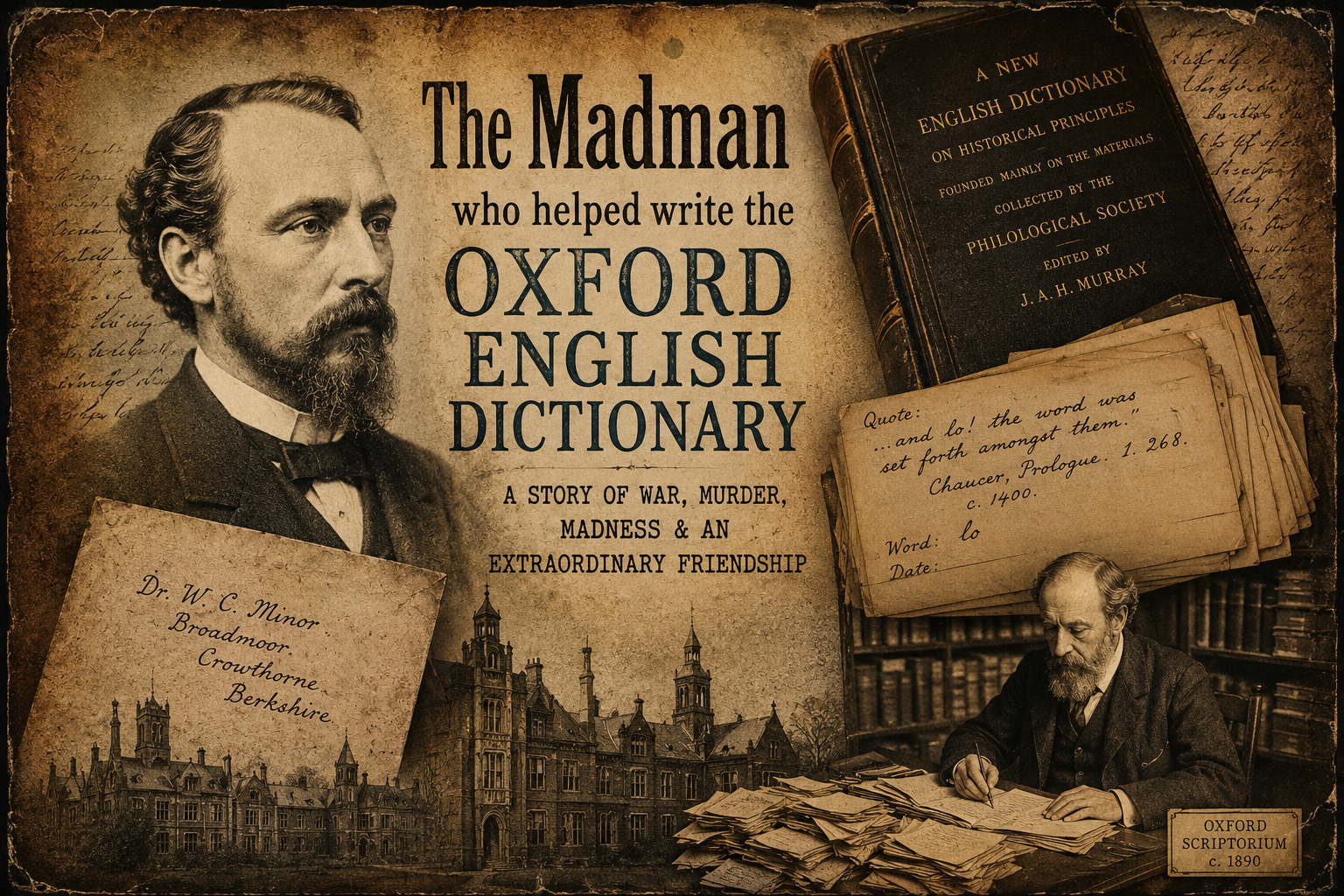
Yet amongst the thousands of contributors, one correspondent gradually distinguished himself from all the others. His contributions arrived with astonishing regularity. The quotations were meticulously chosen. His handwriting was elegant. His scholarship exceptional. Time after time he supplied precisely the historical evidence Murray needed. Whenever particularly obscure words proved difficult to trace, this mysterious volunteer somehow seemed able to locate exactly the right quotation. It almost appeared impossible. Naturally, Murray became curious. Every letter carried the same address. Broadmoor, Crowthorne, Berkshire.
To Murray, the explanation seemed obvious enough. Broadmoor must surely be the doctor's place of employment. After all, the contributor signed himself Dr William Chester Minor. He was courteous. Highly educated. Clearly well read. Perhaps he worked as a physician there while pursuing scholarly interests during his spare time.
Over the years, Murray developed enormous respect for this unseen colleague. Although they had never met, their correspondence revealed a shared love of books, language and meticulous research. Minor seemed capable of producing exactly the quotations the dictionary required, often within remarkably short periods of time. His personal library, Murray assumed, must be extraordinary.
In many respects, he was right. Minor did possess one of the finest private libraries imaginable. He spent countless hours surrounded by books. He devoted much of his life to reading, annotating and searching for obscure words. But Murray had misunderstood one crucial detail. Broadmoor was not William Chester Minor's workplace. It was his prison. Or, more accurately, it was the place where Victorian society confined those deemed criminally insane. The brilliant scholar helping to build the Oxford English Dictionary was not one of Broadmoor's doctors. He was one of its patients.
The revelation would astonish Murray, reshape their friendship and uncover one of the most remarkable human stories hidden behind one of the most ordinary books ever printed. But to understand how an educated American surgeon came to spend his days contributing to the greatest dictionary in the English language from within the walls of Broadmoor Criminal Lunatic Asylum, we must first travel back across the Atlantic—to the jungles of Ceylon, the lecture halls of Yale University, and ultimately to the blood-soaked battlefields of the American Civil War, where William Chester Minor's life would begin its tragic and irreversible transformation.
William Chester Minor entered the world in June 1834 in Ceylon—modern-day Sri Lanka—where his parents served as American Congregational missionaries. Although American by nationality, his earliest memories belonged not to New England but to the tropical landscapes of the Indian Ocean.
Growing up in a missionary household meant education was central to daily life. Reading, languages and scripture formed the backbone of his childhood, whilst visitors from across Asia introduced him to cultures and customs unfamiliar to most American children of the period. Yet Minor's upbringing also left him caught between two worlds. His parents remained deeply committed to their missionary calling, whilst their son developed interests that extended beyond religious life. Like many missionary children, he would eventually be sent back to the United States to continue his education, separated from the only home he had really known.
Such experiences were not unusual during the nineteenth century, but historians have often noted the emotional upheaval these separations created. Children left families, climates and cultures behind to begin entirely new lives in unfamiliar surroundings.
Whether this contributed to Minor's later psychological difficulties cannot be known. It would be simplistic—and irresponsible—to draw such a direct connection. Nevertheless, his early life was characterised by upheaval long before mental illness entered the picture.
Returning to America, Minor proved himself an exceptionally able student. He enrolled at Yale, where he studied medicine and graduated in 1863. Everything suggested a distinguished career lay ahead.
Medicine was rapidly advancing during the nineteenth century. Anaesthesia had transformed surgery, scientific understanding was improving and ambitious young doctors found themselves entering a profession full of opportunity.
Minor was intelligent, meticulous and artistically gifted. Outside medicine he enjoyed painting and played the flute to a high standard. Friends described him as cultured and thoughtful—a man who appreciated literature as much as anatomy.
Nothing in his early career hinted at the tragedy that would later define his life.
Unfortunately, history had other plans.
When Minor graduated, America was already engulfed in civil war. The conflict between Union and Confederate forces would become one of the bloodiest in modern history, claiming more than 600,000 lives and leaving countless others physically and psychologically scarred.
Minor accepted a commission as a surgeon in the Union Army. For a doctor, war demanded a very different form of medicine. There was little time for careful diagnosis. Battlefield hospitals overflowed with shattered bodies. Gunshot wounds, amputations, gangrene, infection and unimaginable suffering became daily realities. Although surgeons did not usually carry rifles into battle, they witnessed horrors that soldiers themselves sometimes escaped. Their work began after the fighting stopped. Rows of wounded men. Limbs piled outside operating tents. The smell of blood mixing with mud, sweat and disinfectant. Hours spent attempting to save lives that often could not be saved.
Modern psychology recognises such prolonged exposure as capable of producing profound psychological trauma. Today we speak of Post-Traumatic Stress Disorder (PTSD), yet Victorian medicine possessed no comparable understanding. Those who broke down mentally were frequently dismissed as weak, unstable or morally deficient.
Minor appears to have carried the war home with him. Historians remain cautious when retrospectively diagnosing historical figures. It is impossible to know precisely what condition William Chester Minor suffered. What is clear is that his mental health deteriorated dramatically after the war. He became increasingly withdrawn. Paranoid. Unable to trust those around him. Most disturbingly, he developed an overwhelming belief that strangers entered his room at night while he slept. These were not vague anxieties. To Minor they were terrifying realities. He believed intruders climbed through windows and ceilings. He became convinced they intended to torture him. Sometimes they were poisoning him. At other times they threatened his life. No evidence supported these fears. Yet for Minor they felt entirely genuine.
One of the great tragedies of severe mental illness is precisely this inability to distinguish internal experience from external reality. To an outside observer the fears appear irrational. To the sufferer they are completely real. It is easy, from the comfort of historical hindsight, to dismiss such beliefs. Far more difficult is imagining the terror of living with them every single day.
Minor attempted to rebuild his life following the war. He moved to New York. He continued practising medicine. Yet his paranoia only deepened. Doctors eventually diagnosed him with what nineteenth-century medicine termed monomania—a now obsolete diagnosis referring to insanity focused upon one dominant delusion.
Today the symptoms described in historical accounts might prompt investigation for several different psychiatric conditions. Whatever the diagnosis, it was evident that Minor required substantial medical support and he was admitted to an institution.
Eventually his condition appeared sufficiently stable for discharge. His family hoped a complete change of surroundings might aid his recovery. England seemed the perfect destination. London offered culture, libraries, galleries and relative anonymity. Perhaps distance from America—and from memories of the Civil War—would provide the peace he desperately needed. It was an understandable hope. Sadly, it proved to be a fatal mistake.
Minor arrived in England during 1871 with considerable financial security. His army pension ensured he lacked for nothing. Unlike many visitors to Victorian London, he could easily have rented comfortable accommodation in affluent districts. Instead, he chose Lambeth. Nineteenth-century Lambeth bore little resemblance to the area familiar today. Its overcrowded streets were notorious for poverty, crime and overcrowded housing. Factories operated day and night. Labourers left for work before dawn. The narrow streets echoed with carts, horses and industry. Why Minor chose to live there remains uncertain. Perhaps he sought solitude. Perhaps he preferred inexpensive lodgings despite his wealth. Whatever his reasoning, the district became the setting for one of Victorian London's most tragic misunderstandings.
During the early hours of 17th February 1872, factory worker George Merrett left home before dawn. Like thousands of working-class Londoners, he was simply walking to work. It was a journey he had undoubtedly made many times before. He never reached his destination. At approximately two o'clock in the morning, William Chester Minor emerged carrying a revolver. He fired. The bullet struck George Merrett in the neck. He collapsed and died in the street.
Police arrived quickly. What they encountered must have seemed bewildering. Minor offered no attempt to flee. He remained calmly at the scene. Weapon in hand. He admitted firing the fatal shot almost immediately. Yet his explanation seemed utterly detached from reality. He insisted George Merrett was not the intended victim. According to Minor, another man had repeatedly broken into his room during the night and fled into the darkness. He believed he had finally confronted his persecutor. In truth, no such intruder existed. George Merrett had simply been walking to work. An ordinary man, undertaking an ordinary journey, happened to cross paths with someone whose grip on reality had collapsed.
Minor's trial attracted considerable attention. The facts themselves were not disputed. He had fired the weapon. George Merrett was dead. The central question became one of responsibility. Witnesses described Minor's profound delusions. Medical experts examined his mental condition. The court concluded that although he had committed the act, he had done so whilst legally insane. He was therefore found not guilty by reason of insanity and ordered to be detained indefinitely, remaining confined "until Her Majesty's Pleasure be known."
For George Merrett's family, such a verdict could offer little comfort. A husband and father had been killed. His widow was left to raise their children alone. Minor himself reportedly recognised this tragedy. Throughout his years in Broadmoor he quietly sent financial assistance to Mrs Merrett, an act suggesting that beneath the delusions remained a man deeply conscious of the suffering he had caused. It is one of the many contradictions that define William Chester Minor. He was both killer and benefactor.Patient and scholar. A man capable of extraordinary kindness whilst simultaneously imprisoned by extraordinary illness.
On 17th April 1872, William Chester Minor entered Broadmoor Criminal Lunatic Asylum as Patient 742. For most people, that would have marked the end of their story. History would remember them, if at all, only as another name entered into institutional records. Few could have imagined that behind those imposing walls, surrounded by books rather than bars, Minor would begin work that would eventually shape the English language itself.
Whilst the outside world knew Broadmoor as a place of confinement, inside its walls an extraordinary library was beginning to take shape. It would become one of the most unlikely centres of literary scholarship Victorian Britain had ever seen—and from that library, William Chester Minor would embark upon the work that transformed him from a forgotten patient into one of the Oxford English Dictionary's greatest and most unexpected contributors.
To many outside its imposing walls, Broadmoor represented a place of fear. Newspapers portrayed it as somewhere dangerous criminals were locked away, hidden from respectable society. Yet Broadmoor was unlike an ordinary prison. Established in 1863, it was intended to house those who had committed crimes whilst suffering from mental illness. Patients received varying degrees of treatment, and those considered trustworthy were afforded freedoms unimaginable within a conventional gaol. Minor benefited from this more progressive approach.
As a former military officer and educated gentleman, he was granted two adjoining rooms rather than a single cell. The doors remained unlocked, although escape was impossible. Large windows looked out across the Berkshire countryside, offering views of meadows and woodland rather than prison yards. More importantly, Broadmoor allowed him to rebuild something of the life he had lost. At the request of the American Vice-Consul, many of Minor's personal possessions were shipped from the United States. His furniture arrived. His paints and easel followed. Boxes of books soon filled the rooms until shelves lined the walls from floor to ceiling.
Gradually, one room became less like an asylum cell and more like the study of an Oxford don. Books were everywhere. Classical literature. Poetry. History. Science. Travel. Philosophy. Languages. It was a remarkable private library, assembled over many years and continually expanded through his military pension, which allowed him to order more volumes from booksellers across Britain.
Visitors later remarked that entering Minor's rooms scarcely felt like entering Broadmoor at all. Instead, they encountered an exceptionally well-read gentleman surrounded by thousands of books, paintings resting against the walls and music waiting upon the stand beside his chair.
Yet appearances could be deceptive. Although his surroundings appeared peaceful, Minor's illness had not disappeared. Each night he remained convinced that strangers entered through the ceiling to torment him. He believed unknown men carried out bizarre acts of torture whilst he slept before vanishing without leaving evidence. His remarkable intellect had survived. His grasp of reality had not.
History often reveals remarkable examples of individuals discovering purpose under the most unlikely circumstances. For Minor, that purpose arrived quietly in the early 1880s. Somewhere amongst newspapers, magazines or correspondence circulating through Broadmoor, he encountered an appeal from a Scottish lexicographer named James Murray. The Oxford English Dictionary required volunteers. Murray's request was beautifully simple. Read. Whenever an interesting word appeared, write it onto a slip of paper together with the quotation in which it appeared. Send it to Oxford.
For most volunteers this represented a pleasant intellectual pastime. For Minor it became an obsession. More importantly, it gave structure to a life increasingly consumed by illness.
Minor quickly developed a working system unlike that of any other contributor. Many volunteers simply read continuously, recording quotations whenever they happened across useful examples. Minor approached the challenge differently. His extraordinary memory allowed him to recall approximately where particular words appeared across thousands of volumes. Rather than searching randomly, he organised his books so that they could be consulted almost like a modern database.
When Murray requested historical evidence for a specific word, Minor often knew exactly which shelves contained the answer. He would retrieve the relevant book, locate the quotation and carefully copy the passage onto one of Murray's famous slips. It was painstaking work. Every quotation required absolute accuracy. Page numbers had to be checked. Spellings verified. Publication details confirmed. There were no photocopiers. No computers. No search engines. Only patience, scholarship and an extraordinary command of language.
The results astonished everyone. Over the years Minor contributed thousands upon thousands of quotations to the dictionary. Some estimates suggest he supplied well over 10,000 individual entries, making him one of the Oxford English Dictionary's single most valuable volunteers. It is a staggering achievement. A man whom society regarded primarily as dangerously insane became one of the greatest authorities on the English language.
For years James Murray knew almost nothing about his mysterious contributor. Every envelope carried the same address. Broadmoor, Crowthorne, Berkshire. Murray naturally assumed Dr Minor worked there. Only in 1891 did the astonishing truth emerge. The American librarian Justin Winsor casually remarked how admirable it was that Murray maintained such a close friendship with Dr Minor given his "painful case." Confused, Murray asked what he meant. Winsor explained. Minor was not employed at Broadmoor. He was confined there. The revelation must have been extraordinary. One imagines Murray replaying years of correspondence in his mind, suddenly viewing every letter through an entirely different lens. Yet what followed perhaps tells us more about James Murray than it does about William Chester Minor. Rather than distancing himself, Murray travelled to Broadmoor to meet him. The visit changed both their lives.
Accounts suggest the two men immediately found common ground. They talked for hours about books. Language. History. Literature. Minor showed Murray his library. Murray saw not merely a patient but a fellow scholar whose mind, despite profound illness, retained astonishing intellectual gifts. Their friendship deepened over the following years. Whenever possible Murray visited Broadmoor. The pair walked through the grounds together. When the weather turned cold, they sat beside the fire discussing words, reading passages aloud and debating the evolution of the English language.
It remains one of Victorian Britain's most unlikely friendships. One man editing the greatest dictionary in history. The other contributing from within the walls of a criminal asylum.
Murray's respect extended beyond academic admiration. As Broadmoor changed management, newer administrators attempted to reduce many of Minor's privileges. His comforts came under threat. Restrictions increased. Murray protested vigorously. He wrote letters supporting his friend, arguing that Minor's treatment had become unnecessarily harsh and urging those in authority to show greater compassion. He also lobbied for Minor's eventual return to America, believing he might receive better care nearer his surviving family. These efforts reveal something often overlooked within historical accounts. Their relationship was never simply transactional. Minor was not merely a useful source of quotations. He had become a genuine friend.
Eventually, after decades inside Broadmoor, permission was granted for Minor to return to the United States. On 16th April 1910, James Murray and his wife travelled to London docks to bid farewell. It must have been an emotional meeting. For nearly twenty years they had worked side by side—sometimes separated by miles, yet united by a shared passion for language. Now they embraced for the last time. Minor returned to America under the care of his family. His health, however, continued to decline. He spent his remaining years in psychiatric institutions before dying peacefully in Connecticut on 26th March 1920 at the age of eighty-five.
James Murray did not live to see the Oxford English Dictionary completed either. He died five years earlier, still immersed in the monumental task that had defined much of his life. The first complete edition of the Oxford English Dictionary was finally published in 1928. It had taken more than seventy years from conception to completion. Thousands of volunteers had contributed. Millions of quotation slips had been examined.One man's impossible dream had finally become reality.
Whenever I hear this story, I find myself looking differently at the objects around me. History often encourages us to seek out the spectacular. We travel to castles because they are impressive. We visit museums because they preserve remarkable artefacts. We stand upon battlefields because great events unfolded there. Yet extraordinary stories frequently hide within the ordinary.
Objects survive long after memories fade. They pass quietly from owner to owner, carrying stories that are rarely written upon their surfaces. Unless someone asks the right questions, those stories remain hidden.
The Oxford English Dictionary represents far more than definitions arranged alphabetically. Within its pages lie the efforts of thousands of ordinary volunteers who devoted countless hours to preserving the English language. Amongst them was William Chester Minor.
His contribution does not excuse the terrible tragedy that brought him to Broadmoor. George Merrett lost his life, and no historical achievement can diminish that loss. It is important to remember both men together: the innocent victim whose death devastated a family, and the deeply troubled doctor whose untreated mental illness destroyed two lives—Merrett's through violence, and his own through decades of confinement.
Yet history also reminds us that human beings are rarely defined by a single chapter of their lives. Minor was a gifted surgeon. A talented artist. A voracious reader. A generous correspondent. A man whose mind was simultaneously capable of extraordinary scholarship and profound delusion. Those contradictions make him endlessly fascinating, not because they provide easy answers, but because they resist them.
Perhaps that is the greatest lesson hidden within this remarkable story. History is seldom black and white. It is filled with flawed people who achieve remarkable things, ordinary objects concealing extraordinary journeys, and friendships that emerge in the most unlikely of places.
So, the next time you reach for a dictionary—or scroll through an online definition without giving it a second thought—pause for a moment. Behind those neatly printed words stands an impossible Victorian ambition, millions of handwritten slips of paper, the tireless determination of James Murray, and the extraordinary scholarship of a man who, from the quiet confines of Broadmoor Criminal Lunatic Asylum, helped shape the language that millions of us still speak today.
Sometimes the most remarkable stories in history are not hidden inside castles or buried beneath ancient ruins. Sometimes, they are waiting patiently on the bookshelf, hidden in plain sight.
You can listen or watch via the links below:
https://www.youtube.com/watch?v=rjNGL7lFYqc&t=21s
Links to Sarah Blake and Hushed Up History:
https://husheduphistory.com/
Link To Book: https://www.amazon.co.uk/Hushed-Up-History-Sarah-Blake-ebook/dp/B0F7ZXF6JF

Host, author and producer
Hi I’m Michelle.
Teacher, podcaster, history and paranormal enthusiast and woman who wears many hats and spins many plates including dog whisperer- as you will often find Archie my dog- joining me during podcast recordings where he promptly falls asleep clearly not as enthusiastic about the subject as I am. It does mean his dulcet snoring can often be heard gently in the background- his contribution as occasional co- host needs a little work.
I live in Oxford in the United Kingdom and I love travelling and exploring historical sites throughout the UK for its history and haunted activity. One of the best gifts I ever received was English Heritage vouchers to use to explore various different historical sites. I had the best summer that year. (For friends and family possibly reading this please note that hint for future gift ideas!)
I started this podcast as an adventure through some of my passions. It has been immensely exciting getting to know lots of other people around the world who have these same common interests. I’ve been humbled by the encouragement and support from strangers and people who have become new friends! I truly could not do this without you.
This isn’t something I have done before and I’m learning everything as I go along - from equipment, to editing, to even creating this website. I’m loving it though- it’s a lot of work - but worth every second. Thank you for being patient as I learn and improve along the way. I have big dreams of where to take this podcast and community I hope we build here. If you wish to support that dream and this c… Read More
Sleep, Trance and the Enfield Poltergeist: Why Altered States of Consciousness Deserve Closer Study