The Devil in the Dock: Crime, Folklore and the Changing Face of Evil
On 12 January 1807, something terrible happened at Upper Mayfield in Staffordshire. George Allen, a local working man who appears until then to have lived a relatively settled life, murdered three of his children and attempted to murder his wife. There were indications that all was not well with him. He was said to have been subject to epileptic fits and had been ill for several days before the killings, while his behaviour on the night itself was sufficiently strange for questions about his state of mind to linger around the case. Shortly before the violence began, Allen was apparently convinced that there was a man downstairs in the house. Whether those around him understood this as confusion, fear, illness or something else is difficult to reconstruct more than two centuries later, but the speed with which events subsequently moved left little opportunity for anyone to explore the question very deeply. Allen was tried, convicted and, on 30th March 1807, hanged at Stafford. Yet somewhere between the killings and the gallows he made an extraordinary confession, not about the murders themselves but about something that he claimed had happened to him approximately four years earlier. He told the coroner that there was something which had “lain heavily on his mind”, and when a group of gentlemen assembled to hear what he had to say, Allen gave what was described as an “incoherent story of a ghost, in the shape of a horse, having about four years ago enticed him into a stable, where it drew blood from him, and then flew into the sky.”
There is so much packed into that single strange statement that it is difficult to know where to begin. We should certainly resist the temptation to turn Allen's tragedy into a colourful supernatural anecdote. Three children had been murdered, his wife had narrowly escaped the same fate, and the surviving evidence gives us good reason to wonder whether Allen himself was seriously unwell. Nor can we diagnose him retrospectively from scraps of nineteenth-century reporting, much less decide what he experienced four years before the crime. What makes the account fascinating is not whether a spectral horse actually entered a Staffordshire stable and subsequently flew into the sky, but the language Allen used when trying to describe something which had apparently troubled him for years. Why a horse? Why did it entice him into a stable? Why did it take blood from him? Why, when he had committed an appalling crime and was awaiting judgement, did this old encounter become something that he felt compelled to confess? The answer may lie somewhere in the complicated territory where mental distress, personal experience and inherited folklore overlap. People do not experience fear in a cultural vacuum. When something inexplicable happens, whether externally or within the mind, we reach for images and stories already available to us, and early nineteenth-century Britain possessed a remarkably rich vocabulary for supernatural danger.
Britain has a long tradition of supernatural animals and animal-shaped spirits: black dogs prowling roads and churchyards, ghostly horses, water creatures that lure or carry human beings away, and spirits capable of shifting between human and animal form. Allen's horse seems to fit within that sprawling supernatural family. There is also an intriguing comparison with the Welsh ceffyl dŵr, the water horse. Accounts concerning it varied, as folklore almost always does, but some Welsh accounts describe a dangerous supernatural horse capable of carrying its victim great distances at extraordinary speed; in North Wales particularly, the creature could even be winged, rising into the air before disappearing and dropping its unfortunate rider. Staffordshire is not Wales, of course, but neither folklore nor the people who carried it respected the neat boundaries we later draw on maps. Staffordshire lies relatively close to the Marches, and English and Welsh supernatural folk beliefs have repeatedly crossed, mingled and borrowed from one another.
Even more suggestive, however, is the detail of the blood. For centuries English witchcraft accusations had been populated by familiars: cats, dogs, toads, hares, rabbits and stranger creatures believed to serve witches or act as intermediary spirits. In many early modern accounts, the relationship between witch and familiar was made disturbingly physical. The familiar fed from the accused person's body, often sucking blood or another bodily substance from an unusual mark, teat or protuberance which witch-finders then searched for as supposed evidence of the relationship. The feeding could be imagined as a form of exchange: nourishment for the spirit, supernatural assistance for the human. Demonologists could interpret the relationship as part of a diabolical pact, binding witch and Devil together through the body itself. By 1807, the English law was no longer prosecuting witches on the basis that they possessed genuine supernatural powers, but legal change did not magically erase centuries of folklore. Stories of witches and familiars continued long after the witch trials themselves had faded, and beliefs about supernatural animals survived particularly stubbornly at the level of local tradition. Seen against that background, Allen's memory of being enticed into a stable by an unnatural horse which then drew blood from him begins to look less like an entirely private invention and more like a deeply personal experience expressed through recognisable cultural imagery.
That does not mean that Allen consciously thought, “I have entered into a witchcraft compact”, nor does the surviving account allow us to claim that he believed the horse caused the murders. Indeed, precisely what connection he made between the old experience and his present circumstances has been lost. Yet the fact that he described it as something which had weighed upon his mind suggests that it possessed considerable significance for him. Perhaps he understood the drawing of blood as marking, claiming or corrupting him; perhaps the horse represented a supernatural bargain or attack; perhaps it was simply one frightening experience among many in a mind already struggling to make sense of itself. What matters is that folklore may have provided a structure through which something otherwise incomprehensible could be articulated. Owen Davies has written extensively about the intersection between supernatural belief and mental illness in the age of the asylum, showing how older religious and folkloric ideas could become incorporated into experiences of psychological distress. The supernatural language changes according to culture: demons, angels, witches, divine commands and animal spirits can all become ways of giving external form to internal terror. This is not evidence that folklore causes mental illness. It is evidence that human beings often understand extraordinary experiences through the imaginative materials their culture gives them.
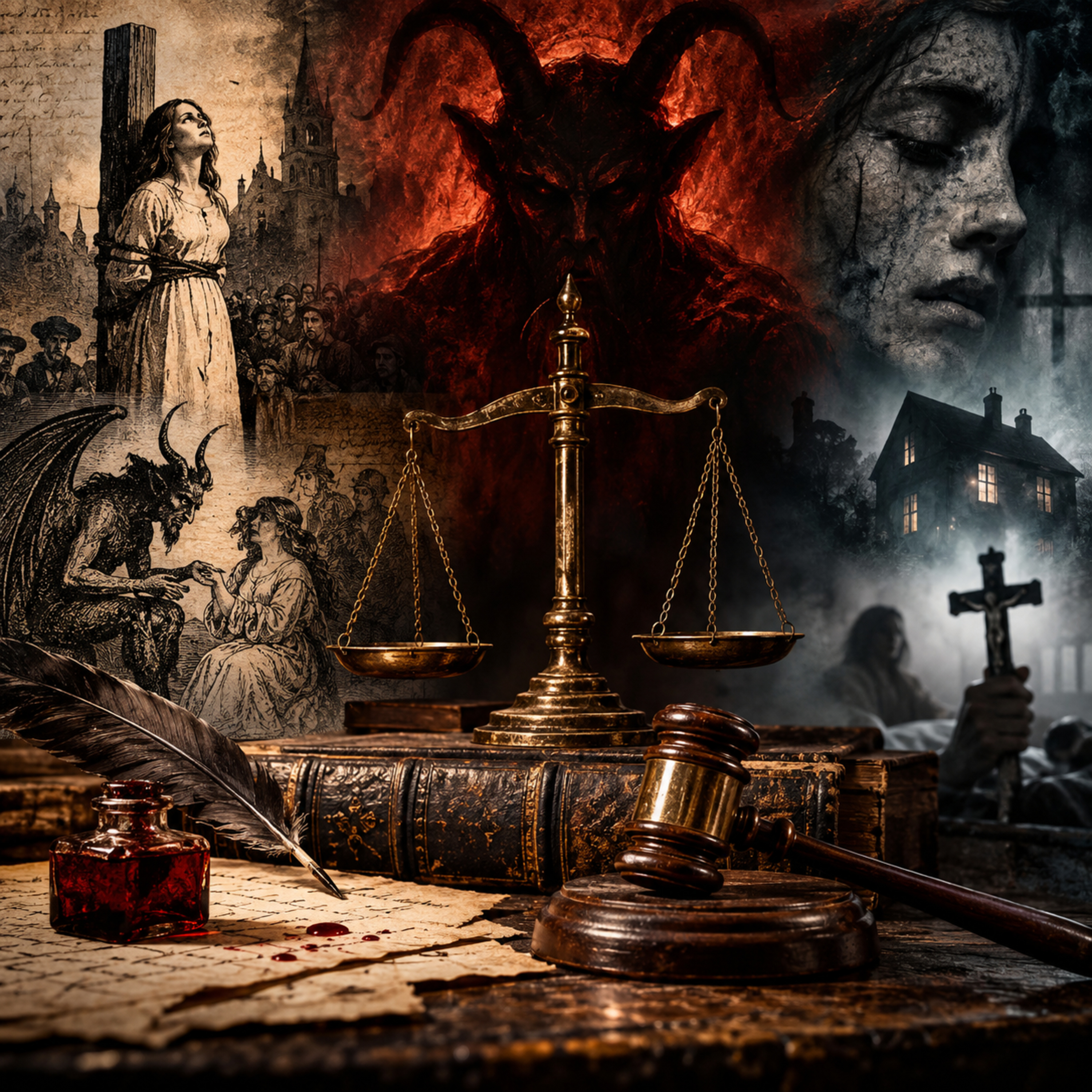
That question — what happens when the Devil enters the explanation for human behaviour — sits at the heart of a recent podcast conversation with criminal barrister Naomi Ryan. Naomi works in criminal and public law within the English legal system and has a particular passion for exploring the darker corners of legal history, especially where they collide with supernatural belief. What interested me most in our discussion was not simply the parade of extraordinary cases in which demons, witchcraft, possession or Satan appeared somewhere in the courtroom, but the much larger historical transformation they reveal. Naomi described the problem in terms familiar to criminal justice as the question of the “mad versus bad”: how do we understand people who commit acts that horrify us, and how does a society decide where illness, intention, belief and responsibility begin and end? Just as importantly, she emphasised that legal history is not simply the history of defendants. It is also the history of the systems judging them and of the slow, uneven process by which those systems change.
The Devil provides a surprisingly useful guide through that history because he never remains quite the same character. There were periods in which a court could proceed on the assumption that demonic interference was not merely something a frightened witness believed but a genuine possibility within the accepted structure of the world. At other times the Devil retreated from law while remaining extraordinarily vigorous in folklore. Later still, claims involving him might be interpreted as evidence about the state of a defendant's mind rather than evidence about supernatural reality. What changes, then, is not simply belief in the Devil but the question being asked. A court might once have asked whether someone had entered into a compact with Satan; a later court might ask why someone believed that they had. The same words — “the Devil” — can therefore occupy very different positions within the history of crime.
That distinction matters when looking back at the early modern witch trials. It is easy from a modern perspective to treat some of their allegations as so fantastic that nobody could possibly have taken them seriously: witches flying, animals speaking, demons copulating with humans, magical injuries, diabolical gatherings and bodily marks through which familiars supposedly fed. Yet the legal proceedings did not take place outside the culture which produced those images. As Naomi and I discussed, judges, jurors, witnesses, clerics and accusers inhabited a world saturated with sermons, religious teachings, pamphlets, woodcuts, demonological treatises and local stories explaining what witches were supposed to be and what the Devil was supposed to do. The imagery did not merely record belief; it could help create and reinforce it. Once particular motifs became recognisable as signs of witchcraft, accusations began to reproduce them, while confessions — sometimes obtained under torture or extreme coercion — appeared to confirm what people already expected to find. The image validated the law, while the law gave authority back to the image.
This is one of the reasons folklore is so important to criminal history. Evidence is never received by a perfectly empty mind. Human beings interpret what they see through stories, expectations and assumptions, and when an event resembles a narrative already deeply embedded within a culture, the resemblance itself can begin to feel evidential. A neighbour's cow dies shortly after an argument with an unpopular woman; the argument becomes a curse and the dead animal its consequence. A child falls mysteriously ill; an earlier quarrel acquires new significance. Someone keeps an unusual animal; the animal becomes a familiar. An unexplained mark on the body becomes the place from which that familiar feeds. None of these details needs to begin as supernatural, but once arranged within the existing story of witchcraft they acquire a terrifying coherence. The narrative gives scattered misfortunes a cause, identifies an enemy and, perhaps most importantly, makes chaos intelligible.
The Devil was particularly useful because his capabilities were almost infinitely adaptable. He could tempt, deceive, possess, bargain, disguise himself, appear as an animal, speak through another person, lend supernatural power or simply encourage human beings to do what they were already inclined to do. He could be simultaneously explanation and antagonist. That flexibility becomes even clearer when we move away from the famous witch trials and into the smaller scraps of folklore that survive almost accidentally in nineteenth-century criminal records. One of the most fascinating examples comes from Shropshire in 1840, where the supernatural problem was not a flying horse but something arguably even more unsettling: the possibility that the person standing before you might not actually be the person whose face you could see.
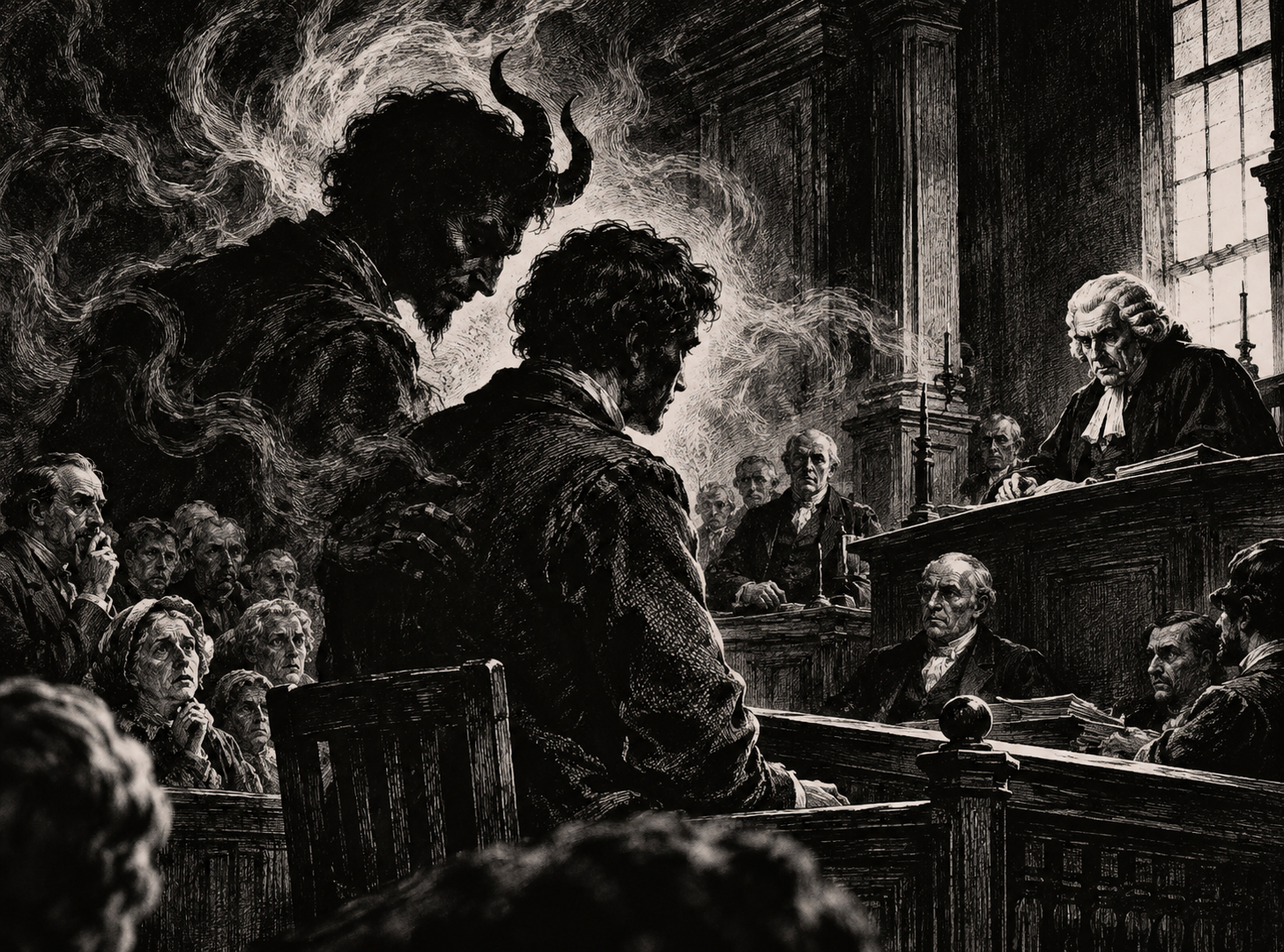
There had been an unpleasant housebreaking at the Barns in Minton involving four robbers and an eighty-year-old woman whose wedding ring was among the property taken. One of the accused was William Evans. A witness named Thomas Roberts testified that, on the night of the robbery, Evans had called at his house near the Barns asking for water. If Roberts was correct, his evidence placed Evans close to the scene of the crime. Evans vehemently denied that he had been there, at which point Roberts replied with a line so casually preserved that we might easily miss its significance: “It was either you or your Enemy.” The newspaper reporter then added an explanation of what Roberts meant — “the Devil in his shape.”
Here was an entirely different diabolical problem. The Devil had not forced Evans to commit a crime. He had not possessed him, whispered instructions into his ear or entered into a contract with him. Instead, the Devil could apparently become William Evans, borrowing his appearance so perfectly that an innocent witness might swear under oath that he had seen the man himself. It is an extraordinary belief because it strikes directly at something fundamental to both law and everyday experience: identification. Ordinarily, “I saw you there” is powerful evidence. But in a world where supernatural impersonation is possible, appearance no longer guarantees identity. The witness may be telling the truth, the accused may be telling the truth, and the contradiction between them can be resolved by placing the Devil between the two.
The idea had a long pedigree. Medieval and early modern traditions contain numerous tales in which the Devil assumes the appearance of particular people, sometimes with the explicit purpose of causing scandal or trouble. Clergymen were particularly useful victims in stories of this kind because their reputations depended upon moral behaviour. If a priest was supposedly seen behaving scandalously, one possible explanation was that the apparent priest was no priest at all. In one wonderfully paradoxical medieval story, the Devil impersonates a priest and delivers an excellent sermon, demonstrating the unsettling possibility that appearance, words and even apparently virtuous behaviour are not necessarily reliable guides to identity. The supernatural double does something more complicated than the familiar demon with horns and hooves. He undermines certainty itself.
George Hurst, who was born in 1800 and later became Mayor of Bedford, remembered this belief from the world of his childhood. Writing in 1873, he recalled that the Devil was commonly believed capable of assuming the appearance of men and women and, if he bore a particular grudge against someone, might take that person's likeness and commit an offence for which the original would subsequently suffer. Hurst's recollection also suggests that the belief could function as a wonderfully convenient defence for supposedly respectable people caught behaving rather less respectably than their public image allowed. As he put it, when such individuals were accused of violating the principles they professed, the response could be: “it was not me, it was the devil in my likeness that did it.”
There is humour in Hurst's account, and probably scepticism too, but beneath it lies a fascinating folkloric mechanism. Supernatural impersonation allows two incompatible things to remain true at once. The witness did see the accused, yet the accused was not there. The respected person really is respectable, yet someone looking exactly like them behaved disgracefully. Identity has been split in two and the Devil inhabits the gap. In an age before photography became ubiquitous, before fingerprints and forensic identification, and in communities where reputation and personal recognition carried enormous weight, the possibility of a supernatural double offered a remarkably elegant explanation for the otherwise impossible.
James Hogg preserved another version of the idea in 1823. A prosperous farmer, John Adamson, became involved in a confrontation with a beggar named Peter Maxwell during a violent thunderstorm. Their quarrel became physical and ended with Adamson's death. Yet according to the story, there was an extraordinary complication: it was asserted that Maxwell had not been in the glen of Laverhope that day at all, but was at a considerable distance in another county. The explanation offered was that “it was the devil who attended the folds in his likeness.” Once again the Devil solves an impossible problem. Maxwell can be both present and absent because the figure witnessed at the scene need not have been Maxwell himself. In modern language we might call it a supernatural doppelgänger; in the older language of the tradition, the Devil simply wore him.
A much older chapbook tale concerning John Overs, a notoriously miserly Southwark ferryman, takes the same belief into black comedy. Overs supposedly decided to fake his own death in the hope that his household would fast until his burial and thereby save him the expense of feeding them. His servants, unfortunately for his economical master, responded to the apparent bereavement by helping themselves enthusiastically to the provisions. Seeing his carefully guarded food and drink disappearing, Overs abandoned the pretence, rose furiously from his “deathbed” and advanced upon them. One apprentice, confronted by the sight of his supposedly dead employer walking towards him, reached what must have seemed an entirely reasonable conclusion within the logic of the story: this could not be Overs because Overs was dead; therefore it was the Devil appearing in Overs's likeness. He seized a broken oar and struck his master fatally. According to the chapbook version, the servant was subsequently acquitted because Overs' own deception had caused the fatal misunderstanding. Whether we treat the tale as history, moral entertainment or folklore, its joke depends upon the audience understanding the supernatural possibility invoked. Something can possess a familiar face without possessing the person to whom that face belongs.
The same logic appears much later in the life of Teresa Higginson, the English Catholic mystic born in 1844 whose religious experiences attracted both devotion and suspicion. Accusations were made against her at various points concerning behaviour seemingly incompatible with her reputation for holiness, ranging from eating during a fast and drunkenness to the theft of a considerable sum of money. The explanation attributed to Higginson was that the Devil had impersonated her. The claim would later prove decidedly awkward in discussions surrounding her stalled canonisation, but folklorically it is almost perfect. Once again, the Devil's double protects an identity that contradictory evidence threatens to destabilise. People claim to have seen Teresa behave badly; Teresa denies doing those things. The solution is not that the witnesses necessarily lied or that Teresa necessarily lied. They saw her face, but they did not see her.
What makes these scattered nineteenth-century references particularly valuable is their rarity. We should not assume from that rarity that belief in supernatural impersonation had vanished. Written evidence is always shaped by what writers consider worthy of recording. By the nineteenth century, educated commentators were increasingly reluctant to treat some older supernatural ideas seriously, and beliefs that had once appeared in theological and legal discussion could sink beneath the threshold of respectable attention while continuing at the level of oral tradition. A folkloric idea can therefore become almost invisible precisely because it has become embarrassing. It survives in casual remarks, childhood memories, odd newspaper reports and jokes rather than formal treatises. Thomas Roberts' “you or your Enemy” is precious because nobody seems to have thought it needed lengthy explanation. The reporter merely glossed it. For a moment, an ordinary courtroom exchange opened a tiny window into a much older supernatural world.
This also reminds us that “belief” is a troublesome word. We often speak as though entire historical populations either believed or did not believe in witches, ghosts or the Devil, but people have never been so tidy. One person might believe fervently, another dismiss the idea, another joke about it in daylight while refusing to walk past a supposedly haunted place after dark. Someone might reject witchcraft in principle yet become less certain when illness follows a neighbour's curse. Folklore thrives in these uncertain spaces. It does not require universal agreement; it merely requires a story to remain available when circumstances make it useful. The Devil-double could be a genuine explanation, a desperate excuse, a humorous proverb or a half-serious possibility, sometimes perhaps all at once.
By the nineteenth century the Devil himself was also undergoing an extraordinary cultural transformation. Naomi Ryan drew attention in our conversation to the way in which he gradually moves away from some of the grotesque physicality of early modern demonology and becomes a more sophisticated figure: the intelligent fallen angel, tempter and deal-maker familiar from literature. Milton's Paradise Lost, Goethe's Faust and the Romantic fascination with rebellion all helped reshape him. This is not to say that the older Devil disappeared. Horns, hooves, animal manifestations and village legends continued perfectly happily. Folklore rarely replaces one image with another so neatly. Instead, the repertoire expanded. Satan could be simultaneously the beast at the crossroads, the animal familiar, the gentleman offering a bargain, the terrifying possessor and the elegant fallen angel. The remarkable thing about the Devil is his ability to become whatever a particular story requires.
At roughly the same time, however, the legal system was beginning to develop a very different vocabulary for extraordinary human behaviour. The rise of psychiatry and what would become forensic psychiatry created new ways of thinking about people whose experiences might previously have been understood through religious or supernatural categories. Naomi described this as a crucial movement from simply seeing demonic influence as an external reality towards asking whether belief in demons might itself tell us something about an individual's mental state. That change is essential to understanding why George Allen's 1807 confession feels so historically significant. He stands near a threshold. Behind him lies the world of the diabolical compact and the blood-feeding familiar; ahead lies the asylum, the alienist and the increasingly medical attempt to understand unusual belief.
The transition was neither simple nor necessarily humane. Early psychiatry had its own prejudices, errors and cruelties, and medical explanations did not automatically guarantee compassionate treatment. Nor did religious and supernatural interpretations disappear as medicine advanced. They coexisted, sometimes uneasily, and they continue to coexist. Yet the change in the central question is profound. Once the Devil was accepted as a possible participant in events, a person's account of supernatural influence might constitute evidence about the world. Increasingly, it became evidence about the person. “I saw the Devil” gradually ceased to mean that investigators needed to establish what the Devil had done and increasingly invited questions about perception, belief and mental state.
That transformation also complicates the phrase “the Devil made me do it”, because there are several very different claims hidden inside it. A person might be claiming literal possession and therefore the loss of control over their body. They might believe they were commanded by a supernatural being but still understand themselves as the person carrying out the act. They might believe that the Devil tempted them, which preserves agency while shifting some moral blame. They might use Satan retrospectively as an excuse. They might be experiencing hallucinations or delusions which take a demonic form because that is the imagery available to them. Or, as in the Shropshire case, they might claim that they did nothing at all because the Devil independently committed the act while looking exactly like them. Those are radically different relationships between supernatural agency and human responsibility, even though all can be compressed into the deceptively simple idea that “the Devil did it”.
The stories also expose a deeper human need to locate the source of evil somewhere. Crime is disturbing not only because of what happens to the victim but because serious violence disrupts our assumptions about other people. A neighbour, parent, spouse or apparently respectable member of a community commits something appalling, and those left behind repeatedly ask versions of the same question: how could the person we knew do this? Modern investigation may search for motive, history, psychology, circumstance, intoxication, coercion or mental disorder, but the need for explanation long predates those categories. Folklore supplied answers of its own. A witch had caused the illness. A familiar had carried out the attack. A demon had entered the body. A bargain had been made. The Devil had tempted the offender. The Devil had taken the offender's shape. Each explanation transformed chaotic human behaviour into a story with recognisable actors and rules.
There can be comfort in that, even when the story itself is terrifying. If evil is external, then it can be named. If it can be named, perhaps it can be resisted, exorcised, prosecuted or avoided. The far more frightening possibility is that there may be no supernatural intruder at all. That possibility lies underneath Naomi's observation that the Devil changes according to the wider concerns of the society imagining him. Towards the end of our conversation she described the concept as “surprisingly malleable”, continually reshaped by the cultural and social world around it. The Devil may therefore tell us less about an unchanging supernatural entity than about the people who invoke him. What a society fears, condemns or cannot explain becomes reflected in the face it gives to evil.
This is why seemingly ridiculous historical beliefs deserve something more thoughtful than laughter. There is certainly absurdity in some of the material. The Devil impersonating someone so that they can deny getting drunk is funny. The idea of a miser being killed because his servant mistakes him for Satan after he has faked his own death possesses the structure of a particularly dark folktale. A flying horse disappearing into the Staffordshire sky sounds fantastical. Yet absurdity and consequence can exist together. The history of witchcraft repeatedly demonstrates how stories that appear ridiculous from a safe distance could become lethal when institutions accepted them as fact. Once the law validates the narrative, folklore can cease to be merely a story and become evidence capable of destroying lives. As Naomi remarked during our discussion, some of the imagery associated with historical witchcraft can appear almost comical now, but remembering that the people accused could end at the gallows or the stake rather quickly removes the humour.
The inverse is equally important. The fact that the law ceases to validate a supernatural belief does not mean the belief disappears from society. The Witchcraft Act of 1735 represented an enormous legal change, but people continued to fear witches, seek protection from them, consult cunning folk and interpret misfortune through supernatural frameworks well into the nineteenth century and beyond. Law can change with the stroke of a pen; folklore does not. It lives in memory, habit, family stories and local explanations, sometimes surviving for generations after the intellectual world that once gave it official authority has moved elsewhere. That is why fragments like Thomas Roberts' courtroom retort are so valuable. They reveal the cultural sediment beneath formal legal change.
George Allen's flying horse belongs to that same sediment. By 1807, no English court was going to prosecute a supernatural horse for taking his blood. Yet the imagery through which Allen understood his experience appears to reach backwards into a world of dangerous animal spirits, familiars and bodily bargains. The law had changed faster than the imagination. Allen's tragedy therefore sits at an uneasy intersection between old supernatural explanations and emerging medical ones, and we should resist flattening it into either. To declare simply that he was “mad” risks doing something surprisingly similar to declaring that he was possessed: it places a convenient label over an experience whose details we barely possess. What we can say is that his behaviour and reported experiences raise serious questions about his mental state, that contemporaries themselves noticed something unusual, and that the imagery he used had precedents within British supernatural tradition.
There is another intriguing possibility here. Folklore may not merely explain an experience afterwards; it may influence the form the experience takes. Someone who fears demonic possession may experience frightening internal events as possession. Someone raised with traditions of hostile supernatural animals may perceive an anomalous encounter through that imagery. This does not require deception. Nor does it settle the ultimate cause of every anomalous experience. It simply recognises that perception and interpretation are inseparable from culture. Human beings do not encounter the inexplicable without context. We carry stories with us, and sometimes those stories are waiting before the experience begins.
Perhaps that helps explain why the supernatural figures associated with fear change over time while certain underlying experiences remain recognisable. Different generations have described night terrors as demons, witches, hags, ghosts, shadow people and extraterrestrial visitors. The physical and psychological experience may share features while its interpretation draws upon whatever explanatory vocabulary the surrounding culture makes available. Something similar may occur in experiences associated with paranoia, dissociation, hallucination or extreme emotional distress. The cultural costume changes. The terror beneath it can remain remarkably familiar.
The Devil is particularly effective in this role because he has always been a master of disguise. Even within Christian tradition he is fundamentally deceptive, the being who makes falsehood appear true and temptation appear desirable. Folklore simply extends that capacity. He becomes a black dog, a horse, a gentleman, a stranger, a lover or a duplicate of someone known intimately. His disguises make him useful wherever appearances cannot be trusted. A supernatural double therefore belongs perfectly within the Devil's repertoire because it transforms the most reassuring evidence of identity — the human face — into another possible deception.
There is a striking parallel here with our own anxieties, even though the mechanisms have changed completely. We increasingly inhabit a world in which a voice can be cloned, a photograph manipulated and a convincing moving image created of someone doing or saying something they never did or said. We do not need Satan to explain this; technology is quite sufficient. Yet the emotional disturbance created by the possibility is curiously familiar. Seeing is no longer necessarily believing. Hearing a familiar voice does not guarantee the familiar person produced it. Someone can appear to be present without ever having been there. The old folklore of supernatural impersonation therefore speaks unexpectedly well to a modern fear: what happens when identity can be detached from the person who owns it?
That does not mean the Devil-double was an early version of artificial intelligence or that folklore somehow predicted modern technology. It means that the underlying anxiety is older than the mechanism. Human beings have long been troubled by doubles, changelings, impostors, possession and stolen identities because they threaten one of our most basic assumptions: that the person before us is who they appear to be. In 1840, Thomas Roberts could explain that uncertainty through “your Enemy”. We have different explanations now, but perhaps the unease has not changed very much.
And this is ultimately why the Devil belongs as much to folklore as to theology. Theology may debate his nature; folklore puts him to work. It sends him down lanes, into houses and across fields. It makes him build bridges, lose wagers, leave footprints in stone, appear at crossroads, dance with strangers and vanish when dawn comes. It gives him hooves when he needs to be recognised and a human face when he does not. The folkloric Devil is endlessly practical. He explains bad luck, mysterious strangers, impossible feats, frightening places and unacceptable behaviour. Sometimes he is terrifying. Sometimes he is surprisingly foolish. Sometimes human beings trick him. Sometimes he tricks them. And sometimes, as in criminal folklore, he takes responsibility for things that are much harder to confront when the supernatural explanation is removed.
That final role may be the most enduring. Towards the end of my conversation with Naomi, I asked whether the Devil had ever truly been the figure on trial in all these cases, or whether the courtroom was really judging something about ourselves. Naomi's response was that the Devil often becomes a scapegoat for acts and behaviours that are “terrifyingly human”. It is an uncomfortable observation because it removes the protective distance offered by the monster. If the Devil caused the atrocity, then evil came from somewhere else. If he did not, we are left with people — frightened people, ill people, manipulative people, violent people, mistaken people and occasionally people doing dreadful things for painfully ordinary human reasons.
Perhaps that is why he never quite disappears. Even when courts stop accepting him as a literal participant, he survives as metaphor, accusation, explanation and excuse. He shifts from the dock into the language surrounding it. The supernatural criminal becomes the “monster”; the incomprehensible act becomes “evil”; behaviour that seems beyond our understanding is described as “demonic”. We secularise the vocabulary while preserving much of its emotional function. The words continue to place certain actions beyond the boundaries of ordinary humanity, perhaps because acknowledging how thoroughly human cruelty can be is more disturbing than imagining something inhuman behind it.
That leaves George Allen in an especially haunting position. Somewhere approximately four years before he killed his children, he believed that he had encountered a ghost in the form of a horse. It enticed him into a stable. It drew blood from him. It flew into the sky. Whatever happened in that stable — whether an external event, dream, seizure, hallucination, distorted memory or something for which we have no adequate explanation — Allen remembered it. More than that, he believed it important enough to confess when the consequences of his own violence were closing around him. We cannot know whether he thought the horse had claimed him, corrupted him, warned him or merely frightened him. The surviving words are too few, and George Allen took the rest with him to the gallows.
Perhaps that uncertainty is more valuable than a tidy answer. It reminds us that criminal history is filled with fragments rather than complete minds, and folklore often survives in exactly the same way. A sentence in a newspaper, an odd remark in court, an explanation added almost casually by a reporter can preserve a belief otherwise lost. The flying horse and the Devil-double are valuable precisely because neither comes to us as part of a carefully collected folklore survey. They escaped into the record because something else was being documented. Crime inadvertently preserved the supernatural worlds surrounding it.
There is a curious progression running through all of this. The Devil committed the crime. The Devil looked like me when he committed it. The Devil tempted me. The Devil entered me. The Devil made me do it. Eventually another question begins to emerge: why did this person believe that the Devil was involved at all? Each formulation places responsibility somewhere slightly different, and each tells us something about the period that produced it. The history of the Devil in crime is therefore not simply a collection of sensational cases involving Satan. It is a history of changing ideas about agency, evidence, identity, illness, temptation, culpability and evil.
That is the much wider territory Naomi Ryan and I explore in the full Haunted History Chronicles episode. Naomi brings the perspective of a practising criminal barrister to cases in which courts have been forced to confront precisely these problems, and our conversation moves through centuries of changing legal attitudes towards witchcraft, demonic influence, insanity, possession and responsibility. I have deliberately avoided unpacking many of those cases here because they deserve to be heard in the context of that conversation; what fascinates me is how closely the legal history she explores sits beside the smaller folkloric fragments preserved by stories such as George Allen's flying horse and William Evans' supposed diabolical double. One gives us the courtroom trying to decide what supernatural belief means in law; the other gives us ordinary people using supernatural belief to make sense of the world around them.
And perhaps the most revealing thing is that the Devil changes whenever we do. The creature inhabiting an early modern witch trial is not quite the Devil wandering through nineteenth-century folklore, and neither is identical to the Devil invoked in a modern courtroom. He acquires the anxieties of the culture imagining him. He can embody forbidden sexuality, religious rebellion, social disorder, mental disturbance, hidden conspiracy or the frightening possibility that someone is not responsible for what their own body appears to have done.
So perhaps we should return one final time to that Staffordshire stable in about 1803. Somewhere inside it, according to George Allen, stood a horse that was not a horse. It lured him towards it, took his blood and rose impossibly into the sky. Four years later Allen would commit an act far more terrible than anything contained within that supernatural memory, and as he waited for the law to decide his fate he reached backwards to the horse and told its story. We will never know exactly why.
Thirty-three years later in Shropshire, William Evans insisted that he had not been where a witness claimed to have seen him. Thomas Roberts had an answer ready. Perhaps, he suggested, it had been Evans' “Enemy” instead: the Devil wearing his face. The remark occupies only a handful of words in a newspaper account, yet behind it lies centuries of anxiety about whether appearances can be trusted and whether evil can borrow an innocent person's shape.
Between those two stories sits an enormous question. When people confront behaviour, experiences or contradictions they cannot explain, what kind of story do they build around them? Sometimes the answer has been medical. Sometimes legal. Sometimes psychological. Sometimes folkloric. For centuries, one of the most adaptable answers available was the Devil.
He could be the creature that tempted you, the familiar that fed upon you, the stranger who bargained with you, the spirit that entered you or the double that committed your sins while wearing your face. He could stand outside the criminal and pull the strings, or he could become the explanation for something frightening happening inside the mind. He could even provide a community with somewhere to place an evil that seemed too terrible to belong to an ordinary human being.
Perhaps that is why following the Devil through criminal history tells us so much more than whether people once believed in Satan. It tells us what they believed about themselves: where responsibility began, what counted as proof, how secure identity really was, what separated sickness from wickedness, and whether evil belonged inside humanity or arrived from somewhere beyond it.
The law eventually stopped putting witches on trial because it believed they possessed supernatural powers. It stopped treating demons as participants whose existence needed to be accounted for in the ordinary machinery of justice. Yet the Devil never quite left the courtroom, because the questions that had summoned him remained.
Why did this happen?
Who is responsible?
Can someone do something terrible without being themselves?
What do we do when the explanation offered by the accused belongs to a reality the court does not recognise?
And what happens when the thing we have called monstrous turns out to be painfully, frighteningly human?
Perhaps, after centuries of appearing as animal, tempter, double, possessor and scapegoat, that is the Devil's most persistent trick. We keep looking towards him for an explanation of evil, only to discover that the trail has led us back to ourselves.

Host, author and producer
Hi I’m Michelle.
Teacher, podcaster, history and paranormal enthusiast and woman who wears many hats and spins many plates including dog whisperer- as you will often find Archie my dog- joining me during podcast recordings where he promptly falls asleep clearly not as enthusiastic about the subject as I am. It does mean his dulcet snoring can often be heard gently in the background- his contribution as occasional co- host needs a little work.
I live in Oxford in the United Kingdom and I love travelling and exploring historical sites throughout the UK for its history and haunted activity. One of the best gifts I ever received was English Heritage vouchers to use to explore various different historical sites. I had the best summer that year. (For friends and family possibly reading this please note that hint for future gift ideas!)
I started this podcast as an adventure through some of my passions. It has been immensely exciting getting to know lots of other people around the world who have these same common interests. I’ve been humbled by the encouragement and support from strangers and people who have become new friends! I truly could not do this without you.
This isn’t something I have done before and I’m learning everything as I go along - from equipment, to editing, to even creating this website. I’m loving it though- it’s a lot of work - but worth every second. Thank you for being patient as I learn and improve along the way. I have big dreams of where to take this podcast and community I hope we build here. If you wish to support that dream and this c… Read More
New Orleans: Where the Dead Are Never Far Away