0:00
So the client needs to be more or less an equal partner with the investigation and the investigators.
So that way you can get more from people because they're more willing to open up to you.
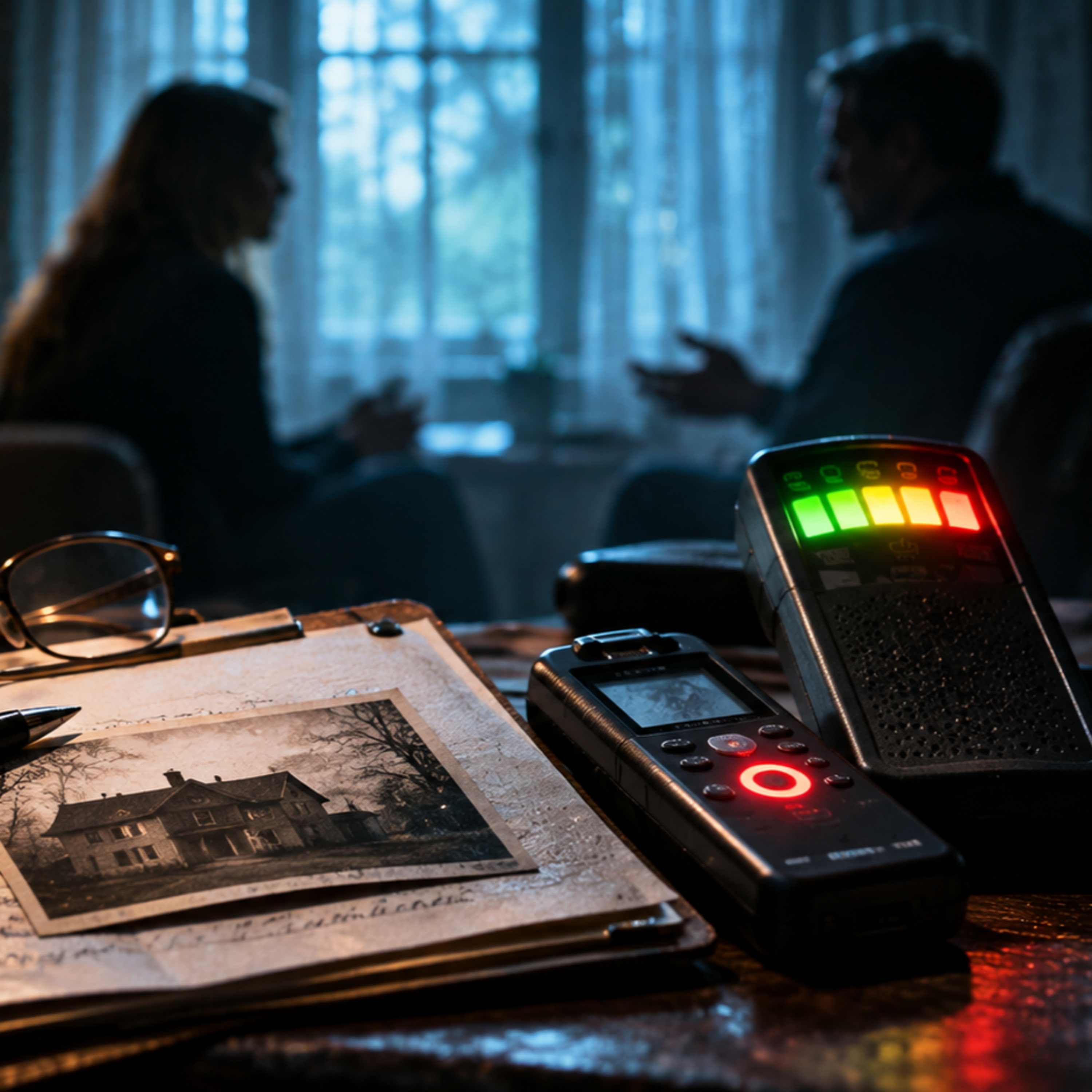
And therefore, perhaps we can dispense with a line of approach which is primarily centred around the acquisition of data with a mind to solve a problem from the perspective of a laboratory technician or scientist wearing a white coat and psychologically distance from their laboratory specimen, the client from behind their clipboard and thick, heavy glasses.
0:32
The best relationship is that the investigator and the client are both in effect on the same team, trying to figure out what's going on and what's happening.
When someone invites A paranormal investigator into their home, who should really have control over what happens next?
0:49
The investigator with their methods, experience, and expectations?
Or the person who has been living with the unexplained.
Welcome to Haunted History Chronicles.
We're continuing my conversation with Kieran Farrell about contamination in paranormal investigation, and today we're turning our attention to the relationship between investigators and the people at the centre of the case.
1:18
Traditionally, much emphasis has been placed on maintaining distance, preserving objectivity and preventing witnesses from influencing the investigative process.
That Kieran challenges the assumption that this is always the most productive, or indeed the most ethical approach.
1:39
What happens when someone has already researched their experiences or form strong beliefs about what might be happening?
How do investigators build trust without simply reinforcing those expectations?
And what responsibilities do they have towards people you might be frightened, vulnerable, or desperate for answers?
2:02
We'll also consider the psychological explanations sometimes offered for paranormal disturbances and the potential consequences of applying them too readily.
Because behind every reported haunting is a human story.
2:19
And perhaps understanding that story requires more than standing at a distance and observing.
So let's return to this conversation with Kieran Farrell.
So you propose A collaborative model between clients and investigators.
2:36
What does this look like then in real, real world terms, Kieran?
Well, I I consider that within an open, cooperative and collegiate way of working between clients and investigators that the client should be encouraged to learn more about psychical research and the paranormal.
2:53
This will hopefully not only give them an interest in the field, it may also provide them with a greater understanding of the investigators perspective.
And in time they too may become researchers and investigators themselves.
To a certain extent, this is kind of pulling the client into the investigators world.
3:13
And sometimes people have actually commented to me about that over the years, but it's also a means of being able to say to clients, look, you know, there's, I'm not hiding anything from you.
There is nothing to be hidden.
It's just that I may not have the same views as you do because I've been sort of involved in studying this for many years.
3:36
And you know, what I'm asking you to do is kind of benefit from my knowledge.
And on the other side, I will sort of endeavour to do my best to walk a mile in their shoes and understand their lives and the problems and issues that they have, both to a certain extent, the normal which would not necessarily feature any sort of report, but also the paranormal.
3:58
Therefore, I consider a more sophisticated approach needs to be taken in cases where the person who has asked for the assistance from an organization like the SPR is knowledgeable about psychic research and the paranormal howsoever they have gained that knowledge.
4:14
These days, of course, people can use Google.
In the old days you'd have to go to a library and carry out quite a bit of of painstaking research, but not everything you see online is actually worth reading or taking a regular notice of.
But unless you're going to put in a lot of time and effort into try and figuring out what's what, then you tend to come away with a rather sore and bemused head.
4:39
That's where an expert should be able to help you.
As with any areas of life.
I would therefore suggest that in such cases it is more a question of working with the client rather than simply obtaining information from them about the phenomena and that they are experiencing, and then processing that information to produce a judgement on the case.
5:01
Most cases will never be entirely solved, because so much of what makes up the paranormal in all its forms are human experiences, which cannot as yet be detected or measured by instruments.
So we're looking for basically confirmation through instrumental means rather than being able to define a case.
5:21
It's a bit like, in the sense a bit like medicine, as was you look at a pattern, you see a pattern of symptoms, signs and symptoms and so on and so forth.
And you hope the lab tests will come back to confirm that rather than, you know, what we have today where doctors are more concerned with taking a panel of tests.
5:41
And then if something shows up, well, that's what you got.
If nothing shows up, well, they're a bit flummoxed as I think many people will be able to, to kind of relate to.
So this means that one must make a judgement about the case in human rather than purely scientific terms and do so in the round, taking everything into consideration because basically we're working on the balance of probabilities.
6:04
It's not, you know, like a legal case or, or anything like that, you know, beyond reasonable doubt because we don't have the certainty in terms of the techniques that we use or in terms of being able to categorically say that the experience that one person had is, is the experience that all people will have.
6:24
Although I've investigated many, many places, many cases where I've gone into a particular property or a room with a particular property and I, I have experienced what the clients have told me is there or they've been sort of wisely in certain extent withholding certain details from me on the basis of they want to test me out the settings to a certain extent I'll be testing them out.
6:48
And then I'll say you, you, you know, you heard that voice too.
Yeah, I did.
So if you can confirm that the paranormal things that they have experienced is something that you as a paranormal investigator have also experienced, that must be quite a powerful argument for something paranormal going on, even if you can't prove it with instrumental readings.
7:09
Therefore, 1 is obliged on this kind of basis of the balance of probabilities and consequently, to a certain extent, one has to give the client the benefit of the scientific doubt, if I can put it that way.
Consequently, it might be as well to take the general approach of joining with the client in a more collaborative relationship from the outset.
7:33
The client should not just be placed in the position of being the subject of the investigation.
This isn't like a detective drama in that sense.
So, you know, the good inspector will trust everybody and suspect no, you know, suspect everybody and trust nobody, that kind of thing.
7:51
It shouldn't be like that because what you want is a good working relationship with those with the clients.
So the client needs to be more or less an equal partner with the investigation and the investigators.
So that way you can get more from people because they're more willing to open up to you.
8:07
And therefore perhaps we can dispense with a line of approach which is primarily centred around the acquisition of data with a mind to solve a problem From the perspective of a laboratory technician or scientist wearing a white coat and psychologically distance from their laboratory specimen, the client from behind their clipboard and thick, heavy glasses.
8:28
The best relationship is that the investigator and the client are both in effect on the same team trying to figure out what's going on and what's happening.
And that way, you know, the teamwork will tend to show through and therefore you'll start to be LED down avenues and lead to client down avenues which you never thought would have existed at the beginning.
8:51
And therefore, collectively you can find out to the best of your ability what is actually going on.
And if there are things that you can do to help people, you should do.
And that's really that simple because what I'm saying is there should be some sort of, you know, compact between you as people, as individuals, rather than sort of calling in somebody like a plumber who just wants to know where the leaky pipe is or whatever, and then goes and fixes A leaky pipe.
9:18
And that's fine for something like that.
But when you're dealing with something that's complicated like a haunting, then it isn't because there are all sorts of different aspects of a haunting.
It's not the same as a broken pipe.
So that's where you need a different approach, and that approach needs to be a collaborative one as I have described.
9:37
So how should investigators handle clients who have fixed beliefs or have conducted their own pre investigations then?
I think the most important thing to do is to listen to the client's arguments and rationale and to be able to spend time with them and actually go through these things with them and explain to them that as an investigator one has to consider a range of explanations for the experience that they've had and instrument readings that may have been taken.
10:10
So again.
It's a collaborative approach because at the end of the day it's a best fit type of.
Solution.
So I think it's important to recognise that there is no right answer and the client might actually be right, even if the investigators do not necessarily agree with them, because the client was the one who had the experiences and the investigators only hoped to be able to experience what the client has themselves experienced.
10:36
So again, if you could actually be there and experiencing an experience haunting phenomena, then that is a very powerful argument to say that you're dealing with the haunting.
If it turns out that the investigators are having the same sorts of experiences as the clients, then this is compelling evidence of the paranormal, of course.
10:54
But the causes and explanations of the paranormal may not necessarily be those that the client has identified.
And this can be for many reasons, and also because at the end of the day, sometimes 1 isn't able to pin down an explanation of why something happened.
11:11
You can figure out what's going on, but why it occurred to these particular people in this particular place at that particular time can sometimes be a bridge too far in terms of finding an explanation.
Or the explanations might be ones that centre on a certain amount of blame in relation to the clients, which I'm not really into.
11:33
You know, things like you kind of brought this on yourself and particularly with the churches will tend to say, Oh well the reason this happened to you is because you're a bad Christian or whatever.
By old fashioned standards, of course, most of us are bad Christians now compared with, you know, the way we were several 100 years ago.
11:51
Yet there doesn't seem to be any huge difference in the number of hauntings as far as one can ascertain, or people being possessed by demons or whatever.
And so one has to be a little bit careful about this.
People lead complex modern lives, as I suspect to a certain extent they always probably did, and therefore it is best not to get involved in these sort of explanations.
12:16
Which lay fault at the foot of the door of the experiences and.
They're likely to get enough of that if they go looking for answers from certain other groups rather than from yourself or your own.
12:32
And I would say that that's the most important thing is to actually be neutral about this.
It happens, it happens sometimes.
It can sometimes happen in this way.
As to the exact nature of why and how, well we can only theorise kind of thing, but I don't really want to start blaming people because they've LED complex lives.
12:53
And there are theories that says that people who've, you know, had a brush with this or that or the other automatically have invited this, that or the other into their lives.
It may be so, it may not, You don't know, and it's best to keep the blame game out of it if you can.
13:10
So this is where both research and above all experience are needed on the part of investigators to be able to provide clients with a full, rounded and balanced picture of the phenomena concerned so that through working together it is possible to identify what phenomena are involved and the potential causes or reasons for them to have occurred.
13:32
And again, some of these things you can address with people in the sense that if there are easy remedies, then they can be applied in terms of if, if you think it's so they've got something to do with this, then you can either sort of see up a wall off that particular Ave. and see whether that helps.
13:50
If it does.
Fine, fair enough.
Then you can at least say that something has made a difference.
If, on the other hand, you find it doesn't, well, maybe you need to again move on and see what you can do elsewhere.
This might appear to be the source of more contamination from a purely scientific point of view, in that it is vital that investigators and clients work together and therefore there will always be a degree of compromise from both sides in order to be able to reach a jointly parallel perspective of the profile of the phenomena and its potential causes.
14:25
Won't always agree, but you need to have a relationship in which that is possible without it breaking the relationship, straining it.
I don't do not think that this is a watering down of the investigators scientific principles or practices in that one needs to bear in mind that one is working with the best fit analysis on the basis of the balance of probabilities rather than a legally based beyond all reasonable doubt type of scenario.
14:53
In other words, don't try and take a courtroom scenario into a paranormal investigation.
You know the arguments for a normal explanation versus the arguments for, you know, an abnormal 1A paranormal one.
Either the ghost is real or it's a phantom of people's minds.
15:11
No, I would far rather work with what is actually happening.
Try as best one can to establish the facts and include in that those facts what people actually experience, because that contributes to your basis of factual knowledge.
15:29
At the end of the day, they may very well be.
More than one explanation of what is going on and the nature of the phenomena and the causes of those phenomena.
As an investigator, one should always have an open mind and consider possible scenarios on the basis of balance of probability and to rank various scenarios in order of estimated probability on the basis of deductive reasoning.
15:54
In other words, yeah, it's more likely to be a haunting than anything else, but we can't be sure.
But there again, if you want to go down the route of a haunting, then how many signs of a haunted house do you need to have before you actually say, OK, I'm going to tick that box, this house is haunted.
16:13
And that is something you can only do really on a case by case basis.
Although there are various.
Scenarios what a haunted house would look like.
But No2 cases are the same so you have to use the judgement.
In essence, it's a question of being both a good investigator, a sensitive listener, and a good deductive reasoner to a certain extent in the Sherlock Holmes type bold.
16:38
But you don't have to exclude everything entirely.
That is impossible in order to arrive at the most likely or probable.
You've just got to get a feel for it.
And often when that happens and you discuss this with your clients one at the time, they'll actually agree with you and you'll agree with them.
16:56
So this is the sort of relationship that I think would be the ideal in terms of a paranormal investigation, although 1 is not always likely to be able to enjoy that kind of relationship.
So what steps then can be taken to build trust and minimise psychological contamination from the client's prior experiences?
17:18
I think, as with the last question, the most important thing to do is to be able to be a good listener and to listen to what the client has said and be open about that with them and work with them to scope out the phenomena that they have experienced and get an idea of how frequently the phenomena are experienced and when and where and how the phenomena are experienced.
17:44
In other words, a bit of profiling in that sense, phenomena profiling, get an idea of that kind of thing.
Because often people don't want to go there for different reasons.
And I know because of having experienced so much paranormal activity myself, once something happens, you can't stop thinking about it.
18:05
But then you try and push it out of your mind and then you say to yourself, well, I got through that one.
You know, I'm not, I'm not going to think about that for a while until the next time comes along.
And I hope there isn't going to be a next time, but inevitably there probably will be.
So what you need to do is you need to work with the with your experience as your clients to be able to say, you know, what was actually happening here.
18:29
How often do you get those nightmares?
How often do things go bump in the night?
And when things do get go bump in the night, what do you do?
Because part of this, again, is to be able to live through these things, as it were with your experiences.
18:45
So that part of this is to be able to help people to conquer their fear of what's going on, because people, often unafraid, are often afraid of what they can't see.
They can't fight something that's invisible.
And therefore part of what you need to do is to say to them, OK.
19:04
Perhaps that's the wrong.
Mindset you don't want to start start to think about fighting something.
First of all, you got to think about.
What is it?
What?
What's what we're dealing with here?
Because if you've got the courage.
To get up out of bed at 3:00 in the morning and find out that something fell off the counter in your kitchen or whatever, and then be able to think, ah, yeah, I know what's happened.
19:31
Yeah, it was.
It was a glass full of milk and the cat knocked it off the counter.
And now the cat's lapping up the milk.
Oh, boy.
Now I can go to bed and in a totally relaxed way and just think that was a close score that didn't happen.
19:47
But on another occasion there might be something that goes on.
You go into the kitchen and suddenly you feel cold atmosphere.
It's nasty and you think, oh, don't want to be here.
There's something wrong.
You know, in the, in the worst sense, the worst thing to do is to run away from that because you to a certain extent, that fear will end up chasing you and following it.
20:10
So if you have the courage to be able to face it and be able to go into that room, switch the light or look around.
And then say, oh, yeah, there's something odd here.
There's a footprint here that shouldn't be there.
Or yes, there was.
I saw a shadow slide into the corner or whatever, you know, blah, blah, blah.
20:28
OK, what I'll do is I'll have another quick look around, switch the light off, go back into the safety of my bedroom or whatever, and make a brief note about it.
Once I've done that, then I can sort of say, OK, I've dealt with it as much as I can tonight.
20:46
And then hopefully you can go back to sleep knowing that you have done several things.
You've faced your fears, you found out what's going on, you've recorded it, and now you've done everything you can about it till the morning.
And that's when you can contact the investigator and whatever and do whatever.
21:03
The worst thing you can do is run away.
As I found from my own experience, so this process.
Turns a client into an investigator, which is what I've referred to earlier on.
But it's often vital because it is a means of being able to to say to yourself, I don't have to sit here and think about how horrible it is in the other room when something went bump in the night.
21:29
There is something I can do.
I can be active, I can do something about this, even if it's not much.
But at least there is.
Something to do and therefore.
That's a step.
To being able to conquer your fear and being able to deal with the situation and be able to become a bit of an investigator and figure out some of the things that's going on in order to be able to find out how you might be able to tackle them or tackle them with the help of an investigator.
21:56
So this is an essential task for an investigator to undertake as it provides both the investigator and the client with a profile of the phenomenon.
How many times did something go bump in the night?
Was it 3:00 in the morning?
Was it 3557?
22:12
Whatever?
What happened?
Was it the same sight shadow that slid into the corner when you went into the kitchen?
Was it always the kitchen?
Was there something more there?
Did something get moved?
Whatever.
All these sorts of things so you can build.
Up a picture of the.
22:27
Activity and just with offender profiling or victim profiling in terms of, you know, the, the ordinary techniques of policing detectives investigating things, you can begin to build up a, a profile of what's going on.
22:44
Are the phenomena centred primarily on a person or are they centred in a particular place, the kitchen or in that particular home or whatever it may be your, your business?
And if so, where so?
So it's a question of finding out what's going on in order to give you an idea of why it might be occurring.
23:03
Sometimes there may not be that much to the phenomena concerned, but on other occasions there might.
Well, it might well be the phenomenon themselves that change or dissipate over time.
So that the.
Client has not actually joined up all the dots or there may be things going on in a different room that have a bearing on what happened in the kitchen.
23:23
So, you know, you might be able to figure out, Oh well, when something happens in one room, something else happens on another.
One of the things that's very common is jots, you know, known as just one of those things.
People tend to lose things, people because things go missing and people don't know what to do about them.
23:42
They put something down on the table.
Something like Often what happens is like with car keys, you're going out, getting ready to go out.
You put your keys down on the table.
You know you've done that and you're only going to be 5 minutes just to finish off getting ready and you go to the bathroom or whatever, you come back.
24:00
Your keys are gone.
Now, what the hell do you do?
People spend hours looking for the keys and they're not there.
They're not in the last place they put them for and this, that and the other and suddenly you sit down.
Oh no, no, no, no, no, I'm not going to be able to go out and go out to where I want you to go and this and that and the other.
24:19
That's ruined my day.
And now I'm going to have to get on the phone and apologise to people because I can't go into work or I'm not going to be able to go shopping or whatever.
Well, I'm now going to be late for work because I'm going to have to use public transport, please, instead of my car, whatever it might be.
And suddenly you stand up.
You, you then think, right, I've got to take my phone out of my bag to make the calls.
24:40
And suddenly you notice the keys are three feet from you.
How did that?
Happen, and you rack your brains over it.
These things occur.
And these things, these jots, tend to occur more frequently in a haunted house than they do to people.
24:58
They they care to people.
You know, from time to time, but in a haunted house where there's a lot of certain psychic activity, they care more often.
There are various theories about this, but the the, the point being is that this is one of those things that can occur.
25:15
Some people like to impute mercy to this.
Oh, it was the ghost.
Well, maybe it was, but it's best not to think in those terms for the simple reason that the more you think in those terms, the more you start thinking and what's it going to do to me now?
How's it going to make life difficult for me and so on and so forth.
25:33
Just treat it as one of those things and sort of again, the same business.
Carry on with your life.
Oh, I had a bit of a, a problem this morning.
I couldn't find my car keys.
So you take ownership from it.
You don't say I, you don't say the ghost Did you say I couldn't for my car keys, put them down and they disappeared.
25:50
That's not to play down the paranormal.
That's simply as a coping mechanism.
It's not a precursor into saying that it was some sort of glitch or mistake necessarily, but it is a means of being able to deal with it.
Because if you start then thinking something went bumped in the night at 3:00 in the morning, then my car keys went missing, and then this happened.
26:12
And then you drive yourself crazy.
And that wouldn't be any good either to you in order to carry on your life living under the stresses and strains of living in a haunted house or whatever it may be.
And it also doesn't doesn't necessarily help an investigator because what you need to be able to know first, first and foremost to the facts, then you can work and put some flesh on those bones.
26:34
But you first of all, you want to know the car, you know, someone's car keys went missing and it went and they went missing after a 3:00 AM incident.
It's these sorts of things that you can deal with in a very sensitive way with experiences and be able to say to them, look, these things can occur, so don't get too fazed by them because you can expect this to happen.
26:56
It will be annoying, but you have to learn to deal with them and take them in new stride.
So where does that leave us?
There is usually an overlap with various different phenomena.
So between the weird and therefore strange and consequently normal and the abnormal, there could very well be signs of symptoms of the paranormal.
27:16
And it's only by in that sense, seeing the background of the normal people's normal lives if in during an on site investigation that you can see how the paranormal might stand out from that.
In other words, if somebody's lost their.
27:32
Keys three times in a week, which I know.
That's happened to some people.
Then that's obviously not normal.
So are they a normally forgetful person or whatever?
They're going through a personal crisis.
Everything else in their life might be fine.
So what is it about the keys?
And then you can start thinking, is something about the keys?
27:49
Is it something about the car?
You know these lines of enquiry.
And often you'll come back with something that seems a bit strange because.
One of the things here is that I found from experience that a lot of items which have a personal value, an emotional value.
28:08
Are things that that tend to get aborted of one sort or another.
And therefore there's often a connection there and there's often likely to be an enhanced kind of psychic field around people in the in, in the haunted house.
28:23
That could be their natural sort of primordial hackles being raised by what's been going on in terms of, you know, the haunted hauntings or a haunted house or whatever.
Or it could be because if.
Of conflict within the household.
And therefore, again, primordial hackles might rise and this could raise the kind of psychological temperature which can raise the psychic temperature which could lead to these sorts of things occurring, this psychokinetic effect.
28:51
So as an investigator, it's often very difficult to tell the difference between 2.
And that's where personal experience of actor haunting phenomena really does make a difference.
Because.
You can say to people, look, I know, I, you know, I haven't had it the way you've had it, but I have experienced it and I have experienced these things sort of things before.
29:09
So the influence of the.
Paranormal on one's life and that of 1's.
Family, if you know.
If one's the the client can be disruptive and as a result, people cover a tendency to live to a certain extent on the edge in which in part of their mind they're.
Anticipating the next thing that might go wrong for them, or that when something does go wrong or does not work out, then it must be the influence of the paranormal at work.
29:35
It could be, but it doesn't necessarily mean that it is.
And the more, again, heads up you get about it, the less easy it is to see the wood for the trees.
So again, it's an exercise in being controlled and disciplined about it and acknowledging, yeah, look, I'm having to live through this situation and consequently, I would do better to keep calm within the situation, which will not make it worse because the worst thing I can probably do is, is panic.
30:08
I think as you remember reading the book Dune, Frank Herbert's book Dune that are very sort of in my teens.
And there's what's known as the Benny Jester, literally litany against fear.
You know, fear is the little death that will bring total obliteration.
30:25
You know, I will face my fear.
I will allow it to go round me and through me and.
When fear has passed, I will turn to see where fear has gone.
In other words, what I was afraid of and why?
And that is?
I found that often personally very useful because it is a means of being able partly to deal with my own emotions and partly the ability to be able to engage my own rational senses.
30:51
Whether those rational senses are the ability to use logic or intuition or a combination of both.
But you need to have a certain mindset, analytical mindset in order to be able to do that.
And that's what's important.
31:07
And to a certain extent, being able to liaise with your clients and say to them, you know, you're in this environment, this these sort of techniques can help you survive in that environment and help you to live as normal life as you can when you're going through this.
So this is a means of helping them take back control and therefore to face their fears and consequently to be able to take the necessary steps they can make and they can take in order to deal with the situation.
31:38
If it is simply something that was unexpected but normal, then at least one could have the comfort that it was not paranormal.
On the other hand, if it was paranormal or potentially so, and is something that needs to be faced and recorded in order to be able to add that incident profile of the phenomena and needs to be catalogued and discussed as part of the investigative process and here.
32:02
Of course, you're relying on your clients because you're not living with them all the time, so you're relying on what they're reporting to you so you know if they ring you up.
And tell you what, this is what you know in the state, this is what happened last night, whatever then like everyone does and and the situation like this, someone's sort of panicking.
32:18
Hold on.
Whoa, whoa, whoa.
Slow down, slow down.
Take this one step at a time.
You know, I need to be able to get some get write some notes or whatever.
So it's best to be able to work out things, put them down on paper if you can.
Some people don't need to do that as long as it's clear in someone's mind and then you can make the call to the investigator and say this is what happened.
32:40
Last night.
In other words, there are ways of being able to deal with such situations which, in one way or another, normalise them and so hopefully make it easier for people to deal with when they have these experiences.
It is easy to play armchair detective in an investigation as if one were a television detective, but investigators need to bear in mind that the clients who have to live with their situation day-to-day.
33:06
There have been many occasions where I've said to my clients and various organisations, it's easy for us, we have an interest in this stuff.
You know, it is our hobby, it is something that we would like to turn into being into a profession and be professionals within that profession.
33:23
But if you have to try and live with this day-to-day, night after night and try and carry on your own life or whatever, go out to work, take the children to school or whatever it is, then it's very different.
It's, it's not an interest that you have.
33:38
It's a nuisance you've got to deal with.
So you need to be kind of aware of that and you need to support people through that.
I've often made this point to investigators in a slightly different way by saying that as investigators, we spend time in people's homes and businesses to listen to what they have to say and to experience the atmosphere for ourselves and to see if we can experience the same sort of things that they do.
34:03
However, we go at home, home at night to our own secure and comfortable environments, whereas they have to continue to live under the psychological pressure and uncertainty of the phenomena, which may very well be paranormal that they are experiencing.
34:20
And so it is a very different situation to have to face because I've often said to people.
OK.
Would you spend a night alone in this house?
And often they've sort of looked at me and sort of said, oh, why do you ask or no, I wouldn't, I wouldn't like to do that.
34:36
I said, Paul, spare a thought for the people who do because that's why we're here to help.
As an investigator, it is very important to be sympathetic and to have empathy with the client and also to see what can be done to reduce the levels of anxiety and apprehension associated with continuing experiences.
34:53
Paranormal or single, more serious incidents such as heavy objects were seriously descending onto the floor from a shop in the middle of the night, for example, not just the bottlenock on the council or castle milk on the council or whatever.
Sometimes things can really take off in the sense that things can, you know, things can be rich from walls in poltergeist cases.
35:18
And then that leaves a lot more questions to be asked and hopefully answered.
But one of them, which is the most difficult one, is why did that thing do that here?
Why did it do it now?
And what kind of message is it trying to send to us?
35:35
Sometimes, again, it's best not to get into that kind of thinking and.
Just sort of say, OK, this is what happened.
All the other stuff we need to look at.
But if you start.
Thinking in terms of imputing motive to the thing, then you start thinking along the lines of it's out, it's come here, it's out to get me or whatever.
35:54
May be an.
Aspect of that that's true, but it's not helpful thought and therefore the best way of dealing with it is not to think in those terms.
And just to to sort of say, OK, for the minute, I'll just add that to the pile of the, you know, the phenomena that's actually occurred.
So it's important to emphasise that these stress reduction strategies are not an attempt to rationalise away the phenomena, only to be able to help those concerned cope with living with them.
36:21
This is.
Particularly important when it comes to considerations around conscious or unconsciously driven psychokinesis, which might be one of the phenomena that it as an investigator could be involved.
And reducing the stress levels of those who are at the centre of the Phalna could potentially reduce the nature and extent of the phenomena themselves might might therefore stop.
36:44
Although I'd often be very doubtful about this.
And obviously reducing stress can always help because it's easier to live in a less stressful situation.
However, as I've said earlier, there are usually a number of explanations for different types of phenomena.
So the stress reduction strategy might be a way, to a certain extent perhaps of killing two bears with one stone, but more likely it is just being able to help people cope a bit better with on a day-to-day basis with what they have to face.
37:15
One of the things that investigators need to be able to gauge, and this comes down to experience more than research, is to make an assessment of how serious the situation is and therefore be able to provide a level of reassurance that the worst is most likely not going to occur and therefore the client need not worry too much about various mysterious goings on.
37:39
In other words, simply because something crashed.
Something who crashed off a shelf in the middle of the night doesn't mean to say it's going to happen every night.
Although if I having been in that situation, that thought has crossed my mind.
Oh my God, if it's done this, I'll do something else.
And then where?
37:55
Would I be?
I won't be safe in my own home.
Best not to go down that line in your own mind.
The reason being that if one considers that certain things can be put into a basket of mysterious things rather than that of malicious paranormal intent, that it is easier for the client.
38:10
To be able to live out their lives on a daily basis without being unduly anxious or on the edge about the phenomena that they are experiencing.
There are several types of phenomena that do this.
In particular the 1st and most important category would be unexplained poltergeist type activity in which an object appears to be thrown or descends from a shelf without any particular apparent reason for doing so, which is what I've just mentioned.
38:37
Particularly if there is a sighting of a shadow form figure associated with this sort of incident or there is a perception of a human presence or perhaps a non human presence.
Another cause of alarm and distress is of course jots as I've explained.
38:54
So these being when objects disappear and cannot be found and then reappear in places where people.
Have looked many times before, but you know either they've already covered that by looking there, or the object appears in a strange place where they would never have put them in the first place.
39:12
People in general and clients in particular have a tendency to think along the very unstandable lines of that is this thing, whatever it is, can do this, what else can it do?
Again, that's not necessarily.
Helpful.
The next point more or less further on from this, which is that how can one stop or fight such an unseen, unpredictable force?
39:32
The key to doing so is through understanding of what is going on and whether or not there.
Really is a specific entity involved, which is how to make people's lives a misery, as that implies a scientific, a specific malicious intent on the part of any ghost spiritual entity.
39:50
Sometimes that can be there and we don't want to minimise this in particular, say for example the typical thing of.
A couple or whoever moves into a new property and the old residents are still there in ghostly form or whatever and therefore, you know, new couple, they start to do some renovations the other older lot.
40:14
Who still may be there or could be a stone taking pressure.
It could be a haunting that's still with a haunting.
They're still there.
So they don't like what's going on.
They don't like that there's someone else living on their house.
So they might very well be, you know.
Making their thoughts and opinions known.
40:29
We don't like what's going on.
And so on.
So that could very well be true.
It's one scenario you would have to look at as an investigator, but also there are others which could be a sequence of coincidences, unlikely if you're dealing with a profile that corresponds to that of a haunting or poltergeist activity, for example.
40:51
And that's why, you know, taking notes and establishing a profile is very useful.
Because then you again, it gives you a means of being able to work out what you're dealing with.
And here, experience as an investigator is something that's absolutely essential.
41:07
So this of course involves a certain amount of psychic detective work as well as the ability to contact any such entity, usually through mediumistic means.
If this can be achieved, then a more humanistic approach can be taken at the Ghost or Polter Ghost.
41:26
Might be more of a nuisance or a pest rather than a pariah set on the destruction of the current occupants of the house, for example.
I've I've been there and I've done this many times again if people can understand.
That, you know, there was somebody there who used to live there who still is there even though they're deceased, you know, so they're in in spirit or whatever, they're a ghost and they think it's their house and that's why they're making a fuss and people.
41:54
Find that that's something as clients they can relate to because they can see the point of view of the discarded entity.
It doesn't.
That's what makes it easier to come to terms with, and that's where you can start to get things more directed towards a solution.
42:12
But one of the things here is the use of.
Psychic mediumistic techniques and means to be able to establish contact with.
This entity, whatever it may be, sometimes that will help.
That can actually, sometimes it won't.
42:28
But the most important thing is to actually ask your clients about it.
Do you want somebody?
Do we want to try and make contact?
Because there can be risks involved and you've got to go through and explain what they might be because it could backfire.
But at the end of the day, often people will say, well, yeah, there could be risks.
42:45
But on the other hand.
You know, what choice have we got because we we can't carry on living like this.
So we've got to take steps, whatever they might be.
To find out more about the problem in order to get one step close to a solution.
So this enables the client to be able to see things through a different lens of unusual kind of human behaviour, even if it might be the human behaviour of a discounted entity.
43:08
It's what the the real hard cases are the ones where.
You know, you're dealing with an entity that does not appear to be human, but that's another story.
And I think that.
Deserves almost like a podcast, a series of podcasts in its own right.
So I think it has to be said that in part, this approach is based on a consideration as to whether or not that there may be significant psychokinesis involved, which relates to either the darker side of the unconscious or semiconscious mind of a poltergeist agent.
43:40
The poltergeist agents are individuals who are at the centre of poltergeist type activity and this activity may be in some way associated with them, or through their connection with a discarded entity or or of whatever description.
43:56
I am personally rather sceptical about some of these theories of poltergeist activity in the form of psychokinesis being caused primarily through a psychological distress within a vulnerable individual, usually thought of as being a pre teenage girl or possibly boy as the result of hormonal changes around the time.
44:18
Of puberty or other times of life events, most particularly in the older days.
This is something that Nando Fodor picked up on from older theories, but I'll come on to that.
The basic concept of the psychological mechanism that would be involved.
44:35
Would be similar to that of conversion hysteria, A literal conversion of psychological distress into physical bodily symptoms for a person's individual psychology and mind body link.
Instead of the psychical energy which is produced as a result of the psychological distress being directed and projected internally within a person's body, it is directed outward at physical objects or people through a psychokinetic process involving, say, throwing of objects or whatever it may be.
45:06
This may or may not relate to conflict within a family or between individuals, so it is thought that it may be to a certain extent malicious in intent, or it could simply be chaotic as the result of the individual becoming psychically disturbed as the result of hormonal imbalances and psychological stress or trauma.
45:28
The main advocates of this sort of approach to the investigation of poltergeist phenomena really began with the well known psychoanalyst and paranormal investigator and psychical researcher Dr. Nandor Fodor.
He was a doctor of law by the way, not a medical doctor.
45:44
The well known and well regarded psychical researcher and investigator D Scott Rogue traced these general concepts back to Nandor Fodor, and a well known advocate of these theories was William Rowe, a psychological and psychical investigator.
46:01
There are more modern.
Advocates of such theories who have had considerable difficulties in applying these theoretical frameworks to the general profile of poltergeists, which can centre around individuals of all ages, ranging from small children to adults of over 70 years of age.
46:20
The reliance on the repurposing of the basic concept of conversion hysteria would imply that any individual, any time of life, throughout a person's life cycle could suffer from stress or trauma.
To the point that this would drive a production of psycho energy to the point at which some notional theoretical switch within the mind directs that energy externally to produce psychocolesis rather than intern to produce psychosomatic symptoms and illness is somewhat doubtful in my opinion.
46:55
Therefore, the hormonal imbalances, it could be argued, are a precursor to this.
Which is why there does not appear to be any coherent correlation between the age of poltergeist agents and their life cycle events.
47:11
In other words, if the hormones running around someone's body at certain times of life are the precursor.
Then why is it that you've got an age range from small tots to elderly people?
Having said that, originally Nando Fodder drew on older ideas of hormonal and psychological and consequently psychical disturbances occurring not only in young individuals going through puberty, but also in middle-aged individuals, most notably middle-aged women going through the menopause.
47:44
I think that this is highly problematic and possibly is the result of this.
Unlike the Carrie perception of a teenage girl being unwittingly or wittingly the agent of a poltergeist, it never really.
Formed a thread within the literature of psychical research or have much of A place within the culture of paranormal investigation yet.
48:08
People always come up with this as a theory.
Oh, that's what's going on.
Usually because they don't really want to talk in terms of ghosts.
Or, you know, poltergeists in the sense of a noisy ghost, as the name implies.
Or.
You know, some kind of.
Horrible discarded entity.
48:24
There's been much research carried out on whether or not poltergeist agents make good PK subjects, as one would think that that would, on the basis of these theories, be the case.
Actually it isn't.
There are indications that essentially poltergeist agents do not make particularly good PK subjects, and therefore either there has to be something special about the time at which they experience poltergeist activity around them, which it could be argued relates to a specific time of life, hormonal changes.
48:57
But again, you've got this issue of how can that occur anywhere between someone being a tiny tot and an elderly person.
I do not personally consider these theories are helpful in that investigators are sometimes apartment to seize on them in order to be able to solve the Riddle of why poltergeist activity has taken place and to identify a specific person, the agent, as the person responsible for that activity.
49:25
The difficulty with this approach is that it is not a neutral one in that the agent is held responsible for the poltergeist activity which it is thought that they are creating and therefore consequently blame attaches to them for that activity itself and for the continuance of that activity.
49:46
The remedy for the situation being to force the individual to calm down, which is often both counter intuitive and counterproductive since from my experience there is nothing worse than being shouted at and slapped around in order to be able to instill an inner calm which would quell the poltergeist within.
50:06
So bit the contradiction there, I tend to work on the basis of a different, more collective and collegiate approach, which is that the poltergeist agent is probably an individual who is psychically sensitive and that a disconnect entity may have linked or associated itself to that individual.
50:26
The reason for this might simply be that the individual concerned was in the wrong place at the wrong time and therefore simply unlucky.
Or might be more specific reasons for this which would be linked to personality and profile of the discarded entity far more than any unfinished business which in effect both the discarded entity might have or these poltergeist agent may have.
50:54
This means that the clients and their family can unite around the principle that one of their family members has been afflicted in this way and that as a result, they need to help and support not only of paranormal investigators and psychical researchers but also the family as well.
51:12
So the family hopefully can gather around the individual and support them rather than being at odds with them because the individual is being blamed for the whole situation the family is actually facing.
So it is therefore an approach that unites the clients and the family against the discarded entity so that they can provide a united front against the paranormal activity taking place in their home or possibly business, as opposed to being divisive within the family unit, for example.
51:41
Therefore, I consider that it is far more important to explore the nature of the relationship between the poltergeist agent and the poltergeist to see what may come out of this, rather than simply attempting to shut up and shut down the poltergeist agent in the hope and expectation that one might quell the paranormal activity.
52:01
Consequently, I see a problem of history to be solved rather than a behaviour that needs to be dealt with.
I'm not saying that there is no such thing as a wild sort of type of psychokinesis, as it were, which is produced as the result of psychological stress or distress, as I have investigated a number of cases where this has been the case.
52:24
The forces concerned can be quite considerable, although very considerable, and it is a very different style or type of investigation as one in which one must as an investigator, determine whether or not there truly is a poltergeist agent of involved or just a distressed individual under pressure.
52:46
That pressure being the driver of the semi conscious psychical pique forces which can move and throw objects sometimes with great a great deal of force.
There are a number of cases or incidents I'm involved with or involved in where for example, a window was cracked right away from side to side on on the diagonal completely cracked.
53:07
The frame was cracked.
We'll go into the details, but it shows the amount of power that can be involved here.
That particular person was psychically sensitive and did have this gift or ability but did not know how to use it or control it.
And this is a sort of like a case in point.
53:24
There are other instances where very strange things kept happening around the person and there were huge quantities by comparison of Jots, for example.
This would happen on a sort of a daily basis.
Some people would write off that individual as simply being extremely careless, but they weren't.
53:39
That wasn't their character and personality, but they were all highly stressed.
So what was going on?
Well, what was going on was that they were a good PK subject but didn't realise it and they were also cyclically sensitive but didn't realise it.
So various life events have gotten wound up and therefore everything was sort of exploding, you know, out through this sort of psychokinetically.
54:01
So the thing with that is to understand the process and be able to work with them in order to be able to reduce the sort of stress levels and help them to to cope with it.
And sometimes I've even helped people to sort of do this, do something in a controlled way, sort of moving objects.
54:19
And therefore if you know and understand the process of stress that's building up inside you, then you might be able to kind of like find the means of dissipating it.
And that's what have helped several people to be actually to actually do.
Therefore, the focus of an investigation would centre on an individual and their experiences in the hope and expectation of being able to establish a correlation between their own internal psychic or mental processes and the external psychokinetic disturbances.
54:49
This sort of investigation has a different focus as is not aimed at correlating the occurrence and nature of the phenomena with life events, stresses and pressures of poltergeist agent activity in the same way.
55:05
It is however, aimed at trying to see if there is a correlation between life events, stresses and pressures of an on an individual and incidents of PK or reports, also Jots.
So it's a different profile and you have to be aware of that and investigate it in a different way in relation to that different profile.
55:26
Some investigators sometimes try to force a fit between these factors in order to be able to streamline the investigation and apply the theories that I mentioned in order to be able to categorise a pigeonhole, a particular case.
This can be another example of investigator contamination.
55:43
One of the things that is difficult to categorise is the mysterious disappearance of items and the later reappearance in unusual places, often put down to jots or just one of those things.
These can occur to anyone at any time, although they are more common and often more disturbing in nature when they occur in the setting of a haunted house or poltergeist activity, as they are sometimes accompanied by ports as well.
56:10
In other words, things just moving, shooting about and so on.
Which case, why is that going on?
Is this the result of somebody who has kind of psychic abilities and don't don't, and this is the first time it's really kind of shown up as the result of stresses and pressures?
56:26
Or is it a question of a discarded entity or some kind of symbiotic relationship between this kind of identity and the poltergeist station?
Therefore, 1 must see them at it in the round as an investigator and not jump to too many conclusions that these mysterious events must be caused either through poltergeist agent activity on the one hand, or through unexplained paranormal phenomena on the other, as is not often not possible to be able to tie things down completely or entirely.
56:58
And that brings us to the end of part three of my conversation with Kieran Farrell.
Make sure to join us next week as we continue to explore contamination in paranormal investigation.
Thank you for joining us on this journey into the unknown.
57:14
If you enjoyed today's episode, please subscribe, rate, and leave a review on your favorite podcast platform.
You can follow us on social media for updates and more intriguing stories.
Until next time, keep your eyes open and your mind curious.


 Podcast Addict
 RSS Feed
 Apple Podcasts
 Spotify
 Amazon Music
 Overcast
 Castro
 iHeartRadio
 PocketCasts
 Castbox
 Podchaser
 TuneIn
 RadioPublic
 Goodpods
 Podyssey