0:00
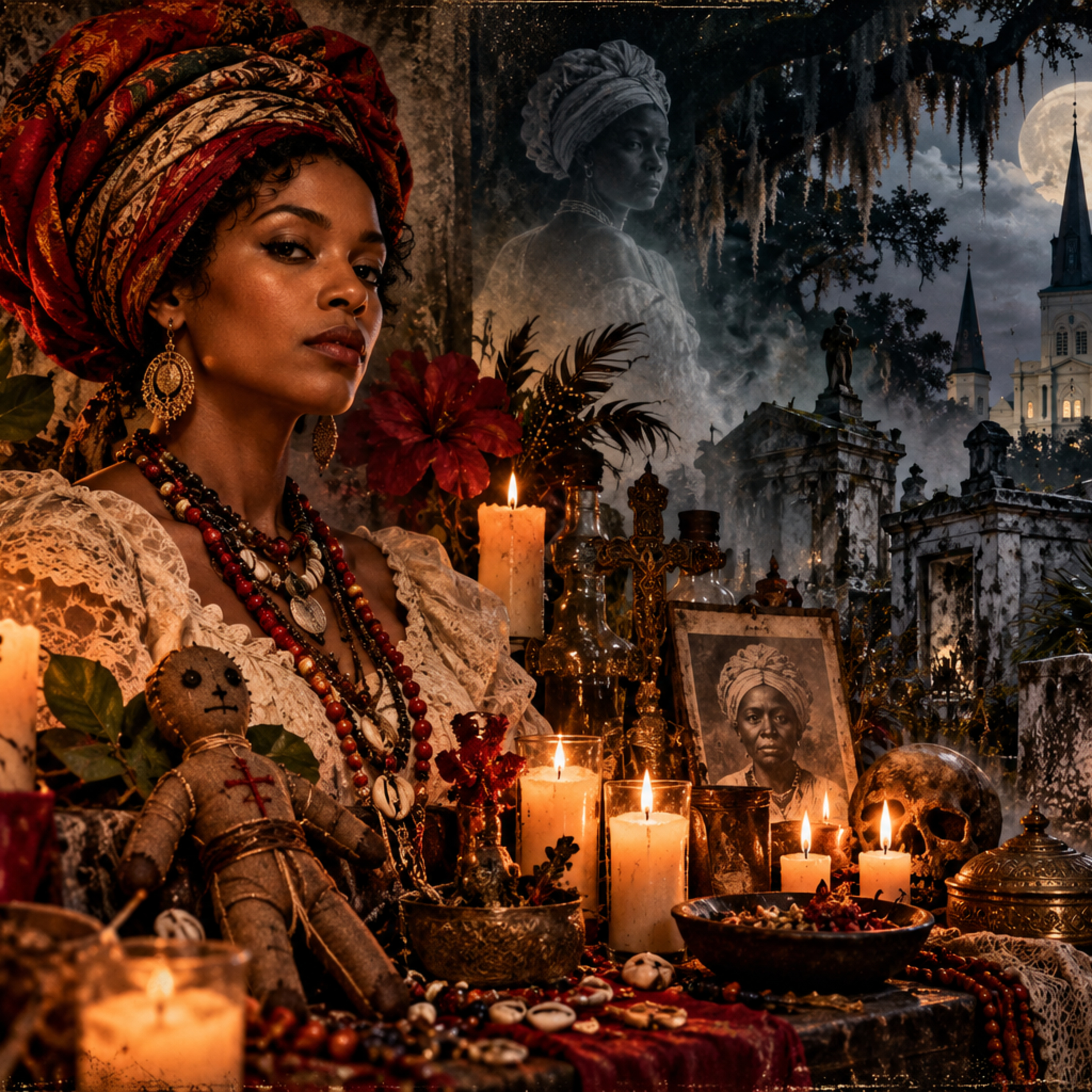
Night is beginning to fall over New Orleans.
Beyond the streets and courtyards, candles are being lit.
People gather.
Someone begins to drum.
Voices answer voices.
Bodies move to the rhythm, circling, singing, praying.
0:22
An offering is placed upon an altar, and somewhere between the beat of the drum, the movement of the dance, and the repetition of the words, a threshold begins to open.
You have to celebrate, you have to pray, you have to sing, you have to call and then they'll.
0:40
Come because within New Orleans, voodoo ceremony isn't something simply watched.
It is participated in the living call upon the dead.
Ancestors are remembered.
Candles burn beside photographs and offerings.
0:58
Music, prayer and movement fill the space.
An invitation to something beyond the visible world.
A big.
Part of it is that invitation.
We want the spirits to come.
We want for them to be venerated.
We want to hear the messages.
1:15
And sometimes, Rory says, the atmosphere itself seems to change.
It was almost like the atmosphere shimmered a little bit.
But for generations, another version of voodoo has existed in the popular imagination, one filled with curses, dolls, dark magic and fear.
1:38
Tonight, we're stepping beyond those shadows.
What I want people to just learn.
What I learned was that it's a beautiful religion with a a wonderful community, and it's really about agency, love and compassion and community.
My guest is returning friend of the podcast Doctor Rory O'Neill Schmidt, author of six books exploring history, culture, art, and the enduring mysteries of place.
2:08
Much of Rory's work is rooted in New Orleans, a city where history, spirituality, memory, and the dead seem to exist unusually close together.
Her books include The Haunted Guide to New Orleans co-authored with Doctor Rosary O'Neill, The Blood of the Baroness, and the book at the heart of today's conversation, New Orleans Voodoo, a Cultural History.
2:36
For that book, Roy didn't simply study voodoo from a distance.
She entered its sacred spaces.
Spoke.
With its religious leaders and practitioners attended ceremonies and experienced something of that world for herself.
A world of altars and ancestors of women in spiritual authority of Marie Laveau.
2:58
Of prayer offerings, ritual and possession.
Of drums, dancing and voices calling across a boundary between worlds.
And of a spiritual tradition that Rory believes that has been hidden behind misunderstandings for far too long.
3:17
So tonight you're going into those shadows, not in search of the video of Hollywood and horror, but of the living tradition that has helped shape New Orleans itself.
Because perhaps beneath the drums and the dancing, the candles and the prayers, lie something remarkably simple.
3:38
The desire to remember those who came before us, and the possibility that they may not be quite as far away as we imagine.
Hi, Rory, thank you so much for coming back onto the podcast.
Hi, Michelle.
I'm so excited to be here.
3:55
And it is just you this time, your mum is not able to be with us tonight.
So just wanted to preface that for those who love hearing your mother's voice and, and what your mum has to share because she has been such a a great partner for our talks with you.
So I just wanted to kind of make people aware in case they're expecting to hear her lovely voice.
4:14
Yes I know, I'm so sorry that my mom can't join us today but I did speak with her yesterday so I will try to incorporate what she would have shared.
But yes, her presence is definitely missed today and hopefully she can join on a future episode.
4:31
So obviously when we last spoke together, we were talking about New Orleans and just the the culture and the history and the unique presence that it has.
And one thing that kind of came up in that conversation that we could have spent so much longer talking about was obviously voodoo.
4:49
And we talked about how you'd written a book about it.
And we're going to have the chance to talk about that book in today's conversation.
Do you want to just explain to the listeners what first inspired you to explore New Orleans voodoo to the depth that you did?
5:07
And what you wanted to bring to that book, what you hoped it would reveal to people who who purchased it?
Yes.
Well, at first I would just say honor and respect one listeners.
You do not need to be afraid.
Voodoo is not something that's bad or negative or harmful.
5:27
And writing this book really provided me an opportunity to research and to study this religion because as a child growing up in New Orleans, I had seen things like voodoo dolls.
And I kind of heard the word and you shudder or you kind of avoid it or don't talk about it because there's this kind of invisible presence or power or fear that it often conjures.
5:50
But what I want people to just learn.
What I learned was that it's a beautiful religion with a a wonderful community.
And it's really about agency, love and compassion and community.
What makes New Orleans Voodoo so distinctive, then?
6:06
How does it differ from, say, Haitian voodoo and other African diasporic spiritual traditions with which it's often very much confused?
Yes, it's extremely complex.
And when I met with a voodoo priestess, Brandy Kelly, she owns a shop called Voodoo Authentica.
6:25
She she advised me, take your time with this, Rory.
You know, you really don't want to rush because you know, this religion is hundreds of years old and for several generations.
So what I learned about New Orleans Voodoo was it's really a specific flavor of voodoo.
6:43
And what's exciting about it is that it allows several different avenues.
You really sort of design your own spiritual practice with your solitary practices.
And there are no set rules or what you have to do or don't do or believe or not believe.
6:59
It's really a a creative and independent way of spiritual self study.
And so if we kind of stripped back then everything that Hollywood and horror and popular culture have really kind of tried to tell us and associate for us with voodoo, what would we find then at the heart of this religion and spiritual tradition that is different from that perception, would you say?
7:26
What is different from there's so many things, Oh my gosh, Michelle, so many things.
One, there's not a human sacrifice.
You know, you're not going to go to a ritual in New Orleans and there's blood, the practice that I went to the congregation, the priestess is actually vegan.
7:42
And so you definitely, you're not going to have any sort of sacrifice like that.
I think that what people are drawn to in entertainment and film with voodoo is, again, that evocative power, that mystery, and that's definitely real.
7:58
You know, walking into a spiritual temple, voodoo temple in New Orleans, you'll see these different Rada or Petro altars cooling or elements or fire elements, and they create these altars for the dead.
So ancestor reverence is part of it.
8:15
I learned early on from Janet Evans, another priestess in New Orleans.
She's inspired more the West African tradition, whereas Sally Ann Glassman is more of the Haitian tradition of voodoo.
But you walk into these beautiful spaces and altars, have pictures of maybe a a pet that died.
8:36
I'm looking at my altar right now.
I've got a picture of my grandparents, my childhood dog, my dad's mother who died in childbirth, who I never met.
And you, you also have Saints and deities too.
And so oftentimes these spirits are in the form of Catholic Saints that you also have on an altar.
8:57
So it's really this lovely religion where you want to be open to the spiritual world.
I know that you're open to the spiritual world or, or learning more about the mystery or the invisible powers that lie beyond that we can't.
We can sense, but we can't touch, We can't define, we can't cage, we can't control.
9:15
And that's the excitement about voodoo.
Is that the sense of agency.
You create an altar and you light a candle.
You provide an offering.
It might be, you know, a, a, a fancy barrette for Marie Laveau.
So Marie Laveau is the famous voodoo queen of the 1800s in New Orleans, was said to really had it be a very powerful voodoo leader.
9:39
She danced with snake in Congo Square.
She really said prayers and did a lot of devotional acts for people.
She's the entrepreneur as well.
And in her three tombs in Saint Louis Cemetery, there's 111 people buried.
9:57
She buried, I think, six of her eight children, but she took in other people in the community who didn't have any money and she didn't turn people away.
So I think learning about voodoo, it's again, it's about creating these altars, visiting these spiritual spaces, practicing in a with a congregation, and also just learning more about either our ancestors, what they might be teaching us or guiding us or the Saints or, or God might be trying to let us know these little taps on these shoulders of these pointing us in a, in a direction just to pay attention to that.
10:32
And voodoo wants you to trust your instinct, especially your intuition.
And what I also find fascinating and I love is that women are leaders and, and priestesses in the New Orleans voodoo practice.
So I was wonderful to see that these these female and male forces are equal.
10:53
And you touched on something there that I think is really quite important, which is this importance and significance of ancestor veneration.
You know, it's, is this connection, isn't it between the living and the dead that it's really quite integral.
11:12
It's, it's this ongoing relationship that the death is not the end.
And I don't know if you want to elaborate more on that in terms of how the dead, that relationship with the dead is also a part of New Orleans video.
11:28
I think that, you know, paying attention to our ancestors is really important because these are the people that pave the way for us.
And just because they're dead or there doesn't mean that they're not.
Their legacy isn't still around.
11:44
And so I think we need to really be grateful for people who have come before us, who've given us life, who've provided safety or opportunity, and also know that, you know, when we do die, I believe our souls go somewhere.
I believe death is not the end.
And that's a big part of Budo, which is extremely comforting to know that when we pass, we don't really have to ever believe we can be with the people we love.
12:09
We can be with our children or our grandchildren or, and just really provide support and, and help.
So I think ancestor veneration is important just to recognize all those that come before us and to acknowledge their beauty, acknowledge their gifts, acknowledge that their ability to to help others is possible still.
12:32
And to be open to that because, you know, with death, it's such a mystery.
But to be open to the fact that we can, you know, call on our grandmother or ask Marie Laveau, you know, can you, can you help me?
I'm going through a hard time right now.
I just had to clear up my office and move campuses.
12:49
This happened to me a few years ago and I just, I just needed some kind of support that was bigger than myself, you know, that to, to kind of give me that, that, that power, that energy, that wind, you know, beneath me to help me move through a, a precarious and, and terrifying time.
13:07
So it's, it's great to know that we're, we're not alone too.
So if, you know, sitting in a room or experiencing something, we can call on them and they can be with us to provide us, but we have to respect them and honor them.
That's very important.
So keep taking care of your altar.
13:25
You know, on your altar, you never would have pictures of living with the dead.
The dead are always separate on the altars and you want to provide things that they would like or, you know, make sure it's always clean and clear.
But just have this kind of respectful spiritual place.
13:42
And for me, just walking past, you know, my altar in my home, it's, it provides a sense of reassurance, you know?
Could you maybe take us inside a contemporary voodoo ceremony?
What might we see?
What might we hear and experience?
13:58
You know, when we're thinking about the the roles of prayer and music and rhythm and dance, ritual and offerings, kinds of things would take place.
I think before you go to a ceremony, you have to prepare yourself.
So with voodoo, just with other religions or other things you're studying, there's so much to be learned.
14:21
And even people who've been practicing voodoo for 20 years are still learning new things.
So for me, I attended a congregation in New Orleans in the Bywater area, and, you know, art and, and visual decorations and are all part of voodoo.
14:40
And I think that's why I'm drawn to it because there's such creativity and beauty there.
I'm grew up Catholic, so I'm used to, you know, white marble altars.
And you stand and you sit and you're allowed to speak at certain times.
And it's very much controlled.
But what's amazing about voodoo is it smashes that box, you know?
15:00
So we walk down this beautiful alleyway towards the temple and the wall, the fence is all painted with different skeleton creatures.
And you know, my sister who's with me, Rochelle O'Brien, who's also a photographer, she, she tells me this is a reminder that the skeletons, that's who we are, you know, underneath all the skin, that's what remains is our bones.
15:23
And so just walking through the hallway, through that alleyway and then entering the temple was this beautiful teal blue kind of Creole cottage.
And, you know, you walk into the space and there's a congregation that was maybe 10 people or so who pray every week together on Saturdays.
15:42
And they're all just very social people of different ages, races, classes.
And they're they're stretching.
Michelle, what is happening here?
You know, why are you stretching?
And I asked this one lady and she said, oh, there's a lot of dancing involved.
15:59
So I said, OK, this is who loves that?
This is going to be very physical and so it's right before sunset is when the ceremony starts.
So everyone's sort of socializing and doing these stretches and I speak with different people and just learn like any sort of stereotype or idea.
16:18
I have a voodoo practitioner was completely wrong with this one guy I worked at Whole Foods.
This other lady, she was a a graphics artist and a computer programmer.
And so people have these private spiritual eyes that are very powerful.
But the priestess, Sally Ann Glassman, she starts the ceremony and she guides the ceremony and she received a message through her meditation that we were going to be offering set.
16:46
Getty A particular Lois who is the God of death, regeneration and sexuality.
So here I am my first.
I'm writing this book on voodoo.
I'm there with my sister and I'm also there with my father who is friends with the priestess and introduced me to voodoo.
17:04
I'm thinking, what is going to happen here?
What are we?
What are we doing this evening?
But I'm open.
So Sally starts the Sally Ann starts the ceremony.
She actually has a machete and she pulls this machete from the temple and she makes a crisscross mark in the sky.
17:23
And this begins the ceremony to open the gates between the two worlds and to invite the spirits to enter.
A big part of it is that invitation.
We want the spirits to come.
We want for them to be venerated.
17:38
We want to hear the messages, we want to.
Some people want to be possessed and have that experience.
And so we start with cross Criss crossing machetes and don't worry listeners, no one's going to get hurt.
It does sound a little scary the first time, but then we're starting to be involved in lighting candles, dancing, singing, singing both English and a Haitian Creole.
18:06
There's often a calm response like I Bobo is what I remember people often saying.
And so it it's I could go on and on, but you know, there's a central pole in the in the temple and the temple had the concrete floor.
18:24
And Sally Ann warned us, you know, if you do feel faint or you do something comes a hold of you, do not fall to the ground and hurt yourself.
You know, slowly go to the ground or if you see a friend next to you going down, like help them down because that's just part of the process.
18:43
One woman did become possessed early on and, and again, the possession experience, it's not like the exorcist, no one's head is turning around.
It's basically just like other world religions where a spirit will enter the human body and you take on that form.
18:59
So the first person, this one of the Saints came to her and she kind of fell to the ground and she spoke in a different voice and people don't actually remember what they said afterwards, but she she was brought rum because this particular loa or Saint, that's what he really likes.
19:15
Another person, she became a different person.
She's talked in a really deep voice and she started smoking a a cigar and I said, this is this.
I talked to her afterwards.
This is petite woman from Alabama.
I said tell me about, tell me about this.
19:32
She said, well, I'm also Native American and part of our traditions have always been this possession experience.
And we're not always meant to remember what happens or what is said, but some, some part of us does retain that.
So, you know, we do have the possession experience happening that at one point there's sparklers that get passed around to, which is so fun and amazing.
19:56
And we're dancing around the central pole that actually is painted with a serpent.
So a serpent is also a sign for God or the benevolent God or even our sometimes it's the sign for the umbilical cord that connects us to our birth mothers as well.
20:13
And just this ritualistic walking in a circle and pacing and singing and just kind of being free.
The possession experiences do happen and it concludes, oh, there's also drummers there.
I should mention that.
20:28
So that's a big part of it.
Someone, you know, jumped on a on a bongo and was playing and that also calls in the spirits and invites them in as well.
And Sally, you know, and she reminded us, you know, you can't just sort of participate.
20:45
You really have to be committed.
You really have to be open and, and believe and participate for that to happen because the gods don't just come, you know, you ring a doorbell and it's delivered.
No, you have to, you have to celebrate, you have to pray, you have to sing, you have to call and then they'll come once they, this spirit's aside, it's it's the right time for them.
21:06
So I would just say it was an incredible experience.
I went to another a ceremony where we honored Laceren, who's like a mermaid God.
That's how she's visualized.
And one of the congregants was possessed by her spirit.
21:26
And because she's a mermaid, he couldn't stand.
Someone wrapped him in a sheet and had to lift him up.
It was, I mean, it was really incredible that, you know, these experiences that people are open and that we're learning and we're prayerful, we're finding meaning.
21:42
And we're, we're, we're part of the ceremony, we're creating the ceremony.
It's not a passive sitting down and watching and, and depending on someone else to read us something or tell us something that we should do or we shouldn't do.
It's really you have that empowerment and that agency and then activity and there's the possibility for the impossible, which is so exciting.
22:05
And I think just kind of following on from what you were saying, because I think it's so clear that, you know, things like the music, the the cool and the response, these elements of dance rhythms, all of these things aren't just there as this kind of atmospheric accompaniment.
22:21
They really are part of, like you said, this almost sensory full body experience that I think is interesting.
When you then look at, say, for example, 19th century Seance, you know, you can see really, really intriguing parallels.
22:37
You know, the fact that hymns or songs were sung in them, the fact that sitters would join hands, that they would say prayers or invocations that would be repeated.
They would alter the environment.
So lights would be lowered, candles would be lit.
22:53
They might have particular objects, sounds might be played.
Fragrance, scent was a big part of it.
And all of that became that association with the arrival of the spirits.
You know, this was the creation.
This was a constructed sensory threshold where, as you kind of just alluded to, something supernatural can then happen.
23:17
The ordinary sensory world has has been altered and that invitation of something in.
And, and I think, you know, we see these similar kinds of constructions when we look at different practices that actually there are real kind of similarities between them, real parallels between them of the use of sound, the use of scent, ETC, to just create this almost liminal space, this threshold where people can become very, very immersed and they can obviously then be very beautiful.
23:50
So yeah, it's fascinating when you kind of look at it and you can see those, see those parallels.
Yes, I completely I completely agree.
This idea that we could create a space for the dead or the divine to actually enter isn't that isn't that fantastic?
24:09
And, and it can be a part of community.
I mean, I think that's what faith is or spirituality.
Religion is to, to call on the divine, to have a relationship with the divine.
And, and part of the ritual practice is, is actually very active.
24:25
You know, it involves meditation and, and sitting and prayer, but it also involves things like, you know, you, you bring a piece of devotion, you bring a gift, you bring a gift to the dead to honor them.
I mean, it shows us that these people aren't really forgotten.
24:42
They're not gone.
If they like chocolate cake when they were alive, they're going to appreciate it and like it in death too.
I, I know I would, I would, yes.
So this idea of coming together, holding hands, singing, lighting candles, calling on the spirits, inviting them, you know, you really want them to come.
25:01
And you know, with the, there are even these like Christmas kind of twinkling lights.
And maybe it was it, maybe it was the twinkling lights or maybe I was just in this kind of trance state, but space felt different.
It was almost like the atmosphere shimmered a little bit.
25:17
And in the corner of my eye, I by the one of the altars, I thought I saw a man sit sitting down and then they'd vanish.
And later I met with Sally Ann because she's a big mentor for me and spiritual advisor.
25:32
And she wrote the foreword for the book.
And I said, you know, I thought I saw this guy.
And I described to her what he looked like.
Oh.
And she said, oh, that's Pere Antoine.
It was Pere.
It was her Haitian priest who initiated her.
She said, oh, yeah, he often comes.
25:48
I said, what?
So this idea, you know, we think about ghosts or spirits and taking on different forms so, you know, energy when we die.
But this idea that someone who had trained her in Haiti to become a priest and who she had a relationship with and, you know, he mentored her that he would come and really just kind of be like this proud father figure on the side or be this powerful presence.
26:14
And she told me about him.
He would come to New Orleans to visit sometimes.
And he told her, you're not going to believe this, Michelle.
He's a Haitian voodoo priest.
He told her that he doesn't like coming to New Orleans because there's too many spirits here.
26:31
It was too much.
It was too much.
And so I, I do think that something about New Orleans, it is a spiritual city, it is a haunted city.
It is a city that recognizes the dead.
It is a city that often believes and goes.
26:47
But I think people can can feel that that invisible, that force, that that power and and that mystery, which can be alarming even for the most devout and religious people.
And you mentioned a few minutes ago obviously experiencing the voodoo ceremony where someone has has had that sense of possession.
27:13
And I and I think it's sometimes described, isn't it, as ridden by a spirit?
What was it like?
I mean, seeing something like that, what was witnessing something like that for you personally?
Well, once there's the anticipation, you know, it's like you're looking at everyone, like, who is it going to happen to?
27:32
Because it doesn't happen to everyone.
It doesn't always happen.
And the priestess, she did this rattle and this prayer on my back, which is supposed to open you up to possession.
And she asked everyone individually and my dad and my sister declined, but I said yes.
27:47
So I, I, you know, I'm, I'm ready.
You know, it's like you're terrified, but but you do it any way and it's exhilarating.
So the possession experience for me, when I saw it, it was almost like it felt magical.
So Sally Anne was also possessed by this Lua or the Saint of life, death and sexuality.
28:09
And she put she grabbed a, a top hat that was on one of the altars and put it on.
And then she starts swaying her hips and kind of doing this kind of sultry dance.
And I said, and then she started purring and meowing.
I had thought, this is not, you know, Sally Ann.
28:25
She's an intellectual.
She she is serious and she really transformed.
But that's part of it is being open to that transformation and allowing your physical body to be almost like a cloak, almost like, you know, a portal for that spirit to just to be.
28:45
And it's only for a short time too.
But I think for me to know that different spirits may enter, it could be an ancestor, it could be another Loa, or it could be the the Loa that you're praying to.
It was really exciting to see the different forms that people's bodies took and how even this one Alabama woman, her voice and her face completely changed how she held her body changed what she was saying.
29:15
I mean, it was really, you know, it's, it's, it was unbelievable and the same time completely believable that this was happening in this space.
And just kind of following on from the discussion that we've had so far in terms of the significance of the ritual and the the various elements.
29:34
I mean, another big part of that is obviously the the connection with things like candles, herbs, powders, oils, charms, you know, these ritual symbols and Grigory, do you want to just talk us through maybe some of those objects and how they can acquire that spiritual significance?
29:54
Yes.
So I'm glad that you mentioned Grigory because that's another term that has often been maligned.
Grigory is like a, a special charm or an herb.
It's based on what you want to ask for a perdition God to help you with.
30:16
And so based on what you're praying for, it's a different, it's usually a bag with a collection of different sorts of of, of herbs and that's involved.
So again, the sense of agency of, you know, opening up a path or praying for something or wanting, you know, maybe it's a new job or maybe it's a new relationship that you can use these, these tools, they are spiritual tools like Grigri or even a candle, a specific candle to either honor one of the Saints or to be devoted to what you're asking the universe to help you with oils as well.
30:54
So I've been to a few different botanical these shops in New Orleans, One's in the New Orleans Healing Center actually, where you can purchase things and you know, it's just a nice reminder of, you know, even in my car I would have a little prayer card, just a reminder that like, OK, things get stressful in life, but we just need to remind ourselves that there's something beyond this life and that we're not alone and we could always ask for help.
31:21
So I would say all these these parts are incorporated.
There's also within New Orleans Voodoo something called Drapos, which are these beautiful hand sewn tapestries and they're usually made with sequins and they're just gorgeous.
31:38
They're depiction of the the different Saints and it's a spiritual practice to make these.
So art making is part of your spiritual practice.
So as you make this tapestry, you're singing these different prayers and you want to infuse that energy and that positivity and that reverence into the artwork that you're making.
31:59
And I think just kind of following on from that, I mean, you mentioned obviously how some of these objects these these kind of different things, they just, they have become so misunderstood, so maligned.
And, you know, I think another one of those is the so-called voodoo doll.
32:17
Do you want to just maybe share a little bit more about that in terms of what the reality is behind that image and what does its history tell us about the difference between, you know, the authentic practice and then the popular mythology?
For voodoo dolls So you know, when I was growing up in New Orleans for taking the streetcar down to the French Quarter with some friends when I was in high school, we went to one of these shops and there were voodoo dolls for sale And you know, I think a friend of mine bought 1 and you know, it's just this idea you can have this it's like a pincushion.
32:52
It's shaped like a almost like a gingerbread man off Often it's shaped like a body and you put the myth is you put pins or these needles in it that correspond to basically putting a curse or a hex on someone that you don't like.
33:09
So you want to cause harm.
But the biggest thing I learned in voodoo and I would love for people to come away with is that karma is a huge part of it.
So if you, if you call on anything bad, that evilness or that, that bad energy will come back to you threefold.
33:27
So voodoo practitioners do do not want to call on any sort of negativity of these of that now.
So this was, you know, this is something that's misunderstood.
It's it's been popularized and it's, it's people buy these voodoo dolls.
But in voodoo practice, there's actually historically voodoo dolls and in in New Orleans history and Louisiana history, the people who the enslaved this practice that they could not practice their there were laws, they couldn't practice their religion coming from West Africa.
34:03
And so they had to concretize or they had to change their practice into associated with like St.
Barbara the Saint, the warrior St. versus an ocean or, or an African Orisha.
But they would make the voodoo doll tradition in New Orleans that I learned is that people would make these dolls and from natural elements.
34:24
So I actually have two of my desk right now.
So they'll get, you know, pieces of of branches you find in nature because, you know, nature worship and realizing we come from the earth.
That's a big part of voodoo as well.
So they'll find Spanish Moss and they'll wrap it around a stick.
34:40
They'll get some beautiful fabric, like this one I have has sequin dress on.
They'll get some hair, either real or synthetic, create the face on it too.
And the voodoo dolls that are authentic are actually devoted to these different Saints.
34:57
So I have a doll that's Baron Samadhi, who's the guardian of the ancestors.
He's leader of the Gede and he's the protector of the grave.
And he's also the Lua of death and sexuality, which I thought was very interesting, like these kind of synchronicity that the one voodoo ritual I, I go to, I just happened to already have that particular voodoo doll.
35:22
So I felt like maybe he was, he was with me.
And then I also have another voodoo doll.
She is Brigitte and she is the warrior goddess.
And these two dolls were given to me and I just, I have them on my altar too.
35:40
But there again, it's like having a statue of Saint Christopher, you know, on your on your desk or on your altar.
They're really just reminders of these different spiritual people and presences that you want to honor.
And you also want to maybe ask for guidance from them and ask for their help.
35:59
And I think, you know, it's important to also recognize that using an effigy or a human shaped object in in ritual magic is not unique to voodoo.
It's not new either.
You know, this is something that has appeared across cultures and centuries.
36:15
You know, we see it in ancient Greek and Roman magic.
We see it in ancient Egyptian ritual where they had wax figures.
We see it in European folk magic.
We see it across many, many different cultures and, and religions and geography that dolls and figures certainly aren't unique to just voodoo.
36:38
I think it represents this wider world of folk magic that again, unfortunately has just had this stereotypical Hollywood sadly representation, which has has turned into something a little bit more sinister and something that makes people feel that they should fear it.
36:56
Which is, as we've kind of heard, it's, it's inaccurate to only see it one way.
And it's important to kind of strip back some of those layers to really understand the history, the significance in the ritual and the practice.
And, and in terms of that connection with magic, it again is just so abundantly rich and clear across so many different regions and periods.
37:19
So.
Yes, and I'm glad that you brought up, you know, the the different cultures and the world religions who also practice things like these effigies and having these kind of dolls or human like human forms.
Because it's just something that I think instinctually we want to make.
37:36
We want to connect with something that looks like us or represents a part of us too.
So it it is important that these tools are available in religions and different spiritual practices.
Absolutely, absolutely.
37:54
And, you know, just kind of bringing something in as well that you spoke about earlier because, again, I think this is a big part of of voodoo.
And that's the, you know, the people, you know, Marie Laveau, who you mentioned just seems almost impossible to separate from the story of New Orleans Voodoo.
38:11
Who was the historical woman then behind the legend?
Why does she remain such a powerful spiritual presence today?
And, you know, for people visiting, what can they encounter at places that are important to her, you know, places like the International Shrine of, you know, Marie Laveau?
38:32
What do we kind of experience when we look at places like that?
Marie Catherine Laveau was born in New Orleans in about 18 O1.
Now certain historical documents are are missing from the record, but this is the date that people believe that she was born.
38:51
She was born a free woman of color, and she grew up in New Orleans.
She got married around 15 or 16 years old.
And her profession was a hairdresser, a hair stylist, right?
And she grew up Catholic.
She was baptized at Saint Louis Cathedral.
39:08
She went to Mass every day.
She was a very religious person.
And her mother and grandmother also practiced some voodoo.
So as a child, she was exposed to it, but she didn't practice it very often.
It wasn't until later in life when she started to have terrible tragedies happen to her that she turned to voodoo and she started to develop her own voodoo practice.
39:35
And she was such an amazing person, such generosity.
You know, she would go visit the jails, visit people in prison, and she would bring them these different medicinal herbs, and she would say prayers for them.
And she would want to help the sick and the imprisoned and people who have just been thrown away, you know, by society.
39:55
She wouldn't forget people.
She would open up her home if someone needed a place to stay.
And I think that with her, her benevolent nature and, you know, being in the community, you know, when you're a hair stylist, it's like you could often see people at their worst or people really unload oftentimes on their hair stylist.
40:17
And they had formed these very close relationships.
So she was able to provide friendship.
Of spiritual counsel to people as well.
And people in New Orleans who didn't even practice voodoo because they had so much respect for her.
They would go to her and ask for her help or ask for Gregory or ask them to, to help her open the gates to something.
40:36
So she, she really drew a crowd.
So Congo Square on Sundays was this huge square downtown where people would congregate and she would lead a ceremony where she would dance with a snake and she would say prayers.
40:55
And, you know, one thing I learned was knocking on the ground three times was supposed to open a gate, so opening that path.
But she empowered people and she gave people that sense of agency through voodoo, especially those who didn't feel like they had any power, who felt like they didn't have any control as well.
41:16
And so she developed this great following of people who supported her.
And, and today, you know, she's still revered.
So I actually just brought out my statue of Marie Laveau.
So Ricardo Puccino is the local artist.
41:33
He created this statue of Marie Laveau and it was included in one of the parades in New Orleans as sort of a, an to honor her.
And people loved it so much that they actually formed this shrine.
So this this shrine is actually at the New Orleans Healing Center where you can go and say a prayer, leave flowers for her.
41:56
They have a little prayers stool.
You can, you know, you can kneel on a kneeler.
But she was this really wonderful person.
And some people say they've seen her walking, they've seen her spirit, her ghost in the Quarter.
She was a breathtakingly beautiful woman.
42:14
And at the time they had these, these laws that women of color had to wear these Ting Yong, which is like a scarf of the hair to again, to try to cover up some of their beauty.
And so she's seen wearing a Ting Yong, this statue that I have, she's wearing a red one and she has a blue cloak, but she's almost like when I prayed and when I, I went to the altar, it was almost like a mother of Mary figure.
42:37
She's cloaked in this light blue dress.
She's very welcoming, yes.
She also has a snake, you know, in the statue.
But it's not something, again, to be fearful of.
It's again, just to show that connection to the divine and also that that sense of power.
42:53
But I would say that for Marie Laveau, in the past, her grave at Saint Louis Cemetery was, was, I think, visited almost as much as Elvis Presley's grave, right?
So all these different people whose devotees would go and they would, you know, and people who didn't believe, just were curious about her would go visit her grave or say prayers to, to her.
43:16
I and in 2016, they actually had to close the cemetery.
And you could only go if you had a, a pass from the archdiocese, either you're related to someone who was buried there.
You had to really have some sort of special permission.
But a friend of mine is a priestess and she says that she'll go and she'll just sit outside of Marie Laveau's tomb and just talk with her.
43:38
You know, try to get her wise counsel.
So you can visit her tomb if you're on a cemetery tour when you visit New Orleans.
So again, in New Orleans, we have these above ground tombs, these Crips because we're we're under sea level and so people aren't buried underground.
43:56
But you can visit her tomb.
And I would definitely want to visit her shrine, if you can, at the Saint at the New Orleans Healing Center.
I mean, to me, I just think what strikes me so much about her is just that she had such incredible power, and that power just wasn't simply something people attributed to her after her death.
44:19
You know?
Here was this woman navigating race, navigating gender, religion, social hierarchy in a kind of a time when that wasn't necessarily something easy to do, you know, But she was just this amazingly resilient, strong woman.
44:39
And I think that's partly why her legacy has become so powerful.
This, you know, this legend has grown around a woman who was already extraordinary.
And it kind of makes it such a big part, I think of the the story of voodoo, her presence that it is, it has almost cast this supernatural kind of glow on the landscape.
45:00
It's become something inseparable, which again I just think adds to the mystique and the and the magic of what draws the place in for people.
Yes, I yeah, I, I definitely think that she is a beautiful symbol of New Orleans.
45:17
I mean, talk about power, beauty, strength and resilience.
I don't know how many hurricanes have come to battered New Orleans, but the people in the city survive somehow.
When she died, there was an article written in the New York Times about her.
45:32
I mean, this is how much of A stretch and a reach she had.
She was an incredible spiritual leader in New Orleans.
And she also practiced Catholicism.
You know, her children were also baptized by a priest, you know, in a Catholic Church.
45:48
And so she did believe in prayer.
And maybe she is a St.
I mean, I don't know.
I think it, she did so much goodness for people when she was alive.
Maybe that generosity and goodness is extending.
So, you know, I would never say anything negative about Marie Laveau because I, I do think that she is a powerful spiritual force and she means to, to do good things in the world.
46:15
And I think she really sees people for who they are and she wants to protect people.
I think she she wanted to do all that she could to to help other people in the community.
And you kind of touched on this earlier, but I think it is worthwhile just bringing it up again because of obviously the connection with Marie Laveau.
46:37
But the book that you wrote obviously really looks at and emphasizes the role of matriarchy and motherhood and women.
And you know, again, here with Marie Laveau, we have a strong woman, a woman who especially as a black woman, a woman of colour who is denied authority, who is denied agency in so many ways.
47:01
But here she is this central figure, this, this spiritual authority.
And again, what's so exciting is that, you know, voodoo has women as very important figures.
And again, I don't know if you want to elaborate on that in terms of why women traditionally have held so much spiritual power within New Orleans voodoo.
47:26
Oh, of course.
I mean, I think that's that was really exciting for me as a woman just to know that there were women spiritual leaders, that women, you know, had a sense of agency.
I met with one of the preeminent scholars on Marie Laveau.
47:43
Her biography was Doctor Martha Ward, and she helped me to understand it.
I just wanted to read something to you.
You know, she said that voodoo is all matters of love, luck and the law, and that people seek out voodoo to gain agency in this really troubling and chaotic world.
48:00
And she said, and this is what I just love, Michelle, she said, you know, you want a divorce in a Catholic city, voodoo.
Your husband needs a job, voodoo.
You want him to be faithful, voodoo.
You want him out of your life forever.
48:16
Voodoo.
So voodoo was a way for people to find solutions and to create solutions.
I mean, I think that's what's really exciting about for women and for men too.
But to, to know that it was an outlet for you, that you had power, that you had control, that you could create something, you could change something.
48:37
You had the energy to make what you needed to happen, happen.
And, and it it happened through spiritual intercession.
It happened through the spirits coming in to your life for me too, writing this book with my mother, Rosary and yeah, I'm sorry she couldn't join.
48:55
It was a wonderful experience for us to to grow spiritually and to learn more about a faith that growing up in New Orleans really wasn't openly shared or clearly explained people because of so much hostility or prejudice or lack of understanding.
49:18
It was practice in the shadows and it was solitary practice, right?
Because people don't want to be judged or punished.
And I met a priestess, Brandy Kelly.
She actually started the first voodoo festival and she said we need to take voodoo out of the shadows.
49:35
You know, she's another great voodoo priestess and great woman leader.
And tell people about really what it is like, the music that's involved, the prayer, the community, the food and people coming together at a festival, the celebration.
It's not about sadness or darkness or hexes or evil.
49:52
It's about life and joy in the future.
And this idea that we continue on, our souls continue on, we're not.
That's not the end.
So I think that the matriarchy component of knowing that women can be leaders, but also knowing that women practitioners can have their own sense of spiritual tools and control and power to create things.
50:17
And they don't need, you know, intercession from someone.
You know.
They don't need confession.
They don't need someone to pray for them.
They can do it like women can do it themselves, which is very exciting.
And I think again, you know, coming back to looking at and examining other cultures, we see how she fits into this much wider pattern in which women could hold considerable ritual, spiritual or community authority.
50:44
I mean, we, if you look at the ancient Greece, for example, with the oracles, the, you know, the Pythea at Delphi, the the Vestal Virgins in, in ancient Rome.
If we look at Shinto traditions in Japan where women served as spirit mediums, you know, they were taking part in divination, ecstatic religious practices.
51:06
I mean, I could literally write a long list of of cultures that I'm aware of of where women have been central in terms of those spiritual practices and rituals and their presence in the community felt.
And I think alongside that, what is, again, an interesting recurring pattern across these different cultures is how often societies that restricted women's formal political or institutional authority could could see, you know, act as healers, diviners, priestesses.
51:41
And then alongside that, you know, they would be revered when they were culturally sanctioned, but then often criminalized when they fell out of acceptance and accept, you know, fell out of those accepted structures.
So you kind of see real kind of patterns in history with other cultures about the question of women's spiritual power and when that power becomes dangerous and when you see often, sadly, these same figures then targeted in order to be silenced.
52:09
And I think that comes back to a question that we've spoken about a number of times about female agency and female voice and how they can that can be celebrated and also really feared.
And I think Marie Laveau is another example of that.
52:25
Yes, exactly, exactly.
And, and to think that, you know what, if women were the leaders and the world leaders, how, how different would our world be if women's spiritual leaders were, were in charge?
And I think that there is something that people might feel like it's dangerous, you know, of, of, of someone who had this strong psychic ability or spiritual ability or healing ability.
52:51
It can be very scary.
So I think that it's important to be open and to, to Revere what is sacred and, and also just to, to respect people who are practicing their spirituality, knowing that there there is always danger in Society of either being judged or, you know, you said criminalize this idea of being an outcast too.
53:15
But in spite of that, to still want to be true and authentic to who you are, to trust your intuition, to have a deep prayerful life and to want to to use that to help other people.
And can I just take us back to a conversation that we had last time when we were talking about New Orleans, because you shared an experience in your relative's home where, you know, there was a ritual, there was kind of voodoo element to kind of help with what was happening.
53:48
And it might be worthwhile just kind of revisiting that experience because obviously you involved Sally Ann Glassman to perform this ceremony.
And it, you know, that might be a good chance to explore more about the, the ritual, the significance then of what she was doing as part of that experience, how they kind of tie together.
54:09
When I was writing this book, I open myself up to learning more.
And I think that when we, if any, you know, if anyone's kind of seen ghosts or have been open to the paranormal, it's, it's wonderful to be open, but you have to have to, you know, protect yourself, make sure you're not too open.
54:28
And so as I'm studying voodoo, I'm in New Orleans and I'm staying at a relative's basement.
She had a bedroom available and you know, there's always something creepy about basements.
I don't know, just being underground, being alone.
54:45
And this particular space has has flooded with four feet of water in it before walls ripped out.
So I'm in staying in this room, this bedroom alone in New Orleans and I, I had a few different encounters that terrified me and one was being visited by this.
55:07
I thought I saw a ghost in, in the house.
I woke up feeling like someone's in the room, which is often, I guess you know what you had shared me like 70% of people's experiences.
You feel like something there and you don't see anything.
Or maybe you feel the, the mattress move like someone's taking a seat on it, but then you sit up and no one's there.
55:25
So, and I looked up and I saw this man who looked ancient and, and then I, I turned over like this is a bad dream or this isn't right.
And then I, I felt him and saw him circle the bed and come lean towards me and look at me and I sat up and then I screamed out, you shouldn't be here.
55:46
And he vanished.
So I, I again, I'm open.
I'm studying voodoo as a religion.
I'm, I've had ghosts, a haunted house I lived in as a kid in New Orleans.
And I'm, I'm not feeling this.
And this room doesn't feel safe anymore.
You know, I feel like my, it felt like it was a real person.
56:03
It felt like I could touch him, you know, like I was an intruder in the home or something.
It didn't feel like a vapor.
It was a presence and it, it wasn't a positive presence.
So that's what I'm learning too with studying videos like trust your instinct.
It's usually right.
And then another night in the same home, I looked up and I saw this, this man standing like a zombie with his arms out in front of him by the bed.
56:27
And that also freaked me out.
He didn't say anything and he didn't even make eye contact.
He was just glaring straight ahead.
And then another couple nights I had, I heard children playing outside my door.
And then the I think the last straw was I was sleeping and this ghost of little boy pulled my ponytail.
56:44
When I shared that experience, a woman told me that wasn't a ghost, that was a demon.
So again, I'm terrified, but I'm committed to research.
So I'm staying at my, at this relative's home and I'm, I'm experiencing these things and I'm telling my family members and I'm telling my dad and he says, you know, you should call Sally Anne.
57:02
She'll help you.
So Sally Anne is this beautiful, spiritual, strong, fearless woman, a lot like Marie Laveau in that even if she's, it's, it seems scary, she'll still be there for people in these dark times or these times of being of uncertainty.
57:19
And she, I told her my experience and I, and she didn't ask too many questions.
You know, she wasn't trying to analyze me or say that I was hallucinating or losing my mind.
She just trust me, She listens.
She offered help, She said she told me these different tools to get.
57:39
So it was a big metal bowl, a bottle of rum, some leafy green vegetables, some cornmeal.
So there's a few different items she told me to have prepared in the house.
I said, OK, no problem.
57:55
And she said now when I come to the house, it needs to no one can be there.
I need to be alone.
I'm thinking, OK, why?
Why does she want to be alone?
What is she going to do?
I'm like, I'm studying voodoo.
I want to learn, you know, But I'm also terrified because it doesn't feel safe.
58:12
And so I said that's fine.
She came.
She was, I think, dressed all in black and then she changed into all white and I took her downstairs to the basement and I said, and I cut chills like my legs.
58:28
I could feel them like get goosebumps walking down these stairs.
And I told her Sally and like it, it, it just it this place doesn't feel good to me.
I just don't I don't even really want to come down here.
And she said, well, you don't have to.
I said, I don't I I used to sleep here.
58:45
I sleep here sometimes, but I just doesn't feel great.
And she said because at that point when she was doing the ritual, I had decided I couldn't stay in this house anymore.
And so I said, I can't sleep here anymore.
And she said it's a good thing you don't.
59:02
Oh, So then I'm like, oh gosh, she's picking up something too.
So there's an unfinished base.
There's an unfinished kind of storage area in the basement too.
And I said, I feel like a lot of it energy energetically is coming from this area.
I'm like, is it possible there's like 4 Texas where there's a lot of psychic activity or spiritual activity with ghosts or spirits moving in and out, which I learned some parts of the world, the veil is thinner.
59:27
Maybe New Orleans is one of those places.
And this basement area definitely has something happened.
And Sally, Sally ain't even asked.
Like, I wonder what happened in this house, you know, I wonder what happened on this land here, you know.
And so I, I gave her a tour of the downstairs or the bedroom and then I left and she said it.
59:44
The reason I don't want you here is sometimes spirits attached to people and they seem drawn to you and they might want to attach to you.
So OK, all right, so I'm out of there.
Leave, maybe come back about an hour or two later.
And she has said, she explained to me what she did.
1:00:03
She said, you know, Rory, I don't think it was 1 ghost.
I think it was a family.
It's like, Oh my gosh, a family, you know, So you think of a family.
You think like you got to have compassion.
Maybe this family lived here before and something happened and they're just stuck.
She said they're a family and I told them I encouraged them to return to the elephants to, to share this house with this new family so that they could enjoy it.
1:00:28
And she said I got the sense that they didn't want to leave.
You know, she's clearing the room.
She was doing this chanting and singing.
She also said she was going to make a lot of noise.
So talk about like power and agency.
She's taking this like metal pan and pots and she's just banging and screaming at these spirits to leave, to evict or to to move on.
1:00:49
And she said one spirit traveled from the basement upstairs to like the up the living area of the family and then moved up to the basement, up to the up from the basement to the attic and was trying to hide in the attic and did not want to go.
So, so she also, so she did, I think bringing the these ghosts or spirits or this haunted space, A sense of solace.
1:01:14
She took the cornmeal and she made these ancient ritual shapes called the vase.
So the vase are they're often like curved lines and different symbols.
So you could almost think of it like a, a Chinese histograph.
1:01:31
And she would drop the cornmeal into different shapes, like a sand painting on the ground of these ancient symbols.
And it did create a sense of, I don't know, peacefulness.
When I returned to the basement, you know, she lit candles to she had to take a shower afterwards.
1:01:49
She said, I need to just get this, this toxins energy off of me.
But she said, I think that I think that they're gone and I think that the space is, is going to be better.
And when I returned, I felt like it definitely was.
It felt like a lot more Placid and calm downstairs.
1:02:07
It still feels something's present.
You know, I'll, I'll stay there in this house.
Again, it's not my first, oh, it's my first person kind of scared down there.
But it definitely feels a little better, which I'm really thankful for that Salian was able to to help our family with that and maybe even help the ghosts or the spirits that were there.
1:02:29
So how important then do you think places to New Orleans?
We do.
I mean, if we were to map the tradition across the city from Congo Square to cemeteries, shrines and other sacred locations, what kind of stories would that landscape tell us, do you think?
1:02:47
And how about, you know, the the public gatherings, the processions, the ceremonies in terms of how they've maybe helped to keep those traditions visible and alive over time?
Yeah, I would say that, you know, all of New Orleans is open to everyone and to spiritual practice and to voodoo.
1:03:05
So voodoo doesn't just live in a cathedral or a church, you know, or, or just even a voodoo temple.
It's really everywhere in the community.
So, you know, visiting Audubon Park or, you know, seeing these huge oak trees, you feel like the spiritual mist or the spiritual nature of New Orleans.
1:03:22
Even going to Bayou Saint John in New Orleans too.
There's different special practices or religious ceremonies.
So on June 23rd every year is Saint the the Feast of Saint John.
And on a Magnolia bridge over Bayou Saint John in New Orleans, not far from City Park, there's voodoo practitioners who come and who celebrate and they take part in washing people's head.
1:03:52
This again, other sacred ancient practice and also their feet and everyone wears white and they have an altar there too.
So the feast of Saint John is, is, is pretty a big event in New Orleans in the summer.
They'll also run the Day of the dead.
1:04:07
They'll have events too, where people again were praising or saying prayers, honoring and venerating our ancestors.
So that happens in November, and that'll happen at the New Orleans Healing Center too.
But you know, just in New Orleans, I'd just be open to different people who are practicing religions and practicing voodoo.
1:04:31
It's for me, it was all about respect and building a relationship as an outsider coming to the community.
Generally people are very welcoming, but sometimes, you know, they're suspicious because it's, it's that people who practice voodoo have not been respected and they have been harmed.
1:04:49
So forming relationships with people going to these different spiritual shops, like Isle of Salvation Botanica, that Sally Ann's shop or Voodoo Authentica, that's Brandy Kelly's shop in the quarter.
You'll be able to, to get, you know, buy these different spiritual tools like herbs and candles and oils and Grigory and Drapos and you know, voodoo dolls.
1:05:13
You will to buy it all, but also at these different shops.
I'd encourage people just to try to speak with the owner, try to speak with the preachers, or try to even schedule a reading with someone because they could.
You know some people do the spiritual readings and they could also just give you great advice and help educate you on understanding more of the religion and they might even invite you to one of their ceremonies.
1:05:39
And I'm curious, you know, in terms of what you think about how Voodoo has shaped, you know, the visual art, music movement and the, the wider cultural identity of New Orleans and, and maybe how in turn that has, you know, reshaped Voodoo itself.
1:05:56
I met with a scholar, Steve Doctor, Steven Weimar out of Vermont, and he was talking to me about New Orleans and the Mardi Gras festival, you know, Carnival each year and liken it to other world festivals where, you know, in New Orleans we like to party, we love to celebrate Carnival, we love food, we love art, we love music, we love dancing, we love celebrating life.
1:06:23
And I think it might be because of this uncertain nature of New Orleans, we're kind of always on the precipice of life and death there with a hurricane coming or some, you know, just natural disaster happening.
And so we love to to celebrate and celebration in New Orleans.
1:06:41
You know, it might be jazz.
It might be, you know, just even Rock'n'roll in New Orleans, there's so many incredible visual artists and musicians.
Even my sister Rochelle has a band.
You know, there people are always making art and celebrating it.
And it's not something that's just done in private, it's done together.
1:06:58
But if you do have the chance to be in be in New Orleans for Mardi Gras, it's very exciting because on that special day on Fat Tuesday, there's something called the Bone and Skulls game.
And this gang is a spiritual practice.
1:07:17
A big part of voodoo iconography are symbols of death of skeletons and skulls.
And at first that seemed like kind of scary to me.
But the reality is this is who again, who we all are underneath and this is what's coming for us like no one escapes death.
1:07:33
And so the bone, bone in Skull Cross gang, they are dressed in outfits, dressed like skeletons.
They have huge paper mache bones.
They have big masks on.
They might have paper mache skeleton heads.
1:07:50
And they walk around New Orleans admonishing people to have good behavior.
And you know, again, Mardi Gras in Carnival is about celebrating.
It's about dressing up.
It's about losing your inhibitions.
It's, and that's welcome there too.
1:08:06
So you'll see at Mardi Gras, you might see them, you know, I'm telling people, you know, you better behave, you better be good.
And then also in the parades, you might see Mardi Gras Indians marching too, which is sort of like a spiritual cousin to Voodoo where people process in the parades and they have these gorgeous costumes on.
1:08:27
They're like hand stitched.
It's almost like a, a tapestry worn.
And they have, they often might have headdresses too.
But when I met with a priestess who makes 2 marches with the Mardi Gras, indeed, it's like a it's like a walking altar.
1:08:42
So when she makes her costume or her her piece that she wears, she'll sing and she'll say prayers and people choose what they're devoting their Mardi Gras Indian, their cloak to.
It could be a baby that died.
It could be to someone who they recently lost.
1:09:00
So that spiritual practice is is woven into even Mardi Gras, even the most exciting celebratory time of in New Orleans.
There's time for God.
There's time for spirituality and prayer.
And there's no kind of doubting that New Orleans now that just has this enormous tourist industry that's built partly around voodoo, you know, ghosts and the supernatural.
1:09:25
And I'm curious, you know, has that visibility helped preserve and celebrates voodoo or, you know, does it have the potential to risk it turning into this almost living religion into a into a spectacle?
Well, I think everyone should know about voodoo.
1:09:42
You know, I mean, I, I think people are just like people are drawn to New Orleans, they're drawn to understand like voodoo, what does this word mean?
What does it, what does this spiritual practice mean?
And so I think it's, I think people who are respectful and who want to learn about voodoo, definitely come ask questions, participate, but just, you know, know that it's a religion like other religions in the world.
1:10:06
And it, it deserves that sense of reverence and respect.
Even if you don't believe, believe in what they're doing or it doesn't resonate with you, That's OK.
I'm just always sensitive to with, you know, and when a, when a shop might be called Voodoo and it's not actually voodoo or a, a hamburger called Voodoo.
1:10:25
I mean, it's just like, that's not that's not respectable.
So I think it's important for companies and businesses to, if they want to support voodoo, to do it in an authentic, you know, mature, appropriate way.
And, you know, people, sometimes they do it at a mistake.
1:10:42
And so just noticing that sometimes you have to tell people that, you know, that actually isn't correct or explain to them what a voodoo doll really is or show them.
But there's definitely places in New Orleans like these different botanicas that, that have Voodoo practitioners who work there and then who have these different spiritual elements that are available.
1:11:05
And there's spiritual communities who invite the public to, to join the congregation or to join a, a special event like for the Day of the Dead or St.
John's Eve.
And so I would definitely come and, and, and check it out and see how Voodoo fits into New Orleans culture.
1:11:22
It's a big part of who we are and I think New Orleans does a good job with their tourism or even on the website explaining what voodoo is in a respectful and clear and correct way.
So that really is important with leadership and tourism to to show what what voodoo is because people do want to know.
1:11:42
And just coming back to your book, New Orleans Voodoo, I mean, I, I, I want to kind of stress this because the amount of research that went into the book, the fact that you participated in ceremonies, you've visited sacred places, you've spoken to different religious leaders.
1:12:02
So much time and effort and care went into what you to crafting the book.
And I just wanted to kind of give you the chance to, to share with the listeners what your hopes are, what you hope someone who maybe has associated voodoo previously with with other ideas, what your your, your hope is basically to them if they pick up your book, if they read the book, what do you hope for them by the end of it?
1:12:31
By the end of the book, I hope they see that and recognize that New Orleans voodoo, which is a very specific type of voodoo practice, is a beautiful spiritual practice that has an incredible community.
1:12:47
I hope that people read the book and might even find different tools, spiritual tools that they might pick up and use, like making an altar at home.
It can be very simple spiritual practice to do.
I would just say just try to keep learning more, reading more and understanding different people's interpretations.
1:13:06
I'm having that open mind and I think there's a lot more to learn about voodoo.
I mean, one person told me as a Nigerian artist I interviewed, he said that there are so many Luwas or these Saints.
There are like thousands, Michelle, like we couldn't even count.
1:13:24
It's like, you know, Greek gods and goddesses.
There's so many spirits that can be learned and Federated and respected.
And so just knowing that there's a wealth of information to learn and to see, how can voodoo help you?
1:13:41
I mean, if you're listening to this, maybe that's the spirit's encouraging you to.
I mean, someone told me that you don't find voodoo.
Voodoo finds you like maybe it's showing up.
You know, I believe that things happen for a reason.
And maybe your curiosity is, is, is leading you somewhere that you can develop or understand more of, of who you are or what your belief system is and, and where you want to move forward because you are in control.
1:14:07
And Voodoo provides an Ave. to really to create, create mystery, but also to to celebrate and to create joy.
So yeah, I would love people to understand Voodoo a little bit more, to be excited about it and just to cherish it because it is a really special spiritual practice that is open to anyone and everyone.
1:14:32
And you don't have to abdicate.
Like for me, being Catholic, I can still be Catholic and practice Voodoo.
So I think that's really important to know too.
And hopefully Voodoo will help you.
And I'm so curious, just to finish with this final thought, you know, if we if we could remove somehow voodoo from the history of New Orleans all together, you know, how different do you think the city would be today?
1:14:58
How would how would it compare to what it is today?
Do you think if it if it was something that we could remove?
Yeah, I think it would be sanitized and controlled.
I mean, if there was just one accepted spirituality or religion and this idea of a voodoo, this ancient practice not being respected or permitted or allowed, it forces people into the shadows.
1:15:25
And, you know, it forces people into being alone or being isolated and practicing.
And people can still practice in that respect.
But I, I think that voodoo has the capacity to help a lot of people.
And you shouldn't hide something or you shouldn't talk bad about something that you don't know.
1:15:42
You shouldn't hide something that's is useful and that's is glorious.
So I would say with Voodoo, without it being there, you definitely miss a key part of what makes New Orleans this beautiful and rich in complexity.
Honestly, Rory, thank you so much for joining me again and taking us into this incredible history.
1:16:01
You know, just the beliefs and the traditions of voodoo with the, the care and the nuance you bring to the conversation.
You know, it's, it's fascinating to be able to discuss and move beyond some of the, the familiar stereotypes and the misconceptions and explore the real people and the real practices and the cultural history behind them.
1:16:24
You know, particularly the importance of ancestry and community and figures like Marie Laveau.
I mean, it's honestly, it's, it's always a pleasure to, to talk with you.
So thank you again for coming along and sharing your knowledge and your passion and your expertise.
1:16:42
So.
Thank you.
Thank you, Michelle.
Thank you so much for all that you do with the community.
And I learned so much just from speaking with you today.
I appreciate you.
And as always, of course, I will make sure in the links to the podcast description notes and on the website that, you know, links back to your books, not just this book that we've been talking about, you know, but all of your books.
1:17:04
There weren't, you know, previous books that we've talked about.
All of those links will be readily available.
So, you know, if people are interested, you can pick up New Orleans, Vidu or any of the other ones that we've previously spoken of.
I will make sure that those are all easily signposted.
Oh, wonderful.
1:17:20
Thank you so much.
That's that's incredible.
I really appreciate it.
Yeah, my friend lives in Washington DCI went to high school with and she she said she saw my book there.
I said, wow, even in Washington, DC, people are interested.
So it's it's great to see to have it available.
You know, it's an ebook or also I think we're going to do it, an audio book and the new year for the voodoo books.
1:17:43
That will be fun as well.
And I will say goodbye to everybody listening.
Bye, everybody.
Thank you for joining us on this journey into the unknown.
If you enjoyed today's episode, please subscribe, rate and leave a review on your favorite podcast platform.
1:17:59
You can follow us on social media for updates and more intriguing stories.
Until next time, keep your eyes open and your mind curious.


 Podcast Addict
 RSS Feed
 Apple Podcasts
 Spotify
 Amazon Music
 Overcast
 Castro
 iHeartRadio
 PocketCasts
 Castbox
 Podchaser
 TuneIn
 RadioPublic
 Goodpods
 Podyssey