Jamaica Inn: The History, Hauntings and Folklore — A Treasure Trove of History, Mystery and Memory
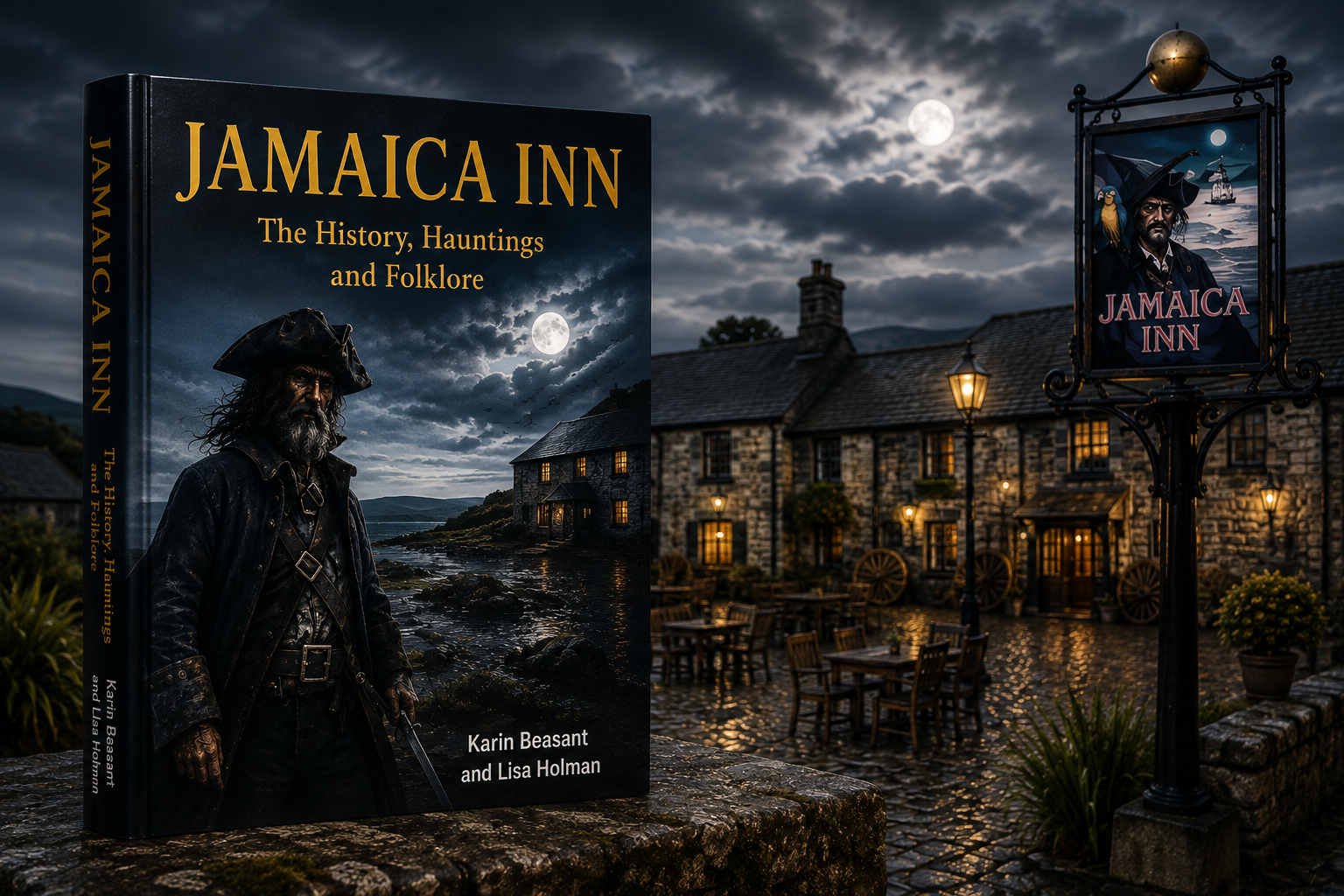
Every so often a book arrives that you find yourself completely absorbed by. You start reading a few pages, perhaps intending to come back to it later, and suddenly you are somewhere else entirely.
In this case, somewhere on Bodmin Moor.
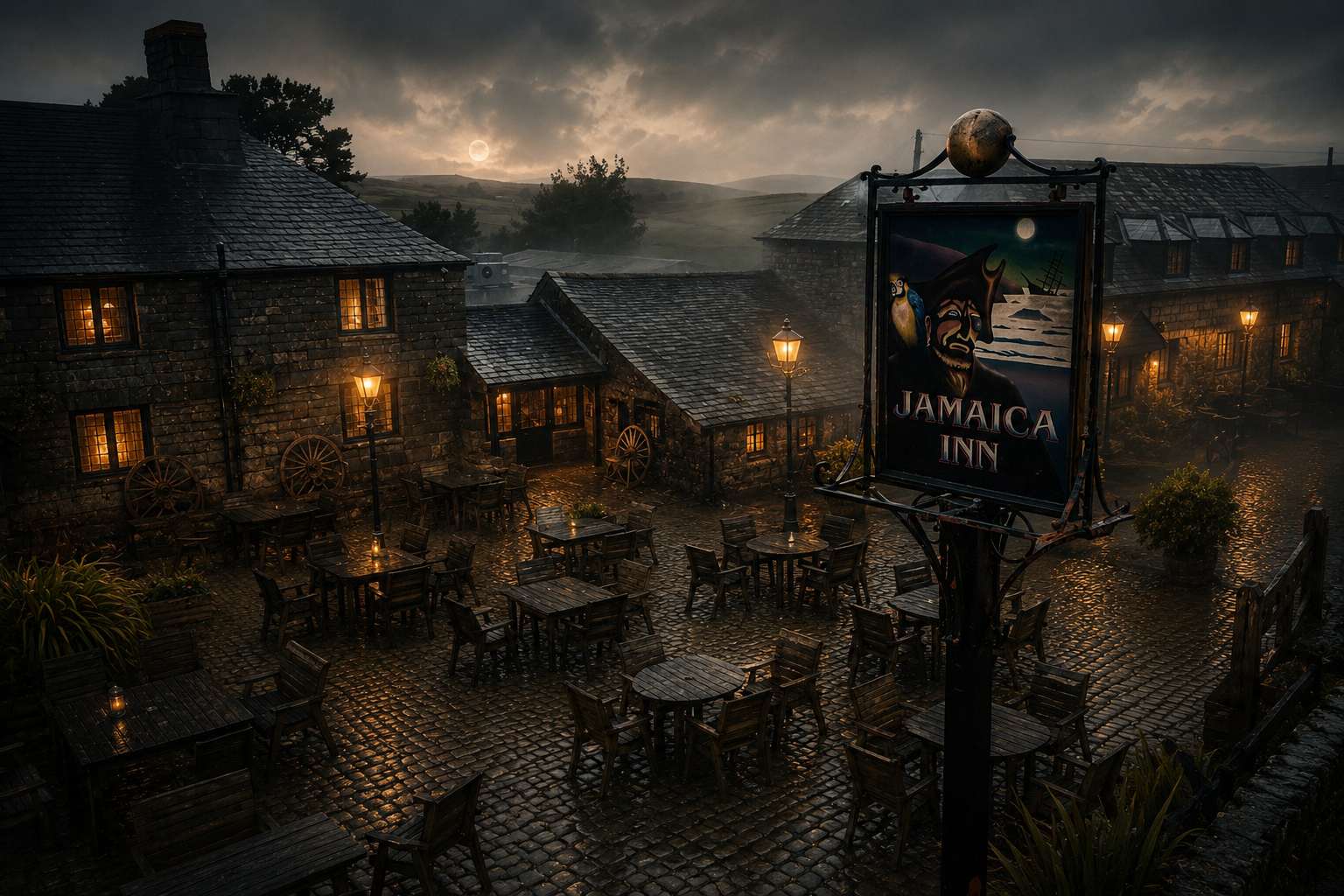
Jamaica Inn: The History, Hauntings and Folklore by Lisa Jane Holman and Karin Beasant is quite simply a joy. It is beautifully researched, wonderfully produced and absolutely overflowing with the sort of details that make me want to stop reading, go back three pages, examine a photograph again, follow another historical thread and then tell somebody else what I have just discovered.
For anyone who assumes this is simply another book about a famous haunted inn, think again. This is something much richer. The book draws upon more than a decade of research, investigation, historical evidence and first-hand testimony. Its scope is extraordinary, moving through the history of Bodmin Moor, Captain John Broad and his family, piracy and free trade, crime and punishment, class, transport, religion, temperance, changing landlords, Daphne du Maurier, the Second World War, the development of the Inn itself and, of course, its remarkable collection of reported hauntings and folklore.
What I particularly love is that Lisa and Karin don't hurry us towards the ghosts. They allow the Jamaica Inn to earn them. Before there are mysterious footsteps in corridors, shadowy figures, unexplained voices or strange encounters in bedrooms, there is a landscape and there are people. There is a history. And Bodmin Moor is almost a physical presence within these pages.
The opening takes us back to before the Inn existed, when this was a considerably wilder landscape: wetter, rougher and less controlled, crossed by old tracks and shaped by geology, weather and time. The authors describe it wonderfully as being “less countryside and more upland relic”. It immediately changes the way we understand the building that eventually appeared within it. That is something the book does repeatedly. It doesn't merely tell us what happened at the Jamaica Inn. It tries to recreate the world in which it happened. We explore what life at sea might actually have meant for a man such as Captain John Broad. We are taken into the political and economic upheavals of eighteenth-century Britain, the changing nature of class, trade, smuggling, justice and punishment. Even events seemingly far removed from a lonely Cornish inn become part of the wider picture. And I loved this. It would have been so easy to write: John Broad was a sea captain who established the Jamaica Inn in 1776. Instead, Lisa and Karin ask us to understand what becoming a merchant captain actually meant. What sort of experience would that have required? What dangers might such a man have encountered? What position would he have occupied within society? What opportunities were available to someone attempting to improve his circumstances in eighteenth-century Britain? Suddenly John Broad isn't a name attached to the beginning of a building. He starts becoming a person. And that attention to people is one of the book's greatest strengths.
Some of my favourite moments are the seemingly smaller histories tucked between the famous ones. Take Thomas Pring, alias Thomas Coombe, the wonderfully described “Incorrigible Thief”. Having already been convicted and sentenced to transportation, behaved sufficiently well for his sentence to be reduced, escaped from Bodmin Gaol on his first night, stolen a horse, robbed the Jamaica Inn and committed further burglaries, his downfall ultimately came after stealing a bottle of spirits and falling asleep drunk on a hedge. He was hanged at Bodmin Gaol in June 1828. You couldn't invent some of these lives.
These are precisely the stories that make history breathe. They remind us that the Jamaica Inn wasn't sitting silently on the moor waiting for Daphne du Maurier or paranormal investigators to arrive. Generations of ordinary—and sometimes decidedly extraordinary—people were already passing through its doors.
There are wonderfully unexpected diversions throughout. A coach crash. An illegitimacy scandal. A place of worship. The arrival of the railway. The hunt. A paymaster's assistant. The temperance movement. A naughty parrot called Percy. Potter's Museum of Curiosities.
Even the question of why somewhere approximately 4,700 miles from Jamaica should be called the Jamaica Inn becomes an opportunity to explore history and folklore. One gloriously charming theory apparently suggested that a landlord found himself with a barrel of smuggled fruit that was beginning to spoil, turned it into jam, and produced something so delicious that people travelled to the “Jam-maker Inn” to buy it. Is that why Jamaica Inn received its name? The book doesn't pretend that it is. And that brings me to something I admire enormously about this work: its integrity. History, folklore, tradition and paranormal testimony are allowed to coexist without being artificially forced into agreement. There is a refreshing willingness throughout to distinguish between what can be demonstrated, what has been reported, what has been handed down and what remains unknown. That matters. Particularly with somewhere as famous as the Jamaica Inn where stories become repeated and repetition becomes tradition. Tradition can eventually masquerade as historical fact. Lisa and Karin are prepared to pull those threads apart. Sometimes the answer is wonderfully satisfying. Sometimes it is tantalising. And sometimes the answer is simply: we don't know. There is absolutely nothing wrong with that. In fact, I trust a book far more when its authors are willing to tell me what the evidence cannot establish.
That same care becomes particularly important when the book crosses into its extensive section on The Hauntings. And extensive really is the word. There are individual sections covering Rooms 3 through 12 and beyond, alongside the gift shop, toilets, restaurants, main bar, snug, attic, museum, stable block, reception, managers' flat and grounds. I rather love that even the toilets haven't escaped paranormal scrutiny. But again, these aren't simply spooky stories dropped onto the page. By the time we reach them we understand something about the building beneath those stories. And here there is another remarkable feature. The changing layout of Jamaica Inn has been painstakingly reconstructed. The book contains beautifully produced plans showing how the Inn has altered over the centuries. These are not merely small illustrations buried between paragraphs. There are tangible inserts that can actually be removed, unfolded and pored over while reading. For someone like me, they are irresistible. You can sit with the plan beside the book, trying to understand where something happened, what occupied that space at another point in the building's history, how rooms relate to one another and how the physical Jamaica Inn changed around the generations living within it. It transforms reading into something almost investigative and I suspect I am going to spend an unreasonable amount of time puzzling over them.
The visual material throughout is another absolute treasure trove. There are photographs I had never seen before, historical images, documents and pieces of writing that bring you physically closer to the people being discussed. Most extraordinary are examples connected with Daphne du Maurier, including handwritten notes previously unseen. There is something extraordinarily intimate about inclusions like that seeing the actual marks their hand made on a page somehow collapses the distance between you and them.
And Daphne's presence is important, but crucially she doesn't overwhelm the real Jamaica Inn. The book explores her connection and the enormous cultural impact of the novel, but the historical Inn is allowed to exist independently of the fictional one. That distinction between Jamaica Inn the place and Jamaica Inn the legend runs beautifully through the book.
Then there are the hauntings. Reported figures. Sounds. Footsteps. Experiences associated with particular rooms and areas. First-hand testimony. The work of the Jamaica Inn Paranormal Team. The rise of paranormal television and its influence upon how haunted locations are perceived. Even the deceptively simple question: What is a ghost? That last question tells you quite a lot about the approach Lisa and Karin have taken. They haven't written a book whose only purpose is to convince the reader that Jamaica Inn is haunted. They have documented. They have researched. They have listened. They have compared. They have preserved accounts. And they allow the reader room to think.
There is also a fascinating final movement into folklore: the Signal of the Moor, stories surrounding the naming of the Inn, tunnels, a smuggler's skull, the Old Smuggler and Hannah's Room. Here again, history and storytelling sit side by side. Some things can be traced through records; others have survived because people remembered them, repeated them and passed them on. And somehow that feels entirely appropriate for Jamaica Inn.
Because by this point in the book, you realise that none of these strands truly exists separately. The history gives meaning to the hauntings. The landscape gives atmosphere to the folklore. The folklore becomes part of the history, while memories, experiences and stories continue to accumulate around the building with every generation that passes through it. Layer upon layer, they have become part of what Jamaica Inn is.
And perhaps that is what the Jamaica Inn ultimately is: a meeting place. Not merely between travellers, as it once was, but between landscape and people; fact and memory; history and folklore; the living and—perhaps—the dead.
What Lisa and Karin have achieved so beautifully is to capture the essence of that place and make it almost tangible within the pages of this book. The atmosphere is here. The emotion is here. But, most importantly, the people are here. Their stories and memories, their hopes and hardships, their ordinary lives and extraordinary moments. Alongside them are the ghosts, the legends and the stories that have gathered around Jamaica Inn across generations.
You don't simply come away knowing more about Jamaica Inn. Somehow, you feel as though you know it a little better—as a building, as a landscape, and as a place shaped by all those who have crossed its threshold.
Lisa and Karin understand that beautifully. Their affection for the Inn is unmistakable. This isn't detached research into a building they happened to choose as a subject. Jamaica Inn has become part of their lives, and that emotional connection runs quietly through the book without ever overwhelming the history. If anything, it makes their determination to preserve its stories—and to tell them with honesty, care and integrity—even more powerful. That combination of passion and intellectual honesty is enormously appealing.
As someone who loves history, folklore and accounts of both historical and contemporary hauntings, this book had absolutely everything for me. There are books you read for information. There are books you buy because they are beautiful objects. There are books you keep returning to because they contain so many strange little pathways that you missed something the first time. This manages to be all three. It is a history book. It is a paranormal casebook. It is a collection of folklore. It is social history. It is local history.It is a visual archive. And above all, it is a celebration of place and of the countless human lives that have accumulated around that place since a lonely inn first appeared on Bodmin Moor in 1776.
10/10. I really cannot recommend it highly enough.
My only disappointment? I only bought one copy for myself. It is that good.
Where to buy
Jamaica Inn: The History, Hauntings and Folklore by Lisa Jane Holman and Karin Beasant can be purchased online directly from Lisa Jane Holman's website:
Buy Jamaica Inn: The History, Hauntings and Folklore
And, rather wonderfully, you can also purchase a copy at Jamaica Inn itself, from the museum. There is something rather fitting about buying this particular book in the very building whose extraordinary history fills its pages.
If history, folklore, ghostlore, paranormal investigation or simply the strange accumulation of human stories within old places fascinates you, this one deserves a place on your bookshelf.
Just perhaps learn from my mistake.
Buy more than one.

Host, author and producer
Hi I’m Michelle.
Teacher, podcaster, history and paranormal enthusiast and woman who wears many hats and spins many plates including dog whisperer- as you will often find Archie my dog- joining me during podcast recordings where he promptly falls asleep clearly not as enthusiastic about the subject as I am. It does mean his dulcet snoring can often be heard gently in the background- his contribution as occasional co- host needs a little work.
I live in Oxford in the United Kingdom and I love travelling and exploring historical sites throughout the UK for its history and haunted activity. One of the best gifts I ever received was English Heritage vouchers to use to explore various different historical sites. I had the best summer that year. (For friends and family possibly reading this please note that hint for future gift ideas!)
I started this podcast as an adventure through some of my passions. It has been immensely exciting getting to know lots of other people around the world who have these same common interests. I’ve been humbled by the encouragement and support from strangers and people who have become new friends! I truly could not do this without you.
This isn’t something I have done before and I’m learning everything as I go along - from equipment, to editing, to even creating this website. I’m loving it though- it’s a lot of work - but worth every second. Thank you for being patient as I learn and improve along the way. I have big dreams of where to take this podcast and community I hope we build here. If you wish to support that dream and this c… Read More
Sleep, Trance and the Enfield Poltergeist: Why Altered States of Consciousness Deserve Closer Study