Brewing Bread from a 5,300-Year-Old Body: Ötzi, Ancient Yeast, and Corpse Medicine Reborn
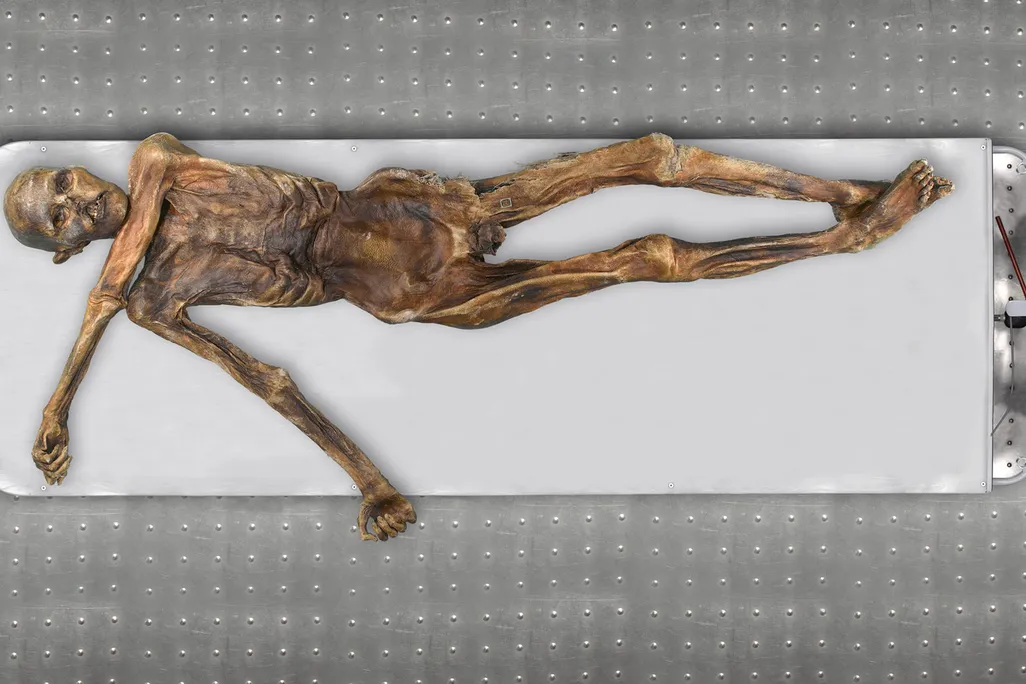
The recent announcement that scientists have successfully produced sourdough bread using yeast strains recovered from the 5,300-year-old Alpine mummy known as Ötzi the Iceman has been presented as a striking example of “ancient microbiology made edible”. Yet the finding also sits within a far older and more unsettling human tradition: the medicinal and quasi-medical use of corpses, bodily remains and mummy-derived substances that persisted across Europe and beyond for centuries.
What looks at first like a cutting-edge experiment in microbial archaeology is, in a cultural sense, a continuation of a very long fascination with death as both archive and apothecary.
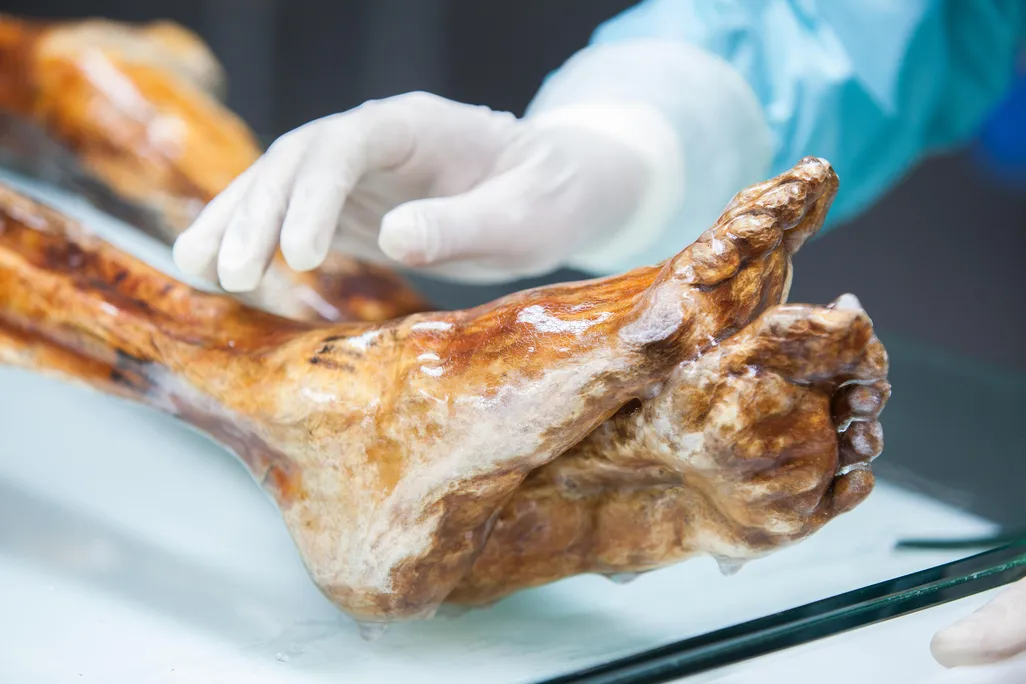
South Tyrol Museum of Archaeology / Eurac Research / Marion Lafogler
Discovered in 1991 in the Tyrolean Alps between Italy and Austria, Ötzi has become one of the most intensively studied human remains in the world. Preserved in ice, his body was effectively time-capsuled by glacier conditions, allowing researchers to reconstruct everything from his last meal—ibex, red deer and einkorn wheat—to evidence of illness, tattoos, and a fatal arrow wound.
More recently, scientists at the Institute for Mummy Studies at Eurac Research have gone further, examining not just the human remains but the broader ecosystem of microorganisms living on and within the mummy.
Their work revealed a complex microbiome: ancient microbes that likely lived in Ötzi while he was alive, modern organisms introduced during excavation and conservation, and a surprising group of cold-adapted yeasts associated with the glacier environment itself. One strain in particular appears to have proliferated under storage conditions, raising the possibility—still debated—that some of these organisms remain metabolically active.
From these yeasts, researchers were able to carry out fermentation experiments, successfully producing sourdough bread. The team has also suggested that beer production could be the next step, arguing that cold-active yeasts may have valuable applications in low-energy fermentation processes.
The implication is provocative: the mummy is not merely a preserved corpse but a living microbial archive capable of yielding functional biological agents.
Scientifically, the experiment sits at the intersection of paleogenetics, microbiology and food science. The key question is whether the yeasts are genuinely active after millennia or simply revived during thawing and laboratory cultivation. Some researchers remain cautious, noting that proof of metabolic activity would require RNA evidence showing gene expression rather than dormant DNA alone.
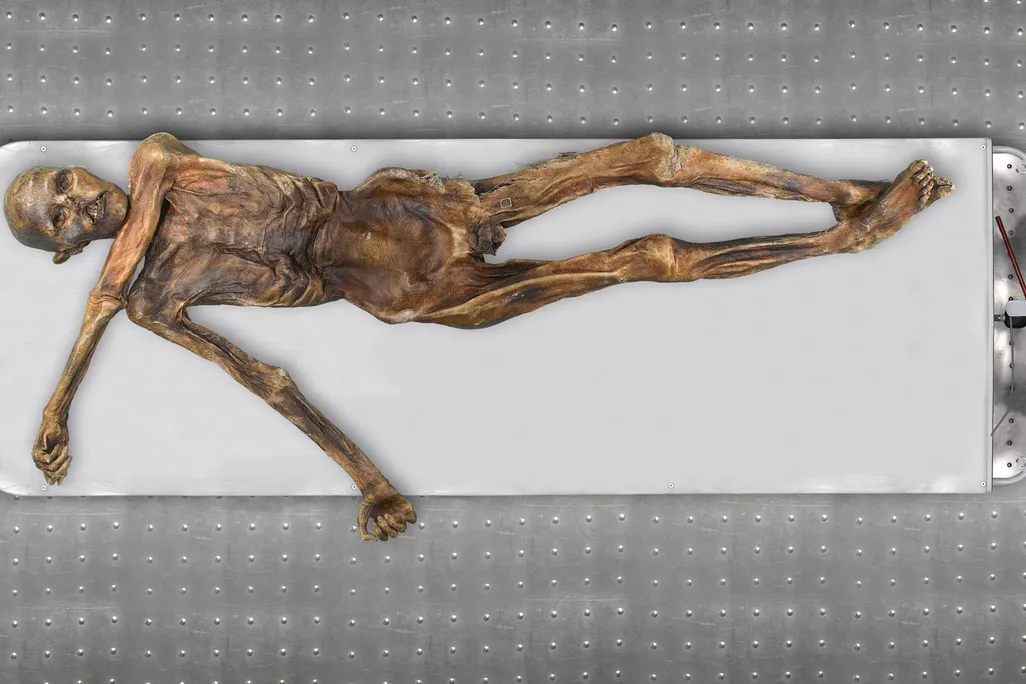
Südtiroler Archäologiemuseum / Eurac / Marco Samadelli-Gregor Staschitz
Even so, the experiment demonstrates that ancient remains can still yield viable biological materials under the right conditions. This raises a broader question that science alone cannot fully contain: what does it mean when human remains become sources of food production?
That question echoes, in a modern scientific register, an older and far more literal history.
For centuries in Europe, human remains were not only objects of curiosity but ingredients in medicine. This tradition, often grouped under the term “corpse medicine”, treated the dead body as a reservoir of potent substances capable of healing the living.
One of the most famous examples was mummia, a medicinal powder originally derived (or claimed to be derived) from Egyptian mummies. By the medieval and early modern periods, demand in Europe for “mummy medicine” was so strong that genuine Egyptian remains became scarce, leading to the substitution of more recent corpses treated and dried for sale.
Mummia was prescribed for a wide range of ailments, including internal bleeding and poisoning, based on the principle that the preserved vitality of the embalmed dead could transfer restorative properties to the living body.
Alongside mummia, other grim pharmacological practices circulated in early modern medicine:
-
Blood preparations, sometimes including fresh human blood or processed forms such as “blood marmalade”, were used in attempts to treat weakness, epilepsy, or consumption.
-
“King’s drops”, associated in folklore with royal executioners’ blood or materials taken from executed criminals, were believed in some traditions to carry curative or protective powers.
-
Scaffold medicine, in which blood or bodily fragments were collected from recently executed individuals, was based on the idea that violent death concentrated life force or healing energy.
-
Skull and bone remedies, including powdered cranium or “cranium humanum”, were widely listed in pharmacopoeias across Europe into the seventeenth century.
While these practices now appear macabre, they were embedded in pre-modern medical frameworks that blended humoral theory, symbolic reasoning and early experimental empiricism. The body—especially the violently or ritually dead body—was seen as chemically and spiritually potent.
At first glance, the sourdough experiment seems far removed from these historical practices. There is no suggestion that Ötzi’s remains are being consumed directly, nor that human tissue is being processed into medicine. Instead, scientists are isolating microorganisms—yeasts living in and around the mummy—and cultivating them under laboratory conditions.
Yet the conceptual continuity is difficult to ignore. Both corpse medicine and modern microbial archaeology rest on a shared premise: that the dead body is not inert, but biologically or chemically productive.
In earlier centuries, that productivity was imagined in terms of “life force”, medicinal essence or spiritual residue. Today, it is understood in terms of microbiomes, DNA, and metabolic pathways. But in both cases, the corpse is treated as a resource.
There is also a subtler parallel in the transformation of death into utility. Mummia became medicine; scaffold blood became remedy; skull powder became pharmacology. In the modern case, ancient yeast becomes fermentation culture, potentially usable for baking and brewing industries.
The difference lies less in the extraction of value than in the framework used to justify it.
Researchers involved in the Ötzi study have emphasised precisely this point. They describe the mummy not as a fixed artefact but as a “dynamic biological system”, continuously shaped by microbial activity, environmental exposure and conservation practices.
Even the museum preservation methods—such as humidification spray used to maintain the body—have altered its microbial profile, introducing modern bacterial signatures. In this sense, the mummy is not only a window into the past but also a living interface between past and present biological processes.
This challenges older ideas of mummies as sealed, silent objects. Instead, they are active sites of biological exchange, even thousands of years after death.
Modern researchers are careful to emphasise that their work is about microorganisms, not the consumption or exploitation of human remains. Nevertheless, the symbolic resonance with earlier corpse-based medicines is unavoidable.
Where medieval apothecaries saw vitality in powdered flesh, modern scientists see fermentative capacity in yeast. Where scaffold medicine imagined healing power in violent death, microbiology identifies adaptive organisms surviving extreme environments.
The trajectory from mummia to microbiome science reflects a broader shift in how humans conceptualise the boundary between life and death. Yet it also shows that this boundary has always been porous in cultural imagination.
The sourdough made from Ötzi’s microbial companions is best understood not as a culinary curiosity, but as part of a long continuum in which human remains have been treated as sources of transformation—medical, symbolic, and now biochemical.
Corpse medicine once extracted meaning and remedy from the dead through the language of humours and essences. Contemporary science extracts enzymes, DNA and metabolic activity through microbiology and genomics.
In both cases, the dead body becomes a site of productivity rather than finality. And in that sense, the ancient mummy in the Alps is not so distant from the jars of mummia, the scaffold remedies, or the powdered skulls of early modern Europe. The tools have changed dramatically; the fascination has not.
You can find out more about corpse medicine here:

Host, author and producer
Hi I’m Michelle.
Teacher, podcaster, history and paranormal enthusiast and woman who wears many hats and spins many plates including dog whisperer- as you will often find Archie my dog- joining me during podcast recordings where he promptly falls asleep clearly not as enthusiastic about the subject as I am. It does mean his dulcet snoring can often be heard gently in the background- his contribution as occasional co- host needs a little work.
I live in Oxford in the United Kingdom and I love travelling and exploring historical sites throughout the UK for its history and haunted activity. One of the best gifts I ever received was English Heritage vouchers to use to explore various different historical sites. I had the best summer that year. (For friends and family possibly reading this please note that hint for future gift ideas!)
I started this podcast as an adventure through some of my passions. It has been immensely exciting getting to know lots of other people around the world who have these same common interests. I’ve been humbled by the encouragement and support from strangers and people who have become new friends! I truly could not do this without you.
This isn’t something I have done before and I’m learning everything as I go along - from equipment, to editing, to even creating this website. I’m loving it though- it’s a lot of work - but worth every second. Thank you for being patient as I learn and improve along the way. I have big dreams of where to take this podcast and community I hope we build here. If you wish to support that dream and this c… Read More
Silver Birch’s Medium: Restoring Maurice Barbanell to the History of Modern Spiritualism