The Dark History of Werewolves in Europe
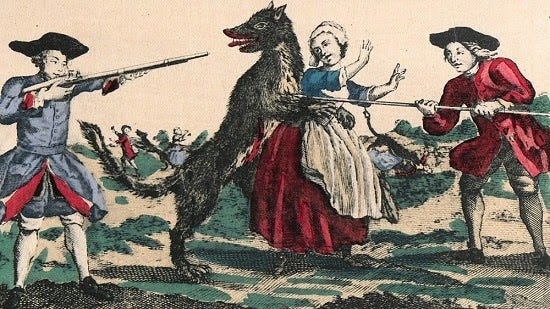
For centuries, the werewolf has lurked at the edges of human imagination — a creature poised between civilisation and savagery, reason and instinct. Yet this is not merely the story of folklore. Across early modern Europe, belief in werewolves led to real accusations, real trials, and real deaths. To understand why, we need to trace the werewolf’s journey from ancient myth to courtroom terror.
The roots of werewolf belief stretch back to the earliest human societies. Wolves were among the most feared predators, and early communities lived in constant awareness of their threat. It is not surprising, then, that stories emerged imagining humans becoming wolves — a way of expressing both fear of the animal and recognition of something shared between human and beast.
In ancient Mesopotamia, the Epic of Gilgamesh tells of a man transformed into a wolf as punishment. In Greek mythology, King Lycaon is turned into a wolf by Zeus after committing a horrific crime — linking lycanthropy with punishment, violence, and moral transgression. Even at this early stage, the werewolf was not just a monster, but a reflection of human wrongdoing.
Classical writers offered different interpretations. Some, like Pliny the Elder, dismissed transformation as superstition or madness. Others described it as something real or magical. This dual understanding — werewolves as either physical beings or psychological delusion — would persist for centuries.
By the medieval period, werewolf beliefs had evolved under the influence of Christianity. Stories such as that of Francis of Assisi taming the Wolf of Gubbio present the wolf not simply as evil, but as something that could be brought under divine control. The werewolf became a symbol of the untamed, the pagan, or the sinful — but also something redeemable.
Medieval literature often portrayed werewolves sympathetically. In the Breton tale Bisclavret, a nobleman transforms into a wolf but remains loyal and human in spirit. Similarly, accounts from Ireland describe werewolves as cursed humans capable of speech and religious belief. These stories suggest that werewolves were not yet seen as inherently demonic.
However, theological debates complicated matters. Thinkers like Augustine argued that only God could truly change a person’s form. This meant that any apparent transformation must be either an illusion or the work of demons. This idea would later prove crucial, as it linked werewolves to the same fears that drove the witch hunts.
Between roughly 1450 and 1700, Europe experienced waves of witch hunts and widespread fear of hidden enemies within society. It is within this context that werewolf trials emerged.
The publication of the Malleus Maleficarum in 1487 helped to codify beliefs about witchcraft and demonic influence. Although primarily focused on witches, it reinforced the idea that humans could be transformed or deceived by the devil. Werewolves became entangled in this framework — no longer ambiguous figures, but agents of evil or victims of satanic power.
This period also saw economic hardship, war, famine, and religious conflict following the Reformation. Communities under stress often looked for scapegoats. The werewolf, like the witch, became a convenient explanation for unexplained violence, crop failure, and social breakdown.
The result was a series of shocking trials across Europe, particularly in France and Germany.
In 1521, Pierre Burgot and Michel Verdun were accused of making a pact with the devil and transforming into wolves using magical ointments. They confessed to murdering and eating children — confessions almost certainly extracted under torture. Their case helped establish a pattern linking lycanthropy with witchcraft, cannibalism, and demonic influence.
In 1573, Gilles Garnier was executed in France after being accused of killing several children as a werewolf. Witnesses claimed to recognise him in wolf form, blurring the line between imagination and reality. His trial led to official decrees encouraging the hunting of werewolves.
Perhaps the most infamous case is that of Peter Stumpp. Arrested in Germany, Stumpp confessed to a catalogue of horrific crimes — including murder, cannibalism, and incest — claiming he used a magical belt given by the devil to transform into a wolf. His execution was brutal, and pamphlets describing his crimes spread widely, fuelling panic across Europe.
In France, the Gandillon family (1598) were accused of lycanthropy after a violent attack on children. Under torture, they confessed to transforming using magical skins or ointments. Observers claimed they behaved like animals — crawling on all fours and howling — though modern interpretations suggest psychological distress or coercion.
These cases share common features:
-
Confessions obtained under torture
-
Links to witchcraft and the devil
-
Accusations of cannibalism and attacks on children
-
Heavy influence from rumours and printed pamphlets
The printing press played a crucial role. Sensational accounts of trials spread rapidly, reinforcing fear and encouraging further accusations — much like the spread of witchcraft panics.
One of the most unusual cases came later, in 1691, with Thiess of Kaltenbrun. Unlike others, Thiess did not claim to serve the devil. Instead, he described himself as a “hound of God”, saying he and others descended into hell to fight witches and protect crops. His testimony challenged the dominant narrative of werewolves as evil, instead presenting them as defenders of the community. Similarly, the Italian benandanti believed they fought witches in spirit form to protect crops. These traditions show that the werewolf could also represent a force for good — a sharp contrast to the demonised figures of Western Europe. This reflects how beliefs about werewolves varied across regions, particularly in Eastern Europe.
By the late 17th century, belief in literal werewolves began to decline. The Scientific Revolution encouraged more rational explanations, and courts became increasingly sceptical. The case of Jacques Roulet in 1598 is significant. Found covered in blood and accused of cannibalism, he claimed to be a werewolf. Cases like that of Jacques Roulet, whose death sentence was commuted due to concerns about his mental state, show a growing awareness that such confessions might stem from illness rather than truth.
Similarly, Jean Grenier, a boy tried in 1603, was not executed but confined to a monastery. His case marks a turning point — a growing recognition that such beliefs might be rooted in psychology rather than the supernatural.
By the late 17th century, belief in werewolves began to decline. Several factors contributed:
-
The Scientific Revolution encouraged rational explanations
-
Improved legal systems demanded stronger evidence
-
Religious conflicts stabilised after events like the Thirty Years’ War
-
Intellectuals increasingly rejected supernatural explanations
By the 18th century, werewolf trials had largely disappeared. Cases such as the Beast of Gévaudan (1760s) were attributed to real animals rather than supernatural beings.
Although belief in werewolves faded, the idea itself endured. Over time, it moved from the courtroom into folklore, literature, and eventually popular culture. The werewolf became less a real threat and more a symbol — representing the darker side of human nature.
The history of werewolves is not just a story about mythological creatures. It reveals how societies respond to fear, uncertainty, and violence. During times of crisis, people sought explanations — and sometimes those explanations led to persecution.
Like the witch hunts, werewolf trials show how easily fear can be shaped into belief, and belief into action. At its core, the werewolf represents a timeless question: how thin is the line between human and beast?
And perhaps more importantly — what happens when society believes that line has been crossed?
▶️ Watch on YouTube:
https://www.youtube.com/watch?v=B5Bpbmf0Dgw
👉 Full episode & more:
https://www.podpage.com/haunted-history-chronicles/werewolf-for-god-the-turbulent-trial-of-thiess-of-kaltenbrunn-with-sarah-blake/

Host, author and producer
Hi I’m Michelle.
Teacher, podcaster, history and paranormal enthusiast and woman who wears many hats and spins many plates including dog whisperer- as you will often find Archie my dog- joining me during podcast recordings where he promptly falls asleep clearly not as enthusiastic about the subject as I am. It does mean his dulcet snoring can often be heard gently in the background- his contribution as occasional co- host needs a little work.
I live in Oxford in the United Kingdom and I love travelling and exploring historical sites throughout the UK for its history and haunted activity. One of the best gifts I ever received was English Heritage vouchers to use to explore various different historical sites. I had the best summer that year. (For friends and family possibly reading this please note that hint for future gift ideas!)
I started this podcast as an adventure through some of my passions. It has been immensely exciting getting to know lots of other people around the world who have these same common interests. I’ve been humbled by the encouragement and support from strangers and people who have become new friends! I truly could not do this without you.
This isn’t something I have done before and I’m learning everything as I go along - from equipment, to editing, to even creating this website. I’m loving it though- it’s a lot of work - but worth every second. Thank you for being patient as I learn and improve along the way. I have big dreams of where to take this podcast and community I hope we build here. If you wish to support that dream and this c… Read More
Silver Birch’s Medium: Restoring Maurice Barbanell to the History of Modern Spiritualism