Sleep, Trance and the Enfield Poltergeist: Why Altered States of Consciousness Deserve Closer Study
Why do so many reports of hauntings, apparitions, possession experiences and encounters with the seemingly impossible occur while people are asleep—or in that curious threshold between sleeping and waking?
It is a question that arose repeatedly during my recent conversation with TyLean Tuijl, a PhD researcher in psychology investigating possession and altered states of consciousness, as well as a Council Member and case investigator with the Society for Psychical Research. It is also a question that takes us directly back to one of the most intensively documented paranormal cases of the twentieth century: the Enfield Poltergeist.
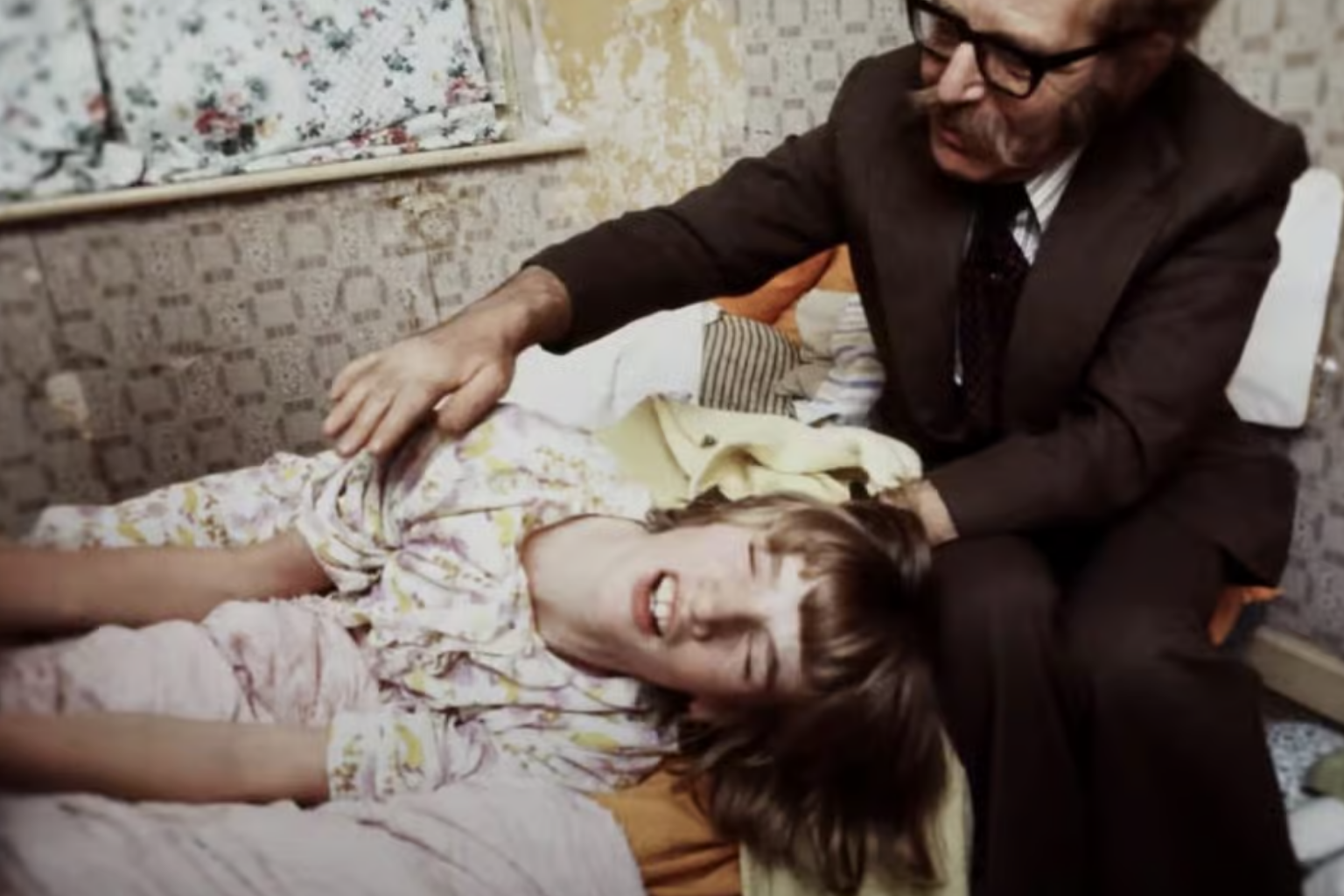
Much of the popular discussion surrounding Enfield understandably focuses on the spectacular. Furniture reportedly moved. Objects were thrown. Strange voices emerged. Janet Hodgson was photographed apparently airborne above her bed. Yet running alongside these dramatic events is another strand of the investigation that receives comparatively little attention: the extraordinary number of incidents involving sleep, dreams, trance-like behaviour and other altered states of consciousness.
This is important because the Enfield material does not present us with a neat division between someone being awake or asleep. The surviving descriptions instead suggest a shifting and sometimes ambiguous range of states. The children could appear deeply asleep while speaking, crying or apparently responding to one another. At other times they displayed what witnesses described as trances, periods of regression, unusual physical strength or an apparent awareness of things happening around them despite seeming unconscious. Guy Lyon Playfair and Maurice Grosse themselves struggled with terminology. In a discussion with Professor Hans Bender, Playfair and Bender considered whether some of Janet's states could even be called "possession", but decided the word was too easily misunderstood. Even "dream" and "trance" could imply more certainty than the evidence allowed. The safest conclusion was simply that some form of altered state of consciousness appeared to be involved.
That uncertainty makes TyLean's comments particularly relevant. Speaking about extraordinary experiences more generally, she observed:
"I think that the vast majority of people who have an extraordinary paranormal type of experience, it is highly likely to happen during the nighttime, a nighttime waking, a sleep paralysis event, et cetera. And so it is something of an entry point for paranormal experience."
TyLean went further, suggesting that altered brain states themselves may be important to understanding why such experiences cluster around sleep:
"I believe that there is something really important happening that we don't entirely understand yet in terms of entering these brainwave states and why things become more accessible to us at that point."
That is not an assertion that a paranormal explanation has been established. Rather, it is an argument for taking the state of consciousness itself seriously. Enfield provides an unusually detailed historical example of why that matters. The investigators did not simply look at Janet lying still and assume she was asleep. They repeatedly tried to establish her responsiveness. Playfair later wrote that they used every simple test they could devise: shining torches into the girls' eyes, tickling their armpits and the soles of their feet, forcing their eyelids open and observing the pupils. Tape recordings contain repeated references to these checks. On one occasion Grosse manipulated Janet's eyelids and obtained no response. On another he noted that her eyes were turned upwards. Peggy Hodgson remarked that Janet's eyes had remained closed "the whole time", while apparently still showing some awareness of people nearby. During another episode Grosse concluded emphatically that there was "no doubt" the girls were asleep. Importantly, however, the investigators were not always so certain. In one voice experiment Grosse felt confident that Margaret was asleep but remained unsure about Janet. That inconsistency is useful evidence in itself: it shows that they did not automatically label every strange episode a trance.
Grosse's notes from 8 September 1977 provide a particularly interesting early example. Following a loud bang, he rushed upstairs and found a chair displaced and damaged. Daily Mirror reporter George Fallows then examined Janet while Grosse watched:
"He found her to be in deep sleep (he used the word 'unconscious'). He lifted her hand, then let it go (it appeared to 'flop' - his words), and he gently pushed her head to one side and found no resistance whatsoever. From her sleeping position and posture I felt that she could have been in a trance-like state (her mouth was open and her breathing very shallow). She was securely tucked in bed."
That report does not prove that the displaced chair had a paranormal cause, nor does it establish exactly what Janet's neurological condition was. It does, however, make the incident more complex than a simple picture of an alert child pretending to sleep after moving an object. Any conventional explanation has to account not only for the movement but for the observations made immediately afterwards.
By November, the altered states had become far more disturbing. Playfair later described them to Hans Bender in unusually emotional terms:
"We found the girl screaming, yelling, lying on the floor. She was underneath the table, trying to kick it over…The mother was absolutely desperate, you know. She didn't know what to do. And Luiz [Gasparetto, a Brazilian medium] spent about half an hour with her [Janet], and she immediately became quiet. I have all this on the tape. He talked to her very quietly in Portuguese, and she went to sleep. She went to sleep at 7 o'clock in the evening and she woke up the next morning only at 9 o'clock. That's fourteen hours of sleep. And she never had another hysterical fit. She just had one bad dream, and, after that, there was no more….The mother told me that she doesn't mind the tables falling over, but these hysterical attacks were absolutely too much, you know. She was really very, very distressed. And, I must say, that I was, too. It's one of the most horrible things I've ever seen, because they would go on for three, four hours. They would go on until 3 o'clock in the morning. And she would even wake up in a conversion. She was completely out for four days…Twice we called a doctor, emergency doctor, who gave her an injection of Valium…An interesting detail was that half an hour after she was given an injection of Valium, she was thrown out of bed, right across the room….the two girls would dream together….And we would open their eyes, and we would shine the torches [flashlights], and the pupil [wouldn't] contract. And we would also tickle under the arms, and they were completely asleep. And they would talk to each other….Again, we have it on tape."
The importance of that passage lies partly in Playfair's reaction. He had already investigated unusual cases in Brazil and had encountered material he regarded as deeply disturbing, yet described Janet's condition as "one of the most horrible things I've ever seen". These episodes were not entertaining séances for those present. They were prolonged, exhausting and frightening experiences involving a distressed child and an increasingly exhausted family.
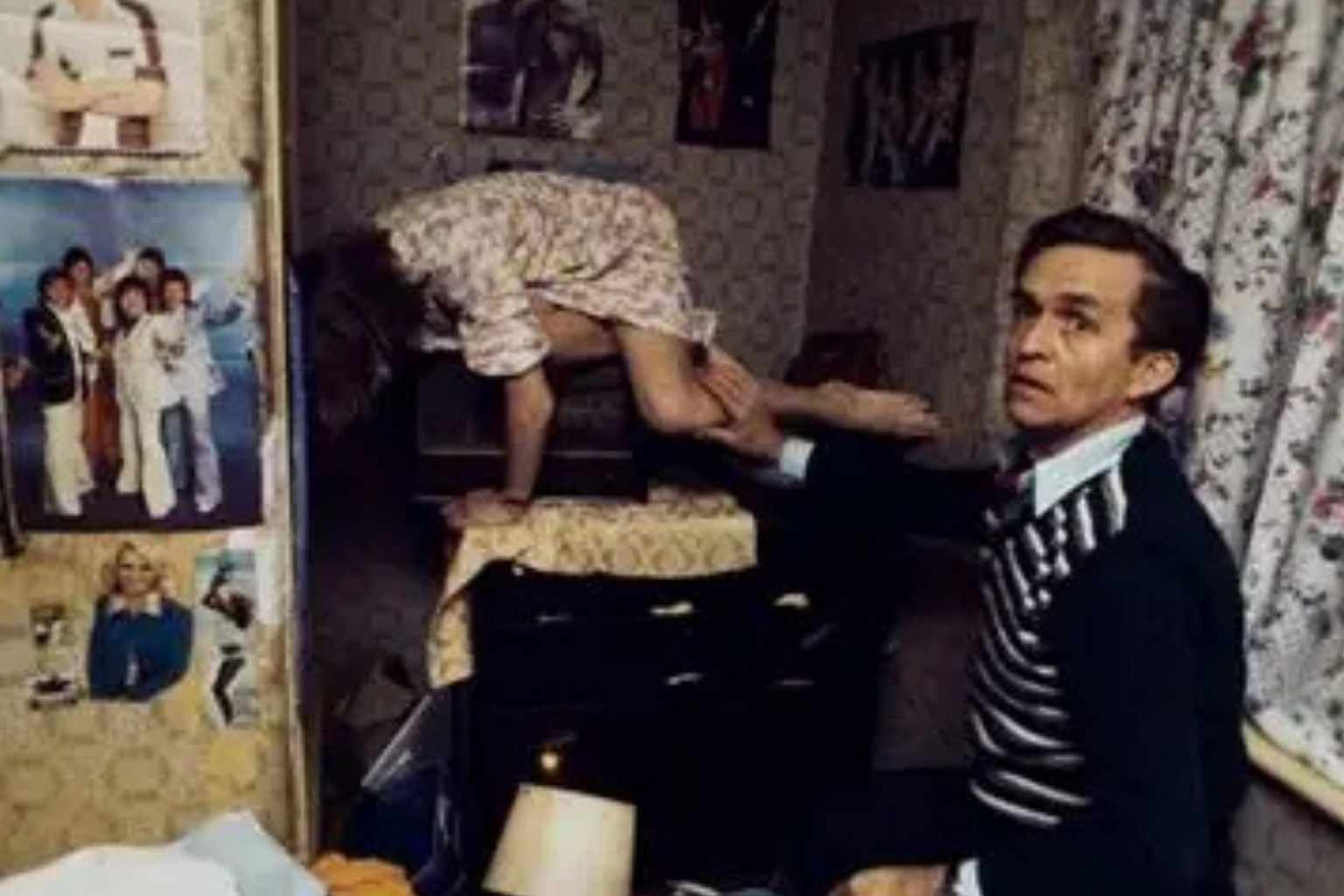
The surviving tapes reinforce that impression, while simultaneously showing how strange and inconsistent these states could be. They could involve screaming and apparent terror one moment, laughter or childish nonsense the next. Some seemed like nightmares; others were almost absurd. Margaret sometimes appeared to adopt an unconvincing childish persona. Janet called for "Mummy" in an unfamiliar pronunciation and, according to the recordings, at times sucked her thumb while Grosse remarked that she appeared to be "regressing". This mixture of terror, regression, childish language and apparent normal awareness makes any single explanatory label difficult to sustain.
That ambiguity is important. An altered state of consciousness does not necessarily mean total unconsciousness. People can retain partial awareness during dreams, dissociative states, anaesthesia and other conditions. TyLean made a similar point throughout our conversation: extraordinary experiences need not be reduced to either "completely normal consciousness" or "completely supernatural". There may be intermediate states that are poorly understood, culturally interpreted in different ways and experienced with extraordinary intensity.
One of the most remarkable aspects of Enfield is the claim that the two girls sometimes appeared to enter related states at the same time. Playfair described finding Janet "crying and moaning in her sleep", only to enter another bedroom and discover Margaret doing the same:
"It was as if the girls were sharing a nightmare."
Elsewhere, the tapes contain references to the girls undergoing apparent "convulsions" and other phenomena at approximately the same time while in different rooms. In another alleged shared dream, their bodily movements were described as nearly identical. Margaret was also reportedly thrown from her bed in one room at roughly the same time that Janet became more violent elsewhere. None of these observations demonstrates telepathy or a shared paranormal dream, but their recurrence makes them worthy of careful analysis rather than dismissal.
One surviving tape gives us an unusually immediate sense of what these episodes sounded like. During a shared dream on tape MG30B, the following exchange was recorded:
Janet Hodgson: [panting and groaning for several seconds, followed by screaming] "Margaret! Help!" [panting and groaning]
Maurice Grosse: "I've just examined the girls again."
Janet Hodgson: [yelling] "Margaret!"
Maurice Grosse: "No doubt whatsoever that they're asleep. No doubt."
Janet Hodgson: [yelling] "[unintelligible] Look at it! It's worse than [unintelligible]."
Margaret Hodgson: "What's going on in the [unintelligible, perhaps 'barn']? It's all coming out."
Janet Hodgson: [yelling] "No, I don't mean that. I'm not worried about that. It's jumping all over the roof."
Margaret Hodgson: [screams before talking] "Look [unintelligible]!"
Janet Hodgson: "Look at Gloria's nose! [Margaret making gasping noises as Janet talks] It's gone red. Look at Gloria! She's [unintelligible]! Look at her!"
It is strange material precisely because it is not what we might expect from a carefully constructed paranormal performance. Much of it is repetitive, childish, confused and seemingly meaningless. That can be used sceptically: perhaps the girls were simply acting out fantasies. But the opposite question also deserves consideration. If they were deliberately manufacturing evidence intended to convince adult investigators, why produce hours of incoherent material that frequently made them appear ridiculous? Why continue for prolonged periods, sometimes sweating, screaming or physically exhausting themselves, when a much shorter performance would have achieved the same goal?
None of those questions rules out deception. The source material itself identifies moments that deserve sceptical scrutiny. Margaret sometimes seems suspiciously aware of events around her. At points she changes tone, jokes with people present or becomes quiet when somebody comes to the door. Her adoption of childish personas could sound artificial. Janet sometimes provides unusually detailed running descriptions of what she claims to be seeing within a dream, which can sound more like narration for an audience than ordinary dreaming. One apparent trance ended soon after Grosse threatened to wake or slap her. These details should not be hidden, because they are part of the evidence too.
Yet suspicious behaviour does not automatically establish that every altered state was fabricated. Nor would partial awareness disprove an altered state. The more responsible position is to acknowledge that the episodes probably did not all have identical causes or characteristics. Some could include joking, performance, subconscious behaviour or deliberate deception; others appear much harder to account for in those terms. That messy mixture is actually typical of complex human cases and is one reason why binary categories such as "genuine" and "fake" often prove inadequate.
The reported changes in Janet's physical strength are one such complication. During some trance episodes, Grosse repeatedly expressed astonishment at her strength. He described her grip as that of a "very, very strong man", called her strength "absolutely incredible", "fantastic" and "phenomenal", and at one point said she seemed to have "the strength of two men". An older cousin was reportedly thrown to the floor, and Playfair later recalled an occasion when five adults, including a judo expert, struggled to restrain her. These are subjective descriptions rather than controlled measurements, and heightened strength during agitation is not unknown. Nonetheless, the consistency with which several witnesses remembered it makes the phenomenon relevant to any analysis of Janet's altered states.
Outside witnesses also encountered these episodes. A woman referred to on the tapes as Mrs Edwards, apparently connected to Janet's school and described as having a background in police work, spent a particularly disturbed night with the family. Grosse recorded the following conversation:
Maurice Grosse: "Well, Mrs. Edwards, I mean, it's a dreadful thing to watch, but I'm very pleased to see perhaps there will be a few less skeptics in your place now."
Edwards: "Well, as I said to Mrs. Hodgson, I've never disbelieved it."
Maurice Grosse: "I know you haven't, but now you've seen it yourself. I'm really pleased you have…."
Later that night:
Maurice Grosse: "Well, I'm sorry you've had a very disturbed night…You're now a witness to the fact we're not all mad…"
Edwards: "I'll tell you what, my shoulder's a witness to the fact that we're not all mad."
Maurice Grosse: "Perhaps you can tell one or two people in the council who seem to think that we are…When you've had the proof, that you've seen those children thrown out of bed quite a number of times…"
Again, this is testimony, not laboratory proof. But testimony is not meaningless simply because it is testimonial. The challenge for psychical research is precisely to determine how such observations should be weighed, especially when multiple witnesses encounter unusual behaviour independently.
Medical involvement adds another layer. Playfair noted that Janet received "three different diagnoses in three days", yet no clear explanation or effective treatment emerged. During an emergency visit on 26 November 1977, an attending doctor examined Janet before administering Valium. On Playfair's recording, he is heard saying that her "pupils were dilated and not reacting to light". Grosse described the situation as "very strange" and compared it with what might once have been called "possession"; the doctor responded, "Yeah." The doctor apparently indicated that Janet had received a "full dose" of Valium and that its effects should last "six to eight hours".
According to Playfair's chronology, the injection was administered at approximately 11.10 p.m. Janet became noticeably quieter within minutes, suggesting that the drug was having an effect. Yet at around 11.55 p.m.—roughly forty-five minutes later—she was reportedly thrown across the room. The argument made by supporters of the case is not that Valium somehow proves paranormality, but that if Janet was significantly sedated, an elaborate physical deception becomes more difficult to explain. The point deserves caution because dosage, individual response and the precise mechanics of the later incident would all matter medically. Still, it is precisely the sort of detail that makes the altered-state material worthy of more serious study.
The investigators even attempted instrumental monitoring. On 5 December 1977, David Robertson brought a strain gauge into the house while Hugh Pincott, then secretary of the Society for Psychical Research, and Maurice Grosse were present. During one of Janet's dream episodes, something reportedly activated the instrument, leading to a discussion captured on tape. The surviving account interprets this as possible evidence that something physical accompanied the dream state, although without the full experimental set-up and data it would be unwise to draw a stronger conclusion.
There were stranger coincidences too. During one shared dream Margaret repeatedly said, "I want to speak to Peggy next door." Playfair then went downstairs and asked Peggy Hodgson to attempt automatic writing. According to his account, the first words she produced were the same phrase:
"I want to speak to Peggy next door."
Playfair emphasised that Peggy could not hear Margaret from the kitchen. It is a remarkable anecdote, though one that inevitably raises questions about experimental controls, unconscious cueing and retrospective interpretation. Yet that is precisely why cases like Enfield need careful documentation rather than either credulous acceptance or reflexive dismissal.
TyLean's current work gives these historical observations a wider context. During our conversation she explained that the Society for Psychical Research's Spontaneous Case Committee is seeing sleep-related experiences appearing alongside a surprisingly broad range of reports. She noted that in one reporting period, around 80 per cent of cases included sleep paralysis as an associated feature even when the primary report concerned something else, such as a ghost sighting, poltergeist activity or a premonition. She cautiously suggested that there may be "some sort of a link", whether because individuals susceptible to such sleep states are also more sensitive to extraordinary experiences or for some other reason not yet understood.
This is where the comparison with Enfield becomes particularly valuable. The argument is not that TyLean's research retroactively proves that Janet Hodgson was paranormal. Nor should Enfield be used to validate every sleep paralysis account as supernatural. Rather, the repeated convergence suggests a research question: why are altered states of consciousness so frequently present when people report extraordinary phenomena?
TyLean also draws attention to something that is easily lost when researchers become preoccupied with classification. An experience does not become irrelevant simply because it happens during sleep.
"Someone else doesn't have to validate it for it to have been an experience that you went through."
She adds that even if somebody ultimately concludes that an experience occurred entirely within sleep, "it was a profound experience. It's something that they have to deal with and they have to process."
That human dimension is impossible to ignore in the Enfield tapes. During one of the worst periods, Peggy Hodgson had reportedly "collapsed in total exhaustion". The girls were moving in and out of these states, screaming, crying and groaning; Janet sometimes became violent; other reported phenomena were occurring simultaneously; and Grosse moved from room to room trying to document everything while helping those present. He described it simply as "a dreadful thing to watch".
For Peggy, however, it was not an investigation. These were her children.
During one episode she expressed the emotional cost in a few words:
"It cuts you in pieces inside."
That line perhaps matters as much as any alleged levitation or mysterious voice. Whatever explanation one eventually favours for Enfield, the family were experiencing something they found frightening, exhausting and profoundly disruptive. A psychologically generated experience is not therefore insignificant. Neither is a sleep-related experience. Nor does acknowledging the psychological dimension oblige us to assume that every anomaly has been explained.
This is perhaps one of the most important points TyLean made during our discussion. Sleep is not an insignificant interruption between meaningful periods of waking life. As she put it:
"We spend a third of our lives asleep… Of course it's going to be important… if you want to ignore or diminish that, you're just siloing off a huge part of the experience of being human."
That is the broader lesson I take from returning to the Enfield tapes alongside contemporary research into sleep, possession and altered states of consciousness. The correct question may not simply be whether Janet and Margaret were "really asleep", "really possessed" or "really faking". Those categories may be too crude for the experiences being described.
Instead, we might ask what states of consciousness they were entering, how those states changed perception, memory, physical behaviour and responsiveness, why apparently related experiences sometimes occurred simultaneously, and why unusual physical events were so frequently reported around them. We should ask what neurological, psychological and social factors were present—and also be willing to document whatever remains after those factors have been considered.
Enfield itself contains reasons for both caution and curiosity. Some episodes appear suspicious. Some behaviour looks theatrical. The children admitted playing tricks on occasions. Yet there are also prolonged states witnessed by multiple people, unusual physical responses, medical observations, apparent changes in strength, reports of simultaneous dreaming, recordings made while events unfolded and incidents that remain difficult to reduce to a single simple explanation. The responsible response is not to select whichever half of that evidence best suits a preferred worldview. It is to hold both together.
This is what makes altered states such an important direction for future psychical research. They occupy precisely the territory where psychology, neuroscience, folklore, religious experience and anomalous phenomena overlap. Historically, cultures have called these states dreams, visions, trances, spirit possession, night visitations and countless other names. Modern medicine gives us different terminology, but the underlying human experiences have not disappeared.
Nearly fifty years after Enfield, the Society for Psychical Research is still collecting accounts in which sleep disturbance, sleep paralysis and unusual states of consciousness accompany reports of apparitions, poltergeists, premonitions and possession-like experiences. That does not give us an answer. It gives us something potentially more valuable: a pattern worth investigating.
Perhaps TyLean's most useful contribution to this discussion is therefore not a theory about what lies on the other side of sleep, but an insistence that the question itself deserves to remain open. As she said:
"There's something about the sleep state that allows people to be able to see in a way that we do not normally have access to, or at least most of us do not normally have access to."
We can disagree about what "see" ultimately means. It might refer to internally generated imagery, altered perception, dissociative processes, culturally shaped experiences, psi phenomena, or something we have not yet adequately described. What matters is that we investigate rather than assume.
Why do so many extraordinary experiences appear at the borders of consciousness? Why do dreams, trances and sleep paralysis recur alongside reports that otherwise seem unrelated? Why did altered states feature so persistently at Enfield, and what might modern research reveal if we examine such states with methods unavailable to Grosse and Playfair in 1977?
Those questions remain open.
And perhaps, when studying the unexplained, that is exactly where the most interesting research begins.
The following episodes may be of interest in light of this blog:

Host, author and producer
Hi I’m Michelle.
Teacher, podcaster, history and paranormal enthusiast and woman who wears many hats and spins many plates including dog whisperer- as you will often find Archie my dog- joining me during podcast recordings where he promptly falls asleep clearly not as enthusiastic about the subject as I am. It does mean his dulcet snoring can often be heard gently in the background- his contribution as occasional co- host needs a little work.
I live in Oxford in the United Kingdom and I love travelling and exploring historical sites throughout the UK for its history and haunted activity. One of the best gifts I ever received was English Heritage vouchers to use to explore various different historical sites. I had the best summer that year. (For friends and family possibly reading this please note that hint for future gift ideas!)
I started this podcast as an adventure through some of my passions. It has been immensely exciting getting to know lots of other people around the world who have these same common interests. I’ve been humbled by the encouragement and support from strangers and people who have become new friends! I truly could not do this without you.
This isn’t something I have done before and I’m learning everything as I go along - from equipment, to editing, to even creating this website. I’m loving it though- it’s a lot of work - but worth every second. Thank you for being patient as I learn and improve along the way. I have big dreams of where to take this podcast and community I hope we build here. If you wish to support that dream and this c… Read More
The Devil in the Dock: Crime, Folklore and the Changing Face of Evil