Silver Birch’s Medium: Restoring Maurice Barbanell to the History of Modern Spiritualism
Some figures become inseparable from the movements they help to create; others, strangely, become almost invisible within them. Maurice Barbanell belongs firmly in the latter category. Anyone who has spent time reading about twentieth-century Spiritualism, mediumship, psychical research or paranormal investigation is likely to have encountered his influence. His name surfaces alongside Psychic News, in accounts of mediums and séances, in debates over fraud and survival after death, and through the teachings attributed to his spirit guide, Silver Birch. Yet Barbanell himself has slipped surprisingly far from view.
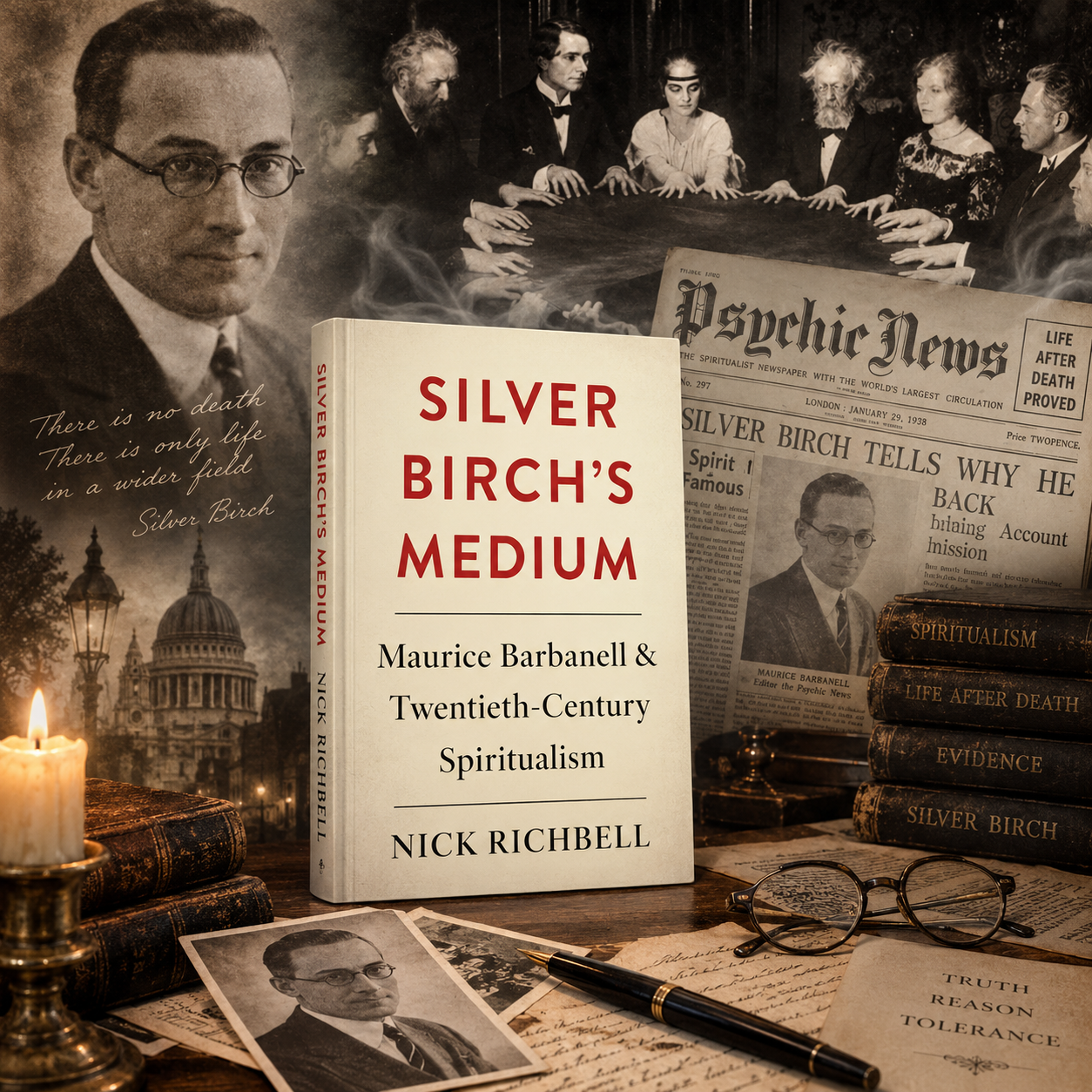
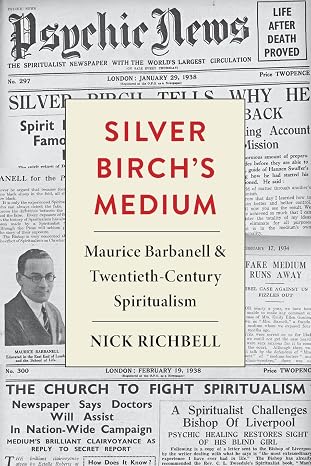
Dr Nick Richbell’s Silver Birch’s Medium: Maurice Barbanell and 20th Century Spiritualism is a compelling attempt to put him back where he belongs: not at the margins of the story, but close to its centre. As Richbell explains in our conversation, Barbanell has been “sidelined” despite being involved in an extraordinary range of activities throughout his career. His aim in writing the book was therefore very deliberate: “I’ve really tried to put him back into history as a central figure in Spiritualism.”
For me, this is a five-star book and a work of remarkable rigour and sensitivity. It is not simply a biography of a medium, nor is it merely a history of Psychic News or a study of Silver Birch. It is something richer: a way into the intellectual, cultural, religious and social world of twentieth-century Spiritualism through one of the people who did so much to shape it.
Barbanell was a medium, journalist, editor, lecturer, author, campaigner and organiser. He practised from the 1920s until his death in 1981 and became the channel through whom the teachings of Silver Birch were delivered for more than six decades. Yet, as Richbell points out, there is an extraordinary imbalance in how the two are remembered: “Silver Birch is widely spoken about in Spiritualist churches to this day. But no one talks about Maurice Barbanell… I think he’s just as important as his spirit guide, Silver Birch.”
That paradox provides one of the book’s most fascinating threads. Silver Birch became the enduring voice; Barbanell increasingly disappeared behind it. For decades he deliberately concealed his identity as the medium, allowing the teaching rather than the messenger to take precedence. Richbell suggests that this anonymity helped protect Barbanell’s credibility as a journalist and editor while reinforcing the perception that Silver Birch was an independent communicator. Ironically, Barbanell’s success in promoting Silver Birch may ultimately have contributed to his own historical eclipse.
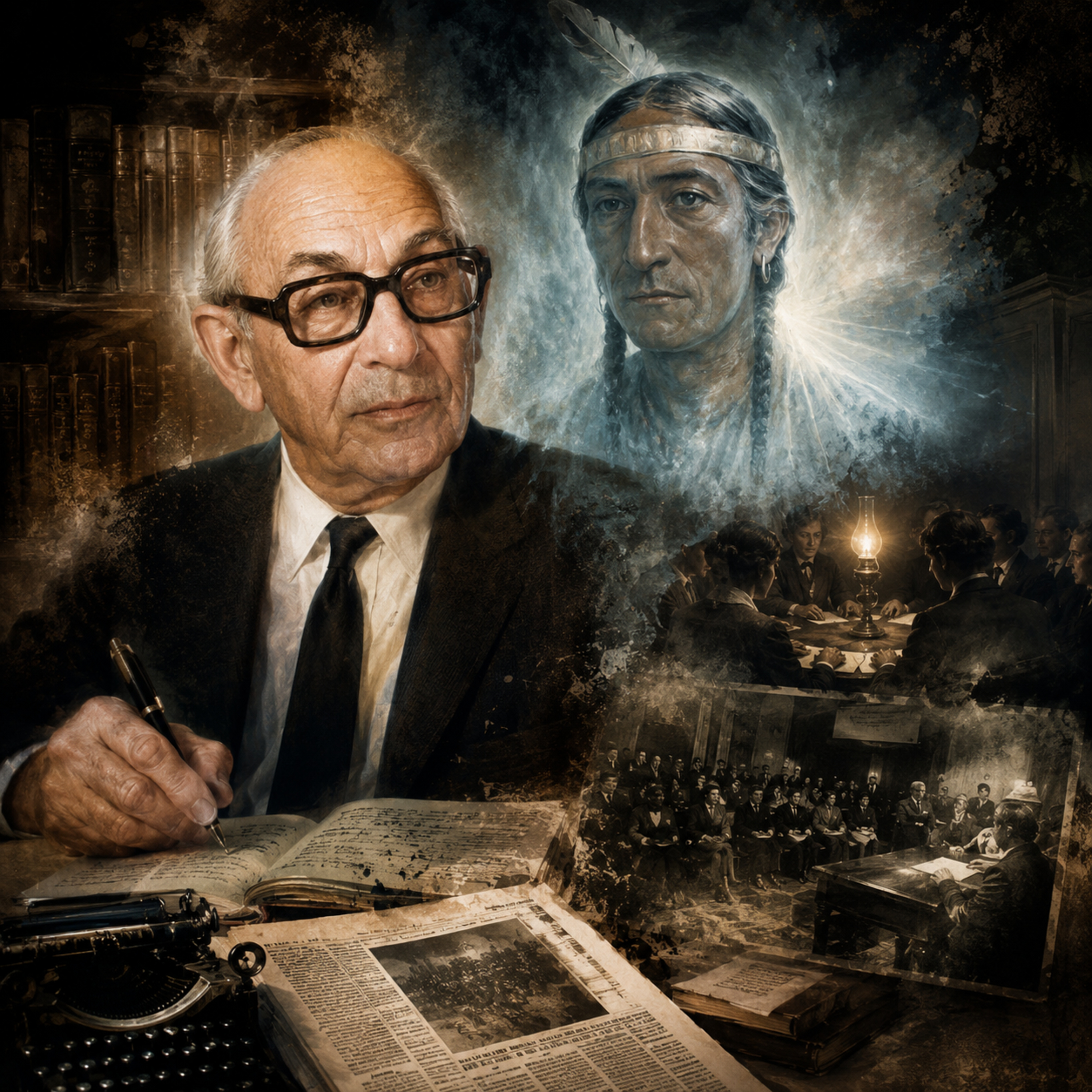
Richbell does not approach that relationship simplistically. Silver Birch is presented as a genuinely difficult historical figure to interpret. The communicator was described as an Indigenous North American spirit and taught a philosophy centred upon service, compassion, personal responsibility, survival after bodily death and a universal spiritual truth transcending organised religion. But Richbell is careful to preserve the interpretative problem at the heart of trance mediumship: “We cannot easily determine where the voice ends and where Barbanell’s begins.”
That uncertainty is treated as intellectually interesting rather than something that must be artificially resolved. To Spiritualists, Silver Birch may be an independent spirit intelligence; to sceptics, the teachings might emerge from Barbanell’s subconscious mind. Richbell goes further, describing Silver Birch as a complex figure at the intersection of “belief, identity, and authorship”, leaving open the possibility of a genuine communicator, a psychological creation, or something more difficult to categorise. This willingness to live with ambiguity is one of the book’s great strengths.
It is also what makes Silver Birch’s Medium valuable to readers outside Spiritualism. Richbell is not simply asking whether particular paranormal claims were true or false. He is asking how belief is formed, communicated, defended, institutionalised and given authority. As he puts it, Barbanell occupied a world in which “experience, persuasion and performance” could overlap, while remaining utterly convinced that he was communicating something of profound importance: the survival of consciousness after death.
Barbanell’s own route into Spiritualism makes that question especially interesting. He did not present himself as somebody who had unquestioningly inherited a religious worldview. Raised in a working-class immigrant community in East London, between a devoutly Jewish mother and an atheist father, he developed an inclination to question religious authority. Richbell sees that background as vital to understanding the credibility Barbanell later constructed around himself: he could portray himself as a sceptic who had investigated Spiritualism and become convinced by experience rather than a believer accepting doctrine on trust.
His first trance experience consequently becomes more than an anecdote about mediumship. Historically, Richbell reads it as a turning point in identity: the moment at which the investigator became personally implicated in the phenomena he was investigating. “It marks the moment where this sceptical investigator becomes personally invested, and this is where experience starts to outweigh doubt.”
Richbell’s treatment of such episodes demonstrates precisely why Professor Heidi Rimke’s description of the book as “a richly detailed and engaging biography… drawing on archival sources, press records, and rare ephemera” feels so appropriate. The archival depth does not sit heavily on the narrative. Richbell originally explored Barbanell as the subject of his doctoral research, but he has deliberately recast that scholarship for a wider readership, removing much of the academic language, adding new material on Barbanell’s visits to North America and a chapter devoted specifically to Silver Birch, and illustrating the volume with around fifty images. The result promises the depth one expects from serious historical scholarship without becoming inaccessible.
And there is a great deal of history to recover. Barbanell reportedly investigated more than 3,000 séances in his determination to encounter mediumship first-hand and distinguish genuine practice from dishonesty. He wrote more than fourteen books, lectured prolifically, participated in public debates and organised rallies in Hyde Park. Most importantly, perhaps, his journalism provided him with something mediumship alone could never have supplied: a mass platform. Through Psychic News, and during a period editing Two Worlds, he could help determine not merely what Spiritualists read but what counted as respectable, defensible and legitimate Spiritualism.
Richbell’s description of Barbanell as a propagandist is therefore important and deliberately provocative. He does not use the term merely in its modern pejorative sense, but to capture Barbanell’s active work promoting and defending a cause. In Richbell’s assessment, that role may ultimately be even more historically significant than Barbanell’s mediumship. Through journalism he shaped public opinion, defended Spiritualism, attacked what he regarded as fraud, and helped generations of believers understand their religion.
Psychic News becomes particularly fascinating when viewed through this lens. It did not simply report events within the movement. Under Barbanell it helped establish boundaries around what constituted acceptable Spiritualist practice, promoting particular mediums, emphasising ethical behaviour, publicising evidence considered supportive of genuine spirit communication and pushing back against fraud and sensationalism. Richbell describes it effectively as a gatekeeper through which notions of authenticity were curated.
This is where the book becomes, for me, a study of one of the architects of twentieth-century Spiritualism. Barbanell was not merely standing inside an existing movement describing what he saw. He was helping construct the structures through which that movement understood itself.
His battles extended far beyond the séance room. Court cases and questions of fraud placed Spiritualist claims into the uncomfortable arena of legal evidence, where experiences that carried enormous personal meaning had to withstand cross-examination. Richbell observes that these disputes reveal the very real stakes involved: reputations, livelihoods, public credibility and even legal consequences could turn upon questions of whether a medium was genuine.
Barbanell could also be uncompromising in his confrontation with established religion. He believed that orthodox Christianity had moved away from the teachings of Jesus and argued that Spiritualist evidence challenged doctrines concerning eternal punishment, exclusive salvation and the impossibility of communication with the dead. In his view, Spiritualism was not necessarily Christianity’s enemy but potentially its corrective: a religion grounded in experience and continued spiritual development rather than doctrine alone.
These disputes illuminate something much larger than the history of séance phenomena. They raise a profound question about authority. If an ordinary person could experience apparent communication with the dead directly, then who possessed the right to define what happened after death? Was knowledge of the afterlife the preserve of churches, theologians and scripture, or could individuals acquire it through personal experience? As Richbell puts it, the clash concerned “who really had the right to speak about God, the soul and the afterlife in 20th century Britain.”
Stanley Krippner’s assessment of the book as “an invaluable resource… [for] understanding the historical roots and enduring legacy of Spiritualist philosophy” therefore captures another of its strengths. This is not history sealed neatly inside the past. Barbanell’s legacy continues through Spiritualist institutions, ideas about mediumship, the continuing circulation of Silver Birch’s teachings and, of course, Psychic News itself.
But perhaps the most compelling aspect of Richbell’s book is how surprisingly modern Barbanell’s world feels. This is a story about evidence and who defines it; about expertise and authority; about journalism and persuasion; about personal experience set against institutional knowledge; and about communities negotiating the boundary between scepticism and belief.
Richbell makes this connection explicit:
“Belief doesn’t just vanish in a scientific age… Barbanell’s world reminds us that belief isn’t just about facts, it’s about trust, it’s about authority, and I’d say it’s about experience of something feeling true. And I think those forces are just as influential now as they were back then.”
That, to me, is one of the reasons Silver Birch’s Medium succeeds so completely. We enter expecting the biography of an overlooked Spiritualist and emerge having encountered a much wider history of how human beings negotiate extraordinary claims and decide whom, and what, to believe.
Richbell never needs to tell the reader what conclusion to reach about Silver Birch. Indeed, he recognises that the historical evidence cannot finally establish where Barbanell ended and Silver Birch began. Instead, readers are invited into that uncertainty. Barbanell himself inhabited precisely that territory: part investigator, part believer; journalist and medium; defender of evidence and passionate advocate; a man seeking proof while simultaneously constructing one of the most persuasive frameworks through which generations of Spiritualists would interpret that proof.
As I said following my conversation with Nick, Barbanell’s influence becomes increasingly astonishing once you begin looking for it. He appears almost as a supporting character throughout twentieth-century paranormal history when, in reality, he was helping shape the stage upon which much of that history unfolded. His fingerprints are everywhere.
That is why my own description of Silver Birch’s Medium as “a work of remarkable rigour and sensitivity… a compelling portrait” is not praise I give lightly. This is a beautifully conceived recovery of an important historical life. It neither reduces Barbanell to his mediumship nor strips that mediumship away in search of a supposedly more respectable subject. Instead, Nick Richbell takes the entirety of the man seriously: his beliefs, journalism, ambition, controversies, campaigning, experiences, relationships with institutions and lifelong conviction that death was not the end.
Most importantly, the book restores agency to someone who has too often become merely “the medium through whom Silver Birch spoke”.
At the end of our interview, Richbell described exactly what he hoped the book would accomplish: “There’s plenty in there that people won’t ever have known that he did. So I’m excited to be able to share his story and put him back into history where he deserves to be.”
Silver Birch’s Medium does exactly that.
For those interested in mediumship and Spiritualism, it provides an essential history. For readers of psychical research and paranormal history, it fills in the life behind a name encountered repeatedly but rarely explained. For historians of religion, media and twentieth-century culture, it offers a remarkable case study of how movements create legitimacy and authority. And for anyone fascinated by the complicated meeting point between evidence, experience and belief, there is a great deal here to contemplate.
Five stars from me. Silver Birch’s Medium is more than the recovery of Maurice Barbanell. It is a doorway into the world he helped build—and into the history of a movement whose questions about death, consciousness, evidence and belief remain very much alive.
You can listen to the full conversation here: Spiritualis…https://www.podpage.com/haunted-history-chronicles/maurice-barbanell-the-forgotten-architect-of-modern-spiritualism-with-dr-nick-richbell/
As well we get your copy of the book here: Silver Birch's Medium: Maurice Barbanell and Twentieth-Century Spiritualism: Amazon.co.uk: Richbell, Nick: 9781786773159: Books

Host, author and producer
Hi I’m Michelle.
Teacher, podcaster, history and paranormal enthusiast and woman who wears many hats and spins many plates including dog whisperer- as you will often find Archie my dog- joining me during podcast recordings where he promptly falls asleep clearly not as enthusiastic about the subject as I am. It does mean his dulcet snoring can often be heard gently in the background- his contribution as occasional co- host needs a little work.
I live in Oxford in the United Kingdom and I love travelling and exploring historical sites throughout the UK for its history and haunted activity. One of the best gifts I ever received was English Heritage vouchers to use to explore various different historical sites. I had the best summer that year. (For friends and family possibly reading this please note that hint for future gift ideas!)
I started this podcast as an adventure through some of my passions. It has been immensely exciting getting to know lots of other people around the world who have these same common interests. I’ve been humbled by the encouragement and support from strangers and people who have become new friends! I truly could not do this without you.
This isn’t something I have done before and I’m learning everything as I go along - from equipment, to editing, to even creating this website. I’m loving it though- it’s a lot of work - but worth every second. Thank you for being patient as I learn and improve along the way. I have big dreams of where to take this podcast and community I hope we build here. If you wish to support that dream and this c… Read More
Burford Priory: The Woman Who Watches Over Us