Infinity Song
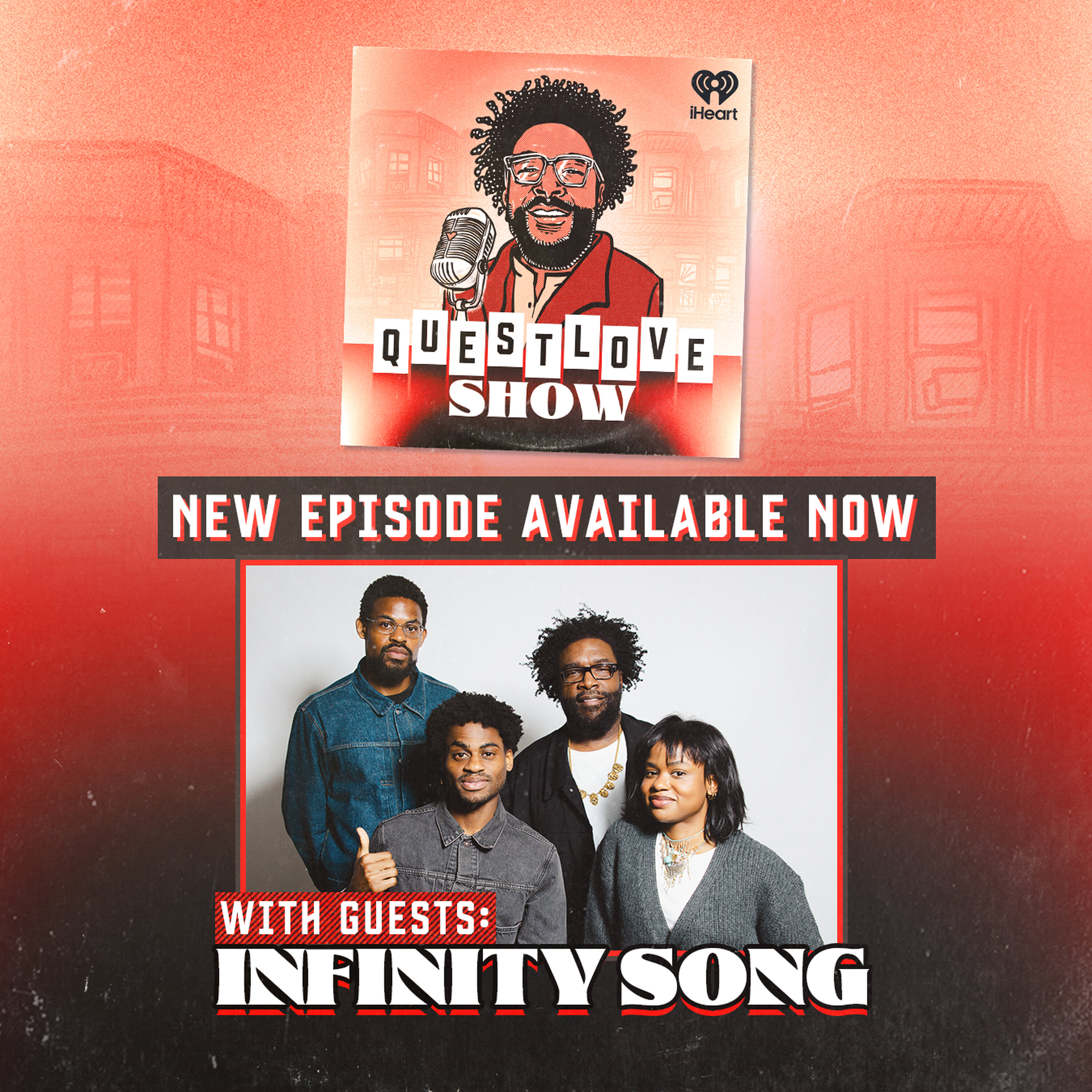
The Questlove Show welcomes Infinity Song's Abraham, Angel, and Israel Boyd. The Detroit-born siblings spent years busking at Central Park's Bethesda Fountain before signing with Roc Nation and earning the support of some of music and film's biggest stars.
The three Boyds talk about being homeschooled by a mom who handed out sour gummy candy watches as rewards for grammar drills, learning harmony as section leaders in their dad's choir, and moving to New York in 2006 out of necessity rather than in pursuit of a dream. Infinity Song also discusses rebuilding the band after founding member Victory went solo, and how going viral with "Haters Anthem" motivated the quartet (including sister Momo) to set their sights on even bigger accomplishments.
Along the way, there are plenty of surprises: meeting Oprah and Jon Batiste while busking, stories about 2000s-era Motor City, and more.

 iHeartRadio

 Apple Podcasts

 Spotify

 Amazon Music

 RSS Feed

 TuneIn

 Castro
00:00:00
Speaker 1: The Questlove Show is a production of iHeartRadio. What's up, y'all? This week we're bringing you the third and final conversation from a series where we go deep with artists who refuse to stick to the status quo and change the game along the way on their own terms. In this partnership with Levi's and their Behind Every Original campaign, we've been highlighting some goaded artists, musicians like Maceo from De La Soul, and, of course, the legendary E-40. Following trends was never their style, so instead they built a culture. Levi's has been the uniform of originals like that for over 150 years. The innovators pushed the limits of music, art, and culture, defining a generation along the way. You know, Levi's is almost like as timeless as a tuxedo, almost. Like, I've been rocking that for so long. A lot of the early roots photos, that's my armor. And this is the third and final conversation of our series, The Making of an Original. And today's story is one that literally started on the streets of Detroit. What up, though? And New York. You guys pretty much know my history on this platform for the last decade or so. And my love for family groups. I speak highly of, of course, you know, always referencing the Jacksons or the Staples or the Isleys or Sister Sledge or the Silvers. I mean, we even had the Womack sisters on this platform. I believe there's a magic that occurs when siblings sing together, something that you can't fake. But also, I can't leave out the slew of 70s vocal groups that I'm really a massive fan of. You can name them from Fifth Dimension, Fleetwood Mac, to Friends of Distinction, the Rotary Connection, to even the Starland Vocal Band. Afternoon Delight, ask your grandparents about that. So it's not surprising to me that a lot like my favorite music and sounds that have shaped my personal taste, of course, comes from the D, the city of Detroit. Legend has it, they relocated to New York City in 2006, having played the Met Steps, Fifth Avenue, Times Square, finally making the Beth Setta Fountain in Central Park. They're home for about 12 years. And as a fellow busker, you already know I was sold hook, line, and sinker. And now to see them rock, you know, the joke about practice. Carnegie Hall, Madison Square Garden, name it. Like, the world is their oyster now. And the world has eventually caught up. Don't feel bad. Just come aboard and, you know, savor the magic of these true originals. They have, I believe, I know the debut album is Rock Nation. I didn't even introduce you yet, so they don't even know who I'm talking to. But you should also check out their Amazeballs performance on Tiny Desk or just their videos. I mean, the cosigns from Doja to Janet, everyone in their corner, the good folks at Rock Nation, of course, put a ring on it this year, a self-titled album that I think will genuinely make your day. Please welcome Abraham Angel Israel Boyd. This is also like the four minutes that I'm absolutely professional. I feel like I have to be professional, but I'm such a fan of you guys. Like I can't even state enough how I love this.
00:03:47
Speaker 2: So thank you.
00:03:48
Speaker 1: Thank you for having us. And that's very much reciprocal. Wow.
00:03:51
Speaker 2: Yeah, we didn't even have that. My only thing is that Momo is not here because she's on tour.
00:03:57
Speaker 1: Of course. She had to go.
00:03:59
Speaker 2: She had some headline shows, and I think she's in Copenhagen today.
00:04:03
Speaker 1: That's forgivable.
00:04:04
Speaker 2: And then we'll join her, or the Infinity Song will go out and do a crazy tour in a few days. You sound excited. We're extremely happy that we got the privilege to do this with you before going out.
00:04:20
Speaker 1: Well, I thank you for giving me the honor to do this because I'm going to nerd out on you guys in ways never seen before. Anyway.
00:04:29
Speaker 3: The whole four minutes of your professional intro, I was staring at your hair and I'm thinking, It's so crispy.
00:04:35
Speaker 1: Juices and berries.
00:04:36
Speaker 3: And defined and moisturized. I need the hair routine.
00:04:40
Speaker 1: Juices and berries. You know what? I got to say, when people ask me, like, so how long are you guys going to stay at 30 Rock? I have to say that their hair staff is bar none. And John Mulaney's comedy bit, he explains how even after leaving Saturday Night Live, Even if I were to leave 30 Rock, I would still keep my ID to see if I can sneak in to get, you know, the juices and berries treatment. So they know what they're doing. Thank you. I appreciate the acknowledgement. So let me ask, where does the musical spark start in the Boyd household back in Detroit?
00:05:23
Speaker 2: It's a multifaceted question. Music is in our DNA, but it's, More than music, it's a paradigm. It has to do with the pursuit of stability, but also the pursuit of a kind of purpose. Music is the vehicle, but it wasn't necessarily, it didn't have to be music. It would have been something else, but God saw fit to give us music. Initially, our mom started us singing when we were really, really young. And we were homeschooled and music was a part of our kind of curriculum.
00:06:00
Speaker 1: Well, what's unusual about this, especially when I think about the church and Detroit, automatically I'm thinking of the Clark sister story. And, you know, because I'm notably older than you guys, I would say that maybe around Generation X, maybe millennials, where... in some Christian black households, like secular music is frowned upon and kind of usually people's crossing over to non-gospel music carry like major repercussions. Like the story of the Clark sisters, of course, is like, you can listen to all their hits and figure out which P-funk song they were sneaking listening to. I mean, their biggest song is You Brought the Sunshine of My Life, which is, pretty much their version of Stevie Wonder's master blaster jamming. And they live in a household where even Stevie Wonder wasn't allowed, you know? So I often wondered, like, did that ever change where like, as the generations go on, then the parents are more lenient where it's just like, you're allowed to listen to music. Like I, I was not allowed to listen to Prince. So there, there was a lot of punishments for all the Prince albums ever found. Wait, you grew up in church? I grew... You know, it's weird. I won't say... Like, my parents started out as those hip, revolutionary 60s parents. And then something happened around 1981. There was an appearance of Donna Summer on a show called either The 700 Club or The PTL Club. Like, back when televangelism was, like, a major thing.
00:07:41
Speaker 3: Peak.
00:07:42
Speaker 1: And so... What I believe is that, you know, the original version of Make America Great Again was with the Reagan administration using religion as their shield. Just a whole slew of people just felt guilty for all the hedonism and all the fun they had in the 70s and the 60s. And now we're 40. We need to repent. And so I just came home one day and we were all Christian. Like, I got the memo.
00:08:11
Speaker 3: That is hilarious.
00:08:14
Speaker 1: We were cool as hell up until 81 and then suddenly, praise the Lord. So that's hilarious. How old were you? Look, I was born in 71. So, yeah, 81, I was 10.
00:08:29
Speaker 2: And so you lived your whole early childhood as a heathen.
00:08:33
Speaker 1: Yeah, I mean, pretty much. But it's weird because also my parents were nightclub singers. So my church was the nightclub. God, I promise I wouldn't make episodes about me. Wait, answer my question.
00:08:51
Speaker 2: It's very interesting. Like your perspective on this is very, very interesting.
00:08:55
Speaker 1: Right. So was there ever any... Christian guilt for listening to any music that wasn't gospel? Like if the answer is no, then this is the most revolutionary thing I've ever heard. Cause, and I know things change with the generations.
00:09:12
Speaker 4: So we were, we're very Christian household, very Christian. Um, but even when I was growing up, we were much more, we were, we would express our Christianity much more through our music. than through even church attendance. Cause like I didn't grow up with the same church experience as Abraham would have. So like I, on Sundays we would be singing. I wouldn't, I wouldn't be, when I was growing up, I didn't really go to like attend churches regularly or things like that.
00:09:42
Speaker 1: But I just mean like, were you allowed to listen to Brandy and the Leah Leis?
00:09:47
Speaker 2: It depends on whose age.
00:09:49
Speaker 3: We definitely didn't grow up. It's definitely a, like a black Christian house. Like, a lot of guilt for like the secular music thing like that was definitely a thing but at the same time actually i think i want to go back to your first question which was like where does the spark of music come from for the boyd family and i think our all of our answers will always kind of be different than each other's but there's like this like boyd family tale if you will of like The beginnings of music for us. And it goes back to our dad and basically his relationship with Christianity and becoming a Christian. And as far as I understand the tale, he was given the gift of melody, of song, of music when he was a teenager. And then that is the spark that he then put into us and had the vision for music in our family.
00:10:45
Speaker 1: Was he a lifelong Detroit resident? Yeah, he's Detroit. Is there history in C.L. Franklin's church or any of the legendary gospel? I mean, Detroit, pretty much their gospel lineage is legendary, at least for the people that came from it. So was he a teenager in these churches?
00:11:08
Speaker 2: Yes.
00:11:08
Speaker 3: He's a quintessential Detroit black man in his 60s now.
00:11:13
Speaker 1: How many buttons in his suit?
00:11:17
Speaker 2: Um.
00:11:17
Speaker 1: Well, that's the thing.
00:11:18
Speaker 2: Detroit does dress up, but Detroit is extremely scrappy. I mean, suits and ties are still a thing, but it's work wear now.
00:11:29
Speaker 4: Actually, he wears suits on occasion, but when he came to New York, because I remember when I was really little, he would wear suits much more often. But when we came to New York and how I grew up, he really switched to just regular clothes, like regular New York.
00:11:45
Speaker 2: Detroit is about work. like work with your hands i know grit is they really don't like um new yorkers that much in the sense that because number one new yorkers and we claim both um but new yorkers believe that we're better than everybody yeah and detroiters have something to say about that.
00:12:07
Speaker 1: I do there's a reason why i a term called Malice in the Palace exists. You remember that? Oh, dude, I watched that like once a year. I watched Malice in the Palace.
00:12:19
Speaker 3: Live.
00:12:20
Speaker 2: I was watching it live. No, I wasn't. My cousin was there. He was a ball boy at that game.
00:12:26
Speaker 1: Cousin Jake, will this mark the third time that a Detroit native or resident has a story about Malice in the Palace? Either someone that went there or whatever.
00:12:35
Speaker 2: Yeah, my cousin Charles. Charles was at the game. He was a ball boy on the court. And I knew he was there, so I was watching.
00:12:44
Speaker 1: Right.
00:12:45
Speaker 2: And he was like, this is.
00:12:47
Speaker 1: So rabbit hole. Okay, so as a younger sibling in a music household, I will say that there were a few times where I was forced to harmonize against my will. And I'm always curious about how siblings sing for fun. Like one day I was just home and suddenly my sister's trying to teach me like Johnny Wilder's harmonies and heat waves boogie nights for some reason. You know, I want to go play. I'm like six years old, but I got to sing like this with the boogie. No, you're singing it wrong. So like in terms of you guys bonding, at what age were you guys just harmonizing for the fun of it?
00:13:34
Speaker 3: For the fun of it.
00:13:36
Speaker 1: Exactly. I'm going to be honest.
00:13:38
Speaker 2: I don't think we were ever just harmonizing for the fun of it.
00:13:42
Speaker 1: Maybe.
00:13:44
Speaker 2: No, I don't think that was a thing.
00:13:45
Speaker 3: Yeah, that wasn't like a game we liked to play. Oh, you sing this note. I'm going to sing this note.
00:13:54
Speaker 1: Okay.
00:13:54
Speaker 3: But there were times. There have been times that are like core memory for me where we were workshopping harmonies, working a song. There's a particular song that just happened for me where the harmonies became fun. Like we reached that point and we just wanted to sing it over and over and over again. And rare, but.
00:14:18
Speaker 1: So you guys had rehearsal, but it wasn't like out of nowhere....
00:14:23
Speaker 3: No.
00:14:24
Speaker 2: That's a theater school tradition more. Or a performing arts high school or something. Juilliard. You know.
00:14:31
Speaker 1: So I went there. Like, I was there when, like, for boys to men to still want to be, to go to the fourth floor boys' bathroom at Creative and Performing Arts in Philly was a choice. You know what I mean?
00:14:49
Speaker 3: They were rehearsing in there?
00:14:50
Speaker 1: Oh, dude, because the acoustics, like, You know, it was a large bathroom with cement, you know, so it would just float everywhere. And you would walk by it and you would just hear, you pretty much knew they were going to make it, like, just based on the amount of time that they just spent there harmonizing. So, you know, I think I'd sort of just thought that with singers, at least, that That's a weird bond to me. I mean, I can see like when my musician friends like, okay, we're going to have a jam session. I'll throw a jam session at a drop of a dime. But with singers, it's weird. You know what I mean? Like, okay, this is your part. This is my part. And I just thought because how effortless you guys blend together, that there had to be at least some 20,000 Gladwellian hours of just singing together. for the sing of.
00:15:43
Speaker 4: It definitely sang for a lot of for a lot of reasons not really just for the sing of it but we've sang together decades but.
00:15:51
Speaker 3: That does go back to our dad being a choir director so harmonies you this is the alto section this is the tenors this is the sopranos like and then Us being his kids, we would be section leaders. So that is like, okay, you have to teach all these other kids this part. And then eventually, I think right now, currently, Abraham really has the ear for harmonies and what parts and how to hit the triads perfectly and everything. So he's now like, okay, if you don't sing this part, it's going to be a problem. So that's kind of how it goes now. Okay. Yeah.
00:16:32
Speaker 1: How many siblings are in the household? There's more than- Nine total. Wow.
00:16:37
Speaker 3: Okay.
00:16:38
Speaker 1: So Randy through Reby. All right.
00:16:41
Speaker 2: Yes.
00:16:41
Speaker 1: Of course, I'm going to make one Jackson reference. Sorry.
00:16:44
Speaker 2: That's funny. I didn't even- Wow. Okay.
00:16:47
Speaker 1: I thought like, don't make no Jackson comparisons because they've heard it all before. No, we do say that actually.
00:16:52
Speaker 2: We love the Jacksons, but we also think that we should be allowed to live in our own light.
00:16:58
Speaker 1: Of course. Exactly. I totally respect that. So when you're homeschool, what's a Tuesday like in the Boyd household?
00:17:08
Speaker 3: Okay. Well, it really, our mom was our, she was in education before. Okay. But then obviously she was our teacher.
00:17:16
Speaker 2: Okay.
00:17:17
Speaker 3: And she has, she's very creative. And so I feel like she liked to gamify everything, which was so helpful.
00:17:24
Speaker 1: She made it fun?
00:17:25
Speaker 3: She made it. Not all the time, but definitely she would have rewards, which ranged from you get to pick a sticker out of the sticker book if you finish all your reading.
00:17:37
Speaker 2: Okay.
00:17:38
Speaker 3: The most famous one was like she had these sour gummy candy watches. Those were the big prize. Like you had to work for like a month.
00:17:47
Speaker 1: And we did. In my SSI, SSI, PBI. You had to learn grammar.
00:17:52
Speaker 3: What are those things called? Grammar....
00:17:55
Speaker 1: What was it?
00:17:56
Speaker 2: Verbs? Pronouns?
00:17:57
Speaker 3: It's like a certain thing in grammar, but like a lot of memorization.
00:18:02
Speaker 1: Okay.
00:18:03
Speaker 3: A lot of reading. Prepositions.
00:18:05
Speaker 2: Prepositions.
00:18:06
Speaker 1: Don't make me.
00:18:07
Speaker 2: Above, about, after.
00:18:08
Speaker 4: Above, across, after, against, among, amid, along, around.
00:18:11
Speaker 3: Out of.
00:18:11
Speaker 1: Would you make up songs to study these things? Yes. Oh, yeah.
00:18:14
Speaker 2: And acronyms.
00:18:15
Speaker 1: Okay.
00:18:15
Speaker 2: A lot of acronyms.
00:18:16
Speaker 1: Okay. Angel, could you name me three albums that changed your life? I'm going to ask you all this individually.
00:18:26
Speaker 3: I'm forgetting.
00:18:27
Speaker 1: It doesn't have to be albums, just songs or musicals.
00:18:30
Speaker 3: First one that literally came to mind, CeCe Winans, literally anything.
00:18:33
Speaker 1: Okay. Is she your North Star or just that's the voice you.
00:18:37
Speaker 3: Not right now, but just foundationally. Okay. Not even just musically, just her whole essence. She's so... She's just amazing.
00:18:48
Speaker 2: Okay.
00:18:48
Speaker 3: But yeah, her voice... And, like, their family. We definitely grew up on the Winans, for sure.
00:18:57
Speaker 1: Did you guys have any interactions with the Winans family in Detroit in your comings and goings? No.
00:19:02
Speaker 2: Okay.
00:19:03
Speaker 3: I don't even know what the other two would be. Definitely, I'm going to say Pat Metheny. Okay. Grew up on him as well, but just his whole... like soundscape yeah it's very it's very subconscious it's not like oh i'm like thinking about him like every day right now but it's just the essence of that feel his feeling it's like so i.
00:19:26
Speaker 1: Understand okay nine times out of ten if i'm shazamming something and it's like almost jazz related or 80s jazz related it always comes back pat mccain for some reason I.
00:19:37
Speaker 3: Don't really think of him... I mean, yeah, I don't think of him in the jazz genre, really. For me, it's just sound. It's just like the feeling of sound.
00:19:46
Speaker 1: Here's Eris. Yeah.
00:19:49
Speaker 3: And then I'm going to say, I guess she kind of would be CCM, actually. But I'm going to say one, when I kind of branched out on my own listening, when I kind of got to high school and I could, like, listen to whatever I wanted, there's this artist named Brit Nicole.
00:20:05
Speaker 2: Okay.
00:20:06
Speaker 3: And she's so, like, in the cut Christian, I guess, like back in the day. But yeah, she had some really cool, like pop sounding stuff that like, I forgot what the name of the album was specifically, but it was, it was huge for me.
00:20:21
Speaker 1: Okay. So your father famously packed the family up to move to New York in 2006 to, for lack of a better term, chase the dream. As kids, do you know, and I've, I've heard, Matthew Knowles has been on this platform to explain his version of that, like stopping his job and putting his investment into his family. At the time when this move happened, were you guys aware of how heavy that bet was? Or was it just like, hey, we're going to New York?
00:20:56
Speaker 2: Well, I don't want to say chase the dream because I don't think that that was the intention. The truth of the matter is that Detroit And Michigan as a whole fell into the depression of 2008 earlier than the rest of the country, much earlier, three years earlier. And so it was an absolute, everything changed. The ability to support artistic pursuit. We actually didn't get into music to chase the dream. It was an upward call, a pursuit of greatness. Like I said earlier, it could have been any medium, but music was the vehicle. And so it wasn't, now we're chasing the dream, I will say.
00:21:50
Speaker 3: Right.
00:21:51
Speaker 2: Now we're pursuing the dream vigorously. But at that time, it was survival. It was a lot of survival. But it was also, because once you know it's music, we can't, we are not going to do anything else. This is our family farm. This is what we use to sustain ourselves.
00:22:09
Speaker 3: Okay.
00:22:10
Speaker 2: You just lock down.
00:22:11
Speaker 1: So I'm always curious when fellow buskers make it out of busking into their moment. First of all, how old were you guys when you first started to busk? And how do you even determine that route to busking? start performing and delivering on the streets?
00:22:31
Speaker 4: Well, I was very young. And then Momo would have been younger than me. I was probably like seven.
00:22:37
Speaker 2: Okay.
00:22:38
Speaker 4: Did it for many years. And it wasn't, you know, it wasn't a route.
00:22:41
Speaker 1: I didn't determine that route.
00:22:43
Speaker 4: You know, it was just, it was a part of the family's culture to perform was the family's culture. And, you know, you take your culture wherever you are and wherever you can express your culture. And so that happened to be, for us doing street performances, but the culture continues right now onto commercial stages around the world. So it's not that the road was like, it was never that it was busking is a necessity. It was more so the expression of our culture and who we are has always been a necessity. And that's an expression of freedom. And to say, whatever the circumstance, whatever level of society you're able to do it at, you do you. You use your voice and you be free and be a sovereign thinker, be able to express yourself. And so that was very important to the family's culture and it stemmed from our parents and the way they thought. And so it manifested with us having street performances, but it didn't originate with that. It wasn't like, okay, we want to street perform because of this or because of that.
00:23:55
Speaker 1: It was really.
00:23:56
Speaker 4: About expression and about that being the medium through which we could express ourselves. But no matter what level we go to, it will always be the same driver. The driver is expression and the driver is a passion for art and creativity and for a voice, for the human voice, which is increasingly valuable, I believe.
00:24:16
Speaker 1: What was it about Central Park that seemed like a steady place? Or were you guys just going.
00:24:21
Speaker 3: All over New York We were all over for the first, I don't know, few years. We did the famous subway spots, 34th Street, 42nd Street. Would you also get on the trains and do that? Not on the trains.
00:24:37
Speaker 1: Okay, I'm a real... Ah, damn.
00:24:39
Speaker 3: Back then, we did the Metropolitan Museum of Art, and then eventually Central Park just became our spot. I don't know, it just proved to be the most... giving environment to our sound and it was nice it was just a nice environment to be in i think but.
00:24:59
Speaker 5: It was like a sanctuary okay i still go back i still will go out there because i enjoy the conversation between at the most rudimentary level between artist and audience um.
00:25:12
Speaker 2: Wait to this day to this day but also i get to meet like everybody and it's not spot specific but um Like, we were performing at the Met, and that was where we met Oprah.
00:25:22
Speaker 3: Okay.
00:25:23
Speaker 2: You know, Steve Harvey on Fifth Avenue. In New York, we get to meet the most amazing people. I met my friend, well, that's where we met our friend John Batiste.
00:25:33
Speaker 1: Okay.
00:25:34
Speaker 2: In Central Park, and we're friends to this day.
00:25:37
Speaker 3: Tori Kelly, Scooter Braun.
00:25:40
Speaker 2: You can meet anybody in the world busking, and it's really, it cuts down like hundreds of layers of, teams and all of that stuff. Like if I want to, if I want to meet a CEO, I'll go sing. That's where I met my friend, Spike Jones. That's where I, you know, if I, if I want to meet a founder, if I want to meet private equity, I'm not, I'm more.
00:26:04
Speaker 1: Likely to meet them.
00:26:05
Speaker 2: And I do meet them performing out there.
00:26:10
Speaker 3: You can meet these people, but it's, it's whatever you're performing is not like resonating. If they're not in your audience, then it's kind of like you didn't meet them. So you have to be like performing at a certain level that they are in your audience to meet them.
00:26:25
Speaker 2: Okay.
00:26:25
Speaker 1: We had no routine. So we pretty much were freestyling for four hours, which we didn't know this would serve Tariq later, but just the pressure of having to talk about someone's black jacket and someone's blue jacket and, Someone's turquoise, but like he literally, that's how he got into his freestyle prowess. The fact that he just had to make stuff on the spot. But in terms of like, what is, what is the best versus original and covers? Like how, how did you guys? Covers.
00:26:56
Speaker 2: I think it's a challenge. So we have to have a conversation.
00:26:59
Speaker 1: It's not a challenge.
00:27:00
Speaker 4: In street performing, there's no other answer.
00:27:02
Speaker 1: You're definitely siblings here.
00:27:04
Speaker 3: There is no other answer than covers.
00:27:06
Speaker 1: No, there is an answer. It's literally not a debate.
00:27:08
Speaker 3: We did covers. And this is the reason why it worked. Because if we were doing originals, nobody would, not nobody, but maybe we would have 30% of the crowd that we had. You have to do covers because they're the bridge between you as an unknown performer and the wide world that knows this famous song. We famously did covers. And that is the reason why people were like, oh my God, like they're singing my favorite song.
00:27:35
Speaker 1: I understand that.
00:27:35
Speaker 3: But they're singing it in their own way. Like, I don't know what he's going to say, but we did literally covers.
00:27:42
Speaker 1: Yes.
00:27:43
Speaker 2: And so here's what I will say. There was an over, we've done it all over our time performing. And I want us to view performance through the lens of storytelling, through the lens of world building, through the lens of underground, through the lens of craftsmanship, because that's what it is. It can be whatever you make it. And so And today, I'm different than I was back then. I have had the privilege of understanding from a high level what you should be doing as an artist versus just getting money. Quick money. Quick money in whatever medium. Because brand building and making money are not the same thing. You could be building a brand on the street and you can plan your ascension to the highest levels of the world from the street. But what it takes to make money in that moment and what it takes to build a brand in that moment are two separate things. And so the street can be a bridge to the highest levels of the world.
00:29:00
Speaker 1: Okay.
00:29:00
Speaker 2: And it has been, and I believe that's a part of your story as well. I heard Wendy Goldstein say that she saw you guys. I don't know what.
00:29:08
Speaker 1: Yeah, she was the... The tipping point for us getting a deal.
00:29:13
Speaker 2: I don't know, but I'm saying there's a higher level that you have to accomplish, and you can accomplish it on the street, but you cannot accomplish it if you're only a street performer. And so if you're only a street performer, you might gravitate towards exclusively covers. But if you are a performer who is the greatest performer in the world, you have to stand behind your original music as well. You have to stand behind your own brand as well from the street.
00:29:40
Speaker 1: For you guys, was there... Well, also, you guys are doing this in the age of social media, so that's another element that I'm not even aware of how that affects the word getting around. But was there any tangible venue structure for which... you guys could, you know, a bottom line in the village or like a club or.
00:30:03
Speaker 2: We went from the street to.
00:30:07
Speaker 1: See, that's the thing.
00:30:08
Speaker 2: I want to spell this out very, very vividly. Yes.
00:30:11
Speaker 1: And I'm asking because as a fan, I want to know the origins of what got you here. The idea that we were.
00:30:18
Speaker 2: On the street just performing. And our dad, he really did... We have a back and forth on this because coming to... I came to understand... in time, there's a development side to it. You're not going to just get discovered off of the street, just singing songs and just doing your thing. It's not going to happen. It never happens like that. Infrastructure takes time to build.
00:30:44
Speaker 1: How much time off the street corners are you committing to your craft? Songwriting, performance, and... Studio, all of that, everything. Pedigree.
00:30:56
Speaker 2: The idea that we were just singing on the street is just, and same for you. I didn't know. I didn't know exactly. But if you, one plus one equals two.
00:31:05
Speaker 3: Right.
00:31:06
Speaker 2: Then I did three.
00:31:06
Speaker 1: I was going to do that, but okay.
00:31:10
Speaker 2: That's going to go viral.
00:31:11
Speaker 1: One plus one equals two.
00:31:13
Speaker 2: Yeah.
00:31:14
Speaker 1: That's going to be the one clip. There you go.
00:31:16
Speaker 2: And so that's my word to all the people who are busking right now. You can meet. The person of your dreams who will change your life tomorrow. The challenge is they're going to ignore you, like Angel said, if you don't have the goods. And often when I see the people on the street, like you, I remember we saw, when we signed, we were with Chaka Pilgrim. And she was like, oh, that's cute. She was the president of Roc Nation at the time. And somebody was performing and she was like, oh, that's cute. You know, Chaga Pilgrim could have changed that woman's life in that moment.
00:31:58
Speaker 1: It was just cute.
00:32:00
Speaker 2: Gotcha.
00:32:01
Speaker 1: So what was the tipping point for the group that got you into, were there other labels or was like Roc Nation the very first major player that stepped up to the plate to say, let's do this? Was that the goal? Was that always the plan?
00:32:19
Speaker 4: Roc Nation was the first.
00:32:20
Speaker 3: Okay.
00:32:21
Speaker 4: And there was a whole, you know, story behind it. But really, Roc Nation was introduced to the family through our sister, Victory.
00:32:29
Speaker 1: Okay.
00:32:30
Speaker 4: So she's my older sister. Abram's younger sister. But for me, she was always, just from my point of view, she was always someone who, even as we were street performing, you know, she was always ambitious in her musical, in what she wanted to do musically. So she would always be writing. She was learning the guitar. And these are not things that, like Abram talks about, these are not things that street performing demands. It's demands you put on yourself. And so she was always seeking knowledge musically and seeking ways to grow. And because she was in the infrastructure of.
00:33:14
Speaker 1: A group where.
00:33:19
Speaker 4: You know, you could be exposed to anybody any day of the week.
00:33:22
Speaker 2: Yes.
00:33:22
Speaker 4: And she, and that was met with her own preparation. She was able to get around certain people and showcase what she had taught herself or what she had learned. And then that put her in front of certain eyes and then other eyes.
00:33:38
Speaker 1: And then yada, yada, yada.
00:33:39
Speaker 4: And then, you know, we get a meeting with Roc Nation and it's really initially just for her, but our dad, being intelligent, says, okay, I want to bring you guys along and I'm going to have you guys just stand by and I'm going to let people know and we're going to bring you guys up. And so victory was the initial point of introduction for Roc Nation. But then once we got up and once we got in front of Roc Nation, we also had a lot of preparation that was outside of just performing. And so we were able to perform for the company as a group, Victory herself, and then all of us as a group. And it was really from there that we were introduced and that we got signed.
00:34:23
Speaker 1: And it was... At one point, were you a fivesome?
00:34:27
Speaker 5: Yes.
00:34:27
Speaker 1: Okay. So even how did you guys reinvent yourselves as a quartet once Victory remained a.
00:34:35
Speaker 3: As a start, we were three.
00:34:37
Speaker 1: You were trio first?
00:34:39
Speaker 3: Yeah, me, Abram, and Victory.
00:34:41
Speaker 2: Okay.
00:34:41
Speaker 3: And then it was five.
00:34:42
Speaker 1: Okay.
00:34:42
Speaker 3: And now it's four. Four. Got it. It's a natural evolution as siblings.
00:34:47
Speaker 1: Are all nine siblings musically engaged?
00:34:50
Speaker 3: Yes, to a certain capacity.
00:34:52
Speaker 1: Okay.
00:34:53
Speaker 3: Not to the same extent, obviously, but.
00:34:55
Speaker 1: And all are... The ones I don't know about, are they actively pursuing their... No.
00:35:00
Speaker 2: That was a big challenge because Victory, being a founder of Infinity Song, she was integral to our DNA as a band.
00:35:08
Speaker 1: Right.
00:35:08
Speaker 2: It's hard to overcome your DNA because... We had to change our entire situation when she went solo. Because musically, she was our information. She was the first person in the family to play the guitar. And she taught Momo how to play the guitar. And I don't know, I don't want to say, like she taught a lot of us how to play the guitar. And she has her own unique style of playing the guitar. She learned it uniquely. Nobody plays the guitar like Victor E. And so just that alone, the harmonic structure, so much of our harmonic pursuit came from victory. So restructuring yourself really speaks to the ambition of each person sitting here because we really did have to remake ourselves.
00:36:01
Speaker 1: So I would like to know, for you, what are the three albums that you hold near and dear as far as your musical development?
00:36:23
Speaker 2: Okay.
00:36:24
Speaker 4: Thriller is always, honestly, I could go, I could say off the wall, Thriller bad.
00:36:29
Speaker 1: Okay. Those three.
00:36:31
Speaker 4: But I think Thriller for me is very consequential to my journey as a person and a musician. And then I was, when you initially asked Angel the question, I was thinking Pat Metheny just right off rip. And his live album from, I forget what year, but I think it's The Road Home.
00:36:51
Speaker 2: Is it The Road to You?
00:36:52
Speaker 1: Yeah, The Road to You, I think.
00:36:53
Speaker 2: Okay.
00:36:53
Speaker 1: I think that's it.
00:36:54
Speaker 2: We might be wrong.
00:36:55
Speaker 4: But yeah, that album specifically, because that's one we listened to a lot when we were growing up.
00:37:02
Speaker 1: Well, your guitar development also is, would Pat sort of be a North Star for you or just who?
00:37:09
Speaker 4: When I was really young, I didn't even know he was playing guitar. I thought he was a pianist. Because that's how young I was. I couldn't differentiate instruments.
00:37:16
Speaker 1: Okay. And so for me with.
00:37:18
Speaker 4: Guitar, the first guitarist I really looked at and thought of as a guitarist was Stevie Ray Vaughan.
00:37:23
Speaker 1: Okay.
00:37:24
Speaker 4: But Pat Metheny was always just music and his composition was everything. And now obviously as I'm older, I listen to his guitaring and I'm like, yeah.
00:37:37
Speaker 3: Okay.
00:37:37
Speaker 4: But for me initially getting into guitar, it wasn't really... inspired by Pat Metheny. He's just musically integral.
00:37:45
Speaker 1: Always there. Yeah. Especially now that you're a foursome, who's the deciding factor if there's a disagreement, either in lyrical content or should the bridge go here, what key this is in, or is it just the person that starts the song gets the say?
00:38:03
Speaker 4: Yeah, we very much give people parity in terms of If you bring it to the table, your voice is the strongest when it comes to the creative. And so we hold that standard across the board, whether it's writing or the production or the chord changes or whatnot. We give people the freedom to bring that song across the finish line in accordance with their vision. And so you'll see that a lot in our music, especially if you listen to albums, you'll be like, oh, this song is very different from this song. And that's probably because there's a different mind behind it, driving it. And so, yeah, we definitely allow people to have their individual expression. And even if we go back to how we get soft rock, I think in the individual expression, there's a collective culture. And collective culture has always been very instruments-based, very acoustic. It was always very acoustic-based and very vocally led. And guitar being the instrument of choice for the family, I think it just lent itself to things, either soul or soft rock. And so we had kind of a culture that was about us, especially when Victory pursued her own path. We had, you know, it was two of us played instruments, me and Momo, and we had four vocalists and they kind of created this, a culture. And so the first person to point it out and to say, we should pursue this was Angel. And she really, you know, at that point in our career, we had a few paths we could go down. We could really lean R & B, we lean urban, We could lean probably some form of indie, whatever. We could go pop. And I remember we would just be meeting and we would be doing covers. We would do a lot of covers. And I think that era of doing covers, just the four of us, informed us on what really makes us go, what we really like hearing ourselves sing. And so Angel identified that when we sing songs that, are more soft rock leaning. It just feels more comfortable to the culture that we had already been creating. And so Angel really pointed that out. And then it wasn't a hard transition to say yes to that because we had already been moving in that direction. And then you get Metamorphosis, you get Haters Anthem, you get Sinking Boat, you get all these songs, and then you get the new project. It's just, I think we're going to have a definitive soft rock statement still You know, in terms of the music recreate, I think there's still space for a definitive soft rock statement. Because I think that what I want is I want Infinity Song to be equal with the term soft rock. And I think we haven't quite achieved that yet. Although in some spaces we have, you know, you think of soft rock, you do think Infinity Song. I want that on a global scale. I want Infinity Song and soft rock to be synonymous. And so I think we will still... come to a space where we have a, uh, a defining musical statement that is, uh, the infinity song statement. But, um, I think we've been growing from that point. And I believe it was 2021. We've been growing from that point and things we've learned in the, the, the knowledge we've acquired has just been, the world does not yet see the fruit of, of all of the things that we have.
00:41:44
Speaker 1: Exactly.
00:41:45
Speaker 4: And, and, And so it's been an amazing journey.
00:41:48
Speaker 1: How would you know what to say for yourself? This is also assuming that, I mean, I'm just under the belief that one can be a quarter of a team, but also have your side projects as well. You know what I mean? Like an open marriage, if you will. I mean, dude, the roots are an open marriage. Like, you know, I've pivoted to everything... But Roots Records, as of lately. But what is something that you want to say for yourself to define you individually as opposed to, hey, guys, I have an idea for a song?
00:42:31
Speaker 3: Well, there's definitely like an unspoken standard of song content material for the band that they're definitely not going to sing this. but this is definitely me kind of a thing. That's like, I would do this on my own project sort of a thing. And then there's ideas where it's like, oh, this is such a good like anthem or universal theme that can, you know, have multiple voices on it that we can really embody. So I think that's generally probably how it goes. But I will say that I think some of our, I know that when I get really specific and personal in songwriting, that it really allows for a perspective to come through that I think is so important for listeners to connect with. And so I have allowed myself to approach it very much more personally than I think maybe they do at times.
00:43:29
Speaker 2: Okay.
00:43:29
Speaker 3: Referencing like our song Slow Burn, very specific lyrics that are very personal to me that really allowed for the listeners to catch on to like the perspective of it. And so.
00:43:42
Speaker 1: Who wrote American Love Song?
00:43:44
Speaker 3: Momo.
00:43:45
Speaker 2: Okay.
00:43:46
Speaker 1: I see the Haters song as a political statement more than just the fun, ironic song for haters around the world to unite. But what's the genesis of... I see all of your lyrics as much deeper than probably you are seeing it.
00:44:03
Speaker 2: Well.
00:44:04
Speaker 3: I don't know about that. But it goes back to that unspoken standard that we just have, which is there's always a message. There's always a deeper theme. And we're not just singing songs just to sing songs or just to sound good. I think there is that internal compass of this understanding that music for us is a service to the human soul. And so we're never just going to write something just because it feels good or sounds good. We're always going to be And we're always going to be completely honest as much as we can because that's what's interesting and that's what's good and that's what's good storytelling. So we're going to be raw and authentic in ourselves and say what we want to say, but it's always going to have like a North Star or a deeper meaning that's like purposeful.
00:44:52
Speaker 1: When haters caught on, which I don't think I truly know what it feels like to have a viral moment. Like, we never had a viral moment. Yeah, you've had other moments.
00:45:03
Speaker 2: Sustained success.
00:45:04
Speaker 1: But the way that the ripples spread, where it's like, yo, you up on this? Like, I've had that a few times with you guys. You know, all my tastemakers come to me like, yo, you up on this? Which I almost feel like is the new version of a hit single. So, you know, I consider haters... I consider that a hit. In my head, that was number one for nine weeks, even though it was just something viral. Okay, old guy talk. I'm sorry. I'm in my 50s. But my whole point is, was there a moment where you guys felt like, okay, the world's finally catching up to took you long enough world? Did it feel like that at all?
00:45:47
Speaker 2: I think for a short time, it might have. Well, no, it was a one-two punch. It was Hater's Anthem, and then it was Slow Burn. It's so weird because I think we learned what sustainable fan base building meant. And that virality does not equal success. Virality equals virality. And so Hater's Anthem took us around the world. Slow Burn took us around the world. Metamorphosis... all of these songs took us around the world and introduced us to tens of millions of people, but only a small fraction of those people are going deep and really exploring what is going on. And, and so we really do feel like we have a lot more work to do to, to, you know, engage with the broader audience globally. And that is, You're celebrating the songwriting, and we celebrate it as well. But then it's a math problem of, okay, what is the song? What are the lyrics? What is the hook? What is the melody that is going to penetrate either the artificial or very real barriers that are keeping the masses from our music?
00:47:09
Speaker 1: Before I close, I would like to do minor rapid firing just about you guys as siblings.
00:47:16
Speaker 2: Okay.
00:47:16
Speaker 1: First of all, who's the sibling that gets in the most trouble? That's probably him. Okay. Gary's man. Okay. Who's the harmony know-it-all?
00:47:27
Speaker 4: The harmony know-it-all?
00:47:28
Speaker 1: Are all the questions going to lead to Abraham? Okay. Okay. Who's the best cook? Wait, it might be Israel. I can cook a little bit. But I'll give it to Angel. I don't know what she can do. I feel like, Angel, we're going to have to have our own episode because you're having such, your silence is, I'm so like the way that I hear people.
00:47:51
Speaker 3: Listen, I haven't said anything.
00:47:53
Speaker 1: I don't know what you're talking about. That's what he's saying. What is the Thanksgiving like in the Boyd household?
00:47:59
Speaker 3: Abram usually cooks for Thanksgiving, actually.
00:48:01
Speaker 1: No, we do a good, we like food in our family. I sure hope you like food. Survival and energy.
00:48:09
Speaker 2: Yeah, our meals are generally good.
00:48:11
Speaker 3: The worst cook in the band is probably Momo.
00:48:14
Speaker 1: I didn't want to say it, but it might be her. Who takes the longest to get ready?
00:48:21
Speaker 4: Momo or Angel.
00:48:23
Speaker 1: Momo. Momo, okay. Well, of course Angel would say that.
00:48:26
Speaker 3: I'm next. I have no problem admitting, but.
00:48:29
Speaker 2: Angel might be, though. See, Momo starts getting ready earlier. Let's just say that.
00:48:35
Speaker 1: Okay. I don't think so. So already there's a... In our circle, there's the Amir time and everyone else time. And my time is like always an hour before. If you want me there at 5, you might have to tell me to be in the lobby at like 3.30 or whatever. Just so I'll show up at 5.10. There's Jedi mind tricks. Who's the worst at keeping a secret of the siblings? Probably Abraham.
00:49:03
Speaker 2: No, that's not true.
00:49:04
Speaker 1: Yeah.
00:49:06
Speaker 4: I mean, we're pretty trustworthy, but if there were.
00:49:11
Speaker 1: Who's the snitchiest then? Probably.
00:49:15
Speaker 2: No, come on. We can't do that. So, first of all, discretion is the one of the most important things in our industry, as you know. So, you know, there's a range of, like.
00:49:28
Speaker 1: So he's guilty?
00:49:28
Speaker 3: No.
00:49:30
Speaker 4: No, no, we're all pretty, we're very trustworthy.
00:49:33
Speaker 1: If we're beefing.
00:49:34
Speaker 4: I'm just talking about amongst siblings. I'm not talking about other people's secrets.
00:49:39
Speaker 1: Who is the sibling, and this is metaphorically speaking, who is the sibling that would know how to get rid of the body? Metaphorically speaking.
00:49:52
Speaker 2: Oh, that's a crazy question.
00:49:54
Speaker 1: In other words, who knows how to effectively solve a problem?
00:49:59
Speaker 2: Oh, that's an interesting question. I think we would all get it cracking if we needed to.
00:50:07
Speaker 1: Y'all better watch out. Your face does not tell me that.
00:50:11
Speaker 4: Listen, I've watched Breaking Bad, so I know a couple of things.
00:50:16
Speaker 3: That's a question we've never been asked before.
00:50:17
Speaker 1: Yeah, that's a really good question. I don't know. Yeah, if you got seconds on the clock.
00:50:23
Speaker 4: I like to think I'm capable, but.
00:50:25
Speaker 1: Who's in enough to center themselves and know exactly how to... I mean, I.
00:50:33
Speaker 3: Could definitely lock in.
00:50:34
Speaker 2: See, that's the thing. I think that's something that we do possess. We do possess that.
00:50:42
Speaker 3: I would say it's between me and Angel. We're locked in. We're not even going to have a conversation. Our brain is already, okay, go.
00:50:51
Speaker 1: What is the clique situation? Like, are you too close? Are you more closer to victory?
00:51:00
Speaker 2: I'm a loner at this point. But everybody's close. So in the context of close, we're.
00:51:07
Speaker 1: All pretty close. I know siblings in the fives and the sixes who pair up.
00:51:12
Speaker 3: No, there have been pairs growing up. But now, like these days, it's... The four of us are kind of the clique if there is one, but there isn't. So it's just like we're grown.
00:51:24
Speaker 1: So now that you guys are together by profession, do you guys prioritize non-working times to hang together?
00:51:34
Speaker 3: No, we prioritize non-working times to not hang together.
00:51:38
Speaker 1: Be away from each other. Oh my gosh. I got, okay.
00:51:43
Speaker 2: It's not because we don't like being with each other, but it's life. Because this takes up our life. I'm married. Everybody has their own personal lives.
00:51:53
Speaker 1: I understand the need to get away.
00:51:55
Speaker 2: It's not get away.
00:51:57
Speaker 3: You need space. The space is healthy. The space makes the working days work.
00:52:02
Speaker 1: Guys, I really appreciate just your artistry and the breath of fresh air that your music gives. brings to me. I'm a massive fan of you guys, of the whole family. Thank you so much. Like everyone involved. Thank you very, very much. Thank you. Finally, is there, Angel, I'll ask you because you've spoken the least, what is it that you want the world to know about Infinity Song?
00:52:29
Speaker 3: I don't know. That seems like such a hard question now. Wait, can you answer it? Also, he spoke the least.
00:52:42
Speaker 1: I love you. I don't know.
00:52:45
Speaker 3: I feel like I would have to think for two days about that.
00:52:49
Speaker 1: I think I just.
00:52:49
Speaker 4: Want the world to know about Infinity Song.
00:52:52
Speaker 1: That's enough. Yeah.
00:52:55
Speaker 4: However you receive it, whatever you learn, I think there's something in Infinity Song for you, something that Infinity Song has created with you in mind. Maybe not you personally, but whatever paradigm or whatever, wherever you are in life, there's, we have, we have thought of you in our creation and we would just, we would like you to be a part of it.
00:53:17
Speaker 1: Well, I received that as a fan and as a peer. Thank you very much.
00:53:21
Speaker 2: Thank you so much. Thank you, Amir.
00:53:23
Speaker 1: Thank you. Israel. Thank you. This affinity song on the quest love show. All right. So there you have it. Every original has a story. find how they got there the people places risk and choices that shape the way they create and move through the world for infinity song that story is still being written one step one song and one new direction at a time and uh with that we reach the end of this making of an original run with levi so Hope you loved these conversations as much as I did. And if you didn't already, check out my interviews with Maceo of De La Soul and E-40. And I'll see y'all next time. Questlove Show is hosted by me, Amir Questlove Thompson. Executive producers are Sean G, Brian Calhoun, and me. Produced by Brittany Benjamin and Jake Payne. Produced for iHeart.com. by Noel Brown. Edited by Alex Conwell. iHeart Video support by Mark McCanton. Logos, graphics, and animation by Nick Aloi. Additional support by Lance Coleman. Special thanks to Kathy Vrong. Special thanks to Sugar Steve Mandel. Please subscribe, rate, review, and share The Questlove Show wherever you stream your podcasts. Make sure you follow us on socials That's at QLS. Check out hundreds and hundreds of QLS episodes, including the Questlove Supreme shows in our podcast archives. The Questlove Show is a production of iHeartRadio.