EMERGENCY EPISODE: How to Be Vigilant During ICE Raids At Airports, Protests, and More w/Kala, "Your Protest Safety Kuya"

 Apple Podcasts

 Spotify

 Amazon Music

 Overcast

 Castro

 iHeartRadio

 PocketCasts

 Podchaser

 RSS Feed
Trigger/Content Warning: Kala and Randy discussing examples of state-sanctioned v*olence from ICE, law enforcement, and government agents
Episode recorded on Tuesday, March 24th, 2026; 3:30 pm US Central Time
Thanks for reading Bánh Mì Bites! This post is public, so feel free to share it.
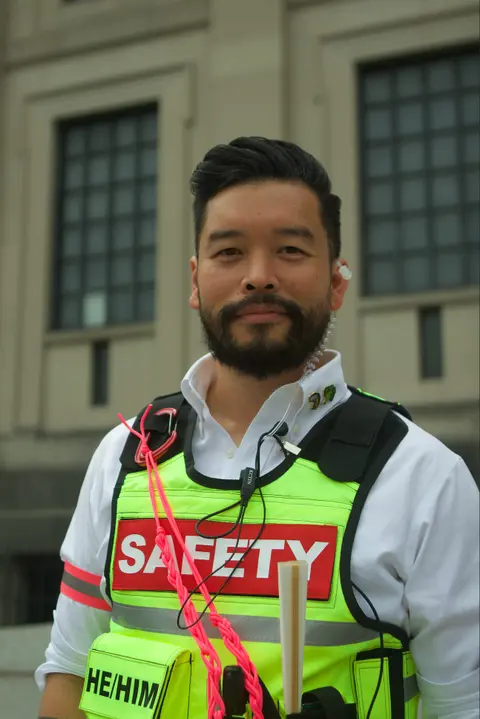
In this emergency episode, I connect with Kala (He/They) aka “Your Protest Safety Kuya” to address the current wave of ICE raids happening at U.S. airports. He dives deep into the changing landscape for travelers—whether local, domestic, or international—and provides essential strategies for protecting yourself and advocating for others in the face of state-sanctioned v*olence.
Key Discussion Points
* The Current Landscape: Understanding the deployment of ICE and CBP agents at airports and what to expect in the coming weeks.
* Know Your Rights While Traveling: Practical “dos and don’ts” when ICE is in the vicinity, including how to handle searches of smartphones, laptops, and GPS trackers.
* Advocacy in Action: How to safely support and document (via photo/video) if you witness someone being searched or harmed by law enforcement.
* Responsible Tech Use: Navigating face-recognition features and social media safety while participating in movement work.
* Inclusive Safety: Specific considerations for travelers who are undocumented, neurodivergent, or living with disabilities.
* Movement Security: Preparing emergency contacts, legal counsel, and paperwork for those publicly outspoken against government actions.
Collective Community Effort
This conversation emphasizes that safety is not just an individual task but a collective community effort. By staying informed without being alarmist, we can provide the nuance and context needed to protect each other and build a more resilient movement.
Bio:
Kalaya’an Mendoza (He/They) is a Frontline Safety and Security specialist, human rights defender and direct action trainer with over 25 years of on-the-ground experience. He is the co-founder of Across Frontlines, a grassroots collective that works alongside frontline communities around the world from Aotearoa (Ah-o-teya-rho-a) to Turtle Island in their struggle for justice and self determination.
Accompanying Links:
Digital Security Checklists for Activists: https://activistchecklist.org/
Protest Safety Resources: https://linktr.ee/kalamendoza
Resources:
* https://activistchecklist.org/travel/
* https://www.nilc.org/resources/community-alert-immigration-arrests-at-airports/
* https://immigrantsrising.org/resource/guide-for-undocumented-individuals-traveling-in-the-u-s/
Tools:
* https://activistchecklist.org/travel/
Thanks for reading Bánh Mì Bites! This post is public so feel free to share it.
Bánh Mì Bites is a reader-supported publication. To receive new posts and support my work, consider becoming a free or paid subscriber.
Get full access to Bánh Mì Bites at randykim.substack.com/subscribe
0:03 Hey, everyone. So welcome to the Bundy Chronicles podcast. My name is Randy Kim. And so I am doing an emergency episode. And unfortunately, this is what the ongoing ICE situation that has now taken a new turn where ICE is now being deployed at a number of U.S. airports. Right now, the timestamp is... Is Tuesday, March 24th, 2026. It is 335 p.m. U.S. Central Standard Time. And I also want to give a trigger warning that there will be mentions and examples of ice rave violence and violence.
0:45 and other state sponsored violence that's connected to government and law enforcement agencies and what have you. So I hope that this episode will help to inform you, but also give you a very strong indication of what is currently happening and how can we learn to protect ourselves, but also to advocate and protect communities at harm right now. So I am joined with a dear friend of mine, Akala. Akala has been a person who was on my show several years back. And, you know, this is a person who has done incredible work with protest safety.
1:32 advocating for liberation movement work, and has really been doing a lot of the education on what it means to safely protest, but also to be aware of the dangers of the counteracts from the government. from the government agencies, what we have seen with protests, what we have seen with the 2020 protests to what we are currently seeing now in the past several months. So Kala, I just want to say thank you so much. And I would like for you to share a little bit more about your work and what you have currently been doing in this rather very chaotic time.
2:20 Yeah, Randy, thank you so much for inviting me. And thank you everyone for listening in. This is really important information. I'm glad you're utilizing your platform to support our communities, keep themselves safe. So my work, I've been doing frontline, I'm a frontline safety and security specialist, and I've been doing work at the front lines with communities everywhere from Standing Rock to Ferguson to Aotearoa to Myanmar. and really wherever communities have invited me to support them in their liberation struggles and building out either safety ecosystems or safety mechanisms for them to be able to fight for their fundamental human rights, self-determination and liberation.
3:06 The last decade has really been around supporting communities by training folks up, whether that was with the rise of anti-Asian hate crimes all over the United States to most recently the last two years following the genocide in Gaza by the Israeli state. for folks to be able to support one another and care for one another in the face of state and non-state actor violence. So I'm basically your protest safety, Kuya. Yeah, thank you so much for this much needed work. And so what's been going on is ICE during the government, the partial government shutdown where TSA agents are not getting their payment.
3:58 And this has caused an issue not only with, obviously, with air traffic security, but also with ICE now stepping in and starting to do random checks. And I was wondering what you know about what you're learning about what is happening at the airports, what people are witnessing or what travelers are witnessing during this time and what are ICE and CBP agents looking at in terms of who are they seeking out and how they're going about this process.
4:46 Definitely. I think it's important to name that this is not the first time that ICE has been at airports. In fact, last March 2025, ICE was placed in multiple airports around the country. And there were some high profile reports of people who were visiting the U.S. being put in ICE detention. So this is not a new situation. situation by any means. But what we're seeing most recently as of yesterday is the Department of Homeland Security's new lead has wanted to have ICE at the airports. And what the Trump regime has said is that they're there to help TSA. Something that's very interesting is that even TSA employees, and there's this one TSA employee and union official by the name of Pascual Contreras that said, I don't think we need them here.
5:39 We need to be paid. Why would you bring another agency to be TSA when you already have TSA? They've just been standing around the whole time. And what we're seeing are reports around the country of people videotaping ICE agents, um, either standing around or, um, uh, in San Francisco, there was, uh, uh, in SFO yesterday, there was a mother, a woman and a child that were being, uh, detained by, uh, state security. I don't know if they're ICE agents. I don't know if they're part of this new wave or if they're part of a former wave that was part of facilitating escorted deportation.
6:21 So that is all to say there is a rise in state security forces at 13 U.S. airports ranging from the Atlanta International Airport, Chicago O'Hare, Cleveland, Houston, New Orleans, all three New York airports, Newark, LaGuardia, JFK, Phoenix, Pittsburgh, and the Luis Muñoz Marin International Airport in San Juan, Puerto Rico. So they're out there. And the interesting thing is they're not even trained to do any kind of TSA duties.
7:01 That takes a large amount of time. And they are just there watching. So it... From the outside, what it looks like, and I'm about to jump on an airplane in a few days, so I'm going to see this for myself, is we're just seeing ICE increasing the level of anxiety, increasing the level of harm against communities, and creating a fascist state that does nothing but terrorizes people who are going about their lives on a day-to-day level. Yeah. And also one of the things that I've been reading more into, I know give credit to YK Reborn and also the work that you and so many other people who have been monitoring ways of how to navigate digital security, which really is extremely crucial.
7:57 I am curious to see what, should travelers be aware of, besides obviously bringing in your passport if you are able to secure that, but what should people really consider when they are taking their electronics with their phones and GPS? Because this is a surveillance state. I mean, we also live, and I'm going to be very blunt about this, that, you know, we live in a very techno, I mean, it's run by techno-fascists, and that's what we're really dealing with with social media. with the censorship from TikTok and how this is affecting the safety of people.
8:38 Definitely. I want to give about kind of like three buckets for folks to think about. And I'll make sure to share the notes so your viewers and listeners can check them out in the notes doc of this episode. So firstly, I want people to start thinking very proactively about their safety planning. What this means is kind of thinking in three steps. three modes so one knowing your risk level and planning accordingly are you undocumented or are you naturalized are you an immigrant are you an asylum seeker or other non-us citizen are you a person of color critical of the u.s government or an activist uh that may want um to weigh in and you really want to weigh in on the pros and cons of traveling right now uh and i bring in person of color because um as of um august of 2025 when the supreme court in Perdomo versus Nome basically made it so that state security forces could target anyone with probable cause if they feel like they've done something.
9:43 And that includes racially profiling individuals. So know your risk level and plan accordingly. Are you of a community that might be targeted by ICE? Really consider whether or not it is... safe for you to travel in this moment. We want to prepare, not panic. What that means is if you have to travel by plane in the US, there are a few important preparation steps to help mitigate harm by ICE. So once again, knowing your rights when traveling. One thing I tell folks all the time is to look up a basic know your rights information.
10:24 If you get approached by ICE, what do you say? Am I being detained? No. Am I free to go? Move on. Am I being detained? Yes. I will remain silent. I wish to see my lawyer. That fits in for really any kind of state security. You want to secure your devices. That means installing the latest software updates on your devices and turning off biometrics. People just shouldn't be using biometrics, period. I do not on any of my devices. And you want to only be using your passcode to access your devices. You want to turn off Any device that you're bringing to the airport, your phone, your Apple Watch, if you have that, your laptop.
11:08 And there are a number of mitigation measures that you can do, but at the very least, turn them off. You want to print a paper boarding pass so you're not having to turn on your phone as you're going through the TSA security checkpoint. And... If you are not already, you should be on Signal, the Signal app. This is an end-to-end encrypted app that I've been using since, I want to say at least for the last decade, but it's important to use that app. And if you are already using Signal, make sure to leave any group chats that you're on, deleting those group chats off of your Signal app, or even taking the Signal app off your phone completely.
11:53 And wearing a mask. Protect yourself from being face scanned and uploaded to Palantir. There were a few photos that I've seen where ICE and other state security were just taking pictures of people at the airport. And you want to just make sure not to make it easy for them to create a profile on you. And as much as possible, opt out of facial recognition. I know it's easier just to kind of acquiesce, but we need to resist. And there's many small ways that folks can resist. And that's what's important right now. And then lastly, share your plans with a trusted person. So regardless of your citizenship, there have been over 200 U.S.
12:34 citizens that have been arrested by ICE since 2025. And we know of what happened with Renee Good and Alex Pretty in Minneapolis. So you want to share your flight itinerary with someone trusted and schedule a check in with them right before you leave your home. make sure to schedule check-in when you arrive, and then schedule another check-in when you finally get home safe. So that's some basics on safety planning. If you're thinking about baseline protection, so for instance, if you are an activist, if you are outspoken on social media, You want to implement some of the recommendations that I shared above.
13:15 And you can find all of this at activistchecklist.org slash travel, which is a phenomenal. I love checklists. I love being able to tick off what I need to do. And it takes about 30 minutes to do this. So knowing your rights when you're crossing the border, that depends on your immigration status. Installing latest software updates, powering off your phone, setting your passcode to 8 to 10 digits, enabling encryption on your laptop, and of course, opting out of facial recognition, wearing a mask. So please, these are some very basic information. So protocols that you can implement some enhanced protections that you might want to consider if you are.
14:03 even more vocal or have been targeted or have been, if you have a record basically. So you wanna uninstall any apps with sensitive data, email, docs, social media on your phone and laptop, secure your signal app before crossing or before getting to the airport. Uninstall your password manager, hide or deactivate social media accounts, log out of websites that have sets of information, your phone and phone number, leave all signal groups that might put others at risk, and install a trusted VPN with ad blocking just to make it harder for cops to do a warrantless surveillance. So if anything, just keep all of your stuff off.
14:46 It makes it much more difficult for the state to get your information. So those are some recommendations that I have for folks. And you can find all of these at activistchecklist.org. But I just want to make a really important note. That is all designed for folks that are in the U.S. with citizenship or with status. If you do not have status... in the US, or if you're in a precarious situation, if you are from a country that had temporary protective status or TPS, you want to look at resources from immigrantsrising.org slash resources or the National Immigration Law Center.
15:30 They have resources specifically for immigrant and other targeted communities. And I'll make sure to include those in the show notes. Much, much appreciated there, too. What about for folks that are traveling from or from like, let's say, Europe, Asia, like they're basically simply just traveling or that they're on a business trip, per se? What else are you hearing about that, too, especially for non-citizen folks that are or non-US status folks coming into the US and coming out? I wish I had a solid, like, this is what you need to do. But I would just invite folks, one, to just stay cool, calm, collected, and connected when you're going through the customs process coming into the U.S.
16:21 I know it's really stressful. You're getting yelled at. You're pretty tired. But... ice and state security under the trump regime have um extended uh kind of scope um due to the supreme court um and just the fact that we're in a fascist state so uh try to just like you know stay calm keep your information on you if you have uh um travel documents, make sure you have both them on paper or physical and a copy that's in a Proton folder or one that you have safe somewhere digitally.
17:05 But I also just want to tell everyone whether or not you're coming into the US from another country or whether you are traveling domestically, everyone write down this number it is 888-347-3767 once again that's 888-347-3767 this is a hotline that has been set up um for anyone that has been detained or if your loved ones have been detained so you want to program that into your phone right now like hit pause program that number down um If you see ICE activity, there's another telephone number, which is 229-304-8720.
17:51 Once again, that's 229-304-8720. And you want if you're documenting ICE and it's really important to use a salute acronym, which stands for size, activity, location, uniform, time and equipment when you're sharing this information. And this is all both for real time documentation, but also when this regime and. All of the agents that are complicit within this regime are being dragged to The Hague.
18:35 We have evidence to be able to show this is who implemented this. It will not be enough, just like with the Nazis, to say, like, I was just following orders. So please keep those two numbers handy. be calm, cool, collected, and just make sure to practice some basic safety planning where at the very least someone knows when you're arriving and what time you're supposed to be home. Yeah, no, this is extremely important. And also in a situation where you do see ICE actively detaining folks, what would be the first instinct? Because, you know, you had just shared part of that, you know, the protocol, but what would you have to consider it's also for the safety of the the person that's being detained um i'm very curious because i do hear um like you know there's like okay make sure that you get their names make sure that you're asking where they live what would be the most sensible way to do this especially when you are recording putting yourself in danger at the same time there's also this concern that you're also putting the person that's at risk in jeopardy so what's what's your take on that one before i answer that i just want to say i am only speaking for myself i don't represent any organization collective etc um well one i think people should document but
20:11 I say this recognizing that right now people are wondering, what do we do? And there's many organizations that have provided guidelines on documentation and monitoring and observation. And there are more of us than there are of them. There has to come a point when people start to resist. This is not normal. None of this shit is normal. Excuse my language. This regime has implemented fascist policies and will continue to do so. Anyone that had read Project 2025 or shout out to all the folks that laughed at me when I was talking about Project 2025 back in the day.
20:52 You need to know that this has been an ongoing strategy far beyond Trump's administration. This country is... This country is unsafe for many of us. It's important for us to look at what privileges we hold, both in our identities, in our access, and our ability to disrupt what is going on. So what I will say to most folks, at the very least, document. If you can, especially I'm looking at our white identified cousins that are listening, use your privilege.
21:34 Stop this violence. There has to be a point where we say that we are no longer acquiescing to the horrors that we continue to see because they might come for one community at night, but they will come for all of us in the morning. Mm hmm. I say that having both studied and participated in frontline efforts of communities who have been fighting back against authoritarianism. So now is the time for us to find our collective courage, our collective care, and our ability to find the ways that our ancestors would have resisted.
22:15 We come from people and generations of people who have resisted colonialism. We are here in this moment and we have a sacred duty to keep our community safe. And with that said, there is the upcoming No Kings March on the 28th, and there's very likely more to follow in the wake of ICE violence, the ongoing war in the Middle East. What should people who are looking to be at these big events or even small localized events, what should people be considerate of, especially in terms of their own safety, but also the safety of others in terms of documenting?
22:56 Yeah, so this kind of goes to your question earlier. Unless you are directly tied to a group, an organization, or a way to funnel information of people who might be detained, whether they're at the airport or at a protest, it's important that you not just post that online. This is not the time to be scoring social media clout. This is not the time to be doxing communities that we are... in solidarity with community members that we are trying to protect. So what I want to invite for folks to do is just to take a for the upcoming No Kings protest and really any protest that's coming up because it is going to be a hot, hot summer.
23:44 And is to just do your own risk assessment for yourself. For instance, if you know it's going to be about 110 degrees at a protest that's going to be happening, maybe it may not be best for you to be out on the ground, or maybe you want to pre-hydrate an entire week beforehand. So just think about the potential risks. If you have questions on how to do a risk assessment, I'll also drop my link tree. There's a video that actually walks you through doing a risk assessment. Think about and do your homework to find out what the action is. A lot of No Kings actions are marches. They're stationary.
24:25 There's a start time and an end time. Many of them have permits. Many of them do not. So I would not say that these are high risk actions by any means. So what I would invite for folks to do is just to kind of like take a look at taking care of yourself and folks that you're going with. But even more important, not even more importantly, but I think it's an important objective to also figure out what you're doing after that. no kings right are you going to be starting a mutual aid group in your uh local rural or suburban area where there is no mutual aid group are you going to be doing um safety trainings with folks to know how to de-escalate themselves and others if they're faced with state violence there's a whole host of ways that folks can take action that isn't in just one uh March.
25:19 I think marches are important, but they are a starting off point. They're not an end point in the struggle for justice and liberation. Yeah. And also I want to give a shout out to my friend and comrade Jung Han for, for, for being on my episode like several months ago during the ICE invasion in Chicago. And I would recommend you take a look at a lot of the protester safety tips, especially on tear gas safety, on state-sanctioned violence that protesters have experienced and civilians alike. So I would recommend using that as a reference. I'll be happy to, you know, share that once again.
26:01 And I also... I also want to get a sense of, I know it's hard to have a crystal ball of what's going on, because I think the goalpost keeps moving pretty quickly here. What do you see happening by the time we get to summer? Because I always feel like Each summer, like 2020 was a great example during the anti, during COVID, anti-Asian violence, and with the George Floyd Bre Taylor murder. What are you starting to see more of that happening?
26:44 that we would have to be mindful that maybe we haven't thought about besides digital safety? I think it's a very loaded question and I feel like I'm putting the crystal ball on you, but I'm just trying to speculate what could this look like in the next couple of months. Yeah, I think in the next couple of months, just like every summer, what I tell folks is to do some basic knowledge work around understanding what heat-related illnesses look like and how to protect yourself from them. For instance... If you're going to be on the ground at an action for 14 hours straight, it's happened many times. Make sure that you have a support network. Make sure you're building in breaks.
27:25 Make sure that you're hydrating throughout. There's a ton of ways to to support yourself. So there are some of the things that we already know to kind of keep in mind. So there is the. the environmental risks of, you know, heat stroke and other heat related illnesses. There's also the just flagrant use of chemical weapons and other commonly used munitions, many of which are not allowed to be used in war that are being used against civilians. So having an extra bottle of water with you, both for hydration, but also, you If you are exposed to tear gas or pepper spray, something just to keep in mind is that tear gas isn't actually a gas.
28:09 It's a particulate that's dispersed out in an area. So it'll land on your clothes. It'll stick to your eyes. You want to just do a basic eye flush. I'm sure that in the previous safety episode that you had mentioned, Randy, They had gone over that. So you just want to have some basic street first aid stuff. So a bottle of water. I always carry saline if I'm doing any kind of street med work to flush folks' eyes. There is a... There is a wipe that I buy. It's called pseudocon. It's specifically for decontamination of tear gas or pepper spray and pepper spray.
28:50 There's different forms of pepper spray. A lot of them are oleoresins, which are basically oil based, similar to some tear gas formulations. And if you get exposed to that, You want to get all of this off of your body. When you get home, you want to take a cool shower, not a hot shower. You want to use Dawn. You want to basically decontaminate yourself. So what I would do for folks is just take a look at in your local area, what type of... commonly used munitions or what type of tactics has the state security or the police used in your location.
29:33 That way you can start preparing. Cause like some places will not have a long range acoustic device. Are there places like in the first time I got exposed to that was in Ferguson in 2014, where a long range acoustic device is a large unit. device that disrupts your inner ear function and it made everyone on our human rights observer team immediately nauseous and want to throw up um so there's a ton of ways for folks to protect against that just like having earbuds but once again you don't want to um go towards like the worst possible uh uh But just take a look at what is the pattern of use of force by state security and prepare for that.
30:22 I don't know. I wish I could figure out what... new tactics are going to be used. But even though we may not be able to look into crystal ball, all we need to do is to look at other tactics used by other fascist regimes around the world. And I think one of the most insidious tactics is a tactic of fear. right? It is the making people scared to be out in the street, making people scared of each other and one another's neighbor. So there is the, um, the external preparation for summer actions, but also the internal preparation. Sorry.
31:06 And the building of, um, um, building a pods, building of community, uh, You never want to go to protests by yourself. You always want to have at least one other person with you. So, yeah, there's a ton of ways for folks to get prepared, but at the very least, start to look at what your own risks are if you're to be out on the ground. And what are some ways that you can continue the actions, whether that's through mutual aid, whether that's through political education, when you're outside of a march or protest space? Yeah.
31:47 for your own safety as well. I think this is a very tough question too for me to ask you this, but especially the work that you do and other movement comrades, how, or does the fear of being detained, does the fear of being detained terrify you. I know it's a very difficult question to answer that. But I'm, I'm curious about like, especially when you see the level of, of danger elevating, you know, each week.
32:32 What is it? What is it telling you in terms of how you navigate your day to day? Yeah, so back in 2008, myself and my action team, we were in Beijing right before the Beijing 2008 Olympics. And we were brutalized, detained. They had used... Waterboarding as a tactic to extract information from us. They put us in solitary and we were deported within 24 hours from China. And yeah, I'm afraid. And if people are not afraid, that is very concerning. It's important to listen to that fear.
33:14 But it is more important for us to remind ourselves that we are not those emotions. We are the awareness behind those emotions. Mm hmm. What that looks like for me is recognizing when is this fear that's happening, that's building in my chest, how do I utilize that as energy, right? Any emotion is energy. And how do I put that back into the community rather than just like sitting here, being afraid to leave, to be on the ground or to do anything else? there will always be fear and there will always be nervousness. It's all about how do we turn those energies into a force of liberation?
33:57 Because that's what we all have control over. We do not have control over what state security forces do, but what we do have control over is our responses, our reactions, and how we train up ourselves and our communities in this moment. What does self-care look like to you and for people that you know in this growing work. What does it look like to you, especially when you're trying to avoid burnout? And I think this is something that I witnessed time and time again over the years is you see organizers, you see the chaos internally and externally and how do we have better ways to take care of ourselves so we can do this for a long haul?
34:41 Because as you know, and I've said this and I've said this and I've had guests tell me this too on their show, on my show, but like what, I think what's so interesting um important is that capitalism is there to defeat you and there's nothing more resisting than staying alive and being able to not just be alive but to be able to be intact mentally intact and i think that's a very powerful thought process that i think about like how can we keep ourselves um clear and calm in the most scariest of situations right now. Because I know like what I do is sometimes I'll call up a friend and I'll just joke around for like a good 20 minutes.
35:25 You know, like I want to keep people, at least in my worldview, it's like I got to find ways to keep people alive. You know, how can we find creative ways to keep going? How can we use Elevate Art to help, you know, you know, inspire people to think of innovative ways to throw the wrench, to throw the many wrenches into these ICE vehicles or the agent vehicles, I should say. So I'm curious about your thoughts on what self-care, what can it look like from a collective and personal standpoint? Mm-hmm. I really appreciate the fact that you brought up the collective and also named the capitalism what it does to us.
36:06 I think it's important that the self-care that we've been sold the last 10 years is not the self-care that Black and Indigenous feminists have talked about and have really showed us what that looks like. And that looks like community care. Right. It does not mean isolating ourselves. It does not mean just getting, you know, our hair done or whatever else. That's, that's, that's fine and all, but we are social creatures. If we isolate ourselves, I know for myself, I will just speak as I'll use I statements. There have been many times I've been doing this work since the late nineties, since 98. And I, There have been many times where I've come to an impasse where I had to choose my well-being versus being able to do movement work.
36:58 And one thing that I found at each of those impasses is when I actually... ask for help from my community, trusted folks. Because I think for many of us, I know for myself, I'm a people pleaser. I'm always like, what do you need for support? No, I'm fine. I'm great. And just like lying about that. We do not have the time. And I don't think any of us have the energy to be inauthentic about what we're feeling in this moment. And one kind of like tactical thing that I'll invite listeners to do is If you're noticing that you are feeling activated, if you're noticing that after a protest, you might be scanning for threats where there may not be threats, you can hear the chants still in your head is to move around your house or your home, wherever you're most comfortable and safe and find five beautiful things.
37:52 What this does, it reorients your nervous system to recognize that you are safe. I think one thing that happens for many of us, and I come from a school of organizing activism where it was almost expected to burn out. And one thing I love about this incoming or merging leaders is they're not willing to do that. They're going to have like a heated rivalry rewatch party. They're going to be, you know... going out to the park and just like hanging out. It is important. It is a vast importance for us to find community and joy in these times, most especially for people of the global majority where we have always put others first.
38:37 Let us think about what our needs are and how our communities can help us meet those needs. That is mutual aid in its essence. It is not charity. It is solidarity. It is recognizing that sometimes I will carry you because you carry me. i really love this so much too and you know actually i know like when i do my podcast i've been doing so many emergency episodes and like last few months and i'm like okay i also gotta add some fun episodes so people are not gonna be completely tuned out because there's a lot of fatigue and doom scrolling there's a lot of fatigue and um and in listening to extremely difficult testimonies and survivor stories.
39:18 And I get that too. I mean, I get vicarious trauma just hearing some of it. But I also feel like, okay, let me just have an episode where I basically do deep dives on my favorite songs, which I'm doing. But I'm also like, how can we balance it? How do we continue to remind each other that joy is a fuel for the long game? And how can it be a fuel to create ideas and new opportunities and to build deeper connections? So I think about that a lot, too. And I think what you did is just naming that. And I hope that we... take the time to really reassess where we are at.
40:00 I hope that it is in the hopes that we want to make sure that we're not guilting ourselves. It's very easy to do that because, you know, we talk about people-pleasing tendencies. If we're seen as a leader, it's like, okay, well, if we're not meeting up to this or we're upsetting a group of people that believe in us, like, let's... let's reevaluate, let's reassess ourselves and how can we build safer, trusting spaces. And I think this is a really important conversation to have. And before I will let you go soon, what other comments or what other perspectives or ideas or talking points would you like to bring up that that we haven't talked about yet.
40:53 Yeah, I would really strongly recommend for folks to do some basic overall safety planning. As data centers are continuing to infect the landscape around the country, water is becoming an even more scarcer resource. Our grocery bills are getting even higher. It's important for us to really take a moment to just do a audit of who our community is. So what that looks like is doing pod mapping. I believe you did an episode of pod mapping a while back. But if folks aren't familiar with pod mapping, it is a phenomenal framework built by Mia Mingus and the Bay Area Transformative Justice Collective on being able to identify capacities that you hold and also capacities that you need.
41:44 And doing this, this is part of that community care, right? It's like sit down with your folks, whether that's your friends, whether that's your block, your neighbors, and just like talk through what are some of the capacities that folks might have. So that goes for like, say I have I have a lot of, I don't have this, but I have a backyard with a lot of space to store water. And some of my neighbors may not have that space. I'll offer that space as a collective space. So it's looking at capacities we have or strengths that we have, resources that we have, and those that we need.
42:26 So that's one. Please check out PodMapping by... Me and Mingus and the Bay Area Transformative Justice Collective. There's a really phenomenal risk assessment tool by Vision Change Win, which is a Black-led organization that focuses on holistic safety and security. Please check out visionchangewin.org and look for the risk assessment. That's a really good place to kind of like start if you're like wondering, like, how do I even begin this? But I will just say kind of more directly to your question. Every time I have had a moment of despair, I think back to what Maryam Caba, the abolitionist organizer and author said is like, hope is a discipline, right?
43:15 And I don't want to spend my energy despairing because in the end, despair does nothing for our communities. What I do want to do is try to put that into radical hope. And that could look like everything from journaling as if you were living in a solar punk future or sitting down with folks in your local community garden and just gardening and getting into the earth. So there are ways that we need to combine resistance work that isn't just going to get your hair done, but also doing a deep dive of acknowledging what you have to offer, but also what your needs are.
44:00 Sorry, I'm kind of going all over the place. But one thing I hope that people leave with is that it's important to take breaks. Don't disassociate. This is the reality that we're in. But the beautiful part of that is that we get to shape that reality. This isn't just something that we do not have to consent to this happening to us. We can actually resist. very powerful words and you know collab and i'm just so happy that you could come on at the last minute to do this i mean i i know that when i got back into the podcast like less than a year ago i knew that there's gonna be situations where this government is inflicting more serious harm and overstepping uh laws and ethics and and what have you and and I see how important it is to, you know, bring folks like you to share the hope because I think what I like to do is like, I hate despair so much because it's so easy to fall into it.
45:01 we model examples on how can we invite to have people be more vigilant and participatory in the dismantling of this horrible killing machine that we're dealing with here and and you know as for me like i i don't pull any punches back especially with things like this you know it's like there's nothing a profession that I need to be in this circumstance because everyone's lives are in danger. And I hope that people are taking, you know, the steps that are needed. I suggest, you know, people look at the show notes for more resources, information that you can take with you, getting the names of emergency contacts.
45:41 knowing the legal counsel around your local area too, and making sure that you have more of an idea of who to reach out to, especially when it comes to legal help, legal assistance, whether you're being arrested at a protest or being detained by ICE unlawfully. And yeah, I want to say thank you so much, Kalah. And yeah, are you willing to share where folks can follow your work? Yeah, definitely. You can find me on the Instagram at yourprotestsafetykuya, all one word. And I primarily post resources, both resources that I've built and resources from other folks and organizations that are primarily focused on frontline safety and security for all communities.
46:34 Thank you so much, Kalal, and much love to you and also much love to the work that you're doing. And please continue to stay safe and keep up the wonderful work that you're doing. Thank you so much, Randy. And I'm so glad that you're one of our amazing voices of the community that is always prioritizing our community's collective well-being, care, and safety. Thank you.
