Do You Really Need an LLC for Your Podcast?
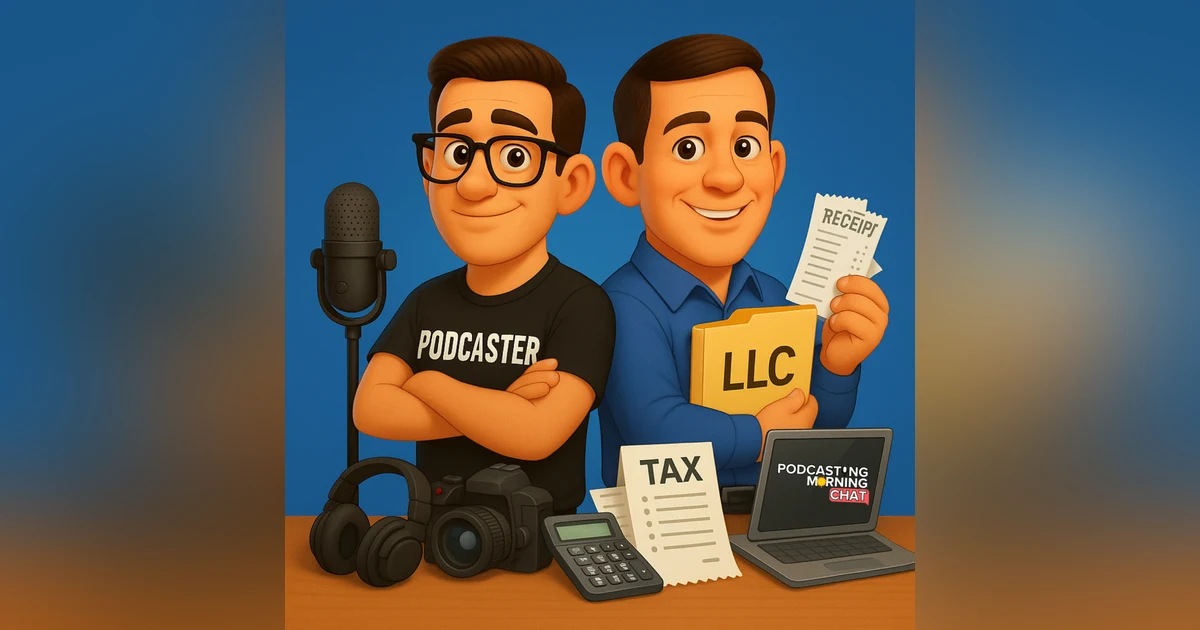


Is your financial system ready for the new year, or are you still relying on a "shoebox full of receipts?" It's time to build a solid foundation for 2026. We welcome tax and accounting expert Ralph Estep, who shares his years of experience helping entrepreneurs set up real systems for stress-free growth. Ralph gives actionable advice on everything from setting up a separate business credit card and bank account to navigating estimated quarterly taxes, emphasizing that consistency matters more than complicated software. Learn the three most critical figures to track and how to determine the right way to pay yourself and run your podcast like a professional business.
Disclaimer: This episode and its content are for informational and entertainment purposes only and do not constitute professional tax, legal, or financial advice. Always consult with a licensed professional for advice tailored to your specific situation.
Episode Highlights:
[02:13] Upcoming Podcast Evaluations
[04:48] The Business of Podcasting
[07:06] Understanding LLCs and Entities
[09:18] Quarterly Taxes and Payment Strategies
[28:50] Understanding Reimbursements and Write-Offs
[30:14] Paying Yourself as a Content Creator
[32:36] The Importance of Professional Help
[36:39] Finding the Right Accountant
[43:01] End-of-Year Tax Tips
[47:17] Introducing the Content Creator's Accountant Podcast
Links & Resources:
Join The Empowered Podcasting Facebook Group:
www.facebook.com/groups/empoweredpodcasting
To Have Your Podcast Considered For Evaluation, Please Complete This Form:
https://docs.google.com/forms/d/e/1FAIpQLSc8-Xv6O6lrNPcPJwj3N0Z5Osdl-5kHGz_PiAU45U
Schedule a Discovery Call WIth Ralph Estep:
The Content Creator's Accountant:
https://www.contentcreatorsaccountant.com
Wave Accounting:
QuickBooks:
Irs:
Remember to rate, follow, share, and review our podcast. Your support helps us grow and bring valuable content to our community.
Join us LIVE every weekday morning at 7 am ET (US) on Clubhouse: https://www.clubhouse.com/house/empowered-podcasting-e6nlrk0w
Or Join us on Chatter: https://preview.chattersocial.io/group/98a69881-f328-4eae-bf3c-9b0bb741481d
Live on YouTube: https://youtube.com/@marcronick
Brought to you by iRonickMedia.com
Please note that some links may be affiliate links, which support the hosts of the PMC. Thank you!
--- Send in your mailbag question at: https://www.podpage.com/pmc/contact/ or marc@ironickmedia.com
Want to be a guest on The Podcasting Morning Chat? Send me a message on PodMatch, here:
https://www.podmatch.com/hostdetailpreview/1729879899384520035bad21b
0:05 Good morning Podcasting Morning Chat. Today is Tuesday, November 18th, 2025 and today making the business side of podcasting simple, light and instantly usable. That's our focus as Ralph Estep helps Breakdown, LL CS, Money flow, Creator deductions and more. So if you're listening live on Clubhouse, hit the share button top right hand side of the screen and share it. However, Clubhouse lets you. And if you're catching us via podcast chatter, YouTube, Facebook, share this with a fellow podcaster and now give us about 30 seconds and we'll get things rolling. Thanks for being here. Good morning again podcasting morning chat. Thanks so much for being here.
1:24 I am your host Mark Ronik and currently on stage with me we have Dr. Fey, producer Ashley Feller, Sid Meadows, Jonathan Howard, Nick Naul back and Ralph E step and look at that. Dominic is in the audience as well. Dominic, you are welcome to come up here and join us as well. It's been a minute since we've had you, Dominic Lawson. And wait, Phil, you're still in the audience, too. What's going on here this morning? Come on up, gang. Feel Better is here. Yep, there he is. And yeah, we'll get into the main topic of the day in just a moment. I appreciate Ralph stepping up and offering. Well, really? I asked.
2:05 But I'll just say offering to be here this morning to talk the business of podcasting. We'll get into that. First, I want to remind you that this Thursday, 7:00 AM Eastern, it's another episode evaluation in our series that we've been doing every Thursday. This time we are reviewing the podcast called The Space Between. It's hosted by Sean McClellan, who happens to be a brand new member of the Empowered Podcasting community. He attended EPC 2 this past September. Had a great time getting to know him. I think he had a great time as well and he saw that we were looking for podcasters to evaluate their shows and he volunteered, so we're going to get into that.
2:55 His podcast is geared to individuals who are seeking balance, purpose and intentional growth. The show explores the journey between where someone is now and where they want to be. It's a 10 minute episode as well. We will share a link to the episode we'll be specifically reviewing. We'll share that in the show notes for you as well. So follow along if you'd like. And if not, I think if you've heard any of these episodes thus far, I think we do a pretty darn good job of really keeping you in the loop, keeping you in the know, removing any confusion, even if you haven't heard the episode. So come join us.
3:36 I think people learn a lot, even if it's not their own podcast. We're evaluating. So come check that out this Thursday, 7:00 AM Eastern. And tomorrow we do podcasting news. And we should be breaking some big news coming from Riverside FM. They're making a big announcement tomorrow and they've told me they want to come on the show and share the news. So they're making a big announcement and they're making it with us. That's right. That's right. By the way, also Lucy, who joined us yesterday, Lucy Werner is in the audience as well. Great to have you back. You know, sometimes you think about when you have a guest on and they say, oh, I want to come back.
4:18 This was really fun. I'm having a great time. I'll have to come back. You always, at least for me, I always kind of think, are they just telling me that because they're being a nice guest? But here Lucy is not just being a nice guest, but she's also here listening today. Lucy, you're welcome to join us as well if you have any questions. Ah, yes, she says in the chat she's prepping for dinner this time because yes, she is in the South of France. She's not prepping dinner at 7:00 in the morning, so welcome Lucy as well. OK, so today we're going to do the business of podcasting. And Ralph has been so kind to step up and answer lots of questions. I know that this is an area that sometimes some creators love to avoid until these things bite them in the ass. That's the business side, accounting, taxes, LLCS, keeping money separate from personal and your podcast or your podcast's business, all that fun stuff.
5:22 But I promise this is going to be simple and it's going to be practical. So Ralph helps creators do this very thing. He helps creators set up real systems so they can grow without stress. And our intention is to give you a road map that'll make 2026 a whole lot easier for you as a creator. And since Ralph is our newest community, I wouldn't say newest, maybe not newest. One of one of our newest community members. Let me tell you a little bit more about why I asked him to lead us through this topic today. He's a creator. He's a tax pro, someone who's spent years helping entrepreneurs and small businesses get their financial systems in order without all that stress.
6:11 He runs a company and Ralph, I'll hopefully pronounce it correctly. Saggy sag GI OK tell. Me, it's actually Saggio which is Italian for wise. Saggio. I like that Saggio Management Group, where he works with creators on taxes, money habits and simple systems that actually make the business side easier. He's a dad, he's a husband. And he revealed to us just recently, he's a rancher who raises Black Angus cows. Interesting tidbit. He also hosts Ask Ralph podcast. And he's launching a new series at contentcreatorsaccountant.com that's all about helping creators run their work like a real business. So an official.
6:55 Good morning to you, Ralph. How are you? Good morning, Mark. And you said it was going to be simple, and my wife tells me I'm a simpleton all the time, so I'll be perfect for today. Great. Well, let's dig into it, Ralph. Creators I think I've come across when they hear form an LLC, they sometimes think, yeah, I got to do that. And sometimes I come across others that say, Nah, I don't need to do that. So what's the real deal? When does it make sense and when does it not, if at all, if there is a time where it doesn't make sense to start an LLC for your podcast? Well, the first thing I want to say is LLC may not always be the best fit. So let's just back up one step and say, do I want to create an entity?
7:37 How about we use that term today because an LLC is a particular entity, but we might want to look at some other options. But to answer your question more directly, in my view, it makes sense when you're earning consistent money, when you've got brand deals, you're doing client work or maybe you're hiring freelancers, you've got some subcontractors working underneath of you or bigger picture thing is you're worried about liability protection and you don't want to have issues with your taxes. Those are the really the big four things, Mark that I see is when an entity or an LLC as you talked about makes sense. OK. So I think it's when you are actually in the black, as they say, that's the best time. I don't know if I would say in the black, I would say you're consistently generating revenue and revenue might not be equal to net income because I have a lot of clients that start off in business in the first couple years, they don't actually show a profit.
8:29 So I don't know that I would say profit is the motivator here. I think it's consistently having money coming in the door. You might be spending more going out the door. A lot of people find themselves in that position, especially with gear acquisition syndrome for us podcasters. I know I've been guilty of that as well. But as long as you've got consistent revenue dollars, you know the top line dollars coming indoor, I think then that's a real good time to look at setting up an entity. Thank you, Ralph, and I want to remind everyone, not just those of you on stage, but those of you in the audience as well. If you have questions for Ralph around the business side of content creation, podcasting, whatever you do to create content, please ask away. Join us up here on stage or ask in the chat as well. And Dr. heated the call.
9:15 Let's go to you, Dr. You have a question for Ralph. I have it in my mind that I want to start paying my taxes quarterly #1 is this a good thing to do #2 how do I even start that? Is there a form I fill out? Do I get like a reminder e-mail to send something in? How do I send it in? I'm not sure. That's a great question, Dr. And honestly, the truthful answer is the IRS wants you to pay as you go. Sound of like if you work for somebody else and you have a paycheck, they your your employer takes the taxes out. Well, the IRS wants you to do the same thing. So from a technical perspective, you should be paying quarterly. It really isn't all that complicated.
9:57 When you do your taxes, there's ES forms are called estimated tax forms. You find those both at the federal level and the state level. But Dr. I'm going to take it back a step because I think what you're really asking is, Ralph, how do I know if I'm making any money? And that's where I think to set up a simple accounting system is really where you're going with that question. Dr. Because then you'll, you'll have an understanding of do I have net profit? If you have net profit, you know, bottom line net income, then the IRS wants their cut. Generally the best way to do that is quarterly and and look and see what's going on with your business. Now, the one thing I will tell you, having done this for over 30 years, when I'm working with small business clients, I'm not a huge proponent of having them send their money as they go, especially when they're first getting started. Because who knows what's above the horizon, you know, next month or the next quarter.
10:47 And what you don't want to do is pay a ton into the IRS or a ton into the state and then have to sit on your hands and waiting for March or April the following year to get that back. That said, I like to focus on the third and fourth quarter estimates because then we kind of have an idea of what the year is going to look like. DRI hope that answers your question. It does, you know, last year I was socked with, you know, $4000 to pay on, you know, before April 15th and I had been saving it up. I have an account with Sofi Bank and they have these quote UN quote vaults that you can put money away in every month automatically. And so I had saved up money, thank God. And so that's, I thought, you know, if I can just pay a little bit out at a time, that would be so much better on my psyche. Absolutely, Dr. and you can actually go to irs.gov. That's irs.gov and you can create an online account with them and you can actually make those payments. The other thing I will say while you're talking about that, Dr. is I would like to understand your entity structure because there may be some ways to save on some of those taxes that you're paying.
11:58 A lot of people don't understand that just a simple LLC, which is called a single member LLC, is not necessarily the best, best tax strategy for you. So that's the kind of thing that I work with creators, helping them understand what's the best tax entity for them to be in so they can cut down on that $4000 number. So I have another question. So can you be anybody's tax person, anyone from California to New York or is it a state thing? Do you have to be licensed? No, absolutely. DDRI have clients all over the world actually. I've got clients overseas. I've got clients all over the United States. So taxes and representation in that regard is not state bounded.
12:38 So there's no issues with that at all. I have clients all over the place, especially, you know, since Zoom opened up, this has been great. I, I find myself, unfortunately, I spend more time on Zoom than I do meeting people face to face. But no, I've got clients all over the world actually. Thank you Dr. for that. Question. Yeah. And thank you, Ralph for answering that. So real quick a follow up to that. You talked about what were we were talking about quarterly payments and you said that's what the government wants you to do, but is it a requirement? Like what if I don't do that but I am making money? Great question mark. So technically, if you do not pay quarterly, the IRS can and the state will too, assess what's called an underpayment penalty. They actually charge you a penalty for not making estimated taxes.
13:25 Now, I don't want to get into the weeds of tax law because there are safe harbor things that you can not have to worry about that depending upon particular situations. But generally, to answer your question mark, yes, it's a legal requirement because the IRS wants to get paid as they go and they will charge you penalty and interest if you don't do that. Anyone else have any questions for Ralph before I ask him some more questions? Yes, go ahead. Good morning, everybody. There's actually a question in the chat. This is from Kathy, she's across the pond. But can you deduct losses from another income? So when I first registered as an earning musician, I received a boost to my employed employed income due to self-employment loss deducted from my salary.
14:10 Ralph, I hope that question makes sense to you. I think so. And I think what she's answering there is can I offset losses from one income stream against other income streams. And I'm going to say generally the answer is yes. I would need to really understand the specifics and I want to be careful here today as I talk. And Mark, I probably should have mentioned at the beginning, I cannot give you tax advice over the Clubhouse chat. Everybody's situation is different, but generally speaking, you can generally offset losses against gains. So for example, I and said this will probably answer the question better. So if she has W2 income from a, a regular nine to five job or something like that, and then she has what we'll call side hustle income or creator income on the side.
14:58 And if she's treating it like a business and it generates a loss, then the answer to that question generally is yes. So let's just use a simple example. Let's say she had $40,000 worth of W2 income and let's say at the end of the year her content income was in actually a loss of $2000. Then yes, we could net that 40,000 against that $2000 loss. I hope that answers the question. I think that's where that question was going. Thank you, Ralph and yeah, Kathy can tell us in the chat if that was helpful and or if she has any follow-ups. Feel free, Kathy and I want to get back to a little bit more on the LLC stuff and we can, we can bounce around today. And if people have more questions on taxes, by all means let's hear them.
15:42 But I do want to ask as far as what if a creator doesn't want to form an LLC or something that's better suited for them, like they they don't want to put in any money yet to do something like that. Is there a next best structure or approach for them? Absolutely. I think the first thing you want to do, and you know it's not for everybody. If you have no intention of generating revenue for your podcast, if you're just doing this as a hobby or something you just want to do on the side, that's totally fine. What I would say the next best step would be to make sure you're keeping track at a very minimum of the money that comes in and the money that goes out.
16:22 That way you can still put that information on your tax return. Because whether you're an entity or not, if you derive income, if you make revenue dollars, technically, unless you want to go to jail like Al Capone went, you've got to report those things. And if you're going to report those things, you want to report the expenses that go alongside of that. Because I'll give you an example. You know, I started in content creation a few years back and when I look at the amount of money I spend on subscriptions, you know, you know, Libsyn, I'm not on Libsyn anymore, but captivate the different pieces of that puzzle. All those things will help to aggregate against any income I earn. So even if you're not going to set up an entity, a basic accounting structure is something you definitely want to put in place so that you have the information.
17:03 So that in the end, because a lot of people don't understand this, Mark, if you use one of these pay platforms like the Cash App or Venmo or something like that, and people are giving you money, the IRS gets a report of that at the end of the year. It's on a, it's on a form called a 1099 K. And when you get, and, and there again, there are nuances to that, depends on the number of transactions, the amount and all that sort of thing. But if the IRS gets that and you don't file a tax return, at least showing that you're reporting those revenue dollars and you can always offset it with expenses. But if you're not reporting that, it's a big red flag and you'll get a letter from the IRS. And Ralph, I think Sid has a follow up or maybe a brand new question. Let's find out. Sid, go for it. Ralph, I want to talk about expenses for just a second.
17:45 So I in my businesses, we put everything on a credit card, the fees, the memberships, you know, $20 here, $20 there. And we do that in order to track all of the expenses. Because I think that's one of the things that content creators can get lost in is not really tracking all of their expenses, which actually do become a deduction at the end of the year, if I'm correct. And so do you have tips about tracking like I guess did we use a credit card? Are there certain tips that you would offer that about ways to track your expenses so that you do get your maximum deductions at the end of the year? Absolutely, Sid. And I think you brought up a very good point. And one of the things that I don't know if you if you're intending to mention this, but one of the things I would definitely say is keep your business and your personal stuff separate. So Sid, I'm hoping you're using a credit card that's just for the quote business side of things that would definitely recommend.
18:38 Yeah, absolutely. I got, I got so many freaking business credit cards. I think I've got four different businesses and they each have an American Express and two of them the same color. And I always have to look at what's the name on it to make sure I'm using the right credit card. So yes. You know, Sid, what I tell clients is sometimes I have some clients that will come in and they'll get their personal card and their business card messed up. I said put a sticker on it and put a B on the business card and P on the personal. Really, that's important said, but no, I would definitely set up the way you're doing is great if you've got a separate, I also like to have a separate bank account. One of things that I recommend for content creators, if you're getting any kind of revenue dollars from online sites and all that, set up a separate checking account so that you can put all of those revenue dollars in that particular thing or checking account.
19:23 Because so many times people have a, a mix match of, you know, 100 different things going into five different accounts. And when we get to the end of the year and we say, OK, we need to file a tax return for this, where do we find the information? It's like, which one do we look at? So great idea, Sid, separate credit card is perfect. Just be careful not to do what they call commingling. And what I mean by that, Sid, and I bet you probably already know this is make sure on that credit card you're only putting business expenses. Because here's the thing, Number one thing the IRS looks at is what's called combing link, fancy accounting term for mixing business and personal. What if you get audited by the IRS? And I'm not trying to scare everybody. The amount of people getting audited is very small. But if you do.
20:03 The IRS is going to pull those records and they're going to look through your credit card statement. They're going to say, Sid, OK, I see you spent money on Amazon. I see you spent money on road D script, whatever those things are. And then all of a sudden they see you took a a vacation to Bahamas and they're going to be like, wait a second, Sid, explain to us how this vacation now it could be that the Empower podcasting conference is going to happen in the Bahamas next year. And it's a perfectly reasonable thing to do that. But I was just being funny. But all that said, don't mix business and personal. That's big take away. So Sid, I hope that answers your question. But I love the idea of having a separate credit card. It's the simplest way to keep track of stuff because then you can go back, like you said, you've got multiple businesses.
20:44 You can go back and look at each statement and figure out what happened on each particular business entity. Great point. I want to get into deductions a little bit more. But first I did see Nick put in the chat here. If you want an LLCI believe you need a separate bank account to get it going. Is that true, Ralph? So yes, basically true. And let me explain where I think you said, Nick, I'm sorry, I don't see the chat 'cause I'm on the I'm on the Mac platform. But what I was going to, the way I was going to answer that is. So technically when you set up an entity like an LLC, it's what's called an artificial entity. It is a separate legal thing. It's not you anymore. So it should have its own bank account. It should have its own credit card.
21:24 Now I want to warn everybody. A lot of people go out online. They find these knuckleheads online, these legal depots and all this kind of stuff and they we'll set up an LLC for just 99 bucks. You know what you get for that? You get a $99 shell. That is not a legal entity. This is something that I do professionally. I'm not trying to sell my services here, but make sure you understand what you are getting. But to answer next question, yes, absolutely it should have its own bank account because it is a separate, for lack of a easier easy way to explain, it's a separate person, It's a separate entity, so it needs to have its own operating agreement. That's what basically makes an LLC an LLC. It needs to have its own bank account. It needs to have a bunch of other things. I don't want to get into the details today. It's not for this audience. But yes, one of the things it should have is its own checking account.
22:07 Absolutely. Thank you, Ralph, Dr. did you have a follow up? So when it comes to the LLC, I live in Nashville, TN. Is it specific to the state that you're living in? For some reason I remember someone saying Oh no get your LLC and I forget what state they mentioned Texas or something like that. It's so much cheaper. I'm like, but I'm in Nashville. No, it doesn't matter. It doesn't matter. So I need clarification on that. And Dr. it does matter. We set up Delaware LLCS because Delaware is one of those states that has great LLC rules. But if I was setting one up for you, DRI would set up a Delaware LLC. Then I would do what's called a foreign status election for the state of Tennessee. Because the way that it works is an LLC is only good for the state in which you've registered it. So technically when you cross state lines, let's just say you set up a Tennessee LLC and I don't know anything about Tennessee LL CS, but let's just say you did and then you went to Florida and did business.
23:04 Well, technically your LLC would not cover you from liability protection. Again, I'm not an attorney. I don't play 1 on TV. If you want to talk legal, talk to an attorney, but generally speaking, it stops at the state line. So to answer your question, yeah, a lot of people do that with Wyoming. I hear Nevada. That's great. Cheap. You again, you get what you pay for. Understand that your LLC needs to, at the very least, be registered to do business in the state in which you're doing business. It's what's called Nexus. If you've got corporate Nexus in Tennessee, then you better make sure now you don't have to set up a Tennessee LLC to do that. You can set up a separate state LLC, but you need to register that LLC.
23:45 Most states have what's called foreign LLC registration. You pay them an annual fee. You smile and wave. Thanks for letting me do business here. But you want to have that set up at the state level. The last time I checked with Nashville it was around $300.00 for the LLC. That doesn't surprise me in in Delaware, your annual franchise tax is $300. That seems to be a pretty much the going rate for what? Again, it's a cost of doing business if you're going to operate a business. And a lot of people don't understand it's not just in the content creator field. They think, well, I've got this corporation in Maryland, but then they go do business in Delaware. Now you've got business across state lines. That makes things a lot more complicated and think about content creators because where are you actually doing business?
24:26 That's a tough call. Right. So every year am I paying $300 to Delaware and $300 to Tennessee? Effectively, yes, because you have to have a registered agent in each state and each state wants to carve out their little piece of tax to make sure they can pay their bills. So absolutely yes, you would be doing that. I see. Thank you. You're welcome. Thank you for your question and thank you for your answer. Dr. and Ralph, I want to go to Jonathan. I know Jonathan had a question as well. And then I still have some questions about deductions. So Jonathan, what do you got for us? Good morning. Good morning. Good morning. So I have a question about, because I do business in like 20 some odd states with my clients, do I need to literally have an LLC in all twenty of those states because I'm in New York, it's like an $800 thing here.
25:21 It's a great question, Jonathan, and it's a tough question to answer. If you're technically not traveling to those states, if you're technically not selling something that is delivered in those states like a physical product, then I don't see that being an issue. The Wayfair decision that the US Supreme Court decided what sales tax is the only thing I can really hang my hat on on this. If you don't have physical presence in those states, in other words, if you're working with clients, I'm assuming you're doing that online, some kind of online meeting or chat or something like that, I don't see where that creates an issue for you to have to register in those other states. Now, that said, if you're traveling to those other states, and I'm not saying travel for a day, travel for a day or two, but if you're setting up satellite offices, if you're selling physical products that are going to those states, then you may have a registration issue and maybe even a sales tax issue in those other states. OK, got it.
26:21 Thank you. Yeah, it's mostly services. That's a great question, Jonathan. It's a question I get all the time. Thank you, Jonathan. All right, so I've been saying, I want to ask you about deductions. What are some things we can think about as content creators that maybe we're not thinking about that we could be submitting as something to deduct, right? Like I know when I'm getting equipment and you mentioned that, right? Like that's a write off for me. I can write that off because this is what I do professionally and it's an equipment that goes with my profession. It. Are there some things that we should be thinking about that maybe we're not as far as what we can write off? Absolutely. I'm going to give you the 30,000 foot view answer.
27:02 Anything that helps you create or grow. That's really the answer, Mark. Anything that helps you do your business, if you can somehow, you know, demonstrate that this is being used to grow my business, then that technically the IRS calls it, you know, a reasonable and you know, a routine expense. So things like part of your Home Office mileage, if you're driving your vehicle to and from shows or things like that, meals, if you're doing video shoots or audio shoots, any gear, software subscriptions, any contractors you're paying, coaches that you might be paying, anything that you can. I always tell my clients, if you can prove it to your grandmother, then it's probably deductible because most people don't lie to grandma.
27:47 So as long as you can just with it, because think about it, it's only an issue when it becomes an issue. It's only an issue when you've got a regulator or an auditor sitting in front of you and saying, Mark, I love the fact that you have beautiful books, but man, you got to explain to me how you wrote off this brand new Lamborghini as a business expense for your, you know, podcast morning chat. I just don't get it. Darn. So I can't get the Lamborghini. OK, got it. Ashley, you have a question. Go for it. Good morning. Good morning. So my question is I recently had a reimbursement. I rented a rental car and the company that paid for me to travel reimbursed me after the fact. My question is, do I get to write that off or is that their write off? Sense they reimbursed you, Ashley, what you want to do is you want to show that as income coming in and then show the corresponding expense what you spent that triggered that expense.
28:40 And why is that, Ralph? Because they're going to probably include that in the 1099 they give you at the end of the year. So you want to make sure you're accounting for all the money. So basically, let me back up a step, Ashley. What you should do is any piece of dollar that hits your bank account during a year, you should be able to trace that. So if they gave you a reimbursement for $200 for renting something that's going to show up on your bank account, the IRS or an auditor examiner is going to go say, OK, prove all these deposits, tell me where these came in. So if they gave you that money, fantastic, show it as income. But then, Ashley, what you're saying to me is you also paid for that thing that they reimbursed. So effectively it's a wash.
29:21 If you think about it, you had $200 come in, but you spent $200 going out to trigger the reimbursement in the first place. By the way, Lucy in the chat here says one thing you could write off is a subscription to her newsletter. Yes, that is true. I I would imagine that. News. A lot of people don't. That's right, Mark. A lot of people don't think about that is anything that you're using to build your skills, anything you're using to build your business, to build your content creation. Think about this one. A lot of people don't think about this. If you're paying for AI models for chat sessions, all those type of things are definitely deductible as long as you keep track of them, keep a receipt for them, and you can prove that they were business use.
30:04 Since we're talking about finances, and I know we're kind of bouncing around between finances and LLCS and things like that, but I feel like this is an appropriate question right now. Is there a right or wrong way to pay yourself as a content creator? Because that's an area that I honestly I am unclear on as far as really what's the best way. What's the right way to pay myself? OK, I'm going to answer that with a depends because anything in content creation depends, right? It depends on the type of entity you have set up. If you have a single member LLC, then you cannot pay yourself a traditional W2. You can't give yourself a paycheck.
30:45 If you set up what I would push a lot of people to is what's called a Subchapter S corporation that you would actually give yourself a paycheck. That's what the IRS requires you to do is you have to take a reasonable salary. But generally, to answer your question, big picture, Mark, is what you're effectively doing is you're taking a draw from the business. You don't want to pay yourself technically a salary. Again, it depends on your situation, but you're going to pay tax on whatever the net income is from the business, regardless of how much money you leave in or take out. So let's just say Mark in your business, and I don't know how it's structured to say it's a simple sole proprietorship. You don't have any entity anything like that. And let's say you're looking at your checking account, you've got $5000 in there. You're like, oh man, I could, I could use this money for my personal side of things.
31:30 It's not going to be business use. If you wrote yourself a check from the business, that's great. It's your money, spend it how you wish, but that is not going to be an expense for the business. It's you're going to pay tax on that regardless of whether you leave that money in or take it out. I hope that makes sense, Mark. Yes, it does. And yeah, that's what I, I learned from past LLCS and yeah, I'm an LLC and yeah, it was taking a draw. And that's what I've, that's what I continue to do. The problem with LLC is mark though and I'm going to throw something out there for everybody to think about. If the LLC is not set up the most tact advantageous way, you could be leaving money on the table. I worked with the creator last year. I saved them $9000 in self-employment tax by changing the structure of their LLC and and finding a more optimum way to do that from a tax perspective.
32:18 So that's the thing when I hear LLCI kind of cringe sometimes because the LLC from a tax perspective can be treated a dozen different ways. So you really need to understand how it's created, how it's set up, and is that the best tax structure for your particular situation. Thank you, Ralph. Yeah, Sid, go ahead. So as you're talking, I'm reminded about how complicated all of this can be. And is there a point in time that you would recommend to a creator or a small business podcaster, whatever we might be, that they actually go and embrace and work with professionals that understand all of these laws? I mean, I have an attorney and an accountant that I work with on all my businesses, same to people and all of my businesses because I don't trust myself to know what's right and what's wrong.
33:08 So I'm always asking their advice. Is there a Is there a point in this journey that you would say to the creator? Now is the time that you need to go and employ the professional. Absolutely said. I'm going to say before you get started is when you should do that because if you sit down with somebody like me, I will charge you a consultation fee of a couple $100 to get started. And I will tell you the things that you don't know. And that stuff can be huge for the one that, like I said, $9000 in self-employment tax savings is not a small amount. But what I found said is a lot of people are shy. They don't want to spend a couple $100 to go meet with a professional. I think it's great you've got an attorney. When I work with small business clients, I say to them, surround yourself with the dream team, a good attorney, a good accountant, a good insurance person. You've got to build that foundation because if you don't build the foundation well at the beginning, it's going to crumble later on.
33:58 So Sid, I think it starts at the very beginning. As soon as you say, look, I've got an idea. And I think in my own head, I would say if you have an idea that you intend this to make money for you at some point, then go enlist the services of somebody like myself. Go enlist some services from an attorney, go enlist some services from an insurance agent so that you've got a strong foundation. Because you're never going to suffer from a strong, you're never going to, you know, be a be a negative from having a strong foundation. Ralph, I have a business, Ironic Media, right? And Ironic Media, it's an LLC don't cringe. It's an LLC and we help podcasters podcast, whether it's production, whether it's consulting and coaching, that's what we do, right? And then I have, as you know, I have the podcasting morning chat.
34:45 Do I need to set up an LLCS Corp? Whatever would be the best for my situation? Do I need to register my podcast as a separate business entity? No, not at all because you can run them under the ironic media head. The only thing I would say, Mark, is if you're going to be doing different things, best example I can give you, let's say this today, you decide. You know what, I love doing the podcast morning chat, but every afternoon I want to run a hot dog stand on the corner where I live. Well, I would set up a separate entity for that because it's not the same type of business. It has different liability fields, but generally a content creator could set up what I will call like a master entity and run all their content underneath it.
35:26 For example, like I'll use me as an example, I've got four different shows. I write books, I do online courses, I do consulting work. All of those things are underneath of what I call Ask Ralph Media, Inc. It's a Subchapter S corporation. Now, my accounting practice is under something different. The farm is under something different because they're not the same business. There's different liability structures or different assets amongst them. But Mark, from what you're telling me, no, you would not need to set up something separate. OK. Thank you, Ralph. I know that's one that I've heard even recently people talking about whether or not they should do that. So I'm glad we've got you here today because that that had been something that was I was curious about and, and. I get that question all the time, Mark, because a lot of people don't understand it.
36:10 And again, it comes down to try it. It's it's an old adage of putting all your eggs in one basket. It's cheaper to put all your eggs in one basket, but it might not be the best long term strategy. Got you. And by the way, Bez is in the audience. Bez, I see you raised your hand. I invited you up here on stage. If you've got a question or want to add anything, by all means, come on up and we'd love to hear from you. And in the meantime, we also want to hear from Ashley. Ashley, you have something for us. I'm thinking about hiring a local accountant to start helping me this next upcoming tax season. What would you look for in a local accountant and what are some things to watch out for? Oh, great question, Ash.
36:52 I get this question all the time because I do a local accounting work for people too #1 make sure they have credentials, make sure they're a licensed accountant, LPA or CPA. The thing that people don't understand what tax prepares, there is no, there's no licensing for that. Anybody can hang a shingle outside their business and say I'm an accountant. I would look at that. I would go online and look at their reviews, go take a look at have they ever been sanctioned by any government bodies? Like for example, I hold a license as a Delaware public accountant. You can go on to the Delaware Public Account Division of Pet Professional Regulation. Look me up and you can see I've had a license for 25 plus years. I've never been sanctioned. Those are the kind of things, this thing a lot of times, Ashley, it's funny in the tax from, I see a lot of people sort of work out of the back door of their house or they've got a laptop, they come to your place and and do the taxes there. So I just would be careful of that. And if somebody's calling themselves an accountant, then they should have an advanced degree. They should have ACPA or an LA or an EA, some kind of designation.
37:52 I have four of them, but you don't need four of them, but you want to make sure they understand what they're doing. And the second thing I would say, Ashley, is work with somebody that understands your field. So for example, the reason I'm really moving into the content creator sphere is that I'm a content creator myself. So I understand this and I can work with content creator because I understand the nuances of it actually. So make sure they're credentialed, make sure they've got good reviews and make sure they understand your particular industry. Thank you, Ralph. I want to ask you, you know, we're talking a lot about hiring people and which I you, you probably know this about me. I'm all for that. I hire lots of people to help me, whether it's coaching, whether it's bookkeeping, I'm all for that. And I also recognize that some creators may not be in a position or care to be in a position to pay somebody to help them yet.
38:42 Maybe they are recognizing that they've got to dig into their finances more. And a lot of creators that I've come across don't love working with numbers. So what's the simplest system that you've seen that works for creators who hate numbers? Listen, I get it. I'm an accountant that hates number, so I totally get that. It's funny. I'm I'm going to do an accounting work since I was 8 years old. I grew up in the industry. My dad had an accounting firm when I was a kid. But no, the simple answer is there are a lot of great online tools. For example, QuickBooks Online is a great tool. Wave is a great tool. FreshBooks is a great tool. The reason I really like those tools is they have something called bank feeds, which you can, and I love this Mark, you can connect your bank account, you can connect your credit card accounts all to this online software.
39:31 And what it does is it feeds in the transactions as you go. So if you're one of the folks who I don't want to be dealing with numbers wrap, this makes me crazy. I'm pulling my hair out, at least go sign up for one of these software things and they're not cost prohibitive and then connect your bank accounts to them. And then what's going to happen is behind the scenes while you're sleeping or while you're doing content creation, all your transactions are going to feed in. And at some point you're going to have to go back and categorize those things and say, oh, this was for this, this was for this. But man, if you've got the information there, at least you're going to have it there. And it's not going to be cost prohibitive to do it. Thank you Ralph, keeping that type of creator in mind. That creator who doesn't love the numbers but recognizes they need to dig in. If that creator could only track or will only track 3 numbers all year, what 3 would you pick?
40:20 OK, real simple. You got to track what comes in the door. That's what we're going to call your income or revenue. You got to track what goes out the door. That's all your expenses, and then track your profit. Those are the three main things that you've got to track. And listen, consistency matters more than software being consistent. I tell content creators, pick a day, 10 minutes a week and do those three things. If you've got those three things, then you're going to be in much better shape than the person who doesn't have those three things. OK. Thank you very much. Because you can overthink it, Mark. Like you can get into a point where you get to what we call a paralysis through analysis. You're worried about this, You're worried about that. It's really not that complicated. What I do is not rocket science.
41:01 It's income minus expenses equals net profit. OK, so let's talk budgeting then for a second, because yeah, let's go simple here. Where does budgeting fit in for creators? How detailed should budgeting be? I think budgeting is huge for creators. And the reason I'll tell you why I think it's huge is I don't think creators realize how much money goes out the door in the different subscriptions they have, the different publications they have, all the different pieces of that puzzle. And that's why I think budgeting is huge. And I actually start a little bit different approach, Mark, what I say is go back and look at the last 60 days of your transactions. Use that to build a simple budget and budgets don't have to be all that complicated. Use categories that work for you and just put together where you're spending your money because here's the truth. What gets measured gets done.
41:52 What you go and look at and see, here's what I spent. If you don't have any concept of what you're spending, you're going to get lost and you're not going to know whether you're actually making any money with your content creation or not. So it doesn't have to be elaborate, don't have to be 15 lines on a budget sheet. It could be simply here's what's coming in, here's what I'm budging to come in. Here are my big expense categories. If you're a content creator, maybe you've got a Captivate subscription, maybe you've got some AI subscriptions, maybe you're paying some coaching, maybe you've got some VA S that you're working with. Those could be just simple categories so that you can go back and see, OK, am I overspending? Am I underspending? Where are the leaks? Because that's a lot of things people don't understand. And a lot of content creators, it's not that they're worried about the numbers, they're scared of what the numbers tell them.
42:37 They're worried about looking back and saying, wow, I spent how much? That's the problem. If you don't keep track of that stuff, you don't have a basic idea, a basic budget, then you're going to be always in that place of fear of like, I don't know what I actually happened. I have a couple more questions and again want to encourage anybody if you have questions, please feel free to ask. Ralph, no pun intended, for the name of his show, Ralph. So what should creators review from 2025 to make smarter decisions next year? OK, real simple answer to that. Number one thing, start today doing things a better way. Go find that, like Sid said, go get that credit card just for the business. Go set up that bank account just for the business.
43:19 So that's what I'm going to say. Draw a line in the sand from today forward, I'm going to do this a better way. And then Mark, go back and look at those three things. What were the revenue dollars that came in? What were the expenses by category? And what does the bottom line number look like? It's really that simple. Again, you can drive yourself crazy. You don't have to sit there and live in this sins of the past mentality like, oh, I'm never going to do this because and I got a whole year to go back and go through. That's great. That does need to get done at some point. But today I'm going to draw a line in the sand. I'm going to say today I listened to Ralph. It made some sense. I'm going to do this moving forward because then at least you've set the tone for your piece moving forward. And it's a great time to do it. As we sit here in November, it's not going to be too far off to where the tax man is going to be knocking or you're going to understand what the end of the year looks like.
44:04 It's a great time to start to put those things in place. You can go out today and set up a simple wave. That's WAVEI don't have an affiliate link, but a wave subscription and start just feeding in your bank account and credit card statements. Do it today and then you'll you'll thank yourself in 30 days. And you say, wow, this was really pretty. And Speaking of wave, I know DRU use wave and I also saw that maybe you have a question. So Ralph, when it comes to paying yourself, what kind of criteria should I be looking at in order to come up with an amount to pay myself? Well, Dr. Again, it depends on the type of entity you're in. If you're a simple sole proprietor, single member LLC, then honestly, if you've got money in the bank account, then you can pay yourself. Now that said, you're going to want to keep a certain amount of what I call emergency funds or emergency cushion in the bank account.
44:57 So come up with a number in your own head as I never want my business account to be less than X dollars. Other than that, Dr. it's your money. Do as you wish with it, understanding that you're not going to take a deduction for that on the business side, but it's your money. You've worked hard to get it. Content creators work hard and if you've got money in the bank, you can take that money and use it. Just be careful that you're not putting yourself in a position where the next month you don't have a big Patreon payout or a big super chat payout or something like that and you're like, oh man, I got subscriptions to pay and now I don't have the money. So come up with that baseline of here's how much I need to keep in the business. Other than that, take it out and enjoy your life. I actually do that very thing DRII have that number that I want always to always see in the account.
45:42 And if it's going over and I want to pay myself, I will pay myself the difference or something similar. But yeah, that that works really well for me too. The other thing I would say Dr. is another great idea. And you actually mentioned the Dr. is the other philosophy I would have in mind is maybe setting up a savings account for taxes. And as you're seeing that money start to go over that minimum number you like, carve out 20% and put it in a savings account, call it your tax savings account or you're, I don't want to be in trouble with the IRS account. And when you take money out, it's a great idea. Put 25% of that or 20% of depending upon your tax structure in that savings account so that you don't have that surprise, surprise, glomer Pyle surprise when tax time comes around in your account or tax repair says, hey, guess what, Dr. you owe $4000. You're like, I owe what we already have. Set that aside because if you're putting that 2025%, again, it depends on your structure aside and you're like, OK, that's cool.
46:39 I've got the money to pay it. It has been a godsend for for that money to to be there, you know, for it to be taken out automatically. And again, I'm with Sofi Bank and they take it out automatically. I've already set up, but they call it a vault. They already, I already set up a vault called taxes and at the end of the year, you know, I know how much that's there and I usually have overshot it. So that's good. I have enough money to pay the taxes and I can still feel like, OK, I've got some money left in there. OK, good. Yes, thank you, Dr. Before I ask you my next question, which is going to be around taxes and any potential changes, but first I want to just ask you, Ralph, to tell us quickly about the Content Creators Accountant, your new podcast series. Oh, thank you, Mark.
47:33 I appreciate that. So the actual show launches on December the 9th. We have a a trailer out there, we've got some YouTube shorts out there, but the whole purpose of this show is to work with content creators and helping them take that next step to stay out of trouble with the IRS to understand how to set up an entity to understand how to set up a simple accounting system. Actually, after today's show, I'm going to recording a whole show that will come out in the middle of December on how to set up a basic accounting system. Kind of a lot of what we talked about today. So it's kind of been a good on rant for that recording today, but it's super simple to go there. We actually created a Patreon group as well. You can go to contentcreatorsaccountant.com/join. My goal with that show is to really build a community of people supporting one another. That's the thing I love about content creators. We love to support each other.
48:20 And I looked at this as a way for me to sort of give back my 30 years of experience working with small business people because the truth is content creators are small business people and I just have a passion for that. Like I said, I don't like numbers, but I love people and this is my whole point of this new show. My new endeavor is to really lean into building relationships. One of the things I also offer, and you're welcome to reach out and do this, I'll send Mark a link for this, but I offer a 15 minute complimentary discovery call. So if you want to, you want to do a Zoom call with me and talk about what's going on with your content creation. Is it the right time for you to create an entity? I would love to talk to you. So just reach out to me and we'll I'll be happy to do that. We will absolutely grab that from you, Ralph, and we will put that in the show notes. Now, Ralph, it's just about tax season. We are unfortunately already at the end or maybe for some, fortunately at the end of 2025.
49:11 And by some, I mean actually me, because I it, it's been a challenging 2025 and I'm curious, are there any tax changes that are coming up that creators need to pay attention to? There's not a whole lot. There have been some changes with this big beautiful bill. There's been some expansion of itemized deductions, there's been some additional credits, but as far as specific to content creators, I don't see anything that would be that dramatic. Again, it comes down to keeping track of your income and expenses. Don't hand your account in a shoebox full of receipts and expect them to put this together for you. Understand what happened and put that together. Like Mike, I'll give you an example, Mark, like you did a conference this year. So you've got complications with that. So all of those things really need to be stratified out so that you can, because here's the thing, like I've been doing accounting work for 30 years at the time we're doing a tax return.
50:03 You'll be shocked how many people bring me just a bucket of receipts or baskets of receipts and I'm like, look, this is great. I'm going to charge you a lot more because now I've got to sit down and do this. And the bigger picture is you have no idea what happened with your business last year and I guarantee you've missed things. So Mark, again, I go back to what I said a little while ago, This is a great time to set up a system for moving forward and also go back and check out what happened in the past. But you can't oversell that. This is a great time to set up some structures, maybe put a call into me or somebody else and decide is the entity you're in the best fit for you? Is this the best tax structure? Because honestly, even right now, if we were to convert your LLC to something, and I don't know what you have to something more tax advantageous, I could still save you money in the current year on self-employment tax. So just something to think about. Like Sid mentioned, spend a couple dollars, talk with somebody, and see if there's a better mousetrap for your particular content creation endeavors. Contentcreatorsaccountant.com So if a creator did only one thing, from everything that we've talked about today, Ralph, what's what should that one thing be? Track your income, expenses, and profit. I'll say that again.
51:17 Track your income, your expenses. And I'm going to say it a third time. No, keep and keep things separate. I love what Sid said. I'm telling you this is the easiest way to keep yourself number one, understanding clarity, because clarity is a big piece of this. And out of hot water, keep your business and your personal stuff separate and track those three simple things. It's really not that big a deal. Just track those three simple things. Awesome, Ralph. Thank you so much. Let me go to Sid before we wrap up officially. But yeah, Ralph, thank you. This has been a a wealth of knowledge. And yes, I did mean that pun. Go ahead, Sid. I just wanted to put a plug, not that I don't have an affiliate link or anything like that, but I just put a plug in for American Express. They are very friendly to new and small businesses in getting a credit card set up.
52:07 So if you're freaking out about a credit card, maybe you have credit issues or whatever. When you have your business and you have your W9 form and your your federal tax ID number and all that, American Express to ask you for very little information and they will give you a credit card. It's super easy, which is why we have American Express for every one of our businesses because they are super easy to work with and very friendly to small businesses. If you're thinking about a credit card, I would highly recommend American Express. Ralph, what say you, you on board with that or is there another credit card that you would recommend? No, no, actually, I think Sid is right. I've had American Express since I was a toddler. No, American Express is great. Now I'm just being funny. American Express is great for small businesses. I actually, I used to run a credit union, so I have a little bit of a a passion for credit unions. I think they really are more suited towards individual small business people and content creators. But no, I think American Express is great, but Sid, just to have a credit card for your content work is a huge thing because now you've separated those things out, it's going to make your life easier and you're going to be able to go figure out what happened last year much simpler.
53:10 So no, American Express is great. Again, I don't have an affiliate link with them as well, but setting up a credit card is a great thing to do. I have a Fidelity credit card and one of the cool things about that is it actually puts money based on what I'm spending. It puts money toward a Roth IRAI like that idea. Just nice to see my money working for me as I spend it as well. Which is a great thing, Mark, and a lot, and can I just add this, a lot of content creators don't think about retirement. One of the chief things I see you in the content creator realm is they don't put money aside for retirement, Mark. So yes, that is huge, dude. Putting money into a Traditional IRA, a Roth IRA, some sort of self funded SIMPLE IRA or 4O1K. Again, that's one of the things that I see a lot of content creators don't think about, especially those who are full time self-employed.
54:00 They don't think about, you know, at some point I'm going to want to retire. So Mark, it is huge that you're doing it. That's fantastic. Cool, thank you. I feel good. I got my Gold Star today. Ralph, thank you so much. This is content creatorsaccountant.com. That's the new series coming out the first week of December. Let's support Ralph. Let's check that out. Let's follow his podcast and give him any kind of support and and take advantage also of that 15 minute discovery call as well that we will share in the show notes. If you have more questions about business, about accounting, Ralph is your guy. And Ralph, we are so thrilled that you're a part of this community and behind the scenes for everybody. Ralph and I've been talking, Ralph will become a regular here, a regular Co host, moderator here on Clubhouse and of course the podcast as well.
54:51 So we are thrilled Ralph, that you're a part of it. Thank you so much for all of this knowledge today. Oh, thank you, Mark. And I've really enjoyed the community. It's been great getting to know folks. My first podcast conference was the Empowered Podcasting Conference, and that was kind of a launching board. I just met some great people there. And so thank you so much for the community, Mark. It's been great being involved. I love that we were your first as well. We had lots of firsts with people this past conference. It's very cool. Thank you for being here, Ralph. Thank you for all you've done already for this community. Looking forward to growing with you moving forward. And we're back tomorrow covering podcasting news. And as I said, one way or another, we're going to have a very big announcement from Riverside.
55:31 Hopefully Kendall, their community manager is going to be joining us in the morning to give us the news herself. If not, I think I will be cleared to share the news with you. So join us tomorrow for that and a whole lot more of podcasting news that affects you as a content creator. So until tomorrow, make it a great day everybody take care.


