The Poltergeist Boy: A Battle for Control Part 3


 Podcast Addict Podcast Addict
  RSS Feed RSS Feed
  Apple Podcasts Apple Podcasts
  Spotify Spotify
  Amazon Music Amazon Music
  Overcast Overcast
  Castro Castro
  iHeartRadio iHeartRadio
  PocketCasts PocketCasts
  Castbox Castbox
  Podchaser Podchaser
  TuneIn TuneIn
  RadioPublic RadioPublic
  Goodpods Goodpods
  Podyssey Podyssey
 How far would an institution go to explain the unexplained?
In Part One, Ciaran Farrell recounted the childhood experiences that began in a haunted holiday home before, according to his account, following him into his boarding school.
In Part Two, we explored how the alleged paranormal activity escalated, affecting pupils and staff alike as the school struggled to maintain order.
Now, in Part Three, the story takes its darkest turn.
As the disturbances intensified, school authorities sought increasingly extreme ways to understand—and suppress—what they believed was happening. Ciaran reflects on the highly disciplined culture of the residential school, the psychiatric theories used to explain the alleged hauntings, and the controversial medical treatments he says were employed in an attempt to stop the phenomena.
This episode examines the complex intersection of psychiatry, discipline and paranormal belief during a very different era, raising important questions about how children were treated and how unusual experiences were interpreted.
My Special Guest Is Ciaran Farrell:
Ciaran has served as a Council member of the Society for Psychical Research, SPR and the SPR’s Spontaneous Cases committee, SCC for many years.
He has had many psychical experiences and adventures when he was a boy. This led him to formulate his own early theories about ghosts, poltergeists and telepathic veridical dreams of the dead gained through direct encounters with ghosts, spirits and poltergeists.
He went on to build and design some of his own ghost-hunting equipment and to improve upon his previous theories about Cold Spots building on his own experience of them and his own ghost adventures.
He formulated the concept of ‘my body as an instrument’ to monitor and evaluate his perception of the atmospheres of rooms and outdoor places and preternatural Cold Spots within them as well as the perception and detection of poltergeists and ghost encounters.
If you value this podcast and want to enjoy more episodes please come and find us on https://www.patreon.com/Haunted_History_Chronicles to support the podcast, gain a wealth of additional exclusive podcasts, writing and other content.
Links to all Haunted History Chronicles Social Media Pages, Published Materials and more: https://linktr.ee/hauntedhistorychronicles?fbclid=IwAR15rJF2m9nJ0HTXm27HZ3QQ2Llz46E0UpdWv-zePVn9Oj9Q8rdYaZsR74I
NEW
Podcast Shop: https://www.teepublic.com/user/haunted-history-chronicles
Buy Me A Coffee https://ko-fi.com/hauntedhistorychronicles
When I was still a boy, I went on a holiday with my family and members of another family to a seaside town.
And there we encountered a number of ghosts, or should I release,
say, poltergeists.
These entities, or whatever you want to call them, followed my family and me back to London, a home in London,
and then me when I went on from there to my boarding school.
At the boarding school,
they already were aware that the school itself was haunted. And my presence, together with the ghosts, poltergeists, whatever that I brought with me, set off a chain reaction.
There was a number of initiatives where the school tried to quell what they considered to be a growing unrest amongst the boys and the staff about the paranormal activity that was occurring.
So they got in contact with all the psychical research organizations of the day.
And that really did whet my appetite for getting involved with these things, because I had no choice in order to be able to figure out what was happening to me, I had to know and understand what was going on.
So I left the boarding school, went home and out to school, and then I went back to the south coast and was fostered and, you know, the activity continued to follow me.
So I then had the same situation, had to try and live with it.
And during these times I went through the Deliverance Ministry a number of times.
Various exorcisms were carried out which did not work for different reasons.
So I returned to London to attend university and again, the phenomena was following me.
So it was back after I had the time when I was going through university. And afterwards I became involved with some of the other psychical research organizations. I started attending meetings of the Society of Psychical Research.
I dipped in and out of that, the SPR and various other organizations over the years.
I took a decision to get involved, seriously involved with the SPR over a decade ago, which I did,
and I was elected onto their council.
So that's how I became involved with the spr. It was a sort of a long association.
That was the voice of Kieran Farrell.
Over the last two episodes, we've explored the extraordinary events surrounding his haunted childhood holiday and the events that followed,
and the lasting impact those experiences had on his life.
Rather than turning away from the paranormal,
Kieran chose to investigate it.
His experiences sparked a lifelong fascination with unexplained phenomena,
leading him to study science and become actively involved with organizations such as the Society for Psychical Research,
where he continues to investigate paranormal claims and support others who have experienced similar events.
In this part of our conversation,
we return to those formative years,
as Kieran reflects on how these early encounters shaped his outlook as well as his continuing search for answers in the world of the unexplained.
So, Kieran, what was the general culture and ethos of the boarding school you went to then?
Well, the first thing I'd like to say about this is that it was very unusual in very many ways.
Firstly, because of the kind of institution it was,
a lot of these schools were thought to be needed,
but they were never actually fully commissioned, not the number that was originally required or thought to be necessary.
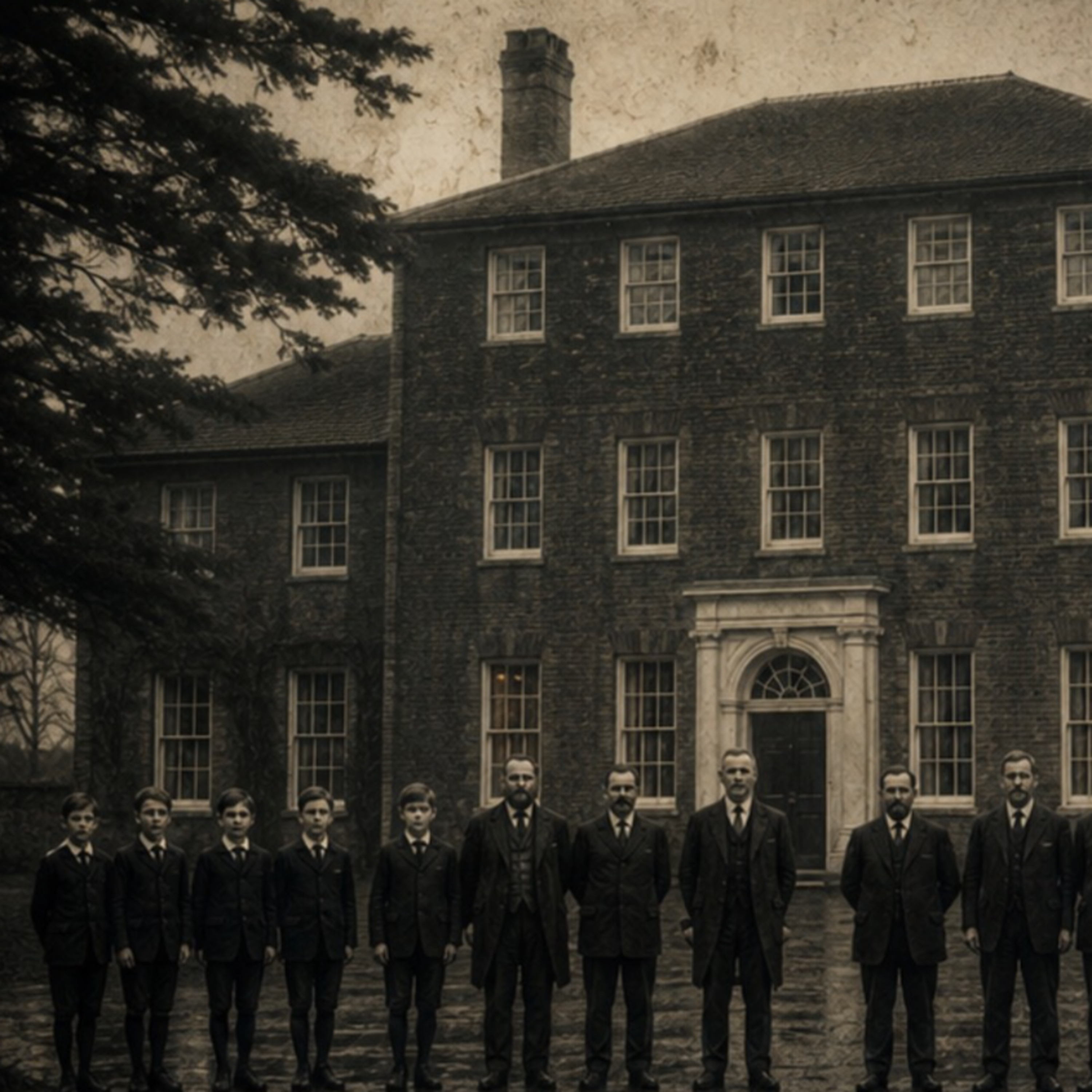
This particular school I went to was one which I can only describe as being militaristic in outlook.
The only way I can describe this, really, is by saying, if you know, or people listening to this, know the film Full Metal Jacket,
which takes a group of soldiers and they are sort of administered to by a very brutal drill sergeant.
And that instills huge loyalty into them.
So all the boys who went to the school were fiercely loyal of this school as an institution,
not necessarily to the individuals who made up that institution and nor to the school as a whole. It was more a concept, a process by which we,
these boys, that we were dysfunctional boys,
became young men,
young men who now had a function and purpose in life, who were set aside from other boys our age because of what we'd been through, the training that we had, the ethos of the school, the Espiritu Corps.
So when I am talking about what happened at the school,
I have very mixed feelings and divided loyalties because I feel I'm being disloyal to the school,
even though what I'm about to say is going to be pretty shocking.
The school itself was for boys aged sort of 10 to 16,
although 10 was considered to be too young.
I certainly was considered to be too young when I went there at ten and a half.
The school could take boys up to the age of 18 under special circumstances.
It was a school that was for maladjusted boys,
which was a residential school.
It was known as an outward bound school.
That was,
in sense of academic considerations came second.
Primarily, it was a school that engendered the outdoor life and outdoor activities,
a physical approach to life.
And through that,
boys were given confidence.
But confidence, in a sense, was knocked into us.
So it was, stand up, be a man, be a soldier,
take your punishment like a man. And there was plenty of punishment.
The general approach to sorting out our problems, because we're deemed to be maladjusted and therefore we had behavioral issues and so on,
was a behavioral One which was enforced through various techniques.
But it was considered that actually the reason we were there was twofold. There's a little bit of a paradox here that it was considered by the child guidance clinics and so on that, you know, produce the necessary educational reports,
that a normal education was counterproductive in our cases because that very education was seen to be a barrier to our education.
Therefore, we had to be lifted out of the normal system and placed somewhere else.
That somewhere else had to be a residential institution for one simple reason, that our home backgrounds were considered to be toxic.
So that meant that there were problems at home and problems at school.
This actually in some ways formed the best rabbit proof fence there was.
It was said by the staff and headteacher in particular that the fence around the school was not there to stop us getting out,
it was to stop prying eyes looking in.
Boys frequently ran away and found out one simple fact, that if they returned home in order to be taken back in by their parents, their parents would often say, no, sorry, we can't keep you because we are under certain jurisdiction, we will have to hand you back to the school.
Boys still ran away, but it wasn't necessarily to flee home. It was to make a point that they'd been maltreated to the point that they had to take extreme measures because the school would not listen to their words.
And so only actions would produce some sort of change or difference in the way that they were being treated.
There were essentially two kinds of boy who were sort of sent to that school.
The crazy, mixed up kids like myself who had various medical problems that weren't being dealt with properly or were misdiagnosed and, you know, we had been badly treated by the health and social care systems.
The other type of boy was known as the tough nuts. These were the schoolyard bullies and children that had been in trouble with the police and had been permanently excluded from a number of schools.
Now, if you think about it, it takes some doing because 10 to 16 means that these problems would have emerged at primary school.
Having been a primary school governor many years ago, for a great many years,
then the number of exclusions these days, of course, is on the rise, as most people will know if they are a parent or whatever.
But to be permanently excluded from more than two schools,
that is a significant barrier to, you know, a boy's continued education and obviously means that his card is marked if he is able to get into another school with his parents, help.
Discipline at the school was tough, dramatic, immediate and physical.
This started with Sergeant Majoring which was sort of as is in the army,
you would be made to stand at attention while somebody shouted and screamed at you.
Often, you know, inches from your face,
prodded and poked you, slapped you, or made you do press ups or whatever.
That's how it started.
Officially,
the school was able to prescribe the punishment of a boy being slippered.
This very rarely happened.
What did tend to happen was informal discipline was meted out. The sort of thing that was said that a parent would use to punish their child.
A good slap.
In practice, that could mean anything.
And what it did mean was that in any situation, a member of staff was licensed to use the flat of their hand to slap with, or they could rabbit punch,
or they could kick with the flat of the foot.
If the boy raised a hand to a member of staff or in any way verbally threatened him, then all bets were off.
That meant punching with a clenched fist or kicking with the toe of a shoe.
And if necessary, a weapon could be used to subdue the boy.
I think I may have mentioned, but if I haven't before that, what were termed hospital jobs, that was when a boy was so badly beaten that he had to be taken to hospital,
occurred up to about 8 to 12 times per half term.
Often,
although it was stated that the reason for this was that the boy who had behavioral problems had lost control, gone berserk and had attacked staff,
actually the reverse was very normally the case.
It was staff beating up on boys.
Hospital jobs usually meant that there was at least one broken bone involved.
Now,
the school was licensed to take up to 46 boys.
It never had held 46.
So if you start thinking about this, look at the numbers, that means that the institution on the basis of those figures was extremely tough and violent.
It was.
So you had to learn fast, you had to learn on your feet,
and you had to figure out how to survive.
So that was the basis of what the culture of the school was. To put old heads on young shoulders. In order that you did survive, you faced your problems because you had no other choice, because you were made to.
And you therefore built yourself up from a boy into a man through this tough discipline and through the physical activities and environment of the school. That's what was expected of you, that's what you did.
And you either sank or swam.
I was one of the swimmers for various different reasons, but there were others who were not.
So it is an extremely physical and tough environment and it was run along militaristic lines. But it was not all about how the military operated the head teacher was an old navy officer and he had a couple of his old navy revolvers.
One was kept in a safe in his office, the other in his home on the wider school estate where he lived with his wife who was a teacher at the school.
This was in case the school were in whatever way lose control of the boys or a particular boy was causing such problems that he had to be brought under control through use,
threat of use of a gun.
That was not official, of course,
because the school belonged to the Inner London Education Authority, the ilea,
but it was one of those things that a blind eye was turned to and there will be a bit more of that a little bit later.
So it was extremely tough and toxic environment in many ways, designed to knock sense into us before the alternative came into play. That alternative was borstal and obviously you couldn't send a child that young to borstal.
So if we didn't shape up, we would end up in borstal, we would end up in prison and there we would remain, one way or another for the rest of our lives.
So we'd better listen up,
we better decide to behave and cooperate and therefore make something of ourselves before it was all too late.
Were there any medical staff in residence or associated with the boarding school in any way?
Oh, yes,
there was the normal sort of complement for a state run boarding school,
which essentially was a school nurse who dispensed medication and generally saw to the boys.
There was a school GP who came and did various medical examinations and made sure we were all right.
But at this kind of school it wasn't just a behavioral approach. That behavioral approach was informed, in a sense, through psychotherapy and child psychiatry.
So there was a child psychiatrist,
there was not a child psychotherapist for various different reasons, one of them being that the headteacher's wife had wanted to train as a psychotherapist but had not been allowed to do so.
There's a long story behind this,
but essentially the point being that she was very much the power behind the headteacher's throne and basically if she couldn't have the job,
she would ensure that no one else did.
So we did have sessions with external psychotherapists,
none of which tended to be particularly beneficial,
either from the school's point of view or from the boy's point of view. There used to be clashes between the boys, parents who often wanted different therapeutic approaches taken, and places like child guidance clinics or whatever.
The Tavistock in my case, and most of a lot of the other points, because it was a central London school and that was a central London facility.
So there would be clashes about that and there would be also difficulties about people, about external therapists coming into the school because they didn't understand the school environment.
So one of the key points was that the school was meant to be, above all a medical establishment. And therefore the individual treatment of an individual boy was thought to be tuned in that sense through their psychotherapeutic and psychiatric needs.
The difficulty with this was that often for many of the boys, like myself, the crazy, mixed up kids,
then there was already a lot of conflict involved in the situation anyway, and these sorts of approaches had not worked.
And the result of this tended to be,
if I can borrow a bit of an expression from the Name of the Rose, when Brother William is talking about the sort of difficulties with some of their sort of religious groups,
that the ecstatic vision of a new psychological key to unlock the mind of a misbehaving boy suddenly gave way to the central frenzy of ensuring that his behaviour would be what was required or wanted through more direct and physical means that we'll come on to a little bit later.
But essentially the theory was that the behavioral needs of the boy would be assessed and that these psychoanalytic and psychotherapeutic regimes would come into play and they would provide a means of therapeutic intervention which would cure him of his behavioral problems.
So that was the theory. The practice was often, forget about the theory,
it's what works that counts. And what tended to work was physical pressure.
That was threats, beatings and so on.
Hence you got tough because you had no choice.
And one of the things I will mention about this is that if you transgressed against the rules or behaved in a way that they didn't like,
then you would have to suffer a punishment. If you cried, you would be deemed to be like a girl, not being stand up and treat your, take your punishment like a man.
And so they had a tendency to increase the punishment.
So you learnt not to cry,
unless of course, it was in the middle of the night and you did so into your pillow. There was what was described as the morning chorus.
In the morning, when they realized, oh, no, we've got to go through another day in this place,
in this school.
And boys used to cry into their pillows. Not all of them, of course, but it was something that had a name, the dawn chorus.
So you can well imagine that from this.
It was something that was pretty commonplace.
It was known,
you know, by the staff as well.
Everybody knew. It went on to a certain Extent a blind eye was turned to it, providing the boys functioned like little men rather than boys or little girls, because if they did, then that would subject them to discipline.
So that was the basic idea.
And like I say, it was an extremely tough and violent environment.
Into this, of course, is pitched myself and all the ghosts and the poltergeist that came with me from the haunted holiday.
So a very peculiar mix in that sense. The school was also known to be haunted as well. And that's, you know, part of this story.
So were there any specific medical or psychological techniques that were generally used on the boys at the school then, given what you just said?
Yes, obviously, as I mentioned, child psychiatry, child psychology,
psychoanalysis,
which,
these behavioral packages and so on.
There were also this sort of idea of the healthy mind and healthy body.
And that was the basic ethos of the school. In order to, you know, put the older heads on the younger children, as we were.
There was a number of other things that they specifically did. There was drug treatment as well.
There was sort of boys were given drugs in the sense of antidepressants, anti anxiety tablets and various other chemical psychological adjuncts to these physical, behavioral means of correcting our behavior.
So these drugs could be anything.
Sometimes boys were given so much of these things that they couldn't speak properly or they couldn't walk in a straight line. This was quite well known.
This, of course, did not stop the school authorities from trying these techniques again on a different boy in a slightly different way.
But what it actually meant was that there was a drug regime that would often be prescribed by the school's psychiatrist and overseen by various other medical professionals. The school doctor took a rather skeptical view of this.
The whole business was essentially meant to be an integrated package. Drugs, psychotherapy, psychology,
psychology, psychotherapy, psychiatry and the behavioral package. That's what it was about because it was supposed to be a medical environment in which a medical cure was meant to be effective against behavioral problems.
The difficulty with that was that many of us, including myself, had a physical problems,
physical medical problems that can't really be eradicated through psychological techniques.
All you can do is then to figure out what you know, that you cannot change certain physical things within your body, no matter how much pressure is put on you.
So you cover up, you lie,
and sometimes you're allowed to get away with that on the basis that you've.
You doffed your cap, you've accepted the regime and therefore there is no problem anymore.
It went away.
It was dealt with. Except, of course, when someone upsets you or whatever.
And then sometimes a blind eye was turned to that because then the other boy would be blamed for upsetting you and causing you the recurrence of or breakdown of your condition.
That had consequences for both boys.
The point being that within the school,
often boys were subjected to medical regimes that would never be considered outside of such an establishment.
So drugs were a part of this and very much used to great extent.
And often the school psychiatrists who prescribed these drugs,
which were dispensed by the school nurse,
did not have sufficient understanding of the way in which such drugs would affect an adult in terms of the complex cocktails that were often given or in terms of the doses, because most of them were adult psychiatrists used to working with adults, not children.
So again, that meant that the doses were inappropriately high.
The doses were also inappropriately high in the sense of using them,
using these drugs, not to ameliorate conditions, but to do two things,
sort of essentially conquer the problem, conquer the boy. And if in the process the medical treatment was far too much, so what? It didn't matter.
That provided a different start,
you know,
would wipe the slate clean, enabling things to be renegotiated. That sometimes happened. And on a number of occasions, boys,
as I said, were so drugged up that they couldn't actually take part in the school routines. And usually what happened to that was the sergeant majoring in the other discipline until it was realized that the boy couldn't help himself.
And then another solution was had to be found.
But that's the environment in which we lived. If you wanted to suddenly decide that the medicine wasn't working for you, well,
you found out that you had to take it because these things were enforced physically, if necessary. And on a lot of occasions that was what was required because boys objected to the way they were being treated
and kind of in that mix, you know, as you kind of alluded to a moment ago, you've also got a school that has a reputation for being haunted and then paranormal experiences taking place,
as well as someone like yourself coming in having had paranormal experiences.
And so the, the kind of, the. The next question I kind of wondered from that is,
you know, was it ever the case that the school authorities then feared losing control of the school due to the outbreak of some of that paranormal activity that.
That took place there?
Oh, yes, they did, because, well, over half the boys and many of the staff were affected by horrible veridical, telepathic dreams. And also they were scared because they were seeing apparitions which were horrific in their nature or shadow form.
Figures or ghosts that were following me around and were also causing a lot of problems that added to the situation which already existed, which had been clamped down upon very viciously by the school.
So you weren't allowed to talk about any of the ghosts.
Of course, when I arrived,
that was the case and everything. My arrival with all these other kind of ghosts and sort of poltergeists in tow, as it were,
meant that everybody started talking about it again. And consequently what happened happened was that the school tried desperately to clamp down on the situation.
So school routine was affected. It became impossible for the school to actually carry out its normal routine because of the fear and the dreams and so on. Boys were left washed out and unable to function and so on.
The.
The response the school had to this was essentially deal with it.
Now, the school psychiatrist analysed the situation and considered that it was a matter of mass hysteria, which must be stamped on and brought under control very quickly, because it would continue to grow to the extent that it would affect the whole school and even the staff.
The staff objected to this on the basis that they were not hysterical at all,
they were just trying to do a job and what was happening was obviously real and beyond them.
The boys knew that whatever was going on was something that the staff could not control or deal with and therefore they lost face and therefore authority in this highly militaristic environment.
And therefore what the school did was they applied to the Inner London Education Authority basically for carte blanche, which they got obtained in order to restore discipline to the school,
because the school authorities feared losing control of the school and therefore they could not run the school effectively and consequently the entire system was beginning to break down.
And that was due to this diagnosed outbreak of mass hysteria by the school psychiatrist.
The school GP had other ideas about this.
He was an Asian doctor and was actually very good at his job. But the school didn't like him, partly because of his ethnic background, which was very unfortunate, but that was often the way back then.
Also, he had seen various things when he was, you know, had been in India. I mean, obviously he's an Asian, so his family had come from India.
And he knew that the approach that was being taken was wrong,
because this is not how you would deal with a jinn or difficult spirits or whatever in India.
And therefore his take on what was going on was very different. But he was overruled by the school psychiatrist who had the ear of the school authorities.
And it also gave the school what they wanted carte blanche to do what they considered necessary.
So this started off with Sergeant Majoring, bullying, discipline and then drugs and so on. But they realized after a while that this approach wasn't working.
And obviously some of the staff, under pressure to take some of the drugs, refused to do so because they weren't having any of that kind of thing.
So then you get the situation of it was the school was seen as being hypocritical because they forced these things down our throats,
but not the staff.
So if the staff were seeing the same apparitions and having the same dreams and having the same sort of experiences that we were,
then why were the staff allowed to get away with it? One rule for the staff, one for the boys.
So there was also considerable pushback from a lot of the staff about the measures that were being implemented against the boys because they felt it was unnecessary cruelty.
And also that there wasn't any sort of basis for the argument of mass hysteria because, well, for two reasons. Firstly, they didn't really agree with the concept.
And secondly, it was this issue of how is it then that even despite all the drugs, all the discipline, all the beatings,
boys still saw what they saw,
which was what the staff saw,
which was what the staff experienced, which was what the boys experienced.
You know, all this treatment did not make any difference to reality.
It simply meant that the boys who had seen things and had experienced things went into denial, as some of the staff did, but it didn't stop what was going on at all.
So a new approach had to be taken.
But before that,
various things happened.
So do you want to just provide some more detail then about how they try to deal with the matter of the paranormal activity? Medically?
Yes, as I've mentioned, there was Sergeant Majoring. This could be of an individual boy or a group of boys.
So it's shouting, screaming, you know, forcing us into physical activity or stress positions and so on. And that could be, you know, accusing us of not participating in school routines as we should, and therefore punishing us unnecessarily.
Things like, you know, we had to make our beds or whatever.
So if we were thought to have misbehaved, then the normal thing that would be would be done anyway. If you didn't make your bed properly is the bed would be turned over and the sheets ripped off it and you'd have to do it again.
That meant that you might be late for getting your shoes and other bits and pieces of school routine sorted out and attending your breakfast. So if you were delayed here, it had a knock on effect there.
So you ended up being punished several times for one misdemeanor if you weren't quick about sorting the situation out.
So a member of staff could come in,
could accuse you of various things or say why they were upset with you and then turn over the beds, forcing you to make them.
That's the typical sort of way in which things went in terms of sergeant majoring.
One of the other things they used to do is make you do press ups and then they'd go and sort of put their foot on your back so that you couldn't actually do the press up.
And then they shout and scream at you and give you further punishments for not cooperating with them. There's this sort of thing, very sort of militaristic kind of stuff. And of course then there was the prescription of a lot of medication, antidepressants, anti anxiety drugs, illibrium and Valium, this sort of stuff.
And phenobarbita. Phenobarbita is a particularly nasty drug.
It was meant to sort out the dreams because it's meant to eradicate your dreams so you don't remember them. Unfortunately it didn't work.
It wasn't ever bound to work for two reasons. It's not particularly effective anyway.
And also there were the wrong kind of dreams because these were veridical telepathic dreams and not the usual sort of ones. It's not the usual kind of nightmare,
so you can't stop it with that kind of drug.
There were therapeutic interventions that tended to be used from time to time anyway, which is part of the behavioral and medical treatment of the boys. And this could be hypnosis and it could be the use of what was termed therapeutic interviews.
These would be through a mixture of different drugs, sodium pentothal, sodium amytal and the like. Sometimes mixed, you know, mixed drugs as well as other drugs as well.
And sometimes boys would be linked, hooked up to lie detectors and so on. I had a number of these interviews anyway.
And the point about this was that you've got a very different sort of kind of structure to things in which these sorts of interventions are considered to be necessary and appropriate.
They took place either usually partly in the medical room or sometimes in the psychotherapy room.
There were special rooms for psychotherapy. The psychiatrist had a particular room,
so that's where he conducted his interviews.
The school thought that I was the focus of what was going on.
They believed that either what was occurring was the result of my subconscious taking on an external form and causing trouble for the school.
And the school was therefore plagued by various poltergeists as a result.
Or there was some sort of external entity.
Which had latched onto me. And was therefore using me in some way.
Either way, it was deemed that I was either responsible for this. Or I could control it.
In order that, you know, I could control what's going on.
The basic theory within the school was that a boy could control his subconscious. And therefore whatever behavioral urges or problems could be brought under control. By forcing his conscious mind to control his subconscious mind.
In order to address his behavior. Therefore, this was simply an extension of that particular set of arguments and considerations.
This was particularly apparent to me because I had nosebleeds. And, you know, essentially these techniques were already used on me.
They didn't work because the reason I had the nosebleeds. Was because of developmental issues. Due to oxygen deprivation at birth. And various other problems from birth.
Never really dealt with it in a proper way or acknowledged as such. They seemed to be psychological. And therefore I'd already run the gambit of these sorts of things.
So the result of some of this was that the boys in my dramatry and so on. Were also seen as being responsible. Because the idea was that I was primarily hysterical.
And radiating out this kind of force of my subconscious that was so powerful.
It was thought that I then brought other boys into my gambit or remit or influence. And they would radiate out,
you know,
from their subconscious,
the ghosts or whatever.
So it was something that was propagated by my subconscious. And those subconscious minds of the boys around me.
Consequently, it was the boys in my dormitory that were also the focus of this.
So we were given huge quantities of drugs.
To the extent that we were given two and a half to three times or more. The maximum adult dose of a given medication or drug.
But we were taking and forced to take several different drugs. Thus multiplying up the effect that those drugs had. That was thought to be beneficial. But it led to what was termed at the time,
foot and mouth disease. Which was a respiratory crisis. Because a lot of these drugs depress the central nervous system and can affect breathing.
So some of the boys in my dormitory and further afield. Who were thought to be particularly susceptible to this.
Were given so much medication that they became semi comatose.
And froth was seen to come out of their mouths. And they kind of twitched, fake twitch from time to time. Hence the sort of notion of this kind of foot and mouth disease.
So the school nurse was called in to see to us.
And she became immediately alarmed. And demanded that the treatment be stopped instantly. And the Boys removed to hospital because she didn't understand what was going on, but she could diagnose some sort of respiratory crisis from which the boys had to basically recover or there could be very severe consequences.
She demanded that the school GP be contacted and brought in to examine us.
The GP arrived without being called for because the nurse had summoned him and said he was an Asian doctor and he did know his job, but as I said, he was not particularly well regarded within the school.
And he backed up his nurse and said, look, you've got a respiratory crisis on your hands to the head teacher.
The head teacher would have none of it because he didn't believe the gp,
because he believed the school psychiatrist.
There were two school psychiatrists when I was there. They both left under clouds for different reasons,
but they'd both been in the military and consequently they had been dealing with soldiers,
shell shock and so on.
So they were used to prescribing what was termed heroic doses. You had to be a hero to put up with those kind of doses or to tolerate them or to be made to tolerate them.
The point being that the headteacher listened to the school psychiatrist because he was determined to get to the bottom of the problem and determined to root it out, and therefore he did not want to quit, as he saw it, too early,
with this aggressive form of treatment.
There was a huge, blazing row between the doctor and the head teacher. And the doctor sort of said, look,
if you don't allow me to send these boys to hospital,
then, you know, I will not only report you to the medical authorities,
I will call in the police, because you are preventing me from caring for my patients.
Eventually,
the headteacher relented,
and I know all about this because it occurred, this big row occurred in my dormitory while I was there,
which again, shows you something about the kind of institution that it was. It wasn't one of these places where it was a question of having a row, not in front of the children.
We were, to a certain extent, irrelevant to the staff in that sense.
They decided who we were, what we were and how we were to behave.
The staff had a right to actually walk around and discuss us openly. And sometimes they did. Not all of them did, but sometimes they did.
So that was, again, something you had to get used to.
The point here is that the GP actually won and some of the boys were removed to hospital,
whereupon the treatment was immediately ceased for two reasons. Firstly, because they didn't know what on earth was going on. And secondly, obviously, if you're in hospital,
you're no longer Getting the drugs.
So that was one of the problems that occurred.
The headteacher himself was generally regarded as a man that you didn't cross.
He was known to be a bit of a psychopath,
with good reason.
He was a physical bully and obviously he had been in the military during the Second World War.
His wife was known as a verbal psychopath.
She was very proud of the fact that she could reduce a boy to tears without ever laying a finger on him through the use of mere words.
That was not an idle boast, I can assure you.
The first school psychiatrist,
for example, considered that I was essentially a psychological weakling for several reasons. Firstly, because I had failed to control my nosebleeds and therefore mentally, I was unable to.
To do what was necessary. That was to exert enough psychological force from my conscious mind onto my unconscious mind to address the problem of my nosebleeds. Because when I would be successful,
I was told that what I needed to do was to create a character, a badly behaved boy that I called Gory, who had nosebleeds. Gory, um, a fairly obvious name.
And that I had to control him. He was a badly behaved boy. So as they disciplined me, I had to discipline Gory. And the idea being is when Gory had learnt how to behave himself, my nosebleeds would cease.
That, to my mind, was a rather nasty and brutal fiction.
It was not as simple as that, but that they made it to be that simple.
There was one incident, that which was that one of the poltergeists, Dr. George Pearce,
actually turned over one of the rooms in one of my dormitory at the time.
Sometimes he was seen as an actual natural figure or as a shadow form figure. He moved around, ripped down the curtains, turned over furniture and generally caused a huge disturbance in that room.
One of the things he did do was that he overturned the bed of my best friend at the time while he was still lying on it and tipping my friend onto the floor, scaring the hell out of him.
It was thought afterwards that some of this incident was actually witnessed by a member of staff. So there was no question about it being our imagination or just some sort of story or exaggeration of what had actually happened.
So I was held to blame for the incident for allowing it to happen through not controlling my subconscious mind and my relationship, whatever it might be, with my subconscious that created this poltergeist or set him free to cause trouble,
or alternatively, to control part of my subconscious mind which had generated him in the first place.
So in order to demonstrate that I could do so then I was put to the task of showing how my conscious mind could be controlled by my subconscious mind.
In order to do that, I was forced to try to turn over the bed myself.
I was a small,
relatively young boy at the time. It was just too much, too heavy a task for me. But in order to motivate me, I was slapped and whipped with towels in order to ensure that I was sufficiently motivated to exert the full force I was capable of exerting in order to lift the bed up and turn it over.
I could not do so. And therefore I was written off as some sort of psychological weakling who had obviously allowed these things to happen to him and therefore was the bane of the entire school.
The first psychiatrist, when I was there,
left under a cloud.
The second psychiatrist, Dr. P,
had a different approach.
He was somebody that was more inclined to talk things through rather than to use these heavy behavioral approaches. Although he was naive in the sense that he did not know or understand or comprehend that when he provided the school staff team with various psychological theories as to why the boys behaved as they did,
that his theories would be enforced through behavioral means on the boys themselves. And therefore we were forced into believing whatever theories he had about us that led to many of the boys refusing to cooperate with him.
One of my friends and my best friends at the time,
he said about the activities of the poltergeist, well, look,
you know,
you can easily, from one reason or another here, you can easily find yourself standing up against a wall and being disciplined. Well,
these poltergeists, whatever, they're just another way in which that could happen to you. So it's not so bad, really, here anyway, you know, in this dormitory.
He had a point,
and it was one that was shared by a number of the other boys.
But also because some of the staff were very wary, partly of us,
partly of the poltergeist. Then, you know, they had a tendency to leave us alone, which was quite a good thing.
So there were pluses and minuses about that.
The new psychiatrist, Dr. P,
he had been an army psychiatrist. Now, there's a whole story behind this.
But he had not worked with children, and he had no idea of the correct doses of medication to prescribe to children.
He was slightly horrified by the foot and mouth crisis and felt that another approach needed to be taken,
which was all well and good.
Now, one of the things that they decided to do was to use a different approach, which was insulin shock therapy.
Insulin shock therapy was something that was a shell shock type treatment. And some of the Doctors that had worked at the tail end of the Second World War on military personnel where these techniques were used were still around and in practice.
The idea behind it was that you give somebody an injection of insulin which sends them into a coma.
During the coma they should internally process what is happening to them. Give them the space and time for the subconscious to work and any dreams or whatever to come out and express themselves.
And when the person is woken up, usually by shaking him and giving him some a sugary drink or potatoes or something like that, the sugary potatoes,
then he comes out of it. And the sort of system, as it were, was allowed to reboot.
And therefore the person involved will not be aware of their surroundings because they're coming out of a drug induced coma. And therefore they'd be more amenable to the other forms of treatment.
The reason that they decided on this was because the ILEA was part of the Greater London Council and before that London County Council.
The London County Council really didn't like electroconvulsive therapy, ECT and wanted it banned. It wasn't allowed to be used in some of their hospitals, but in some other medical settings it was used.
It also required, of course, equipment to do that. So this was not something that was easily portable as syringes and drugs,
and you had to account for it within a medical setting.
So that was seen to be an unofficial avenue that the school could not go down. But they could make use of insulin shock treatment, and they did.
In the 1960s and 70s, in the sort of psychedelic age of psychiatry,
some psychiatrists used some of these techniques to get to the bottom of domestic trauma or abuse or other sort of deep psychological problems where no other psychological treatments or therapies appeared to work.
I fell into that category and had already been the subject of sodium pantothon, sodium amytal. So called therapeutic interviews,
as my case was deemed to be hard to crack and therefore I was considered to be a complex case.
Some of these drugs were also basically drug treatment was accompanied by hypnosis. And so you essentially were given drugs and they tried to hypnotize you at the same time.
I already had been subjected to some of this when I was at primary school, which is a totally inappropriate setting, and later at the Royal Free Hospital and at Great Hormon Street Children's Hospital.
So other such interviews took place at the Tavistock Clinic and later at the boarding school.
Sometimes these interviews also used lie detectors and ECGs and EEGs in order to gain a therapeutic understanding of what was happening. The person's heart in order to monitor their physical condition, and their brain in order to monitor their psychological state.
The lie detectors were obviously there as a result of monitoring when the person was estimated to be telling the truth or not.
They were not particularly good. And that essentially the interview was a military style one which involved such majoring, shouting at you,
a certain amount of slapping, and so on and so forth.
It was thought that essentially the subject, the person, could become violent as the result of a cathartic release of psychological, if not psychical energy. And therefore they were often strapped into a chair during the proceedings.
Essentially,
these military techniques of interrogation had no place in the military world because they had been outlawed or against the various Geneva Conventions. They certainly should not have been used against the civilian population, and by no means should they ever have been used against children.
But they were,
and that was the cause of a lot of problems.
So there was not only this hypnosis you had to contend with as well as the drugs. They also tended to use white noise and other noise type techniques to distract you and to generally knock you off guard.
Something else we always had to contend with.
Now the insulin shock therapy was something that was singularly inappropriate because you need to monitor it carefully.
If you don't, then someone will go into too deep a coma and it will be difficult to rouse them out of it. And you need to monitor them medically, carefully.
And also if they are, they go too deep for too long,
then that can lead to brain damage. In 1963 in America, there was a seminal test case which showed that lie detector test, as part of these sort of drug and hypnosis based,
so called therapeutic interviews were unreliable due to the level of coercion that was used.
And the subject could produce false memories or just generally be so incoherent that the data or evidence used from them could not effectively be used against them.
And that had cast a very long shadow over these techniques in the United Kingdom.
But it was still thought that the techniques could be used to uncover a problem and get to the bottom of it so that those problems or issues could be addressed by other means.
Now,
insulin shock therapy was used against one of the boys in my dormitory.
This severely affected him, and it was thought that,
or it seemed likely that he had had been brain damaged As a result.
Two things happened as a result of that. Firstly, I'll come on to what happened to him specifically later.
But I was next in turn,
because the idea here was that they were to deprive me of my witting or unwitting Hysterical helpers, as it were, because I was the primary focus of what was going on and therefore deprived me of.
Of these other boys who were seen to be the echo of my psychological state, and therefore reduce the effect of the plague of mass hysteria, and therefore then cut off the head, as it were,
by dealing with me.
So I was going to be given an insulin shock therapy treatment.
But by that stage, the school nurse had refused to cooperate with this regime and also the school doctor had,
so they had to find someone else to give the injection. This turned out to be a member of care staff P. He had said that he was a nurse.
That was not true because the General Nursing Council would not permit men to train as general nurses until after 1960.
Obviously, we're talking about events in 1970, 71 to 72,
so considerable time later.
But even so, it would be difficult to understand how a man with his background could have trained as a nurse at the time that he said he had.
He then said he was a psychiatric nurse, but psychiatric nurses didn't receive this sort of training. The reality was that he had been a psychiatric patient and had witnessed these sorts of things occurring.
So he considered, oh, how difficult can it be? I reckon I can do that. And he was the one that was siding with the Warrens, who considered that I was spawn of the devil or that Susan was spawn of the devil.
And therefore he was very enthusiastic to make sure that the treatment was given.
I resisted the injection. I was held down and I fought.
The entire load of the syringe was not given, was not delivered. My vein was ripped and I was rolled up in a rug and kicked.
This was a punishment thing that was often done.
The object of the exercise being that you could still feel being kicked. And it was definitely humiliating and all the rest of it, but that the object of the exercise was that the force of the kicks against a body rolled up in a rug would not be sufficient to cause large bruises and so on.
And therefore, you know, from the punishment point of view, you could have your cake and eat it.
Susan was sort of standing by and I had been bullied to not ask for her assistance.
I did out of sheer desperation.
They had been ignoring her and she had been wondering what to do.
The whole object of the insulin shock therapy was to break the connection, whether it be, you know, a telepathic one, a sympathetic one, or that she was thought to be part of the dark side of my subconscious.
There's also an interesting twist here, because Susan being female, they considered that my sexuality was part of the issue that was driving this,
which of course was just completely untrue, but they thought that one of the reasons behind the whole business was my disturbed sexuality.
Not so,
because Susan was completely independent of me.
She was an attached, earthbound spirit,
a very powerful one, and so you could say she was a poltergeist, but she was entirely independent of me. She was dependent on me because she thought that I was a man that she desperately was in love with before he betrayed her to her death.
She was very protective of me, and therefore the school strategy was to try and drive a wedge between us,
saying that I must fight my own battles and not rely on a girl to save me.
That girl was a young woman, as could be plainly seen in her apparitional form.
And so in this particular instance, I called on her for help as I went under as a result of the drug, I could still see her and the room in my mind's eye, even though I was unconscious.
By all normal means of measuring that, insofar as one can,
what I did was to ask her for help to get the bursa, who lived in an upstairs flat, on site for some of the time,
because he was the only one that I thought would help me,
because he had decided that, you know, he was going to take me under his wing.
So as I went under,
I called for Susan to call for him, to get him to come to me.
In that upstairs flat, the bursa was dozing. His dog aroused him and started to try to say to him he needed. There was something that he needed to do, he needed to come with him.
And so the bursa followed the dog. The bursa thought that the dog in some way was in danger or would lead him to danger.
So he was rather apprehensive.
And when he arrived,
when the dog arrived at the scene, the dog was simply bleating and pointing with his paw, meaning pointing through the door, the dormitory, at me.
Susan, who was covering me and protecting me,
moved away from him,
from me, rather allowing him to come in to tend to me.
And a sort of improvised tourniquet was applied to me, which stopped the bleeding,
and I was revived through the use of a sweet. And I was generally, you know, sat up and so on. And after a period of time, I was allowed to go back to sleep on the basis that the drug had worn off to the extent that it would be unlikely that I would lose consciousness.
So that was one of the incidents that occurred.
Now, as a result of this business of being a psychological weakling,
sometimes various challenges were given out by members of staff, Often the head teacher.
He had usually certain boys in mind when these challenges were made.
And it was a question of whether the boy who was targeted, whether he realized it or not, was going to be man enough to take up the challenge.
Well, one of those challenges was about being William Tell.
Didn't really know what that meant. I didn't. Neither did the other boys. But it was a meeting in the common room.
So I stepped up in order that what I was going to do was to prove to him and the school psychiatrist that I had enough gumption, courage within me as any of the other boys did.
Being William Tell meant the headteacher shooting a cup off the top of my head with his old navy revolver,
which he did.
So that proved the point.
I may be sometimes cowardly and not want to fight because I was known as somebody who didn't like fighting.
But I was no longer seen as,
you know, an abject coward.
That held its advantages.
One of the things that happened was that if these techniques could not make me control my subconscious or make me control Susan, then another approach had to be taken.
And that incident put ideas in people's minds.
So when various incidents occurred,
then the headteacher would be sent for,
and he would arrive on scene with his revolver.
On one occasion, he threatened me,
saying that I needed to deal with the situation,
I needed to send Susan away,
and that if I didn't do that,
he was going to threaten me with a gun, which he did.
So it was a question of, control your alter ego, or I'll blow you to hell.
Well, neither of those two things happened.
The alter ego concerned Susan ripped the gun from his hand, smashed it against the wall,
and then took up a protective position between me and him.
He then decided that he was going to launch himself at me to teach me a lesson. He didn't get very far.
He. He ended up under the table in the room,
taking refuge under the table while Susan stood guard between me and him.
The boys didn't know what to do,
and the staff could only sort of intervene at a distance.
And they were very much aware that what I heard, Susan heard. And there was a relationship between us because she was going to protect me. The headteacher's wife was sent for,
and she tried,
first off to deal with the situation by ignoring it.
And so she came forward to extricate her husband from under the table.
She was prevented from doing so.
She then had to sit on one of the pads and then complained that this was the first time that she'd ever had to negotiate with something ghost. In order to get access to her husband.
Always being a teacher and modeling herself after Jean Brodie, she started giving some of the boys an impromptu lesson, history lesson. And then, you know, the situation dragged on.
So the only thing that could be done was, as I suggested,
that certain guarantees needed to be given to me in order that Susan could hear them.
And actually the situation resolved.
That's what finally occurred.
Now, the interesting point about this is not only that resolution, but also when the gun was retrieved,
the barrel of the gun was bent. It was bent upwards where she had ripped it out of the headteacher's hand.
The surface of the barrel was somewhat grainy, and it looked like it had been put in large heat or sort of wrenched cold flow,
technically.
The headteacher did take it to a gunsmith who, you know, resolved the situation by heating up the barrel and realigning it. He then decided he was going to test the gun.
So there was an old dartboard, and we were going to get a new one. So he put it in the corner of the common room and he tested his gun and made sure it was right.
He actually said, look, he wanted me to be part of this, actually, because he wasn't just a psychopath.
He was, in some ways a father to us all and took great pride in that because he wanted his school to be a school that would be like some of the best private schools.
And he was going to achieve this on the money that he got in from the ILEA, on the rates.
So he got me and he taught me sort of in a very brief way, how to shoot the gun.
So I fired the gun after he had done into this dartboard, which made a hole in the wall as well. But anyway, you know, these things get glossed over in a place like that.
And so, you know, in that sense,
we were, to a certain extent, back as friends until the next time.
Now, this occurred sometime later because there was another occasion when they wanted essentially to ensure that either this was the dark side of my mind, that they'd have to address my subconscious that was generating Susan,
or it was some sort of independent entity or poltergeist, in which case the strategy would be much the same. I had to control that.
I had to control Susan.
Susan had her own mind. And that was something that they didn't bank on.
It was evident from many of these incidences, particularly the one that I've just related,
that Susan was extremely protective of me. I did not control her.
She, in a sense, basically controlled me because I was scared.
But Sometimes because of the environment of the school, I had to ask for her help.
Now,
on some of those occasions,
she asked me to pray,
to pray to God to give her the power to protect me, which she did,
as I have described. And there are also other occasions when that occurred. The school thought that what they were going to do was to keep me in a drugged state, cut me off from her and her from me, so she wouldn't know what to do.
So they drugged me up.
I was slightly aware of what was going on because the link between Susan and myself had not been entirely broken. It had just been diminished due to my incapacity under the influence of the drugs.
So I was taken in a drugged state and brought into the medical room,
whereupon I was strapped into a chair.
I was woken up partly by slapping me and partly by an injection. It was probably amphetamine. And told what was going to happen. There was a doctor there. I recognized him and I was told,
yes, that's him. You've seen him before.
Now we're going to give you another one of these therapeutic interviews. We're going to get to the bottom of this,
okay? I could see that in my weakened state, I couldn't resist as physically as I had done before because I'd been manhandled and down and sort of strapped into the chair and so on and wasn't really with it at all.
But the injection that had brought me out of that gave me a certain amount of energy, although I was still extremely weak because I'd been in this drug induced state for a considerable period of time.
I was hooked up to an ecg, an EEG and a lie detector.
And these were on the. On the table to my left.
On my right,
there was Mr. P, member of care staff, who had a knife. He held it to my throat.
During my corporation,
the doctor prepared some medication.
And this was going. This was a mixed sodium amytal, sodium pentothal.
Interview.
Sodium pentothal is,
as some people will probably know, it's what you get given before a major operation.
It's basically to make you. To relax you if you're given too much. It makes you sort of like as if. As if you're kind of in this sort of drunken state.
Sodium pentothal is nasty. And I will describe why in a moment.
What happened was that I thought I was going to be all right because I didn't think the doctor was going to use the same technique as he did before. He did.
Susan,
who'd been following me,
was sort of around.
She came to Me. And this was seen by the other people in the room.
Her presence was there as a shadow form, figure, but later it crystallized into a full body apparition.
She came to me and she said to me. She stood in front of me and she told me I was in danger and that I needed to pray to God to give her the power to protect me.
My answer to this was that he had not protected her in her hour of need because she'd been murdered and she'd also been, early in her life, abused.
Why should I believe her?
I was told,
you must trust me.
I had no alternative.
So I did. I did what she asked.
The injection was given,
and this was initially a sodium pentothal followed by sodium pentothal and sodium amytal.
Sodium amytal in injectable form is a nasty drug.
It is a preservative, is used or was used. That would keep it fresh and make it effective.
Now, that is ethylene glycol antifreeze.
And it has to be delivered through the use of a glass syringe because it will kind of warp or melt a plastic one.
It was injected into my wrist.
It burns, it bites, it freezes.
And you can feel it working its way up your arm. I was told that if the drug reached my heart,
I would die.
And therefore I had very little time to cooperate. If I did so, I would be given an antidote.
The antidote would be administered through an injection to my heart.
I had been through this before. I knew it was a lie, which was why I thought that I was not to be given this particular treatment in this way. I was wrong.
I waited,
and I was, you know,
basically slapped around a bit. When drug reached my heart. You get this incredible burning pain sensation, and it's sort of like shooting upwards out of your body into a sort of like almost nirvana, like going through fire or something.
And the thing is, they'd given me too much of the drug.
Susan had become very concerned, and she kind of covered me, meaning that her etheric body covered mine. And she brought me back.
Meanwhile, she maintained a presence, guarding me.
She pushed. With a gesture, she pushed P away from me.
And he was knocked over onto the floor.
Susan brought me back,
and then other things happened.
The doctor was about to give me another dose of the medication, which would have killed me,
no doubt about that.
She stopped him.
She turned on him,
turned around,
and she just pushed him back with a gesture and knocked him straight back against the desk.
He decided that it probably was wiser to wait and see what happened than Try again.
P.
Who had been knocked to the floor,
got up and returned to his position.
Audacing the knife at my throat,
Susan said to him, I will not permit you to harm him.
He said,
I will not take your orders. Born of the devil. And told her to something. Go away,
she snarled,
and with a gesture,
she picked him up and threw him across the room a distance of some 10ft, lifted him up physically and threw him across the room.
His back crashed against the wall, and he slumped into a chair.
The headteacher, who had anticipated this,
went slowly towards a little table that contained the revolver,
some ammunition and a knife.
The doctor now had become very agitated and considered that his personal safety was at risk. So he picked up the chair,
moved it above his head in order to try and hit Susan with it and therefore alleviate the situation, deal with it.
She wrenched the chair out of his hands and it ricocheted off the ceiling,
back down onto the wall and then the desk and then onto the floor again.
She pushed him through a gesture that lifted him up,
threw him against the wall on top of the desk, and he crashed down onto the desk.
It took him a while to recover.
And then what happened was he came forward. He tried to launch forward and attack her.
She knocked him back again.
This time his back crashed against the back of the desk,
and she bent him over the desk in a, you know, stress position or whatever.
He slumped onto the floor and then took refuge under the desk, and she pinned him there with a chair.
P decided he was going to have a go,
and he launched himself against Susan.
She threw him backwards against the wall again and this time pinned him there with the medical examination couch.
Now, during some of this,
although I was unconscious because of the action of the drugs, I could see in my mind's eye what was happening. I knew I was connected to what was going on.
Susan's thoughts were my thoughts, my thoughts, hers. And therefore,
when she picked, then,
you know, it was this question of want to stop him doing that again.
So I thought of the medical examination couch.
As I thought about it in my mind,
there it was.
There was the couch in my mind,
and it came forward, she lifted it up, it came forward, it turned around, and it was smashed right against his body,
knocking him against the wall. And it was my idea to pin him there by ensuring that one of the end of the couch was under his chin,
locking him against the wall so that it was at an angle and so on. That kept him pinned up for a little while.
Meanwhile, the head teacher had got the gun out and was threatening me with it and saying, call off your dogs or I will shoot you. And that will be the end of you.
So you better decide where your priorities lie.
I didn't know what to do.
Susan moved between us and the head teacher said,
look,
the bullet will pass straight through that ghost and it will go straight into you, Kieran.
So call her off and then we can talk.
But if you don't,
I'll shoot you.
I didn't know what to do. I was scared.
In my mind, I asked Susan what to do.
She said, stand up to him.
And various images flowed through my mind.
I barely understood what she meant because the images came too thick and fast. But I got the idea. I said to him,
if you shoot me,
oh, yes, I'll probably end up dead.
But you won't be able to pin this down.
As in an incident of self defense.
No, not with that gun.
My world will be over, but so will yours. Because they'll take this school away from you. There will be a board of inquiry, and one way or another,
the life that you lead now will be stripped from you, just as my life will be stripped from me.
Do you really want to do that?
If so,
you pull that trigger.
He wavered.
And then he made a good, clear aim. And he said,
right between the eyes, Sonny Jim.
Right between the eyes.
And he leveled the revolver at me. And I could see his aims good and clear.
Then a number of things happened. Almost instantly,
one of the things that occurred was that Susan,
who had been standing between us,
then a window right at the other end of the room was blown out.
What then happened was with again, with a gesture, she ripped that gun away from out of his hand to the extent that later he needed actual medical treatment on his hand, arm and shoulder,
because his shoulder was severely injured, dislocated.
That's how serious it was.
And also the syringe was taken from the desk,
projected out outside onto the grass.
The revolver was found with the syringe through the trigger guard.
A clear message the gun was loaded,
but one of the bullet, couple of the bullets were found outside on the grass. The gun had not been fired. There was a lot of corrosion around the revolving chamber of the gun and on some of the bullets.
The bullets, however,
the first one in the firing chamber and the two either side were fairly heavily corroded.
And the lead bullet.
Lead bullets themselves were arranged about 2ft, 18 inches. The central one that had been in the firing chamber and then the two others before 18 inches away from the gun,
they had not been fired, but they had been uncrimped from the cartridges.
This is not possible without a machine, and even so it would be very difficult. However, that's a bit of an aside, because what was happening in the room was that there'd been a sort of like a great big explosion of white light and the power had gone off, shutting off the recorders and the instruments.
The session had been tape recorded and that provided a record of the session.
When the power went,
the fire alarm kicked in and therefore what happened was that there was a brief discussion between a member of care staff and the head teacher about what they should do.
The doctor tried to rush out of the room because he was scared. He found that he couldn't actually get out of the room.
The head teacher and the member of care staff decided that their priority had to be the rest of the school, not me.
So they decided to leave.
When they said they were going to go and they were going to leave me. The door was able to be unlocked because it had been mysteriously locked and the doctor was unable to get out.
The doctor ran up the road because he was scared.
He then,
after a period of time, rang the school because he realized he'd left his briefcase in the examination room and, of course, his equipment. But he was more worried about his briefcase for the simple reason that he had other patients to see and it contained confidential records.
Well, it would, wouldn't it?
He would not return to the school to receive his briefcase and demanded that a member of staff come out of school to meet him at the call box from which he was calling and he would take the train back to London.
He returned some time later, some days later,
to find that one piece of equipment didn't really work. The other was damaged.
The headteacher's view and eyes, and my own, was that the one piece of equipment that mysteriously did not work would work when he took it back to his clinic in London, which it did.
The other piece of equipment had to be basically sent to technicians to sort out.
The tape recorder had blown up during the power shortage. Merely flicking off the power wouldn't have caused one of its valves to explode and two others to blow.
The recording which existed there was played back on another machine, on the original machine when it was repaired, and it gave a record as to what was going on.
Now, the traces from the EEG and ECG were remarkable.
What it showed was that after a short period of time,
all the traces were flatlined,
with the exception of two no breathing, no respiration,
no pulse,
no electrodermal activity or it was again flat blind. And all the EEG measures, apart from two,
were flat.
Those two were the alpha trace,
which would normally be a sort of a sinusoidal type trace,
but it would be at one amplitude, then it would zigzag.
The pen would bang up and down and then be spaced. There'd be space,
nothing happened. Then there would be banging up and down and then sinusoidal trace at a different amplitude.
The other one was the theta,
and that was termed to be erratic. And that would be small jagging up and down, followed by large jagging up and down to the extent that the pen recorder. The pen would just hit the upper limit and just stay there and then bang to the other extreme.
So it was zigzagging all over the place.
Normally, if you have flatline on most of all of the ECG, so EEGs,
traces that would indicate brain death and also physical death.
So it was debatable whether I'd actually ceased to clinically live. In other words, that I was dead.
It was thought that I didn't, because these traces were still active.
But the stool did not, for obvious reasons, consult very widely about that.
However, I was made to produce a report of what had happened, and I was told that you must not engage in any sort of commentary about the way you were treated, just about what happened to the phenomena that went on.
It was obvious from the way I was being questioned and the sounds of physical violence, but I was not to comment on that.
I produce a commentary, which is largely what I've just related,
and that this was typed up as a transcript, although it was edited,
and this was offered to the spr, who declined it on the basis that it was not relevant because it was a controversial medical examination and not relevant to the work of the spr.
I wish they'd taken was also offered to Ed and Rain Warren,
who decided that Bathsheba Sherman was the ghost or spirit involved, not Susan.
There were also a couple of surprises in terms of the audio recording, because there were two voices that shouldn't have been there because they did not correspond to the people that were in the room.
The first and obvious one was Susan,
and she spoke sometimes in Polish and in English with a Polish accent.
So part of the tape was copied and sent to a Polish institution in London who confirmed that the language was Polish.
And they also confirmed that some of what was said and translated it, which relied upon basically said,
look, now that I have found him,
I will not let him go and you will not harm him.
You will not harm him.
I Have the power of God to protect him.
And you will not interfere with me or with God as I protect him.
That's what was said in Polish.
That's what they translated and sent it to the school.
Thank you so much, Kieran, once again, for sharing these deeply personal experiences.
I know that many memories we've discussed today are difficult to revisit,
and so I just really appreciate the honesty and detail with which you've told your story.
In this episode, we've kind of moved beyond the paranormal events themselves to explore the environment in more detail in which they unfolded.
And we've heard about a boarding school unlike most people could imagine.
One run along these very strict militaristic lines that you've, you know, you describe the discipline and the behavioral programs and the powerful medication as part of that daily life.
And at the same time,
that already intense environment,
how that became the setting for these reports of apparitions,
shared dreams,
poltergeist activity,
and just the growing fear among both the pupils and the staff. I mean, it's unimaginable. Kieran,
you know, your account, Kieran, is a. Is a complicated one. It's one that we have to look at through the lens of psychology, through trauma,
through psychical research in the paranormal.
You know, it's one that we can't simply define with simple labels.
It's one where, as you've explained, there were competing interpretations at every stage.
You know, some believed the experiences were the product of mass hysteria or subconscious processes, as you've detailed today.
You know, others more convinced that they pointed towards genuine paranormal phenomena.
And.
And then, of course, what you have are these competing explanations colliding the human cost that everyone involved becoming so increasingly apparent as you've discussed today.
Next week, of course, we're going to be concluding this part of our conversation and going to be exploring perhaps the story's most controversial chapter for those in the paranormal community, which is looking at Ed and Lorraine Warren themselves in more earnest and how they brought a very different interpretation of what was happening.
We'll explore the belief that the activity was demonic,
the reported rituals carried out during the investigation.
So until then, thank you again, Kieran, for giving up your time today.
As I said just a few moments ago,
I know that these are very difficult memories for you to share and to discuss. So thank you again for your honesty and the detail with which you've been able to share your story.
Thank you for joining us on this journey into the unknown. If you enjoyed today's episode,
please subscribe rate and leave a review on your favorite podcast platform.
You can follow us on social media for updates and more intriguing stories.
Until next time,
keep your eyes open and your mind curious.

Psychical Researcher & Paranormal Investigator
Ciaran has served as a Council member of the Society for Psychical Research, SPR and the SPR’s Spontaneous Cases committee, SCC for many years.
He has had many psychical experiences and adventures when he was a boy. This led him to formulate his own early theories about ghosts, poltergeists and telepathic veridical dreams of the dead gained through direct encounters with ghosts, spirits and poltergeists.
He went on to build and design some of his own ghost-hunting equipment and to improve upon his previous theories about Cold Spots building on his own experience of them and his own ghost adventures.
He formulated the concept of ‘my body as an instrument’ to monitor and evaluate his perception of the atmospheres of rooms and outdoor places and preternatural Cold Spots within them as well as the perception and detection of poltergeists and ghost encounters.
In 1970, Ciaran went with his mother and sister and members of another family to an extremely haunted holiday home in Broadstairs in Kent. There was a great deal of paranormal activity during the holiday, which was cut short as a result of it. However, the real horror was yet to come, as the paranormal activity associated with several poltergeists/ghosts from the holiday followed Ciaran and his family back to their home in London, and Ciaran to his boarding school. The other family was also severely affected. One of the phenomena that Ciaran experienced due to his psychic sensitivity was that of lucid telepathic veridical dreams from at least two murder victims.
This gave him a deep desire to study sc… Read More

