How to Get Better at Being Wrong About the Future | Futurist Pascal Finette
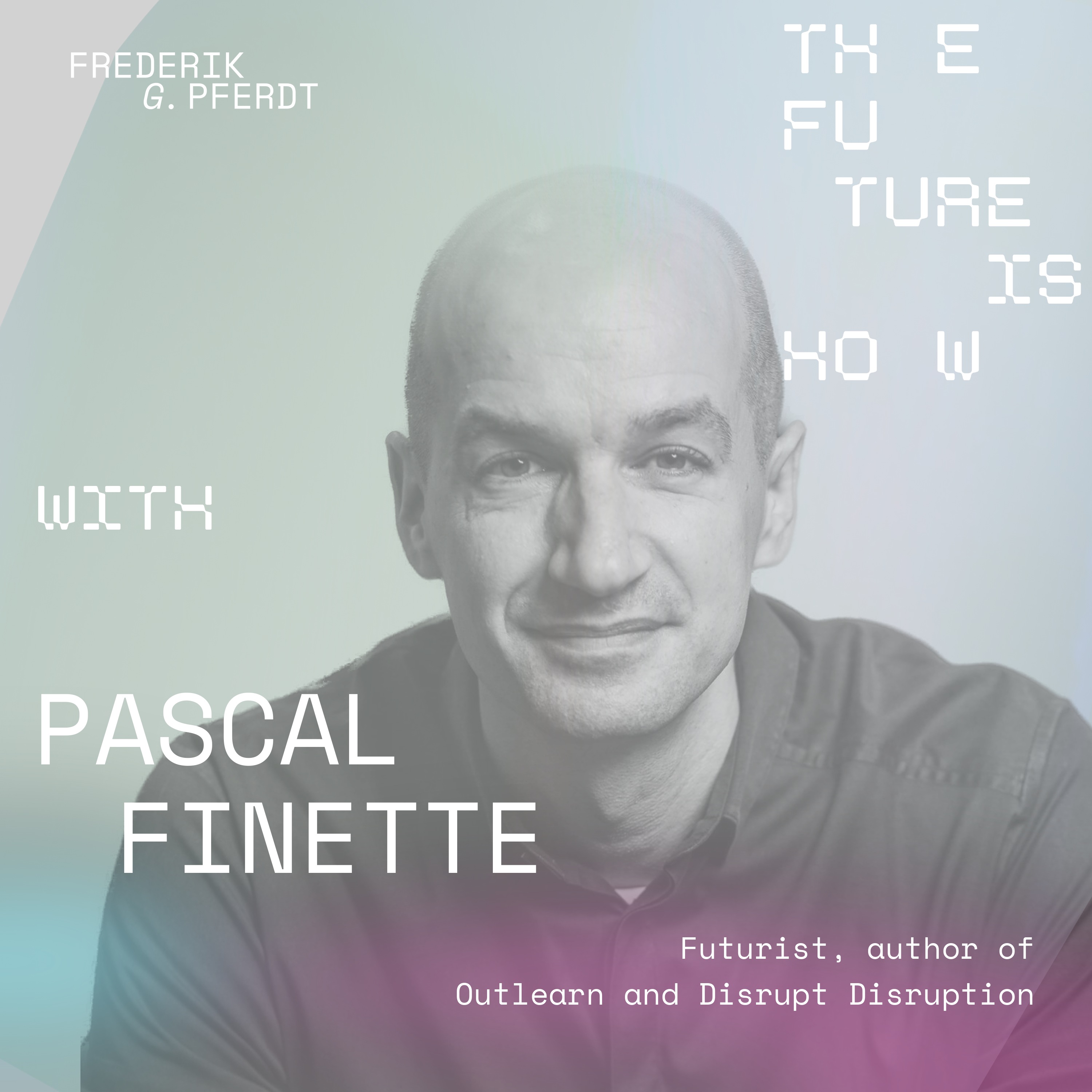


Every school on earth teaches a class on history. Almost none teach a class on the future. So this episode is one: a leadership class on the future. Lesson one: stop trying to guess the future, and start getting better at being wrong about it.
Pascal Finette is a futurist and co-founder of radical, where he helps leaders build organizations that get stronger under stress. He founded eBay's Platform Solutions Group in Europe, led Mozilla's Open Innovation Lab and was a Principal at Google.org. He is the author of Disrupt Disruption and his new book, Outlearn: The Art of Learning Faster Than the World Can Change. Frederik and Pascal first met ten years ago, in front of a room of 50 entrepreneurs at Google for Entrepreneurs.
If the world feels more uncertain every month and you are tired of pretending to know what comes next, this episode is for you. Pascal shows you why the future is plural, why your ability to learn is the one advantage that lasts, and why sometimes you have to go slow to go fast.
In this episode, you'll discover:
Why a life is about 960 months, and how Pascal decides where to spend the ones he has left
Why the future isn't one thing, and how seeing many futures gives you more options
How to live with uncertainty without burning out, and why it also brings opportunity
Why you ship your org chart, and what that means for leaders designing for AI
The core idea of Outlearn: the cheaper you make failing, the faster you learn
What an injury taught Pascal about going slow to go fast
Why climbing quiets his mind like nothing else
How to hold two opposing thoughts at once, the way a heretic does
You'll leave with two practices: count your months, and make failing cheap.
Chapters:
00:00 Coming up
00:58 A leadership class on the future
02:44 Pascal's future bio and the 960 months
04:52 What changed since the first room of 50 entrepreneurs
06:36 What Pascal does every morning
08:03 Make your assumptions small enough to test
10:37 The question every CEO is really asking
11:41 Why uncertainty means opportunity
13:05 The future is plural
16:01 Earning trust by saying "I don't know"
18:26 Handing leaders the chalk
21:59 The core theorem of Outlearn
24:04 Go slow to go fast
26:27 Why climbing quiets the mind
29:57 The chief heretic
33:25 Being called out, and why Pascal loves it
35:34 Giving everything to a room of three
37:25 Reimagining the classroom
40:07 Fast future round
41:28 Class dismissed
Connect with Pascal Finette:
radical: https://rdcl.is/pascal-finette/
Outlearn: https://rdcl.is/outlearn/
LinkedIn: https://www.linkedin.com/in/pfinette/
Two free gifts from Frederik:
Mindstate Moments: one small practice every morning. Takes two minutes. Changes the rest of your day. https://frederikgpferdt.link/join
Where to Start: 30 doors into the best of this podcast, matched to how you feel right now. https://www.frederikgpferdt.com/where-to-start
Watch the full episode on YouTube: https://youtu.be/eJsuTjk2R7o
Frederik: Every school on earth teaches a class on history. Every single one. Name me one that teaches a class on the future. You can't. So that's what today is. Not an interview, a leadership class on the future. Here's lesson one. Stop trying to guess the future. Start trying to get better at being wrong about it. Pascal calls himself a heretic for a reason. And today he tells you what that means for you and for all of us. So this is a class in session. Let's get into it. Ten years ago, Pascal and I stood in front of 50 entrepreneurs for an entire day. It was Google for Entrepreneurs. One room, no script, we could hide behind. We weren't there to hand them answers. We were there to take apart everything they assumed about the future and help them rebuild something truer by the time the sun went down. That was the first time when I met Pascal. And then came Singularity University, another room, another audience, same undercurrent. Different logos on the slide, same question underneath every single time. How do you build a person or an organization that doesn't just survive what's coming, but actually get stronger because of it? And here's who's picking it up with me. Pascal Finette. He didn't write a book about disruption, he wrote one about disrupting disruption. He's not asking you to learn faster. He built the operating system to Outlearn. That's the title of his latest book. And he's not the guy with the framework you forget by Monday. He's the one who spent 10 years telling rooms full of very smart people the thing they didn't want to hear and being right anyway. Ladies and gentlemen, Pascal Finette. Welcome.
Pascal Finette: Frederik, what an incredible opening. Thank you so much, my friend. I'm just really excited to be here with you today.
Frederik: Pascal, I'm not going to read your bio. Everyone can
Pascal Finette: Please don't.
Frederik: look up eBay, Mozilla, Google.org, Singularity University, and founder of Radical. That's all past tense. And you and I both know the past isn't where you live. So instead, tell us your future bio, not where you've been. Who are you building yourself into right now?
Pascal Finette: I love that question. and it's a really good one. I think it's a question we don't ask of ourselves often enough. so for me personally, and this is a little bit of inside baseball because Frederik and I had a wonderful conversation prior to this recording. For me, really, the answer to that question is the the remaining of a number which is 960. That number is very simple. It came out of a TV show I watched, where there's a a quote in that TV show where one of the protagonists realizes that the whole of your life is on average only 960 months. So 80 years, give or take, times 12 months gets you to 960. And then if you're in, my age bracket, so somewhere in your 50s. That 960 is not 960 anymore, it's 360. And 360 is less month I have left to live than average photos I take on a weekend when I'm out. So that really gave me pause. And so to answer your question of where am I going to be in the future, I am currently on a path which you, my friend, have embarked way prior to me and much smarter and much with much more intention. But Something I finally got around to, which is really becoming very conscious about where do I want to spend my time. And that will be essentially between my family, the great outdoors. as Frederik, I'm a huge climber. And then the other part, still working and supporting leaders in better anticipating the future and doing something about it. Because the thing which rubs me most is when people Just talk about the future, but don't do anything about the future. And I know that you and I have that in common as well.
Frederik: Wonderful. Thanks for sharing that. So let's go back into that room of 50 entrepreneurs. So what's changed in how you think about the future since that first room of 50 entrepreneurs?
Pascal Finette: Yeah, it's a good question. So I think first of all, the future has changed as it is continuously changing. when you and I did that session ten plus years ago, AI was not really on the table. people talked about machine learning and you and I worked at Google. So very clearly a a company which was deep in the world of machine learning, but like as everybody knows now, of course, the world has changed and the questions we questions we ask of this world has changed. I think the other thing which has changed is that Kevin Kelly recently wrote a a very thoughtful piece about uncertainty and the fact that we are now have become uncertain about our uncertainties itself. So the the the world we're living in has become increasingly uncertain, increasingly unstable, which requires also of us to navigate this world very differently. I think that's number two. And then number three is. Personally, if you would have asked me 10 years ago, I would have said a lot about when it comes to the future, I think we need to get better at understanding the future, at seeing possibilities, at becoming curious about it, and at perceiving this future. I've now come more to the insight that as important as all of that is, at the same time, you also need to build the capacity to probe the future, to send out these little tri tiny echolocation pings to understand in the darkness where the journey could go for you. And hence the reason why, I ended up writing this book on learning. But I think that's the the third big piece for me.
Frederik: You mentioned something interesting. you said It drives you a little bit crazy when people don't do anything about their future. So what is Pascal doing about his future every morning?
Pascal Finette: Yes. so two things. One is I 20 years ago or so, I on a whim and more as a practical joke, founded a productivity movement, and this is in air quotes, called GYSHIDO the get your stuff. Sorry. Hey, let's keep this chill children's friendly. so get your stuff done movement. And the idea is really about, and this is the first part which drives me bonkers when I see people talking about the future is too much talk, too little action. And again, one thing I took away from very first meeting, which was prior to us being in front of this room and you walking me through the design thinking work you've been doing and pioneering at Google, which is really about you have to do things to learn. we can rationally think about things, but you learn so much more when you do things. So I think the first thing for me in the morning is thinking about and then doing like what are the things I want to GYSHIDO today? and then the second one is just becoming, and this is a practice I've started, and I know you are again the grandmaster of this, just becoming really mindful about how do I actually want to spend this day? what does What does a good day look like for me before I started?
Frederik: So if you would share one one practice from GYSHIDO and I I think it's more than a project, it's actually a movement you started there,
Pascal Finette: Yeah.
Frederik: with a big community and and what would be one practice that you recommend that we all can do to really get our stuff done better, probably? Not just get
Pascal Finette: Yeah.
Frederik: it done, but get it done better.
Pascal Finette: Yeah, I think one of the things I find people get stuck on is we we operate in this world of conjecture. So we operate in this world of we assume things, we think things through, and we have an assumption. And then what we often tend to do, and this is I think the biggest problem I find, is that these conjectures are loaded with so much assumption that they become in itself so big that it feels really hard to test them. So very often when I speak to, for example, an entrepreneur or someone in the corporate world, but also in the in the personal life, people say, yeah, I want to do this, but and I've got an idea what it could be, but I don't know how to test this because it's so big. And one thing I really like doing is applying essentially like a version of the the Toyota, the five whys, really getting down to okay, so what is this assumption based on? what is the assumption of the assumption? And getting to the the the smallest possible denominator, which I then can test really quickly. So the the the main thing for me is coming down to what is it you actually want to test? What is the quickest and cheapest way to test that? And then do it. Test it. Call someone, send someone an email. I give you an example. When we wrote the last book, the original version of that book was this Magnus Opus. It's literally, I had this idea. I'm going to write this 600-page book. It's going to be amazing. And it's like all my collected wisdom, whatever. And then I had this moment of clarity where it's like, I should probably test this. And I literally called three of my friends who are CEOs and the classic audience for this book. And I said, Hey, I've got this idea. This is how it would look like. What do you think? And every single one to a T said the same thing to me. They Pascal, this is great. And I will buy the book, but I will not read it because I don't have time for 600 pages. And that got me to, my God. And ultimately it led to Outlearn is this tiny little book. It's 200 pages. You read it literally on a flight. It's super quick. It's super, super easily written. based on a simple three people phone call. And again, a lot of that I learned from you, my friend, in your, back in the day, in the Google days of the of design thinking.
Frederik: What are the main questions these CEOs have currently? And coming to you, As you're talking to many people around the world, in Latin America, in Asia, in Europe,
Pascal Finette: Mm-hmm.
Frederik: what are the the top questions that these CEOs currently have?
Pascal Finette: I think superficially they come from what does AI mean for my business? How do I get my organization ready for this new wave? how do I operate in a world of crazy geopolitics, et cetera? But really, when you start probing them a little bit, you realize that the underlying question is actually a much more fundamental one, which is how do I navigate uncertainty? How do I manage? Not just through uncertainty, because that would assume that there is certainty at the end, that there's an end to that journey. But rather, how do I stay in this without going crazy, insane, burnt out, anxious all the time? And also, how do as a practice, the beauty of uncertainty is that the upside of it is opportunity. An increasingly uncertain world is also a world which by definition has more opportunity. And
Frederik: Tell me more about that, yes.
Pascal Finette: So the question becomes like, how do you how do you remind yourself of that and how do you become aware of it? Well, the the assumption is very simple. So you look at a perfectly certain world, in a perfectly certain world, if you just look at a market, for example, interest rates are low. you you invest y your your return on investment by definition is low because it's perfectly certain, everybody knows the same thing, information flows, etc. So ultimately, if you live in a in a certain environment, which feels good, but is ultimately a it's to a certain extent you can make the argument it's actually boring, and you don't learn all that much anymore, but also your opportunity is much smaller. If you live in an uncertain environment, it's harder, no doubt. it costs you more energy, but at the same time, you also have the opportunities, you have the ability to create something out of nothing. And I think that's exciting. And it requires a little bit of a mental shift to be not just okay with it, but probably even embrace it.
Frederik: And so how would you work with a CEO then? as you, I think called yourself also a CEO whisperer, okay, maybe you've been called, called
Pascal Finette: I definitely did not call myself that, but yes.
Frederik: that. But what would you whisper into their ears, right? What is
Pascal Finette: What do I whisper today? Yeah.
Frederik: when you hear those questions that have a lot to do with uncertainty and finding an an answer, right? To
Pascal Finette: Mm-hmm.
Frederik: that that world that they're currently live in.
Pascal Finette: Yeah. I think there's a couple of pieces. One is around the individual. So just working with the individual, talking to the individual and basically getting them to embrace it, getting them to understand that future so in the in the futurist community there's this idea, this notion around what we call the official future. This very narrow band of a future we see, a singular version, a single vision for the future. And every company and many individuals have that. In the company case, it's called the five-year plan. It's your strategic plan. It lays out a vision for the future. But you need to understand that the further out you go into the future, the wider your band of possible futures will become. The more uncertainty you insert, the more optionality you insert. Hence, there's this interesting thing, which is in every single written language on this planet, at least to my best of my knowledge. Future is considered a singular. The future. You and I are both German, die Zukunft, which is ironic because the future isn't a thing. the future is not a singular thing, it's it's a multitude, right? It's it's plural. So it's it's not that you have a future, you've got futures. So the first thing I like to get these people to understand is to think more expansively about the future. once you start doing that, you get you see more optionality. If you see more optionality, you can actually do something. And then I think the second really big thing is, and that's a common concern for all of these people, is okay, so how do I get my organization to follow? How do I get the people I work with to understand this? And I think a lot of that has to do with not just the way you lead, but also the structures in which we operate. So one of the interesting things I've been mulling about recently quite a bit is There's this concept called Conway's Law. Conway's Law comes out of this the world of software originally, way back when. And what Conway observed is that a product is the manifestation of the ultimately the communication lines between the teams which have built their product. Or, in very simple terms, it's a little bit of a gross oversimplification, but you're you ship your org chart. So in software, it's very simple if you have, and you you and I remember this well from Google. You have a team which works on the front end, you've got a team which works on the back end. Your software will inevitably have a separated front end from a separated back end, and they will talk to each other through an API. And there is an interesting piece in there, which is, a hospital is a good example. you go to a hospital and the reason why you need to check in at the front desk and then you go there and then you go there is because that's how the org chart of the hospital looks like. So the the interesting thing is, as you're thinking about the future as a leader. As you're thinking about designing your organization for the future, very often they lead with product. They say, we need to put AI into our products, what have you, which is fine. But at the same time, you also need to think about what does the structure of the organization actually be to support that, to express what this product should be in the future. so that's another really big conversation we're having with people these days, particularly as AI is. Shifting so much.
Frederik: So let's get back into that classroom that
Pascal Finette: Mm-hmm.
Frederik: I mentioned in the beginning. And let's imagine that, a CEO is sitting in the last row, right? Trying to make sense of what Pascal is is conveying about the future and how the organization needs to be designed and the org chart, how that needs to be maybe reimagined. How do you earn the trust in that classroom? of those CEOs or the CEO sitting in the back row.
Pascal Finette: Yeah. I think Twofold. One is I have the luxury of of being able to tell people that I have done a lot of this work, which is an incredible privilege. sitting there and saying, yeah, I've seen this, I've done this. I think that's one. The other one is for me, really important is to make them understand that I don't have the answers. I I often have no clue about their business. I give you simple examples. if that CEO is the is the head of an automotive firm, I have no I can't even repair my own car. I don't I have no idea how car how the car industry works, how automotive works, how you build a factory, and so on. My point is, and I make this very clear to them. I literally tell them, I can't tell you anything about your business. What I can do is there's a few things I know, I hope I know at least. And I can provide them to you, and I can teach you how you use those things. And then my my my hope and my trust is that you can bring those things I brought to you together with all of the stuff you already know. And you find this intersection of where this makes sense and where it can actually bring something to you. And I find it interesting that. Apparently there's not that many people who admit they don't know, which by the way, I think is another thing we should learn. We should all learn as leaders. To be like, I don't know, that's fine. we can't. So I think that's an important bit. Like the and that's not a humblebrag . It's like it's it's important for me to for them to understand I will I will not and they cannot expect from me to tell them. I don't know what the future of automotive looks like or what their particular strategy should be to bring out an E V car. I don't know.
Frederik: But that's probably the the two qu the two questions they come into that classroom with, right? It's like tell me what my strategy should be and
Pascal Finette: Correct. Correct.
Frederik: tell me the future of my industry, right? Or show it to me. Absolutely, yeah. It's super lazy.
Pascal Finette: Yes. And I think that's lazy thinking, by the way.
Frederik: And I remember when I went to school way back in the times, the best teachers I had were handing me the chalk and inviting me to the chalkboard. And saying, Frederik, I give you an exercise and you're gonna draw something out, you're gonna create something in front of everyone,
Pascal Finette: Mm-hmm.
Frederik: Which was nerve-wracking. two things it did for me. The first one was that they trusted that I can do it. And the second one is they challenged me, to do something that I probably feel uncomfortable about, right? So what would be the exercise you gonna give to that CEO to invite him or her from the back row to come to the chalkboard, take that chalk and actually draw something out? What would be the exercise that you would give them?
Pascal Finette: first of all, I think those were also my favorite teachers in hindsight. Not in the moment. Yes, so in hindsight,
Frederik: Exactly. Good point, yes.
Pascal Finette: for sure. I to answer your question, I I think that so the first thing is it typically what I found is you probably don't want to put them in front of the classroom. I for the simple reason is you make them really uncomfortable, you put them It's you create the performance theater, et cetera. So I'd rather have that conversation with them in a in a one-on-one meeting or in a very safe environment where they feel like, these are my lieutenants, they know me, we can be, we can be honest and we can be vulnerable. And I I think for me, the the exercise really is, we have a lot of tools in our toolbox, specific exercises. But if you zoom out, it's about them basically grappling with one of the Tools or the concepts we gave them. So the the old adage of, you can fish for someone, you give them a fish, they can eat for a day, you can teach them to fish, and they they will never go hungry. Very similar to the way we approach our work, is I teach you a methodology, I teach you a tool. say, for example, something as simple as and this disruption mapping, where you look at what are the implications of the implication, it really allows you to see a much broader spectrum of what the impact of a particular change might be. So we give him this tool and then we say, okay, now let's apply it to your business. And the important bit for me is always One of the challenges I find is when you go to your average consulting firm, they hand you, you give them a question, they hand you the 80 slides, 200 slide, whatever PowerPoint, which you flip through, but very, very seldomly do I see actual insight coming out of this. Not because the report is bad, but you haven't lifted. You haven't actually put effort into it. And the learning science clearly shows us there's this Goldilocks thing where it's like you need to put a little bit, you need to struggle through it a little bit. So what we love to do is have them struggle a little bit with it. if only to teach them once what this tool actually really feels like, so that the next time they see it, and maybe someone else has executed for them, because clearly they don't have the time to do it all the time, which is fine, but they they have such a much more lived experience of what this thing actually is and what the insights are and where the insights come from and what is really important, et cetera. So think that's for me is the really important bit. you have to, as with everything in life, and I love your story about your teacher, this Goldilocks zone of it needs to challenge you. It can't be too challenging, right? If it's like if you just bang your head against the wall and you're like dis you just walk away from it. But it needs to be challenging because otherwise you don't learn anything.
Frederik: So in that classroom, you probably would hand out a copy of Disrupt Disruption or Outlearn your latest book. What page would you recommend the CEO goes to in the first couple of minutes and why? You don't have to name the exact page, but just the the chapter or the the insight.
Pascal Finette: my god, that is such a good question. Yeah. Yeah, totally. Yeah, totally. So if I take Outlearn, because this Disrupt Disruption is now four years old or so, which is still a good book, I think. It's just it had its moment. if I take Outlearn, in Outlearn is one core theorem. And the core theorem is is unbelievably simple on its surface, but if you start peeling the layers, you you understand why it's so important. And the core theorem is very simple. The core theorem says that your speed of learning is inversely proportional to the cost of failure. So, in very simple terms, it means you learn faster, the cheaper you make failing. And if you start to really understand this, and this and you you start locking this in, you start changing in very fundamental ways how you do your experimentation. and again, this goes back to a lot of the work I've seen you do is take a post-it. No, no, no. Don't open your computer and open Figma and take a freaking post-it, take a piece of paper, So which is all about how do you make it so cheap that I can try something and test it? And if I make it so cheap, it becomes fast by definition, and then it gets I can just incredibly fast. increase my rate of learning. And I think this that's I I very fundamentally believe that in this environment we're living in today, your durable competitive advantage is your ability to learn. Because everything else becomes commoditized, it changes, it it's like floats away, knowledge is gone. It's like AI knows more than I will ever know. Wikipedia knew more than I will ever know for the last 20 years already. So As this is all floating away, the advantage you still have is your ability to learn and learn fast.
Frederik: You just had an injury, And We all know that human beings are incredible. structures and they have incredible structures that when bones grow back or bones break, they grow back stronger at that exact point. So when you now recovering from that injury, right, what do you think is gonna be something that you take forward? Something that you've learned, while you were in these first moments or without injury after the recovery, and being in a state where sometimes we're just frustrated, right? That we are not able to walk like we walked back in the days, or that we, can can handle things that as we used to handle things. So, what are some of the things that you're learning while you're injured?
Pascal Finette: It's a really good question. I think the the biggest challenge for me in the recovery is the speed of recovery. And this has a lot to do with I'm just a very energetic person. I need to do a lot of things just to keep my brain occupied and my my body occupied. And there is this really interesting I had this really interesting moment, maybe about a week and a half into recovery. And my recovery is going phenomenally good and phenomenally fast. And yet still it felt like not quite fast enough for me. so I pushed a little bit on the on the physio protocol. it's like, let's do a little bit more. because that might speed it up. And of course, lo and behold, that's not the thing you should do. Because the next day I was sore and it's I went back basically two days. there's this old saying of go slow to go fast, which for me always for a long time essentially, I intellectually understood this, but I never felt it. And that day I was like, shit, okay, yeah, I feel it. I know, I I get it. I I I had it in my bones, going back to the the Goldilocks of learning. Yeah, sometimes you have to feel it. not just intellectually understand it. And I think that's the big for me is the big learning. It's like this is really interesting, we have this go, go, go, go, go. And that's fine, but at the same time, that's actually often not getting you to the outcome you want to get to. So there's this element of patience and slowing down and being okay with it, and just finding the right balance between you want to push a little bit, clearly, but also not too much.
Frederik: you also shared that you're a big climber, right? And I see photos of you in these free climbs and there's ice and I feel it's very courageous, right? Because I'm scared of heights. and so seeing someone climbing at that altitude and it's a pure joy, I have to say. So thanks for sharing that. what does it give to you when you're out in the mountain?
Pascal Finette: So I think two things. One is you're just surrounded and I know you're a big hiker. I've seen your incredible hiking photos with your buddies, doing these multi day outings. I and so you relate to the I just love the environment. being in the mountains is is just for me is divine. seeing I've seen multiple many many times i've seen in very remote parts of the of the of the mountains because you start out at 2 a.m in the morning you hike into the mountains and by the time you're at the base of your climb it's time when the the alpen glow comes so the sun comes up and it reflects on the the tips of the of the mountains and it's just truly spiritual for me that's number one the second one is No doubt there's a there's a piece around the the athletic part of it which I enjoy. But the most important part for me is when I climb, is it calms down my brain like nothing else I've ever done. And for me it's it's really a meditative state, a an ability for me where because my brain is like firing all the time. And I have a really hard time calming it down. And you will laugh about this. I tried clearly, I tried meditation and so on. And my my ability to meditate, and probably I'm just doing the wrong meditation at the wrong guides. Maybe I should work with you. But I I just can't. I sit there and I'm like, I go crazy. And what happens when I climb is probably because your amygdala screams at you, do not die. it's this rare moment where for Hours at a time, I cannot think about anything else but the next move. And there is such that it's such a such a joy for me and such a truly spiritual moment. I I just enjoy it. And then the the last part is climbing is this really intense relationship you have with a very small group of people, typically one other person. and it's just a really nice thing. you're on this. on this mountain, you trust your life to this person. And it's this really intense, beautiful relationship, which I also enjoy.
Frederik: How often do you get out into that divine environment?
Pascal Finette: I try to get out as much as I possibly can. Yeah. I'm out every weekend, if I can. and then, I we have this saying at the company where whenever a client, something doesn't work out with a client, which is great, every day I don't work, I go climbing.
Frederik: So you're you're already a great meditator. You're doing it every weekend.
Pascal Finette: That's fair.
Frederik: there is no wrong meditation because the right
Pascal Finette: Thank you.
Frederik: meditation is just being aware what goes on in your mind and in your body, right? And as you
Pascal Finette: Thank you.
Frederik: describe it beautifully, that the mind is rushing, always wants to go to the next step and always figures figures or wants to figure out what's ahead of you, right? that's one of the the best states you can get into, Just being fully aware of what's going on. you also call yourself the chief heretic, Tell us more, how did you come up with that and what does it actually mean on a what's today a wednesday a wednesday morning
Pascal Finette: Sure. So the the the heretic moniker comes from a blog I started writing, gosh, 20 years ago. when I was at Mozilla, the maker of the Firefox web browser, one of the pieces I was responsible for was our initiatives which related to startups. So working with founders, entrepreneurs, startups, etc., and helping them. And so I started this this essentially daily meditation blog. Not a meditation, but a a daily reflection, on things I just encountered with these founders, questions they went through and anything from how do you pitch better to how do you think about your finances to what have you. And I gave it the title The Heretic because I wanted it to be a little counter to the usual BS of or startups all great or whatever. the the this the Silicon Valley rosy glasses, piece where you and I both know better than a lot of people, Silicon Valley is a is a valley of carcasses. There's more dead carcasses than anything in that valley. And I think we need to talk about that. We need to give people an a much more honest perspective. So that blog became somewhat popular and And for me to The the the heretical heretical thing is to allow myself to take a opposing position. So a good example is like AI. I'm a I'm a big fan of AI, use it every day. It's like I think it's it's a great piece of technology. And at the same time, it's also, maybe a massive bubble. Maybe it's the biggest piece of crap on the planet. Maybe it's like destroying humanity. And the interesting thing for me is, and this goes to Scott Fitzgerald once said that the the true sign of of quote unquote genius is your ability to hold two opposing thoughts in your head at the same time and still function. And I think that's what I try to do with this heretical thinking is like I try to see where could I be wrong? What could be the what could be something I am missing, what could be a different perspective and try to hold those thoughts in my head at the same time. Because again it gives you I think it gives you a better overall sense of where's the world going, what's happening. and it makes you probably a more interesting person because you can argue both sides.
Frederik: And what gives you more energy, writing these pieces, or when you receive feedback about them? When someone reached out and say, hey Pascal,
Pascal Finette: Hm.
Frederik: that really helped me,
Pascal Finette: Hm.
Frederik: think through something, or holding those two opposing views maybe at the same time, what gives you more joy? the writing, the publishing, or the receiving feedback on it?
Pascal Finette: The the writing is fun because it allows you to take an idea and write it down and anyone who's listening, honestly, start a blog and just start writing. I know Frederik, you write a a really beautiful newsletter which I enjoy reading. I just that the act of writing, the sharpening of your thought to the the forcing yourself through this this process is really helpful. The thing which gives me most energy is honestly is talking about this. When I see someone who's like Has a different opinion. I love that. someone who's like challenging me on stuff. someone who's like, hey, have you thought about this? Have you I think you missed something here? the this, that I love when someone comes and basically you have this ability. And quite frankly, I love just talking about it. I think, email and whatever you is it's all great. But this ability to interactively with another human. In the ideal case over a cup of coffee in in the real world, it's just beautiful.
Frederik: And so where have you been challenged recently? And maybe
Pascal Finette: Yeah.
Frederik: maybe to to balance that off, where have you received a compliment? Or what was the piece about? So first challenged and second, where have you received a compliment?
Pascal Finette: Yeah, sure. I think people call me out on bullshit all the time, which is totally fine. which is great. I love it. without a doubt, I've I'm I'm a hundred percent sure I've been wrong wrong w many more times than I've been right in my life. in terms of making predictions or making comments or, whatever. recently I had someone this is really interesting. It's like And it I was really like I was really first taken aback, and then I was like, you know what, you're right. when we wrote Outlearn, I set up a little a mini authors community. And my initial idea of Outlearn was I'm going to publish chapter by chapter, and I get feedback from this community, and and we co-create. But then I got su into such a mode of writing that I I wrote this thing in two weeks like flat down. And didn't go to the community. And then someone in the community, rightfully so, called me out on it. And he was like, dude, that's not what I signed up for here. what are you doing? I thought we co-create, and now you're just giving us the the the finished manuscript. You're an idiot, And I was like, first I was like taking aback a little bit and was like, man, you got this whole thing for I I I didn't charge for anything, right? It's like, is this whatever. And then I was like, you know what? You're right. You're actually right. So I wrote a a nice email to the whole community and was like, hey, I'm sorry, you I know that I promised this and I didn't do it. so I love that. I love I love people standing up and saying something. and I, feedback as in terms of where people like the stuff is like it's not honestly, I find it nice and clearly it it strokes my ego and so on. but I'd rather have someone say, I loved it, and here's something else. They don't need to criticize us, right? But I love people who come to me and say, Hey Pascal, I read this thing from you. This is great. And it reminded me of this. Right? Because it allows me then to say, this is great. And I, I add something to the thing I just I just did.
Frederik: Yes. And it helps you to learn.
Pascal Finette: Yeah, hundred percent.
Frederik: And which you mentioned is the most important thing that we humans can can do. so what's a compliment you received recently? I know you've been avoiding that. But what's something
Pascal Finette: Yeah.
Frederik: where people say like Pascal, this was like this was just incredible. for something
Pascal Finette: I don't know.
Frederik: that you've done for someone, you've done with someone,
Pascal Finette: Sure.
Frederik: maybe how you showed up.
Pascal Finette: Sure. I think I don't know. I think when I'm as as and people probably can tell, I'm a I'm a fairly energetic person. And I I recently had this interesting interaction where and I'm sure you found yourself in a similar situation. So I was I was doing a keynote and then I was doing a workshop for a client at a a bigger event keynote went great and then I went into the workshop and because there were 15 other workshops going on at the same time, what ended up being was in my workshop there were three people. and I don't care. That's fine. I I as a matter of fact, it's awesome because now we can work even more intensively. Right. So I gave them a whole hour of full on Pascal energy and whatever. And a one of the participants, and this was very high level business leaders. One of the participants came afterwards and said, Hey, I just wanted to say, I'm really impressed by the fact that despite the fact that you're like you should be bummed out because there's only three people in your workshop, and you still gave it your all. And it was great. And it was like it's funny because I for me it was like it wasn't even a question, right? It was like, it's not just like I'm here to perform. I'm like, this is great. three people is awesome. So yeah. Maybe that. I think that was really sweet.
Frederik: That's a great compliment, even When not a lot of people show up, right, you give it your everything,
Pascal Finette: Yeah and yeah.
Frederik: And it matters that it just needs one person, right? That you give it everything, right?
Pascal Finette: Mm-hmm.
Frederik: And that is that is rare. So thanks Pascal for doing that, yes.
Pascal Finette: My pleasure. It was fun for me.
Frederik: So let's go back into that classroom where you teach a leadership class on the future. How would you reimagine that whole classroom, right?
Pascal Finette: Mm.
Frederik: What what is something that, and I consider yourself an educator too, right?
Pascal Finette: Mm-hmm.
Frederik: somebody who shares what they know but also helps other people to learn. how would that classroom look like? So give me that. environment, give me the tools, give me the interactions, so everything that makes a good classroom work. And you you hinted into one of the things that makes a good classroom for you is the outdoors, right? The environment that really speaks to you, right? That you find yourself in a different state of mind in. And so how would that classroom look like?
Pascal Finette: boy. this is like a my my wish list thing here. for me personally, so first of all, I I think environment matters, no doubt. you and I have surely spent way too much time in brown carpeted, windowless hotel conference centers. those should all be bombed and being like, just flattened to the ground. I just find like I find them so depressing every single time. Every single time. so for me it's like it's the exact opposite. So get people into an environment where they feel comfortable, comfortable chairs and sofas and they can walk around and there's light, there's plants, there's whatever. It could be in the outdoors, it can be indoors, I don't care. I think that's that's important. I think the second piece is actually much more around the how do you create an environment where people really feel comfortable? where people feel comfortable, feel safe to say what they want to say without, any any judgment, any repression of thought, etc. I think that's number two. And then number three for me really is around how do you get people to not do the Sage on stage thing. I I I get why we are doing it. And I get that in certain elements that's fine. And I get it. But really for me the question is how do you get people like how do you get a friend of mine runs a company and their head their their tagline is they they build these tools for events and the tagline is less talking heads and more heads talking.
Frederik: Beautiful. Yes.
Pascal Finette: And I this is brilliant. And that's exactly what we need, right? yes, of course, you and I and many other people who are educators and teachers and speakers and so on, we have something to give to them. But at the same time, the learning is not in me telling them. The learning is in them grappling with it, making it real, trying it out, getting it challenged by other people, et cetera. So how do we like the the question for me is always like, how do we get there?
Frederik: So I have a section here I call the fast future. usually I'm trying to promote slowness, right? And we talked about that. Sometimes
Pascal Finette: Yes.
Frederik: slowing down gets you to where you want to go faster, right?
Pascal Finette: Mm-hmm.
Frederik: But this is just a reminder that it's rapid fire, no overthinking, just whatever comes to your mind first. So one belief about the future you've completely reversed on. What was it? And why did you change thinking about it that way?
Pascal Finette: When I was at Singularity we had this belief that the future is exponential and there's an inevitability to it. And I think that's partially true, but largely not.
Frederik: The skill almost no one is practising today that everyone will need in ten years.
Pascal Finette: Even more curiosity.
Frederik: One word for the next decade.
Pascal Finette: crazy.
Frederik: If every leader adopted one practice tomorrow morning, what would you hand them?
Pascal Finette: Become curious about stuff which is not directly in your field of vision.
Frederik: And you talked about the three hundred and sixty months you have left, Pascal.
Pascal Finette: Yes.
Frederik: What's happening in that last month?
Pascal Finette: In my last month? Holy shit. Sorry. that's a really good that's a really good question. if I'm very, very lucky, I will still have my faculties. I will still be, healthy enough to be surrounded by my loved ones and will spend time with them in my my favorite environments, which is the mountains.
Frederik: Beautiful. So ten years, many different stages, one question, and today Pascal finally said the quiet part out loud. You don't get to choose whether the future surprises you. You only get to choose what kind of person it surprises. this week, pick one thing that maybe went wrong. Don't fix it yet. Just ask what made it you better at. Find the one heretic in your room, the person who says the thing no one asked for, and actually listen to them once before you argue back. Take the practice just gave you and do it once before tomorrow's sun goes down. Not someday tomorrow. Class dismissed. The future isn't something that happens to you, it's something you get stronger from on purpose. So see you next time. And if you enjoyed this show, please feel free to leave us a review, share it with your friends. This is Pascal Finette, and my name is Frederik.
Pascal Finette: That was beautiful, my friend.


