The Mind on Fire | OpenAI's Brice Challamel on Stewardship, Questions & What AI Asks of Us
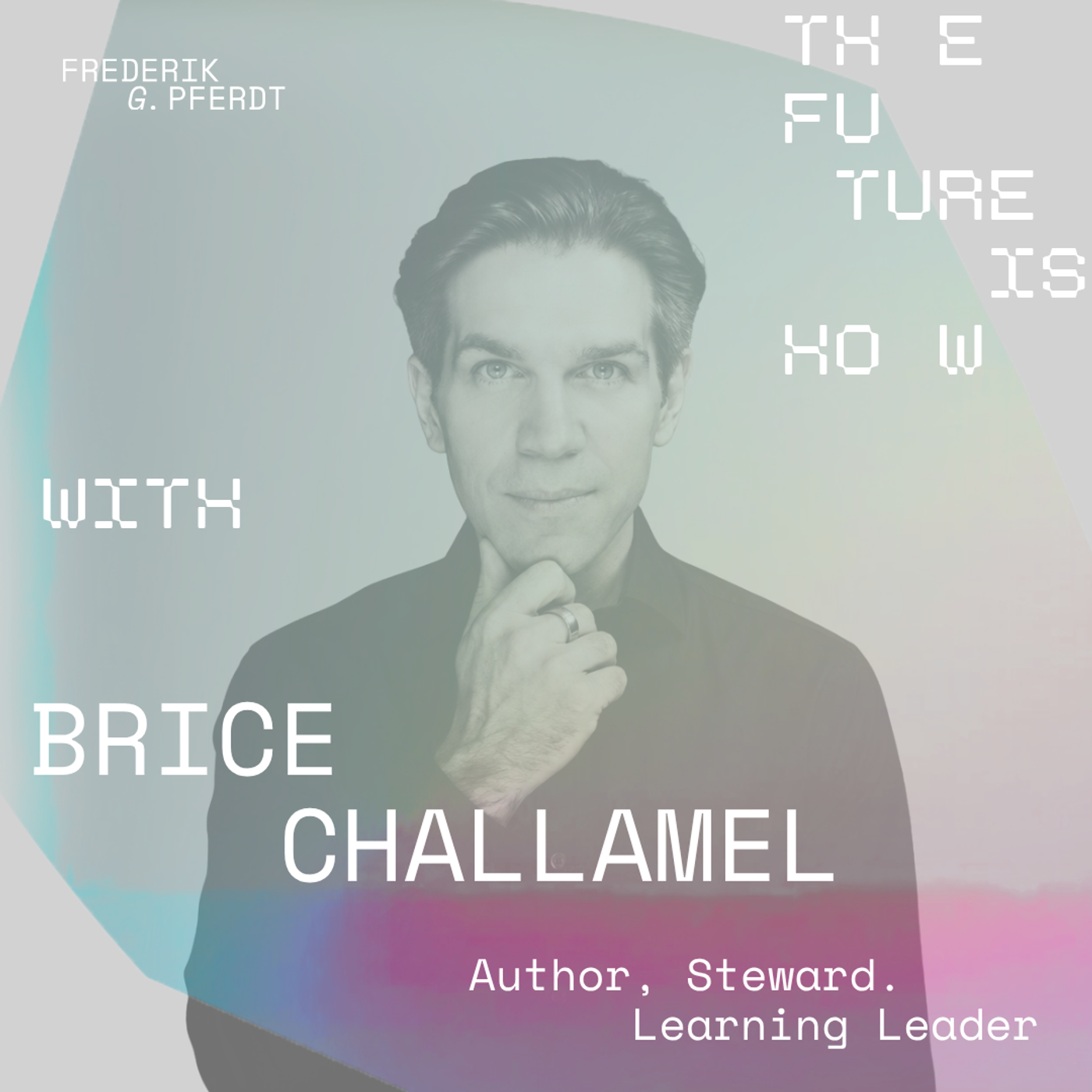


What's left of us when AI can generate the idea, write the memo, and build the prototype faster than we ever could? Brice Challamel, Head of AI Strategy and Adoption at OpenAI offers a surprising answer: we become stewards of our own intent. In this episode he shares why he doesn't ask AI for answers in the morning but for questions, how a movie-night app turned into a love letter to his family, why he has actually cried during AI conversations - and what makes us irreplaceably human.
Chapters
- 00:00 - What exactly am I for?
- 02:24 - 5 minutes, 22 seconds: how Brice built a pharma pitch in Codex
- 04:46 - "Coffee by any love" – the morning ritual
- 05:46 - The first thing he asks AI every day
- 09:30 - From knowledge worker to intelligence worker
- 11:34 - Why good AI should make you uncomfortable, and how AI turned movie night into a love letter
- 21:27 - "I made this" vs. "I meant this" – from author to steward
- 26:27 - The Joy of Missing Out vs. the Fear of Missing Out
- 28:33 - Imagining a future of thought-driven society
- 31:57 - Externalizing mental models with AI
- 33:44 - The role of emotions in AI interactions
- 38:16 - Practical experiments with AI engagement
More from Brice Challamel
- LinkedIn: linkedin.com/in/bricechallamel
- Power of Why: powerofwhy.ai
More from Frederik G. Pferdt
- Take the Awareness Test – How future-ready is your mindstate?
- 8-Day Foundation Course – Build your Future-ready Mindstate
- Ask Frederik – AI trained on 20 years of Frederik's work
- NEXTletter – One question, two perspectives, one experiment (bi-weekly, free)
- Live Events 2026 – See Frederik speak live
- The Future Is How Podcast – New episodes every two weeks
Frederik G. Pferdt: There is a question a lot of us are sitting with right now, if we haven't said it out If AI can generate the idea, write the memo, design the prototype, and faster than I ever could, what exactly am I for? And I've been sitting with that question for a while, â and I think it might be the most important question of our time. not because it's frightening, but because the answer is where something new begins. today's guest might be one of the few people alive who can help us find out. When I reached out to Bryce Challamel recently, first thing he said was that he was one of the biggest fans of the creativity and innovation team at Google. A small, quiet lab where we both spent time in that truly believed human creativity was worth developing. not just optimizing. And that message stopped me because Bryce is now head of AI strategy and adoption at OpenAI. He spent years at Moderna during the pandemic helping embed AI into an organization in a race against time where the stakes weren't efficiency, they were lives. he has been inside the machine at some of the most important moments of the last decade. And he still thinks what we were doing in that little lab matters. Today we find out why and what it means for you. Whoever you are, whatever you do, wherever you are in your relationship with AI right now. Bryce, welcome to the future is how.
Brice Challamel: Thank you so much, Frederik And I'm so glad and grateful to be with you. I have to say also for our audience that when I joined Google back in 2016, you were one of the first to welcome me, that on the onboarding for Google as a whole, your team had a session about the importance of design thinking and of renewing our perspective to the world. That was a mandatory part of everyone coming to the company. And that's how I even got to know you on day one. and that ever since have been enlightened and probably also deeply powered the last decade by the things that I started to learn on that day with you and that we're going to be discussing today.
Frederik G. Pferdt: Thanks so much, Brice It's an honor to have you on. And we anywhere big, I want to start somewhere small and real. So tell me your Friday morning and how it started today. Walk me through it and tell me what role, if any, AI played in it.
Brice Challamel: So today was very common day in my life. I by â meeting customers. And I meet them mostly at the leadership level. And in case, I'm preparing â a contribution to the team of a large pharma company that adopting â and OpenAI technology. And we were discussing how best to approach it. And there's really two options there that we're discussing. One of them is, would say, thought leadership and Q &A. And the other one is to leverage AI platform, in this case, Codex, and to get a little bit hands-on, could be also mouth-on, because more and more we speak to AI rather than type to AI. and to drive the conversation with AI intelligence by the side of those 60 leaders and myself. And we discussed the pros and cons with the team that is in charge of preparing that which happens at the end of May. And at end of it, they said that this was, you know, that they had to think about it, that this was a bold proposition that we were making to embed AI into the very fabric of that day with their leadership team. And that they wish I could put a few notes together for them to take back to the CEO of the company and discuss it with them. And what I did, because we had recorded the conversation, is I went straight to Codex, where I have an agent that does this and skills to that effect, which created an HTML page exactly to the request that they asked. From that HTML page, a beautiful PDF document with five pages that is fantastically well organized and gorgeous, but also very clear. in here is the situation, here are the stakes, here are the two options, here are the trade-offs, and here is the moment, component of your choice. And I just finalized this. think it took five minutes and 22 seconds. I remember it because â always something magical about seeing those moments. And I sent them this gorgeous document, which I could, of course, edit to their liking because it's made in code. And in a way, I realized when I sent it to them, that this was the essence of how I work. I work now constantly AI and with the coding part of AI, must say. And it is the topic that we address, but at the time, the way we work together. Because of course, I think they expected me to jot down notes, probably out of memory or out of the transcript and to write something. But I really have evolved from authorship to stewardship.
Frederik G. Pferdt: let me ask you, did the minutes before the meeting or the hours before the meeting start for you today?
Brice Challamel: you mean from the moment I woke up? â
Frederik G. Pferdt: Absolutely, yes.
Brice Challamel: You mean a typical morning in my life? First, am sometimes I say surrounded by beauty and love. I live my two children, with my wife we have two cats. They are kittens, they are one year old. So my day started surrounded by cats and children. And my wife used say, it's in but it works in English too. Would you bring me a coffee by chance? And I say, if I bring you a coffee, won't be of chance. It'll be out of love. And so it became coffee by any love. And so now when I wake up, the first thing that I do is I bring her a coffee by any love. â is the way we call them. â been going on for 18 years. my starts. I don't drink coffee myself ever. And so which makes it all the more a gesture of love that the first thing I do in my in my morning when I wake up.
Frederik G. Pferdt: Wonderful. Wonderful.
Brice Challamel: is I do something for the person that I love the most in the world. A coffee by Annie Love.
Frederik G. Pferdt: Wonderful. Thanks for sharing that. And what would be the first thing you ask AI or you type in AI? What would be the that you're most curious?
Brice Challamel: Yes? Yeah. It really depends on the day, but very often, the first thing that I ask AI is to ask me questions. We go back to the opening that you made about the fact that what is left for us when AI has the answers. â
Frederik G. Pferdt: most curious about like every morning probably, right? After you. â
Brice Challamel: If we take a step back, we are surrounded by people who have a lot of answers. My father, who passed away a year ago, was the type of man who had all the answers. And one day, my mother told me, you know, I asked, what do you think is the main difference between my father and I? And my mother said, your father has all the answers and you have all the questions. And I found this so striking and interesting. And so in a way,
Frederik G. Pferdt: interesting.
Brice Challamel: For a long part of my life, I've been surrounded with all the answers. that didn't stop me from thinking on my feet. And it made me somewhat much more curious in a way because I couldn't fight with all those answers. They were like the definitive answers, right? â so I'll give you a concrete example because that happened this morning too. I'm working right now on frameworks
Frederik G. Pferdt: Yes.
Brice Challamel: with organizations that want to onboard on AI and that are eager to find how open AI can help them. There are so many ways and in a way it's overwhelming for everyone because the past technology revolutions were very much within the same form factor. If you think of the evolution of photography, the transition from a digital photography, from an analog photography camera, is very seamless. If you take DSLRs, it's like the same shape, the same form. You just have sensors that are different. And even if you take the compact cameras that we had and other mobile phones, we have to relearn a lot. It's a very seamless transition for us. The form factor is the same. And even a step back, if you think of the transition from â typewriters computers, We had keyboards, we have keyboards, and it's the same keys at the same place. And they are at that place because of typewriters. reason why there's a QWERTY keyboard in English and an AZZERTY keyboard in French is to avoid the jamming. of the keys because they were typed too quickly. And used to have a page â top of the keyboard, and now we have a screen in front of the keyboard. But it's the same thing. We have just reproduced the form factor of the keyboard and the page with the keyboard and the screen. And so there's a long tradition of easing the process of transition for the user by simply continuing the form factor and injecting technology into it. And I have dozens of other examples like this one. In the case of AI, however, it's one of those transitions in which doesn't matter the form factor in the end. We need to profoundly rethink how we behave at the core. Instead, instance, browsing documents and reading them, we need to expect to be briefed on documents and what's in them. Instead of writing documents or we need to expect to manage AI teammates who write documents. They steal us, but there is a layer of abstraction both sides. And in this way, we're no longer exactly knowledge workers. We don't read knowledge and write knowledge. We receive intelligence briefings, and we produce intelligent instructions. We're intelligence workers. that transition from knowledge workers to intelligence workers, think, is one of the defining concepts of our lifetime. It is the delivery of the promise of computing and the internet bundled all together within direct voice conversation. It's pretty phenomenal. And even though the form factor evolves, our behavior has to completely change. And that's one of the parts that I find the most thrilling, because it's the first time. If I go back from this, how do we support companies? Because we are providing a technology. We're also providing a platform with a lot of tools and interfaces and components and connections to other platforms. But we're also a catalyst of change. And how we show up across the three components, technology provider, capability platforms, catalyst of change? is a decisive choice. And so because I was struggling with that question, I asked Codex to organize a 30-minute interview on those topics to propose to me the categories of the questions that we review the interview together and that then I would answer one question after the other. And I spent half an hour this morning answering 20 questions. one by one in seven categories on all the topics of the type of partnerships that I would dream to establish. And at the end of this, my mind was much sharper on what I really wanted to do. Regardless of whatever answer I come up or we come up with together, I had clarified a lot of my assumptions because the way that AI helped me and pressure tested my own mental model on this topic was irreplaceable in this case.
Frederik G. Pferdt: You said something very interesting that we grew up in a world that pretended to have all the answers, That's, think, how we got educated, Bryce, when you went to school, when I went to school, I think we thought that there's all the answers out there, It's in a book, it's in the teachers, it's somewhere, Now we're living in a world where we probably more questions than answers, And I think that's a more honest approach to â the world that we live in actually functions. And you also said something that I take away to tomorrow morning. And that is that asking AI to you questions. first thing in the morning can be that spark of curiosity, Where you're not looking for an answer, but you're looking for a better question that, as you said, sharpens your mind, sharpens your thinking, helps you to explore â answers, ways of thinking about something, I love that. So thanks for sharing that. â
Brice Challamel: And I have to say, questions, I just want to add one thing, is that those questions always make me feel a little bit uncomfortable in the good way. I'm like, â wow, that's a great question. I'm not prepared to answer that question. Let me take a step back and think on that question. And I always feel at the edge of what I can actually answer to. Because most people that I know have kind of... made an image of myself in their minds and asked me the questions that they think I can answer. And most often, they're right. But AI doesn't have that kind of preconception. So it asks me the question that needs to be answered, whether I can or can't. And there's something pretty thrilling about the way that AI interviews you, because it's a very, very good interviewer. Makes you uncomfortably at the edge of your comfort zone, right?
Frederik G. Pferdt: I love that. Yes. Yes, what would be an example of such an uncomfortable question recently you got asked by AI?
Brice Challamel: of them is... So I was working on movie night recommendations. When are we going to watch the movie with my family? I the AI to ask me questions about our habits, about the movies we like, we don't like, and so on. And the AI went into a series of questions about why do we watch movies? With whom do we watch them? What happens when someone feels isolated and it's not their choice because we're a family of four? what are the geometries of the family that work with movies? If I work with movie with my wife without the children, with my son without the girls, with my daughter without my wife and son, what kind of movies are those? And the further we went with those questions, the further I realized that I was just starting, â I usually do, the ask me questions to just prepare a little bit of... I wanted to write a small app that kind of remembers what we've seen and proposes always the best, freshest movie at any given time. And I found myself into the fabric of relationship at my home between the four of us. Just out of this, you see what I'm saying? â And of course, and of course, that the choice of a movie is not only not small and trivial topic, but it's actually a profound.
Frederik G. Pferdt: Wonderful.
Brice Challamel: marker of how we relate to one another in my household and an expression of love. Because if someone says, OK, I don't like that side of movie, but I will I will be there with three of you because this is a consensus. It's a little sacrifice and act of love because we don't all like the same types of movies. And this is typical of the journey because every little trivial act daily life. If you take it with An additional moment of intelligence and questioning suddenly becomes a moment when you have to reveal to the surface things that you've not really considered Even movie night is actually a profoundly emotional, psychological, and relational topic.
Frederik G. Pferdt: Amazing, yes. And I see you maybe next time when you deliver your first coffee to your wife, And you get question that surprises you, that â is making you a little bit more uncomfortable. You take it to the coffee machine again and prepare the second coffee and some time to think about that, Which I think is â a beautiful segue into what I wanna talk about next. And you said something that genuinely stopped me when I first read it. You said there no more individual contributors, that everyone, whatever they know, is already leading a team. So tell me what you mean by that, because I think most people listening right now think of themselves as solo, Responsible for their own work, their own output. What do you see that they don't?
Brice Challamel: So first, I want to do two caveats before I dive into the topic. The first one is that when I say everyone, I mean person who has the huge privilege to live in a developed economy and have access to a computing device and to an AI model, which a minority of mankind. And I want us to never... ignore and dismiss the fact that there is majority of mankind who doesn't have access. â â ability for to have access has to stay on top of our thoughts all the time. â The of OpenAI is to make AI beneficial for mankind, and we really mean it. So â we thinking all the time about how do we make AI accessible â to who don't have connectivity.
Frederik G. Pferdt: Thanks for sharing that.
Brice Challamel: who don't have smartphones, who maybe don't even have electricity. â we make this a offering for the whole of the human population than just â the privileged people who have access to this? And at the moment, everyone means everyone like you and I. And probably everyone listening to this podcast. Because if you're listening to this, you are among the happy few privileged people who have connectivity, electricity, and the goodness of the world. The second caveat I want to bring here is that you mentioned in that question the sense of ownership. And that sense is still completely ours. I don't mean by saying that we all have teammates that we're not in charge anymore. We just have more support than we used to. But in this way, I think of us more like the, if you would, the CEO of a small startup. that is made of AI components, but we are the CEO. And at the end of the day, we make the decisions. And those decisions are ours. And if they go right or if they go wrong, it's on us. with those two caveats, let's dive into the topic. AI â not one thing. It is least four things that we can â in good intelligence and be the architect of how we use them. The first is assistance. So what I did this morning when I wrote that beautiful five-pager, which was an HTML site and then a PDF, it was an extraordinary act of assistance, right? Instead of... taking my notes, writing what I remembered, and then trying to put it into good form and shape. AI was an assistant to me, did note taking, did the document production. I could just send it, and that's as good as it gets. The second is expertise. And certainly, there's a little bit of expertise that went into this document. But I can ask AI about almost anything at this point and get some level of expertise, technical expertise. I can ask about astronomy, about biology, about sciences. I ask about statistics, about social behavior. And one of daily habits is when I have â time in my car, when I commute, I go somewhere. I pick any topic that comes to my mind, and I launch AI conversation. And I just engage with the topic with AI voice to voice instead of to a podcast or to music. â And I just dive into the experience, like having an infinite encyclopedia and opening a page random. And I ask the strangest questions and have a fascination for all the way always lead somewhere. Where do all the languages come from? And why did they separate in branches? And what does the difference between? Eastern languages and Western languages say about the way our civilizations want and then you're in for 20 minutes of conversation. So that's expertise. The third is coaching and mentoring. AI should not be taken as a psychologist, which it's not, much less as a therapist, which is absolutely not. But within the boundaries of a healthy situation, asking AI, how do you think I should go about to position myself for a job that I dream to have?
Frederik G. Pferdt: Yeah.
Brice Challamel: or based on the transcript of that conversation, of that meeting that I had yesterday, how did I show up? And how could I maybe show up better and have better skills and presence to really deliver my message? Because I felt that I was a little bit off in that meeting, and please guide me. And most often, you are going to get very useful feedback and guidance. It's one voice out of many. You should not restrict it to just the AI. It's also useful to go meet with the humans who can help you. But certainly, it's a useful voice. And the fourth is the creative partner, something that you and I truly cherish. AI is fantastic ideation partner, never tired of yes anding any idea that we come up with. It's going say yes and something. And yes and something that... who never crossed the mind of another human. I'll give you an example. I was working on biases recently. I doing this really traditional thing about the â old judge. You you say, â draw image of â a judge, and you almost always have an old white man with a beard, with a hammer, with an American flag, and there's so many biases in there. And I spot. five or six biases in that image that immediately jumped to my mind. It's a man, he's old, there's an American flag. There's a lot there that was not in my question and that goes straight into the answer. But then there's a list that goes beyond of like 15 or 20. And one of the points of AI was, huh, it's a human. And it didn't even cross my mind to question the fact that when I asked for a wise judge, why would it be a human? It's a typical thing of AI to highlight that the bias is a difference to human. That a wise judge could be a god, could be digital, could be like so many other things that are human. And I just found it funny when I was reading the end of the list. there's something there also about the creative designer. And so when we see those four. know, person as of sorts, the assistant, the expert, the coach, the creative. Then we're a team of five because we are still there. We are, we matter a lot. We are the orchestrator and we are the decision maker. We are the owner. But now we can play any combination of those four in ourselves and start to really have a panel of advisors and of contributors because they can produce assets, all of them. that work with us on any given topic. And the truth is, if you have a great assistant, a great universal expert, a fantastic mentor, and an unstoppable, imaginative, creative partner, your mind is on fire. And this is to be the first time that I'm going to start to touch about the topic that you opened with. AI is the human mind on fire. It is not something of loss. It is something of extreme gain.
Frederik G. Pferdt: Beautiful. You described a shift recently from author to steward. And I find that one, one of the most quietly radical â I've encountered in a long time. Because says, â made Stewardship says different. So what does a steward actually do?
Brice Challamel: Other ship means I made this. Store ship means I meant this.
Frederik G. Pferdt: meant this.
Brice Challamel: I meant this. This is the expression of my intent. It doesn't matter. I've worked a lot. back in the days, and you would find it, you would look for it, I published a book, which is in French. You'll never know how bad it was, but I did this â a of cards in the book. were 36 cards. It was a book about personas to stimulate your imagination. And there were 36 illustrated cards. I didn't do the illustrations. I don't have that skill set, not at that level, not at that speed, not at that level of professionalism. I love to draw, but not like this. But I had an idea of the characters I wanted, and I designed the personas, and I drafted questions and slogans and And I started briefing the illustrator on how I imagined the illustration to go, right? And the illustrator finalized some extraordinarily beautiful of the person as. And it was with iterations. They would first do this with a pencil. Then I would agree to this. And we would put some color shades and things like this. And we'd say, OK. And then we'd go into the last form. So I didn't do this. Even though the cards are in the book and the authorship still is mine, by the way, right? It's a type of contract that is called share authorship in which you describe who meant the thing and who executed it. And the property belongs to who meant it. And you have to describe exactly what you said. But you cannot completely alienate the person who executed from the rights of it. a subtle negotiation there. And back there. 30 years later, to my first love of doing. illustrated cards for imaginative purposes. Working with an illustrator, I met the game, the design, the book, the method, but they helped me a lot to get it through the finish line. And they accomplished a lot of amazing work of art in the process of this. And so today, I delegate in part still to other humans and in part still to other AIs. And I try to find the right combination of both. always a decision, even what combination of both you're going to get. But as a steward and as a manager, I'm mean for something to happen, and then I negotiate with the world how it's going to take shape.
Frederik G. Pferdt: lot of people still wonder how to use AI better. They're looking for the answer, like, how can I use better in my work, in my private life, in my relationship, â whatever that means. I think we need to ask a different and that is, â who do we need to become as human beings? Do you an answer for that?
Brice Challamel: My hypothesis here is that we need to become who we've always been. that because this is not new to us. Like we have a blessing with the humans, which is we have infinite adaptability. We are not born fully baked. Actually, when we are born, we are very fragile. you take the example of â a A phone can just be born and then get up on their legs and then run. no human can do this. We born very premature. We don't have a lot of instinct. We don't have a lot of skills. â If we don't meet someone who teaches us how to speak by the age of eight or 10, we won't be able to anymore. There's a moment in time when we can acquire speech and after which that capability is just gone for us. And so... â In this, in so many different ways, we are empty vessels. who are willing to, ready to take any C. And we've taken so many different Cs. And this is our relationship to technology, right? We've adapted to printing, we've adapted to industry, we've adapted to urban life, we've adapted to computing, we've adapted to electricity, we've adapted to the radio. Think of the radio. How crazy is this? 100, 150 years ago, someone starts to speak in your living room. And then if you change channel, someone else speaks in your living room and then another person, â can't listen to all of them. So there's always going to be something you didn't hear and you're going to be deprived of a lot of knowledge because there's like 20 people speaking at the same time into everyone's living rooms except yours and our mind had to adjust to this tremendously and this is a long time ago compared to well a short time ago in the history of mankind but a long time ago compared to our own lifespan.
Frederik G. Pferdt: Yeah, that's probably where FOMO was born,
Brice Challamel: That's exactly right, because at the time, an educated person could read every newspaper, but suddenly they couldn't listen to every radio channel. And so the notion, which was of course was always very deceptive, that they could understand everything and know everything, was materially impossible. You had to accept that you were going to miss out, and then this is when you would have, if you're lucky, the joy of missing out. Jomo. Because the more you're missing out, the more intentional you've been about what you are capturing, what you are doing, the more choices you are making, and what an extraordinary chance for us to not have just one radio station that we have to listen, that everyone feeds on, but to have the choice of 20 and to the joy of missing out on 19 because that one, the 20, is the one we like to be on. Right? The joy of missing out. Like with you, I have the joy of missing out on everything else the world has to offer because, wow, I'm with Frederik Pferdt and we're having this conversation. And this has accelerated since, but I think our ability to constantly reinvent ourselves, to constantly find new ways to leverage technology and elevate ourselves and rethink who we are. going to keep being exhilarating. I'm actually, I am part of the people who think that there is no â evolution that will ever threaten us as humans, ever. That as long as we love to explore and sample the experience that is life, as long as we have problems to solve, as long as we have loved ones to please, as long as we make coffees by any love. There will be something for us to experience and to enjoy, right? And the more technology, the better. And this, comes with downsides, with impact on environment. Sometimes the transition between the old world and the new world is a bit too slow, and then we fall the cracks. Sometimes our children are exposed too early to technology that is not meant for them. and there are things that shouldn't be happening. So I am conscious of all those limitations, what I'm saying. But profoundly, think as long as are driven by the motivation of of helping other people, of making a good contribution on this earth, we will find that technology serves us.
Frederik G. Pferdt: Beautiful.
Brice Challamel: factor? Does that answer your â question?
Frederik G. Pferdt: than that, yes. And continue on that thread â the radio metaphor that you just the fear of missing out, but also the joy missing out. And I think the radio was invented 1890. And, you know, back then, I think people were, as you said, to one channel, And then as second channel, the third channel, and like 20 channels appear, People were... giving a choice, to choose what they're listening to. And just fast forward to today, where everyone â can be their own radio channel, And, giving people, inside view of what they're thinking, how they're thinking, what they're working on, what they're contributing to the world and so forth, but also share opinions, to be honest, I think that's a very different world that we are now living in. And I think you're absolutely right. People adapted. And people probably not ready in the 1890s to all have their own radio channels. But now I think we are ready towards that. But let's look into the future. What can we imagine? And maybe we draw one of your 36 imagination cards. What can we imagine not a lot of people can see right now where this is gonna lead to, So take us into your mind and how you predict the future, not kind of like do some foresight here, but like really imagine â what's the world that you want to in, â That you wanna build for your children. for your wife, for your friends, for the people that are living on this planet.
Brice Challamel: So one of the things that I think about these days I want to exactly continue the thread that you're on because it's exactly where I am also. So â go from an environment in which first very few people have a work related to their thoughts. We a few minutes ago about the privilege to be living in this day and age and in the Western world. It is the first time in the history of mankind. that autonomous has more people that live from their thoughts than live from their hands. It's never happened before and it doesn't happen elsewhere. Suddenly, we're inventing societies where thinking is the main line of work, which when you just pull and take a step back is extraordinary. And â Then we start to feed that thought process that is emerging in Western societies with a lot of input, radio, the television, the internet, an exponential curve of input that constantly feeds the way people think. But the one thing that has not been externalized yet is how are those input processes in our mind and what are the inner workings? that transform them into the output of our opinions, of our decisions, of our expressions, of our behaviors in all sorts of situations. And I don't know that we are faring very well as a society. There are lot of unhappy people, there are a lot of lonely people, there are a lot of radicalized people. And not that I don't think you shouldn't be, there are a of reasons to be, but I feel their angst, I feel their anger, I see it all the time. And we have ways to monitor this that tell us that it's more than it's ever been. And I think and hope that AI gives us a chance to externalize our mental models to question them. When we go towards code, I started with code. And code is a bit frightening, but it's going to be something that's just going to be there at our fingertips, where we can say, create a small application that does this, that does that. And then the AI is going to create code for us. When we do this, we need to explain how what enters the app has to be processed to get out of the app. if it's for meal planning, even if it's for simple things of everyday life, for preparing the movie night. you have to take a step back and think about what it meant to make a decision for the movie or to prepare for the meal or to â organize a meeting or to make a decision for your health or for, know, if you are someone who a dependent, an elder person a friend or child who is dependent on you. And now we have to externalize our mental model. But it's an extraordinary chance, because suddenly we can put it out there and take a look at it. We can put the entire machinery of our mind and how it's currently working on the screen, on the paper, on the page in the conversation, and take a look at it and think, â that's the way I'm thinking about this right now. What if I toggle off that assumption? What if I use that glider to push a little bit more towards that kind of opinion that I've had in the past but I've never completely explored? And hope the ability of AI to run â and â and increment way think about the world in those societies that have more thinkers than doers is a chance for us to start doing the real work of society, which is to challenge, improve, and share our mental models. as an externality, not as an internality, but as something that is inside of me and that I can't express, but something that is certainly outside of me and I can show to you and we can work on together. And I take the very simple examples that I just shared about movie night or meal planning, the option to say this is how we decide how we make the meal, then suddenly my children have a chance to say hold on, wish to put one more factor in how you decide. There's this or that, that is dear to me. And then suddenly we're smarter together. â very â way that we are intelligent together starts to enhance and to get better. â Now you take that and you put it into trials. You take that and you put it into manufacturing for automotive, into â healthcare processes for elderly people. into the platforms of entertainment that we use for video games or for 3D animations or for narrative entertainment. And then we have a real conversation. How are ideas crafted, Our songs and our dances and our movies. How are meals done? How are healthcare journeys decided? We have not had that discussion and it's hard for us to be on top of them, but with AI we can. So that's the world that I hope. I'm already seeing this in a lot of different dimensions at work, at home. I'm starting to see this emerge. I know that this will not be the daily life of everyone as of tomorrow, but I think as a society, we're going to more and more be able to transfer things that were always to the effect of hidden internal skills and tastes and capabilities into a platform of intelligence that we can share and discuss with others.
Frederik G. Pferdt: What's the role of feelings in that? Because when you describe that, you know, now more people are using their mind to do the work instead of their hands, And I think we saw in the past that machines could help us do the work on the field that we did with our hands and our feet â better, And had machines supporting us. â Now we had age where our machines help us to think better, is the next edge feelings, And how emotions â are, know, processed, â worked expressed and so forth.
Brice Challamel: Yeah, I love this question because one hand, our emotions drive the intent to begin with. Why are we doing something? Why would we wake up and do a coffee by any love? It's emotion topic. And then they drive our perception of what is right or wrong. Why would my children ask for another way to prepare the meals? â It's to them. It's not just rational. â And why do we...
Frederik G. Pferdt: Absolutely.
Brice Challamel: Yeah, why then we prefer a solution than another? It's almost an aesthetic judgment. It's a matter of almost culture and taste. And while all this is happening and our emotions are channeled towards intention, towards contribution, and towards expression of the artistic finality of what we do, they are also, I think, given a chance to be better and for us. â to remain in control of them and not the other way around because instead of being abruptly thrown into social media with super abrasive topic that are thrown in our face by troll farms, we get to have some Socratic companionship through AI that is an assistant and expert to culture creative. And that helps us take a step back, reflect, document, understand. And I feel that the type of emotion that I have when I work with AI, and I still have a lot, they are much more pleasant and conducive to good experience for me than the type of emotions that I have when I'm on X, for me to use Twitter, or on Meta, for me to use Facebook, or any of those platforms, which always drew me to the edge of my seat emotionally, right, in so many different ways. And I find that the interaction an AI augmented environment, even with my colleagues my loved ones and my friends, suddenly the become the sails of my boat and not the storm on my boat. Suddenly, â they are that even though it's extraordinary and impressive and beautiful, it is in the service of the motion that I'm in and not something that is just shattering me. And so I hope that we find increasingly better place with our emotions. These such early days. We'll see how that plays out. But I with you that emotions are important and the way translate into perception and judgment. And I find also, I don't know what you think, but that the way that our emotions play out in the relationship with in the majority of cases, can be channeled to a better extent and is more soothing than what it used to be when we were in a digital environment.
Frederik G. Pferdt: Absolutely. Yes. So we were moving from working machines to thinking machines to feeling machines, maybe, â working intelligence to...
Brice Challamel: I don't that they feel, but they understand the language of feelings. And so they are great listeners. We'll come back to using AI to ask you The you're to answer those questions. Has it ever happened to you, Frederik, to cry in an AI conversation?
Frederik G. Pferdt: I think I was at the edge many feeling something that I haven't felt before, I would say, By mirroring something to me â I haven't looked at before in that way went deeper than I â expected, So I on the edge, I would say, many, â times. crying when I engage with many AIs I have a very good relationship with. â
Brice Challamel: have the exact same experience. I have been moved more often than I care to admit by an AI conversation. And I have found myself crying a number of times about the realization, the profound realization of things that I was suddenly able to surface within the conversation with AI on â that were difficult for me to express to begin with, but that it would have been hard for me to discuss with another human. but was easy for me to discuss with AI and sometimes just started from a very simple conversation and came to a very moving place. And in this way, the AI has no feelings. just acknowledge this once and for all. It doesn't feel anything. But it understands the language of emotions, and it is able to help us deal with our own emotions to the point that sometimes they are very profoundly emotional conversations.
Frederik G. Pferdt: So I want to make this conversation land somewhere practical because I think the most dangerous thing that can happen after conversations like this that I very much enjoy and I think it's wonderful. So thank you so much, Bryce. So the most dangerous thing that can happen after a conversation like this is that someone listens, feels something, and then opens their laptop and does exactly what they were doing before. So if someone is listening right now on a run,
Brice Challamel: Of course, thank you. Yes.
Frederik G. Pferdt: in their car, dishes or petting their dog or whatever they do. â And feel something shifting in how they think about themselves and AI. What's the one experiment you would give them? Something small, something they can try before next Friday. Shouldn't be a tool, not a framework, an experiment.
Brice Challamel: Yeah, so let's stick with exactly what we've been discussing, because I think that we'll seal perfectly this conversation. soon as this podcast is finished and you're done with it, I want to speak to you, the listener. On the next topic that comes to your mind, instead of asking AI for an answer, ask AI for a question. That simple thing. Whether it is, â the relationship with your dog or the decision at work, philosophical topic. We been trained for decades to perceive, I would say, an open command line like the Google search bar or the Amazon search bar as a way to ask something and get an answer. But the truth is we can also go to it and ask a question, like for a question, right? And so would propose this simple experiment â any topic, even a small trivial topic, ask â AI to you one question or maybe even three questions. Say, hey, ask me three questions on this topic. Whichever questions you think are going to help me think about this in a clearer, better, smarter way. wait for you find out where that leads you because it will lead you in a new territory and you'll probably be grateful for it.
Frederik G. Pferdt: I that. Thanks for sharing that, Bryce. I want to close with something I do with every guest, but I've never done it with someone who has sat where you've sat. Five questions, one breath between each, no preparation, no perfect answer, just what's true for you right now. Ready? What about AI actually frightens you? Not a risk to manage, but something you feel in your body.
Brice Challamel: It's Yeah. how deeply it can understand us.
Frederik G. Pferdt: What would the 10 year old version of you think is most beautiful about the world where we're building?
Brice Challamel: infinite possibilities.
Frederik G. Pferdt: What's the question you're carrying right now that no one in AI is helping you answer?
Brice Challamel: What is the next move?
Frederik G. Pferdt: One capacity, not a tool, not a skill, something interior. You'd give every person to carry them through the next 10 years. What is it?
Brice Challamel: empathy.
Frederik G. Pferdt: finishing this sentence, the future I'm working to make real is.
Brice Challamel: of a world shared and love that respects and elevates the human condition for all of us.
Frederik G. Pferdt: beautiful. Bryce, thank you so much for the honesty for sitting in those uncomfortable questions â and for carrying something forward from that little lab that the world right now more than ever. If something in this conversation shifted something in you, even just a little, I want you to do one thing before you close this episode. Send it to one person. Not because it's a great podcast, but because someone in your life is sitting with the same questions you started this episode with. What exactly am I for in a world where AI can do so much? And they haven't found the words for it yet. Maybe this conversation gives them those words. how ideas that matter travel, not through algorithms, through one human choosing another human and saying, I thought of you when I heard this. â And if today helped you see the future a little differently, if you're walking away with a new word, a new question, or even just a little more curiosity about what you are becoming, then this show did what it exists to do. The future is not something that happens to us, it's something we built from within. And it starts with conversations like this one and the person you shared with next. You'll find Bryce on LinkedIn. You find him everywhere. He writes a newsletter. He shares his thoughts online. And if you're new here, welcome. Every other Friday, a new conversation drops. In between, the next letter arrives, one question, two perspectives, one experiment. And you can find it. typing in Next Letter into your favorite AI search engine or wherever you find your information. It's free and always will be. Until next time, from within, I'm Frederik


