What If Everything Works Out? How to Turn Up your Inside Volume | Dushka Zapata + Dan Roam
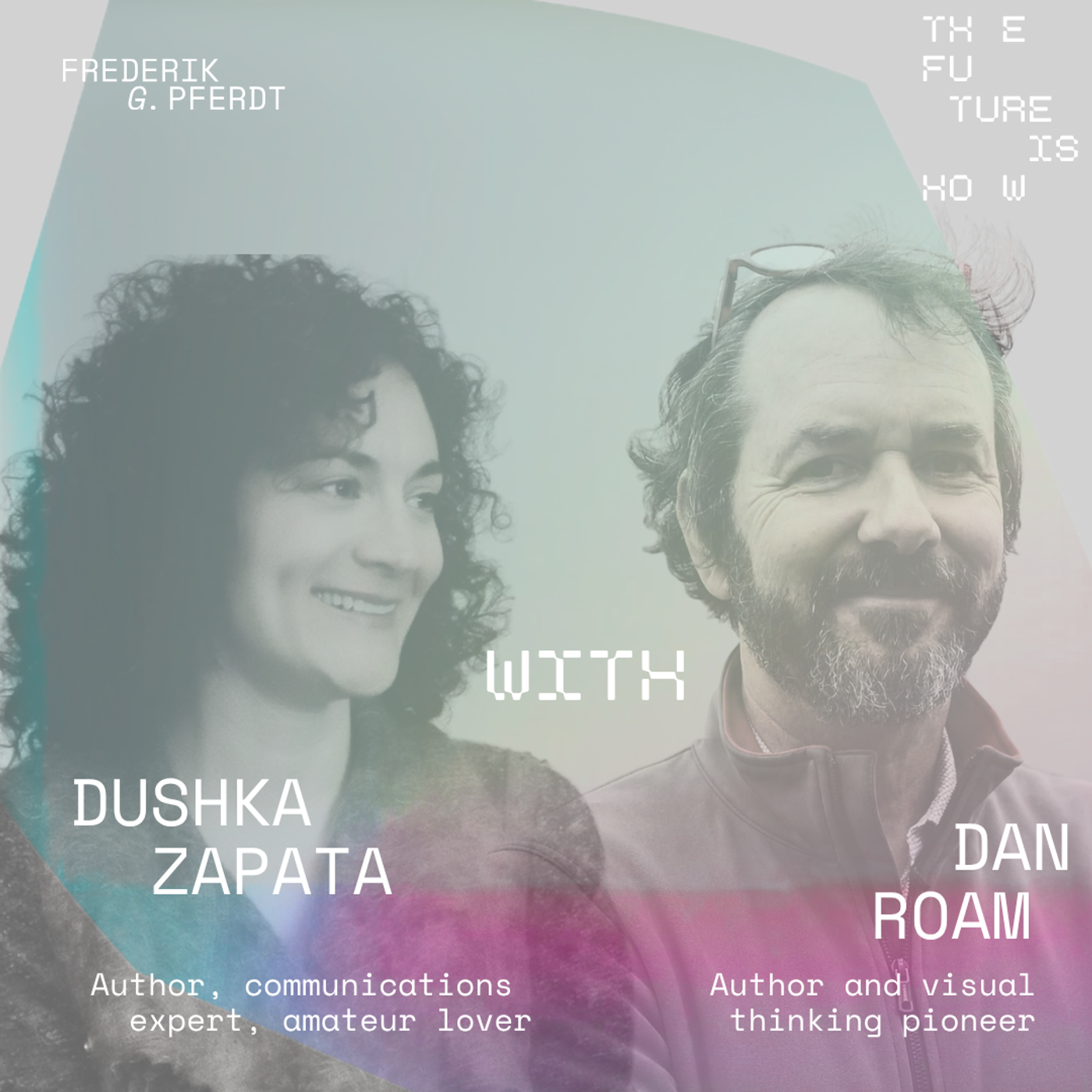


Dushka Zapata has written 17 books and is one of the most-read writers on Quora. Dan Roam wrote "The Back of the Napkin" and has taught Google, Microsoft, and the U.S. Navy how to think with pictures. For the first time on this show, I have two guests at the same mic - recorded inside my geodesic dome, words on one side, pictures on the other. Together we explore why imagining your future too clearly is actually a form of anxiety, why the fear of drawing is really the fear of your own future, and the practice that helped my 10-year-old draw a horse in under two minutes. Dan also shares a brand-new idea, born live in this conversation: the Palace of the Present Moment. If you've ever felt overwhelmed by the future, this one is for you.
Chapters
00:00 - First time in the dome, first time with two guests
03:15 - How Dan helped my daughter Josefina draw a horse in under two minutes
05:42 - The fear of drawing is the fear of your own future
11:27 - Dushka's antidote to overwhelm (and the Einstein quote you'll steal)
14:00 - Why half of your brain is built for visual thinking
17:17 - Generative AI and why you should draw first, prompt later
20:00 - "Claude is mad at me" - why AI is just a mirror
24:00 - Patience as a minor form of despair disguised as a virtue
26:48 - The annoying bell and the power of the pause
30:00 - The Zen master, the trash over the fence, and a better way to react
32:11 - Drawing your future self
39:09 - Anxiety is too much future
41:00 - What if everything works out?
50:30 - Find silence. Draw a circle. Repeat.
Links Dushka Zapata
How to Be Ferociously Happy (Book)
Links Dan Roam
Links Frederik
Take the Awareness Test – How future-ready is your mindstate?
What's Next Is Now (Book) – Frederik's book on designing your future (HarperCollins)
8-Day Foundation Course – Build your future-ready mindstate
Ask Frederik – AI trained on 20 years of Frederik's work
NEXTletter – One question, two perspectives, one experiment (bi-weekly, free)
Live Events 2026 – See Frederik speak live
The Future Is How Podcast – New episodes every two weeks
Frederik G. Pferdt: Thanks for being here. And Welcome to the future is how, yes. It's the first time, many first times. It's the first time we do this in my dome here in my house. And it's the first time I have two wonderful guests. this room is incredible. I am so happy to be here. Thank I feel very relaxed and I bet you that in this I could be incredibly creative. How do you feel, Dan? This room is beautiful. And as we'll talk about as we go into this, I'm having a of a nostalgic moment because very important years of my life were lived in a neighborhood just over the hill in the Santa Cruz Mountains, where I went to UC Santa Cruz for school. So I'm having a huge, beautiful deja vu. The light and the beauty of this room is reminding me a lot of things from the past. So thank you. And you shared that previously when we were walking around that. spaces really evoke these emotions and so I'm glad that you have some emotions and some feelings right when you when you enter some spaces and you you feel like that's this is like the past that you are experiencing yeah today we don't want to talk about the past we want to talk about the future maybe they're not that different maybe yes we'll find out we'll find out I love that yes and So Duska Zapata, you wrote 16 books. 17. 17 books. Yes, but who's counting? Incredible, yes. And you just handed us a copy of which I would say. could be your favorite one because I saw you really lighting up when you shared that, which is really about how you can love yourself. Yes. So finding the self-love. Rohn, you are an incredible author as well, but the one remarkable thing about you is that you are bringing your ideas into the world visually. And you help other people to do that too. And so when you entered today in our house, daughter Josefina was there too. And one of the things you helped her to understand is that whenever we handed a a tool, we are kind of like hesitant. â We sometimes afraid to... not knowing what to do with this tool, what we can put out into the world. And you ask her what's the favorite animal she has, and she responded with a horse. And then we walked outside to a whiteboard and then you helped her draw that horse, right, in less than two minutes. And... I definitely think she will never forget that moment because your fears of putting an idea out into the world in a way that you're not really comfortable with. We use our words to put out â idea to the world. We messages, we do presentations, but rarely use a pencil or a pen to really visualize what we actually want to communicate. â sharing that with my daughter. Well, Frederick, this is why I have a career is because you've worked in Silicon Valley for years and years and years. Dushka has. I have â organization in Silicon Valley you go into, whether it's Google or Apple or any one of them has rooms full of whiteboards. Like â ago, it was decided that whiteboards were a really good thing to put into a conference room. But they're almost never used. or they're used in ways that people will write a little note on or something. So the reason I have a job is because I can be one of those people who will walk into a place like Google and say, OK, you've got a whiteboard. Let's get over the fear of drawing on it. And I'm going to show you how to take any idea you have and get it onto that whiteboard instantly to get past that fear of what would I do. That's why I have a job. That's why I've been able. to do what I do is because I'm not afraid to do that. And I'm not afraid like with your daughter, Josefina, to draw the horse or whatever the thing is. Here's how you get some confidence to put the first mark on the whiteboard. And once the first mark is there, the rest will flow. think that there is a relationship between the fear of drawing something and where that fear comes from and our inability to see our own future. â two things come from the same place. Tell me more about that. I think we have... come into the world, maybe not when we're born, but have innately some clarity about where we want to go and who we are and to express ourselves. I think that it is put out by noise, â the noise that we hear, by the things people say we can be doing better or if you did it this way or expectations. And I think that that creates in us a fear and we stop listening to ourselves. I love that. So it's almost that. we think there is a right way to live life, to create a future, right? But there is not, right? There's only our way. That is exactly what, yes. And I love that. And you both kind of like help us to put ideas out into the world visually, but also in words, right? And helping others to also find their confidence, which I think is an important word here, right? in not letting the fear that we have hold us back, but literally make the first step, make the first kind of like mark on the board, right? Write the first letter. I think that's such an important way of looking at things in these days. the days where we have just a lot of information around us. We have an abundance of things we can look at, we can read, we can absorb. But I think what's really important now is making out of it. Yes. Taking the first step. Yes. And not feeling like, â you know, I need to have a little bit more time to make it perfect or... I need to wait until I acquire a certain skill or I need to wait until something else is feeling more ready. Or I don't believe I'm good at that. Absolutely. Yes. Because I think that you said you mentioned the word confidence in there and I think there's something innately in us and it's not about the feeling that I have when I'm like finally hearing what I'm trying to tell myself is less about me being confident and more about me recognizing like that's it. That is the answer that I had in me all along. And I think that to hear that, there needs to be a little bit of a turning down the volume on the outside noise. Absolutely. And turning up the inside volume, right? Which is a deep belief that I have, is that the future starts from within. I agree. I 100 % believe that. Yes. And so... you are helping people to bring that within to the outside so that people can look at it, they can read it, they can understand it, they can become more aware around it. I'd like to add something if I may just at that moment just back to drawing the horse with Josefina a moment ago. This idea about confidence that somehow we've been told, you already mentioned this both of you, that there is a right way to do it but not and It's really interesting if you're trying to encourage someone to try something because we have learned that there's typically a right way. And if I don't know what the right way is, I won't do anything. So what I was trying to do is say, here is a way to get started. This is not the only way in this case to draw a horse, but this is a way to get you started. And let's just begin with that. As you seek out your future, there is no one way, but you have to start with something. And here's a way to get started. And confidence can come from knowing there's multiple ways and now I have one, at least. also think we have a mechanism inside us, inside ourselves, maybe coupled with that clarity. There's a mechanism inside us that is, that wants to keep us safe. So we hear that we can't do that, it sounds very â right, very familiar because â not it means less risk. So I that there's a double, I need to turn the volume down on, the outside and I also need to distinguish voice that tells me when to go from the voice that is always stopping me and that voice is really hard because it's put there to protect us. Yeah. how can we overcome that? What are some ways that you you learned in your life to really overcome that and also then your I think or at least the book I like most is The of the Net. I just go back to it over and over again because it's not literally about the skill to draw, it's something else. So tell us more about what it is. Would you like me to start with that or you want to go first? I definitely want to hear what you have to say about this. I talk in the back of the napkin about the idea of using our visual mind to clarify an idea, to have more confidence in our own idea or to be more willing to explore it. so that it's clearer in our own mind, so that then I can show it to you and it's clearer in your mind. So that's kind of the central concept and it works. But the trick is, especially in the corporate world, is this idea that people say, well, can't draw. So I can't do that approach. And Frederick, to your point, I make the distinction, I try to make the distinction, the difference between drawing for an artistic reason which is to creatively achieve a particular effect or trying to realistically render the horse or the Mona Lisa if you're Leonardo da Vinci or something to decouple the artistic idea from just the thinking idea. What I want us to be able to do is understand that our visual mind gives us an incredible way to think by using pictures that don't have to be realistic and in fact are not artistic at all. And in fact, very often in a workshop setting with a large enterprise or a small startup or a governmental organization or something, the first thing I do is just a break the ice exercise where we just get someone drawing something. Draw me a circle and call it today and then draw me another circle and call it tomorrow. would connect those? That's all you need to do. You don't need to draw me a beautiful picture. And that is when the confidence begins to come up. If you can draw a circle, a box, an arrow, a line, that's all you need to do. And that's where the thinking begins. Incredible. I might have a challenge for you later on, which really connects those two things, I guess, because we all have a... not a good understanding about our future self. Who are we becoming in the future? If you imagine yourself five or 10 years from today, like who is the Dan, the Duschka, the Frederick? But apparently, if we use visual mind, we have an opportunity to actually make that idea a little bit more clear. So I might challenge you later on to give really a way to visualize our future selves in a very approachable way that everybody can do that. So we'll go into that. Perfect. But first, over to you. Yes. I think the answer that I would give is both very similar to the one you gave and different. I think that the opposite for lack of a better way of putting it, seeing the future, to me the opposite is overwhelm. Overwhelm â the that shuts me down from looking at anything. And I think the way out of overwhelm is to... practice breaking things down into their smallest possible version and then doing a little bit at a time. Just like, just for today, I just need to get through this hour. I just need to figure out this little bit. And I recently, I'm kind of going through and recently went through something overwhelming and dealing with an aging parent and anyone who's dealt with it knows how completely overwhelming it feels. And the antidote to the overwhelm and the emotion and everything was, I don't need to do all at once. I just need to take care of the next couple of hours or today. And I got through a pretty big crisis just doing that, like breaking things down. And I feel like anything that feels overwhelming. Einstein said something that he has a quote that I adore. He said, time exists so that not everything happens at once. And I love that so much. And I think about it all the time. And I think. Because time exists, not everything happens at once, which means I don't have to deal with it all at once. And I think that we understand who we are becoming because I am not becoming who I will be in the future. I am becoming her right now. And I can manage who I'm becoming right now or enjoying who I am becoming right now or observing who I'm becoming right now, just a tiny little bit at a time. Not bad. Just that feeling of overwhelming. I think everybody can relate to. overwhelmed by politics, by climate by â the by your family situation, by your relationship, by your financial health. â All of feel overwhelming. And that only increases. So finding clarity, finding a way to approach this overwhelm, I think is such an important way of looking at life. Because as you're saying, like just take the first step, right? Break it down. what you can influence and whatnot, right? A very important, I even say perspective shifts on looking at that whole overwhelming world that we're living in. What are you helping people to see more clearly in this world â literally feels overwhelming every morning we wake up? Building upon both of you. I want to just talk about the analogy of our visual mind for a moment. Okay, so when I talk about our visual mind, and this will connect in a second, what I'm referring to is our cognitive, physiological, psychological ability to have our eyes look at the world around us, bring in light, and turn it into meaning in our head constantly, millions of times a second. Roughly half, if you think about the human brain, it's about a hundred billion neurons and our brain is about the size. If both of you put your two fists together like this, that's about the size of your brain. You think your brain is very big, but your skull is thick. It's about that size. It's about a hundred billion neurons. And half of that, half of that is focused on processing vision. So for people, for the 95 % of the population on the planet who has vision, there's 5 % arguably who are either congenitally blind or lacking vision or visually disabled. But for the vast majority of us that have robust sense of vision, what's happening is that our brain, within about a tenth of a second, is taking in an overwhelming â of photons, an overwhelming amount of information, and doing the best job it can, fast as it can, to turn that into meaning. So what I mean by that is I'm moving through this space and I'm not falling down. I'm still talking. I'm avoiding this thing, my peripheral vision. So the way our vision system does that to avoid overwhelm is we don't see everything all at once. The reason why the process takes time, about a tenth of a second from the time light enters our eyes until it has found meaning in our visual neocortex and all of the steps that take place. is because we're actually breaking down the visual world into a set of discrete information. We're breaking it down into those elements that you talked about. We're breaking it down in time and in space into objects. I'm seeing physical objects. I'm then seeing their position relative to me. I'm seeing how they move through the change in the position relative to me. All of those things are adding up. So, From an engineering perspective, we have a process in our mind that's the same for all humans. This has nothing to do with emotional beliefs or religious beliefs or anything else. This is just the neurobiological process. The reason why it's valuable, our visual system has already figured out through millions of years of evolution, how to deal with overwhelm. And it's to break it down and identify the discrete elements that are in front of me, identify them, process them individually. then stitch them together to get the big picture and then react to that. So I know it's a little bit abstract, but what I try to do, as we did with Josephina and the horse, don't try to see the whole horse at once. Many of us can picture a horse in our mind and it's a complicated beast. It has a lot of moving parts, it's different colors, it's got hair, it's got bones, it's got eyeballs. Great. But way to draw that is to just imagine there's a circular shape. and another circular shape and a big triangle that's the neck with a circle on top that's the head. And if you break it down analytically, which our brain does, you can make a horse manageable. And forgive me for going long on this, but this is to me why our visual mind helps us not be overwhelmed. We can take a concept or an emotional feeling or climate change or the arrival of AI or whatever it is that's overwhelming and say, let's break it down. into its individual pieces, see them, and then add them together. Does that help you? like, let's act like our eyes. Let's act like our eyes. Our brain teaches our visual mind distinct from our verbal mind. Our verbal mind does not work that way. It is a linear system of building ideas on top of ideas to deliver a stream, an as a linear stream of words in â sequence. visual mind doesn't work like that. It's obviously spatial. I talked over you, but yes, Duschka, the idea is at the risk of over lecturing or something, our visual mind has already figured out how to deal with overwhelm. Let's learn from that and mimic it to address these other issues. Does that make any sense? Amazing. Yes. So what can we do? before we go into that question, you mentioned AI. So how has your world changed in terms of like, you know, putting words out into the world? to express yourself and putting visuals out into the world to express ideas. How have your worlds changed when AI is now helping us in so many ways? You start. I know that working on something related to AI, so you should go first. We started this conversation by saying many people are afraid to draw. Okay, for good or for bad, generative AI can do the drawing for you. Put a text prompt in, draw me a horse. It will do that. So we now have this human amplification tool that for people who are afraid to draw, offload it to mid journey or whatever tool you like, it will do the drawing for you. Well, that's magnificent because it opens up this world of people who fear that they're not visual to suddenly be able to create something visual. And I think that's Fantastic. There's threats. There's all kinds of downside to it. We can talk about the environmental impact of AI or the employment impact of AI. Let's put that aside for a moment. And just to say that we have a new amazing tool set that can help you draw something that you couldn't before if you can describe it. And as you dive deeper into using visually generative AI, you will find that the best way to work with the robot is not to give it a text prompt, but to actually draw something first. and then feed that in. And now you start to work with it. So what has changed for me is the ability to now amplify. my ability to draw in a way that I had not been able to do by working with the AI. The downside of it is it can make it easy for me to stop thinking. It can make it easy for me to stop making the decisions and offload everything to the robot. And now I've really messed myself up and others as well. So the way it's changed is the story that you seek to tell. or the problem that you want to work on, or the opportunity that you want to explain is always yours. Never give that to the robot. The story is yours. What the robot can help you do, if you are thoughtful, is articulate what the visuals might look like so that they become more clear. I hope that a double-edged sword, but it works. Such an involvement of â my thinking and what I've learned from... â recent podcast guest, Jeremy Utley, really is an expert in AI and friend of mine teaching at Stanford University. And what he said is that we need to go beyond the prompt, which means go beyond the text prompt. And he really argues for the prompts. â talk to the machine, talk to â because that's how you can explain your idea. better, that's where you can give more details, more context and all of those things. But what I hear you say is, go beyond the text prompt, beyond the voice prompt, go to the visual prompt. So now you're feeding literally AI with an image that you drew, that you sketched out, so that the AI can actually really what your idea is about. and can help you even, is that correct? Yes, I've got so much more I could say, but I wanna hear what you have to I'm going to answer the question differently. I wanna tell you a story about my relationship with Claude. was working with Claude on something and were iterating and I basically asked him like a very thoughtful prompt and then he responded and I was like, I'm not really happy with this response. think maybe I wanted to ask you this and you answered this. And we started sort of like going back and forth. And at one point I was like, Claude is mad at me because I'm being really, â like I think I'm being, I think I'm asking him to do too much work. â I've been asking him questions and maybe my prompts aren't being clear and I think I'm irritating him. And I was sitting alone with Claude in my apartment. I wasn't talking to anyone else. I was just having this conversation with myself. And I thought to myself, I think that this machine is mad at me. This is a mirror. So to me, AI is a mirror. there to mirror â own stuff at us. And I that it has shown me a lot of things that I project onto other people. It has made clear the things that I project onto other people and how much of it is actually just about me. So to connect it back to the initial conversation we had, think that so much of what we see in others and in what we think the future is, is really just about us. Absolutely. It's so beautifully framed and thanks for sharing that story because that's what I experienced with myself too, is like impatience. Yes. Working with AI, I'm just totally impatient, right? It needs to produce the perfect outcome, ideally right now. And so the impatience is something that is not. where the machine is doing you, or is not wrong, it's you that's something you have to learn, right? Patience is such a â great you can build over time, literally, where you can train yourself in patience and do little practices and experiments. For example, I work with â a coachee we were giving us patience experiments. So for example, next time you're going to be in the supermarket, and you are in line, you're gonna let the person with more items in their shopping carts go first. first. Not with less items, that's the easy one. But look for somebody in your line that has more items and ask them to go first. way to practice, please. Yes. â you heard of an author called Ambrose Bierce? I not. he was wonderful, he was a journalist and he wrote a series of definitions of everyday words. that someone else not him collected into a book called the Devil's Dictionary. And you'll see why when I tell you. You know what his definition of patience was? A minor form of despair disguised as a virtue. Isn't that great? Whenever someone says you need to be more patient, I'm like, it's a minor form of despair disguised as a virtue. Isn't that great? I'm a little bit in despair, I will be virtuous. feel virtuous about it. Absolutely. And while practicing patience, you actually doing yourself a service and to someone else too, because other people admire you for your patience. Can I add something right there, Frederick? Absolutely. Dushka often and I talk about this because one of the things I'd like to add in is in our own future, we been nominally in our own different careers, helping people explain ideas. And over the last five years, we're working together more and more. â At this point, we're probably doing about 50 % of our work actually together. Dushka â a simplified way, Dushka providing the words and me providing the pictures. It's not that simple because there is a cycle that takes place where I will draw something that Dushka will respond to and often she'll then draw it back and I'll write it back. So we do get this kind of symbiosis, symbiosis, this two cycle engine that's moving. I do think of this. hear this in my mind. If you're just using your visual mind or if you're only using your verbal mind to think, it's kind of like a one cylinder engine. I mean, it'll work, but it's always a push. It's like pop, pop, pop, pop. But if you're using both, now you've got pop, pop, pop, pop, pop, pop, pop, If that works, you've got both going. you're your auditive. Now I'm doing my auditive mind. So we do that. And the reason I brought that up is just thinking through. Dushka often says. when things get really complicated. Take a pause. I hear you saying patience is a virtue. I hear you saying take a pause. I think they're kind of the same thing because in that space between the stimulus and the reaction, you do have the choice to take a moment, patience, to take a pause, let it process so that your reaction is more, what, thoughtful? Contentional. So I play it back to you. How does that sound to you? Absolutely. Yeah. And I think that's the magic, right? Yes. Is responding in ways that are thoughtful. Some may call it wise. And is hard because we not wired that way. If we, and we tried that outside, you know, â we like a bell here which we actually took from our neighbors. They were throwing it away and we were it's a wonderful piece of, you know, even art. And so we put it in our garden. And the first time I rang the bell, which you can hit it a little stick, first time I rang it, horrible sound. And was like annoyed, right? I'm like, â it's clearly broken. And then I thought, when I paused for a moment, maybe that's the point, right? To really make me think that it's about me how I perceive a noise, right? Is it annoying? Is it beautiful? Is it whatever it is, right? But I can choose how I view that voice or like how I listen to noise. And so how I can listen to that noise. And so I used to really... find some kind of meaning in it to really ring it every day to just check on myself. Am I annoyed by something or can I choose to view it differently? That is beautiful. That is beautiful. And it is an annoying little bell, have to say. That's the lesson. But hold on because I think that we are living in a cultural moment that goes against that pause. And it is urgency culture. Everything is urgent and we are sort of like programmed to believe that everything is urgent So you live with the belief that you don't have time for a pause Right. So if I if you ask me ask me a question and I go down you go first and I want to think about it and I don't have like an immediate answer I think that I'm going to be perceived poorly and it has taken me a long time to learn to say I Can take a breath and it's very very difficult not just because I'm patient or not patient But because I have been, I have spent a lot of time learning that everything is urgent. And it does us a huge disservice because we believe that the right reaction is any reaction. And we forget that we have a right to pick our reaction and can't take the time. We just have to take the time. And that makes a huge difference. And it's practice. It's just practice. It's not urgent. I can take a breath. And that's really difficult. I learned recently from a Zen master about something that I found really, really fascinating. He said, if a neighbor throws trash over the fence in your garden, you have a choice how to react. And the first initial reaction would be you take the trash and you throw it But what does that create? creates anger, creates hatred, creates like a disconnect, right? Instead, pause for a moment. Pick up the trash, put it in your trash bin, and then here it comes. Go celebrate. Celebrate yourself. Go for a coffee, treat yourself in a way that you just did something that... You should be proud Just hearing the story made my heart open up. There is another way. wonderful. Yeah. Because there is another way, but you don't see that way if you just act or react. You have to pause and then think... Okay, what can I do here? I can throw it back or I can just pick it up and put it in the fridge. Which reminds you of all the tiny little triumphs that we each experience that others have no way of seeing. We should be celebrating ourselves every day for the tiny little things that we accomplish that are like, I'm going to react differently. And then you're like, I did it, but it's invisible to everyone. More coffee! It was amazing. Yeah. So let's go back to this challenge I have. both of you actually. This is related to our futures, more specifically to our future self. Something that we humans just have a really hard time to imagine. Imagine yourself five years from now, 10 years from now. Who are we becoming? It's not just about what work are we going to do, in which relationship are we going to be, or in which health are going to find ourselves. It's a little bit more complex. And I also think we don't spend enough time to actually sit with this question, like who are we becoming? Who do we want to become? And what are we doing right now to actually move towards that future? So the challenge for you is that... If you could draw the den in, you can pick five years, 10 years, but the future self that you see, that you're becoming. how would that picture look like? And we have a whiteboard Let me try it. Let me try something. So I'm going to do two things. I'm going try to answer your question specifically about me. But in doing so, I'm going to try to give a tool that anybody could use to do the same. So that sounds very meta, but let me explain what I We talked about this already when in a workshop or in an environment where I'm being asked to come in and draw â teach people how to draw. The first thing I will ever do, ever always, always, always is draw my favorite shape. I'll just draw a circle. A circle to me, and it's always an ugly circle, so you just keep going and make it little more beautiful. A circle is our most elemental shape, I believe, and I think it's our most beautiful. You all saw the photos coming from Artemis II other day as it was rounding the moon and coming back, and what do we see? We see circles. We see these spheres. The sphere is just such a perfect symbol. So I always â to people, draw a circle. You can do that. Now let's say that that circle is a thing. And earlier we talked about the circle being the brain. Okay, that's fine, but it could also just be me. So just doing that, drawing a circle and giving it a name, the first thing that comes to mind, you ask me the question, who am I in five years? Okay, so I say, all right, so this is me today. We'll talk about more about who this is in a moment. But what I would do is I would say, if this is me today, what you've asked me to do is imagine another circle of me tomorrow. Okay, that's fine. And so we have a picture and I know what my challenge is right now. What is the difference â who I am now and what I imagine I'd be, let's say it's five years, five years out. I could work on that a little bit more, but before I do, I've never drawn this picture before. It's dawning on me as we talk. I actually think it's very challenging to think about who we're going to be. And I know, Dushka, you have your own opinions and thoughts about this that you'll share. But for me, it's very difficult. I hated it as a kid when a teacher or my parents would say, picture yourself in the future. What job are you going to have? Where do you want to be when you grow up? Where do you want to be? I have no idea. So a much better answer that I didn't make up, this actually comes from Dan Pink, the multi-time bestselling author who I had a chance to work with some years ago was saying, if you're dealing with a young person, never ask them, who do you see yourself being in the future? Because they don't know how to answer it yet. But the better question is to ask, if you reflect back, and here's the picture on who you were the past. And what I want to think about is what have you â found yourself doing in the past that gave you pleasure or gave you joy or made you happy or the thing that you found yourself doing in default without any other pressure on that was a good thing, do more of that. who you're going to be is best part of who you were. mapped into the future. So I'm not going to go any further about me specifically, but I think the exercises to say, and I know you're going to dovetail on this, I think in some way, you're going to fit in with this in some way, is it to answer this question. way to do it is to reflect back and say, who was I and what were the things that I loved? And Frederick, this is the last thing I'll say about it. Being in this studio with you overlooking Monterey Bay, again channeling who I was literally 40 years ago and the same smells and the same things is making me think who I want to be out there looks a lot like the best of who I was 40 years ago with the additional experiences and love and opportunities that a lifetime brings. So that's how I would answer that. Incredible. Thanks for sharing that. Sure. And so Duschka, you're a master of words, right? Just like helping us to ideas better through words. If you had six words to describe your future self, which six words would you I wouldn't. Let me tell you what I would do instead. Who I am today exceeds my expectations of who I ever thought I would be in every possible way by such a degree that I would not dare look at the future and make a guess about what I see in me because I would be shortchanging a very limited imagination. I that what is in store for us is so beyond what we can imagine that the only thing that we can do is meet the present in the best possible way and let the future unfold itself from the present. So that means that I need to take care of myself in the present. I need to make sure that I care for myself, I love myself, that I care for myself. in the way maybe a loving parent would care for a child. that will prepare me so that I can meet the future that comes. But â the years, â gonna say every five years, I see where I am and I think I am so much more fortunate than I could have ever imagined. And future will unfold as it will. And to me, imagining the future in any way that's clearer than that, like six words to imagine the future, â I feel like that is my definition of anxiety. I think anxiety is, anxiety is too much future. Like when really is nothing there, there's nothing to see and it's all happening right now. The person that you, you and I will talk again in five, 10 years, maybe less, I hope less, but also in five, 10 years. And we will be like, look where we are. This is so much better than we thought. â the feeling that has accompanied me throughout my life. And I also agree with Dan's drawing because I have always known that writing would be a part of my life and a part of my future. And I like, because I see so clearly in the present that I want to do what I want to do now is right. I know that that's in my future. And because I see so clearly now that I don't see a future without Dan, I'm sure that that's in my future. But like anything beyond that is just, I think it's just going to be more wonderful. More filled with wonder. optimism at its best. Okay. So let me talk about that because I actually don't think I'm a radical optimist. â think that there is a difference between saying everything is going to be okay than saying, what if everything was going to be okay? Because one is opening â door. One is ensuring a future that you can't really know is going to happen. And the other is opening the door to that possibility. Like I am opening the door to wonder rather than prescribing something that I can't really see. Can you give the two one more time, the two titles? Yeah. So one is everything is going to be okay. Okay. I don't know that. I have no way of knowing that. don't necessarily. facile. It sounds when someone says it's going to be okay. You're like, how do you know what? Okay. But on the screen saver in my phone, I have What if everything works out? if everything works out? Turns out okay. And what if everything works out? Whenever I'm like in despair, like, â my God, this person I love is gonna die. â my God. open the phone and it says, what if everything works out? I'm like, it could. â what does that then do? That opens up that pause in the present to be more present. Help me connect that because I get it in other words. We often we as humans often say what is the worst that can happen? Yeah, and my answer is also think what is the best that could happen not because it not because you force it to happen or believe force optimism into it, but you're but you're like these two scenarios I have to make room for the fact that these two scenarios are just as plausible the worst that can happen and the best that can happen. That's true. That is so true. I also see the difference is The one is a statement, everything's gonna be fine. The other one is a question. Exactly, exactly. your curiosity around the future, Yeah. And I that, yes. â And actually think optimism can be a form of aggression towards myself because sometimes I... Because sometimes I'm not, I don't feel optimistic or I don't feel happy. And I also want to make room for those feelings. I want to have all of the space that I can. So if I'm grieving and someone says to me, everything's going to be okay. I'm like, really? Is it, is it going to be okay? I want to have room to fully grieve, to fully be sad, to fully not believe that everything is going to be okay. But I want the possibility. What if everything were to work out? And to me, possibility opens, me curious. And does not force me into a feeling that I'm not actually feeling. Yes. And I would build on that to say, yes, giving room to whatever feeling arises to whatever experience you have at the moment. And at the same time, being in control of what I want to feel next. Yes. Right. If I feel grief, if I feel anxiety, if I feel sadness, whatever it is, right? Accepting that and at the same time saying like, how can I come out of that sadness? What can I do to myself? And we're back in what you just said, like taking care of yourself in the moment. What can I do to myself to come out of that sadness, to come out of that grief, to come out of that hatred or whatever it is that I currently feel? And I think that's the power because as soon as you can not just feel your feelings, but you can make the best to change them. even make the best of what you're feeling. Absolutely. Yeah. Something is triggering. Do you mind if I add something right at this moment? This is something you and I have never talked about. This is a nascent idea. Is there something we've never talked about? is it. You'll see. You'll let us know. Let's see. Frederick, we'll see right now. It's another first one, right? It's like first two people. Well, this idea in this conversation, a little catalytic moment just took place, like two chemicals snapped together and something is emerging out. For reasons far beyond what we can talk about right now, I've been working on a story for a long, long time that, Frederick, you have mentioned to us that you are a student of Zen. You love Japan. many elements of what we see in the house that you've built and the palace that you've built here are Zen-like. Is a fair assessment? â are with Zen Buddhism and... Something that happened in my past a long, time ago was that â I was 17 years old, I lived as an exchange student for a year in Bangkok, Thailand. Now I grew up in Montana, â so was sent at 17 to Thailand. And I lived with a Thai family where nobody spoke English. And drawing around the kitchen table became a way of communicating until I started to pick up Thai. But the point I wanted to make was that the last month that was in Thailand, â I became a Buddhist monk. So I was years old and I went to the head of the temple in our little village and I said, I'm an American, I'm an exchange student, my Thai was acceptable, was okay. And he said, absolutely, join our temple. So shaved head, orange robes, all of the things. And there are so many things that I learned in that time. I wouldn't consider myself a Buddhist, at the age of, I had literally had my 18th birthday in the temple. And the head monk said to me, â Dan, you're gonna turn 18, we have a special gift for you. This, because it's your birthday, for one week, Not only are going to meditate in the temple, but you're not going to talk to anybody else for a week. So that's our gift to you. Wow. So this was at 18. So it's a very formative time and a lot of the ideas landed and only now that was 40 some years ago are coming back to me as things that manifest in what I want to do now. And the one that is the strongest, which is response to what I'm hearing from you. We talk about architectures and buildings. I'm obsessed by this idea of a palace, I'm calling the palace of the present moment. No matter what is going on in my life, good or bad, I can in my mind take a pause. You don't even have to meditate officially to do this, but take a pause and listen to everything that's around and explore this entire endless palace that you're living in of right now. And the only reason I bring that up is it has become a source of great comfort for me that when shit might be going sideways and I'm stressed and the client thing is going bad, I can pause for a moment and say, let me just sit in my palace of the present moment for a few minutes. And exactly as you said about the bell, maybe the test is it doesn't sound awful. Maybe that's how you're hearing it. Take the moment. Forgive me for going on, but there's something, take a moment in this palace of the present moment. you will be okay now and from that you can. What if it works out? What if it works out? Like when the stuff is hitting, now take a pause when you can. There's always a moment. What am I hearing? What am I feeling? Good or bad? Even if it's bad, even if my heart is pumping, I can experience that right now. â that's interesting. And distract me from the fear long enough to take a breath and say, this is simply what's happening now. And maybe if we can build on enough of those, is going to come. guess We talked about this earlier. In the future, who are you going to be? You're going to be Frederick. And where is it going to be? Right here. And when is it going to be? Right now. Yeah. And I'm practiced for that. You are going to be a wonderful fagrack in the future. Thank you. I can see him right here today. Amazing. Reminds me of an interesting exercise. I learned many, many years back. which exactly is building on what you just described, which brings you into the present moment using all of your senses. And it goes five, four, three, two, one. So you use your eyesight first and you're trying to look at five things that you're seeing right now. So I see a tree. I see both of you, I see a circle, I see a book and I see a camera. And then you go four. are four things â you can touch? Right? So you can touch, you know, texture, different you go three is three things you can hear at the moment. So you have to really carefully listen, right? There's different sounds we can hear now. There's a smell of your own breath. There's a smell that's around you from plant, whatever it is. And the last thing is the one thing that you can taste. What's taste right now in your mouth? And if we do that, it takes a minute, but it brings you into this present moment. There's no way around it, right? And it gets you literally out of your head, which we sometimes I think need because sometimes we feel overwhelmed. There's too much noise that we talked about and gets you into your senses, into your body, which I think that's an exercise that you can do anywhere, right? And it's just a beautiful way of practicing that. It's perfect. It creates your palace. It creates the palace right now. It's perfect. Amazing. So what can we do? What can we do about our future? So Dan and Duscha, thanks again for being here. this moment right here, I really appreciate that. â Thanks for all you shared. So what's one thing everybody can start to do differently? you know, we want to be using our visual mind more, we want to use words more to express ourselves, we want to also fall in love with ourselves even more, right? the book that you shared with us too. So what are some ways we can look at the future differently and experience the future differently? Do you want to go first? â I one. Find silence. How can do that? Just a little bit at a time. a, build a geodome or sit in garden put on your noise earbuds, just silence. I don't think it has to be for very long. It doesn't have to be a week long silent, you know, isolation or just... sit in silence for a little bit each day because it allows you to stop hearing just outside stimulus, advice, voices, social your phone, the ringer, the traffic, find silence â and experience it is like to tune into what you have to tell yourself. I think that is a life-changing practice. And it can be three minutes a day. And it can be anytime. want to add on to that. I think that's beautiful. Finding my moment of silence, this temple of the present moment, five, four, three, two, grounds me. Now what? I've solved the problem of being overwhelmed. I've solved the problem of anxiety for the time being. Now what? And what I would add is now as it's time to begin to think about the problem that you face, now that you're in a place of calm. and you have some space to think about the problem that you need to solve or the opportunity that's in front of you or the thing that you want to do or who do you want to be. I always come back to this and I do this every single day and I've already done it once here is just draw a circle. Now that I'm in my moment of calm and give it the name of whatever is top of mind in my problem. The horse. How do I draw a horse? Do that. And if you've made that first mark, it goes back to where we began this call. The confidence is with you now. What is the next thing that comes off of that? And whatever that is, is the next thing you can draw. And draw that circle, give it the first name, and then keep going. And you will unpack the noise or the complexity and get something that you didn't have before you did it. That's what I would recommend. Amazing. Thank you so much. future is how. And that belief that the future really starts from within, I think became even more clear today. we can use our visual mind, right, to bring that within to the outside. and we can use words, right, to really bring whatever we're thinking about, whatever we're feeling, also to the outside. So thank you for being guests, sharing your wisdom, your knowledge, your â And yeah, I'm looking forward to the next couple of hours that we're gonna spend here and go even deeper. So thank you so much. Thank you so much. Thank you. Alright friends, this is the future is how. This many firsts today. First time we do it in this geodesic dome. First time we have two wonderful guests here. And next time we're going to do another first, but going to reveal that. Very soon. So thank you for listening in and for watching. is the future as well. Thank you. you. All right. Wonderful. Thank you.


