Beyond the Mekong: Beyond the Representation

 Apple Podcasts

 Spotify

 Amazon Music

 Overcast

 Castro

 iHeartRadio

 PocketCasts

 Podchaser

 RSS Feed
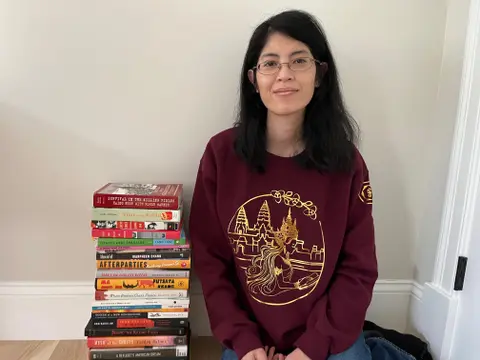
What does discovering an author who shares your similar lived experiences mean to you? I sit down with my friend and Khmer American content creator, Sophia Lee based out in the Boston area. She is the founder of the IG account BeyondtheMekong, which highlights books and writings by Khmer diasporic authors and other Asian American/diasporic authors. Sophia shares with me about her love of reading and the joy of finding Cambodian and Asian authors, and what it means to highlight those voices and find connections with fellow Asian bookstagrammers. We discuss some of our favorite readings from Khmer authors and so much more in this episode!
Books & Authors mentioned on this episode:
Ma and Me by Putsata Reang
Afterparties by Anthony Veasna So
Last Boat Out of Shanghai by Helen Zia
Sambath Meas
Vaddey Ratner
First, They Killed My Father by Loung Ung
When Broken Glass Floats by Chanrithy Him
The Rape of Nanking by Iris Chang
Human Axe by Han Kang
Lurlene McDaniel
Put it on Record w/ Dr. Sokunthary Svay
Slow Noodles by Chantha Nguon
The Undocumented Americans by Karla Cornejo Villavicencio
Remembering Water: A Memoir of Departure and Return by Tuan Phan
Bio:
A second-generation Cambodian-American and the daughter of genocide survivors, Sophia Lee aims to bridge the gap between readers and Cambodian diasporic authors, and to explore the importance of heritage language reclamation for Asian American identity via social media.
Sophia has served the Cambodian-American community for over 10 years. She co-authored the Cambodian Texans chapter in ASIAN TEXANS: OUR HISTORIES AND OUR LIVES, and helped organize the More than a Number exhibit, featuring Cambodian Genocide survivor stories, at the Lynn Museum. Her writing is featured in the Cambodian American Literary Arts Association’s The Still House Zine, and you can find her at BeyondtheMekong on Instagram and Substack.
Get full access to Bánh Mì Bites at randykim.substack.com/subscribe
0:36 This is Randy Kim from the Banh Mi Chronicles podcast. So today I am joined by my friend Sophia Lee. And Sophia runs the Beyond the Mekong Instagram account. And Beyond the Mekong is... is an account that really shares a lot of content surrounding Southeast Asian authors and books. And so, you know, it was very natural that we connected because I have featured many Southeast Asian authors on my show and, you know, I think when I started the podcast, I didn't realize that this was the direction that I was going to turn more into during the first four years of my podcast.
1:22 And it was when I ran into Sophia online. And so we really connected. You know, I just want to say, Sophia, like, I have known you since the pandemic. And I think when we look back in that time, you know, the civil rights movement of George Floyd and the anti-Asian hate violence and and you know, the COVID lockdown and how a lot of people were turning into podcasts, but people were also turning into books too. And I think that that was also a big shift. But Sophia, thank you so much for being on my show. It feels great to, you know, finally have a personal conversation with you and talking about your love of books.
2:12 And I love your shirt, by the way. Thank you. For everyone who can't see, it says book-travert. Book-travert. I love that. I love that. A person who prefers the company of fictional characters to real people. Yeah. Perfect. Yeah. I mean, yeah. And I also want to say, yeah, like you also serve as a nurse to like on your full time, your full time day job. And you are also based in Lowell, Massachusetts. Oh, Boston, the greater Boston area. In the Boston area. In the Boston area. And you also have your mother of three.
2:53 Three kids. Three kids. Wow. And how old are they? Yes. They are 3, 6, and 9. Oh, wow. How has that been going for you so far? It's wild. Yeah. So one of the things I wanted to bring up is... When you started Beyond the Mekong, what was really inspiring you to create this account? And what did you learn about the Bookstagram or Bookstagrammer culture, I guess, so to speak, or the BookTok? I have noticed that that has also been such a tight-knit community, but I'm curious about what you learned about that community and how it led you to create Beyond the Mekong.
3:41 Yeah. Thank you so much for asking and thanks for having me on your show. I'm so excited and I'm really honored to be here. And Randy, I have been probably like your biggest fan of your podcast for forever. Cause I have, I first started mostly listening to all the, all the episodes with all the authors actually. And so that's what, yeah. And like the ones that you did with like Helen, Helen Zia, the author of Last Boat Out of Shanghai, and also with Luong Ong, the First They Kill My Father, and then Nguyen Pham Ki Mai for The Mountain Sings, and now Dust Child.
4:29 I had listened to all of those already. And then actually, a lot of your interviews with podcast guests who were like community activists as well and so I've I've been such a huge fan I'm so glad to be here I feel so honored and not worthy of your oh oh stop it stop it that's not true you know I think I think what's so um beautiful about the Cambodian community because because you are Cambodian um and Over the years, it was always kind of hard to see ourselves in media in different fields.
5:12 I mean, our community went through an obviously deep trauma that put a lot of our families in survival mode once they arrived to America. So the idea of thinking about these long reaching goals seems out of reach. And it was hard to see journalists. It was hard to see entertainers. It was hard to see a lot of folks like doing these things. And it was hard to like really see that. And I think it's so cool to see how there are more Cambodian content creators, both, you know, in the homeland, but also in, across the U.S.
5:56 in the diaspora. I mean, I think it's incredibly... It's incredibly fun to witness it, but also I feel like I continue to learn so much more about our community through these lens and the people who are spending a lot of time showcasing what our community is doing and also what they're documenting, what they are writing. Yeah, I was wondering about maybe some of your early experiences with writing and how that came about. Yeah. Okay. Where do I start? With writing or with bookstagram? Actually, let's go with the bookstagram.
6:38 Yeah, let's go with the bookstagram. Yeah. Okay, sounds good. So I had been following some bookstagrammers. So people on Instagram who write about books, all things books related for a while. And I initially was just... reading their reviews and getting an idea of different kinds of books and um i think my first my first like real interest was when i began to see books by asian american authors and then i realized there was a lack of representation in southeast asian authors so i think that was my first observation and then slowly the more time that i spent in the space i realized oh actually there is some Southeast Asian representation.
7:32 I have connected with a few, like there's a good amount of Vietnamese, Vietnamese diaspora, books of grammars that I've met and who are amazing. And I learned a lot from, and there's a lot of East Asian, but I really noticed that there's not that many, if there's very few Khmer since, since becoming, more and so essentially that was like one of my motivations for starting a public bookstagram account was recognizing the lack of representation in Khmer authors and and then because there's lack of representation in Khmer authors then there's also for sure there's people Khmer people who read books but they're just not like public basing you know and so then um And I had connected with a few and but I definitely felt like there needed to be that carved out space that didn't exist yet for like a platform for these Khmer authors.
8:35 And I think I like recognizing that gap, I started to try to fill in that space and one particular one particular comment that I had seen on a specific post that was really like the trigger for me to to start writing book book posts specifically to highlight my authors was a a post about children's books and I think And I don't really remember like the nature of the content, but they were specifically highlighting different authors from different countries.
9:16 And then there was one singular comment that said, yeah, it's a shame. I can't find any children's books by Khmer authors or they use like Cambodian authors. I can't find any children's books by Cambodian authors. And I don't know why that is. And it was just like some random strangers comment that I don't know them. I've never interacted with them. And that one comment really just lit a fire in me. I don't know how else to explain it because in my mind, I knew the answer. For a random person who has no understanding of the complexity of Cambodian history and the history of the diaspora and how educated people in Cambodia were targeted during the genocide, how authors were targeting the genocide, how after like four and a half years, like there were only three, like all the libraries were destroyed.
10:10 You know, for a person who has no understanding, yeah, for them, it's just like some random comment, like, oh, I can't find any books by my authors. But for me, oh, wow, it was just so, it, it just like lit up the flames. And I felt like I had to, I felt so driven to educate people as to why that was. And then also to show them, look, actually there's a plethora of client authors. And so that's kind of how it started. Where initially was like one book post, like, here are some books like my authors um and then and then I began to highlight like the kids books um some kids books like my authors and then slowly over time I realized I was saving and bookmarking like every single book post I could find by any my author I was like saving tabbing writing them down um And then slowly just creating new posts every few months to increase the volume, create this online catalog.
11:25 And what's so interesting to me is I met, so I was talking to someone who I see like every week and he's a part of Ankur Dance Troupe, Chun Ming. I don't know if you've heard of him. He also is a part of, I think it's Khmer Urban Ballet is their troop name. But he didn't realize that I run the account Beyond the Mekong. And he asked me, do you have a library? Like, are all the books that you write about, are they in your library?
12:06 And I said, oh, well, technically, like, yes and no. A lot of them, if I'm able to, I check them out from the library. But the ones that I can't, I do purchase them. Or I try to find out where I can get them. And I try to make that accessible to all so that way people can find it on their own if they live in a different city or even a different country. And so I am really humbled every day by the people who I've met, whether they are up and coming my authors, whether they have self-published, whether they have published, but they're just not as known, or whether they are in academia and they've published through a university press, but nobody knows about them because they are in academia and they don't do interaction with the general public outside the university, which is very common.
13:03 So I'm really thankful for the interactions that I've had with the community in both helping elevate Khmer authors through the Bookstagram space, and then also helping connect those very resources with specifically the Khmer community who I think is so hungry and yearning for that education, for that history, that especially for the diaspora that has been largely inaccessible. So those are some of my like motivations behind the booksagram.
13:47 And then on the side also, little bit talk about like bilingual parenting and passing on teaching my kids Khmer. That is like really important to name that because when you bring up the genocide and we're over 50 years already since the beginning of the Khmer Rouge and We lost nearly 90% of our artists, writers, and we lost a template in a way of how to document our own history, but also not just our history, but our own history. being able to use our creativity, being able to innovate.
14:27 And that was something that was lost in our community for a really long time. And I think it's slowly coming back. And unfortunately it takes generations after horrible tragedies to get to a place where it's starting to move forward. I think, you know, looking back, I don't know if your first book by Khmer author was Long On, because for me, The First They Killed My Father was the first book that I read from a Khmer author talking about the Khmer Rouge genocide. And this book was released in 2001. And I think that was right around the time of Tomb Raider, Angelina Jolie's, you know.
15:11 filming of that movie and i think that was like during the time where i actually learned um from a deeper level about the genocide i think was my first um understanding of it outside of my father's story. And then I didn't pick up that book until like maybe 2008. And so I was 25 years old when I got that book. And I realized, wow, this is very fascinating. This is such a gateway. This is not just about the historical lens written by a white researcher. it had a more humanizing way of talking about the survivors.
15:57 And I wonder, was Long Long the first Khmer author that you read or was it another Cambodian author? Oh, that's a great question. Actually, I know her book and Chandruti Him's book came out around the same time. She's the author of When Broken Glass Floats. So actually that was the first book that I read. And Luong's book, First They Killed My Father, I knew of it, but actually I was very scared to read it because the title was so triggering. And I held off for many, many years. And actually I did not read it until the movie came out.
16:40 And so when the movie came out, then I thought, oh, well, maybe I need to read the book to know. So that way I can have a comparison for the movie because oftentimes, you know, books are better than the movies when they reproduce it. And actually when they screened the film, they screened it in Lowell. And since I live in the greater Boston area, I wanted to invite my mom to it. And so I felt like I had to do the internal work before bringing my mom to the film. to know whether it was appropriate to bring my mom. So I read the book and it, uh, was a really difficult read.
17:26 Very difficult. Um, yeah, it was a hard book for me to read, but so important. And I, I'm so glad I read it. And then I did end up bringing my mom to the film and, um, And that was a very special time for us. It was very painful. We were crying throughout the entire film. But what was so profound for me was that there were things that my mom did not disclose until I saw the film with her. And so that was just so powerful because it was like, you know, she kept this, her history like locked for decades.
18:08 And then seeing an image in a film, and then her to sit next to me and say, like, this happened to me. They also made me dye all my clothes black. And how sad it made me feel to have to do that. That was so powerful, you know, to not be able to contextualize any of that previously, and then suddenly to see another portrayal of a similar family history on the screen like next to your family, it was very, very moving. So I was, I was really, even though it was a hard, a hard book to read and the movie was also very difficult to sit through, but I recognized that actually after the film, my mom was like, my story is so much, so much worse than that.
19:02 And that just, and that just like puts it into perspective, you know? Um, that she experienced even more trauma than that. And so I'm very grateful to have read the book. And for me, that's one reason why I read is to understand more about the history that has been so difficult for my parents to share. to understand more about like my identity and of course how history ties into identity and all the factors that it impacts, whether it's language or whether it's culture or whether it's stance and how all of that ties back to to what happened during the genocide.
19:56 But then in addition to how there was definitely a civilization before that, there was also life and culture and history that came before the genocide. And so that's also another reason why I read so I can try to like learn these roots and understand how they're all intertwined and connected. And Yeah, so it was really a special time for me to have read her book and also have watched the film. But yeah, to answer your question, going back to your question, When Broken Glass Floats was actually the first book I read by Chandriti Him. And I remember it being really interesting because actually my sister read it around the same time and she was in like middle school or high school.
20:46 And she had asked my parents the way, okay, she didn't even like bring up the book. We were just like at the dinner table and she was eating and she decided to just eat salt with rice. And my parents asked her, why aren't you eating any of the food we actually cooked on the table? And she says, I just want to see what salt and rice tastes like. And they looked at her wide eyed in complete confusion. And then she says, I thought it's supposed to taste like heaven, but it just tastes like salty rice. And so then they were very, even more confused. And they said, what are you talking about?
21:27 And she said, oh, because I read this book when broken glass floats. And she says that during that they were not given any food. They were only given rice and a few grains of salt and it tasted like heaven. And so that's when my parents their entire posture shifted and it became one of understanding. And it was then that they realized, Oh, our daughter is trying to understand us and their entire demeanor changed. And then they were a little bit more open to sharing about, about starvation and how challenging that was.
22:09 And it was very eyeopening. Um, And for me, books opened that gateway for us. My parents only opened up because we had learned a little bit of the history through books. And so I recognize that people read for different motivations. Some people read to escape, and some people read for history, to learn. my yeah my initial journey into reading books like my authors was to understand history so i could better grapple with the history that i was not told from my from my family and so um yeah that for me was that that was actually my first book by my author Thank you so much for sharing your story and also how it helped to unlock the stories about your own mother and your parents in this case.
23:18 And being able to have a deeper understanding of what your parents went through. And, you know, I... Despite reading First Day Killed My Father, I had never seen the film. One thing I've always struggled with over the years, and to this day, is that I struggle to watch movies that depict... genocide that depict violence. I have a very strong aversion to it. I had never seen the killing field.
23:58 I kid you not. But my dad would always reference it as his story because it's very similar to how he escaped and also what he was dealing with at that time. And I struggle with that. I could read books. I could listen to stories, I could watch documentaries, I could, you know, listen to TED Talks. I'm more of a storyteller so like I love hearing people's narratives on stage and how they present it. But film, it's very hard. It's a very hard thing for me to handle because I remembered for the Cambodian Museum when I had served on the board, we had a showing of First to Kill My Father and I was like, no, I'm going to pass on it.
24:50 This is not going to do it for me. And it's, I think that that reading books for me is very helpful because even though, yes, it is very graphic in the words and I do have a vivid imagination, I feel like in some ways it helps me to really understand the connection better without having to be exposed to the graphic violence that never leaves me. What I could also say is that I think one of the books that I have struggled that I actually have not finished, and you brought this up, is Helen Zia's Last Blood Out of Shanghai.
25:44 I think I was like maybe halfway through the book and I was already overwhelmed immensely by it. And knowing about the Nanking Massacre during the World War II area, the World War II era during the Imperial Japan's ruling of China and Japan, the Philippines, it was very barbaric. And it was so graphic that I just couldn't continue. It was just so demoralizing. And being in the Cambodian community and the Vietnamese community and hearing stories of war survival genocide violence and hunger this this was another level that i was not able to handle and i think that was just incredibly demoralizing and and just dejecting um i don't think there's any word to describe that um i am and also the kind of maybe in a way shift gears but like um was reading encouraged in your family and were you were you also doing it for leisure was reading a leisure activity for you growing up yeah um oh before before I answer that I just wanted to say and it's okay it's okay if you if it's hard to watch the killing fields or first they kill my father because
27:17 um I would say especially for the Khmer diaspora or children of genocide survivors, children of refugees, secondary PTSD is real. And, you know, we fight our own battles. Yeah, there's no pressure, I think, to watch any films or to read any books, especially if they are triggering. Yeah, so no pressure. And I also find it certain content is very hard to read. I haven't read Rape of Nanking as well. Yeah, I haven't read that yet.
27:59 So certain books I can get through, like Last Boat of Shanghai, but there's other books that been really hard to get through um uh like human human acts by han gang the nobel peace prize winner last year i did read that but it was very very difficult and at one point i had to stop because i felt like i was falling into darkness it was very hard so i would say for any listeners out there yeah don't I encourage the learning of history. But if you recognize that you're not in a safe space, then please pause and reach out for help if you do get triggered.
28:44 Yeah. So I just wanted to add that to it. Thank you for that. Yeah. Yeah. So your question was, when I was younger, was I encouraged to read? I would say I have always enjoyed reading. And as a kid, I often found myself bringing a book with me everywhere. My mom is not a reader. My dad, I didn't, I would say my parents were always working. You know, it was the refugee survival, trying to survive in the 80s reality for most Southeast Asians. And so they just, they weren't home.
29:26 And I was, often either at like a relative's house or a neighbor's house or a friend's house, often being cared for by somebody else. But I did have a book with me all the time. And so I've always had this love for reading. And I think reading helped me to process the world, especially I think as yeah, a child of genocide survivors and not being able to understand so much, not having a parent who is present because they're just trying to survive. I think reading helped me to process those things.
30:09 And so in many ways, reading taught me those life lessons that I really couldn't get anywhere else. And I was trying to think about books that that shaped me in a way. And when I was in middle school, I often read these books by a particular author named Lurleen McDaniel and she wrote young adult books and they were all titled like six months and dying or like 16 and dying or like six months to live they were all like these very these very yeah they were all about like either cancer or like depression but they were about like young people facing their mortality and And I was trying to process that.
31:03 Like, why did I write, why did I like reading those books so much? And I think it's because they helped me understand and process death in a healthy way. Because I didn't have anyone to explain those things for me. But yet as a child of genocide survivors, there's so much death. There's so much death, you know? And you're constantly reminded, your whole reality is being reminded of death and how your parents barely survived death. And so I think that's one reason that I was attracted to those books as a teenager was to understand and to confront mortality and to sift through that, but in a healthy way through fiction.
31:48 Yeah, I think that's a really interesting connection, how you think of the perspective of death from a younger person's lens and how that, in a way, is kind of aligned to the unspoken word about death. that runs in your family the tragedies of the untimely deaths that have happened and you know it's it's certainly something that i think about quite a bit you know i think as we are now getting older like our parents generation are passing on and and you know we also have colleagues or people around our age that died suddenly or um And I think that certainly sometimes I kind of look at, you know, reading and writing as my way of kind of like building my own self-reflection and, you know, being more thoughtful about what this time period means to me and what do I want my...
32:50 What do I want to still... you know, I don't want to think of like accomplishments and, you know, crossing off the checklist here, but it's more like, well, what does it, what do I want it to mean, you know, moving forward with the time that we have and, and the relationships that we have. And I think in some ways reading has been therapeutic. I think the last several years I found myself reading at such a high rate up until like a year ago where I like really hadn't been able to read, but like, Before that, it was very, you know, hit or miss. Sometimes I will read for a good stretch and then sometimes I will not read for a while. But then, you know, the pandemic happened and, you know, I started reading books like Kathy Park Hong, Minor Feelings, which really shaped the way I saw myself as an Asian American and living in America and dealing with the politics and And I felt that was very relatable, reading Ocean Vuong's poetry and his work.
33:52 Wen Fun Kwe Mai, who's a dear friend and just a brilliant, compassionate writer and even a better person. And along with the way, seeing the emerging writers in the Southeast Asian communities, from poetry to children's books to fiction, memoirs, and different avenues of creativity. I feel like that's emerging, but in the Cambodian sense, it was still a struggle until a person named Anthony Visnasol, who was starting to emerge as a poet.
34:33 And I had heard about his name maybe in the 2016, 2018. I can't pinpoint exactly what time. We did not know each other personally. We haven't had a conversation. We might have liked each other's posts here and there, but that was the extent of the conversation. But for some reason, I was kind of drawn to him because he was queer. He is a Cambodian-American, kind of within the millennial age. So he's a person that I can understand. And I had learned about him signing this two-book deal, which the first book would be After Parties.
35:16 And several months before the book was published, he passed away unexpectedly. And You know, he was not even 30 years old. And to me, I felt this intense gut punch. I mean, I was grieving. I was grieving a person who I had never met, never had a conversation with. But I felt like around that time, we were losing people untimely to COVID. And this was in 2020 when he passed away. So it felt like... we were going back to what um camboiding's experience not i mean i don't want to compare like that era to the genocide but like we were losing artists done and i'm like okay now we're starting to make our footing and we're starting to lose certain people and he was definitely um a bright a north star for the community i mean i think he was elevating himself as a creative writer because he wasn't just really talking about genocide he was talking about life in California from a you know from a fictional perspective and it was very creative he had you know the donut shop he talked about like you know tennis he talked about His characters talked about queer sex.
36:40 It was very relevant to the experiences that we have now and not tied to what happened 50 years ago because unfortunately that's what we get so... attached to in a way. At least that's what, that's what is associated with us as Cambodians. So yeah, I'm curious about like when you're reading other authors, other Cambodian writers who are emerging in both poetry and in the literary world and, and, and you're in your thoughts about Anthony Visa so as a writer.
37:22 Yes, I, Love his work. I too felt such a profound loss when he passed. And at that time, I actually hadn't read his work yet. But to hear that his book was just about to be published and he hadn't even gotten to see that to fruition made me so sad. And so I and then I also saw like the outpouring of like the Khmer community and the growing Khmer literary community that was grieving and mourning with his loss, with his passing.
38:06 And I realized, or I hadn't yet realized like what a brilliant writer he was because I hadn't read his work yet, but I already knew how much he was loved and respected. And so when I read his work, I was totally blown away. I did not, I did not expect the humor because I didn't, I didn't know him personally, but his book is so funny. Both of his books are so funny and it really helped me, helped challenge me to think about writing in a different way. And actually there's a, let me try to find it. I, I saved a quote of his.
38:49 Yeah. That I, really enjoyed. And I think about this quote a lot. So hold on one second and see if I can find it. I think it was from his second book. So the book is Songs on Endless Repeat, which was published after he had passed. And so this is the quote, and it's a conversation, I think, between cousins. Okay. I mean, Darren said, I kind of hate the idea of writing a book on humor and trauma.
39:30 It feels trite. Like for example, Cambos here are always laughing, but it's not only because they are trying to heal from their pain. Sometimes old Cambo dudes laugh because they are just, you know, laughing. And to me, that was, I just enjoyed that so much because It's true that so much of the Khmer experience is encapsulated and all-encompassing intertwined with trauma because that's the reality of genocide. It affects every facet of your life for generations to come. And at the same time, can we not be minimized to trauma only?
40:17 Could Americans see Khmer people as people other than who have experienced trauma and genocide other than could they see us beyond genocide survivors. And so to to read that passage about oh you know sometimes they're just laughing like i love that i love that so much it just it it means like we can be human too we can laugh too we can be silly we don't always have something important to say we can just be ourselves yeah and i want to add to this because i'm so glad that you named this and uh You know, when I went to Cambodia a year ago, I was in Phnom Penh, and my tuk-tuk driver, it was just me and my tuk-tuk driver, he was giving me a tour around the city of Phnom Penh, and he took me to Silk Island.
41:10 And so he was taking me along the way. He was like, basically trying to quiz me. So what are they making? Like, what is this? What are they growing here? What are they growing here? And I was like, um, banana. I was naming random stuff and he would just start laughing. And he hit this big smile. Like, you know, it's like, you know, he would, he would do this little gotcha, you know, it's very Cambodian. It's hard to describe it, but it's very Cambodian because that little smile, it's like, okay, I'm here to clown you. And I'm like, oh, great. Now he's going to clown me. And I'm like, I'm going to look like an idiot. And so we were, you know, like we were watching the silk being made and I was getting the grammars and, And then, you know, we got back into Tuk Tuk and, you know, like we started talking about, you know, the genocide.
42:04 You know, I think he talked about, do you have family members here? And I said, well, no, a lot of my family members were gone in Cambodia. And he talked about his uncle losing his uncle, you know, and then we had this very silent moment. And next thing you know, 10 seconds later, he was, like, driving to the next field. He was like, hey, what is this again? I just showed you. And I'm like, oh, my God. And I'm like, oh, my God. And he was just laughing. And he wanted to clown me so bad. And I was like, oh, my God. This is hysterical. I mean, but it's also like, yes, there is sadness that we can't. necessarily get away from but boy i mean we could still have a sense of humor and it was that kind of moment i mean it felt like we were just bonding you know just finding ways to connect and laugh in and admire the beauty of cambodia in that moment so yeah i really appreciate you bringing that up um What other stories have you also noticed that you're seeing of other Cambodians who are writing about things outside of the genocide?
43:17 Yeah. Let's see. So Sokuntary Swai, I often recommend her book. I loved her. Yes. She's wonderful. I love her. I love her vocal poetry, which is called Atara in New York. And then her second book is called Put It on Record. And that one's a collection of short stories, essays, as well as poetry. And I got to hear her recite some of the works from that book in person when she visited Lowell. And it was so much fun to hear her like share about her parents and then share both like a poem that she where she uses her mom's accent.
44:05 That was so much fun to hear her share. And then I remember there's a short story on music, which I really loved. And she talked about her brother's love for electric guitar or how she decided to write opera lyrics. All of that is so... It's so fascinating to me. It's awesome to see my people share a love of music and that we can bond over that. Or whether it's hearing my rock and roll that our parents listened to from the 60s. Whatever genre it is, I love hearing people, reading people talk about it, reading people write about it and hearing people talk about their love for music.
44:51 That's something that I really enjoy reading. And then, so I definitely recommend both of her books. as well as there is a author I enjoyed reading last year and her name is Galeanne Bradley and she wrote The Ministry of Time. And it's a speculative fiction slash romance novel. And so that book is about a mixed Khmer British woman who works for the British government and she is like an agent of the government and there is a guy from like he's like an arctic explorer from i don't remember the time period though um either like the 1800s or something and he basically the british have an experiment and they extract people from different time periods So this Arctic explorer is now extracted and goes through like a time machine and he ends up in like modern day England.
46:01 And so I love the concept in the book about how it's almost like he's a refugee, but he's not a refugee, if that makes sense. He's like an experiment to the British. And it's a different way that she explores the impacts of colonization and colonialism. And so I thought that book was so fascinating how she describes it in a way of time travel. I thought it was so creative. But from what I have, it was a very popular book last year. And interestingly, people are either on the love it or hate it side.
46:41 So I loved it. But I also know people who are my friends who do not like it that much. So if you read this, just know. I recommend it but if you don't like it don't come for me yeah yeah no um yeah also like I was thinking about my good friend Sambat Mies um Sambat is also like a self-published author and she wrote her rom-com she wants to do like more creative writing which I applaud her for that I you know yeah I adore her and you know she also does content creation about like you know teaching Kamai words and the significance. Yes. Yes. Oh yeah. I follow her. She's awesome.
47:21 Yeah. She's great. And then I, with Sada Ring, Ma and Me was probably one of my favorite. Oh yes. I love Ma and Me. It is one of the most well-written memoirs that I have read. And I don't say this lightly. I think this is the book that really grabbed me for a number of reasons. One, because I wanted to go into journalism. She was a journalist. She's queer and, I'm queer. And also, you know, this friction that she had with her own parents and over her own identity and sexual, her own coming out experience and, you know, navigating, you know, living in Cambodia and living in back in Oregon.
48:05 So, yeah, I, I was profoundly moved by that. I had her on my podcast a few years ago and, you know, just, it was a very delightful conversation and, But I... think about the tug of war that she had with her mother it was exhausting to read because I was like oh my god this this mom is just really holding on so hard you know and against you know her uh partner and I was like oh it was just hard it was so hard to like get through parts of it but I'm like boy this woman is stubborn as hell and that's a lot of Cambodian women you know older Cambodian women who survive horrible things and boy you know the stubbornness really shows and I'm but I think that yeah I don't know what were your thoughts reading Butsada but god I think you know that was really one of my favorite memoirs hands down yes I also loved I also loved her memoir and I think she did an amazing job of exploring different aspects of the Khmer American experience I think that's what really stands out to me so she starts off like sharing her family's history.
49:21 And then what's unique about her family story as well is that she includes the part about her family escaping via boat. And that's unique because it's not, a lot of people know about the Vietnamese history with like the boat people, but they don't know that Kwan people also escaped by boat. And so that it was really cool to read about. and um and i was familiar with that history i actually have an uncle who also escaped on one of those ships and i later connect with her i was like you probably your parents probably know each other but um yeah it's i i think it's amazing and i i love that she included that in her story and then also the the experience of being in Oregon at that time, like in the 80s and like working on the farms and like how her family hustled.
50:20 I love reading about that. It is so insightful. It tells so much about the refugee experience and then how they were very intentional about caring for the incoming Khmer refugees as they continue to grow and they were resettling in that community. it's really cool to read about and to hear to read and learn about that experience um and then and then also with her queer identity and then not feeling accepted by her mom there's so much that she describes so well and she writes it so beautifully it is just it is such a privilege to have read her book honestly it is so beautiful yes Yeah, and another book that comes to mind, and I met her last year when I was in Cambodia.
51:10 We had a wonderful lunch together at Chantang Nguyen, who wrote Slow Noodles. I was also a fan of reading that book. And I think what's very important is that she's Vietnamese growing up in Cambodia. And what is very important to note that it was President Long Ngo who was... the puppet leader from the U.S. that was, you know, assigning him as a leader of Cambodia after the king was put in exile. And Hala Noh wanted to get rid of Vietnamese people first.
51:52 I mean, before the Khmer Rouge. wanted to continue doing that. So I thought that was very important to also note that, but also the expatriation of Cambodians from Thailand to back to Cambodia. in some places to Vietnam. And she also talks about her experience with the Vietnam War on top of it. I mean, like, I think each chapter was like a recipe and it was visibly moving. I was really... just blown away by the storytelling and also, also, you know, showing and demonstrating her connections with other ethnic minorities in both Vietnam and Cambodia, which are not talked about.
52:44 And I think that also like goes into a deeper level, but yeah, that was also another recommended book for me. Yeah. Yes, for sure. I, slow noodles, I think is so creative in the way that the stories are presented. I think for an average reader, they would not expect to, to find like a book that's a hybrid cookbook slash memoir. But when I started, I listened to the audio book. And when I started listening to it, I instantly felt like I was in my own kitchen, listening to my parents and it really, it really be like that. Like they'll be cooking a dish and then suddenly like the aroma, or it could be like the caramelizing of the sugar, or it could be like, you know, them pounding lemongrass in the mortar and pestle.
53:36 And then all of a sudden they start talking about their stories from Cambodia and it comes out. The stories come out when the food is served, the stories come out when the cutting board is on the floor and the that's when the histories start to unravel. And so it was really, it felt, yeah, it just like listening to her book, looking at the recipes in her book just felt like a slice of home. It was so comforting in that way. And I just, really enjoyed the book and also I appreciate how you mentioned too how she highlights like a different experience because she's Khmer Vietnamese and that is it's not a voice that we hear in either side of the border.
54:36 Like, so in Khmer literature, you're not going to see very much like Viet representation of Vietnamese in Khmer literature. And then likewise, you're not going to see very much like Khmer representation in Vietnamese literature. And so she really was that voice that could speak to both. And it's such a unique experience. And I also really liked, yeah, hearing about her such the journey that she went through to try to leave Cambodia but then having to return back yeah it is so it was so like such a tumultuous journey and yet she is so resilient mm-hmm And she continues to cook and continues to serve like in whichever capacity and whichever city she's in, in that moment, she serves the community and she still does it to this day, like through her charity work and her, non-profits that she runs and she's amazing I hope to meet her when I go to Cambodia oh I hope so too because she's so she's just so wonderful and it was an honor because I mean you know that whole trip to Cambodia was such a homecoming for me and um And I think that it made it more special because I was able to read my authors prior to it.
55:58 I think in some ways it kind of like set the stage for the experience that I would have or what I wanted to have that I came away with. I am also curious about your own kids' relationship with books. And are there current Kamai children authors that you have picked up and that your kids are starting to be exposed to? Yes, definitely. So for my kids, I'm definitely intentional about reading diversely. So trying to check out books from the library by authors of the global majority and then in addition to that also trying to make sure that I have an entire shelf of Khmer authored books um because representation is so important seeing yourself on the page is so important and some Khmer authors that I have enjoyed for children's books um One of them is, hold on, let me, I don't have all the, My kids' books are in my basement, so I don't have them to pull quickly.
57:19 I'm sure I could look through your account. I'm pretty sure I could pop up to your account and be like, okay. But I think that's why I really appreciate it because we also need children's books. We need fiction. We need poetry. We need the different stories. But also, I'm curious, and I don't know if you have looked more into it because I know that you've also looked out for Kamae diaspora. authors like you know um across like the globe but also have you come across like kamai books that are now getting translated into english because i'm not sure how that has worked so far you know in terms of like writers and trying to get their books published in english yeah yeah um i think it's the I am starting to get more connected slowly with the publishing space and the Khmer literary scene in Cambodia, which has been growing over the last few years.
58:23 And right now there is a author. She is the author of, sorry, I'm just like trying to find my books. Okay, so this author Linda Sung Pan, she wrote two books, Remnants of the Past, a Filmography of Early Cambodian Cinema, and Faded Reels, The Art of Four Cambodian Filmmakers. And she is an, I wanna say, she's a researcher. Oh yes, I've met her. Yeah, I met her. Oh, you have, okay. Yes, yes. Okay, yeah. And people may know her more from the documentary, Don't Think I've Forgotten.
59:03 Because she was an associate producer for that, the Cambodians lost rock and roll. And I noticed that in Cambodia, she recently wrote an English novel, and it was just recently published. but it's published in Cambodia. And it's published by a Khmer publisher, which is really cool. And so I'm hoping that it will eventually make its way to the US. And for now, I think that that book is in English, but in Cambodia and not in Khmer. And there are definitely Khmer authors published in Cambodia, but I haven't seen translated works by Khmer authors available in the U.S.
59:49 yet. Like that's just not, I think it's, it takes time in reestablishing the publishing industry after genocide. I know that for the Viet community, there is an established, like Viet translator works that you can find in English. And there's particular publishers who also publish and market those books. But I haven't seen that in the Khmer literary space yet. But if anyone is listening to this and wants to correct me, I'm open to correction. Please feel free if I've missed a book. Yeah. No, because I think that's certainly something that just comes to mind because I know, like, with Vietnam, like, censorship is also still an issue there, too.
1:00:34 Like, you know, Vietnam, when sympathizer book is certainly not, you know, getting published there. And, you know, even when Phan Kuan Mai, I think her next book, she's had to kind of, like, change certain language about... in order for the book to be published in vietnam so so it is kind of like it's still a tug and pull but i think for cambodia it's it feels like it's still at the infancy level because yeah because the the writing is starting to kind of emerge slowly but i'm also like very curious about what my literary writers are coming up with and what are they sharing and yeah i hope that they will come a lot sooner and more accessible to us you know yeah i since like i can read kai but my kai is still my kai reading levels at like an elementary level so i'm not reading novels right now other than me in the future wait we can work towards it it's okay i'm already working on my yeah i'm already working on my vietnamese and it's like it's kind of moving along very slowly um yeah but yeah it's okay yeah that's okay yeah and one thing i will one thing i also really did appreciate you know your Beyond the Mekong account is that you also talk about a lot of the social justice issues and human rights issues like what we're seeing with Gaza, what we're seeing with Congo and Sudan.
1:02:01 I know that these are things that you highlight, but you also emphasize the importance of Palestinian authors and and other writers that speak to the current issues. Why do you feel it's so important to talk about through the lens of literature? Yeah, that's a great question. So for me, I think reading has enabled me to see how people and systems are connected And I could not have understood that if I didn't read.
1:02:45 So one book in particular that helped reveal that to me, for example, is this book called The Undocumented Americans. And I'm trying to find the author. Hold on one second. It is by Carla... I don't want to mess up her last name. Hold on one second. Let me see if I can find it too. Yeah. Oh, OK. I found it. OK. So the book that helped open my eyes to this is The Undocumented Americans by Carla Cornejo Villavicencio.
1:03:28 And it explores the plight of undocumented Americans in the US And when I read it, there's a particular section where she talks about undocumented workers are some of the most exploited people in America because they work the hardest jobs that most people don't want. Let's say post-hurricane cleanup or post-9-11 cleanup at the Twin Towers, like at the site of the Twin Towers.
1:04:11 And they're the ones who go in and do all the dirty work, but don't get any recognition and don't get benefits and don't get anything really and get very minimal pay. And so as I was reading this book, I realized, oh, wait a second. I took care of a patient once who was likely undocumented. I actually don't know if they were or not, but I remember that they were doing the cleanup after a major hurricane. And I will never forget that particular patient because I remember him describing like his symptoms.
1:05:01 He was having all these symptoms and it was a result of being in the water and how he was tasked to clean up being in dirty water. And so I took care of him in the hospital. And I thought in that moment, at that time, many years ago, I thought, oh, this is like my one patient with this one story. And it wasn't until like, Many years later, as I read this book, The Undocumented Americans, that I began to see, oh, it's actually not a singular incident. This is across the board, a systemic issue that is occurring to undocumented Americans all across the US where they're all exploited and they're all doing the work that people don't want and they're not getting recognition.
1:05:52 And so it helped me to connect the dots. And so I think I later learned, like as I was talking with some friends who are in academia, that they explained to me, this is exactly what scholars do. They read and they spend the time studying to help connect the dots and to look at these patterns in society to help understand how things work. And for me, I never, I didn't have the opportunity to go to grad school. And in many ways, I feel like grad school is very expensive and it's not accessible to most people. And so I read so I can get that, so I can learn all the things that I could not have otherwise learned.
1:06:39 And for me, it helps me to understand, oh, all the things that I thought was just happening to me individually or happening to people I care for, in actuality no they are there are bigger systems at play that connect all of these injustices that i witness on a daily basis yeah and we're beyond the mekong i'm starting to see it grow more gradually like you have put out some really good content and you know like as someone who also content creates i have like so many different niches it's like it's all over the place and i always envy people who could just make it just one particular focus and and i think you know seeing your work and seeing how much you deeply care about uplifting the work of our southeast asian writers um what have you learned from the community since starting the account like what has the relationship been like what have you learned along the way with authors who have reached out to you or um other Cambodian folks just you know randomly stumbling upon your account like what what has that been like yeah it's been it's It's been a journey, a really rewarding journey.
1:08:00 I never anticipated any of it, honestly, because I just, I think in a way I, yeah, I started it sometime maybe during or after the pandemic. And so, okay, previously in terms of my writing, previously I mostly wrote about my life as a nurse and the journey of being a nurse. And it helps me to process all the life and death that were in my hands and writing helped me to sift and process all of that. But then interestingly, life took a turn during COVID and COVID was very hard for nurses and for all medical professionals.
1:08:43 And so I began to steer in a different direction where I actually didn't want to read anything medical at all. or write anything medical even. And I got burnt out. And so then I started to read more and spend more time in the booksagram space. And that's kind of how I gradually shifted into books. Yeah, books and bilingual parenting. And um wait ask me the question again I started yeah no yeah no it's it's it's fine I think uh like I'm curious about like your own interactions with oh yes with the community yeah yeah and also yeah yes uh-huh yeah so it's been a really rewarding journey because yeah I just kind of did it for fun and um it's a hobby for me and I really enjoy it.
1:09:38 And so the people I've interacted with in the community are so eager to learn. And that I think is amazing. I love, I love hearing that whether it's they're interested in finding Khmer authors because they wanted to learn more history and to learn more about Khmer history or about their own family. their experiences or whether they just want to read something new and exciting or whether they are someone who hasn't been introduced to a Southeast Asian author yet and they come across one of my posts about like VIA authors for example that's really really fun to interact engage with them and and connect with them.
1:10:29 And then there's also, yeah, for writers, I've been connected with some authors. So for example, there's one Vietnamese author who reached out to me and who I really enjoyed his book. Oh, you know, I don't have it on my bookshelf because I lent it to a friend because that's how much I enjoyed the book. Yeah. Yeah, hold on. Let me pull up the book one second. It's Remembering Water by Twan, a memoir of departure and return by Twan Phan. Oh, yes, yes, yes. I do have that book. Yes. Yeah, he's lovely. Yes. Yes. Yeah. So I really enjoyed that book. I thought it was really unique because it was not just about the Vietnamese-American people, diaspora experience, but also he returns to Vietnam.
1:11:22 And so all of the stories of him embracing Vietnam for where it's at now or interacting with friends and peers and colleagues in Vietnam, in current day Vietnam, it was really illuminating to hear about the differences. And I really enjoyed that. And then I enjoyed all his references to water And it was a enjoyable read. And so I'm glad that I got to connect with him through Books of Green. Yeah. A personal question. So this happens to me quite a bit. And ever since I started doing interviews with authors and, you know, when I was doing my sub stack, I still do my sub stack, but like when I would highlight books, I would get publishers like, you know, or even authors reaching out.
1:12:13 I was like, hey, we'd love to send a copy of this new book. this advanced copy ahead of time, and usually I'm like, okay, yeah, feel free, bring it on, you know? But do you also feel like, because I struggle with this, I always have this sense of guilt, like, okay, I want to be very authentic and genuine, but if it's a book that I just cannot get into, but I also don't want to be that kind of person who just... um negatively impacts um an author's way of living but also their creativity um this is a struggle for me because like it's like i'm like i'm like this with restaurants like if i go to a restaurant like look it's it's always gonna be five stars if local if it's a local restaurant mom and pop but if it's not any good or if i really did not like it like i won't review it you know i think that's kind of the policy that i go on unless it's like horribly bad or if i got mistreated then you know then, then I would have something to say about it.
1:13:24 But yeah, when it comes to, you know, being given advanced copies of books, um, do you feel like it's still a struggle for you to try to navigate that without, you know, negatively affecting an author? Yes, that's a good question. So I, it's interesting that you asked that. Um, I definitely feel that tension. I will say, in the few years that I have been in the Bookstagram space, I realized I actually don't have a huge bandwidth to read a ton of books, especially physical copies, because I have three kids and they interrupt my reading a lot.
1:14:12 And so I just basically can't get any reading done during the day. And so for physical books, I read them very slowly. And so I realized early on that I could, I didn't want to accept too many physical advanced reader copies because I just couldn't get through them in like a timely fashion. And so majority of my books are actually either from the library or, or I buy them on my own. And so I don't have as much pressure to give like a positive review for a advanced reader copy that I didn't receive, if that makes sense. But on the flip side, I will say I do, I do as a reviewer sometimes wrestle with how much do I share if I didn't enjoy a book?
1:15:02 Because I recognize that other readers appreciate authentic reviews. They want an honest review and I think in the beginning, when I first started my bookstagram space, before I realized that I was going to use my platform as a way to elevate Khmer and Southeast Asian authors, at that time, I was trying to give very honest reviews. And was less filtered, I guess you could say. But over time, as I realized that I do want to elevate the work of Khmer and Southeast Asian authors primarily, then I have to sit back and think, okay, if I say that I don't like this book, is it going to negatively hurt the author?
1:15:51 That means that people are less likely to read it. But what if just because I don't like it, it doesn't mean that someone else isn't going to like it. So how do I say it like, oh, this is a me thing. It's not a book thing, you know? And so I sometimes grapple with that when I write reviews in a way to still give people the opportunity to read it if they want to, to not like limit them completely to where they feel like, I'm not going to judge the book with a 10-foot pole. But more like, oh, so it's not your thing. So for example, I'm not a huge fantasy reader because I tend to be very pragmatic.
1:16:34 And when I read a scene that's like, the fire went up to the sky and it was like 100 feet high. And then he appeared behind the fire and then he walked through the fire. In my mind, I'm like, that's impossible. There's like, there's no, there's just no creativity in it. But like my friends who love fantasy, they're like, that was the best scene ever. So I recognize that people have different interests. And so what works for me may not work for someone else and then vice versa what didn't work for me someone else may love it so i try to i try to keep that in mind as i write but definitely there is that tension yeah it's kind of funny because i would have private conversations with you whenever i would have um whenever I would read a new book that I just got, and I'm like, okay, this book is great.
1:17:29 I love it. You've got to read it, and I'll tell you such and such reason why. But then... there's always that on one book i'm like oh i just cannot get through it i feel horrible i feel terrible for it but yeah it's like i i'm glad that i always have you to talk to because at least it kind of at least i could kind of like untangle uh whatever complex feelings i have about this book that i've been given you know and or yes or sometimes i blame myself i'm like okay am i just not getting it you know is this going over my head you know so but yeah i do think that you know we could be very honest about like okay this is what we view it as take it or leave it like i think i've kind of like try to stay away from the reviewing aspect of it because i don't because especially when i have relationships with people it's like i don't like to feel like i'm punching down on fellow authors i mean that's there's a soft side to me, believe it or not.
1:18:32 But like, yeah, I also am curious, like, what are some of the latest books that you're like really into right now? Like any new books that you're like very excited about? Let's see. So I'm trying to think of books that I just recently read that I enjoyed. So one that, I just finished recently. Hold on, let me just look through my Libby app. One book I finished recently, it was called Dying to Cross by Jorge Ramos. And that book is about, in 2003, there were 19 people who died crossing the border and they died in a trailer.
1:19:24 in the back of an 18-wheeler. And I had heard about it when it happened back then. I was, I think, in college. And it was really, really scary to hear about that. And so when I read the book, I was I was really sad. It's really sad to hear about what the survivors went through. And at the same time, it reveals how people who cross the border, they're just trying to live their lives.
1:20:15 And so one person who was the survivor in this tragedy he had wanted to just build a home for his mom, or actually, I don't know if he's one of the victims, but one of the persons in the trailer had just, his goal was to build a home for his mom because he knew he did not earn enough in his home country in Latin America in order to provide for his family. And so that's why he was crossing the border to earn enough making construction. So that way he could build a home for his mom. Like that is not, It is not something that is unworthy.
1:20:56 It is not a reason to dehumanize people and label them as illegal aliens or as criminals. And so something that struck me at the end of the book was that the author had said, and I wish I had written it down, but it was something along the lines of the only thing inhibiting inhibiting uh illegal immigration is that the government all they have to do is declare the immigration is legal like that's all it takes you know so when when our current administration says oh it's about coming in the country the right way well all it takes is for you to say this is the right way you know like that's all it takes and so The dehumanizing of people is just so...
1:21:58 Yeah, it doesn't have to happen. It doesn't have to... Yeah, it doesn't have to be that way. It doesn't have to be the standard or the norm. And so I found that book to be very eye-opening. And I... Also just finished a book called Flashlight by Susan Choi. And that book described the complexities of Korea, Japanese occupation and North Korea.
1:22:40 And I found it to be very interesting. And it also talked about like North Korean defectors so people who have fled north korea and um and i was very much intrigued by it because when i was in college i was in a student organization called link liberation in north korea yes i do know that organization yeah and so i had heard they had an event where one of the speakers came and she herself was a North Korean like defector and she had made it out. She had escaped and she shared her story and I was horrified.
1:23:24 And it was very shocking and tragic. And so to read this book, which is more of historical fiction, But it was, yeah, I thought it was a very interesting take on the complexities of each of those countries and their dynamics. So yeah, that's a little bit of what I mean. And another book I read is One Day Everyone Will Always Have Been Against This by Omar El Akkad. And he talks about like the plight of the Palestinian people and the genocide.
1:24:08 in Gaza. So yeah, I read a little bit of everything, but I do tend to steer towards Southeast Asian authors, Asian American authors, and then also history, nonfiction, and social justice. Yeah. And as we start to wrap up the conversation, what are you looking to do for this year, whether it's for the Instagram account or just in general? yeah um there is an upcoming event oh actually i so i don't know when when this will be posted but i'm going to be participating for um cambodian american literary arts association they have an upcoming event yes cla so they have an upcoming event in lowell that i'll be sharing about um in person.
1:25:02 So I look forward to that where I'll get to talk about like my motivations behind beyond the Mekong and, um, reading and writing, my love for both reading and writing. So I'll get to talk more about that there. And I'm excited for that. Um, and I'm currently in a writing workshop, a fellowship with this organization called made for packs and it's for a Christian creatives. Um, Christian creatives in the BIPOC community. And so I'm in a writing workshop where it's taught by a author and he's a black author and he wrote a book. His name is Dominique Gillard and he wrote a book called Rethinking Incarceration.
1:25:47 And so that's been really inspiring and life-giving. So that's what I've been doing this year as well. and so hopefully hopefully the goal is more writing but we'll see we'll see what that looks like yeah and i'm just happy to not only have this conversation but to really see your work you know just grow and and bringing light to so many uh new books that we haven't thought of and or books that we have not paid attention to you know so i'm really glad that you're bringing it to the forefront and I'm just so thankful for the many conversations that we've had privately over books, but also, you know, just in general.
1:26:34 And yeah, I hope that people get to follow Sophia on Instagram. It's called Beyond the Mekong. And yeah, you will get your updates about certain books and author highlights and also critical issues that are tied to literary work. So I hope that you follow it. I think it's a really wonderful account to get a good glimpse of the many potential and the many wonderful things that our Southeast Asian and specifically Khmer writers have to offer. So yeah, all the best to you. Thank you, Randy. Thanks for having me.
