
How Carlos Gauna's Drone Revealed California's Hidden White Sharks


 Apple Podcasts

 Spotify

 YouTube
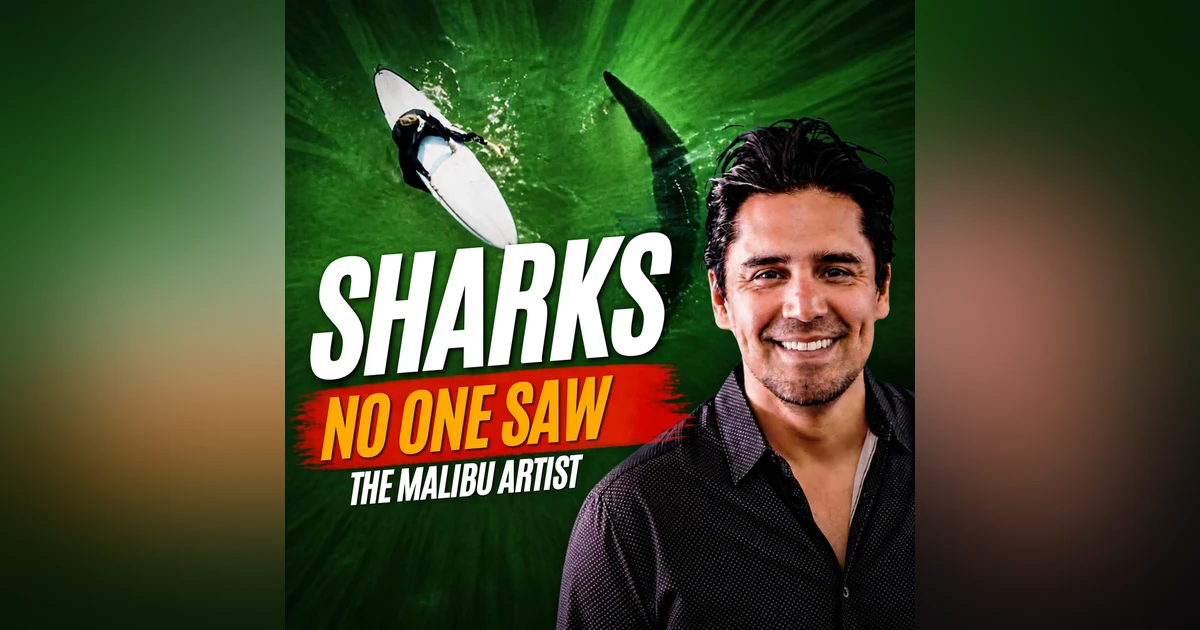
What flying drones over great whites really revealed is that far more white sharks live off Southern California beaches than anyone's records showed, often within a few yards of swimmers who never know they're there. Carlos Gauna, known online as The Malibu Artist, has spent years documenting them from above. It started with a shot he missed: sitting atop Point Dume at sunset without his camera or phone, he watched a large white shark chase a sea lion right below him. He had been flying his drone over gray whales, and from that night on he went looking for sharks. Today the photographer and FAA-certified drone pilot films white sharks nearly every month of the year, has published peer-reviewed research on their behavior, and funds most of his fieldwork through his YouTube channel.
Andrew and Dave follow the whole path with him: storm chasing in Oklahoma with his university's first digital camera, 16 years in corporate insurance while shooting weddings on the side, and a first drone bought in 2016 by someone who admits he couldn't stand drones at first. Carlos explains how he scouted beaches by tallying decades of reported encounters in Ralph Collier's Shark Research Committee records, then used empty COVID-era beaches to search alone. That's where his first viral clip came from: four white sharks consuming a common dolphin in 18 minutes. He also describes how outreach to Dr. Chris Lowe's Shark Lab and to Dr. Alison Towner turned an artist's curiosity into careful science communication. Dave adds what he saw from helicopters over Monterey Bay and South Africa decades ago, and the three of them work through a hard question: are there more white sharks now, or are we just finally able to see them?
The conversation also gets into water temperature as the most reliable predictor of where sharks show up, reading a shark's mood from the angle of its pectoral fins, filming natural behavior with no chum in the water, and the viral video of a swimmer who waved off a lifeguard while white sharks circled him. Carlos compares Southern California's approach to shark sightings with Cape Cod's, shares his simple rule for beachgoers when his drone flies close, and closes with advice for young creators: find a story, and make the content you want to watch.
Takeaways:
- Carlos Gauna switched from filming whales to filming white sharks after seeing a sea lion chased at Point Dume, a moment he couldn't record.
- He found his first shark hotspots by tallying reported encounters, beach by beach, in Ralph Collier's Shark Research Committee records, then searching those beaches by drone.
- Encounter databases rely on people noticing sharks. Drone surveys show white sharks close to swimmers who never knew they were there.
- Warm water temperature is the most consistent predictor Carlos has found for locating white sharks, especially in January and February.
- Hours of observation let him read shark behavior from fin posture, telling a calm, agitated, or foraging shark apart.
- Filming without chum shows natural behavior, which differs from the amped-up sharks seen on baited TV shoots.
- Staying with a group in the water lowers risk, and when a drone hovers close to you, a shark is probably nearby.
Carlos' YouTube Channel: https://www.youtube.com/themalibuartist
0:00 Imagine being able to watch white sharks from above the water using a drone. That's what our guest today, carlos Gauna is here to talk about how he discovered using drones to monitor great whites, not only as a safety thing, but just as a way to observe these wonderful animals. He does this, has a channel also known as The Malibu Artist, and, uh, we have him on the podcast today. He talks about his career and how it turned into going from being a photographer and videographer to doing drone work with great white sharks, having a successful YouTube channel. We're gonna talk all about how that happened, and what he does, and how he loves it on this episode of the Beyond Jaws podcast.
0:43 Let's start the show. Hey, everybody. Welcome back to another exciting episode of the Beyond Jaws podcast. I'm your co-host, Andrew Lewin, here with my co-host, Dr. David Ebert, also known as the Lost Shark Guy. Dave, drone work. I've always wanted- Yeah … to fly a drone. Have you ever flown a drone? I haven't flown them, but I've been with people that have flown them. and I've seen footage and stuff, and it's phenomenal. It's fun. I, I, I wish… there's one of these little tools now that I wished I would've had back in the day when I was doing my graduate studies, watching sevengill sharks. Yeah, right. Because we'd have… Because I would set up, like, high on, like, some bluffs and stuff, and some rocks, and could watch some of the stuff, but nothing like you could get with this drone.
1:24 Yeah. And it'd been really fascinating to watch how those sharks moved about and hunted and interacted with each other from a drone footage. Um, and so Carlos, it's, yeah, He's got some amazing footage- Yeah … on mostly white sharks, but he has other things too. He gets dolphins- Yeah … and other marine, mega marine fauna out there. And, uh, I think, we'll, we'll talk to him today about seeing all the cool stuff. I don't wanna give everything away, 'cause, uh, it's a pretty, it's a fascinating story, and I'm really hoping everybody's gonna enjoy today's, uh, show. Absolutely. Before we get into it, I just have to say, like, can you imagine flying a drone back in the '80s, in the '70s and '80s? People would've thought it was a UFO for sure. Oh, yeah. Oh, yeah. Yeah. Oh, yeah. They'd be like, "What is this? This is, this is something different.
2:06 This is out of this world." Oh, absolutely. Yeah, yeah, it'd be, yeah, it'd be great to go back in a time machine and be able to- Yeah. … be spoofing around the drone. Oh, yeah. Oh, yeah. Yeah. Yeah. People would be lose their, people would lose their minds. Uh- We'll talk about it after the interview, but it's an interesting concept of having a drone and just going out and flying it, and just being able to observe a different viewpoint, of what you're able to see along the coastline, and, you know, obviously white sharks, surfers, and swimmers- Mm-hmm and, and all that kinda stuff, and the other animals that we'll talk about. So I'm looking forward to this interview. So Dave, we'll get right to it. Yep. Here's the interview with Carlos Gauna, talking about the wonderful world of drone footage and coastline in Southern California, which is even better. Yep. Yep. So here's the interview.
2:46 We'll talk to you after. Hey, Carlos. Welcome to the Beyond Jaws podcast. Are you ready to talk about filming sharks? I'm always ready to talk about sharks. All right. Well, welcome to the Beyond Jaws podcast. And today we have a very special guest. We have Carlos Gauna, known as The Malibu Artist. he's a professional photographer, cameraman, and FAA certified drone pilot based in Southern California. He specializes in capturing aerial and landscape imagery, as well as creating unique digital media content. He's best known to many of us in the shark world for his spectacular, uh, drone videos of white sharks off Southern California. He recently posted a video of a swimmer off Southern California with six white sharks swimming around him.
3:26 It's like, wow, that's nuts. But- Carlos uses photography, filmmaking, and drones to bring awareness to wildlife preservation. He's published scientific research and collaborated with scientists across the world. As a public speaker and science communicator, Carlos enjoys sharing ideas that help educate the next generation of conservationists and filmmakers. His goal is to use photography and drones to bring awareness to wildlife and the nature around us. His aim is to bring cinematic elements to the educational, presentation. His photography has been featured on National Geographic Shark Fest, BBC, Discovery's Shark Week, NBC, CBS, LA Times, Boston Globe, PBS, pretty much all the big ones. if it's a big media, he's been there.
4:08 Carlos got his, uh, education, he did a Bachelor's of Science at, uh, Southwestern Oklahoma State and a master's at Oklahoma City University. And we got a lot to cover today, so I'm gonna get right to it. Hoo. Carlos, welcome to the show. It's an honor to be here. I'm looking forward to this one, Carlos. Oh, yeah. I have to admit, we've been watching you for a while. And, uh, you know, the videos are amazing. like, how did it all get started? Yeah. Like, where did this love for the ocean happen? It happened very far away from the ocean to begin with. It started with tornadoes, believe it or not. Oh, really? In the plains of Oklahoma, yeah. Sharknado? Sharknados? Sharknados, there you go. Not quite. It was more like catfish-nados there, but- Yeah, I had a job as the photo editor for the university newspaper.
4:55 And in the early days of digital photography, I, I got the very first digital camera at the university, started using it for things other than newsworthy pieces. Just photographing thunderstorms and, like, just beautiful, like, flowers and things like that. But then one evening, a big thunderstorm came through, and I just fell in love with photography. Started learning how to do long exposures, and chasing tornadoes, in fact. And, um, that really started my love for photography. Storm chasing. This started with storm chasing. Mm-hmm. Wow. that'd make a good movie. It would. Twister or something. The Storm Chaser. That'd be great. We have to think about that one, so, And you grew up in Oklahoma, just so we're clear there, in the middle, basically the middle.
5:39 Yeah. Well, I grew up in New Mexico, and then went to Oklahoma. And I lived there for 10 years, did my undergrad graduate work there. Mm-hmm. And I lived on the plains of Oklahoma. Ended up on the coast here in California, and I wanted to be by the ocean, and I ended up moving to Malibu. That must have been 2007 or so. And, um, all that time, I'd been a photographer, wedding photography, commercial photography, had my business in Malibu. And, uh, I just fell in love with the ocean. I found myself, I think I had a streak there for a couple years where I saw sunset at the ocean, um, every day. Wow. That was my thing. That's how I started on social media, photographing sunsets in Malibu. did you start off early on in social media?
6:19 Like, when people started getting into the social media- Mmm … were you early on, or? Not really. you know what? I started Instagram, like, in 2013. I guess that was early. ' Cause Instagram, when did Instagram start? Uh, like, Facebook started, like, 2007, 2008 to, like, the public, like, beyond- Right … those universities. But I think Instagram was, probably around, like, what? 2011, 2012? I'm not too sure. Something like that. Yeah. But it, was, I guess it was early for Instagram. I know I started in 2013, but I was literally uploading… You probably even go all the way down my Instagram feed, you can see, I think I was just uploading photos of my cat. The long way we've come. Yeah. Oh, it's- Well, if- … 2010 Instagram started.
7:00 Okay. Okay. Yeah. Well, there's a lot of cat people out there, so you've- probably got an audience early on just the cat people. Yeah, oh, 100%. Uh, yeah. Cat, cats were big back then. I remember YouTube was- Yeah … all cat videos, right? Yeah. Yeah. Yeah. Kinda what brought you out to California? You just wanted to come to the ocean, or? Yeah, I had an opportunity, uh, in the corporate world to move out here. Okay. And I, got a job on the West Coast here in Los Angeles for a major insurance company, and I actually worked in the corporate world for 16 years. Wow. Um, but it, my heart wasn't in it. I needed- Yeah … to be outside. I couldn't stand being in an office building and, doing the corporate thing. Yeah. Mm-hmm. Uh, and you know, meanwhile, I was photographing weddings and commercial work and doing those gigs on the side.
7:42 Uh, and then drones came onto the scene in around 2016, and I bought my first drone, and I started using it to film the gray whales. and the gray whales- Oh … in Malibu are one of the best places, it is one of the best places to see a gray whale up close in the world. Yeah. Yeah, for sure. when you decided, like, drones were really new back then. not a lot of people had them. Obviously you were into photography, into videography. What made you decide drones would be a good tool, to use? And was it just for wildlife, like off the ocean, or was it for your wedding business? funny thing is I never incorporated it into my business.
8:24 Uh- Okay … it was really just my hobby at the time. Yeah. Yeah. I saw it as, you know, as a creative, you're always looking for new outlets, new technologies, new things to kind of explore new creative, creative avenues, right? And so that's what it was for me. to, to be frank, I hated drones when they first came out. I just couldn't stand, like, them. They were so loud and everything. Yeah. and then, I don't know, just one day I was like, "I'm gonna get one of these. There's a camera in the sky. I mean, yeah, that sounds cool." Mm-hmm. And I started playing with drones. when the whales came through, I started filming them, and then I just fell in love with seeing the ocean from the sky. That's where it all started. Mm-hmm. Did you ever have to worry about using drones around whales at first?
9:07 Because I remember there weren't any regulations around it at that time. Like I remember a certain, uh, scientist, like, they were like, " we're not allowed to use them." Like, "We won't get permits." Like, it was, the regulations hadn't been put in place, and nobody knew how to deal with them. Did that affect you in any kind of way? Or was it later on that you did that when all the regulations were in place? I had a mentor who's very, very old school mentor that, you know, my biggest dream was to be a Nat Geo photographer, and I always believed in, as a photojournalist, 'cause I, you know, I was in photojournalism, um- Mm-hmm I always believed that you should have as little impact on what you're- Yeah … photographing as possible. And so for me, I never, looked at it as, "I'm gonna bug these whales."
9:49 Right. ' And back then they were so new, I did not wanna get close to a whale. Like, I was- 'Cause you didn't even know what would happen. Yeah, for sure. Yeah, yeah, yeah. For sure. and, you know, just you start researching, start asking people, like things like that. Even with a new technology like that, it's always best to just play it conservatively, and that's what I did. I observed the whales. And, funny enough, I started noticing that the whales really didn't care about the drone and so like, you know, just one of those things you evolve into. You just- Yeah … take information, you learn, and then, you know, you gotta be ethical. You gotta have that- Of course … innate ability- Yeah … to tell this is gonna affect the animal, and my shot's gonna be wasted if it does. Yeah. Was it a difficult thing to learn how to fly a drone?
10:31 'Cause that's gotta be, like especially at the beginning, it's gotta be a kind of a bit of a learning curve, right? The wind and everything, especially out offshore. Well, there are some shooters. I remember my first flight. Yes. There are some shooters. Do I lose it? So tell us about it. So here's a, here's a, here's a little, uh, tidbit for you, and I always thank my mom for this 'cause I still to this day, she was just here last week, and I told her, "See, Mom, all those hours of video gaming has really, really paid off." And see, I told you. I told you. Mm. So fine-tuning and controlling the drone in the air and stuff- Mm-hmm … honestly, I learned that basic skill set through my many hours of video gaming. Love it. Uh- There you go … but it's true. It is, it is a remote.
11:11 Like, it is like a game console remote, right? Like it's not that- Yeah far off. So yeah, I could see that. Yeah. If you fly, uh, any of the, if you play any of the first-person shooter games or any of the- Yeah airplane games, even like Star Wars, it's the same controls. It's the same exact controls. Yeah. Yeah. Yeah. That's interesting. so when you're doing the whales, they, you're, you know, you're still working in the corporate world. You're doing your side gig with the wedding photography, and then you're doing this hobby of the whales. And so, like, you're, as you're going, like taking all these like, I'm sure, really nice whale pictures, did you kinda stumble into the sharks? Or how'd that come about? You know, that real light bulb moment came, like many things do in life, by accident.
11:53 at the time, I only had three batteries. You buy your kit, and you have three batteries, and that's it. And so I knew the whales were coming through. It was March. there's an Instagram post that I made, on that day, and I usually would go spin sunset, fly in the drone, use my batteries, and then go up and take pictures of the flowers and whatnot. That was my feed. And I'll never forget this day because I'm standing atop Point Dume. Have you been to Point Dume before in Malibu? No. Uh, long time ago, but yeah Okay. Have you seen the end of Planet of the Apes? Oh, yeah. Yep. I know- The Statue of Liberty. I know exactly what you're talking about now. Yep. That big rock is Point Dume. I was standing at the very point of that rock, and, um, I had run out of batteries.
12:37 So there's a parking lot down at the bottom. So I was flying my drone from the parking lot, 'cause you can't fly from the top because it's a state park. So I'm flying from down at the bottom. I run out of batteries, and I hadn't seen any whales. and, you know, I was there three hours. I used all my batteries, and then decided to just go take in the sunset. So I walked all the way to the top, left my phone behind, my camera behind. I'm just gonna watch the sun. The one night I don't bring my camera or my phone, whatever, and I sit up there, and there's like a, it's almost like a chair up, up there, a rock formation. You could just sit up there and enjoy sunset. And I'm sitting there, and I see a splash, and I'm like, "What is that down there?" And dorsal fin comes up.
13:20 I look at it again, I'm just watching it, and then I see a sea lion just jump in the sky. Mm-hmm. And there's another splash, and this shark starts chasing a sea lion. I was watching a Nat Geo documentary live. Mm-hmm. I was watching a sea lion getting chased by a 16-foot great white shark. And I'm like, "Oh my gosh, that's a shark." And it had its dorsal fin Jaws style, just going around. there was another woman up there that came up, and I said, "Are you seeing that? Are you seeing that?" And she said, "Oh my gosh." And she gets her phone out and she starts filming it. And I didn't have my camera, damn nothing. Of course. No one's gonna believe me, right? Yeah. So, I get back to my car. I told the woman that, was up there, I, I told her, "Hey, this is my email.
14:01 Can you send this to me, like your footage? 'Cause no one's gonna believe me. I just wanna have it just for myself." I never heard from her, unfortunately. That sucks, yeah. However, I get in my car and I'm driving home, and I think about, I'm just thinking about what I just saw, and it's just a light bulb moment. I'm like, "You know what? Maybe I'm looking for the wrong species. What if I start researching sharks? What if I start looking for areas where the sharks might be, and start dedicating some time, my free time, to just making the sharks my hobby?" Hmm. And that's where it all started. Instead of the whales. Instead of the whales, yeah. Because a lot of people are filming whales, and as, like me, I always wanna do something that's… I don't wanna copy what everyone else is doing.
14:47 Of course, right. I wanna do my own thing. I wanna just, lead in that capacity. And my Instagram post, you can still see it, it's up still to this day, where I said, you know, "I missed out this opportunity to film or photograph the only great white shark I probably will ever see in my life." Is what I put in my Instagram post. That's- Little did I know that I see great whites every day. Like, I was next to one two hours ago. Yeah. how long ago was this? How many years ago was this you got that first, you saw that? This must have been 2017 or 2018. I think it's 2018. Okay. Yeah. Okay. Okay. so when you started to go out with your drone, how long did it take you till you actually, like, were able to start finding the sharks?
15:28 It wasn't a process that I started immediately. Anyone that knows me knows I'm very, I do my homework before I just go out. So I'm not one to just test things. I like to do my homework, I like to do my research, and just kind of be strategic about what I do. And so I spent a lot of time actually, just doing online sleuthing, like looking at where encounters were. the one website that was the most beneficial was the Pacific Coast Research Committee by, um, the late, uh, Ralph Collier. Ralph Collier, yep. Yep. Yeah. and Ralph, he was so, so impactful in getting me started in this. Mm-hmm. Not directly, but indirectly, because I relied on his amazing documentation of shark data going back to the '90s, '80s, you know- Yeah … all this.
16:16 Ralph went back to the '60s, I think, when he started- Yeah, yeah as a teenager. Yeah. Yeah. But on the- So … but on the website, it went back quite- Yeah … a few years. Yeah, yeah. And so what I did is I pulled up his website, and I would see a beach, and I would put a stick mark on it. I'd go to the next beach, put a stick mark on it. And then after a while, this one has five, this one has six, has seven, eight, nine, 10 encounters. Well, that seems like a good beach to go start my search at. And so I started doing that. I started just going to these beaches as time allowed. Mm-hmm. And then I started finding sharks. And I started seeing that sharks were kind of around us more than probably even Ralph ever believed, Yeah based on his reports, right?
16:59 Yeah. And so now, like, I'm there, I'm like, "Wow, these sharks are here all the time." Regardless of where I go, the sharks are there. And so that was kind of the process. That whole process took, like, two years, and then when COVID hit, all the beaches were closed, and I had all this free time to go by myself- Mm-hmm and just search the beaches. And j- and just search the be- that'd … Well, probably w- I guess, uh, you had one benefit there. You could just go out there by yourself and fly the drone- Yeah … and not worry about a whole bunch of people out there. Exactly. COVID was very important to me there because, uh, you know, I, I guess you can't say very important, 'cause that was- Yeah not a good thing. it's not a good thing- Yeah … of course. Yeah. It was not a good thing, but for my personal story, that opportunity lent itself to me being able to go out by myself, empty beaches, in my car, and just sit in my car and fly my drone.
17:47 Yeah. And you, so you started going out there, you started picking up with the sharks and seeing that there's kinda like there's a lot of sharks out here- Mm-hmm … with the drone. initially was it off Point Dume, or w- any particular beaches you can share where you were really started seeing them? Man, I went everywhere from Long Beach to Emma Wood State Beach to Sunset Point Malibu to County Line. You name it, I was at every beach if there was an encounter. Uh, went all the way to Rincon Beach, you know, the, Padaro Lane up in Ca- Carpinteria. and just from there all the way just south. Yeah. From Santa Barbara south all the way to Long Beach, and I started finding sharks. Um, even down in, Huntington Beach. this is over the course of two and a half years, but, like, yeah.
18:28 Yeah. That, that's- It- That was a wake-up call seeing all those sharks. And, and I get- I can imagine, yeah. And I'm guessing, I don't know what, point. So I, I presume you talked to Ralph and, like you said, Ralph was probably stunned at how many you were seeing. and then I know Chris Lowe had the white shark program going there. At what point did you just said, "I better might go talk to Chris, Chris there about your white shark stuff"? I filmed my very first viral piece during COVID. Mm-hmm. It was a white shark, four white sharks, they basically ate a whole common dolphin in 18 minutes. Hmm. Didn't leave anything behind. Yeah. That was my very first viral piece of footage that I captured. That was the catalyst to launching the YouTube channel- Yeah which would be a very vital part to what I do every day.
19:13 Because without the YouTube channel and the revenue that came through that, I wouldn't have been able to finance- Right … half of the stuff that I do. Yeah. And so that viral piece, I launched my channel at the same time. I knew that was gonna go viral. I launched it, got 3 million views basically- Wow … in the first week or so, and it was enough to meet the hours and get monetized on YouTube, and then from there on is- From one video? Kept, kept it. Yeah. One video. Oof. Amazing. that is amazing there. Again, especially, and we, a college is a perfect thing. You got, what'd you have, four, you said four white sharks feeding on a, a dolphin basically. Yeah. Gosh, that- Right … that's amazing. That's a- And to answer your question, yeah, to Chris Lowe, I didn't come in contact with Chris Lowe until probably, mm, late 2020.
19:57 Okay. When some of my footage started gaining traction and people were watching it. I've always had a, a kind of a, I don't know if it's probably through schooling, I don't wanna misinform people or act like I know it. Yeah, right … because I'm definitely not an expert in the field. And so I actually made a call to Chris Lowe, emailed him and the Shark Lab, and started consulting with me on some things. You can see that I've actually cited the Shark Lab in a lot of my early videos- Mm-hmm, mm … as that relationship started growing there. And then, um, LA Times really put us together because they put us on the front page. Okay. Okay. Okay. Like when you guys were going out together- Put the two drugs together is that it?
20:37 Yeah. Let me back up a little bit. So what'd Ralph say? 'Cause I, I knew Ralph. what'd Ralph say when you started telling him about all these sharks you were seeing? Did he have any- Oh, it, no, it was all through email. Okay. And, um, he was amazed. He was like, "Wow, that's pretty interesting." And, you know, one email he told me that the sharks were, like, there would be years in between incidents at these places. And, I can't remember the beach. Maybe it might have been actually the one in Carpinteria, I believe. Anyways, he said that yeah, there hadn't been a, a sighting there in a while. I was like, "Well, I saw 20 of them last week there." But you're, but so, so let's just get, like I just, I just wanna differentiate too, like- So he's looking at it from a boat, you're looking at it from above where there's no disturbance in the water.
21:27 So you can almost argue that if there's like a motorboat going around, even if it's stopped, it could be something that pushes away the sharks. Whereas you're not even in the water, you're however many feet above, you can see a lot more, they're just not as disturbed. Obviously, you can see if they were disturbed, they would probably leave, right? Like that's an assumption I would make. But that's kinda the benefit for you is because you're so high up, you're not in the water watching them. Mm-hmm. You can see so many more. Is that- And just to clarify, his database, the Pacific Coast Research Committee's database, which is Ralph's website that he had, a, an amazing archive, all of that was self-reported shark incidents. So you have a beach, like I've seen, he said, well, we haven't had a shark incident at this particular beach in several years.
22:13 But that means that they haven't had a surfer that got bumped or a surfer that was about to catch a wave and see a shark. That's what we define as an incident. Mm-hmm. Right. So it, I mean, it was a self-reporting, like how many of these encounters occurred when an actual human was able to see it? Mm-hmm. Mm-hmm. Or was there a tooth fragment? Something that you could measure that was actually counted as a shark sighting. Mm-hmm. Mm-hmm. So the, key thing was there, it's like, "Hey, there hasn't been a shark sighting per your report because people haven't actually reported something in four years." Yeah. Yeah. "But I saw 20 here this week, and you know what else I saw? I saw 15 people in the water, and not one- Mm-hmm … of those people saw a white shark next to them."
22:55 That was- Yeah. It's insane. I, I, yeah. I… Well, if people know that listen to the podcast, I grew up here in Monterey, and I've been in the water since I was about eight years old, literally like free diving. I used to do a lot of free diving, spearfishing and stuff when I was younger. And people kinda knew there were sharks around, especially times of the year. they knew they were around, but you just try, you know, think about and stuff. But if I would've had any idea there was like 20, 30 white sharks in the water, might have rethought the whole spearfishing thing back then- … or the free diving thing. But were there that many back then? Because, like, we've seen a population boom over the last few decades, but you know, when you were younger, you're talking 1970s. '70s, '80s. '80s. Yeah. ' 70s, eight- Yeah, s- '70s, '80s.
23:36 Yeah. Like were there a lot then? 'Cause that's when they got put on the Endangered Species Act at that point, right? Yeah. well, this gets into the whole thing about, yeah, I think the population's probably gone up. Except I'm the old guy here on the show, but- Right I think, I think the, I think the… Thanks, Andrew. Um, I have to- Um. I said '70s, I didn't say '40s. I could've said '40s. Yeah, I know. Yeah, yeah. but I just, once in a while some fisherman would see one or you'd catch one and stuff, or you might see something off in the distance, but, you know, you weren't thinking like, You know they're around. But since they started, uh, well, I know I, I started going up in 2014 with, um, specialized helicopters up in Wa- out of Watsonville, Chris Galardi's company. And we would routinely go up to the… Are, are you familiar with the Monterey up here, Carlos?
24:19 It's the cement boat- Yeah. Yeah … in that area. we'd go up and go out to the cement boat, and, like, along a, about a two-mile stretch of beach, I'd count 40 white sharks. There's sort of kind of mostly in that six, eight foot, maybe a little bigger, but that. And then, and we just, you just literally get tired of counting them. And then of course, you see all the kids in the surf boogie boarding, surf, body surfing, the parents are laying on the beach. You can see all this from, you know, about 1,000 foot up, which sounds like a long way, but when you're at that height, you suddenly this whole view shows up, and all these sharks are just hanging out in back of the surf, just hanging around and kids are playing in there. And that area is, it's a real popular beach up here in this area. and then you go down to Manresa Beach, which is a couple of miles away, where the, it's a big s- surf area, and that's, that's where the big white sharks.
25:05 You'll see these sort of 16-footers hanging out, just people surfing and… if you would've ever asked me, like, years ago if there are that many white sharks, "Oh no, there's no way there's that many white sharks there." So, and I, I don't think in the '70s and '80s there was that many, you know, out there. But, that's just My best guess and, dad was a marine biologist with Fish and Game up here, so I had a kind of a bit of an insight into what was going on, if people would see sharks and white sharks and stuff. and as I, I mentioned, have you been up here to Monterey at all, Carlos, doing any filming up here? Yeah. Yeah, definitely. I'll be up there, uh, probably soon as well. Okay. Okay. Um, but there's definitely some big sharks up there. The interesting thing about Monterey and that whole area, is that a lot of the sharks that I've observed down here, I've actually documented connectivity between the sharks up there and the sharks that I'm seeing down here.
25:55 Mm-hmm. Uh, from the big sharks, the, the- Hmm … big ones. Mm-hmm. Yeah. So, you know, whether they go to Guadalupe or whether they're the Farallons tribe, I think that they just cover the whole West Coast. I think they just- Yeah … go up the whole West Coast. Yeah. yeah, I mean, the one thing I can say from growing up here is small white sharks were really unusual to see up here, except during El Niño years. They would catch them, the fishermen might ca- you know, back in the '70s and '80s there was no restrictions, and not that people were trying to catch them, but they would incidentally catch them here, but they were larger ones. Except during El Niño years you would pick up these smaller ones. But since about 2014, they're routinely here now all the time, and that's, to get back to our question about has the population gone up, I would say yes, just because of all these smaller ones- Mm-hmm … we see up here now year-round.
26:44 I don't know about all year round, but definitely three quarters of the year now. They'll show up around April or so, May, and they're here pretty much till December, for the most part. They start thinning out a little bit, but you definitely see the smaller ones up here, which we never, they used to be pretty rare. But which I guess- A couple things there that are interesting a- Yeah about that, is, people always ask me what I do to find the sharks, how do I find them to begin with, what are the tips? the one variable that I always find consistent with the success of finding white sharks is always water temperature. and them moving farther north- The water's getting warmer. we have documented proof the water's- Yeah … getting warmer farther north. Well- So it makes sense that those juveniles are moving up.
27:25 The other thing, too, is that area where the, cement boat is, that, that New Brighton area in Santa Cruz, I know talking to the oceanographers, that area tends to be a warmer area within the bay. I don't know if microclimate's the right word, but that area tends to be warmer. And so that makes sense why the, small white sharks are hanging out in that one area there, 'cause it tends to be warmer than the other parts of the bay, which drop off and are a little deeper there. But that's really interesting what you're saying. y- how it's temperature related, on stuff. I guess the question is, next question is, do you check on the water temperature when you go out, when you're out flying your drone, like, on a daily, like if you're off this beach or that beach, do you kinda check what the temperature is? Yeah. Uh- Water temperature's probably the baseline- Okay … to start with.
28:05 Especially in the off-seasons, January, February. Mm-hmm. Those are really important. Where the water's warm is you're gonna find the sharks, much higher area. Even, even, I don't know Southern California quite as well, but do, so you see them pretty much year-round if the water temperature's up there? Every single month, yeah. Okay. Year-round. Okay. again, the, the, uh, the guys that used to have the best data going back to the '60s was the, uh, marine mammal guys. They used to do aerial, flyovers for, uh, whales and that type of stuff. And those guys, they used to record shark sightings, basking sharks, white sharks. And there's a couple papers published in the '70s and '80s just on sightings and at least up in this area, kinda May to November, December, they would see them.
28:49 There'd be a bit of a spike August, September, October, which that's kind of, like, pretty typical. but with the drone stuff or people going up in helicopters now, you see them most of the year, except up here middle of the w- again, I'm not, I don't stay dialed in on it all the time, 'cause frankly, they're magnificent to see the white sharks, as you know, but as a shark guy, I get kinda bored with them. It's like, "Oh, okay, another white shark." Hence the name of the podcast, Beyond Jaws. Beyond Jaws. Good one. I will tell you- That, that wasn't my idea. That was all Dave. Yeah. I will tell you they can be very boring to watch, and to get those little, like, micro behaviors that are really cool, I think people don't realize how many hours of observation it takes to get a shark- Yeah turning, becoming inverted, for example, or doing a breach.
29:38 I filmed a breach today, for example. and so that just takes hours upon hours. Mmm, there's a breach right there Oh, wow. Wow. That's awesome. That was, that was, um, that was today. That's not from your drone, that's from, like, your own camera, right? Like from the shore? So I always set a camera next to me. Okay, just in case. I'm, I'm, I'm now starting to set cameras next to me while I'm filming. I do film them from my drone. Of course. Yeah. Yeah, of course. Definitely. Yeah. But, but that was right next to me today. And so yeah, it's crazy. Yeah. Well, y- well, I, I always, I've told this story many times in here, but you know, I, I did my PhD in South Africa in the late '80s, and down there the sharks breaching was pretty well known by the locals.
30:20 And I can remember seeing that, and coming back here and trying to tell people like John McCosker, Ralph Collier, Leonard Cap- well, Capano was in South Africa. He was with me, so he kinda, he'd seen it too. But you come up back home and try to tell these people st- that, and their thought, like, "Are you drinking or smoking dope, Dave, or whatever you're doing?" I go, "No, no, I don't drink. I don't do drugs. but these sharks really are breaching up here." Because you had no, cameras that could really capture it like, like you're doing now. Um, and now of course we seem like, yeah, they seem to kinda do it everywhere, most places you go, whether South Africa or California or Australia. that to me is, like, all this drone stuff, just fascinating that would've been awesome to have, like, 40 years ago when I was a punk kid- Yeah running around, you know. I spent a month in South Africa earlier, back in May, and, um- Oh, did you?
31:02 I didn't see a single white shark breach unfortunately. Oh. Man, so, uh- You know, things have changed down there. But, uh- Of course that was quite an experience. Uh, South Africa is, uh, pretty, pretty amazing. Oh, yes, yes. it's really n- nice. In fact, if you go up to the Eastern Cape, it's very similar to, uh, what you see down where you are, down in the Malibu, that area, that, those long, sandy beaches. And that area is kind of in the Eastern Cape past Port Elizabeth. It's very similar habitat, and even back when I was a student it was known that you could find small white sharks out there at times of the year. And you'd get, like, fi- I mean, like, five, six-foot white sharks. At times they'd be really abundant around in that area. And I think it had to do with the water temperature, like you're talking about as well.
31:44 But back then we didn't have nearly the- Type of technology, which you have, which makes me, again, makes me a little envious about- I was in East London there on- Yep the Eastern Cape and filmed white sharks near kayakers and people- Yep … and just like here, and some big sharks as well. So, you know something always people always say, "Those California sharks are so calm, and if that was South Africa or if it was Australia, those people- Right … would be gone." That's just not the case. No. I just see, I saw the same thing in South Africa. I saw people unknowingly kayaking next to a large white shark. I just think that these animals, again, That Jaws reputation has just followed them all around the world. Yeah, yeah. Yeah. Well, again, again, uh, just sharing a quick story.
32:25 I've talked to Andrew about this, but when I was first in South Africa I, I went out to a place called Bird Island. I was actually looking for a guitarfish, but they had a South African Defense Force helicopter pick me up on the mainland and flew me out. And the guys, this is like 1986, they said, "Hey, you wanna go see some sharks from the air?" It was my first helicopter ride ever, you know, and I'm like, "Sure, why not?" And I had no frame of reference for what I was about to see. But we flow along that coast towards, I don't know if you know where Kenton-on-Sea is roughly, towards- Mm-hmm … uh, it's kind of about halfway between East London and, Port Elizabeth. And we flew along the beach, there are some popular beaches, and you see these sharks, bronzies, raggtos, and then you see like a white shark.
33:09 And when you're in the air, there's nothing else that could be. you just go like, that's a white shark. And you see this, and you see these swimmers and surfers right there in the surf and maybe 50 feet beyond them there's this, 16, 18-foot white shark just cruising along the back. and so that was the first time I'd ever seen sharks from the air like- Yeah … like you're describing there. So I guess the- And massive ones too, I'm sure. Yeah. So I guess coming back to the thing we, we talked about a few minutes ago is I think there probably were sharks around, but just nobody was up in a helicopter or had drones that see how many were around. Right. You know? They may not have been- Unless you saw the breaching ones, but that's about it … the, the breaching ones, yeah. Did you, do you, so how do you- I, I always ask people, um, you know, when you talk about population numbers, because, I spent some time up at the Farallons with Scott Anderson and Dr.
33:58 Paul Knvy up there at the California White Shark Project. They're doing some amazing work up there with counting the sharks and ID-ing the sharks and getting that population study going. But I always go back to where I'm seeing a lot of juveniles, a lot of juveniles. We've seen, like yes, on the surface it looks like there's more sharks, but how many of those juveniles are making it to that adult age? I think that's the unknown there when you're talking about populations, is the population really up? how do we know that those young sharks are making it to adulthood? Right. We really don't, do we? No. We don't know that. Yeah. The only way you see if there's, like, constant tagging and following and observing, right?
34:38 Yeah. Mm-hmm. - The theory would be there's, is that there's so many marine mammals out there, seals, sea lions, whales. There's a lot of food out there, and so by extension that the assumption is the population's probably up, but nobody really has any hard information. In fact, if you weren't flying drones, you and other people weren't doing these drone surveys, we wouldn't have any idea just how many sharks are out there now. Mm-hmm. ' We literally would have no idea. And as you started out your journey, that first feeding event you saw, you had no camera, no phone, no nothing, and you're just trying to explain it to people. So it's like- Yeah. … you know, it's like, uh, yeah, good luck on that. That's right.
35:19 have to ask too, like, as you started to capture more footage of these animals, at what point did you really start to get really interested in the science and the numbers and the health of the population? ' As we're doing this interview, I'm on your Instagram, and I'm going through some of these shots. You've had some incredible experiences of seeing all different types of whales, from gray whales and humpbacks and orcas and different types of sharks and, and so forth. But, like, at what point did you get interested as an artist to say, "Hey, look, here are some people swimming by these sharks, but also there's a lot more sharks than I originally thought," probably yourself as well, like, to say, "Hey, I didn't expect these to be here." And you're, you and, uh, maybe s- a handful of others are at the forefront of shooting all these, sharks.
36:05 At what point did you be like, " Like, when you started talking to scientists, like, get really interested in the science? Was it when you actually really started to get the, the answers from, like, people like Chris and Collier and, and those things, or those guys who were like, "Yeah, these are, this is what's going on," or, "This is what we've been observing," kinda thing? Or where did that scientific interest come from? And, you know, a lot of that, came from just my natural curiosity with the world- Yeah. Yeah … honestly. I'm a really, really, big proponent of making sure that the public is informed. All of us should do our, our just our civic duty of making sure we don't say things that we don't know. Mm-hmm. Especially when you start getting a following and people are watching, I did not want to misinform people.
36:50 So- Mm-hmm … at that point, I was like, "Oh, a lot of people like this content. A lot of people are asking me questions, but I don't feel comfortable answering this because I could Google it and just say whatever." Mm-hmm. But I just really wanted to give an opportunity to the experts and to the people that know this stuff, because if there's one thing, remember, I have a background in PR, if there's one thing that I've realized the science community doesn't do very well is communicate. and so that really helped me. I was like, I, okay, I got a chance here to communicate a science, a field, and I started, you know, making phone calls. You know Dr. Alison Towner down in South Africa? Oh, yeah. She was really, really, really vital to my early success in this because a lot of the stuff I didn't know.
37:37 "Wait, Alison, here's a clip. What the heck's going on? Why is this shark doing this?" Mm-hmm. And she would explain it so well for me, and that really helped me a lot. So I leaned into the experts. I leaned into the people that are around sharks all the time. Yeah. And slowly, just through osmosis, started learning their behaviors. And then the one thing that I would also do is I've observed the sharks, and I'd started noticing patterns in their movements, patterns in how, in order to be a cinematographer and capture the right angle to kind of- know what's gonna happen before it happens, you have to understand the animal. And so I started- Of course … getting into the nerdy stuff of learning- Yeah … you know what?
38:17 That peck fin is down, that shark's gonna move in this direction, or it's pointed, this shark is moving differently. now I can tell a shark whether it's calm, whether it's agitated, whether it's moving, or whether it's foraging. Those little subtle movements in the fins can tell you that, but you only get that through countless hours of observing them. Yeah. Mm. Yeah. Well, I've told this story on the show, is that when I was a student and stuff, I spent years trying to get into high locations where I could watch sharks. I didn't have the drone and stuff, but I could watch. That's where I started seeing, like, sevengill sharks h- hunting in groups. 'cause you'd see, like, you know they're not, it's not a random… I think you had some foota- you talked about your first footage of those white sharks feeding on the dolphin.
38:59 Y- you know it's not a random what they're doing. It's a coordinated hunt and kill, basically, for food. Mm-hmm. But you gotta just sit and watch, kinda without the noise going on about, and just try to observe. And especially now with your video footage, you can really analyze what's going on now. That, to me, is just- Yeah … great to be able to do. I mean, that feeding event, you could see three smaller white sharks, they wanted to nibble. they're taking their turns, and you see the dominance hierarchy immediately. The big one comes in, they leave. This is your dolphin. Yeah. Yep. we'll, we'll take the scraps. Yeah. Yeah. And so you could see that. But when I filmed it, I couldn't see it. Now, when I'm filming a scene that's similar to that, I know exactly where I wanna put the camera because I know here comes the big shark, I need to get ready for this one.
39:47 Again, I've showed some of this stuff before, but you know, what really got me going onto stuff, and I've tried to express this to young people too, is, and this, this was the brilliance of Leonard Compagno, is when I was trying, first trying ex- like you are, Carlos, I was trying to explain this to him, and he goes, "I got some books for you to read." And I read some books on lions and how they hunt. Uh, I think it was Hans Kruuk and The Spotted Hyena. I was in Africa, so naturally, like, well, let's watch what the land predators do. And when you start reading up these things and you're, like, going, "Oh, my gosh. This is exactly what these sharks are doing." Same type of pattern, but just being on the water like that, you only get short, quick, little glimpses of what they're doing.
40:28 but yeah, if anybody's interested, like I said, check out some of these books on foraging strategies of some of these land predators, you know, where it could be grizzly bears or wolves would be a good one to look at too, but, but hyenas, lions. You can apply a lot of what you see with the sharks to these land animals. Very similar- Yeah … type of, type of- Yeah. And, you know, and if you wanna do, like, a literal comparison with lions, for example, The one novel thing about drones is that we can see the sharks' behavior without a third party in the water, without interfering what they're doing. But a key thing here, and you'll see this, like for example, why do the sharks on Shark Week look so amped up all the time, or even Nat Geo, whatever?
41:09 It's because there's chum in the water, there's blood in the water, so the sharks' demeanor is completely different. So what I'm doing now is I'm even filming them underwater with no chum, with no anything, to get that real movement of the sharks. and from the- Yeah … air you really see that. And so a- Yeah … lot can be said about, comparing it to lion, for example. If if you have a safari vehicle and you hang a giant piece of bloody meat off the back of that- Yep. For sure … safari vehicle- Exactly … lions are gonna be completely different- Yeah. Yep. Yeah … than if you're just observing them without any meat around. Yeah, no, I've, I've used it. My thing is if you sit in your Land Rover and you toss beef steaks out the window for the lions, you'll get some great pictures, but that's not really telling anything about what the lions- No … are doing.
41:51 Yeah. It's not their natural- That's exactly how… That's, yeah, same story. So yeah. No, you're right. It's not a natural… Yeah. So Carlos, as I said, I'm going through your Instagram feed. I, I noticed most of the shots are drone shots, but you kinda just mentioned it. You've done some underwater videography and like phenomenal, videography. How long did it take you to start doing videography under the water and what was the biggest like differences or challenges that you had to face? Or had you done it before, uh, before you started doing all this drone stuff over- I had, I had done it before as a photographer. the thing about- Okay … the drone stuff, and I have this discussion with, producers and stuff for productions for TV and BBC and stuff, is that I always get painted into the aerial square.
42:33 Mm. Yeah, yeah, yeah. And so, and people think I'm just… I only know how to do this. Yeah. But I get in the water and I film, I scuba dive, I do those things with sharks. and I've been able to witness some amazing things underw- I almost got swallowed by a barrudis whale, but the photograph came out amazing. I got the shot. Excellent. But like- Classic photographer. Yeah, yeah, yeah. Hey, the one thing that's amazing is I've swam with the orcas, I've done this, but last month I got in the water with pilot whales, right? But I didn't take my camera at all. So I'm in the water with these pilot whales. They're surround- doing vortexes around me and stuff. But then I'm thinking You know, it's really different. Like, I started getting spooked out because I didn't have my camera with me, and I started thinking things that I just don't think of whenever I have the camera.
43:19 And it's like- It's like a security blanket … as soon as I get the camera in my hand, I'm like, I feel invincible. Like I'm just- Interesting … oh, I got a mission. I'm doing this, right? Yeah. But without the camera, it was a whole different world. Uh- A little more- I guess what I'm trying to s- … a little more vulnerable in the water. Is that what it is? Yeah. Yeah. Yeah. Yeah. and so what I'm trying to say is I love being in the water. I love filming everything underwater as well. The white sharks, I'm starting to do that, but I'm not swimming with the white sharks. I'm developing different contraptions to film them underwater where I don't have to be in the water with them, whether it's a reef cam or whether it's a tow cam, things like that, to get these intimate shots of the sharks, again, without my interference directly. Yeah. Yeah. so I gotta ask you, like s- because it's almost that, you know too much from doing all your filming and stuff, does that give you pause when you go to the beach to go in the ocean, or if your kids are with you?
44:08 No, no. Okay. it, it doesn't. I tell you I wouldn't be swimming at sunset by myself, that's for sure. Yeah. You know, I've learned a thing or two. Yeah. No, I, well, I, I know up here, like Chris always says, like sort of dawn and dusk is when the sharks seem to get most active. During the day- Mm-hmm … he says they're mostly just hanging out, just could care less of what you're doing there. They're just literally just kind of- And, and I see big ones near shore during the day. I saw an 18-footer. I've seen 16-footers, 15-footers. they come in really close to some of these areas that are stereotypically juvenile nursery areas. And I talked to Allison Towner about it, for example, and she believes that some of these sharks are probably using the warm water temperatures to aid them with digestion, and that's why they're so lethargic when I see them.
44:51 I've taken my kayak next to an 18-footer with no problem at all, right next to him. Mm. Like, "Hello." And they just don't care. Yeah. Yeah. Um, they might just be full, and they're just in that warm digestion s- phase. Mm-hmm. got that, it was just, was all over on, social media, the guy was swimming there, and he had six white sharks swimming around him. Could you tell us a little bit about that? Yeah, that was actually recently, less than a month ago from the recording- Yeah … uh, that we're doing right now. Uh, you know, that guy, he was out there swimming, and rarely do these encounters happen, like, close enough to where I can yell at people. They're usually pretty far down the beach, or I'm not able- Mm-hmm to physically let people know. In this case, not only did I yell at the guy and tell him, you know, " there's a shark," there was a lifeguard there as well, and the lifeguard paddled over there and started telling him, "Hey, you got sharks around you." This guy just ignored him.
45:41 He's like, "I'm swim- I'm taking my swim," and he just continued swimming. Hmm. Um, he only thought there was one shark, but there was, I believe, seven around, like- Wow … within 100 yards of him. Wow, that's crazy. And at one point, three of them within 20 yards of him, and then two of them within five yards. And it got really intense for a little bit there. Mm-hmm. that was a pretty close encounter for white sharks being close to a swimmer. Yeah. And it does make you nervous, because like a few months ago, I was kayaking with a tow cam, and I had a seven, eight-foot white shark come up to the camera, go away. This went viral as well. It did it twice, similar as you see with the swimmer, but the third time it bolted, and it- Mm … grabbed that camera, and it smashed my dome.
46:29 this is a- Mm-hmm … seven, eight-foot shark that put- Yeah … a ginormous tooth crack inside of a really hard- Yeah … acrylic dome. So that's what kept coming into my head, like if that shark wanted to bite that guy's foot, he could've easily just done it- Yeah … in the split of a second. Yeah. They're wild animals. Yep. That, yeah … incredible. That's what I try to tell people that are wild, 'cause I've seen, like, particularly because I did a lot of work on sevengills, as people know, and they were considered kind of a lumbering, slow shark. And I don't know if you've ever captured sevengills in your drone stuff, but boy, I gotta tell you, when they, they could literally just be kinda sluggish and doing all that, but they literally in a split second go into just this dart and just unbelievably quick when they wanna hit a shark or catch some food.
47:16 You're just stunned, like, I can't believe that shark just did that. From, like, just kinda dopily hanging out to, like, just quickly. And, white sharks are just, they're in a whole different league as far as that, that- Yeah … that goes. Have you ever seen sevengill sharks, by the way? I'm just gotta ask the question. Um, The ones in False Bay are sevengills, right? Right? Yeah, they're, yeah. That's, well, I was, I worked on those down there in South Africa. Okay. Yeah, yeah. So I saw a sevengill get hunted by Port and Starboard, the, the orcas- Okay … while I was there. Okay. Okay, yeah. So I filmed that. That was pretty intense. Okay. Yeah. That's the only time I've ever seen them. Unfortunately, the only time I've seen a sevengill, it was getting murdered by orca. Oh, okay. Okay. Well- …, they tend to congregate down at La Jolla Cove, if you're, if- Yeah I haven't seen it, but I know the guys just talk about, so had to get in my sevengill question here.
48:02 I filmed a tope shark, believe it or not, recently, near- Oh, really? … a white shark. Yeah. Oh, really? Oh, that's a favorite food that white sharks like to snack on, are tope sharks. I know that. I filmed, uh, white sharks with thresher sharks in their mouths. Yeah. I could, yeah. I saw that. That's pretty cool. I saw that- Yeah … on your Instagram. That's pretty crazy. Yeah. Yeah. Well, they, yeah, I mean, they're pretty mu- They're kind of up there in the whole predator thing. Other sharks are kind of high on the menu for them. They, people think of, seals and sea lions and dolphins, but other sharks are pretty high up in the food list for a lot of the white sharks. I think those juveniles are on the, on the menu for the larger sharks as well, because I've seen small juveniles and a big shark go, like, that big shark was on a mission. And like, it, "Gulp." Yeah. It went right at it, disappeared, but- There- … you know … most people know Rod and Valerie Taylor.
48:44 Mm-hmm. well known from the Blue Water, White Death, and Australian photographers. Back in the early '80s, I was at a conference when I was like a young grad student, and they had a photograph of, was probably about an 18-foot white shark with about an 8-foot white shark in its mouth. And it was a pretty spectacular, it was back in the '80s, and it was a just amazingly spectacular, i- shot. The only time I ever saw it was just I was at a, conference they were giving a talk at, and it was just, um, it was amaz- amazing. It was literally just, just, the, the sort of eight-foot one looked like it could've been two feet. It was looked like just a minutiae thing to the big one. But I guess the point, it gets to your point is, yeah, the bigger white sharks like to eat the small ones if they can and stuff.
49:24 Yeah. So, um, yeah. So, uh, well, you know, we're kinda get coming up to the end here. It's like Carlos, this has been a, an amazing… I can't believe it's gone, time's gone so fast. We're- I could talk to you forever … we're gonna, we're, we're gonna have you back on here. we'll figure some time here after the show airs. Okay. 'Cause, uh, this has been a great, I could spend a whole lot of time talking to you here. In fact, we didn't even go- Yeah, we didn't even get into some of the footage. Like, yeah, yeah. Oh, oh, I know. We'd love to come back and talk to you about some of these moments. Yeah. We'll definitely, we'll try to get you to come back here. I did have one question- Yeah, go ahead … before we end it, 'cause I gotta talk a little bit, uh… A lot of the times, like, you're filming footage where there's a white shark around people, whether it's a group of surfers or maybe coming in close to shore where there's sometimes children, close, not that close, but, onshore and they see it and stuff.
50:08 It's just a drone with a camera, and you're not, necessarily alerting the people. Do a lot of them know that the shark is there? And if they see your drone, are some of the surfers who maybe know you or know that there's a drone around, whenever there's a drone around, there's probably a shark or something there that is of interest? No, they don't know. 80% of the time they don't know. But what I do is sometimes I'm the first one at the beach, and as people start coming up and I see someone's going in to swim, I say, "Hey," I just use you as a courtesy, I'll tell people, "I'm gonna fly a drone. it's only gonna be making noise for a short period of time, but- Okay I'm gonna get it out of here." But I tell people, "If you see this drone come near you- So it's more of a noise than anything else. Yeah. Yeah. That's interesting. Okay. If you see a drone come near you in the water, I'm not filming you, that means it's a shark.
50:52 So if, I'm here filming sharks, think of the drone as a shark. If it comes near you, that's a shark. Yeah. Mm-hmm. And so people- Yeah … will start spreading that along the beach sometimes. Mm-hmm. That's the only means I have, which brings me to a really cool point. Mm-hmm. So the East Coast is very different from the West Coast in how they handle sharks. And I tell you, it's night and day because the day that I was there, I think I counted 21 sharks. That day that the swimmer was with the seven sharks around him- Mm-hmm … there was a total of 21 sharks on that beach. Had there just been one shark spotted, when I'm filming in Cape Cod, for example, they give me a radio. Like when I go to Cape Cod, they give me a radio, and I'm in- Mm-hmm … touch with safety personnel across Cape Cod.
51:36 Like- Interesting … you know, the Atlantic White Shark Conservancy, Dr. Greg Skomal and all them. Yeah. They have a very different protocol on the East Coast than they have on the West Coast. And so it's really interesting because of how different the coasts handle the sharks. the beach wasn't closed, the beach wasn't evacuated, nothing like that. In Cape Cod, the moment I saw a white shark, I called in an animal, they put the flags up, pulled everybody. Mmm. Right away. Interesting. Is that just because of the incidents that have happened in the past where people have passed away or have been some serious, incidents then compared to California? They, you know, they had a couple incidents in 2019. I think that it's just out of a precautionary, Yeah … you know, they, they're hunting seals near shore there, which is a very different dynamic than what we have in some of these- Yeah … Southern California nurseries and, and- Well- … sandy bottom areas.
52:24 Well, you know, we had this attack last December on this, uh, woman here out here- Right … in Monterey Bay, a swimmer, and, uh, but, you know, you go out there now, people are just out there swimming every day. They just kinda- Yeah you know, I think people just, they just sort of take it as it's really tragic, you know, they feel bad, but it's just kinda like if you go out in the woods, you might see a bear, you might see a mountain lion, and I think people just kinda take it as you might see a shark. I think New England, because as you mentioned, it's a newer thing with, uh, that they're seeing there with Greg Skomal's talked about, like, it's more recent that maybe people are just react differently now when they see stuff. And of course, they filmed Jaws up in New England as well, so.
53:05 Yeah. Yeah. The unfortunate thing, people don't think about those, in those situations, like even with Erica up there in, Monterey area. Mm-hmm. Yep. the one thing that people don't realize is we can learn from this, and the one lesson, especially here in California with our recent fatality, is she left her group, swimming on her own. both of the cases in Cape Cod that were fatalities the last fatality in Cape Cod, he was swimming on his own. Again, uh, I always try to remind my audience, you have to be mindful of these animals. Do the things that are gonna lower your risk instead of raise your risk. You leaving your group swimming is going to raise your risk.
53:46 Yeah. So th- those are just little things that I, again, education. We gotta- Well, yeah … these are wild animals. Yeah. Oh yeah, they are. They are. I mean, sur- I always say that. I always say that, yeah. Yeah, I mean, surfers love to be out. It's not a knock on surfers. I used to surf a bit, but they like to be out on their own, kind of on this isolated beach where they're just, maybe just them and a couple of their buddies, and just as, and great surf and stuff. And it's the same with spearfishing or abalone when they used to have abalone diving in California. You like to find that little out of the way spot that nobody else is going to, 'cause that's where the big fish are, the big abalone are gonna be found. Yeah. But your, point is well taken. You should stay in a group. It definitely will reduce your opportunities. and yeah, I can go on for another hour.
54:27 I got a whole bunch of questions- Yeah. … I wanna ask you, but look, we're gonna have you back on, Carlos. We wanna talk, we wanna talk- 100%. We're gonna definitely have you back on, wanna talk some more about some of this stuff and, uh, but really thank you so much for coming on the show today. we'll have you back on if you can share some more of your stories and everything with us. And, uh, one question we usually ask people, like, if some young person, and you're a pretty young person yourself, was interested in getting into doing photography and stuff like this, what advice would you have for them? Well, photography specifically, I always tell people to find a story. Whatever you do, find a story. and in the age of social media, something I've personally done is create content for yourself, not for your audience.
55:11 If you enjoy what you're doing, then it's gonna show in your content. So, it sounds selfish at first, but I really, really truly believe that in order to enjoy YouTube, en- enjoy Instagram, do it for you. Do make content, create content that you enjoy first. Don't be chasing the audience. And, and- Yeah … so that's what I tell especially young people. You're a content creator. Are you consuming content or are you creating content? Create content that matters to you, and it will show in the end. That's great. That's a really- That's great advice … that's really good advice. Great advice. Good. Good. Well, good. Thank you so much, Carlos, and, uh, yeah, we'll be talking soon.
55:53 Thank you so much. Thanks a lot. Yeah, we appreciate it, man. Thank you so much. Thank you so much, Carlos, for joining us on today's episode of the Beyond Jaws It is So cool. Like, I'll be honest, Dave, like, that inspired me. I'm like, "You know what?" Oh, yeah. I don't get these types of animals in Lake Ontario. By the way, it's still Lake Ontario. We're not calling it the other name. Uh, and I, I was like, that inspired me to, like, go fly a drone just to see what I could see, you know- Yeah … over, over the lake, and just to observe, like, what's happening along a coastline. Um, I just think it's really cool what he does. And it's, it's just- Yeah … it's gotta give you a lot of just… He's ba- Like, you know, Wallace J. Nichols talked about blue mind and being around, you know, the water all the time.
56:35 Mm-hmm. And he gets to do that every day. You know, he's in the field- Yeah … every day doing this kinda stuff in Southern California. I'm sure some days are better than others in terms of wind and everything like that, but my God, the footage he has is just phenomenal. Well, I think, like most photographers, the stuff you're seeing is, like, the best stuff he's got there. And if you ask him about, and he'll probably, you know, like he says, like, well, there's a lot of stuff that he doesn't show- Of course … that's not quite, quite the A quality you know- Right … premium stuff. but he has phenomenal stuff, and the thing I like about it, and, I like about the drone stuff is you can just sit and watch what these sharks are doing and see, and try to put into context from a behavioral standpoint. And I did a lot of that, but I didn't have drones, obviously, as I, you know- Right had to sit up on bluffs and cliffs and anywhere I could get an advantage, like where I could look on sharks, particularly sevengill sharks, when I was doing my graduate studies.
57:22 But, To have the drone footage and to be able to see what these things are doing, and then, you know, to just to watch and try to put into context, whereas, you know, today there's so much of a, push that you have to have everything quantified. Mm-hmm. You need to quantify everything. Like, hey, why don't we just go out and watch what the animal does? Yeah. And don't have to go crazy and, like, say, and, you know, try to, you know, anthropomorphize what these things are doing. Right. But just, like, what are these things doing? How are they behaving? How are they interacting with each other? How are they moving through the kelp? How do they re- you know, move around seal? Just some of that stuff's just fascinating behavior that really can tell you a lot, and I think that the use of those drones today is just amazing to, to be able, to be able to do that.
58:02 I might go get one just for fun. Yeah. Just to see what it's like, you know, to have one. I know there's, like, there's specific, uh, things you have to look for. You have to fly, and there's, like, s- licensing and everything like that. Mm-hmm. But this seems like a really cool thing to do. Yeah. Just to see what's around, you know what I mean? Yeah. And, and from that vantage point, as you said, it's like you're not in the water, you're not on the water, you're not disturbing these animals. You can go from a pretty far up and still get good quality and zoom in with the camera. Mm-hmm. it's great. Like, What he does is awesome. His channel's amazing. Uh, I can't wait to talk to him about more stuff that he's discovered. It's, it's- Yeah … it's a pretty cool thing. Oh, yeah. I mean, talking about the juvenile sharks and all this kinda stuff, and how they interact with humans.
58:43 But also, like, the, the fact that he's teaming up with scientists to to, you know, do more work. I think that's really valuable to get someone like a community member to team up with a scientist and- Mm-hmm … and be able to talk about the work that they're doing and complement each other, right? Yeah. I mean, the nice thing too with the drone footage, you got the video, you can actually, once you got that video footage, you can sit at home or sit at your desk, look on the computer, and kinda try to see what they're doing. You know, 'cause sometimes when you get a chance to see a video like that, you'll pick up stuff you may not have seen in the moment. Mm-hmm. And so it's nice to be able to kinda be able to pick up that stuff. And I have, I have a, I have a number of people, you know, close friends of mine that do use drone footage, and it is pretty phenomenal stuff they do. You know, you can get a lot of really cool angles and different things on that.
59:26 It's just, it's amazing. Yeah. The technology now is, is ridic- I mean, now from, like, uh, underwater BRUVs with just, like, GoPros, and then you have- Mm-hmm. Oh, yeah … you know, you have these, these, these drones- GoPros that you can fly. It, it allows us access to animals that we've never had before. Now, it does take a while to go through the footage and, and everything. Yeah. But that's the, that's the labor-of-love part, right? Yeah. Not everything is, like, is, uh, easy and perfect. Well, well, if you get a, a, a s- a, a plug here, but if you get a, if you see episode three of our, uh, series, uh, Searching for Lost Sharks: Extinct or Alive, we actually had some drone footage in there. Yes. Yes, you did. And I thought it would really kinda had a, really was impactful in the, in that episode, episode three, if you wanna go check it out.
1:00:07 Mm-hmm. And, uh, please subscribe if you're not. but you can see what you can do with the drone footage. I wish I could have used one on some of the other trips we did, but you know, every country you go to has different, has restrictions and stuff. Yeah. Some, some it's wide open, you can do whatever you wanna do. Yeah. In other places, you gotta, they're more strict about it. And, uh- It also depends where you are, like in proximity- Yeah … to an airport, and, and like it's- Yeah … it's pretty common sense, I think. I think they've, like I remember when they, when drones first came out, there were a lot of, uh, restrictions 'cause they didn't really know what to make of it. They didn't know if it would disturb animals and things. I know with the Marine Mammal Protection Act, in the US where you live, you couldn't fly it above a marine mammal. Now they're using drones to take samples, like snot samples from the blowhole.
1:00:50 Yeah. using drones. Well- So, like, obviously, you know, when it first comes out it takes a while, but I think with the technology that they have and now knowing that you can get, like, I think it's, like, an FAA license, right? Like a drone pilot's license. Yeah. Yeah. I think it's, that's- Depends where you are … and for Canada it's, it's very similar to our, uh, flying restrictions. Like, like up here if you're, if, if you're flying, like, in a marine sanctuary or a non-marine sanctuary, y- you know, depends on whether or not you need to get a- Right … get a dr- get a drone. And I talked about, like, I know up here the guys I've been out that do the drone stuff here at Monterey, those white sharks pick up on the shadows if it's a clear day- Yeah in the water, and they pick up and the, and they, it's almost like a cat with a little laser beam on the wall. Mm-hmm. I've seen this, and I, you know, I don't spend a lot of time out there with the drone guys, but you know, I, when I've been there, it's like, it's interesting that They'll pick up on the, on what's going on, so.
1:01:34 Yeah, no doubt. Anyway, it's interesting, so. It's, it's awesome. Yeah. Yeah. So all right, we're gonna put link to the Malibu Artists', uh, like Carlos's, uh, YouTube channel, so go check it out. Go see this footage, it's phenomenal. I watch it. You know what I do, actually? I've been having it on my computer, sound off, just watching. Oh, wow. And, and just, you know, just as like kind of cool things to observe. it's really fun to do. Oh, cool. It just loops, loops around to different videos and stuff. Yep. But I highly recommend you go, you go watch that. And Dave, uh, you mentioned it earlier, uh, the Lost Shark Guy channel, uh, on YouTube. Oh, yeah. So go subscribe to it, go watch it. Look, we're doing documentaries here on how- Mm-hmm … to find lost sharks. These are sharks that we haven't seen in sometimes 25, 30 years. Hundred years. In places, yeah, 100 years.
1:02:16 Places that, you know, nobody goes anymore. And Dave, uh, brings, uh, uh, Denise Audemeier out, who's the camera woman, and she is phenomenal at catching all of the important stuff. Yep. Talking to different fishers and fish markets, and all this kinda stuff. So go subscribe to that. And of course, if you're watching this on YouTube or you're listening to this on your favorite podcast app, follow, subscribe, whatever you need to do. Don't forget to get in touch with us on Instagram as well. We'll put the links in the show notes. Thank you so much for joining us on this episode of the Beyond Jaws podcast. Have a great day. We'll talk to you next time. And happy conservation.