
Walking Sharks and the Great Zebra vs. Leopard Shark Debate with Dr. Chris Dudgeon


 Apple Podcasts

 Spotify

 YouTube
Dr. Chris Dudgeon has spent more than two decades studying some of the ocean's strangest and least understood sharks, from the reef-walking Hemiscyllium species of Papua New Guinea and Indonesia to the shape-shifting zebra shark that spends its youth striped and its adulthood spotted. In this episode, hosts Andrew Lewin and Dr. David Ebert sit down with Chris, a senior researcher who bridges evolutionary biology, population genetics, and applied conservation, to unpack why a single species can carry two completely different common names, how a newly discovered walking shark came to be named after her, and what it actually took to build a rewilding program from scratch.
The conversation traces Chris's path from a landlocked childhood in Canberra to the front lines of Australian shark science, including her role as a founding member of the Oceania Chondrichthyan Society and her work describing new walking shark species alongside taxonomist Gerry Allen. She walks through the surprising biogeography of Papua New Guinea's walking sharks, where distinct species turn up within a short distance of each other with no obvious barrier explaining the split, and the practical realities of doing fieldwork where saltwater crocodiles share the water. The back half of the episode is devoted to the StAR Project, the rewilding effort that raises zebra shark pups from eggs supplied by aquariums around the world and releases them into the wild in Indonesia and Thailand, and to the taxonomic history behind why scientists now call the species Stegostoma tigrinum rather than Stegostoma fasciatum.
Along the way, Chris shares a personal tribute to her late PhD supervisor, Janet Lanyon, reflects on what it means to build a research career with no roadmap to follow, and offers direct advice for the next generation of aspiring marine scientists. It is a wide-ranging look at how careful taxonomy, genetics, and community partnerships come together to protect species most people have never heard of, let alone seen.
Takeaways
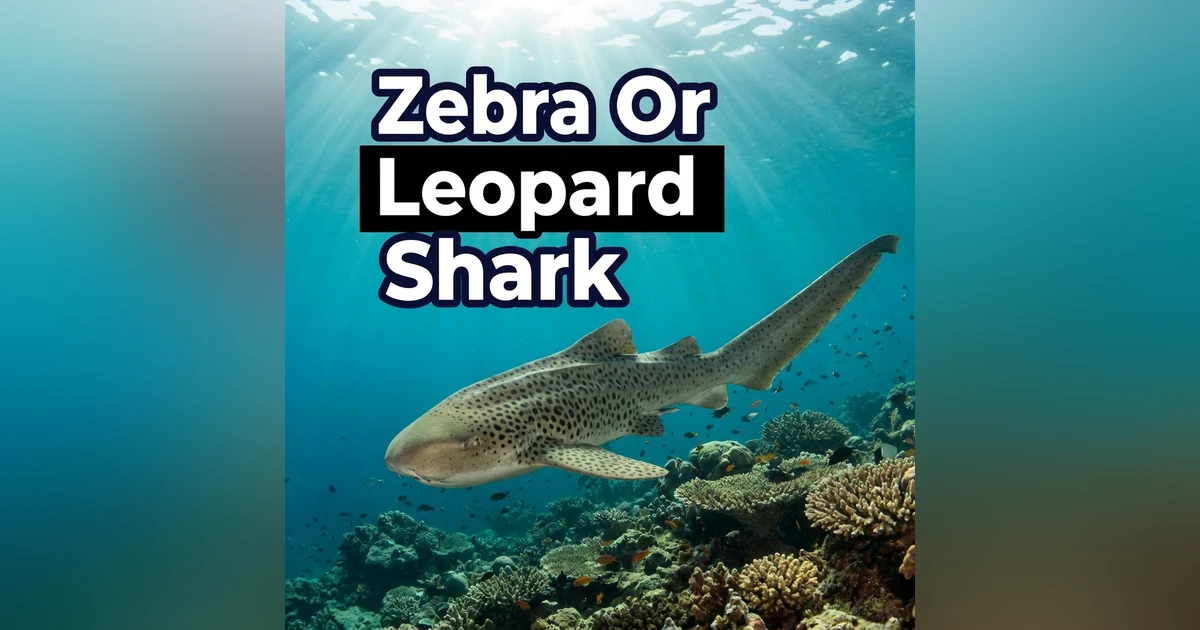
- Zebra sharks and leopard sharks are common names for the same Indo-Pacific species, Stegostoma tigrinum, which is striped as a juvenile and spotted as an adult; the confusion exists because a completely unrelated species, Triakis semifasciata, is also called a leopard shark in the eastern Pacific.
- A 2018 taxonomic review found that the species' correct scientific name should be Stegostoma tigrinum, not Stegostoma fasciatum, because an earlier valid name had been overlooked.
- Walking sharks (genus Hemiscyllium) use their pectoral and pelvic fins to "walk" across reef flats, mostly at night, and new species are still being described in Papua New Guinea and eastern Indonesia.
- A newly described walking shark species was named after Chris by her own PhD student, Jess Blakeway.
- The StAR Project (Stegostoma tigrinum Augmentation and Recovery) rewilds zebra sharks bred from aquarium-supplied eggs, with active hatchery and release programs in Raja Ampat, Indonesia and the Gulf of Thailand.
- Chris was a founding member of the Oceania Chondrichthyan Society in the mid-2000s, part of a small cohort of students who built the region's shark research community largely from scratch.
- Chris's advice for aspiring marine scientists: pick an understudied species to build genuine expertise faster, expect the path to feel anything but linear, and be prepared to figure things out without a roadmap.
Connect with us:
Website: https://bit.ly/37TMqeK
Instagram: https://bit.ly/3eorwXZ
YouTube: https://www.youtube.com/@beyondjawspodcast7591
Dave:
Website: https://www.lostsharkguy.com/
Instagram: https://bit.ly/3q1J9Q5
YouTube: https://www.youtube.com/@lostsharkguy
Andrew:
Website: https://www.speakupforblue.com/
Instagram: https://bit.ly/37g5WkG
YouTube: https://www.youtube.com/@SpeakUpForBlueTV
0:00 Welcome back to another exciting episode of the Beyond Jaws Podcast. On the podcast today, we have Dr. Chris Dudgeon from Australia talking about walking sharks, talking about zebra and leopard sharks, and which is the right name to use. We're going to talk all about that on today's episode. Let's start the show. Hey everybody, welcome back to another exciting episode of the Beyond Jaws Podcast. I'm your co-host Andrew Lewin with my other co-host, Dr. David Ebert. Dave, you're calling from the mountains today, and we're talking to somebody in Australia on a Sunday night after the World Cup. As this is recorded, obviously this will be put up after. ~ very exciting World Cup, very exciting interview talking about beyond the World Cup and talking about walking sharks and talking about a number of different sharks, including the very controversial leopard or zebra shark, which one do we call it?
0:55 ~ but yeah, I think it's gonna be a fun interview for people to get along. You've known Chris for quite some time. ~ do you want to say something before we get into this interview? No, I think I had not seen as I mentioned, I just seen Chris at the Sharks International in May and hadn't seen her for several years and I thought, oh this should be a great one to have on the podcast. And then coincidentally, after I invited her on the podcast, found out she had a shark named after her. And so what a coincidence. And ~ it was great. We had Jess Blakeway on last week. And if you haven't caught that one, you have to catch that episode. And she'll give you all the insights if you're a grad student on how to butter up your professor by naming a shark after her or him.
1:39 And ~ but no, Chris was great today. I could have gone another half hour hour with her. And we'll definitely she'll be back for another follow up episode here at some point. But no, she was terrific and ~ really glad we had her on and let's why don't we start the show here and we'll come back. All right, here's the interview with Dr. Chris Dudgeon. Enjoy and we'll talk to you after. Hey Chris, welcome to the Beyond Jaws podcast. Are you ready to talk about walking sharks? I am hi Andrew. All right. Well, welcome to the Beyond Jaws Podcast where today we have a phenomenal guest, the amazing Doctor Christine Dudgeon. However, first we need to acknowledge Spain's win in the FIFA World Cup Soccer that just concluded.
2:21 And although you have an Australian, a Canadian, an American here, we all watched the match and thoroughly enjoyed it. And Chris watched the match in the middle of her night in Australia, so she actually kinda deserves the Iron Woman Award for making the podcast on limited sleep. So Chris is a senior researcher at the University of the Sunshine Coast in Queensland, Australia, and she's also at the Biopixel Ocean Foundation, where she investigates how biodiversity originates and is maintained through time. Chris's research examines the evolutionary process that drives the emergence of species and populations alongside the ecological mechanisms that sustain them in modern ecosystems. By bridging the fundamental science with applied wildlife management, her work directly informs conservation, recovery, and policy initiatives.
3:06 Chris works across a wide range of marine organisms, including corals, ~ seabirds, fishes, and whales, and particularly it focuses on chondrychthians, the sharks, the rays, and the chimeras, or go sharks as I like to call them. Her research has contributed to the discovery and description of new species of sharks and bony fishes, advancing scientific understanding of marine biodiversity while highlighting the importance of taxonomy and conservation. Her PhD research focuses on the population ecology of the Indo-Pacific leopard sharks. Most most which most of us call zebra sharks, ~ providing critical insights into their movements, patterns, demography, and conservation needs. She's a foundational member of the world's first rewilding program, the StAR program, which is stegostoma tigram, the scientific name, augmentation recovery, which delivered under the Global Reese Shark Initiative.
3:58 and focused on the recovery of the species. Chris has been a member of the IUCN Shark Specialist Group since 2015 And has served as a vice co-chair since 2021. In this role, she contributes to the Global Conservation Assessment, Strategic Plan Planning and Policy Guidance for Sharks and Rays worldwide. Chris has over 75 peer-reviewed publications and has mentored 13 PhD students, four MSc students, and 11 honor students. And one of her current students is Jess Blakeway, who was just on the podcast last week and described a new species of walking shark after Chris. And she also has a BSC honors and she has her PhD from the University of Queensland.
4:42 And Chris, welcome to the show. Thank you, Dave. Thanks for having me. Great. So well I ask you the question we always ask our first our guest is, how'd you get interested in sharks and marine science? yeah, thank you. So ~ it's a funny one. I know lots of marine biologists that grew up inland. So I did my high school years in a place called Canberra, which ~ Americans may be familiar with but it's our capital city and in Australia and they couldn't decide between Sydney or Melbourne. which are the big cities, so they put the capital in between, ~ in Canberra. So it's about two hours from the coast.
5:23 ~ And I used to spend a couple of weeks every summer down the coast of ~ southern New South Wales, south of Sydney. And it was my favourite time of the year. I just love going to the ocean. It's a beautiful area, rocky headlands and you'd see things like the big ~ black stingrays, ~ southern stingrays that would come in really close and you know lots of rock pools and activity. So I think that just sort of captured my imagination of wanting to do marine science. With sharks in particular, my earliest memory of them being on my radar was maybe 14, 15 and I saw an interview with a famous shark fisherman in Australia who had these sort of funny museums and he Basically justified killing big sharks by saying that because we killed a lot of the fish, they didn't have food left, so we needed to then also remove them.
6:23 ~ and I don't think I even was familiar with the concept of sustainability at the time, but I just thought there might be a better way of managing that situation, such as how about we leave them some fish to eat and then perhaps we can all have something. ~ and so I think, yeah, I decided I wanted to learn more about it and perhaps be a voice for them. Love it. So as you went through your schooling and everything, you got through high school, you're still interested in marine science. You ended up going to James Cook University? Yes, I did. Yeah. And why that particular university?
7:04 So at the time, so this is the nineties, last century, ~ at the time in Australia we had two main unis that were known for marine science. So James Cook is in Townsville in the tropics and has a strong focus on coral reefs. And the other university that was big for marine science was the University of Tasmania, ~ which ~ also has the Australian Antarctic Division ~ sort of connected to it. So that's cold water stuff. I am not a cold person, so this was really in many aspects just a pragmatic choice of that I prefer being in warmer water. ~ and so I chose to go to JCU.
7:47 Yeah. Okay. And was Colin Simpfendorfer there at the time, or is that before Colin? So no, I kind of was there in between Colin's times. So I think maybe when I turned up, ~ Colin's a little bit older than me, but I think maybe when I turned up he was still there as a postgrad. But ~ I, you know, as a brand new undergrad, I wouldn't have had access to any post grads at that time. And then when I went through, when I got to postgrad, Colin had left. And so I was interested in doing work on sharks, but there wasn't anything available at JCU.
8:28 So my honours was actually on parrotfish. And I worked I sort of was in the I guess the beginning stages of molecular ecology, which was one of the fields I was interested in along with field biology and ecology. ~ So my honours project was the first time that mitochondrial DNA sequencing was used to examine population genetics of reef fish in the Great Barrier Reef. So it was pretty early days. And I managed to sort of from that those skills I got a lot of jobs. So people kept employing me to work on different mainly coral and ~ reef fish projects.
9:12 But I was very interested in studying sharks and there just really wasn't anything happening. at JCU at that time, which is funny because of course it's really well known as a shark research centre. So after I left, Colin ~ and Michelle Heupel came to JCU and set up their fish and fisheries and Michelle had her aims at JCU ~ programs. So yeah, so I I kind of missed them but ~ you know Yeah, yeah, because when you were starting out in the nineties, there really wasn't there was John Stevens and Peter Last, ~ down in but they were down in Hobart at the time and they were there with CSIRO.
9:53 But they're really Yeah, the cold place. Yes. Yes. And ~ so there is and they're really I think it's probably people like a lot of the younger people today don't realize that the the shark It was sort like in the US in the eighties and even into the nineties, there was just shark research was not like it is today. There were not many institutions that were doing it really that much. It really came on a little more little well, probably people like yourselves when you got into the 2000's and you started doing more work at the universities, you started having students, I think. Would that be a fair thing? when I was looking into PhDs, it was really ~ as you said, so the people that were driving the shark research in Australia, ~ that you could probably count them on two hands.
10:41 And most of them were associated with ~ you know, government organizations like CSIRO or the State Fisheries ~ organization. So many of them were not just shark researchers, right? So they worked on lots of different programs and sharks were one of the things they got to work on. I think John Stevens was a bit of an anomaly. I think he managed to just work mostly on sharks, but certainly you know the other main scientists driving things at that time. ~ And then there was kind of this next ~ generation kind Coming through, which I guess was, you know, Colin, Michelle, Will White with a lot of the taxonomy ~ stuff that was happening.
11:23 And then we're kind of the next generation after that. ~ And so my contemporaries, we started really in the early 2000s and so other people I can sort of point to from that time. So Pete Kine, Charlie Hoverniers, Simon Pierce, these are people I went through with, Shannon Corrigan, ~ Lindsay Marshall, ~ Andrea Marshall. She was the we overlapped as well. at UQ ~ and you know several others so ~ and Cynthia Alrich we were just mentioning her as well so yeah sorry Argentina lost ~ we'll commiserate with her later.
12:09 And so actually what happened at that time was that we didn't have a society. And so and a lot of us were our supervisors were not necessarily shark biologists. So my primary supervisor was a marine mammal expert ~ working on dugongs. ~ I know Charlie went through a marine mammal lab, so you know there was ~ or Tilios specialists, etc. So it was You know, we didn't have a sort of a society dedicated to that. We would go to the Australian Society of Fish Biology conferences. But as the shark research was building, you'd basically spend the whole time at the conference in the shark room.
12:54 And so it was in ~ 2004 that ~ we actually ~ our mainly PhD cohort ~ coordinated to start the Oceania Chondrict. society. So I'm a founding member of that along with Cynthia and Charlie and several others. So you know that was really and it was we had a critical mass of you know students really starting to focus on chondrychthians to be able to make that happen. Mm. I yeah, I remember ~ at the 2005 Indo-Pacific, I think for a lot that was the first time I met a number of you. I think it was the first time I think you and I met there at that conference there the first time and I just remember a lot of people.
13:39 Australian had a really good contingent of young people attending that conference at the time. I obviously I knew Will and I knew ~ Pete Kyne at the time already. ~ but like I said, a number of you showed up at that Indo-Pacific, which was a good showing, really, looking back now on it at the time. ~ at that point you'd kinda started formulating the whole had you had your first OCS meeting at that time, Oceanicondricthy meeting? so I think that was the one in Taiwan. Is that the one you're talking about? Yeah. So that was 2004 And our first OCS ~ was 2005. Well, that's when we founded, yeah.
14:19 So we to remember anyone's back in that that era there and stuff and yeah, and actually I was a member there as you know for a number quite a few years there. It was kinda fun conference. It's just for me it's a long ways to go from California to Australia for a two-day conference, but it's a lot of well fun. Plus I was also I was doing a lot of work with Will White at the time too, so I had a I had an excuse to be in Australia. ~ So anyway, did you see when you is the OCS is kind of really kinda helping pull a lot of the Australian sort of sharky people together to kind of really start to build off the whole thing from that point on, as the OCS started to come together and everything that that helped drive a lot of the shark I do think it's quite a cohesive network.
15:07 ~ and particularly I mean one of the things that we were really passionate about when we started it was that this was a conference that was largely built or a society largely built by students for students. And so we've always made sure that the you know the conferences are really affordable, lots of you know, support to get people there. ~ and just and you know, ~ having that very sort of open, welcoming, you know, friendly society. And I think that that's really held through. So there was a conference last year held at the Sunshine Coast, and that was celebrating 20 years since the founding of the conference, and it was really a lovely ~ conference to be a part of.
15:56 Colin was celebrated ~ as a lifetime member achievement award. ~ And so, you know, and I think ~ just to to have the moment to, you know, really appreciate what he's done for Australian, you know, Kondrichthian research and conservation is really important and I think he felt quite touched to, you know, be recognised by, you know, the next generations coming through as well. ~ you know, I think sometimes I mean we've all done it, but you know, as the younger ones come through they kind of forget that there were people that paved the way, that Yeah. did some stuff before them. Like You know, they're inventing everything for the first time as you know, which is great energy, but sometimes we've got to stop and reflect and just remember, you know, what people have done and I think it's a really, really nice society.
16:51 I think it's a really supportive society and it gives opportunities for you know progressing a lot of this work in Australia. And you know, it is regional, so it's not just Australia, it's New Zealand ~ and the Oceania. region. Yeah. Well backing up a little bit, when you were doing this, was this you started this was this during your PhD when you guys were starting the OCS at that time? Okay. 'Cause yeah, 'cause there's like I said, that kind of that sort of cohort of yours was really sort of the first group that really started to get together sort of in mass as far as doing you know in mass as far as doing the research and stuff. So that was kind of pretty dynamic thing for you guys to being students like that and get and starting up a shark society, how is that ~ kinda had that feel looking back on it now?
17:40 so proud of it. Like it's such a wonderful thing to have been a part of and ~ you know to so I was honored to be invited as a keynote last year for the 20 year ~ you know celebration and it was yeah really looking around it was the largest OCS that we've ever had. it was amazing to see you know how much it's grown and all the new generations coming through. It was just fantastic. You know, there's so many fantastic new students and it's still it's really heavily student driven, which is super important. Now, how are you navigating when you were coming through, like you said, you worked on parrot fishes for your undergraduate, for your aunt honors and then and so when you went to do your PhD, how did you convince your advisor that you're gonna work on zebra slash leopard sharks?
18:37 ~ well, I think like many of these things it's just very serendipitous timing. So ~ so ~ my project was advertised on a notice board at UQ and so a friend of mine had moved from Townsville to Brisbane to start his PhD. He worked on Humpback Whale Song and he saw this PhD advertised and ~ it was just sort of quite general the ecology of leopard sharks. And what had happened was that there was a student based out of Brisbane where I am now who had started doing some work and he tagged a couple of these animals.
19:18 So we have them aggregate off our coast here every summer. So he put some fin tags in a couple of animals but he couldn't continue the work. And so my supervisor Janet Lanyon who her expertise is dugongs but she was supervising him because at that time Again, there weren't any people who really ~ you know were working specifically on sharks. ~ and so she thought the project was interesting and wanted somebody to continue it. So my friend told me about the project. I contacted her and she was just about to go on maternity leave, and I think she just went, Yep, great, apply.
19:58 And so ~ And I just very quickly want to ~ make a comment here too. So ~ a few weeks ago ~ Janet died ~ and it was quite abrupt. and I just wanted to kind of take a moment to, you know, just reflect on that she gave me this opportunity and ~ as my mentor and it was really important ~ and so I'm you know super grateful to her ~ for that. ~ and I think it's really important you know to know those things you know going forward. and pass that on, you know, to the next generation who wanting to do these things.
20:43 And I came from ~ a lab background mostly, but I had been doing a fair bit of volunteer work in the field because I wanted to be a field biologist as well. And so, you know, Janet supported that, but she also encouraged me to do genetics work too, ~ which was great and I'm still doing it, so it was, you know, highly valuable. But yeah, it was a massive learning curve because I'd never seen one of these animals In the wild. ~ I had no idea how we were going to do any of this. So we wanted to go out. ~ Could we use photo ID to track them over time?
21:24 You know, would the animals be there? How easy is it to approach them? How do we take tissue samples from them? How do we, ~ you know, attach ~ it was early days of acoustic tracking, so we were you know attaching acoustic tags to them. ~ Yeah, how do we? captured them, all of those things. So it was just massive learning curve. Janet was like, yeah, just go, figure it out, figure it out, go on, you know. ~ and we did. So, you know, and yeah, spoiler alert, it worked. Yeah. So How'd she happen to suggest the zebra sharks or the leopard sharks for you?
22:07 Well that so there was the student that had started some of that work. So they just done a little bit and that's how come that species had been flagged. So at that time there was another lab at the University of Queensland ~ that the head of was Mike Bennett. And Mike Bennett was the PhD advisor for people like Pete Kyne, Andrea Marshall, Simon Pierce. So that was sort of the Shark and Ray lab. And a lot of the work that was happening local. in Mike's lab was very fishing based and inside Morton Bay where this work meant for the leopard sharks we needed to go on the outside so we needed to go across you know the breakers and into more the surf area and there wasn't really that happening so so I think that was sort of pushing limits to take it further offshore and get into some more of the deeper, more exposed areas as well.
23:04 I love your comment your prof Janet gave you about like, well, go figure it out yourself because if the people listen to that podcast, when I started out in the early eighties, it was the exact situation you described in Australia. There was nothing going on in the States. And it was just like I remember Lisa Natanson and I showed up and a few others at Moss Landing and Greg Kai was just like, Go figure it out, guys. Good luck. You know, it was there's no And you'll but you know you've like you probably I experienced this, you probably learned a hell of a lot because there was no roadmap. It was like you had to go figure it out. And young people listening today, that's I can't stress that enough that, you know, people like Chris and I have lived that.
23:45 It's just go figure it out. Don't you know, you'll learn more, you'll be a much better scientist, researcher, figuring it out in yourself than having your hand held for you. So ~ anyway. it's the fun stuff too, right? Because you you know, like it it's and and the other stuff I loved about it is it was ~ sort of a blank slate project. So and this was really the first time, you know, this species had been studied and ~ you said, you know, giving advice to next generation when people say, How do you become a world expert on something? I'm like, study something nobody's looked at. It's quite easy. You know, if you go for manta rays or whale sharks or white sharks, it's a bit harder to become, you know, the expert.
24:31 Go for an obscure species nobody's bothered to look at yet. Then ~ yeah, you can skip a lot of that. groundwork. Yeah, that's exactly that's great. Yeah, that's the best advice I could say. So as you got along, you worked on the leopard sharks and you kinda advanced your career. Some of these of these projects you got into doing now, I'm kinda jumping forward a little bit, but like the star project and some of the stuff you're doing now, the walking sharks. How did you get involved in some of those different projects? Yeah. So ~ I'll talk about the walking sharks because that's sort of chronologically the next thing.
25:11 So I actually started working on walking sharks in my PhD as well. So it wasn't part of my PhD but was a bit of a side quest. ~ and this comes from me having worked on ~ Tilios beforehand. So ~ one of the people I'd worked with on a Gobi project, he'd been approached by Gerry Allen. looking for someone to do the genetics on a potential new species description. And ~ I'm not sure how familiar everyone here is with Gerry Allen, but he's sort of one of the world's foremost you know fish taxonomists. ~ And in the Chondrichthian world he's the leading taxonomist for the walking sharks.
25:55 And so over the last, you know, ~ sort of well fifteen years he's described five species. Yeah. He's somebody the young people should know who he is. Yeah, and as somebody working in the fish world, I was pretty excited to get to work with Gerry Allen. So this is twenty years ago. So I mean he's now described over six hundred, something like six hundred species of Yeah, it's extraordinary. And he's just an awesome person to work with, like, and he's really loved. He's eighty four and he's still going. Yeah. we're still describing new species, you know, other bony fish and he's still diving, he's still doing it like he's, you know, just extraordinary, yeah.
26:37 Yeah. and so when I'd been contacted ~ through Phil and about, you know, would I Be willing to sort of help Gerry out. I was like, yes, please. And so this was for two species of walking shark in eastern Indonesia. I wasn't on this paper, but I did the genetics work sort of as a volunteer. I was excited to be involved in some of the species description because I hadn't really done that work at that time. And the co-author with Gerry was someone named Mark Erdmann, who I had not heard of, but is now someone I work with very closely for. many many years. ~ And ~ then a few years later Gerry got back in touch with me and asked me if I would help with another walking shark species, which turned out to be ~ Hemicillium mycoli, the one that's the focus of Jess's PhD work ~ in Milne Bay.
27:36 And so Gerry and I are the species authorities on that one. And then there was one more, Hemicillium Halmahera. a couple of years later. And then following on from that we did work on ~ sort of looking at the group as a whole, sort of a synthesis of the whole ~ at that time nine species of walking sharks and and also some phylogenetic evolutionary work on the group and IUCN ~ red list assessment work with them as well. ~ And then really things started working up again when Jess came and approached me about wanting to do a PhD.
28:18 So she'd been, ~ I presuming she's told her story. So she talked about she basically wanted to to work on this Mullen Bay species or Hemocilium mycoli that she'd been doing some work on as a volunteer, ~ came to me as one of the species authorities wanting to work on it and then it sort of went from there. So I gotta ask the question, how does the field have a shark named after you? ~ still quite surreal, I think. ha. It's yeah, amazing you when you like was it a surprise when she presented it to you or did you know this was happening?
29:00 so I guess the way the story goes, so when we found You know, when we went sort of caught the first one on this expedition, and then we suspected, so Jess was the first person to recognize that it had a brand new pattern and that it was probably something different, but we only had one individual. ~ and then over the next few days we caught this you know collectively another eleven. And at that time, Gerry was convinced. So Gerry was on the on the trip with us, and he was already convinced that this was a new species, but the genetics still needed to be done. And in the past, that was my bit but I think they all went and conspired ~ Gerry, Mark and Jess and then basically came back and went you're not working on this this is Jess's project and we're naming it after you and so I was pretty flawed at that point in time.
29:56 ~ now it did take a year from then till ~ or over a year from that point in time to the actual publication recently. ~ and of course, you know, things could happen. So I wouldn't say I'm a glass half empty person, but I'm a skeptic until like something's actually, you know, for real. I'm not gonna celebrate it until it's for real. So once that publication came out I just went, oh my god, this is actually real now. So yeah. the picture of the fish like I get an illustration and get it up on your wall? ~ So Definitely.
30:40 we asked Jess, people up her podcast was up last week. We asked her so and as young students listening to this like, if you really wanna butter up your advisor, name a shark after them. ~ So I'm sure you're gonna read that chapter a lot differently. Yeah, no, it's definitely a good way to keep them in favour, that's for sure. ~ I'm not setting the bar for my other students, so like they don't need to freak out about that. It's okay. Other bribes will do, other bribes, yeah. Get creative. So did you just get the one new species in this one or was there more than one?
31:22 ~ yeah. Was it just the one? well, named after me or in general. So, I mean, obviously I could only have one hemicillium named after me. ~ but ~ so there was the one new species that has now been described. Yeah. There are likely more, but there's a bit of work that needs to be done. Yeah. So Well you could listen to the podcast, but Jess was, let's say, a little enthusiastic when she showed you the different sharks and she had ~ expressed your reaction at the time. So Yeah. came out like well that's new. I haven't seen this one before. I haven't seen this one before.
32:03 It was she expressed it a little more enthusiastically than Andrew did, let's put it that way. So but go listen to the podcast and if people if you didn't listen to it already, catch it. It was pretty funny, ~ the way she explained it. the interesting thing, and you've been to obviously you've been to Papua New Guinea ~ several times and stuff. And I've got to say that that's a group that fascinates me just 'cause of I've never worked on at all, but just because you And we talked to Jess about this, like you have such a high endemism in such a small area when you've been looking at this stuff kinda what do you what's your sort of thoughts or opinions on the whole Yeah, this has been a complete I think my mind's been a bit blown with what's happening here.
32:52 So we when we started the expedition work a couple of years ago and we were doing the expedition along the southern ~ island sort of chain that goes all the way out to the east. And I think Jess would have explained that how ~ we sort of went from looking for the Milne Bay one and then we got to this next wonderfully named place, Panopompom, and then all of a sudden We're seeing a different species, the Port Moresby one, and then we're getting to a next place, and we're sort of seeing this mosaic distribution of these species that was completely unexpected. and that first gap, that's a really deep channel.
33:35 So that's a thing called the Jamin Channel. If you look at like any of those shipping maps, you can see ~ that's like the main shipping channel that boats leave from Australia and go north through PNG to head sort of past. Singapore and keep going up that way. ~ But then we're seeing these other things. There's nothing obvious. There's just nothing obvious about what ~ if you look back in the tectonic history or you know any of the current barriers, why would that be a species break? ~ And particularly with this new species, you know, that it's unclear where that boundary is and therefore ~ you know what is really you know keeping those things apart ~ which I find absolutely fascinating.
34:25 ~ and also particularly with these animals because they only differ visually in body pattern, you know, are there other things that we're missing? You know, are we seeing the body pattern of a particular species but in fact it's something else. and also potential hybrid zones. So we don't know if they do this or not. And Northern Australia is also really interesting for this because we have this nice continuum up through the Great Barrier Reef through the Torres Strait into Papua New Guinea. So these are our neighbours and we share ~ species across those borders and particularly with Hemicilium, we don't really know where the Great Barrier Reef one ends and the Port Moresby one starts.
35:14 So that's an area Of interest that we really want to go ~ exploring further. Biggest challenge really, they do sort of co-occur with saltwater crocodiles, so that's our you know, we're starting to look at some eDNA methods and things to try and perhaps get around those limitations. ~ I have to say it's possibly my least favourite bit of that field work is the feeling of swimming around. at night time with the you know in what theoretically could be saltwater crocodile territory. Yeah.
35:55 Yes, yeah, she's good at spotting them. That's right. Yeah, yeah, she was just on the podcast here and we ~ talked a lot about 'cause I was out I went out on a trip with her in the saltwater crocodiles there. ~ and I was gonna ask Jess that question about 'cause you guys she said you guys were going out, she's talking about we're just going around diving at night, you know, or picking up these things. And I'm thinking like, Man, are there some saltwater crocodiles an issue there? And ~ Yeah, I mean I well and I know Julia doesn't really go in the water as much, right? So she does more fishing based, yeah, sense but Northern Australia is particularly crazy with numbers of saltwater crocodiles. I think in Papua New Guinea they've removed a lot of them, particularly like near the villages and things.
36:39 But the very first ~ village we went to when we did the very first expedition and so one of the things I love about Jess's work is that when we go to a new village we talk savvy with the village to begin with. So we'll go we get permission to come on, meet with the elders and get their permission and you know, and often the villagers will basically help us to look for the animals and tell us where they are. ~ and then ~ the first place we went to and and so I asked, okay, so what about the crocodiles, which they're called puck book? And my so what about the puckpook? And they're like, no, it's not a problem.
37:20 They're only it's only a problem if they're hungry. And Ha. how do we know? Like has anyone interviewed them recently? So yes. After that I was always a bit dubious, but ~ yeah. Well let me ask you this. Like is it you know, saltwater crocodiles having these ~ you know leopard sharks or zebra sharks that are around who might be a little more difficult to find. Would saltwater crocs be a predator of these sharks? And is that could be why you don't see them as often in Northern Australia? Because there are more?
38:00 ~ yeah, so this is the more the walking shark thing, but but the zebra slash leopard sharks are found in these similar areas as well, like sort of distribution-wise, but tend to be a bit deeper. ~ I don't think they're a target species for saltwater crocodiles. So ~ they're just a bit more cryptic. So because during the day they tend to be hiding. During night, so often we do work at night because the walking sharks come out at night time and then and we can catch them walking as well. So if it's a really low tide and you can just walk on the reflat, you can pick them up out of tidal pools and things, which is sort of the easiest way to get them, but you can snorkel or dive.
38:45 We do find them during the day, but you usually have to look right in under ledges and things like that. So ~ it's more their cryptic nature than I would say ~ the predation. Yeah. I assume the water's pretty clear where you guys are diving? No, not always. Dear God. now you're really talking these things they're in mangroves, they're in seagrass, they're in coral reef, we're you know, so we're starting at shore through so yeah. I mean we're not diving in super turbid water, but we are you know, nighttime you only see the torch.
39:26 Yeah. Okay. So that's not well the only thing I asked, you I took Julia and I talked about that and I've talked to her we're in Timor Lesty, which is close by, and man, you want to talk about crocodiles? Holy smokes. There are thousands and thousands of crocodiles there. They're everywhere. You just they're everywhere there. So I meant to ask ~ Jess that, but she was just like, oh yeah, then we go diving here and we'll catch them here and I guess this point in your career you can just bring a lot of grad students with you and you know, they're l let let go let literally let go test the waters for ya. Ha ha.
40:07 Well, I do also work with some quite fearless people. So Mark Erdmann I don't think has fear. ~ and ~ so just talking about low visibility. So with the StAR project, if we talk about that, we've been doing some more work off Australia on the Indo-Pacific leopard sharks to inform their biology and ecology. And the first time Mark came out with me, there'd been some big rains on the east coast. So the water was so dirty. ~ and we're diving offshore so sometimes it can be beautiful clear 20 meter visibility. This day it was you couldn't see your hand.
40:49 And I said to Mark, there's no point going in. And he went, we'll go in. And I'm like, there's no point coming in. And so, you know, we've jumped, we've gone in, like, we've hit the bottom of the reef in six metres before we can see anything. And I just turned to him and went, no, we're leaving now. And ~ this is bull shark territory, you know, so and I just went, no self-respecting leopard shark is going to be in these conditions. So, you know, even if we swim around. around looking for them, we're not gonna find one. They will have moved off into nicer, deeper, clearer water. ~ and I'm not staying in this water. So yeah, so but he was quite willing to, you know, keep searching in these conditions and I just went, no.
41:33 Yeah, I mean that's kinda dumb sorts of it's like 'cause those I've seen those bull sharks when it's clear, those kind of stay back. But man, you get that visibility goes down, they just start coming right in. They're just Yeah. they get real. Just their behavior just changes becoming from kind of very much staring away to just becoming just fearless. ~ you know. you know, it's their ~ prime conditions is when the visibility is poor. So, you know, but as you said, in clearer water, not a problem at all. Like they come anywhere near you. So Those are the conditions I'll go out in. Yeah.
42:13 yeah, I know. Well sp well I mean why go in the water too if you know they're not gonna be there at all. They'll be there and stuff. So do you have any I'm kinda curious I wanna hear a little more about the if there's anything else for the walking sharks you wanted to add when we talk about your reshark project? ~ yeah we can ~ pivot to ReShark. Give the leopards some love. Yeah. Yeah, Leopard, Zebra, whatever. Anyway. You say Leopard, I say Zebra. Anyway. Let's go. Let's go. You call it you get would you like me to explain the difference?
42:57 Sure, why don't you why should you? Yeah, for the Just to clarify, so I suppose you know you have in America on the west coast a leopard shark, yeah? That's found off California and Mexico. And and that's your dogfish ~ species. And so That's not a dogfish. Dogfish is a separate thing. Ha ha ha. Tri it's a triacid. What's the common a hound shark? shark, yes. Alright, so see all the common names there going in there. Sorry, I shall not call it a dogfish, hound shark.
43:37 So you. completely not yeah, so completely different order ~ from the Indo-Pacific leopard shark. And so ~ the reason that it's called a zebra shark, ~ actually I should go back and explain. So that species, the triacus is only found in the eastern Pacific on that coastline of California down to Mexico. So the Indo-Pacific leopard sharks found in the West Pacific all through the Indian Ocean and in subtropical and tropical locations. So they don't co-occur in the wild. And the only place that they co-occur is in aquariums. And I think that's where needing two different common names came to play.
44:21 And so leopard sharks, ~ the Indo-Pacific leopard sharks breed quite well in aquariums, which is part of the StAR project where we get to that. ~ And they lay eggs, they have the largest eggs of the egg laying sharks. And the pups hatch out at about twenty sort of to thirty centimetres in length. And when they hatch out they're stripy. And that's where the zebra name comes from. And then they undergo this massive transformation, arguably the biggest transformation of any shark species between juvenile to adult form. And when they become adults, they are spotty. And so the juvenile stage is not for very long.
45:04 So they start losing their stripes, you know, within weeks to months really. So it's very, very rare to see a stripy one in the wild. But more common to see the adult spotting form. So where you do see these animals in the wild, say here off Australia, off Thailand, elsewhere, they're called leopard sharks because they're spotty. ~ and we don't have the other leopard sharks. So that's why we have two species called leopard shark and it is confusing. Well, I always grew up with calling them zebra sharks, but you are right, the adult form, once they start to grow and they get the spots, they're more like a leopard shark would be a better appropriate name.
45:46 But I think I was telling Jess that the juvenile form had been described as a different species. And I think and that's where I'm guessing partly the whole zebra shark thing, 'cause like you just stated, they have stripes like a zebra. And so, ~ but I'd always grown up hearing called zebra sharks. And ~ so when I was going overseas Australians are calling them ~ leopard sharks. It's like, what do you calling these? I know what a leopard shark is. Anyway, we're getting too much off in the weeds, but it's a good back good to know. you know, here if I go and talk to a local, they wouldn't have a clue what I'm talking about if I mentioned a zebra shark.
46:28 That doesn't Yeah. They're very one's an eastern Pacific and the other one's Indo-Pacific species. But anyway, they're both pretty sharks, so something that's interesting, as someone who doesn't have as much of a background as the two of you, I just looked it up on Google and said, you know, like difference between zebra shark and leopard shark. And it actually calls the Indo-Pacific zebra shark. but it has two different species though. So I don't know if it says commonly called zebra sharks in the US, leopard sharks in Australia. So this is stegostoma fasciatum. Is that the one we're talking about? you wanna take that one Yeah. Yeah. Okay.
47:08 it's the same. But it's the only species in its family, so it's actually not like a difficult one taxonomically. It's just that ~ back in 2018 there was a Danish research group that were ~ describing a What they call the sandy morph. So the more regular morph is a yellowy brown with brown spots. And then in the Indian Ocean, more so, you also get this sandy morph, which it's almost grey. And it looks like the sort of colouring of a nurse shark, ~ rather than having that sort of brown with the spots.
47:49 And so and the juvenile start off differently too. They're really finely striped, almost like reticulations rather than the bold stripes of the more normal or regular morph, if you call it. ~ And so this Danish group were describing those pattern changes and then as they were doing that work they looked at some of the genetics to check that it wasn't a different species but it's just a different morph like we have in manta rays you've got the chevron and the white-bellied dominant morphs. ~ and so it's not a different species ~ but as they were doing that work they realized that the nomenclature was incorrect.
48:37 And so they were digging into the historical records of the naming and found that there was a valid name that predated Stegostoma fasciatum. ~ And then this turns out to be Stegostoma tigrinum. So even though it's not going to be confused with anything else, ~ it still changed because of the rules of nomenclature. Yeah. And just on the common name idea, ~ I was joking around with ~ Steve Kessel, who I work with on the StAR Project as well with the common names 'cause he's based in America, so we have those discussions and I said, Well, maybe we could call that Sandy Morphous snow leopard shark and then ~ and then here off Brisbane our populations are often very ornate, like they have quite ~ almost more Jaguar patterns.
49:34 And I said, so maybe we could call these ones the Jaguar shark. And ~ that's a shout out to Steve Zisu. And I thought, you know, that's not out there yet. So we could fix the whole nomenclature thing by doing this, but that would require quite a movement to change common name, I think. yeah, yeah. Well yeah, yeah. Yeah. Well I think what I think I shared this with you, but when I was in Madagascar, the locals there, the fishermen, when you show pictures of like the blue spotted bamboo shark there, which is chylosillium, but it's in the same family, different genus, they all think you're talking about ~ the leopard shark, the stegostoma.
50:18 And but The small ones 'cause they all the what they see is the spots. Even though the spots are bluish on the bamboo shark and they're brownish in that one. 'Cause what the tip off was they would say, oh we see these all the time. And then I said, really? What is it? Oh yeah, they grow like two and a half to three meters and I'm like, That's not the bamboo shark. They're like sixty centimeters maybe max. ~ but there was the small ones are are mistaken for the bamboo sharks in Madagascar and the Blue spotted bamboo shark, if you follow my social media, it's endemic just to Madagascar and it's only been up until recently it only been seen one time in the last hundred and twenty years. So it's kind of ~ Yeah, amazing.
50:58 Yeah. But I think it's 'cause people are mistaking for the zebra leopard shark thing there. So anyway, do you want to talk a little bit about the re shark? What's the whole point or purpose of it? ~ the sort of the backstory to that was after my PhD for my postdoc I wanted to find out more about ~ the species in ~ tropical locations. And so where I'm based it's a bit more towards the edge of the distribution for the species, so they're quite seasonal. ~ you see movements with relation to different water temperatures and I was wondering well what happens when your water temperature doesn't really change?
51:45 You know, how does that impact migratory movements and so I managed to sort of make contact with a dive shop in Thailand in the Phi Phi Islands and so we set up this photo ID project called Spot the Leopard Shark. ~ And the idea being let's tap into the dive tourism industry and start collecting you know data on when the sharks are there. ~ And so that was great. We did that for a few years. ~ and then the Phi Phi Islands are on the western side of Thailand, and then I went across to the Gulf of Thailand, and some colleagues were saying, oh don't worry about coming here, there's no leopard sharks here.
52:29 And I thought, but there should be because this is actually a place where people would go and dive with them, and there's a massive dive tourism industry. So at that time, pre-COVID, ~ they were certifying about a hundred thousand divers a year in the Gulf. Of Thailand, like massive dive tourism industry. And so that flagged that. You know, this species has basically disappeared from these waters. And you know, I'd heard of the sort of shifting baselines concept with fishing, but not so much with the diving tourism industry. And so because it's such a huge turnover, anybody who had been there for sort of less than seven or eight years had not seen these animals.
53:16 But if you talk to the older people that have been there for a while, they used to see them regularly. ~ and there was some data. That was had been collected separate to what I was doing that supported that. ~ And around that time in 2015, we were ~ reassessing stegastoma for the IUC and Red List, and I reached out to Mark Erdmann, ~ and he and Gerry had been doing extensive ~ fish biodiversity surveys all through Indonesia and Papua New Guinea. And so, you know, tens of thousands, well, thousands. Into tens of thousands of dives throughout these areas and asked him, you know, what do you know about what data do you have on these, you know, that we can go back in time and see ~ what was happening before?
54:07 And so the same story came out, and you know, which was basically happening in front of people's eyes that these animals were disappearing. They used to be there, they were regularly observed, they weren't anymore. there's not so much fishing data on them because they're not a particularly common species either so you don't have any targeted fishing or you know so it's very sporadic in fish markets but what we would find is that there'd be a pulse ~ of animals in a fish market where you would see like dozens. ~ And you know we have one of the largest healthiest populations here in Southeast Queensland ~ and our population estimates are in you know the hundreds to few thousands.
54:52 So when you're seeing you know those sorts of catches in one place, that's potentially quite a lot of a population and particularly of breeding adults. ~ And we also now just with the photo ID because we can match them as adults, we've now matched several animals for over 20 years in the wild coming back every year. So they seem to have this sort of site fidelity to particular locations. ~ And so From these conversations with Mark, he'd also been working with aquarium folks on different projects and noticed that they at that time Singapore Aquarium had a lot of pups and they were sort of asking the question, well, can we release them into the wild?
55:40 and so you know, this was sort of the concept ~ where ~ StAR Project started, where we started thinking about, well How would that work? You know, what would be needed to do something like that? What would we need to know about these animals, about where we're releasing them, you know, how would you go about it, etc. And so we sort of discussed this, ~ you know, sort of started digging into it for a few years, and then ~ in 2019 the project got some interest from some big aquariums in the US, so the Shedd Aquarium, Georgia Aquarium, Seattle Aquarium came on board and others and so there was a big ~ meeting to be held about you know is this something that you know we can do?
56:29 Is it something we should do ~ and because this is a species that is in aquariums around the world and it also breeds quite well in aquariums around the world and there's been quite a big shift in terrestrial you know in zoos into more you know sort of active conservation efforts of of rewilding but not so much in the aquarium space and particularly not with you know elasmobranx. and so there was a lot of interest in this species particularly as kind of a model species because it's an egg layer ~ and some of the logistics about shipping eggs as opposed to shipping wild animals around the world.
57:14 ~ And so yeah basically all of these different partners signed on ~ to do this project and we got the green light from the IUCN Shark Specialist Group as well. And so the idea was to run this under what's known as the IUCN One Plan approach, which is a combination of bringing together the expertise of those of us that work with these animals in the wild with the expertise of those that work with them in the aquarium settings. And you know then ~ basically started from there and that was five years ago that it kicked off. Yeah. any results or anything or any feel for how it's going?
57:58 Yeah, so so far ~ we've now so ~ it's a very big collaboration so there's a lot of different ~ partners involved. So the first project was set up in eastern Indonesia in Raja Ampat, ~ and so this was supported by a couple of foundations that have associated resorts there. So they actually built hatcheries. So ~ and we have these Indonesian conservation groups that manage all of that and we work closely with. So Nesha Cheetah is our Indonesian program manager who's an amazing young conservationist who just is a ~ Yeah, incredible energy and effort ~ in wrangling all of this.
58:47 And then we have what we call the shark nannies and basically or the aquas, so their job is to raise these baby sharks. So they get them as eggs and then raise them up. ~ and so they start to learn to eat live food immediately after hatching and then they go into C pens ~ at a certain stage and then once they reach about sort of five to six months of age and are large enough. They have an acoustic tag implanted ~ and then we release them. And so we're now over 75 animals have been released and this is in Raja Ampat.
59:27 We also have another project started in Thailand ~ and ~ with WildAid and our manager there is a lady named May and again amazing ~ local Thai team that are driving all of that. They haven't released as many so far, but they've had ~ I think it's seven released and we've now been starting to get hits back from animals sort of I think Thailand was four months later and Indonesia was eight months later. later. ~ And so it's still early stages as far as you know tracking these animals in the wild. We're seeing that success, we're seeing that survival.
1:00:08 ~ We also have some really important I guess additional conservation measures. In Thailand the species has been fully protected. So the government is very invested in the project and we're quite quick to move for protection. In Indonesia, it's in process. The area is a marine protected area, but there is still ~ artisanal fishing in Indonesia. However, we're getting more and more reports of when fishes are catching these, you know, because they do come across these leopard sharks occasionally, they're releasing them. and ~ the local school groups or local communities as well of children ~ provide a lot of the food for the baby leopard sharks and so you know there's a lot of stewardship for this species and really you know trying to shift that narrative about you know the importance of these types of animals in you know the environment.
1:01:13 ~ and so yeah they're because they are quite acute shark species, particularly as babies, you know, they're a lovely I guess entry shark, if you will, you know, to bring people on board to, you know, understand that not all sharks are, you know, bitey and dangerous and Yeah. And that there's, you know, value in these animals beyond ~ just fishing. ~ and so yeah. Yeah. Well well Chris, this this has been super exciting and very informative what you've been talking about. I I wanna ask you, what advice would you have for a young person just starting out considering a career in marine biology or in the shark world?
1:02:00 yeah, so I think firstly you know, you've gotta love what you do. And I think you need to feel inspired to get up and do things because it's not always easy. ~ I think from the outside my path looks probably quite linear but it doesn't feel like that at all. ~ because I feel like you know, as I mentioned I've worked on lots of different animals and different types of projects and so one of my supervisors once said, you know, It's about one percent inspiration, ninety-nine percent perspiration. And I kind of feel that there's a lot of truth to that.
1:02:45 and I think, you know, there's no one path. Like you have to forge your own path and follow your passions. And ~ one of the things that I've probably talked to my students ad nauseum about is that apart from being a scientist, I'm also a mother. So I have a nineteen and a seventeen year old kids and so that's been a massive part of my life. ~ I had my children doing my PhD. And ~ you know, and I see and that's not easy. That's not easy to combine that with and a half full time jobs separately. Yeah. And and you know, but it's possible, right?
1:03:27 And so it's just finding your own path to make that happen. And you don't know what life's gonna throw at you. So follow your passions and yeah, and just keep trying. Yeah. Great. Well Chris, thank you so much for coming on. We're definitely gonna have you back 'cause I feel like we just barely scratched the surface of your career and everything. And so we'll definitely have you come back. We'll talk about some other parts, aspects of your career. But thank you so much for coming on today and congratulations on your new namesake, Bamboo Shark. And ~ anyway, thank you very much. Thank you so much. Thank you, Chris, for joining us on today's episode of the Beyond Jaws Podcast.
1:04:10 Dave, what an interview. Lots of stuff going on in research, not only in Australia, but Papua New Guinea, around walking sharks, around a lot of different other sharks. Her coral reef research we talked about. ~ quite a lot of stuff. I think it's interesting how as someone's career progresses and they've been in the career for 20 plus years, you start to ~ you know go into different areas and really discover things as you get more and more research. I feel like, you know, Chris is definitely an example of that. And yeah, she has a very broad background. You know, we talked a little about it but we really just didn't really get into some of the other stuff she's done on coral reefs and fishes and seabirds and you know, she has quite a lot and I think ~ quite a broad background, I think you know, something she didn't mention, but if you're a young person starting out That broad background's gonna help you from a job standpoint, having a lot of having a broader background and having a lot of skills.
1:05:09 And she had it was interesting to hearing her also talk a bit a little bit about how the when she started out she was in kind of in that sort of first wave of young Australians. Yeah. that came around in the early two thousands and is very similar to how the US was twenty years earlier. I talk about the Jaws generation in the US and stuff. When we started out there was just nothing there. And her comment about from a professor and like, well, go figure it out. That's pretty much what all of us had to do is like, well let's go figure it out. And ~ in here Australia sort of came again it's hard for younger people to understand this, but even through the nineties you had John Stevens, Peter Last, and kind of at the end, beginning of 2000, Will White kind of came on the scene.
1:05:56 but it was just a Colin Simpfendorfer, Michelle Heupel, but it was just a handful of people really in the 90s that kind of came on the scene in Australia. But they laid the foundation for the generation that Chris talked about with her, Charlie Huvenairs who's been on the show, Pete Kyne ~ a lot of and a few people, several other people that have been on the show, some that We haven't had on the show yet, but ~ Andrea Marshall she mentioned, Lindsay Marshall, these are all cohorts. It was interesting hearing talk about how they started the whole Oceano Chondrichthin Society, which is a yeah. that. No, I yeah, no, I knew she was one of the first founders down there to was involved in early on, but it was kind of cool hearing some of the story, even though I'd been a member I think I joined in two thousand eight and I was a member for probably close to what almost fifteen, twenty years so after that.
1:06:48 So it's kind of kinda neat here and Karen here the parallel between Australia and contrasting with the US and everything. And as I say, she you know, of course the other part of it she got into talking about diving with the crocodiles and ~ Papua New Guinea. It's one those things in North America you don't think about. I mean if you're in Florida you do have American crocodiles and you do have alligators to keep an eye on a bit. And I but I've been down in like Florida and stuff and you gotta watch but man, with the saltwater croc, you're more in the menu with those guys, man. They're like ~ and you're also in remote areas too.
1:07:28 A lot of areas that they don't have there's not signs posted like keep an eye out for crocs. It's just understood, like for a lot of people who live there. Well, like she said, they talk to the villagers, you know, and they kinda and I like your comment about like, you know, well as long as they're not hungry, you're okay. Exactly. Exactly. Yeah. And lots of gems. Like lots of cool things that she's been able to accomplish and lots of things that we were able to cover. And I think that's something that's really important and a lot of fun too, you know, to be able to document and stuff like that.
1:08:10 So it's always fun. We'll put ~ all of her social media links in the show notes and of course with ours, Dave, if people want to get a hold of you, what could they do? It's ~ Lost Shark Guy on ~ Instagram and also go to the YouTube channel Lost Shark Guy. Check out our series that Andrew and I are doing with Denisse Sotomayor on the searching for lost sharks, extinct or alive. We got the first five episodes are up right now and there'll be a lot more coming very soon. Awesome, perfect. And then yeah, and if you want to get a hold of us, Beyond Jaws on YouTube, also look at for Beyond Jaws Pod on Instagram. And of course, you can just ~ search for us on our different socials.
1:08:51 So thank you so much for joining us. We really do appreciate thank you to Dr. Chris Dudgeon and thank you to of course my co-host Dave. Thank you very much for everybody else who are listening. We really do appreciate you listening to us each and every time we release an episode. And have a great day. This has been another episode of the Beyond Jaws podcast. We'll talk to you next time and happy conservation.