
Inside Shark Biology and Conservation, Second Edition


 Apple Podcasts

 Spotify

 YouTube
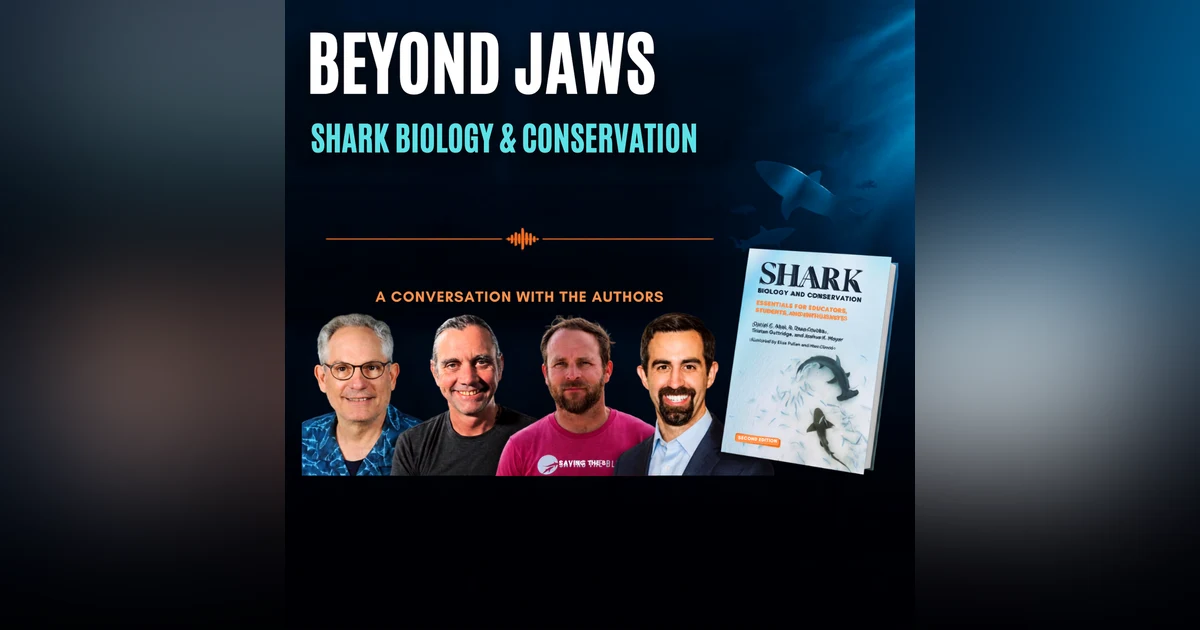
Every shark course needs a bible, and this one just got a second edition. Five years after the first Shark Biology and Conservation: Essentials for Educators, Students, and Enthusiasts landed on shelves and in classrooms, co-authors Dan Abel, Dean Grubbs, Tristan Guttridge, and Josh Moyer rebuilt it from the ground up: new chapters, new contributed essays from researchers around the world, and two co-authors who weren't part of the original book at all. Three of the four join Andrew and Dave (Dean's internet dropped him from the call, but he's credited throughout) to talk about why a book that was already considered the accessible alternative to a dense academic textbook needed a full rewrite so soon.
Dan walks through where the book started, a shark biology course he and Dean taught together at the Bimini Biological Field Station, and why they brought in fresh voices for the second edition instead of writing it alone again. Tristan and Josh talk about what it was like joining an established two-author project, the freedom they were given to shape their own chapters on behavior and sensory biology, and the unglamorous realities of textbook publishing: turnover with editors, humor that gets cut by copy editors who remind you that you're a scientist, not a comedian, and illustrators like Elise Pullen and Marc Dando who redraw a shark's fin position a tenth of a percent at a time until it's right. Josh also shares how he ended up adopting the first edition for his own shark biology course at Yale, and how that classroom experience shaped what he pushed for in the second edition.
The conversation closes with each author's advice for readers, professors deciding how to structure a course around the book, and a look at what's next: a batoid biology book from Dean and Dan, a title called How Sharks Work from Dan and Josh, and Tristan's focus for now on building a research field station in the Bahamas rather than a fifth book. It's a fun, candid look at what actually goes into building the reference book an entire field ends up using.
Takeaways:
- Shark Biology and Conservation is now in its second edition from four co-authors, Dan Abel, Dean Grubbs, Tristan Guttridge, and Josh Moyer, illustrated by Elise Pullen and Marc Dando, published by Hopkins Press.
- The second edition added two new co-authors and dozens of contributed mini-essays from researchers worldwide specifically to bring in fresh perspectives Dan and Dean felt they'd already exhausted after the first edition.
- Co-authors got real creative freedom: Tristan and Josh were each given latitude to shape their own chapters (behavior and cognition for Tristan, sensory biology for Josh) rather than being handed a rigid outline.
- Textbook publishing has real friction most readers never see: editor turnover, cut jokes, and illustrators redrawing figures repeatedly to get anatomical details right, all without royalties for the original artwork licensed into the second edition.
- The authors' shared advice to readers: don't stop at what the book says. If a fact or figure interests you, go track down the primary source.
Website: https://www.press.jhu.edu/books/title/53846/shark-biology-and-conservation
Connect with us:
Website: https://bit.ly/37TMqeK
Instagram: https://bit.ly/3eorwXZ
YouTube: https://www.youtube.com/@beyondjawspodcast7591
Dave:
Website: https://www.lostsharkguy.com/
Instagram: https://bit.ly/3q1J9Q5
YouTube: https://www.youtube.com/@lostsharkguy
Andrew:
Website: https://www.speakupforblue.com/
Instagram: https://bit.ly/37g5WkG
YouTube: https://www.youtube.com/@SpeakUpForBlueTV
0:00 On the podcast today, everybody, we have a new book that we're going to be highlighting. And we have three out of the four authors of that book here to talk about why they would do another shark book. It's called Shark Biology and Conservation Essentials for Educators, Students, and Enthusiasts. It's a second edition. It's by Dan Abel, Dean Grubbs, Tristan Gudridge, and Josh Moyer. Some fabulous guests that have been on the pod all have been on the podcast before, and we're gonna get them back on. unfortunately Dean couldn't make it ~ because of internet issues, but ~ we we we love having him on. ~ we'll get him on again ~ quite quite soon. But everybody else was on and they talk all about this book and why you should get this book.
0:45 We're gonna talk about that on this episode of the Beyond Jaws Podcast. Let's start the show. Hey everybody, welcome back to another exciting episode of the Beyond Jaws Podcast. I am your co-host, Andrew Lewin here with my co host, Dr. David Ebert. Dave, are you ready to talk about another book? Not One that you wrote this time, but the one Yeah. No. that Dan, Dean, Tristan, and Josh wrote. Yeah, no, very excited. I mean, we're glad you know, we when people have books come out, you know, even mine, but other people's books come out. Yeah. it's great having them come on and and you know, helps helps promote their book and you know, we're all about trying to help promote shark, shark conservation, research, education, and just enthusiast. And so the Absolutely.
1:25 so the book actually was perfect, ~ perfect timing. And it was great to get all the guys on there. We had Dean, as you mentioned, on there, but unfortunately his internet wasn't cooperating today. It wasn't the best. Yeah, unfortunately. ~ But we had we had the other guys on and they've all been on before and they're always great and it's always entertaining to have on and especially have on together and promoting their book. And so I hope everyone enjoys it and everyone goes out and gets their book too. It's a great it is it it is a good book. Absolutely. Yeah, it looks fantastic. ~ I'm looking forward to getting my copy. ~ but we're gonna get into it right now with Dan, Tristan, and Josh on the book Shark Biology and Conservation. Enjoy the interview and we'll talk to you after. Hey Dan, hey Tristan, hey Josh, welcome to the Beyond Jaws podcast.
2:08 Are you ready to talk about shark biology and conservation? Absolutely. Always ready. Yeah. Always ready. All right. Well, welcome to the Beyond Jaws Podcast. We have a special bonus episode featuring a new book by four authors who have all been on the program before. We do have a footnote, Dean Grubbs was here, but he somehow he fell off, but we'll Lost connection. we'll carry on with his co-authors here. The new book's titled The Shark Shark Biology and Conservation by Dan Abel, Dean Grubbs, Tristan Guttridge, and Josh Moyer. And the book was also illustrated by Elise Pullen and Mark Dando. Mark, of course, has done been on the podcast before. He's done illustrates many of the books I've done before, ~ Sharks of the World and some of those books.
2:50 And ~ just to show everybody here the book here. And I have to say, this is probably one of the best damn books I've seen. Next to a certain book on yeah. the except next to a certain book on the sharks of the world. This is like the best damn book I've ever seen. So Yeah. ~ I really well we're gonna get into it here today. But just to refresh everybody, Dan is a retired professor. From Coastal Carolina University, who just informed us he just had his last graduate student finished. So he's in a very happy mood tonight. And Dean, of course, is a f is a research faculty and associate director of research at Florida State University. And he's recently off his latest Shark Week episode this year. And Tristan, of course, he's a regular, he's also off his ~ fresh off of Shark Week this year.
3:33 And he's also the vice president and chief scientist for Saving the Blue, a company he co-founded with his wife. And Josh is a lecturer at the Department of Vertebrate Zoology at Yale University who specializes in orgasmic or orgasm biology, something like that. ~ I just wanted just in case Josh's sister's listening Ha ha to the show, just wanted to clarify for my last my last last introduction for Josh. Anyway, welcome guys and Welcome to the show. Yeah. That's a great way to start. Great way to start. Mm-hmm. Who knows where it's gonna go from here, but ~ so So Dan, Dan, why don't you tell us a little bit about the book, the overview of the book, since you're the first author on this but we want to hear Okay. Well from you first.
4:13 yeah, first I wanna thank Dave for those very kind words. As I look at my bookshelf, if I were to do a word cloud of books on of titles on my bookshelf, Ebert would be the w like big letters all over the place. ~ I also want to correct a quick injustice. Last time I was on the show, Dave reminded me that it was about forty years ago that we crossed paths in a bar in Avalon, ~ Right. Catalina Island. and I wanna tell him that if we should cross paths again, this time I'm buying. Okay, so. there we go. Okay. And just just for every we're Dan and I were graduate students at the time. And ~ yeah, it was a it was a it was an intri it was a little while ago. A little bit ago. A couple of years ago. Yeah. I looked about Anyway. Yeah.
4:54 the same. He looked a lot younger, I think. Yeah. So okay, so yeah. ~ old old old folks jokes. ~ so yeah, the the second edition, ~ logically followed the first edition. Five years is about the the period after which first edition becomes a little bit dated. And and the first edition was written 'cause Dean and I had been teaching at the Bimini Biological Field Station, ~ a course in shark biology. That's where we met Tristan first time. for you know, for years and we realized there were great books out there but none suited our needs. And so we put our heads together and finally wrote this one. And the the the big addition to the second one ~ is the new voices that we've added because Dean and I I don't know about Dean, but I think I've written about everything that's in my head about sharks.
5:41 And Mm-hmm. we needed different perspectives, we needed fresh voices, ~ and we needed people to up update and And do some of the chapters that we felt weren't, you know, w within our expertise. And so Tristan and Josh, fortunately they were there, they were out of jail for had to do a hundred hours of community service and so we engaged them. Why not? Ha ha. Just kidding. at any rate, ~ you know, and then we we had some ~ focuses on research conservation and education where we brought in people from across the globe to write ~ thousand word l mini essays on some aspect of education, physiology, evolution, anatomy conservation, and and that strengthened the book immensely.
6:34 And so like when when you you and you and Dean brought on ~ Tristan and Josh, like I guess let's go to Tristan first, like so what did you think when you were invited to join in on this endeavor? Well, ~ obviously I'd met Dan and Dean. Gosh, it would have been must have been in 2005 or six, something like that. So 20 odd years ago. And at that point, there my professors, you know, Dean in particular, you go out in the field with him, and he's like this shark wizard. ~ and so I'm just completely in awe of him. and then to be invited to be part of the book, and obviously I spent my PhD years in Vimini working on social behavior, so the behavioural stuff was was something that I've I've done as part of PhD. So I was obviously thrilled to be involved and and happy to to try and contribute as best I could.
7:28 So yeah, like it it kind of all started at the Bimini Shark Lab and I was part of those courses and being in those lectures and I I'll agree with them that there never really was a book that was accessible for not just the the student that's in those classes but also for someone that's just generally super enthusiastic about sharks. You know, a lot of the books that I read were, you know, had a lot of papers in them and were quite hard to understand. partics particularly topics like you know taxonomy and things like that. And I think it this is a lot more accessible. So I was pretty excited about being able to contribute for for that reason as well.
8:08 Yeah. Yeah. J Josh, what was how about what'd you ~ after you recovered from fainting when you were invited to do the book, how did how did it go for you? What did you It went really well. I mean it it was I guess it was a great experience principally because my co authors, yeah, I I would say to them, I'd I think that I'd like to write about this or I'd you know, I'd like to include example X, Y, or Z. I don't think I've I ever heard anything but a supportive sure, go for it. ~ Mm. which of course, credit to you, Dan. You you You were very supportive. ~ and you sort of ran interference with the publisher because it ~ as I've learned, it would be the publisher to say, No, no, no, no, no, no, no. You want to spend how many words going down what rabbit hole? ~ so you were able to run interference and as a result, it was a great experience for me 'cause I could just write to my heart's content.
9:11 ~ as an organism biologist, Dave. That too. Yes. It it was cool it was quite nice ~ to just think about all the aspects of shark biology that interest me and and go into answering the question, How do sharks work? and say, Well, let's explore that in whatever level of detail w we want to get into. So it was a it was really a fun experience. Did and I ~ and Josh sa s and as you tristan as well, since this was kind of your fur was this your first Tristan, your first book experience as well? ~ ~ no, I'd I've I've written a few chapters but ~ but nothing quite as yeah, as as kind of similar to what Josh says as I was given kind of free scope to to go with the chapter how I saw fit, which was nice because my My PhD was on social behavior, group living in sharks, and then I I did some work in cognition as well, and I was able to kind of put quite a focus on those two topics within the the behavioural theme, ~ which was which was really nice.
10:20 I was getting I realized getting out as I know my first book I would did with Leonard Campano, and much like you know, Dan was a senior guy in this project and Dean, having done books before, it really helped me huge to have somebody who actually had been down the path of having done a book before because I you know, probably Dan can comment on this. Like when you first do a book, like you think the the publisher's like, this is on sharks, this is gonna be a great book. They'll just lap it up, but it's never that quite that easy, is it, Dan? When you're trying to No, it it it it definitely isn't, and there's so many questions you have about how to please the publisher, how to write the book within your own vision, to to find the audience. I mean it it becomes really complicated and and and you know, tribute to all my co authors.
11:09 ~ you know, I can't imagine ~ any co authors that made it more easy and had and were more ex had more expertise than these two people and of course Dean, who can't can't be with us, but you know, Dean I I you know, if I made a stupid mistake writing, I felt very confident it would be caught by one of those three co authors. And that that safety net is a big deal as well. Yeah. Yeah, yeah, yeah. And it and s even things like you'd done a few books with Johns Hopkins, so I assume it was a little smoother for you, Dan, when you s when you approached him about doing or did they approach you about doing the second edition? Well, I bugged him about the second edition after two years because I was ready to correct some of the stupid mistakes that we had made.
11:52 ~ and and and kept doing it and then they you know, and it's maybe your experience, maybe less so with Princeton than with Johns Hopkins, but they had a big turnover of editors that we w wrote with and it was almost every time you emailed them it was somebody new. ~ and then finally after about four years after the first edition, they contacted me and said it's time and I told them what, you know, Dean and I chatted about what our vision was for the second edition, slightly expanded, rev you know, doing a complete revision of a lot of the parts that were dated. and the good thing about it was that when we got releases for all of the figures and illustrations, the expert the ~ the photographs from you know, from professional photographers and the good ~ beautiful watercolors and other artwork, ~ we didn't have to pay royalties for the second edition for those.
12:45 I feel bad because these people earned them. ~ but you Mm-hmm. you probably test that authors and these two guys will learn pretty soon when they get their first royalty statement. We're not making much either for for you know, for the effort we put in. Dan, didn't you say that your cut of the royalties on the first edition was just enough to buy you a nice coffee maker? Like a name brand coffee maker, like Mr. Coffee. well okay, okay. six thousand dollar espresso machine. No no not not really. No You got that much? Tristan's sitting there going like there's royalties? Yeah. Yeah, well I I was just gonna say you you do these projects 'cause it's your passion, don't you?
13:28 You know, we Yeah. all do it and and at the same time I think it's good for you as a as a s a scientist trying to to strive for new ideas and technologies and things to have to read the literature. ~ and and writing a book chapter on shark behavior for me made me read around the subject a lot more than perhaps I might do sometimes. So I th I th and and it then gives you ideas for other research projects you might have. So I I think it's ~ it's good in that way too. D did you guys find let me ask you this? I know when I do books and stuff, I find a a certain them to be kind of liberating compared to like writing a peer reviewed paper. Cause you have more even though the book will get reviewed by someone, you have more a little more latitude if you want to get into something you know about, you've experienced, but it's not like a real quantitative or observational.
14:21 You can put like sort of anecdotal stuff in there that that is kind of interesting. Do you do you find that? Did you find that? Yourself? I mean, I think the the conserv the conversational style that that Dan kind of led with made it easier to to write for sure. I mean, I have to hold my hands up. You know, I didn't write anywhere near as many chapters as Dan and Dean did. They did the the main chapters on this. I I obviously wrote the shark behaviour chapter and then ~ I contributed to the sensory biology chapter on this second edition, ~ which was fun to do. ~ but yeah, I mean it's These books are they're they're a huge undertaking.
15:01 Like, you know, the Yeah. number of emails that came back and forth and and I wasn't even the one conversing with the editor, like that Dan, it it made me realize like I there was a point where I was thinking a few years ago that I would write a book, a shark behavior book. And I'd spoken to a colleague, a friend about doing it, and I was all excited, and and then I was started to be involved in this book and seeing everything, I'm like, I don't know whether I'm quite ready yet. Yeah. But but I I agree with what both David and and Tristan said. You learn a whole lot when you're writing a book because it just gives you license to to spend time. You you feel this obligation to see what's out there. ~ and also the the tone of writing is very different.
15:43 You you know, I always wondered in textbooks there's n you know, in big like intro textbooks is rarely citations and they're Mm-hmm. all relying on primary literature as well. So That's a a gray area. You can write something and you want to attribute it to whoever you got it. But if you you know, if you did that it would make it more turgid and hard to read. So, you know, it's that fine balance between how do you cite legitimate sources and how do you assume something is more common knowledge. Yeah. Yeah. No well you I often you like I I'm sure yeah and here too you have that you have you put in some like there's some general references you generally tend to use that are kind of a more broader view versus every single paper on a particular topic. As you say it we get it you just get bogged down and I think the average person you'll find some people I mean I you I'm sure with your book students taking this or just kind of getting introduced to sharks don't want to get bogged down all the literature 'cause they're they're you know Yep.
16:44 And that's that you know, that's the one comment that we get when we use the course the use of book in a shark biology course. It's like the untext book. They say, Well, I've never read a textbook in a course before. I'm reading this one. And I mean that's that's not hyperbole to say that some of them get through college and have never read the textbook. But generally the Right. students who take shark biology courses start out with that passion. And so you can at least entice them to open the book. ~ one of the things Dean and I tried to do is put some humor into the first edition and I we put a lot more in and it was our our our copy editor took it out. She said, you know, this is this is you know, this isn't you're not a comedian, you know, you're a shark biologist.
17:26 ~ I did recently Mm. had a a manuscript for another book r ~ was reviewed and ~ the reviewer said my writing was silly which I took as a compliment. Ha ha ha. Yeah. I thought thank you. Ha ha Yeah. I've I've had that where I put in f a few things I thought were kind of funny here or there and in books some of the books I've done and the editors are like, No, that we're taking those out. Like that. You're you're you're not a comedian. We're we're just we wanna keep it more I don't know, kind of ~ formal, I guess, even though it's not really a formal formal stuff. Yeah. Well well you the one I wasn't gonna take out was for Osmo Regulation. Sharks use urea based osmoregulation. So I was very bold thinking this is hysterical.
18:09 One of the headings was How do you solve a problem like urea? Now, yeah, you have to be a student of older movies like The Sound of Music. Yeah. And so when I would do the the song How Do You Sol I'm not gonna sing. Yeah, you can. Hey, that's fine. I don't think we'll get hit with copyright, you can go ahead. No. You don't get it with copyright but you'll lose you'll lose viewers. I promise. No. But I you know, I the students I I you know, title this in a presentation and I get these blank stares. They have no clue what what that meant. That's so funny. Yeah. Yeah. ~ yeah. Well I had a I had a recent one where I just I just had I had half my co actually three quarters of my co-authors I and the paper I gave on guitar fish, I made a reference to ~ Van Halen and my authors Okay.
18:56 are my co-authors are looking at me like who who's Van Halen? And I'm like, Yeah. You guys have never heard of Eddie Van Halen or No, not a clue. Never heard of it. that's awesome. So so Dan, I told so if you're going back to Sound and Music, Dan I Right. can relate I can relate with you 'cause I saw it when I was probably about eight years old ~ when it came out. But none of these other kids have any frickin' idea what we're talking about. So speaking of kids, Josh, so how is your ~ your experience? Is this something you're gonna use with your your classes that you're teaching? yeah, absolutely. In fact, ~ my sort of connection to this project, to the second edition, stems from ~ a shark biology course that I developed and teach at Yale, because I adopted the first edition as the textbook for that course.
19:43 And it just so happened to be the first time that I taught that course at Yale. I had taught taught shark biology a handful of other places, but it was the first time I taught it at Yale with that group of students. And ~ so I reached out to Dean at the end of the semester and I said, Hey, this was a really a fun book to to supplement the course material with. It w it was great to point people in the direction of certain chapters or figures or what have you. ~ if you ever happen to do another edition, here are some of the topics that my students and I talked about in R Shark biology course that didn't ~ find their way into into the first edition.
20:31 So if you ever do a second edition, here's what here are some things that I would love to see in it. And Dean, of course, being very understated and gracious as he always is, just said, All right, thanks, Josh. Appreciate that. Glad you liked it. And then a couple weeks went by. He put me in contact with Dan, and the upshot is that rather than saying Here, walk us through all the changes that you'd like to see made in the second edition. Dan and Dean just said, Well, listen, if you have all these changes you want to see made, you make them. You you Yeah. go ahead, rewrite it, make it the way. And I said, well, geez, this sounds like a great opportunity.
21:12 Sure. So Yeah. that was my way into the project. And ~ so I'm really excited we have the shark biology course coming up ~ actually in in just a couple weeks. It starts in a couple weeks. Nice. So I'm very excited to use this new edition as the textbook because Yeah. it really goes point for point, page for page. It it meshes very nicely with the content of the course. So I'm excited ~ to to know that there will be at least thirty more sales of the book. ~ Ha ha ha Ha ~ ha ha. Well, we Could say tried to push that. it on Shark Ha ha. Week. I tried to push it, so hopefully we got a sales. There you go. Did you did you did y you did did you get Yes, thank you, Tristan. Well done. Yeah.
21:53 But did you get it out there on Shark Week? I didn't catch the episode. well I on all the all the social media I was blasting it trying to tryna you didn't bring it on the boat for your episode. get people it Well at that point it hadn't it it only came out, Hadn't come out. Yeah. yeah. So ~ unfortunately. Okay. Next time I'll be I'll be clutching it when I'm out on the boat. Ha ha ha ha. You'll look out and you'll say, All right, look at that shark. Now let me see. Turn to page two twenty five. Let me see, yeah, exactly. I I I I Yeah. Yeah, exactly. Exactly. That's the got I got lucky when I did the f show with Forrest Galani a few years ago. He actually brought brought the brought the book with him. He's done it a few times and actually brought it on the during the show when they're filming. So it's I've always been very that's cool. appreciative of Forrest for that. ~ so yeah. Josh, let me ask you, let me ask you this. you know, you talk about using the the course and now it's fit well for the book. Like for the second edition is now going to fit well with the course material. For those ~ professors, lecturers who have their own class, how would you recommend they use this book for their shark course?
22:51 Well, that's a great question. I would say anybody who's designing a course on shark biology, first you wanna focus on who your audience is. I mean, there is a difference between an introductory non-biomajor course for just anybody who's really interested in sharks versus say a graduate level seminar Right. on shark biology, right? ~ so I would say if you fall into the the former category and you're teaching a non-majors or an introductory level shark biology course, you can look at the topics that that we put in this book and sort of use that as your skeleton to organize your course.
23:34 Right. And and believe me, I don't think I mean Dean isn't here, but I feel comfortable saying this. We won't take it personally if you say, Yeah. well geez, I'm I've maybe we gloss over that topic or that whatever. Yeah. ~ But you can use basically the table of contents sort of as a as an Mm-hmm. organizational outline if if you're teaching an introductory course. If you're teaching a graduate seminar, for example, on shark biology, the focus may not necessarily be on the actual facts and figures, because we don't Right, goes a little deeper. Yeah.
24:14 right, exactly. However, you can challenge the grad students, many of whom probably will wind up doing some outreach or education in their careers and say, let's focus on how the authors present this material, organize the material, what the common themes and threads are that that unite one chapter with the next. ~ so you can take a sort of educational approach and say, okay, so how do you teach people about sharks and use this book as a as a case study? Nice. Yeah. I like that. Very Yeah. cool. cool. Now this now Tristan do you use this something this something you could use out of your ~ in your your work with your ~ organization?
24:55 I mean at at the moment we we're running research expeditions that are very much dedicated in the field, running running research. ~ but I you know I we do give the odd lecture here and there. I th I see it as something that I'll use a lot more in the future because we're hoping to set up a field station and run courses, shark biology courses and, you know, this will be who knows, maybe there'll be a third edition. I I hope we'll have a a research station done by the time before the time the third edition perhaps comes out. I don't know. ~ but yeah definitely. yeah it's it's got Yeah. there's so much great content in it. ~ Yeah. ~ I you know, a lot of the enthusiast people that come on our trips that are not necessarily ~ you know, graduate students, you know, these are just people that love sharks, they find Mm-hmm.
25:43 it very accessible. I always get comments about the fact that they can just read it in the evenings. you know, in bed and not be overwhelmed by terminology and overwhelmed by sightings and things like that. ~ and there's lots of lots of photos, you know, a lot of cool stuff in the taxonomy as well. I think the art art stuff, the artwork in there helps to explain Yeah. some of the Yeah. con concepts too. ~ so yeah, absolutely I'll be using it in the future, but not not so much at the moment, as I don't really run a full course like that. But Tristan, it came out in in hardcover. I'm sure you have wobbly tables that need to be propped up. That's true. That's true. You can Yeah. Yeah, Ha ha. Ha ha ha. It's heavy as well. It's heavy.
26:24 Yeah. You could could exactly. Yep. maybe use it as a as a weight of some sort. A good paperweight for sure. Yeah, ki good paperway. ~ Mark Daniel's been on the show, but your other ~ illustrator, Elise Elise Pullen, ~ could I'd share share a little bit about her? Yeah, I'm I'm happy to. What a what a a perfect surprise and a gem she turned out to be. She interviewed with me to be a graduate student and I actually told her not to come to Coastal Carolina University 'cause she had a a full better ride at another institution and and she liked what she saw at Coastal and and you know, she started doing her work on microplastics and rhizopryon and Atlant Atlantic sharp noses. And lo and behold she's you I I see her a picture she's drawn when she flies places she would take a sketch pad and draw animals for kids.
27:13 And I this she had professional level, you know, professional quality artwork. and and, you know, she was willing to work for just a share of royalties and a small stipend. ~ extremely responsive. She wanted to learn her craft. She you know, she didn't have the skills yet that someone like Mark has who's you know who's professionally done illustrations like that for a long time. But she had the talent. And and she she came through. Yeah, okay. And so She subsequently illustrated a book that I wrote with Rob John Can I just sing Elise's praises f for for a quick second, just throw my own two cents in.
27:54 When on the second edition we went in and did a lot of revision to the ~ shark evolution chapter where we talked about all the different extinct sharks well, not all the different extinct sharks, there are a lot of extinct sharks, but many notable ~ extinct shark species. And a lot of them Elise had to illustrate. And the Mm. dirty little secret with artistic renderings of extinct species is that in in the vast majority of cases, we're pretty sure we know what the whole body looks like. But there's there are a couple gray areas that it's like, well, maybe the fin was a little farther forward, maybe it was a little farther back, maybe the fins were here, maybe the eyes were this big, maybe the Right, the gills were were situated here.
28:48 And so Elise was incredibly tolerant Mm. of of me looking at her artwork and saying, Can you move the gills back just like a tenth of a percent of the body length? Or or could you just round the edges on those fins just a little bit to, you know, and now that might seem insanely knit picky. But it's something that any paleo artist has to has to do, ~ or at least be open to. And to Yeah. her credit, Elise she was open to it.
29:28 She didn't push back at all. Whenever I would give her a comment, the only things she would write back is, okay, thanks. And then I'd give it a week or two, and I would see a new version of the figure. And Now when she that was great. when she changed it, was it all like ~ you know, I as you're asking like just minor changes, like from an illustration, I'm not sure if you know this, she'll probably be able to answer better. How much of a work is it to change and like is it's not digitally? Is it digitally done? Like is it on like a Adobe kind of software, like a you know, Lightroom or whatever illustrator to like move that down? Like how much like it you said a couple weeks, like how much time does that take to just do those little changes?
30:11 Well, I I hope that she digitized her first her first draft Ha ha ha. ~ because because that could could just be a you know a couple hours worth of work. ~ Right. if she had to redraw it from scratch, Mm-hmm. which I don't think I I made I I I don't think How could you, Josh, every time she had to redo it from scratch? Josh, you are mean. You that is so bad. Can't believe you made her do that. I don't think I made any requests quite that bad. I never did that. Dan probably never did that either. Yeah. Can I never know. God. Wow. Yeah, it was just Josh. Yeah. Can I can I add Just ~ a couple more things about Elise because she an amazing Yeah, yeah. For sure. field scientist, an amazing ~ instructor or natural teacher, and she would go out on the boat ~ and catch and tag and release big sharks.
30:54 I would maybe stay in the back and not do anything. I'd get off the boat, it look, you know, it looked like a pile of a bucket of shark blood had been put on top on on top of me. She'd get off the boat and there wouldn't be a drop of red or stain anything on it. She was just amazingly ~ adept at doing everything and not looking as if she had done it. So That's awesome. Has this kind of propelled her in a new career direction to go ~ as an illustrator than where she may have gone b thinking ri originally? Well yeah, I was gonna say she illustrated another book that I've co wrote with Rob Johnson and Sharon Gilman called ~ Tooth and Claw Top Predators of the World. That we also we published that with Princeton.
31:35 she illustrated that. subsequently she's she's done some ~ some work I think maybe in a children's book. ~ but she's mainly been working as a as a field naturalist and educator. Okay. Okay. Did she I did she didn't did she end up going to coastal Carolina for her degree or she did. She got a master's degree, in you know, in like two two and a half years to a good study at the time. ~ the the the microplastic load in rhizopryprinodin was higher than in any other shark. subsequently I think they're there are ~ Yeah. you know, they've been eclipsed. But ~ it was it was good solid work. Hadn't been published yet. I'm waiting for her to do that.
32:15 It's always a fun that's Ha ha ha. Yeah. it's two sages. Get through the thesis, then let's get the paper published. Yeah. Get them published. Yeah. Yeah, that that's really good. Yeah. Yeah. Now what one It's really good. thing about this book, ~ at the end it says, you know, it's like essentials for educators, students, and enthusiasts. How do you like obviously, you know, students, you I can understand where, you know, people are arguing are buying it because they're, you know, Josh, they're in your class or they're in a professor's class and I can see that that happening. what do you d how do you define and and Dan you might be able to say how do you define ~ enthusiasts and then and like what would they use this book for?
32:55 Yeah, I mean i it enthusiasts covers a broad range, doesn't it? And you Mm-hmm. know, it's like ~ when Supreme Court Justice Potter Stewart said, You know pornography when you see it I think y Ha ha ha. you know an enthusiast when when you see one. That's true. So I you know, I I again there's a big big range. I mean, a c a colleague at another institution sent me a picture of a kid leafing through it. And obviously Right. he's not gonna be reading it, but ~ you know, this this will Yeah. set them on a you know, maybe to begin reading more about sharks and to appreciate ~ something you know, a level above the typical kid lid.
33:39 Yeah. but ~ you know, there are there have been some enthusiasts that I think You know, you need to maybe step back a little bit. This is not quite level for you if you're like a a maybe a a teenager or preteen. ~ but then I've seen others that break that rule and would be it would be perfectly suitable for. I've taught I was actually that's what I was thinking about some high school Yeah. I mean I students that are in my area that probably want a a copy of that book, so we'll have to make sure they Yeah. I I would get it. I would think an enthusiastic high school or student or certainly a early c early college student would be would would jump all over something like that. something like this book. I mean, it's just it's just there's a lot of information in there just on just the general shark biology, ecology and everything Yeah.
34:23 and and the fossil records. And I was gonna say if you ask somebody, I know I this kind of be probably a bit of an inside baseball thing, but ~ those of you that are familiar with Frank Daniels, Elazo brank fishes from like nineteen thirty four. ~ Josh nodded his head. He's probably one of the few he's probably one yeah. It's a classic. It's a classic. of the few young you're probably one of the few people in your age cohort that knows what that is, but ~ but Leonard Capano always told me he'd read that when he was eight years old. And ~ and he showed Eight years old. he showed me the Yeah, we cop Boy, he must have been a fun little kid at dinner parties. Ha ha ha. I can tell you that's well Yeah. I bet. Yeah. He and he and he had the receipts 'cause he showed me the co he showed me his copy that he got when he was about about eight years old, his mom gave him and he read it.
35:05 He had just all kinds of s notes in there and stuff and he still had it when I was there. So ~ yeah, I I like you said, he must have been a fun kid at parties and stuff. Can I just make a point that actually it it builds on something that Tristan said at the top of the interview? ~ the terminology, right? I mean, we we have terminology in the book. You have to. I mean, th there Of course. there are certain there are certain words. You just that's what you call this structure Mm-hmm. or this behavior or this whatever. ~ however, it really is like if you're not careful.
35:46 Learning another language. when I was a freshman in college, my zoology professor said the average biology major learns more words in their freshman year that are completely new to them than a foreign language major, because most foreign language majors come in with a working knowledge of of at least conversational French or Spanish or German or whatever language they're taking. And I don't I I'm embarrassed to say I've never actually asked him to cite his source on that. But it sounds so good, it deserves to be true. ~ and Ha ha so I always took that to heart.
36:26 When you're writing an educational text in shark biology or any branch of biology, you have to bear in mind that there's terminology that you can't escape, but it can Mm-hmm. be really daunting and really dry. And Tristan made the point that we didn't go super heavy into the terminology, and that's part of the appeal. And I would just say the terminology that we couldn't avoid, we used. And that's how you learn a a language. You don't learn a language. When you were learning your your first language, you'd probab I would imagine you probably didn't go into preschool and have the teacher say, Okay, let's conjugate the verb to be.
37:13 You know, Yeah. Yeah. Right. which you just use it and you you learn the the language, you you learn the vocabulary by using it. And that's what we did in this book. When we had terminology, we used it. And so the the definitions, we presented the definitions, but they were also self-evident, which makes it far more accessible. For the enthusiasts, for the people who Yeah. Yeah. don't necessarily wake up in the morning saying, boy, I'm going to master biological terminology today. But you read Yeah. the book and and you just use the words to describe what you're learning and it becomes more accessible and you and you learn the terminology.
37:57 So that's Yeah. part of what makes this, I think, accessible for both students and enthusiasts. Yeah, yeah, yeah, yeah, very much so. So so now that you guys have this book done, I'll start with Dan. Do you have any other books lined up, Dan, you can talk about? Yeah. Funny funny you should ask. ~ when Dean was on this podcast, you mentioned to him about writing a book on batoid biology, and he and I and Matt Coleman are in the final stages of finishing that one up. Awesome. Josh and I ~ have a contract from Princeton to work on a book called How Sharks Work. ~ and he can cool. tell you a little bit more about that because I came up with the title and it said, Would you like Yeah.
38:40 to be senior author of this book, provide a vision for it, fill in the blanks. And he did. Ha ha Yeah. Yeah. I've got a ~ an idea on the drawing board with ~ Sophie Maycock, who you who you had on, who who wrote Shark yeah. Yep. Mm-hmm. the Illustrated Biography with me, ~ called ~ what's it called? Sharks that break the rules. And I'm talking with some of my former students about having students write a book about shark biology for students. And then Hmm. To top it off when my wife and I were talking, she said, ~ you know, you could use sharks to teach a lot of other disciplines. And so I'm thinking, well, you know, I'm a liberal arts kind of guy.
39:21 Why not a book called Sharks Across the Curriculum? And just look I like that. at every every different curriculum and find shark examples that could be used to illustrate important principles in that curriculum. So wow. I'll probably die before I finish any of but but they're on the drawing board. I love it. Go, cool. Good. Good. I love it. Tr how about you, Tristan? ~ well at this point w Is that behavior book gonna come out? I d I don't think so. Not at not at not at this point. ~ I'm full steam ahead with with trying to set up a research station in the Bahamas, so that's that's kind of the priority at the moment and Nice. kids Yeah. and and just focusing on the the projects that we have going.
40:02 ~ I don't know. It's something I'm quite keen on. I feel like there's a gap in the market there. There's not really a good just shark behavior and people kind of love Right. that. Like you talk to any students ~ I get so many students email me about how can I do this? How do I get into sh behavioral work? And you know that that was one of the reasons why I got into shark. I I actually read books on animal behavior. I remember Yes. when I was 16, 17 reading a book by a lady called Aubrey Manning, Dr. Aubrey Manning, about animal behavior, and that had quite serious concepts and things in it. But I got it when I was that age, and and that kind of got me into behavioral ecology, and and and that's that's why Yeah.
40:43 I I kind of love love that side of it. But at the moment, yeah, a little bit of a pause on the on the on Yeah. the book writing, more into we've got a lot of papers I'm working on at the moment as well. So yeah, Yeah. good. Yeah. Josh, how about you? but maybe. Do you have any Well, Dan already told you that that we're Yeah. chipping away at a book, Mm-hmm. so give it give it another what would you say, two years, Dan, and maybe it'll be on shelves then. Ha ha ha. Yeah. at the rate these things go. How how sharks work. Great title, great title. I love it. Well so it I Great title. Yeah. was gonna say here's a bit of trivia Dan Dan and I share is that when we were kind of coming up, there was kind of two books that pretty much everybody read. They were sort of the Bibles, and they were both by a guy named Perry Gilbert.
41:26 And ~ they were around for looks like Josh Pai has a copy of it, and they were done in the sixties, and when Dan and I met, yep, there they are. Classics We go. Yep. And if you're if you're out, if you can score those like Josh, those are two that good to have, two good ones to have. But ~ in this infamous bar that ~ Dan and I were at, we were there and one of the people we met was Perry Gilbert, which and it's just one of those things I know Dan you know, I I just I never forgot about it. It was just such a I j I Easy, yeah. yeah, I tried to forget a little bit about our bar experience, but thank God there were no cell phones around that time. But but the Perry Gilbert aspect of it was was pretty Pretty amazing. and just for the young people listening there, it was Perry Gilbert who was like the big name there, but also there was Don Nelson who was hosting us, ~ Greg Cae, Leonard Campano, ~ who else, Dan? There was just like a almost like a who's who of that era in the early 80s of shark people.
42:30 But those were those were all very prominent people ~ in their careers and stuff. And it was kind of neat just. Sitting around having a beer, talking with these guys, very casual. ~ but the Perry Gilbert meeting him was really a big, big thing. I know in my career early in. To me. Yeah, I I agree. And and those embarrassing moments I recalled included a bottle of stillich nye and a bison, as I recall. ~ Interesting. We'll just let that one rest for now. ~ So maybe some episode where Dan and I'll come out and have a couple of beers and share some stories of beyond the this this well, That'll be for members only. We'll have a membership group for that one.
43:10 yeah, this will be the membership only and this will be the beyond Yeah. The beyond beyond jaws. the the beyond Beyond Jaws, ~ Be Jaws ~ so yeah. Actually, that's not a bad idea for a membership. Right on. So ~ well anyway yeah anyway guys, any it's been great having you on to catch up with you and to talk about your book. Do you have any Each of you deep starting with Dan, do each of you have any final comments you'd like to make about the book? ~ speaking for everybody, I very much appreciate your podcast and what you're doing and have always done both of you for the Shark World. The only other thing is I've never actually met Josh face to face, so I'm not convinced he's not a AI avatar, Ha ha Ha ha ha. but anyone can validate that for me. no.
43:50 AI doesn't put the typos into its work that I put into it. Ha ha ha. That's how you know. But but th thank you. Thank you very much for all the Yeah. You're welcome. all the great questions for you know, and everything you all Yeah. Tr Tristan? I mean the only thing I would say is I just hope it inspires people to want to learn more about sharks and you know whether whether you read something in here and and it and it and it ignites a question that you might have and and you take that on and it maybe it becomes a a project that you're doing. I you know, I just I you know, for me that's what happened to me when I was a kid, reading books. You you get these ideas and and it might be you're reading about, you know, chimpanzee behaviour and then you can think, how would I relate that to to perhaps doing something With sharks, or ~ and and so I yeah, I just ~ I love these types of books.
44:39 ~ I love the thought of all different people from all different walks of life might get ignited and do something, and who knows, they could be but could become one of the leading scientists ~ that you know explain some theory that none of us know about. And the one thing I I love about sharks, and I was thinking about this before ~ I came on this, was you know, I just went on safari. in South Africa and you can literally sit there and watch a lion all day, every day, pretty much. Okay, at That's amazing. night they disappear. But you can watch them. You you've got drones, you've got VHS, you know, taggers, you can follow exactly what they're doing the whole time. But with sharks, they disappear.
45:20 They become mysterious. And I just think Mm. that always inspires for me that inspires me to want to Yeah. learn more. And it's like it doesn't matter who is working on them? Even if even if like Elon Musk and Bezos came together and like, let's put our billions together and figure out what white sharks do, they still wouldn't be able to do it 'cause they disappear off into the depths. ~ Right. you know, and I I I think that's super cool about sharks. Absolutely. Absolutely. Yeah, yeah. And Josh. Well, I guess ~ related to the book I would just say if anybody is reading it, if they're interested in a fact or a figure that we present, don't take our word for it. I mean sure, we Mm-hmm.
46:01 put it in the book, but if you're really interested in something, if something captures your attention, don't just stop with our book. ~ go track down the source. Go figure Yeah, be curious. out yeah, exactly. Read broadly and Ha ha ha I had to get a shaveless plug in there. Yeah, there you go. That that's a Go read Sharks of the World. yeah, that that's that's that's a good one. ~ Two good books. but yeah, read broadly and and don't stop with one book. If you Yeah. find a fact or a figure that interests you, go track down the source. And and in so doing, you might wind up, as Tristan said, realizing, hey, there is actually a gap in the knowledge. It turns out that Dan and Tristan and Dean and Josh just sort of summarized something when they made this statement.
46:44 Right. When you do a little Digging, you find out, well actually yes, that is the general trend. Except for here, here, here, or in this species or that species. And then you're Mm-hmm. off to the races. Go figure out why. And Yeah. and now you're you're on the cutting edge. You can really sink your teeth into sharks in a way that other people haven't. Mm-hmm. Mm-hmm. That's great. Well well great. Well well thanks guys. Thank you all and thank thanks Dean who couldn't make it here tonight because of his internet. Yeah. But ~ really well we're really glad having all you guys on here and ~ we'll ~ hopefully speak with you all soon. Okay, and good luck with the book sales. Thank you. This is a great fight Yes, thank you. Thanks, Thank you. tonight. Dave. Thanks, Andrew. We'll we'll put a link in the show notes just to make sure that people can get access to the book on where to buy it and everything.
47:27 Yep. Yep. Cool. All right. Thanks, Awesome. Okay, thanks Awesome. Okay. Thank you. guys. guys. Thank you, Dan. Thank you, Tristan. And thank you, Josh, for joining us on today's episode of the Beyond Jaws podcast. What a great book. I'm looking forward to diving into this one. ~ it it seems like a fun book, not just like your regular textbook. It's it seems like it's a little bit of everything for everybody, which which I think is is is really great for a textbook. It's thick, it's got a hardcover, but it's not really your traditional textbook. And I think a lot of people are going to enjoy it. Learning about the sharks that are in this book. Yeah, I think it's even though it's kind of designed for for for you know ~ classes, coursework and stuff, if you're j if you're a young person, you're you're enthusiastic and you want to know just about general shark biology, this is really a good book to get.
48:16 I mean, it's really it's it's definitely geared. I mean, it's it's it's it's ~ I don't know what the exact age group group, but I think if you're an advanced high school student, certainly a Yeah. college student, but even like I said even an advanced ~ high school student who wants to learn about sharks or have a good something that could even be a good reference book for you later on because you can pick you can if you hear some topic comes up you're not familiar with, this would be a good book to to pick up and to and to read. And I think it's so I would say again, obviously we're recommending it. We had had the authors on here to to share their story about it. And I think it was kind of neat too having 'cause Dan and Dean have both done a number of books, you know, now and ~ having Tristan and and Josh come on and kind of learn a little bit of the ropes about how to do a how to write a book too, approaching the editor, and all that.
49:06 And I just remember myself when I was a young graduate student, did my first book with Leonard Campano. I learned a ton of stuff, kind of what goes on behind the scenes. Yeah. Yeah. ~ 'cause you gotta prep there's a lot that goes a lot of preparation goes on behind the scenes. If you're out there listening to this episode and you're thinking about doing a book, there's definitely a pr lot of preparation that goes on behind the scenes. You gotta basically sell the publisher. on why they Yeah. w why anyone would want to buy the book. When I think also dividing up with four people, and and I like what what Dan was saying at the beginning of the of the interview where he's like, we wanted to mix it up. Like him and Dean could probably written the book, but they want to get some fresh a fresh new look, you know, with with Josh and and Tristan being a little younger, ~ and being able to provide their perspective.
49:49 you know, ~ obviously Josh is is a great professor and and lecturer, ~ and and does the the the mook shark. Sharkboat. Shark Mook ~ Yeah. classes and stuff like that. So he's he's got a a wide range of of audiences that he's been able to teach that to. And Tristan with the shark behavior background, I think is is is kind of a nice compliment to to Dean and and and Dan, who know quite a bit, you know, in in terms of their experience and everything. ~ so I thought that was kind of cool to even divide it up between, you know, four four people, you know, and to get their perspective yeah. and everything and really mix it up and provide that their different perspectives on on how to approach this book.
50:33 So I th I'm sure it it it probab it made it fresh, especially being a second edition. It's a lot to look up to to the first edition. ~ and so it's it's it's good that they're able to get it done. Yeah, I was thinking I was when I saw the book come out here, I I was I was aware of it from talking to some of the guys, Josh and and I think Dean I knew I was aware of the book coming out. And I think I think Dan might have even mentioned it to us a couple of years ago when he was on that he was gonna be working on the next edition of this. And Yeah. and so it was really good to it's really good. And I really encourage people listening out there to check into the book if it's something if you're you know, if you're again if you're somebody who just wants to have a reference book. Or if a young Yeah. person wants to learn something about shark biology and ecology, ~ Yeah.
51:16 the fossil record, this is an excellent book. I just can't recommend it enough. And ~ so really, really urge you urge you to go get it. Yeah. Absolutely. Absolutely. ~ so we're going to put links to all of their socials so that they can you can get access to and get in touch with them if you need to. ~ and then of course, ~ Dave, if people want to get a hold of you, how would they do so? you ~ la Lost Shark Guy on Instagram is probably the best way. And ~ please go there and subscribe and also check out my YouTube channel at Lost Shark Guy. and check out the series that Andrew and I have been doing with Denise Sotomayor on us searching for lost sharks, extinct or alive. It's a documentary series about our journey to find find lost sharks. So appreciate Yeah.
51:57 that. And of course, subscribe to this channel if you're watching this on YouTube, Beyond Jaws Pod, and and of course we're on their Instagram at Beyond Jaws Pod. Dave, always fun to do this with you and and Yeah. Yep. to get the you know three people on, almost four people on to have a ~ quite a a busy room in the interview, in the interview cutting floor. So it's a lot of fun to be able to do that. ~ and everybody like you know, Dan, Tristan, Josh, really appreciate you guys coming on and Dean, of course, for trying to unfortunately you're Your internet wasn't as good, but we'll get you next time, I promise. ~ and we wanna thank you guys for listening continuously all the time and your support. It's always great to to be able to provide these shows for you. So thank you so much. This has been another exciting episode of the Beyond Jaws podcast from Dave and I.
52:40 Have a great night. Talk to you next time in conservation.