
Walking Sharks Explained: A PhD Candidate's Path to a New Species


 Apple Podcasts

 Spotify

 YouTube
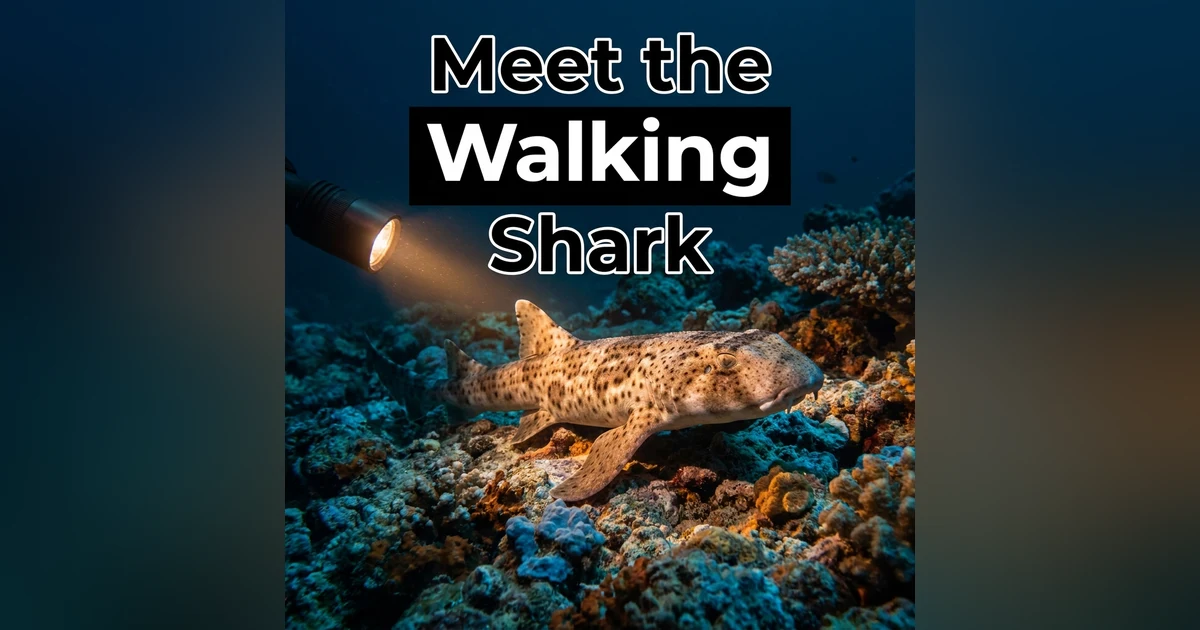
Walking sharks are one of the strangest small predators on the reef: pectoral fins built for crawling across coral flats at low tide, distributions so narrow some species live in a single bay, and a family tree that's still being filled in. In this episode, Andrew Lewin and Dr. David Ebert are joined by Jess Blakeway, a PhD candidate at the University of the Sunshine Coast, whose research on the distribution, ecology, and biology of walking sharks (genus Hemiscyllium) in Papua New Guinea has already led to a new species discovery.
Jess walks through her path from volunteering with sea turtles in PNG to noticing a walking shark outside its known range, emailing shark scientist Christine Dudgeon out of the blue, and eventually joining her as a PhD student. That relationship led to the description of Hemiscyllium dudgeonae, or Dudgeon's walking shark, named in honor of her supervisor. Jess and the hosts also dig into why these sharks have such tiny, non-overlapping ranges, how researchers tell nearly identical-looking species apart using color pattern, genetics, and geography, and the ongoing mix-up between "zebra sharks" and "leopard sharks," which turn out to be the same animal at different life stages.
It's a fun, detail-rich conversation about what it actually looks like to find a new species in the field, what happens after that moment (specimen collection, museum deposits, taxonomic description), and what Jess has planned for her postdoc research.
Takeaways:
- Papua New Guinea and northern Australia are home to all 10 known species of walking shark, each with a highly restricted range shaped by deep-water barriers, freshwater outflows, and shallow-water habitat limits.
- Jess Blakeway co-described Hemiscyllium dudgeonae, a newly recognized walking shark species named after her supervisor Christine Dudgeon.
- Because walking sharks look nearly identical morphologically, researchers rely on color pattern, genetics, and geography, not body shape, to tell species apart.
- Zebra sharks and leopard sharks are the same species (Stegostoma tigrinum): striped as juveniles, spotted as adults.
- Some walking shark distributions overlap without the species actually co-occurring, raising open questions about how isolation and reef geography shaped their evolution.
Connect with us:
Website: https://bit.ly/37TMqeK
Instagram: https://bit.ly/3eorwXZ
YouTube: https://www.youtube.com/@beyondjawspodcast7591
Dave:
Website: https://www.lostsharkguy.com/
Instagram: https://bit.ly/3q1J9Q5
YouTube: https://www.youtube.com/@lostsharkguy
Andrew:
Website: https://www.speakupforblue.com/
Instagram: https://bit.ly/37g5WkG
YouTube: https://www.youtube.com/@SpeakUpForBlueTV
1:00:00 Do you like walking sharks? Cause that's what we're going to be talking about in today's episode of the Beyond Jaws podcast. We have PhD candidate Jess Blakeway, who is on the podcast today to talk about these sharks that can walk. This is a fascinating species that has been the topic of choice for a lot of different Shark Week shows and I think National Geographic shows and Shark Fest and all these kinds of things. And they're always interesting because look, this is a walking shark and it's a small shark and we're learning a lot about them. And so much so that Jess always has this knack or seems to have this knack of finding new ones and where they not normally found.
1:00:44 So we're going to be talking about that on today's episode. So let's get started with the show. Hey everybody, welcome back to another exciting episode of the Beyond Jaws podcast. I'm your co-host Andrew Lewin here with my co-host, Dr. David Ebert. Dave, are you excited about walking sharks? Is this something that really gets you going? Oh yeah, these are really cool. I've never actually seen them in the wild like this. I'm super excited to hear about this story here. And yeah, and the other, well, they're really cool, pretty little sharks. They walk, I mean, right there, they're kind of really cool. Yeah, that's cool too. But the fact they have such narrow distributions in that whole Northern territory and Papua New Guinea area, we'll find out today, like 10 species there.
1:01:29 And Jess described, discovered one of them. And it sounded like every time they bring her in the field, she's finding something new out there. So if you listen to the episode, you'll find out why we're talking about. And I also thought it was pretty cool that we had, we had actually, we'll mention here, we actually previously invited Christine Dudgeon, who was her professor onto the show. And coincidentally, after we'd invited her, we saw this new species she named after her professor. And we thought, well, we got to have her come on. Got to have her on. So, absolutely. The fascinating discussion is really cool. As you're the young PhD student, who's just finishing up now and she has a great story. And we're definitely going to have her back on to talk more about it.
1:02:11 Yeah, to get the full, full story. This is more of a bonus episode to introduce the walking sharks. And we haven't really had them on the podcast before. And this is going to be a lot of fun talking about a lot of places in Papua New Guinea. I highly suggest if you're watching this on YouTube, you open up a Google Maps tab and then start looking around to get your familiarize yourself with it, because there's a lot of names that get thrown out, which I think it was a lot of fun. I was actually looking at it while she was talking about it, to see if I can find where we were. But it's really cool. And we also find out, Dave, what's the real common name? Is it a zebra fish or is it a zebra leopard shark?
1:02:55 Zebra or leopard shark? That's the ongoing question. That's the ongoing question. And we are going to discuss that. Yeah, we're going to discuss that in this episode. So why don't we just start? Here's the interview with Jess Blakeway talking about zebra slash leopard sharks and walking sharks. Enjoy and we'll talk to you after. Hey Jess, welcome to the Beyond Jaws podcast. Are you ready to talk about zebra? No leopard sharks, I think is what we call them. Are you ready to talk about these wonderful animals? I sure am. All right. Well, welcome to the Beyond Jaws podcast. And today we have a terrific first time guest on our show. We have Jessica Anne Blakeway, who's a PhD candidate at the University of the Sunshine Coast in Queensland, Australia.
1:03:39 Her research focuses on the distribution, ecology and biology of walking sharks, hemicillium in Papua New Guinea, with the primary focus on the species found in the Malini Bay Province. I probably can't ask that wrong, but we'll she'll correct me later. And she leads a multi-year research project to assess the distribution of limits of walking shark species whilst collecting ecological and biological best flying data to address critical knowledge gaps. And if you don't know, we'll cover today this Papua New Guinea has an amazing array of these walking sharks that are found nowhere else in the world. So we'll definitely get into that. Her project, a collaborative effort with local communities, NGOs and international researchers.
1:04:21 Her research integrates genetic analysis to better understand species boundaries and within species population structures. Working alongside the conflicts, conflict islands conservation initiative, she also investigates reproductive patterns and spatial use to inform long term conservation strategies. Just recently described the new species of walking shark, hemicillium dudgeoni. And dudgeoni sounds familiar to you. It's a species she named after her one of her advisors, Dr. Christine Dudgeon, who not coincidentally is going to be our next guest on the Beyond Jaws podcast. But we haven't told anybody yet. So she doesn't know. And just as research directly informs conservation planning and policy and includes contributions to the important shark and ray area program.
1:05:10 And also she contributed to IUCN Red List assessments. She has extensive experience in marine conservation, field based research, project management and scientific communication. She has led remote field expeditions and logistically complex regions and regularly presents research findings to stakeholders and government agencies. She doesn't say she's currently doing her PhD at the University of the Sunshine Coast, but she did a BSC with honors at Deakin University and her BSC at Murdoch University. And with that, Jess, welcome to the show. Thank you. Yeah. So it's a long list of accomplishments at such a young age. That's amazing. I know. It's amazing. So how did you get interested in sharks and the marine environment?
1:05:53 Yeah, so I actually grew up in Tasmania, where I currently live. Tasmania. But yeah, well, sort of born in WA, but grown up in Tassie. So OK, I grew up going out on the boat with my dad. And he used to work with the dive shop down in Eagle Hook Neck. So I've been around diving in the ocean since a young age. And that's kind of where it all stemmed from. There was a little moment there where I almost thought I might go into law, but I'm glad I didn't. But yeah, so just basically growing up in a beautiful part of the world and being inspired to be in the water all the time, learning how to dive at about 15 and then got hooked since then.
1:06:44 Yeah, what's the difference? Like, you know, when we a lot of people I live in Canada, you know, Dave lives in the US. So here in the western part of the world, when we think of of, you know, Australia and diving, we think of the Great Barrier Reef. You know, I know Tasmania is a lot different. What like to dive in Tasmania? What is what could one expect other than Neil the seal? Apparently, who likes to. Neil the seal has been around lately. He actually lives right near my mother-in-law when he's in Tassie, which is right on. That's hilarious. Yeah, no, diving in Tassie is definitely not coral reefs.
1:07:25 We're quite temperate, pretty cold. Last time I went diving, it was actually 13 degrees Celsius. Wow. Yeah, that's chilly. But yeah, it's mostly kelps and that sort of thing. But yeah, we've got in terms of the last my brains, we get some bigger bull rays. We get, you know, the. Oh my God, my brain just stopped working. There's just so many to think about. You know, we yeah, we get poor Jackson sharks and all of those more temperate species, which is really nice.
1:08:10 You know, we do get some of the bigger by few months. But so far, luckily, I haven't seen them on my diving. I think that would be a little bit nerve wracking diving. But we get like lots of crayfish and abalone and all of that down here as well. I think that's my favorite scientific description is the bitey ones. The bitey ones. Yeah. So so you went there. So you went here in Tasmania, obviously, and you went, which has a good program, the University of Tasmania and a lot of top researchers there, well, white and Peter Lass, who's retired and John Stevens, who's retired are down there.
1:08:52 So why did you go first? Would you go to you went to Murdoch University out in WA Western Australia? Yeah, yeah. So I was called Tasmania is called in terms of Australia. So, yeah, I decided I wanted to go somewhere a little bit warmer. I have family over in Western Australia as well. And I got accepted into Murdoch. So I made the move over there, which was wonderful. They've got a really good program with lots of field activities as well. So you're not just sitting in the classroom, which is really great.
1:09:32 And then you went to Deakin. Where's Deakin? Deakin is in Victoria. So I came back to the coldest side again. OK. And I actually did my honours on Galapagos sea lions using the telemetry data. So I didn't get to go. But OK. Yeah. So so at this point, you're just doing where you're just interested in marine science in general. Pretty much not shark specifically, just marine science. Yeah. I mean, I've always had a soft spot for sharks, but I wasn't really sure where I wanted to go. So I just was like, oh, this sounds interesting.
1:10:13 May as well jump on and try this. Yeah. So what? So so you got the work did for your honours. You worked on. We say was it Galapagos sea lions, you said. Yeah, correct. OK. OK. Which Australia is a little bit far from Galapagos sea lions, but you can have that for another conversation. Exactly. So so OK. So how did you go from the sea lions to walking sharks? Yeah. So when I actually finished my undergrad over in WA, I was looking for something to do to try figure out what I actually wanted to do. I feel like doing volunteering is so important in trying to figure out what you actually want to do when you graduate in terms of what you like and what you don't like.
1:11:01 So I was doing a lot of that. And I saw an opportunity to go over to Papua New Guinea and do some volunteering over there, which was actually with sea turtles. OK, turtles. OK. Yeah. Um, but while I was over there, I got to do some diving as well. And they actually had one of the walking shark species, which I now study over there. And I was like, I want to know more about this. And there wasn't any information. So, yeah, then I started hassling Chris.
1:11:43 I emailed her because I saw she was on the description of this species and I jumped into emails and I was like, hey, my name is Jess. I've just been diving in Papua New Guinea at this spot that's outside the described range. This could be a cool project that maybe you might want to. I like that. Yeah. Yeah. So that's that's how I got into the sharks. So wait, so sorry, take that back again. So you went diving in Papua New Guinea. You saw these sharks. Yeah. And it's kind of cool to see these sharks, obviously. You knew a little bit about them. You did some research.
1:12:23 They say this is outside their normal range. I mean, email the person who's attached with describing the species and say, hey, by the way, I found this outside the range. You might be interested. This would be a cool project to study. That's that's what you did, essentially. Pretty much. Yeah. That's fabulous. Well, you know, you have to find your gap. And it was a big research gap. So that's a huge research gap. And so what was her response? So at the time, Chris, I think she was based at University of Queensland, mostly at that stage. But she didn't have the capacity to take on a PhD student at that point.
1:13:04 So I ended up volunteering with her and doing some photo ID work with the leopard sharks or zebra sharks. Oh, we'll get this. Can I just can I just probably just so people were talking about Dr. Christine Dudgeon, who's a professor at the university up there. I actually I think she's a senior researcher. I don't think she's quite a professor. Anyway, she's up there. And just a sneak peek. Christine's going to be coming up on the next episode after this one. So keep that to ourselves. And so but just want to just make sure everybody knew we knew we're talking about.
1:13:44 So, yeah, go ahead. Go ahead. Yeah. So Kristen quite have the capacity in her position to take on a PhD student. So while we were waiting for her to have the availability and time to briefly take me on, I did some work with her on the leopard shark population in Australia, working on their photo ID database and just getting that all uploaded. So it was a lot of old photos that needed uploading. And then same thing with the Thailand population and uploaded a bunch of that information for her.
1:14:27 And then somewhere in this time, COVID happened. I moved to Queensland and there was a bit of a gap, a few years of waiting for this PhD position to be open. But yeah, in 2023, finally, we locked in and I started. What were you doing during those years? I mean, it's got to be a tough thing. You know what you want to start. You know, you know, the people are ready. There's I assume there's funding for that at that point. You know, I wasn't I'm impatient when it comes to these kind of things. So I just want to know, especially with COVID, not knowing when it was going to end, knowing the severity, especially in Australia, where they would close down on a regular basis, just like here in Canada.
1:15:10 What was that feeling like for you to like kind of put things on pause because of this pandemic? Yeah, the pandemic was pretty stressful. I was actually living in Melbourne when it happened. So we had the longest lockdown in the world, basically. So that was not fun. I like many people doing studies was working in hospitality to supplement my income and make sure I could pay the bills at the same time as doing my honours. So basically, in that time, I just ended up working in hospitality.
1:15:52 I didn't. Yeah, didn't get to do too much fun, fun research. Was there ever a point where you're like, this may not happen because because the pandemic just because of things moving around? I mean, I'm I'm a pretty relaxed person. Like, I can't get stressed. But I feel like if it's going to happen, it will happen. And, you know, you've got to do other things in the meantime, then you've got to do other things in the meantime. But you, you know, you just have to keep at it and for sure that it comes to fruition. Yeah, absolutely. Absolutely. Good for you. That's awesome.
1:16:34 Yeah. Yeah. So, yeah, stressful. Yeah. So they say you're working on doing this leopard shark. I.D. Now, can I ask you, why do they call him like leopard sharks versus zebra sharks? Yeah. So they when they're born. So leopard sharks, they lay eggs. And when they hatch from their eggs, they're striped, which is why you guys call them zebra sharks. They're striped like a zebra. And then as they grow, they actually their color patterns kind of morph into more leopard like spots.
1:17:20 So that's why we call them leopard sharks. And of course, the scientific name is Stegostoma tigrum, which is the tiger shark. Oh, that's interesting. Yeah. Yeah. It's a very confused shark. It is. They are pretty. They are pretty sharks. I'll say that. But they're but they're just kind of because we have we have the leopard shark here in California, the true leopard shark, in my opinion, which is a completely different family. It's in the hound shark groups. Tricus, semi-fasciana. And yeah, so I was always it's always a back and forth when I have to hear when I hear tiger shark, leopard shark, whatever. Yeah, it always gets confusing with a common name.
1:18:01 Yeah. Yeah. Yeah. Another another little bit of trivia, but the the juveniles, as you mentioned, are striped when they're born. They were actually described as a different species. I can see that. They are so strikingly different. They're actually one had been described as separate species. No, but it was only when people actually I think had them in captivity and saw them actually growing up. They is where they figured out like, hey, these things are actually the same species. So yeah, it's a little bit of trivia for people out there. Yeah. And interestingly, the walking sharks do the same thing. They're striped when they hatch and then they grow into their color patterns. What can you tell people out there? The the the I mean, I think it's really fascinating the whole walking shark thing in Papua New Guinea.
1:18:44 Because you have all these different species are very limited distribution. Can you just kind of for everybody listening here, give a quick overview on what exactly when you talk about these? What do you yeah? so normally when I do a talk to students or Whoever I kind of start off with, you know, you think of walking sharks. You think of Bruce from Finding Nemo. His grown legs who smoked on land. It's like, oh no, like shark NATO kind of It's stressful. But we're not talking about that. We're talking about like these little sharks that kind of come up onto the coral reefs and they use their fins to walk.
1:19:26 And the most famous of them is the epaulette shark from the Great Barrier Reef. And I feel like most people who have watched any David Attenborough. Yeah, has probably seen the clip of this little shark coming up and walking at low tide. And that's the epaulette shark from Australia. And in addition to that one, we actually have nine other species. Which most people. Wow, I did not know there were nine other species. Wow. Okay, so a total of 10 species in this genus, which is really exciting. And they're only found in northern Australia and around the island of New Guinea. So that's Papua New Guinea and West Papua in Indonesia and then also Halmahera and the Aru islands.
1:20:23 And each of these species have like distinctive color patterns that you can use to tell them apart. And they've all got quite distinctive distributions. And yeah, in Papua New Guinea, we have officially as of a month ago, four species in Papua New Guinea with three of those species found in Millon Bay, which is the very eastern tip of Papua New Guinea. And now all of these things here, and we'll talk about the one you just described in a moment, but all of these these these walking sharks have a very limited distribution to like just really like some bays and short stretches of coastline.
1:21:14 That opens up all kinds of weird questions about why are they so so have such a side restricted. Yeah, yeah. Yeah, so there's a few different hypothesis hypotheses on it. The main thought is these animals are, you know, less than a meter in length. So they're pretty small. So what three feet. Yeah. And then they are quite site restricted. So they don't really it's all that they aren't really cross depths of over 200 meters.
1:21:56 So they're quite restricted to the shallow water. And then they're also egg laying similar to the leopard shark. So they kind of deposit their eggs on the sea floor. So all of these factors together kind of make them quite restricted to one location. And then they're also associated with just coral reefs and seagrass beds and mangrove systems. So they're fairly habitat restricted as well. And then the thought on their non-overlapping distributions that are quite distinct is because of these factors, they're quite influenced by the deep water barriers. And then also things like really large freshwater outflows causing a break in their habitat can cause a break in the species distributions.
1:22:52 So they're kind of like the main reasons why we think they have these quite small distributions. What's the most like the Australia, how many you just have the one species in Australia? Is that correct? No, we have to. Oh, you have to. Yeah, we have to. So we have the epaulette shark on the east coast, which is in the Great Barrier Reef. And then we also have hemicillium trispecular or the, I think the common name is the spotted. Okay. Walking shark. It's on the west coast of Australia. And it kind of goes from Darwin along down to the Ningaloo Reef. Okay. Okay.
1:23:37 So the Northwest area. So they, but they don't overlap at all. Currently, we don't have any information that they overlap. Okay. Yeah. It's something that we want to look into in the future. But we've got to work with traditional owners to kind of work in that area, which is obviously a really amazing thing to be able to do. But you know, that's, that's down the line, hopefully for postdoc. Yeah, sure. But this is what I love. Sorry, David, I didn't mean to cut you off. This is what I love about these, these types of sharks is not a lot of it seems like there's not a lot known about their ranges, right? Just as in terms of how this PhD came. And I love how you answered is like, yes, we don't know yet because we could, they could overlap for all we know we have no idea. And I assume you're getting into pretty remote places in certain spots in Australia. And, you know, it's like you said, it's going to be interesting to build those relationships with traditional owners and stuff. And I think that's really cool.
1:24:47 But this is what I love about looking at sharks and doing this podcast, because every time we have somebody here, it's like, yeah, we're not gonna say that they overlap or that they don't overlap. It's because we haven't figured it out yet. You know, we don't know. Definitely. So like the work that we've been doing for my PhD, basically stemmed off the information we had from doing the volunteering at the conflict islands that there was a shark species outside of its known range. So we wanted to do exploratory surveys to look into that more. And the first big trip we did, so I also work with Mark Erdmann, Dr. Mark Erdmann.
1:25:32 And so, and Kathy Townsend, as well as one of my other supervisors. So we all went on this big trip on a boat all throughout Melon Bay in November 2023 to kind of look at part of the known area, but also outside of the known distribution to kind of get a bit more information on what was happening and update those distributions because they do have small distributions. And we kind of left the conflict islands and there's this big, it's actually a massive shipping channel, but it's this big deep water barrier and it drops down to I think over 500 meters, maybe over a thousand meters in depth.
1:26:20 Yeah, quite deep. And there's another group of islands called the Du Boin Islands and a lot of our friends who work at the conflict islands actually are from those islands as well. And we were doing some snorkeling at nighttime because that's when these sharks are more active. And really excitingly, I was in the water with Chris Dudgeon again, and Chris grabs a shark because we just pick them up and bring them back to the boat because they're not bitey sharks. And so she grabbed it, we swam back to the dinghy where we had a bucket of fresh sea water to place the animal in before we take the information we need from it. And I got in the boat first and Chris passes me the shark and I was like, "Hey, this is different!" And I was like, "This is, it's not my collide. Like I think this is house Ramay and house Ramay is the species, the Pupwin walking shark and that one's the one that's actually meant to be found up towards Port Moresby. Oh, okay. So this was really far from the known range of that species and we had had no indication that this is what we're going to be finding. So just to give people context, how far is Port Moresby from where you were? Um,
1:27:52 so I would say over 800 kilometers. That's a distance. Yeah. Sorry, my dog's just being a little bit crazy. No worries. No worries. We are a dog friendly podcast, a pet friendly podcast. He just needs attention. Hey, there he is. Let's pick up a little bit here. You can't look at him. Hey, this is Kenny. Oh, is he like a, like a bully mix or he's a blue stuffy. Oh, look at him. Yeah. He's adorable. He is very needy. Yes. He often gets jealous when I'm talking to the computer.
1:28:36 Like, why can't they pet me? Why can't they? Yeah, exactly. Um, sorry. Um, but yes, he, the spaces that we found further, um, past the conflict islands, yeah, was completely different in color pattern and, um, was very similar to the Papuan walking shark. So we were really excited about that. That is exciting. Yeah. Um, but we weren't sure if it was going to be a crossover zone for the two species where we could find both. Oh yeah. The species.
1:29:18 But, um, after a few more surveys, we, um, basically found that at these group of islands, it was just, um, the Papuan species. And then we went over another deep water barrier to a place called the Roswell islands. Yeah. The furthest eastern island in Millam Bay. It's way, way off in addition. If you look at the map, it's a tiny little dot at the very end. Um, and we did a couple of surveys there and we found Michael's walking shark, which is the main species that we had been working on. Um, can you stop?
1:29:58 That's okay. No worries. Um, so we were at the Russell islands. Yes. Yes. Um, and we again found Michael's walking shark out there. So that's after another deep water barrier. Um, and that's kind of brought up all these questions about the distribution because with all of the other species, particularly the ones found in West Papua, they all have these really distinct distributions that don't overlap at all. And now we've found overlapping, but not co-occurring. So yeah, it's raised so many questions. I can imagine. Did you recognize right away that based on the color pattern, that there was a different species?
1:30:46 Well, you said you did when you got it up in the boat. Chris was like, Oh my God, it's a different species or something. So you kind of, you kind of knew, right? It was right. One of those moments you really knew like, okay, there's something different. Yeah. Just, just so people know these sharks, they're really some of the prettiest sharks. I can think of as far as a group goes, but there's almost no morphological differences besides the color pattern and genetics. Correct? Yeah, correct. So color pattern and where they found is kind of the main key to figuring out which one you're looking at. Yeah. Because I think like, you know, you preserve some of these things and I don't know if you've, you probably looked at some of the museum specimens when you did your thing and they probably all look kind of a drabby brown or something with, yeah, poor coloration. They do have some, some of the defining features do still come out even in some of the specimens that have been preserved for 200 years, but it is very faint. Yeah. Okay.
1:31:46 Okay. So you got, so you got this thing and so you got this shark and you realized it was something new. So what, what, what did you do next? What was the next step? The next step, we actually went back to the main boat and woke up Mark. Mark was asleep at this point. And he got excited and came and did some surveys and took some pretty pictures. And then we, so basically when we catch the sharks, we collect some morphological information. We collect a fin clip. So we take a little clip for the genetics from its dorsal fin. No.
1:32:31 Yeah. And then we also take a cloacal swab to kind of see what they've been eating, hopefully. And then we take photos of them and then we release them. So we're just trying to collect as much information as possible because there is no information. Yeah. But now when you went to describe this thing, you had to get some specimens for preservation. Yeah. So that's actually in a different location. So that was on a different trip. So same thing happened. Chris passed me a shark on a boat and I say, Chris, this is something different. And she's like, again?
1:33:14 Which is pretty cool. But yeah, so this one was at the Amplett Islands, which is just north of the Tiendre Castor Islands. It's still in the Mill and Bay Province. And this one has all of these small, like, white dots and dashes on along it, which is pretty unique for this genus. Like, it's not similar to anything else, really. Now, there was a similar to the one you'd already collected, or was this one also different? So this one was different. So the one that we saw on the first trip was actually the disarranged extension, basically. Okay.
1:34:00 Of the species that's found in Port Moresby. And then on a trip last year in March, we were doing the same thing, diving and snorkeling to find these sharks. And again, it was me and Chris and Chris passed me this animal and saw it in the light. And I was like, Chris, Chris. Like, it's, it's pretty funny, because as soon as she passed it to me, I was, I knew it was different to Michael's Walking Shark, which is the main species that I work on. Yeah. And just completely different color pattern. And we got really excited. We only found one that night, though. So we ended up staying for a few days and trying to find some more. So you're able to see so you have what you basically got so far, you got one new species that you just described.
1:35:00 And so what can you talk to us about how that that whole process like when you had this had this thing, you said, okay, I'm going to describe this. And all the students out there, the grad students listening, listen carefully. How does this do you want to butter up one of your professors on your committee? Listen carefully. Yes, yes, it is a good way to butter up to name a new shark after one of your supervisors. But yeah, so basically, we, we caught these sharks, we ended up having to collect some specimens for the Tysonoid description, which is not really my favorite thing as somebody who wants to conserve sharks. You don't really like having to euthanize any. But unfortunately, we have to have museum specimens for long term preservation.
1:35:54 So we ended up collecting three specimens, which I think it was two males and one female. And then basically, we had to take more detailed morphometrics in line with the other species descriptions in this genus. And then we basically had to take these animals back to Australia. We put two two are currently in Australia and then the other one.
1:36:37 The dog is being crazy. I picture is is is just going around and around trying to figure out what's comfortable. He was literally just doing zoomies in circles. I think his tail buddy. I don't know if you could hear him like, yeah, we can hear it a little bit. It's so cute. Yeah, yeah, yeah. It's normally not this bad. Hey, it's it's it's his day. It's his day to do the zoomies. He wants to be famous. Absolutely. But yes, it's it's definitely a process during the taxonomic description. I worked with Jerry Allen for that as well. Yep.
1:37:26 And basically, he also got x rays done of the two individuals that are in Australia. One is at the Queensland Museum and one is at the museum in WA. And then one is also at the University of Papua New Guinea in there. Okay, cool. Yeah, that's good. And what's it like for you to be like part of your PhD you describe a species like that's a pretty big accolade. That's a big deal. It's not something I thought would happen in my PhD and very exciting to be involved with that. It's pretty cool.
1:38:14 What what point did you decide you're gonna name it after your professor? So we had a bit of a conversation about it, not with Chris. Mark, Jerry and I and myself had a bit of a conversation and, you know, Chris for people who don't know or who will get to know her in the next episode. Chris has been working in this field for 20 plus years. She's a genetic geneticist and she is just a wonderful, amazing human. So we really wanted to give her kind of her flowers for all that she does.
1:38:54 And this is kind of like, you know, one of the nicest ways that you can do it. And she's actually one of the very few female scientists that have a shark named after her. Like, I think it's Eugenie Clark, Shannon, Corrigan and then I think there's maybe one or two others and then Chris. So it's very rare for female shark scientists to have. Well, Dominic Dittier, we named a shark after the colleague and good friend very accomplished with go shark. I know we need I think we named one. But you're right. There's not like a lot of there's not a lot. I have to think that's a great question. I don't even know what the answer is off the top. I could think think of some of the people you mentioned. But yeah, that's.
1:39:41 Yeah, I think it's it's quite low. Like, I believe it's under 10. Yeah, it's quite like, and then you think of the male scientists with things. But yeah, so it's kind of nice to, you know, do something nice for another woman in science as well. And yeah, it's very, very deserving of stuff. But I'm sure it was a good way to get your help out with your thesis too. So there's definitely a big thing that I think that's something named after you like that. So, you know, so actually, I just have another one actually named the shark after my niece. So, nice. Yeah, I forgot how to forget about that one. Sorry, Lana. Lana saw shark forgot about that one. So anyway, cool. That's that's that's that's that's that's really that's really nice of you to do. And just for the people out there know we're Christine's Christine's dungeon is going to be in our next episode. We're already planning to invite her on the show. And then I said, I'm going to do a little bit of a little one. And Iole told you in two weeks just about. I was here when the in the wild myself, but definitely a fun group to work on because you can actually see them alive and dive.
1:41:05 Yeah, that is pretty cool. And you get to dive on beautiful coral reefs. Yeah, okay, don't rub that in, that's right. (laughing) And it's like 28 to 30 degrees in the water, like Celsius. In comparison to diving in Tasmania, where it's 13 degrees, so it's nice to go warm up. Yeah, so I share the story with everybody because Jess and I were talking before the air, my first time, growing up, like a lot of people, I wanted to go diving in the Great Barrier Reef, and the first time I went to Australia, I went to Tasmania, and my first dive in Australia was in Tasmania, in a kelp forest in about 10 degrees centigrade water, which if I want to do that, I live here in Monterey, so I could have just gone out here in Monterey, where I grew up, and just gone diving in 10 degrees Celsius water, with kelp beds in there.
1:41:58 So for me, it was a little bit of a... You didn't have to fly across the world. Yeah, I fly away to Australia and end up in there. So thanks to Will White, Peter Lass, thanks guys for that memorable experience. Anyway, well Jess, this has been really terrific hearing this story about your discovery of this white shark. This guy got a white shark in my head. Anyway, I'm a long guy. I'm not like a lost shark guy. I don't want to think of a white shark. Anyway, I was supposed to say walking shark. I got the W right. It's a really great story. And so now, just to kind of finish up here for this episode, what are you going to... you're working on your last chapter now?
1:42:42 I'm trying to smash out three chapters at once. Oh, okay. There you go. That's how you do it. Yeah, yeah. Because why not? So yeah, I'm meant to hand in in April. Okay. So currently just trying to get the writing and the analysis done. And we also have another trip in October plan to collect postdoc data. Okay. So just trying to do everything on. Okay, so the plan's in place. Yeah. Right on the ground, we're for your postdoc. That's great. Good for you. Good for you. Good for you. Students listening out there, that's how you do it. You start laying the groundwork for the next step. That's great. Yeah. And of course you accidentally find these new species of sharks every time you go snorkeling helps too.
1:43:25 Yeah. Exactly. Sounds like it. Sounds like it. Anyway, just thanks so much for coming on today. We're definitely going to have you back. Maybe after you get your PhD done, you get settled into a postdoc. Why don't you plan to come back on and share with us what you're up to? Love that. Sounds great. Yeah. That'd be great. Thank you. That'd be great. Thank you so much. Awesome. Thank you. Thank you, Jess, for joining us on today's episode of the Beyond Jaws podcast. Dave, walking sharks are cool. It seems like there's more than we ever thought there were. And it seems like Jess is the key to finding new species, Jess and Chris, because they just keep picking them up and just finding that, hey, this is new. This is new. This is new. This is pretty cool.
1:44:06 Yeah. Oh yeah. That's great. But we got to give a shout out to Kenny, our unexpected guest on the show today. Kenny is Jess' dog. And you probably heard whether you're on audio or you're listening to this on video, you probably heard us talk about Kenny throughout the episode. Because I decided we're going to keep it in because I think it's fun. We love having dogs on the podcast. And he had a little bit of zoomies as he was going through the episode. He was excited about walking sharks. You want to walk around, be like, is this how they walk? Is this how they walk? Yeah. Oh yeah. No, that was that was some of the best parts of the story. He said every time she did, we're out to this area. They really hadn't surveyed before. They kept pulling up a new shark. I was like, hey, here's why. And she goes, damn, it's another new shark. So which I thought was pretty hilarious. Yeah.
1:44:51 Usually, I've told explain before you get those moments where like, just explain where you're like, wow, this is something new. Yeah. But more often than not, you're kind of going like, I'm not sure it might be new. Right. I'm not 100% sure. But yeah, so it's kind of cool when you actually get one that's you're like, yeah, this is this is definitely a new species like that. And there's a lot of excitement there. When I think what I think what's interesting too about because like I've always been told, you know, when I when I was a student, I'll never forget this. Like people are like, don't just focus on the the exterior, like the coloring. Yeah, you could focus on like some of the morphology. And sometimes that includes like the ridges or coloring and things like that. And also, you know, as we get more and more towards genetics, the genetics count. But it seems like walking sharks, it is some of the designs and the colors and the spots or non spots and things like that on the sharks.
1:45:41 And that's is that unique to sharks in general? No, this is actually because some sharks are infected never built changes with growth. Well, we talked about the zebra. Yeah, leopard shark. And as we mentioned during the show, like, you know, they change color from when they're born to when they grow up. And it's the birth size where they got the name sort of leopard shark. Right. And then as they grow, they change the spot more of a spotting pattern. And so, yeah, it colors. It's a character you can use, but you shouldn't be the only one rely on it. Right. But on these walking sharks and the other group I mentioned the shy sharks in South Africa, the same thing.
1:46:24 There's when you measure them up and I've the shy sharks, I've done a lot of those. You can't really tell them apart morphologically. But but the color, you can usually separate them on. And these walking sharks are the way you can tell apart is by the coloration. Yeah, there's no real good characteristics that they use on that they can use other than genetics and I think genetics and geography. And I think there's one other character. I think she said coloring, wasn't it? I think color. Yeah, it was the main way to color genetics and geography was really the three main ways of telling. So in other words, they all look alike from a morphological perspective, like a body shape perspective. But the coloring might be different. I think that's that's really fascinating. I wonder what that evolution is.
1:47:07 That evolutionary tree looks like for them as they as they went along. It's a fascinating group because as we talked about in the show, you know, particularly around Papua New Guinea in that area, they have really restricted ranges. I mean, like some were like in a bay and maybe a little bit along the coast. But they're really restricted. They don't seem to overlap a lot. A few of them have a little bit of an overlap. And the other ones, they just don't know. Yeah. So it's just it's kind of a from an evolutionary standpoint, it's a super interesting area of the world. Yeah, a little group of sharks. You know, again, the only ones I could think that would be kind of close to be the shy sharks in South Africa, which are three, four species there. And they all occupy a narrow range of coastline. And that's it pretty much. I wonder just be around these islands, you know, and knowing how old sharks are like, and I don't know how old these types of sharks are. If they go back, you know, millions of years or things like that. I wonder if.
1:48:06 You know, just being the isolation may have just, you know, because they're in such these these bays and island areas and you know, if those if it's if it is millions of years, were some of those islands submerged and then they got isolated that way, you know, different coastal morphology changes and earthquakes and things like that that could change their their habitat and they just get isolated. And I wonder if there's any divergence of within the same species to see how they've different genetically. A lot of a lot of questions that people can do a lot of research on. It's a great group to work on. Like you said, they're because they're isolated by depth or rivers and they're just there where they occur. They're isolated. So they can't because they're so coastal. It's not like they're swimming out at, you know, a hundred meters or so. I think most of them are less than 50 meters maximum depth. So they don't. And when you got when you're on an island, you got hundreds of meters depth around you.
1:49:00 You're not likely to be able to cross those areas unless you're unless you unless you can. You get up and swim and you know, these things don't appear to be the type of sharks are going to be doing any kind of distance swimming. Yeah. And so so, yes, I think you'd have to have something about. Well, I'm sure that people do know what the evolutionary history is of those islands when they separated when they broke up and you could probably with the genetics. I call you look at a time clock, you know, geologic time clock and see when they developed and when these things may have diverged and radiated into different species. But again, there's mainly the genetics, the color and where they occur. That's the only way you can tell them apart, which is which is super interesting. It's yeah, it's very fascinating. That'd be that'd be an interest of mine for sure.
1:49:46 Just to find out what these things are doing. Plus diving and snorkeling in in Papua New Guinea is not is not half bad, right? Like, I don't think it's a bad place. I think we should do a show from Papua New Guinea. We have to see. We'll have to see if we get it. We have to see if we get an invitation from somebody we know. Yes. That would be that would be phenomenal. All right. We'll wrap this up because I know we can talk about this forever. But just thank you so much for indulging us in our curiosity and learning about these beautiful sharks and sharing your knack for discovering new ones as well as your research. We really appreciate it. Can't wait to have you back on. We're going to share her social media connections in the show notes. You can check that out. All right.
1:50:28 Ours will be there as well. Dave, if people want to connect with you and see all your stuff doing, you just let us know what you're up to. Yeah, just a law shark guy on Instagram and law shark eye on YouTube. Check it. Check them out and please follow both and you can always message me that way. That's right. And check out the your your series that we've been working on together. Would you want to name that? So people can check it out. Series on the YouTube channel at law shark guy. The series is series on the show. The series on the show. And please check it out and please, please like. All right, wonderful. This is great. So thank you so much for joining us if you want.
1:51:14 If you're listening to this on YouTube, please subscribe, you know, hit that notification bell. Let us know what you think about this interview in the comments and about zebra sharks as well as if you're listening to this on the audio version, please follow on your favorite social media platforms. And we'll talk to you next time. And happy conservation.