
What a 5-Week Shark Trip Revealed About the Future of Shark Science and Conservation


 Apple Podcasts

 Spotify

 YouTube
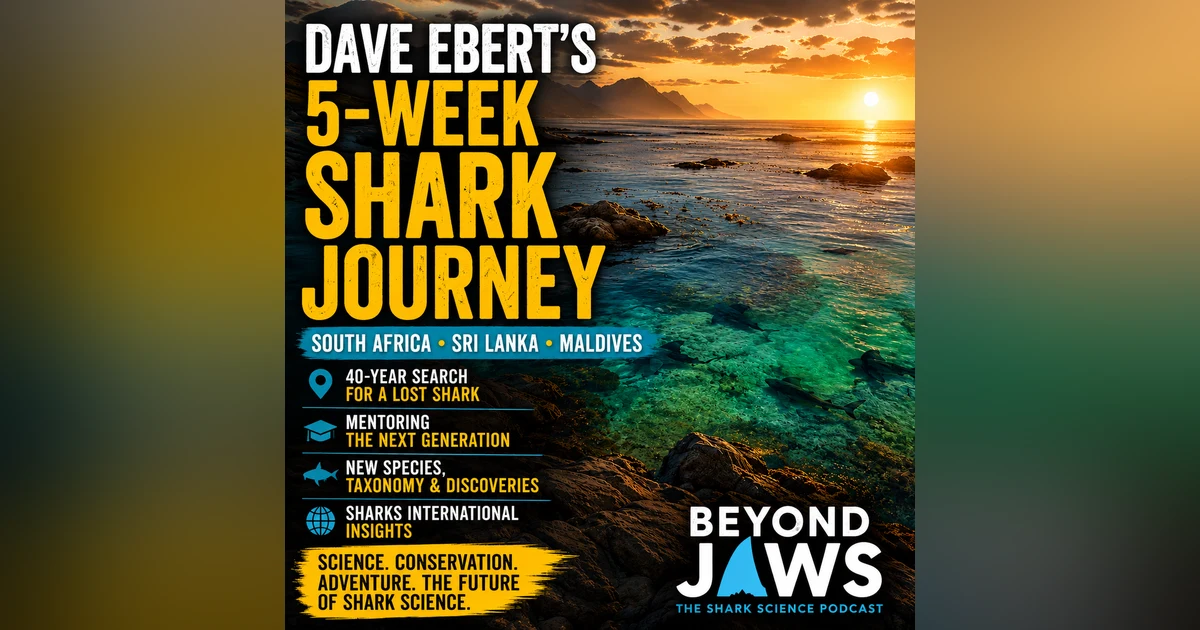
Dave Ebert returns from a five-week journey across South Africa, Sri Lanka, and the Maldives, sharing stories from shark research, Sharks International, mentoring young scientists, and the search for lost sharks. This episode explores why taxonomy still matters, how new shark and ray species are still being discovered, and why the future of shark science depends on training the next generation.
Shark science, shark conservation, Beyond Jaws, Dave Ebert, lost sharks, new shark species, guitarfish, South Africa sharks, Sri Lanka sharks, Sharks International, marine biology, ocean science, shark research, taxonomy, chondrichthyans, marine conservation, Save Our Seas Foundation, Maldives diving, science communication.
Connect with us:
Website: https://bit.ly/37TMqeK
Instagram: https://bit.ly/3eorwXZ
YouTube: https://www.youtube.com/@beyondjawspodcast7591
Dave:
Website: https://www.lostsharkguy.com/
Instagram: https://bit.ly/3q1J9Q5
YouTube: https://www.youtube.com/@lostsharkguy
Andrew:
Website: https://www.speakupforblue.com/
Instagram: https://bit.ly/37g5WkG
YouTube: https://www.youtube.com/@SpeakUpForBlueTV
1:00:02 Welcome back to the Beyond Jaws podcast everybody. We've got a very special episode last week. We had me on the podcast. I was the focus because of a new job that I got back in April and I've been working for Pisces Oceans ever since, bit of a dream job. Want to talk about that a little bit here on the podcast because you know, it's what we do. We talk about Jaws, we talk about updates in our lives, especially between Dave and I. And Dave, we're gonna be focusing on you today because you just got back from a trip, I think it was about five weeks long where you went to South Africa and you also went to Sri Lanka for Sharks International. So we're gonna run down some of the significance of that trip and you even got to dive in the Maldives, which is great. You know, off season, however, as you said, as you will say, pretty, pretty terrific diving.
1:00:48 So a lot of fun. I can't wait to get into it all. First of all, welcome back. How are you feeling? Uh, a little wrecked, but after after going to five weeks, five countries, three continents and I didn't want to think about how many hours I spent on a flight or an airport. It's just kind of just want to blot that out of my mind. But it was an awesome trip. I just I can't can't. Well, I'll tell you about it. I can't say enough, but I'm going to talk. So I'll probably say more than you. You'll say more. I'll say it all there. So right now. So let's just let's just break it down, Dave. I went five weeks away. Why don't you just talk about like purpose of the trip, where you went first, where you went last, and then we'll kind of dive into.
1:01:33 We'll start off with South Africa and then we'll dive into the national. Well, I I had my start off the trip. I went to South Africa for a couple of weeks and the South Africa trip was part of a Save Our Seas Foundation and an ocean census grants that I had in partnership with the also with the South African Institute for aquatic biodiversity. And I've been working on it. I've been working in South Africa, obviously, for a long time for 40 years. This is my 40th year, by the way, since I first arrived in South Africa. So amazing kind of a bit of been turned into a bit of a journey already for the year. Yeah. But it's kind of neat going back to the South African Institute for Aquatic Biodiversity, which used to be called the J.L.B. Smith Institute of Ictheology when I was a student back in the day.
1:02:22 And those that don't know, J.L.B. Smith was the one who described the Coelacanth back in 1938, the old four legs. Yeah. And it was a it was a fish that was thought to be an extinct for 70 million years. And specimen turned up off East London, South Africa. And Marjorie Courtney Latimer got ahold of the fish from the fishing captain and contacted J.L.B. Smith. They didn't know initially didn't know what the hell they had. And but they eventually figured out it was a Coelacanth. And and such began a journey that took them till the 1950s. I was interrupted with World War Two before they found another specimen off the Camar.
1:03:04 So anyway, that's just a little bit of the history there of a SIA, which is South. That again, the South African Institute for Aquatic Biodiversity. They changed the name had been changed. And his just a little footnote, J.L.B. Smith's wife, Margaret Smith, when I first went to South Africa in 1986, she was still alive. And I actually got to know her. And I house sat for her and her sister. She heard they were in her 70s at the time. And her sister was a had was a retired vaudeville performer. And I'm sure the young people are going, what's a vaudeville performer? So I don't even know that. OK, basically, basically, you get up on stage and entertain people. Be like going to a concert. Now, yeah, it's comedy, it's entertainment.
1:03:47 It's all kinds of different stuff. People because back in the day, you didn't have like, you know, you didn't have like videos and movies and stuff. So people just go there and get up on stage and entertain, entertain the talent show, if you will. Yeah. Sort of like if you think of some of the old people you may know the names like Bob Hope and some people. They started out as vaudeville performers. Charlie Chaplin, these guys. And so they would go look it up. But anyway, anyway, so Margaret and her sister were had a home and they're well into their 70s. They used to have students would house it. They had a cottage that would stay there in case there was any, you know, help problems with them, you know, having a younger person there. And so I ended up house out there for a little bit for him. And it was kind of cool as a young guy in my 20s and and Margaret and her sister, Flora, had come over literally with tea and crumpets every night around seven o'clock.
1:04:35 And she'd share some stories. And she was a pretty amazing woman. The stuff she was doing back in the 30s and 40s and 50s, you know, as a young woman in South Africa, they they'd venture to Mozambique or Tanzania or Angola, Namibia to go on collecting. And J.L.B. was about 20, at least 20 years older than her. And so he was and he wasn't in great health. So she actually had to do a lot of the diving and swimming and stuff. And she was actually a very accomplished swimmer when she was a young woman. And so she used to do used to go out and collect the fish. And she'd tell me these stories about that.
1:05:18 Go out in these beautiful coral reefs in like Mozambique. And they and this is how they used to collect fish. So, you know, young people don't be horrified. But they used to dynamite the reefs and then the dead fish would float up at the time. Any better. They was all they had to do. Because I mean, there was no no luxuries at all. I mean, you're out there camping. And so she'd go. She told me the story. She'd go diving around. She says, yeah, you know, Dave, all these sharks would start showing up and swimming around and be looking at J.L.B. going like, is it OK for me to be in the water? And she goes, oh, don't worry, sharks don't bother people. And she goes and she and she looked at me like, you know, like, you know, just perfect without skipping a beat and go like, what do you think, Dave?
1:06:00 Should I have been worried? And I say, well, my attitude is if they're bigger than me, I'd get the hell out of the water. But you know, you made it. So so I have scientists as well. Yeah. She was an illustrator. If you look at like, yeah, she was she was actually your background was in chemistry. And actually, J.L.B. Smith was a chemist as well. She is the backstory. She was as she was a chemistry student of his is how they met. So back in the day. So it's kind of an interesting story. Sometimes I'll definitely maybe come on sometime and just share more of that whole backstory. I've shared parts of it before, but it's kind of interesting, just a bit of the history there. Yeah. And then so I've kept my relationship with with now, SIAB for all these years and I go back as often as I can because I'm a research associate there and continue working on the in the collection.
1:06:54 So before you before you go on, what does it mean to be a research associate? Is that like a junk professor in a way? Yeah, it's like an adjunct. Basically, it means you have an affiliation, but they don't pay anything. Right. So when you go there, you can you can do some experiments and things like that. Right. I go into the fish collection there. They they're basically like one of the one of the two main national fish collections in the country. That and what used to be the South African Museum or now it's called a Zico in Cape Town. Those are the two main facilities and they have it's an amazing place. They got just historical stuff, archival stuff, research stuff there that, you know, just from, you know, over 150 years ago, just those collected back in the day.
1:07:36 And a lot of South Africa's collection, they're important type species are actually either at SIAB or in Cape Town. So it's kind of a good place to go to do research and and they're connected with the university with the Rhodes University. I think they're autonomous, but they have a lot of students that go to Rhodes that are in the Department of ICH theology and fishery sciences, which is where I was technically affiliated with. But then my professor was connected. He was a he worked for for a SIAB or JLB at the time. Gotcha. And so, yeah, so I've had this affiliation. I don't say I don't get paid, but I get I get some accommodation. Maybe when I go down there and it's kind of neat now to go down there.
1:08:18 I still do research, very active. But I also I'm kind of training a lot of the young South Africans and other young people from East Africa kind of training them in Chondrykthian taxonomy and systematics. And so kind of which is, you know, it's not a obviously is a very small field. Not a lot of not a lot of people go into it. But, you know, right now I'm really the main person still there doing that type of research. And so it's kind of fun working with the young people and training them that and. You know, say thanks. Go ahead. Sorry, I was just say what's the benefit like for someone now to become like a taxonomist in that in the way that you are like is like from a career standpoint, like obviously you've been you've had an illustrious career where you've been able to describe discover and describe in over 50 species.
1:09:06 You've you've traveled all over the world. You have all these, you know, these affiliations. If someone was building a career right now, like listening to this, we know there's a lot of young people who are listening to this because you met them at Sharks International. And they love the podcast, which we appreciate. But if they're listening to this and they're like they're trying to find their avenue into, you know, sharks, like just shark science in general, would you recommend, you know, people fall within this this category? Is it like a one that not necessarily pays off like a crazy amount, but something that somebody can actually have a career in these days? It's really tough because just nobody wants to. There's a lot of room in this field for this type of type of research because nobody's doing it.
1:09:50 So it's a why it's a wide open field. And it's one of these areas that you could go into. You could make a name for yourself pretty easily. I say, well, I don't want to say easily with a lot of work. You can make a name for yourself in this field because there's not many there's not many people, younger people coming up in the field. There's a couple. But there's not there's really not many. There's not a lot of positions available. You know, if you're South African, you almost have to get on with like a museum, whether it's SIAB or the Zico or the Oceanographic Research Institute in Durban. There's a few places you could get in there. And the chances are, you know, like I if you listen to the podcast, I didn't start out as a taxonomist. I was a marine ecologist with my background and most of it I was doing it.
1:10:33 But in my case, Leonard Capagno and other people I knew, but mainly Capagno, you know, they were like huge names in in taxonomy. And in Leonard's case, he had to let basically leave California as, you know, native state, San Francisco and city, San Francisco, go to South Africa for a job back in the 80s. And he essentially stayed there the rest of his life and and worked in South Africa. And he was fortunate he got a position first at SIAB and then later to Zico or the Cape Town at the South African Museum in Cape Town. But it was a lot of work and he met but he was, you know, Leonard was like I said, one of the best all time in the field. So you can do it.
1:11:14 It's a lot of work, a lot of sacrifice. But I think I tell students is it's a good skill to know, yet because you can make it's one of those tools that can make you invaluable. If you have other skills to bring in quantitative skills, genetics, which is a big field now, if you have other skills to compliment this, that you can get a job. It may not be as a taxonomist, but it might be as a, you know, a fishery biologist or or or another type of some other type of position adjacent to the field, then your expertise can help out. And that's kind of what I were I kind of came in was after Leonard kind of moved off the field, I kind of filled a big void there and I kind of moved as I kind of moved from doing the the a lot of the field stuff into doing more of the taxonomic work.
1:12:03 Just I've kind of moved in to fill that field on and stuff. And that's kind of what you that's the way to look. That's the way you could look at it. But you you can make a name for yourself in the field, basically, because there's just not a lot of people doing it. And, you know, the the the similarity I use is, you know, you can go do white sharks like everybody else does and, you know, you'll be one of a thousand people out there. But, you know, you're not going to stand out. Maybe after years, you know, decades of work, you'll get there. But if you do something, some good, solid research in the taxonomic, chondricting taxonomy, you can get yourself on the map pretty quickly. Yeah, you become pretty effective within a lab or something, right?
1:12:46 Like if you have those identification skills and so forth. And a lot of the students I'm working with now, they're there and we'll talk about a few of them and some of them will have on the podcast. And one of them has been the podcast. But if you develop quantitative skills and or genetic skills, then you start to make yourself valuable because you have multiple skills. And that's what I always tell students. Skills are what's going to get you there. Agreed. And so it's kind of neat to some of the young people I'm working with. And I'll mention some of the names like Rachel Aitjenson, who was one of my former MSC students. She's now in Nick Dolve podcast. Yep. She's been in the podcast. She's a Nick Dolve's lab. Michaela Van Statten, who's also been on the podcast.
1:13:28 She's now a postdoc at the University of Stellenbosch and a letter of Vondemarva's lab, who led has been on the podcast as well. And she's doing a postdoc and she has the genetic skills and she's learning the taxonomic stuff. And Rachel has quantitative skills. She's learning. And also another young postdoc who's who's who's very, very dynamic is a Yonella Sitto, who's who's a postdoc at SIAB. In her case, she worked and she did some taxonomy in freshwater fishes. And now she's come over to the light in terms of working with chondric theans. And she has genetic skills. And so those are just a few of the young students I'm working with now kind of training them up.
1:14:11 But all of them have other skills that are really help them in the taxonomic world. Now taxonomy stuff could work out at some point where somebody needs someone that can identify sharks and rays. Yeah. And those that's a skill for him. So so, yeah, we'll definitely we're going to have we have all three of them back on the podcast. You know, has you know, hasn't been on the podcast yet, but we'll definitely have the other two back on as well. So so, yeah, so those are just a few of the core people I've been working with. I ran some when I was at SIAB, I was running some identification workshops, which are kind of fun. Yeah. And I did one for the for a lot of the people, young people at SIAB that working on other areas, have other areas where there's freshwater fishes or bony fishes and stuff just to give them some basics, to train them some basics and chondrythian identification.
1:15:05 And so that was kind of that was kind of a cool thing. I enjoy doing that type of stuff. So it's really good. I had one day had a bunch of young grade school, I think, equivalent about third or third or fourth grade. I think there were seven, eight years old from one of the girl girl school there came by. One of the teachers, the former had been at SIAB, brought up and did her PhD there and brought them by. And so he spent about at a half hour just showing him talking about sharks and stuff like that. So, you know, most of them are not going to probably end up doing sharks, but to kind of be able to inspire some young people like that, you know, especially young kids like that, to see like, wow, there's opportunities there to pursue.
1:15:48 And you can see some of these posts I have up on my Instagram account if you if you follow me at long shark guy on Instagram. Pretty cool. Yeah, it's really cool. And one of the main projects I'm working with is with the Food and Agriculture Organization and the the Nansen Research Vessel Nansen, which is doing research cruises off the east coast of Africa. They did it recently in 2023 and 2025 and the chondrythians come to SIAB for eventual deposition. But we've been working on describing we've probably got about 12 or 15 new species now that we're working on there. And again, I'm kind of working with the students.
1:16:29 I just some of the postdocs, some of the postdocs and students I just mentioned, Rachel, Michaela and Yonella, as well as some others on identifying and confirming if these things are new species. Right. And that includes some revisionary work on the guitar fishes and stuff, which would be when they're done, there'll be some pretty impressive publications for them to have in their resume and their CV. And so that's pretty cool. And again, the other side thing is people think like young people think, well, has everything been discovered? And here we've got a dozen or more new species. And it's one of the Michigan like the ocean census and save our seas have been really great about helping support this type of research over over over the last several years of my certainly career.
1:17:21 And then, of course, SIAB has been really good as well. So it's kind of a fun. We spent a couple of weeks and it was pretty full on. I mean, we worked. I worked like 15, 16 days straight right through the weekends because I knew I only had a certain amount of time there. And so we were just in the kids were there just pounding away and stuff. And I had also had to get stuff together because I was given a talk that sharks International, which I'll talk about here just a moment. And so I had to get stuff together for that. Get get ready for that talk. And yes, an ongoing project. I hoping to go back in a early next year and continue, continue the journey with it with the young people. And say at this point, my career, it's kind of cool seeing the young people kind of coming up and doing some stuff.
1:18:05 So that was kind of the SIAP trip. And as I mentioned, it was 40 years ago. I first arrived in South Africa. It's funny because most these kids are like 10 years younger than, you know, are either aren't 30 or they're just barely 30 now. So it's kind of like, let me ask you this. So like, you know, you've had this relationship for 40 years, but how did it like, you know, you're living in California for most of that time, you know, other than when you lived in South Africa. But, you know, coming back, you probably lived in California now since you back. What, since the early 90s? Yeah, I've been there for about 35 years or so. Yeah, five years. Yeah. So like, you know, especially as the Internet got on, probably got a little easier to keep in touch with people and so forth.
1:18:50 But over the years, like, how do you maintain that type of relationship with such a geographic distance? Well, I'll say the Internet did help a bit. Part of it, I had I had developed a lot of good friendships at the time. And it's kind of interesting because you see these people I went to grad school with and like, you know, some of them are like director of the lab director, right? Director at the Oceanographic Research Institute. Larry Allerman, a lot of the research people there at the Oceanographic Research Institute, some at SIAB. They got jobs here or some of the other universities or institutions there. And so this is an important point for young people.
1:19:31 I made these relationships. We're all grad students. And we just kept those friendships going over the years. And as they moved into position initially start, you know, starting positions and then moved up through their careers and became more senior researchers there, that kind of enabled me to eventually get get on as a research associate. And of course, of course, the number of the people there that were directors, senior people when I was a student were still there. You know, I became a research associate at SIAB in 2009. So it was about 18 years or so after I left. And I didn't even I wasn't even really thinking about it. And when I was down there, I had been going back already doing some research there.
1:20:14 And someone asked me one of my friends there. I think it was Paul Cowley asked me if I wanted to be a research associate. And I said, sure. That's awesome. And so there's a so to satisfy something like that. Do you have to do a certain like, do you publish papers with people? And then and then when you do visit, you do these workshops and stuff like that. Is that how it works? Yeah, I publish. I publish. I use the SIAB in addition to my Moss Landing San Jose State address. I use SIAB as an address and they get they get, you know, it gives them recognition publicity. And they also get they get research funds to fund because they're their national institution. They get research funds from the government for publications and notoriety.
1:20:56 And so as a research associate, when I publish and I use their address that gets, you know, they they get funding. They get they get basically funding from the government for publications. And I'm one of the more prolific researchers there in terms of publications. And so when I go down there, I you know, they help. They help defray a lot of my costs. Gotcha. So it's so it works out. It works out for everybody. You know, and then between that and then with these other grants, Save Our Seas and Ocean Cents, it kind of like between the three of those, it kind of all based as long as they cover my expenses. I'm not making any money on it, but as long as they cover all my expenses, they get a trip to South Africa.
1:21:38 Yeah, some research, get to visit with friends and make new acquaintances and new friendships down there. So and that's amazing. Yeah. So it's been it's one of those things that Andrew have talked about is like you just sort of figured out as you go along. I didn't have any grand plan. I couldn't even have told you when I started out that I was going to be spending as much time there. You know, I'm glad I did. But I didn't. I told you that 35 years ago where I didn't really know where I was going at that point in time. Yeah, my career. That's amazing. Yeah, that's so cool. So you spent what two weeks there? Yeah, I was there basically like full on for like 15 days and I went out. Yeah, I worked right through the weekends. I had people coming and going at the young people.
1:22:20 I mentioned another colleague of mine, Rob Leslie, who's retired from sea fisheries. I knew Rob back in the day when I was a student there and he was a recent and he was one of the fishery biologists. He's went out some cruises with and so. So, yeah, so we just so he was there. So I had people coming. I had people coming and going the whole time I was there literally. I'm sure because I mean, that's the fun part though, right? When you go back, it's busy. Yeah, that's the fun part. Like, you know, while you're working there and then after you have some dinner, have some drinks, some folks that you haven't seen in a while, catch up, see what they're up to, see how things have changed. Like, did you find not only the lab, but just like the area that you were in, had that changed over the years?
1:23:01 I assume since you've been there. Yeah, it's a little different from what I it's it's a it's a for good and bad. Some of the a lot of the infrastructure is kind of falling apart there in Grahamstown than from when I was there. But it's kind of like going on all over the over the country right now. Just just some of that stuff going on. But it's it's the best part of the whole thing is just the friendships I've had over the time. And and now it's like most of the people I knew there are now retiring, which is scary as shit to me. I have no intention of retiring. I mean, what I need to retire and travel. I mean, I travel now and see my stuff. Exactly. So but but it's still good. I see I see a lot of my friends when I'm down there and see a lot of a lot of my say retire, but a lot of they retire and they do consulting work.
1:23:44 Yeah, they're kind of still active in the field. And I'm not that old. You know, we're only in our 60s for crying out loud. It's not that old. Well, I also think I also think there's this like I can't see myself, you know, I see myself retiring at some point from a job. But I can't see myself turning off the curiosity of asking questions. And I wonder if I could just do this or I know what I mean as a marine biology. I feel like it's different if I worked at like a company that I worked at before, I can see myself retiring. Yeah, I'd never do that thing again. But like I think marine biology and shark science, like it's a little different in a way, like the mindset, right? When you get towards that age, I mean, you might get tired or something.
1:24:25 And maybe if you're a director of something, maybe you retire from that. But I feel like the science brain just never really shuts off and you might mentor some students or you might like just work on a paper together or probably you. You'll probably catch up on a lot of stuff that you haven't published on and you want to publish on, especially a lot of these species discoveries. I see. Yeah. Some of the stuff is just I mean, there's some stuff I'll know I know I'll never get to and I just pass off to younger people. They might get to it. And then there's newer stuff because the new stuff keeps coming up. And, you know, it's just I think a thing and I've talked and I've talked about this before the podcast is that, you know, I kind of got into new things, kind of reinvent myself a little bit because pretty much most of my career, I was pretty much just hardcore like doing research.
1:25:14 You know, the the social media was non existent. Yeah, I mean, doing a lot of outreach stuff. I mean, honestly, back when I was coming up, a lot of the people, my professors and stuff kind of shied away from doing any kind of outreach or science communication. The one guy who was an exception to that, I was fortunate to have. And I was very fortunate. Some again, sometimes I've talked about a lot of these people a little more detailed. John McCosker, who was the director of the Steinhardt Aquarium and later the California Academy of Sciences, he was doing his top notch scientist, really good. Went to Scripps universe Scripps Institute of Oceanography top notch did he did fish taxonomy.
1:25:56 But he was doing science communication back when it wasn't even a thing. They didn't even call it science communication. It was just but he was very good at education. Yeah, reaching out and connecting with the public. And he was the first person and still probably the best person I ever knew at that level of top scientists where he could take a complicated. Topic and break it down to simple thing that the average guy in the street would understand. And and that's a thing in the field is that a lot of the people scientists, they don't know how to communicate with the average person. There's too much scientific jargon. And you know this because you've kind of spanned both sides of the field.
1:26:39 So you probably understand this better than most. But he's one of the few people at the time is really is a pioneer in that area of the field because generally doing the stuff the science communication he was doing at the time was like generally not well thought of even though I but I kind of understood. I thought what John was doing was we should be doing more communicating with the public because he can't and you need to explain it in a situation in his in a con. The average person can understand if you're throwing around a lot of big words. There's people just they might think they might say, wow, you're really enthusiastic, but I have no idea what you're talking about. Yeah, true. True.
1:27:20 And so, of course, with the Internet and with social media now, that's completely changed the game. And I should talk a little bit more about this at this about in regards to the shark international conference. But so I kind of came up in an air that kind of straddled both sides of this. And now at this point in my career and again, the young people, it's hard to convey this to. But when you get older, later in your career, always good to reinvent yourself. Like I never could have imagined what? 10, 15 years before I met you doing this kind of I mean, a podcast was like unheard of. I just never thought about that. I blame all that on you, but now you're addicted.
1:28:01 Oh, yeah, I love it. Yeah. Yeah. Well, I got it. I got I enjoyed. I kind of got to join podcasts a little bit, but I'd never you were the first one ever invited me on to podcast. I've never done one. And I really enjoy this long form like we do with the Beyond Jaws podcast. And of course, that led to this now. And then, of course, now we're doing these YouTube. Documentary series searching for lost sharks documenting some of these journeys. I've been on the last few years, you know, thanks to the Save our Seas Foundation and trying to tell a story about how, you know, about these different things. I try to lay and pray add a little more, you know, context of some of these discoveries that the recent one up give a plug for the on the River Shark story.
1:28:42 If you have a chance to catch it, it's only like twelve, thirteen minutes. But I encourage people to go to lost shark guy on YouTube and watch it. But it really that whole journey laid the foundation for shark conservation because there was no shark conservation against hard for people to understand that. You know, you're probably in that tweener area. You're at your age, Andrew, like I don't like the really it was kind of sort of starting out when you came of age, but it was really, you know, there was no field for it. And I just really that whole thing. And again, brilliance of like Leonard Kapano's he was thinking about this and talking about sharks that had disappeared.
1:29:26 And I talk about this in that video episode about how there's no nothing going on. And coincidentally, parallel to my journey in shark conservation, Sarah Fowler in England, who is working, who's also doing marine conservation, started asking questions about shark conservation. And Sarah and I are about the same age. And again, without having social media or any kind of Internet, we're just on these parallel paths that kind of eventually crossed, you know, later on in the 90s. But in my case, Leonard Leonard, it's good. Everybody's talking about like sharks in terms of fisheries. Nobody is talking about sharks having disappeared at that time.
1:30:09 And the River Shark was one was one of the was one of the species that Leonard literally thought the Ganges shark it may have gone extinct back in the 80s because nobody has seen one for like a hundred and fifty or sixty years at the time. The same River Shark that we just released an episode on not too long ago that people can go check out last shark on the YouTube channel. Yep. Just want to just want to mention that just a little. Yeah. No, lost shark guy on YouTube and Andrew and Denise Sotomayor. I want to get mention her. She's she's been on the podcast video. She did the filming out. She did the filming on there and you did the all the, you know, did the editing for the stuff. And I put the other story and I try to put more of a story to it than just like, yeah, here's River Sharks. Tell a little more of a story and of course feature a lot of young people in the series.
1:30:59 Julia Constance is one of the featured people in the current one, but I've also had Adriana Pestana, Nia Simone and the thing. So there's a number of young people there. I've got Christelle Madagascar, Pierre, and it was a whole bunch of people are young people kind of featured. So you get a bit of a crossover as well in some of the stuff. But yeah, definitely check it out. But it's an interesting story in the whole whole journey as far as how the is how that took place. But again, coming back to the main thing I mentioned is you get along in your career, never be afraid to reinvent yourself because that's going to because you keep young.
1:31:41 You want to challenge it the more you when you're challenging yourself, you're always wanting to do something new, something different rather than just getting stale, doing the same old thing. Yeah, no, 100 percent. Like it's it's yeah, for sure. Yeah. Yeah. So after the. Great time I had there at SIAB and it was a good time at a really good time seeing friends and, you know, everything I went on to Sri Lanka to a Colombo for the Fifth Sharks International. And I think that's what your second visit to Sri Lanka. Yes, that was the second one. My first one was about eight years ago now. Yeah. Daniel Fernando, who was just in the podcast. And I'm going to try and repost a lot of these things, but go out and check out Daniel Fernando on there. He was I spent a couple of weeks with him and his team in Sri Lanka about eight years ago.
1:32:30 Had a phenomenal time. That was just that was an epic. That was the next time me from there. You're like, yeah, you're like, this is amazing. We just we just saw a shark. We just saw a shark. Yeah. I'm looking for it. Yeah. Oh, it's one of those. I tell the story. I've told it. I know many times. But this before I went, I got a email from someone, a guy named Rex De Silva who I'd corresponded with for going back to the mid 80s. And I finally met him in 2018. First time we actually met in person and Rex actually showed up at Sharks International. And here's a story for here's a story. I don't know if you think I've told you share this one with you. When I got to Sharks International, I met up with a with a friend of mine. I'd never met in person with Asha Davos. Yes.
1:33:17 Who's who's known for her phenomenal person. What a dynamo. Oh, yeah. And we'll have to have her on. I know she's kind of a whale person, but we'll have her on the pike. I don't care. We'll have her on the pie. She was a marine conservation person. Yeah. Like all in all in all together. And she's just a very fun interview. She's always so much fun. Have you had her on the have you had her on your podcast? I've had her on the podcast. I've actually interviewed her a few times. She's been out. She does a lot of she gets flown around the world. A lot to do a lot of talks and she's as you I think you were about to say she discussed. She discovered one of the only non migrating blue whale populations that were that was in the Indian Ocean just south of Sri Lanka. And she does study on that. And just to kind of give a brief description of what she did like during that time. She has one of the largest ports in the world, if not the largest.
1:34:07 I'm not sure if it's the largest anymore, but it's huge. And and she rallied the government like went there every day to you know, to get them to change the way like the basically the shipping lanes. To go in so that they didn't have any incidences against the blue whales, which, you know, sounds, you know, kind of normal enough, you know, if you go and you lobby the government in the US or Canada and stuff like that. It's it's you know, it's normal that people would do that to change shipping lanes and your organization's a backer. But in Sri Lanka, it's a little bit different. There's obviously a gender bias there, you know, as she's a woman doing science and and you know, she's had a lot of work.
1:34:48 You know, she's had over that time, she had a lot of threats to her life and danger and things like that. And she's continued to persevere. But not only that, she got it to change, by the way. And then she's just been an amazing person. Like she's she's been a mentor to people in developing countries to who also want to do what she does. She started her own organization. She's just like it just doesn't stop with her. She's extremely busy. But she came out to Toronto a few times and every time she comes in, she's like, Oh, it's a great place to be. And every time she comes, I try to I try to link up with her because she's just so much fun. Like she's a marathon runner. She's just a fun person to get to know and and and just to learn off of like she's younger than I am. But she's like just such a cool person to to know as you as you probably.
1:35:34 Oh, yeah. Well, I said I'd known her a little bit over the years and I'd been I'd identified some deep sea sharks. She had some videos of in the past and the but I never met her before. I had one time there before it was Daniel Fernandez. And I've known Daniel and I've known Daniel since probably 2012, 13 early on when he first got going. So I've known Dan and Dan was more in the manor a sharks. You know, Guy Stevens and so who I've known a long time as well. So I kind of got to know them. So I've known them more. But I got I got to know Ashley a few years ago. We've corresponded. And so I was coming to see those coming there. We got together. Well, the story I started to tell was this guy named Rex De Silva, who's Rex is up in his mid 80s now. But I got to know Rex through correspondence back in the 80s. Met him the first time when I went there in 2018.
1:36:27 And I was like, well, Rex came down and he just had a heart attack like five weeks earlier and he still shows still came to the conference because he just wanted to see me in person and get catch up with him. Well, turns out that Rex is no ashes since she was about six years old because he was her karate coach. Yeah. I mean, I realize Sri Lanka is a small place, but still though, there's lots of people that live there. Like that doesn't always happen. No, I mean, he wasn't like a marine. Rex is more of a self taught naturalist. He's not a he's not doesn't have the academic background. A lot of people do. But he got one of the things he did besides, you know, keeping track of sharks. There was he was a karate instructor and he'd been he'd been trading ashes since he was like six.
1:37:16 So I thought that was just the hilarious story. So there's a picture you'll see on the thing of Asha and Rex and I and as they had Rex as they start tell the story, sent me a picture of this weird shark. They a friend had sent him from this deep water port on the east coast of Sri Lanka. And when I and when I went there with Daniel turned out, I showed some fishermen a picture of this thing and said, the guys kind of shook their head and they say, I'll come back tomorrow. And I came back the next day and they caught one and I was like running up and down the beach doing fist pumps. I was one of the one of the most amazing discoveries ever. And it was a new species of shark, obviously. And I asked the guys, I said, how often do you collect catch these things is, oh, we caught three yesterday.
1:38:03 We just throw them back because they're not worth anything. So that's phenomenal. It was unbelievable. It was an amazing. That was what that was my last Sri Lanka's. When I was my last trip there and yeah, I was that was that was a wild trip. That's that's to get another whole story for another time. But but anyway, so I so Rex was there, which is kind of a sentimental thing for me because I've been corresponding with them. And I met him before. And then of course, Asha was there. And of course, Daniel, who's whose team was running the sharks international. They did a phenomenal job. It was really well done. There's there's a lot of little bumps there kind of leading up to it. But overall, I think everybody had a really good time at the conference. I've heard nothing but great things. Yeah.
1:38:46 From from people all ages from all around the world from what for those who commented where it was they just thought it was absolutely amazing that they would go again. Was it 800 people that yeah, I kept seeing different numbers, but 800 or 850 people and like from 85. From 85. It was 800 people, 85 countries, something like that. They kept saying and yeah, it was it was really good. It was really good. If you're following, I'm going to repost these. But yeah, I've I managed to give a shout out to all of the keynote speakers. We featured all of their podcasts that they'd been on recently. And so we'll we'll repost those on my social media as well to catch up.
1:39:29 So if you didn't make sharks international, you can go hear their story. Yeah. From a lot of it from a lot of the keynote speakers. Yeah, I actually didn't catch many talks myself because I was mostly talking with people seeing the old friends catching up with people that meet met a lot of young people there. Some of them I knew the name some of I didn't know just kind of really kind of cool catching up with them in person. Yeah. Yeah, it was I thought I you know, I find that at those types of conferences where you've been going to them for quite a while and you're in you've been in the industry for quite some time, like in the field for quite some time. And when you when you meet up at a conference like this, you know, you're going to meet new people, which is always great. You know, you're going to see you're going to catch some sessions that are going to be like, wow, this is an amazing, you know, you'll look it up and you'll want to go to those. But you tend to miss a lot of the sessions because you're meeting you're meeting with people that you haven't met with.
1:40:21 Because of geographic distances or you haven't seen them for whatever for whatever it's worth. Yeah, but also like, you know, through the podcast to I assume, you know, we get DMS from people all the time, which is great, by the way, and to see them in person must have been a real treat to to so you're meeting new people that have, you know, you have they've been listening to the podcast and they're asking questions about so and so and so and it's just great to be there. And that's what a lot of these conferences are like to be able to go see the poster presentations and the sessions and the sessions and the. The keynotes. Those are always fun, but we, you know, as you know, there's always a conference. The problem with conferences, you can't meet, you can't go to all the sessions, you know, because, you know, they're concurrent and you know, a lot of the times it's difficult to choose which one and sometimes like I like to go to a lot of the graduate student like poster presentations or even sessions to get to know who's coming up into this into the field. But a lot of the times it's, you know, you're talking to people behind the scenes and you're just chatting with people. And that's the.
1:41:19 That's also the fun part of of the of the conferences, right? Yeah. Oh, yeah. Yeah. I mean, they say a lot of the people really again, I was texting you see kind of knew this, but just for people out there, I gotta say it was really kind of heartwarming to the number of people that came up to me unsolicited and just said how much they enjoyed the podcast or they enjoyed watching the documentary on YouTube. And I mean, I'm talking I had people from like countries of Benin Guinea, Bissau, Ghana, just like I mean, and there's some other countries I just place you'd have to go. I mean, I kind of know where they are. I lived in Africa, but place you just never think about just comes in.
1:42:00 Oh, I really enjoy the podcast. Dave, you know, blah, blah, blah. And a few of the several of the people actually I was kind of like after talk with them, I go like, great. Why don't you come on the podcast? So I'm going to have some more. I got it got a whole slew of people that got a chance to catch up with in person and find out about what they're doing. And I think one thing we've done very well as we've had guests on from at least 50 countries now. And I probably picked up at least another half dozen people. Another half dozen to a dozen people from countries that I had no idea they were listening to us the podcast. So look forward to that later this year. I have some have some new guests on to share their stories in some of these countries. I can't wait.
1:42:46 Oh, yeah. No, it was it was amazing. Just the people coming up there and just sharing their stories on on on on where, you know, on on how much they enjoyed the podcast. And so, yeah. So they really give us I know. I know we talked about how we have probably downloads about 175 countries or so. But when you have to have people from countries, you didn't even think about saying how much they enjoy the podcast. They look forward to the new episodes. It's like, wow, that's that's really for us. It's just really rewarding to hear that. Hear that type of thing. And I think also that's the one of the that's one of the major benefits of having a conference in a country like Sri Lanka.
1:43:26 It's a lot cheaper. My assumption from, you know, to go from like Thailand and Singapore and Papua New Guinea to get to Sri Lanka than it is to where it has been in the in the past or in other places like in Europe or or in North America, which is. It's expensive to not only go there to get there, but it's also expensive when you when you get there. So going into a country like Sri Lanka, it opens it up to a lot more people that, you know, people haven't met before met each other because it's been so expensive. I know International Marine Conservation Congress. We did a Congress in Malaysia, you know, like back in 2016. And then we're going, they're going back there.
1:44:10 Um, or no, I'm not sure. No, it's sorry. It's it's it's international international is going there next year. Next 2030 2030, which which is again, it's great because you're going to get people from those places that get to go another and it's cheaper to not only be there, but also to get there, which is nice. It's a more for us, but we can afford it. Right. Well, the thing is like if I take out the airfare and I was kind of fortunate that I was in I was I was going to South Africa on the one project. So I had my airfare cover for that part of it, but I didn't have any I totally self funded the the the sharks international because, you know, unfortunately they don't, you know, the groups most groups don't like to fund any fund to talk. So I but because I was in South Africa, it was cheaper for me to go there from airfare.
1:44:56 But if I take the airfare, if I just took the airfare out of the equation for the hotel and the food registration, all that, it was cheaper to go to Colombo than it would cost me to go to New Orleans in July for a s. Yeah, that's crazy. And it was the same. It was the same in 2022 when the sharks international is in Valencia, Spain. And the A.S. was at Spokane. It was cheaper for me to go to Valencia than to go to Spokane, Washington, which I'd rather go to Valencia anyway. But it was a but it was just just to give you an idea in the cost differences to go into, you know, conferences are getting so expensive these days, especially in North America or Europe.
1:45:41 It's just, you know, I, you know, a little sidebar, but it's like they really need to rethink how they're doing these conferences, I think, or they're going to they're going to slowly, slowly go away because people just unless you have funding, you just cannot afford to go to them. It's a tough thing. I mean, especially with the world today, you know, obviously, you know, airplane tickets are more expensive these days around the world. We're in an energy crisis at this point, you know, you know, gas prices went up. And they were not down here, but they were up at that time, they were up, why, we were closer to $2 a liter, which is equivalent to almost $5 a gallon, you know, us. So, you know, it's, it's, it's, that could be, obviously, that could be difficult. You're right, though, it's, you can't just assume that everybody can pay their own way.
1:46:30 It's it's actually that usually doesn't happen. And usually people wait on funding. And if they plan it properly, and they do maybe some creative accounting near their fiscal year ended and beginning, it may it can help. But I think that that's, I think that's a, I guess, an issue and a challenge for every conference in in marine. Yeah, well, things like the reg, like things like the registration are just getting untenable. The register is like, what do you think? Like, what am I paying for with the registration? I'm sure I mean, I'm sure you could break it down. I could probably give you some ideas, but it's like, it's like, that's, that's what's that's a big hit when you're, you've got the other expenses there.
1:47:12 And then, you know, there's a lot of emphasis put on student funding, which is great, of course, but now when I came up, there was no student funding you if you're going to the student, you funded yourself. And so you save up all year, just so you could go to the conference. And nowadays, they have a lot of student funding opportunities. But then you go to, when I go to a conference like this, you know, a lot of the students want to come up, you know, someone like myself, they want to come up and meet me, you know, take pictures and stuff and get and talk with me and stuff. And I'm using I'm pretty accessible most of the time, unless I'm giving a talk or something. And I think that's something I think, you know, funding agencies and conferences need to think about is that, you know, some of the senior people here that, you know, are, you know, either either self, they're self funding, even just to help out like on a registration cost would be would be a huge would be huge.
1:48:06 You know, especially like later in your career, we're not working or not, you don't have many as many grant funds and a lot of those things don't fund conferences. I mean, it's great the students are there, but it's like if the students are just talking to other students, they don't get a chance to meet some of the people. You know, when I started out was grabbing and met Eugenie Clark when I was a young student, you know, many people like Sonny Gruber, you know, a number of other people that era and of course, Leonard Capagno, I talked about all the time. It was great to have meet those people like at conferences because you know, yeah, you may not and stuff and it's kind of neat, you know, looking back now. Yeah, you get fond memories. I think like, Oh, I remember the first time I met this person or that. Yeah, sure. And I get a lot of funny stories I could tell the time I'll save that for some other time.
1:48:52 But no, but you're right. But I think I think it goes to, you know, when you look at conferences all in all, this is not sharks international, we're not picking on it at all. I think it's more conferences all around it. You know, I've been in other I've worked in other industries, you know, like the software engineering and tech engineering and a lot of times you go to a conference to get specific training, you go to you need a benefit out there and I'll be honest, like the conference is there like upwards of of $2,000 registration or $1,000 registration. So when you go when you're ready to pay that you have to justify it to your place of work of, hey, like, I need to, I need to go to this or like I need to go because I'm going to get training on this or there's specific software package that I can get training.
1:49:36 I think with with marine biology, it's a little different because you're like, Oh, I have this paper that I want to present because it's really important and I want to be able to go there. We don't really think of it. I've never thought of it when I go there is what am I going to get out of it? Am I going to get a collaboration out of it? Am I going to learn something new or there's somebody I want to meet there? Is there going to be like, you know, it's always based on I got funding. Maybe I can go or my professor has funding. Maybe he'll he or she or they will send me to a conference. There's no like question that you're answering like a training or something that you're saying this is worth it like with the registration and things like that. And I think it's a it's a interesting question to think of that.
1:50:20 I haven't thought of person when I go to marine biology. I'm like, is it fun? Are the people great? Am I going to learn something new? You know, you know, I'm going now is from like when I go to IMCC. I'm going to be in Scotland. I'm going to be going as Pisces ocean. So okay, all right now I'm going for for work. So I'm going to be talking to people about maybe doing some collaborations or getting some work from them at some point. And so now it's a little bit different. But when you go as a student, when you go as a professor, like what are you going to you got to ask yourself, like, what are you looking for? You're near the end towards the end of your career. You've been to these conferences before you went to the one in Spain. You know, what questions were you asking yourself when you went to this? Like, what were you like? Did you ask yourself, what are you going to try and get out of this conference? Yeah, well, yeah. Well, when I when I was when I had a full lab and I'd always have like seven, eight students at these conferences presenting. And so I would, you know, so I there's a there's a big incentive to go because I'd be there to support the students and but now that I don't have students here at Moss Landing, for the most part, but I do, but I do mentor quite a few students and pretty much some of the ones I mentioned, you know, I mentioned Adriana, Benaya, Julia, they all presented at Sharks International, even though I wasn't directly involved with their with their particular projects.
1:51:36 I was still there to be supportive and everything and kind of it was kind of cool to see. But a lot of it at this point in time is just to be able to just more just personal, just to keep in contact, keep my finger in the pie with people, especially I think this is where this is where it comes into doing things like the podcast that I just mentioned. I mean, it was great hearing feedback from people on the podcast. And then also, like I said, there's a number of young people. I was like, wow, I didn't know you were doing anything in Ghana. I didn't know. Right. Some people I knew the name, but I hadn't really know them at all. And so I had a chance to make those connections. And as I say, stay tuned later this year, you're going to see a number of people that that I literally made the connections with it there and there and at Sharks International. And I say a lot of the people because it's such a big conference, a lot of the people that I I only see every few years are at this conference. You know, I could run and most of them have been on the podcast, but it's nice to see them socially and, you know, have a beer or something with them and just kind of what they're doing. Yeah. So, so yes, it's a bit of professional development, but it's also just kind of a little bit social. And this year I did present, which I hadn't done in a few years, present gave, gave an actual presentation, short presentation on a guitar fish stuff we're working with. And most of the co-authors are younger people, you know, late, late twenties, 30ish or so. And as you and I talked off air, it's kind of funny if,
1:53:06 if you saw any of my posts on Instagram or if you were there, you'll, you'll know what I'm talking about. But I, I asked my first question. I popped up a picture of a well-known guitarist and I asked if anybody out there in the audience that was not named Rachel agents and knows who under, who's under 40, who knows who has ever heard of Eddie Van Halen and just crickets. Nobody had a freaking clue as you guys know, Van Halen, anybody? No, just nothing crickets. Never heard of them. Never. So you really feel like old then as far as, as far as life goes. But anyway, I had, it was a fun talk and that was actually kind of just a quick story.
1:53:47 I'll probably talk about this more in a separate, separate episode. But I, I, when I first went to South Africa 40 years ago, Leonard Kapanja sent me out off to go to a place called bird Island off the South African coast to look for a guitar fish that nobody at that time, nobody had seen in like what, 60 years or so. And, and so I literally like about six weeks after I arrived, I was standing out in a field near, near a place called Bushman's river, waiting for a South African defense force helicopter to come pick me up. And it was my first helicopter ride. And we went out, we cruised along the coast. The guys were a couple of young guys about my age at the time and said, Hey, you want to go look for some sharks? And so we cruised along the coast. The first time I got to see sharks from a helicopter.
1:54:34 And that was pretty, that was pretty cool. Yeah. And we went to bird Island to start, to start this journey. And it was short story was that was 40 years ago. And after, after 40 years, we finally, I finally found this guitar fish. Nobody had seen it for like literally a hundred years. And in this paper I've been working out with these young people. We found that we found this guitar fish had not been seen for literally a hundred years. That's amazing. And so that's a whole story in itself. And I talked about that in my presentation about folks a little bit on that, just because here's persistence and trying to see if you can find a shark that are in this case, a flat shark, nobody's seen. So that was quite, that was kind of a cool story.
1:55:17 And again, I had, it was nice because I had people coming up, you know, that weren't even, not only weren't even born, they weren't even in the planning stages. I'm sure at that point, because they weren't born until the mid late nineties. Tell her how much they enjoyed hearing that story about this stuff. And then I just had a man. Yeah. So it was kind of cool. Now, let me ask you this. We're kind of coming to the end of time here. And I know we could, you and I could talk about this forever. We have talked about it quite a bit. We will after this recording, but when we had Daniel, Daniel for error on, I asked him, we asked him, like, Hey, like, what's the point? What's the mission of this conference? And I think the mission was not just to talk about shark science, but also around the people that are around these sharks that, in the villages and in the towns and in cities along the coastal areas, and to really tell those stories and to really look at from a science perspective, how science can really help coastal people, whether they're fishing villages, whether they're tourism villages, or whether just villages that have something different or towns and cities that have something different.
1:56:21 And with your experience of going there, do you find that a lot of the sessions, do you find that a lot of people were talking about this type of thing in terms of working with people? Normally the sharks are the hero. In this case, it seemed like Daniel, the point that Daniel was trying to say was that the people are the hero and how we can help them. Where the fields gone, and I can speak this now, you know, with over 40 years experience in this thing, you see, I talked a little bit about the science communication or lack of it before. There's a, I had to say one of the takeaways was a huge emphasis on science communication. I'd say less hard science and more science communication, right?
1:57:05 Storytelling that type of stuff really seemed to be kind of at the core of a lot of the lot of the presentations. I mean, they're doing science, but there, but there's a huge push on the science communication aspect of it. That seems to be really a big emphasis on a lot of the stuff, which is, which has been a change. And for me, it's at this point seeing this trajectory from where we were where there wasn't anything called shark conservation to now. Now the shark conservation, a big aspect of it, the whole science communications becoming a whole, a whole is what has become a whole area that a lot of people talk about in terms of with their presentations.
1:57:48 And so it's still kind of in a burgeoning stage, but it'll be interesting to see where it goes in terms of how it turned to the science and stuff as far as where it went. And so you saw, you saw a lot of that. All of the presentations really folks and hit a lot on the communication aspect of it. Yeah, interesting. So, yes, that was a real, that was a real thing. And I'll talk more about that, like off air and stuff, but it was a real just kind of interesting for me being around this long and and then seeing young people that all they know is science communication. That's really what they're at. And they're doing less. And I'm not trying to diminish anything, but they're doing less of what I'd call the hard science and more having the storytelling science communication.
1:58:32 Again, there's certainly a need for that to communicate with people. But I still think a thing of a lot of people are missing is you need to communicate with the average person and the non-science person. You need to, you don't need to demean him. You don't need to talk down to him. You just need to come up. And this is where I go back to John McOsker decades ago, communicate with them in an intelligent, but just a non-jargon way. Yeah. And you can do that. And if you can do that, you're going to you're going to be way ahead of the game. Kind of like you're talking to your friends or your family and explaining what you do and things like that. Right. Yeah. In simple terms. The interesting thing about this and you're right, there's a lot of more storytelling going on, especially from younger people who are using the technologies that we have in social media and really, you know, growing up on it and and using it to the thing.
1:59:22 Here's the thing that we're at, in my opinion, with my history of storytelling and as well as science. Funding either happens one or the other, you know, the scientist is not incentivized to do science communication because they're not necessarily getting paid for science communication. They're getting paid to do the science and vice versa. And I think what happens is we get a lot of people like Christian Parsons and others who have done a great job in communicating science, but they can't go to find because it's a lot of times because they can't sign to find a science job, you know. And so I think there's if we can marry the two together, you know, labs and and and nonprofit organizations and for profit organizations can marry those two together and and fund both, which we're starting to see it a little bit more.
2:00:09 But we I feel like we need to see that a little bit more so that we incentivize our scientists to be able to speak about the science that they're doing to make it part of their jobs and not just an extra. You know what I mean? Yeah, I see what you're saying. I know I just see what you're saying. A thing that I see and I know some people get really upset about this, especially people that are really good in the social communication is that there's a definitely there's a study done about 10, 12 years ago. But, you know, where the guy developed a thing called the K index. Right. Stand for the Kardashian index. I think you know, I've talked about it. And it really is true. And I see this where you see people that do really good. They're really good on the social communication. But I certainly wouldn't put them in a different category and say some people that are really I've taught science.
2:00:53 I mean, really doing some work for sure. But but they don't have because it take as you know, it takes a lot of time to do science communication. Yeah. Then you see people that are doing the science. They don't have the time for that. And the people that are good to science communication don't really have the time for doing that, doing a lot of this, the science stuff. And this is where I think it needs to be married together where you're right. I don't think everybody should be doing both. But at least in each lab, there should be a science communication person in each nonprofit. There should be a division of science. And what you're seeing a lot more of in the nonprofit sector, they're hiring more and they're well-paid jobs for a lot of them that are like a lot of the bigger organizations. But you're right, because like the scientist who's doing amazing science may not have the ability to communicate that.
2:01:36 So science communicator can come in, understand what it's all about and then be able to communicate to that audience that they want to communicate. I mean, I think there's really good. There's definitely value in having both on your team. Yeah. And I think the one thing like, you know, because people say, well, you do science communication now, Dave. And I said, well, yeah, but I've had like a, you know, 45 year career where I did stuff in the science communication. I've just started doing. That's why I want to do some of these. That's one of the things that I'm doing, these things like this documentary series, Searching for Lost Sharks, Extinct or Alive. Yeah. Go check it out on YouTube. I can tell a story like how shark conservation came about because I lived it. Yeah. I was there. I mean, a younger person, you know, like half my age doesn't have that frame of reference in 30 years. They will.
2:02:20 But exactly. But I have that frame of reference. And so I try to tell those stories, as you know, to share, to kind of put some people have a bit of a history on what's where we've come from. They'll know where they know where we're at, but then they can like hopefully look to the future. Yeah. Exactly. I completely agree. That's right. It goes, you know, I think we can do an entire episode on this. And maybe we should get a guest that does science communication and science as well to talk about some of the the advantages and disadvantages of doing it and where the field is going. Because I think you're right. I think we're in a very interesting age of of science and getting out to beyond the choir, beyond the conferences. And and how do we get into the homes of people and be able to do that?
2:03:04 How do you make use of these technologies again? Because they're, you know, I think you need to talk to you. Yeah. That's all. Yeah. That's that should be said. We should try to have this story on it. One thing before we go, I just got to share with everybody is after after Sri Lanka at the end of the conference there, I had to go tick off of one of my lifetime. But listening and went down to the Maldives with a with a with a group of students from the Dolby lab. Rachel Ayshenson, who is from former student of mine, Amanda Arnold and Jay, I forget Jay's last name off the top and his girlfriend's stuff. But we had a chance. And we had a we had an awesome time. I got to go diving, which was kind of again, water's about 90 degrees Fahrenheit.
2:03:53 So it was terrible. Horrible. And they kept saying, well, this is where the locals are getting. Well, this really isn't the best time of year to go there. The one the one thing that people follow the podcast know this is my thing is I was hoping to really hoping to see the whale sharks there. And how did it happen? No. But but I was pulling up. I was pulling up pictures from other people that went to different islands from the conference. No, pull our block. Oh, damn it. And they're showing these pictures of these freaking whale sharks are diving with. I was like, damn it on the wrong island. Yeah. So these invasive one day, we're going to have to do it, Dave. One day. Yeah.
2:04:35 I don't have specifically just for whale sharks. Like, yes. Well, have to be like Mexico or something and just be like during the right time of year and just go. Yeah. But I will say finally, I just say like it was great. Rachel, Amanda, Jay, Janice's amazing time. Great. Having a good good time. It couldn't have asked for a better first experience in the Maldives. And so it was like definitely a lifetime bucket list for me. So anyway, thanks a lot for the time here and everyone. Oh, thank you. Thank you for all the adventures, man. Like doing doing this is tiring for anybody. And so it's nice to be able for you to be able to tell us about these adventures and the tips that you provide.
2:05:16 It's always great. So thanks a lot, Dave. We appreciate it. And we'll see you next episode. Yep. We'll do. All right. Bye bye.