Aug. 29, 2026
The Weekend Wrap, August 29: Roman's Countdown Begins
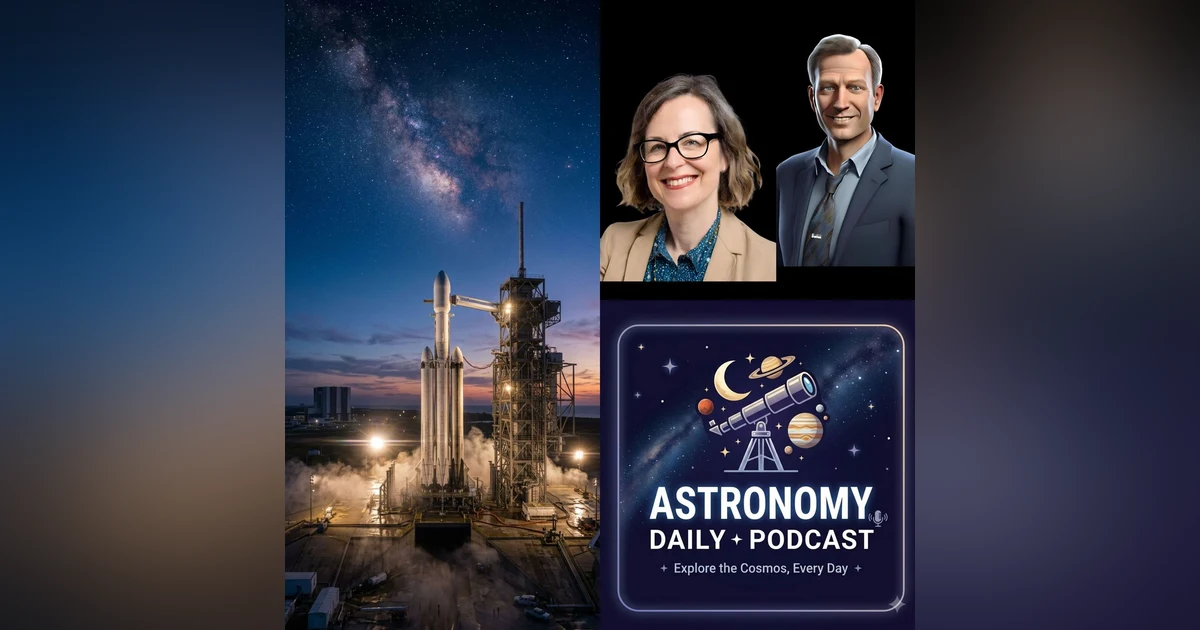
Today's episode — S05E180, Saturday August 29, 2026, The Weekend Wrap: Main story: The Nancy Grace Roman Space Telescope launches tomorrow, Sunday August 30, with a primary window opening 7:26am EDT (11:26 UTC / 9:26pm AEST Sunday night in Sydney) on a SpaceX Falcon Heavy from LC-39A, Kennedy Space Center; backup window Monday August 31 at 7:22am EDT. Total ascent to spacecraft deployment is about 31 minutes 31 seconds, with Falcon Heavy's side boosters landing back at Cape Canaveral roughly 7 minutes 40 seconds after liftoff. Named for NASA's first chief astronomer Nancy Grace Roman (the "mother of Hubble"), the telescope shares Hubble's 2.4-metre primary mirror but pairs it with a Wide Field Instrument boasting a field of view roughly 100 times larger at similar resolution. Its major science campaigns: the High Latitude Wide Area Survey, mapping ~2 billion galaxies to probe dark matter and dark energy; a companion supernova time-domain survey; and the Galactic Bulge Time Domain Survey, a gravitational-microlensing exoplanet hunt expected to find on the order of 100,000 new worlds, including free-floating rogue planets. A Coronagraph Instrument will demonstrate direct exoplanet imaging technology. After deployment, Roman heads for the Sun-Earth L2 point (~1.5 million km out), a month-long cruise followed by months of commissioning. The mission closes out three threads covered this week: its clearance for launch nine months early (S05E176), its Cold War spy-satellite origin story (S05E178), and its narrow escape from budget cancellation (S05E179). The week in review: ● Chang'e-7's delay, revisited: Monday's episode (S05E175) reported China's Chang'e-7 lunar south pole mission scrubbing on August 24 due to Tropical Storm Narra, with the next window estimated at about a month out. Since then, reporting has split — some outlets still cite a mid-September window, while others report a slip to February or March 2027, citing the mission's roughly 100-days-per-year favorable lighting geometry at Shackleton Crater. China's Manned Space Agency has not issued a firm new date as of this recording; we're flagging the uncertainty rather than picking a side. ● Betelgeuse's bubbling surface: ALMA's most detailed image yet of the red supergiant's actual surface shows a corrugated, hot-spotted texture, with one hot spot persisting for over seven years — possibly stirred by a newly confirmed companion star (S05E177). ● Diamond rain, decoded: A Lawrence Livermore experiment recreated Neptune- and Uranus-like interior pressures, settling a 20-year dispute over diamond's melting point and pointing toward roughly triple the energy gain in certain fusion reactor configurations (S05E178). ● The space-mirror fight: US startup Reflect Orbital has FCC approval for its first demonstration mirror satellite; a new peer-reviewed study (Kocifaj, Bakos & Kundracik) finds the planned full-scale mirrors would appear roughly 40 times brighter than the full Moon to anyone in their beam — "worse than big cities like London," per Princeton's Gáspár Bakos (S05E179). ● Starship's Ship 40 is actually heading home: hours after Friday's episode aired, Ship 40 was loaded onto the heavy-lift vessel Forte and departed Christmas Island on the ~20,000km voyage back to Starbase, Texas, expected to take several weeks. Flight 14 remains targeted no-earlier-than September 15, with Booster 21's static-fire testing now complete. Links & sources: ● Space.com — What time will SpaceX launch NASA's Roman Space Telescope on Aug. 30? (Full mission timeline) ● NASA Science — Roman Launch Countdown ● Engadget — How to watch the Nancy Grace Roman Space Telescope's launch ● Scientific American — China delays ambitious Chang'e 7 moon mission until 2027 ● SpaceNews — China delays Chang'e-7 lunar south pole landing mission launch ● CGTN — Explainer: Why Chang'e-7 can't simply launch a few days later ● Space.com — The bubbling surface of doomed supergiant star Betelgeuse has been revealed like never before ● ScienceDaily — Scientists crushed diamond beyond Neptune-like pressures — and solved a 20-year mystery ● Gizmodo — Scientists recreate the melting "diamond rain" of Neptune and Uranus. It may help fusion power ● Space.com — Massive space mirrors could be 40 times brighter than the full moon, astronomers warn ● ABC News (Australia) — SpaceX rocket begins journey back to Texas from Christmas Island ● NASASpaceFlight.com — Ship 40 arrives at Christmas Island, plans return to Starbase Follow us: @AstroDailyPod
Become a supporter of this podcast: https://www.spreaker.com/podcast/astronomy-daily-latest-space-news--5648921/support.
Sponsor Details:
Ensure your online privacy by using NordVPN. To get our special listener deal and save a lot of money, visit www.astronomydaily.io/nordvpn. You'll be glad you did!
Get the best secure and private email on the planet. Stop your Government, google and who knows who else spying on every email you write. Do what we did and use ProtonMail. They beleive in privacy and there are no ads in their business model...yet they still provide a free forever service. Check them out and get out special deal at www.astronomydaily.io/protonmail
Become a supporter of Astronomy Daily by joining our Supporters Club. Commercial free episodes daily are only a click way... Click Here
This episode includes AI-generated content.
Become a supporter of this podcast: https://www.spreaker.com/podcast/astronomy-daily-latest-space-news--5648921/support.
Sponsor Details:
Ensure your online privacy by using NordVPN. To get our special listener deal and save a lot of money, visit www.astronomydaily.io/nordvpn. You'll be glad you did!
Get the best secure and private email on the planet. Stop your Government, google and who knows who else spying on every email you write. Do what we did and use ProtonMail. They beleive in privacy and there are no ads in their business model...yet they still provide a free forever service. Check them out and get out special deal at www.astronomydaily.io/protonmail
Become a supporter of Astronomy Daily by joining our Supporters Club. Commercial free episodes daily are only a click way... Click Here
This episode includes AI-generated content.
WEBVTT
0
00:00:00.640 --> 00:00:02.960
Anna: Hey everyone, welcome back to Astronomy
1
00:00:02.960 --> 00:00:05.080
AstroDailyPod. And it's Saturday, so you know
2
00:00:05.080 --> 00:00:05.760
what that means.
3
00:00:06.240 --> 00:00:08.960
Avery: The weekend wrap one brand new storey. Then
4
00:00:08.960 --> 00:00:11.000
we run back through the week's biggest news.
5
00:00:11.000 --> 00:00:12.320
In case you missed any of it,
6
00:00:12.640 --> 00:00:15.240
Anna: it's Saturday, August 29th. Series five
7
00:00:15.240 --> 00:00:18.040
episode 180. And today's fresh storey
8
00:00:18.040 --> 00:00:20.920
is a big one. Literally the biggest NASA
9
00:00:20.920 --> 00:00:23.440
mission of the year is on the pad right now.
10
00:00:23.440 --> 00:00:24.880
Less than a day from launch.
11
00:00:25.690 --> 00:00:28.570
Avery: The Nancy Grace Roman Space Telescope.
12
00:00:28.730 --> 00:00:30.650
We've been building up to this one all week
13
00:00:30.650 --> 00:00:32.730
without ever quite telling the whole storey.
14
00:00:33.450 --> 00:00:36.170
Anna: So today we finally do full launch
15
00:00:36.170 --> 00:00:38.450
profile, what it's actually going to do out
16
00:00:38.450 --> 00:00:41.090
there and exactly when to watch wherever you
17
00:00:41.090 --> 00:00:41.370
are.
18
00:00:41.770 --> 00:00:44.570
Avery: Okay, then, a moon mission that slipped from
19
00:00:44.570 --> 00:00:47.570
a month to maybe next year. A star
20
00:00:47.570 --> 00:00:50.410
with a bubbling face, a couple of scientists
21
00:00:50.490 --> 00:00:53.130
finally settling an argument about diamonds,
22
00:00:53.690 --> 00:00:56.130
a fight over how bright space is allowed to
23
00:00:56.130 --> 00:00:58.970
get, and a very well travelled rocket
24
00:00:58.970 --> 00:01:00.090
finally heading home.
25
00:01:00.570 --> 00:01:02.970
Anna: It's a big one today. Let's get into it.
26
00:01:03.370 --> 00:01:06.130
Avery: Okay, we've mentioned Roman three times this
27
00:01:06.130 --> 00:01:08.370
week without ever actually sitting down with
28
00:01:08.370 --> 00:01:10.410
it properly. Fix that for me.
29
00:01:10.730 --> 00:01:13.570
Anna: Happy to. The Nancy Grace Roman Space
30
00:01:13.570 --> 00:01:16.250
Telescope launches tomorrow, Sunday, August
31
00:01:16.250 --> 00:01:18.730
30th. And by the time most of you are hearing
32
00:01:18.730 --> 00:01:20.890
this, it's inside its final day of
33
00:01:20.890 --> 00:01:21.450
preparation.
34
00:01:22.260 --> 00:01:25.060
Avery: Give me the vitals. When, how? From where?
35
00:01:25.300 --> 00:01:27.020
Anna: Liftoff window opens at
36
00:01:27.020 --> 00:01:29.700
7:26am M Eastern. That's
37
00:01:29.700 --> 00:01:32.220
11:26 UTC on a
38
00:01:32.220 --> 00:01:35.140
SpaceX Falcon Heavy from Launch Complex
39
00:01:35.300 --> 00:01:38.099
39A at Kennedy Space Centre. The
40
00:01:38.099 --> 00:01:40.780
same pad the Apollo missions and more
41
00:01:40.780 --> 00:01:43.780
recently Artemis One flew from. There's a
42
00:01:43.780 --> 00:01:46.260
backup window the next morning, Monday the
43
00:01:46.260 --> 00:01:48.820
31st at 7:22am
44
00:01:48.980 --> 00:01:51.620
Eastern. If anything pushes it a day, um,
45
00:01:51.620 --> 00:01:53.410
Avery: and for anyone listening in our part
46
00:01:53.410 --> 00:01:55.970
Anna: of the world, this is the rare one where
47
00:01:55.970 --> 00:01:57.810
Southern Hemisphere listeners actually get
48
00:01:57.810 --> 00:02:00.770
the good time slot. 11:26 UTC
49
00:02:00.770 --> 00:02:03.690
on Sunday is 9:26pm Sunday
50
00:02:03.690 --> 00:02:06.410
night here in Sydney. Prime time. Not a
51
00:02:06.410 --> 00:02:08.930
3am alarm. Our, uh, North American listeners
52
00:02:08.930 --> 00:02:10.970
get it at breakfast. We get it with our
53
00:02:10.970 --> 00:02:12.250
Sunday night cup of tea.
54
00:02:12.570 --> 00:02:14.770
Avery: I'll take it. What actually happens once it
55
00:02:14.770 --> 00:02:16.570
goes, It's a fast ride.
56
00:02:16.570 --> 00:02:19.370
Anna: The whole ascent to spacecraft separation is
57
00:02:19.370 --> 00:02:22.010
about 31 1/2 minutes and Falcon
58
00:02:22.010 --> 00:02:24.930
Heavy's two side boosters peel away 2
59
00:02:25.010 --> 00:02:27.730
1/2 minutes in and fly themselves back to
60
00:02:27.730 --> 00:02:30.490
landing zones at Cape Canaveral. And Roman
61
00:02:30.570 --> 00:02:33.530
itself separates from the upper stage right
62
00:02:33.530 --> 00:02:36.250
at the 31 minute 31 second mark.
63
00:02:36.810 --> 00:02:39.570
Avery: So of Falcon Heavy, that's the same rocket
64
00:02:39.570 --> 00:02:41.810
family that launched ship 40's return voyage
65
00:02:41.810 --> 00:02:44.570
on flight 13. Anyone can watch this live.
66
00:02:45.130 --> 00:02:48.010
Anna: NASA's coverage starts at 6:20am Eastern
67
00:02:48.010 --> 00:02:50.410
on NASA. Their social channels
68
00:02:50.490 --> 00:02:53.120
Twitch, Discovery, Apple Prime
69
00:02:53.270 --> 00:02:56.030
prime and YouTube. SpaceX runs its own stream
70
00:02:56.030 --> 00:02:58.750
on X starting about an hour before launch. If
71
00:02:58.750 --> 00:03:00.430
you'd rather watch it from that side of the
72
00:03:00.430 --> 00:03:00.790
pad.
73
00:03:01.190 --> 00:03:03.990
Avery: Okay, so who is this telescope actually for?
74
00:03:04.150 --> 00:03:06.190
Remind people why we've spent all week
75
00:03:06.190 --> 00:03:06.950
circling it.
76
00:03:07.350 --> 00:03:09.670
Anna: It's named after Nancy Grace Roman,
77
00:03:09.910 --> 00:03:12.590
NASA's very first chief astronomer, who's
78
00:03:12.590 --> 00:03:14.950
often called the mother of Hubble because she
79
00:03:14.950 --> 00:03:17.150
was the one who pushed a space telescope into
80
00:03:17.150 --> 00:03:20.030
existence back in the 1960s. And it
81
00:03:20.030 --> 00:03:22.110
feels right that this one carries her name
82
00:03:22.110 --> 00:03:24.910
because it's genuinely a spiritual sibling to
83
00:03:24.910 --> 00:03:27.270
Hubble. Same size primary mirror,
84
00:03:27.270 --> 00:03:30.150
2.4 metres, but pointed at a completely
85
00:03:30.150 --> 00:03:30.870
different problem.
86
00:03:31.350 --> 00:03:32.150
Avery: Different how?
87
00:03:32.550 --> 00:03:35.270
Anna: Hubble and Webb are both brilliant at staring
88
00:03:35.349 --> 00:03:37.990
very closely at one small patch of sky.
89
00:03:38.310 --> 00:03:40.550
Roman's whole design philosophy is the
90
00:03:40.550 --> 00:03:43.510
opposite. Its wide field instrument carries a
91
00:03:43.510 --> 00:03:46.270
300 megapixel camera with a field of
92
00:03:46.270 --> 00:03:48.550
view roughly a hundred times larger than
93
00:03:48.550 --> 00:03:50.870
Hubble's at basically the same sharp
94
00:03:51.440 --> 00:03:53.840
where Hubble gives you a postage stamp, Roman
95
00:03:53.840 --> 00:03:56.160
gives you a poster at the same resolution.
96
00:03:56.640 --> 00:03:58.720
Avery: What's the point of that much sky at once?
97
00:03:59.440 --> 00:04:02.160
Anna: Statistics, mostly. Some of the biggest
98
00:04:02.160 --> 00:04:05.000
open questions in cosmology need you to look
99
00:04:05.000 --> 00:04:07.439
at billions of things, not dozens.
100
00:04:08.000 --> 00:04:11.000
Roman's headline project is the High Latitude
101
00:04:11.000 --> 00:04:13.720
Wide Area survey. Imaging roughly
102
00:04:13.720 --> 00:04:16.680
2 billion galaxies to map how dark
103
00:04:16.680 --> 00:04:19.680
matter is distributed and how dark energy is
104
00:04:19.680 --> 00:04:22.480
pushing the universe apart over cosmic time
105
00:04:22.920 --> 00:04:25.600
using weak gravitational lensing and the
106
00:04:25.600 --> 00:04:27.720
large scale clustering of galaxies.
107
00:04:28.200 --> 00:04:30.920
Avery: That's the why does a universe's expansion
108
00:04:30.920 --> 00:04:32.280
keep accelerating Question.
109
00:04:32.760 --> 00:04:35.720
Anna: Exactly that one. Arguably the biggest
110
00:04:35.720 --> 00:04:38.280
unanswered question in cosmology right now.
111
00:04:38.600 --> 00:04:41.040
There's a companion time domain survey,
112
00:04:41.040 --> 00:04:43.800
hunting supernovae for the same dark energy
113
00:04:43.800 --> 00:04:46.440
work. And then there's the survey I think is
114
00:04:46.440 --> 00:04:49.090
actually the most fun. The Galactic
115
00:04:49.090 --> 00:04:51.490
Bulge Time Domain Survey. A
116
00:04:51.490 --> 00:04:53.810
dedicated exoplanet hunt using
117
00:04:53.890 --> 00:04:55.730
gravitational microlensing.
118
00:04:56.130 --> 00:04:58.050
Avery: Different from how Kepler and Tess found
119
00:04:58.050 --> 00:04:58.530
planets.
120
00:04:58.770 --> 00:05:01.370
Anna: Completely different technique. Instead of
121
00:05:01.370 --> 00:05:03.570
watching a planet cross in front of its star,
122
00:05:03.970 --> 00:05:06.930
microlensing watches for a foreground star's
123
00:05:06.930 --> 00:05:09.850
gravity, briefly magnifying the light of a
124
00:05:09.850 --> 00:05:12.690
background star with a planet adding its own
125
00:05:12.690 --> 00:05:15.400
little blip to that signal. It's sensitive to
126
00:05:15.400 --> 00:05:18.120
planets transiting missions can't easily see,
127
00:05:18.440 --> 00:05:21.240
including ones on wide orbits. And even
128
00:05:21.240 --> 00:05:24.200
rogue free floating planets with no star
129
00:05:24.200 --> 00:05:27.040
at all. Scientists are expecting on the
130
00:05:27.040 --> 00:05:29.200
order of 100,000 new
131
00:05:29.200 --> 00:05:31.920
exoplanet detections out of this one
132
00:05:31.920 --> 00:05:32.840
survey alone.
133
00:05:33.320 --> 00:05:35.880
Avery: Hundred thousand from one instrument.
134
00:05:36.120 --> 00:05:38.920
Anna: From one instrument. And there's a fourth
135
00:05:38.920 --> 00:05:41.280
piece Riding along. The coronagraph
136
00:05:41.280 --> 00:05:44.020
instrument. A technology demonstration for
137
00:05:44.020 --> 00:05:46.500
blocking out a star's glare well enough to
138
00:05:46.500 --> 00:05:49.420
directly image the planets around it, rather
139
00:05:49.420 --> 00:05:52.140
than just inferring them. If that works as
140
00:05:52.140 --> 00:05:54.780
hoped, it's a genuine stepping stone toward
141
00:05:54.780 --> 00:05:57.140
the kind of direct exoplanet imaging
142
00:05:57.300 --> 00:05:59.940
NASA wants for future flagship missions.
143
00:06:00.260 --> 00:06:02.860
Avery: Okay, so where does it actually go after that
144
00:06:02.860 --> 00:06:04.180
31 minute ride?
145
00:06:04.500 --> 00:06:07.460
Anna: It heads not into orbit around Earth, it
146
00:06:07.460 --> 00:06:10.180
heads for the sun. Earth. Lagrange point two.
147
00:06:10.500 --> 00:06:13.140
About one and a half million kilometres out.
148
00:06:13.540 --> 00:06:16.180
The same gravitationally stable parking spot
149
00:06:16.180 --> 00:06:18.820
Webb uses. That's roughly a month's
150
00:06:18.820 --> 00:06:21.300
cruise, then months more of commissioning
151
00:06:21.300 --> 00:06:23.700
before real science data, uh, starts flowing.
152
00:06:24.020 --> 00:06:26.700
Avery: Right, so nothing dramatic happens tomorrow
153
00:06:26.700 --> 00:06:28.940
night beyond the launch and a very long
154
00:06:28.940 --> 00:06:29.380
drive.
155
00:06:29.780 --> 00:06:32.380
Anna: Correct, and worth saying plainly, so
156
00:06:32.380 --> 00:06:35.300
nobody's disappointed. Tomorrow is liftoff
157
00:06:35.300 --> 00:06:38.060
deployment and the start of the journey. Not
158
00:06:38.060 --> 00:06:40.870
first light. But it's still a huge moment
159
00:06:40.950 --> 00:06:43.190
because of everything that had to go right
160
00:06:43.270 --> 00:06:45.910
just to get here. If you've been with us this
161
00:06:45.910 --> 00:06:48.590
week, you know the shape of it. Tuesday we
162
00:06:48.590 --> 00:06:50.990
covered Roman being cleared for launch nine
163
00:06:50.990 --> 00:06:53.030
months ahead of its original schedule.
164
00:06:53.350 --> 00:06:56.230
Thursday we told the strange Cold War storey
165
00:06:56.470 --> 00:06:59.190
of the surplus spy satellite hardware
166
00:06:59.270 --> 00:07:01.510
this whole mission was actually built around.
167
00:07:01.990 --> 00:07:04.470
And yesterday we told you the part nobody
168
00:07:04.470 --> 00:07:07.270
had. That this telescope was one leaked
169
00:07:07.270 --> 00:07:09.470
budget draught away from being cancelled
170
00:07:09.470 --> 00:07:12.270
outright. Last. And the team that saved it
171
00:07:12.350 --> 00:07:14.750
responded by launching eight months early
172
00:07:14.830 --> 00:07:15.710
instead of late.
173
00:07:15.950 --> 00:07:18.350
Avery: Three different storeys, one mission.
174
00:07:18.590 --> 00:07:21.230
Anna: And tomorrow all three of those threads
175
00:07:21.230 --> 00:07:24.110
either pay off or they don't in real time
176
00:07:24.110 --> 00:07:26.910
on a pad in Florida. That's why we wanted
177
00:07:26.910 --> 00:07:29.470
this to be its own proper segment, rather
178
00:07:29.470 --> 00:07:31.710
than another line in Friday's recap.
179
00:07:31.950 --> 00:07:34.710
Avery: No episode tomorrow. So this is genuinely the
180
00:07:34.710 --> 00:07:36.030
last word before it flies.
181
00:07:36.530 --> 00:07:38.890
Anna: It is. We're back Monday with our regular
182
00:07:38.890 --> 00:07:41.410
weekday format. And if all goes to plan,
183
00:07:41.570 --> 00:07:44.090
that'll be a very satisfying episode to
184
00:07:44.090 --> 00:07:44.370
record.
185
00:07:44.850 --> 00:07:47.290
Avery: Rockets on. The pad window opens tomorrow
186
00:07:47.290 --> 00:07:48.850
night, our time. We'll be watching.
187
00:07:49.010 --> 00:07:51.890
Anna: All right, on to the recap. And it was a
188
00:07:51.890 --> 00:07:54.450
genuinely full week. Five storeys
189
00:07:54.530 --> 00:07:56.290
roughly in the order they broke.
190
00:07:56.610 --> 00:07:59.290
Avery: Storey one. And it's actually a correction to
191
00:07:59.290 --> 00:08:01.770
something we told you ourselves. Monday's
192
00:08:01.770 --> 00:08:04.450
episode reported China's Chang' E7 launch
193
00:08:04.450 --> 00:08:07.290
scrubbing on the 24th because of Tropical
194
00:08:07.290 --> 00:08:09.910
Storm Nar, with our best information at the
195
00:08:09.910 --> 00:08:12.150
time, putting the next window about a month
196
00:08:12.150 --> 00:08:14.750
out, sometime in mid to late September.
197
00:08:15.070 --> 00:08:17.230
Anna: That's what the trajectory analysis available
198
00:08:17.310 --> 00:08:20.230
Monday pointed to. And we stand by reporting
199
00:08:20.230 --> 00:08:22.910
it that way with the information we had. But
200
00:08:22.910 --> 00:08:25.390
the picture's gotten murkier since, not
201
00:08:25.390 --> 00:08:28.350
clearer. Tonga 7 targets the rim of
202
00:08:28.350 --> 00:08:30.830
Shackleton Crater at the lunar South Pole.
203
00:08:30.990 --> 00:08:33.270
And that landing site only gets the right
204
00:08:33.270 --> 00:08:35.830
sunlight geometry for something like a
205
00:08:35.830 --> 00:08:38.750
hundred days total across an entire year,
206
00:08:39.169 --> 00:08:41.769
split into short windows. China's own state
207
00:08:41.769 --> 00:08:44.169
broadcaster, cgtn, ran an
208
00:08:44.169 --> 00:08:46.129
explainer on exactly this point.
209
00:08:46.689 --> 00:08:49.130
Avery: So it's not as simple as wait a month and,
210
00:08:49.130 --> 00:08:49.809
um, try again.
211
00:08:50.369 --> 00:08:53.129
Anna: Not necessarily. And here's the part that's
212
00:08:53.129 --> 00:08:55.409
genuinely unresolved as we're recording this.
213
00:08:55.729 --> 00:08:58.169
Some regional reporting is still holding the
214
00:08:58.169 --> 00:09:00.729
line at a matter of weeks. But several other
215
00:09:00.729 --> 00:09:03.249
outlets, citing the same orbital mechanics
216
00:09:03.249 --> 00:09:05.809
constraints, are now reporting the next real
217
00:09:05.809 --> 00:09:08.769
opportunity isn't until February or March
218
00:09:08.769 --> 00:09:10.689
of next year, 2020.
219
00:09:11.710 --> 00:09:13.590
Avery: That's a completely different storey than
220
00:09:13.590 --> 00:09:13.870
about
221
00:09:13.870 --> 00:09:16.750
Anna: a month it is. And China's Manned
222
00:09:16.750 --> 00:09:19.550
Space Agency hasn't put out a firm new date
223
00:09:19.550 --> 00:09:22.150
to settle it. Either way. Officially, it's
224
00:09:22.150 --> 00:09:24.790
just a comprehensive assessment, finding the
225
00:09:24.790 --> 00:09:27.510
mission no longer met the conditions required
226
00:09:27.510 --> 00:09:30.150
for launch, with no specifics beyond the
227
00:09:30.150 --> 00:09:32.710
weather. We're not going to pretend we have a
228
00:09:32.710 --> 00:09:34.830
cleaner answer than the primary source does.
229
00:09:35.150 --> 00:09:37.670
What we can tell you is that the spacecraft
230
00:09:37.670 --> 00:09:39.910
was already vertical on the pad when this
231
00:09:39.910 --> 00:09:42.390
happened, which several outlets flagged as an
232
00:09:42.390 --> 00:09:44.490
unusual, usually late point in the campaign
233
00:09:44.810 --> 00:09:46.090
for that kind of call.
234
00:09:46.810 --> 00:09:49.570
Avery: So watch this space more literally than
235
00:09:49.570 --> 00:09:50.010
usual.
236
00:09:50.330 --> 00:09:52.970
Anna: Exactly. We'll give you the real number the
237
00:09:52.970 --> 00:09:55.530
moment China's space agency actually commits
238
00:09:55.530 --> 00:09:58.090
to one, rather than repeating whichever guess
239
00:09:58.090 --> 00:09:59.290
sounds most confident.
240
00:09:59.690 --> 00:10:02.690
Avery: Storey two from Wednesday. The closest look
241
00:10:02.690 --> 00:10:05.250
anyone's ever gotten to the actual surface of
242
00:10:05.250 --> 00:10:08.210
a star most people only know as that big
243
00:10:08.210 --> 00:10:09.690
red one that might explode.
244
00:10:10.300 --> 00:10:13.060
Anna: Betelgeuse. Using alma, the big radio
245
00:10:13.060 --> 00:10:15.940
telescope array in Chile. What he captured
246
00:10:15.940 --> 00:10:18.580
isn't a smooth stellar disc. It's a
247
00:10:18.580 --> 00:10:21.420
corrugated, genuinely bubbling surface
248
00:10:21.580 --> 00:10:23.740
dotted with hot spots that come and go.
249
00:10:23.980 --> 00:10:26.180
Except for one that's been sitting in more or
250
00:10:26.180 --> 00:10:28.700
less the same place for over seven years.
251
00:10:29.340 --> 00:10:31.900
Avery: Seven years is a long time for a hotspot to
252
00:10:31.900 --> 00:10:33.780
just stay put long
253
00:10:33.780 --> 00:10:35.900
Anna: enough that it's not obviously random
254
00:10:35.900 --> 00:10:38.610
convective churn. The leading explanation on
255
00:10:38.610 --> 00:10:41.490
the table now is a previously unconfirmed
256
00:10:41.490 --> 00:10:44.330
companion star tucked in close enough that
257
00:10:44.330 --> 00:10:46.130
its gravity or its passage through
258
00:10:46.130 --> 00:10:49.090
Betelgeuse's extended outer layers keeps
259
00:10:49.090 --> 00:10:50.530
stirring the same patch.
260
00:10:51.010 --> 00:10:53.810
Avery: A star with its own tiny stirring spoon.
261
00:10:54.130 --> 00:10:56.490
Anna: That's more or less the picture. It doesn't
262
00:10:56.490 --> 00:10:59.010
change the is Betelgeuse about to explode?
263
00:10:59.010 --> 00:11:01.810
Question either way. Still no, not on
264
00:11:01.810 --> 00:11:04.520
any human timescale we can predict. But it's
265
00:11:04.520 --> 00:11:06.960
a genuinely new piece of the puzzle of how
266
00:11:06.960 --> 00:11:09.200
these enormous instable red
267
00:11:09.200 --> 00:11:12.080
supergiants actually behave right at the end
268
00:11:12.080 --> 00:11:12.640
of their lives.
269
00:11:13.280 --> 00:11:16.080
Avery: Storey3 Thursday and this is the one I've
270
00:11:16.080 --> 00:11:18.640
been waiting to talk about. Diamond rain.
271
00:11:19.200 --> 00:11:22.160
Anna: This is genuinely satisfying. Scientists
272
00:11:22.160 --> 00:11:25.000
at Lawrence Livermore recreated the crushing
273
00:11:25.000 --> 00:11:27.320
pressure and temperature conditions found
274
00:11:27.320 --> 00:11:29.880
deep inside ice giants like Neptune and
275
00:11:29.880 --> 00:11:32.180
Uranus. We're talking millions of
276
00:11:32.180 --> 00:11:34.500
atmospheres to settle an argument about
277
00:11:34.500 --> 00:11:37.500
exactly where carbon turns to diamond under
278
00:11:37.500 --> 00:11:39.780
those conditions. That's been running for 20
279
00:11:39.780 --> 00:11:40.140
years.
280
00:11:40.860 --> 00:11:43.140
Avery: 20 years is a long running scientific
281
00:11:43.140 --> 00:11:43.740
argument.
282
00:11:44.060 --> 00:11:46.340
Anna: Different experiments over the years kept
283
00:11:46.340 --> 00:11:48.820
disagreeing on diamond's precise melting
284
00:11:48.820 --> 00:11:51.260
point at those extreme pressures. Which
285
00:11:51.260 --> 00:11:53.740
matters more than it sounds. It changes
286
00:11:53.740 --> 00:11:56.220
models of what's actually happening inside
287
00:11:56.220 --> 00:11:58.450
those planets all the way down to whether
288
00:11:58.450 --> 00:12:01.290
it's literally raining diamonds in their deep
289
00:12:01.290 --> 00:12:04.050
interiors. Which is the popular framing. But
290
00:12:04.050 --> 00:12:06.490
the real prize is what it means for us here,
291
00:12:06.970 --> 00:12:09.570
which is the same pressure temperature
292
00:12:09.570 --> 00:12:12.290
physics that governs diamond formation inside
293
00:12:12.290 --> 00:12:15.130
Neptune also governs some of the compression
294
00:12:15.130 --> 00:12:17.850
physics inside fusion reactor targets.
295
00:12:18.090 --> 00:12:21.050
The new Resolved data points toward roughly
296
00:12:21.050 --> 00:12:23.530
triple the energy gain achievable in certain
297
00:12:23.530 --> 00:12:26.050
fusion configurations compared to what
298
00:12:26.050 --> 00:12:28.650
older less certain diamond behaviour models
299
00:12:28.650 --> 00:12:29.040
assume.
300
00:12:30.150 --> 00:12:32.670
Avery: So a ah, 20 year argument about ice
301
00:12:32.670 --> 00:12:35.270
giants just quietly helped fusion energy
302
00:12:35.270 --> 00:12:35.670
research.
303
00:12:36.230 --> 00:12:38.630
Anna: That's genuinely one of the nicer side
304
00:12:38.630 --> 00:12:41.150
effects of planetary science. The physics
305
00:12:41.150 --> 00:12:43.750
doesn't know it's supposed to stay in its own
306
00:12:43.750 --> 00:12:44.470
subfield.
307
00:12:45.109 --> 00:12:48.070
Avery: Storey4 Friday and um, this is the one people
308
00:12:48.070 --> 00:12:50.710
are still arguing about. Space mirrors.
309
00:12:50.950 --> 00:12:53.830
Anna: A US startup Reflect Orbital wants
310
00:12:53.830 --> 00:12:56.710
to eventually put more than 50,000 large
311
00:12:56.710 --> 00:12:59.550
mirrors into low Earth orbit, reflecting
312
00:12:59.550 --> 00:13:02.210
sunlight down to chosen spots on the ground
313
00:13:02.290 --> 00:13:05.050
on demand, even at night. Back in
314
00:13:05.050 --> 00:13:07.650
July the FCC approved their first
315
00:13:07.650 --> 00:13:10.570
demonstration satellite, a 60 foot mirror
316
00:13:10.570 --> 00:13:12.130
called Earendel 1.
317
00:13:12.610 --> 00:13:14.690
Avery: And the pushback is about brightness.
318
00:13:15.330 --> 00:13:18.050
Anna: Specifically a new peer reviewed study
319
00:13:18.290 --> 00:13:21.010
Kossify, Bacchus and Kundrassic
320
00:13:21.170 --> 00:13:23.890
accepted at the Astrophysical Journal Letters
321
00:13:24.050 --> 00:13:26.250
modelled what the planned full scale
322
00:13:26.250 --> 00:13:28.690
174 foot operational
323
00:13:28.690 --> 00:13:31.130
mirrors would actually look like from the
324
00:13:31.130 --> 00:13:33.880
ground. Their number roughly 40
325
00:13:33.960 --> 00:13:36.720
times brighter than the full moon to anyone
326
00:13:36.720 --> 00:13:39.400
standing inside the beam with measurable
327
00:13:39.480 --> 00:13:42.080
sky glow extending another 20 to
328
00:13:42.080 --> 00:13:44.440
34 kilometres beyond its edge.
329
00:13:44.760 --> 00:13:47.479
Avery: Princeton's Gaspar Bacchus had a pretty
330
00:13:47.479 --> 00:13:48.600
blunt line about that.
331
00:13:48.920 --> 00:13:51.480
Anna: Worse than big cities like London was his
332
00:13:51.480 --> 00:13:54.240
framing. You would not see any stars if you
333
00:13:54.240 --> 00:13:57.160
were in the beam. And if several mirrors ever
334
00:13:57.160 --> 00:13:59.800
end up overlapping their beams at once, which
335
00:13:59.800 --> 00:14:02.320
is a real possibility at full constellation
336
00:14:02.320 --> 00:14:04.960
scale. The the combined brightness in those
337
00:14:04.960 --> 00:14:07.560
overlap zones could reach something like
338
00:14:07.560 --> 00:14:09.880
10,000 times the full moon.
339
00:14:10.360 --> 00:14:12.680
Avery: That's a genuinely different complaint to the
340
00:14:12.680 --> 00:14:15.040
starlink streaking satellite arguments we've
341
00:14:15.040 --> 00:14:15.560
covered before.
342
00:14:15.960 --> 00:14:18.959
Anna: It is this is hardware built specifically
343
00:14:18.959 --> 00:14:21.240
to be as bright as physically possible,
344
00:14:21.560 --> 00:14:24.200
aimed deliberately at the ground, rather than
345
00:14:24.200 --> 00:14:26.760
an incidental side effect of a communications
346
00:14:26.920 --> 00:14:29.880
constellation. Reflect Orbital's position is
347
00:14:29.880 --> 00:14:32.680
that beams stay contained to defined target
348
00:14:32.680 --> 00:14:35.500
areas, can be shut off instant, and
349
00:14:35.500 --> 00:14:37.660
will steer clear of observatories and
350
00:14:37.660 --> 00:14:40.340
sensitive habitats. Whether that promise
351
00:14:40.340 --> 00:14:43.260
holds at a constellation of tens of thousands
352
00:14:43.260 --> 00:14:46.100
of mirrors is exactly the fight regulators
353
00:14:46.100 --> 00:14:48.500
and astronomers are now gearing up to have.
354
00:14:49.060 --> 00:14:51.660
Avery: And um, Storey five An um update to an update
355
00:14:51.660 --> 00:14:54.500
to an update at this point ship 40's
356
00:14:54.500 --> 00:14:56.340
journey genuinely this
357
00:14:56.340 --> 00:14:58.740
Anna: saga just keeps getting new chapters
358
00:14:59.060 --> 00:15:01.820
Quick recap for Anyone just joining ship
359
00:15:01.820 --> 00:15:04.420
40 survived Starship's first ever
360
00:15:04.420 --> 00:15:06.810
intact splashdown after Flight 13
361
00:15:07.520 --> 00:15:10.320
back on July 24, then spent over
362
00:15:10.320 --> 00:15:13.040
three weeks adrift before finally getting
363
00:15:13.040 --> 00:15:15.480
towed to sheltered waters off Christmas
364
00:15:15.480 --> 00:15:18.360
island in mid August, where it sat with no
365
00:15:18.360 --> 00:15:19.680
announced plan home.
366
00:15:20.000 --> 00:15:21.670
Avery: That's where Friday's episode left it.
367
00:15:21.670 --> 00:15:24.160
Anna: Uh, right. But just hours after
368
00:15:24.160 --> 00:15:26.840
Friday's episode went out, it actually got
369
00:15:26.840 --> 00:15:29.720
moving. Jip 40 was loaded onto a heavy
370
00:15:29.720 --> 00:15:32.560
lift transport vessel called the Forte, which
371
00:15:32.560 --> 00:15:35.280
departed Christmas island on Friday afternoon
372
00:15:35.360 --> 00:15:38.160
and is now genuinely underway on the roughly
373
00:15:38.160 --> 00:15:40.740
20,000 thousand kilometre voyage back to
374
00:15:40.740 --> 00:15:43.580
Starbase Texas. Expected to take several
375
00:15:43.580 --> 00:15:46.460
weeks, not the year plus a slow tow
376
00:15:46.460 --> 00:15:47.260
would have needed.
377
00:15:47.580 --> 00:15:50.420
Avery: And Flight 14? The next launch still on
378
00:15:50.420 --> 00:15:52.340
track for that mid September target from
379
00:15:52.340 --> 00:15:53.180
Friday's episode?
380
00:15:53.580 --> 00:15:55.980
Anna: Still tracking that way as of our recording.
381
00:15:56.140 --> 00:15:58.820
Booster 21 completed its static fire
382
00:15:58.820 --> 00:16:01.420
testing this week, which was the pacing item
383
00:16:01.420 --> 00:16:03.940
holding things up so no earlier than
384
00:16:03.940 --> 00:16:06.370
September 15 still stands for now,
385
00:16:06.920 --> 00:16:09.440
when Flight 14 does go, it's slated to
386
00:16:09.440 --> 00:16:12.240
attempt Starship's first ever full orbital
387
00:16:12.240 --> 00:16:12.680
flight.
388
00:16:13.160 --> 00:16:15.800
Avery: So the old ship is finally actually
389
00:16:16.120 --> 00:16:19.080
definitely coming home. And the next one
390
00:16:19.160 --> 00:16:21.720
Static fire tested and waiting its turn.
391
00:16:22.279 --> 00:16:24.440
Anna: That's about as clean a status as this
392
00:16:24.520 --> 00:16:26.840
particular saga has offered us in weeks.
393
00:16:27.160 --> 00:16:27.880
We'll take it.
394
00:16:28.360 --> 00:16:31.240
Avery: Okay, that's the weekend wrap for this week.
395
00:16:31.560 --> 00:16:34.240
The Nancy Grace Roman Space Telescope on the
396
00:16:34.240 --> 00:16:36.800
pad and set to launch tomorrow night. Our
397
00:16:36.800 --> 00:16:39.760
time plus a full week catching up on Chang'
398
00:16:39.760 --> 00:16:42.440
E7's delay turning out to be a lot
399
00:16:42.440 --> 00:16:44.280
murkier than about a month
400
00:16:44.600 --> 00:16:47.480
Beetlejuice's bubbling long lived hotspot,
401
00:16:47.640 --> 00:16:50.600
a 20 year diamond rain argument finally
402
00:16:50.600 --> 00:16:53.199
settled, the fight brewing over reflect
403
00:16:53.199 --> 00:16:55.920
orbital space mirrors and Starship ship
404
00:16:55.920 --> 00:16:58.440
40 genuinely on its way home at last
405
00:16:59.080 --> 00:16:59.360
a
406
00:16:59.360 --> 00:17:02.280
Anna: big one to wrap up and hopefully a useful way
407
00:17:02.280 --> 00:17:04.200
to catch up if you missed any of it live
408
00:17:04.200 --> 00:17:04.840
through the week.
409
00:17:05.419 --> 00:17:07.499
Avery: If you enjoyed today's episode, the best
410
00:17:07.499 --> 00:17:09.739
thing you can do for us is leave a rating or
411
00:17:09.739 --> 00:17:11.939
review wherever you're listening and share it
412
00:17:11.939 --> 00:17:14.579
with a fellow space nerd. Full show notes,
413
00:17:14.579 --> 00:17:16.979
sources and links for every storey we cover
414
00:17:16.979 --> 00:17:19.659
today are @astronomydaily IO
415
00:17:19.899 --> 00:17:22.219
and you can find us on social media. We're
416
00:17:22.219 --> 00:17:24.779
AstroDaily Pod pretty much everywhere.
417
00:17:25.099 --> 00:17:27.419
Anna: We'll be back Monday with our regular weekday
418
00:17:27.419 --> 00:17:29.899
format and hopefully some very good news
419
00:17:29.899 --> 00:17:32.630
about a certain telescope. Fingers crossed.
420
00:17:32.790 --> 00:17:34.470
Until then, keep looking up.
421
00:17:34.950 --> 00:17:36.710
Avery: See you then. Clear skies, everyone.
0
00:00:00.640 --> 00:00:02.960
Anna: Hey everyone, welcome back to Astronomy
1
00:00:02.960 --> 00:00:05.080
AstroDailyPod. And it's Saturday, so you know
2
00:00:05.080 --> 00:00:05.760
what that means.
3
00:00:06.240 --> 00:00:08.960
Avery: The weekend wrap one brand new storey. Then
4
00:00:08.960 --> 00:00:11.000
we run back through the week's biggest news.
5
00:00:11.000 --> 00:00:12.320
In case you missed any of it,
6
00:00:12.640 --> 00:00:15.240
Anna: it's Saturday, August 29th. Series five
7
00:00:15.240 --> 00:00:18.040
episode 180. And today's fresh storey
8
00:00:18.040 --> 00:00:20.920
is a big one. Literally the biggest NASA
9
00:00:20.920 --> 00:00:23.440
mission of the year is on the pad right now.
10
00:00:23.440 --> 00:00:24.880
Less than a day from launch.
11
00:00:25.690 --> 00:00:28.570
Avery: The Nancy Grace Roman Space Telescope.
12
00:00:28.730 --> 00:00:30.650
We've been building up to this one all week
13
00:00:30.650 --> 00:00:32.730
without ever quite telling the whole storey.
14
00:00:33.450 --> 00:00:36.170
Anna: So today we finally do full launch
15
00:00:36.170 --> 00:00:38.450
profile, what it's actually going to do out
16
00:00:38.450 --> 00:00:41.090
there and exactly when to watch wherever you
17
00:00:41.090 --> 00:00:41.370
are.
18
00:00:41.770 --> 00:00:44.570
Avery: Okay, then, a moon mission that slipped from
19
00:00:44.570 --> 00:00:47.570
a month to maybe next year. A star
20
00:00:47.570 --> 00:00:50.410
with a bubbling face, a couple of scientists
21
00:00:50.490 --> 00:00:53.130
finally settling an argument about diamonds,
22
00:00:53.690 --> 00:00:56.130
a fight over how bright space is allowed to
23
00:00:56.130 --> 00:00:58.970
get, and a very well travelled rocket
24
00:00:58.970 --> 00:01:00.090
finally heading home.
25
00:01:00.570 --> 00:01:02.970
Anna: It's a big one today. Let's get into it.
26
00:01:03.370 --> 00:01:06.130
Avery: Okay, we've mentioned Roman three times this
27
00:01:06.130 --> 00:01:08.370
week without ever actually sitting down with
28
00:01:08.370 --> 00:01:10.410
it properly. Fix that for me.
29
00:01:10.730 --> 00:01:13.570
Anna: Happy to. The Nancy Grace Roman Space
30
00:01:13.570 --> 00:01:16.250
Telescope launches tomorrow, Sunday, August
31
00:01:16.250 --> 00:01:18.730
30th. And by the time most of you are hearing
32
00:01:18.730 --> 00:01:20.890
this, it's inside its final day of
33
00:01:20.890 --> 00:01:21.450
preparation.
34
00:01:22.260 --> 00:01:25.060
Avery: Give me the vitals. When, how? From where?
35
00:01:25.300 --> 00:01:27.020
Anna: Liftoff window opens at
36
00:01:27.020 --> 00:01:29.700
7:26am M Eastern. That's
37
00:01:29.700 --> 00:01:32.220
11:26 UTC on a
38
00:01:32.220 --> 00:01:35.140
SpaceX Falcon Heavy from Launch Complex
39
00:01:35.300 --> 00:01:38.099
39A at Kennedy Space Centre. The
40
00:01:38.099 --> 00:01:40.780
same pad the Apollo missions and more
41
00:01:40.780 --> 00:01:43.780
recently Artemis One flew from. There's a
42
00:01:43.780 --> 00:01:46.260
backup window the next morning, Monday the
43
00:01:46.260 --> 00:01:48.820
31st at 7:22am
44
00:01:48.980 --> 00:01:51.620
Eastern. If anything pushes it a day, um,
45
00:01:51.620 --> 00:01:53.410
Avery: and for anyone listening in our part
46
00:01:53.410 --> 00:01:55.970
Anna: of the world, this is the rare one where
47
00:01:55.970 --> 00:01:57.810
Southern Hemisphere listeners actually get
48
00:01:57.810 --> 00:02:00.770
the good time slot. 11:26 UTC
49
00:02:00.770 --> 00:02:03.690
on Sunday is 9:26pm Sunday
50
00:02:03.690 --> 00:02:06.410
night here in Sydney. Prime time. Not a
51
00:02:06.410 --> 00:02:08.930
3am alarm. Our, uh, North American listeners
52
00:02:08.930 --> 00:02:10.970
get it at breakfast. We get it with our
53
00:02:10.970 --> 00:02:12.250
Sunday night cup of tea.
54
00:02:12.570 --> 00:02:14.770
Avery: I'll take it. What actually happens once it
55
00:02:14.770 --> 00:02:16.570
goes, It's a fast ride.
56
00:02:16.570 --> 00:02:19.370
Anna: The whole ascent to spacecraft separation is
57
00:02:19.370 --> 00:02:22.010
about 31 1/2 minutes and Falcon
58
00:02:22.010 --> 00:02:24.930
Heavy's two side boosters peel away 2
59
00:02:25.010 --> 00:02:27.730
1/2 minutes in and fly themselves back to
60
00:02:27.730 --> 00:02:30.490
landing zones at Cape Canaveral. And Roman
61
00:02:30.570 --> 00:02:33.530
itself separates from the upper stage right
62
00:02:33.530 --> 00:02:36.250
at the 31 minute 31 second mark.
63
00:02:36.810 --> 00:02:39.570
Avery: So of Falcon Heavy, that's the same rocket
64
00:02:39.570 --> 00:02:41.810
family that launched ship 40's return voyage
65
00:02:41.810 --> 00:02:44.570
on flight 13. Anyone can watch this live.
66
00:02:45.130 --> 00:02:48.010
Anna: NASA's coverage starts at 6:20am Eastern
67
00:02:48.010 --> 00:02:50.410
on NASA. Their social channels
68
00:02:50.490 --> 00:02:53.120
Twitch, Discovery, Apple Prime
69
00:02:53.270 --> 00:02:56.030
prime and YouTube. SpaceX runs its own stream
70
00:02:56.030 --> 00:02:58.750
on X starting about an hour before launch. If
71
00:02:58.750 --> 00:03:00.430
you'd rather watch it from that side of the
72
00:03:00.430 --> 00:03:00.790
pad.
73
00:03:01.190 --> 00:03:03.990
Avery: Okay, so who is this telescope actually for?
74
00:03:04.150 --> 00:03:06.190
Remind people why we've spent all week
75
00:03:06.190 --> 00:03:06.950
circling it.
76
00:03:07.350 --> 00:03:09.670
Anna: It's named after Nancy Grace Roman,
77
00:03:09.910 --> 00:03:12.590
NASA's very first chief astronomer, who's
78
00:03:12.590 --> 00:03:14.950
often called the mother of Hubble because she
79
00:03:14.950 --> 00:03:17.150
was the one who pushed a space telescope into
80
00:03:17.150 --> 00:03:20.030
existence back in the 1960s. And it
81
00:03:20.030 --> 00:03:22.110
feels right that this one carries her name
82
00:03:22.110 --> 00:03:24.910
because it's genuinely a spiritual sibling to
83
00:03:24.910 --> 00:03:27.270
Hubble. Same size primary mirror,
84
00:03:27.270 --> 00:03:30.150
2.4 metres, but pointed at a completely
85
00:03:30.150 --> 00:03:30.870
different problem.
86
00:03:31.350 --> 00:03:32.150
Avery: Different how?
87
00:03:32.550 --> 00:03:35.270
Anna: Hubble and Webb are both brilliant at staring
88
00:03:35.349 --> 00:03:37.990
very closely at one small patch of sky.
89
00:03:38.310 --> 00:03:40.550
Roman's whole design philosophy is the
90
00:03:40.550 --> 00:03:43.510
opposite. Its wide field instrument carries a
91
00:03:43.510 --> 00:03:46.270
300 megapixel camera with a field of
92
00:03:46.270 --> 00:03:48.550
view roughly a hundred times larger than
93
00:03:48.550 --> 00:03:50.870
Hubble's at basically the same sharp
94
00:03:51.440 --> 00:03:53.840
where Hubble gives you a postage stamp, Roman
95
00:03:53.840 --> 00:03:56.160
gives you a poster at the same resolution.
96
00:03:56.640 --> 00:03:58.720
Avery: What's the point of that much sky at once?
97
00:03:59.440 --> 00:04:02.160
Anna: Statistics, mostly. Some of the biggest
98
00:04:02.160 --> 00:04:05.000
open questions in cosmology need you to look
99
00:04:05.000 --> 00:04:07.439
at billions of things, not dozens.
100
00:04:08.000 --> 00:04:11.000
Roman's headline project is the High Latitude
101
00:04:11.000 --> 00:04:13.720
Wide Area survey. Imaging roughly
102
00:04:13.720 --> 00:04:16.680
2 billion galaxies to map how dark
103
00:04:16.680 --> 00:04:19.680
matter is distributed and how dark energy is
104
00:04:19.680 --> 00:04:22.480
pushing the universe apart over cosmic time
105
00:04:22.920 --> 00:04:25.600
using weak gravitational lensing and the
106
00:04:25.600 --> 00:04:27.720
large scale clustering of galaxies.
107
00:04:28.200 --> 00:04:30.920
Avery: That's the why does a universe's expansion
108
00:04:30.920 --> 00:04:32.280
keep accelerating Question.
109
00:04:32.760 --> 00:04:35.720
Anna: Exactly that one. Arguably the biggest
110
00:04:35.720 --> 00:04:38.280
unanswered question in cosmology right now.
111
00:04:38.600 --> 00:04:41.040
There's a companion time domain survey,
112
00:04:41.040 --> 00:04:43.800
hunting supernovae for the same dark energy
113
00:04:43.800 --> 00:04:46.440
work. And then there's the survey I think is
114
00:04:46.440 --> 00:04:49.090
actually the most fun. The Galactic
115
00:04:49.090 --> 00:04:51.490
Bulge Time Domain Survey. A
116
00:04:51.490 --> 00:04:53.810
dedicated exoplanet hunt using
117
00:04:53.890 --> 00:04:55.730
gravitational microlensing.
118
00:04:56.130 --> 00:04:58.050
Avery: Different from how Kepler and Tess found
119
00:04:58.050 --> 00:04:58.530
planets.
120
00:04:58.770 --> 00:05:01.370
Anna: Completely different technique. Instead of
121
00:05:01.370 --> 00:05:03.570
watching a planet cross in front of its star,
122
00:05:03.970 --> 00:05:06.930
microlensing watches for a foreground star's
123
00:05:06.930 --> 00:05:09.850
gravity, briefly magnifying the light of a
124
00:05:09.850 --> 00:05:12.690
background star with a planet adding its own
125
00:05:12.690 --> 00:05:15.400
little blip to that signal. It's sensitive to
126
00:05:15.400 --> 00:05:18.120
planets transiting missions can't easily see,
127
00:05:18.440 --> 00:05:21.240
including ones on wide orbits. And even
128
00:05:21.240 --> 00:05:24.200
rogue free floating planets with no star
129
00:05:24.200 --> 00:05:27.040
at all. Scientists are expecting on the
130
00:05:27.040 --> 00:05:29.200
order of 100,000 new
131
00:05:29.200 --> 00:05:31.920
exoplanet detections out of this one
132
00:05:31.920 --> 00:05:32.840
survey alone.
133
00:05:33.320 --> 00:05:35.880
Avery: Hundred thousand from one instrument.
134
00:05:36.120 --> 00:05:38.920
Anna: From one instrument. And there's a fourth
135
00:05:38.920 --> 00:05:41.280
piece Riding along. The coronagraph
136
00:05:41.280 --> 00:05:44.020
instrument. A technology demonstration for
137
00:05:44.020 --> 00:05:46.500
blocking out a star's glare well enough to
138
00:05:46.500 --> 00:05:49.420
directly image the planets around it, rather
139
00:05:49.420 --> 00:05:52.140
than just inferring them. If that works as
140
00:05:52.140 --> 00:05:54.780
hoped, it's a genuine stepping stone toward
141
00:05:54.780 --> 00:05:57.140
the kind of direct exoplanet imaging
142
00:05:57.300 --> 00:05:59.940
NASA wants for future flagship missions.
143
00:06:00.260 --> 00:06:02.860
Avery: Okay, so where does it actually go after that
144
00:06:02.860 --> 00:06:04.180
31 minute ride?
145
00:06:04.500 --> 00:06:07.460
Anna: It heads not into orbit around Earth, it
146
00:06:07.460 --> 00:06:10.180
heads for the sun. Earth. Lagrange point two.
147
00:06:10.500 --> 00:06:13.140
About one and a half million kilometres out.
148
00:06:13.540 --> 00:06:16.180
The same gravitationally stable parking spot
149
00:06:16.180 --> 00:06:18.820
Webb uses. That's roughly a month's
150
00:06:18.820 --> 00:06:21.300
cruise, then months more of commissioning
151
00:06:21.300 --> 00:06:23.700
before real science data, uh, starts flowing.
152
00:06:24.020 --> 00:06:26.700
Avery: Right, so nothing dramatic happens tomorrow
153
00:06:26.700 --> 00:06:28.940
night beyond the launch and a very long
154
00:06:28.940 --> 00:06:29.380
drive.
155
00:06:29.780 --> 00:06:32.380
Anna: Correct, and worth saying plainly, so
156
00:06:32.380 --> 00:06:35.300
nobody's disappointed. Tomorrow is liftoff
157
00:06:35.300 --> 00:06:38.060
deployment and the start of the journey. Not
158
00:06:38.060 --> 00:06:40.870
first light. But it's still a huge moment
159
00:06:40.950 --> 00:06:43.190
because of everything that had to go right
160
00:06:43.270 --> 00:06:45.910
just to get here. If you've been with us this
161
00:06:45.910 --> 00:06:48.590
week, you know the shape of it. Tuesday we
162
00:06:48.590 --> 00:06:50.990
covered Roman being cleared for launch nine
163
00:06:50.990 --> 00:06:53.030
months ahead of its original schedule.
164
00:06:53.350 --> 00:06:56.230
Thursday we told the strange Cold War storey
165
00:06:56.470 --> 00:06:59.190
of the surplus spy satellite hardware
166
00:06:59.270 --> 00:07:01.510
this whole mission was actually built around.
167
00:07:01.990 --> 00:07:04.470
And yesterday we told you the part nobody
168
00:07:04.470 --> 00:07:07.270
had. That this telescope was one leaked
169
00:07:07.270 --> 00:07:09.470
budget draught away from being cancelled
170
00:07:09.470 --> 00:07:12.270
outright. Last. And the team that saved it
171
00:07:12.350 --> 00:07:14.750
responded by launching eight months early
172
00:07:14.830 --> 00:07:15.710
instead of late.
173
00:07:15.950 --> 00:07:18.350
Avery: Three different storeys, one mission.
174
00:07:18.590 --> 00:07:21.230
Anna: And tomorrow all three of those threads
175
00:07:21.230 --> 00:07:24.110
either pay off or they don't in real time
176
00:07:24.110 --> 00:07:26.910
on a pad in Florida. That's why we wanted
177
00:07:26.910 --> 00:07:29.470
this to be its own proper segment, rather
178
00:07:29.470 --> 00:07:31.710
than another line in Friday's recap.
179
00:07:31.950 --> 00:07:34.710
Avery: No episode tomorrow. So this is genuinely the
180
00:07:34.710 --> 00:07:36.030
last word before it flies.
181
00:07:36.530 --> 00:07:38.890
Anna: It is. We're back Monday with our regular
182
00:07:38.890 --> 00:07:41.410
weekday format. And if all goes to plan,
183
00:07:41.570 --> 00:07:44.090
that'll be a very satisfying episode to
184
00:07:44.090 --> 00:07:44.370
record.
185
00:07:44.850 --> 00:07:47.290
Avery: Rockets on. The pad window opens tomorrow
186
00:07:47.290 --> 00:07:48.850
night, our time. We'll be watching.
187
00:07:49.010 --> 00:07:51.890
Anna: All right, on to the recap. And it was a
188
00:07:51.890 --> 00:07:54.450
genuinely full week. Five storeys
189
00:07:54.530 --> 00:07:56.290
roughly in the order they broke.
190
00:07:56.610 --> 00:07:59.290
Avery: Storey one. And it's actually a correction to
191
00:07:59.290 --> 00:08:01.770
something we told you ourselves. Monday's
192
00:08:01.770 --> 00:08:04.450
episode reported China's Chang' E7 launch
193
00:08:04.450 --> 00:08:07.290
scrubbing on the 24th because of Tropical
194
00:08:07.290 --> 00:08:09.910
Storm Nar, with our best information at the
195
00:08:09.910 --> 00:08:12.150
time, putting the next window about a month
196
00:08:12.150 --> 00:08:14.750
out, sometime in mid to late September.
197
00:08:15.070 --> 00:08:17.230
Anna: That's what the trajectory analysis available
198
00:08:17.310 --> 00:08:20.230
Monday pointed to. And we stand by reporting
199
00:08:20.230 --> 00:08:22.910
it that way with the information we had. But
200
00:08:22.910 --> 00:08:25.390
the picture's gotten murkier since, not
201
00:08:25.390 --> 00:08:28.350
clearer. Tonga 7 targets the rim of
202
00:08:28.350 --> 00:08:30.830
Shackleton Crater at the lunar South Pole.
203
00:08:30.990 --> 00:08:33.270
And that landing site only gets the right
204
00:08:33.270 --> 00:08:35.830
sunlight geometry for something like a
205
00:08:35.830 --> 00:08:38.750
hundred days total across an entire year,
206
00:08:39.169 --> 00:08:41.769
split into short windows. China's own state
207
00:08:41.769 --> 00:08:44.169
broadcaster, cgtn, ran an
208
00:08:44.169 --> 00:08:46.129
explainer on exactly this point.
209
00:08:46.689 --> 00:08:49.130
Avery: So it's not as simple as wait a month and,
210
00:08:49.130 --> 00:08:49.809
um, try again.
211
00:08:50.369 --> 00:08:53.129
Anna: Not necessarily. And here's the part that's
212
00:08:53.129 --> 00:08:55.409
genuinely unresolved as we're recording this.
213
00:08:55.729 --> 00:08:58.169
Some regional reporting is still holding the
214
00:08:58.169 --> 00:09:00.729
line at a matter of weeks. But several other
215
00:09:00.729 --> 00:09:03.249
outlets, citing the same orbital mechanics
216
00:09:03.249 --> 00:09:05.809
constraints, are now reporting the next real
217
00:09:05.809 --> 00:09:08.769
opportunity isn't until February or March
218
00:09:08.769 --> 00:09:10.689
of next year, 2020.
219
00:09:11.710 --> 00:09:13.590
Avery: That's a completely different storey than
220
00:09:13.590 --> 00:09:13.870
about
221
00:09:13.870 --> 00:09:16.750
Anna: a month it is. And China's Manned
222
00:09:16.750 --> 00:09:19.550
Space Agency hasn't put out a firm new date
223
00:09:19.550 --> 00:09:22.150
to settle it. Either way. Officially, it's
224
00:09:22.150 --> 00:09:24.790
just a comprehensive assessment, finding the
225
00:09:24.790 --> 00:09:27.510
mission no longer met the conditions required
226
00:09:27.510 --> 00:09:30.150
for launch, with no specifics beyond the
227
00:09:30.150 --> 00:09:32.710
weather. We're not going to pretend we have a
228
00:09:32.710 --> 00:09:34.830
cleaner answer than the primary source does.
229
00:09:35.150 --> 00:09:37.670
What we can tell you is that the spacecraft
230
00:09:37.670 --> 00:09:39.910
was already vertical on the pad when this
231
00:09:39.910 --> 00:09:42.390
happened, which several outlets flagged as an
232
00:09:42.390 --> 00:09:44.490
unusual, usually late point in the campaign
233
00:09:44.810 --> 00:09:46.090
for that kind of call.
234
00:09:46.810 --> 00:09:49.570
Avery: So watch this space more literally than
235
00:09:49.570 --> 00:09:50.010
usual.
236
00:09:50.330 --> 00:09:52.970
Anna: Exactly. We'll give you the real number the
237
00:09:52.970 --> 00:09:55.530
moment China's space agency actually commits
238
00:09:55.530 --> 00:09:58.090
to one, rather than repeating whichever guess
239
00:09:58.090 --> 00:09:59.290
sounds most confident.
240
00:09:59.690 --> 00:10:02.690
Avery: Storey two from Wednesday. The closest look
241
00:10:02.690 --> 00:10:05.250
anyone's ever gotten to the actual surface of
242
00:10:05.250 --> 00:10:08.210
a star most people only know as that big
243
00:10:08.210 --> 00:10:09.690
red one that might explode.
244
00:10:10.300 --> 00:10:13.060
Anna: Betelgeuse. Using alma, the big radio
245
00:10:13.060 --> 00:10:15.940
telescope array in Chile. What he captured
246
00:10:15.940 --> 00:10:18.580
isn't a smooth stellar disc. It's a
247
00:10:18.580 --> 00:10:21.420
corrugated, genuinely bubbling surface
248
00:10:21.580 --> 00:10:23.740
dotted with hot spots that come and go.
249
00:10:23.980 --> 00:10:26.180
Except for one that's been sitting in more or
250
00:10:26.180 --> 00:10:28.700
less the same place for over seven years.
251
00:10:29.340 --> 00:10:31.900
Avery: Seven years is a long time for a hotspot to
252
00:10:31.900 --> 00:10:33.780
just stay put long
253
00:10:33.780 --> 00:10:35.900
Anna: enough that it's not obviously random
254
00:10:35.900 --> 00:10:38.610
convective churn. The leading explanation on
255
00:10:38.610 --> 00:10:41.490
the table now is a previously unconfirmed
256
00:10:41.490 --> 00:10:44.330
companion star tucked in close enough that
257
00:10:44.330 --> 00:10:46.130
its gravity or its passage through
258
00:10:46.130 --> 00:10:49.090
Betelgeuse's extended outer layers keeps
259
00:10:49.090 --> 00:10:50.530
stirring the same patch.
260
00:10:51.010 --> 00:10:53.810
Avery: A star with its own tiny stirring spoon.
261
00:10:54.130 --> 00:10:56.490
Anna: That's more or less the picture. It doesn't
262
00:10:56.490 --> 00:10:59.010
change the is Betelgeuse about to explode?
263
00:10:59.010 --> 00:11:01.810
Question either way. Still no, not on
264
00:11:01.810 --> 00:11:04.520
any human timescale we can predict. But it's
265
00:11:04.520 --> 00:11:06.960
a genuinely new piece of the puzzle of how
266
00:11:06.960 --> 00:11:09.200
these enormous instable red
267
00:11:09.200 --> 00:11:12.080
supergiants actually behave right at the end
268
00:11:12.080 --> 00:11:12.640
of their lives.
269
00:11:13.280 --> 00:11:16.080
Avery: Storey3 Thursday and this is the one I've
270
00:11:16.080 --> 00:11:18.640
been waiting to talk about. Diamond rain.
271
00:11:19.200 --> 00:11:22.160
Anna: This is genuinely satisfying. Scientists
272
00:11:22.160 --> 00:11:25.000
at Lawrence Livermore recreated the crushing
273
00:11:25.000 --> 00:11:27.320
pressure and temperature conditions found
274
00:11:27.320 --> 00:11:29.880
deep inside ice giants like Neptune and
275
00:11:29.880 --> 00:11:32.180
Uranus. We're talking millions of
276
00:11:32.180 --> 00:11:34.500
atmospheres to settle an argument about
277
00:11:34.500 --> 00:11:37.500
exactly where carbon turns to diamond under
278
00:11:37.500 --> 00:11:39.780
those conditions. That's been running for 20
279
00:11:39.780 --> 00:11:40.140
years.
280
00:11:40.860 --> 00:11:43.140
Avery: 20 years is a long running scientific
281
00:11:43.140 --> 00:11:43.740
argument.
282
00:11:44.060 --> 00:11:46.340
Anna: Different experiments over the years kept
283
00:11:46.340 --> 00:11:48.820
disagreeing on diamond's precise melting
284
00:11:48.820 --> 00:11:51.260
point at those extreme pressures. Which
285
00:11:51.260 --> 00:11:53.740
matters more than it sounds. It changes
286
00:11:53.740 --> 00:11:56.220
models of what's actually happening inside
287
00:11:56.220 --> 00:11:58.450
those planets all the way down to whether
288
00:11:58.450 --> 00:12:01.290
it's literally raining diamonds in their deep
289
00:12:01.290 --> 00:12:04.050
interiors. Which is the popular framing. But
290
00:12:04.050 --> 00:12:06.490
the real prize is what it means for us here,
291
00:12:06.970 --> 00:12:09.570
which is the same pressure temperature
292
00:12:09.570 --> 00:12:12.290
physics that governs diamond formation inside
293
00:12:12.290 --> 00:12:15.130
Neptune also governs some of the compression
294
00:12:15.130 --> 00:12:17.850
physics inside fusion reactor targets.
295
00:12:18.090 --> 00:12:21.050
The new Resolved data points toward roughly
296
00:12:21.050 --> 00:12:23.530
triple the energy gain achievable in certain
297
00:12:23.530 --> 00:12:26.050
fusion configurations compared to what
298
00:12:26.050 --> 00:12:28.650
older less certain diamond behaviour models
299
00:12:28.650 --> 00:12:29.040
assume.
300
00:12:30.150 --> 00:12:32.670
Avery: So a ah, 20 year argument about ice
301
00:12:32.670 --> 00:12:35.270
giants just quietly helped fusion energy
302
00:12:35.270 --> 00:12:35.670
research.
303
00:12:36.230 --> 00:12:38.630
Anna: That's genuinely one of the nicer side
304
00:12:38.630 --> 00:12:41.150
effects of planetary science. The physics
305
00:12:41.150 --> 00:12:43.750
doesn't know it's supposed to stay in its own
306
00:12:43.750 --> 00:12:44.470
subfield.
307
00:12:45.109 --> 00:12:48.070
Avery: Storey4 Friday and um, this is the one people
308
00:12:48.070 --> 00:12:50.710
are still arguing about. Space mirrors.
309
00:12:50.950 --> 00:12:53.830
Anna: A US startup Reflect Orbital wants
310
00:12:53.830 --> 00:12:56.710
to eventually put more than 50,000 large
311
00:12:56.710 --> 00:12:59.550
mirrors into low Earth orbit, reflecting
312
00:12:59.550 --> 00:13:02.210
sunlight down to chosen spots on the ground
313
00:13:02.290 --> 00:13:05.050
on demand, even at night. Back in
314
00:13:05.050 --> 00:13:07.650
July the FCC approved their first
315
00:13:07.650 --> 00:13:10.570
demonstration satellite, a 60 foot mirror
316
00:13:10.570 --> 00:13:12.130
called Earendel 1.
317
00:13:12.610 --> 00:13:14.690
Avery: And the pushback is about brightness.
318
00:13:15.330 --> 00:13:18.050
Anna: Specifically a new peer reviewed study
319
00:13:18.290 --> 00:13:21.010
Kossify, Bacchus and Kundrassic
320
00:13:21.170 --> 00:13:23.890
accepted at the Astrophysical Journal Letters
321
00:13:24.050 --> 00:13:26.250
modelled what the planned full scale
322
00:13:26.250 --> 00:13:28.690
174 foot operational
323
00:13:28.690 --> 00:13:31.130
mirrors would actually look like from the
324
00:13:31.130 --> 00:13:33.880
ground. Their number roughly 40
325
00:13:33.960 --> 00:13:36.720
times brighter than the full moon to anyone
326
00:13:36.720 --> 00:13:39.400
standing inside the beam with measurable
327
00:13:39.480 --> 00:13:42.080
sky glow extending another 20 to
328
00:13:42.080 --> 00:13:44.440
34 kilometres beyond its edge.
329
00:13:44.760 --> 00:13:47.479
Avery: Princeton's Gaspar Bacchus had a pretty
330
00:13:47.479 --> 00:13:48.600
blunt line about that.
331
00:13:48.920 --> 00:13:51.480
Anna: Worse than big cities like London was his
332
00:13:51.480 --> 00:13:54.240
framing. You would not see any stars if you
333
00:13:54.240 --> 00:13:57.160
were in the beam. And if several mirrors ever
334
00:13:57.160 --> 00:13:59.800
end up overlapping their beams at once, which
335
00:13:59.800 --> 00:14:02.320
is a real possibility at full constellation
336
00:14:02.320 --> 00:14:04.960
scale. The the combined brightness in those
337
00:14:04.960 --> 00:14:07.560
overlap zones could reach something like
338
00:14:07.560 --> 00:14:09.880
10,000 times the full moon.
339
00:14:10.360 --> 00:14:12.680
Avery: That's a genuinely different complaint to the
340
00:14:12.680 --> 00:14:15.040
starlink streaking satellite arguments we've
341
00:14:15.040 --> 00:14:15.560
covered before.
342
00:14:15.960 --> 00:14:18.959
Anna: It is this is hardware built specifically
343
00:14:18.959 --> 00:14:21.240
to be as bright as physically possible,
344
00:14:21.560 --> 00:14:24.200
aimed deliberately at the ground, rather than
345
00:14:24.200 --> 00:14:26.760
an incidental side effect of a communications
346
00:14:26.920 --> 00:14:29.880
constellation. Reflect Orbital's position is
347
00:14:29.880 --> 00:14:32.680
that beams stay contained to defined target
348
00:14:32.680 --> 00:14:35.500
areas, can be shut off instant, and
349
00:14:35.500 --> 00:14:37.660
will steer clear of observatories and
350
00:14:37.660 --> 00:14:40.340
sensitive habitats. Whether that promise
351
00:14:40.340 --> 00:14:43.260
holds at a constellation of tens of thousands
352
00:14:43.260 --> 00:14:46.100
of mirrors is exactly the fight regulators
353
00:14:46.100 --> 00:14:48.500
and astronomers are now gearing up to have.
354
00:14:49.060 --> 00:14:51.660
Avery: And um, Storey five An um update to an update
355
00:14:51.660 --> 00:14:54.500
to an update at this point ship 40's
356
00:14:54.500 --> 00:14:56.340
journey genuinely this
357
00:14:56.340 --> 00:14:58.740
Anna: saga just keeps getting new chapters
358
00:14:59.060 --> 00:15:01.820
Quick recap for Anyone just joining ship
359
00:15:01.820 --> 00:15:04.420
40 survived Starship's first ever
360
00:15:04.420 --> 00:15:06.810
intact splashdown after Flight 13
361
00:15:07.520 --> 00:15:10.320
back on July 24, then spent over
362
00:15:10.320 --> 00:15:13.040
three weeks adrift before finally getting
363
00:15:13.040 --> 00:15:15.480
towed to sheltered waters off Christmas
364
00:15:15.480 --> 00:15:18.360
island in mid August, where it sat with no
365
00:15:18.360 --> 00:15:19.680
announced plan home.
366
00:15:20.000 --> 00:15:21.670
Avery: That's where Friday's episode left it.
367
00:15:21.670 --> 00:15:24.160
Anna: Uh, right. But just hours after
368
00:15:24.160 --> 00:15:26.840
Friday's episode went out, it actually got
369
00:15:26.840 --> 00:15:29.720
moving. Jip 40 was loaded onto a heavy
370
00:15:29.720 --> 00:15:32.560
lift transport vessel called the Forte, which
371
00:15:32.560 --> 00:15:35.280
departed Christmas island on Friday afternoon
372
00:15:35.360 --> 00:15:38.160
and is now genuinely underway on the roughly
373
00:15:38.160 --> 00:15:40.740
20,000 thousand kilometre voyage back to
374
00:15:40.740 --> 00:15:43.580
Starbase Texas. Expected to take several
375
00:15:43.580 --> 00:15:46.460
weeks, not the year plus a slow tow
376
00:15:46.460 --> 00:15:47.260
would have needed.
377
00:15:47.580 --> 00:15:50.420
Avery: And Flight 14? The next launch still on
378
00:15:50.420 --> 00:15:52.340
track for that mid September target from
379
00:15:52.340 --> 00:15:53.180
Friday's episode?
380
00:15:53.580 --> 00:15:55.980
Anna: Still tracking that way as of our recording.
381
00:15:56.140 --> 00:15:58.820
Booster 21 completed its static fire
382
00:15:58.820 --> 00:16:01.420
testing this week, which was the pacing item
383
00:16:01.420 --> 00:16:03.940
holding things up so no earlier than
384
00:16:03.940 --> 00:16:06.370
September 15 still stands for now,
385
00:16:06.920 --> 00:16:09.440
when Flight 14 does go, it's slated to
386
00:16:09.440 --> 00:16:12.240
attempt Starship's first ever full orbital
387
00:16:12.240 --> 00:16:12.680
flight.
388
00:16:13.160 --> 00:16:15.800
Avery: So the old ship is finally actually
389
00:16:16.120 --> 00:16:19.080
definitely coming home. And the next one
390
00:16:19.160 --> 00:16:21.720
Static fire tested and waiting its turn.
391
00:16:22.279 --> 00:16:24.440
Anna: That's about as clean a status as this
392
00:16:24.520 --> 00:16:26.840
particular saga has offered us in weeks.
393
00:16:27.160 --> 00:16:27.880
We'll take it.
394
00:16:28.360 --> 00:16:31.240
Avery: Okay, that's the weekend wrap for this week.
395
00:16:31.560 --> 00:16:34.240
The Nancy Grace Roman Space Telescope on the
396
00:16:34.240 --> 00:16:36.800
pad and set to launch tomorrow night. Our
397
00:16:36.800 --> 00:16:39.760
time plus a full week catching up on Chang'
398
00:16:39.760 --> 00:16:42.440
E7's delay turning out to be a lot
399
00:16:42.440 --> 00:16:44.280
murkier than about a month
400
00:16:44.600 --> 00:16:47.480
Beetlejuice's bubbling long lived hotspot,
401
00:16:47.640 --> 00:16:50.600
a 20 year diamond rain argument finally
402
00:16:50.600 --> 00:16:53.199
settled, the fight brewing over reflect
403
00:16:53.199 --> 00:16:55.920
orbital space mirrors and Starship ship
404
00:16:55.920 --> 00:16:58.440
40 genuinely on its way home at last
405
00:16:59.080 --> 00:16:59.360
a
406
00:16:59.360 --> 00:17:02.280
Anna: big one to wrap up and hopefully a useful way
407
00:17:02.280 --> 00:17:04.200
to catch up if you missed any of it live
408
00:17:04.200 --> 00:17:04.840
through the week.
409
00:17:05.419 --> 00:17:07.499
Avery: If you enjoyed today's episode, the best
410
00:17:07.499 --> 00:17:09.739
thing you can do for us is leave a rating or
411
00:17:09.739 --> 00:17:11.939
review wherever you're listening and share it
412
00:17:11.939 --> 00:17:14.579
with a fellow space nerd. Full show notes,
413
00:17:14.579 --> 00:17:16.979
sources and links for every storey we cover
414
00:17:16.979 --> 00:17:19.659
today are @astronomydaily IO
415
00:17:19.899 --> 00:17:22.219
and you can find us on social media. We're
416
00:17:22.219 --> 00:17:24.779
AstroDaily Pod pretty much everywhere.
417
00:17:25.099 --> 00:17:27.419
Anna: We'll be back Monday with our regular weekday
418
00:17:27.419 --> 00:17:29.899
format and hopefully some very good news
419
00:17:29.899 --> 00:17:32.630
about a certain telescope. Fingers crossed.
420
00:17:32.790 --> 00:17:34.470
Until then, keep looking up.
421
00:17:34.950 --> 00:17:36.710
Avery: See you then. Clear skies, everyone.


