Half the Neutron Stars
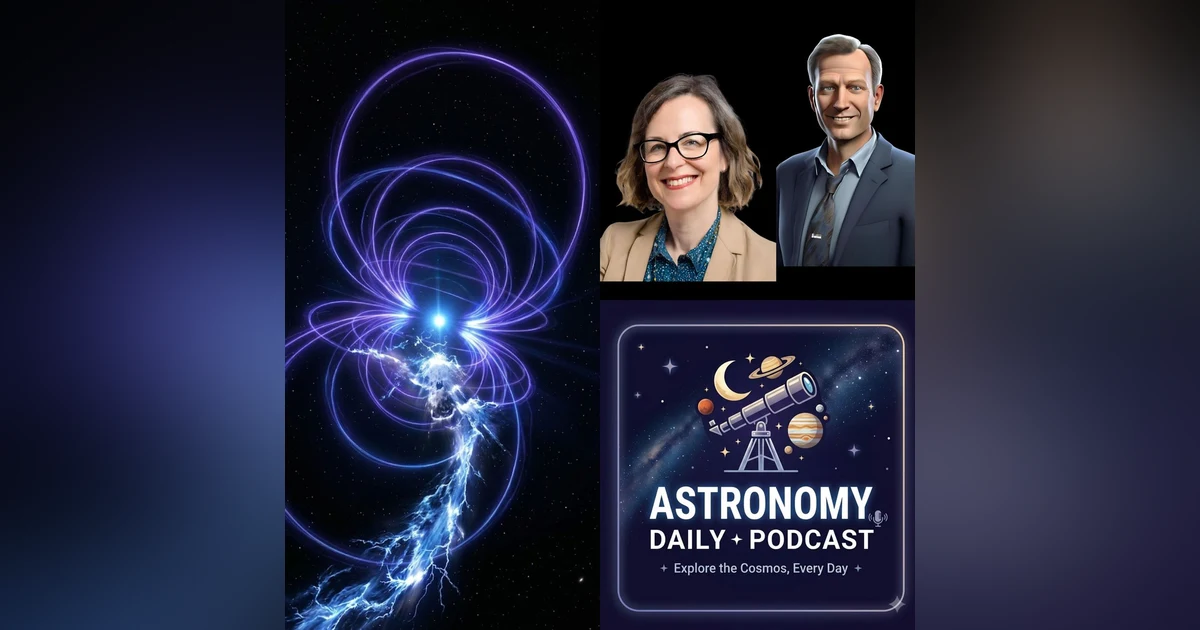
Today's episode — S05E191, Friday September 11, 2026: Main story: A population-synthesis study published in Nature Astronomy on 10 September argues that magnetars make up roughly half of all neutron stars, not the one-in-a-hundred implied by the catalogues. Celsa Pardo-Araujo and Nanda Rea (Institute of Space Sciences, ICE-CSIC, Barcelona) with Michele Ronchi (ASTRON) and Vanessa Graber (Royal Holloway) modelled the whole isolated-neutron-star population as one family rather than four separate classes, evolving spin-down, magneto-thermal decay and Galactic dynamics together, then filtering the simulated population the way real surveys filter the sky. Of the 24 known neutron stars younger than 2,000 years, magnetars and central compact objects are about 59%; the derived birth fraction averages ~50% (40–70% or 30–50% depending on the assumed birth-field distribution, which peaks at 1–2.5 × 10^14 gauss). Two consequences: the Galactic core-collapse supernova rate has to be higher than assumed, around two per century, and magnetar central-engine models for superluminous supernovae, gamma-ray burst plateaus and fast radio bursts finally have the supply to work. Caveats: it is a model rather than a census, the anchor sample is 24 objects, and 'magnetar' is defined by a field threshold. Southern thread: the field began with SGR 0526−66 in the Large Magellanic Cloud on 5 March 1979, and the same Barcelona group modelled GLEAM-X J162759, found with the Murchison Widefield Array in Western Australia. The rest of the news: · Chariklo's rings: The first stellar occultation ever planned specifically for JWST — 18 October 2022 — has been published in Science Advances, led by Yücel Kılıç, Pablo Santos-Sanz and Celia Navas (IAA-CSIC) with Nicolas Rambaux, Bruno Sicardy and Josselin Desmars (LTE) and Damya Souami (LIRA). Against the 2017 ground-based occultations, the inner ring C1R is about 50% more opaque and the outer ring C2R about 60% less, with the ring positions unchanged. Chariklo is the largest known centaur at ~125 km radius; the rings sit at 390 and 405 km and are a few km wide. Candidate explanations: material loss from C2R, material arriving at or collisions grinding down C1R — or a wavelength effect, since infrared is being compared with visible light. The rings were discovered in 2013 by an occultation campaign across Chile, Brazil, Argentina and Uruguay. · Mercury under bombardment: Kilpua et al. report in Nature Astronomy (8 September) that BepiColombo's fourth Mercury flyby in September 2024 — 165 km above the surface, closer than its eventual science orbit — coincided with a major solar particle eruption. The Finnish-built SIXS instrument watched energetic electrons and protons penetrate Mercury's magnetosphere and precipitate onto the surface over a wide area. That bombardment both sputters atoms off the surface and drives the X-ray fluorescence used to read its composition, and Mercury's small, weak magnetosphere makes it a stand-in for Earth during an extreme solar storm. The spacecraft separated its transfer module on 3 September; gravity capture is 21 November. · Europe buys a way home: ESA has awarded The Exploration Company a contract worth up to €760M under ALADDIN (Autonomous LEO Accelerated Demo Docking to ISS Node) — €310M for the demonstration mission, with ESA funding 60% and the company 40%, plus €450M in options for two further flights. The Nyx capsule flies on Ariane 6 and must dock with the ISS no later than Q2 2029, with up to €50M in additional incentive for using European launch vehicles. Europe has flown cargo up before, with the five ATVs, but has never returned anything from orbit. CEO Hélène Huby: 'It is the first time in Europe that a five-year-old space startup wins a contract worth hundreds of millions of euros.' The company's Mission Possible capsule survived reentry in June 2025 but was lost before splashdown — a partial success in its own words. Thales Alenia Space Italy remains in a parallel tender. · Parker Solar Probe: NASA reports the spacecraft completed its 29th close approach on 4 September, again matching the record set on Christmas Eve 2024 — 430,000 mph and 3.8 million miles from the solar surface, for the eighth time. The encounter ran 30 August to 9 September with nine days of autonomous operation and a beacon tone on the 7th; this pass targeted structures near the Sun's north pole, sampling nearly 40% of the solar circumference in a day. Telemetry began flowing on 11 September, science data 13–27 September. The mission is extended through 2029. · Skywatch: New Moon on 11 September at 14:27 AEST makes tonight and tomorrow the darkest nights of the month. Southern Hemisphere — Venus low in the west after sunset, building to greatest brilliancy on 18 September at magnitude −4.8, with a very thin crescent Moon sweeping past on the 13th and 14th (about half a degree apart on the 14th, near Spica); EarthSky notes the Southern Hemisphere gets the better view. Saturn rises soon after sunset heading for its 4 October opposition with the rings ~7° open, and the Milky Way core is still high in the early evening. The zodiacal light is an evening object here — 'false dusk' in the west after full darkness, through early November. North America — the zodiacal light is a pre-dawn object in the east ('false dawn'), well flagged around the 15th; Jupiter dominates the pre-dawn east closing on Regulus with Mars near Castor and Pollux; Saturn is ~50° up in the south after midnight, and early Saturday morning Dione transits Saturn's north polar region around 2:55 a.m. EDT with Tethys entering Saturn's shadow around 2:10 a.m. EDT. Space weather has eased to quiet-to-unsettled after two minor G1 storms on the 8th and 9th. Eye safety: never point optics near the Sun without a purpose-built front-mounted solar filter; eclipse glasses must be ISO 12312-2 certified and are for naked-eye use only, never with binoculars or a telescope. Links & sources · Pardo-Araujo, Rea, Ronchi & Graber, 'Magnetar fraction in Core-Collapse Supernovae', Nature Astronomy (10 Sept 2026) — https://arxiv.org/abs/2601.16159 · ICE-CSIC — Institute of Space Sciences, magnetar population release (10 Sept 2026) — https://www.ice.csic.es/ · Kılıç, Santos-Sanz, Navas, Rambaux, Sicardy, Desmars & Souami, 'JWST stellar occultation reveals unexpected changes in Chariklo's ring system', Science Advances (Sept 2026) — https://www.science.org/doi/10.1126/sciadv.aeh4794 · Observatoire de Paris / LTE — The James Webb Space Telescope Reveals That Chariklo's Invisible Rings Are Changing (9–10 Sept 2026) — https://lte.observatoiredeparis.psl.eu/The-James-Webb-Space-Telescope-Reveals-That-Chariklo-s-Invisible-Rings-Are · Sky & Telescope — Webb Space Telescope Discovers Surprising Changes in an Asteroid's Rings (10 Sept 2026) — https://skyandtelescope.org/astronomy-news/webb-space-telescope-discovers-surprising-changes-in-an-asteroids-rings/ · Kilpua et al., 'Planetary shielding and surface precipitation of solar energetic particles during BepiColombo's close Mercury flyby', Nature Astronomy (8 Sept 2026) — https://www.nature.com/natastron/research-articles · University of Helsinki / SIXS — BepiColombo measures Mercury's particle bombardment up close (10 Sept 2026) — https://phys.org/news/2026-09-bepicolombo-mercury-particle-bombardment.html · ESA — Press Release N° 47–2026: ESA awards service contract to The Exploration Company (10 Sept 2026) — https://www.esa.int/Newsroom/Press_Releases · European Spaceflight — ESA Awards The Exploration Company a €760M Space Station Cargo Contract (10 Sept 2026) — https://europeanspaceflight.com/esa-awards-the-exploration-company-a-e760m-space-station-cargo-contract · NASA — After Latest Swing Past Sun, NASA's Parker Solar Probe Checks In (10 Sept 2026) — https://science.nasa.gov/blogs/parker-solar-probe/ · EarthSky — Visible planets and night sky guide for September — https://earthsky.org/astronomy-essentials/visible-planets-tonight-mars-jupiter-venus-saturn-mercury/ · EarthSky — Zodiacal light: everything you need to know — https://earthsky.org/astronomy-essentials/everything-you-need-to-know-zodiacal-light-or-false-dawn/ · Astronomy.com — The Sky This Week from September 11 to 18 — https://www.astronomy.com/the-sky-this-week/the-sky-this-week-from-september-11-to-18-2026/ Follow us: @AstroDailyPod
Become a supporter of this podcast: https://www.spreaker.com/podcast/astronomy-daily-latest-space-news--5648921/support.
Sponsor Details:
Ensure your online privacy by using NordVPN. To get our special listener deal and save a lot of money, visit www.astronomydaily.io/nordvpn. You'll be glad you did!
Get the best secure and private email on the planet. Stop your Government, google and who knows who else spying on every email you write. Do what we did and use ProtonMail. They beleive in privacy and there are no ads in their business model...yet they still provide a free forever service. Check them out and get out special deal at www.astronomydaily.io/protonmail
Become a supporter of Astronomy Daily by joining our Supporters Club. Commercial free episodes daily are only a click way... Click Here
This episode includes AI-generated content.
0
00:00:00.000 --> 00:00:02.560
Anna: Hello and welcome to Astronomy AstroDailyPod.
1
00:00:03.040 --> 00:00:06.006
It's Friday the 11th of, uh, September
2
00:00:06.194 --> 00:00:08.640
2026. This is series
3
00:00:08.800 --> 00:00:11.360
five, episode 191.
4
00:00:11.760 --> 00:00:12.880
And I'm Anna.
5
00:00:13.440 --> 00:00:14.880
Avery: And I'm Avery.
6
00:00:15.040 --> 00:00:18.000
Anna. Today's lead is a paper arguing that
7
00:00:18.000 --> 00:00:20.680
one of the rarest, strangest objects in the
8
00:00:20.680 --> 00:00:22.480
galaxy isn't rare at all.
9
00:00:23.040 --> 00:00:25.760
Anna: Magnetars. Neutron stars with
10
00:00:25.760 --> 00:00:28.760
magnetic fields so strong the number stops
11
00:00:28.760 --> 00:00:31.680
meaning anything. And we know of about 30 of
12
00:00:31.680 --> 00:00:34.280
them against a few thousand ordinary radio
13
00:00:34.280 --> 00:00:37.000
pulsars. So the picture has always been
14
00:00:37.240 --> 00:00:40.040
exotic, freakish. One in a hundred.
15
00:00:40.520 --> 00:00:42.920
A new paper in Nature Astronomy says that
16
00:00:42.920 --> 00:00:45.400
picture is a counting error and the real
17
00:00:45.400 --> 00:00:47.240
figure is closer to one in two.
18
00:00:47.720 --> 00:00:50.680
Avery: Half. Half of all neutron stars.
19
00:00:51.160 --> 00:00:54.080
Anna: Half. And if that's right, it doesn't just
20
00:00:54.080 --> 00:00:56.910
reshuffle a catalogue. It changes how many
21
00:00:56.910 --> 00:00:58.910
supernovae, uh, our galaxy has to be
22
00:00:58.910 --> 00:01:01.390
producing. And it quietly props up. The
23
00:01:01.390 --> 00:01:03.310
leading explanation for some of the most
24
00:01:03.310 --> 00:01:06.070
extreme events in the universe, including
25
00:01:06.150 --> 00:01:08.670
the fast radio bursts we spent yesterday's
26
00:01:08.670 --> 00:01:09.190
lead on.
27
00:01:09.670 --> 00:01:12.230
Avery: After that, the rings around a small
28
00:01:12.310 --> 00:01:15.110
icy body 2 billion kilometres away
29
00:01:15.190 --> 00:01:17.750
have changed. One thickened, one
30
00:01:17.750 --> 00:01:20.670
thinned in the space of five years. And the
31
00:01:20.670 --> 00:01:23.110
James Webb Space Telescope caught it by
32
00:01:23.110 --> 00:01:25.350
watching the thing pass in front of a star.
33
00:01:26.020 --> 00:01:28.940
Anna: A spacecraft skimming 165 kilometres
34
00:01:28.940 --> 00:01:31.780
above Mercury at the exact moment the sun
35
00:01:31.780 --> 00:01:34.540
let go of a burst of particles and measuring
36
00:01:34.540 --> 00:01:35.860
them landing on the surface.
37
00:01:36.420 --> 00:01:39.060
Avery: Europe writing a 760 million
38
00:01:39.060 --> 00:01:41.620
euro cheque for something it has never once
39
00:01:41.620 --> 00:01:44.380
been able to do. Bring cargo home
40
00:01:44.380 --> 00:01:45.300
from orbit.
41
00:01:45.540 --> 00:01:47.700
Anna: And a quick one on Parker solar probe
42
00:01:47.940 --> 00:01:50.220
checking in from its 29th trip through the
43
00:01:50.220 --> 00:01:51.140
sun's atmosphere.
44
00:01:51.650 --> 00:01:54.530
Avery: Plus the sky for both hemispheres. New
45
00:01:54.530 --> 00:01:57.410
Moon was this afternoon, so tonight is as
46
00:01:57.410 --> 00:01:59.930
dark as September gets. And there's a
47
00:01:59.930 --> 00:02:02.410
genuinely lovely pairing this weekend that
48
00:02:02.410 --> 00:02:05.130
the south gets the better view of. Let's get
49
00:02:05.130 --> 00:02:05.650
into it.
50
00:02:05.970 --> 00:02:06.930
Anna: Ready when you are.
51
00:02:07.490 --> 00:02:10.450
Avery: Start me at the beginning. What's a magnetar?
52
00:02:10.930 --> 00:02:13.810
Anna: Start one step further back. A neutron star.
53
00:02:14.370 --> 00:02:17.010
Take a star 8 to 20 something times the mass
54
00:02:17.010 --> 00:02:19.100
of the sun, magnifying, run it out of fuel
55
00:02:19.100 --> 00:02:21.500
and the core collapses in about a second.
56
00:02:22.060 --> 00:02:24.620
What's left is a ball roughly 20 kilometres
57
00:02:24.620 --> 00:02:27.220
across with more mass than the sun packed
58
00:02:27.220 --> 00:02:29.820
into it. A teaspoon of the material weighs
59
00:02:29.820 --> 00:02:31.420
about as much as a mountain range.
60
00:02:31.820 --> 00:02:34.460
Avery: And they come in flavours, that's the part
61
00:02:34.460 --> 00:02:35.020
that matters.
62
00:02:35.020 --> 00:02:37.380
Anna: Today we've catalogued them as separate
63
00:02:37.380 --> 00:02:39.700
species, largely because of how we found
64
00:02:39.700 --> 00:02:42.420
them. There are radio pulsars, the
65
00:02:42.420 --> 00:02:44.620
lighthouse ones, thousands of them, spinning
66
00:02:44.620 --> 00:02:47.580
fast and beaming. There are central compact
67
00:02:47.580 --> 00:02:50.380
objects sitting quietly inside supernova
68
00:02:50.380 --> 00:02:53.060
remnants Doing almost nothing. There are X
69
00:02:53.060 --> 00:02:55.900
ray dim isolated neutron stars, which
70
00:02:55.900 --> 00:02:58.700
are exactly as boring as they sound. And then
71
00:02:58.700 --> 00:03:01.380
there are magnetars, which are not
72
00:03:01.380 --> 00:03:03.860
boring. The opposite. A
73
00:03:03.860 --> 00:03:06.300
magnetar's magnetic field is somewhere around
74
00:03:06.300 --> 00:03:08.860
10 to the 14, 10 to the 15
75
00:03:08.860 --> 00:03:11.740
gauss. Earth's is about half a gauss.
76
00:03:12.300 --> 00:03:14.620
A hospital MRI about 15,000,
77
00:03:15.340 --> 00:03:17.980
so something like a quadrillion times Earth.
78
00:03:18.380 --> 00:03:20.820
And structurally, the key point is that a
79
00:03:20.820 --> 00:03:23.780
magnetar isn't powered by its spin the way a
80
00:03:23.780 --> 00:03:26.420
pulsar is. It's powered by that field
81
00:03:26.420 --> 00:03:29.100
decaying. The field is the fuel tank.
82
00:03:29.500 --> 00:03:31.340
Avery: What does that look like from the outside?
83
00:03:32.220 --> 00:03:34.980
Anna: Violence in short bursts. The
84
00:03:34.980 --> 00:03:37.420
crust is a rigid solid under enormous
85
00:03:37.420 --> 00:03:40.000
magnetic stress. And every so often it
86
00:03:40.000 --> 00:03:42.760
cracks a starquake and the object
87
00:03:42.760 --> 00:03:44.920
releases more energy in a fraction of a
88
00:03:44.920 --> 00:03:47.320
second than the sun manages in a hundred
89
00:03:47.320 --> 00:03:50.000
thousand years. In 2004,
90
00:03:50.240 --> 00:03:52.440
one of them put out a flare that measurably
91
00:03:52.440 --> 00:03:55.320
ionised Earth's upper atmosphere from 50,000
92
00:03:55.320 --> 00:03:56.160
light years away.
93
00:03:56.640 --> 00:03:58.480
Avery: And we know of about 30.
94
00:03:59.040 --> 00:04:01.720
Anna: About 30 confirmed against several thousand
95
00:04:01.720 --> 00:04:04.360
radio pulsars. Which is where the counting
96
00:04:04.360 --> 00:04:06.810
error creeps in, because those two numbers
97
00:04:06.810 --> 00:04:08.370
are not measuring the same thing.
98
00:04:08.930 --> 00:04:09.890
Avery: Explain that.
99
00:04:10.290 --> 00:04:12.970
Anna: A radio pulsar is a long lived, steady
100
00:04:12.970 --> 00:04:15.770
beacon. It'll beam for tens of millions of
101
00:04:15.770 --> 00:04:18.370
years, and we've spent 60 years building
102
00:04:18.370 --> 00:04:21.290
surveys designed to catch exactly that. A
103
00:04:21.290 --> 00:04:23.930
magnetar is the opposite. Bright and obvious
104
00:04:23.930 --> 00:04:26.450
for a few thousand years, powered by a field
105
00:04:26.450 --> 00:04:29.130
that is actively destroying itself. And then
106
00:04:29.130 --> 00:04:30.890
it fades into something much harder to
107
00:04:30.890 --> 00:04:33.590
identify. So if you count what's in the
108
00:04:33.590 --> 00:04:35.990
catalogues, you're counting how long each
109
00:04:35.990 --> 00:04:37.990
type stays visible to the instruments we
110
00:04:37.990 --> 00:04:40.590
happen to have built, not how many get born.
111
00:04:41.310 --> 00:04:43.470
Avery: So how do you count births instead of
112
00:04:43.470 --> 00:04:44.110
sightings?
113
00:04:44.510 --> 00:04:47.110
Anna: You build the galaxy in a computer. That's
114
00:04:47.110 --> 00:04:49.910
this work. Celsa Pardo Araujo and
115
00:04:49.910 --> 00:04:52.550
Nanda Rea at the Institute of Space Sciences
116
00:04:52.550 --> 00:04:55.110
in Barcelona with Michelle Ronke at
117
00:04:55.110 --> 00:04:57.710
ASTRON in the Netherlands and Vanessa Graeber
118
00:04:57.710 --> 00:05:00.120
at Royal Holloway in London. Published this
119
00:05:00.120 --> 00:05:02.760
week in Nature Astronomy. It's a population
120
00:05:02.840 --> 00:05:05.480
synthesis. Assume a distribution of
121
00:05:05.480 --> 00:05:08.040
magnetic fields and spins at birth, then
122
00:05:08.040 --> 00:05:09.960
evolve the whole simulated population
123
00:05:10.040 --> 00:05:10.440
forward.
124
00:05:11.000 --> 00:05:11.960
Avery: Evolve how?
125
00:05:12.440 --> 00:05:14.440
Anna: Three things at once, which is the technical
126
00:05:14.440 --> 00:05:17.280
advance. The spindown, how the rotation
127
00:05:17.280 --> 00:05:20.200
bleeds away, the magnetothermal evolution,
128
00:05:20.360 --> 00:05:22.320
how the field decays and how the crust
129
00:05:22.320 --> 00:05:25.130
coolswhich are coupled to each other and. And
130
00:05:25.130 --> 00:05:27.690
the galactic dynamics. These things get
131
00:05:27.690 --> 00:05:30.210
kicked at birth by the supernova and drift
132
00:05:30.210 --> 00:05:32.650
away from where they were born, which changes
133
00:05:32.650 --> 00:05:35.570
how far off and how obscured they look. Then
134
00:05:35.570 --> 00:05:37.850
you run the simulated population through the
135
00:05:37.850 --> 00:05:40.130
same detection filters as the real surveys
136
00:05:40.130 --> 00:05:43.130
and ask which starting assumption produces
137
00:05:43.130 --> 00:05:44.450
the sky we actually see.
138
00:05:44.850 --> 00:05:47.730
Avery: And the anchor is what? The full catalogue.
139
00:05:47.890 --> 00:05:50.840
Anna: The tightest anchor is the young end, and
140
00:05:50.840 --> 00:05:53.480
it's a small number. There are 24
141
00:05:53.480 --> 00:05:56.360
known isolated neutron stars in our galaxy
142
00:05:56.600 --> 00:05:59.560
younger than 2000 years. That's the sample
143
00:05:59.560 --> 00:06:02.280
where nothing has had time to fade. So it's
144
00:06:02.280 --> 00:06:04.840
the fairest census we've got. And in that
145
00:06:04.840 --> 00:06:07.640
sample, magnetars and central compact
146
00:06:07.640 --> 00:06:09.720
objects together make up about
147
00:06:09.720 --> 00:06:10.680
59%,
148
00:06:11.160 --> 00:06:13.400
Avery: nearly 6 in 10 of the young ones.
149
00:06:13.800 --> 00:06:16.320
Anna: They combine that with a volume limited
150
00:06:16.320 --> 00:06:18.680
sample of the x ray dim objects,
151
00:06:19.180 --> 00:06:21.260
and what comes out is a birth fraction for
152
00:06:21.260 --> 00:06:24.180
magnetars averaging around 50% of
153
00:06:24.180 --> 00:06:26.540
the entire neutron star population.
154
00:06:27.260 --> 00:06:29.460
The range depends on what you assume about
155
00:06:29.460 --> 00:06:31.180
the field distribution at birth.
156
00:06:31.580 --> 00:06:34.300
If it peaks around one times 10 to the 14
157
00:06:34.300 --> 00:06:36.940
gauss, you get 40 to 70%.
158
00:06:37.340 --> 00:06:39.660
If it peaks a bit higher, around two and a
159
00:06:39.660 --> 00:06:42.540
half times 10 to the 14, you get 30 to 50.
160
00:06:43.180 --> 00:06:45.780
Avery: So the headline number is about half with
161
00:06:45.780 --> 00:06:47.020
honest width on it.
162
00:06:47.540 --> 00:06:50.380
Anna: About half with width. And Pardo
163
00:06:50.380 --> 00:06:53.020
Araujo's own framing of why it took this long
164
00:06:53.020 --> 00:06:54.100
is worth quoting.
165
00:06:54.580 --> 00:06:56.620
She says it's essential to model the
166
00:06:56.620 --> 00:06:59.100
different types of isolated neutron star in a
167
00:06:59.100 --> 00:07:01.460
unified way, together with their possible
168
00:07:01.620 --> 00:07:04.380
evolutionary connections, because that's what
169
00:07:04.380 --> 00:07:06.740
lets you estimate consistently how many
170
00:07:06.740 --> 00:07:09.500
magnetars form. In other words, the
171
00:07:09.500 --> 00:07:12.220
mistake was treating four catalogues as four
172
00:07:12.220 --> 00:07:14.930
species instead of one population seen
173
00:07:14.930 --> 00:07:15.970
at different stages.
174
00:07:16.770 --> 00:07:19.330
Avery: Right. So what breaks if this is true?
175
00:07:19.890 --> 00:07:20.610
Anna: Two things.
176
00:07:21.010 --> 00:07:22.690
And the first is a lovely piece of
177
00:07:22.690 --> 00:07:25.690
arithmetic. If half of all neutron stars are
178
00:07:25.690 --> 00:07:28.530
magnetars, and magnetars are only visible
179
00:07:28.530 --> 00:07:31.450
for a couple of thousand years, then to keep
180
00:07:31.450 --> 00:07:33.970
the observed population topped up, the
181
00:07:33.970 --> 00:07:36.850
galaxy has to be making neutron stars faster
182
00:07:36.850 --> 00:07:39.370
than we'd assumed. They derive a core
183
00:07:39.370 --> 00:07:41.610
collapse supernova rate of about 2 per
184
00:07:41.610 --> 00:07:44.210
century. 2.01 with a
185
00:07:44.210 --> 00:07:46.690
generous error bar running from about 1 to
186
00:07:46.690 --> 00:07:49.050
nearly 4. And the old number,
187
00:07:49.530 --> 00:07:51.770
the conventional figure, has sat at roughly
188
00:07:51.770 --> 00:07:54.090
one to two per century for a long time.
189
00:07:54.330 --> 00:07:56.850
And estimates have often drifted towards the
190
00:07:56.850 --> 00:07:59.730
low end. So this pushes the galaxy's
191
00:07:59.730 --> 00:08:02.090
supernova rate up from a completely
192
00:08:02.090 --> 00:08:04.450
independent direction. That's the part I
193
00:08:04.450 --> 00:08:07.450
like. It's not a supernova paper and it still
194
00:08:07.450 --> 00:08:10.090
lands on the supernova rate. And the second
195
00:08:10.090 --> 00:08:12.890
thing, the second is bigger, and it's about
196
00:08:12.890 --> 00:08:15.730
the rest of the universe. There's a family of
197
00:08:15.730 --> 00:08:18.170
extreme events nobody can fully explain.
198
00:08:18.570 --> 00:08:21.370
Super luminous supernovae, ten to a
199
00:08:21.370 --> 00:08:23.970
hundred times brighter than a normal one. The
200
00:08:23.970 --> 00:08:26.890
long plateaus in gamma ray burst afterglows
201
00:08:26.890 --> 00:08:29.010
where something keeps injecting energy after
202
00:08:29.010 --> 00:08:31.530
the explosion should be over and fast.
203
00:08:31.530 --> 00:08:34.490
Avery: Radio bursts, which was yesterday's lead
204
00:08:34.730 --> 00:08:35.010
from
205
00:08:35.010 --> 00:08:37.590
Anna: the other end, a hundred and nine of them
206
00:08:37.590 --> 00:08:39.550
used to weigh the ordinary matter of the
207
00:08:39.550 --> 00:08:42.310
universe. And for all three, the
208
00:08:42.310 --> 00:08:44.910
leading explanation is the a
209
00:08:44.910 --> 00:08:47.470
newborn magnetar in the middle, dumping its
210
00:08:47.470 --> 00:08:50.390
magnetic energy into the debris. We know it's
211
00:08:50.390 --> 00:08:52.790
physically possible because in 2020, a
212
00:08:52.790 --> 00:08:55.470
magnetar in our own galaxy, SGR
213
00:08:55.630 --> 00:08:58.110
1935, 2154,
214
00:08:58.430 --> 00:09:00.990
produced a fast radio burst and settled that
215
00:09:00.990 --> 00:09:01.310
question.
216
00:09:02.230 --> 00:09:04.070
Avery: So what was missing was the supply.
217
00:09:04.710 --> 00:09:06.070
Anna: Exactly. The supply.
218
00:09:06.550 --> 00:09:08.670
A central engine model needs there to be
219
00:09:08.670 --> 00:09:11.670
enough engines. If magnetars were a 1%
220
00:09:11.670 --> 00:09:14.550
curiosity, then explaining a whole class of
221
00:09:14.550 --> 00:09:16.910
common extragalactic transients with them is
222
00:09:16.910 --> 00:09:19.590
a stretch. If they're half of all neutron
223
00:09:19.590 --> 00:09:22.470
stars, the budget works. The paper is
224
00:09:22.470 --> 00:09:24.670
explicit that this lends strong support to
225
00:09:24.670 --> 00:09:27.390
the models. It doesn't prove them, it makes
226
00:09:27.390 --> 00:09:28.150
them affordable.
227
00:09:28.880 --> 00:09:31.360
Avery: Caveats. Give me the honest ones.
228
00:09:31.840 --> 00:09:34.440
Anna: 3. First, this is a model, not a
229
00:09:34.440 --> 00:09:36.760
census. Nobody counted 50 million
230
00:09:36.760 --> 00:09:39.480
magnetars. It's a simulation tuned to
231
00:09:39.480 --> 00:09:42.040
reproduce what we see. And if the assumed
232
00:09:42.040 --> 00:09:43.920
shape of the birth field distribution is
233
00:09:43.920 --> 00:09:46.800
wrong, the answer moves. The paper
234
00:09:46.800 --> 00:09:49.480
is up front that the 50% depends on assuming
235
00:09:49.480 --> 00:09:51.680
a 2 peaked field distribution at birth.
236
00:09:52.320 --> 00:09:54.800
Second, the anchor sample is 24
237
00:09:54.800 --> 00:09:56.480
objects. 24.
238
00:09:56.960 --> 00:09:59.440
That's the tightest constraint they have. And
239
00:09:59.440 --> 00:10:01.480
it's also a very small number to hang a
240
00:10:01.480 --> 00:10:03.280
galaxy on. And third,
241
00:10:03.920 --> 00:10:06.400
magnetar here is defined by a threshold,
242
00:10:06.800 --> 00:10:09.400
a dipole field above about 10 to the
243
00:10:09.400 --> 00:10:12.320
13.5 gauss. And nature doesn't
244
00:10:12.320 --> 00:10:15.000
come with a threshold. Some objects sit right
245
00:10:15.000 --> 00:10:15.600
on the line.
246
00:10:16.160 --> 00:10:17.920
Avery: And where does the work go next?
247
00:10:18.320 --> 00:10:20.720
Anna: Ria's answer is the obvious one and also the
248
00:10:20.720 --> 00:10:23.310
right one tested outside our galaxy.
249
00:10:23.710 --> 00:10:25.790
A, uh, natural extension, she says, would be
250
00:10:25.790 --> 00:10:28.030
to cheque these results in an extragalactic
251
00:10:28.030 --> 00:10:30.310
context, which is exactly where the
252
00:10:30.310 --> 00:10:31.150
transients are.
253
00:10:31.550 --> 00:10:33.750
Avery: And there's a southern thread here, isn't
254
00:10:33.750 --> 00:10:34.030
there?
255
00:10:34.350 --> 00:10:36.350
Anna: There's a good one, and it's not decorative,
256
00:10:36.670 --> 00:10:37.629
it's foundational.
257
00:10:38.190 --> 00:10:40.590
The entire field of magnetars starts in the
258
00:10:40.590 --> 00:10:43.311
southern sky. On 5 March
259
00:10:43.442 --> 00:10:46.310
1979, a burst of gamma rays swept through
260
00:10:46.310 --> 00:10:49.190
the solar system so hard that it saturated
261
00:10:49.190 --> 00:10:52.030
instruments on nine separate spacecraft. And
262
00:10:52.030 --> 00:10:54.270
when it was traced back, it came from the
263
00:10:54.270 --> 00:10:56.830
N49 supernova remnant in the Large
264
00:10:56.830 --> 00:10:59.030
Magellanic Cloud, SGR
265
00:10:59.270 --> 00:11:01.910
0526 66,
266
00:11:02.390 --> 00:11:04.910
a southern sky object in a southern sky
267
00:11:04.910 --> 00:11:07.550
satellite galaxy. That event is the reason
268
00:11:07.550 --> 00:11:09.590
the word magnetar exists at all.
269
00:11:10.070 --> 00:11:11.270
Avery: And the modern end?
270
00:11:11.590 --> 00:11:13.510
Anna: The modern end runs through Western
271
00:11:13.510 --> 00:11:16.460
Australia. In 2022, a survey with
272
00:11:16.460 --> 00:11:19.220
the Murchison Widefield Array at Inyarimanha
273
00:11:19.220 --> 00:11:21.940
Il Ghari Bundara, the same site that'll host
274
00:11:21.940 --> 00:11:24.260
Ska Lo turned up Gleam
275
00:11:24.260 --> 00:11:26.980
XJ16000 2759,
276
00:11:27.380 --> 00:11:29.580
an object switching on for a minute at a time
277
00:11:29.580 --> 00:11:32.460
every 18 minutes. Far too slow for anything
278
00:11:32.460 --> 00:11:34.340
we thought could produce radio emission like
279
00:11:34.340 --> 00:11:36.380
that. And the follow up that took that
280
00:11:36.380 --> 00:11:39.140
Australian discovery seriously as a possible
281
00:11:39.220 --> 00:11:42.210
ultra long period magnetar was led out of
282
00:11:42.210 --> 00:11:44.650
the same Barcelona group using the same
283
00:11:44.650 --> 00:11:46.730
magnetothermal machinery behind today's
284
00:11:46.730 --> 00:11:49.170
result, same tools, same people.
285
00:11:49.730 --> 00:11:52.450
Southern data, which is how this actually
286
00:11:52.530 --> 00:11:53.090
works.
287
00:11:53.650 --> 00:11:56.370
A wide field radio survey on Guadari
288
00:11:56.370 --> 00:11:59.010
country finds something nobody can classify.
289
00:11:59.730 --> 00:12:02.330
A theory group in Spain builds the model that
290
00:12:02.330 --> 00:12:05.010
might explain it. And four years later
291
00:12:05.250 --> 00:12:07.930
the model tells us we've been miscounting the
292
00:12:07.930 --> 00:12:08.770
whole population.
293
00:12:09.940 --> 00:12:12.820
Avery: Storey2 and it's small, distant and
294
00:12:12.820 --> 00:12:15.820
genuinely strange. Chariklo is
295
00:12:15.820 --> 00:12:18.460
a centaur, one of the icy bodies on
296
00:12:18.460 --> 00:12:20.780
unstable orbits between Jupiter and
297
00:12:20.780 --> 00:12:21.540
Neptune.
298
00:12:21.540 --> 00:12:24.460
In Chariklo's case, crossing between Saturn
299
00:12:24.460 --> 00:12:26.620
and uranus. It's about
300
00:12:26.620 --> 00:12:29.420
250 kilometres across, so a
301
00:12:29.420 --> 00:12:32.380
radius of roughly 125, which
302
00:12:32.380 --> 00:12:34.820
makes it the largest centaur we know of.
303
00:12:35.460 --> 00:12:38.300
And in 2013, it became the first object
304
00:12:38.300 --> 00:12:40.700
smaller than a planet ever found to have
305
00:12:40.700 --> 00:12:41.140
rings.
306
00:12:41.700 --> 00:12:44.500
Anna: Found how? You can't image something that
307
00:12:44.500 --> 00:12:45.780
small at that distance.
308
00:12:46.420 --> 00:12:49.260
Avery: You can't. You watch it pass in front of a
309
00:12:49.260 --> 00:12:51.820
star and time the shadow A, uh, stellar
310
00:12:51.820 --> 00:12:54.660
occultation. The star blinks out.
311
00:12:54.820 --> 00:12:57.620
You measure for exactly how long and from
312
00:12:57.620 --> 00:12:59.700
telescopes at different sites, you
313
00:12:59.700 --> 00:13:01.900
reconstruct the shape of whatever passed in
314
00:13:01.900 --> 00:13:04.670
front of. In 2013, a campaign
315
00:13:04.910 --> 00:13:07.870
strung across Chile, Brazil, Argentina
316
00:13:07.870 --> 00:13:10.750
and Uruguay caught Chariklo doing that.
317
00:13:10.750 --> 00:13:12.910
And the star didn't blink once.
318
00:13:13.470 --> 00:13:16.350
It blinked twice on the way in and twice on
319
00:13:16.350 --> 00:13:19.230
the way out. Rings, two
320
00:13:19.230 --> 00:13:21.910
of them sharp, narrow and a
321
00:13:21.910 --> 00:13:24.710
complete surprise. At the time, rings
322
00:13:24.710 --> 00:13:27.430
were something planets had. They sit about
323
00:13:27.430 --> 00:13:30.070
390 and 405
324
00:13:30.070 --> 00:13:32.270
kilometres from the centre, one a few
325
00:13:32.270 --> 00:13:33.630
kilometres wide each.
326
00:13:33.870 --> 00:13:36.190
And they've been called Chariklos pocket
327
00:13:36.190 --> 00:13:37.310
rings ever since.
328
00:13:37.870 --> 00:13:39.390
Anna: And Webb has now looked.
329
00:13:39.790 --> 00:13:42.190
Avery: Webb looked on 18 October
330
00:13:42.350 --> 00:13:45.150
2022, the first stellar occultation
331
00:13:45.230 --> 00:13:47.710
ever specifically planned for the telescope.
332
00:13:48.190 --> 00:13:51.030
The payoff is wavelength. Webb sees
333
00:13:51.030 --> 00:13:53.870
out to five microns in the infrared, which
334
00:13:53.870 --> 00:13:55.390
isn't available from the ground.
335
00:13:55.630 --> 00:13:57.670
And it resolved the rings to about a
336
00:13:57.670 --> 00:14:00.550
kilometre. Published this week in Science
337
00:14:00.550 --> 00:14:03.310
Advances, led by Yucel Kilitz,
338
00:14:03.310 --> 00:14:06.270
Pablo Santos Sanz and Celia Navis at
339
00:14:06.270 --> 00:14:08.790
the Institute of Astrophysics of Andalusia
340
00:14:08.870 --> 00:14:11.830
with Nicolas Rambo, Bruno Siccardi and
341
00:14:11.830 --> 00:14:13.830
Jocelyn Demars in Paris.
342
00:14:14.310 --> 00:14:15.350
Anna: And what changed?
343
00:14:15.830 --> 00:14:18.150
Avery: Both rings in opposite directions.
344
00:14:18.790 --> 00:14:20.910
Compared with the ground based occultations
345
00:14:20.910 --> 00:14:23.430
of 2017, the inner ring
346
00:14:25.170 --> 00:14:27.730
is now about 50% more opaque.
347
00:14:28.290 --> 00:14:31.290
The outer ring, C2R, has gone
348
00:14:31.290 --> 00:14:34.210
the other way. Its opacity has dropped by
349
00:14:34.210 --> 00:14:36.970
around 60% and the positions
350
00:14:36.970 --> 00:14:39.770
haven't moved at all. The rings are where
351
00:14:39.770 --> 00:14:42.730
they were. It's the material in them that's
352
00:14:42.730 --> 00:14:43.010
different.
353
00:14:43.490 --> 00:14:44.450
Anna: In five years.
354
00:14:45.170 --> 00:14:47.970
Avery: In five years around an object that takes
355
00:14:47.970 --> 00:14:50.050
63 years to go round the sun.
356
00:14:50.940 --> 00:14:53.460
That's the finding. These are not static
357
00:14:53.460 --> 00:14:56.020
structures you can photograph once and file
358
00:14:56.020 --> 00:14:58.820
away. They're dynamically active on a
359
00:14:58.820 --> 00:15:01.100
timescale a human being can sit through.
360
00:15:01.500 --> 00:15:02.460
Anna: What would do that?
361
00:15:02.540 --> 00:15:05.340
Avery: Nobody knows yet, and the paper says so.
362
00:15:05.580 --> 00:15:07.540
The outer ring thinning could be
363
00:15:07.540 --> 00:15:10.500
straightforward material loss. The inner
364
00:15:10.500 --> 00:15:13.220
one thickening could be material arriving or
365
00:15:13.220 --> 00:15:15.820
collisions grinding larger particles into
366
00:15:15.820 --> 00:15:18.510
finer grains, which are more opaque per
367
00:15:18.510 --> 00:15:21.150
kilogramme. And the team adds a third
368
00:15:21.150 --> 00:15:23.830
possibility that isn't astrophysics at all.
369
00:15:24.230 --> 00:15:26.590
They're comparing infrared measurements with
370
00:15:26.590 --> 00:15:28.310
older visible light ones.
371
00:15:28.630 --> 00:15:30.710
So some of the difference could be about what
372
00:15:30.710 --> 00:15:33.470
each wavelength is sensitive to, rather than
373
00:15:33.470 --> 00:15:35.110
the rings actually changing.
374
00:15:35.990 --> 00:15:38.990
Anna: So the result is a real change, a
375
00:15:38.990 --> 00:15:41.790
suspected cause and an unresolved
376
00:15:41.790 --> 00:15:42.470
confound.
377
00:15:43.200 --> 00:15:45.640
Avery: That's a fair summary. And it's why the next
378
00:15:45.640 --> 00:15:48.000
occultation matters more than this one.
379
00:15:48.480 --> 00:15:49.760
The southern hemisphere.
380
00:15:49.760 --> 00:15:52.120
Point here is that this whole technique is
381
00:15:52.120 --> 00:15:54.640
ours by geography and by habit.
382
00:15:54.960 --> 00:15:57.400
Chariklos rings were discovered from South
383
00:15:57.400 --> 00:16:00.280
American soil. Occultation chasing is
384
00:16:00.280 --> 00:16:02.440
a discipline where a well placed amateur
385
00:16:02.440 --> 00:16:05.280
telescope in rural Australia or New Zealand
386
00:16:05.520 --> 00:16:08.320
can contribute real data. And the shadow
387
00:16:08.320 --> 00:16:11.150
tracks fall where they fall, which is often
388
00:16:11.230 --> 00:16:13.230
down here, storey three.
389
00:16:13.470 --> 00:16:15.430
Anna: And it's a piece of luck that turned into a
390
00:16:15.430 --> 00:16:15.710
result.
391
00:16:16.270 --> 00:16:18.990
BepiColombo, the joint European and
392
00:16:18.990 --> 00:16:21.430
Japanese mission to Mercury, which we've been
393
00:16:21.430 --> 00:16:24.030
following as it comes in to arrive, made its
394
00:16:24.030 --> 00:16:26.990
fourth flyby of the planet in September 2024
395
00:16:27.310 --> 00:16:30.030
and it came in low, 165
396
00:16:30.030 --> 00:16:32.870
kilometres above the surface, which is closer
397
00:16:32.870 --> 00:16:34.590
Avery: than it'll be when it's actually in
398
00:16:34.590 --> 00:16:36.990
Anna: orbit, closer than the science orbit, which
399
00:16:36.990 --> 00:16:39.860
is the point the team keeps making. And at
400
00:16:39.860 --> 00:16:42.660
the exact moment it was down there, the sun
401
00:16:42.660 --> 00:16:45.260
let go of a major eruption of energetic
402
00:16:45.260 --> 00:16:48.220
particles. The lead author, Kilpua
403
00:16:48.380 --> 00:16:50.460
at the University of Helsinki, puts it
404
00:16:50.460 --> 00:16:50.940
plainly.
405
00:16:51.260 --> 00:16:54.140
The fourth flyby was unique. The spacecraft
406
00:16:54.140 --> 00:16:56.100
was much closer to the surface than it will
407
00:16:56.100 --> 00:16:58.700
ever be in its final orbit. And they were
408
00:16:58.700 --> 00:17:01.300
lucky that a major particle eruption happened
409
00:17:01.300 --> 00:17:03.420
on the sun at precisely that moment.
410
00:17:03.980 --> 00:17:05.100
Avery: So what did it see?
411
00:17:05.640 --> 00:17:06.080
Anna: It watched.
412
00:17:06.080 --> 00:17:08.120
The particles get through. High energy
413
00:17:08.120 --> 00:17:10.600
electrons and protons penetrated Mercury's
414
00:17:10.600 --> 00:17:13.000
magnetic field and precipitated onto the
415
00:17:13.000 --> 00:17:15.760
surface across a wide area. The instrument is
416
00:17:15.760 --> 00:17:18.600
called sixis, the Solar Intensity X
417
00:17:18.600 --> 00:17:21.200
Ray and Particle Spectrometer, designed and
418
00:17:21.200 --> 00:17:23.760
built in Finland, and the work has just been
419
00:17:23.760 --> 00:17:25.560
published in Nature Astronomy.
420
00:17:25.880 --> 00:17:28.040
Avery: Why does it matter where particles land?
421
00:17:28.440 --> 00:17:29.280
Anna: Two reasons.
422
00:17:29.280 --> 00:17:31.810
And the first is practical. When energetic
423
00:17:31.810 --> 00:17:34.290
particles hit an airless surface, they knock
424
00:17:34.290 --> 00:17:36.810
atoms and molecules off it and they make the
425
00:17:36.810 --> 00:17:39.130
surface fluoresce in X rays. That
426
00:17:39.130 --> 00:17:41.130
fluorescence is exactly how you read the
427
00:17:41.130 --> 00:17:42.970
chemical composition of a planet you can't
428
00:17:42.970 --> 00:17:45.530
land on. So if you want to map what Mercury
429
00:17:45.530 --> 00:17:47.250
is made of, you need to know what's
430
00:17:47.250 --> 00:17:49.930
bombarding it and where. This is calibration
431
00:17:49.930 --> 00:17:51.490
for the mission's own science.
432
00:17:52.050 --> 00:17:52.770
Avery: And the second?
433
00:17:52.930 --> 00:17:55.850
Anna: The second is that it's weathering over
434
00:17:55.850 --> 00:17:58.750
geological time. That bombardment is one
435
00:17:58.750 --> 00:18:01.630
of the things reworking the surface, along
436
00:18:01.630 --> 00:18:04.430
with the solar wind and micrometeorites.
437
00:18:04.910 --> 00:18:07.310
And there's a third payoff that reaches back
438
00:18:07.310 --> 00:18:10.270
here. Rami Vainio at the University
439
00:18:10.270 --> 00:18:13.150
of Turku, the CO investigator, makes
440
00:18:13.150 --> 00:18:15.710
the point that Mercury has a real magnetic
441
00:18:15.710 --> 00:18:18.270
field, but a small, weak
442
00:18:18.350 --> 00:18:21.350
magnetosphere, which makes it a natural
443
00:18:21.350 --> 00:18:23.790
stand in for what Earth looks like during an
444
00:18:23.790 --> 00:18:25.650
extreme solar solar storm.
445
00:18:26.370 --> 00:18:29.370
Mercury is the experiment we can't run on
446
00:18:29.370 --> 00:18:29.890
ourselves.
447
00:18:30.770 --> 00:18:32.930
Avery: And where is the spacecraft now?
448
00:18:33.330 --> 00:18:35.650
Anna: In the middle of the most interesting stretch
449
00:18:35.650 --> 00:18:38.570
of its life, it separated its transfer
450
00:18:38.570 --> 00:18:41.530
module, the big electric propulsion stack
451
00:18:41.530 --> 00:18:43.490
that's been doing the work for eight years.
452
00:18:44.050 --> 00:18:46.450
On the 3rd of September, eight days ago,
453
00:18:46.930 --> 00:18:49.690
gravity capture at Mercury is on the 21st of
454
00:18:49.690 --> 00:18:52.080
November. The Japanese orbiter
455
00:18:52.880 --> 00:18:54.760
gets released around the 9th or 10th of
456
00:18:54.760 --> 00:18:55.200
December.
457
00:18:55.520 --> 00:18:58.040
And the European orbiter reaches its final
458
00:18:58.040 --> 00:19:00.880
science orbit in March, with routine science
459
00:19:00.880 --> 00:19:03.760
from April. So this flyby result is arriving
460
00:19:03.760 --> 00:19:06.200
as a kind of advanced sample of what the
461
00:19:06.200 --> 00:19:08.240
mission is about to start doing properly.
462
00:19:10.080 --> 00:19:13.000
Avery: And it's money rather than physics, but it's
463
00:19:13.000 --> 00:19:15.120
the kind of money that changes what's
464
00:19:15.120 --> 00:19:17.970
possible. Yesterday, the European Space
465
00:19:17.970 --> 00:19:20.650
Agency awarded a contract worth up to
466
00:19:20.650 --> 00:19:23.410
760 million euros to a
467
00:19:23.410 --> 00:19:26.330
German startup called the Exploration Company
468
00:19:26.810 --> 00:19:29.810
to build a spacecraft that can carry cargo to
469
00:19:29.810 --> 00:19:32.329
the International Space Station. And
470
00:19:32.570 --> 00:19:34.970
this is the part Europe has never done.
471
00:19:35.290 --> 00:19:36.170
Bring it back.
472
00:19:36.810 --> 00:19:39.650
Anna: Never. Europe flew cargo to the station for
473
00:19:39.650 --> 00:19:39.930
years.
474
00:19:40.730 --> 00:19:43.290
Avery: Flew it up, yes. The ATVs,
475
00:19:43.450 --> 00:19:45.900
five of them, big and successful.
476
00:19:46.460 --> 00:19:48.540
Every one of them was then deliberately
477
00:19:48.540 --> 00:19:51.420
destroyed on the way down. Europe has
478
00:19:51.420 --> 00:19:53.860
never returned anything from orbit to the
479
00:19:53.860 --> 00:19:56.860
ground. That capability belongs to the United
480
00:19:56.940 --> 00:19:59.780
States, Russia and China. And
481
00:19:59.780 --> 00:20:01.860
it's the difference between shipping and
482
00:20:01.860 --> 00:20:04.820
shipping, both ways. Experiments, you
483
00:20:04.820 --> 00:20:07.500
can actually get back, Hardware you can
484
00:20:07.500 --> 00:20:09.980
inspect, samples that survive.
485
00:20:10.680 --> 00:20:11.800
Anna: What's the shape of the deal?
486
00:20:12.280 --> 00:20:14.960
Avery: It runs under a programme ESA calls
487
00:20:14.960 --> 00:20:17.160
Aladdin. And the structure is
488
00:20:17.160 --> 00:20:19.880
310 million euros for the
489
00:20:19.880 --> 00:20:22.840
demonstration mission, with ESA covering
490
00:20:22.840 --> 00:20:25.840
60% of that and the company funding the
491
00:20:25.840 --> 00:20:27.720
other 40, plus
492
00:20:27.720 --> 00:20:30.680
450 million in options for
493
00:20:30.680 --> 00:20:33.680
two further missions. The vehicle is called
494
00:20:33.680 --> 00:20:36.600
Nix. It flies on Ariane 6
495
00:20:36.990 --> 00:20:39.630
and it has to dock with the space station no
496
00:20:39.630 --> 00:20:42.430
later than the second quarter of 2029.
497
00:20:42.990 --> 00:20:45.870
There's also up to 50 million euros in
498
00:20:45.870 --> 00:20:48.430
additional incentive for flying on European
499
00:20:48.430 --> 00:20:51.230
launch vehicles, which tells you what else
500
00:20:51.230 --> 00:20:52.830
this contract is really for.
501
00:20:53.390 --> 00:20:54.990
Anna: And the company is how old?
502
00:20:55.150 --> 00:20:58.110
Avery: Founded in 2021. Their chief executive,
503
00:20:58.430 --> 00:21:01.070
Ellen Huby, is quite direct about how
504
00:21:01.070 --> 00:21:03.990
unusual that is. She says it's the first
505
00:21:03.990 --> 00:21:06.230
time in Europe that a five year old space
506
00:21:06.230 --> 00:21:08.830
startup has won a contract worth hundreds of
507
00:21:08.830 --> 00:21:10.070
millions of euros.
508
00:21:10.550 --> 00:21:13.350
ESA's Daniel Neuenschwander frames it
509
00:21:13.350 --> 00:21:15.870
as getting Europe one step closer to a
510
00:21:15.870 --> 00:21:18.430
capability only a handful of nations have
511
00:21:18.430 --> 00:21:21.310
mastered. And it's worth noting ESA
512
00:21:21.310 --> 00:21:23.430
hasn't closed the door on the alternative.
513
00:21:23.750 --> 00:21:26.470
Thales Alenius Space in Italy is
514
00:21:26.470 --> 00:21:28.150
still in a parallel tender.
515
00:21:28.750 --> 00:21:30.190
Anna: Has the company flown anything?
516
00:21:30.670 --> 00:21:31.390
Avery: It has.
517
00:21:31.390 --> 00:21:34.350
And this is the honest caveat. In
518
00:21:34.350 --> 00:21:36.790
June 2025, they flew a small
519
00:21:36.790 --> 00:21:39.750
reentry capsule called Mission Possible. As a
520
00:21:39.750 --> 00:21:42.670
rideshare, it launched, it operated in
521
00:21:42.670 --> 00:21:45.550
orbit, it survived reentry and then
522
00:21:45.550 --> 00:21:48.270
contact was lost shortly before splashdown
523
00:21:48.350 --> 00:21:51.030
and the capsule was not recovered. The
524
00:21:51.030 --> 00:21:53.830
company called it a partial success, which is
525
00:21:53.830 --> 00:21:56.710
fair in both directions. So the jump
526
00:21:56.710 --> 00:21:58.870
from that to docking with the space station
527
00:21:58.870 --> 00:22:01.630
and returning intact is a very large one
528
00:22:01.630 --> 00:22:03.070
on a fixed timeline.
529
00:22:03.550 --> 00:22:04.830
Anna: And the strategic read?
530
00:22:05.390 --> 00:22:07.910
Avery: It's the same thread we were pulling on six
531
00:22:07.910 --> 00:22:10.790
days ago. With Isar Aerospace reaching orbit
532
00:22:10.790 --> 00:22:13.590
from Norway within one fortnight,
533
00:22:13.590 --> 00:22:15.830
Europe has launched to orbit from its own
534
00:22:15.830 --> 00:22:18.590
soil for the first time and bought itself a
535
00:22:18.590 --> 00:22:21.590
route home. The target isn't really the space
536
00:22:21.590 --> 00:22:24.310
station either. The ISS has a
537
00:22:24.310 --> 00:22:25.630
handful of years left.
538
00:22:26.230 --> 00:22:28.550
It's whatever commercial stations replace it.
539
00:22:28.710 --> 00:22:30.390
And who gets to service them?
540
00:22:30.870 --> 00:22:33.830
Anna: One quick one before the sky. NASA's Parker
541
00:22:33.830 --> 00:22:36.510
Solar Probe has reported in after its 29th
542
00:22:36.510 --> 00:22:38.990
close approach to the sun, which it made on
543
00:22:38.990 --> 00:22:41.990
4 September. Still holding the record,
544
00:22:42.630 --> 00:22:43.590
still holding it.
545
00:22:43.830 --> 00:22:45.830
And that's now the eighth time it has
546
00:22:46.390 --> 00:22:49.230
430,000 miles an hour, about
547
00:22:49.230 --> 00:22:52.230
690,000 kilometres an hour, and
548
00:22:52.230 --> 00:22:54.870
3.8 million miles from the surface,
549
00:22:55.030 --> 00:22:56.990
which are exactly the numbers it set on
550
00:22:56.990 --> 00:22:59.990
Christmas Eve 2024. It's not going
551
00:22:59.990 --> 00:23:02.710
faster or closer. It's repeating the same
552
00:23:02.710 --> 00:23:05.590
extraordinary pass over and over, which is
553
00:23:05.590 --> 00:23:06.230
the whole design.
554
00:23:06.950 --> 00:23:08.950
Avery: And it goes silent while it does it
555
00:23:09.430 --> 00:23:10.150
completely.
556
00:23:10.390 --> 00:23:12.910
Anna: The encounter ran from the 30th of August to
557
00:23:12.910 --> 00:23:15.510
the 9th of September, and for nine days of
558
00:23:15.510 --> 00:23:18.230
that it's on its own with no contact too
559
00:23:18.230 --> 00:23:19.390
close to the sun to talk.
560
00:23:19.790 --> 00:23:22.070
It sent a beacon tone on the seventh to say
561
00:23:22.070 --> 00:23:24.470
it was healthy. This particular pass was
562
00:23:24.470 --> 00:23:26.830
aimed at the north pole of the sun, looking
563
00:23:26.830 --> 00:23:29.350
at structures and activity up there, and in
564
00:23:29.350 --> 00:23:32.150
one day it sweeps through nearly 40% of the
565
00:23:32.150 --> 00:23:33.150
solar circumference.
566
00:23:33.950 --> 00:23:35.310
Avery: When do we see anything?
567
00:23:35.870 --> 00:23:38.310
Anna: Telemetry started flowing today and the
568
00:23:38.310 --> 00:23:40.710
science data comes down between the 13th and
569
00:23:40.710 --> 00:23:43.510
the 27th. And the mission itself has been
570
00:23:43.510 --> 00:23:46.220
extended through 2029 and after this
571
00:23:46.220 --> 00:23:47.700
year's Heliophysics review.
572
00:23:48.260 --> 00:23:49.780
So there's plenty more of this to
573
00:23:49.780 --> 00:23:52.780
Avery: come and to the sky. And this is a good
574
00:23:52.780 --> 00:23:55.660
weekend for a simple reason. New
575
00:23:55.660 --> 00:23:58.180
Moon fell this afternoon, Sydney time
576
00:23:58.340 --> 00:24:01.300
at 27 minutes past 2. Which
577
00:24:01.300 --> 00:24:03.780
means tonight and tomorrow night are the
578
00:24:03.780 --> 00:24:04.900
darkest of the month.
579
00:24:05.060 --> 00:24:08.060
And the moon comes back as a thin evening
580
00:24:08.060 --> 00:24:10.820
crescent just in time to do something pretty.
581
00:24:11.790 --> 00:24:12.990
Anna: Southern hemisphere first.
582
00:24:13.870 --> 00:24:16.870
Avery: From Sydney and similar latitudes, Venus
583
00:24:16.870 --> 00:24:19.430
is the evening object and it wants dealing
584
00:24:19.430 --> 00:24:22.030
with promptly. Low in the west after
585
00:24:22.030 --> 00:24:24.830
sunset and setting quickly. So the window
586
00:24:24.830 --> 00:24:27.830
is the first 45 minutes once the sky
587
00:24:27.830 --> 00:24:28.430
darkens.
588
00:24:29.070 --> 00:24:31.030
Worth the trouble because it's building
589
00:24:31.030 --> 00:24:33.790
towards greatest Brilliancy on the 18th
590
00:24:33.790 --> 00:24:36.350
at magnitude -4.8,
591
00:24:36.840 --> 00:24:39.240
about as bright as Venus ever gets.
592
00:24:40.120 --> 00:24:42.880
Anna: And the pairing you mentioned, Sunday
593
00:24:42.880 --> 00:24:43.200
and
594
00:24:43.200 --> 00:24:45.640
Avery: Monday evening, the 13th and
595
00:24:45.640 --> 00:24:48.440
14th, a very thin waxing
596
00:24:48.440 --> 00:24:51.400
crescent sweeps past Venus and on the
597
00:24:51.400 --> 00:24:53.800
14th they're about half a degree apart.
598
00:24:54.360 --> 00:24:57.160
That's a moon width. Spica is right
599
00:24:57.160 --> 00:24:57.720
there too.
600
00:24:57.960 --> 00:25:00.840
So there's a third point in the picture and
601
00:25:00.840 --> 00:25:03.680
this one is genuinely ours. Earth
602
00:25:03.680 --> 00:25:05.760
Sky's own note is that the southern
603
00:25:05.760 --> 00:25:08.600
hemisphere gets the better view. Find a
604
00:25:08.600 --> 00:25:11.440
clear low western horizon and look
605
00:25:11.440 --> 00:25:13.840
as soon as the sky starts to colour.
606
00:25:14.560 --> 00:25:15.200
Anna: Saturn.
607
00:25:16.080 --> 00:25:18.640
Avery: Saturn is the reliable one for everybody.
608
00:25:18.800 --> 00:25:21.680
Rising in the east not long after sunset,
609
00:25:21.840 --> 00:25:24.240
well up by mid evening, heading for
610
00:25:24.240 --> 00:25:26.680
opposition on the 4th of October. With the
611
00:25:26.680 --> 00:25:29.600
rings about 7 degrees open and
612
00:25:29.600 --> 00:25:32.280
with no moon in the sky, the core of the
613
00:25:32.280 --> 00:25:35.040
Milky Way is still high after dark down
614
00:25:35.040 --> 00:25:37.720
here. Sagittarius and Scorpius
615
00:25:37.720 --> 00:25:40.320
overhead in the early evening. The best
616
00:25:40.320 --> 00:25:43.160
naked eye view in the sky and ours
617
00:25:43.160 --> 00:25:44.480
for a few more weeks.
618
00:25:45.520 --> 00:25:47.680
Anna: There's one more southern thing, and it's
619
00:25:47.680 --> 00:25:48.160
subtle.
620
00:25:48.960 --> 00:25:51.960
Avery: The zodiacal light sunlight scattered
621
00:25:51.960 --> 00:25:54.160
off dust in the plane of the solar system,
622
00:25:54.730 --> 00:25:57.090
looking like a faint pyramid leaning up from
623
00:25:57.090 --> 00:25:59.570
the horizon. It's an equinox
624
00:25:59.570 --> 00:26:01.970
phenomenon. And right now in the southern
625
00:26:01.970 --> 00:26:04.850
hemisphere it's an evening object. Look
626
00:26:04.850 --> 00:26:07.450
west after true darkness and it's often
627
00:26:07.450 --> 00:26:10.290
called the false dusk. You need a
628
00:26:10.290 --> 00:26:13.130
properly dark sight and no moon, which
629
00:26:13.130 --> 00:26:15.370
is precisely what this week gives you.
630
00:26:15.690 --> 00:26:17.930
It runs through to early November
631
00:26:18.890 --> 00:26:19.210
North
632
00:26:19.210 --> 00:26:22.130
Anna: America your turn and you get the same
633
00:26:22.130 --> 00:26:23.290
thing at the other end of
634
00:26:23.290 --> 00:26:26.000
Avery: the night you do for the
635
00:26:26.000 --> 00:26:28.920
northern hemisphere in September the zodiacal
636
00:26:28.920 --> 00:26:31.640
light is a pre dawn object. Look
637
00:26:31.640 --> 00:26:34.280
east in the couple of hours before sunrise
638
00:26:34.280 --> 00:26:36.800
and it's called the false dawn for the
639
00:26:36.800 --> 00:26:39.560
obvious reason. Around the 15th
640
00:26:39.560 --> 00:26:40.920
is well flagged.
641
00:26:41.480 --> 00:26:44.360
Same dust, same geometry, opposite
642
00:26:44.360 --> 00:26:44.880
end of
643
00:26:44.880 --> 00:26:47.480
Anna: the night and the planets from the north.
644
00:26:47.560 --> 00:26:49.960
Avery: The morning sky is where your action is.
645
00:26:50.660 --> 00:26:53.540
Jupiter dominates the pre dawn east and is
646
00:26:53.540 --> 00:26:56.420
closing on Regulus with Mars nearby
647
00:26:56.900 --> 00:26:59.700
high in the east near Castor and Pollux
648
00:26:59.780 --> 00:27:02.620
shortly before sunrise. Saturn is
649
00:27:02.620 --> 00:27:04.900
your evening and overnight object too.
650
00:27:05.380 --> 00:27:08.060
Around 50 degrees up in the south after
651
00:27:08.060 --> 00:27:10.580
midnight. The best it's looked all year.
652
00:27:10.900 --> 00:27:13.340
And for telescope owners there's a nice
653
00:27:13.340 --> 00:27:15.540
Saturn event early Saturday morning.
654
00:27:16.230 --> 00:27:19.190
Dione transits the north polar region around
655
00:27:19.270 --> 00:27:22.070
2:55am M Eastern and
656
00:27:22.070 --> 00:27:25.030
Tethys slides into Saturn's shadow around
657
00:27:25.110 --> 00:27:27.510
2:10. Space weather
658
00:27:28.230 --> 00:27:29.590
quieter than it was.
659
00:27:30.070 --> 00:27:32.910
The convoy of coronal mass ejections From
660
00:27:32.910 --> 00:27:35.430
Active Region 4524
661
00:27:35.830 --> 00:27:38.710
produced a couple of minor G1 storms on
662
00:27:38.710 --> 00:27:41.630
the 8th and 9th and conditions have eased
663
00:27:41.630 --> 00:27:44.470
back to quiet to unsettled as those effects
664
00:27:44.470 --> 00:27:47.190
fade. No storm watch running.
665
00:27:47.430 --> 00:27:50.390
If more arrives it'll be the northern tier of
666
00:27:50.390 --> 00:27:53.150
the United States. The UK and northern
667
00:27:53.150 --> 00:27:55.990
Europe first and Tasmania and the
668
00:27:55.990 --> 00:27:58.230
south island of New Zealand down here.
669
00:27:59.030 --> 00:28:00.150
Anna: Safety passage.
670
00:28:01.109 --> 00:28:03.790
Avery: Yes, and it's in every episode for a
671
00:28:03.790 --> 00:28:06.190
reason. Venus at minus
672
00:28:06.190 --> 00:28:09.190
4.8 is bright enough to find in broad
673
00:28:09.190 --> 00:28:12.150
daylight, which is a real and rewarding thing
674
00:28:12.150 --> 00:28:14.670
to do. And it is also the one
675
00:28:14.670 --> 00:28:17.150
hobby that puts you in the habit of sweeping
676
00:28:17.150 --> 00:28:19.950
the sky near the sun. So
677
00:28:20.270 --> 00:28:22.790
never point binoculars or a telescope
678
00:28:22.790 --> 00:28:25.790
anywhere near the sun without a purpose built
679
00:28:25.950 --> 00:28:28.590
properly fitted solar filter over the front
680
00:28:28.590 --> 00:28:31.470
of the instrument. Eclipse glasses must
681
00:28:31.470 --> 00:28:33.310
be certified to ISO
682
00:28:33.310 --> 00:28:35.950
123122
683
00:28:36.350 --> 00:28:37.710
and even certify.
684
00:28:37.790 --> 00:28:40.350
Glasses are for naked eye use only.
685
00:28:41.180 --> 00:28:44.140
They are not a filter for optics. Putting a
686
00:28:44.140 --> 00:28:46.620
telescope behind them concentrates the light
687
00:28:46.700 --> 00:28:48.540
and they fail instantly.
688
00:28:49.340 --> 00:28:52.260
Anna: And looking ahead, the equinox on
689
00:28:52.260 --> 00:28:52.460
the
690
00:28:52.460 --> 00:28:55.340
Avery: 22nd, spring for us, autumn for
691
00:28:55.340 --> 00:28:55.900
the north.
692
00:28:56.539 --> 00:28:58.980
The harvest moon sits near Saturn in the
693
00:28:58.980 --> 00:29:01.980
Evening sky on the 26th. Then
694
00:29:01.980 --> 00:29:04.460
Saturn's opposition on the 4th of October
695
00:29:04.780 --> 00:29:07.740
and two nights later on the 6th, Saturn. The
696
00:29:07.740 --> 00:29:10.300
pre dawn lunar occultation of Jupiter
697
00:29:10.460 --> 00:29:13.100
which is being billed as the spectacular
698
00:29:13.100 --> 00:29:16.100
event of the year. We'll be building up to
699
00:29:16.100 --> 00:29:17.180
that one properly.
700
00:29:17.900 --> 00:29:20.340
Anna: That's Astronomy daily for Friday, 11
701
00:29:20.340 --> 00:29:23.300
September Magnetars may be half of all the
702
00:29:23.300 --> 00:29:25.620
neutron stars in the galaxy rather than one
703
00:29:25.620 --> 00:29:28.540
in a hundred, which raises the supernova rate
704
00:29:28.540 --> 00:29:30.940
and makes the magnetar engine explanation for
705
00:29:30.940 --> 00:29:33.740
fast radio bursts and super luminous
706
00:29:33.740 --> 00:29:34.940
supernovae affordable.
707
00:29:34.940 --> 00:29:37.570
For the first time. Chariklo's two
708
00:29:37.570 --> 00:29:39.530
tiny rings have changed in opposite
709
00:29:39.530 --> 00:29:42.370
directions in five years. BepiColombo
710
00:29:42.370 --> 00:29:45.210
caught the sun bombarding mercury from 165
711
00:29:45.210 --> 00:29:46.130
kilometres up.
712
00:29:46.770 --> 00:29:49.170
Avery: Europe has bought itself a way home from
713
00:29:49.170 --> 00:29:52.169
orbit for the first time. Parker solar
714
00:29:52.169 --> 00:29:54.930
probe has checked in from its 29th pass
715
00:29:54.930 --> 00:29:57.650
through the sun's atmosphere and there's a
716
00:29:57.650 --> 00:30:00.490
moon and Venus pairing this weekend that the
717
00:30:00.490 --> 00:30:02.570
southern half of the world gets the better
718
00:30:02.570 --> 00:30:03.330
seat for.
719
00:30:04.240 --> 00:30:06.280
Anna: Everything we covered with links to the
720
00:30:06.280 --> 00:30:08.920
papers and the source releases is in the show
721
00:30:08.920 --> 00:30:11.600
notes and at astronomydaily IO,
722
00:30:12.000 --> 00:30:13.640
where you'll also find the full back
723
00:30:13.640 --> 00:30:15.280
catalogue and the newsletter.
724
00:30:15.280 --> 00:30:17.960
Avery: And the contact form on the site is real and
725
00:30:17.960 --> 00:30:20.680
we read it more than one storey in the past
726
00:30:20.680 --> 00:30:22.960
fortnight. Started as a listener question.
727
00:30:24.000 --> 00:30:26.600
You'll find us on X at astrodaily.
728
00:30:26.600 --> 00:30:29.560
Pod Astronomy AstroDailyPod is part
729
00:30:29.560 --> 00:30:32.080
of the bytes.com podcast network.
730
00:30:33.020 --> 00:30:33.740
Anna: I'm Anna.
731
00:30:33.900 --> 00:30:36.900
Avery: And I'm Avery. Clear skies and if
732
00:30:36.900 --> 00:30:39.100
you can get away from the lights tonight, do
733
00:30:39.500 --> 00:30:41.420
it doesn't get darker than this.


