Oct. 9, 2026
A Nobel in Ice: Unveiling the Secrets of the IceCube Neutrino Observatory
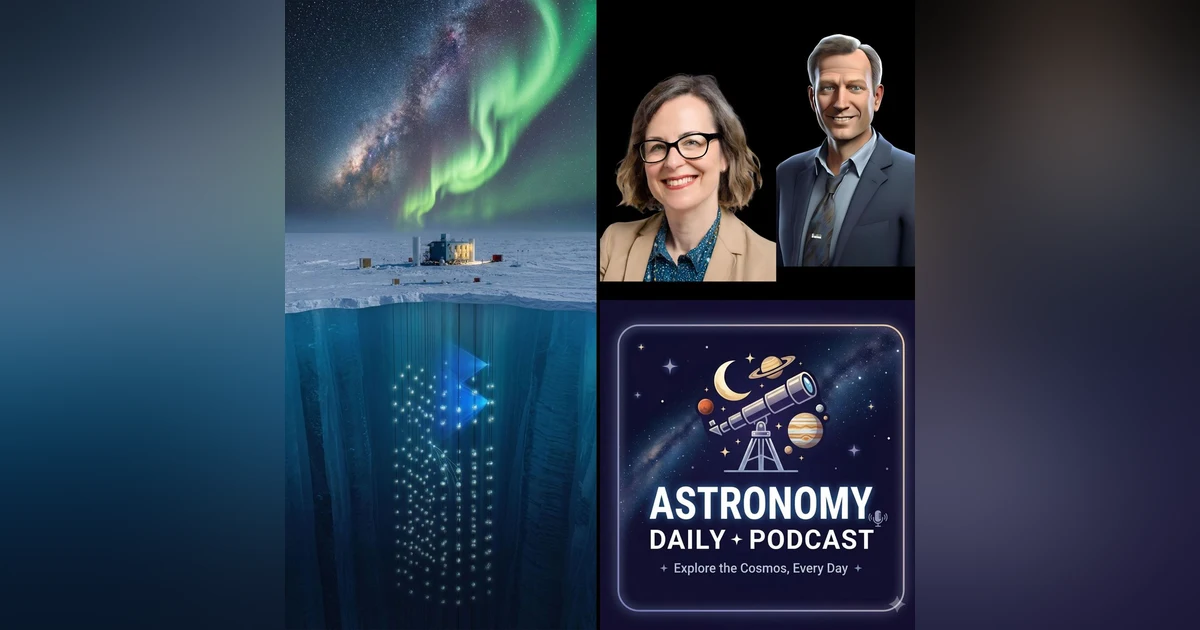
Show notes We're back after a short break! Today: the 2026 Nobel Prize in Physics goes to Francis Halzen for the IceCube Neutrino Observatory — a cubic kilometre of Antarctic ice turned into a telescope. Then a Sydney-led team publishes the most distant fast radio burst yet, from a dwarf galaxy just 3 billion years after the big bang; Hubble's archive yields a possible second-generation planet around a white dwarf; and we catch up on Starship's first orbit, Crew-13, Juice's Earth flyby and the end of the LINK/Swift story. Skywatch: zodiacal light at both ends of the day, Mercury above Venus in southern twilight, and Mars in the Beehive for the north. Segment 1 — LEAD: The Telescope Made of Ice · Nobel Prize in Physics 2026 — nobelprize.org/prizes/physics/2026 (6 Oct 2026) · Royal Swedish Academy of Sciences press release, 6 Oct 2026 · AIP congratulations release, Newswise, 6 Oct 2026 · University of Wisconsin–Madison / IceCube background (via Interesting Engineering, 6 Oct 2026) Segment 2 — The Most Distant Fast Radio Burst · NASA: 'Webb Measures Distance to Farthest Fast Radio Burst, Suggesting Origin', 8 Oct 2026 · Caleb et al., Science, 8 Oct 2026, DOI 10.1126/science.adz2675 · Preprint: arXiv 2508.01648, 3 Aug 2025 (14-month gap disclosed) Segment 3 — A Planet Built From a Dead Star · NASA: 'Suspected Second-generation Planet Solves NASA Hubble Cold Case', 5 Oct 2026 · Williams et al., Nature Astronomy, 5 Oct 2026, DOI 10.1038/s41550-026-02983-7 · ESA/Hubble heic2613; poster, UK White Dwarf meeting, Durham, July 2025 (disclosed) Segment 4 — While We Were Away · SpaceX Starship Flight 14 overview (via leonarddavid.com, 29 Sept 2026) · NASA: 'NASA's SpaceX Crew-13 Launches', 1 Oct 2026 · ESA: 'Successful Earth flyby improves Juice's course to Jupiter', 28–30 Sept 2026 · AP (Marcia Dunn): 'Private spacecraft falls back to Earth...', 25 Sept 2026 · JAXA: MMX launch schedule aboard H3 F10, 20 Aug 2026 Segment 5 — Skywatch: Both Hemispheres · PyEphem 4.2.1 computations, Sydney / Los Angeles / New York / London · BBC Sky at Night: Vesta and Pallas at opposition, Oct 2026 · NASA: What's Up, October 2026
Become a supporter of this podcast: https://www.spreaker.com/podcast/astronomy-daily-latest-space-news--5648921/support.
Sponsor Details:
Ensure your online privacy by using NordVPN. To get our special listener deal and save a lot of money, visit www.astronomydaily.io/nordvpn. You'll be glad you did!
Get the best secure and private email on the planet. Stop your Government, google and who knows who else spying on every email you write. Do what we did and use ProtonMail. They beleive in privacy and there are no ads in their business model...yet they still provide a free forever service. Check them out and get out special deal at www.astronomydaily.io/protonmail
Become a supporter of Astronomy Daily by joining our Supporters Club. Commercial free episodes daily are only a click way... Click Here
This episode includes AI-generated content.
Become a supporter of this podcast: https://www.spreaker.com/podcast/astronomy-daily-latest-space-news--5648921/support.
Sponsor Details:
Ensure your online privacy by using NordVPN. To get our special listener deal and save a lot of money, visit www.astronomydaily.io/nordvpn. You'll be glad you did!
Get the best secure and private email on the planet. Stop your Government, google and who knows who else spying on every email you write. Do what we did and use ProtonMail. They beleive in privacy and there are no ads in their business model...yet they still provide a free forever service. Check them out and get out special deal at www.astronomydaily.io/protonmail
Become a supporter of Astronomy Daily by joining our Supporters Club. Commercial free episodes daily are only a click way... Click Here
This episode includes AI-generated content.
WEBVTT
0
00:00:00.320 --> 00:00:02.800
Anna: Hello and welcome back to Astronomy daily.
1
00:00:02.880 --> 00:00:05.600
It's Friday the 9th of October 2026.
2
00:00:06.000 --> 00:00:08.880
This is series five, episode 201.
3
00:00:08.880 --> 00:00:10.000
And I'm Anna.
4
00:00:10.400 --> 00:00:12.960
Avery: And, um, I'm Avery. It is very good to be
5
00:00:12.960 --> 00:00:15.280
back. We've been off air for a little over
6
00:00:15.280 --> 00:00:17.480
two weeks. Our producer, Huw, needed some
7
00:00:17.480 --> 00:00:19.680
time away for surgery and we're very glad to
8
00:00:19.680 --> 00:00:21.240
report that it went well and he's on the
9
00:00:21.240 --> 00:00:21.680
mend.
10
00:00:21.920 --> 00:00:24.720
Anna: Welcome back, Huw. And to everyone
11
00:00:24.720 --> 00:00:26.920
who wrote in over the past fortnight asking
12
00:00:26.920 --> 00:00:29.910
where we'd got to, thank you. It meant a lot
13
00:00:29.910 --> 00:00:31.550
to know you'd noticed we were gone.
14
00:00:31.710 --> 00:00:34.550
Avery: It really did. And there's plenty to catch up
15
00:00:34.550 --> 00:00:37.430
on today. A Nobel Prize for a
16
00:00:37.430 --> 00:00:39.790
telescope buried two kilometres down in
17
00:00:39.790 --> 00:00:42.430
Antarctic ice. The most distant fast
18
00:00:42.430 --> 00:00:45.069
radio burst ever pinned down. With a Sydney
19
00:00:45.069 --> 00:00:47.790
astronomer leading the paper, and a planet
20
00:00:47.790 --> 00:00:50.310
that may have been built from the ashes of a
21
00:00:50.310 --> 00:00:50.990
dead star.
22
00:00:51.390 --> 00:00:53.990
Anna: Plus everything that happened while we were
23
00:00:53.990 --> 00:00:56.830
away. Starship reaching orbit. Crew
24
00:00:56.830 --> 00:00:59.210
13 at the station. Everything. And the end of
25
00:00:59.210 --> 00:01:01.930
a story you, our listeners, asked us to
26
00:01:01.930 --> 00:01:02.210
follow.
27
00:01:03.010 --> 00:01:03.650
Avery: Let's go.
28
00:01:04.050 --> 00:01:06.890
Anna: On Tuesday, the Royal Swedish Academy of
29
00:01:06.890 --> 00:01:09.810
sciences awarded the 2026 Nobel
30
00:01:09.810 --> 00:01:12.530
Prize in Physics to one person, Frances
31
00:01:12.530 --> 00:01:14.930
Halsen of the University of Wisconsin,
32
00:01:14.930 --> 00:01:17.930
Madison, for decisive contributions to
33
00:01:17.930 --> 00:01:20.730
the IceCube Neutrino Observatory and
34
00:01:20.730 --> 00:01:23.530
the discovery of high energy neutrinos of
35
00:01:23.530 --> 00:01:24.930
astrophysical origin.
36
00:01:25.480 --> 00:01:27.920
Avery: Halsin is 82, born in
37
00:01:27.920 --> 00:01:30.520
Tinan in Belgium. In 1944,
38
00:01:31.160 --> 00:01:33.360
when the call came, he was travelling in
39
00:01:33.360 --> 00:01:36.320
Italy, giving talks. And the instrument
40
00:01:36.320 --> 00:01:38.240
he's being honoured for is one of the
41
00:01:38.240 --> 00:01:41.039
strangest telescopes ever built, because it
42
00:01:41.039 --> 00:01:44.000
has no mirror, no lens, and it sits
43
00:01:44.000 --> 00:01:46.600
at the bottom of the world. The problem?
44
00:01:47.160 --> 00:01:49.000
A messenger that won't stop.
45
00:01:49.560 --> 00:01:51.870
Anna: To see why it matters, start with the
46
00:01:51.870 --> 00:01:54.190
particle. A, uh, neutrino is almost
47
00:01:54.510 --> 00:01:57.190
nothing, nearly massless, no
48
00:01:57.190 --> 00:02:00.150
electric charge, and it barely interacts with
49
00:02:00.150 --> 00:02:03.070
anything. Roughly 65 billion of
50
00:02:03.070 --> 00:02:05.510
them from the sun pass through every square
51
00:02:05.510 --> 00:02:07.990
centimetre of you every second, about the
52
00:02:07.990 --> 00:02:10.750
size of your fingernail. And essentially none
53
00:02:10.750 --> 00:02:12.110
of them notice you're there.
54
00:02:12.590 --> 00:02:14.830
Avery: Which is exactly what makes them valuable.
55
00:02:15.230 --> 00:02:18.200
Light gets absorbed by dust, bent by magnetic
56
00:02:18.200 --> 00:02:20.960
fields, blocked by gas. Charged
57
00:02:20.960 --> 00:02:23.720
cosmic rays get deflected so badly we can't
58
00:02:23.720 --> 00:02:26.160
tell where they came from. A neutrino just
59
00:02:26.160 --> 00:02:28.520
keeps going in a straight line. So if you
60
00:02:28.520 --> 00:02:30.810
catch one, it points straight back at, uh,
61
00:02:30.810 --> 00:02:31.600
whatever made it.
62
00:02:32.080 --> 00:02:34.800
Anna: The catch is the catching. If
63
00:02:34.800 --> 00:02:37.640
almost nothing stops a neutrino, you need an
64
00:02:37.640 --> 00:02:40.560
enormous amount of material and the patience
65
00:02:40.560 --> 00:02:42.840
to wait for the rare one that does hit an
66
00:02:42.840 --> 00:02:45.490
atom. That's the problem. Halsin took on in
67
00:02:45.490 --> 00:02:47.530
1988, his idea
68
00:02:47.530 --> 00:02:50.530
Avery: was to use the ice at the South Pole. Very
69
00:02:50.530 --> 00:02:52.770
occasionally, a, ah, neutrino collides with
70
00:02:52.770 --> 00:02:55.610
an atomic nucleus in the ice and produces
71
00:02:55.610 --> 00:02:58.050
a charged particle that moves faster than
72
00:02:58.050 --> 00:03:00.850
light does in ice. That throws off a faint
73
00:03:00.850 --> 00:03:03.330
cone of blue lightcherenkov light.
74
00:03:03.730 --> 00:03:06.010
The same glow you see in the water around the
75
00:03:06.010 --> 00:03:07.250
nuclear reactor core.
76
00:03:07.730 --> 00:03:09.850
Anna: And the deep Antarctic ice is
77
00:03:09.850 --> 00:03:12.410
extraordinarily clear, dark and
78
00:03:12.410 --> 00:03:14.690
stable. So you drill holes,
79
00:03:15.010 --> 00:03:17.810
lower light sensors on cables, freeze them in
80
00:03:17.970 --> 00:03:20.730
and use a cubic kilometre of glacier as the
81
00:03:20.730 --> 00:03:21.250
detector.
82
00:03:21.730 --> 00:03:23.250
Avery: That's what IceCube is
83
00:03:23.730 --> 00:03:26.610
5,160 sensors
84
00:03:26.770 --> 00:03:29.250
on 86 cables sitting between
85
00:03:29.730 --> 00:03:32.170
1,450 and
86
00:03:32.170 --> 00:03:34.970
2,450 metres down near
87
00:03:34.970 --> 00:03:37.250
the Ahmanson Scott South Pole Station.
88
00:03:38.130 --> 00:03:40.250
It came out of an earlier, smaller experiment
89
00:03:40.250 --> 00:03:42.930
called Amanda, and it was completed in 2011.
90
00:03:43.470 --> 00:03:46.350
Anna: Hm. Here's the Part I. The overwhelming
91
00:03:46.350 --> 00:03:49.110
majority of what IceCube sees isn't cosmic
92
00:03:49.110 --> 00:03:51.830
neutrinos at all. It's particles from
93
00:03:51.830 --> 00:03:54.270
cosmic ray showers in the atmosphere above
94
00:03:54.270 --> 00:03:57.030
Antarcticamore than 100 million a
95
00:03:57.030 --> 00:03:59.910
day. One of the cleanest tricks for rejecting
96
00:03:59.910 --> 00:04:02.790
them is to look down. A particle track
97
00:04:02.790 --> 00:04:05.030
coming up through the Earth can only have
98
00:04:05.030 --> 00:04:07.830
been made by a neutrino, because nothing else
99
00:04:07.830 --> 00:04:08.830
can cross the planet.
100
00:04:09.530 --> 00:04:12.210
Avery: So the telescope at the South Pole uses the
101
00:04:12.210 --> 00:04:14.890
whole Earth as a filter, which means
102
00:04:14.970 --> 00:04:17.610
for that technique, its best view is of the
103
00:04:17.610 --> 00:04:20.010
northern sky, straight through the planet.
104
00:04:20.490 --> 00:04:22.890
The most southerly observatory on Earth
105
00:04:23.130 --> 00:04:24.970
looking north through rock.
106
00:04:25.450 --> 00:04:27.970
Anna: It's worth remembering how unlikely that
107
00:04:27.970 --> 00:04:30.930
sounded in 1988. Nobody had
108
00:04:30.930 --> 00:04:33.170
built a particle detector out of a natural
109
00:04:33.170 --> 00:04:35.810
glacier and the early prototype work in the
110
00:04:35.810 --> 00:04:38.520
ice was slow going. Halsin's own
111
00:04:38.520 --> 00:04:41.080
reaction to Tuesday's call was that it was a
112
00:04:41.080 --> 00:04:43.920
great surprise and he obviously
113
00:04:43.920 --> 00:04:46.440
didn't expect it. After nearly four
114
00:04:46.440 --> 00:04:47.600
decades of pushing the
115
00:04:47.600 --> 00:04:50.320
Avery: idea and the shape of the light tells you
116
00:04:50.320 --> 00:04:52.840
what happened. A neutrino that makes a
117
00:04:52.840 --> 00:04:55.560
muon leaves a long, straight track of light
118
00:04:55.560 --> 00:04:57.800
through the array. That's the one that points
119
00:04:57.800 --> 00:05:00.320
back well to its source. Other
120
00:05:00.320 --> 00:05:02.960
interactions make a roughly spherical flash,
121
00:05:03.290 --> 00:05:06.130
a cascade which measures the energy well, but
122
00:05:06.130 --> 00:05:08.610
the direction only roughly. Different
123
00:05:08.610 --> 00:05:11.570
events, different strengths. An ice cube uses
124
00:05:11.570 --> 00:05:14.450
both. Then there's the question it was
125
00:05:14.450 --> 00:05:16.810
really built for cosmic rays.
126
00:05:17.050 --> 00:05:19.610
Charged particles hitting Earth with enormous
127
00:05:19.610 --> 00:05:22.610
energies were discovered in 1912. And
128
00:05:22.610 --> 00:05:25.130
more than a century later, we still can't say
129
00:05:25.130 --> 00:05:27.210
for sure where the most energetic ones are
130
00:05:27.210 --> 00:05:30.020
accelerated. Wherever cosmic rays are being
131
00:05:30.020 --> 00:05:32.700
sped up and crash into gas or light, they
132
00:05:32.700 --> 00:05:35.420
make neutrinos. So find the neutrino
133
00:05:35.420 --> 00:05:37.340
sources and you've found the particle
134
00:05:37.340 --> 00:05:38.020
accelerators.
135
00:05:38.580 --> 00:05:40.980
Anna: And it worked. By 2013,
136
00:05:41.300 --> 00:05:44.220
two years into full operation, IceCube
137
00:05:44.220 --> 00:05:47.220
had collected 28 high energy events that
138
00:05:47.220 --> 00:05:49.860
couldn't be explained by the atmosphere. The
139
00:05:49.860 --> 00:05:52.300
first evidence of neutrinos from beyond the
140
00:05:52.300 --> 00:05:55.100
solar system. That's the discovery the prize
141
00:05:55.100 --> 00:05:55.620
names.
142
00:05:56.190 --> 00:05:59.030
Avery: Then it started pointing to sources. In
143
00:05:59.030 --> 00:06:01.830
September 2017, a single high
144
00:06:01.830 --> 00:06:04.350
energy neutrino triggered an alert, and
145
00:06:04.350 --> 00:06:06.430
telescopes found a Flaring Blazar
146
00:06:06.750 --> 00:06:08.370
TXS0506
147
00:06:08.730 --> 00:06:11.470
0.56 in the same patch of
148
00:06:11.470 --> 00:06:13.778
sky. In 2022,
149
00:06:13.962 --> 00:06:16.430
IceCube reported neutrinos from the active
150
00:06:16.430 --> 00:06:18.750
galaxy NGC 10, UM68.
151
00:06:19.230 --> 00:06:22.070
And in 2023, it mapped high energy
152
00:06:22.070 --> 00:06:24.310
neutrinos coming from the plane of our own
153
00:06:24.310 --> 00:06:24.990
Milky Way.
154
00:06:25.680 --> 00:06:28.680
Anna: That last one has a southern twist. The
155
00:06:28.680 --> 00:06:31.200
heart of our galaxy sits in the southern sky,
156
00:06:31.360 --> 00:06:33.880
which is exactly the part IceCube's track
157
00:06:33.880 --> 00:06:36.000
method struggles with, because those
158
00:06:36.000 --> 00:06:38.160
neutrinos come down through the ice along
159
00:06:38.160 --> 00:06:41.080
with all the atmospheric junk. The galactic
160
00:06:41.080 --> 00:06:43.480
plane result leaned on the cascade events
161
00:06:43.480 --> 00:06:46.120
instead and on, um, machine learning to pick
162
00:06:46.120 --> 00:06:46.560
them out.
163
00:06:47.040 --> 00:06:50.040
Avery: And NGC 1068 is a nice one
164
00:06:50.040 --> 00:06:52.930
for listeners. It's about 47 million
165
00:06:53.010 --> 00:06:55.330
light years away in Cetus the Whale,
166
00:06:55.730 --> 00:06:58.250
right on the celestial equator, so it can be
167
00:06:58.250 --> 00:07:00.970
found from both hemispheres. And it shares a
168
00:07:00.970 --> 00:07:03.270
constellation with Saturn this month. More,
169
00:07:03.270 --> 00:07:04.450
um, on that in Skywatch.
170
00:07:04.930 --> 00:07:07.290
Anna: Each of those opened a door optical
171
00:07:07.290 --> 00:07:10.250
astronomy can't. Neutrinos come from the
172
00:07:10.250 --> 00:07:13.250
deep interiors of the most violent places.
173
00:07:13.570 --> 00:07:16.530
The core of an active galaxy, the region
174
00:07:16.610 --> 00:07:19.460
close to a black hole, places light can't
175
00:07:19.460 --> 00:07:20.460
escape cleanly.
176
00:07:20.940 --> 00:07:23.900
Avery: Now, one thing we should say plainly, a Nobel
177
00:07:23.900 --> 00:07:25.980
in physics can go to, uh, at most, three
178
00:07:25.980 --> 00:07:28.380
people. And this year it went to one.
179
00:07:29.180 --> 00:07:31.500
IceCube itself is the work of a large
180
00:07:31.500 --> 00:07:34.179
international collaboration, plus the
181
00:07:34.179 --> 00:07:36.420
engineers who drilled it and the winter over
182
00:07:36.420 --> 00:07:38.420
crews who keep it running through the polar
183
00:07:38.420 --> 00:07:40.260
night when it's too cold for aircraft to
184
00:07:40.260 --> 00:07:40.540
land.
185
00:07:41.020 --> 00:07:43.780
Anna: And the committee said so the chair, Mark
186
00:07:43.780 --> 00:07:46.670
Pierce, put it this way. Halsin has
187
00:07:46.670 --> 00:07:49.150
led an international team of researchers and
188
00:07:49.150 --> 00:07:51.630
engineers who have provided us with a
189
00:07:51.630 --> 00:07:54.550
fantastic instrument. The prize is for the
190
00:07:54.550 --> 00:07:56.870
vision and the leadership. The instrument
191
00:07:56.870 --> 00:07:58.270
belongs to a lot of people.
192
00:07:58.750 --> 00:08:01.470
Avery: It also fits a lineage. Raymond
193
00:08:01.470 --> 00:08:04.070
Davis and Masatoshi Koshiba shared a
194
00:08:04.070 --> 00:08:06.950
Nobel in 2002 for catching neutrinos from
195
00:08:06.950 --> 00:08:09.178
the sun and from supernova
196
00:08:09.362 --> 00:08:11.750
1987a, the explosion in the Large
197
00:08:11.750 --> 00:08:13.910
Magellanic Cloud we talked about just a few
198
00:08:13.910 --> 00:08:16.470
weeks ago. Still the only supernova whose
199
00:08:16.470 --> 00:08:18.970
neutrinos we've ever detected. In
200
00:08:18.970 --> 00:08:21.690
2015, it was Takaki Kajita and
201
00:08:21.690 --> 00:08:24.290
Arthur McDonald for showing neutrinos change
202
00:08:24.290 --> 00:08:24.810
flavour.
203
00:08:25.290 --> 00:08:27.370
Anna: The next step is bigger ice.
204
00:08:27.770 --> 00:08:30.770
IceCube Gen 2 is planned at roughly 8 times
205
00:08:30.770 --> 00:08:33.609
the volume, and the field is no longer
206
00:08:33.609 --> 00:08:36.450
only in Antarctica. The KM3 net
207
00:08:36.450 --> 00:08:38.730
detectors on the floor of the Mediterranean
208
00:08:38.890 --> 00:08:41.650
use seawater the same way, and early
209
00:08:41.650 --> 00:08:44.210
last year that collaboration reported the
210
00:08:44.210 --> 00:08:46.570
most energetic neutrino yet seen.
211
00:08:47.360 --> 00:08:50.160
Avery: So from a 1988 proposal that sounded
212
00:08:50.160 --> 00:08:53.040
faintly absurd, let's turn a glacier into
213
00:08:53.040 --> 00:08:55.800
a telescope. We now have neutrino
214
00:08:55.800 --> 00:08:58.480
astronomy as a working branch of the science,
215
00:08:58.880 --> 00:09:01.040
with the southernmost lab on Earth at its
216
00:09:01.040 --> 00:09:01.440
centre.
217
00:09:02.000 --> 00:09:04.760
Anna: Congratulations to Frances Halsin and to
218
00:09:04.760 --> 00:09:07.120
everyone who has ever frozen a sensor into
219
00:09:07.120 --> 00:09:08.240
the ice at the pole.
220
00:09:08.800 --> 00:09:11.400
Avery: Avery from one kind of cosmic
221
00:09:11.400 --> 00:09:13.930
messenger to another In a story led out of
222
00:09:13.930 --> 00:09:16.490
Sydney, astronomers have pinned down the most
223
00:09:16.490 --> 00:09:19.490
distant fast radio burst yet seen, and
224
00:09:19.490 --> 00:09:21.330
the paper was published on Thursday in the
225
00:09:21.330 --> 00:09:24.010
journal Science, led by Manisha Kaleb of the
226
00:09:24.010 --> 00:09:25.050
University of Sydney.
227
00:09:25.450 --> 00:09:28.210
Anna: Quick refresher Fast radio bursts are
228
00:09:28.210 --> 00:09:30.930
flashes of radio emission lasting about a
229
00:09:30.930 --> 00:09:33.770
millisecond from far outside our galaxy.
230
00:09:34.250 --> 00:09:37.210
The first was found in 2007 in archival
231
00:09:37.210 --> 00:09:39.980
data from Parkes Moraing in New
232
00:09:39.980 --> 00:09:42.340
South Wales, and we still don't know for
233
00:09:42.340 --> 00:09:43.580
certain what makes them.
234
00:09:44.060 --> 00:09:46.480
Avery: This one, FRB2024O3
235
00:09:46.840 --> 00:09:49.540
04B, was caught on
236
00:09:49.540 --> 00:09:52.220
4th March 2024 by the Meer
237
00:09:52.220 --> 00:09:55.020
TRAP system on the Meerkat radio telescope in
238
00:09:55.020 --> 00:09:57.540
South Africa. The radio signal
239
00:09:57.540 --> 00:10:00.500
suggested it was extremely far away. The
240
00:10:00.500 --> 00:10:02.740
problem was that the world's largest ground
241
00:10:02.740 --> 00:10:05.740
based telescopes could see no galaxy at all
242
00:10:05.740 --> 00:10:07.100
at that precise spot.
243
00:10:07.690 --> 00:10:10.250
Anna: How can a radio flash tell you its distance?
244
00:10:10.730 --> 00:10:12.850
As, uh, the burst crosses space, free
245
00:10:12.850 --> 00:10:15.130
electrons slow the longer wavelength
246
00:10:15.130 --> 00:10:18.010
slightly, so the low frequencies arrive a
247
00:10:18.010 --> 00:10:20.810
fraction of a second late. That delay,
248
00:10:20.890 --> 00:10:23.409
the dispersion measure, grows with the amount
249
00:10:23.409 --> 00:10:25.610
of gas crossed. So with distance,
250
00:10:26.330 --> 00:10:28.130
the link between the two is called the
251
00:10:28.130 --> 00:10:30.730
McQuart relation, after JP McQuart of
252
00:10:30.730 --> 00:10:33.690
ICRAR Curtin, whose team pinned it
253
00:10:33.690 --> 00:10:36.090
down with Australia's ASCAP in 2020.
254
00:10:37.000 --> 00:10:39.400
This burst's dispersion measure was huge,
255
00:10:39.560 --> 00:10:42.480
around 2,300, which is why the team
256
00:10:42.480 --> 00:10:45.360
expected it to be so far away. So the
257
00:10:45.360 --> 00:10:47.000
team turned to the James Webb Space
258
00:10:47.000 --> 00:10:49.560
Telescope. Webb's camera found a faint
259
00:10:49.560 --> 00:10:52.360
galaxy in exactly the right place, and its
260
00:10:52.360 --> 00:10:54.200
spectrograph measured a redshift of
261
00:10:54.200 --> 00:10:57.200
2.148 light. That left when the
262
00:10:57.200 --> 00:10:59.320
universe was about 3 billion years old.
263
00:10:59.800 --> 00:11:02.610
Avery: And the host was a surprise. Most
264
00:11:02.610 --> 00:11:05.410
fast radio burst hosts are big star forming
265
00:11:05.410 --> 00:11:07.930
galaxies. This one is a small dwarf
266
00:11:07.930 --> 00:11:10.730
galaxy about a thousand times less massive
267
00:11:10.730 --> 00:11:13.730
than expected, forming stars hard with
268
00:11:13.730 --> 00:11:15.810
most of its stars perhaps made within about
269
00:11:15.810 --> 00:11:16.930
30 million years.
270
00:11:17.729 --> 00:11:20.530
Anna: That matters for the origin. One idea
271
00:11:20.530 --> 00:11:22.930
is that bursts come from merging neutron
272
00:11:22.930 --> 00:11:25.290
stars, but that takes billions of years to
273
00:11:25.290 --> 00:11:28.290
happen. Another is a young intensely
274
00:11:28.290 --> 00:11:31.180
magnetic neutron star, a magnetar, which
275
00:11:31.180 --> 00:11:34.060
can form fast. A young host fits the
276
00:11:34.060 --> 00:11:36.540
magnetar picture and Caleb says the team
277
00:11:36.540 --> 00:11:39.020
thinks a uh, merger origin for this burst is
278
00:11:39.020 --> 00:11:40.020
very unlikely.
279
00:11:40.500 --> 00:11:43.220
Avery: There's a bonus. A burst like this
280
00:11:43.220 --> 00:11:45.860
is a flashlight shining through everything
281
00:11:46.100 --> 00:11:48.820
between it and us. Its signal
282
00:11:48.820 --> 00:11:51.660
carries the imprints of a previously unknown
283
00:11:51.660 --> 00:11:54.420
galaxy cluster about three and a half
284
00:11:54.420 --> 00:11:57.290
billion light years away and of the
285
00:11:57.290 --> 00:11:58.690
nearby Virgo cluster.
286
00:11:59.170 --> 00:12:01.930
Anna: One thing to be clear about this is the peer
287
00:12:01.930 --> 00:12:04.490
reviewed version of a result first posted as
288
00:12:04.490 --> 00:12:07.170
a preprint in August last year and the record
289
00:12:07.170 --> 00:12:09.970
distance was reported then. What's new this
290
00:12:09.970 --> 00:12:12.530
week is publication in Science after review
291
00:12:12.930 --> 00:12:15.810
along with NASA's release. It's one burst
292
00:12:16.050 --> 00:12:18.290
and one burst doesn't settle the origin
293
00:12:18.290 --> 00:12:19.250
question for the whole
294
00:12:19.250 --> 00:12:21.810
Avery: population, but the team estimates
295
00:12:21.810 --> 00:12:24.210
meerkat could catch several bursts a year
296
00:12:24.210 --> 00:12:25.810
from beyond redshift 1.
297
00:12:26.670 --> 00:12:29.310
Meerkat is a precursor to the SKA
298
00:12:29.550 --> 00:12:32.070
and its low frequency sibling is going up in
299
00:12:32.070 --> 00:12:34.670
Western Australia. Expect more of these
300
00:12:35.310 --> 00:12:35.710
next.
301
00:12:35.950 --> 00:12:38.870
Anna: A cold case from the Hubble archive in
302
00:12:38.870 --> 00:12:41.510
1999 Hubble took an ultraviolet
303
00:12:41.510 --> 00:12:43.550
spectrum of a white dwarf called
304
00:12:43.550 --> 00:12:47.470
HS02090832
305
00:12:47.870 --> 00:12:50.030
about 270 light years away.
306
00:12:50.910 --> 00:12:53.910
It contained roughly 100 absorption features
307
00:12:53.910 --> 00:12:55.070
nobody could identify.
308
00:12:55.730 --> 00:12:58.050
Avery: Jamie Williams, a doctoral candidate at the
309
00:12:58.050 --> 00:13:00.050
University of Warwick, went back to that
310
00:13:00.050 --> 00:13:02.770
spectrum with an updated atomic database and
311
00:13:02.770 --> 00:13:04.810
found that many of the mystery lines matched
312
00:13:04.810 --> 00:13:07.490
niobium, an element never before seen in a
313
00:13:07.490 --> 00:13:09.810
white dwarf. The paper was published on
314
00:13:09.810 --> 00:13:11.330
Monday in Nature Astronomy.
315
00:13:11.890 --> 00:13:14.690
Anna: Why is niobium a clue? Elements
316
00:13:14.690 --> 00:13:17.370
heavier than iron mostly aren't forged in a
317
00:13:17.370 --> 00:13:20.210
star's core. Niobium is made in the
318
00:13:20.210 --> 00:13:22.970
late swollen stage of a dying sun like
319
00:13:22.970 --> 00:13:25.850
star and then expelled. And this star's
320
00:13:25.850 --> 00:13:28.450
surface is also rich in zinc and copper,
321
00:13:28.610 --> 00:13:30.850
while it's nearly bare of the silicon and
322
00:13:30.850 --> 00:13:33.410
iron you'd expect from an ordinary rocky
323
00:13:33.410 --> 00:13:33.810
planet.
324
00:13:33.810 --> 00:13:36.690
Avery: Falling in that contrast is the
325
00:13:36.690 --> 00:13:39.690
point astronomers have found plenty of so
326
00:13:39.690 --> 00:13:42.490
called polluted white dwarfs. Stars whose
327
00:13:42.490 --> 00:13:45.250
surfaces are dusted with the remains of rocky
328
00:13:45.250 --> 00:13:47.570
asteroids and planets from the original
329
00:13:47.570 --> 00:13:50.130
system. First generation debris with
330
00:13:50.130 --> 00:13:52.980
silicon and iron in it. This one's
331
00:13:52.980 --> 00:13:54.940
surface chemistry looks nothing like that.
332
00:13:55.420 --> 00:13:58.420
Anna: Then there's tess. Over four months it
333
00:13:58.420 --> 00:14:00.740
saw ah, the white dwarf's brightness wobble
334
00:14:00.740 --> 00:14:03.500
on a cycle of about 4.4 days.
335
00:14:03.980 --> 00:14:06.740
The team reads that as a Jupiter sized
336
00:14:06.740 --> 00:14:09.700
planet orbiting about 6 million kilometres
337
00:14:09.700 --> 00:14:12.700
out far closer than Mercury is to the Sun.
338
00:14:13.100 --> 00:14:15.300
Avery: Put it together. And the proposal is
339
00:14:15.300 --> 00:14:18.020
remarkable. The planet didn't survive from
340
00:14:18.020 --> 00:14:20.940
the system's birth. It formed afterwards out
341
00:14:20.940 --> 00:14:23.780
of material the star shed as it died. A
342
00:14:23.780 --> 00:14:26.500
second generation planet, the white
343
00:14:26.500 --> 00:14:29.060
dwarf, is still around 35,000 degrees.
344
00:14:29.540 --> 00:14:31.780
So it's stripping that planet's atmosphere.
345
00:14:31.860 --> 00:14:34.620
And the niobium rich gas is raining back
346
00:14:34.620 --> 00:14:36.900
down onto the star where Hubble saw it.
347
00:14:37.460 --> 00:14:39.940
Anna: If that sounds familiar, it's the flip side
348
00:14:39.940 --> 00:14:42.860
of a story we ran last month. Bataygin and
349
00:14:42.860 --> 00:14:45.020
colleagues arguing that when a star like the
350
00:14:45.020 --> 00:14:47.840
sun becomes a white dwarf, it its planets get
351
00:14:47.840 --> 00:14:50.760
scattered. This suggests a star's death can
352
00:14:50.760 --> 00:14:53.560
also build something new. Three
353
00:14:53.560 --> 00:14:55.920
caveats and the team states them itself.
354
00:14:56.640 --> 00:14:59.160
First, Williams says plainly it is not a
355
00:14:59.160 --> 00:15:01.320
confirmed planet. The test signal is
356
00:15:01.320 --> 00:15:03.880
indirect. Second, keeping the
357
00:15:03.880 --> 00:15:06.200
ejected material close enough to form a
358
00:15:06.200 --> 00:15:08.720
planet probably needs a companion star to
359
00:15:08.720 --> 00:15:11.560
pull it back. Third, this work was
360
00:15:11.560 --> 00:15:13.480
first presented as a conference poster in
361
00:15:13.480 --> 00:15:16.120
July last year. This week's news is the peer
362
00:15:16.120 --> 00:15:16.880
reviewed paper.
363
00:15:17.360 --> 00:15:19.600
Avery: Williams plans to use Hubble over the next
364
00:15:19.600 --> 00:15:21.480
several years to find out whether planets
365
00:15:21.480 --> 00:15:24.400
like this are rare or common. Either
366
00:15:24.400 --> 00:15:27.320
way, a 27 year old spectrum just told us
367
00:15:27.320 --> 00:15:30.320
something new. Now, while we were away,
368
00:15:30.720 --> 00:15:32.720
four stories we'd been following came to a
369
00:15:32.720 --> 00:15:34.560
head. So here's to catch up.
370
00:15:35.040 --> 00:15:38.040
Anna: First Starship Flight 14 launched from
371
00:15:38.040 --> 00:15:40.890
Starbase on 28 September late that
372
00:15:40.890 --> 00:15:43.290
evening in eastern Australia and became the
373
00:15:43.290 --> 00:15:45.890
first starship to reach orbit. It deployed
374
00:15:45.890 --> 00:15:48.770
26 of the larger Starlink V3 satellites,
375
00:15:48.770 --> 00:15:50.610
the first ever delivered to orbit by
376
00:15:50.610 --> 00:15:53.530
starship. It wasn't clean. One booster
377
00:15:53.530 --> 00:15:55.570
engine shut down on the way up and so did one
378
00:15:55.570 --> 00:15:57.970
of the ship's vacuum engines. The ship still
379
00:15:57.970 --> 00:16:00.010
had enough to fire one sea level engine and
380
00:16:00.010 --> 00:16:02.850
insert itself into orbit. But in SpaceX's
381
00:16:02.850 --> 00:16:04.930
words, out of an abundance of caution,
382
00:16:05.250 --> 00:16:07.570
controllers cut the planned roughly 10 hour
383
00:16:07.570 --> 00:16:10.260
mission short, fired the first ever Starship
384
00:16:10.260 --> 00:16:12.820
deorbit burn after about two orbits and
385
00:16:12.820 --> 00:16:14.660
brought it down in the northern Pacific a
386
00:16:14.660 --> 00:16:17.020
little over three hours after launch. Not off
387
00:16:17.020 --> 00:16:19.980
Chile as we previewed. So orbit achieved
388
00:16:19.980 --> 00:16:22.700
payload delivered and an engine reliability
389
00:16:22.700 --> 00:16:24.380
question to answer before flight 15.
390
00:16:25.100 --> 00:16:28.020
Avery: Second crew um, 13 after the
391
00:16:28.020 --> 00:16:29.900
oxidizer leak that uh, grounded it in
392
00:16:29.900 --> 00:16:32.300
September. Crew 13 launched on Thursday
393
00:16:32.380 --> 00:16:35.380
1 October from Cape Canaveral aboard the
394
00:16:35.380 --> 00:16:37.910
Dragon Grace and docked with the station the
395
00:16:37.910 --> 00:16:40.590
same evening. Commander Jessica Watkins
396
00:16:40.590 --> 00:16:43.230
became the first NASA astronaut to fly Dragon
397
00:16:43.230 --> 00:16:46.030
twice with Luke Delaney, Canada's
398
00:16:46.030 --> 00:16:48.470
Joshua Kutryk and Russia's Sergei
399
00:16:48.470 --> 00:16:49.230
Tetericio.
400
00:16:49.710 --> 00:16:52.670
Anna: Third juice ESA's Jupiter
401
00:16:52.670 --> 00:16:54.230
mission swung past at
402
00:16:54.230 --> 00:16:57.030
8,640 kilometres over the
403
00:16:57.030 --> 00:16:59.776
Indian Ocean on the 28th, gaining 3
404
00:16:59.844 --> 00:17:02.430
1/2 kilometres per second and bending its
405
00:17:02.430 --> 00:17:05.430
path by about 20 degrees. Its monitoring
406
00:17:05.430 --> 00:17:07.190
cameras sent back views of Africa,
407
00:17:07.830 --> 00:17:10.630
Madagascar and the moon. The high
408
00:17:10.630 --> 00:17:12.670
resolution science camera images are still
409
00:17:12.670 --> 00:17:15.470
being processed. One more Earth Flyby
410
00:17:15.470 --> 00:17:18.270
comes in January 2029, then Jupiter
411
00:17:18.270 --> 00:17:19.350
in 2031.
412
00:17:19.670 --> 00:17:22.270
Avery: ESA says flying through the tail of Earth's
413
00:17:22.270 --> 00:17:24.870
magnetic field was a useful dress rehearsal.
414
00:17:25.030 --> 00:17:27.750
Juice has 35 flybys of Ganymede,
415
00:17:27.750 --> 00:17:30.030
Europa and Callisto ahead of it once it
416
00:17:30.030 --> 00:17:32.880
arrives. And fourth, the one you asked
417
00:17:32.880 --> 00:17:35.400
us to follow. The Link spacecraft sent to
418
00:17:35.400 --> 00:17:37.920
boost NASA's ageing Swift observatory re
419
00:17:37.920 --> 00:17:40.320
entered the atmosphere on 25 September
420
00:17:40.800 --> 00:17:42.720
after losing two of its three reaction
421
00:17:42.720 --> 00:17:44.920
wheels. It never had the fuel to attempt to
422
00:17:44.920 --> 00:17:47.800
capture, but its team did fly it to within 12
423
00:17:47.800 --> 00:17:50.440
to 15 kilometres of swift and practised
424
00:17:50.440 --> 00:17:53.360
moving its robot arms. NASA paid Catalyst $30
425
00:17:53.360 --> 00:17:55.720
million for the attempt and the spacecraft
426
00:17:55.720 --> 00:17:58.200
was built in under a year. Swift itself
427
00:17:58.200 --> 00:18:00.520
launched in 2004 and has spent more than two
428
00:18:00.520 --> 00:18:02.640
decades catching gamma ray bursts within
429
00:18:02.640 --> 00:18:04.800
seconds and swinging around to look at them.
430
00:18:05.120 --> 00:18:07.480
Work that made it a first responder for half
431
00:18:07.480 --> 00:18:08.800
the observatories on Earth.
432
00:18:09.120 --> 00:18:11.800
Anna: Swift is expected to follow it down in early
433
00:18:11.800 --> 00:18:14.440
November. Until then, it's back
434
00:18:14.440 --> 00:18:17.400
observing a gamma ray lookout working through
435
00:18:17.400 --> 00:18:19.960
its final weeks. Thank you to everyone who
436
00:18:19.960 --> 00:18:22.280
wrote in about this one. We'll mark Swift's
437
00:18:22.280 --> 00:18:23.120
end when it comes
438
00:18:23.800 --> 00:18:26.760
Avery: and one to watch. Japan's MMX mission,
439
00:18:26.840 --> 00:18:29.120
aiming to bring back the first samples ever
440
00:18:29.120 --> 00:18:31.840
from a moon of Mars, is set to launch on an
441
00:18:31.840 --> 00:18:34.240
H3 rocket from Tanegashima at
442
00:18:34.240 --> 00:18:37.016
06:41 on the morning of Tuesday 20th
443
00:18:37.144 --> 00:18:40.080
October Sydney time. That's the afternoon
444
00:18:40.080 --> 00:18:42.760
of Monday the 19th on the US east coast.
445
00:18:43.240 --> 00:18:46.080
Anna: Time for the sky and it's a good weekend for
446
00:18:46.080 --> 00:18:49.080
it. New moon arrives at 15:50
447
00:18:49.240 --> 00:18:51.970
Universal Time on Saturday. That's
448
00:18:51.970 --> 00:18:54.570
Saturday in the Americas and Europe, but
449
00:18:54.650 --> 00:18:56.970
2:50 on Sunday morning in Sydney.
450
00:18:57.450 --> 00:19:00.250
Either way, the next several evenings are
451
00:19:00.250 --> 00:19:03.250
Avery: properly dark, which makes it prime time
452
00:19:03.250 --> 00:19:06.210
for the zodiacal light. A faint cone
453
00:19:06.210 --> 00:19:08.690
of sunlight scattered off dust in the plane
454
00:19:08.690 --> 00:19:11.490
of the planets. The trick is the
455
00:19:11.490 --> 00:19:14.050
angle of that plane to your horizon. And
456
00:19:14.050 --> 00:19:16.050
right now the two hemispheres get
457
00:19:16.050 --> 00:19:18.620
Anna: opposite ends of the day. From Sydney,
458
00:19:18.780 --> 00:19:21.260
after astronomical Twilight ends around
459
00:19:21.260 --> 00:19:23.820
8:30 in the evening, the ecliptic
460
00:19:23.820 --> 00:19:26.500
stands about 75 degrees from the
461
00:19:26.500 --> 00:19:28.940
western horizon, nearly upright.
462
00:19:29.580 --> 00:19:32.540
Look west from a dark site for a tilted,
463
00:19:32.540 --> 00:19:35.260
tapering glow. A false dusk
464
00:19:36.140 --> 00:19:39.060
from Los Angeles. At the same stage it's
465
00:19:39.060 --> 00:19:41.420
about 38 degrees from New York,
466
00:19:41.500 --> 00:19:44.460
32 from London, only 23.
467
00:19:45.220 --> 00:19:47.660
So in the evening the north mostly misses
468
00:19:47.660 --> 00:19:47.940
out.
469
00:19:48.420 --> 00:19:51.300
Avery: But in the morning, it flips before
470
00:19:51.380 --> 00:19:54.340
astronomical dawn around half past five in
471
00:19:54.340 --> 00:19:56.740
Los Angeles and, uh, New York. The ecliptic
472
00:19:56.740 --> 00:19:59.340
stands about 79 degrees from the eastern
473
00:19:59.340 --> 00:20:02.260
horizon in LA, 73 in New York,
474
00:20:02.580 --> 00:20:05.500
62 in London. That's your false dawn.
475
00:20:05.500 --> 00:20:08.300
In the east from Sydney, it's only 33
476
00:20:08.300 --> 00:20:09.220
degrees in the morning.
477
00:20:09.780 --> 00:20:12.740
Anna: Same geometry as the steep evening Venus
478
00:20:12.740 --> 00:20:15.580
we described last month. It's all about how
479
00:20:15.580 --> 00:20:18.220
the plane of the planets meets your horizon.
480
00:20:19.100 --> 00:20:22.060
One practical note, for Australians, daylight
481
00:20:22.060 --> 00:20:24.620
saving began last Sunday in New South Wales,
482
00:20:24.940 --> 00:20:26.380
Victoria, the act,
483
00:20:27.020 --> 00:20:29.180
Tasmania and South Australia.
484
00:20:29.740 --> 00:20:32.540
So all our Sydney times are now daylight
485
00:20:32.540 --> 00:20:35.420
time. Southern listeners also get a rare
486
00:20:35.420 --> 00:20:38.180
twilight treat. Mercury is near its
487
00:20:38.180 --> 00:20:40.900
greatest distance from the sun, magnitude 0,
488
00:20:41.060 --> 00:20:43.620
sitting 24 degrees up at sunset from
489
00:20:43.620 --> 00:20:46.380
Sydney. Actually higher than Venus, which is
490
00:20:46.380 --> 00:20:48.540
22 degrees up at magnitude
491
00:20:48.540 --> 00:20:51.420
-4.3 and sets almost two hours
492
00:20:51.420 --> 00:20:53.620
after the sun from the north.
493
00:20:53.860 --> 00:20:56.500
Avery: Sorry. At Sunset,
494
00:20:56.500 --> 00:20:59.460
Venus is 4 degrees up in Los Angeles, under
495
00:20:59.460 --> 00:21:02.140
2 in New York and already below the
496
00:21:02.140 --> 00:21:05.100
horizon in London. And Venus is now
497
00:21:05.100 --> 00:21:08.020
sliding quickly towards the sun. So southern
498
00:21:08.020 --> 00:21:09.780
viewers catch it this week.
499
00:21:10.340 --> 00:21:12.540
Anna: And because both planets are close to the
500
00:21:12.540 --> 00:21:15.300
Sun, a safety line we never skip.
501
00:21:15.700 --> 00:21:17.620
Never look at the sun with your eyes,
502
00:21:17.700 --> 00:21:20.580
binoculars or a telescope. And never
503
00:21:20.580 --> 00:21:23.300
sweep binoculars across the western sky until
504
00:21:23.300 --> 00:21:26.260
the sun is fully down. Any solar viewer
505
00:21:26.260 --> 00:21:27.620
must meet the ISO
506
00:21:27.620 --> 00:21:30.260
123122 standard
507
00:21:30.500 --> 00:21:32.700
and a filter goes over the front of any
508
00:21:32.700 --> 00:21:34.930
optics, never at the eyepiece.
509
00:21:35.490 --> 00:21:38.130
Avery: Northern listeners, your reward is before
510
00:21:38.130 --> 00:21:40.970
dawn. Mars is passing through the Beehive
511
00:21:40.970 --> 00:21:43.770
Star cluster, closest little more than a
512
00:21:43.770 --> 00:21:46.650
tenth of a degree on the 11th Universal
513
00:21:46.650 --> 00:21:49.090
Time and within half a degree either side.
514
00:21:49.490 --> 00:21:52.210
Binoculars make it lovely. At
515
00:21:52.210 --> 00:21:55.210
nautical dawn on Monday, Mars is about 57
516
00:21:55.210 --> 00:21:57.810
degrees up from LA 55 from New York,
517
00:21:58.050 --> 00:22:00.800
49 from London against 23 from
518
00:22:00.800 --> 00:22:03.480
Sydney. Jupiter is nearby,
519
00:22:03.640 --> 00:22:06.560
15 degrees away and closing. The two will
520
00:22:06.560 --> 00:22:09.240
be just over a degree apart in mid November.
521
00:22:09.640 --> 00:22:11.960
Anna: Southern predawn watchers can see the pair
522
00:22:11.960 --> 00:22:14.960
too, just lower. Mars about 23
523
00:22:14.960 --> 00:22:17.640
degrees up at nautical dawn from Sydney and
524
00:22:17.640 --> 00:22:20.640
Jupiter 17. Mars is at magnitude
525
00:22:20.640 --> 00:22:23.560
plus 1.1 and Jupiter at minus
526
00:22:23.560 --> 00:22:26.480
1.8, so the colour contrast is easy
527
00:22:26.480 --> 00:22:27.720
even in a bright sky.
528
00:22:28.230 --> 00:22:30.590
Avery: Saturn, just past opposition, is
529
00:22:30.590 --> 00:22:33.430
magnitude 0.35 and, um, well
530
00:22:33.430 --> 00:22:36.310
placed for everyone. Highest around half past
531
00:22:36.310 --> 00:22:39.230
midnight local time. 54 degrees up from
532
00:22:39.230 --> 00:22:42.110
Sydney, 58 from LA 51 from
533
00:22:42.110 --> 00:22:44.910
New York, 40 from London. The
534
00:22:44.910 --> 00:22:47.830
rings are tilted only about 7 degrees, so
535
00:22:47.830 --> 00:22:49.190
they look unusually, um, thin.
536
00:22:49.590 --> 00:22:52.310
Anna: While you're with Saturn, remember NGC
537
00:22:52.310 --> 00:22:54.940
1068. From the lead, the neutrino
538
00:22:54.940 --> 00:22:57.740
galaxy is in Cetus II. A, uh, small telescope
539
00:22:57.740 --> 00:23:00.740
target near the star Delta Ceti. Asteroid
540
00:23:00.740 --> 00:23:03.180
Vesta also reaches opposition on Tuesday the
541
00:23:03.180 --> 00:23:06.100
13th in Cetus within reach of binoculars.
542
00:23:06.340 --> 00:23:08.940
And the Orionid meteor shower peaks on the
543
00:23:08.940 --> 00:23:11.940
night of the 21st into the 22nd. There will
544
00:23:11.940 --> 00:23:14.540
be a fat waxing moon early in the night, so
545
00:23:14.540 --> 00:23:16.620
the hours before dawn are best from both
546
00:23:16.620 --> 00:23:19.020
hemispheres. The Orionids are dust from
547
00:23:19.020 --> 00:23:21.500
Hallie's comet, so it's a chance to catch a
548
00:23:21.500 --> 00:23:24.340
little of Hallie ahead of its return in 2061.
549
00:23:25.050 --> 00:23:27.340
Avery: Um, and that's the show. Thank you for your
550
00:23:27.340 --> 00:23:29.660
patience over the past couple of weeks. It's
551
00:23:29.660 --> 00:23:32.220
good to be back. A Nobel for a
552
00:23:32.220 --> 00:23:34.940
telescope made of ice, the most distant
553
00:23:34.940 --> 00:23:37.900
fast radio burst, a planet that may have been
554
00:23:37.900 --> 00:23:40.779
built from a dying star, and a lot of
555
00:23:40.779 --> 00:23:43.140
catching up. Get WOL soon, Huw.
556
00:23:43.540 --> 00:23:46.100
And as ever, the credit for this show belongs
557
00:23:46.100 --> 00:23:48.540
to the whole team behind it. If you've got a
558
00:23:48.540 --> 00:23:50.340
question you'd like us to chase the way you
559
00:23:50.340 --> 00:23:52.580
did with Link and Swift, use the contact
560
00:23:52.580 --> 00:23:55.480
form@astronomydaily.IO you'll
561
00:23:55.480 --> 00:23:58.440
find us on socials. Astrodaily pod and
562
00:23:58.440 --> 00:24:00.000
the show notes have every source.
563
00:24:00.240 --> 00:24:01.200
Anna: I'm Anna.
564
00:24:01.520 --> 00:24:03.840
Avery: And I'm Avery. Clear Skies.
0
00:00:00.320 --> 00:00:02.800
Anna: Hello and welcome back to Astronomy daily.
1
00:00:02.880 --> 00:00:05.600
It's Friday the 9th of October 2026.
2
00:00:06.000 --> 00:00:08.880
This is series five, episode 201.
3
00:00:08.880 --> 00:00:10.000
And I'm Anna.
4
00:00:10.400 --> 00:00:12.960
Avery: And, um, I'm Avery. It is very good to be
5
00:00:12.960 --> 00:00:15.280
back. We've been off air for a little over
6
00:00:15.280 --> 00:00:17.480
two weeks. Our producer, Huw, needed some
7
00:00:17.480 --> 00:00:19.680
time away for surgery and we're very glad to
8
00:00:19.680 --> 00:00:21.240
report that it went well and he's on the
9
00:00:21.240 --> 00:00:21.680
mend.
10
00:00:21.920 --> 00:00:24.720
Anna: Welcome back, Huw. And to everyone
11
00:00:24.720 --> 00:00:26.920
who wrote in over the past fortnight asking
12
00:00:26.920 --> 00:00:29.910
where we'd got to, thank you. It meant a lot
13
00:00:29.910 --> 00:00:31.550
to know you'd noticed we were gone.
14
00:00:31.710 --> 00:00:34.550
Avery: It really did. And there's plenty to catch up
15
00:00:34.550 --> 00:00:37.430
on today. A Nobel Prize for a
16
00:00:37.430 --> 00:00:39.790
telescope buried two kilometres down in
17
00:00:39.790 --> 00:00:42.430
Antarctic ice. The most distant fast
18
00:00:42.430 --> 00:00:45.069
radio burst ever pinned down. With a Sydney
19
00:00:45.069 --> 00:00:47.790
astronomer leading the paper, and a planet
20
00:00:47.790 --> 00:00:50.310
that may have been built from the ashes of a
21
00:00:50.310 --> 00:00:50.990
dead star.
22
00:00:51.390 --> 00:00:53.990
Anna: Plus everything that happened while we were
23
00:00:53.990 --> 00:00:56.830
away. Starship reaching orbit. Crew
24
00:00:56.830 --> 00:00:59.210
13 at the station. Everything. And the end of
25
00:00:59.210 --> 00:01:01.930
a story you, our listeners, asked us to
26
00:01:01.930 --> 00:01:02.210
follow.
27
00:01:03.010 --> 00:01:03.650
Avery: Let's go.
28
00:01:04.050 --> 00:01:06.890
Anna: On Tuesday, the Royal Swedish Academy of
29
00:01:06.890 --> 00:01:09.810
sciences awarded the 2026 Nobel
30
00:01:09.810 --> 00:01:12.530
Prize in Physics to one person, Frances
31
00:01:12.530 --> 00:01:14.930
Halsen of the University of Wisconsin,
32
00:01:14.930 --> 00:01:17.930
Madison, for decisive contributions to
33
00:01:17.930 --> 00:01:20.730
the IceCube Neutrino Observatory and
34
00:01:20.730 --> 00:01:23.530
the discovery of high energy neutrinos of
35
00:01:23.530 --> 00:01:24.930
astrophysical origin.
36
00:01:25.480 --> 00:01:27.920
Avery: Halsin is 82, born in
37
00:01:27.920 --> 00:01:30.520
Tinan in Belgium. In 1944,
38
00:01:31.160 --> 00:01:33.360
when the call came, he was travelling in
39
00:01:33.360 --> 00:01:36.320
Italy, giving talks. And the instrument
40
00:01:36.320 --> 00:01:38.240
he's being honoured for is one of the
41
00:01:38.240 --> 00:01:41.039
strangest telescopes ever built, because it
42
00:01:41.039 --> 00:01:44.000
has no mirror, no lens, and it sits
43
00:01:44.000 --> 00:01:46.600
at the bottom of the world. The problem?
44
00:01:47.160 --> 00:01:49.000
A messenger that won't stop.
45
00:01:49.560 --> 00:01:51.870
Anna: To see why it matters, start with the
46
00:01:51.870 --> 00:01:54.190
particle. A, uh, neutrino is almost
47
00:01:54.510 --> 00:01:57.190
nothing, nearly massless, no
48
00:01:57.190 --> 00:02:00.150
electric charge, and it barely interacts with
49
00:02:00.150 --> 00:02:03.070
anything. Roughly 65 billion of
50
00:02:03.070 --> 00:02:05.510
them from the sun pass through every square
51
00:02:05.510 --> 00:02:07.990
centimetre of you every second, about the
52
00:02:07.990 --> 00:02:10.750
size of your fingernail. And essentially none
53
00:02:10.750 --> 00:02:12.110
of them notice you're there.
54
00:02:12.590 --> 00:02:14.830
Avery: Which is exactly what makes them valuable.
55
00:02:15.230 --> 00:02:18.200
Light gets absorbed by dust, bent by magnetic
56
00:02:18.200 --> 00:02:20.960
fields, blocked by gas. Charged
57
00:02:20.960 --> 00:02:23.720
cosmic rays get deflected so badly we can't
58
00:02:23.720 --> 00:02:26.160
tell where they came from. A neutrino just
59
00:02:26.160 --> 00:02:28.520
keeps going in a straight line. So if you
60
00:02:28.520 --> 00:02:30.810
catch one, it points straight back at, uh,
61
00:02:30.810 --> 00:02:31.600
whatever made it.
62
00:02:32.080 --> 00:02:34.800
Anna: The catch is the catching. If
63
00:02:34.800 --> 00:02:37.640
almost nothing stops a neutrino, you need an
64
00:02:37.640 --> 00:02:40.560
enormous amount of material and the patience
65
00:02:40.560 --> 00:02:42.840
to wait for the rare one that does hit an
66
00:02:42.840 --> 00:02:45.490
atom. That's the problem. Halsin took on in
67
00:02:45.490 --> 00:02:47.530
1988, his idea
68
00:02:47.530 --> 00:02:50.530
Avery: was to use the ice at the South Pole. Very
69
00:02:50.530 --> 00:02:52.770
occasionally, a, ah, neutrino collides with
70
00:02:52.770 --> 00:02:55.610
an atomic nucleus in the ice and produces
71
00:02:55.610 --> 00:02:58.050
a charged particle that moves faster than
72
00:02:58.050 --> 00:03:00.850
light does in ice. That throws off a faint
73
00:03:00.850 --> 00:03:03.330
cone of blue lightcherenkov light.
74
00:03:03.730 --> 00:03:06.010
The same glow you see in the water around the
75
00:03:06.010 --> 00:03:07.250
nuclear reactor core.
76
00:03:07.730 --> 00:03:09.850
Anna: And the deep Antarctic ice is
77
00:03:09.850 --> 00:03:12.410
extraordinarily clear, dark and
78
00:03:12.410 --> 00:03:14.690
stable. So you drill holes,
79
00:03:15.010 --> 00:03:17.810
lower light sensors on cables, freeze them in
80
00:03:17.970 --> 00:03:20.730
and use a cubic kilometre of glacier as the
81
00:03:20.730 --> 00:03:21.250
detector.
82
00:03:21.730 --> 00:03:23.250
Avery: That's what IceCube is
83
00:03:23.730 --> 00:03:26.610
5,160 sensors
84
00:03:26.770 --> 00:03:29.250
on 86 cables sitting between
85
00:03:29.730 --> 00:03:32.170
1,450 and
86
00:03:32.170 --> 00:03:34.970
2,450 metres down near
87
00:03:34.970 --> 00:03:37.250
the Ahmanson Scott South Pole Station.
88
00:03:38.130 --> 00:03:40.250
It came out of an earlier, smaller experiment
89
00:03:40.250 --> 00:03:42.930
called Amanda, and it was completed in 2011.
90
00:03:43.470 --> 00:03:46.350
Anna: Hm. Here's the Part I. The overwhelming
91
00:03:46.350 --> 00:03:49.110
majority of what IceCube sees isn't cosmic
92
00:03:49.110 --> 00:03:51.830
neutrinos at all. It's particles from
93
00:03:51.830 --> 00:03:54.270
cosmic ray showers in the atmosphere above
94
00:03:54.270 --> 00:03:57.030
Antarcticamore than 100 million a
95
00:03:57.030 --> 00:03:59.910
day. One of the cleanest tricks for rejecting
96
00:03:59.910 --> 00:04:02.790
them is to look down. A particle track
97
00:04:02.790 --> 00:04:05.030
coming up through the Earth can only have
98
00:04:05.030 --> 00:04:07.830
been made by a neutrino, because nothing else
99
00:04:07.830 --> 00:04:08.830
can cross the planet.
100
00:04:09.530 --> 00:04:12.210
Avery: So the telescope at the South Pole uses the
101
00:04:12.210 --> 00:04:14.890
whole Earth as a filter, which means
102
00:04:14.970 --> 00:04:17.610
for that technique, its best view is of the
103
00:04:17.610 --> 00:04:20.010
northern sky, straight through the planet.
104
00:04:20.490 --> 00:04:22.890
The most southerly observatory on Earth
105
00:04:23.130 --> 00:04:24.970
looking north through rock.
106
00:04:25.450 --> 00:04:27.970
Anna: It's worth remembering how unlikely that
107
00:04:27.970 --> 00:04:30.930
sounded in 1988. Nobody had
108
00:04:30.930 --> 00:04:33.170
built a particle detector out of a natural
109
00:04:33.170 --> 00:04:35.810
glacier and the early prototype work in the
110
00:04:35.810 --> 00:04:38.520
ice was slow going. Halsin's own
111
00:04:38.520 --> 00:04:41.080
reaction to Tuesday's call was that it was a
112
00:04:41.080 --> 00:04:43.920
great surprise and he obviously
113
00:04:43.920 --> 00:04:46.440
didn't expect it. After nearly four
114
00:04:46.440 --> 00:04:47.600
decades of pushing the
115
00:04:47.600 --> 00:04:50.320
Avery: idea and the shape of the light tells you
116
00:04:50.320 --> 00:04:52.840
what happened. A neutrino that makes a
117
00:04:52.840 --> 00:04:55.560
muon leaves a long, straight track of light
118
00:04:55.560 --> 00:04:57.800
through the array. That's the one that points
119
00:04:57.800 --> 00:05:00.320
back well to its source. Other
120
00:05:00.320 --> 00:05:02.960
interactions make a roughly spherical flash,
121
00:05:03.290 --> 00:05:06.130
a cascade which measures the energy well, but
122
00:05:06.130 --> 00:05:08.610
the direction only roughly. Different
123
00:05:08.610 --> 00:05:11.570
events, different strengths. An ice cube uses
124
00:05:11.570 --> 00:05:14.450
both. Then there's the question it was
125
00:05:14.450 --> 00:05:16.810
really built for cosmic rays.
126
00:05:17.050 --> 00:05:19.610
Charged particles hitting Earth with enormous
127
00:05:19.610 --> 00:05:22.610
energies were discovered in 1912. And
128
00:05:22.610 --> 00:05:25.130
more than a century later, we still can't say
129
00:05:25.130 --> 00:05:27.210
for sure where the most energetic ones are
130
00:05:27.210 --> 00:05:30.020
accelerated. Wherever cosmic rays are being
131
00:05:30.020 --> 00:05:32.700
sped up and crash into gas or light, they
132
00:05:32.700 --> 00:05:35.420
make neutrinos. So find the neutrino
133
00:05:35.420 --> 00:05:37.340
sources and you've found the particle
134
00:05:37.340 --> 00:05:38.020
accelerators.
135
00:05:38.580 --> 00:05:40.980
Anna: And it worked. By 2013,
136
00:05:41.300 --> 00:05:44.220
two years into full operation, IceCube
137
00:05:44.220 --> 00:05:47.220
had collected 28 high energy events that
138
00:05:47.220 --> 00:05:49.860
couldn't be explained by the atmosphere. The
139
00:05:49.860 --> 00:05:52.300
first evidence of neutrinos from beyond the
140
00:05:52.300 --> 00:05:55.100
solar system. That's the discovery the prize
141
00:05:55.100 --> 00:05:55.620
names.
142
00:05:56.190 --> 00:05:59.030
Avery: Then it started pointing to sources. In
143
00:05:59.030 --> 00:06:01.830
September 2017, a single high
144
00:06:01.830 --> 00:06:04.350
energy neutrino triggered an alert, and
145
00:06:04.350 --> 00:06:06.430
telescopes found a Flaring Blazar
146
00:06:06.750 --> 00:06:08.370
TXS0506
147
00:06:08.730 --> 00:06:11.470
0.56 in the same patch of
148
00:06:11.470 --> 00:06:13.778
sky. In 2022,
149
00:06:13.962 --> 00:06:16.430
IceCube reported neutrinos from the active
150
00:06:16.430 --> 00:06:18.750
galaxy NGC 10, UM68.
151
00:06:19.230 --> 00:06:22.070
And in 2023, it mapped high energy
152
00:06:22.070 --> 00:06:24.310
neutrinos coming from the plane of our own
153
00:06:24.310 --> 00:06:24.990
Milky Way.
154
00:06:25.680 --> 00:06:28.680
Anna: That last one has a southern twist. The
155
00:06:28.680 --> 00:06:31.200
heart of our galaxy sits in the southern sky,
156
00:06:31.360 --> 00:06:33.880
which is exactly the part IceCube's track
157
00:06:33.880 --> 00:06:36.000
method struggles with, because those
158
00:06:36.000 --> 00:06:38.160
neutrinos come down through the ice along
159
00:06:38.160 --> 00:06:41.080
with all the atmospheric junk. The galactic
160
00:06:41.080 --> 00:06:43.480
plane result leaned on the cascade events
161
00:06:43.480 --> 00:06:46.120
instead and on, um, machine learning to pick
162
00:06:46.120 --> 00:06:46.560
them out.
163
00:06:47.040 --> 00:06:50.040
Avery: And NGC 1068 is a nice one
164
00:06:50.040 --> 00:06:52.930
for listeners. It's about 47 million
165
00:06:53.010 --> 00:06:55.330
light years away in Cetus the Whale,
166
00:06:55.730 --> 00:06:58.250
right on the celestial equator, so it can be
167
00:06:58.250 --> 00:07:00.970
found from both hemispheres. And it shares a
168
00:07:00.970 --> 00:07:03.270
constellation with Saturn this month. More,
169
00:07:03.270 --> 00:07:04.450
um, on that in Skywatch.
170
00:07:04.930 --> 00:07:07.290
Anna: Each of those opened a door optical
171
00:07:07.290 --> 00:07:10.250
astronomy can't. Neutrinos come from the
172
00:07:10.250 --> 00:07:13.250
deep interiors of the most violent places.
173
00:07:13.570 --> 00:07:16.530
The core of an active galaxy, the region
174
00:07:16.610 --> 00:07:19.460
close to a black hole, places light can't
175
00:07:19.460 --> 00:07:20.460
escape cleanly.
176
00:07:20.940 --> 00:07:23.900
Avery: Now, one thing we should say plainly, a Nobel
177
00:07:23.900 --> 00:07:25.980
in physics can go to, uh, at most, three
178
00:07:25.980 --> 00:07:28.380
people. And this year it went to one.
179
00:07:29.180 --> 00:07:31.500
IceCube itself is the work of a large
180
00:07:31.500 --> 00:07:34.179
international collaboration, plus the
181
00:07:34.179 --> 00:07:36.420
engineers who drilled it and the winter over
182
00:07:36.420 --> 00:07:38.420
crews who keep it running through the polar
183
00:07:38.420 --> 00:07:40.260
night when it's too cold for aircraft to
184
00:07:40.260 --> 00:07:40.540
land.
185
00:07:41.020 --> 00:07:43.780
Anna: And the committee said so the chair, Mark
186
00:07:43.780 --> 00:07:46.670
Pierce, put it this way. Halsin has
187
00:07:46.670 --> 00:07:49.150
led an international team of researchers and
188
00:07:49.150 --> 00:07:51.630
engineers who have provided us with a
189
00:07:51.630 --> 00:07:54.550
fantastic instrument. The prize is for the
190
00:07:54.550 --> 00:07:56.870
vision and the leadership. The instrument
191
00:07:56.870 --> 00:07:58.270
belongs to a lot of people.
192
00:07:58.750 --> 00:08:01.470
Avery: It also fits a lineage. Raymond
193
00:08:01.470 --> 00:08:04.070
Davis and Masatoshi Koshiba shared a
194
00:08:04.070 --> 00:08:06.950
Nobel in 2002 for catching neutrinos from
195
00:08:06.950 --> 00:08:09.178
the sun and from supernova
196
00:08:09.362 --> 00:08:11.750
1987a, the explosion in the Large
197
00:08:11.750 --> 00:08:13.910
Magellanic Cloud we talked about just a few
198
00:08:13.910 --> 00:08:16.470
weeks ago. Still the only supernova whose
199
00:08:16.470 --> 00:08:18.970
neutrinos we've ever detected. In
200
00:08:18.970 --> 00:08:21.690
2015, it was Takaki Kajita and
201
00:08:21.690 --> 00:08:24.290
Arthur McDonald for showing neutrinos change
202
00:08:24.290 --> 00:08:24.810
flavour.
203
00:08:25.290 --> 00:08:27.370
Anna: The next step is bigger ice.
204
00:08:27.770 --> 00:08:30.770
IceCube Gen 2 is planned at roughly 8 times
205
00:08:30.770 --> 00:08:33.609
the volume, and the field is no longer
206
00:08:33.609 --> 00:08:36.450
only in Antarctica. The KM3 net
207
00:08:36.450 --> 00:08:38.730
detectors on the floor of the Mediterranean
208
00:08:38.890 --> 00:08:41.650
use seawater the same way, and early
209
00:08:41.650 --> 00:08:44.210
last year that collaboration reported the
210
00:08:44.210 --> 00:08:46.570
most energetic neutrino yet seen.
211
00:08:47.360 --> 00:08:50.160
Avery: So from a 1988 proposal that sounded
212
00:08:50.160 --> 00:08:53.040
faintly absurd, let's turn a glacier into
213
00:08:53.040 --> 00:08:55.800
a telescope. We now have neutrino
214
00:08:55.800 --> 00:08:58.480
astronomy as a working branch of the science,
215
00:08:58.880 --> 00:09:01.040
with the southernmost lab on Earth at its
216
00:09:01.040 --> 00:09:01.440
centre.
217
00:09:02.000 --> 00:09:04.760
Anna: Congratulations to Frances Halsin and to
218
00:09:04.760 --> 00:09:07.120
everyone who has ever frozen a sensor into
219
00:09:07.120 --> 00:09:08.240
the ice at the pole.
220
00:09:08.800 --> 00:09:11.400
Avery: Avery from one kind of cosmic
221
00:09:11.400 --> 00:09:13.930
messenger to another In a story led out of
222
00:09:13.930 --> 00:09:16.490
Sydney, astronomers have pinned down the most
223
00:09:16.490 --> 00:09:19.490
distant fast radio burst yet seen, and
224
00:09:19.490 --> 00:09:21.330
the paper was published on Thursday in the
225
00:09:21.330 --> 00:09:24.010
journal Science, led by Manisha Kaleb of the
226
00:09:24.010 --> 00:09:25.050
University of Sydney.
227
00:09:25.450 --> 00:09:28.210
Anna: Quick refresher Fast radio bursts are
228
00:09:28.210 --> 00:09:30.930
flashes of radio emission lasting about a
229
00:09:30.930 --> 00:09:33.770
millisecond from far outside our galaxy.
230
00:09:34.250 --> 00:09:37.210
The first was found in 2007 in archival
231
00:09:37.210 --> 00:09:39.980
data from Parkes Moraing in New
232
00:09:39.980 --> 00:09:42.340
South Wales, and we still don't know for
233
00:09:42.340 --> 00:09:43.580
certain what makes them.
234
00:09:44.060 --> 00:09:46.480
Avery: This one, FRB2024O3
235
00:09:46.840 --> 00:09:49.540
04B, was caught on
236
00:09:49.540 --> 00:09:52.220
4th March 2024 by the Meer
237
00:09:52.220 --> 00:09:55.020
TRAP system on the Meerkat radio telescope in
238
00:09:55.020 --> 00:09:57.540
South Africa. The radio signal
239
00:09:57.540 --> 00:10:00.500
suggested it was extremely far away. The
240
00:10:00.500 --> 00:10:02.740
problem was that the world's largest ground
241
00:10:02.740 --> 00:10:05.740
based telescopes could see no galaxy at all
242
00:10:05.740 --> 00:10:07.100
at that precise spot.
243
00:10:07.690 --> 00:10:10.250
Anna: How can a radio flash tell you its distance?
244
00:10:10.730 --> 00:10:12.850
As, uh, the burst crosses space, free
245
00:10:12.850 --> 00:10:15.130
electrons slow the longer wavelength
246
00:10:15.130 --> 00:10:18.010
slightly, so the low frequencies arrive a
247
00:10:18.010 --> 00:10:20.810
fraction of a second late. That delay,
248
00:10:20.890 --> 00:10:23.409
the dispersion measure, grows with the amount
249
00:10:23.409 --> 00:10:25.610
of gas crossed. So with distance,
250
00:10:26.330 --> 00:10:28.130
the link between the two is called the
251
00:10:28.130 --> 00:10:30.730
McQuart relation, after JP McQuart of
252
00:10:30.730 --> 00:10:33.690
ICRAR Curtin, whose team pinned it
253
00:10:33.690 --> 00:10:36.090
down with Australia's ASCAP in 2020.
254
00:10:37.000 --> 00:10:39.400
This burst's dispersion measure was huge,
255
00:10:39.560 --> 00:10:42.480
around 2,300, which is why the team
256
00:10:42.480 --> 00:10:45.360
expected it to be so far away. So the
257
00:10:45.360 --> 00:10:47.000
team turned to the James Webb Space
258
00:10:47.000 --> 00:10:49.560
Telescope. Webb's camera found a faint
259
00:10:49.560 --> 00:10:52.360
galaxy in exactly the right place, and its
260
00:10:52.360 --> 00:10:54.200
spectrograph measured a redshift of
261
00:10:54.200 --> 00:10:57.200
2.148 light. That left when the
262
00:10:57.200 --> 00:10:59.320
universe was about 3 billion years old.
263
00:10:59.800 --> 00:11:02.610
Avery: And the host was a surprise. Most
264
00:11:02.610 --> 00:11:05.410
fast radio burst hosts are big star forming
265
00:11:05.410 --> 00:11:07.930
galaxies. This one is a small dwarf
266
00:11:07.930 --> 00:11:10.730
galaxy about a thousand times less massive
267
00:11:10.730 --> 00:11:13.730
than expected, forming stars hard with
268
00:11:13.730 --> 00:11:15.810
most of its stars perhaps made within about
269
00:11:15.810 --> 00:11:16.930
30 million years.
270
00:11:17.729 --> 00:11:20.530
Anna: That matters for the origin. One idea
271
00:11:20.530 --> 00:11:22.930
is that bursts come from merging neutron
272
00:11:22.930 --> 00:11:25.290
stars, but that takes billions of years to
273
00:11:25.290 --> 00:11:28.290
happen. Another is a young intensely
274
00:11:28.290 --> 00:11:31.180
magnetic neutron star, a magnetar, which
275
00:11:31.180 --> 00:11:34.060
can form fast. A young host fits the
276
00:11:34.060 --> 00:11:36.540
magnetar picture and Caleb says the team
277
00:11:36.540 --> 00:11:39.020
thinks a uh, merger origin for this burst is
278
00:11:39.020 --> 00:11:40.020
very unlikely.
279
00:11:40.500 --> 00:11:43.220
Avery: There's a bonus. A burst like this
280
00:11:43.220 --> 00:11:45.860
is a flashlight shining through everything
281
00:11:46.100 --> 00:11:48.820
between it and us. Its signal
282
00:11:48.820 --> 00:11:51.660
carries the imprints of a previously unknown
283
00:11:51.660 --> 00:11:54.420
galaxy cluster about three and a half
284
00:11:54.420 --> 00:11:57.290
billion light years away and of the
285
00:11:57.290 --> 00:11:58.690
nearby Virgo cluster.
286
00:11:59.170 --> 00:12:01.930
Anna: One thing to be clear about this is the peer
287
00:12:01.930 --> 00:12:04.490
reviewed version of a result first posted as
288
00:12:04.490 --> 00:12:07.170
a preprint in August last year and the record
289
00:12:07.170 --> 00:12:09.970
distance was reported then. What's new this
290
00:12:09.970 --> 00:12:12.530
week is publication in Science after review
291
00:12:12.930 --> 00:12:15.810
along with NASA's release. It's one burst
292
00:12:16.050 --> 00:12:18.290
and one burst doesn't settle the origin
293
00:12:18.290 --> 00:12:19.250
question for the whole
294
00:12:19.250 --> 00:12:21.810
Avery: population, but the team estimates
295
00:12:21.810 --> 00:12:24.210
meerkat could catch several bursts a year
296
00:12:24.210 --> 00:12:25.810
from beyond redshift 1.
297
00:12:26.670 --> 00:12:29.310
Meerkat is a precursor to the SKA
298
00:12:29.550 --> 00:12:32.070
and its low frequency sibling is going up in
299
00:12:32.070 --> 00:12:34.670
Western Australia. Expect more of these
300
00:12:35.310 --> 00:12:35.710
next.
301
00:12:35.950 --> 00:12:38.870
Anna: A cold case from the Hubble archive in
302
00:12:38.870 --> 00:12:41.510
1999 Hubble took an ultraviolet
303
00:12:41.510 --> 00:12:43.550
spectrum of a white dwarf called
304
00:12:43.550 --> 00:12:47.470
HS02090832
305
00:12:47.870 --> 00:12:50.030
about 270 light years away.
306
00:12:50.910 --> 00:12:53.910
It contained roughly 100 absorption features
307
00:12:53.910 --> 00:12:55.070
nobody could identify.
308
00:12:55.730 --> 00:12:58.050
Avery: Jamie Williams, a doctoral candidate at the
309
00:12:58.050 --> 00:13:00.050
University of Warwick, went back to that
310
00:13:00.050 --> 00:13:02.770
spectrum with an updated atomic database and
311
00:13:02.770 --> 00:13:04.810
found that many of the mystery lines matched
312
00:13:04.810 --> 00:13:07.490
niobium, an element never before seen in a
313
00:13:07.490 --> 00:13:09.810
white dwarf. The paper was published on
314
00:13:09.810 --> 00:13:11.330
Monday in Nature Astronomy.
315
00:13:11.890 --> 00:13:14.690
Anna: Why is niobium a clue? Elements
316
00:13:14.690 --> 00:13:17.370
heavier than iron mostly aren't forged in a
317
00:13:17.370 --> 00:13:20.210
star's core. Niobium is made in the
318
00:13:20.210 --> 00:13:22.970
late swollen stage of a dying sun like
319
00:13:22.970 --> 00:13:25.850
star and then expelled. And this star's
320
00:13:25.850 --> 00:13:28.450
surface is also rich in zinc and copper,
321
00:13:28.610 --> 00:13:30.850
while it's nearly bare of the silicon and
322
00:13:30.850 --> 00:13:33.410
iron you'd expect from an ordinary rocky
323
00:13:33.410 --> 00:13:33.810
planet.
324
00:13:33.810 --> 00:13:36.690
Avery: Falling in that contrast is the
325
00:13:36.690 --> 00:13:39.690
point astronomers have found plenty of so
326
00:13:39.690 --> 00:13:42.490
called polluted white dwarfs. Stars whose
327
00:13:42.490 --> 00:13:45.250
surfaces are dusted with the remains of rocky
328
00:13:45.250 --> 00:13:47.570
asteroids and planets from the original
329
00:13:47.570 --> 00:13:50.130
system. First generation debris with
330
00:13:50.130 --> 00:13:52.980
silicon and iron in it. This one's
331
00:13:52.980 --> 00:13:54.940
surface chemistry looks nothing like that.
332
00:13:55.420 --> 00:13:58.420
Anna: Then there's tess. Over four months it
333
00:13:58.420 --> 00:14:00.740
saw ah, the white dwarf's brightness wobble
334
00:14:00.740 --> 00:14:03.500
on a cycle of about 4.4 days.
335
00:14:03.980 --> 00:14:06.740
The team reads that as a Jupiter sized
336
00:14:06.740 --> 00:14:09.700
planet orbiting about 6 million kilometres
337
00:14:09.700 --> 00:14:12.700
out far closer than Mercury is to the Sun.
338
00:14:13.100 --> 00:14:15.300
Avery: Put it together. And the proposal is
339
00:14:15.300 --> 00:14:18.020
remarkable. The planet didn't survive from
340
00:14:18.020 --> 00:14:20.940
the system's birth. It formed afterwards out
341
00:14:20.940 --> 00:14:23.780
of material the star shed as it died. A
342
00:14:23.780 --> 00:14:26.500
second generation planet, the white
343
00:14:26.500 --> 00:14:29.060
dwarf, is still around 35,000 degrees.
344
00:14:29.540 --> 00:14:31.780
So it's stripping that planet's atmosphere.
345
00:14:31.860 --> 00:14:34.620
And the niobium rich gas is raining back
346
00:14:34.620 --> 00:14:36.900
down onto the star where Hubble saw it.
347
00:14:37.460 --> 00:14:39.940
Anna: If that sounds familiar, it's the flip side
348
00:14:39.940 --> 00:14:42.860
of a story we ran last month. Bataygin and
349
00:14:42.860 --> 00:14:45.020
colleagues arguing that when a star like the
350
00:14:45.020 --> 00:14:47.840
sun becomes a white dwarf, it its planets get
351
00:14:47.840 --> 00:14:50.760
scattered. This suggests a star's death can
352
00:14:50.760 --> 00:14:53.560
also build something new. Three
353
00:14:53.560 --> 00:14:55.920
caveats and the team states them itself.
354
00:14:56.640 --> 00:14:59.160
First, Williams says plainly it is not a
355
00:14:59.160 --> 00:15:01.320
confirmed planet. The test signal is
356
00:15:01.320 --> 00:15:03.880
indirect. Second, keeping the
357
00:15:03.880 --> 00:15:06.200
ejected material close enough to form a
358
00:15:06.200 --> 00:15:08.720
planet probably needs a companion star to
359
00:15:08.720 --> 00:15:11.560
pull it back. Third, this work was
360
00:15:11.560 --> 00:15:13.480
first presented as a conference poster in
361
00:15:13.480 --> 00:15:16.120
July last year. This week's news is the peer
362
00:15:16.120 --> 00:15:16.880
reviewed paper.
363
00:15:17.360 --> 00:15:19.600
Avery: Williams plans to use Hubble over the next
364
00:15:19.600 --> 00:15:21.480
several years to find out whether planets
365
00:15:21.480 --> 00:15:24.400
like this are rare or common. Either
366
00:15:24.400 --> 00:15:27.320
way, a 27 year old spectrum just told us
367
00:15:27.320 --> 00:15:30.320
something new. Now, while we were away,
368
00:15:30.720 --> 00:15:32.720
four stories we'd been following came to a
369
00:15:32.720 --> 00:15:34.560
head. So here's to catch up.
370
00:15:35.040 --> 00:15:38.040
Anna: First Starship Flight 14 launched from
371
00:15:38.040 --> 00:15:40.890
Starbase on 28 September late that
372
00:15:40.890 --> 00:15:43.290
evening in eastern Australia and became the
373
00:15:43.290 --> 00:15:45.890
first starship to reach orbit. It deployed
374
00:15:45.890 --> 00:15:48.770
26 of the larger Starlink V3 satellites,
375
00:15:48.770 --> 00:15:50.610
the first ever delivered to orbit by
376
00:15:50.610 --> 00:15:53.530
starship. It wasn't clean. One booster
377
00:15:53.530 --> 00:15:55.570
engine shut down on the way up and so did one
378
00:15:55.570 --> 00:15:57.970
of the ship's vacuum engines. The ship still
379
00:15:57.970 --> 00:16:00.010
had enough to fire one sea level engine and
380
00:16:00.010 --> 00:16:02.850
insert itself into orbit. But in SpaceX's
381
00:16:02.850 --> 00:16:04.930
words, out of an abundance of caution,
382
00:16:05.250 --> 00:16:07.570
controllers cut the planned roughly 10 hour
383
00:16:07.570 --> 00:16:10.260
mission short, fired the first ever Starship
384
00:16:10.260 --> 00:16:12.820
deorbit burn after about two orbits and
385
00:16:12.820 --> 00:16:14.660
brought it down in the northern Pacific a
386
00:16:14.660 --> 00:16:17.020
little over three hours after launch. Not off
387
00:16:17.020 --> 00:16:19.980
Chile as we previewed. So orbit achieved
388
00:16:19.980 --> 00:16:22.700
payload delivered and an engine reliability
389
00:16:22.700 --> 00:16:24.380
question to answer before flight 15.
390
00:16:25.100 --> 00:16:28.020
Avery: Second crew um, 13 after the
391
00:16:28.020 --> 00:16:29.900
oxidizer leak that uh, grounded it in
392
00:16:29.900 --> 00:16:32.300
September. Crew 13 launched on Thursday
393
00:16:32.380 --> 00:16:35.380
1 October from Cape Canaveral aboard the
394
00:16:35.380 --> 00:16:37.910
Dragon Grace and docked with the station the
395
00:16:37.910 --> 00:16:40.590
same evening. Commander Jessica Watkins
396
00:16:40.590 --> 00:16:43.230
became the first NASA astronaut to fly Dragon
397
00:16:43.230 --> 00:16:46.030
twice with Luke Delaney, Canada's
398
00:16:46.030 --> 00:16:48.470
Joshua Kutryk and Russia's Sergei
399
00:16:48.470 --> 00:16:49.230
Tetericio.
400
00:16:49.710 --> 00:16:52.670
Anna: Third juice ESA's Jupiter
401
00:16:52.670 --> 00:16:54.230
mission swung past at
402
00:16:54.230 --> 00:16:57.030
8,640 kilometres over the
403
00:16:57.030 --> 00:16:59.776
Indian Ocean on the 28th, gaining 3
404
00:16:59.844 --> 00:17:02.430
1/2 kilometres per second and bending its
405
00:17:02.430 --> 00:17:05.430
path by about 20 degrees. Its monitoring
406
00:17:05.430 --> 00:17:07.190
cameras sent back views of Africa,
407
00:17:07.830 --> 00:17:10.630
Madagascar and the moon. The high
408
00:17:10.630 --> 00:17:12.670
resolution science camera images are still
409
00:17:12.670 --> 00:17:15.470
being processed. One more Earth Flyby
410
00:17:15.470 --> 00:17:18.270
comes in January 2029, then Jupiter
411
00:17:18.270 --> 00:17:19.350
in 2031.
412
00:17:19.670 --> 00:17:22.270
Avery: ESA says flying through the tail of Earth's
413
00:17:22.270 --> 00:17:24.870
magnetic field was a useful dress rehearsal.
414
00:17:25.030 --> 00:17:27.750
Juice has 35 flybys of Ganymede,
415
00:17:27.750 --> 00:17:30.030
Europa and Callisto ahead of it once it
416
00:17:30.030 --> 00:17:32.880
arrives. And fourth, the one you asked
417
00:17:32.880 --> 00:17:35.400
us to follow. The Link spacecraft sent to
418
00:17:35.400 --> 00:17:37.920
boost NASA's ageing Swift observatory re
419
00:17:37.920 --> 00:17:40.320
entered the atmosphere on 25 September
420
00:17:40.800 --> 00:17:42.720
after losing two of its three reaction
421
00:17:42.720 --> 00:17:44.920
wheels. It never had the fuel to attempt to
422
00:17:44.920 --> 00:17:47.800
capture, but its team did fly it to within 12
423
00:17:47.800 --> 00:17:50.440
to 15 kilometres of swift and practised
424
00:17:50.440 --> 00:17:53.360
moving its robot arms. NASA paid Catalyst $30
425
00:17:53.360 --> 00:17:55.720
million for the attempt and the spacecraft
426
00:17:55.720 --> 00:17:58.200
was built in under a year. Swift itself
427
00:17:58.200 --> 00:18:00.520
launched in 2004 and has spent more than two
428
00:18:00.520 --> 00:18:02.640
decades catching gamma ray bursts within
429
00:18:02.640 --> 00:18:04.800
seconds and swinging around to look at them.
430
00:18:05.120 --> 00:18:07.480
Work that made it a first responder for half
431
00:18:07.480 --> 00:18:08.800
the observatories on Earth.
432
00:18:09.120 --> 00:18:11.800
Anna: Swift is expected to follow it down in early
433
00:18:11.800 --> 00:18:14.440
November. Until then, it's back
434
00:18:14.440 --> 00:18:17.400
observing a gamma ray lookout working through
435
00:18:17.400 --> 00:18:19.960
its final weeks. Thank you to everyone who
436
00:18:19.960 --> 00:18:22.280
wrote in about this one. We'll mark Swift's
437
00:18:22.280 --> 00:18:23.120
end when it comes
438
00:18:23.800 --> 00:18:26.760
Avery: and one to watch. Japan's MMX mission,
439
00:18:26.840 --> 00:18:29.120
aiming to bring back the first samples ever
440
00:18:29.120 --> 00:18:31.840
from a moon of Mars, is set to launch on an
441
00:18:31.840 --> 00:18:34.240
H3 rocket from Tanegashima at
442
00:18:34.240 --> 00:18:37.016
06:41 on the morning of Tuesday 20th
443
00:18:37.144 --> 00:18:40.080
October Sydney time. That's the afternoon
444
00:18:40.080 --> 00:18:42.760
of Monday the 19th on the US east coast.
445
00:18:43.240 --> 00:18:46.080
Anna: Time for the sky and it's a good weekend for
446
00:18:46.080 --> 00:18:49.080
it. New moon arrives at 15:50
447
00:18:49.240 --> 00:18:51.970
Universal Time on Saturday. That's
448
00:18:51.970 --> 00:18:54.570
Saturday in the Americas and Europe, but
449
00:18:54.650 --> 00:18:56.970
2:50 on Sunday morning in Sydney.
450
00:18:57.450 --> 00:19:00.250
Either way, the next several evenings are
451
00:19:00.250 --> 00:19:03.250
Avery: properly dark, which makes it prime time
452
00:19:03.250 --> 00:19:06.210
for the zodiacal light. A faint cone
453
00:19:06.210 --> 00:19:08.690
of sunlight scattered off dust in the plane
454
00:19:08.690 --> 00:19:11.490
of the planets. The trick is the
455
00:19:11.490 --> 00:19:14.050
angle of that plane to your horizon. And
456
00:19:14.050 --> 00:19:16.050
right now the two hemispheres get
457
00:19:16.050 --> 00:19:18.620
Anna: opposite ends of the day. From Sydney,
458
00:19:18.780 --> 00:19:21.260
after astronomical Twilight ends around
459
00:19:21.260 --> 00:19:23.820
8:30 in the evening, the ecliptic
460
00:19:23.820 --> 00:19:26.500
stands about 75 degrees from the
461
00:19:26.500 --> 00:19:28.940
western horizon, nearly upright.
462
00:19:29.580 --> 00:19:32.540
Look west from a dark site for a tilted,
463
00:19:32.540 --> 00:19:35.260
tapering glow. A false dusk
464
00:19:36.140 --> 00:19:39.060
from Los Angeles. At the same stage it's
465
00:19:39.060 --> 00:19:41.420
about 38 degrees from New York,
466
00:19:41.500 --> 00:19:44.460
32 from London, only 23.
467
00:19:45.220 --> 00:19:47.660
So in the evening the north mostly misses
468
00:19:47.660 --> 00:19:47.940
out.
469
00:19:48.420 --> 00:19:51.300
Avery: But in the morning, it flips before
470
00:19:51.380 --> 00:19:54.340
astronomical dawn around half past five in
471
00:19:54.340 --> 00:19:56.740
Los Angeles and, uh, New York. The ecliptic
472
00:19:56.740 --> 00:19:59.340
stands about 79 degrees from the eastern
473
00:19:59.340 --> 00:20:02.260
horizon in LA, 73 in New York,
474
00:20:02.580 --> 00:20:05.500
62 in London. That's your false dawn.
475
00:20:05.500 --> 00:20:08.300
In the east from Sydney, it's only 33
476
00:20:08.300 --> 00:20:09.220
degrees in the morning.
477
00:20:09.780 --> 00:20:12.740
Anna: Same geometry as the steep evening Venus
478
00:20:12.740 --> 00:20:15.580
we described last month. It's all about how
479
00:20:15.580 --> 00:20:18.220
the plane of the planets meets your horizon.
480
00:20:19.100 --> 00:20:22.060
One practical note, for Australians, daylight
481
00:20:22.060 --> 00:20:24.620
saving began last Sunday in New South Wales,
482
00:20:24.940 --> 00:20:26.380
Victoria, the act,
483
00:20:27.020 --> 00:20:29.180
Tasmania and South Australia.
484
00:20:29.740 --> 00:20:32.540
So all our Sydney times are now daylight
485
00:20:32.540 --> 00:20:35.420
time. Southern listeners also get a rare
486
00:20:35.420 --> 00:20:38.180
twilight treat. Mercury is near its
487
00:20:38.180 --> 00:20:40.900
greatest distance from the sun, magnitude 0,
488
00:20:41.060 --> 00:20:43.620
sitting 24 degrees up at sunset from
489
00:20:43.620 --> 00:20:46.380
Sydney. Actually higher than Venus, which is
490
00:20:46.380 --> 00:20:48.540
22 degrees up at magnitude
491
00:20:48.540 --> 00:20:51.420
-4.3 and sets almost two hours
492
00:20:51.420 --> 00:20:53.620
after the sun from the north.
493
00:20:53.860 --> 00:20:56.500
Avery: Sorry. At Sunset,
494
00:20:56.500 --> 00:20:59.460
Venus is 4 degrees up in Los Angeles, under
495
00:20:59.460 --> 00:21:02.140
2 in New York and already below the
496
00:21:02.140 --> 00:21:05.100
horizon in London. And Venus is now
497
00:21:05.100 --> 00:21:08.020
sliding quickly towards the sun. So southern
498
00:21:08.020 --> 00:21:09.780
viewers catch it this week.
499
00:21:10.340 --> 00:21:12.540
Anna: And because both planets are close to the
500
00:21:12.540 --> 00:21:15.300
Sun, a safety line we never skip.
501
00:21:15.700 --> 00:21:17.620
Never look at the sun with your eyes,
502
00:21:17.700 --> 00:21:20.580
binoculars or a telescope. And never
503
00:21:20.580 --> 00:21:23.300
sweep binoculars across the western sky until
504
00:21:23.300 --> 00:21:26.260
the sun is fully down. Any solar viewer
505
00:21:26.260 --> 00:21:27.620
must meet the ISO
506
00:21:27.620 --> 00:21:30.260
123122 standard
507
00:21:30.500 --> 00:21:32.700
and a filter goes over the front of any
508
00:21:32.700 --> 00:21:34.930
optics, never at the eyepiece.
509
00:21:35.490 --> 00:21:38.130
Avery: Northern listeners, your reward is before
510
00:21:38.130 --> 00:21:40.970
dawn. Mars is passing through the Beehive
511
00:21:40.970 --> 00:21:43.770
Star cluster, closest little more than a
512
00:21:43.770 --> 00:21:46.650
tenth of a degree on the 11th Universal
513
00:21:46.650 --> 00:21:49.090
Time and within half a degree either side.
514
00:21:49.490 --> 00:21:52.210
Binoculars make it lovely. At
515
00:21:52.210 --> 00:21:55.210
nautical dawn on Monday, Mars is about 57
516
00:21:55.210 --> 00:21:57.810
degrees up from LA 55 from New York,
517
00:21:58.050 --> 00:22:00.800
49 from London against 23 from
518
00:22:00.800 --> 00:22:03.480
Sydney. Jupiter is nearby,
519
00:22:03.640 --> 00:22:06.560
15 degrees away and closing. The two will
520
00:22:06.560 --> 00:22:09.240
be just over a degree apart in mid November.
521
00:22:09.640 --> 00:22:11.960
Anna: Southern predawn watchers can see the pair
522
00:22:11.960 --> 00:22:14.960
too, just lower. Mars about 23
523
00:22:14.960 --> 00:22:17.640
degrees up at nautical dawn from Sydney and
524
00:22:17.640 --> 00:22:20.640
Jupiter 17. Mars is at magnitude
525
00:22:20.640 --> 00:22:23.560
plus 1.1 and Jupiter at minus
526
00:22:23.560 --> 00:22:26.480
1.8, so the colour contrast is easy
527
00:22:26.480 --> 00:22:27.720
even in a bright sky.
528
00:22:28.230 --> 00:22:30.590
Avery: Saturn, just past opposition, is
529
00:22:30.590 --> 00:22:33.430
magnitude 0.35 and, um, well
530
00:22:33.430 --> 00:22:36.310
placed for everyone. Highest around half past
531
00:22:36.310 --> 00:22:39.230
midnight local time. 54 degrees up from
532
00:22:39.230 --> 00:22:42.110
Sydney, 58 from LA 51 from
533
00:22:42.110 --> 00:22:44.910
New York, 40 from London. The
534
00:22:44.910 --> 00:22:47.830
rings are tilted only about 7 degrees, so
535
00:22:47.830 --> 00:22:49.190
they look unusually, um, thin.
536
00:22:49.590 --> 00:22:52.310
Anna: While you're with Saturn, remember NGC
537
00:22:52.310 --> 00:22:54.940
1068. From the lead, the neutrino
538
00:22:54.940 --> 00:22:57.740
galaxy is in Cetus II. A, uh, small telescope
539
00:22:57.740 --> 00:23:00.740
target near the star Delta Ceti. Asteroid
540
00:23:00.740 --> 00:23:03.180
Vesta also reaches opposition on Tuesday the
541
00:23:03.180 --> 00:23:06.100
13th in Cetus within reach of binoculars.
542
00:23:06.340 --> 00:23:08.940
And the Orionid meteor shower peaks on the
543
00:23:08.940 --> 00:23:11.940
night of the 21st into the 22nd. There will
544
00:23:11.940 --> 00:23:14.540
be a fat waxing moon early in the night, so
545
00:23:14.540 --> 00:23:16.620
the hours before dawn are best from both
546
00:23:16.620 --> 00:23:19.020
hemispheres. The Orionids are dust from
547
00:23:19.020 --> 00:23:21.500
Hallie's comet, so it's a chance to catch a
548
00:23:21.500 --> 00:23:24.340
little of Hallie ahead of its return in 2061.
549
00:23:25.050 --> 00:23:27.340
Avery: Um, and that's the show. Thank you for your
550
00:23:27.340 --> 00:23:29.660
patience over the past couple of weeks. It's
551
00:23:29.660 --> 00:23:32.220
good to be back. A Nobel for a
552
00:23:32.220 --> 00:23:34.940
telescope made of ice, the most distant
553
00:23:34.940 --> 00:23:37.900
fast radio burst, a planet that may have been
554
00:23:37.900 --> 00:23:40.779
built from a dying star, and a lot of
555
00:23:40.779 --> 00:23:43.140
catching up. Get WOL soon, Huw.
556
00:23:43.540 --> 00:23:46.100
And as ever, the credit for this show belongs
557
00:23:46.100 --> 00:23:48.540
to the whole team behind it. If you've got a
558
00:23:48.540 --> 00:23:50.340
question you'd like us to chase the way you
559
00:23:50.340 --> 00:23:52.580
did with Link and Swift, use the contact
560
00:23:52.580 --> 00:23:55.480
form@astronomydaily.IO you'll
561
00:23:55.480 --> 00:23:58.440
find us on socials. Astrodaily pod and
562
00:23:58.440 --> 00:24:00.000
the show notes have every source.
563
00:24:00.240 --> 00:24:01.200
Anna: I'm Anna.
564
00:24:01.520 --> 00:24:03.840
Avery: And I'm Avery. Clear Skies.


