Aug. 3, 2026
The Largest Galaxy in the Universe, Measured at Last
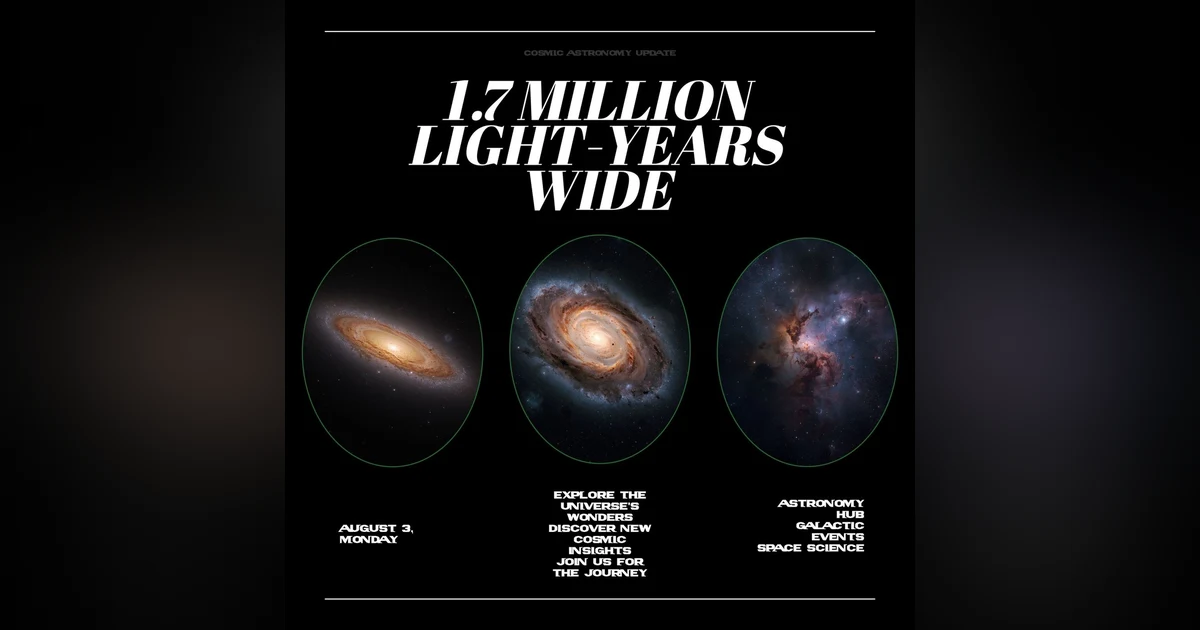
Astronomy Daily · S05E157 · “The Edge of Everything” · Monday 3 August 2026
In this episode • The largest galaxy, measured at last. Ultra-deep imaging of IC 1101 in the Abell 2029 cluster has traced its outer edge for the first time: an edge radius of ~260 kpc, a diameter near 520 kpc (~1.7 million light-years), and ~3.4 trillion solar masses in stars — about 17× the width of the Milky Way. Faint outer structures aligned with cluster X-ray disturbances show it is still accreting. Source: Marrero-de la Rosa et al., “How large can galaxies be? Ultra-deep imaging of IC 1101”, accepted A&A (arXiv:2607.15340, 16 Jul 2026); phys.org, 31 Jul 2026; The Debrief, 1 Aug 2026. • Hayabusa2's record asteroid flyby. JAXA confirmed (press conference 30 Jul) that its Hayabusa2 probe passed just 400 m from the surface of near-Earth asteroid Torifune on 5 July — 744 m from centre at >18,000 km/h — the closest asteroid flyby by any mission, plus the first-ever laser ranging of an asteroid during a flyby. Torifune proved to be a contact binary. Source: JAXA press conference, 30 Jul 2026; phys.org / Japan Today (AFP), 31 Jul 2026; autoevolution, 1 Aug 2026. • UK's first orbital launch on hold. Rocket Factory Augsburg de-stacked its RFA One at SaxaVord Spaceport (Unst, Shetland) after finding a vehicle issue during hot-fire test prep (announced 28 Jul). The certified launch window opens 10 August; a successful flight would be the first orbital launch from UK soil. Source: RFA statement (X), 28 Jul 2026; Space.com, 1 Aug 2026; Shetland Times, 28 Jul 2026. • Andromeda is winding down. A new Hubble study mapping ~200 million stars across two-thirds of Andromeda's disk finds star formation has declined over ~500 million years (from ~1 to ~0.2 solar masses/year), with the steepest drop in the last 40 million years — possibly linked to an interaction with satellite galaxy M32. Source: Williams et al., The Astrophysical Journal, 27 Jul 2026; NASA/STScI release, 27 Jul 2026. Skywatch — both hemispheres • Comet 10P/Tempel 2 — perihelion 2 Aug; closest approach to Earth tonight (3 Aug). Binoculars/small scope, dark skies. Best pre-dawn from the Southern Hemisphere; ~9:30–10:30 pm local for mid-northern latitudes before moonrise. • Moon near Saturn tonight (3 Aug) — naked-eye pairing, both hemispheres, up into dawn. • Mercury at greatest western elongation (2 Aug) — low eastern horizon ~1 hr before sunrise, toward Gemini; Mars higher. Better placed for northern observers. • Diary (2 days out): Falcon 9 upper stage (2025-010D) lunar impact near Einstein Crater, 5 Aug ~06:35 UTC — ~2:35 am EDT / 11:35 pm PDT (4 Aug); North America best-timed on the dark limb. Southern Hemisphere: ~4:35 pm AEST (daylight) — await orbiter after-images. • Looking ahead: 12 Aug total solar eclipse (Greenland/Iceland/Spain) + moonless Perseid peak + six-planet dawn alignment. View partial phases only through certified ISO 12312-2 filters. Links & follow • Website, back catalogue, news feed & newsletter: astronomydaily.io • Social: @AstroDailyPod · Part of the Bitesz.com Podcast Network
Become a supporter of this podcast: https://www.spreaker.com/podcast/astronomy-daily-latest-space-news--5648921/support.
Sponsor Details:
Ensure your online privacy by using NordVPN. To get our special listener deal and save a lot of money, visit www.astronomydaily.io/nordvpn. You'll be glad you did!
Get the best secure and private email on the planet. Stop your Government, google and who knows who else spying on every email you write. Do what we did and use ProtonMail. They beleive in privacy and there are no ads in their business model...yet they still provide a free forever service. Check them out and get out special deal at www.astronomydaily.io/protonmail
Become a supporter of Astronomy Daily by joining our Supporters Club. Commercial free episodes daily are only a click way... Click Here
This episode includes AI-generated content.
In this episode • The largest galaxy, measured at last. Ultra-deep imaging of IC 1101 in the Abell 2029 cluster has traced its outer edge for the first time: an edge radius of ~260 kpc, a diameter near 520 kpc (~1.7 million light-years), and ~3.4 trillion solar masses in stars — about 17× the width of the Milky Way. Faint outer structures aligned with cluster X-ray disturbances show it is still accreting. Source: Marrero-de la Rosa et al., “How large can galaxies be? Ultra-deep imaging of IC 1101”, accepted A&A (arXiv:2607.15340, 16 Jul 2026); phys.org, 31 Jul 2026; The Debrief, 1 Aug 2026. • Hayabusa2's record asteroid flyby. JAXA confirmed (press conference 30 Jul) that its Hayabusa2 probe passed just 400 m from the surface of near-Earth asteroid Torifune on 5 July — 744 m from centre at >18,000 km/h — the closest asteroid flyby by any mission, plus the first-ever laser ranging of an asteroid during a flyby. Torifune proved to be a contact binary. Source: JAXA press conference, 30 Jul 2026; phys.org / Japan Today (AFP), 31 Jul 2026; autoevolution, 1 Aug 2026. • UK's first orbital launch on hold. Rocket Factory Augsburg de-stacked its RFA One at SaxaVord Spaceport (Unst, Shetland) after finding a vehicle issue during hot-fire test prep (announced 28 Jul). The certified launch window opens 10 August; a successful flight would be the first orbital launch from UK soil. Source: RFA statement (X), 28 Jul 2026; Space.com, 1 Aug 2026; Shetland Times, 28 Jul 2026. • Andromeda is winding down. A new Hubble study mapping ~200 million stars across two-thirds of Andromeda's disk finds star formation has declined over ~500 million years (from ~1 to ~0.2 solar masses/year), with the steepest drop in the last 40 million years — possibly linked to an interaction with satellite galaxy M32. Source: Williams et al., The Astrophysical Journal, 27 Jul 2026; NASA/STScI release, 27 Jul 2026. Skywatch — both hemispheres • Comet 10P/Tempel 2 — perihelion 2 Aug; closest approach to Earth tonight (3 Aug). Binoculars/small scope, dark skies. Best pre-dawn from the Southern Hemisphere; ~9:30–10:30 pm local for mid-northern latitudes before moonrise. • Moon near Saturn tonight (3 Aug) — naked-eye pairing, both hemispheres, up into dawn. • Mercury at greatest western elongation (2 Aug) — low eastern horizon ~1 hr before sunrise, toward Gemini; Mars higher. Better placed for northern observers. • Diary (2 days out): Falcon 9 upper stage (2025-010D) lunar impact near Einstein Crater, 5 Aug ~06:35 UTC — ~2:35 am EDT / 11:35 pm PDT (4 Aug); North America best-timed on the dark limb. Southern Hemisphere: ~4:35 pm AEST (daylight) — await orbiter after-images. • Looking ahead: 12 Aug total solar eclipse (Greenland/Iceland/Spain) + moonless Perseid peak + six-planet dawn alignment. View partial phases only through certified ISO 12312-2 filters. Links & follow • Website, back catalogue, news feed & newsletter: astronomydaily.io • Social: @AstroDailyPod · Part of the Bitesz.com Podcast Network
Become a supporter of this podcast: https://www.spreaker.com/podcast/astronomy-daily-latest-space-news--5648921/support.
Sponsor Details:
Ensure your online privacy by using NordVPN. To get our special listener deal and save a lot of money, visit www.astronomydaily.io/nordvpn. You'll be glad you did!
Get the best secure and private email on the planet. Stop your Government, google and who knows who else spying on every email you write. Do what we did and use ProtonMail. They beleive in privacy and there are no ads in their business model...yet they still provide a free forever service. Check them out and get out special deal at www.astronomydaily.io/protonmail
Become a supporter of Astronomy Daily by joining our Supporters Club. Commercial free episodes daily are only a click way... Click Here
This episode includes AI-generated content.
WEBVTT
0
00:00:01.200 --> 00:00:04.120
Anna: Here's a question to start your week. How big
1
00:00:04.120 --> 00:00:06.720
can a single thing actually get?
2
00:00:07.120 --> 00:00:10.000
Not a country, not an ocean. One
3
00:00:10.080 --> 00:00:12.400
object held together as one.
4
00:00:12.880 --> 00:00:15.120
Avery: And I'm guessing you don't mean my inbox.
5
00:00:15.680 --> 00:00:18.240
Anna: Bigger. Today, astronomers have
6
00:00:18.240 --> 00:00:21.160
finally put a tape measure around the largest
7
00:00:21.160 --> 00:00:23.920
galaxy we know of and found its edge
8
00:00:24.000 --> 00:00:25.600
for the very first time.
9
00:00:26.260 --> 00:00:28.220
Avery: Plus a Japanese spacecraft that, huh, just
10
00:00:28.220 --> 00:00:30.900
set the record for the closest asteroid flyby
11
00:00:30.900 --> 00:00:33.740
ever flown. A British launch put on hold at
12
00:00:33.740 --> 00:00:36.020
the last minute. And news that our nearest
13
00:00:36.020 --> 00:00:38.860
big neighbor galaxy is quietly powering
14
00:00:38.860 --> 00:00:39.220
down.
15
00:00:39.700 --> 00:00:42.340
Anna: It's Monday 3rd August. This is
16
00:00:42.340 --> 00:00:44.580
Astronomy Daily. I'm Anna.
17
00:00:44.900 --> 00:00:46.820
Avery: And I'm, um, Avery. Let's get into it.
18
00:00:47.220 --> 00:00:50.180
Anna: So let's start with that tape measure. If I
19
00:00:50.180 --> 00:00:52.700
asked you to name the biggest galaxy in the
20
00:00:52.700 --> 00:00:55.700
universe, an astronomer would very likely say
21
00:00:55.700 --> 00:00:58.600
IC1101. And they've
22
00:00:58.600 --> 00:01:01.000
been saying it for decades. But here's the
23
00:01:01.000 --> 00:01:03.800
strange until now, nobody could
24
00:01:03.800 --> 00:01:05.840
actually tell you where it ends.
25
00:01:06.480 --> 00:01:09.280
Avery: How do you not know where a galaxy ends? It's
26
00:01:09.280 --> 00:01:10.320
right there in the pictures.
27
00:01:10.720 --> 00:01:12.560
Anna: You'd think so. IC
28
00:01:12.640 --> 00:01:14.640
1101 sits about
29
00:01:14.720 --> 00:01:17.360
1.15 billion light years away
30
00:01:17.680 --> 00:01:20.040
at the heart of a cluster of galaxies called
31
00:01:20.040 --> 00:01:22.640
Abel 2029. William
32
00:01:22.640 --> 00:01:25.200
Herschel first logged it back in 1790.
33
00:01:25.440 --> 00:01:27.960
Though of course he had no idea it was a
34
00:01:27.960 --> 00:01:30.780
galaxy. Nobody did until the 1920s.
35
00:01:31.180 --> 00:01:34.180
It's what we call a giant elliptical, or
36
00:01:34.180 --> 00:01:36.620
more precisely a, uh, brightest cluster
37
00:01:36.620 --> 00:01:39.020
galaxy a, uh, BCG. And
38
00:01:39.020 --> 00:01:41.940
BCGs are the great white sharks of the
39
00:01:41.940 --> 00:01:44.580
galaxy world. They sit at the center of a
40
00:01:44.580 --> 00:01:47.100
cluster and they grow by swallowing their
41
00:01:47.100 --> 00:01:49.740
neighbors one merger at a time over
42
00:01:49.740 --> 00:01:50.780
billions of years.
43
00:01:51.500 --> 00:01:53.500
Avery: So it's basically been eating the other
44
00:01:53.500 --> 00:01:56.150
Anna: galaxies in its cluster for most of
45
00:01:56.150 --> 00:01:59.030
cosmic history. Yes, and that's exactly
46
00:01:59.030 --> 00:02:02.030
why its edge is so hard to find. When
47
00:02:02.030 --> 00:02:04.550
a galaxy grows by cannibalizing others,
48
00:02:04.790 --> 00:02:07.550
it ends up wrapped in an enormous faint
49
00:02:07.550 --> 00:02:10.390
halo of starsstars flung out into
50
00:02:10.390 --> 00:02:13.350
the space between galaxies. That glow
51
00:02:13.350 --> 00:02:16.190
is so dim, it blurs into the background of
52
00:02:16.190 --> 00:02:18.950
the cluster itself. So the honest answer
53
00:02:18.950 --> 00:02:20.470
to how big is
54
00:02:20.470 --> 00:02:23.270
IC1101? Has for
55
00:02:23.270 --> 00:02:26.130
years been a, uh, shrug. You'll see figures
56
00:02:26.130 --> 00:02:28.810
online anywhere from about 400,000
57
00:02:28.890 --> 00:02:31.690
light years across to a wild 6
58
00:02:31.770 --> 00:02:34.370
million light years. Nobody could pin it
59
00:02:34.370 --> 00:02:34.650
down.
60
00:02:35.050 --> 00:02:37.410
Avery: That's not a rounding error. That's a factor
61
00:02:37.410 --> 00:02:39.370
of 15. So what changed?
62
00:02:39.770 --> 00:02:42.570
Anna: A team led by Carlos Marrero de la
63
00:02:42.570 --> 00:02:45.170
Rosa took the deepest images ever
64
00:02:45.170 --> 00:02:47.890
captured of this galaxy. Ultra deep
65
00:02:47.890 --> 00:02:50.850
exposures in two colors using the Isaacman
66
00:02:50.850 --> 00:02:53.710
Newton's Wide Field Camera. And when I say
67
00:02:53.710 --> 00:02:56.350
deep I mean, they were sensitive enough to
68
00:02:56.350 --> 00:02:59.150
detect a glow 30 magnitudes per
69
00:02:59.150 --> 00:03:02.150
square arcsecond. Faint in plain
70
00:03:02.150 --> 00:03:04.830
terms, they could pick out starlight roughly
71
00:03:04.830 --> 00:03:07.550
a billion times fainter than the night sky
72
00:03:07.550 --> 00:03:08.870
you'd see with your own eyes.
73
00:03:09.350 --> 00:03:11.630
Avery: And the trick is separating that whisper of
74
00:03:11.630 --> 00:03:12.790
light from everything else.
75
00:03:13.350 --> 00:03:16.070
Anna: That's the whole game. Bright foreground
76
00:03:16.070 --> 00:03:18.890
stars smear light across the image. The
77
00:03:18.890 --> 00:03:21.890
galaxy scatters its own light, too. So they
78
00:03:21.890 --> 00:03:24.650
carefully modeled all that stray light and
79
00:03:24.650 --> 00:03:27.610
subtracted it using a detailed map of
80
00:03:27.610 --> 00:03:29.970
how the telescope spreads out a point of
81
00:03:29.970 --> 00:03:32.370
light. Only then could they trace the
82
00:03:32.370 --> 00:03:35.049
galaxy's true profile all the way out
83
00:03:35.210 --> 00:03:37.850
until it finally melts into the cluster.
84
00:03:38.170 --> 00:03:40.410
And here's what they IC
85
00:03:40.410 --> 00:03:43.210
1101 reaches an edge about
86
00:03:43.290 --> 00:03:46.100
263,000 light years from
87
00:03:46.100 --> 00:03:48.540
its center, which gives it a diameter of
88
00:03:48.540 --> 00:03:50.380
roughly 520
89
00:03:50.460 --> 00:03:52.500
kiloparsecs. That's about
90
00:03:52.500 --> 00:03:55.500
1.7 million light years from one side
91
00:03:55.500 --> 00:03:58.460
to the other, holding around 3.4
92
00:03:58.540 --> 00:04:00.700
trillion suns worth of stars.
93
00:04:01.180 --> 00:04:03.700
Avery: Okay, I need a yardstick for that. How does
94
00:04:03.700 --> 00:04:05.660
it compare to us? To the Milky Way?
95
00:04:06.060 --> 00:04:08.900
Anna: Our galaxy is about 100,000 light years
96
00:04:08.900 --> 00:04:11.900
across. So IC1101
97
00:04:11.900 --> 00:04:14.740
is something like 17 times wider
98
00:04:14.740 --> 00:04:17.120
than the Milky Way. And en masse,
99
00:04:17.360 --> 00:04:20.360
our entire galaxy, including all its dark
100
00:04:20.360 --> 00:04:23.160
matter, comes in around one to one and a
101
00:04:23.160 --> 00:04:25.040
half trillion solar masses.
102
00:04:25.360 --> 00:04:28.160
IC1101 has more
103
00:04:28.160 --> 00:04:30.640
than three trillion solar masses in its
104
00:04:30.640 --> 00:04:33.400
stars alone. It is, by any
105
00:04:33.400 --> 00:04:36.080
measure we can now defend with data, the
106
00:04:36.080 --> 00:04:37.680
largest galaxy known.
107
00:04:38.160 --> 00:04:41.120
Avery: You said now defend with data. That word
108
00:04:41.120 --> 00:04:42.560
now is doing some work.
109
00:04:43.280 --> 00:04:46.080
Anna: It is, because the second finding is
110
00:04:46.080 --> 00:04:48.600
almost better than the first. This
111
00:04:48.600 --> 00:04:51.560
galaxy isn't finished. Beyond that
112
00:04:51.560 --> 00:04:54.240
main edge, the team spotted a scatter
113
00:04:54.240 --> 00:04:57.240
of faint, lopsided structures. Eight
114
00:04:57.240 --> 00:05:00.160
of them and two line up neatly with
115
00:05:00.160 --> 00:05:02.960
disturbances astronomers had already seen
116
00:05:02.960 --> 00:05:05.440
in the hot X ray gas of the cluster.
117
00:05:05.920 --> 00:05:08.880
That's the fingerprint of ongoing feeding.
118
00:05:09.400 --> 00:05:11.880
IC1101 is still pulling
119
00:05:11.880 --> 00:05:14.520
material in, still assembling,
120
00:05:14.920 --> 00:05:17.480
probably shaped by a collision with another
121
00:05:17.480 --> 00:05:20.440
group of galaxies 2 to 3 billion years
122
00:05:20.440 --> 00:05:22.920
ago that's still settling down today.
123
00:05:23.480 --> 00:05:25.760
Avery: So it holds the record, and it's still
124
00:05:25.760 --> 00:05:28.280
growing. That feels almost greedy.
125
00:05:28.760 --> 00:05:31.280
Anna: Which brings us to the real question in the
126
00:05:31.280 --> 00:05:33.800
paper's title. How large can
127
00:05:33.800 --> 00:05:36.370
galaxies actually get? Because
128
00:05:36.450 --> 00:05:39.370
IC1101 now sits right at
129
00:05:39.370 --> 00:05:42.210
the extreme upper end of what we call the
130
00:05:42.210 --> 00:05:44.890
mass size relation, the biggest
131
00:05:44.890 --> 00:05:47.730
edge yet measured for any galaxy.
132
00:05:48.050 --> 00:05:51.010
It's not just a trivia record, it's a data
133
00:05:51.010 --> 00:05:53.810
point that tells us the ceiling for how big
134
00:05:53.810 --> 00:05:56.530
a galaxy can grow in the present day
135
00:05:56.530 --> 00:05:59.410
universe. And IC1101 is
136
00:05:59.410 --> 00:06:01.890
sitting up there, brushing against it,
137
00:06:02.430 --> 00:06:03.310
still reaching.
138
00:06:03.790 --> 00:06:05.990
Avery: Can, um, anyone actually see this monster for
139
00:06:05.990 --> 00:06:06.510
themselves?
140
00:06:07.230 --> 00:06:10.230
Anna: You'd want a good telescope. It's a faint
141
00:06:10.230 --> 00:06:13.070
smudge in the constellation Serpents near
142
00:06:13.070 --> 00:06:15.790
the Virgo border. Well placed in the evening
143
00:06:15.790 --> 00:06:18.109
for both hemispheres right now. But
144
00:06:18.109 --> 00:06:20.710
honestly, the wonder here isn't in the
145
00:06:20.710 --> 00:06:22.830
eyepiece. It's the idea.
146
00:06:23.230 --> 00:06:25.870
Somewhere out there is an object nearly
147
00:06:25.950 --> 00:06:28.270
2 million light years wide.
148
00:06:28.780 --> 00:06:31.700
3 trillion stars strong, and it's
149
00:06:31.700 --> 00:06:32.700
still hungry.
150
00:06:33.260 --> 00:06:35.740
Avery: From the largest thing we know to a very
151
00:06:35.820 --> 00:06:38.500
small, very fast one. Japan's space
152
00:06:38.500 --> 00:06:41.220
agency JAXA held a press conference last
153
00:06:41.220 --> 00:06:43.380
Thursday to confirm a result that had
154
00:06:43.380 --> 00:06:45.740
asteroid scientists grinning. Their
155
00:06:45.740 --> 00:06:48.500
Hayabusa2 spacecraft has just flown the
156
00:06:48.500 --> 00:06:51.260
closest asteroid flyby ever attempted
157
00:06:51.260 --> 00:06:52.300
by any mission.
158
00:06:52.780 --> 00:06:55.140
Anna: This is the same spacecraft that brought
159
00:06:55.140 --> 00:06:57.900
samples of asteroid Ryugu back to Earth,
160
00:06:57.900 --> 00:06:58.460
isn't it?
161
00:06:59.060 --> 00:07:01.900
Avery: The very same Hayabusa2, launched back
162
00:07:01.900 --> 00:07:04.700
in 2014, dropped those precious Ryuko
163
00:07:04.700 --> 00:07:06.940
samples in the Australian outback in 2020,
164
00:07:06.940 --> 00:07:09.300
and then, with fuel still in the tank,
165
00:07:09.540 --> 00:07:12.500
kept going. It's now traveled something like
166
00:07:12.500 --> 00:07:15.420
10.7 billion kilometers on
167
00:07:15.420 --> 00:07:18.100
an extended mission. And on 5 July,
168
00:07:18.100 --> 00:07:20.780
it threaded past a near Earth asteroid called
169
00:07:20.780 --> 00:07:21.780
Torifune.
170
00:07:22.100 --> 00:07:24.660
Anna: How close is closest ever?
171
00:07:25.450 --> 00:07:28.410
Avery: 400 meters from the surface. 400.
172
00:07:28.810 --> 00:07:31.810
That's 744 meters from the asteroid's
173
00:07:31.810 --> 00:07:34.290
center. And they did it. While both objects
174
00:07:34.290 --> 00:07:37.050
were screaming along at more than 18,000
175
00:07:37.130 --> 00:07:39.770
kilometers an hour, about 100 million
176
00:07:39.770 --> 00:07:42.410
kilometers from Earth, they'd plan to pass
177
00:07:42.490 --> 00:07:44.890
800 meters from the center and beat their own
178
00:07:44.890 --> 00:07:46.330
target by clean half.
179
00:07:46.810 --> 00:07:49.250
Anna: At that speed and distance, that's
180
00:07:49.250 --> 00:07:50.730
absurdly precise.
181
00:07:51.450 --> 00:07:53.930
Avery: The operations lead, Yuyemimasu, put it
182
00:07:53.930 --> 00:07:56.490
beautifully. He said the difficulty was like
183
00:07:56.490 --> 00:07:59.250
shooting a 1 yen coin up on the northern
184
00:07:59.250 --> 00:08:02.130
island of Hokkaido from down in Okinawa,
185
00:08:02.130 --> 00:08:04.250
right at the other end of Japan. And they
186
00:08:04.250 --> 00:08:06.850
didn't just take pictures. Hayabusa2
187
00:08:06.850 --> 00:08:09.610
pulled off the first ever laser ranging of an
188
00:08:09.610 --> 00:08:12.530
asteroid during a flyby, bouncing a laser
189
00:08:12.530 --> 00:08:15.050
off the rock to measure the distance in real
190
00:08:15.050 --> 00:08:15.450
time.
191
00:08:16.010 --> 00:08:18.090
Anna: And there was a surprise waiting for them
192
00:08:18.090 --> 00:08:18.410
too.
193
00:08:19.100 --> 00:08:21.660
Avery: There was. Torifune turned out to be a
194
00:08:21.660 --> 00:08:24.620
contact binary. Two lumps of rock stuck
195
00:08:24.620 --> 00:08:27.180
together a bit like a cosmic snowman.
196
00:08:27.580 --> 00:08:30.540
Roughly 450 meters of double lobed
197
00:08:30.540 --> 00:08:32.660
asteroid. They hadn't expected to look like
198
00:08:32.660 --> 00:08:33.500
that at all.
199
00:08:34.060 --> 00:08:36.780
Anna: So why do this? Beyond the lovely
200
00:08:36.780 --> 00:08:39.180
images, planetary defense.
201
00:08:39.580 --> 00:08:41.820
Avery: Learning to navigate a spacecraft that
202
00:08:41.820 --> 00:08:44.460
precisely that close to a moving target
203
00:08:44.620 --> 00:08:47.180
is exactly the skill you'd need to reach,
204
00:08:47.340 --> 00:08:49.900
or one day nudge a genuinely
205
00:08:49.900 --> 00:08:52.760
hazardous asteroid. This was a rehearsal
206
00:08:52.840 --> 00:08:55.080
and the next act is already booked. In
207
00:08:55.080 --> 00:08:58.080
2031, Hayabusa2 will rendezvous with a
208
00:08:58.080 --> 00:09:00.436
tiny asteroid called 1998
209
00:09:00.684 --> 00:09:03.640
KY26. Just 11 meters across.
210
00:09:04.120 --> 00:09:06.200
It might even try to land a
211
00:09:06.200 --> 00:09:09.000
Anna: fridge sized probe landing on something
212
00:09:09.000 --> 00:09:11.800
the size of a house. I love this mission.
213
00:09:12.360 --> 00:09:14.880
Now to a launch that isn't happening quite
214
00:09:14.880 --> 00:09:17.320
yet, but when it does, it'll be a first.
215
00:09:17.840 --> 00:09:20.640
The German company rocket factory Oxford
216
00:09:20.800 --> 00:09:23.680
RFA is aiming to send the first ever
217
00:09:23.680 --> 00:09:26.560
rocket to orbit from UK soil, flying
218
00:09:26.560 --> 00:09:29.040
from Saxavoord Spaceport up on
219
00:09:29.040 --> 00:09:31.560
Unst, the most northerly of Britain's
220
00:09:31.560 --> 00:09:33.440
inhabited islands in Shetland.
221
00:09:33.760 --> 00:09:36.480
Avery: The first orbital launch from the uk. That's
222
00:09:36.480 --> 00:09:37.600
a genuine milestone.
223
00:09:37.920 --> 00:09:40.760
Anna: It really is. Britain has never launched a
224
00:09:40.760 --> 00:09:42.880
satellite to orbit from its own ground.
225
00:09:43.460 --> 00:09:46.100
RFA's rocket, called RFA1,
226
00:09:46.260 --> 00:09:48.980
is a 30 meter three stage vehicle
227
00:09:48.980 --> 00:09:51.300
designed to carry up to 1300
228
00:09:51.380 --> 00:09:54.260
kilograms to a sun synchronous orbit.
229
00:09:54.420 --> 00:09:56.580
But last Monday, while running a test
230
00:09:56.660 --> 00:09:59.139
campaign on the pad ahead of a hot fire of
231
00:09:59.139 --> 00:10:01.780
the engines, the company found what it called
232
00:10:02.100 --> 00:10:04.500
an issue with the vehicle that requires
233
00:10:04.500 --> 00:10:07.140
further investigation. So they've made the
234
00:10:07.140 --> 00:10:09.980
call to de stack to take the fully
235
00:10:09.980 --> 00:10:12.740
assembled rocket apart stage by stage
236
00:10:12.820 --> 00:10:13.780
to get at the problem.
237
00:10:14.380 --> 00:10:15.900
Avery: And they've got a history at that pad,
238
00:10:15.900 --> 00:10:16.460
haven't they?
239
00:10:16.700 --> 00:10:19.660
Anna: They do. Back in August 2024,
240
00:10:19.900 --> 00:10:22.780
an earlier RFA1 first stage was
241
00:10:22.780 --> 00:10:25.460
destroyed in a fireball during a static fire
242
00:10:25.460 --> 00:10:28.220
test at that very site. Nobody hurt,
243
00:10:28.220 --> 00:10:30.940
the pad saved, but the stage lost.
244
00:10:31.340 --> 00:10:34.140
RFA are open about their philosophy. They
245
00:10:34.140 --> 00:10:37.060
develop iteratively, they test hard and
246
00:10:37.060 --> 00:10:39.910
they accept that things sometimes break. This
247
00:10:39.910 --> 00:10:42.870
latest issue sounds far less dramatic. Caught
248
00:10:42.870 --> 00:10:45.070
on the ground exactly where you want to catch
249
00:10:45.070 --> 00:10:45.350
it.
250
00:10:45.670 --> 00:10:47.510
Avery: So what does the timeline look like now?
251
00:10:47.910 --> 00:10:50.670
Anna: AIR certified launch window opens on the 10th
252
00:10:50.670 --> 00:10:53.190
of August. Whether they make that depends on
253
00:10:53.190 --> 00:10:55.950
what the investigation turns up. SACS of
254
00:10:55.950 --> 00:10:58.790
ORD matters here beyond just this one flight.
255
00:10:59.030 --> 00:11:01.470
It's the first fully licensed vertical
256
00:11:01.470 --> 00:11:04.270
orbital launch site in Western Europe and the
257
00:11:04.270 --> 00:11:06.870
only UK spaceport cleared for vertical
258
00:11:06.870 --> 00:11:09.340
launches. With satellite demand the way it
259
00:11:09.340 --> 00:11:11.820
is, Europe is hungry for its own
260
00:11:11.820 --> 00:11:14.700
independent way to orbit. So this is one
261
00:11:14.700 --> 00:11:16.580
to keep an eye on over the next week.
262
00:11:16.900 --> 00:11:19.060
Avery: We opened with a galaxy that's still growing.
263
00:11:19.380 --> 00:11:21.780
Let's close the news with one that's slowing
264
00:11:21.780 --> 00:11:24.260
down. And this one's practically a neighbor.
265
00:11:24.580 --> 00:11:27.220
New Hubble work published last Monday finds
266
00:11:27.220 --> 00:11:29.660
star formation across the Andromeda galaxy
267
00:11:29.660 --> 00:11:32.220
has been fading for the last 500 million
268
00:11:32.220 --> 00:11:32.580
years.
269
00:11:32.980 --> 00:11:35.840
Anna: Andromeda, that's the closest big spiral to
270
00:11:35.840 --> 00:11:38.280
Avery: us, the nearest large spiral, about
271
00:11:38.280 --> 00:11:41.190
2.5 million light years away, roughly a uh,
272
00:11:41.240 --> 00:11:44.080
trillion stars. And on a dark night, you
273
00:11:44.080 --> 00:11:46.760
can see it with your own eyes. A team led by
274
00:11:46.760 --> 00:11:48.800
Benjamin Williams pieced together two
275
00:11:48.800 --> 00:11:51.400
enormous Hubble surveys covering about two
276
00:11:51.400 --> 00:11:53.840
thirds of Andromeda's disk and measured
277
00:11:53.840 --> 00:11:56.840
something like 200 million individual stars.
278
00:11:57.160 --> 00:12:00.000
As Williams put it, the stars are the fossil
279
00:12:00.000 --> 00:12:02.450
record of the galaxy's formation. Read them
280
00:12:02.450 --> 00:12:04.370
carefully and you can reconstruct its
281
00:12:04.370 --> 00:12:04.690
history.
282
00:12:05.170 --> 00:12:07.770
Anna: And that history is one of a galaxy
283
00:12:07.770 --> 00:12:09.970
quieting down steadily.
284
00:12:09.970 --> 00:12:12.490
Avery: Yes, its star forming rate has dropped from
285
00:12:12.490 --> 00:12:15.370
about one sun's worth of new stars a year to
286
00:12:15.370 --> 00:12:17.849
roughly a fifth of that with the sharpest
287
00:12:17.849 --> 00:12:20.130
decline in just the last 40 million years.
288
00:12:20.530 --> 00:12:22.930
Most of what's left is concentrated in a ring
289
00:12:22.930 --> 00:12:25.730
about 32,000 light years out from the center.
290
00:12:25.810 --> 00:12:28.090
And there may be a culprit. A little
291
00:12:28.090 --> 00:12:30.570
satellite galaxy called M M32
292
00:12:31.130 --> 00:12:34.010
pit and run, possibly a sideswipe.
293
00:12:34.010 --> 00:12:36.930
The region of Andromeda nearest M M32 shows
294
00:12:36.930 --> 00:12:39.410
the most suppressed star formation. And the
295
00:12:39.410 --> 00:12:41.290
slowdown there seems to have kicked off
296
00:12:41.290 --> 00:12:43.930
around 60 million years ago, which could
297
00:12:43.930 --> 00:12:46.690
actually help pin down when M M32 last
298
00:12:46.690 --> 00:12:49.130
barged through Andromeda's disk. It's a
299
00:12:49.130 --> 00:12:51.850
reminder that galaxies aren't serene islands.
300
00:12:51.930 --> 00:12:54.770
They jostle, they collide. And sometimes a
301
00:12:54.770 --> 00:12:57.130
small neighbor leaves a very large mark.
302
00:12:57.560 --> 00:12:59.600
Anna: And you can go and look at the scene of the
303
00:12:59.600 --> 00:13:00.600
crime tonight.
304
00:13:01.000 --> 00:13:03.280
Avery: You can, which is the perfect handover to the
305
00:13:03.280 --> 00:13:03.960
skywatch.
306
00:13:04.360 --> 00:13:07.080
Anna: Skywatch time and a, uh, heads up before we
307
00:13:07.080 --> 00:13:09.960
start. We've just had the full buck moon,
308
00:13:09.960 --> 00:13:12.520
so the moon is a waning gibbous this week,
309
00:13:12.680 --> 00:13:15.120
still bright enough early on to wash out the
310
00:13:15.120 --> 00:13:17.600
faintest targets. It'll get easier as the
311
00:13:17.600 --> 00:13:19.920
week goes and the moon thins toward last
312
00:13:19.920 --> 00:13:20.280
quarter.
313
00:13:20.760 --> 00:13:23.720
Avery: First up, a comet with its moment tonight.
314
00:13:24.200 --> 00:13:26.760
Comet 10P Tempel 2
315
00:13:27.080 --> 00:13:29.040
reached its closest point to the sun
316
00:13:29.040 --> 00:13:31.880
yesterday. And Tonight, Monday the 3rd,
317
00:13:32.200 --> 00:13:34.680
it makes its closest approach to Earth.
318
00:13:35.240 --> 00:13:37.880
Anna: It's not a naked eye showpiece. You'll want
319
00:13:37.880 --> 00:13:40.680
binoculars or a small telescope. And dark
320
00:13:40.680 --> 00:13:43.440
skies from the southern hemisphere. It rides
321
00:13:43.440 --> 00:13:46.320
highest before dawn. So Sydney early
322
00:13:46.320 --> 00:13:49.120
risers have the better geometry. From North
323
00:13:49.120 --> 00:13:51.760
America, it's best hunted in the narrow
324
00:13:51.760 --> 00:13:54.400
window of true darkness after evening
325
00:13:54.400 --> 00:13:57.150
twilight. But before that, gibbous moon
326
00:13:57.150 --> 00:13:59.830
climbs up for mid northern latitudes
327
00:13:59.830 --> 00:14:02.470
roughly 9:30 to 10:30pm
328
00:14:02.470 --> 00:14:05.310
local. Use averted vision and let your
329
00:14:05.310 --> 00:14:06.150
eyes settle.
330
00:14:06.630 --> 00:14:08.630
Avery: Next, an easy one for everyone.
331
00:14:09.110 --> 00:14:11.910
Tonight, the waning gibbous moon sits
332
00:14:11.910 --> 00:14:14.910
right beside Saturn, a lovely naked eye
333
00:14:14.910 --> 00:14:17.430
pairing up through most of the night and into
334
00:14:17.430 --> 00:14:20.310
dawn and visible from both hemispheres.
335
00:14:20.390 --> 00:14:22.950
If you've got a scope, swing it to Saturn
336
00:14:22.950 --> 00:14:23.870
while you're there for the
337
00:14:23.870 --> 00:14:26.300
Anna: rings and for the early risers.
338
00:14:26.460 --> 00:14:28.820
Mercury reached its greatest western
339
00:14:28.820 --> 00:14:31.780
elongation yesterday, so it's about as well
340
00:14:31.780 --> 00:14:34.140
placed in the morning sky as it gets this
341
00:14:34.140 --> 00:14:37.020
round. Look low to the eastern horizon
342
00:14:37.020 --> 00:14:39.860
roughly an hour before sunrise over
343
00:14:39.860 --> 00:14:42.820
toward the stars of Gemini, with Mars a
344
00:14:42.820 --> 00:14:45.580
little higher up. Northern observers get the
345
00:14:45.580 --> 00:14:48.380
cleaner shot at Mercury this time, but it's
346
00:14:48.380 --> 00:14:51.200
worth a try from the south too. You'll need a
347
00:14:51.200 --> 00:14:53.320
flat clear horizon either way.
348
00:14:53.880 --> 00:14:56.680
Avery: Now a uh, diary note we flagged last week and
349
00:14:56.680 --> 00:14:59.640
it's now just two days out on the 5th of
350
00:14:59.640 --> 00:15:02.440
August, a UH Spent Falcon 9 upper stage
351
00:15:02.520 --> 00:15:05.320
is on track to impact the Moon near
352
00:15:05.320 --> 00:15:08.280
Einstein crater on the western limb at about
353
00:15:08.280 --> 00:15:10.920
0635 Universal Time.
354
00:15:11.480 --> 00:15:14.000
Anna: And this one's squarely for our, uh, North
355
00:15:14.000 --> 00:15:16.720
American listeners. You have the best seat in
356
00:15:16.720 --> 00:15:19.510
the house. That impact time works out to
357
00:15:19.510 --> 00:15:21.630
about 2:35 Eastern,
358
00:15:22.030 --> 00:15:24.590
11:35 Pacific the night before.
359
00:15:24.830 --> 00:15:27.590
With the moon up and the impact region on the
360
00:15:27.590 --> 00:15:30.350
dark side of the terminator ideal, you
361
00:15:30.350 --> 00:15:32.630
won't see a flash with the naked eye. But if
362
00:15:32.630 --> 00:15:35.190
you've got a decent telescope and a camera
363
00:15:35.190 --> 00:15:37.230
trained on that limb, you're in the game.
364
00:15:37.630 --> 00:15:39.630
Avery: For us in the southern hemisphere, the
365
00:15:39.630 --> 00:15:42.550
timing's unkind. That's mid afternoon in
366
00:15:42.550 --> 00:15:45.430
Sydney, uh, around 4:35pm with
367
00:15:45.430 --> 00:15:48.340
the moon not favorably placed. So we'll be
368
00:15:48.340 --> 00:15:50.580
waiting on the orbiter after images of the
369
00:15:50.580 --> 00:15:52.940
impact site rather than catching it live.
370
00:15:53.340 --> 00:15:55.220
But it's a great excuse to follow
371
00:15:55.220 --> 00:15:58.180
Anna: along online and looking ahead, a
372
00:15:58.180 --> 00:16:00.220
quick flag for the big month coming.
373
00:16:00.380 --> 00:16:03.100
12 August is a huge date.
374
00:16:03.260 --> 00:16:05.820
A total solar eclipse tracking across
375
00:16:05.820 --> 00:16:08.780
Greenland, Iceland and Spain, paired
376
00:16:08.780 --> 00:16:11.260
for once with a moonless peak of the
377
00:16:11.260 --> 00:16:14.060
Perseid meteor shower. Plus a six
378
00:16:14.060 --> 00:16:17.040
planet lineup in the pre dawn sky. We'll
379
00:16:17.040 --> 00:16:19.360
build all of that out closer to the day.
380
00:16:19.760 --> 00:16:22.600
Avery: 1 um, safety word now though, and we'll say
381
00:16:22.600 --> 00:16:25.360
it every time. If you're anywhere near that
382
00:16:25.360 --> 00:16:27.920
eclipse path, you view the partial phases
383
00:16:28.000 --> 00:16:30.240
only through certified ISO
384
00:16:30.480 --> 00:16:33.000
123122
385
00:16:33.000 --> 00:16:35.720
eclipse glasses or a properly filtered
386
00:16:35.720 --> 00:16:38.720
scope. Never look at the uneclipsed, um, sun
387
00:16:38.720 --> 00:16:39.440
without them.
388
00:16:39.920 --> 00:16:41.960
Anna: That's your Monday briefing. If you want
389
00:16:41.960 --> 00:16:44.480
more. Everything lives at astronomydaily,
390
00:16:44.800 --> 00:16:47.420
IO, the full back catalog, a news
391
00:16:47.420 --> 00:16:49.940
feed that updates through the day, and a spot
392
00:16:49.940 --> 00:16:51.820
to sign up for the daily newsletter.
393
00:16:52.060 --> 00:16:54.220
Avery: You can send us a message from the site too.
394
00:16:54.380 --> 00:16:57.100
Corrections, questions, what you spotted in
395
00:16:57.100 --> 00:16:59.820
your own sky. We read them and we love them.
396
00:17:00.060 --> 00:17:02.260
We even got our first voice message today
397
00:17:02.260 --> 00:17:05.020
from listener Ian Sama in Uganda who
398
00:17:05.020 --> 00:17:07.980
said hi there, I'm Um, Ian from Uganda and I
399
00:17:07.980 --> 00:17:10.540
really enjoy your podcast very much. Thanks a
400
00:17:10.540 --> 00:17:13.470
lot. Thank you, Ian. Um, the feedback is very
401
00:17:13.470 --> 00:17:14.390
much appreciated.
402
00:17:14.790 --> 00:17:17.590
Anna: Yes, thank you, Ian. Very much appreciated by
403
00:17:17.590 --> 00:17:20.070
all of us. We'll be back tomorrow with more
404
00:17:20.070 --> 00:17:22.630
of today's space news. Until then, from
405
00:17:22.630 --> 00:17:24.070
Avery and me, keep
406
00:17:24.070 --> 00:17:25.990
Avery: looking up clear skies.
407
00:17:32.260 --> 00:17:32.480
Anna: Mhm.
408
00:17:37.360 --> 00:17:38.000
The stories.
0
00:00:01.200 --> 00:00:04.120
Anna: Here's a question to start your week. How big
1
00:00:04.120 --> 00:00:06.720
can a single thing actually get?
2
00:00:07.120 --> 00:00:10.000
Not a country, not an ocean. One
3
00:00:10.080 --> 00:00:12.400
object held together as one.
4
00:00:12.880 --> 00:00:15.120
Avery: And I'm guessing you don't mean my inbox.
5
00:00:15.680 --> 00:00:18.240
Anna: Bigger. Today, astronomers have
6
00:00:18.240 --> 00:00:21.160
finally put a tape measure around the largest
7
00:00:21.160 --> 00:00:23.920
galaxy we know of and found its edge
8
00:00:24.000 --> 00:00:25.600
for the very first time.
9
00:00:26.260 --> 00:00:28.220
Avery: Plus a Japanese spacecraft that, huh, just
10
00:00:28.220 --> 00:00:30.900
set the record for the closest asteroid flyby
11
00:00:30.900 --> 00:00:33.740
ever flown. A British launch put on hold at
12
00:00:33.740 --> 00:00:36.020
the last minute. And news that our nearest
13
00:00:36.020 --> 00:00:38.860
big neighbor galaxy is quietly powering
14
00:00:38.860 --> 00:00:39.220
down.
15
00:00:39.700 --> 00:00:42.340
Anna: It's Monday 3rd August. This is
16
00:00:42.340 --> 00:00:44.580
Astronomy Daily. I'm Anna.
17
00:00:44.900 --> 00:00:46.820
Avery: And I'm, um, Avery. Let's get into it.
18
00:00:47.220 --> 00:00:50.180
Anna: So let's start with that tape measure. If I
19
00:00:50.180 --> 00:00:52.700
asked you to name the biggest galaxy in the
20
00:00:52.700 --> 00:00:55.700
universe, an astronomer would very likely say
21
00:00:55.700 --> 00:00:58.600
IC1101. And they've
22
00:00:58.600 --> 00:01:01.000
been saying it for decades. But here's the
23
00:01:01.000 --> 00:01:03.800
strange until now, nobody could
24
00:01:03.800 --> 00:01:05.840
actually tell you where it ends.
25
00:01:06.480 --> 00:01:09.280
Avery: How do you not know where a galaxy ends? It's
26
00:01:09.280 --> 00:01:10.320
right there in the pictures.
27
00:01:10.720 --> 00:01:12.560
Anna: You'd think so. IC
28
00:01:12.640 --> 00:01:14.640
1101 sits about
29
00:01:14.720 --> 00:01:17.360
1.15 billion light years away
30
00:01:17.680 --> 00:01:20.040
at the heart of a cluster of galaxies called
31
00:01:20.040 --> 00:01:22.640
Abel 2029. William
32
00:01:22.640 --> 00:01:25.200
Herschel first logged it back in 1790.
33
00:01:25.440 --> 00:01:27.960
Though of course he had no idea it was a
34
00:01:27.960 --> 00:01:30.780
galaxy. Nobody did until the 1920s.
35
00:01:31.180 --> 00:01:34.180
It's what we call a giant elliptical, or
36
00:01:34.180 --> 00:01:36.620
more precisely a, uh, brightest cluster
37
00:01:36.620 --> 00:01:39.020
galaxy a, uh, BCG. And
38
00:01:39.020 --> 00:01:41.940
BCGs are the great white sharks of the
39
00:01:41.940 --> 00:01:44.580
galaxy world. They sit at the center of a
40
00:01:44.580 --> 00:01:47.100
cluster and they grow by swallowing their
41
00:01:47.100 --> 00:01:49.740
neighbors one merger at a time over
42
00:01:49.740 --> 00:01:50.780
billions of years.
43
00:01:51.500 --> 00:01:53.500
Avery: So it's basically been eating the other
44
00:01:53.500 --> 00:01:56.150
Anna: galaxies in its cluster for most of
45
00:01:56.150 --> 00:01:59.030
cosmic history. Yes, and that's exactly
46
00:01:59.030 --> 00:02:02.030
why its edge is so hard to find. When
47
00:02:02.030 --> 00:02:04.550
a galaxy grows by cannibalizing others,
48
00:02:04.790 --> 00:02:07.550
it ends up wrapped in an enormous faint
49
00:02:07.550 --> 00:02:10.390
halo of starsstars flung out into
50
00:02:10.390 --> 00:02:13.350
the space between galaxies. That glow
51
00:02:13.350 --> 00:02:16.190
is so dim, it blurs into the background of
52
00:02:16.190 --> 00:02:18.950
the cluster itself. So the honest answer
53
00:02:18.950 --> 00:02:20.470
to how big is
54
00:02:20.470 --> 00:02:23.270
IC1101? Has for
55
00:02:23.270 --> 00:02:26.130
years been a, uh, shrug. You'll see figures
56
00:02:26.130 --> 00:02:28.810
online anywhere from about 400,000
57
00:02:28.890 --> 00:02:31.690
light years across to a wild 6
58
00:02:31.770 --> 00:02:34.370
million light years. Nobody could pin it
59
00:02:34.370 --> 00:02:34.650
down.
60
00:02:35.050 --> 00:02:37.410
Avery: That's not a rounding error. That's a factor
61
00:02:37.410 --> 00:02:39.370
of 15. So what changed?
62
00:02:39.770 --> 00:02:42.570
Anna: A team led by Carlos Marrero de la
63
00:02:42.570 --> 00:02:45.170
Rosa took the deepest images ever
64
00:02:45.170 --> 00:02:47.890
captured of this galaxy. Ultra deep
65
00:02:47.890 --> 00:02:50.850
exposures in two colors using the Isaacman
66
00:02:50.850 --> 00:02:53.710
Newton's Wide Field Camera. And when I say
67
00:02:53.710 --> 00:02:56.350
deep I mean, they were sensitive enough to
68
00:02:56.350 --> 00:02:59.150
detect a glow 30 magnitudes per
69
00:02:59.150 --> 00:03:02.150
square arcsecond. Faint in plain
70
00:03:02.150 --> 00:03:04.830
terms, they could pick out starlight roughly
71
00:03:04.830 --> 00:03:07.550
a billion times fainter than the night sky
72
00:03:07.550 --> 00:03:08.870
you'd see with your own eyes.
73
00:03:09.350 --> 00:03:11.630
Avery: And the trick is separating that whisper of
74
00:03:11.630 --> 00:03:12.790
light from everything else.
75
00:03:13.350 --> 00:03:16.070
Anna: That's the whole game. Bright foreground
76
00:03:16.070 --> 00:03:18.890
stars smear light across the image. The
77
00:03:18.890 --> 00:03:21.890
galaxy scatters its own light, too. So they
78
00:03:21.890 --> 00:03:24.650
carefully modeled all that stray light and
79
00:03:24.650 --> 00:03:27.610
subtracted it using a detailed map of
80
00:03:27.610 --> 00:03:29.970
how the telescope spreads out a point of
81
00:03:29.970 --> 00:03:32.370
light. Only then could they trace the
82
00:03:32.370 --> 00:03:35.049
galaxy's true profile all the way out
83
00:03:35.210 --> 00:03:37.850
until it finally melts into the cluster.
84
00:03:38.170 --> 00:03:40.410
And here's what they IC
85
00:03:40.410 --> 00:03:43.210
1101 reaches an edge about
86
00:03:43.290 --> 00:03:46.100
263,000 light years from
87
00:03:46.100 --> 00:03:48.540
its center, which gives it a diameter of
88
00:03:48.540 --> 00:03:50.380
roughly 520
89
00:03:50.460 --> 00:03:52.500
kiloparsecs. That's about
90
00:03:52.500 --> 00:03:55.500
1.7 million light years from one side
91
00:03:55.500 --> 00:03:58.460
to the other, holding around 3.4
92
00:03:58.540 --> 00:04:00.700
trillion suns worth of stars.
93
00:04:01.180 --> 00:04:03.700
Avery: Okay, I need a yardstick for that. How does
94
00:04:03.700 --> 00:04:05.660
it compare to us? To the Milky Way?
95
00:04:06.060 --> 00:04:08.900
Anna: Our galaxy is about 100,000 light years
96
00:04:08.900 --> 00:04:11.900
across. So IC1101
97
00:04:11.900 --> 00:04:14.740
is something like 17 times wider
98
00:04:14.740 --> 00:04:17.120
than the Milky Way. And en masse,
99
00:04:17.360 --> 00:04:20.360
our entire galaxy, including all its dark
100
00:04:20.360 --> 00:04:23.160
matter, comes in around one to one and a
101
00:04:23.160 --> 00:04:25.040
half trillion solar masses.
102
00:04:25.360 --> 00:04:28.160
IC1101 has more
103
00:04:28.160 --> 00:04:30.640
than three trillion solar masses in its
104
00:04:30.640 --> 00:04:33.400
stars alone. It is, by any
105
00:04:33.400 --> 00:04:36.080
measure we can now defend with data, the
106
00:04:36.080 --> 00:04:37.680
largest galaxy known.
107
00:04:38.160 --> 00:04:41.120
Avery: You said now defend with data. That word
108
00:04:41.120 --> 00:04:42.560
now is doing some work.
109
00:04:43.280 --> 00:04:46.080
Anna: It is, because the second finding is
110
00:04:46.080 --> 00:04:48.600
almost better than the first. This
111
00:04:48.600 --> 00:04:51.560
galaxy isn't finished. Beyond that
112
00:04:51.560 --> 00:04:54.240
main edge, the team spotted a scatter
113
00:04:54.240 --> 00:04:57.240
of faint, lopsided structures. Eight
114
00:04:57.240 --> 00:05:00.160
of them and two line up neatly with
115
00:05:00.160 --> 00:05:02.960
disturbances astronomers had already seen
116
00:05:02.960 --> 00:05:05.440
in the hot X ray gas of the cluster.
117
00:05:05.920 --> 00:05:08.880
That's the fingerprint of ongoing feeding.
118
00:05:09.400 --> 00:05:11.880
IC1101 is still pulling
119
00:05:11.880 --> 00:05:14.520
material in, still assembling,
120
00:05:14.920 --> 00:05:17.480
probably shaped by a collision with another
121
00:05:17.480 --> 00:05:20.440
group of galaxies 2 to 3 billion years
122
00:05:20.440 --> 00:05:22.920
ago that's still settling down today.
123
00:05:23.480 --> 00:05:25.760
Avery: So it holds the record, and it's still
124
00:05:25.760 --> 00:05:28.280
growing. That feels almost greedy.
125
00:05:28.760 --> 00:05:31.280
Anna: Which brings us to the real question in the
126
00:05:31.280 --> 00:05:33.800
paper's title. How large can
127
00:05:33.800 --> 00:05:36.370
galaxies actually get? Because
128
00:05:36.450 --> 00:05:39.370
IC1101 now sits right at
129
00:05:39.370 --> 00:05:42.210
the extreme upper end of what we call the
130
00:05:42.210 --> 00:05:44.890
mass size relation, the biggest
131
00:05:44.890 --> 00:05:47.730
edge yet measured for any galaxy.
132
00:05:48.050 --> 00:05:51.010
It's not just a trivia record, it's a data
133
00:05:51.010 --> 00:05:53.810
point that tells us the ceiling for how big
134
00:05:53.810 --> 00:05:56.530
a galaxy can grow in the present day
135
00:05:56.530 --> 00:05:59.410
universe. And IC1101 is
136
00:05:59.410 --> 00:06:01.890
sitting up there, brushing against it,
137
00:06:02.430 --> 00:06:03.310
still reaching.
138
00:06:03.790 --> 00:06:05.990
Avery: Can, um, anyone actually see this monster for
139
00:06:05.990 --> 00:06:06.510
themselves?
140
00:06:07.230 --> 00:06:10.230
Anna: You'd want a good telescope. It's a faint
141
00:06:10.230 --> 00:06:13.070
smudge in the constellation Serpents near
142
00:06:13.070 --> 00:06:15.790
the Virgo border. Well placed in the evening
143
00:06:15.790 --> 00:06:18.109
for both hemispheres right now. But
144
00:06:18.109 --> 00:06:20.710
honestly, the wonder here isn't in the
145
00:06:20.710 --> 00:06:22.830
eyepiece. It's the idea.
146
00:06:23.230 --> 00:06:25.870
Somewhere out there is an object nearly
147
00:06:25.950 --> 00:06:28.270
2 million light years wide.
148
00:06:28.780 --> 00:06:31.700
3 trillion stars strong, and it's
149
00:06:31.700 --> 00:06:32.700
still hungry.
150
00:06:33.260 --> 00:06:35.740
Avery: From the largest thing we know to a very
151
00:06:35.820 --> 00:06:38.500
small, very fast one. Japan's space
152
00:06:38.500 --> 00:06:41.220
agency JAXA held a press conference last
153
00:06:41.220 --> 00:06:43.380
Thursday to confirm a result that had
154
00:06:43.380 --> 00:06:45.740
asteroid scientists grinning. Their
155
00:06:45.740 --> 00:06:48.500
Hayabusa2 spacecraft has just flown the
156
00:06:48.500 --> 00:06:51.260
closest asteroid flyby ever attempted
157
00:06:51.260 --> 00:06:52.300
by any mission.
158
00:06:52.780 --> 00:06:55.140
Anna: This is the same spacecraft that brought
159
00:06:55.140 --> 00:06:57.900
samples of asteroid Ryugu back to Earth,
160
00:06:57.900 --> 00:06:58.460
isn't it?
161
00:06:59.060 --> 00:07:01.900
Avery: The very same Hayabusa2, launched back
162
00:07:01.900 --> 00:07:04.700
in 2014, dropped those precious Ryuko
163
00:07:04.700 --> 00:07:06.940
samples in the Australian outback in 2020,
164
00:07:06.940 --> 00:07:09.300
and then, with fuel still in the tank,
165
00:07:09.540 --> 00:07:12.500
kept going. It's now traveled something like
166
00:07:12.500 --> 00:07:15.420
10.7 billion kilometers on
167
00:07:15.420 --> 00:07:18.100
an extended mission. And on 5 July,
168
00:07:18.100 --> 00:07:20.780
it threaded past a near Earth asteroid called
169
00:07:20.780 --> 00:07:21.780
Torifune.
170
00:07:22.100 --> 00:07:24.660
Anna: How close is closest ever?
171
00:07:25.450 --> 00:07:28.410
Avery: 400 meters from the surface. 400.
172
00:07:28.810 --> 00:07:31.810
That's 744 meters from the asteroid's
173
00:07:31.810 --> 00:07:34.290
center. And they did it. While both objects
174
00:07:34.290 --> 00:07:37.050
were screaming along at more than 18,000
175
00:07:37.130 --> 00:07:39.770
kilometers an hour, about 100 million
176
00:07:39.770 --> 00:07:42.410
kilometers from Earth, they'd plan to pass
177
00:07:42.490 --> 00:07:44.890
800 meters from the center and beat their own
178
00:07:44.890 --> 00:07:46.330
target by clean half.
179
00:07:46.810 --> 00:07:49.250
Anna: At that speed and distance, that's
180
00:07:49.250 --> 00:07:50.730
absurdly precise.
181
00:07:51.450 --> 00:07:53.930
Avery: The operations lead, Yuyemimasu, put it
182
00:07:53.930 --> 00:07:56.490
beautifully. He said the difficulty was like
183
00:07:56.490 --> 00:07:59.250
shooting a 1 yen coin up on the northern
184
00:07:59.250 --> 00:08:02.130
island of Hokkaido from down in Okinawa,
185
00:08:02.130 --> 00:08:04.250
right at the other end of Japan. And they
186
00:08:04.250 --> 00:08:06.850
didn't just take pictures. Hayabusa2
187
00:08:06.850 --> 00:08:09.610
pulled off the first ever laser ranging of an
188
00:08:09.610 --> 00:08:12.530
asteroid during a flyby, bouncing a laser
189
00:08:12.530 --> 00:08:15.050
off the rock to measure the distance in real
190
00:08:15.050 --> 00:08:15.450
time.
191
00:08:16.010 --> 00:08:18.090
Anna: And there was a surprise waiting for them
192
00:08:18.090 --> 00:08:18.410
too.
193
00:08:19.100 --> 00:08:21.660
Avery: There was. Torifune turned out to be a
194
00:08:21.660 --> 00:08:24.620
contact binary. Two lumps of rock stuck
195
00:08:24.620 --> 00:08:27.180
together a bit like a cosmic snowman.
196
00:08:27.580 --> 00:08:30.540
Roughly 450 meters of double lobed
197
00:08:30.540 --> 00:08:32.660
asteroid. They hadn't expected to look like
198
00:08:32.660 --> 00:08:33.500
that at all.
199
00:08:34.060 --> 00:08:36.780
Anna: So why do this? Beyond the lovely
200
00:08:36.780 --> 00:08:39.180
images, planetary defense.
201
00:08:39.580 --> 00:08:41.820
Avery: Learning to navigate a spacecraft that
202
00:08:41.820 --> 00:08:44.460
precisely that close to a moving target
203
00:08:44.620 --> 00:08:47.180
is exactly the skill you'd need to reach,
204
00:08:47.340 --> 00:08:49.900
or one day nudge a genuinely
205
00:08:49.900 --> 00:08:52.760
hazardous asteroid. This was a rehearsal
206
00:08:52.840 --> 00:08:55.080
and the next act is already booked. In
207
00:08:55.080 --> 00:08:58.080
2031, Hayabusa2 will rendezvous with a
208
00:08:58.080 --> 00:09:00.436
tiny asteroid called 1998
209
00:09:00.684 --> 00:09:03.640
KY26. Just 11 meters across.
210
00:09:04.120 --> 00:09:06.200
It might even try to land a
211
00:09:06.200 --> 00:09:09.000
Anna: fridge sized probe landing on something
212
00:09:09.000 --> 00:09:11.800
the size of a house. I love this mission.
213
00:09:12.360 --> 00:09:14.880
Now to a launch that isn't happening quite
214
00:09:14.880 --> 00:09:17.320
yet, but when it does, it'll be a first.
215
00:09:17.840 --> 00:09:20.640
The German company rocket factory Oxford
216
00:09:20.800 --> 00:09:23.680
RFA is aiming to send the first ever
217
00:09:23.680 --> 00:09:26.560
rocket to orbit from UK soil, flying
218
00:09:26.560 --> 00:09:29.040
from Saxavoord Spaceport up on
219
00:09:29.040 --> 00:09:31.560
Unst, the most northerly of Britain's
220
00:09:31.560 --> 00:09:33.440
inhabited islands in Shetland.
221
00:09:33.760 --> 00:09:36.480
Avery: The first orbital launch from the uk. That's
222
00:09:36.480 --> 00:09:37.600
a genuine milestone.
223
00:09:37.920 --> 00:09:40.760
Anna: It really is. Britain has never launched a
224
00:09:40.760 --> 00:09:42.880
satellite to orbit from its own ground.
225
00:09:43.460 --> 00:09:46.100
RFA's rocket, called RFA1,
226
00:09:46.260 --> 00:09:48.980
is a 30 meter three stage vehicle
227
00:09:48.980 --> 00:09:51.300
designed to carry up to 1300
228
00:09:51.380 --> 00:09:54.260
kilograms to a sun synchronous orbit.
229
00:09:54.420 --> 00:09:56.580
But last Monday, while running a test
230
00:09:56.660 --> 00:09:59.139
campaign on the pad ahead of a hot fire of
231
00:09:59.139 --> 00:10:01.780
the engines, the company found what it called
232
00:10:02.100 --> 00:10:04.500
an issue with the vehicle that requires
233
00:10:04.500 --> 00:10:07.140
further investigation. So they've made the
234
00:10:07.140 --> 00:10:09.980
call to de stack to take the fully
235
00:10:09.980 --> 00:10:12.740
assembled rocket apart stage by stage
236
00:10:12.820 --> 00:10:13.780
to get at the problem.
237
00:10:14.380 --> 00:10:15.900
Avery: And they've got a history at that pad,
238
00:10:15.900 --> 00:10:16.460
haven't they?
239
00:10:16.700 --> 00:10:19.660
Anna: They do. Back in August 2024,
240
00:10:19.900 --> 00:10:22.780
an earlier RFA1 first stage was
241
00:10:22.780 --> 00:10:25.460
destroyed in a fireball during a static fire
242
00:10:25.460 --> 00:10:28.220
test at that very site. Nobody hurt,
243
00:10:28.220 --> 00:10:30.940
the pad saved, but the stage lost.
244
00:10:31.340 --> 00:10:34.140
RFA are open about their philosophy. They
245
00:10:34.140 --> 00:10:37.060
develop iteratively, they test hard and
246
00:10:37.060 --> 00:10:39.910
they accept that things sometimes break. This
247
00:10:39.910 --> 00:10:42.870
latest issue sounds far less dramatic. Caught
248
00:10:42.870 --> 00:10:45.070
on the ground exactly where you want to catch
249
00:10:45.070 --> 00:10:45.350
it.
250
00:10:45.670 --> 00:10:47.510
Avery: So what does the timeline look like now?
251
00:10:47.910 --> 00:10:50.670
Anna: AIR certified launch window opens on the 10th
252
00:10:50.670 --> 00:10:53.190
of August. Whether they make that depends on
253
00:10:53.190 --> 00:10:55.950
what the investigation turns up. SACS of
254
00:10:55.950 --> 00:10:58.790
ORD matters here beyond just this one flight.
255
00:10:59.030 --> 00:11:01.470
It's the first fully licensed vertical
256
00:11:01.470 --> 00:11:04.270
orbital launch site in Western Europe and the
257
00:11:04.270 --> 00:11:06.870
only UK spaceport cleared for vertical
258
00:11:06.870 --> 00:11:09.340
launches. With satellite demand the way it
259
00:11:09.340 --> 00:11:11.820
is, Europe is hungry for its own
260
00:11:11.820 --> 00:11:14.700
independent way to orbit. So this is one
261
00:11:14.700 --> 00:11:16.580
to keep an eye on over the next week.
262
00:11:16.900 --> 00:11:19.060
Avery: We opened with a galaxy that's still growing.
263
00:11:19.380 --> 00:11:21.780
Let's close the news with one that's slowing
264
00:11:21.780 --> 00:11:24.260
down. And this one's practically a neighbor.
265
00:11:24.580 --> 00:11:27.220
New Hubble work published last Monday finds
266
00:11:27.220 --> 00:11:29.660
star formation across the Andromeda galaxy
267
00:11:29.660 --> 00:11:32.220
has been fading for the last 500 million
268
00:11:32.220 --> 00:11:32.580
years.
269
00:11:32.980 --> 00:11:35.840
Anna: Andromeda, that's the closest big spiral to
270
00:11:35.840 --> 00:11:38.280
Avery: us, the nearest large spiral, about
271
00:11:38.280 --> 00:11:41.190
2.5 million light years away, roughly a uh,
272
00:11:41.240 --> 00:11:44.080
trillion stars. And on a dark night, you
273
00:11:44.080 --> 00:11:46.760
can see it with your own eyes. A team led by
274
00:11:46.760 --> 00:11:48.800
Benjamin Williams pieced together two
275
00:11:48.800 --> 00:11:51.400
enormous Hubble surveys covering about two
276
00:11:51.400 --> 00:11:53.840
thirds of Andromeda's disk and measured
277
00:11:53.840 --> 00:11:56.840
something like 200 million individual stars.
278
00:11:57.160 --> 00:12:00.000
As Williams put it, the stars are the fossil
279
00:12:00.000 --> 00:12:02.450
record of the galaxy's formation. Read them
280
00:12:02.450 --> 00:12:04.370
carefully and you can reconstruct its
281
00:12:04.370 --> 00:12:04.690
history.
282
00:12:05.170 --> 00:12:07.770
Anna: And that history is one of a galaxy
283
00:12:07.770 --> 00:12:09.970
quieting down steadily.
284
00:12:09.970 --> 00:12:12.490
Avery: Yes, its star forming rate has dropped from
285
00:12:12.490 --> 00:12:15.370
about one sun's worth of new stars a year to
286
00:12:15.370 --> 00:12:17.849
roughly a fifth of that with the sharpest
287
00:12:17.849 --> 00:12:20.130
decline in just the last 40 million years.
288
00:12:20.530 --> 00:12:22.930
Most of what's left is concentrated in a ring
289
00:12:22.930 --> 00:12:25.730
about 32,000 light years out from the center.
290
00:12:25.810 --> 00:12:28.090
And there may be a culprit. A little
291
00:12:28.090 --> 00:12:30.570
satellite galaxy called M M32
292
00:12:31.130 --> 00:12:34.010
pit and run, possibly a sideswipe.
293
00:12:34.010 --> 00:12:36.930
The region of Andromeda nearest M M32 shows
294
00:12:36.930 --> 00:12:39.410
the most suppressed star formation. And the
295
00:12:39.410 --> 00:12:41.290
slowdown there seems to have kicked off
296
00:12:41.290 --> 00:12:43.930
around 60 million years ago, which could
297
00:12:43.930 --> 00:12:46.690
actually help pin down when M M32 last
298
00:12:46.690 --> 00:12:49.130
barged through Andromeda's disk. It's a
299
00:12:49.130 --> 00:12:51.850
reminder that galaxies aren't serene islands.
300
00:12:51.930 --> 00:12:54.770
They jostle, they collide. And sometimes a
301
00:12:54.770 --> 00:12:57.130
small neighbor leaves a very large mark.
302
00:12:57.560 --> 00:12:59.600
Anna: And you can go and look at the scene of the
303
00:12:59.600 --> 00:13:00.600
crime tonight.
304
00:13:01.000 --> 00:13:03.280
Avery: You can, which is the perfect handover to the
305
00:13:03.280 --> 00:13:03.960
skywatch.
306
00:13:04.360 --> 00:13:07.080
Anna: Skywatch time and a, uh, heads up before we
307
00:13:07.080 --> 00:13:09.960
start. We've just had the full buck moon,
308
00:13:09.960 --> 00:13:12.520
so the moon is a waning gibbous this week,
309
00:13:12.680 --> 00:13:15.120
still bright enough early on to wash out the
310
00:13:15.120 --> 00:13:17.600
faintest targets. It'll get easier as the
311
00:13:17.600 --> 00:13:19.920
week goes and the moon thins toward last
312
00:13:19.920 --> 00:13:20.280
quarter.
313
00:13:20.760 --> 00:13:23.720
Avery: First up, a comet with its moment tonight.
314
00:13:24.200 --> 00:13:26.760
Comet 10P Tempel 2
315
00:13:27.080 --> 00:13:29.040
reached its closest point to the sun
316
00:13:29.040 --> 00:13:31.880
yesterday. And Tonight, Monday the 3rd,
317
00:13:32.200 --> 00:13:34.680
it makes its closest approach to Earth.
318
00:13:35.240 --> 00:13:37.880
Anna: It's not a naked eye showpiece. You'll want
319
00:13:37.880 --> 00:13:40.680
binoculars or a small telescope. And dark
320
00:13:40.680 --> 00:13:43.440
skies from the southern hemisphere. It rides
321
00:13:43.440 --> 00:13:46.320
highest before dawn. So Sydney early
322
00:13:46.320 --> 00:13:49.120
risers have the better geometry. From North
323
00:13:49.120 --> 00:13:51.760
America, it's best hunted in the narrow
324
00:13:51.760 --> 00:13:54.400
window of true darkness after evening
325
00:13:54.400 --> 00:13:57.150
twilight. But before that, gibbous moon
326
00:13:57.150 --> 00:13:59.830
climbs up for mid northern latitudes
327
00:13:59.830 --> 00:14:02.470
roughly 9:30 to 10:30pm
328
00:14:02.470 --> 00:14:05.310
local. Use averted vision and let your
329
00:14:05.310 --> 00:14:06.150
eyes settle.
330
00:14:06.630 --> 00:14:08.630
Avery: Next, an easy one for everyone.
331
00:14:09.110 --> 00:14:11.910
Tonight, the waning gibbous moon sits
332
00:14:11.910 --> 00:14:14.910
right beside Saturn, a lovely naked eye
333
00:14:14.910 --> 00:14:17.430
pairing up through most of the night and into
334
00:14:17.430 --> 00:14:20.310
dawn and visible from both hemispheres.
335
00:14:20.390 --> 00:14:22.950
If you've got a scope, swing it to Saturn
336
00:14:22.950 --> 00:14:23.870
while you're there for the
337
00:14:23.870 --> 00:14:26.300
Anna: rings and for the early risers.
338
00:14:26.460 --> 00:14:28.820
Mercury reached its greatest western
339
00:14:28.820 --> 00:14:31.780
elongation yesterday, so it's about as well
340
00:14:31.780 --> 00:14:34.140
placed in the morning sky as it gets this
341
00:14:34.140 --> 00:14:37.020
round. Look low to the eastern horizon
342
00:14:37.020 --> 00:14:39.860
roughly an hour before sunrise over
343
00:14:39.860 --> 00:14:42.820
toward the stars of Gemini, with Mars a
344
00:14:42.820 --> 00:14:45.580
little higher up. Northern observers get the
345
00:14:45.580 --> 00:14:48.380
cleaner shot at Mercury this time, but it's
346
00:14:48.380 --> 00:14:51.200
worth a try from the south too. You'll need a
347
00:14:51.200 --> 00:14:53.320
flat clear horizon either way.
348
00:14:53.880 --> 00:14:56.680
Avery: Now a uh, diary note we flagged last week and
349
00:14:56.680 --> 00:14:59.640
it's now just two days out on the 5th of
350
00:14:59.640 --> 00:15:02.440
August, a UH Spent Falcon 9 upper stage
351
00:15:02.520 --> 00:15:05.320
is on track to impact the Moon near
352
00:15:05.320 --> 00:15:08.280
Einstein crater on the western limb at about
353
00:15:08.280 --> 00:15:10.920
0635 Universal Time.
354
00:15:11.480 --> 00:15:14.000
Anna: And this one's squarely for our, uh, North
355
00:15:14.000 --> 00:15:16.720
American listeners. You have the best seat in
356
00:15:16.720 --> 00:15:19.510
the house. That impact time works out to
357
00:15:19.510 --> 00:15:21.630
about 2:35 Eastern,
358
00:15:22.030 --> 00:15:24.590
11:35 Pacific the night before.
359
00:15:24.830 --> 00:15:27.590
With the moon up and the impact region on the
360
00:15:27.590 --> 00:15:30.350
dark side of the terminator ideal, you
361
00:15:30.350 --> 00:15:32.630
won't see a flash with the naked eye. But if
362
00:15:32.630 --> 00:15:35.190
you've got a decent telescope and a camera
363
00:15:35.190 --> 00:15:37.230
trained on that limb, you're in the game.
364
00:15:37.630 --> 00:15:39.630
Avery: For us in the southern hemisphere, the
365
00:15:39.630 --> 00:15:42.550
timing's unkind. That's mid afternoon in
366
00:15:42.550 --> 00:15:45.430
Sydney, uh, around 4:35pm with
367
00:15:45.430 --> 00:15:48.340
the moon not favorably placed. So we'll be
368
00:15:48.340 --> 00:15:50.580
waiting on the orbiter after images of the
369
00:15:50.580 --> 00:15:52.940
impact site rather than catching it live.
370
00:15:53.340 --> 00:15:55.220
But it's a great excuse to follow
371
00:15:55.220 --> 00:15:58.180
Anna: along online and looking ahead, a
372
00:15:58.180 --> 00:16:00.220
quick flag for the big month coming.
373
00:16:00.380 --> 00:16:03.100
12 August is a huge date.
374
00:16:03.260 --> 00:16:05.820
A total solar eclipse tracking across
375
00:16:05.820 --> 00:16:08.780
Greenland, Iceland and Spain, paired
376
00:16:08.780 --> 00:16:11.260
for once with a moonless peak of the
377
00:16:11.260 --> 00:16:14.060
Perseid meteor shower. Plus a six
378
00:16:14.060 --> 00:16:17.040
planet lineup in the pre dawn sky. We'll
379
00:16:17.040 --> 00:16:19.360
build all of that out closer to the day.
380
00:16:19.760 --> 00:16:22.600
Avery: 1 um, safety word now though, and we'll say
381
00:16:22.600 --> 00:16:25.360
it every time. If you're anywhere near that
382
00:16:25.360 --> 00:16:27.920
eclipse path, you view the partial phases
383
00:16:28.000 --> 00:16:30.240
only through certified ISO
384
00:16:30.480 --> 00:16:33.000
123122
385
00:16:33.000 --> 00:16:35.720
eclipse glasses or a properly filtered
386
00:16:35.720 --> 00:16:38.720
scope. Never look at the uneclipsed, um, sun
387
00:16:38.720 --> 00:16:39.440
without them.
388
00:16:39.920 --> 00:16:41.960
Anna: That's your Monday briefing. If you want
389
00:16:41.960 --> 00:16:44.480
more. Everything lives at astronomydaily,
390
00:16:44.800 --> 00:16:47.420
IO, the full back catalog, a news
391
00:16:47.420 --> 00:16:49.940
feed that updates through the day, and a spot
392
00:16:49.940 --> 00:16:51.820
to sign up for the daily newsletter.
393
00:16:52.060 --> 00:16:54.220
Avery: You can send us a message from the site too.
394
00:16:54.380 --> 00:16:57.100
Corrections, questions, what you spotted in
395
00:16:57.100 --> 00:16:59.820
your own sky. We read them and we love them.
396
00:17:00.060 --> 00:17:02.260
We even got our first voice message today
397
00:17:02.260 --> 00:17:05.020
from listener Ian Sama in Uganda who
398
00:17:05.020 --> 00:17:07.980
said hi there, I'm Um, Ian from Uganda and I
399
00:17:07.980 --> 00:17:10.540
really enjoy your podcast very much. Thanks a
400
00:17:10.540 --> 00:17:13.470
lot. Thank you, Ian. Um, the feedback is very
401
00:17:13.470 --> 00:17:14.390
much appreciated.
402
00:17:14.790 --> 00:17:17.590
Anna: Yes, thank you, Ian. Very much appreciated by
403
00:17:17.590 --> 00:17:20.070
all of us. We'll be back tomorrow with more
404
00:17:20.070 --> 00:17:22.630
of today's space news. Until then, from
405
00:17:22.630 --> 00:17:24.070
Avery and me, keep
406
00:17:24.070 --> 00:17:25.990
Avery: looking up clear skies.
407
00:17:32.260 --> 00:17:32.480
Anna: Mhm.
408
00:17:37.360 --> 00:17:38.000
The stories.


