The Hydrogen Map: How a Radio Telescope Heard Half the Universe
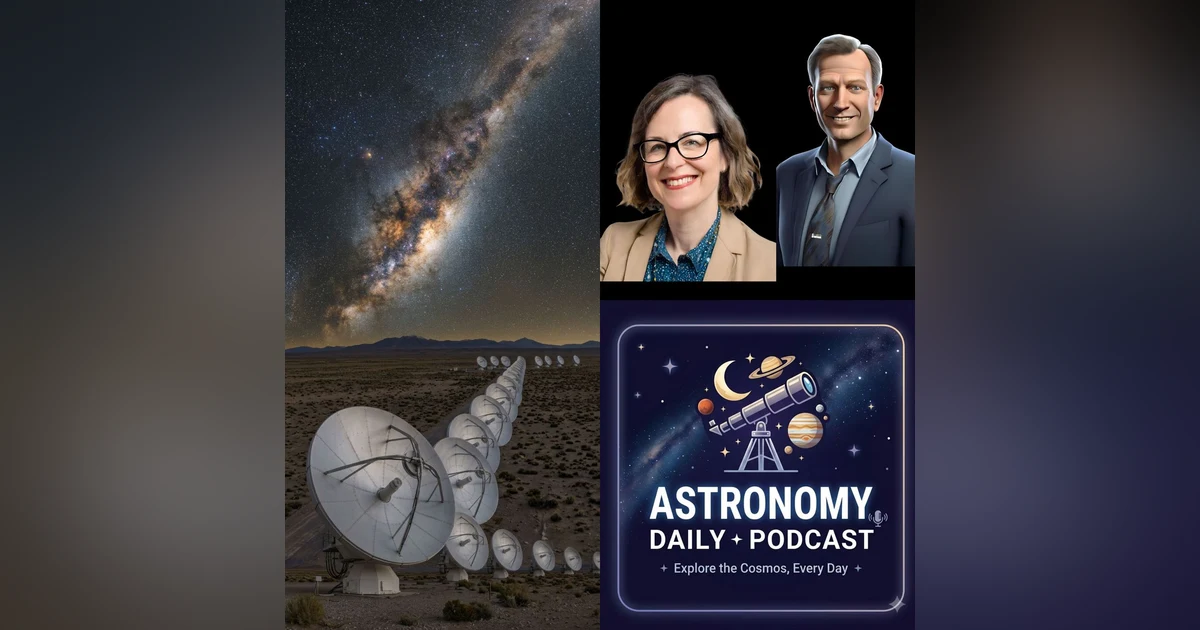
Anna and Avery open the Weekend Wrap with a genuine first: South Africa's MeerKAT has detected the 21-centimetre hydrogen signal from four to five billion light years away using radio data alone — no optical galaxy survey propping it up — proving out the technique the Square Kilometre Array will use to measure dark energy. Then the week in review: Roman's coronagraph wakes up, Starship Flight 14 gets a date, Mars turns out to be lopsided inside, BepiColombo lets go, LZ's one unexplained flash, and a centaur caught in the act of becoming a comet. Plus the sky for the week ahead, both hemispheres.
Links & sources · University of Manchester — Astronomers use MeerKAT to directly detect faint hydrogen signal from the distant Universe — https://www.manchester.ac.uk/about/news/astronomers-use-meerkat-to-directly-detect-faint-hydrogen-signal-from-the-distant-universe · The Astrophysical Journal Letters — Paul, Wolz, Santos, Chen et al. (paper DOI) — https://doi.org/10.3847/2041-8213/ae808f · American Astronomical Society — release listing — https://aas.org/node/730547 · Phys.org — MeerKAT directly detects faint hydrogen signal from the distant universe — https://phys.org/news/2026-09-meerkat-faint-hydrogen-distant-universe.html · Space.com — Scientists detect signals of hydrogen from billions of years ago — https://www.space.com/astronomy/galaxies/scientists-detect-signals-of-hydrogen-from-billions-of-years-ago-could-this-help-us-map-out-the-universe · Xinhua — MeerKAT in South Africa directly detects faint hydrogen signal from distant universe — https://english.news.cn/africa/20260905/3f6c7164a4404b0a9b79f879b1d31a59/c.html · SKA Observatory — the construction journey (SKA-Mid, Karoo; SKA-Low, Murchison) — https://www.skao.int/en/explore/construction-journey · NASA Science — Roman's planet imager has powered on (1 September 2026) — https://science.nasa.gov/blogs/roman/2026/09/01/nasa-romans-planet-imager-has-powered-on/ · NASA — NASA's dark universe-seeking Nancy Grace Roman Space Telescope launches — https://www.nasa.gov/news-release/nasas-dark-universe-seeking-nancy-grace-roman-space-telescope-launches/ · Next Spaceflight — Starship Flight 14 (NET 15 September 2026, Pad 2, Starbase) — https://nextspaceflight.com/launches/details/8346/ · Tesla Oracle — FCC filing points to Starship Flight 14 on 15 September; Booster 21 33-engine static fire — https://www.teslaoracle.com/2026/09/02/fcc-filing-reveals-starship-flight-14-launch-on-september-15-spacex-conducts-33-engine-static-fire-on-booster-21/ · Nature — Tidal tomography reveals a thermal anomaly beneath Mars's crustal dichotomy (27 August 2026) — https://www.nature.com/articles/s41586-026-10893-x · Phys.org — Thermal anomaly discovered below Mars' south pole — https://phys.org/news/2026-08-thermal-anomaly-mars-south-pole.html · ESA — Latest updates: BepiColombo's arrival at Mercury — https://www.esa.int/Science_Exploration/Space_Science/BepiColombo/Latest_updates_BepiColombo_s_arrival_at_Mercury · ESA — BepiColombo's Mercury arrival begins (full replay) — https://www.esa.int/ESA_Multimedia/Videos/2026/09/BepiColombo_s_Mercury_arrival_begins_-_full_replay · Brown University — LZ experiment sees surprising result in search for dark matter — https://www.brown.edu/news/2026-09-01/lz-dark-matter-results · The LZ Dark Matter Experiment — collaboration site — https://lz.lbl.gov/ · ARC Centre of Excellence for Dark Matter Particle Physics — Stawell Underground Physics Laboratory — https://www.centredarkmatter.org/supl · University of Central Florida — UCF researchers study a centaur transforming into a comet — https://www.ucf.edu/news/ucf-researchers-study-a-centaur-transforming-into-a-comet/ · Phys.org — Saturn encounter may have set distant centaur on path to becoming a comet — https://phys.org/news/2026-09-saturn-encounter-distant-centaur-path.html · Space.com — Scientists watch a comet being born 3 billion miles away — https://www.space.com/astronomy/comets/scientists-watch-a-comet-being-born-3-billion-miles-away · Star Walk — Astronomical events in September 2026 — https://starwalk.space/en/news/night-sky-tonight-september · EarthSky — Venus greatest brilliancy, 18 September 2026 (magnitude −4.8) — https://earthsky.org/astronomy-essentials/venus-brightest-greatest-brilliancy-greatest-illuminated-extent-2/ · EarthSky — Sun news: flares, CMEs and aurora updates — https://earthsky.org/sun/sun-news-activity-solar-flare-cme-aurora-updates/ · Space.com — Night sky September 2026: the best things to see this month — https://www.space.com/stargazing/what-to-see-night-sky-september-2026 Follow us: @AstroDailyPod · astronomydaily.io
Become a supporter of this podcast: https://www.spreaker.com/podcast/astronomy-daily-latest-space-news--5648921/support.
Sponsor Details:
Ensure your online privacy by using NordVPN. To get our special listener deal and save a lot of money, visit www.astronomydaily.io/nordvpn. You'll be glad you did!
Get the best secure and private email on the planet. Stop your Government, google and who knows who else spying on every email you write. Do what we did and use ProtonMail. They beleive in privacy and there are no ads in their business model...yet they still provide a free forever service. Check them out and get out special deal at www.astronomydaily.io/protonmail
Become a supporter of Astronomy Daily by joining our Supporters Club. Commercial free episodes daily are only a click way... Click Here
This episode includes AI-generated content.
0
00:00:00.640 --> 00:00:03.040
Anna: Hey, everyone. Welcome back to Astronomy
1
00:00:03.040 --> 00:00:05.280
AstroDailyPod. And it's Saturday,
2
00:00:06.160 --> 00:00:07.440
so you know what that means.
3
00:00:08.320 --> 00:00:11.280
Avery: The weekend wrap one brand new storey,
4
00:00:11.520 --> 00:00:14.320
properly developed. And then we run back
5
00:00:14.320 --> 00:00:16.680
through the week's biggest news. In case you
6
00:00:16.680 --> 00:00:17.680
missed any of it,
7
00:00:18.240 --> 00:00:21.200
Anna: it's Saturday, September 5th, 2026.
8
00:00:21.600 --> 00:00:24.120
I'm Anna and this is series five, episode
9
00:00:24.120 --> 00:00:25.360
186.
10
00:00:26.000 --> 00:00:28.840
Avery: And, um, I'm Avery. Anna. Today's
11
00:00:28.840 --> 00:00:31.440
fresh storey is one I've been waiting years.
12
00:00:31.980 --> 00:00:34.820
Anna: Somebody to pull off a radio telescope in the
13
00:00:34.820 --> 00:00:37.660
Karoo desert has heard hydrogen. Not
14
00:00:37.660 --> 00:00:40.420
from one galaxy, from billions of them at
15
00:00:40.420 --> 00:00:43.020
once, 4 to 5 billion light years away.
16
00:00:43.340 --> 00:00:45.180
And it did it without any help from an
17
00:00:45.180 --> 00:00:47.859
optical telescope, which sounds modest
18
00:00:47.859 --> 00:00:49.980
Avery: until you understand that this particular
19
00:00:50.140 --> 00:00:52.940
signal is buried under a foreground about
20
00:00:52.940 --> 00:00:55.180
10,000 times brighter than it is.
21
00:00:55.660 --> 00:00:57.500
Anna: It's a technique people have been trying to
22
00:00:57.500 --> 00:01:00.140
make work for 15 years. This Week
23
00:01:00.380 --> 00:01:02.940
it worked. And it's a South African
24
00:01:02.940 --> 00:01:04.980
instrument that did it. With a strong
25
00:01:04.980 --> 00:01:06.420
Australian sequel coming.
26
00:01:07.060 --> 00:01:09.820
Avery: Then the week that was Roman
27
00:01:09.820 --> 00:01:11.780
opened its planet camera's eyes.
28
00:01:12.340 --> 00:01:15.260
Starship Flight 14 finally has a date on
29
00:01:15.260 --> 00:01:18.100
it. Mars turned out to be hotter underneath
30
00:01:18.100 --> 00:01:19.220
than anyone expected.
31
00:01:20.100 --> 00:01:23.100
Bepicolombo let go of the ride that got it to
32
00:01:23.100 --> 00:01:25.660
Mercury. A dark matter detector
33
00:01:25.660 --> 00:01:28.180
recorded one flash it cannot explain.
34
00:01:29.020 --> 00:01:31.580
Anna: And brand new this week. And genuinely
35
00:01:31.580 --> 00:01:34.380
lovely astronomers have watched a Comet
36
00:01:34.380 --> 00:01:37.100
switch on 3 billion miles away
37
00:01:37.180 --> 00:01:39.180
over five years in real time.
38
00:01:39.580 --> 00:01:41.940
Avery: Plus the sky for the week ahead. Both
39
00:01:41.940 --> 00:01:44.540
hemispheres. And it is a dark one
40
00:01:44.860 --> 00:01:45.820
in the good way.
41
00:01:46.300 --> 00:01:47.420
Anna: It's a big episode.
42
00:01:47.500 --> 00:01:48.540
Let's get into it.
43
00:01:49.020 --> 00:01:51.980
Avery: Right, start me at the beginning. Who did
44
00:01:51.980 --> 00:01:52.300
what?
45
00:01:52.780 --> 00:01:55.740
Anna: A team led by Dr. Surabh Paul. He's
46
00:01:55.740 --> 00:01:57.580
at the University of Manchester and the
47
00:01:57.580 --> 00:01:59.940
University of the Western Cape, working with
48
00:01:59.940 --> 00:02:02.640
Laura Wols at Jodrell Bank, Mario
49
00:02:02.640 --> 00:02:05.480
Santos at the Western Cape and Xiaoting
50
00:02:05.480 --> 00:02:08.080
Chen at Edinburgh. The paper is in the
51
00:02:08.080 --> 00:02:10.720
Astrophysical Journal Letters. And Manchester
52
00:02:10.720 --> 00:02:13.360
put the release out on Tuesday. It has been
53
00:02:13.360 --> 00:02:15.400
rolling through the international wires all
54
00:02:15.400 --> 00:02:17.640
week. Xinhua ran it yesterday.
55
00:02:18.040 --> 00:02:20.200
Avery: And the instrument is Meerkat.
56
00:02:20.600 --> 00:02:23.560
Anna: Meerkat 64 radio dishes standing
57
00:02:23.560 --> 00:02:26.520
in the Karoo in South Africa's Northern Cape,
58
00:02:26.960 --> 00:02:29.200
one of the quietest patches of radio sky on
59
00:02:29.200 --> 00:02:31.440
Earth. Which turns out to be the whole point.
60
00:02:31.840 --> 00:02:34.320
And Meerkat is not just a fine telescope in
61
00:02:34.320 --> 00:02:37.320
its own right. It's a precursor. It gets
62
00:02:37.320 --> 00:02:39.800
absorbed into ska mid the mid
63
00:02:39.800 --> 00:02:42.320
frequency half of the Square Kilometre Array.
64
00:02:42.720 --> 00:02:45.600
Avery: Okay, now tell me what they detected. Because
65
00:02:45.680 --> 00:02:48.480
hydrogen on its own doesn't sound like news.
66
00:02:49.040 --> 00:02:51.960
Anna: It isn't on its own. Hydrogen is
67
00:02:51.960 --> 00:02:54.160
the most common thing in the universe. The
68
00:02:54.160 --> 00:02:56.620
News is how they detected it and at what
69
00:02:56.620 --> 00:02:59.420
distance. Neutral hydrogen, a
70
00:02:59.420 --> 00:03:02.340
lone proton with a lone electron, emits
71
00:03:02.340 --> 00:03:04.500
at a very specific radio wavelength,
72
00:03:04.900 --> 00:03:06.340
21 centimetres.
73
00:03:06.820 --> 00:03:09.140
Avery: The famous 21 centimetre line.
74
00:03:09.220 --> 00:03:11.980
Anna: The famous one. And it's famous because it's
75
00:03:11.980 --> 00:03:14.740
reliable. Hydrogen doesn't care whether it's
76
00:03:14.740 --> 00:03:17.420
in a bright galaxy or a dim one. If it's
77
00:03:17.420 --> 00:03:19.780
neutral, it glows at 21 centimetres,
78
00:03:20.260 --> 00:03:23.030
which makes it, in principle, the perfect
79
00:03:23.030 --> 00:03:25.470
tracer for where matter actually is.
80
00:03:26.190 --> 00:03:27.230
Avery: In principle?
81
00:03:27.630 --> 00:03:30.430
Anna: In principle. In practise, the
82
00:03:30.430 --> 00:03:33.030
emission from any single distant galaxy is
83
00:03:33.030 --> 00:03:35.790
far too faint to pick out. So about 15
84
00:03:35.790 --> 00:03:37.670
years ago, people proposed a workaround
85
00:03:37.670 --> 00:03:40.430
called intensity mapping. Stop trying to
86
00:03:40.430 --> 00:03:43.350
resolve galaxies, point the telescope at a
87
00:03:43.350 --> 00:03:46.230
big patch of sky, deliberately blur it and
88
00:03:46.230 --> 00:03:48.750
measure the total 21 centimetre glow coming
89
00:03:48.750 --> 00:03:49.950
from that whole volume.
90
00:03:50.730 --> 00:03:52.970
Avery: So instead of a photograph of individual
91
00:03:52.970 --> 00:03:55.570
galaxies, you get what? A heat
92
00:03:55.570 --> 00:03:56.010
map.
93
00:03:56.330 --> 00:03:58.810
Anna: That's exactly the right image. A low
94
00:03:58.810 --> 00:04:01.170
resolution map of where the hydrogen is piled
95
00:04:01.170 --> 00:04:03.890
up and where it's thin. And because hydrogen
96
00:04:03.890 --> 00:04:06.610
sits inside galaxies and galaxies sit
97
00:04:06.610 --> 00:04:09.370
inside the cosmic web, that blurry map
98
00:04:09.370 --> 00:04:11.530
traces the large scale structure of the
99
00:04:11.530 --> 00:04:14.090
universe cheaply and over
100
00:04:14.090 --> 00:04:15.290
enormous volumes.
101
00:04:16.100 --> 00:04:18.900
Avery: Why does cheap matter? We have galaxy
102
00:04:18.900 --> 00:04:19.460
surveys.
103
00:04:19.940 --> 00:04:21.780
Anna: We do, and they're superb, but they're
104
00:04:21.780 --> 00:04:24.340
expensive in telescope time. To map
105
00:04:24.340 --> 00:04:26.300
structure optically, you have to identify
106
00:04:26.300 --> 00:04:28.780
each galaxy and measure its distance one at a
107
00:04:28.780 --> 00:04:31.460
time. Millions of them. Intensity
108
00:04:31.460 --> 00:04:33.740
mapping says, I don't need to know which
109
00:04:33.740 --> 00:04:36.420
galaxy is which, I only need to know how much
110
00:04:36.420 --> 00:04:39.100
hydrogen is in this cube of space versus that
111
00:04:39.100 --> 00:04:41.620
one. And if you can do that out to high
112
00:04:41.620 --> 00:04:44.040
redshift, you can measure how the universe
113
00:04:44.040 --> 00:04:46.520
has expanded, which is the dark energy
114
00:04:46.520 --> 00:04:46.920
question.
115
00:04:47.640 --> 00:04:49.480
Avery: So why hasn't anyone done it?
116
00:04:49.800 --> 00:04:51.600
Anna: Because of the foregrounds, and this is the
117
00:04:51.600 --> 00:04:54.200
part I want to be Precise about. The 21
118
00:04:54.200 --> 00:04:56.440
centimetre signal from those distant galaxies
119
00:04:56.440 --> 00:04:59.440
is extraordinarily faint. Sitting on top
120
00:04:59.440 --> 00:05:01.760
of it is radio emission from our own Milky
121
00:05:01.760 --> 00:05:03.880
Way synchrotron radiation,
122
00:05:04.280 --> 00:05:06.920
electrons spiralling in the galaxy's magnetic
123
00:05:06.920 --> 00:05:09.800
field. And that is roughly four orders of
124
00:05:09.800 --> 00:05:11.600
magnitude brighter than the thing you're
125
00:05:11.600 --> 00:05:12.280
trying to measure.
126
00:05:13.080 --> 00:05:14.360
Avery: 10,000 times.
127
00:05:15.000 --> 00:05:18.000
Anna: 10,000 times? Give or take. Then add human
128
00:05:18.000 --> 00:05:20.880
radio interference, satellites, aircraft,
129
00:05:20.880 --> 00:05:23.600
mobile networks, and then add the telescope's
130
00:05:23.600 --> 00:05:26.000
own quirks, which imprint themselves on the
131
00:05:26.000 --> 00:05:28.040
data in ways that look deceptively like
132
00:05:28.040 --> 00:05:30.800
signal. Paul's line in the release is the
133
00:05:30.800 --> 00:05:33.800
honest one. The signal is extremely faint and
134
00:05:33.800 --> 00:05:35.640
difficult to isolate from foreground
135
00:05:35.640 --> 00:05:38.120
emission, human made radio frequency
136
00:05:38.120 --> 00:05:40.550
interference and instrumental effects.
137
00:05:41.030 --> 00:05:43.430
Avery: So how have people got around that until now?
138
00:05:43.910 --> 00:05:45.950
Anna: By cheating slightly. And I mean that
139
00:05:45.950 --> 00:05:48.670
Admiringly, you take your radio map and you
140
00:05:48.670 --> 00:05:50.830
cross correlate it with an optical galaxy
141
00:05:50.830 --> 00:05:53.510
survey of the same patch of sky. You already
142
00:05:53.510 --> 00:05:55.350
know where the galaxies are from the optical
143
00:05:55.350 --> 00:05:58.270
data, so you ask, does the radio map get
144
00:05:58.270 --> 00:06:00.310
brighter in the places the optical survey
145
00:06:00.310 --> 00:06:01.430
says galaxies live?
146
00:06:01.910 --> 00:06:04.310
Avery: And if it does, that's the hydrogen.
147
00:06:04.390 --> 00:06:06.750
Anna: That's the hydrogen. It's a legitimate
148
00:06:06.750 --> 00:06:09.670
detection and Meerkat and its predecessors
149
00:06:09.670 --> 00:06:12.450
have done it before. But it has a built
150
00:06:12.450 --> 00:06:15.330
in limit. The foreground contamination
151
00:06:15.410 --> 00:06:18.250
and your instrumental noise don't know where
152
00:06:18.250 --> 00:06:20.970
the optical galaxies are. So they average
153
00:06:20.970 --> 00:06:23.690
away in the cross correlation, which is
154
00:06:23.690 --> 00:06:26.530
wonderful for confidence and useless if
155
00:06:26.530 --> 00:06:28.650
what you actually want is a standalone
156
00:06:28.650 --> 00:06:31.570
survey. You're always tethered to an
157
00:06:31.570 --> 00:06:32.850
optical telescope
158
00:06:33.410 --> 00:06:35.890
Avery: and, um, this week they cut the tether.
159
00:06:36.620 --> 00:06:38.860
Anna: This week they cut the tether.
160
00:06:39.740 --> 00:06:42.580
This is the 21 centimetre signal measured in
161
00:06:42.580 --> 00:06:45.100
the radio data alone. No
162
00:06:45.100 --> 00:06:47.940
optical survey propping it up. The
163
00:06:47.940 --> 00:06:50.380
foregrounds had to be genuinely removed
164
00:06:50.380 --> 00:06:53.060
rather than statistically dodged. And
165
00:06:53.060 --> 00:06:55.540
what's left is a real measurement of the
166
00:06:55.540 --> 00:06:56.780
hydrogen distribution.
167
00:06:57.340 --> 00:06:59.420
Avery: How much observing time did that take?
168
00:06:59.740 --> 00:07:02.380
Anna: Here's the part that made me sit up. About
169
00:07:02.460 --> 00:07:05.310
96 hours, four
170
00:07:05.470 --> 00:07:07.390
days of telescope time.
171
00:07:07.790 --> 00:07:08.830
Avery: That's nothing.
172
00:07:08.910 --> 00:07:11.750
Anna: And it gets better. Santos's quote is
173
00:07:11.750 --> 00:07:13.790
my favourite line in the whole release.
174
00:07:14.590 --> 00:07:17.070
It is particularly remarkable that the data
175
00:07:17.070 --> 00:07:19.550
used in this study were taken in 2018,
176
00:07:20.029 --> 00:07:22.350
when Meerkat had only just started science
177
00:07:22.350 --> 00:07:22.990
operations.
178
00:07:23.470 --> 00:07:25.950
Avery: Wait, the data is 8 years old?
179
00:07:26.350 --> 00:07:29.270
Anna: The data is 8 years old. This is not a new
180
00:07:29.270 --> 00:07:31.630
observing campaign. This is a brand new
181
00:07:31.630 --> 00:07:33.910
analysis of some of the first science data
182
00:07:33.910 --> 00:07:36.800
Meerkat ever took. And the advance is in
183
00:07:36.800 --> 00:07:39.600
the method, the foreground removal, the
184
00:07:39.600 --> 00:07:42.280
handling of the instrument's own systematics,
185
00:07:42.440 --> 00:07:44.960
the pipeline. The telescope was always
186
00:07:44.960 --> 00:07:46.440
capable, we weren't.
187
00:07:46.840 --> 00:07:48.840
Avery: How far back are we actually looking?
188
00:07:49.320 --> 00:07:51.880
Anna: The emission has been travelling 4 to 5
189
00:07:52.040 --> 00:07:54.560
billion years. So we're seeing the
190
00:07:54.560 --> 00:07:56.640
hydrogen as it was when the universe was
191
00:07:56.640 --> 00:07:59.600
around 9 billion years old, roughly a third
192
00:07:59.600 --> 00:08:02.570
of its present age ago, and well into the era
193
00:08:02.570 --> 00:08:05.010
when dark energy had taken over and the
194
00:08:05.010 --> 00:08:07.610
expansion was accelerating. That is
195
00:08:07.610 --> 00:08:09.850
exactly the epoch you want if you're trying
196
00:08:09.850 --> 00:08:12.170
to test how dark energy behaves over time.
197
00:08:12.650 --> 00:08:15.050
Avery: And the structures they're mapping are big,
198
00:08:15.690 --> 00:08:16.490
enormous.
199
00:08:17.050 --> 00:08:19.210
Anna: The scales involved are comparable to the gap
200
00:08:19.210 --> 00:08:22.170
between us and Andromeda millions of light
201
00:08:22.170 --> 00:08:24.730
years. Which is precisely the size range
202
00:08:24.730 --> 00:08:26.650
where the cosmic web's pattern lives.
203
00:08:27.430 --> 00:08:30.350
Avery: Alright, southern hemisphere angle. Because I
204
00:08:30.350 --> 00:08:32.670
know there is one and I know you're saving
205
00:08:32.670 --> 00:08:32.950
it.
206
00:08:33.350 --> 00:08:35.990
Anna: I am. And it's not a footnote, it's the
207
00:08:35.990 --> 00:08:38.630
entire future of this field. The
208
00:08:38.630 --> 00:08:41.190
Square Kilometre Array observatory is being
209
00:08:41.190 --> 00:08:44.150
built in two halves, both of them in the
210
00:08:44.150 --> 00:08:46.910
south. SKA Mid is going up in the
211
00:08:46.910 --> 00:08:49.910
Karoo alongside and incorporating meerkat
212
00:08:49.910 --> 00:08:52.750
itself. SKA Low is going up
213
00:08:52.750 --> 00:08:55.470
at Inuramana Ilgari Bundara, The
214
00:08:55.470 --> 00:08:58.390
CSIRO Murchison Radio Astronomy Observatory
215
00:08:58.390 --> 00:09:00.710
in Western Australia on Wajari
216
00:09:00.710 --> 00:09:01.750
Yamiji country.
217
00:09:02.390 --> 00:09:04.710
Avery: So this technique's proving ground and its
218
00:09:04.710 --> 00:09:07.150
future home are both in the Southern
219
00:09:07.150 --> 00:09:07.670
hemisphere.
220
00:09:07.830 --> 00:09:10.750
Anna: Both. And that's not an accident of
221
00:09:10.750 --> 00:09:13.750
politics. It's radio quietness
222
00:09:13.830 --> 00:09:16.750
and its geography. You cannot do
223
00:09:16.750 --> 00:09:19.630
this from a populated continent. The signal
224
00:09:19.630 --> 00:09:22.340
is too faint. You need somewhere with
225
00:09:22.340 --> 00:09:25.220
legally protected radio silence. And both
226
00:09:25.220 --> 00:09:27.900
the Karoo and the Murchison have exactly
227
00:09:27.900 --> 00:09:30.860
that. Wohls's line is the forward
228
00:09:30.860 --> 00:09:33.700
looking one. Meerkat continues to open
229
00:09:33.700 --> 00:09:36.699
new windows for cosmology and the point of a
230
00:09:36.699 --> 00:09:39.260
precursor is that everything you learn on it
231
00:09:39.420 --> 00:09:40.460
you carry across.
232
00:09:41.580 --> 00:09:44.140
Avery: So what does the SKA do with a working
233
00:09:44.140 --> 00:09:45.100
version of this?
234
00:09:45.740 --> 00:09:48.060
Anna: Surveys of a size that simply aren't
235
00:09:48.060 --> 00:09:50.400
available any other way. If
236
00:09:50.400 --> 00:09:53.240
96 hours on 64 dishes gets you a
237
00:09:53.240 --> 00:09:55.960
detection, then thousands of hours on an
238
00:09:55.960 --> 00:09:58.560
array with vastly more collecting area gets
239
00:09:58.560 --> 00:10:01.480
you a map. A three dimensional hydrogen map
240
00:10:01.480 --> 00:10:03.760
running across billions of years of cosmic
241
00:10:03.760 --> 00:10:06.079
time. Measuring the expansion history
242
00:10:06.080 --> 00:10:08.480
directly. That's a dark energy
243
00:10:08.480 --> 00:10:11.160
experiment done with radio waves from the
244
00:10:11.160 --> 00:10:12.480
southern half of the planet.
245
00:10:13.120 --> 00:10:16.000
Avery: And the honest caveat, because you always
246
00:10:16.080 --> 00:10:17.740
have one, two.
247
00:10:18.540 --> 00:10:21.100
Anna: First, this is a detection of the signal,
248
00:10:21.340 --> 00:10:23.980
not yet a precision cosmological measurement.
249
00:10:23.980 --> 00:10:26.300
The error bars are wide. And turning this
250
00:10:26.300 --> 00:10:28.340
into competitive constraints on dark energy
251
00:10:28.340 --> 00:10:30.380
is a longer road. Second,
252
00:10:30.940 --> 00:10:32.860
foreground removal is the kind of problem
253
00:10:32.860 --> 00:10:35.020
that has embarrassed radio astronomy before.
254
00:10:35.580 --> 00:10:38.340
The 21 centimetre cosmology field has had
255
00:10:38.340 --> 00:10:41.300
claimed detections walked back. The reason
256
00:10:41.300 --> 00:10:43.860
this one is being taken seriously is, is the
257
00:10:43.860 --> 00:10:46.140
cross correlation groundwork underneath it.
258
00:10:46.620 --> 00:10:48.420
They had already shown they could find the
259
00:10:48.420 --> 00:10:50.860
signal the safe way before they went looking
260
00:10:50.860 --> 00:10:51.980
for it the hard way,
261
00:10:52.540 --> 00:10:54.700
Avery: which is the right order to do things in.
262
00:10:55.260 --> 00:10:57.820
Anna: It's exactly the right order and it's why
263
00:10:57.820 --> 00:11:00.060
Paul's summary is the sentence to take away.
264
00:11:00.700 --> 00:11:03.620
Detecting it directly with meerkat shows that
265
00:11:03.620 --> 00:11:05.860
this technique is becoming a practical tool
266
00:11:05.860 --> 00:11:08.500
for cosmology. Not a promising
267
00:11:08.500 --> 00:11:10.400
idea anymore. Uh, a tool.
268
00:11:11.200 --> 00:11:11.600
Avery: Right?
269
00:11:11.840 --> 00:11:14.320
Monday to Friday, the six storeys that
270
00:11:14.320 --> 00:11:17.200
mattered and three of them have moved since
271
00:11:17.200 --> 00:11:18.080
we covered them.
272
00:11:18.720 --> 00:11:21.280
Anna: We start where we ended last weekend. The
273
00:11:21.280 --> 00:11:24.000
Nancy Grace Roman Space Telescope launched on
274
00:11:24.000 --> 00:11:27.000
Sunday, August 30th on a Falcon Heavy out of
275
00:11:27.000 --> 00:11:29.600
Launch Complex 39A. And it was
276
00:11:29.600 --> 00:11:32.600
clean, no anomalies. Straight up. Right
277
00:11:32.600 --> 00:11:34.920
on the money. We led Monday's episode with
278
00:11:34.920 --> 00:11:36.840
it, and that closed an ark we'd been building
279
00:11:36.840 --> 00:11:38.240
since 25 August.
280
00:11:39.130 --> 00:11:40.890
Avery: But it hasn't stopped being a storey.
281
00:11:41.530 --> 00:11:44.290
Anna: It hasn't. On Tuesday, NASA
282
00:11:44.290 --> 00:11:46.290
powered on the Roman Coronagraph instrument
283
00:11:46.290 --> 00:11:48.810
for the first time. It came alive between
284
00:11:48.810 --> 00:11:51.650
7:27 and 8:22 in the morning, Eastern
285
00:11:51.650 --> 00:11:54.169
time. That's the technology demonstration
286
00:11:54.169 --> 00:11:56.050
that blocks the light of a star so you can
287
00:11:56.050 --> 00:11:58.530
photograph the planets around it. Which is
288
00:11:58.530 --> 00:12:01.490
the hard part, absurdly hard. You're trying
289
00:12:01.490 --> 00:12:04.370
to see something a billion times fainter than
290
00:12:04.370 --> 00:12:06.390
the thing sitting right next to it. The
291
00:12:06.390 --> 00:12:09.190
coronagraph does it with masks, sensors
292
00:12:09.350 --> 00:12:12.190
and mirrors that flex themselves in real time
293
00:12:12.190 --> 00:12:14.830
to cancel out scattered starlight. And what
294
00:12:14.830 --> 00:12:17.350
it's after is a class of planet we've barely
295
00:12:17.350 --> 00:12:19.910
photographed, worlds that are older,
296
00:12:20.070 --> 00:12:23.030
colder and in closer orbits than the hot,
297
00:12:23.030 --> 00:12:25.990
young super Jupiters that direct imaging
298
00:12:25.990 --> 00:12:27.350
has managed so far.
299
00:12:27.750 --> 00:12:29.750
Avery: How long before it produces anything?
300
00:12:30.230 --> 00:12:32.950
Anna: Months. It goes into a long calibration
301
00:12:33.030 --> 00:12:35.670
campaign and its observing is spread across
302
00:12:35.750 --> 00:12:38.490
roughly three months of time inside the
303
00:12:38.490 --> 00:12:41.130
mission's first year and a half. So don't
304
00:12:41.130 --> 00:12:43.850
expect pictures soon. But the instrument is
305
00:12:43.850 --> 00:12:45.810
awake. And that's the milestone.
306
00:12:46.290 --> 00:12:49.250
Avery: On Tuesday, we led on Starship Flight 14.
307
00:12:49.730 --> 00:12:52.530
And the news then was that Booster 21
308
00:12:52.530 --> 00:12:55.330
had cleared its 33 engine static fire,
309
00:12:55.410 --> 00:12:58.210
and Ship 41's static fire was already
310
00:12:58.290 --> 00:13:01.090
done. What we could not give you was a date.
311
00:13:01.410 --> 00:13:02.450
Anna: And now there's one.
312
00:13:02.850 --> 00:13:05.770
Avery: There's one with a caveat I want to put up
313
00:13:05.770 --> 00:13:08.680
front. An FCC filing points to launch
314
00:13:08.680 --> 00:13:11.520
no earlier than September 15, and the
315
00:13:11.520 --> 00:13:13.640
launch trackers have moved to that date.
316
00:13:14.040 --> 00:13:16.920
SpaceX itself has not stood up and confirmed
317
00:13:16.920 --> 00:13:19.880
it. So net the 15th
318
00:13:19.880 --> 00:13:22.840
from Pad 2 at Starbase and treat it
319
00:13:22.840 --> 00:13:25.560
as a strong indication rather than a promise.
320
00:13:26.040 --> 00:13:27.320
Anna: And this is the big one.
321
00:13:27.720 --> 00:13:30.560
Avery: This is the big one on two counts. It's
322
00:13:30.560 --> 00:13:32.960
billed as the first genuinely orbital flight
323
00:13:32.960 --> 00:13:35.870
of starship. Previous test flights have flown
324
00:13:35.870 --> 00:13:38.030
trajectories that deliberately stopped short
325
00:13:38.030 --> 00:13:39.990
of orbit. So the vehicle came down
326
00:13:39.990 --> 00:13:42.790
regardless. And it carries the first ever
327
00:13:42.790 --> 00:13:45.430
attempt to catch the ship itself. Not the
328
00:13:45.430 --> 00:13:47.990
booster. The upper stage, back at the
329
00:13:47.990 --> 00:13:49.470
tower, into the arms.
330
00:13:49.869 --> 00:13:52.510
Anna: They've caught boosters repeatedly now they
331
00:13:52.510 --> 00:13:52.830
have,
332
00:13:52.990 --> 00:13:55.670
Avery: and it stopped being astonishing faster than
333
00:13:55.670 --> 00:13:57.950
it should have. But the ship is a different
334
00:13:57.950 --> 00:14:00.910
animal. It comes back from orbital velocity
335
00:14:01.300 --> 00:14:03.420
through the worst of the heating, and it has
336
00:14:03.420 --> 00:14:05.740
to arrive at a precise point with enough
337
00:14:05.740 --> 00:14:08.660
control authority left to be grabbed. If that
338
00:14:08.660 --> 00:14:10.940
works on the first try, it will be one of the
339
00:14:10.940 --> 00:14:13.460
more remarkable things this vehicle has done.
340
00:14:13.780 --> 00:14:16.300
And if it doesn't, then it's a test
341
00:14:16.300 --> 00:14:18.900
flight. And that's what test flights are for.
342
00:14:19.380 --> 00:14:21.940
Ten days out, weather and paperwork
343
00:14:21.940 --> 00:14:22.580
permitting.
344
00:14:22.900 --> 00:14:25.100
Anna: Wednesday's lead was the one I keep thinking
345
00:14:25.100 --> 00:14:28.000
about. A paper in nature published on
346
00:14:28.000 --> 00:14:30.440
August 27, led by Bern and
347
00:14:30.440 --> 00:14:33.040
colleagues, built out of years of accumulated
348
00:14:33.040 --> 00:14:35.080
radio tracking of three NASA
349
00:14:36.040 --> 00:14:39.000
Mars Global Surveyor, Mars Odyssey
350
00:14:39.160 --> 00:14:41.080
and the Mars Reconnaissance Orbiter.
351
00:14:41.480 --> 00:14:44.400
Avery: And the technique was the clever bit tidal
352
00:14:44.400 --> 00:14:45.240
tomography.
353
00:14:45.400 --> 00:14:48.280
Anna: The sun and Phobos flex Mars very slightly,
354
00:14:48.360 --> 00:14:50.800
and how much a planet flexes depends on how
355
00:14:50.800 --> 00:14:53.320
stiff it is inside. So if you track your
356
00:14:53.320 --> 00:14:55.640
orbiters precisely enough for long enough,
357
00:14:55.960 --> 00:14:58.080
the wobble in their orbits tells you about
358
00:14:58.080 --> 00:15:00.180
the rigidity of the rock rock beneath them.
359
00:15:00.500 --> 00:15:02.900
It's seismology without a seismometer.
360
00:15:03.220 --> 00:15:04.340
Avery: And what did it find?
361
00:15:04.420 --> 00:15:06.260
Anna: That the interior beneath the southern
362
00:15:06.260 --> 00:15:08.500
highlands is somewhere between 200
363
00:15:09.060 --> 00:15:11.740
and 400 degrees Celsius, hotter than the
364
00:15:11.740 --> 00:15:13.940
north and partially molten,
365
00:15:14.660 --> 00:15:17.540
which is not a small asymmetry. That's
366
00:15:17.540 --> 00:15:20.340
one planet with two different interiors.
367
00:15:20.900 --> 00:15:22.540
Avery: Does that explain anything?
368
00:15:22.540 --> 00:15:25.420
Anna: We've been stuck on potentially three
369
00:15:25.420 --> 00:15:27.540
things at once, which is why it's such a
370
00:15:27.540 --> 00:15:29.870
satisfying result. The crustal
371
00:15:29.870 --> 00:15:32.270
dichotomy. Why the southern highlands sit
372
00:15:32.270 --> 00:15:34.750
kilometres above the northern lowlands. The
373
00:15:34.750 --> 00:15:36.870
crustal magnetic anomalies, which are
374
00:15:36.870 --> 00:15:39.590
overwhelmingly a southern phenomenon. And a
375
00:15:39.590 --> 00:15:42.230
puzzle from Insight, where seismic waves were
376
00:15:42.230 --> 00:15:44.869
damped more than the models predicted. A
377
00:15:44.869 --> 00:15:47.430
hotter, partly molten south is a candidate
378
00:15:47.430 --> 00:15:48.510
answer to all three.
379
00:15:49.070 --> 00:15:51.150
Avery: And what caused it open?
380
00:15:51.790 --> 00:15:54.630
Anna: A giant impact early on? Lopsided
381
00:15:54.630 --> 00:15:57.080
convection in the mantle or a layer down
382
00:15:57.080 --> 00:15:59.600
there trapping heat? The paper doesn't pick
383
00:15:59.600 --> 00:16:01.200
one and I respect that.
384
00:16:01.680 --> 00:16:04.480
Avery: Moving on to Thursday and one of those quiet,
385
00:16:04.480 --> 00:16:06.920
irreversible moments. Bepi
386
00:16:06.920 --> 00:16:09.680
Colombo, the joint European and Japanese
387
00:16:09.680 --> 00:16:12.520
mission to Mercury separated from its Mercury
388
00:16:12.520 --> 00:16:14.960
transfer module on Wednesday the 3rd.
389
00:16:15.600 --> 00:16:17.200
Anna: Eight years to get to that point.
390
00:16:17.680 --> 00:16:20.640
Avery: Eight years and nine planetary flybys.
391
00:16:20.800 --> 00:16:23.780
Using gravity to shed speed because falling
392
00:16:23.780 --> 00:16:26.580
toward the sun is the easy part and arriving
393
00:16:26.660 --> 00:16:29.020
slowly enough to be captured is the hard
394
00:16:29.020 --> 00:16:31.620
part. The transfer module is the
395
00:16:31.620 --> 00:16:34.580
ion propulsion bus that did all that work,
396
00:16:34.980 --> 00:16:37.340
including working around a thruster power
397
00:16:37.340 --> 00:16:39.340
fault that forced the arrival to be
398
00:16:39.340 --> 00:16:42.020
redesigned. And once you let it go,
399
00:16:42.260 --> 00:16:43.700
you don't get it back.
400
00:16:44.260 --> 00:16:45.620
Anna: So what's the timeline now?
401
00:16:46.100 --> 00:16:48.620
Avery: Gravity capture at Mercury on November
402
00:16:48.620 --> 00:16:51.500
21st. Then the two orbiters
403
00:16:51.500 --> 00:16:54.460
go their separate ways. Japan's MIO is
404
00:16:54.460 --> 00:16:57.180
released around the 9th or 10th of December.
405
00:16:57.660 --> 00:17:00.420
Europe's Mercury Planetary Orbiter reaches
406
00:17:00.420 --> 00:17:03.020
its final Science orbit on 10 March
407
00:17:03.100 --> 00:17:06.100
next year and routine science begins on
408
00:17:06.100 --> 00:17:07.100
6 April.
409
00:17:07.740 --> 00:17:10.020
Anna: So this is the start of the arrival, not the
410
00:17:10.020 --> 00:17:10.860
end of the cruise.
411
00:17:11.420 --> 00:17:14.140
Avery: Precisely. And there are follow up, uh, beats
412
00:17:14.140 --> 00:17:17.090
all the way through this is a storey we'll be
413
00:17:17.090 --> 00:17:19.370
coming back to for the next seven months.
414
00:17:19.930 --> 00:17:22.090
Anna: And yesterday the storey with the biggest
415
00:17:22.090 --> 00:17:24.290
headlines and the smallest number attached to
416
00:17:24.290 --> 00:17:27.290
it. The LZ collaboration. Lux
417
00:17:27.290 --> 00:17:30.170
Zeppelin. 10 tonnes of liquid xenon
418
00:17:30.170 --> 00:17:32.970
a mile under South Dakota reported a
419
00:17:32.970 --> 00:17:35.770
single nuclear recoil event. They cannot
420
00:17:35.770 --> 00:17:37.770
explain in a place where
421
00:17:37.770 --> 00:17:40.730
Avery: dark matter could plausibly show up in
422
00:17:40.730 --> 00:17:43.370
Anna: exactly that place with essentially zero
423
00:17:43.450 --> 00:17:46.370
expected background. In 220 days
424
00:17:46.370 --> 00:17:48.550
of data from 2020, 2023 and
425
00:17:48.550 --> 00:17:51.470
2024, it was announced at TeV
426
00:17:51.470 --> 00:17:54.110
Particle Astrophysics in Chiba. Brown
427
00:17:54.110 --> 00:17:56.510
University released it on Tuesday and the
428
00:17:56.510 --> 00:17:58.710
paper has gone to Physical Review Letters.
429
00:17:59.190 --> 00:17:59.990
Avery: And the number?
430
00:18:00.470 --> 00:18:03.430
Anna: 2.6- Sigma globally, 3.4
431
00:18:03.430 --> 00:18:05.950
locally. Physics calls something a
432
00:18:05.950 --> 00:18:08.870
discovery at 5. So this is an anomaly.
433
00:18:09.030 --> 00:18:11.230
And to LZ's enormous credit, they have
434
00:18:11.230 --> 00:18:14.000
published it as an anomaly. Rick Gaitskill's
435
00:18:14.000 --> 00:18:16.440
line was that with only one event they are
436
00:18:16.440 --> 00:18:18.160
not claiming to have seen dark matter.
437
00:18:18.320 --> 00:18:20.760
Avery: If people take one thing from yesterday's
438
00:18:20.760 --> 00:18:23.280
Anna: episode, let it be the difference between
439
00:18:23.280 --> 00:18:25.520
local and global significance.
440
00:18:26.160 --> 00:18:28.960
Local asks how surprising the event is at
441
00:18:28.960 --> 00:18:30.960
one specific mass and energy.
442
00:18:31.680 --> 00:18:34.080
Global asks how surprising it is that you
443
00:18:34.080 --> 00:18:36.280
found something odd anywhere in the whole
444
00:18:36.280 --> 00:18:38.880
range you searched. Account for the size of
445
00:18:38.880 --> 00:18:41.420
the haystack and the surprise shrinks. That
446
00:18:41.420 --> 00:18:44.220
gap is the reason the honest number is 2.6
447
00:18:44.700 --> 00:18:46.060
and the southern angle
448
00:18:46.060 --> 00:18:47.820
Avery: briefly, because it's a good one.
449
00:18:48.380 --> 00:18:51.260
Anna: C upl the Stawell underground physics
450
00:18:51.260 --> 00:18:53.980
laboratory a kilometre down, a working gold
451
00:18:53.980 --> 00:18:56.380
mine in western Victoria and the only
452
00:18:56.380 --> 00:18:58.260
underground physics lab in the southern
453
00:18:58.260 --> 00:19:01.180
hemisphere. Its first experiment, Sabre
454
00:19:01.180 --> 00:19:04.140
south, installs late this year to test a 20
455
00:19:04.140 --> 00:19:06.700
year old Italian claim from Reversed Seasons,
456
00:19:07.410 --> 00:19:09.290
which is a genuinely elegant piece of
457
00:19:09.290 --> 00:19:09.970
experimental
458
00:19:09.970 --> 00:19:12.890
Avery: design and to finish something new that
459
00:19:12.890 --> 00:19:15.290
we didn't get to during the week. And it's my
460
00:19:15.290 --> 00:19:18.290
favourite thing on the list. Astronomers have
461
00:19:18.290 --> 00:19:20.050
watched a comet switch on,
462
00:19:20.610 --> 00:19:23.330
Anna: watched present tense over five
463
00:19:23.330 --> 00:19:23.730
years.
464
00:19:24.210 --> 00:19:26.290
Avery: The object is 450p
465
00:19:26.770 --> 00:19:29.490
lonios. It's a Centaur. And
466
00:19:29.490 --> 00:19:31.890
centaurs are uh, the in between population.
467
00:19:32.630 --> 00:19:35.430
I see bodies out among the giant planets that
468
00:19:35.430 --> 00:19:38.110
used to live in the Kuiper Belt and are on
469
00:19:38.110 --> 00:19:41.070
their way over enormous timescales to
470
00:19:41.070 --> 00:19:43.270
becoming the short period comets we
471
00:19:43.270 --> 00:19:43.990
recognise.
472
00:19:44.550 --> 00:19:47.110
Anna: So they're comets in waiting, comets in
473
00:19:47.110 --> 00:19:47.510
waiting.
474
00:19:47.510 --> 00:19:50.470
Avery: And normally we catch them at one end or the
475
00:19:50.470 --> 00:19:53.470
other. Catching one mid transition is
476
00:19:53.470 --> 00:19:55.910
rare. The work is out of the University
477
00:19:56.230 --> 00:19:58.790
of Central Florida, Charles Chambeau
478
00:19:58.790 --> 00:20:01.200
leading with Maria Womack, Yan
479
00:20:01.200 --> 00:20:04.080
Fernandez and Aaron Beck. And it's
480
00:20:04.080 --> 00:20:06.120
been accepted by the Planetary Science
481
00:20:06.120 --> 00:20:08.280
Journal released on Tuesday.
482
00:20:09.000 --> 00:20:10.200
Anna: How far out is it?
483
00:20:10.440 --> 00:20:13.320
Avery: Over 3 billion miles. And using
484
00:20:13.320 --> 00:20:16.120
the James Webb Space Telescope, together with
485
00:20:16.120 --> 00:20:18.760
Gemini North. They detected carbon
486
00:20:18.760 --> 00:20:21.480
dioxide gas, icy dust and
487
00:20:21.480 --> 00:20:24.480
thermal activity around it, and a coma that
488
00:20:24.480 --> 00:20:27.160
grows visibly across observations from
489
00:20:27.160 --> 00:20:29.480
2019 to 2024.
490
00:20:30.180 --> 00:20:32.420
Anna: So what's turning it on? It's nowhere near
491
00:20:32.420 --> 00:20:32.980
the Sun.
492
00:20:33.380 --> 00:20:36.180
Avery: It doesn't need to be. And this is the lovely
493
00:20:36.180 --> 00:20:38.740
bit of physics out in the cold.
494
00:20:38.980 --> 00:20:41.940
Water ice freezes into an amorphous form,
495
00:20:42.180 --> 00:20:45.060
disordered, glassy, with other gases
496
00:20:45.060 --> 00:20:47.980
trapped inside the structure. Warm it
497
00:20:47.980 --> 00:20:50.420
gently and it rearranges into proper
498
00:20:50.420 --> 00:20:53.140
crystalline ice. That transition
499
00:20:53.140 --> 00:20:55.500
releases the trapped gas, carbon
500
00:20:55.500 --> 00:20:58.300
dioxide, in this case, and that's what's
501
00:20:58.300 --> 00:20:59.540
blowing the coma out.
502
00:21:00.160 --> 00:21:02.000
Anna: And they can see that the ice has changed.
503
00:21:02.400 --> 00:21:04.880
Avery: They found crystalline water ice in the
504
00:21:04.880 --> 00:21:07.560
coma, which is the fingerprint. And a
505
00:21:07.560 --> 00:21:10.000
Saturn encounter appears to be what nudged
506
00:21:10.000 --> 00:21:12.680
the object onto the path that started warming
507
00:21:12.680 --> 00:21:15.600
it in the first place. So you get the whole
508
00:21:15.600 --> 00:21:18.520
causal chain. A gravitational nudge from
509
00:21:18.520 --> 00:21:21.520
a giant planet, a slow warming, a
510
00:21:21.520 --> 00:21:24.400
phase change in the ice, and a Comet is
511
00:21:24.400 --> 00:21:24.800
born
512
00:21:25.530 --> 00:21:27.330
Anna: 3 billion miles away. And we watched it
513
00:21:27.330 --> 00:21:27.610
happen.
514
00:21:28.170 --> 00:21:29.450
Avery: We watched it happen.
515
00:21:30.090 --> 00:21:32.450
Anna: Let's move on to our Skywatch segment. And
516
00:21:32.450 --> 00:21:34.170
this is a good week to actually get outside,
517
00:21:34.730 --> 00:21:36.490
because the Moon is getting out of the way.
518
00:21:36.570 --> 00:21:39.450
Last quarter was yesterday, Last quarter
519
00:21:39.450 --> 00:21:42.130
yesterday, and new Moon on Friday the
520
00:21:42.130 --> 00:21:45.130
11th. So every night this week, the Moon
521
00:21:45.130 --> 00:21:47.890
rises later and thinner and the evening
522
00:21:47.890 --> 00:21:50.810
sky is dark. If you have been putting off
523
00:21:50.810 --> 00:21:53.560
looking at something faint, this is the week.
524
00:21:53.960 --> 00:21:55.320
Avery: Southern hemisphere first.
525
00:21:55.720 --> 00:21:57.760
Anna: Southern hemisphere first, because September
526
00:21:57.760 --> 00:22:00.160
is our last really good month for it. From
527
00:22:00.160 --> 00:22:02.440
Sydney, the sun sets just before a quarter to
528
00:22:02.440 --> 00:22:05.160
six, and once it's properly dark, the centre
529
00:22:05.160 --> 00:22:07.880
of the Milky Way is almost directly overhead
530
00:22:08.440 --> 00:22:11.000
Sagittarius and Scorpius at the zenith.
531
00:22:11.560 --> 00:22:13.280
That means you're looking through the least
532
00:22:13.280 --> 00:22:16.000
atmosphere possible at the richest part of
533
00:22:16.000 --> 00:22:16.840
our galaxy.
534
00:22:17.160 --> 00:22:19.080
Avery: What do people actually point at?
535
00:22:19.660 --> 00:22:21.940
Anna: Find the teapot of Sagittarius with the naked
536
00:22:21.940 --> 00:22:24.860
eye and follow the steam up out of the spout.
537
00:22:25.260 --> 00:22:28.180
That's the galactic centre. Binoculars
538
00:22:28.180 --> 00:22:30.700
turn it into star clouds and dark dust lanes
539
00:22:30.860 --> 00:22:33.460
and the Lagoon Nebula. And a whole run of
540
00:22:33.460 --> 00:22:35.820
globular clusters are sitting right there.
541
00:22:36.460 --> 00:22:39.300
Then later in the evening, the Magellanic
542
00:22:39.300 --> 00:22:42.220
Clouds climb up in the Southeast, and 47
543
00:22:42.220 --> 00:22:45.020
Tucane is arguably the finest globular
544
00:22:45.020 --> 00:22:45.980
cluster in the sky.
545
00:22:46.590 --> 00:22:47.550
Avery: Planets down here.
546
00:22:47.790 --> 00:22:49.950
Anna: Venus low in the west after sunset.
547
00:22:50.190 --> 00:22:52.870
Brilliant, unmistakable, and building toward
548
00:22:52.870 --> 00:22:55.830
greatest Brilliancy on the 18th. At magnitude
549
00:22:55.830 --> 00:22:58.750
-4.8. Saturn is up most of
550
00:22:58.750 --> 00:23:01.070
the night in Aquarius, heading for opposition
551
00:23:01.070 --> 00:23:03.710
on October 4. And from the south, it
552
00:23:03.710 --> 00:23:05.830
rides far higher than it does for northern
553
00:23:05.830 --> 00:23:08.630
observers. And Jupiter is the pre dawn
554
00:23:08.630 --> 00:23:09.790
showpiece in the east.
555
00:23:10.190 --> 00:23:12.930
Avery: Anything to circle in the diary tomorrow
556
00:23:12.930 --> 00:23:13.210
morning?
557
00:23:13.370 --> 00:23:16.170
Anna: Sunday the 6th, a thin waning crescent
558
00:23:16.170 --> 00:23:18.050
moon sits a few degrees from Mars in the
559
00:23:18.050 --> 00:23:21.050
predawn sky. A nice one for a phone camera.
560
00:23:21.690 --> 00:23:23.690
Monday the Moon moves on to Pollux
561
00:23:24.170 --> 00:23:26.730
Avery: and North America gets the proper event.
562
00:23:27.210 --> 00:23:29.280
Anna: Tuesday the 8th, the moon occults uh,
563
00:23:29.730 --> 00:23:32.570
Jupiter. The planet passes behind the lunar
564
00:23:32.570 --> 00:23:34.890
disc. The footprint covers Canada,
565
00:23:35.210 --> 00:23:38.010
Greenland, the United States, eastern
566
00:23:38.010 --> 00:23:40.920
Russia and the North Pacific. And for much
567
00:23:40.920 --> 00:23:43.320
of eastern North America it happens after
568
00:23:43.320 --> 00:23:45.440
sunrise in broad daylight.
569
00:23:45.680 --> 00:23:46.400
Avery: Daylight.
570
00:23:46.720 --> 00:23:49.000
Anna: Daylight. And that brings the standing
571
00:23:49.000 --> 00:23:51.880
reminder which applies directly here. If
572
00:23:51.880 --> 00:23:53.840
you are observing anywhere near the sun,
573
00:23:54.160 --> 00:23:57.080
hunting Jupiter in a bright sky or looking at
574
00:23:57.080 --> 00:23:59.920
the sunspots. I'm about to mention any filter
575
00:23:59.920 --> 00:24:02.360
you use for direct solar viewing must be
576
00:24:02.360 --> 00:24:03.960
certified to the ISO
577
00:24:03.960 --> 00:24:06.640
123122 standard.
578
00:24:07.200 --> 00:24:10.160
Not sunglasses, not welding glass of unknown
579
00:24:10.160 --> 00:24:13.120
grade, not smoked glass, not a phone screen,
580
00:24:13.520 --> 00:24:14.240
ISO
581
00:24:14.240 --> 00:24:17.160
123122 and
582
00:24:17.160 --> 00:24:19.040
cheque. The certification is genuine.
583
00:24:19.520 --> 00:24:21.960
Sweeping binoculars or a telescope across a
584
00:24:21.960 --> 00:24:24.760
daylight sky is exactly how people injure
585
00:24:24.760 --> 00:24:27.080
themselves permanently. And it takes a
586
00:24:27.080 --> 00:24:28.000
fraction of a second.
587
00:24:28.560 --> 00:24:29.200
Avery: Meteors.
588
00:24:29.680 --> 00:24:32.040
Anna: The September Epsilon Perseids peak on
589
00:24:32.040 --> 00:24:34.470
Wednesday the 9th. A modest shower,
590
00:24:34.710 --> 00:24:37.230
about eight an hour at best. And it's a
591
00:24:37.230 --> 00:24:39.390
northern hemisphere event with the radiant in
592
00:24:39.390 --> 00:24:42.110
Perseus. But it falls two nights before
593
00:24:42.110 --> 00:24:44.590
New Moon. So if you're up north and you're
594
00:24:44.590 --> 00:24:46.990
out anyway, conditions are as good as that
595
00:24:46.990 --> 00:24:49.590
shower ever gets. And the sun itself
596
00:24:50.070 --> 00:24:52.630
busier than last weekend. Active Region
597
00:24:52.790 --> 00:24:55.390
4524 has come back around the
598
00:24:55.390 --> 00:24:58.390
limb and fired an M M1 2 flare
599
00:24:58.390 --> 00:25:01.090
at 6 7:45 universal time. Yesterday,
600
00:25:01.330 --> 00:25:04.318
with a brief radio blackout, Region
601
00:25:04.502 --> 00:25:07.290
4523 is growing and throwing C class
602
00:25:07.290 --> 00:25:10.050
flares. Nothing is aimed squarely at us.
603
00:25:10.370 --> 00:25:12.610
The strongest eruption went well away from
604
00:25:12.610 --> 00:25:14.530
Earth. Aurora chances
605
00:25:15.250 --> 00:25:17.730
honest answer quiet tonight,
606
00:25:17.970 --> 00:25:20.050
possibly unsettled. Sunday into Monday
607
00:25:20.450 --> 00:25:23.370
KP3.4 at best that's a high
608
00:25:23.370 --> 00:25:26.250
latitude show. Only Tasmania and southern
609
00:25:26.250 --> 00:25:28.970
New Zealand down here, Scotland and Alaska up
610
00:25:28.970 --> 00:25:31.450
there. Watch the space weather feeds rather
611
00:25:31.450 --> 00:25:32.370
than the headlines.
612
00:25:32.770 --> 00:25:34.930
Avery: And one for northern binoculars.
613
00:25:35.250 --> 00:25:37.530
Anna: The Double Cluster in Perseus. While the
614
00:25:37.530 --> 00:25:40.210
moon's away, naked eye, it's a smudge.
615
00:25:40.370 --> 00:25:43.170
In binoculars it's two open clusters side by
616
00:25:43.170 --> 00:25:45.570
side in one field. And it's one of the best
617
00:25:45.570 --> 00:25:46.530
sights in the sky.
618
00:25:47.090 --> 00:25:49.330
Avery: And that's the weekend wrap for Saturday
619
00:25:49.730 --> 00:25:52.720
September 5th. A radio telescope in
620
00:25:52.720 --> 00:25:55.360
the Kourou has mapped hydrogen across
621
00:25:55.520 --> 00:25:58.400
4 to 5 billion light years using
622
00:25:58.400 --> 00:26:01.360
nothing but radio waves and proved out
623
00:26:01.360 --> 00:26:03.960
the technique the Square Kilometre Array will
624
00:26:03.960 --> 00:26:06.600
use to measure dark energy from the southern
625
00:26:06.600 --> 00:26:07.279
hemisphere.
626
00:26:07.680 --> 00:26:10.440
Anna: Roman's coronagraph is awake. Starship
627
00:26:10.440 --> 00:26:13.320
Flight 14 is pencilled in for the 15th with
628
00:26:13.320 --> 00:26:16.120
the first attempt to catch a ship. Mars is
629
00:26:16.120 --> 00:26:18.040
hotter underneath its southern half than
630
00:26:18.040 --> 00:26:20.970
anyone expected. BepiColombo has let go
631
00:26:20.970 --> 00:26:23.130
of its transfer module and is falling toward
632
00:26:23.130 --> 00:26:25.690
Mercury. A xenon detector under South
633
00:26:25.690 --> 00:26:28.610
Dakota has one flash it can't explain and is
634
00:26:28.610 --> 00:26:30.450
being admirably careful about it.
635
00:26:30.770 --> 00:26:33.570
Avery: And a centaur 3 billion miles away
636
00:26:33.650 --> 00:26:36.450
has spent five years quietly turning into a
637
00:26:36.450 --> 00:26:37.890
comet while we watched.
638
00:26:38.290 --> 00:26:41.010
Anna: Full show notes Links to every primary source
639
00:26:41.010 --> 00:26:43.090
and the whole back catalogue are at
640
00:26:43.090 --> 00:26:44.770
astronomydaily IO.
641
00:26:45.250 --> 00:26:47.610
Avery: You'll find us on X Instagram and
642
00:26:47.610 --> 00:26:50.570
TikTok@astrodaily pod. And if
643
00:26:50.570 --> 00:26:52.890
you've got a question or a correction, we
644
00:26:52.890 --> 00:26:55.250
want it. There's a contact form on the
645
00:26:55.250 --> 00:26:55.570
website.
646
00:26:56.130 --> 00:26:58.850
Anna: If today's episode was useful, the single
647
00:26:58.850 --> 00:27:01.530
most helpful thing you can do is send it to
648
00:27:01.530 --> 00:27:03.250
one person who'd enjoy it.
649
00:27:03.570 --> 00:27:06.090
Avery: We're back Monday with the regular weekday
650
00:27:06.090 --> 00:27:06.690
format.
651
00:27:07.090 --> 00:27:09.570
Anna: Until then, the moon's out of the way all
652
00:27:09.570 --> 00:27:11.990
week. Get outside. Clear skies,
653
00:27:12.390 --> 00:27:13.270
Clear skies.


