May 14, 2026
Starship V3 Has a Launch Date + Psyche's Mars Flyby + JWST Cosmic Web
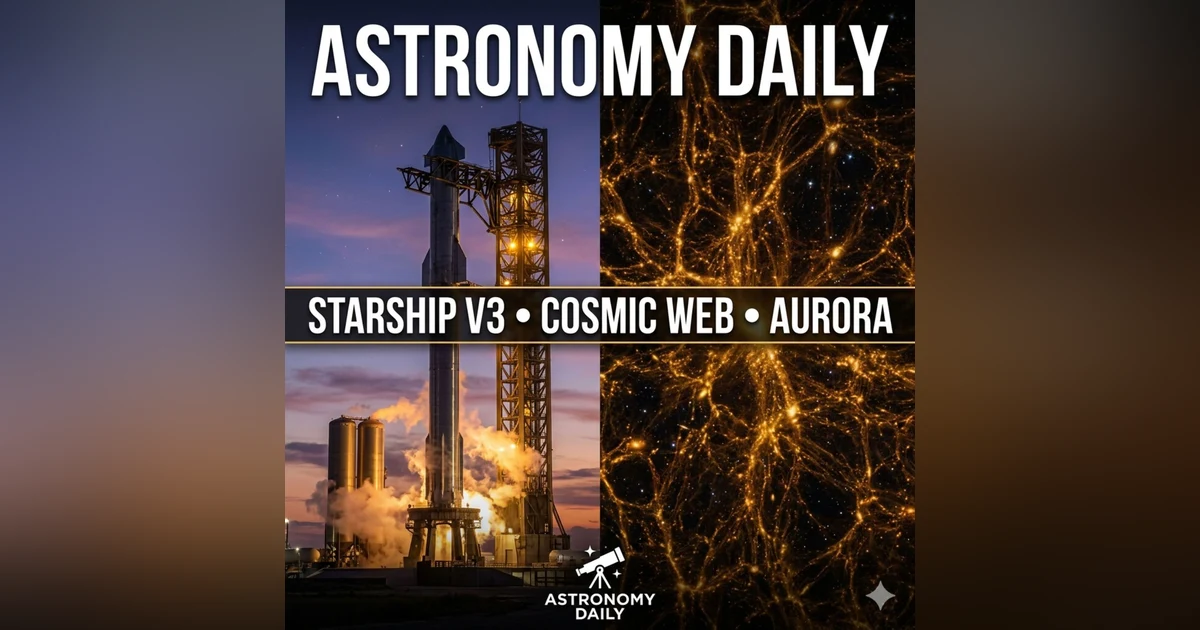
Sponsor Link: Our sponsor this week, NordVPN has put together a great money saving deal for you. Get the best protection for less. We use them and recommend them highly. To check out the details - https://bitesz.com/nordvpn Astronomy Daily — S05E102...
Sponsor Link:
Our sponsor this week, NordVPN has put together a great money saving deal for you. Get the best protection for less. We use them and recommend them highly. To check out the details - Click Here
Astronomy Daily — S05E102 | Thursday 14 May 2026 In today's episode, Anna and Avery cover six stories spanning the entire space science spectrum — from a record-breaking rocket debut to medieval literary theory. Stories in This Episode 1. Starship V3 Gets a Launch Date — SpaceX confirms May 19 for Flight 12, the debut of the fully redesigned Version 3 Starship and Super Heavy. 2. Psyche Mission: Mars Flyby Tomorrow — NASA's asteroid-bound spacecraft passes just 2,800 miles from Mars on May 15 for a crucial gravity assist. 3. JWST Maps the Cosmic Web — The James Webb Space Telescope charts 164,000 galaxies across 13.7 billion years in the most detailed cosmic web map ever made. 4. Aurora Watch: Coronal Hole Facing Earth — A large solar coronal hole is pointing at Earth; G2 storm conditions expected from May 15 with aurora potential for Southern Hemisphere observers. 5. Dante's Inferno and Impact Physics — New research presented at the European Geosciences Union argues Dante's 14th-century Hell maps the geometry of a planetary impact crater. 6. CRS-34: Dragon Docks at the ISS — After two weather scrubs, SpaceX's Dragon cargo capsule successfully delivers 6,500 lbs of science experiments to the space station. Chapter Timestamps 00:00 — Introduction & Headlines 01:00 — Starship V3: May 19 Launch Date Set 05:00 — NASA Psyche: Mars Gravity Assist Flyby 08:30 — JWST Maps the Cosmic Web 12:00 — Aurora Alert: Coronal Hole & Solar Wind 15:00 — Dante's Inferno as Impact Crater Science 18:30 — CRS-34 Dragon Docks at the ISS 21:30 — Skywatcher's Corner: Aurora Tips & Mars 23:00 — Trivia, Sign-Off & Socials Find us at astronomydaily.io | Follow @AstroDailyPod | Part of the Bitesz.com Podcast Network
Become a supporter of this podcast: https://www.spreaker.com/podcast/astronomy-daily-space-news-updates--5648921/support.
Sponsor Details:
Ensure your online privacy by using NordVPN. To get our special listener deal and save a lot of money, visit www.bitesz.com/nordvpn. You'll be glad you did!
Become a supporter of Astronomy Daily by joining our Supporters Club. Commercial free episodes daily are only a click way... Click Here
This episode includes AI-generated content.
Our sponsor this week, NordVPN has put together a great money saving deal for you. Get the best protection for less. We use them and recommend them highly. To check out the details - Click Here
Astronomy Daily — S05E102 | Thursday 14 May 2026 In today's episode, Anna and Avery cover six stories spanning the entire space science spectrum — from a record-breaking rocket debut to medieval literary theory. Stories in This Episode 1. Starship V3 Gets a Launch Date — SpaceX confirms May 19 for Flight 12, the debut of the fully redesigned Version 3 Starship and Super Heavy. 2. Psyche Mission: Mars Flyby Tomorrow — NASA's asteroid-bound spacecraft passes just 2,800 miles from Mars on May 15 for a crucial gravity assist. 3. JWST Maps the Cosmic Web — The James Webb Space Telescope charts 164,000 galaxies across 13.7 billion years in the most detailed cosmic web map ever made. 4. Aurora Watch: Coronal Hole Facing Earth — A large solar coronal hole is pointing at Earth; G2 storm conditions expected from May 15 with aurora potential for Southern Hemisphere observers. 5. Dante's Inferno and Impact Physics — New research presented at the European Geosciences Union argues Dante's 14th-century Hell maps the geometry of a planetary impact crater. 6. CRS-34: Dragon Docks at the ISS — After two weather scrubs, SpaceX's Dragon cargo capsule successfully delivers 6,500 lbs of science experiments to the space station. Chapter Timestamps 00:00 — Introduction & Headlines 01:00 — Starship V3: May 19 Launch Date Set 05:00 — NASA Psyche: Mars Gravity Assist Flyby 08:30 — JWST Maps the Cosmic Web 12:00 — Aurora Alert: Coronal Hole & Solar Wind 15:00 — Dante's Inferno as Impact Crater Science 18:30 — CRS-34 Dragon Docks at the ISS 21:30 — Skywatcher's Corner: Aurora Tips & Mars 23:00 — Trivia, Sign-Off & Socials Find us at astronomydaily.io | Follow @AstroDailyPod | Part of the Bitesz.com Podcast Network
Become a supporter of this podcast: https://www.spreaker.com/podcast/astronomy-daily-space-news-updates--5648921/support.
Sponsor Details:
Ensure your online privacy by using NordVPN. To get our special listener deal and save a lot of money, visit www.bitesz.com/nordvpn. You'll be glad you did!
Become a supporter of Astronomy Daily by joining our Supporters Club. Commercial free episodes daily are only a click way... Click Here
This episode includes AI-generated content.
WEBVTT
0
00:00:00.400 --> 00:00:02.960
Anna: Hello and welcome to Astronomy Daily,
1
00:00:03.120 --> 00:00:05.920
your daily guide to the Universe for Thursday
2
00:00:06.080 --> 00:00:08.880
the 14th of May, 2026.
3
00:00:09.280 --> 00:00:10.160
I'm Anna.
4
00:00:10.320 --> 00:00:12.810
Avery: And I'm Avery. Big show today, Anna. Uh,
5
00:00:12.960 --> 00:00:15.640
we've got a rocket about to make history, a
6
00:00:15.640 --> 00:00:18.600
spacecraft using Mars as a slingshot, and a
7
00:00:18.600 --> 00:00:20.720
medieval poet who may have accidentally
8
00:00:20.720 --> 00:00:23.040
written the world's first impact physics
9
00:00:23.040 --> 00:00:23.600
textbook.
10
00:00:24.080 --> 00:00:26.840
Anna: Coming up, SpaceX locks in a
11
00:00:26.840 --> 00:00:29.480
launch date for the most powerful version of
12
00:00:29.480 --> 00:00:32.370
Starship yet. NASA's Psyche
13
00:00:32.370 --> 00:00:35.250
probe is just hours away from its dramatic
14
00:00:35.250 --> 00:00:38.050
Mars flyby. The James Webb Space
15
00:00:38.050 --> 00:00:40.810
Telescope has delivered its clearest ever
16
00:00:40.810 --> 00:00:42.810
map of the universe's skeleton.
17
00:00:43.210 --> 00:00:45.970
Avery: Coming up, a large coronal hole is sending a
18
00:00:45.970 --> 00:00:48.850
surge of solar wind our way. Good news for
19
00:00:48.850 --> 00:00:51.130
Aurora watchers in the Southern Hemisphere.
20
00:00:51.370 --> 00:00:53.930
The Dragon cargo capsule has docked at the
21
00:00:53.930 --> 00:00:56.250
International Space Station after a week of
22
00:00:56.250 --> 00:00:58.670
weather delays. And we'll tell you why
23
00:00:58.670 --> 00:01:01.430
researchers are re reading Dante's Inferno
24
00:01:01.430 --> 00:01:03.670
through the eyes of a planetary scientist.
25
00:01:04.150 --> 00:01:06.470
Anna: Stay with us. It's all coming up on
26
00:01:06.470 --> 00:01:07.590
Astronomy Daily.
27
00:01:07.910 --> 00:01:08.390
Avery: Let's go.
28
00:01:08.390 --> 00:01:11.270
Anna: Then let's kick things off with a story that
29
00:01:11.270 --> 00:01:13.190
has the space community buzzing.
30
00:01:13.590 --> 00:01:16.230
SpaceX has officially announced the launch
31
00:01:16.230 --> 00:01:19.070
date for Starship Flight 12, and
32
00:01:19.070 --> 00:01:21.030
it is just five days away.
33
00:01:21.510 --> 00:01:24.270
Avery: That's right, May 19 is now the target
34
00:01:24.270 --> 00:01:26.950
for what may be the most anticipated rocket
35
00:01:26.950 --> 00:01:29.610
test of the decade. This isn't just any
36
00:01:29.610 --> 00:01:32.610
starship launch. Flight 12 will be the debut
37
00:01:32.610 --> 00:01:35.330
of Starship version 3, a thoroughly
38
00:01:35.330 --> 00:01:38.010
redesigned vehicle that SpaceX says has been
39
00:01:38.010 --> 00:01:40.730
rebuilt almost from the ground up for full
40
00:01:40.730 --> 00:01:42.250
and rapid reuse.
41
00:01:42.890 --> 00:01:45.890
Anna: So what's actually changed? Well, the super
42
00:01:45.890 --> 00:01:48.490
heavy booster now sports three grid
43
00:01:48.490 --> 00:01:51.490
fins instead of the original six. Those are
44
00:01:51.490 --> 00:01:53.890
the lattice like structures that help steer
45
00:01:53.890 --> 00:01:56.280
it back through the atmosphere. The whole
46
00:01:56.280 --> 00:01:58.920
vehicle is taller, heavier and more
47
00:01:58.920 --> 00:02:00.640
capable than its predecessors.
48
00:02:01.040 --> 00:02:03.320
Avery: The launch window opens at 6:30 in the
49
00:02:03.320 --> 00:02:06.200
evening Eastern Time. That's 8:30 the next
50
00:02:06.200 --> 00:02:08.720
morning here in Australia. On May 20th,
51
00:02:08.960 --> 00:02:11.760
it'll lift off from Starbase in South Texas.
52
00:02:12.000 --> 00:02:14.200
And um, importantly, this will be the very
53
00:02:14.200 --> 00:02:16.800
first launch from Starbase's second orbital
54
00:02:16.800 --> 00:02:17.520
launch pad.
55
00:02:18.000 --> 00:02:20.480
Anna: Now, because this is a brand new vehicle
56
00:02:20.480 --> 00:02:23.440
design, SpaceX won't be attempting to catch
57
00:02:23.440 --> 00:02:25.640
the super heavy booster back at the launch
58
00:02:25.640 --> 00:02:28.450
tower on this flight. Instead, both
59
00:02:28.450 --> 00:02:30.930
the booster and the upper stage, known as
60
00:02:30.930 --> 00:02:33.810
Ship, are targeting water landings. The
61
00:02:33.810 --> 00:02:36.690
booster aims for the Gulf of Mexico and Ship
62
00:02:36.690 --> 00:02:39.450
is targeting the Indian Ocean about 65
63
00:02:39.450 --> 00:02:40.930
minutes after liftoff.
64
00:02:41.170 --> 00:02:43.850
Avery: As for the payload, ship will carry 22
65
00:02:43.850 --> 00:02:46.210
dummy Starlink satellites on the same
66
00:02:46.210 --> 00:02:48.770
suborbital trajectory. And there's a clever
67
00:02:48.770 --> 00:02:51.450
experiment. The last two of those dummy
68
00:02:51.450 --> 00:02:54.050
satellites will actually scan Starship's heat
69
00:02:54.050 --> 00:02:56.450
shield and beam images back to mission
70
00:02:56.450 --> 00:02:58.620
controllers. They want to test whether they
71
00:02:58.620 --> 00:03:01.060
can remotely assess heat shield integrity
72
00:03:01.060 --> 00:03:01.860
from orbit.
73
00:03:02.180 --> 00:03:04.740
Anna: There's also a single Raptor engine
74
00:03:04.740 --> 00:03:07.420
relight planned in space, something that'll
75
00:03:07.420 --> 00:03:10.100
be essential for future operational missions.
76
00:03:10.420 --> 00:03:13.220
And SpaceX has deliberately removed one
77
00:03:13.300 --> 00:03:15.940
heat shield tile to measure how adjacent
78
00:03:15.940 --> 00:03:18.340
tiles behave under re entry stress when
79
00:03:18.340 --> 00:03:19.220
there's a gap.
80
00:03:19.700 --> 00:03:21.900
Avery: Full disclosure on the engineering nerves
81
00:03:21.900 --> 00:03:24.380
here. The previous version of this booster,
82
00:03:24.380 --> 00:03:27.140
called B18, was actually destroyed
83
00:03:27.140 --> 00:03:29.600
during ground testing late last year when its
84
00:03:29.600 --> 00:03:32.240
liquid oxygen tank imploded during a pressure
85
00:03:32.240 --> 00:03:35.240
test. B19 has had a much smoother
86
00:03:35.240 --> 00:03:38.160
road, passing three static fire tests in
87
00:03:38.160 --> 00:03:40.720
the last three months, including a, uh, full
88
00:03:40.800 --> 00:03:43.280
33 engine full duration burn.
89
00:03:43.760 --> 00:03:46.320
Anna: We will of course, be watching this one very
90
00:03:46.320 --> 00:03:48.760
closely. Mark your calendars May
91
00:03:48.760 --> 00:03:51.560
19th. We'll have full coverage in the next
92
00:03:51.560 --> 00:03:54.560
episode. Enormous stakes, enormous
93
00:03:54.560 --> 00:03:55.120
rocket.
94
00:03:55.560 --> 00:03:57.560
Avery: While everyone's eyes are on Starship next
95
00:03:57.560 --> 00:03:59.720
week, there's something happening tomorrow
96
00:03:59.720 --> 00:04:02.080
that deserves just as much attention, at
97
00:04:02.080 --> 00:04:04.800
least for the science crowd. NASA's Psyche
98
00:04:04.800 --> 00:04:07.640
spacecraft is about to use Mars as a cosmic
99
00:04:07.640 --> 00:04:08.360
slingshot.
100
00:04:08.680 --> 00:04:11.320
Anna: This is one of those elegantly clever
101
00:04:11.400 --> 00:04:14.000
things about orbital mechanics. The
102
00:04:14.000 --> 00:04:16.320
Psyche mission is ultimately headed for a
103
00:04:16.320 --> 00:04:18.760
metal rich asteroid, also called
104
00:04:18.760 --> 00:04:21.480
Psyche, out in the main asteroid belt
105
00:04:21.480 --> 00:04:24.470
between Mars and Jupiter. It launched back
106
00:04:24.470 --> 00:04:27.190
in October 2023, and it's been
107
00:04:27.190 --> 00:04:30.110
gradually building speed using its solar
108
00:04:30.110 --> 00:04:32.270
electric propulsion system ever since.
109
00:04:32.750 --> 00:04:35.510
Avery: But solar electric propulsion is quiet and
110
00:04:35.510 --> 00:04:38.350
efficient rather than fast. So to get the
111
00:04:38.350 --> 00:04:40.990
extra kick it needs, the team planned this
112
00:04:40.990 --> 00:04:43.870
Mars flyby from the very beginning. On
113
00:04:43.870 --> 00:04:46.790
May 15th. That's tomorrow, Psyche
114
00:04:46.790 --> 00:04:49.710
will pass just 2,800 miles from the Martian
115
00:04:49.710 --> 00:04:52.410
surface. That's closer than the orbit of
116
00:04:52.410 --> 00:04:54.290
Mars own moon, Phobos.
117
00:04:54.690 --> 00:04:56.530
Anna: And it'll be moving at over
118
00:04:56.610 --> 00:04:59.330
12,300 miles per hour,
119
00:04:59.650 --> 00:05:02.370
nearly 20,000 kilometers per hour.
120
00:05:02.850 --> 00:05:05.410
Mars's gravity will grab the spacecraft,
121
00:05:05.490 --> 00:05:08.450
whip it around and send it on its way faster
122
00:05:08.850 --> 00:05:11.290
and on a tilted trajectory that would have
123
00:05:11.290 --> 00:05:14.210
been prohibitively expensive to achieve with
124
00:05:14.210 --> 00:05:15.250
propellant alone.
125
00:05:15.730 --> 00:05:17.890
Avery: The mission team has been preparing for this
126
00:05:17.890 --> 00:05:20.440
for months. Back on February 23rd,
127
00:05:20.680 --> 00:05:23.280
they fired the spacecraft's thrusters for,
128
00:05:23.280 --> 00:05:25.840
uh, a full 12 hours to fine tune the
129
00:05:25.840 --> 00:05:28.040
approach. And since May 7th,
130
00:05:28.200 --> 00:05:30.760
Psyche has been sending back early images.
131
00:05:31.160 --> 00:05:33.800
First a distant star field, then a
132
00:05:33.800 --> 00:05:36.480
crescent shaped Mars, growing larger by the
133
00:05:36.480 --> 00:05:36.760
day.
134
00:05:37.160 --> 00:05:39.760
Anna: Those images aren't just pretty, they're
135
00:05:39.760 --> 00:05:42.440
functional. The imaging team is using this
136
00:05:42.440 --> 00:05:44.880
period to calibrate their cameras and
137
00:05:44.880 --> 00:05:46.880
practice the techniques they'll need when
138
00:05:46.880 --> 00:05:49.640
Psyche eventually arrives at the asteroid
139
00:05:49.640 --> 00:05:52.580
in late 20. It's essentially
140
00:05:52.580 --> 00:05:53.780
a dress rehearsal.
141
00:05:54.340 --> 00:05:56.820
Avery: One unique visual because Psyche is
142
00:05:56.820 --> 00:05:59.380
approaching from Mars's night side, the
143
00:05:59.380 --> 00:06:01.820
planet currently looks like a crescent, just
144
00:06:01.820 --> 00:06:04.700
a thin sliver of sunlight on the edge, very
145
00:06:04.700 --> 00:06:07.460
much like our own crescent Moon. After
146
00:06:07.460 --> 00:06:10.260
closest approach, mission controllers expect
147
00:06:10.260 --> 00:06:13.260
to see a near full Mars view. As the
148
00:06:13.260 --> 00:06:15.860
spacecraft swings around to confirm
149
00:06:15.860 --> 00:06:18.420
Anna: the flyby was successful, the team will
150
00:06:18.420 --> 00:06:21.140
monitor radio signals through NASA's Deep
151
00:06:21.140 --> 00:06:24.130
Space Network. And there's a bonus science
152
00:06:24.130 --> 00:06:26.730
objective, too. Psyche will use its
153
00:06:26.730 --> 00:06:29.330
instruments to search for any faint dust
154
00:06:29.330 --> 00:06:31.610
rings that might surround Mars
155
00:06:31.850 --> 00:06:34.530
created by micrometeorites striking
156
00:06:34.530 --> 00:06:35.210
Phobos
157
00:06:35.210 --> 00:06:37.610
Avery: and Deimos asteroid arrival
158
00:06:37.690 --> 00:06:40.450
2029 but tomorrow is a big
159
00:06:40.450 --> 00:06:42.730
milestone. We'll have the results in our next
160
00:06:42.730 --> 00:06:43.210
episode.
161
00:06:43.610 --> 00:06:46.490
Anna: Now for something that puts everything, and
162
00:06:46.490 --> 00:06:48.730
we mean everything, in perspective.
163
00:06:49.370 --> 00:06:52.170
Astronomers using the James Webb Telescope
164
00:06:52.250 --> 00:06:54.570
have produced what they're calling the most
165
00:06:54.570 --> 00:06:57.450
detailed map ever made of the cosmic
166
00:06:57.450 --> 00:06:57.850
web.
167
00:06:58.330 --> 00:07:00.930
Avery: The cosmic web is, well, it's the
168
00:07:00.930 --> 00:07:03.690
universe's skeleton. Imagine the largest
169
00:07:03.690 --> 00:07:06.610
structure that exists, a vast network of
170
00:07:06.610 --> 00:07:08.810
dark matter filaments and gas sheets
171
00:07:09.050 --> 00:07:11.610
interwoven across billions of light years,
172
00:07:11.770 --> 00:07:14.210
connecting galaxies and galaxy clusters
173
00:07:14.210 --> 00:07:16.520
together. Between those filaments are
174
00:07:16.520 --> 00:07:19.360
enormous, almost entirely empty regions
175
00:07:19.360 --> 00:07:21.960
called voids. That's the cosmic web.
176
00:07:22.280 --> 00:07:25.160
Anna: And now, for the first time, we have a
177
00:07:25.160 --> 00:07:28.000
truly detailed map of it, one
178
00:07:28.000 --> 00:07:30.160
that stretches all the way back to when the
179
00:07:30.160 --> 00:07:32.920
universe was only about 1 billion years
180
00:07:32.920 --> 00:07:35.760
old. The research was led by a team at
181
00:07:35.760 --> 00:07:38.280
the University of California, Riverside,
182
00:07:38.520 --> 00:07:41.120
using what's known as the Cosmos Web
183
00:07:41.120 --> 00:07:44.100
Survey, the single largest observing program
184
00:07:44.100 --> 00:07:45.940
that Webb has ever conducted.
185
00:07:46.420 --> 00:07:48.540
Avery: The map charts the positions of over
186
00:07:48.540 --> 00:07:50.980
164,000 galaxies
187
00:07:51.220 --> 00:07:54.020
plotted across 13.7 billion
188
00:07:54.180 --> 00:07:56.900
years of cosmic history. Think about that
189
00:07:57.060 --> 00:07:59.300
A map of 164,000
190
00:07:59.460 --> 00:08:02.380
galaxies spread across nearly the entire age
191
00:08:02.380 --> 00:08:04.500
of the universe. Published in the
192
00:08:04.500 --> 00:08:05.700
Astrophysical Journal.
193
00:08:06.180 --> 00:08:08.540
Anna: What makes this such a leap forward is
194
00:08:08.540 --> 00:08:11.490
precision. Webb's infrared instruments can
195
00:08:11.490 --> 00:08:13.650
detect galaxies that were completely
196
00:08:13.650 --> 00:08:16.530
invisible to older telescopes and can
197
00:08:16.530 --> 00:08:18.690
measure their distances with far greater
198
00:08:18.690 --> 00:08:21.450
accuracy. That's what allows you to place
199
00:08:21.450 --> 00:08:24.210
each galaxy precisely in its cosmic
200
00:08:24.210 --> 00:08:26.810
context, rather than just knowing roughly
201
00:08:26.810 --> 00:08:27.570
where it sits.
202
00:08:28.130 --> 00:08:30.650
Avery: The lead author, Jose Hatamnia, a
203
00:08:30.650 --> 00:08:33.490
graduate student at UC Riverside, put it this
204
00:08:34.050 --> 00:08:36.770
for the first time, scientists can study how
205
00:08:36.770 --> 00:08:39.010
galaxies evolve within cluster and
206
00:08:39.010 --> 00:08:41.589
filamentary structures across of
207
00:08:41.589 --> 00:08:44.269
cosmic time, from the universe's infancy
208
00:08:44.349 --> 00:08:45.709
right up to the present day.
209
00:08:46.109 --> 00:08:48.909
Anna: And the images from this map are genuinely
210
00:08:48.909 --> 00:08:51.869
beautiful. The dense clusters and filaments
211
00:08:51.869 --> 00:08:53.669
show up as bright yellow in the
212
00:08:53.669 --> 00:08:56.269
visualizations. The voids are dark,
213
00:08:56.509 --> 00:08:59.309
great sweeping emptiness between the cosmic
214
00:08:59.309 --> 00:09:01.949
threads. It really does look like a web.
215
00:09:02.349 --> 00:09:04.509
Avery: The implications reach well beyond
216
00:09:04.509 --> 00:09:07.309
aesthetics. Understanding how the cosmic
217
00:09:07.309 --> 00:09:10.229
web formed and evolved over time is key to
218
00:09:10.229 --> 00:09:12.629
understanding why galaxies look the way they
219
00:09:12.629 --> 00:09:15.330
do today, why some are large spirals, others
220
00:09:15.330 --> 00:09:18.170
are elliptical, others are irregular, and
221
00:09:18.170 --> 00:09:20.450
how dark matter has shaped the universe we
222
00:09:20.450 --> 00:09:20.890
live in.
223
00:09:21.370 --> 00:09:23.890
Anna: One of the most stunning results from the
224
00:09:23.890 --> 00:09:26.890
cosmos Webb data is that the cosmic web
225
00:09:26.890 --> 00:09:29.130
appears to have been in place much earlier
226
00:09:29.289 --> 00:09:31.770
than some models predicted, meaning the
227
00:09:31.770 --> 00:09:34.330
universe organized itself into this vast
228
00:09:34.330 --> 00:09:37.050
structure surprisingly quickly after the Big
229
00:09:37.050 --> 00:09:37.530
Bang.
230
00:09:37.930 --> 00:09:40.850
Avery: Webb continues to rewrite the textbooks. This
231
00:09:40.850 --> 00:09:42.170
one is a landmark result.
232
00:09:42.840 --> 00:09:45.200
Anna: Time now for a quick reminder to check out
233
00:09:45.200 --> 00:09:47.320
the great deal our UH, sponsor this week
234
00:09:47.320 --> 00:09:50.200
NORDVPN has put together for our listeners.
235
00:09:50.520 --> 00:09:53.200
Get the best in online security for not a lot
236
00:09:53.200 --> 00:09:55.560
of money. The savings are that good.
237
00:09:55.880 --> 00:09:58.000
Check out the details by following the link
238
00:09:58.000 --> 00:10:00.720
in the show notes. Only the best is good
239
00:10:00.720 --> 00:10:03.400
enough and that's why we use NORDVPN
240
00:10:03.560 --> 00:10:06.320
and so should you. Again, link in the show
241
00:10:06.320 --> 00:10:06.760
notes.
242
00:10:07.160 --> 00:10:09.560
Avery: Alright, let's get back to today's space and
243
00:10:09.560 --> 00:10:10.520
astronomy news.
244
00:10:11.170 --> 00:10:13.330
Anna: Now for something that Southern Hemisphere
245
00:10:13.330 --> 00:10:15.410
listeners may want to keep an eye on this
246
00:10:15.410 --> 00:10:18.170
weekend our sun has been busy and the
247
00:10:18.170 --> 00:10:20.850
results could mean auroras for sky watchers
248
00:10:20.850 --> 00:10:23.570
across Australia, New Zealand and southern
249
00:10:23.570 --> 00:10:24.450
South America.
250
00:10:24.770 --> 00:10:27.690
Avery: A large coronal hole has rotated into what's
251
00:10:27.690 --> 00:10:30.210
called a ah, geoffective position, meaning
252
00:10:30.210 --> 00:10:32.970
it's pointing directly at Earth. Coronal
253
00:10:32.970 --> 00:10:34.970
holes are regions in the Sun's outer
254
00:10:34.970 --> 00:10:37.130
atmosphere where the magnetic field opens
255
00:10:37.130 --> 00:10:39.810
outward into space rather than looping back,
256
00:10:40.410 --> 00:10:42.730
allowing a fast stream of solar wind to
257
00:10:42.730 --> 00:10:44.730
escape directly into the solar system.
258
00:10:45.210 --> 00:10:48.170
Anna: This particular coronal hole is both large
259
00:10:48.250 --> 00:10:50.890
and positioned right at the solar equator,
260
00:10:50.970 --> 00:10:53.650
which means the high speed solar wind stream
261
00:10:53.650 --> 00:10:56.049
it produces is aimed squarely in our
262
00:10:56.049 --> 00:10:58.850
direction. That stream is expected to begin
263
00:10:58.850 --> 00:11:01.570
reaching Earth on Friday, which is tomorrow.
264
00:11:01.570 --> 00:11:04.410
Avery: Our time base weather forecasters have
265
00:11:04.410 --> 00:11:07.007
issued a uh, G2 moderate geomagnetic
266
00:11:07.142 --> 00:11:09.514
storm watch for Friday the 15th.
267
00:11:09.666 --> 00:11:12.630
G2 conditions are significant enough to push
268
00:11:12.630 --> 00:11:15.150
aurora visibility well beyond the polar
269
00:11:15.150 --> 00:11:17.750
circles. For Southern Hemisphere observers,
270
00:11:17.750 --> 00:11:20.470
that means southern Australia, Tasmania and
271
00:11:20.470 --> 00:11:22.310
New Zealand could all be in play.
272
00:11:22.790 --> 00:11:25.510
Anna: There's also a separate, slightly earlier
273
00:11:25.510 --> 00:11:27.870
event to watch, a coronal mass
274
00:11:27.870 --> 00:11:30.870
ejection. A blob of solar plasma was
275
00:11:30.870 --> 00:11:32.950
launched on May 10 during an M
276
00:11:32.950 --> 00:11:35.646
M5.7 flare from Active
277
00:11:35.800 --> 00:11:38.750
Region 4436. That CME
278
00:11:38.910 --> 00:11:41.630
may deliver a, uh, glancing blow today or
279
00:11:41.630 --> 00:11:44.190
tomorrow, potentially adding some extra
280
00:11:44.190 --> 00:11:46.790
activity before the main solar wind stream
281
00:11:46.790 --> 00:11:47.150
arrives.
282
00:11:47.710 --> 00:11:49.470
Avery: So what should you do if you want to catch
283
00:11:49.470 --> 00:11:52.110
the show? Tonight and Friday night are your
284
00:11:52.110 --> 00:11:54.830
best windows? Get away from city lights, find
285
00:11:54.830 --> 00:11:56.950
the clear southern horizon and check the
286
00:11:56.950 --> 00:11:59.310
Bureau of Meteorology's Space Weather Alert
287
00:11:59.310 --> 00:12:02.110
page or apps like space weather live for
288
00:12:02.110 --> 00:12:05.080
real time, KP Index updates. If it hits
289
00:12:05.080 --> 00:12:07.200
KP5 or above, look south.
290
00:12:07.680 --> 00:12:09.760
Anna: Clear skies and fingers crossed.
291
00:12:09.760 --> 00:12:11.640
For those of you hoping to see the Southern
292
00:12:11.640 --> 00:12:13.880
lights this weekend, now for
293
00:12:13.880 --> 00:12:16.320
Avery: something a little different. What if one of
294
00:12:16.320 --> 00:12:18.720
the greatest works of medieval literature was
295
00:12:18.720 --> 00:12:21.720
also accidentally a, uh, reasonably accurate
296
00:12:21.720 --> 00:12:24.240
description of a planetary impact event?
297
00:12:24.800 --> 00:12:27.240
Anna: That is the argument being put forward by
298
00:12:27.240 --> 00:12:29.880
Timothy Burberry, a professor at Marshall
299
00:12:29.880 --> 00:12:32.320
University in West Virginia, in research
300
00:12:32.400 --> 00:12:35.320
presented at the European Geosciences Union
301
00:12:35.320 --> 00:12:37.580
General assembly in Vienna earlier this
302
00:12:37.580 --> 00:12:39.980
month. And once you hear it, it's
303
00:12:39.980 --> 00:12:42.220
genuinely hard to unthink.
304
00:12:42.780 --> 00:12:45.700
Avery: So, the basics. Dante Alighetti wrote
305
00:12:45.700 --> 00:12:48.420
the Divine Comedy in the early 1300s.
306
00:12:48.420 --> 00:12:51.340
That's the 1300s. The inferno is the
307
00:12:51.340 --> 00:12:53.260
first part of that work. And it describes
308
00:12:53.260 --> 00:12:55.820
Hell as an inverted conical pit beneath
309
00:12:55.820 --> 00:12:58.380
Jerusalem. Nine concentric circles
310
00:12:58.380 --> 00:13:00.900
descending downward to a frozen core where
311
00:13:00.900 --> 00:13:01.820
Satan is trapped.
312
00:13:02.690 --> 00:13:05.370
Anna: Now, for seven centuries, readers have
313
00:13:05.370 --> 00:13:08.050
interpreted this as spiritual allegory,
314
00:13:08.290 --> 00:13:11.090
pure and simple. Satan fell from
315
00:13:11.090 --> 00:13:13.210
heaven and was imprisoned at the Earth's
316
00:13:13.210 --> 00:13:16.050
center. Mount Purgatory was created on
317
00:13:16.050 --> 00:13:18.169
the opposite side of the globe from the
318
00:13:18.169 --> 00:13:20.850
displaced Earth. Vivid imagery,
319
00:13:20.930 --> 00:13:23.330
profound theology, end of story.
320
00:13:23.810 --> 00:13:26.490
Avery: Or so everyone thought. Burberry's
321
00:13:26.490 --> 00:13:28.330
argument is that if you strip away the
322
00:13:28.330 --> 00:13:30.970
religious symbolism and look at what Dante is
323
00:13:30.970 --> 00:13:33.330
actually describing as a physical event,
324
00:13:34.050 --> 00:13:36.410
it maps remarkably well onto the structure of
325
00:13:36.410 --> 00:13:38.050
a complex impact crater.
326
00:13:38.530 --> 00:13:41.370
Anna: In his interpretation, Satan acts as
327
00:13:41.370 --> 00:13:43.890
a high velocity impactor, an
328
00:13:43.890 --> 00:13:46.770
asteroid sized object striking the southern
329
00:13:46.770 --> 00:13:48.850
hemisphere at tremendous speed,
330
00:13:49.090 --> 00:13:51.570
drilling through the crust to the Earth's
331
00:13:51.570 --> 00:13:54.490
core. The nine circles of Hell. They
332
00:13:54.490 --> 00:13:57.250
closely resemble the concentric terraced
333
00:13:57.250 --> 00:13:59.890
rings that large impacts create as
334
00:13:59.890 --> 00:14:02.680
shockwaves propagate outward, the same
335
00:14:02.680 --> 00:14:05.640
structures you see in major impact basins
336
00:14:05.640 --> 00:14:07.200
on the Moon and Venus.
337
00:14:07.600 --> 00:14:10.200
Avery: The specific comparison Burberry makes is to
338
00:14:10.200 --> 00:14:13.200
the Chicxulub impact, The asteroid strike
339
00:14:13.200 --> 00:14:15.760
66 million years ago that ended the age of
340
00:14:15.760 --> 00:14:18.200
the dinosaurs and left the 150
341
00:14:18.200 --> 00:14:20.680
kilometer crater beneath what is now the Gulf
342
00:14:20.680 --> 00:14:23.400
of Mexico. Chicxulub is one of the best
343
00:14:23.400 --> 00:14:25.760
studied complex impact structures on Earth.
344
00:14:26.000 --> 00:14:28.610
And its internal geometry, peak
345
00:14:28.610 --> 00:14:31.170
rings, terraced walls, central basin,
346
00:14:31.570 --> 00:14:33.410
mirrors what Dante described.
347
00:14:34.050 --> 00:14:36.930
Anna: Mount Purgatory rising on the opposite
348
00:14:36.930 --> 00:14:39.250
side of the globe. That would be the central
349
00:14:39.410 --> 00:14:42.130
peak, or in some large impacts, an
350
00:14:42.130 --> 00:14:45.130
antipodal feature, a mountain created by
351
00:14:45.130 --> 00:14:47.490
the focused seismic energy of the impact
352
00:14:47.890 --> 00:14:50.370
converging on the far side of the planet.
353
00:14:50.530 --> 00:14:53.390
Avery: It's a real phenomenon now, and, um,
354
00:14:53.410 --> 00:14:56.240
this is important. Burberry is not claiming
355
00:14:56.240 --> 00:14:58.600
that Dante had secret knowledge of impact
356
00:14:58.680 --> 00:15:01.040
physics. He's proposing something more
357
00:15:01.040 --> 00:15:03.360
interesting than that, that Dante
358
00:15:03.360 --> 00:15:05.720
intuitively applied the best physics
359
00:15:05.720 --> 00:15:08.680
available to him in the 14th century to think
360
00:15:08.680 --> 00:15:11.120
through what a catastrophic fall from heaven
361
00:15:11.120 --> 00:15:14.000
would look like as a real physical event. And
362
00:15:14.000 --> 00:15:16.400
in doing so, he stumbled into something that
363
00:15:16.400 --> 00:15:18.360
looks a lot like what we now know about
364
00:15:18.440 --> 00:15:19.560
impact craters.
365
00:15:20.130 --> 00:15:22.410
Anna: The research was presented under the flag of
366
00:15:22.410 --> 00:15:24.370
what Burberry calls literary
367
00:15:24.450 --> 00:15:27.450
geomythology, the idea that ancient
368
00:15:27.450 --> 00:15:30.090
texts and myths sometimes preserve
369
00:15:30.090 --> 00:15:33.090
intuitions about natural phenomena long
370
00:15:33.090 --> 00:15:35.889
before science has the tools to formally
371
00:15:35.889 --> 00:15:38.610
describe them. The nine Circles of Hell
372
00:15:38.610 --> 00:15:41.010
as Multi Ring Impact Basin
373
00:15:41.250 --> 00:15:43.730
Satan as Oblong Asteroid
374
00:15:44.050 --> 00:15:45.090
it's quite a thought.
375
00:15:45.820 --> 00:15:48.260
Avery: The Divine Comedy simultaneously one of
376
00:15:48.260 --> 00:15:50.780
history's greatest literary achievements, and
377
00:15:50.780 --> 00:15:53.140
apparently a geophysical thought
378
00:15:53.140 --> 00:15:53.900
experiment.
379
00:15:54.060 --> 00:15:56.820
Anna: Who knew Wrapping up our main stories
380
00:15:56.820 --> 00:15:59.140
today with an update to a mission we've been
381
00:15:59.140 --> 00:16:02.020
following this week. After not one but
382
00:16:02.020 --> 00:16:05.020
two weather scrubs, the SpaceX Dragon
383
00:16:05.020 --> 00:16:07.500
cargo capsule for NASA's CRS
384
00:16:07.500 --> 00:16:10.420
34 mission has successfully docked with
385
00:16:10.420 --> 00:16:12.140
the International Space Station.
386
00:16:12.800 --> 00:16:14.680
Avery: The launch finally got off the ground from
387
00:16:14.680 --> 00:16:17.160
Cape Canaveral on Wednesday evening. After
388
00:16:17.160 --> 00:16:19.560
scrubs on both Tuesday and Wednesday due to
389
00:16:19.560 --> 00:16:22.320
weather, Dragon arrived at the ISS today,
390
00:16:22.400 --> 00:16:25.240
May 14, docking autonomously to the
391
00:16:25.240 --> 00:16:27.120
forward port of the Harmony Module.
392
00:16:27.440 --> 00:16:29.760
Anna: On board about 6,500
393
00:16:29.920 --> 00:16:32.480
pounds, roughly 2,950
394
00:16:32.480 --> 00:16:34.880
kilograms of science experiments,
395
00:16:34.960 --> 00:16:37.640
supplies and hardware for the expedition's
396
00:16:37.640 --> 00:16:40.620
74 crew. BASA astronaut Jack
397
00:16:40.620 --> 00:16:43.140
Hathaway and ESA astronaut Sophie
398
00:16:43.140 --> 00:16:46.100
Adenow were on duty to monitor Dragon's
399
00:16:46.100 --> 00:16:47.260
approach and docking.
400
00:16:47.660 --> 00:16:49.900
Avery: Now, some of that cargo is genuinely
401
00:16:49.900 --> 00:16:52.900
fascinating. One investigation, called Green
402
00:16:52.900 --> 00:16:55.900
Bone, involves a scaffold made from wood that
403
00:16:55.900 --> 00:16:57.860
researchers believe could be used to help
404
00:16:57.860 --> 00:17:00.660
grow bone cells in microgravity. The
405
00:17:00.660 --> 00:17:02.900
goal is to develop new treatments for bone
406
00:17:02.900 --> 00:17:05.230
fragility conditions, particularly
407
00:17:05.230 --> 00:17:08.230
osteoporosis Wood derived growing
408
00:17:08.230 --> 00:17:09.430
bone in space.
409
00:17:09.990 --> 00:17:12.710
Anna: There's also the ODESSI study, which is
410
00:17:12.710 --> 00:17:15.670
testing how accurately Earth based simulators
411
00:17:15.670 --> 00:17:18.270
can replicate actual microgravity
412
00:17:18.270 --> 00:17:20.710
conditions. Scientists will compare
413
00:17:20.710 --> 00:17:23.190
bacteria behavior in true space
414
00:17:23.190 --> 00:17:25.990
conditions against results from ground based
415
00:17:25.990 --> 00:17:28.910
labs, and if the data differs, it
416
00:17:28.910 --> 00:17:30.830
could mean some of our ground based
417
00:17:30.830 --> 00:17:33.590
conclusions about microgravity biology
418
00:17:33.670 --> 00:17:34.790
need to be revised.
419
00:17:35.520 --> 00:17:38.320
Avery: And a third investigation is looking at how
420
00:17:38.320 --> 00:17:41.200
red blood cells and the spleen change
421
00:17:41.200 --> 00:17:44.120
in the space environment, crucial data for
422
00:17:44.120 --> 00:17:46.360
protecting the health of astronauts on long
423
00:17:46.360 --> 00:17:48.960
duration missions to the moon and eventually
424
00:17:49.120 --> 00:17:49.600
Mars.
425
00:17:50.080 --> 00:17:52.160
Anna: This Dragon capsule known as
426
00:17:52.160 --> 00:17:55.080
C209 is actually making its
427
00:17:55.080 --> 00:17:58.040
sixth flight to the ISS. That's a record for
428
00:17:58.040 --> 00:18:00.800
a SpaceX cargo craft and a sign of just
429
00:18:00.800 --> 00:18:03.360
how reliably reusable these vehicles have
430
00:18:03.360 --> 00:18:05.950
become. It's expected to stay at the station
431
00:18:05.950 --> 00:18:08.270
for about a month before returning to Earth
432
00:18:08.270 --> 00:18:11.110
with completed experiments splashing down off
433
00:18:11.110 --> 00:18:13.150
the coast of California in mid June.
434
00:18:13.790 --> 00:18:16.630
Avery: Despite the weather delays, CRS 34
435
00:18:16.630 --> 00:18:19.310
is on its way. Science is being done.
436
00:18:19.550 --> 00:18:20.670
Good news all round.
437
00:18:21.230 --> 00:18:23.950
Anna: Time now for your Sky Watcher's Corner, our
438
00:18:23.950 --> 00:18:26.110
weekly guide to what's worth looking for in
439
00:18:26.110 --> 00:18:28.630
the night sky. And this week, Avery, we've
440
00:18:28.630 --> 00:18:30.110
got a very timely one.
441
00:18:30.680 --> 00:18:33.400
Avery: We do. As we mentioned in story four,
442
00:18:33.480 --> 00:18:36.120
there is a real chance of aurora activity
443
00:18:36.120 --> 00:18:38.040
this weekend for the Southern Hemisphere
444
00:18:38.040 --> 00:18:40.080
observers with a, uh, G2
445
00:18:40.080 --> 00:18:42.840
geomagnetic storm watch in effect from Friday
446
00:18:42.840 --> 00:18:45.400
the 15th. The Southern Lights, the
447
00:18:45.400 --> 00:18:48.200
Aurora Australis could be visible from
448
00:18:48.200 --> 00:18:50.880
southern Australia, Tasmania and New
449
00:18:50.880 --> 00:18:51.320
Zealand.
450
00:18:52.760 --> 00:18:55.080
Anna: The best viewing is away from city light
451
00:18:55.080 --> 00:18:57.760
pollution with a clear, unobstructed southern
452
00:18:57.760 --> 00:19:00.740
Horizon. Check the KP index. If it
453
00:19:00.740 --> 00:19:03.020
reaches 5 or higher, you're in business.
454
00:19:03.420 --> 00:19:06.180
Apps like Space Weather Live and my Aurora
455
00:19:06.180 --> 00:19:09.180
Forecast give real time updates. Bundle up,
456
00:19:09.180 --> 00:19:10.780
be patient and look south.
457
00:19:11.340 --> 00:19:13.420
Avery: And while you're out there Friday evening,
458
00:19:13.580 --> 00:19:16.340
remember that just hours earlier, NASA's
459
00:19:16.340 --> 00:19:18.620
Psyche spacecraft will have completed its
460
00:19:18.620 --> 00:19:21.580
Mars flyby, slingshotting around the red
461
00:19:21.580 --> 00:19:23.900
planet on its way to a metal asteroid.
462
00:19:24.550 --> 00:19:27.430
Mars itself is in the pre dawn sky this week
463
00:19:27.430 --> 00:19:30.390
near Saturn. Early risers can catch both
464
00:19:30.390 --> 00:19:32.630
as the sky lightens before sunrise.
465
00:19:32.950 --> 00:19:35.430
Anna: A weekend of space events right on our
466
00:19:35.430 --> 00:19:36.950
doorstep. Don't miss it.
467
00:19:37.350 --> 00:19:39.270
Avery: That's everything from us for this Thursday
468
00:19:39.350 --> 00:19:42.310
edition of Astronomy Daily. What a show.
469
00:19:42.790 --> 00:19:45.110
Starship V3 on the launch pad.
470
00:19:45.270 --> 00:19:47.790
Psyche swinging past Mars. The
471
00:19:47.790 --> 00:19:50.790
universe's skeleton mapped in unprecedented
472
00:19:50.790 --> 00:19:53.380
detail. Aurora alerts for the Southern
473
00:19:53.380 --> 00:19:56.100
Hemisphere. Dante moonlighting as an
474
00:19:56.100 --> 00:19:59.020
impact physicist and Dragon safely
475
00:19:59.020 --> 00:19:59.860
at the station.
476
00:20:00.340 --> 00:20:03.140
Anna: Before we go, a quick trivia. The
477
00:20:03.140 --> 00:20:05.860
Chicxulub impact crater, the one that helped
478
00:20:05.860 --> 00:20:08.420
end the dinosaurs 66 million years ago,
479
00:20:08.580 --> 00:20:11.100
is buried beneath the Gulf of Mexico and the
480
00:20:11.100 --> 00:20:13.220
Yucatan peninsula. At roughly
481
00:20:13.220 --> 00:20:15.940
150km across, it's one of the
482
00:20:15.940 --> 00:20:18.580
largest confirmed impact structures on Earth.
483
00:20:18.940 --> 00:20:21.500
And now possibly in medieval Italian
484
00:20:21.500 --> 00:20:22.060
poetry.
485
00:20:22.540 --> 00:20:24.740
Avery: Links to everything we've covered today are
486
00:20:24.740 --> 00:20:27.660
in the show Notes. Find us at astronomydaily
487
00:20:27.980 --> 00:20:30.380
IO and follow us on social media
488
00:20:30.620 --> 00:20:33.460
astrodaily pod. And if you enjoy the
489
00:20:33.460 --> 00:20:35.660
show, please leave us a rating and a review.
490
00:20:35.820 --> 00:20:38.220
It genuinely helps new listeners find us.
491
00:20:38.620 --> 00:20:41.420
Anna: From all of us here at Astronomy Daily, keep
492
00:20:41.420 --> 00:20:43.900
looking up clear skies and we'll see you
493
00:20:43.900 --> 00:20:44.460
tomorrow.
494
00:20:45.020 --> 00:20:46.300
Avery: I saw every day
495
00:20:47.740 --> 00:20:49.180
the stories be told.
496
00:20:55.980 --> 00:20:56.540
Stories.
0
00:00:00.400 --> 00:00:02.960
Anna: Hello and welcome to Astronomy Daily,
1
00:00:03.120 --> 00:00:05.920
your daily guide to the Universe for Thursday
2
00:00:06.080 --> 00:00:08.880
the 14th of May, 2026.
3
00:00:09.280 --> 00:00:10.160
I'm Anna.
4
00:00:10.320 --> 00:00:12.810
Avery: And I'm Avery. Big show today, Anna. Uh,
5
00:00:12.960 --> 00:00:15.640
we've got a rocket about to make history, a
6
00:00:15.640 --> 00:00:18.600
spacecraft using Mars as a slingshot, and a
7
00:00:18.600 --> 00:00:20.720
medieval poet who may have accidentally
8
00:00:20.720 --> 00:00:23.040
written the world's first impact physics
9
00:00:23.040 --> 00:00:23.600
textbook.
10
00:00:24.080 --> 00:00:26.840
Anna: Coming up, SpaceX locks in a
11
00:00:26.840 --> 00:00:29.480
launch date for the most powerful version of
12
00:00:29.480 --> 00:00:32.370
Starship yet. NASA's Psyche
13
00:00:32.370 --> 00:00:35.250
probe is just hours away from its dramatic
14
00:00:35.250 --> 00:00:38.050
Mars flyby. The James Webb Space
15
00:00:38.050 --> 00:00:40.810
Telescope has delivered its clearest ever
16
00:00:40.810 --> 00:00:42.810
map of the universe's skeleton.
17
00:00:43.210 --> 00:00:45.970
Avery: Coming up, a large coronal hole is sending a
18
00:00:45.970 --> 00:00:48.850
surge of solar wind our way. Good news for
19
00:00:48.850 --> 00:00:51.130
Aurora watchers in the Southern Hemisphere.
20
00:00:51.370 --> 00:00:53.930
The Dragon cargo capsule has docked at the
21
00:00:53.930 --> 00:00:56.250
International Space Station after a week of
22
00:00:56.250 --> 00:00:58.670
weather delays. And we'll tell you why
23
00:00:58.670 --> 00:01:01.430
researchers are re reading Dante's Inferno
24
00:01:01.430 --> 00:01:03.670
through the eyes of a planetary scientist.
25
00:01:04.150 --> 00:01:06.470
Anna: Stay with us. It's all coming up on
26
00:01:06.470 --> 00:01:07.590
Astronomy Daily.
27
00:01:07.910 --> 00:01:08.390
Avery: Let's go.
28
00:01:08.390 --> 00:01:11.270
Anna: Then let's kick things off with a story that
29
00:01:11.270 --> 00:01:13.190
has the space community buzzing.
30
00:01:13.590 --> 00:01:16.230
SpaceX has officially announced the launch
31
00:01:16.230 --> 00:01:19.070
date for Starship Flight 12, and
32
00:01:19.070 --> 00:01:21.030
it is just five days away.
33
00:01:21.510 --> 00:01:24.270
Avery: That's right, May 19 is now the target
34
00:01:24.270 --> 00:01:26.950
for what may be the most anticipated rocket
35
00:01:26.950 --> 00:01:29.610
test of the decade. This isn't just any
36
00:01:29.610 --> 00:01:32.610
starship launch. Flight 12 will be the debut
37
00:01:32.610 --> 00:01:35.330
of Starship version 3, a thoroughly
38
00:01:35.330 --> 00:01:38.010
redesigned vehicle that SpaceX says has been
39
00:01:38.010 --> 00:01:40.730
rebuilt almost from the ground up for full
40
00:01:40.730 --> 00:01:42.250
and rapid reuse.
41
00:01:42.890 --> 00:01:45.890
Anna: So what's actually changed? Well, the super
42
00:01:45.890 --> 00:01:48.490
heavy booster now sports three grid
43
00:01:48.490 --> 00:01:51.490
fins instead of the original six. Those are
44
00:01:51.490 --> 00:01:53.890
the lattice like structures that help steer
45
00:01:53.890 --> 00:01:56.280
it back through the atmosphere. The whole
46
00:01:56.280 --> 00:01:58.920
vehicle is taller, heavier and more
47
00:01:58.920 --> 00:02:00.640
capable than its predecessors.
48
00:02:01.040 --> 00:02:03.320
Avery: The launch window opens at 6:30 in the
49
00:02:03.320 --> 00:02:06.200
evening Eastern Time. That's 8:30 the next
50
00:02:06.200 --> 00:02:08.720
morning here in Australia. On May 20th,
51
00:02:08.960 --> 00:02:11.760
it'll lift off from Starbase in South Texas.
52
00:02:12.000 --> 00:02:14.200
And um, importantly, this will be the very
53
00:02:14.200 --> 00:02:16.800
first launch from Starbase's second orbital
54
00:02:16.800 --> 00:02:17.520
launch pad.
55
00:02:18.000 --> 00:02:20.480
Anna: Now, because this is a brand new vehicle
56
00:02:20.480 --> 00:02:23.440
design, SpaceX won't be attempting to catch
57
00:02:23.440 --> 00:02:25.640
the super heavy booster back at the launch
58
00:02:25.640 --> 00:02:28.450
tower on this flight. Instead, both
59
00:02:28.450 --> 00:02:30.930
the booster and the upper stage, known as
60
00:02:30.930 --> 00:02:33.810
Ship, are targeting water landings. The
61
00:02:33.810 --> 00:02:36.690
booster aims for the Gulf of Mexico and Ship
62
00:02:36.690 --> 00:02:39.450
is targeting the Indian Ocean about 65
63
00:02:39.450 --> 00:02:40.930
minutes after liftoff.
64
00:02:41.170 --> 00:02:43.850
Avery: As for the payload, ship will carry 22
65
00:02:43.850 --> 00:02:46.210
dummy Starlink satellites on the same
66
00:02:46.210 --> 00:02:48.770
suborbital trajectory. And there's a clever
67
00:02:48.770 --> 00:02:51.450
experiment. The last two of those dummy
68
00:02:51.450 --> 00:02:54.050
satellites will actually scan Starship's heat
69
00:02:54.050 --> 00:02:56.450
shield and beam images back to mission
70
00:02:56.450 --> 00:02:58.620
controllers. They want to test whether they
71
00:02:58.620 --> 00:03:01.060
can remotely assess heat shield integrity
72
00:03:01.060 --> 00:03:01.860
from orbit.
73
00:03:02.180 --> 00:03:04.740
Anna: There's also a single Raptor engine
74
00:03:04.740 --> 00:03:07.420
relight planned in space, something that'll
75
00:03:07.420 --> 00:03:10.100
be essential for future operational missions.
76
00:03:10.420 --> 00:03:13.220
And SpaceX has deliberately removed one
77
00:03:13.300 --> 00:03:15.940
heat shield tile to measure how adjacent
78
00:03:15.940 --> 00:03:18.340
tiles behave under re entry stress when
79
00:03:18.340 --> 00:03:19.220
there's a gap.
80
00:03:19.700 --> 00:03:21.900
Avery: Full disclosure on the engineering nerves
81
00:03:21.900 --> 00:03:24.380
here. The previous version of this booster,
82
00:03:24.380 --> 00:03:27.140
called B18, was actually destroyed
83
00:03:27.140 --> 00:03:29.600
during ground testing late last year when its
84
00:03:29.600 --> 00:03:32.240
liquid oxygen tank imploded during a pressure
85
00:03:32.240 --> 00:03:35.240
test. B19 has had a much smoother
86
00:03:35.240 --> 00:03:38.160
road, passing three static fire tests in
87
00:03:38.160 --> 00:03:40.720
the last three months, including a, uh, full
88
00:03:40.800 --> 00:03:43.280
33 engine full duration burn.
89
00:03:43.760 --> 00:03:46.320
Anna: We will of course, be watching this one very
90
00:03:46.320 --> 00:03:48.760
closely. Mark your calendars May
91
00:03:48.760 --> 00:03:51.560
19th. We'll have full coverage in the next
92
00:03:51.560 --> 00:03:54.560
episode. Enormous stakes, enormous
93
00:03:54.560 --> 00:03:55.120
rocket.
94
00:03:55.560 --> 00:03:57.560
Avery: While everyone's eyes are on Starship next
95
00:03:57.560 --> 00:03:59.720
week, there's something happening tomorrow
96
00:03:59.720 --> 00:04:02.080
that deserves just as much attention, at
97
00:04:02.080 --> 00:04:04.800
least for the science crowd. NASA's Psyche
98
00:04:04.800 --> 00:04:07.640
spacecraft is about to use Mars as a cosmic
99
00:04:07.640 --> 00:04:08.360
slingshot.
100
00:04:08.680 --> 00:04:11.320
Anna: This is one of those elegantly clever
101
00:04:11.400 --> 00:04:14.000
things about orbital mechanics. The
102
00:04:14.000 --> 00:04:16.320
Psyche mission is ultimately headed for a
103
00:04:16.320 --> 00:04:18.760
metal rich asteroid, also called
104
00:04:18.760 --> 00:04:21.480
Psyche, out in the main asteroid belt
105
00:04:21.480 --> 00:04:24.470
between Mars and Jupiter. It launched back
106
00:04:24.470 --> 00:04:27.190
in October 2023, and it's been
107
00:04:27.190 --> 00:04:30.110
gradually building speed using its solar
108
00:04:30.110 --> 00:04:32.270
electric propulsion system ever since.
109
00:04:32.750 --> 00:04:35.510
Avery: But solar electric propulsion is quiet and
110
00:04:35.510 --> 00:04:38.350
efficient rather than fast. So to get the
111
00:04:38.350 --> 00:04:40.990
extra kick it needs, the team planned this
112
00:04:40.990 --> 00:04:43.870
Mars flyby from the very beginning. On
113
00:04:43.870 --> 00:04:46.790
May 15th. That's tomorrow, Psyche
114
00:04:46.790 --> 00:04:49.710
will pass just 2,800 miles from the Martian
115
00:04:49.710 --> 00:04:52.410
surface. That's closer than the orbit of
116
00:04:52.410 --> 00:04:54.290
Mars own moon, Phobos.
117
00:04:54.690 --> 00:04:56.530
Anna: And it'll be moving at over
118
00:04:56.610 --> 00:04:59.330
12,300 miles per hour,
119
00:04:59.650 --> 00:05:02.370
nearly 20,000 kilometers per hour.
120
00:05:02.850 --> 00:05:05.410
Mars's gravity will grab the spacecraft,
121
00:05:05.490 --> 00:05:08.450
whip it around and send it on its way faster
122
00:05:08.850 --> 00:05:11.290
and on a tilted trajectory that would have
123
00:05:11.290 --> 00:05:14.210
been prohibitively expensive to achieve with
124
00:05:14.210 --> 00:05:15.250
propellant alone.
125
00:05:15.730 --> 00:05:17.890
Avery: The mission team has been preparing for this
126
00:05:17.890 --> 00:05:20.440
for months. Back on February 23rd,
127
00:05:20.680 --> 00:05:23.280
they fired the spacecraft's thrusters for,
128
00:05:23.280 --> 00:05:25.840
uh, a full 12 hours to fine tune the
129
00:05:25.840 --> 00:05:28.040
approach. And since May 7th,
130
00:05:28.200 --> 00:05:30.760
Psyche has been sending back early images.
131
00:05:31.160 --> 00:05:33.800
First a distant star field, then a
132
00:05:33.800 --> 00:05:36.480
crescent shaped Mars, growing larger by the
133
00:05:36.480 --> 00:05:36.760
day.
134
00:05:37.160 --> 00:05:39.760
Anna: Those images aren't just pretty, they're
135
00:05:39.760 --> 00:05:42.440
functional. The imaging team is using this
136
00:05:42.440 --> 00:05:44.880
period to calibrate their cameras and
137
00:05:44.880 --> 00:05:46.880
practice the techniques they'll need when
138
00:05:46.880 --> 00:05:49.640
Psyche eventually arrives at the asteroid
139
00:05:49.640 --> 00:05:52.580
in late 20. It's essentially
140
00:05:52.580 --> 00:05:53.780
a dress rehearsal.
141
00:05:54.340 --> 00:05:56.820
Avery: One unique visual because Psyche is
142
00:05:56.820 --> 00:05:59.380
approaching from Mars's night side, the
143
00:05:59.380 --> 00:06:01.820
planet currently looks like a crescent, just
144
00:06:01.820 --> 00:06:04.700
a thin sliver of sunlight on the edge, very
145
00:06:04.700 --> 00:06:07.460
much like our own crescent Moon. After
146
00:06:07.460 --> 00:06:10.260
closest approach, mission controllers expect
147
00:06:10.260 --> 00:06:13.260
to see a near full Mars view. As the
148
00:06:13.260 --> 00:06:15.860
spacecraft swings around to confirm
149
00:06:15.860 --> 00:06:18.420
Anna: the flyby was successful, the team will
150
00:06:18.420 --> 00:06:21.140
monitor radio signals through NASA's Deep
151
00:06:21.140 --> 00:06:24.130
Space Network. And there's a bonus science
152
00:06:24.130 --> 00:06:26.730
objective, too. Psyche will use its
153
00:06:26.730 --> 00:06:29.330
instruments to search for any faint dust
154
00:06:29.330 --> 00:06:31.610
rings that might surround Mars
155
00:06:31.850 --> 00:06:34.530
created by micrometeorites striking
156
00:06:34.530 --> 00:06:35.210
Phobos
157
00:06:35.210 --> 00:06:37.610
Avery: and Deimos asteroid arrival
158
00:06:37.690 --> 00:06:40.450
2029 but tomorrow is a big
159
00:06:40.450 --> 00:06:42.730
milestone. We'll have the results in our next
160
00:06:42.730 --> 00:06:43.210
episode.
161
00:06:43.610 --> 00:06:46.490
Anna: Now for something that puts everything, and
162
00:06:46.490 --> 00:06:48.730
we mean everything, in perspective.
163
00:06:49.370 --> 00:06:52.170
Astronomers using the James Webb Telescope
164
00:06:52.250 --> 00:06:54.570
have produced what they're calling the most
165
00:06:54.570 --> 00:06:57.450
detailed map ever made of the cosmic
166
00:06:57.450 --> 00:06:57.850
web.
167
00:06:58.330 --> 00:07:00.930
Avery: The cosmic web is, well, it's the
168
00:07:00.930 --> 00:07:03.690
universe's skeleton. Imagine the largest
169
00:07:03.690 --> 00:07:06.610
structure that exists, a vast network of
170
00:07:06.610 --> 00:07:08.810
dark matter filaments and gas sheets
171
00:07:09.050 --> 00:07:11.610
interwoven across billions of light years,
172
00:07:11.770 --> 00:07:14.210
connecting galaxies and galaxy clusters
173
00:07:14.210 --> 00:07:16.520
together. Between those filaments are
174
00:07:16.520 --> 00:07:19.360
enormous, almost entirely empty regions
175
00:07:19.360 --> 00:07:21.960
called voids. That's the cosmic web.
176
00:07:22.280 --> 00:07:25.160
Anna: And now, for the first time, we have a
177
00:07:25.160 --> 00:07:28.000
truly detailed map of it, one
178
00:07:28.000 --> 00:07:30.160
that stretches all the way back to when the
179
00:07:30.160 --> 00:07:32.920
universe was only about 1 billion years
180
00:07:32.920 --> 00:07:35.760
old. The research was led by a team at
181
00:07:35.760 --> 00:07:38.280
the University of California, Riverside,
182
00:07:38.520 --> 00:07:41.120
using what's known as the Cosmos Web
183
00:07:41.120 --> 00:07:44.100
Survey, the single largest observing program
184
00:07:44.100 --> 00:07:45.940
that Webb has ever conducted.
185
00:07:46.420 --> 00:07:48.540
Avery: The map charts the positions of over
186
00:07:48.540 --> 00:07:50.980
164,000 galaxies
187
00:07:51.220 --> 00:07:54.020
plotted across 13.7 billion
188
00:07:54.180 --> 00:07:56.900
years of cosmic history. Think about that
189
00:07:57.060 --> 00:07:59.300
A map of 164,000
190
00:07:59.460 --> 00:08:02.380
galaxies spread across nearly the entire age
191
00:08:02.380 --> 00:08:04.500
of the universe. Published in the
192
00:08:04.500 --> 00:08:05.700
Astrophysical Journal.
193
00:08:06.180 --> 00:08:08.540
Anna: What makes this such a leap forward is
194
00:08:08.540 --> 00:08:11.490
precision. Webb's infrared instruments can
195
00:08:11.490 --> 00:08:13.650
detect galaxies that were completely
196
00:08:13.650 --> 00:08:16.530
invisible to older telescopes and can
197
00:08:16.530 --> 00:08:18.690
measure their distances with far greater
198
00:08:18.690 --> 00:08:21.450
accuracy. That's what allows you to place
199
00:08:21.450 --> 00:08:24.210
each galaxy precisely in its cosmic
200
00:08:24.210 --> 00:08:26.810
context, rather than just knowing roughly
201
00:08:26.810 --> 00:08:27.570
where it sits.
202
00:08:28.130 --> 00:08:30.650
Avery: The lead author, Jose Hatamnia, a
203
00:08:30.650 --> 00:08:33.490
graduate student at UC Riverside, put it this
204
00:08:34.050 --> 00:08:36.770
for the first time, scientists can study how
205
00:08:36.770 --> 00:08:39.010
galaxies evolve within cluster and
206
00:08:39.010 --> 00:08:41.589
filamentary structures across of
207
00:08:41.589 --> 00:08:44.269
cosmic time, from the universe's infancy
208
00:08:44.349 --> 00:08:45.709
right up to the present day.
209
00:08:46.109 --> 00:08:48.909
Anna: And the images from this map are genuinely
210
00:08:48.909 --> 00:08:51.869
beautiful. The dense clusters and filaments
211
00:08:51.869 --> 00:08:53.669
show up as bright yellow in the
212
00:08:53.669 --> 00:08:56.269
visualizations. The voids are dark,
213
00:08:56.509 --> 00:08:59.309
great sweeping emptiness between the cosmic
214
00:08:59.309 --> 00:09:01.949
threads. It really does look like a web.
215
00:09:02.349 --> 00:09:04.509
Avery: The implications reach well beyond
216
00:09:04.509 --> 00:09:07.309
aesthetics. Understanding how the cosmic
217
00:09:07.309 --> 00:09:10.229
web formed and evolved over time is key to
218
00:09:10.229 --> 00:09:12.629
understanding why galaxies look the way they
219
00:09:12.629 --> 00:09:15.330
do today, why some are large spirals, others
220
00:09:15.330 --> 00:09:18.170
are elliptical, others are irregular, and
221
00:09:18.170 --> 00:09:20.450
how dark matter has shaped the universe we
222
00:09:20.450 --> 00:09:20.890
live in.
223
00:09:21.370 --> 00:09:23.890
Anna: One of the most stunning results from the
224
00:09:23.890 --> 00:09:26.890
cosmos Webb data is that the cosmic web
225
00:09:26.890 --> 00:09:29.130
appears to have been in place much earlier
226
00:09:29.289 --> 00:09:31.770
than some models predicted, meaning the
227
00:09:31.770 --> 00:09:34.330
universe organized itself into this vast
228
00:09:34.330 --> 00:09:37.050
structure surprisingly quickly after the Big
229
00:09:37.050 --> 00:09:37.530
Bang.
230
00:09:37.930 --> 00:09:40.850
Avery: Webb continues to rewrite the textbooks. This
231
00:09:40.850 --> 00:09:42.170
one is a landmark result.
232
00:09:42.840 --> 00:09:45.200
Anna: Time now for a quick reminder to check out
233
00:09:45.200 --> 00:09:47.320
the great deal our UH, sponsor this week
234
00:09:47.320 --> 00:09:50.200
NORDVPN has put together for our listeners.
235
00:09:50.520 --> 00:09:53.200
Get the best in online security for not a lot
236
00:09:53.200 --> 00:09:55.560
of money. The savings are that good.
237
00:09:55.880 --> 00:09:58.000
Check out the details by following the link
238
00:09:58.000 --> 00:10:00.720
in the show notes. Only the best is good
239
00:10:00.720 --> 00:10:03.400
enough and that's why we use NORDVPN
240
00:10:03.560 --> 00:10:06.320
and so should you. Again, link in the show
241
00:10:06.320 --> 00:10:06.760
notes.
242
00:10:07.160 --> 00:10:09.560
Avery: Alright, let's get back to today's space and
243
00:10:09.560 --> 00:10:10.520
astronomy news.
244
00:10:11.170 --> 00:10:13.330
Anna: Now for something that Southern Hemisphere
245
00:10:13.330 --> 00:10:15.410
listeners may want to keep an eye on this
246
00:10:15.410 --> 00:10:18.170
weekend our sun has been busy and the
247
00:10:18.170 --> 00:10:20.850
results could mean auroras for sky watchers
248
00:10:20.850 --> 00:10:23.570
across Australia, New Zealand and southern
249
00:10:23.570 --> 00:10:24.450
South America.
250
00:10:24.770 --> 00:10:27.690
Avery: A large coronal hole has rotated into what's
251
00:10:27.690 --> 00:10:30.210
called a ah, geoffective position, meaning
252
00:10:30.210 --> 00:10:32.970
it's pointing directly at Earth. Coronal
253
00:10:32.970 --> 00:10:34.970
holes are regions in the Sun's outer
254
00:10:34.970 --> 00:10:37.130
atmosphere where the magnetic field opens
255
00:10:37.130 --> 00:10:39.810
outward into space rather than looping back,
256
00:10:40.410 --> 00:10:42.730
allowing a fast stream of solar wind to
257
00:10:42.730 --> 00:10:44.730
escape directly into the solar system.
258
00:10:45.210 --> 00:10:48.170
Anna: This particular coronal hole is both large
259
00:10:48.250 --> 00:10:50.890
and positioned right at the solar equator,
260
00:10:50.970 --> 00:10:53.650
which means the high speed solar wind stream
261
00:10:53.650 --> 00:10:56.049
it produces is aimed squarely in our
262
00:10:56.049 --> 00:10:58.850
direction. That stream is expected to begin
263
00:10:58.850 --> 00:11:01.570
reaching Earth on Friday, which is tomorrow.
264
00:11:01.570 --> 00:11:04.410
Avery: Our time base weather forecasters have
265
00:11:04.410 --> 00:11:07.007
issued a uh, G2 moderate geomagnetic
266
00:11:07.142 --> 00:11:09.514
storm watch for Friday the 15th.
267
00:11:09.666 --> 00:11:12.630
G2 conditions are significant enough to push
268
00:11:12.630 --> 00:11:15.150
aurora visibility well beyond the polar
269
00:11:15.150 --> 00:11:17.750
circles. For Southern Hemisphere observers,
270
00:11:17.750 --> 00:11:20.470
that means southern Australia, Tasmania and
271
00:11:20.470 --> 00:11:22.310
New Zealand could all be in play.
272
00:11:22.790 --> 00:11:25.510
Anna: There's also a separate, slightly earlier
273
00:11:25.510 --> 00:11:27.870
event to watch, a coronal mass
274
00:11:27.870 --> 00:11:30.870
ejection. A blob of solar plasma was
275
00:11:30.870 --> 00:11:32.950
launched on May 10 during an M
276
00:11:32.950 --> 00:11:35.646
M5.7 flare from Active
277
00:11:35.800 --> 00:11:38.750
Region 4436. That CME
278
00:11:38.910 --> 00:11:41.630
may deliver a, uh, glancing blow today or
279
00:11:41.630 --> 00:11:44.190
tomorrow, potentially adding some extra
280
00:11:44.190 --> 00:11:46.790
activity before the main solar wind stream
281
00:11:46.790 --> 00:11:47.150
arrives.
282
00:11:47.710 --> 00:11:49.470
Avery: So what should you do if you want to catch
283
00:11:49.470 --> 00:11:52.110
the show? Tonight and Friday night are your
284
00:11:52.110 --> 00:11:54.830
best windows? Get away from city lights, find
285
00:11:54.830 --> 00:11:56.950
the clear southern horizon and check the
286
00:11:56.950 --> 00:11:59.310
Bureau of Meteorology's Space Weather Alert
287
00:11:59.310 --> 00:12:02.110
page or apps like space weather live for
288
00:12:02.110 --> 00:12:05.080
real time, KP Index updates. If it hits
289
00:12:05.080 --> 00:12:07.200
KP5 or above, look south.
290
00:12:07.680 --> 00:12:09.760
Anna: Clear skies and fingers crossed.
291
00:12:09.760 --> 00:12:11.640
For those of you hoping to see the Southern
292
00:12:11.640 --> 00:12:13.880
lights this weekend, now for
293
00:12:13.880 --> 00:12:16.320
Avery: something a little different. What if one of
294
00:12:16.320 --> 00:12:18.720
the greatest works of medieval literature was
295
00:12:18.720 --> 00:12:21.720
also accidentally a, uh, reasonably accurate
296
00:12:21.720 --> 00:12:24.240
description of a planetary impact event?
297
00:12:24.800 --> 00:12:27.240
Anna: That is the argument being put forward by
298
00:12:27.240 --> 00:12:29.880
Timothy Burberry, a professor at Marshall
299
00:12:29.880 --> 00:12:32.320
University in West Virginia, in research
300
00:12:32.400 --> 00:12:35.320
presented at the European Geosciences Union
301
00:12:35.320 --> 00:12:37.580
General assembly in Vienna earlier this
302
00:12:37.580 --> 00:12:39.980
month. And once you hear it, it's
303
00:12:39.980 --> 00:12:42.220
genuinely hard to unthink.
304
00:12:42.780 --> 00:12:45.700
Avery: So, the basics. Dante Alighetti wrote
305
00:12:45.700 --> 00:12:48.420
the Divine Comedy in the early 1300s.
306
00:12:48.420 --> 00:12:51.340
That's the 1300s. The inferno is the
307
00:12:51.340 --> 00:12:53.260
first part of that work. And it describes
308
00:12:53.260 --> 00:12:55.820
Hell as an inverted conical pit beneath
309
00:12:55.820 --> 00:12:58.380
Jerusalem. Nine concentric circles
310
00:12:58.380 --> 00:13:00.900
descending downward to a frozen core where
311
00:13:00.900 --> 00:13:01.820
Satan is trapped.
312
00:13:02.690 --> 00:13:05.370
Anna: Now, for seven centuries, readers have
313
00:13:05.370 --> 00:13:08.050
interpreted this as spiritual allegory,
314
00:13:08.290 --> 00:13:11.090
pure and simple. Satan fell from
315
00:13:11.090 --> 00:13:13.210
heaven and was imprisoned at the Earth's
316
00:13:13.210 --> 00:13:16.050
center. Mount Purgatory was created on
317
00:13:16.050 --> 00:13:18.169
the opposite side of the globe from the
318
00:13:18.169 --> 00:13:20.850
displaced Earth. Vivid imagery,
319
00:13:20.930 --> 00:13:23.330
profound theology, end of story.
320
00:13:23.810 --> 00:13:26.490
Avery: Or so everyone thought. Burberry's
321
00:13:26.490 --> 00:13:28.330
argument is that if you strip away the
322
00:13:28.330 --> 00:13:30.970
religious symbolism and look at what Dante is
323
00:13:30.970 --> 00:13:33.330
actually describing as a physical event,
324
00:13:34.050 --> 00:13:36.410
it maps remarkably well onto the structure of
325
00:13:36.410 --> 00:13:38.050
a complex impact crater.
326
00:13:38.530 --> 00:13:41.370
Anna: In his interpretation, Satan acts as
327
00:13:41.370 --> 00:13:43.890
a high velocity impactor, an
328
00:13:43.890 --> 00:13:46.770
asteroid sized object striking the southern
329
00:13:46.770 --> 00:13:48.850
hemisphere at tremendous speed,
330
00:13:49.090 --> 00:13:51.570
drilling through the crust to the Earth's
331
00:13:51.570 --> 00:13:54.490
core. The nine circles of Hell. They
332
00:13:54.490 --> 00:13:57.250
closely resemble the concentric terraced
333
00:13:57.250 --> 00:13:59.890
rings that large impacts create as
334
00:13:59.890 --> 00:14:02.680
shockwaves propagate outward, the same
335
00:14:02.680 --> 00:14:05.640
structures you see in major impact basins
336
00:14:05.640 --> 00:14:07.200
on the Moon and Venus.
337
00:14:07.600 --> 00:14:10.200
Avery: The specific comparison Burberry makes is to
338
00:14:10.200 --> 00:14:13.200
the Chicxulub impact, The asteroid strike
339
00:14:13.200 --> 00:14:15.760
66 million years ago that ended the age of
340
00:14:15.760 --> 00:14:18.200
the dinosaurs and left the 150
341
00:14:18.200 --> 00:14:20.680
kilometer crater beneath what is now the Gulf
342
00:14:20.680 --> 00:14:23.400
of Mexico. Chicxulub is one of the best
343
00:14:23.400 --> 00:14:25.760
studied complex impact structures on Earth.
344
00:14:26.000 --> 00:14:28.610
And its internal geometry, peak
345
00:14:28.610 --> 00:14:31.170
rings, terraced walls, central basin,
346
00:14:31.570 --> 00:14:33.410
mirrors what Dante described.
347
00:14:34.050 --> 00:14:36.930
Anna: Mount Purgatory rising on the opposite
348
00:14:36.930 --> 00:14:39.250
side of the globe. That would be the central
349
00:14:39.410 --> 00:14:42.130
peak, or in some large impacts, an
350
00:14:42.130 --> 00:14:45.130
antipodal feature, a mountain created by
351
00:14:45.130 --> 00:14:47.490
the focused seismic energy of the impact
352
00:14:47.890 --> 00:14:50.370
converging on the far side of the planet.
353
00:14:50.530 --> 00:14:53.390
Avery: It's a real phenomenon now, and, um,
354
00:14:53.410 --> 00:14:56.240
this is important. Burberry is not claiming
355
00:14:56.240 --> 00:14:58.600
that Dante had secret knowledge of impact
356
00:14:58.680 --> 00:15:01.040
physics. He's proposing something more
357
00:15:01.040 --> 00:15:03.360
interesting than that, that Dante
358
00:15:03.360 --> 00:15:05.720
intuitively applied the best physics
359
00:15:05.720 --> 00:15:08.680
available to him in the 14th century to think
360
00:15:08.680 --> 00:15:11.120
through what a catastrophic fall from heaven
361
00:15:11.120 --> 00:15:14.000
would look like as a real physical event. And
362
00:15:14.000 --> 00:15:16.400
in doing so, he stumbled into something that
363
00:15:16.400 --> 00:15:18.360
looks a lot like what we now know about
364
00:15:18.440 --> 00:15:19.560
impact craters.
365
00:15:20.130 --> 00:15:22.410
Anna: The research was presented under the flag of
366
00:15:22.410 --> 00:15:24.370
what Burberry calls literary
367
00:15:24.450 --> 00:15:27.450
geomythology, the idea that ancient
368
00:15:27.450 --> 00:15:30.090
texts and myths sometimes preserve
369
00:15:30.090 --> 00:15:33.090
intuitions about natural phenomena long
370
00:15:33.090 --> 00:15:35.889
before science has the tools to formally
371
00:15:35.889 --> 00:15:38.610
describe them. The nine Circles of Hell
372
00:15:38.610 --> 00:15:41.010
as Multi Ring Impact Basin
373
00:15:41.250 --> 00:15:43.730
Satan as Oblong Asteroid
374
00:15:44.050 --> 00:15:45.090
it's quite a thought.
375
00:15:45.820 --> 00:15:48.260
Avery: The Divine Comedy simultaneously one of
376
00:15:48.260 --> 00:15:50.780
history's greatest literary achievements, and
377
00:15:50.780 --> 00:15:53.140
apparently a geophysical thought
378
00:15:53.140 --> 00:15:53.900
experiment.
379
00:15:54.060 --> 00:15:56.820
Anna: Who knew Wrapping up our main stories
380
00:15:56.820 --> 00:15:59.140
today with an update to a mission we've been
381
00:15:59.140 --> 00:16:02.020
following this week. After not one but
382
00:16:02.020 --> 00:16:05.020
two weather scrubs, the SpaceX Dragon
383
00:16:05.020 --> 00:16:07.500
cargo capsule for NASA's CRS
384
00:16:07.500 --> 00:16:10.420
34 mission has successfully docked with
385
00:16:10.420 --> 00:16:12.140
the International Space Station.
386
00:16:12.800 --> 00:16:14.680
Avery: The launch finally got off the ground from
387
00:16:14.680 --> 00:16:17.160
Cape Canaveral on Wednesday evening. After
388
00:16:17.160 --> 00:16:19.560
scrubs on both Tuesday and Wednesday due to
389
00:16:19.560 --> 00:16:22.320
weather, Dragon arrived at the ISS today,
390
00:16:22.400 --> 00:16:25.240
May 14, docking autonomously to the
391
00:16:25.240 --> 00:16:27.120
forward port of the Harmony Module.
392
00:16:27.440 --> 00:16:29.760
Anna: On board about 6,500
393
00:16:29.920 --> 00:16:32.480
pounds, roughly 2,950
394
00:16:32.480 --> 00:16:34.880
kilograms of science experiments,
395
00:16:34.960 --> 00:16:37.640
supplies and hardware for the expedition's
396
00:16:37.640 --> 00:16:40.620
74 crew. BASA astronaut Jack
397
00:16:40.620 --> 00:16:43.140
Hathaway and ESA astronaut Sophie
398
00:16:43.140 --> 00:16:46.100
Adenow were on duty to monitor Dragon's
399
00:16:46.100 --> 00:16:47.260
approach and docking.
400
00:16:47.660 --> 00:16:49.900
Avery: Now, some of that cargo is genuinely
401
00:16:49.900 --> 00:16:52.900
fascinating. One investigation, called Green
402
00:16:52.900 --> 00:16:55.900
Bone, involves a scaffold made from wood that
403
00:16:55.900 --> 00:16:57.860
researchers believe could be used to help
404
00:16:57.860 --> 00:17:00.660
grow bone cells in microgravity. The
405
00:17:00.660 --> 00:17:02.900
goal is to develop new treatments for bone
406
00:17:02.900 --> 00:17:05.230
fragility conditions, particularly
407
00:17:05.230 --> 00:17:08.230
osteoporosis Wood derived growing
408
00:17:08.230 --> 00:17:09.430
bone in space.
409
00:17:09.990 --> 00:17:12.710
Anna: There's also the ODESSI study, which is
410
00:17:12.710 --> 00:17:15.670
testing how accurately Earth based simulators
411
00:17:15.670 --> 00:17:18.270
can replicate actual microgravity
412
00:17:18.270 --> 00:17:20.710
conditions. Scientists will compare
413
00:17:20.710 --> 00:17:23.190
bacteria behavior in true space
414
00:17:23.190 --> 00:17:25.990
conditions against results from ground based
415
00:17:25.990 --> 00:17:28.910
labs, and if the data differs, it
416
00:17:28.910 --> 00:17:30.830
could mean some of our ground based
417
00:17:30.830 --> 00:17:33.590
conclusions about microgravity biology
418
00:17:33.670 --> 00:17:34.790
need to be revised.
419
00:17:35.520 --> 00:17:38.320
Avery: And a third investigation is looking at how
420
00:17:38.320 --> 00:17:41.200
red blood cells and the spleen change
421
00:17:41.200 --> 00:17:44.120
in the space environment, crucial data for
422
00:17:44.120 --> 00:17:46.360
protecting the health of astronauts on long
423
00:17:46.360 --> 00:17:48.960
duration missions to the moon and eventually
424
00:17:49.120 --> 00:17:49.600
Mars.
425
00:17:50.080 --> 00:17:52.160
Anna: This Dragon capsule known as
426
00:17:52.160 --> 00:17:55.080
C209 is actually making its
427
00:17:55.080 --> 00:17:58.040
sixth flight to the ISS. That's a record for
428
00:17:58.040 --> 00:18:00.800
a SpaceX cargo craft and a sign of just
429
00:18:00.800 --> 00:18:03.360
how reliably reusable these vehicles have
430
00:18:03.360 --> 00:18:05.950
become. It's expected to stay at the station
431
00:18:05.950 --> 00:18:08.270
for about a month before returning to Earth
432
00:18:08.270 --> 00:18:11.110
with completed experiments splashing down off
433
00:18:11.110 --> 00:18:13.150
the coast of California in mid June.
434
00:18:13.790 --> 00:18:16.630
Avery: Despite the weather delays, CRS 34
435
00:18:16.630 --> 00:18:19.310
is on its way. Science is being done.
436
00:18:19.550 --> 00:18:20.670
Good news all round.
437
00:18:21.230 --> 00:18:23.950
Anna: Time now for your Sky Watcher's Corner, our
438
00:18:23.950 --> 00:18:26.110
weekly guide to what's worth looking for in
439
00:18:26.110 --> 00:18:28.630
the night sky. And this week, Avery, we've
440
00:18:28.630 --> 00:18:30.110
got a very timely one.
441
00:18:30.680 --> 00:18:33.400
Avery: We do. As we mentioned in story four,
442
00:18:33.480 --> 00:18:36.120
there is a real chance of aurora activity
443
00:18:36.120 --> 00:18:38.040
this weekend for the Southern Hemisphere
444
00:18:38.040 --> 00:18:40.080
observers with a, uh, G2
445
00:18:40.080 --> 00:18:42.840
geomagnetic storm watch in effect from Friday
446
00:18:42.840 --> 00:18:45.400
the 15th. The Southern Lights, the
447
00:18:45.400 --> 00:18:48.200
Aurora Australis could be visible from
448
00:18:48.200 --> 00:18:50.880
southern Australia, Tasmania and New
449
00:18:50.880 --> 00:18:51.320
Zealand.
450
00:18:52.760 --> 00:18:55.080
Anna: The best viewing is away from city light
451
00:18:55.080 --> 00:18:57.760
pollution with a clear, unobstructed southern
452
00:18:57.760 --> 00:19:00.740
Horizon. Check the KP index. If it
453
00:19:00.740 --> 00:19:03.020
reaches 5 or higher, you're in business.
454
00:19:03.420 --> 00:19:06.180
Apps like Space Weather Live and my Aurora
455
00:19:06.180 --> 00:19:09.180
Forecast give real time updates. Bundle up,
456
00:19:09.180 --> 00:19:10.780
be patient and look south.
457
00:19:11.340 --> 00:19:13.420
Avery: And while you're out there Friday evening,
458
00:19:13.580 --> 00:19:16.340
remember that just hours earlier, NASA's
459
00:19:16.340 --> 00:19:18.620
Psyche spacecraft will have completed its
460
00:19:18.620 --> 00:19:21.580
Mars flyby, slingshotting around the red
461
00:19:21.580 --> 00:19:23.900
planet on its way to a metal asteroid.
462
00:19:24.550 --> 00:19:27.430
Mars itself is in the pre dawn sky this week
463
00:19:27.430 --> 00:19:30.390
near Saturn. Early risers can catch both
464
00:19:30.390 --> 00:19:32.630
as the sky lightens before sunrise.
465
00:19:32.950 --> 00:19:35.430
Anna: A weekend of space events right on our
466
00:19:35.430 --> 00:19:36.950
doorstep. Don't miss it.
467
00:19:37.350 --> 00:19:39.270
Avery: That's everything from us for this Thursday
468
00:19:39.350 --> 00:19:42.310
edition of Astronomy Daily. What a show.
469
00:19:42.790 --> 00:19:45.110
Starship V3 on the launch pad.
470
00:19:45.270 --> 00:19:47.790
Psyche swinging past Mars. The
471
00:19:47.790 --> 00:19:50.790
universe's skeleton mapped in unprecedented
472
00:19:50.790 --> 00:19:53.380
detail. Aurora alerts for the Southern
473
00:19:53.380 --> 00:19:56.100
Hemisphere. Dante moonlighting as an
474
00:19:56.100 --> 00:19:59.020
impact physicist and Dragon safely
475
00:19:59.020 --> 00:19:59.860
at the station.
476
00:20:00.340 --> 00:20:03.140
Anna: Before we go, a quick trivia. The
477
00:20:03.140 --> 00:20:05.860
Chicxulub impact crater, the one that helped
478
00:20:05.860 --> 00:20:08.420
end the dinosaurs 66 million years ago,
479
00:20:08.580 --> 00:20:11.100
is buried beneath the Gulf of Mexico and the
480
00:20:11.100 --> 00:20:13.220
Yucatan peninsula. At roughly
481
00:20:13.220 --> 00:20:15.940
150km across, it's one of the
482
00:20:15.940 --> 00:20:18.580
largest confirmed impact structures on Earth.
483
00:20:18.940 --> 00:20:21.500
And now possibly in medieval Italian
484
00:20:21.500 --> 00:20:22.060
poetry.
485
00:20:22.540 --> 00:20:24.740
Avery: Links to everything we've covered today are
486
00:20:24.740 --> 00:20:27.660
in the show Notes. Find us at astronomydaily
487
00:20:27.980 --> 00:20:30.380
IO and follow us on social media
488
00:20:30.620 --> 00:20:33.460
astrodaily pod. And if you enjoy the
489
00:20:33.460 --> 00:20:35.660
show, please leave us a rating and a review.
490
00:20:35.820 --> 00:20:38.220
It genuinely helps new listeners find us.
491
00:20:38.620 --> 00:20:41.420
Anna: From all of us here at Astronomy Daily, keep
492
00:20:41.420 --> 00:20:43.900
looking up clear skies and we'll see you
493
00:20:43.900 --> 00:20:44.460
tomorrow.
494
00:20:45.020 --> 00:20:46.300
Avery: I saw every day
495
00:20:47.740 --> 00:20:49.180
the stories be told.
496
00:20:55.980 --> 00:20:56.540
Stories.


