WEBVTT
1
00:00:00.240 --> 00:00:05.240
Good day, stargazers, and welcome to Astronomy Daily, episode forty
2
00:00:05.280 --> 00:00:08.839
one of season five. I'm Anna and I'm.
3
00:00:08.640 --> 00:00:12.160
Avery, and what a day will be alive and looking up? Anna,
4
00:00:12.320 --> 00:00:16.160
It's Tuesday, February seventeenth, twenty twenty six, and we have
5
00:00:16.359 --> 00:00:19.559
not one, but two celestial events happening today.
6
00:00:20.120 --> 00:00:23.600
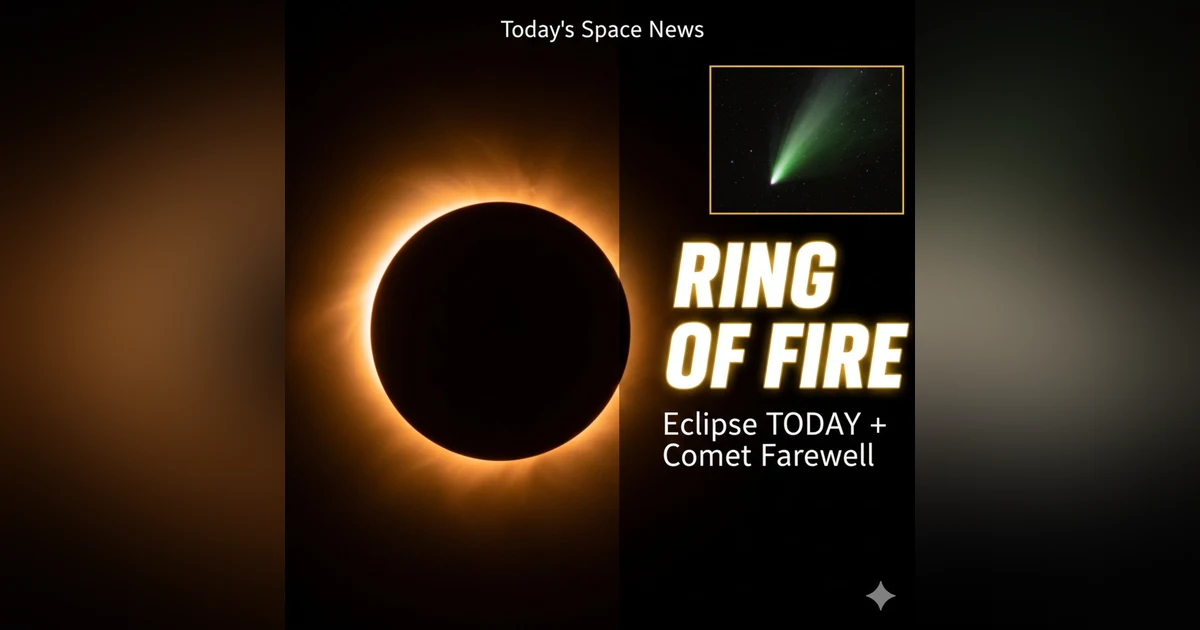
That's right. The Sun is about to be turned into
7
00:00:23.640 --> 00:00:27.679
a ring of fire over Antarctica, and a comment that
8
00:00:27.839 --> 00:00:31.199
may never return is making its closest pass to Earth
9
00:00:31.320 --> 00:00:36.679
as we speak. Plus we've got JWST solving an identity
10
00:00:36.719 --> 00:00:41.520
crisis for some massive exoplanets, NASA doing CT scans on
11
00:00:41.560 --> 00:00:44.719
the Northern Lights, and a startup that wants to fuel
12
00:00:44.840 --> 00:00:48.719
rockets with water. And a preview of why twenty twenty
13
00:00:48.759 --> 00:00:52.320
six might just be the greatest year of eclipses in
14
00:00:52.359 --> 00:00:53.079
a generation.
15
00:00:53.799 --> 00:00:56.560
Let's not waste a single second. Let's dive right.
16
00:00:56.399 --> 00:01:00.520
In, so Avery, We've been building up to this for weeks,
17
00:01:00.840 --> 00:01:04.519
and today is finally the day. Right now, as many
18
00:01:04.599 --> 00:01:08.239
of our listeners are tuning in, an annular solar eclipse
19
00:01:08.359 --> 00:01:10.799
is tracing its path across Antarctica.
20
00:01:11.359 --> 00:01:13.799
And I know some of our listeners might be thinking,
21
00:01:13.959 --> 00:01:17.159
didn't we just cover this, and yes, we've talked about
22
00:01:17.159 --> 00:01:20.239
it in recent episodes, but today is the day, and
23
00:01:20.280 --> 00:01:23.359
there's something truly special happening down at the bottom of
24
00:01:23.439 --> 00:01:23.879
the world.
25
00:01:24.480 --> 00:01:28.760
Let's recap the essentials. An annular eclipse happens when the
26
00:01:28.760 --> 00:01:32.439
Moon passes directly between the Earth and the Sun, but
27
00:01:32.640 --> 00:01:35.159
because the Moon is at a more distant point in
28
00:01:35.200 --> 00:01:39.680
its orbit, it doesn't completely cover the Sun's disk. Instead,
29
00:01:40.079 --> 00:01:44.239
you get this breath taking ring of brilliant sunlight surrounding
30
00:01:44.280 --> 00:01:45.879
the dark silhouette of the Moon.
31
00:01:46.519 --> 00:01:49.159
The ring of fire, and today's ring will last up
32
00:01:49.159 --> 00:01:52.359
to two minutes and twenty seconds for anyone lucky enough
33
00:01:52.400 --> 00:01:55.480
to be standing in the path of annularity. At the
34
00:01:55.519 --> 00:01:58.879
moment of greatest eclipse, which occurs at twelve twelve UTC,
35
00:01:59.439 --> 00:02:02.599
the Moon will cover approximately ninety six percent of the
36
00:02:02.599 --> 00:02:03.280
Sun's surface.
37
00:02:03.920 --> 00:02:08.319
Now ninety six percent sounds like almost everything, but here's
38
00:02:08.400 --> 00:02:12.319
the important thing. It's not a total eclipse. The sky
39
00:02:12.560 --> 00:02:16.639
won't go dark. You absolutely must keep your solar eclipse
40
00:02:16.639 --> 00:02:20.479
glasses on for the entire event. There's no moment where
41
00:02:20.520 --> 00:02:23.000
it's safe to look at the Sun with the naked eye.
42
00:02:23.360 --> 00:02:26.919
The path of annularity itself is actually quite wide, for
43
00:02:26.960 --> 00:02:31.319
eclipse standards about six hundred and sixteen kilometers across, but
44
00:02:31.360 --> 00:02:34.240
it's crossing some of the most remote territory on Earth.
45
00:02:34.400 --> 00:02:38.520
We're talking about the Antarctic mainland and the surrounding Southern Ocean.
46
00:02:38.960 --> 00:02:42.240
So realistically, the only people seeing the full ring of
47
00:02:42.280 --> 00:02:46.000
fire today are researchers at a handful of Antarctic stations.
48
00:02:46.560 --> 00:02:49.960
However, the partial phases of the eclipse are visible from
49
00:02:50.000 --> 00:02:55.080
a much wider area. Observers in southern Argentina, southern Chile,
50
00:02:55.520 --> 00:03:00.479
southeastern Africa, Madagascar, and Mauritius will all see the Moon
51
00:03:00.599 --> 00:03:03.000
take a bite out of the Sun to varying degrees.
52
00:03:03.479 --> 00:03:06.360
And here's something that I think really elevates today's event.
53
00:03:06.560 --> 00:03:09.400
This eclipse kicks off the first eclipse season of twenty
54
00:03:09.479 --> 00:03:13.360
twenty six. Eclipse seasons are these brief windows, typically about
55
00:03:13.360 --> 00:03:16.680
thirty four days long, when the geometry of the Sun, Earth,
56
00:03:16.719 --> 00:03:20.520
and Moon aligns just right for eclipses to occur, and
57
00:03:20.560 --> 00:03:22.159
they usually come in pairs.
58
00:03:22.199 --> 00:03:25.680
Exactly so less than two weeks from now, on March
59
00:03:25.719 --> 00:03:29.560
the third, we get a total lunar eclipse, a blood moon,
60
00:03:29.840 --> 00:03:33.000
visible from North America. And that's just the beginning for
61
00:03:33.039 --> 00:03:35.759
twenty twenty six, which we'll come back to later in
62
00:03:35.800 --> 00:03:36.240
the show.
63
00:03:36.439 --> 00:03:39.280
For anyone wanting to follow along today, there are several
64
00:03:39.280 --> 00:03:41.599
live streams available, and we'll have links in our show
65
00:03:41.639 --> 00:03:44.319
notes even if you can't see it from where you are.
66
00:03:44.479 --> 00:03:48.039
This is a wonderful moment to appreciate the clockwork precision
67
00:03:48.120 --> 00:03:49.039
of our solar system.
68
00:03:49.520 --> 00:03:53.919
Am sticking with things happening literally today, let's talk about
69
00:03:54.000 --> 00:03:57.879
Comet C twenty twenty four e one, better known as
70
00:03:57.960 --> 00:04:01.400
Comet weird Chosh, which is making its closest approach to
71
00:04:01.479 --> 00:04:02.879
Earth right now.
72
00:04:03.039 --> 00:04:05.080
This is one of those stories where the science and
73
00:04:05.159 --> 00:04:09.120
the poetry really come together beautifully. This comment was discovered
74
00:04:09.159 --> 00:04:12.680
back in March twenty twenty four by Polish astronomer Casper
75
00:04:12.800 --> 00:04:16.920
Weirtoch using the Mount Lemon survey in Arizona, and today
76
00:04:17.000 --> 00:04:20.040
it passes within about one hundred and fifty one million
77
00:04:20.120 --> 00:04:23.560
kilometers from Earth, roughly the same distance as Earth is
78
00:04:23.560 --> 00:04:24.920
from the Sun, so.
79
00:04:25.000 --> 00:04:28.240
It's not exactly a close shave, but it's still a
80
00:04:28.279 --> 00:04:33.120
significant astronomical moment. What makes this comment truly special is
81
00:04:33.160 --> 00:04:36.600
that it's on a hyperbolic orbit. For our listeners who
82
00:04:36.680 --> 00:04:40.199
aren't familiar with that, term. It means the comet's trajectory
83
00:04:40.399 --> 00:04:43.519
isn't a closed loop. It's not coming back.
84
00:04:43.800 --> 00:04:47.519
Ever, or at least not for over two hundred thousand years,
85
00:04:47.560 --> 00:04:51.519
and even that's optimistic. Scientists believe it originated in the
86
00:04:51.680 --> 00:04:55.000
Orc cloud, that vast icy shell at the outer edges
87
00:04:55.040 --> 00:04:58.360
of our solar system, and it's now getting a gravitational
88
00:04:58.439 --> 00:05:02.639
slingshot that will send it how into interstellar space. This
89
00:05:02.720 --> 00:05:05.560
is genuinely a once in a civilization event.
90
00:05:06.240 --> 00:05:10.480
NASA's Astronomy Picture of the Day featured Comet Versos today
91
00:05:10.600 --> 00:05:14.279
with a thirty minute exposure taken from Chile, showing a
92
00:05:14.360 --> 00:05:19.680
gorgeous five degree long ion tail and three separate dust tails.
93
00:05:20.120 --> 00:05:24.199
The comet also has a vivid green coma, which scientists
94
00:05:24.240 --> 00:05:29.000
believe is linked to carbon bearing compounds, likely diatomic carbon,
95
00:05:29.279 --> 00:05:31.560
fluorescing under ultraviolet sunlight.
96
00:05:32.240 --> 00:05:35.600
The James Webb Telescope actually observed this comet last year
97
00:05:35.680 --> 00:05:38.800
when it was still far out at about seven astronomical
98
00:05:38.920 --> 00:05:41.720
units from the sun. They found that it's activity is
99
00:05:41.839 --> 00:05:46.519
primarily driven by carbon dioxide rather than carbon monoxide, which
100
00:05:46.560 --> 00:05:49.759
is interesting because it suggests the comet may have lost
101
00:05:49.800 --> 00:05:52.480
its near surface COO early in its evolution.
102
00:05:53.279 --> 00:05:57.040
Now, in terms of actually seeing it at magnitude seven
103
00:05:57.120 --> 00:05:59.680
point eight to eight point two, you're going to need
104
00:05:59.720 --> 00:06:04.160
bens at minimum, ideally a small telescope. It's currently in
105
00:06:04.199 --> 00:06:08.680
the constellation Sculptor, quite low in the southwestern sky after sunset.
106
00:06:09.120 --> 00:06:12.279
Southern hemisphere observers have the far better view today.
107
00:06:12.879 --> 00:06:16.600
Northern hemisphere observers don't despair. Over the coming days, the
108
00:06:16.680 --> 00:06:19.720
comment will climb a bit higher, and by around February
109
00:06:19.759 --> 00:06:22.920
twenty third it should be a more accessible target as
110
00:06:22.920 --> 00:06:26.319
it passes near some galaxies in Cetus, but it will
111
00:06:26.319 --> 00:06:28.920
be fading by then. If you can get out tonight
112
00:06:28.959 --> 00:06:32.120
with some optics, it's worth the effort. You're quite literally
113
00:06:32.199 --> 00:06:35.519
saying goodbye to something the human race will never see again.
114
00:06:36.079 --> 00:06:39.600
All right, let's travel one hundred and thirty three light
115
00:06:39.680 --> 00:06:43.560
years away to the constellation Pegasus, where the James Webb
116
00:06:43.680 --> 00:06:49.639
telescope has just settled one of exoplanet's science's most persistent mysteries.
117
00:06:49.720 --> 00:06:53.759
And the key to solving it. Hydrogen sulfide, the molecule
118
00:06:53.800 --> 00:06:58.480
that gives rotten eggs their delightful aroma. Published in Nature Astronomy,
119
00:06:58.639 --> 00:07:01.879
a team from UCLA and U see San Diego use
120
00:07:02.000 --> 00:07:06.600
JWST to study HR eight seven nine nine system, which
121
00:07:06.639 --> 00:07:11.079
hosts four enormous gas giant planets, each between five and
122
00:07:11.240 --> 00:07:12.920
ten times the mass of Jupiter.
123
00:07:13.519 --> 00:07:16.399
Now, these planets have been known since two thousand and eight,
124
00:07:16.519 --> 00:07:20.800
and they're actually directly visible through telescopes, which is remarkable
125
00:07:20.839 --> 00:07:25.800
in itself. Most exoplanets are detected indirectly. But because they're
126
00:07:25.879 --> 00:07:29.160
so massive, and because they're so far from their star
127
00:07:29.560 --> 00:07:33.240
between fifteen and seventy times Earth's distance from the Sun,
128
00:07:33.680 --> 00:07:37.720
scientists have long debated if they're truly planets or something
129
00:07:37.759 --> 00:07:38.720
else entirely.
130
00:07:39.360 --> 00:07:43.720
Specifically, are they planets or brown dwarfs. Brown dwarfs are
131
00:07:43.759 --> 00:07:48.920
sometimes called failed stars, objects that form through gravitational collapse
132
00:07:48.959 --> 00:07:51.759
of a gas cloud like a star, but never got
133
00:07:51.879 --> 00:07:56.360
massive enough to sustain hydrogen fusion. The traditional mass boundary
134
00:07:56.480 --> 00:07:59.839
is around thirteen Jupiter masses, but that's a bit arbitrary.
135
00:08:00.480 --> 00:08:03.959
What really matters is how they formed. Did they form
136
00:08:04.120 --> 00:08:08.279
like planets through core accretion, building up a solid core
137
00:08:08.360 --> 00:08:11.720
from dust and rock that then attracted gas, or did
138
00:08:11.759 --> 00:08:14.800
they form like stars through the rapid collapse of a
139
00:08:14.879 --> 00:08:16.319
dense pocket of gas.
140
00:08:16.879 --> 00:08:19.040
And this is where the rotten eggs come in. The
141
00:08:19.079 --> 00:08:22.639
team detected hydrogen sulfide in the atmospheres of these three
142
00:08:22.680 --> 00:08:27.199
worlds Hr eight, seven, nine, nine, C, D, and E.
143
00:08:27.759 --> 00:08:30.839
Now why is sulfur the key? Because at the vast
144
00:08:30.879 --> 00:08:35.080
distances these planets orbit their star, sulfur can only exist
145
00:08:35.120 --> 00:08:38.879
in solid form within the protoplanetary disc. It cannot be
146
00:08:38.960 --> 00:08:41.679
in the gas phase. So if they're sulfur in these
147
00:08:41.720 --> 00:08:44.840
planet's atmospheres, it had to have been gobbled up as
148
00:08:44.879 --> 00:08:47.039
solid material during the planet's formation.
149
00:08:47.799 --> 00:08:52.720
That's the smoking gun for core accretion. These worlds massive
150
00:08:52.840 --> 00:08:56.480
as they are formed the same way Jupiter did, just
151
00:08:56.639 --> 00:09:00.720
on a much grander scale. Previous studies looking at carbon
152
00:09:00.799 --> 00:09:05.279
and oxygen couldn't distinguish between the two formation pathways because
153
00:09:05.320 --> 00:09:08.600
those elements can come from either gas or solids.
154
00:09:09.320 --> 00:09:12.919
The researchers also found that these planets are enriched in
155
00:09:12.960 --> 00:09:16.559
heavy elements compared to their hostar by factors of roughly
156
00:09:16.639 --> 00:09:20.720
two to nine times. The estimate the four planets together
157
00:09:20.879 --> 00:09:25.159
contain around six hundred earth masses of heavy material. That's
158
00:09:25.279 --> 00:09:28.080
an extraordinary amount of solid material.
159
00:09:28.159 --> 00:09:32.639
And this phrases a really fascinating question. How big can
160
00:09:32.639 --> 00:09:36.799
a planet get if objects ten times Jupiter's mass can
161
00:09:36.879 --> 00:09:40.840
form through Cora accretion, where exactly is the line between
162
00:09:40.960 --> 00:09:43.960
the biggest planets and the smallest brown dwarfs.
163
00:09:44.600 --> 00:09:49.120
Lead researcher Jerry Swan from UCLA put it beautifully. He said,
164
00:09:49.159 --> 00:09:51.840
the technique they used to separate the light from these
165
00:09:51.879 --> 00:09:56.200
incredibly faint planets ten thousand times fainter than their star,
166
00:09:56.720 --> 00:10:00.720
will eventually be applicable to studying earth like worlds. He said.
167
00:10:00.840 --> 00:10:03.960
Finding an Earth analog is the holy grail, and we
168
00:10:04.120 --> 00:10:06.960
might be twenty to thirty years away from getting the
169
00:10:07.000 --> 00:10:10.960
first spectrum of an earth like planet and searching for biosignatures.
170
00:10:11.480 --> 00:10:15.440
The future of exoplanet science built on the foundation of
171
00:10:15.600 --> 00:10:16.600
smelly gas.
172
00:10:16.799 --> 00:10:20.240
Who would have thought thing closer to home now? Well,
173
00:10:20.639 --> 00:10:25.480
relatively speaking. NASA launched two groundbreaking sounding rocket missions from
174
00:10:25.519 --> 00:10:29.279
Alaska earlier this month, and the results are already exciting
175
00:10:29.279 --> 00:10:30.200
the science community.
176
00:10:30.679 --> 00:10:34.159
These launched from the Poker Flat Research Range near Fairbanks,
177
00:10:34.399 --> 00:10:37.440
and they had two of the best mission acronyms I've
178
00:10:37.480 --> 00:10:42.159
ever encountered. The first is Badass, the Black and Diffuse
179
00:10:42.279 --> 00:10:45.960
Auroral Science Surveyor and yes that's the real name.
180
00:10:46.559 --> 00:10:50.519
Launched February ninth, Badass reads an altitude of about three
181
00:10:50.639 --> 00:10:54.360
hundred and sixty kilometers and was specifically designed to study
182
00:10:54.360 --> 00:10:58.559
a phenomenon called black auroras. These are these strange dark
183
00:10:58.600 --> 00:11:02.120
structures that appear as apps or voids drifting within the
184
00:11:02.159 --> 00:11:06.080
brighter diffuse aurora like someone has taken an eraser to
185
00:11:06.200 --> 00:11:07.360
parts of the Northern Lights.
186
00:11:07.919 --> 00:11:12.399
What's happening physically is that electrons, instead of streaming down
187
00:11:12.440 --> 00:11:15.759
into Earth's atmosphere the way they do in normal auroras,
188
00:11:16.039 --> 00:11:20.960
are shooting upward into space. Scientists don't fully understand why
189
00:11:21.000 --> 00:11:25.080
this reversal happens, and Badass was designed to gather data
190
00:11:25.159 --> 00:11:26.080
on exactly that.
191
00:11:26.919 --> 00:11:32.559
Then on February tenth, NASA launched the GNEISS mission. That's
192
00:11:32.639 --> 00:11:37.720
the Geophysical Non Equilibrium Ionoscire Science System. This one used
193
00:11:37.759 --> 00:11:41.559
two rockets launched just thirty seconds apart, flying side by
194
00:11:41.679 --> 00:11:44.600
side through the same aurora along different slices.
195
00:11:45.200 --> 00:11:49.759
And here's the clever bit. Each rocket ejected four sub payloads,
196
00:11:50.039 --> 00:11:55.320
giving them multiple measurement points inside the aurora. Simultaneously, the
197
00:11:55.440 --> 00:11:59.639
rockets also sent radio signals through the surrounding plasma to
198
00:11:59.679 --> 00:12:04.120
a network of eleven ground receivers. The way the plasma altered,
199
00:12:04.159 --> 00:12:08.320
those radio wives allowed scientists to map the plasma density,
200
00:12:08.720 --> 00:12:11.200
revealing where electrical currents can flow.
201
00:12:11.759 --> 00:12:15.919
Principal investigator Christina Lynch from Dartmouth College described it as
202
00:12:16.039 --> 00:12:19.039
essentially doing a CT scan of the plasma beneath the
203
00:12:19.080 --> 00:12:22.600
aurora in the same way a medical CT scan uses
204
00:12:22.759 --> 00:12:26.000
X rays passing through different body tissues to reconstruct the
205
00:12:26.039 --> 00:12:30.159
three D image. NIE uses radio waves passing through auroral
206
00:12:30.240 --> 00:12:34.159
plasma to reconstruct the electrical environment in three dimensions.
207
00:12:34.799 --> 00:12:38.919
Both missions reported that all instruments performed as expected and
208
00:12:39.039 --> 00:12:43.399
returned high quality data. This is particularly satisfying for the
209
00:12:43.480 --> 00:12:46.840
Badass team because the same mission was on the launch
210
00:12:46.879 --> 00:12:50.159
pad at Poker Flat last year, but the required auroral
211
00:12:50.200 --> 00:12:53.720
conditions never materialized before the launch window closed.
212
00:12:54.399 --> 00:12:58.960
Understanding how auroral currents work isn't just pure physics. Those
213
00:12:59.080 --> 00:13:03.360
currents shape how energy from space spreads through earth upper atmosphere.
214
00:13:03.759 --> 00:13:06.879
Where the current fans out, the atmosphere heats up, which
215
00:13:06.919 --> 00:13:11.960
can affect satellite drag, GPS accuracy and radiocommunications. With our
216
00:13:12.039 --> 00:13:16.080
increasing dependence on space based technology, this research has very
217
00:13:16.159 --> 00:13:17.320
practical implications.
218
00:13:17.960 --> 00:13:21.279
Now for something that sounds like science fiction but is
219
00:13:21.320 --> 00:13:24.519
heading for a real World test later this year. A
220
00:13:24.519 --> 00:13:29.759
startup called General Galactic, led by former SpaceX engineer Hallan Madison,
221
00:13:30.120 --> 00:13:33.399
is developing technology to use water as rocket fuel.
222
00:13:34.240 --> 00:13:36.759
And before anyone thinks we're talking about some kind of
223
00:13:36.799 --> 00:13:41.320
perpetual motion scam, the science here is sound. The core
224
00:13:41.440 --> 00:13:46.799
concept uses electrolysis, splitting water molecules into hydrogen and oxygen,
225
00:13:47.240 --> 00:13:50.759
and then using those gases in two different propulsion systems.
226
00:13:51.440 --> 00:13:55.720
Right For chemical propulsion, you burn the hydrogen and oxygen together,
227
00:13:56.039 --> 00:14:00.200
which produces high pressure thrust, much like a conventional rocket engine.
228
00:14:00.320 --> 00:14:04.440
For electrical propulsion, you ionize the oxygen and accelerate it
229
00:14:04.559 --> 00:14:09.360
using a magnetic field, creating plasma thrust. Madison describes that
230
00:14:09.519 --> 00:14:13.759
second type as very very low thrust. People jokingly like
231
00:14:13.799 --> 00:14:16.480
to call it a burp in space, but.
232
00:14:16.720 --> 00:14:19.639
Even a burp in space can be useful for precise
233
00:14:19.720 --> 00:14:23.480
maneuvers and station keeping. The real game changer here isn't
234
00:14:23.480 --> 00:14:27.840
the propulsion technology itself, but the fuel source. Water is
235
00:14:27.840 --> 00:14:31.080
one of the most abundant resources we found on other worlds.
236
00:14:31.519 --> 00:14:34.879
There's water ice on the Moon, on Mars, on asteroids.
237
00:14:35.320 --> 00:14:38.240
If you can turn that water into fuel, you've essentially
238
00:14:38.279 --> 00:14:41.360
created the infrastructure for cosmic refueling stations.
239
00:14:41.960 --> 00:14:46.440
That's exactly Madison's long term vision. He's talking about building
240
00:14:46.480 --> 00:14:50.320
a refueling network that connects Earth, the Moon, and Mars.
241
00:14:50.720 --> 00:14:53.440
As he puts it, everybody wants to go build a
242
00:14:53.480 --> 00:14:56.120
Moon base or a Mars base. Who's going to pay