Aug. 25, 2026
NASA's Roman Space Telescope Is Ready to Fly — Nine Months Early
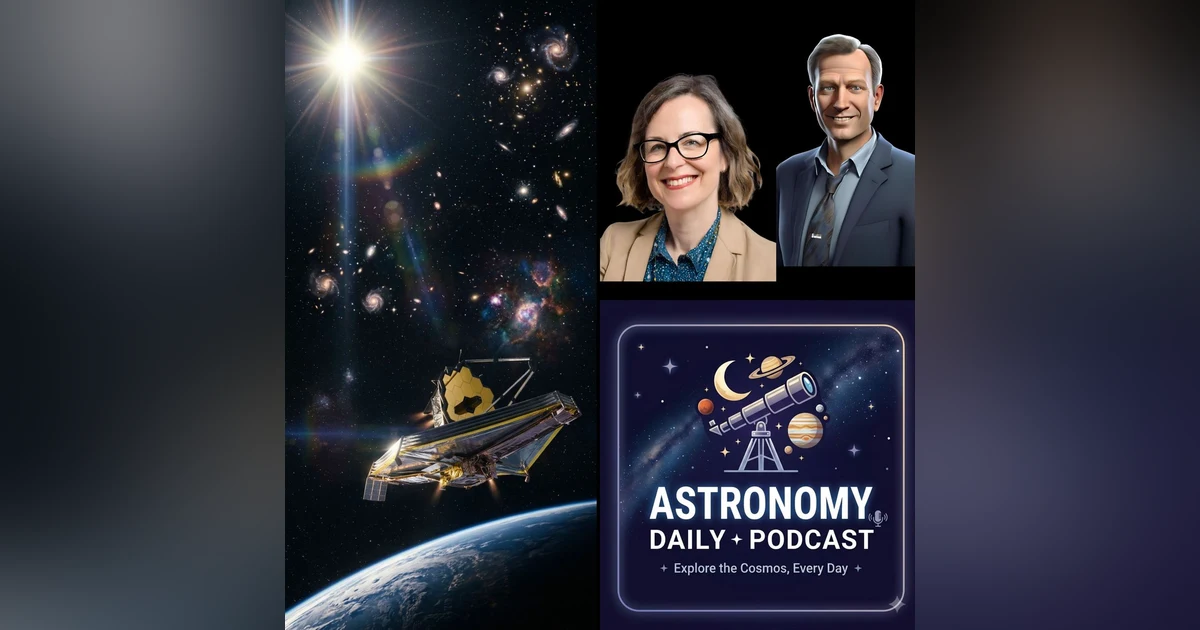
Today's episode — S05E176, Tuesday August 25, 2026: Feature story: NASA's Roman Space Telescope is fully encapsulated inside its Falcon Heavy fairing and cleared to launch no earlier than 7:26 a.m. ET this Sunday, August 30 — about nine months ahead...
Today's episode — S05E176, Tuesday August 25, 2026:
Feature story: NASA's Roman Space Telescope is fully encapsulated inside its Falcon Heavy fairing and cleared to launch no earlier than 7:26 a.m. ET this Sunday, August 30 — about nine months ahead of its original schedule, a rarity for a NASA flagship mission. Roman is headed to Sun-Earth L2 for a five-year mission mapping dark energy and dark matter and hunting exoplanets with a starlight-cancelling coronagraph. Its wide-field camera surveys roughly a hundred times faster than Hubble at comparable image sharpness. Named for NASA's first chief astronomer, Nancy Grace Roman — the "mother of Hubble" — the mission is a formal ESA partnership; some of its data will come down through a new ESA antenna at New Norcia, Western Australia.
The rest of the news:
Links & sources:
Follow us: @AstronomyDailyPod
Become a supporter of this podcast: https://www.spreaker.com/podcast/astronomy-daily-latest-space-news--5648921/support.
Sponsor Details:
Ensure your online privacy by using NordVPN. To get our special listener deal and save a lot of money, visit www.astronomydaily.io/nordvpn. You'll be glad you did!
Get the best secure and private email on the planet. Stop your Government, google and who knows who else spying on every email you write. Do what we did and use ProtonMail. They beleive in privacy and there are no ads in their business model...yet they still provide a free forever service. Check them out and get out special deal at www.astronomydaily.io/protonmail
Become a supporter of Astronomy Daily by joining our Supporters Club. Commercial free episodes daily are only a click way... Click Here
This episode includes AI-generated content.
Feature story: NASA's Roman Space Telescope is fully encapsulated inside its Falcon Heavy fairing and cleared to launch no earlier than 7:26 a.m. ET this Sunday, August 30 — about nine months ahead of its original schedule, a rarity for a NASA flagship mission. Roman is headed to Sun-Earth L2 for a five-year mission mapping dark energy and dark matter and hunting exoplanets with a starlight-cancelling coronagraph. Its wide-field camera surveys roughly a hundred times faster than Hubble at comparable image sharpness. Named for NASA's first chief astronomer, Nancy Grace Roman — the "mother of Hubble" — the mission is a formal ESA partnership; some of its data will come down through a new ESA antenna at New Norcia, Western Australia.
The rest of the news:
- ISS Spacewalk 98: NASA's Anil Menon and ESA's Sophie Adenot are outside the station today finishing a Space-to-Ground antenna replacement and, time permitting, installing a new docking retroreflector — their third spacewalk together in under a month.
- Milky Way merger scar: A Hubble-based study (the ARMA project, led by Davide Massari) has found evidence of a ~500-million-solar-mass dwarf galaxy, dubbed Low-energy-Kraken-Heracles, absorbed by the Milky Way roughly 12 billion years ago — the earliest documented merger in our galaxy's history.
- Perseids 2028 watch: Jupiter's gravity may nudge Perseid debris closer to Earth's path in 2028, potentially producing an outburst of 200-300 meteors/hour under favorable dark-sky conditions — though modelers caution the forecast is an "educated guess."
- Tonight's Sky: A 96%-partial lunar eclipse falls the night of August 27-28 — spectacular from the Americas and parts of Europe/Africa, but invisible from Australia and the rest of Asia-Pacific, where it happens in broad daylight. Venus and Saturn remain good evening targets locally in the meantime.
Links & sources:
- NASA Science — Roman Launch Countdown
- NASA Roman Blog — Roman Telescope Enclosed in Falcon Heavy Fairing
- Space.com — The Roman Space Telescope is ready to launch Aug. 30
- JPL — NASA Telescope Named for "Mother of Hubble" Nancy Grace Roman
- ESA — Roman factsheet
- NASA — NASA to Cover Three US Spacewalks
- Space.com — The earliest galaxy "swallowed" by the cannibal Milky Way left a scar at its heart
- Space.com — Could Jupiter supercharge the Perseids in 2028?
- Space.com — Partial lunar eclipse Aug. 27-28: stages and visibility
Follow us: @AstronomyDailyPod
Become a supporter of this podcast: https://www.spreaker.com/podcast/astronomy-daily-latest-space-news--5648921/support.
Sponsor Details:
Ensure your online privacy by using NordVPN. To get our special listener deal and save a lot of money, visit www.astronomydaily.io/nordvpn. You'll be glad you did!
Get the best secure and private email on the planet. Stop your Government, google and who knows who else spying on every email you write. Do what we did and use ProtonMail. They beleive in privacy and there are no ads in their business model...yet they still provide a free forever service. Check them out and get out special deal at www.astronomydaily.io/protonmail
Become a supporter of Astronomy Daily by joining our Supporters Club. Commercial free episodes daily are only a click way... Click Here
This episode includes AI-generated content.
WEBVTT
0
00:00:01.200 --> 00:00:03.640
Anna: Hey everyone. Welcome back to Astronomy
1
00:00:03.640 --> 00:00:04.960
AstroDailyPod. I'm Anna.
2
00:00:05.040 --> 00:00:07.360
Avery: And I'm, uh, avery. It's Tuesday, August
3
00:00:07.360 --> 00:00:09.714
25th, series five, episode
4
00:00:09.926 --> 00:00:10.880
176.
5
00:00:11.520 --> 00:00:14.000
Anna: Quick programming note before we get into it,
6
00:00:14.160 --> 00:00:16.880
no firm new launch date yet on China's
7
00:00:16.880 --> 00:00:19.720
Chang' E7, the storey we spent most of
8
00:00:19.720 --> 00:00:22.360
yesterday's episode on. Still pointing at
9
00:00:22.360 --> 00:00:24.760
that mid to late September window we talked
10
00:00:24.760 --> 00:00:27.680
about. Nothing more specific from CNSA
11
00:00:27.680 --> 00:00:30.140
as of this morning. We'll flag it the moment
12
00:00:30.140 --> 00:00:30.860
that changes.
13
00:00:31.340 --> 00:00:33.820
Avery: So instead, today belongs to a
14
00:00:33.820 --> 00:00:36.620
telescope. A, uh, very big, very expensive,
15
00:00:36.940 --> 00:00:38.940
very ready to fly telescope.
16
00:00:39.420 --> 00:00:41.820
Anna: NASA's Nancy Grace Roman Space
17
00:00:41.820 --> 00:00:44.180
Telescope is sitting inside its rocket
18
00:00:44.180 --> 00:00:46.940
fairing right now. Cleared for launch this
19
00:00:46.940 --> 00:00:49.220
Sunday, and it's getting there the better
20
00:00:49.220 --> 00:00:51.740
part of a year earlier than anyone expected.
21
00:00:52.300 --> 00:00:54.460
We'll spend some real time on why that
22
00:00:54.460 --> 00:00:54.940
matters.
23
00:00:55.330 --> 00:00:57.650
Avery: Astronauts are heading back outside the space
24
00:00:57.650 --> 00:01:00.490
station today for the third spacewalk in a
25
00:01:00.490 --> 00:01:03.250
month. Astronomers have found a scar
26
00:01:03.330 --> 00:01:05.530
at the centre of the Milky Way from a
27
00:01:05.530 --> 00:01:07.970
collision 12 billion years ago.
28
00:01:08.610 --> 00:01:11.210
Jupiter might be about to supercharge the
29
00:01:11.210 --> 00:01:14.170
Perseids in 2028. And there's
30
00:01:14.170 --> 00:01:16.690
a near total lunar eclipse this week
31
00:01:17.010 --> 00:01:19.490
though we've gotta manage expectations on
32
00:01:19.490 --> 00:01:21.810
that last one. For anyone listening from down
33
00:01:21.810 --> 00:01:23.550
under, let's get into it.
34
00:01:23.790 --> 00:01:26.470
Okay, so this is the big one today. Talk me
35
00:01:26.470 --> 00:01:27.870
through where things actually stand.
36
00:01:28.430 --> 00:01:31.270
Anna: As of Monday, the Nancy Grace Roman Space
37
00:01:31.270 --> 00:01:34.070
Telescope is fully encapsulated inside the
38
00:01:34.070 --> 00:01:36.430
fairing of the Falcon Heavy rocket that's
39
00:01:36.430 --> 00:01:39.110
going to launch it. That happened at Kennedy
40
00:01:39.110 --> 00:01:41.470
Space Centre's Payload Hazardous Servicing
41
00:01:41.470 --> 00:01:44.230
facility. Teams will move the encapsulated
42
00:01:44.230 --> 00:01:46.910
payload over to SpaceX's hangar at
43
00:01:46.910 --> 00:01:49.770
pad 39A, made it to the rocket
44
00:01:49.770 --> 00:01:52.530
and roll the whole stack out to the pad later
45
00:01:52.530 --> 00:01:55.410
this week. Liftoff is targeted for no earlier
46
00:01:55.410 --> 00:01:58.250
than 7:26am Eastern time
47
00:01:58.250 --> 00:02:00.050
this Sunday, August 30th.
48
00:02:00.370 --> 00:02:02.530
Avery: That's in Florida time. So for anyone doing
49
00:02:02.530 --> 00:02:04.850
the math from Australia, that lines up with
50
00:02:04.850 --> 00:02:07.530
Sunday night here. Somewhere around 9:30pm
51
00:02:07.530 --> 00:02:08.290
Sydney time.
52
00:02:08.850 --> 00:02:11.170
Anna: Exactly. We'll pin down the precise local
53
00:02:11.170 --> 00:02:13.730
time closer to launch day. But here's the
54
00:02:13.730 --> 00:02:15.650
headline that actually got our attention.
55
00:02:16.230 --> 00:02:18.910
Roman is launching about nine months ahead of
56
00:02:18.910 --> 00:02:20.070
its original schedule.
57
00:02:20.630 --> 00:02:23.430
Avery: Nine months early for a NASA flagship
58
00:02:23.430 --> 00:02:25.910
mission. That basically never happens.
59
00:02:26.390 --> 00:02:29.270
Anna: It basically never happens, which is exactly
60
00:02:29.270 --> 00:02:31.630
why it's worth pausing on. Big space
61
00:02:31.630 --> 00:02:34.230
telescopes have a well earned reputation for
62
00:02:34.230 --> 00:02:37.110
slipping. Right. Webb famously blew out its
63
00:02:37.110 --> 00:02:40.070
schedule and budget by years. Roman going the
64
00:02:40.070 --> 00:02:42.950
other direction, arriving early and as far as
65
00:02:42.950 --> 00:02:45.470
the reporting shows, without dramatic cost
66
00:02:45.470 --> 00:02:47.750
blowouts, is genuinely unus.
67
00:02:48.370 --> 00:02:50.770
And it says something about how NASA and its
68
00:02:50.770 --> 00:02:52.370
contractors have run this build.
69
00:02:52.850 --> 00:02:54.730
Avery: What actually happens once it's up there?
70
00:02:54.730 --> 00:02:55.890
What is Roman for?
71
00:02:56.450 --> 00:02:58.770
Anna: 2 big jobs plus a bonus one.
72
00:02:59.090 --> 00:03:02.050
Job 1 map Dark Energy and dark matter
73
00:03:02.050 --> 00:03:04.890
by surveying huge swaths of the sky and
74
00:03:04.890 --> 00:03:07.690
watching how galaxies are distributed and how
75
00:03:07.690 --> 00:03:10.450
their light is bent by gravity. Job 2
76
00:03:10.610 --> 00:03:13.330
Hunt for exoplanets using a coronagraph
77
00:03:13.330 --> 00:03:15.650
instrument that's specifically built to block
78
00:03:15.650 --> 00:03:18.290
out a star's glare so the much fainter
79
00:03:18.290 --> 00:03:21.270
planets around it become visible. NASA's
80
00:03:21.270 --> 00:03:23.430
senior project scientist on this, Julie
81
00:03:23.430 --> 00:03:26.190
McInerney, put it nicely. She called it
82
00:03:26.190 --> 00:03:28.910
doing magic with physics, using the wave
83
00:03:28.910 --> 00:03:31.390
properties of light itself to cancel out
84
00:03:31.390 --> 00:03:33.710
starlight and reveal what's hiding next to
85
00:03:33.710 --> 00:03:33.950
it.
86
00:03:34.430 --> 00:03:35.710
Avery: And, um, the bonus job?
87
00:03:36.270 --> 00:03:39.190
Anna: The bonus job is speed. Roman's
88
00:03:39.190 --> 00:03:41.670
mirror is roughly the same size and sharpness
89
00:03:41.670 --> 00:03:44.350
as Hubble's, so similar image quality,
90
00:03:44.430 --> 00:03:46.830
but its camera has a field of view about
91
00:03:46.910 --> 00:03:49.880
100 times wider. NASA's own
92
00:03:49.880 --> 00:03:52.640
comparison is the one that stuck with us. One
93
00:03:52.640 --> 00:03:55.360
month of Roman surveying the Milky Way would
94
00:03:55.360 --> 00:03:57.120
take Hubble something like a
95
00:03:57.120 --> 00:03:59.720
Avery: century to match a century of
96
00:03:59.720 --> 00:04:00.880
Hubble time in a month.
97
00:04:01.200 --> 00:04:04.080
Anna: That's the number over its main survey.
98
00:04:04.160 --> 00:04:06.880
Roman is expected to image something like
99
00:04:06.880 --> 00:04:09.480
2 billion galaxies. And it'll
100
00:04:09.480 --> 00:04:12.320
generate more than 500 terabytes of data
101
00:04:12.320 --> 00:04:15.000
a year. For comparison, Hubble has
102
00:04:15.000 --> 00:04:17.520
produced around 400 terabytes total
103
00:04:17.840 --> 00:04:20.480
across its entire 35 year mission.
104
00:04:20.980 --> 00:04:23.700
Roman matches that in well under 12 months
105
00:04:23.940 --> 00:04:26.540
every year for years M. How
106
00:04:26.540 --> 00:04:28.900
Avery: does it stack up against James Webb since
107
00:04:28.900 --> 00:04:30.860
that's the telescope everyone's already got a
108
00:04:30.860 --> 00:04:33.220
mental picture of different job.
109
00:04:33.220 --> 00:04:35.780
Anna: Basically, Webb is built for depth,
110
00:04:35.860 --> 00:04:38.260
extreme sensitivity in the infrared,
111
00:04:38.580 --> 00:04:41.340
staring at one small patch of sky for a
112
00:04:41.340 --> 00:04:43.780
long time to see extremely faint,
113
00:04:43.860 --> 00:04:46.460
extremely distant objects in exquisite
114
00:04:46.460 --> 00:04:49.030
detail. Roman is built for breath,
115
00:04:49.190 --> 00:04:51.870
a wide field survey machine covering
116
00:04:51.870 --> 00:04:54.790
roughly 50 times the area Webb can. In
117
00:04:54.790 --> 00:04:57.670
a single image, one finds needles, the
118
00:04:57.670 --> 00:05:00.070
other maps the whole haystack. And
119
00:05:00.070 --> 00:05:02.350
Roman's actually expected to help with a
120
00:05:02.350 --> 00:05:05.070
puzzle. Webb turned up the little red
121
00:05:05.070 --> 00:05:07.830
dots, these compact, surprisingly
122
00:05:07.830 --> 00:05:10.230
luminous objects from the early universe
123
00:05:10.230 --> 00:05:12.880
nobody's fully explained yet. More
124
00:05:12.880 --> 00:05:15.520
sky coverage means more of those objects to
125
00:05:15.520 --> 00:05:18.400
study statistically instead of one at a time.
126
00:05:18.960 --> 00:05:21.280
Avery: Where does it actually go once it launches?
127
00:05:21.920 --> 00:05:24.520
Anna: Not low Earth orbit like Hubble or the space
128
00:05:24.520 --> 00:05:27.200
station Roman is headed to. Sun Earth,
129
00:05:27.200 --> 00:05:29.280
Lagrange Point 2, about
130
00:05:29.280 --> 00:05:31.760
1.6 million kilometres out.
131
00:05:32.000 --> 00:05:34.720
The same gravitationally stable neighbourhood
132
00:05:34.720 --> 00:05:37.160
Webb calls home. It's carrying enough
133
00:05:37.160 --> 00:05:39.240
hydrazine fuel on board for course
134
00:05:39.240 --> 00:05:41.840
corrections on the way out and for station
135
00:05:41.840 --> 00:05:44.400
keeping across a planned five year prim
136
00:05:44.780 --> 00:05:45.100
mission.
137
00:05:45.500 --> 00:05:47.580
Avery: Any sense of what happens right after launch?
138
00:05:47.740 --> 00:05:49.420
Like day One week one.
139
00:05:49.980 --> 00:05:52.500
Anna: Jeremy Perkins, one of the integration and
140
00:05:52.500 --> 00:05:55.180
test scientists on the project, described it
141
00:05:55.180 --> 00:05:57.860
about as plainly as you can. Roughly
142
00:05:57.860 --> 00:06:00.380
30 days out from an early August update,
143
00:06:00.539 --> 00:06:02.940
he said, we're going to be launching Roman,
144
00:06:03.100 --> 00:06:05.380
testing it out, opening the deployable
145
00:06:05.380 --> 00:06:07.620
aperture cover, looking at the sky and
146
00:06:07.620 --> 00:06:10.180
sending data down to the ground for the first
147
00:06:10.180 --> 00:06:12.630
time. So the sequence is launch,
148
00:06:12.790 --> 00:06:15.390
commissioning, first light, and then the real
149
00:06:15.390 --> 00:06:16.710
survey work begins.
150
00:06:17.110 --> 00:06:19.190
Avery: And the project managers basically just
151
00:06:19.190 --> 00:06:20.710
declared it done and ready.
152
00:06:21.190 --> 00:06:24.150
Anna: Jacqui Townsend's line was short. Roman
153
00:06:24.150 --> 00:06:27.070
is ready for launch after nine months of
154
00:06:27.070 --> 00:06:29.470
schedule margin. They clearly feel confident
155
00:06:29.470 --> 00:06:30.070
saying that.
156
00:06:30.630 --> 00:06:33.110
Avery: Worth asking. Who actually is Nancy Grace
157
00:06:33.110 --> 00:06:35.470
Roman? The name gets used a lot without the
158
00:06:35.470 --> 00:06:36.070
backstory.
159
00:06:36.640 --> 00:06:39.520
Anna: She was NASA's first chief astronomer back in
160
00:06:39.520 --> 00:06:42.440
the 1960s and she's usually credited as
161
00:06:42.440 --> 00:06:44.840
the person who did more than anyone to get
162
00:06:44.840 --> 00:06:47.360
the Hubble Space Telescope funded and built
163
00:06:47.360 --> 00:06:49.240
in the first place, which is where the
164
00:06:49.240 --> 00:06:52.000
nickname Mother of Hubble comes from. This
165
00:06:52.000 --> 00:06:54.480
mission actually started life under a much
166
00:06:54.480 --> 00:06:57.360
clunkier name, Wide Field Infrared
167
00:06:57.360 --> 00:07:00.240
Survey Telescope, before NASA renamed it in
168
00:07:00.240 --> 00:07:02.530
her honour a few years back. Given what
169
00:07:02.530 --> 00:07:05.050
Roman's actually built to do, a fast
170
00:07:05.130 --> 00:07:07.690
wide field survey machine following on from
171
00:07:07.690 --> 00:07:10.530
Hubble's legacy. It's a genuinely fitting
172
00:07:10.530 --> 00:07:10.890
name.
173
00:07:11.370 --> 00:07:13.610
Avery: And, um, this isn't a NASA only build, Right.
174
00:07:13.690 --> 00:07:16.330
I feel like I've seen ESA and other partners
175
00:07:16.330 --> 00:07:17.690
mentioned, right?
176
00:07:17.770 --> 00:07:19.210
Anna: There's meaningful international
177
00:07:19.530 --> 00:07:22.210
contribution. ESA is flying as a
178
00:07:22.210 --> 00:07:24.690
formal partner, supplying detector hardware
179
00:07:24.690 --> 00:07:26.570
for that coronagraph we just talked about,
180
00:07:26.810 --> 00:07:29.510
plus star trackers and batteries. And
181
00:07:29.510 --> 00:07:32.430
here's a nice local angle. Some of Roman's
182
00:07:32.430 --> 00:07:35.350
data is going to come down through a new 35
183
00:07:35.350 --> 00:07:38.310
metre ESA antenna at New Norcia
184
00:07:38.310 --> 00:07:39.430
out in Western Australia.
185
00:07:40.390 --> 00:07:42.710
Avery: Wait, this telescope's data's going to
186
00:07:42.710 --> 00:07:43.990
physically land in Australia?
187
00:07:45.110 --> 00:07:47.750
Anna: Some of it, yes. New Norcia already
188
00:07:47.830 --> 00:07:50.750
hosts one ESA dish, and this new one
189
00:07:50.750 --> 00:07:53.310
was built partly with missions like Roman in
190
00:07:53.310 --> 00:07:56.070
mind. So next time someone tells you space
191
00:07:56.070 --> 00:07:58.470
is happening somewhere else, you can point
192
00:07:58.470 --> 00:08:01.410
out there's a dish out west quietly catching
193
00:08:01.410 --> 00:08:03.810
signals from a telescope parked a million
194
00:08:03.810 --> 00:08:04.930
miles from Earth.
195
00:08:05.410 --> 00:08:08.050
Avery: And, um, remind me on cost, because flagship
196
00:08:08.050 --> 00:08:09.970
telescopes have a reputation for blowing
197
00:08:09.970 --> 00:08:12.730
budgets as well as schedules, anon's been
198
00:08:12.730 --> 00:08:15.410
Anna: reported at roughly $4 billion across its
199
00:08:15.410 --> 00:08:18.090
development. That's real money, but it's a
200
00:08:18.090 --> 00:08:21.050
fraction of Webb's final cost. And going back
201
00:08:21.050 --> 00:08:23.170
to where we started, it's arriving early
202
00:08:23.170 --> 00:08:25.650
rather than late, which on recent NASA
203
00:08:25.650 --> 00:08:27.970
flagship history is close to a genuine
204
00:08:27.970 --> 00:08:28.450
surprise.
205
00:08:29.370 --> 00:08:32.210
Avery: So to sum up the why this Matters, a $4
206
00:08:32.210 --> 00:08:35.130
billion flagship observatory, arriving
207
00:08:35.210 --> 00:08:37.810
early instead of late, headed out to join
208
00:08:37.810 --> 00:08:40.570
Webb at L2 built to survey the
209
00:08:40.570 --> 00:08:42.930
sky roughly a hundred times faster than
210
00:08:42.930 --> 00:08:45.810
Hubble, hunting dark energy and thousands
211
00:08:45.810 --> 00:08:47.770
of new exoplanets at the same time.
212
00:08:48.330 --> 00:08:50.970
Anna: That's the mission Sunday morning. US time.
213
00:08:50.970 --> 00:08:51.850
We'll be watching.
214
00:08:52.490 --> 00:08:54.690
Avery: Sticking with things happening literally this
215
00:08:54.690 --> 00:08:56.410
week, there is a spacewalk today.
216
00:08:57.010 --> 00:08:59.530
Anna: There is, and it's the third one in less than
217
00:08:59.530 --> 00:09:02.490
a month for the same two astronauts. NASA's
218
00:09:02.490 --> 00:09:05.290
Anil Menon and ESA's Sophie AdNote are
219
00:09:05.290 --> 00:09:07.530
heading back outside the International space
220
00:09:07.530 --> 00:09:10.010
station today. US time for what Mission
221
00:09:10.010 --> 00:09:12.450
Control is calling Spacewalk 98,
222
00:09:12.690 --> 00:09:15.530
Menon's third career EVA, AD notes.
223
00:09:15.530 --> 00:09:17.930
Avery: Second, remind me what the first two were
224
00:09:17.930 --> 00:09:18.210
about.
225
00:09:18.690 --> 00:09:21.650
Anna: Spacewalk 96 back on August 6th
226
00:09:21.730 --> 00:09:24.490
had Menon out with veteran astronaut Jessica
227
00:09:24.490 --> 00:09:26.770
Mair, installing hardware to modify the
228
00:09:26.770 --> 00:09:29.170
station's power channels, prepping for a
229
00:09:29.170 --> 00:09:31.690
future solar Array upgrade. Spacewalk
230
00:09:31.690 --> 00:09:34.410
97 on the 18th is the one that actually
231
00:09:34.410 --> 00:09:37.170
made headlines. Menon and Adano went out to
232
00:09:37.170 --> 00:09:39.370
replace a space to ground communications
233
00:09:39.370 --> 00:09:42.330
antenna. And Adno became the first French
234
00:09:42.330 --> 00:09:44.410
woman ever to conduct a spacewalk.
235
00:09:44.890 --> 00:09:47.530
Avery: And today's picks up where that one left off.
236
00:09:48.010 --> 00:09:50.530
Anna: Right. Today's walk is billed as finishing
237
00:09:50.530 --> 00:09:52.970
the antenna replacement and if time and
238
00:09:52.970 --> 00:09:55.370
consumables allow, swapping in a new
239
00:09:55.370 --> 00:09:58.210
retroreflector, which is a passive device
240
00:09:58.210 --> 00:10:00.790
used to help visiting spacecraft navigate and
241
00:10:00.790 --> 00:10:03.750
dock precisely. Standard EVA suit
242
00:10:03.750 --> 00:10:06.310
up puts the actual hatch open time at around
243
00:10:06.310 --> 00:10:09.030
8:35am M. Eastern, running
244
00:10:09.030 --> 00:10:11.590
roughly six and a half hours. So by the time
245
00:10:11.590 --> 00:10:13.550
most of you are hearing this, it's either
246
00:10:13.550 --> 00:10:15.949
just getting underway or already wrapped up.
247
00:10:15.949 --> 00:10:18.670
Avery: US side Three spacewalks, two
248
00:10:18.670 --> 00:10:21.390
astronauts, one month. That's a heavy
249
00:10:21.390 --> 00:10:21.830
cadence.
250
00:10:22.230 --> 00:10:24.710
Anna: It is though. It's also just what station
251
00:10:24.710 --> 00:10:26.750
maintenance looks like when several jobs
252
00:10:26.750 --> 00:10:29.460
queue up at once. Power upgrades, comms,
253
00:10:29.460 --> 00:10:32.220
hardware, docking aids. Nothing about today's
254
00:10:32.220 --> 00:10:35.100
walk is flagged as urgent or off normal. It's
255
00:10:35.100 --> 00:10:37.660
scheduled methodical work. We'll confirm how
256
00:10:37.660 --> 00:10:39.900
it went and note anything unexpected once
257
00:10:39.900 --> 00:10:41.460
NASA posts the wrap up.
258
00:10:41.460 --> 00:10:43.819
Avery: Now, for something that happened a lot longer
259
00:10:43.819 --> 00:10:46.500
ago than this morning, try 12 billion
260
00:10:46.580 --> 00:10:46.980
years.
261
00:10:47.380 --> 00:10:50.060
Anna: This is a genuinely nice piece of galactic
262
00:10:50.060 --> 00:10:52.660
archaeology. A team led by Daveed
263
00:10:52.660 --> 00:10:54.740
Massari at the Italian Institute for
264
00:10:54.740 --> 00:10:56.980
Astrophysics, working on something called the
265
00:10:56.980 --> 00:10:59.530
ARMA Project, has identified evidence that
266
00:10:59.680 --> 00:11:02.400
that the Milky Way swallowed a dwarf galaxy
267
00:11:02.480 --> 00:11:05.480
roughly 12 billion years ago. Which pushes
268
00:11:05.480 --> 00:11:07.480
the known start of our galaxy's merger
269
00:11:07.480 --> 00:11:10.480
history back about 1.8 billion years
270
00:11:10.480 --> 00:11:13.200
earlier than anything previously documented.
271
00:11:13.680 --> 00:11:15.320
Avery: How do you even find evidence of
272
00:11:15.320 --> 00:11:18.320
Anna: something that old globular clusters,
273
00:11:18.400 --> 00:11:21.240
these dense ancient balls of stars that orbit
274
00:11:21.240 --> 00:11:24.040
the galactic core. The team used Hubble to
275
00:11:24.040 --> 00:11:26.520
measure the ages and chemical makeup the
276
00:11:26.520 --> 00:11:29.280
metallicity of clusters right at the Milky
277
00:11:29.280 --> 00:11:31.740
Way centre with real precision. And they
278
00:11:31.740 --> 00:11:34.620
found three distinct groups. Two matched
279
00:11:34.620 --> 00:11:37.060
patterns astronomers already understood. The
280
00:11:37.060 --> 00:11:38.860
third didn't fit anything on record.
281
00:11:39.020 --> 00:11:41.540
Different age, different chemistry, which is
282
00:11:41.540 --> 00:11:43.580
the signature of material that came from
283
00:11:43.580 --> 00:11:44.940
somewhere else entirely.
284
00:11:45.580 --> 00:11:47.980
Avery: Somewhere else being this dwarf galaxy.
285
00:11:48.380 --> 00:11:50.940
Anna: Right, They've given it the name low energy
286
00:11:51.020 --> 00:11:53.900
Kraken Hercules or LKH for short,
287
00:11:54.140 --> 00:11:56.780
and estimate its mass at around 500
288
00:11:56.780 --> 00:11:59.130
million times that of the Sun. That's
289
00:11:59.130 --> 00:12:01.450
genuinely comparable in scale to Gaia
290
00:12:01.450 --> 00:12:04.210
Enceladus, the previously best known ancient
291
00:12:04.210 --> 00:12:06.770
merger in the Milky Way's history. Most of
292
00:12:06.770 --> 00:12:09.130
what LKH contributed ended up
293
00:12:09.130 --> 00:12:11.810
concentrated within about 20,000 light years
294
00:12:11.810 --> 00:12:14.409
of the galactic centre, which is exactly why
295
00:12:14.409 --> 00:12:17.290
it left a scar right at the core, rather than
296
00:12:17.290 --> 00:12:18.850
out in the disc somewhere else.
297
00:12:19.090 --> 00:12:21.050
Avery: What does finding this actually tell us?
298
00:12:21.050 --> 00:12:22.930
Beyond just there was another one.
299
00:12:23.170 --> 00:12:25.610
Anna: It fills in the very earliest chapter of the
300
00:12:25.610 --> 00:12:28.110
Storey. One of the team members, Chiara
301
00:12:28.110 --> 00:12:31.030
Zerbinati, put it simply. This work tells us
302
00:12:31.030 --> 00:12:32.830
what happened to the Milky Way in its
303
00:12:32.830 --> 00:12:35.750
infancy. A merger that early and that
304
00:12:35.750 --> 00:12:37.750
massive would have shaped how the galaxy's
305
00:12:37.750 --> 00:12:40.430
core assembled and how everything since has
306
00:12:40.430 --> 00:12:42.870
built on top of it. She called it a piece of
307
00:12:42.870 --> 00:12:44.990
the answer to where we ultimately came from.
308
00:12:45.390 --> 00:12:48.190
Avery: 12 billion years, and we're only just now
309
00:12:48.190 --> 00:12:49.470
finding the scar tissue.
310
00:12:49.710 --> 00:12:52.500
Anna: That's galactic archaeology for you. The
311
00:12:52.500 --> 00:12:54.580
wounds heal into structure. And it takes
312
00:12:54.580 --> 00:12:56.780
instruments like Hubble and a lot of careful
313
00:12:56.780 --> 00:12:59.260
work on stellar ages to read the scar.
314
00:12:59.580 --> 00:13:02.340
Avery: Okay, moving on and sticking with things
315
00:13:02.340 --> 00:13:04.940
written a long way in advance. This one's a
316
00:13:04.940 --> 00:13:07.460
forecast rather than a discovery. Meteor
317
00:13:07.460 --> 00:13:08.980
watchers are starting to talk about
318
00:13:08.980 --> 00:13:11.620
Anna: 2028, specifically whether
319
00:13:11.620 --> 00:13:13.980
Jupiter is about to give the Perseid meteor
320
00:13:13.980 --> 00:13:16.900
shower a serious boost. Robert Lunsford
321
00:13:16.900 --> 00:13:18.980
from the American Meteor Society has been
322
00:13:18.980 --> 00:13:21.480
modelling this. Jupiter's gravity passes
323
00:13:21.480 --> 00:13:23.560
close to part of the debris stream left
324
00:13:23.560 --> 00:13:26.520
behind by Comet 109p Swift Tuttle,
325
00:13:26.520 --> 00:13:28.600
the comet responsible for the perseids.
326
00:13:28.920 --> 00:13:31.640
Roughly every 12 years, the next close
327
00:13:31.640 --> 00:13:33.640
pass lines up with 2028.
328
00:13:34.040 --> 00:13:35.720
Avery: And the effect is what exactly?
329
00:13:35.880 --> 00:13:38.720
Anna: Jupiter's pull can nudge some of that debris
330
00:13:38.720 --> 00:13:41.200
into orbits that bring it closer to Earth's
331
00:13:41.200 --> 00:13:43.440
path. Which means more material for our
332
00:13:43.440 --> 00:13:46.080
atmosphere to potentially run into, and
333
00:13:46.080 --> 00:13:48.480
potentially a real outburst rather than a
334
00:13:48.480 --> 00:13:50.000
typical year's Perseid rate.
335
00:13:50.710 --> 00:13:51.910
Avery: How much more are we talking?
336
00:13:52.230 --> 00:13:54.750
Anna: Lunsford's own framing is honest about the
337
00:13:54.750 --> 00:13:56.870
uncertainty. He called these predictions
338
00:13:56.950 --> 00:13:59.390
educated guesses because the models don't
339
00:13:59.390 --> 00:14:01.710
have great data on exactly how dense the
340
00:14:01.710 --> 00:14:03.830
debris is at different points in the stream.
341
00:14:04.150 --> 00:14:06.349
But the working expectation is a, ah, two
342
00:14:06.349 --> 00:14:09.270
step signal. If 2027's Perseids
343
00:14:09.270 --> 00:14:12.230
come in elevated above 100 meteors an hour,
344
00:14:12.470 --> 00:14:14.390
that would support forecasts of something
345
00:14:14.390 --> 00:14:17.110
like 2 to 300 an hour in 2028.
346
00:14:17.680 --> 00:14:19.000
Genuinely spectacular.
347
00:14:19.000 --> 00:14:21.880
Avery: If it holds up, that's years away. But the
348
00:14:21.880 --> 00:14:23.720
good news is the timing might actually
349
00:14:23.720 --> 00:14:24.480
cooperate.
350
00:14:24.640 --> 00:14:27.600
Anna: It might. The 2028 peak is expected under
351
00:14:27.600 --> 00:14:29.920
a third quarter moon, which is far better
352
00:14:29.920 --> 00:14:31.760
than a full moon washing out the fainter
353
00:14:31.760 --> 00:14:34.000
meteors. Nothing to mark the calendar for
354
00:14:34.000 --> 00:14:36.280
yet, but it's the kind of setup worth
355
00:14:36.280 --> 00:14:38.160
watching over the next two Augusts.
356
00:14:38.320 --> 00:14:40.520
Avery: Alright, what should people actually go out
357
00:14:40.520 --> 00:14:42.520
and look for? And from what you said at the
358
00:14:42.520 --> 00:14:44.840
top of the show, I have a feeling a caveat's
359
00:14:44.840 --> 00:14:45.120
coming.
360
00:14:45.610 --> 00:14:47.530
Anna: There is, and we want to get ahead of it
361
00:14:47.530 --> 00:14:50.130
rather than oversell it. The lunar eclipse we
362
00:14:50.130 --> 00:14:52.530
flagged yesterday is real and it's dramatic
363
00:14:52.530 --> 00:14:55.090
on paper. A partial eclipse the night of
364
00:14:55.090 --> 00:14:57.970
August 27th into the 28th covering
365
00:14:57.970 --> 00:15:00.770
96% of the moon's disc. About as
366
00:15:00.770 --> 00:15:03.210
close to total as a partial eclipse gets
367
00:15:03.210 --> 00:15:05.730
without crossing the line. Peak coverage
368
00:15:05.730 --> 00:15:08.530
lands around 12:12am U.S. eastern
369
00:15:08.530 --> 00:15:10.920
Time on the 28th, which is 4:12
370
00:15:11.060 --> 00:15:11.690
UTC.
371
00:15:12.230 --> 00:15:13.460
Avery: Um, and convert it to here.
372
00:15:13.700 --> 00:15:16.660
Anna: That's the catch. 4:12 UTC works
373
00:15:16.660 --> 00:15:19.060
out to a little after 2pm in Sydney.
374
00:15:19.220 --> 00:15:21.940
Daybright Moon nowhere near the horizon.
375
00:15:22.100 --> 00:15:24.380
This one plays out over the Americas and
376
00:15:24.380 --> 00:15:26.540
parts of Europe and Africa, catching it low
377
00:15:26.540 --> 00:15:29.500
near sunrise for Australia and pretty much
378
00:15:29.500 --> 00:15:32.420
all of Asia and Pacific. The Moon is simply
379
00:15:32.420 --> 00:15:34.140
on the wrong side of the planet when it
380
00:15:34.140 --> 00:15:34.580
happens.
381
00:15:34.980 --> 00:15:37.140
Avery: So no blood moon for us this time.
382
00:15:37.550 --> 00:15:39.910
Anna: Not this time. Genuinely sorry to the watch
383
00:15:39.910 --> 00:15:42.230
this space crowd from yesterday. If you've
384
00:15:42.230 --> 00:15:44.350
got family or listeners in the Americas,
385
00:15:44.350 --> 00:15:47.110
though, it's worth telling them. 96%
386
00:15:47.110 --> 00:15:49.230
coverage, completely safe to watch with
387
00:15:49.230 --> 00:15:51.830
nothing more than your eyes, binoculars or a
388
00:15:51.830 --> 00:15:53.990
telescope. And it should turn the moon, uh, a
389
00:15:53.990 --> 00:15:56.550
deep coppery red as it passes through Earth's
390
00:15:56.550 --> 00:15:56.990
shadow.
391
00:15:57.230 --> 00:15:59.310
Avery: Anything to actually look at from down here
392
00:15:59.310 --> 00:16:01.030
this week, so we're not sending everyone home
393
00:16:01.030 --> 00:16:01.870
empty handed.
394
00:16:02.190 --> 00:16:04.870
Anna: Keep an eye on the evening western sky for
395
00:16:04.870 --> 00:16:07.270
Venus. It's been sitting there bright and
396
00:16:07.270 --> 00:16:10.130
unmistakable through most of August and is
397
00:16:10.130 --> 00:16:13.050
still an easy naked eye target after sunset.
398
00:16:13.210 --> 00:16:16.090
And Saturn's well placed too, rising
399
00:16:16.090 --> 00:16:18.730
in the east as it gets dark and sitting up
400
00:16:18.730 --> 00:16:20.970
nicely for a chunk of the evening. If you've
401
00:16:20.970 --> 00:16:23.450
got binoculars or a small scope handy.
402
00:16:23.850 --> 00:16:26.290
Nothing as headline grabbing as a comet
403
00:16:26.290 --> 00:16:29.290
outburst, but a genuinely nice pair to go
404
00:16:29.290 --> 00:16:30.010
find tonight.
405
00:16:30.490 --> 00:16:33.370
Avery: Venus at dusk, Saturn overnight, and an
406
00:16:33.370 --> 00:16:35.370
eclipse for the other side of the planet.
407
00:16:35.900 --> 00:16:38.540
Anna: That's the sky this week and that's it for
408
00:16:38.540 --> 00:16:39.580
Today's episode.
409
00:16:39.900 --> 00:16:42.900
Series 5 Episode 176 in the
410
00:16:42.900 --> 00:16:43.260
Books
411
00:16:43.660 --> 00:16:46.340
Avery: Quick Recap NASA's Roman Space Telescope is
412
00:16:46.340 --> 00:16:48.740
encapsulated, cleared and launching this
413
00:16:48.740 --> 00:16:50.820
Sunday, nine months ahead of schedule, to
414
00:16:50.820 --> 00:16:53.140
hunt dark energy and exoplanets from deep
415
00:16:53.140 --> 00:16:55.780
space. Astronauts Anil Menon and Sophie
416
00:16:55.780 --> 00:16:58.020
Adenote are back outside the station today
417
00:16:58.020 --> 00:17:00.140
for their third spacewalk in a month.
418
00:17:00.620 --> 00:17:02.940
Astronomers have found a 12 billion year old
419
00:17:02.940 --> 00:17:05.130
merger scar at the heart of the Milky Way.
420
00:17:05.759 --> 00:17:08.079
Jupiter might supercharge the Perseids in
421
00:17:08.079 --> 00:17:11.039
2028, and there's a spectacular near total
422
00:17:11.039 --> 00:17:13.719
lunar eclipse this week, just not for us here
423
00:17:13.719 --> 00:17:14.799
in the southern hemisphere.
424
00:17:15.199 --> 00:17:17.479
Anna: If you enjoyed the show, the best thing you
425
00:17:17.479 --> 00:17:19.799
can do is tell a friend. Leave us a rating
426
00:17:19.799 --> 00:17:22.479
wherever you listen and follow us. Just
427
00:17:22.479 --> 00:17:24.799
search astrodaily pod on Facebook,
428
00:17:25.039 --> 00:17:28.039
Instagram, TikTok X, Tumblr and
429
00:17:28.039 --> 00:17:28.559
YouTube.
430
00:17:28.799 --> 00:17:30.399
Avery: And while you're online, head to
431
00:17:30.399 --> 00:17:33.359
astronomydaily IO and sign up for our free
432
00:17:33.359 --> 00:17:35.890
daily newsletter. A summary of the latest
433
00:17:35.890 --> 00:17:38.130
space and astronomy news straight to your
434
00:17:38.130 --> 00:17:41.010
inbox, plus an email alert every time we post
435
00:17:41.010 --> 00:17:41.810
a new episode.
436
00:17:42.290 --> 00:17:44.490
Anna: We'll be back tomorrow with more from across
437
00:17:44.490 --> 00:17:45.250
the universe.
438
00:17:45.330 --> 00:17:47.730
Avery: Until then, keep looking up and
439
00:17:48.130 --> 00:17:49.090
clear skies.
440
00:17:49.410 --> 00:17:51.970
Anna: See you next time. Astronomy Day
441
00:17:53.730 --> 00:17:54.930
Avery: Storeys we told.
442
00:17:59.780 --> 00:17:59.910
You.
443
00:17:59.910 --> 00:18:00.010
Anna: Mhm.
0
00:00:01.200 --> 00:00:03.640
Anna: Hey everyone. Welcome back to Astronomy
1
00:00:03.640 --> 00:00:04.960
AstroDailyPod. I'm Anna.
2
00:00:05.040 --> 00:00:07.360
Avery: And I'm, uh, avery. It's Tuesday, August
3
00:00:07.360 --> 00:00:09.714
25th, series five, episode
4
00:00:09.926 --> 00:00:10.880
176.
5
00:00:11.520 --> 00:00:14.000
Anna: Quick programming note before we get into it,
6
00:00:14.160 --> 00:00:16.880
no firm new launch date yet on China's
7
00:00:16.880 --> 00:00:19.720
Chang' E7, the storey we spent most of
8
00:00:19.720 --> 00:00:22.360
yesterday's episode on. Still pointing at
9
00:00:22.360 --> 00:00:24.760
that mid to late September window we talked
10
00:00:24.760 --> 00:00:27.680
about. Nothing more specific from CNSA
11
00:00:27.680 --> 00:00:30.140
as of this morning. We'll flag it the moment
12
00:00:30.140 --> 00:00:30.860
that changes.
13
00:00:31.340 --> 00:00:33.820
Avery: So instead, today belongs to a
14
00:00:33.820 --> 00:00:36.620
telescope. A, uh, very big, very expensive,
15
00:00:36.940 --> 00:00:38.940
very ready to fly telescope.
16
00:00:39.420 --> 00:00:41.820
Anna: NASA's Nancy Grace Roman Space
17
00:00:41.820 --> 00:00:44.180
Telescope is sitting inside its rocket
18
00:00:44.180 --> 00:00:46.940
fairing right now. Cleared for launch this
19
00:00:46.940 --> 00:00:49.220
Sunday, and it's getting there the better
20
00:00:49.220 --> 00:00:51.740
part of a year earlier than anyone expected.
21
00:00:52.300 --> 00:00:54.460
We'll spend some real time on why that
22
00:00:54.460 --> 00:00:54.940
matters.
23
00:00:55.330 --> 00:00:57.650
Avery: Astronauts are heading back outside the space
24
00:00:57.650 --> 00:01:00.490
station today for the third spacewalk in a
25
00:01:00.490 --> 00:01:03.250
month. Astronomers have found a scar
26
00:01:03.330 --> 00:01:05.530
at the centre of the Milky Way from a
27
00:01:05.530 --> 00:01:07.970
collision 12 billion years ago.
28
00:01:08.610 --> 00:01:11.210
Jupiter might be about to supercharge the
29
00:01:11.210 --> 00:01:14.170
Perseids in 2028. And there's
30
00:01:14.170 --> 00:01:16.690
a near total lunar eclipse this week
31
00:01:17.010 --> 00:01:19.490
though we've gotta manage expectations on
32
00:01:19.490 --> 00:01:21.810
that last one. For anyone listening from down
33
00:01:21.810 --> 00:01:23.550
under, let's get into it.
34
00:01:23.790 --> 00:01:26.470
Okay, so this is the big one today. Talk me
35
00:01:26.470 --> 00:01:27.870
through where things actually stand.
36
00:01:28.430 --> 00:01:31.270
Anna: As of Monday, the Nancy Grace Roman Space
37
00:01:31.270 --> 00:01:34.070
Telescope is fully encapsulated inside the
38
00:01:34.070 --> 00:01:36.430
fairing of the Falcon Heavy rocket that's
39
00:01:36.430 --> 00:01:39.110
going to launch it. That happened at Kennedy
40
00:01:39.110 --> 00:01:41.470
Space Centre's Payload Hazardous Servicing
41
00:01:41.470 --> 00:01:44.230
facility. Teams will move the encapsulated
42
00:01:44.230 --> 00:01:46.910
payload over to SpaceX's hangar at
43
00:01:46.910 --> 00:01:49.770
pad 39A, made it to the rocket
44
00:01:49.770 --> 00:01:52.530
and roll the whole stack out to the pad later
45
00:01:52.530 --> 00:01:55.410
this week. Liftoff is targeted for no earlier
46
00:01:55.410 --> 00:01:58.250
than 7:26am Eastern time
47
00:01:58.250 --> 00:02:00.050
this Sunday, August 30th.
48
00:02:00.370 --> 00:02:02.530
Avery: That's in Florida time. So for anyone doing
49
00:02:02.530 --> 00:02:04.850
the math from Australia, that lines up with
50
00:02:04.850 --> 00:02:07.530
Sunday night here. Somewhere around 9:30pm
51
00:02:07.530 --> 00:02:08.290
Sydney time.
52
00:02:08.850 --> 00:02:11.170
Anna: Exactly. We'll pin down the precise local
53
00:02:11.170 --> 00:02:13.730
time closer to launch day. But here's the
54
00:02:13.730 --> 00:02:15.650
headline that actually got our attention.
55
00:02:16.230 --> 00:02:18.910
Roman is launching about nine months ahead of
56
00:02:18.910 --> 00:02:20.070
its original schedule.
57
00:02:20.630 --> 00:02:23.430
Avery: Nine months early for a NASA flagship
58
00:02:23.430 --> 00:02:25.910
mission. That basically never happens.
59
00:02:26.390 --> 00:02:29.270
Anna: It basically never happens, which is exactly
60
00:02:29.270 --> 00:02:31.630
why it's worth pausing on. Big space
61
00:02:31.630 --> 00:02:34.230
telescopes have a well earned reputation for
62
00:02:34.230 --> 00:02:37.110
slipping. Right. Webb famously blew out its
63
00:02:37.110 --> 00:02:40.070
schedule and budget by years. Roman going the
64
00:02:40.070 --> 00:02:42.950
other direction, arriving early and as far as
65
00:02:42.950 --> 00:02:45.470
the reporting shows, without dramatic cost
66
00:02:45.470 --> 00:02:47.750
blowouts, is genuinely unus.
67
00:02:48.370 --> 00:02:50.770
And it says something about how NASA and its
68
00:02:50.770 --> 00:02:52.370
contractors have run this build.
69
00:02:52.850 --> 00:02:54.730
Avery: What actually happens once it's up there?
70
00:02:54.730 --> 00:02:55.890
What is Roman for?
71
00:02:56.450 --> 00:02:58.770
Anna: 2 big jobs plus a bonus one.
72
00:02:59.090 --> 00:03:02.050
Job 1 map Dark Energy and dark matter
73
00:03:02.050 --> 00:03:04.890
by surveying huge swaths of the sky and
74
00:03:04.890 --> 00:03:07.690
watching how galaxies are distributed and how
75
00:03:07.690 --> 00:03:10.450
their light is bent by gravity. Job 2
76
00:03:10.610 --> 00:03:13.330
Hunt for exoplanets using a coronagraph
77
00:03:13.330 --> 00:03:15.650
instrument that's specifically built to block
78
00:03:15.650 --> 00:03:18.290
out a star's glare so the much fainter
79
00:03:18.290 --> 00:03:21.270
planets around it become visible. NASA's
80
00:03:21.270 --> 00:03:23.430
senior project scientist on this, Julie
81
00:03:23.430 --> 00:03:26.190
McInerney, put it nicely. She called it
82
00:03:26.190 --> 00:03:28.910
doing magic with physics, using the wave
83
00:03:28.910 --> 00:03:31.390
properties of light itself to cancel out
84
00:03:31.390 --> 00:03:33.710
starlight and reveal what's hiding next to
85
00:03:33.710 --> 00:03:33.950
it.
86
00:03:34.430 --> 00:03:35.710
Avery: And, um, the bonus job?
87
00:03:36.270 --> 00:03:39.190
Anna: The bonus job is speed. Roman's
88
00:03:39.190 --> 00:03:41.670
mirror is roughly the same size and sharpness
89
00:03:41.670 --> 00:03:44.350
as Hubble's, so similar image quality,
90
00:03:44.430 --> 00:03:46.830
but its camera has a field of view about
91
00:03:46.910 --> 00:03:49.880
100 times wider. NASA's own
92
00:03:49.880 --> 00:03:52.640
comparison is the one that stuck with us. One
93
00:03:52.640 --> 00:03:55.360
month of Roman surveying the Milky Way would
94
00:03:55.360 --> 00:03:57.120
take Hubble something like a
95
00:03:57.120 --> 00:03:59.720
Avery: century to match a century of
96
00:03:59.720 --> 00:04:00.880
Hubble time in a month.
97
00:04:01.200 --> 00:04:04.080
Anna: That's the number over its main survey.
98
00:04:04.160 --> 00:04:06.880
Roman is expected to image something like
99
00:04:06.880 --> 00:04:09.480
2 billion galaxies. And it'll
100
00:04:09.480 --> 00:04:12.320
generate more than 500 terabytes of data
101
00:04:12.320 --> 00:04:15.000
a year. For comparison, Hubble has
102
00:04:15.000 --> 00:04:17.520
produced around 400 terabytes total
103
00:04:17.840 --> 00:04:20.480
across its entire 35 year mission.
104
00:04:20.980 --> 00:04:23.700
Roman matches that in well under 12 months
105
00:04:23.940 --> 00:04:26.540
every year for years M. How
106
00:04:26.540 --> 00:04:28.900
Avery: does it stack up against James Webb since
107
00:04:28.900 --> 00:04:30.860
that's the telescope everyone's already got a
108
00:04:30.860 --> 00:04:33.220
mental picture of different job.
109
00:04:33.220 --> 00:04:35.780
Anna: Basically, Webb is built for depth,
110
00:04:35.860 --> 00:04:38.260
extreme sensitivity in the infrared,
111
00:04:38.580 --> 00:04:41.340
staring at one small patch of sky for a
112
00:04:41.340 --> 00:04:43.780
long time to see extremely faint,
113
00:04:43.860 --> 00:04:46.460
extremely distant objects in exquisite
114
00:04:46.460 --> 00:04:49.030
detail. Roman is built for breath,
115
00:04:49.190 --> 00:04:51.870
a wide field survey machine covering
116
00:04:51.870 --> 00:04:54.790
roughly 50 times the area Webb can. In
117
00:04:54.790 --> 00:04:57.670
a single image, one finds needles, the
118
00:04:57.670 --> 00:05:00.070
other maps the whole haystack. And
119
00:05:00.070 --> 00:05:02.350
Roman's actually expected to help with a
120
00:05:02.350 --> 00:05:05.070
puzzle. Webb turned up the little red
121
00:05:05.070 --> 00:05:07.830
dots, these compact, surprisingly
122
00:05:07.830 --> 00:05:10.230
luminous objects from the early universe
123
00:05:10.230 --> 00:05:12.880
nobody's fully explained yet. More
124
00:05:12.880 --> 00:05:15.520
sky coverage means more of those objects to
125
00:05:15.520 --> 00:05:18.400
study statistically instead of one at a time.
126
00:05:18.960 --> 00:05:21.280
Avery: Where does it actually go once it launches?
127
00:05:21.920 --> 00:05:24.520
Anna: Not low Earth orbit like Hubble or the space
128
00:05:24.520 --> 00:05:27.200
station Roman is headed to. Sun Earth,
129
00:05:27.200 --> 00:05:29.280
Lagrange Point 2, about
130
00:05:29.280 --> 00:05:31.760
1.6 million kilometres out.
131
00:05:32.000 --> 00:05:34.720
The same gravitationally stable neighbourhood
132
00:05:34.720 --> 00:05:37.160
Webb calls home. It's carrying enough
133
00:05:37.160 --> 00:05:39.240
hydrazine fuel on board for course
134
00:05:39.240 --> 00:05:41.840
corrections on the way out and for station
135
00:05:41.840 --> 00:05:44.400
keeping across a planned five year prim
136
00:05:44.780 --> 00:05:45.100
mission.
137
00:05:45.500 --> 00:05:47.580
Avery: Any sense of what happens right after launch?
138
00:05:47.740 --> 00:05:49.420
Like day One week one.
139
00:05:49.980 --> 00:05:52.500
Anna: Jeremy Perkins, one of the integration and
140
00:05:52.500 --> 00:05:55.180
test scientists on the project, described it
141
00:05:55.180 --> 00:05:57.860
about as plainly as you can. Roughly
142
00:05:57.860 --> 00:06:00.380
30 days out from an early August update,
143
00:06:00.539 --> 00:06:02.940
he said, we're going to be launching Roman,
144
00:06:03.100 --> 00:06:05.380
testing it out, opening the deployable
145
00:06:05.380 --> 00:06:07.620
aperture cover, looking at the sky and
146
00:06:07.620 --> 00:06:10.180
sending data down to the ground for the first
147
00:06:10.180 --> 00:06:12.630
time. So the sequence is launch,
148
00:06:12.790 --> 00:06:15.390
commissioning, first light, and then the real
149
00:06:15.390 --> 00:06:16.710
survey work begins.
150
00:06:17.110 --> 00:06:19.190
Avery: And the project managers basically just
151
00:06:19.190 --> 00:06:20.710
declared it done and ready.
152
00:06:21.190 --> 00:06:24.150
Anna: Jacqui Townsend's line was short. Roman
153
00:06:24.150 --> 00:06:27.070
is ready for launch after nine months of
154
00:06:27.070 --> 00:06:29.470
schedule margin. They clearly feel confident
155
00:06:29.470 --> 00:06:30.070
saying that.
156
00:06:30.630 --> 00:06:33.110
Avery: Worth asking. Who actually is Nancy Grace
157
00:06:33.110 --> 00:06:35.470
Roman? The name gets used a lot without the
158
00:06:35.470 --> 00:06:36.070
backstory.
159
00:06:36.640 --> 00:06:39.520
Anna: She was NASA's first chief astronomer back in
160
00:06:39.520 --> 00:06:42.440
the 1960s and she's usually credited as
161
00:06:42.440 --> 00:06:44.840
the person who did more than anyone to get
162
00:06:44.840 --> 00:06:47.360
the Hubble Space Telescope funded and built
163
00:06:47.360 --> 00:06:49.240
in the first place, which is where the
164
00:06:49.240 --> 00:06:52.000
nickname Mother of Hubble comes from. This
165
00:06:52.000 --> 00:06:54.480
mission actually started life under a much
166
00:06:54.480 --> 00:06:57.360
clunkier name, Wide Field Infrared
167
00:06:57.360 --> 00:07:00.240
Survey Telescope, before NASA renamed it in
168
00:07:00.240 --> 00:07:02.530
her honour a few years back. Given what
169
00:07:02.530 --> 00:07:05.050
Roman's actually built to do, a fast
170
00:07:05.130 --> 00:07:07.690
wide field survey machine following on from
171
00:07:07.690 --> 00:07:10.530
Hubble's legacy. It's a genuinely fitting
172
00:07:10.530 --> 00:07:10.890
name.
173
00:07:11.370 --> 00:07:13.610
Avery: And, um, this isn't a NASA only build, Right.
174
00:07:13.690 --> 00:07:16.330
I feel like I've seen ESA and other partners
175
00:07:16.330 --> 00:07:17.690
mentioned, right?
176
00:07:17.770 --> 00:07:19.210
Anna: There's meaningful international
177
00:07:19.530 --> 00:07:22.210
contribution. ESA is flying as a
178
00:07:22.210 --> 00:07:24.690
formal partner, supplying detector hardware
179
00:07:24.690 --> 00:07:26.570
for that coronagraph we just talked about,
180
00:07:26.810 --> 00:07:29.510
plus star trackers and batteries. And
181
00:07:29.510 --> 00:07:32.430
here's a nice local angle. Some of Roman's
182
00:07:32.430 --> 00:07:35.350
data is going to come down through a new 35
183
00:07:35.350 --> 00:07:38.310
metre ESA antenna at New Norcia
184
00:07:38.310 --> 00:07:39.430
out in Western Australia.
185
00:07:40.390 --> 00:07:42.710
Avery: Wait, this telescope's data's going to
186
00:07:42.710 --> 00:07:43.990
physically land in Australia?
187
00:07:45.110 --> 00:07:47.750
Anna: Some of it, yes. New Norcia already
188
00:07:47.830 --> 00:07:50.750
hosts one ESA dish, and this new one
189
00:07:50.750 --> 00:07:53.310
was built partly with missions like Roman in
190
00:07:53.310 --> 00:07:56.070
mind. So next time someone tells you space
191
00:07:56.070 --> 00:07:58.470
is happening somewhere else, you can point
192
00:07:58.470 --> 00:08:01.410
out there's a dish out west quietly catching
193
00:08:01.410 --> 00:08:03.810
signals from a telescope parked a million
194
00:08:03.810 --> 00:08:04.930
miles from Earth.
195
00:08:05.410 --> 00:08:08.050
Avery: And, um, remind me on cost, because flagship
196
00:08:08.050 --> 00:08:09.970
telescopes have a reputation for blowing
197
00:08:09.970 --> 00:08:12.730
budgets as well as schedules, anon's been
198
00:08:12.730 --> 00:08:15.410
Anna: reported at roughly $4 billion across its
199
00:08:15.410 --> 00:08:18.090
development. That's real money, but it's a
200
00:08:18.090 --> 00:08:21.050
fraction of Webb's final cost. And going back
201
00:08:21.050 --> 00:08:23.170
to where we started, it's arriving early
202
00:08:23.170 --> 00:08:25.650
rather than late, which on recent NASA
203
00:08:25.650 --> 00:08:27.970
flagship history is close to a genuine
204
00:08:27.970 --> 00:08:28.450
surprise.
205
00:08:29.370 --> 00:08:32.210
Avery: So to sum up the why this Matters, a $4
206
00:08:32.210 --> 00:08:35.130
billion flagship observatory, arriving
207
00:08:35.210 --> 00:08:37.810
early instead of late, headed out to join
208
00:08:37.810 --> 00:08:40.570
Webb at L2 built to survey the
209
00:08:40.570 --> 00:08:42.930
sky roughly a hundred times faster than
210
00:08:42.930 --> 00:08:45.810
Hubble, hunting dark energy and thousands
211
00:08:45.810 --> 00:08:47.770
of new exoplanets at the same time.
212
00:08:48.330 --> 00:08:50.970
Anna: That's the mission Sunday morning. US time.
213
00:08:50.970 --> 00:08:51.850
We'll be watching.
214
00:08:52.490 --> 00:08:54.690
Avery: Sticking with things happening literally this
215
00:08:54.690 --> 00:08:56.410
week, there is a spacewalk today.
216
00:08:57.010 --> 00:08:59.530
Anna: There is, and it's the third one in less than
217
00:08:59.530 --> 00:09:02.490
a month for the same two astronauts. NASA's
218
00:09:02.490 --> 00:09:05.290
Anil Menon and ESA's Sophie AdNote are
219
00:09:05.290 --> 00:09:07.530
heading back outside the International space
220
00:09:07.530 --> 00:09:10.010
station today. US time for what Mission
221
00:09:10.010 --> 00:09:12.450
Control is calling Spacewalk 98,
222
00:09:12.690 --> 00:09:15.530
Menon's third career EVA, AD notes.
223
00:09:15.530 --> 00:09:17.930
Avery: Second, remind me what the first two were
224
00:09:17.930 --> 00:09:18.210
about.
225
00:09:18.690 --> 00:09:21.650
Anna: Spacewalk 96 back on August 6th
226
00:09:21.730 --> 00:09:24.490
had Menon out with veteran astronaut Jessica
227
00:09:24.490 --> 00:09:26.770
Mair, installing hardware to modify the
228
00:09:26.770 --> 00:09:29.170
station's power channels, prepping for a
229
00:09:29.170 --> 00:09:31.690
future solar Array upgrade. Spacewalk
230
00:09:31.690 --> 00:09:34.410
97 on the 18th is the one that actually
231
00:09:34.410 --> 00:09:37.170
made headlines. Menon and Adano went out to
232
00:09:37.170 --> 00:09:39.370
replace a space to ground communications
233
00:09:39.370 --> 00:09:42.330
antenna. And Adno became the first French
234
00:09:42.330 --> 00:09:44.410
woman ever to conduct a spacewalk.
235
00:09:44.890 --> 00:09:47.530
Avery: And today's picks up where that one left off.
236
00:09:48.010 --> 00:09:50.530
Anna: Right. Today's walk is billed as finishing
237
00:09:50.530 --> 00:09:52.970
the antenna replacement and if time and
238
00:09:52.970 --> 00:09:55.370
consumables allow, swapping in a new
239
00:09:55.370 --> 00:09:58.210
retroreflector, which is a passive device
240
00:09:58.210 --> 00:10:00.790
used to help visiting spacecraft navigate and
241
00:10:00.790 --> 00:10:03.750
dock precisely. Standard EVA suit
242
00:10:03.750 --> 00:10:06.310
up puts the actual hatch open time at around
243
00:10:06.310 --> 00:10:09.030
8:35am M. Eastern, running
244
00:10:09.030 --> 00:10:11.590
roughly six and a half hours. So by the time
245
00:10:11.590 --> 00:10:13.550
most of you are hearing this, it's either
246
00:10:13.550 --> 00:10:15.949
just getting underway or already wrapped up.
247
00:10:15.949 --> 00:10:18.670
Avery: US side Three spacewalks, two
248
00:10:18.670 --> 00:10:21.390
astronauts, one month. That's a heavy
249
00:10:21.390 --> 00:10:21.830
cadence.
250
00:10:22.230 --> 00:10:24.710
Anna: It is though. It's also just what station
251
00:10:24.710 --> 00:10:26.750
maintenance looks like when several jobs
252
00:10:26.750 --> 00:10:29.460
queue up at once. Power upgrades, comms,
253
00:10:29.460 --> 00:10:32.220
hardware, docking aids. Nothing about today's
254
00:10:32.220 --> 00:10:35.100
walk is flagged as urgent or off normal. It's
255
00:10:35.100 --> 00:10:37.660
scheduled methodical work. We'll confirm how
256
00:10:37.660 --> 00:10:39.900
it went and note anything unexpected once
257
00:10:39.900 --> 00:10:41.460
NASA posts the wrap up.
258
00:10:41.460 --> 00:10:43.819
Avery: Now, for something that happened a lot longer
259
00:10:43.819 --> 00:10:46.500
ago than this morning, try 12 billion
260
00:10:46.580 --> 00:10:46.980
years.
261
00:10:47.380 --> 00:10:50.060
Anna: This is a genuinely nice piece of galactic
262
00:10:50.060 --> 00:10:52.660
archaeology. A team led by Daveed
263
00:10:52.660 --> 00:10:54.740
Massari at the Italian Institute for
264
00:10:54.740 --> 00:10:56.980
Astrophysics, working on something called the
265
00:10:56.980 --> 00:10:59.530
ARMA Project, has identified evidence that
266
00:10:59.680 --> 00:11:02.400
that the Milky Way swallowed a dwarf galaxy
267
00:11:02.480 --> 00:11:05.480
roughly 12 billion years ago. Which pushes
268
00:11:05.480 --> 00:11:07.480
the known start of our galaxy's merger
269
00:11:07.480 --> 00:11:10.480
history back about 1.8 billion years
270
00:11:10.480 --> 00:11:13.200
earlier than anything previously documented.
271
00:11:13.680 --> 00:11:15.320
Avery: How do you even find evidence of
272
00:11:15.320 --> 00:11:18.320
Anna: something that old globular clusters,
273
00:11:18.400 --> 00:11:21.240
these dense ancient balls of stars that orbit
274
00:11:21.240 --> 00:11:24.040
the galactic core. The team used Hubble to
275
00:11:24.040 --> 00:11:26.520
measure the ages and chemical makeup the
276
00:11:26.520 --> 00:11:29.280
metallicity of clusters right at the Milky
277
00:11:29.280 --> 00:11:31.740
Way centre with real precision. And they
278
00:11:31.740 --> 00:11:34.620
found three distinct groups. Two matched
279
00:11:34.620 --> 00:11:37.060
patterns astronomers already understood. The
280
00:11:37.060 --> 00:11:38.860
third didn't fit anything on record.
281
00:11:39.020 --> 00:11:41.540
Different age, different chemistry, which is
282
00:11:41.540 --> 00:11:43.580
the signature of material that came from
283
00:11:43.580 --> 00:11:44.940
somewhere else entirely.
284
00:11:45.580 --> 00:11:47.980
Avery: Somewhere else being this dwarf galaxy.
285
00:11:48.380 --> 00:11:50.940
Anna: Right, They've given it the name low energy
286
00:11:51.020 --> 00:11:53.900
Kraken Hercules or LKH for short,
287
00:11:54.140 --> 00:11:56.780
and estimate its mass at around 500
288
00:11:56.780 --> 00:11:59.130
million times that of the Sun. That's
289
00:11:59.130 --> 00:12:01.450
genuinely comparable in scale to Gaia
290
00:12:01.450 --> 00:12:04.210
Enceladus, the previously best known ancient
291
00:12:04.210 --> 00:12:06.770
merger in the Milky Way's history. Most of
292
00:12:06.770 --> 00:12:09.130
what LKH contributed ended up
293
00:12:09.130 --> 00:12:11.810
concentrated within about 20,000 light years
294
00:12:11.810 --> 00:12:14.409
of the galactic centre, which is exactly why
295
00:12:14.409 --> 00:12:17.290
it left a scar right at the core, rather than
296
00:12:17.290 --> 00:12:18.850
out in the disc somewhere else.
297
00:12:19.090 --> 00:12:21.050
Avery: What does finding this actually tell us?
298
00:12:21.050 --> 00:12:22.930
Beyond just there was another one.
299
00:12:23.170 --> 00:12:25.610
Anna: It fills in the very earliest chapter of the
300
00:12:25.610 --> 00:12:28.110
Storey. One of the team members, Chiara
301
00:12:28.110 --> 00:12:31.030
Zerbinati, put it simply. This work tells us
302
00:12:31.030 --> 00:12:32.830
what happened to the Milky Way in its
303
00:12:32.830 --> 00:12:35.750
infancy. A merger that early and that
304
00:12:35.750 --> 00:12:37.750
massive would have shaped how the galaxy's
305
00:12:37.750 --> 00:12:40.430
core assembled and how everything since has
306
00:12:40.430 --> 00:12:42.870
built on top of it. She called it a piece of
307
00:12:42.870 --> 00:12:44.990
the answer to where we ultimately came from.
308
00:12:45.390 --> 00:12:48.190
Avery: 12 billion years, and we're only just now
309
00:12:48.190 --> 00:12:49.470
finding the scar tissue.
310
00:12:49.710 --> 00:12:52.500
Anna: That's galactic archaeology for you. The
311
00:12:52.500 --> 00:12:54.580
wounds heal into structure. And it takes
312
00:12:54.580 --> 00:12:56.780
instruments like Hubble and a lot of careful
313
00:12:56.780 --> 00:12:59.260
work on stellar ages to read the scar.
314
00:12:59.580 --> 00:13:02.340
Avery: Okay, moving on and sticking with things
315
00:13:02.340 --> 00:13:04.940
written a long way in advance. This one's a
316
00:13:04.940 --> 00:13:07.460
forecast rather than a discovery. Meteor
317
00:13:07.460 --> 00:13:08.980
watchers are starting to talk about
318
00:13:08.980 --> 00:13:11.620
Anna: 2028, specifically whether
319
00:13:11.620 --> 00:13:13.980
Jupiter is about to give the Perseid meteor
320
00:13:13.980 --> 00:13:16.900
shower a serious boost. Robert Lunsford
321
00:13:16.900 --> 00:13:18.980
from the American Meteor Society has been
322
00:13:18.980 --> 00:13:21.480
modelling this. Jupiter's gravity passes
323
00:13:21.480 --> 00:13:23.560
close to part of the debris stream left
324
00:13:23.560 --> 00:13:26.520
behind by Comet 109p Swift Tuttle,
325
00:13:26.520 --> 00:13:28.600
the comet responsible for the perseids.
326
00:13:28.920 --> 00:13:31.640
Roughly every 12 years, the next close
327
00:13:31.640 --> 00:13:33.640
pass lines up with 2028.
328
00:13:34.040 --> 00:13:35.720
Avery: And the effect is what exactly?
329
00:13:35.880 --> 00:13:38.720
Anna: Jupiter's pull can nudge some of that debris
330
00:13:38.720 --> 00:13:41.200
into orbits that bring it closer to Earth's
331
00:13:41.200 --> 00:13:43.440
path. Which means more material for our
332
00:13:43.440 --> 00:13:46.080
atmosphere to potentially run into, and
333
00:13:46.080 --> 00:13:48.480
potentially a real outburst rather than a
334
00:13:48.480 --> 00:13:50.000
typical year's Perseid rate.
335
00:13:50.710 --> 00:13:51.910
Avery: How much more are we talking?
336
00:13:52.230 --> 00:13:54.750
Anna: Lunsford's own framing is honest about the
337
00:13:54.750 --> 00:13:56.870
uncertainty. He called these predictions
338
00:13:56.950 --> 00:13:59.390
educated guesses because the models don't
339
00:13:59.390 --> 00:14:01.710
have great data on exactly how dense the
340
00:14:01.710 --> 00:14:03.830
debris is at different points in the stream.
341
00:14:04.150 --> 00:14:06.349
But the working expectation is a, ah, two
342
00:14:06.349 --> 00:14:09.270
step signal. If 2027's Perseids
343
00:14:09.270 --> 00:14:12.230
come in elevated above 100 meteors an hour,
344
00:14:12.470 --> 00:14:14.390
that would support forecasts of something
345
00:14:14.390 --> 00:14:17.110
like 2 to 300 an hour in 2028.
346
00:14:17.680 --> 00:14:19.000
Genuinely spectacular.
347
00:14:19.000 --> 00:14:21.880
Avery: If it holds up, that's years away. But the
348
00:14:21.880 --> 00:14:23.720
good news is the timing might actually
349
00:14:23.720 --> 00:14:24.480
cooperate.
350
00:14:24.640 --> 00:14:27.600
Anna: It might. The 2028 peak is expected under
351
00:14:27.600 --> 00:14:29.920
a third quarter moon, which is far better
352
00:14:29.920 --> 00:14:31.760
than a full moon washing out the fainter
353
00:14:31.760 --> 00:14:34.000
meteors. Nothing to mark the calendar for
354
00:14:34.000 --> 00:14:36.280
yet, but it's the kind of setup worth
355
00:14:36.280 --> 00:14:38.160
watching over the next two Augusts.
356
00:14:38.320 --> 00:14:40.520
Avery: Alright, what should people actually go out
357
00:14:40.520 --> 00:14:42.520
and look for? And from what you said at the
358
00:14:42.520 --> 00:14:44.840
top of the show, I have a feeling a caveat's
359
00:14:44.840 --> 00:14:45.120
coming.
360
00:14:45.610 --> 00:14:47.530
Anna: There is, and we want to get ahead of it
361
00:14:47.530 --> 00:14:50.130
rather than oversell it. The lunar eclipse we
362
00:14:50.130 --> 00:14:52.530
flagged yesterday is real and it's dramatic
363
00:14:52.530 --> 00:14:55.090
on paper. A partial eclipse the night of
364
00:14:55.090 --> 00:14:57.970
August 27th into the 28th covering
365
00:14:57.970 --> 00:15:00.770
96% of the moon's disc. About as
366
00:15:00.770 --> 00:15:03.210
close to total as a partial eclipse gets
367
00:15:03.210 --> 00:15:05.730
without crossing the line. Peak coverage
368
00:15:05.730 --> 00:15:08.530
lands around 12:12am U.S. eastern
369
00:15:08.530 --> 00:15:10.920
Time on the 28th, which is 4:12
370
00:15:11.060 --> 00:15:11.690
UTC.
371
00:15:12.230 --> 00:15:13.460
Avery: Um, and convert it to here.
372
00:15:13.700 --> 00:15:16.660
Anna: That's the catch. 4:12 UTC works
373
00:15:16.660 --> 00:15:19.060
out to a little after 2pm in Sydney.
374
00:15:19.220 --> 00:15:21.940
Daybright Moon nowhere near the horizon.
375
00:15:22.100 --> 00:15:24.380
This one plays out over the Americas and
376
00:15:24.380 --> 00:15:26.540
parts of Europe and Africa, catching it low
377
00:15:26.540 --> 00:15:29.500
near sunrise for Australia and pretty much
378
00:15:29.500 --> 00:15:32.420
all of Asia and Pacific. The Moon is simply
379
00:15:32.420 --> 00:15:34.140
on the wrong side of the planet when it
380
00:15:34.140 --> 00:15:34.580
happens.
381
00:15:34.980 --> 00:15:37.140
Avery: So no blood moon for us this time.
382
00:15:37.550 --> 00:15:39.910
Anna: Not this time. Genuinely sorry to the watch
383
00:15:39.910 --> 00:15:42.230
this space crowd from yesterday. If you've
384
00:15:42.230 --> 00:15:44.350
got family or listeners in the Americas,
385
00:15:44.350 --> 00:15:47.110
though, it's worth telling them. 96%
386
00:15:47.110 --> 00:15:49.230
coverage, completely safe to watch with
387
00:15:49.230 --> 00:15:51.830
nothing more than your eyes, binoculars or a
388
00:15:51.830 --> 00:15:53.990
telescope. And it should turn the moon, uh, a
389
00:15:53.990 --> 00:15:56.550
deep coppery red as it passes through Earth's
390
00:15:56.550 --> 00:15:56.990
shadow.
391
00:15:57.230 --> 00:15:59.310
Avery: Anything to actually look at from down here
392
00:15:59.310 --> 00:16:01.030
this week, so we're not sending everyone home
393
00:16:01.030 --> 00:16:01.870
empty handed.
394
00:16:02.190 --> 00:16:04.870
Anna: Keep an eye on the evening western sky for
395
00:16:04.870 --> 00:16:07.270
Venus. It's been sitting there bright and
396
00:16:07.270 --> 00:16:10.130
unmistakable through most of August and is
397
00:16:10.130 --> 00:16:13.050
still an easy naked eye target after sunset.
398
00:16:13.210 --> 00:16:16.090
And Saturn's well placed too, rising
399
00:16:16.090 --> 00:16:18.730
in the east as it gets dark and sitting up
400
00:16:18.730 --> 00:16:20.970
nicely for a chunk of the evening. If you've
401
00:16:20.970 --> 00:16:23.450
got binoculars or a small scope handy.
402
00:16:23.850 --> 00:16:26.290
Nothing as headline grabbing as a comet
403
00:16:26.290 --> 00:16:29.290
outburst, but a genuinely nice pair to go
404
00:16:29.290 --> 00:16:30.010
find tonight.
405
00:16:30.490 --> 00:16:33.370
Avery: Venus at dusk, Saturn overnight, and an
406
00:16:33.370 --> 00:16:35.370
eclipse for the other side of the planet.
407
00:16:35.900 --> 00:16:38.540
Anna: That's the sky this week and that's it for
408
00:16:38.540 --> 00:16:39.580
Today's episode.
409
00:16:39.900 --> 00:16:42.900
Series 5 Episode 176 in the
410
00:16:42.900 --> 00:16:43.260
Books
411
00:16:43.660 --> 00:16:46.340
Avery: Quick Recap NASA's Roman Space Telescope is
412
00:16:46.340 --> 00:16:48.740
encapsulated, cleared and launching this
413
00:16:48.740 --> 00:16:50.820
Sunday, nine months ahead of schedule, to
414
00:16:50.820 --> 00:16:53.140
hunt dark energy and exoplanets from deep
415
00:16:53.140 --> 00:16:55.780
space. Astronauts Anil Menon and Sophie
416
00:16:55.780 --> 00:16:58.020
Adenote are back outside the station today
417
00:16:58.020 --> 00:17:00.140
for their third spacewalk in a month.
418
00:17:00.620 --> 00:17:02.940
Astronomers have found a 12 billion year old
419
00:17:02.940 --> 00:17:05.130
merger scar at the heart of the Milky Way.
420
00:17:05.759 --> 00:17:08.079
Jupiter might supercharge the Perseids in
421
00:17:08.079 --> 00:17:11.039
2028, and there's a spectacular near total
422
00:17:11.039 --> 00:17:13.719
lunar eclipse this week, just not for us here
423
00:17:13.719 --> 00:17:14.799
in the southern hemisphere.
424
00:17:15.199 --> 00:17:17.479
Anna: If you enjoyed the show, the best thing you
425
00:17:17.479 --> 00:17:19.799
can do is tell a friend. Leave us a rating
426
00:17:19.799 --> 00:17:22.479
wherever you listen and follow us. Just
427
00:17:22.479 --> 00:17:24.799
search astrodaily pod on Facebook,
428
00:17:25.039 --> 00:17:28.039
Instagram, TikTok X, Tumblr and
429
00:17:28.039 --> 00:17:28.559
YouTube.
430
00:17:28.799 --> 00:17:30.399
Avery: And while you're online, head to
431
00:17:30.399 --> 00:17:33.359
astronomydaily IO and sign up for our free
432
00:17:33.359 --> 00:17:35.890
daily newsletter. A summary of the latest
433
00:17:35.890 --> 00:17:38.130
space and astronomy news straight to your
434
00:17:38.130 --> 00:17:41.010
inbox, plus an email alert every time we post
435
00:17:41.010 --> 00:17:41.810
a new episode.
436
00:17:42.290 --> 00:17:44.490
Anna: We'll be back tomorrow with more from across
437
00:17:44.490 --> 00:17:45.250
the universe.
438
00:17:45.330 --> 00:17:47.730
Avery: Until then, keep looking up and
439
00:17:48.130 --> 00:17:49.090
clear skies.
440
00:17:49.410 --> 00:17:51.970
Anna: See you next time. Astronomy Day
441
00:17:53.730 --> 00:17:54.930
Avery: Storeys we told.
442
00:17:59.780 --> 00:17:59.910
You.
443
00:17:59.910 --> 00:18:00.010
Anna: Mhm.


