May 20, 2026
Launch Eve: Starship V3 Ready for Liftoff | Lunar Laser Navigation Breakthrough | VAST Ventures into Satellites
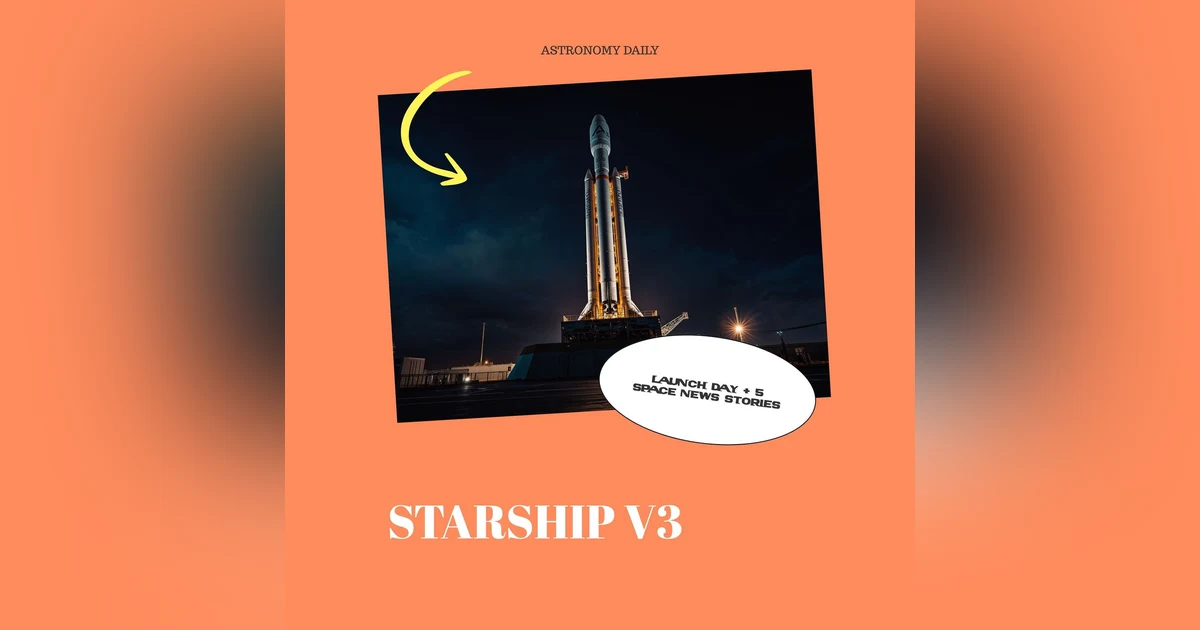
Sponsor Link: To check out our great NordVPN money saving deal - https://www.bitesz.com/nordvpn Astronomy Daily • S05E107 • Wednesday 21 May 2026 Starship V3 is on the pad and counting down for Thursday's debut launch — we bring you the full update...
Sponsor Link:
To check out our great NordVPN money saving deal - Click Here
Astronomy Daily • S05E107 • Wednesday 21 May 2026 Starship V3 is on the pad and counting down for Thursday's debut launch — we bring you the full update including technical objectives, the Artemis stakes, and a sober note about a worker fatality at Starbase. Plus: a NIST proposal to build GPS for the Moon using lasers inside permanently frozen polar craters; space station startup Vast enters the satellite market; JWST finally has an explanation for the universe's impossibly large early black holes; the Roman Space Telescope locks in a September 2026 launch; and interstellar comet 3I/ATLAS gives up two remarkable new secrets — alien water thirty times richer in heavy hydrogen than anything in our solar system, and pre-discovery images that show it was spotted before anyone knew it was there. Stories This Episode • STORY 1 — Starship V3 Flight 12: Launch window opens Thursday 21 May at 6:30 PM EDT (8:30 AM AEST Friday 22 May). Splashdown of upper stage in Indian Ocean off Western Australia ~65 min after liftoff. First flight of Starship V3, first use of Starbase Pad 2. Key objectives: Raptor 3 engines, heat shield imaging by modified Starlink sats, 22 dummy Starlink deployments, Raptor relight in space. Worker fatality at Starbase 15 May under OSHA investigation. • STORY 2 — Lunar GPS via NIST: Proposal to place ultrastable silicon optical cavity lasers in permanently shadowed craters near lunar south pole (~16K, near-perfect vacuum). Could enable lunar GPS network, atomic timekeeping on Moon, precise satellite ranging, gravitational wave detection. • STORY 3 — Vast Corporation: Space station builder announces new line of high-power satellites, expanding beyond Haven-1 into commercial satellite manufacturing. Announced 19 May 2026. • STORY 4 — JWST Black Holes: New arXiv paper proposes 'episodic super-Eddington accretion' in gas-rich dark matter-dominated early galaxies explains overmassive black holes found by JWST. Identifies them as 'missing link' between heavy seeds and luminous quasars. • STORY 5 — Roman Space Telescope: Launch now confirmed as early as September 2026 — 8 months ahead of schedule, under budget. 100x Hubble's field of view, 1,000x survey speed. Targets dark energy, dark matter, exoplanets. Coronagraph for direct exoplanet imaging. • STORY 6 — 3I/ATLAS: Pre-discovery images found in Rubin Observatory data from 21 June–2 July 2025, over a week before official ATLAS discovery. Water deuterium ratio at least 30x higher than any solar system comet (ALMA/U of Michigan/Nature Astronomy). Comet estimated ~12 billion years old. Key Links • SpaceX Starship Flight 12 livestream: spacex.com • Flight 12 timeline (Space.com): space.com/space-exploration/launches-spacecraft/what-time-is-spacex-starship-v3-launch-starship-flight-12-timeline • Starbase worker death (Space.com): space.com/space-exploration/launches-spacecraft/worker-dies-at-spacexs-starbase-in-leadup-to-starship-v3-megarocket-launch • Lunar laser GPS (NIST): nist.gov/news-events/news/2026/05/shooting-moon-ultrastable-lasers-dark-craters-could-enable-lunar-navigation • Vast satellite announcement: space.com (19 May 2026) • Roman Space Telescope launch update: nasa.gov • 3I/ATLAS pre-discovery images: space.com/astronomy/comets • 3I/ATLAS water chemistry (ALMA): almaobservatory.org
Become a supporter of this podcast: https://www.spreaker.com/podcast/astronomy-daily-space-news-updates--5648921/support.
Sponsor Details:
Ensure your online privacy by using NordVPN. To get our special listener deal and save a lot of money, visit www.bitesz.com/nordvpn. You'll be glad you did!
Become a supporter of Astronomy Daily by joining our Supporters Club. Commercial free episodes daily are only a click way... Click Here
This episode includes AI-generated content.
To check out our great NordVPN money saving deal - Click Here
Astronomy Daily • S05E107 • Wednesday 21 May 2026 Starship V3 is on the pad and counting down for Thursday's debut launch — we bring you the full update including technical objectives, the Artemis stakes, and a sober note about a worker fatality at Starbase. Plus: a NIST proposal to build GPS for the Moon using lasers inside permanently frozen polar craters; space station startup Vast enters the satellite market; JWST finally has an explanation for the universe's impossibly large early black holes; the Roman Space Telescope locks in a September 2026 launch; and interstellar comet 3I/ATLAS gives up two remarkable new secrets — alien water thirty times richer in heavy hydrogen than anything in our solar system, and pre-discovery images that show it was spotted before anyone knew it was there. Stories This Episode • STORY 1 — Starship V3 Flight 12: Launch window opens Thursday 21 May at 6:30 PM EDT (8:30 AM AEST Friday 22 May). Splashdown of upper stage in Indian Ocean off Western Australia ~65 min after liftoff. First flight of Starship V3, first use of Starbase Pad 2. Key objectives: Raptor 3 engines, heat shield imaging by modified Starlink sats, 22 dummy Starlink deployments, Raptor relight in space. Worker fatality at Starbase 15 May under OSHA investigation. • STORY 2 — Lunar GPS via NIST: Proposal to place ultrastable silicon optical cavity lasers in permanently shadowed craters near lunar south pole (~16K, near-perfect vacuum). Could enable lunar GPS network, atomic timekeeping on Moon, precise satellite ranging, gravitational wave detection. • STORY 3 — Vast Corporation: Space station builder announces new line of high-power satellites, expanding beyond Haven-1 into commercial satellite manufacturing. Announced 19 May 2026. • STORY 4 — JWST Black Holes: New arXiv paper proposes 'episodic super-Eddington accretion' in gas-rich dark matter-dominated early galaxies explains overmassive black holes found by JWST. Identifies them as 'missing link' between heavy seeds and luminous quasars. • STORY 5 — Roman Space Telescope: Launch now confirmed as early as September 2026 — 8 months ahead of schedule, under budget. 100x Hubble's field of view, 1,000x survey speed. Targets dark energy, dark matter, exoplanets. Coronagraph for direct exoplanet imaging. • STORY 6 — 3I/ATLAS: Pre-discovery images found in Rubin Observatory data from 21 June–2 July 2025, over a week before official ATLAS discovery. Water deuterium ratio at least 30x higher than any solar system comet (ALMA/U of Michigan/Nature Astronomy). Comet estimated ~12 billion years old. Key Links • SpaceX Starship Flight 12 livestream: spacex.com • Flight 12 timeline (Space.com): space.com/space-exploration/launches-spacecraft/what-time-is-spacex-starship-v3-launch-starship-flight-12-timeline • Starbase worker death (Space.com): space.com/space-exploration/launches-spacecraft/worker-dies-at-spacexs-starbase-in-leadup-to-starship-v3-megarocket-launch • Lunar laser GPS (NIST): nist.gov/news-events/news/2026/05/shooting-moon-ultrastable-lasers-dark-craters-could-enable-lunar-navigation • Vast satellite announcement: space.com (19 May 2026) • Roman Space Telescope launch update: nasa.gov • 3I/ATLAS pre-discovery images: space.com/astronomy/comets • 3I/ATLAS water chemistry (ALMA): almaobservatory.org
Become a supporter of this podcast: https://www.spreaker.com/podcast/astronomy-daily-space-news-updates--5648921/support.
Sponsor Details:
Ensure your online privacy by using NordVPN. To get our special listener deal and save a lot of money, visit www.bitesz.com/nordvpn. You'll be glad you did!
Become a supporter of Astronomy Daily by joining our Supporters Club. Commercial free episodes daily are only a click way... Click Here
This episode includes AI-generated content.
WEBVTT
0
00:00:00.640 --> 00:00:03.240
Anna: The world's most powerful rocket is on the
1
00:00:03.240 --> 00:00:05.880
launch pad and it's launching tomorrow. We
2
00:00:05.880 --> 00:00:08.720
have the full Update on Starship V3 and
3
00:00:08.720 --> 00:00:10.880
the bittersweet shadow hanging over the
4
00:00:10.880 --> 00:00:11.520
launch site.
5
00:00:11.920 --> 00:00:14.360
Avery: In the cold darkness of the Moon's south
6
00:00:14.360 --> 00:00:16.680
pole, scientists want to build the most
7
00:00:16.680 --> 00:00:19.680
precise navigation system ever created.
8
00:00:20.160 --> 00:00:22.680
Lasers and craters permanently
9
00:00:22.680 --> 00:00:23.920
frozen in shadow.
10
00:00:24.320 --> 00:00:26.440
Anna: A, uh, space startup you might know best for
11
00:00:26.440 --> 00:00:29.240
its space station ambitions just revealed a
12
00:00:29.240 --> 00:00:31.800
surprise new business. Astronomy Daily
13
00:00:31.880 --> 00:00:34.840
Season 5 Episode 107 let's go.
14
00:00:35.160 --> 00:00:36.120
Avery: Ready when you are.
15
00:00:36.440 --> 00:00:38.920
Anna: It's launch eve for the most anticipated
16
00:00:38.920 --> 00:00:41.920
rocket test of 2026. SpaceX's
17
00:00:41.920 --> 00:00:44.720
Starship V3, the biggest, most
18
00:00:44.720 --> 00:00:47.680
powerful rocket ever built, is on the pad at
19
00:00:47.680 --> 00:00:50.680
Starbase in South Texas. Confirmed go for
20
00:00:50.680 --> 00:00:52.600
launch Thursday, May 21st.
21
00:00:53.080 --> 00:00:55.240
Avery: We've been following this one for a few days
22
00:00:55.240 --> 00:00:57.720
now, Anna, and this is genuinely the launch
23
00:00:57.720 --> 00:01:00.660
where the stakes couldn't be higher for NASA,
24
00:01:00.660 --> 00:01:03.420
for SpaceX, for the whole future of deep
25
00:01:03.420 --> 00:01:04.380
space travel.
26
00:01:04.860 --> 00:01:06.900
Anna: Let's run through what's happening and why it
27
00:01:06.900 --> 00:01:09.220
matters. The launch window opens at
28
00:01:09.220 --> 00:01:11.740
6:30pm Eastern Time on Thursday.
29
00:01:12.140 --> 00:01:14.900
That's 8:30 Friday morning for listeners in
30
00:01:14.900 --> 00:01:17.820
Australia and New Zealand. 90 minutes to get
31
00:01:17.820 --> 00:01:18.540
off the pad.
32
00:01:19.020 --> 00:01:21.860
Avery: This is Flight 12, the 12th Test
33
00:01:21.860 --> 00:01:24.440
of the fully stacked Starship vehicle. And
34
00:01:24.440 --> 00:01:26.260
um, the very first for the completely
35
00:01:26.260 --> 00:01:29.100
redesigned version 3 architecture. It's
36
00:01:29.100 --> 00:01:31.740
been seven months since Starship last flew
37
00:01:31.740 --> 00:01:34.580
back in October 2025, so the
38
00:01:34.580 --> 00:01:35.900
pressure has been building.
39
00:01:36.540 --> 00:01:39.220
Anna: And it's the first flight From Starbase Pad
40
00:01:39.220 --> 00:01:42.100
2, a brand new launch complex. So
41
00:01:42.100 --> 00:01:44.340
there are a lot of firsts stacked up in this
42
00:01:44.340 --> 00:01:45.019
one mission.
43
00:01:45.420 --> 00:01:47.780
Avery: What are the main test objectives for Flight
44
00:01:47.780 --> 00:01:48.140
12?
45
00:01:48.700 --> 00:01:51.170
Anna: The Booster Super Heavy will attempt a, uh,
46
00:01:51.260 --> 00:01:53.820
controlled splashdown in the Gulf of Mexico
47
00:01:53.900 --> 00:01:56.390
about seven minutes after launching. No
48
00:01:56.390 --> 00:01:59.270
Mechazilla catch attempt this time. This is a
49
00:01:59.270 --> 00:02:01.790
new vehicle and SpaceX wants clean data
50
00:02:01.870 --> 00:02:04.830
before pushing for that. Meanwhile, the upper
51
00:02:04.830 --> 00:02:07.190
stage ship 39 heads on a
52
00:02:07.190 --> 00:02:09.590
suborbital trajectory partway around the
53
00:02:09.590 --> 00:02:09.870
world.
54
00:02:10.350 --> 00:02:13.030
Avery: And it ends in the Indian Ocean, which puts
55
00:02:13.030 --> 00:02:15.430
the re entry path right over Western
56
00:02:15.430 --> 00:02:17.790
Australia. For our Southern Hemisphere
57
00:02:17.790 --> 00:02:20.110
audience, there is a real chance of a visible
58
00:02:20.110 --> 00:02:22.830
streak across the Predawn sky around
59
00:02:22.910 --> 00:02:24.850
65 minutes after launching.
60
00:02:25.240 --> 00:02:27.120
Anna: The upper stage has some fascinating
61
00:02:27.120 --> 00:02:30.080
objectives. It'll deploy 22 dummy
62
00:02:30.080 --> 00:02:32.440
Starlink satellites. Two of those are
63
00:02:32.440 --> 00:02:35.360
specially modified. They'll scan Starship's
64
00:02:35.360 --> 00:02:38.360
heat shield from outside and beam images back
65
00:02:38.360 --> 00:02:40.919
to mission controllers. That's a completely
66
00:02:40.919 --> 00:02:43.640
new capability testing how the team might
67
00:02:43.640 --> 00:02:45.960
assess heat shield readiness for future
68
00:02:46.040 --> 00:02:47.720
return to Starbase missions.
69
00:02:48.200 --> 00:02:50.120
Avery: And there's a deliberately removed heat
70
00:02:50.120 --> 00:02:52.200
shield tile to measure what happens
71
00:02:52.200 --> 00:02:55.190
aerodynamically when one is missing. Plus a
72
00:02:55.190 --> 00:02:57.830
Raptor engine relay in space and a
73
00:02:57.830 --> 00:03:00.190
structural stress maneuver on the rear flaps.
74
00:03:00.510 --> 00:03:02.750
SpaceX is loading this flight with data
75
00:03:02.750 --> 00:03:03.230
collection.
76
00:03:03.870 --> 00:03:06.470
Anna: Now, before we go further with the excitement
77
00:03:06.470 --> 00:03:09.430
and we are genuinely excited, we do need
78
00:03:09.430 --> 00:03:12.350
to acknowledge something. On 15 May, a
79
00:03:12.350 --> 00:03:14.590
worker died at the Starbase site in South
80
00:03:14.590 --> 00:03:17.430
Texas. According to reports, the person was a
81
00:03:17.430 --> 00:03:20.190
contractor who died after a fall in the early
82
00:03:20.190 --> 00:03:22.630
hours of that Friday morning OSHA is
83
00:03:22.630 --> 00:03:23.310
investigating.
84
00:03:23.870 --> 00:03:26.470
Avery: SpaceX has not publicly commented. Our
85
00:03:26.470 --> 00:03:28.230
thoughts are with the person's family and
86
00:03:28.230 --> 00:03:30.990
colleagues. It's a reminder that behind every
87
00:03:30.990 --> 00:03:33.430
spectacular launch is a workforce of
88
00:03:33.430 --> 00:03:35.310
thousands of people doing difficult,
89
00:03:35.550 --> 00:03:37.989
sometimes dangerous work that deserves
90
00:03:37.989 --> 00:03:38.750
acknowledgment.
91
00:03:39.230 --> 00:03:41.870
Anna: And there is a broader context here. A, uh,
92
00:03:41.950 --> 00:03:44.510
2025 analysis using OSHA data
93
00:03:44.750 --> 00:03:47.110
found that Starbase has a significantly
94
00:03:47.110 --> 00:03:49.550
higher worker injury rate than comparable
95
00:03:49.550 --> 00:03:51.940
aerospace facilities. That's something the
96
00:03:51.940 --> 00:03:54.340
industry and regulators need to keep in focus
97
00:03:54.580 --> 00:03:56.900
as the pace of operations accelerates.
98
00:03:57.300 --> 00:04:00.220
Avery: With that noted, the launch itself. Why does
99
00:04:00.220 --> 00:04:02.780
NASA need Starship V3 to work so
100
00:04:02.780 --> 00:04:03.300
badly?
101
00:04:03.700 --> 00:04:06.460
Anna: Because Starship is the designated lunar
102
00:04:06.460 --> 00:04:09.180
lander for Artemis 4. That's the mission that
103
00:04:09.180 --> 00:04:11.540
will actually put boots back on the moon,
104
00:04:11.700 --> 00:04:14.460
targeted for 2028. NASA
105
00:04:14.460 --> 00:04:17.140
needs SpaceX to prove Starship can get to
106
00:04:17.140 --> 00:04:20.140
orbit, refuel there, dock with an Orion
107
00:04:20.140 --> 00:04:23.140
capsule and descend to the surface. None of
108
00:04:23.140 --> 00:04:25.660
that has happened yet. This test is the
109
00:04:25.660 --> 00:04:26.220
foundation.
110
00:04:26.780 --> 00:04:29.140
Avery: B3 is also supposed to be the baseline
111
00:04:29.140 --> 00:04:31.500
vehicle for crewed missions eventually. And
112
00:04:31.500 --> 00:04:34.140
SpaceX's plans for orbital data centers,
113
00:04:34.140 --> 00:04:37.140
Mars missions, everything a lot is
114
00:04:37.140 --> 00:04:38.860
riding on a clean test tomorrow.
115
00:04:39.100 --> 00:04:41.980
Anna: The launch window opens at 6:30 Eastern
116
00:04:42.060 --> 00:04:44.700
Thursday evening. 8:30 Friday morning,
117
00:04:44.780 --> 00:04:47.460
Australian Eastern Time. SpaceX will
118
00:04:47.460 --> 00:04:49.940
livestream from about 45 minutes before
119
00:04:49.940 --> 00:04:52.340
liftoff. We'll link everything in the show
120
00:04:52.340 --> 00:04:53.780
Notes next up.
121
00:04:53.780 --> 00:04:56.140
Avery: Today, here's, um, an idea that sounds like
122
00:04:56.140 --> 00:04:58.980
science fiction, but is grounded in some very
123
00:04:58.980 --> 00:05:01.300
serious physics. What if the
124
00:05:01.300 --> 00:05:04.060
coldest, darkest, most inhospitable
125
00:05:04.060 --> 00:05:06.899
places on the Moon turned out to be the ideal
126
00:05:06.899 --> 00:05:09.300
location for one of the most precise
127
00:05:09.380 --> 00:05:11.060
instruments ever conceived?
128
00:05:11.460 --> 00:05:13.940
Anna: You're talking about the permanently shadowed
129
00:05:13.940 --> 00:05:15.940
craters near the lunar south pole.
130
00:05:16.670 --> 00:05:18.750
Avery: Exactly. Researchers at the National
131
00:05:18.830 --> 00:05:20.590
Institute of Standards and Technology
132
00:05:21.710 --> 00:05:24.550
in the US have published a proposal this
133
00:05:24.550 --> 00:05:27.230
week that's genuinely elegant. These
134
00:05:27.230 --> 00:05:30.070
polar craters never, ever receive direct
135
00:05:30.070 --> 00:05:32.549
sunlight. Because of the Moon's very low
136
00:05:32.549 --> 00:05:34.910
axial tilt, they've been in permanent
137
00:05:34.910 --> 00:05:37.750
darkness for billions of years. Temperatures
138
00:05:37.750 --> 00:05:40.550
inside reach around 16 Kelvin. That's
139
00:05:40.550 --> 00:05:43.310
minus 257 degrees Celsius,
140
00:05:43.960 --> 00:05:45.400
almost absolute zero.
141
00:05:45.880 --> 00:05:48.200
Anna: And that makes them special for lasers.
142
00:05:48.680 --> 00:05:51.400
Avery: Incredibly special. The most stable
143
00:05:51.400 --> 00:05:54.160
lasers in existence rely on silicon
144
00:05:54.160 --> 00:05:57.160
optical cavities, essentially a pair of
145
00:05:57.160 --> 00:06:00.040
ultra precise mirrors in a rigid housing.
146
00:06:00.440 --> 00:06:02.840
The problem is that even the tiniest
147
00:06:02.840 --> 00:06:05.640
temperature fluctuation or vibration will
148
00:06:05.640 --> 00:06:08.560
cause the laser frequency to drift. On Earth,
149
00:06:08.560 --> 00:06:11.280
you need enormously complex cryogenic
150
00:06:11.280 --> 00:06:13.640
cooling systems and vibration isolation
151
00:06:14.040 --> 00:06:16.500
just to keep them stable. In one of these
152
00:06:16.500 --> 00:06:19.460
lunar craters, nature provides all of that
153
00:06:19.460 --> 00:06:19.940
for free.
154
00:06:20.420 --> 00:06:22.660
Anna: The near absolute zero temperature
155
00:06:22.740 --> 00:06:25.540
eliminates thermal noise. The near perfect
156
00:06:25.540 --> 00:06:28.100
vacuum eliminates atmospheric interference.
157
00:06:28.500 --> 00:06:30.740
And the bedrock of a lunar crater is
158
00:06:30.740 --> 00:06:33.380
extraordinarily stable compared to any
159
00:06:33.380 --> 00:06:34.500
location on Earth.
160
00:06:34.980 --> 00:06:37.940
Avery: Jun Ye, the lead researcher at nist, put it
161
00:06:37.940 --> 00:06:40.300
beautifully. He said as soon as he understood
162
00:06:40.300 --> 00:06:42.500
what these permanently shadowed regions could
163
00:06:42.500 --> 00:06:45.140
offer, he he felt it would be the most ideal
164
00:06:45.140 --> 00:06:48.060
environment ever for a super stable laser.
165
00:06:48.540 --> 00:06:51.180
Anna: So what would such a laser actually be used
166
00:06:51.260 --> 00:06:53.660
for? This isn't just a cool physics
167
00:06:53.660 --> 00:06:54.300
experiment.
168
00:06:54.780 --> 00:06:57.460
Avery: Not at all. The applications are immediately
169
00:06:57.460 --> 00:06:59.900
practical for everything humanity is planning
170
00:06:59.900 --> 00:07:02.540
to do on the moon. First, navigation.
171
00:07:02.860 --> 00:07:05.300
As we build up Artemis infrastructure at the
172
00:07:05.300 --> 00:07:08.180
lunar south pole, spacecraft and landers
173
00:07:08.180 --> 00:07:10.660
currently have to rely heavily on Earth based
174
00:07:10.660 --> 00:07:12.950
tracking systems. That's slow,
175
00:07:12.950 --> 00:07:15.710
imprecise and increasingly impractical as
176
00:07:15.710 --> 00:07:18.470
lunar activity ramps up. A laser
177
00:07:18.470 --> 00:07:20.910
locked to this kind of ultra stable cavity
178
00:07:20.910 --> 00:07:23.750
could provide a GPS like timing backbone.
179
00:07:23.990 --> 00:07:26.630
A master reference signal that spacecraft,
180
00:07:26.630 --> 00:07:28.950
landers and astronauts could navigate by
181
00:07:29.350 --> 00:07:30.470
an independent
182
00:07:30.470 --> 00:07:32.830
Anna: lunar positioning system that's
183
00:07:32.830 --> 00:07:34.990
genuinely transformative for long term
184
00:07:34.990 --> 00:07:35.590
operations.
185
00:07:36.150 --> 00:07:38.630
Avery: There's more. The same laser could enable
186
00:07:38.630 --> 00:07:41.030
ultra precise distance measurements between
187
00:07:41.030 --> 00:07:43.690
satellites in lunar orbit, critical for
188
00:07:43.690 --> 00:07:46.290
mapping and coordination. It could serve as
189
00:07:46.290 --> 00:07:49.050
the first atomic clock on an extraterrestrial
190
00:07:49.050 --> 00:07:51.450
body, establishing a lunar timescale.
191
00:07:51.850 --> 00:07:54.530
And this one caught my eye. It could
192
00:07:54.530 --> 00:07:56.890
potentially support gravitational wave
193
00:07:56.890 --> 00:07:59.050
detection from the lunar surface.
194
00:07:59.450 --> 00:08:01.530
Anna: The Moon has been discussed as a future
195
00:08:01.610 --> 00:08:04.410
gravitational wave observatory site. Because
196
00:08:04.410 --> 00:08:06.690
it lacks the seismic noise that limits
197
00:08:06.690 --> 00:08:09.490
detectors on Earth, a laser like this would
198
00:08:09.490 --> 00:08:10.730
be a key component.
199
00:08:11.440 --> 00:08:13.480
Avery: This is still a proposal, but it's the kind
200
00:08:13.480 --> 00:08:15.680
of forward thinking infrastructure planning
201
00:08:15.680 --> 00:08:18.200
that needs to happen now before the crewed
202
00:08:18.200 --> 00:08:20.680
missions arrive. Because you really don't
203
00:08:20.680 --> 00:08:23.480
want to be figuring out lunar GPS after
204
00:08:23.480 --> 00:08:25.200
the astronauts are already there.
205
00:08:25.680 --> 00:08:28.560
Anna: Before moving on to our next story, a quick
206
00:08:28.560 --> 00:08:31.520
reminder about our sponsor NORDVPN and
207
00:08:31.520 --> 00:08:33.760
the special money saving deal they have in
208
00:08:33.760 --> 00:08:36.040
place for you. When you're ready to upgrade
209
00:08:36.040 --> 00:08:38.640
your online security, make sure it's to
210
00:08:38.640 --> 00:08:41.560
NORDVPN and save a bunch of money in the
211
00:08:41.560 --> 00:08:41.840
process.
212
00:08:42.350 --> 00:08:44.830
Avery: When when you can find a link to our special
213
00:08:44.830 --> 00:08:47.230
offer in the show notes, do what we did and
214
00:08:47.230 --> 00:08:48.590
get NordVPN.
215
00:08:49.230 --> 00:08:51.870
Anna: Now you might know vast as the California
216
00:08:51.870 --> 00:08:54.710
startup building haven one the commercial
217
00:08:54.710 --> 00:08:57.070
space station that launched last year as
218
00:08:57.070 --> 00:08:59.750
humanity's first privately owned orbital
219
00:08:59.750 --> 00:09:02.550
outpost. But this week, VAST made an
220
00:09:02.550 --> 00:09:04.830
announcement that raised a few eyebrows.
221
00:09:04.910 --> 00:09:06.990
They're getting into the satellite business.
222
00:09:07.470 --> 00:09:10.060
A pivot, an expansion really.
223
00:09:10.380 --> 00:09:13.340
On 19 May, Vast announced a new
224
00:09:13.340 --> 00:09:16.140
line of high power satellites distinct
225
00:09:16.140 --> 00:09:18.420
from their space station work. They're
226
00:09:18.420 --> 00:09:20.780
positioning this as a separate business line,
227
00:09:21.020 --> 00:09:23.380
entering a market currently dominated by
228
00:09:23.380 --> 00:09:26.260
established players like Boeing and Airbus in
229
00:09:26.260 --> 00:09:29.100
the geostationary orbit segment, as well as
230
00:09:29.100 --> 00:09:31.980
the emerging high throughput LEO operators.
231
00:09:32.700 --> 00:09:35.220
Avery: High power satellites. What does that mean
232
00:09:35.220 --> 00:09:37.670
specifically? Higher power than standard
233
00:09:37.670 --> 00:09:38.950
communication satellites?
234
00:09:39.270 --> 00:09:41.790
Anna: Exactly. High power satellites can
235
00:09:41.790 --> 00:09:44.550
generate significantly more electrical power
236
00:09:44.550 --> 00:09:46.950
from their solar arrays, which translates
237
00:09:46.950 --> 00:09:49.590
directly into more powerful transmitters and
238
00:09:49.590 --> 00:09:52.110
more bandwidth capacity. They're attractive
239
00:09:52.110 --> 00:09:53.950
for government customers, defense
240
00:09:53.950 --> 00:09:56.150
applications and premium commercial
241
00:09:56.150 --> 00:09:58.310
communications sectors where performance
242
00:09:58.710 --> 00:10:00.950
outweighs launch cost as a priority.
243
00:10:01.270 --> 00:10:03.990
Avery: And VAST has the manufacturing expertise from
244
00:10:03.990 --> 00:10:05.510
Haven One to draw on.
245
00:10:05.970 --> 00:10:08.570
Anna: That's presumably part of the logic. Building
246
00:10:08.570 --> 00:10:11.450
a space station requires solving very hard
247
00:10:11.450 --> 00:10:14.290
problems around long duration power systems,
248
00:10:14.450 --> 00:10:17.330
thermal management, structural integrity in
249
00:10:17.330 --> 00:10:20.170
orbitall, things that translate well into
250
00:10:20.170 --> 00:10:22.970
satellite manufacturing. Bast seems to be
251
00:10:22.970 --> 00:10:25.450
betting they can leverage that expertise into
252
00:10:25.450 --> 00:10:26.770
a new revenue stream.
253
00:10:27.010 --> 00:10:29.010
Avery: It's, um, an interesting strategic move.
254
00:10:29.330 --> 00:10:31.530
Space stations are enormously capital
255
00:10:31.530 --> 00:10:34.290
intensive with a very long return horizon.
256
00:10:34.710 --> 00:10:37.190
Satellites are a more established market with
257
00:10:37.190 --> 00:10:39.910
clearer near term revenue. It diversifies
258
00:10:39.910 --> 00:10:41.590
their business in a meaningful way.
259
00:10:41.990 --> 00:10:44.550
Anna: Haven One remains their flagship product.
260
00:10:44.710 --> 00:10:47.390
This isn't an abandonment of that vision, but
261
00:10:47.390 --> 00:10:49.870
it signals that VAST is thinking about itself
262
00:10:49.870 --> 00:10:52.310
as a broader space infrastructure company,
263
00:10:52.710 --> 00:10:55.190
not just a station operator. One to watch.
264
00:10:55.750 --> 00:10:58.190
Avery: Time now for a black hole story. When the
265
00:10:58.190 --> 00:11:00.710
James Webb Space Telescope started returning
266
00:11:00.710 --> 00:11:03.390
data from the early universe, it created a
267
00:11:03.390 --> 00:11:06.050
beautiful problem. It found black holes that
268
00:11:06.050 --> 00:11:08.650
were too big. Impossibly big by our
269
00:11:08.650 --> 00:11:11.210
models. Supermassive black holes in
270
00:11:11.210 --> 00:11:14.090
galaxies just 800 million years after
271
00:11:14.090 --> 00:11:16.690
the Big Bang. Far more massive relative to
272
00:11:16.690 --> 00:11:18.810
their host galaxies than anything we see in
273
00:11:18.810 --> 00:11:19.770
the modern universe.
274
00:11:20.170 --> 00:11:22.410
Anna: And that shouldn't be possible under our
275
00:11:22.410 --> 00:11:24.850
standard understanding of how black holes and
276
00:11:24.850 --> 00:11:26.410
galaxies co evolve.
277
00:11:26.890 --> 00:11:29.050
Avery: Right. The conventional model says black
278
00:11:29.050 --> 00:11:31.850
holes and galaxies grow together in a kind
279
00:11:31.850 --> 00:11:34.700
of feedback loop. Star formation, gas
280
00:11:34.700 --> 00:11:37.180
accretion, they regulate each other. The
281
00:11:37.180 --> 00:11:39.900
ratio of black hole mass to galaxy mass is
282
00:11:39.900 --> 00:11:42.140
fairly consistent in the local universe,
283
00:11:42.300 --> 00:11:45.020
around a, uh, tenth to half a percent. But
284
00:11:45.020 --> 00:11:47.980
JWST kept finding early galaxies where
285
00:11:47.980 --> 00:11:50.940
the black hole was grotesquely oversized
286
00:11:51.260 --> 00:11:51.740
relative
287
00:11:51.740 --> 00:11:53.740
Anna: to its host galaxy, the
288
00:11:53.740 --> 00:11:56.660
overmassive black holes. So what's the new
289
00:11:56.660 --> 00:11:57.420
explanation?
290
00:11:57.820 --> 00:12:00.220
Avery: New research published this week on Arxiv,
291
00:12:00.220 --> 00:12:02.940
led by Muhammad Latif at UAE University,
292
00:12:03.420 --> 00:12:06.240
proposes a, uh, compelling mechanism in the
293
00:12:06.240 --> 00:12:08.440
earliest Cosmic environments. Certain
294
00:12:08.440 --> 00:12:11.240
galaxies were extraordinarily gas rich
295
00:12:11.240 --> 00:12:13.920
and embedded in particularly dense dark
296
00:12:13.920 --> 00:12:16.640
matter halos. That combination created
297
00:12:16.640 --> 00:12:18.880
conditions where gas could fall into the
298
00:12:18.880 --> 00:12:21.600
central black hole far faster than the
299
00:12:21.600 --> 00:12:23.480
surrounding galaxy could form stars.
300
00:12:23.880 --> 00:12:26.280
Anna: Though the black hole got a head start, it
301
00:12:26.280 --> 00:12:28.280
never lost exactly.
302
00:12:28.440 --> 00:12:31.040
Avery: The researchers call this rapid early phase
303
00:12:31.040 --> 00:12:34.000
episodic super Eddington accretion. The black
304
00:12:34.000 --> 00:12:36.400
hole was consuming gas at rates that exceed
305
00:12:36.400 --> 00:12:38.640
the theoretical limit that normally governs
306
00:12:38.640 --> 00:12:41.400
how fast accretion can proceed in these
307
00:12:41.400 --> 00:12:43.560
extreme early environments. That limit may
308
00:12:43.560 --> 00:12:44.960
have been routinely broken.
309
00:12:45.280 --> 00:12:48.240
Anna: This paper also identifies these over massive
310
00:12:48.240 --> 00:12:50.960
black holes as potentially the missing link
311
00:12:50.960 --> 00:12:53.640
between what are called heavy seeds, the
312
00:12:53.640 --> 00:12:55.800
primordial black holes that formed from the
313
00:12:55.800 --> 00:12:58.480
collapse of the very first massive stars, and
314
00:12:58.480 --> 00:13:00.760
the luminous quasars we observe later in
315
00:13:00.760 --> 00:13:01.440
cosmic history.
316
00:13:01.920 --> 00:13:04.360
Avery: There is also a separate but related finding
317
00:13:04.360 --> 00:13:07.160
this week on JWST's data from two
318
00:13:07.160 --> 00:13:09.600
specific early galaxies, named in the
319
00:13:09.600 --> 00:13:12.400
research as Kola 1 and Nepla 4,
320
00:13:12.800 --> 00:13:15.360
seen just 800 million years after the Big
321
00:13:15.360 --> 00:13:17.719
Bang, where the black holes appear to have
322
00:13:17.719 --> 00:13:20.080
grown far faster than their host galaxies.
323
00:13:20.400 --> 00:13:23.200
The JWST spectroscopy detected
324
00:13:23.200 --> 00:13:25.260
broad hydrogen emission lines, a, uh,
325
00:13:25.260 --> 00:13:28.240
telltale signature of gas swirling rapidly
326
00:13:28.240 --> 00:13:30.000
around the supermassive black hole.
327
00:13:30.270 --> 00:13:32.510
Anna: That we're getting closer to a, uh, coherent
328
00:13:32.510 --> 00:13:34.830
story of how the universe's largest
329
00:13:34.830 --> 00:13:36.990
structures assembled themselves in those
330
00:13:36.990 --> 00:13:39.830
first billion years. JWST keeps
331
00:13:39.830 --> 00:13:40.350
delivering.
332
00:13:40.670 --> 00:13:43.150
Avery: If you thought the James Webb Space Telescope
333
00:13:43.150 --> 00:13:45.670
changed everything, and it did, you should be
334
00:13:45.670 --> 00:13:48.030
paying close attention to what's coming next.
335
00:13:48.430 --> 00:13:51.310
NASA's Nancy Grace Roman Space Telescope
336
00:13:51.310 --> 00:13:53.550
is now confirmed for launch as early as
337
00:13:53.550 --> 00:13:56.350
September 2026. That's eight months
338
00:13:56.350 --> 00:13:58.790
ahead of its mandated deadline, and it's
339
00:13:58.790 --> 00:14:00.340
under budget, which almost
340
00:14:00.420 --> 00:14:02.820
Anna: never happens with flagship space telescopes.
341
00:14:02.980 --> 00:14:05.780
Avery: Almost never. NASA administrator Jared
342
00:14:05.780 --> 00:14:08.340
Isaacman announced the updated timeline at a
343
00:14:08.340 --> 00:14:10.220
news conference at Goddard Space Flight
344
00:14:10.220 --> 00:14:12.300
center in April. And since then, the
345
00:14:12.300 --> 00:14:14.500
telescope has completed construction and is
346
00:14:14.500 --> 00:14:16.700
being prepared for shipment to Kennedy Space
347
00:14:16.700 --> 00:14:19.300
center in Florida. It'll ride to orbit on a
348
00:14:19.300 --> 00:14:20.660
SpaceX Falcon Heavy.
349
00:14:20.900 --> 00:14:23.140
Anna: Walk us through what Roman actually does,
350
00:14:23.140 --> 00:14:25.260
because I think a lot of people haven't heard
351
00:14:25.260 --> 00:14:27.100
as much about it as they will once it
352
00:14:27.100 --> 00:14:27.540
launches.
353
00:14:28.040 --> 00:14:30.320
Avery: Roman is built around the primary mirror
354
00:14:30.320 --> 00:14:32.760
that's similar in size to Hubble, about
355
00:14:32.760 --> 00:14:35.560
2.4 meters across. But where Hubble
356
00:14:35.560 --> 00:14:37.880
sees a relatively narrow field of view.
357
00:14:38.200 --> 00:14:40.800
Roman's Wide Field Instrument captures a
358
00:14:40.800 --> 00:14:43.360
patch of sky at least a hundred times larger
359
00:14:43.360 --> 00:14:46.160
in a single exposure. And it surveys the
360
00:14:46.160 --> 00:14:48.000
sky at, uh, more than a thousand times
361
00:14:48.000 --> 00:14:48.920
Hubble's speed.
362
00:14:49.160 --> 00:14:52.160
Anna: That's an almost incomprehensible upgrade
363
00:14:52.160 --> 00:14:53.160
in survey capability.
364
00:14:53.740 --> 00:14:55.980
Avery: By the end of its planned five year primary
365
00:14:55.980 --> 00:14:58.300
mission, Roman is expected to accumulate
366
00:14:58.300 --> 00:15:00.620
around 20,000 terabytes of data.
367
00:15:01.100 --> 00:15:03.020
Scientists will use that to investigate
368
00:15:03.020 --> 00:15:05.900
around 100,000 exoplanets, hundreds
369
00:15:05.900 --> 00:15:08.420
of millions of galaxies, billions of
370
00:15:08.420 --> 00:15:11.380
stars. And the mission team fully expects to
371
00:15:11.380 --> 00:15:13.660
find phenomena that have never been observed.
372
00:15:13.900 --> 00:15:16.260
Anna: The primary scientific targets are dark
373
00:15:16.260 --> 00:15:18.740
energy and dark matter, the invisible
374
00:15:18.740 --> 00:15:21.020
scaffolding of the universe that we know must
375
00:15:21.020 --> 00:15:23.930
exist but can't directly see. Roman should
376
00:15:23.930 --> 00:15:26.010
be able to map how much dark matter is
377
00:15:26.010 --> 00:15:28.810
distributed across cosmic time in a way
378
00:15:28.810 --> 00:15:30.290
that's never been possible before.
379
00:15:30.530 --> 00:15:33.290
Avery: It also carries a coronagraph instrument, the
380
00:15:33.290 --> 00:15:35.170
most advanced starlight suppression
381
00:15:35.170 --> 00:15:37.850
technology ever flown in space, which will
382
00:15:37.850 --> 00:15:40.010
enable direct imaging of planets around
383
00:15:40.010 --> 00:15:42.850
nearby stars. That's a key stepping stone in
384
00:15:42.850 --> 00:15:42.970
the
385
00:15:42.970 --> 00:15:45.410
Anna: search for earth like worlds September
386
00:15:45.410 --> 00:15:47.650
2026 mark the calendar.
387
00:15:47.730 --> 00:15:50.690
Astronomy is about to get very, very busy.
388
00:15:51.190 --> 00:15:53.750
Avery: Our final story today involves a visitor from
389
00:15:53.750 --> 00:15:56.190
beyond our solar system and two new
390
00:15:56.190 --> 00:15:58.310
revelations about it that are genuinely
391
00:15:58.310 --> 00:15:59.110
extraordinary.
392
00:15:59.430 --> 00:16:01.750
Anna: The interstellar comet 3 I
393
00:16:02.070 --> 00:16:05.030
HE L A S. We've spoken about this before on
394
00:16:05.030 --> 00:16:07.710
Astronomy Daily. It was officially discovered
395
00:16:07.710 --> 00:16:10.510
on 1 July 2025 by the
396
00:16:10.510 --> 00:16:13.270
ATLAS telescope network in Chile, the third
397
00:16:13.270 --> 00:16:15.870
interstellar object ever detected passing
398
00:16:15.870 --> 00:16:16.870
through our solar system.
399
00:16:17.480 --> 00:16:19.800
Avery: And there are two new developments this week.
400
00:16:20.040 --> 00:16:23.000
The first, researchers have found that 3i a
401
00:16:23.000 --> 00:16:25.880
atlas was actually being imaged by the Vera C
402
00:16:25.880 --> 00:16:28.560
Rubin Observatory in Chile for more than a
403
00:16:28.560 --> 00:16:31.320
week before its official discovery. The Comet
404
00:16:31.320 --> 00:16:34.320
nearly became 3i Rubin. Images from
405
00:16:34.320 --> 00:16:37.270
between 21 June and 2 July
406
00:16:37.396 --> 00:16:40.240
2025 show it clearly in Rubin data. But
407
00:16:40.240 --> 00:16:42.320
the observatory was still in its science
408
00:16:42.320 --> 00:16:44.680
validation phase at the time, not yet in full
409
00:16:44.680 --> 00:16:47.280
operation. Nobody was looking at those frames
410
00:16:47.280 --> 00:16:48.000
in real time.
411
00:16:48.480 --> 00:16:50.880
Anna: That's a fascinating footnote about the state
412
00:16:50.880 --> 00:16:53.880
of our sky survey infrastructure. Had Rubin
413
00:16:53.880 --> 00:16:55.800
been fully operational, we would have had
414
00:16:55.800 --> 00:16:57.960
over a week of additional early tracking
415
00:16:57.960 --> 00:16:58.240
data.
416
00:16:58.720 --> 00:17:00.760
Avery: And that matters enormously for
417
00:17:00.760 --> 00:17:03.120
characterizing these objects. The earlier you
418
00:17:03.120 --> 00:17:05.080
catch them, the better you understand their
419
00:17:05.080 --> 00:17:07.360
trajectory, their composition, their size.
420
00:17:07.520 --> 00:17:10.400
Anna: The second development is even more striking.
421
00:17:10.800 --> 00:17:13.280
Research led by the University of Michigan
422
00:17:13.280 --> 00:17:15.600
and published in Nature Astronomy
423
00:17:15.950 --> 00:17:18.510
reveals that the water inside 2i
424
00:17:18.510 --> 00:17:21.430
Atlas is unlike anything we've ever
425
00:17:21.430 --> 00:17:24.430
found in our own solar system. Specifically,
426
00:17:24.430 --> 00:17:27.030
its ratio of heavy water water
427
00:17:27.030 --> 00:17:29.630
molecules, where one hydrogen atom is
428
00:17:29.630 --> 00:17:32.590
replaced by deuterium, is at least 30
429
00:17:32.670 --> 00:17:35.470
times higher than anything found in comets
430
00:17:35.470 --> 00:17:36.830
from our own solar system.
431
00:17:37.230 --> 00:17:40.030
Avery: Thirty times? That's not a small difference.
432
00:17:40.270 --> 00:17:43.170
Anna: It's a profound one. Deuterium is a heavier
433
00:17:43.170 --> 00:17:45.410
isotope of hydrogen, and the ratio of
434
00:17:45.410 --> 00:17:48.130
deuterium to regular hydrogen in water is a
435
00:17:48.130 --> 00:17:50.690
chemical fossil. It records the temperature
436
00:17:50.690 --> 00:17:53.170
conditions where the water formed. High
437
00:17:53.170 --> 00:17:55.210
deuterium means the water formed in an
438
00:17:55.210 --> 00:17:58.050
extremely cold environment, far colder than
439
00:17:58.050 --> 00:18:00.010
the outer reaches of our own solar system.
440
00:18:00.570 --> 00:18:03.490
Avery: So 3 IA atlas forms somewhere colder
441
00:18:03.490 --> 00:18:05.490
and stranger than anything in our
442
00:18:05.490 --> 00:18:08.250
neighborhood. A different kind of planetary
443
00:18:08.250 --> 00:18:10.810
system, possibly much further from its parent
444
00:18:10.810 --> 00:18:11.130
star.
445
00:18:11.660 --> 00:18:14.020
Anna: The researchers at ALMA Observatory described
446
00:18:14.020 --> 00:18:16.700
it beautifully. They said each interstellar
447
00:18:16.700 --> 00:18:19.380
comet brings a little bit of its history, its
448
00:18:19.380 --> 00:18:22.260
fossils from elsewhere in the galaxy. We
449
00:18:22.260 --> 00:18:25.060
don't know exactly where 3 IA Atlas came
450
00:18:25.060 --> 00:18:27.379
from, but with instruments like ALMA and
451
00:18:27.379 --> 00:18:30.260
Rubin and jwst, we're beginning to
452
00:18:30.260 --> 00:18:32.900
read the chemical biography of another star
453
00:18:32.900 --> 00:18:33.260
system.
454
00:18:33.820 --> 00:18:36.220
Avery: And the comet itself is estimated to be
455
00:18:36.220 --> 00:18:39.110
nearly 12 billion years old. Its
456
00:18:39.110 --> 00:18:42.070
parent star system may no longer exist. We're
457
00:18:42.070 --> 00:18:43.750
reading the message from a stellar
458
00:18:43.750 --> 00:18:46.190
civilization of ice and rock that formed
459
00:18:46.190 --> 00:18:47.710
before our sun was born.
460
00:18:48.270 --> 00:18:51.150
Anna: Space travel in slow motion across
461
00:18:51.310 --> 00:18:54.310
12 billion years before we go
462
00:18:54.310 --> 00:18:54.530
a, uh,
463
00:18:54.550 --> 00:18:56.910
Avery: quick heads up for your skies tonight. Look
464
00:18:56.910 --> 00:18:59.110
west after sunset and you'll find a lovely
465
00:18:59.110 --> 00:19:01.790
pairing. Jupiter glows brightly beside the
466
00:19:01.790 --> 00:19:04.510
waxing crescent moon. The crescent acts as a
467
00:19:04.510 --> 00:19:06.400
natural pointer. Jupiter will be the
468
00:19:06.400 --> 00:19:08.800
brightest star like object nearby. No
469
00:19:08.800 --> 00:19:10.920
telescope needed, though. Binoculars will
470
00:19:10.920 --> 00:19:13.840
show Jupiter's four Galilean moons as tiny
471
00:19:13.840 --> 00:19:16.680
dots in a line. Southern Hemisphere viewers
472
00:19:16.680 --> 00:19:19.080
look northwest after dark. Enjoy it.
473
00:19:19.320 --> 00:19:21.800
Anna: That's Astronomy daily for Wednesday,
474
00:19:22.040 --> 00:19:24.280
May 21, 2026.
475
00:19:24.680 --> 00:19:27.080
Season 5 Episode 107
476
00:19:27.480 --> 00:19:30.160
Big Day Tomorrow with Starship. We'll be
477
00:19:30.160 --> 00:19:30.600
watching.
478
00:19:30.760 --> 00:19:32.360
Avery: If you're enjoying the show, please
479
00:19:32.360 --> 00:19:34.720
subscribe, leave a review and tell a fellow
480
00:19:34.720 --> 00:19:37.590
space enthusiast. Find us at astronomydaily
481
00:19:37.670 --> 00:19:40.030
IO and across all platforms as
482
00:19:40.030 --> 00:19:42.830
astrodaily. Pod. This is Anna and
483
00:19:42.830 --> 00:19:44.550
Avery. Keep looking up.
0
00:00:00.640 --> 00:00:03.240
Anna: The world's most powerful rocket is on the
1
00:00:03.240 --> 00:00:05.880
launch pad and it's launching tomorrow. We
2
00:00:05.880 --> 00:00:08.720
have the full Update on Starship V3 and
3
00:00:08.720 --> 00:00:10.880
the bittersweet shadow hanging over the
4
00:00:10.880 --> 00:00:11.520
launch site.
5
00:00:11.920 --> 00:00:14.360
Avery: In the cold darkness of the Moon's south
6
00:00:14.360 --> 00:00:16.680
pole, scientists want to build the most
7
00:00:16.680 --> 00:00:19.680
precise navigation system ever created.
8
00:00:20.160 --> 00:00:22.680
Lasers and craters permanently
9
00:00:22.680 --> 00:00:23.920
frozen in shadow.
10
00:00:24.320 --> 00:00:26.440
Anna: A, uh, space startup you might know best for
11
00:00:26.440 --> 00:00:29.240
its space station ambitions just revealed a
12
00:00:29.240 --> 00:00:31.800
surprise new business. Astronomy Daily
13
00:00:31.880 --> 00:00:34.840
Season 5 Episode 107 let's go.
14
00:00:35.160 --> 00:00:36.120
Avery: Ready when you are.
15
00:00:36.440 --> 00:00:38.920
Anna: It's launch eve for the most anticipated
16
00:00:38.920 --> 00:00:41.920
rocket test of 2026. SpaceX's
17
00:00:41.920 --> 00:00:44.720
Starship V3, the biggest, most
18
00:00:44.720 --> 00:00:47.680
powerful rocket ever built, is on the pad at
19
00:00:47.680 --> 00:00:50.680
Starbase in South Texas. Confirmed go for
20
00:00:50.680 --> 00:00:52.600
launch Thursday, May 21st.
21
00:00:53.080 --> 00:00:55.240
Avery: We've been following this one for a few days
22
00:00:55.240 --> 00:00:57.720
now, Anna, and this is genuinely the launch
23
00:00:57.720 --> 00:01:00.660
where the stakes couldn't be higher for NASA,
24
00:01:00.660 --> 00:01:03.420
for SpaceX, for the whole future of deep
25
00:01:03.420 --> 00:01:04.380
space travel.
26
00:01:04.860 --> 00:01:06.900
Anna: Let's run through what's happening and why it
27
00:01:06.900 --> 00:01:09.220
matters. The launch window opens at
28
00:01:09.220 --> 00:01:11.740
6:30pm Eastern Time on Thursday.
29
00:01:12.140 --> 00:01:14.900
That's 8:30 Friday morning for listeners in
30
00:01:14.900 --> 00:01:17.820
Australia and New Zealand. 90 minutes to get
31
00:01:17.820 --> 00:01:18.540
off the pad.
32
00:01:19.020 --> 00:01:21.860
Avery: This is Flight 12, the 12th Test
33
00:01:21.860 --> 00:01:24.440
of the fully stacked Starship vehicle. And
34
00:01:24.440 --> 00:01:26.260
um, the very first for the completely
35
00:01:26.260 --> 00:01:29.100
redesigned version 3 architecture. It's
36
00:01:29.100 --> 00:01:31.740
been seven months since Starship last flew
37
00:01:31.740 --> 00:01:34.580
back in October 2025, so the
38
00:01:34.580 --> 00:01:35.900
pressure has been building.
39
00:01:36.540 --> 00:01:39.220
Anna: And it's the first flight From Starbase Pad
40
00:01:39.220 --> 00:01:42.100
2, a brand new launch complex. So
41
00:01:42.100 --> 00:01:44.340
there are a lot of firsts stacked up in this
42
00:01:44.340 --> 00:01:45.019
one mission.
43
00:01:45.420 --> 00:01:47.780
Avery: What are the main test objectives for Flight
44
00:01:47.780 --> 00:01:48.140
12?
45
00:01:48.700 --> 00:01:51.170
Anna: The Booster Super Heavy will attempt a, uh,
46
00:01:51.260 --> 00:01:53.820
controlled splashdown in the Gulf of Mexico
47
00:01:53.900 --> 00:01:56.390
about seven minutes after launching. No
48
00:01:56.390 --> 00:01:59.270
Mechazilla catch attempt this time. This is a
49
00:01:59.270 --> 00:02:01.790
new vehicle and SpaceX wants clean data
50
00:02:01.870 --> 00:02:04.830
before pushing for that. Meanwhile, the upper
51
00:02:04.830 --> 00:02:07.190
stage ship 39 heads on a
52
00:02:07.190 --> 00:02:09.590
suborbital trajectory partway around the
53
00:02:09.590 --> 00:02:09.870
world.
54
00:02:10.350 --> 00:02:13.030
Avery: And it ends in the Indian Ocean, which puts
55
00:02:13.030 --> 00:02:15.430
the re entry path right over Western
56
00:02:15.430 --> 00:02:17.790
Australia. For our Southern Hemisphere
57
00:02:17.790 --> 00:02:20.110
audience, there is a real chance of a visible
58
00:02:20.110 --> 00:02:22.830
streak across the Predawn sky around
59
00:02:22.910 --> 00:02:24.850
65 minutes after launching.
60
00:02:25.240 --> 00:02:27.120
Anna: The upper stage has some fascinating
61
00:02:27.120 --> 00:02:30.080
objectives. It'll deploy 22 dummy
62
00:02:30.080 --> 00:02:32.440
Starlink satellites. Two of those are
63
00:02:32.440 --> 00:02:35.360
specially modified. They'll scan Starship's
64
00:02:35.360 --> 00:02:38.360
heat shield from outside and beam images back
65
00:02:38.360 --> 00:02:40.919
to mission controllers. That's a completely
66
00:02:40.919 --> 00:02:43.640
new capability testing how the team might
67
00:02:43.640 --> 00:02:45.960
assess heat shield readiness for future
68
00:02:46.040 --> 00:02:47.720
return to Starbase missions.
69
00:02:48.200 --> 00:02:50.120
Avery: And there's a deliberately removed heat
70
00:02:50.120 --> 00:02:52.200
shield tile to measure what happens
71
00:02:52.200 --> 00:02:55.190
aerodynamically when one is missing. Plus a
72
00:02:55.190 --> 00:02:57.830
Raptor engine relay in space and a
73
00:02:57.830 --> 00:03:00.190
structural stress maneuver on the rear flaps.
74
00:03:00.510 --> 00:03:02.750
SpaceX is loading this flight with data
75
00:03:02.750 --> 00:03:03.230
collection.
76
00:03:03.870 --> 00:03:06.470
Anna: Now, before we go further with the excitement
77
00:03:06.470 --> 00:03:09.430
and we are genuinely excited, we do need
78
00:03:09.430 --> 00:03:12.350
to acknowledge something. On 15 May, a
79
00:03:12.350 --> 00:03:14.590
worker died at the Starbase site in South
80
00:03:14.590 --> 00:03:17.430
Texas. According to reports, the person was a
81
00:03:17.430 --> 00:03:20.190
contractor who died after a fall in the early
82
00:03:20.190 --> 00:03:22.630
hours of that Friday morning OSHA is
83
00:03:22.630 --> 00:03:23.310
investigating.
84
00:03:23.870 --> 00:03:26.470
Avery: SpaceX has not publicly commented. Our
85
00:03:26.470 --> 00:03:28.230
thoughts are with the person's family and
86
00:03:28.230 --> 00:03:30.990
colleagues. It's a reminder that behind every
87
00:03:30.990 --> 00:03:33.430
spectacular launch is a workforce of
88
00:03:33.430 --> 00:03:35.310
thousands of people doing difficult,
89
00:03:35.550 --> 00:03:37.989
sometimes dangerous work that deserves
90
00:03:37.989 --> 00:03:38.750
acknowledgment.
91
00:03:39.230 --> 00:03:41.870
Anna: And there is a broader context here. A, uh,
92
00:03:41.950 --> 00:03:44.510
2025 analysis using OSHA data
93
00:03:44.750 --> 00:03:47.110
found that Starbase has a significantly
94
00:03:47.110 --> 00:03:49.550
higher worker injury rate than comparable
95
00:03:49.550 --> 00:03:51.940
aerospace facilities. That's something the
96
00:03:51.940 --> 00:03:54.340
industry and regulators need to keep in focus
97
00:03:54.580 --> 00:03:56.900
as the pace of operations accelerates.
98
00:03:57.300 --> 00:04:00.220
Avery: With that noted, the launch itself. Why does
99
00:04:00.220 --> 00:04:02.780
NASA need Starship V3 to work so
100
00:04:02.780 --> 00:04:03.300
badly?
101
00:04:03.700 --> 00:04:06.460
Anna: Because Starship is the designated lunar
102
00:04:06.460 --> 00:04:09.180
lander for Artemis 4. That's the mission that
103
00:04:09.180 --> 00:04:11.540
will actually put boots back on the moon,
104
00:04:11.700 --> 00:04:14.460
targeted for 2028. NASA
105
00:04:14.460 --> 00:04:17.140
needs SpaceX to prove Starship can get to
106
00:04:17.140 --> 00:04:20.140
orbit, refuel there, dock with an Orion
107
00:04:20.140 --> 00:04:23.140
capsule and descend to the surface. None of
108
00:04:23.140 --> 00:04:25.660
that has happened yet. This test is the
109
00:04:25.660 --> 00:04:26.220
foundation.
110
00:04:26.780 --> 00:04:29.140
Avery: B3 is also supposed to be the baseline
111
00:04:29.140 --> 00:04:31.500
vehicle for crewed missions eventually. And
112
00:04:31.500 --> 00:04:34.140
SpaceX's plans for orbital data centers,
113
00:04:34.140 --> 00:04:37.140
Mars missions, everything a lot is
114
00:04:37.140 --> 00:04:38.860
riding on a clean test tomorrow.
115
00:04:39.100 --> 00:04:41.980
Anna: The launch window opens at 6:30 Eastern
116
00:04:42.060 --> 00:04:44.700
Thursday evening. 8:30 Friday morning,
117
00:04:44.780 --> 00:04:47.460
Australian Eastern Time. SpaceX will
118
00:04:47.460 --> 00:04:49.940
livestream from about 45 minutes before
119
00:04:49.940 --> 00:04:52.340
liftoff. We'll link everything in the show
120
00:04:52.340 --> 00:04:53.780
Notes next up.
121
00:04:53.780 --> 00:04:56.140
Avery: Today, here's, um, an idea that sounds like
122
00:04:56.140 --> 00:04:58.980
science fiction, but is grounded in some very
123
00:04:58.980 --> 00:05:01.300
serious physics. What if the
124
00:05:01.300 --> 00:05:04.060
coldest, darkest, most inhospitable
125
00:05:04.060 --> 00:05:06.899
places on the Moon turned out to be the ideal
126
00:05:06.899 --> 00:05:09.300
location for one of the most precise
127
00:05:09.380 --> 00:05:11.060
instruments ever conceived?
128
00:05:11.460 --> 00:05:13.940
Anna: You're talking about the permanently shadowed
129
00:05:13.940 --> 00:05:15.940
craters near the lunar south pole.
130
00:05:16.670 --> 00:05:18.750
Avery: Exactly. Researchers at the National
131
00:05:18.830 --> 00:05:20.590
Institute of Standards and Technology
132
00:05:21.710 --> 00:05:24.550
in the US have published a proposal this
133
00:05:24.550 --> 00:05:27.230
week that's genuinely elegant. These
134
00:05:27.230 --> 00:05:30.070
polar craters never, ever receive direct
135
00:05:30.070 --> 00:05:32.549
sunlight. Because of the Moon's very low
136
00:05:32.549 --> 00:05:34.910
axial tilt, they've been in permanent
137
00:05:34.910 --> 00:05:37.750
darkness for billions of years. Temperatures
138
00:05:37.750 --> 00:05:40.550
inside reach around 16 Kelvin. That's
139
00:05:40.550 --> 00:05:43.310
minus 257 degrees Celsius,
140
00:05:43.960 --> 00:05:45.400
almost absolute zero.
141
00:05:45.880 --> 00:05:48.200
Anna: And that makes them special for lasers.
142
00:05:48.680 --> 00:05:51.400
Avery: Incredibly special. The most stable
143
00:05:51.400 --> 00:05:54.160
lasers in existence rely on silicon
144
00:05:54.160 --> 00:05:57.160
optical cavities, essentially a pair of
145
00:05:57.160 --> 00:06:00.040
ultra precise mirrors in a rigid housing.
146
00:06:00.440 --> 00:06:02.840
The problem is that even the tiniest
147
00:06:02.840 --> 00:06:05.640
temperature fluctuation or vibration will
148
00:06:05.640 --> 00:06:08.560
cause the laser frequency to drift. On Earth,
149
00:06:08.560 --> 00:06:11.280
you need enormously complex cryogenic
150
00:06:11.280 --> 00:06:13.640
cooling systems and vibration isolation
151
00:06:14.040 --> 00:06:16.500
just to keep them stable. In one of these
152
00:06:16.500 --> 00:06:19.460
lunar craters, nature provides all of that
153
00:06:19.460 --> 00:06:19.940
for free.
154
00:06:20.420 --> 00:06:22.660
Anna: The near absolute zero temperature
155
00:06:22.740 --> 00:06:25.540
eliminates thermal noise. The near perfect
156
00:06:25.540 --> 00:06:28.100
vacuum eliminates atmospheric interference.
157
00:06:28.500 --> 00:06:30.740
And the bedrock of a lunar crater is
158
00:06:30.740 --> 00:06:33.380
extraordinarily stable compared to any
159
00:06:33.380 --> 00:06:34.500
location on Earth.
160
00:06:34.980 --> 00:06:37.940
Avery: Jun Ye, the lead researcher at nist, put it
161
00:06:37.940 --> 00:06:40.300
beautifully. He said as soon as he understood
162
00:06:40.300 --> 00:06:42.500
what these permanently shadowed regions could
163
00:06:42.500 --> 00:06:45.140
offer, he he felt it would be the most ideal
164
00:06:45.140 --> 00:06:48.060
environment ever for a super stable laser.
165
00:06:48.540 --> 00:06:51.180
Anna: So what would such a laser actually be used
166
00:06:51.260 --> 00:06:53.660
for? This isn't just a cool physics
167
00:06:53.660 --> 00:06:54.300
experiment.
168
00:06:54.780 --> 00:06:57.460
Avery: Not at all. The applications are immediately
169
00:06:57.460 --> 00:06:59.900
practical for everything humanity is planning
170
00:06:59.900 --> 00:07:02.540
to do on the moon. First, navigation.
171
00:07:02.860 --> 00:07:05.300
As we build up Artemis infrastructure at the
172
00:07:05.300 --> 00:07:08.180
lunar south pole, spacecraft and landers
173
00:07:08.180 --> 00:07:10.660
currently have to rely heavily on Earth based
174
00:07:10.660 --> 00:07:12.950
tracking systems. That's slow,
175
00:07:12.950 --> 00:07:15.710
imprecise and increasingly impractical as
176
00:07:15.710 --> 00:07:18.470
lunar activity ramps up. A laser
177
00:07:18.470 --> 00:07:20.910
locked to this kind of ultra stable cavity
178
00:07:20.910 --> 00:07:23.750
could provide a GPS like timing backbone.
179
00:07:23.990 --> 00:07:26.630
A master reference signal that spacecraft,
180
00:07:26.630 --> 00:07:28.950
landers and astronauts could navigate by
181
00:07:29.350 --> 00:07:30.470
an independent
182
00:07:30.470 --> 00:07:32.830
Anna: lunar positioning system that's
183
00:07:32.830 --> 00:07:34.990
genuinely transformative for long term
184
00:07:34.990 --> 00:07:35.590
operations.
185
00:07:36.150 --> 00:07:38.630
Avery: There's more. The same laser could enable
186
00:07:38.630 --> 00:07:41.030
ultra precise distance measurements between
187
00:07:41.030 --> 00:07:43.690
satellites in lunar orbit, critical for
188
00:07:43.690 --> 00:07:46.290
mapping and coordination. It could serve as
189
00:07:46.290 --> 00:07:49.050
the first atomic clock on an extraterrestrial
190
00:07:49.050 --> 00:07:51.450
body, establishing a lunar timescale.
191
00:07:51.850 --> 00:07:54.530
And this one caught my eye. It could
192
00:07:54.530 --> 00:07:56.890
potentially support gravitational wave
193
00:07:56.890 --> 00:07:59.050
detection from the lunar surface.
194
00:07:59.450 --> 00:08:01.530
Anna: The Moon has been discussed as a future
195
00:08:01.610 --> 00:08:04.410
gravitational wave observatory site. Because
196
00:08:04.410 --> 00:08:06.690
it lacks the seismic noise that limits
197
00:08:06.690 --> 00:08:09.490
detectors on Earth, a laser like this would
198
00:08:09.490 --> 00:08:10.730
be a key component.
199
00:08:11.440 --> 00:08:13.480
Avery: This is still a proposal, but it's the kind
200
00:08:13.480 --> 00:08:15.680
of forward thinking infrastructure planning
201
00:08:15.680 --> 00:08:18.200
that needs to happen now before the crewed
202
00:08:18.200 --> 00:08:20.680
missions arrive. Because you really don't
203
00:08:20.680 --> 00:08:23.480
want to be figuring out lunar GPS after
204
00:08:23.480 --> 00:08:25.200
the astronauts are already there.
205
00:08:25.680 --> 00:08:28.560
Anna: Before moving on to our next story, a quick
206
00:08:28.560 --> 00:08:31.520
reminder about our sponsor NORDVPN and
207
00:08:31.520 --> 00:08:33.760
the special money saving deal they have in
208
00:08:33.760 --> 00:08:36.040
place for you. When you're ready to upgrade
209
00:08:36.040 --> 00:08:38.640
your online security, make sure it's to
210
00:08:38.640 --> 00:08:41.560
NORDVPN and save a bunch of money in the
211
00:08:41.560 --> 00:08:41.840
process.
212
00:08:42.350 --> 00:08:44.830
Avery: When when you can find a link to our special
213
00:08:44.830 --> 00:08:47.230
offer in the show notes, do what we did and
214
00:08:47.230 --> 00:08:48.590
get NordVPN.
215
00:08:49.230 --> 00:08:51.870
Anna: Now you might know vast as the California
216
00:08:51.870 --> 00:08:54.710
startup building haven one the commercial
217
00:08:54.710 --> 00:08:57.070
space station that launched last year as
218
00:08:57.070 --> 00:08:59.750
humanity's first privately owned orbital
219
00:08:59.750 --> 00:09:02.550
outpost. But this week, VAST made an
220
00:09:02.550 --> 00:09:04.830
announcement that raised a few eyebrows.
221
00:09:04.910 --> 00:09:06.990
They're getting into the satellite business.
222
00:09:07.470 --> 00:09:10.060
A pivot, an expansion really.
223
00:09:10.380 --> 00:09:13.340
On 19 May, Vast announced a new
224
00:09:13.340 --> 00:09:16.140
line of high power satellites distinct
225
00:09:16.140 --> 00:09:18.420
from their space station work. They're
226
00:09:18.420 --> 00:09:20.780
positioning this as a separate business line,
227
00:09:21.020 --> 00:09:23.380
entering a market currently dominated by
228
00:09:23.380 --> 00:09:26.260
established players like Boeing and Airbus in
229
00:09:26.260 --> 00:09:29.100
the geostationary orbit segment, as well as
230
00:09:29.100 --> 00:09:31.980
the emerging high throughput LEO operators.
231
00:09:32.700 --> 00:09:35.220
Avery: High power satellites. What does that mean
232
00:09:35.220 --> 00:09:37.670
specifically? Higher power than standard
233
00:09:37.670 --> 00:09:38.950
communication satellites?
234
00:09:39.270 --> 00:09:41.790
Anna: Exactly. High power satellites can
235
00:09:41.790 --> 00:09:44.550
generate significantly more electrical power
236
00:09:44.550 --> 00:09:46.950
from their solar arrays, which translates
237
00:09:46.950 --> 00:09:49.590
directly into more powerful transmitters and
238
00:09:49.590 --> 00:09:52.110
more bandwidth capacity. They're attractive
239
00:09:52.110 --> 00:09:53.950
for government customers, defense
240
00:09:53.950 --> 00:09:56.150
applications and premium commercial
241
00:09:56.150 --> 00:09:58.310
communications sectors where performance
242
00:09:58.710 --> 00:10:00.950
outweighs launch cost as a priority.
243
00:10:01.270 --> 00:10:03.990
Avery: And VAST has the manufacturing expertise from
244
00:10:03.990 --> 00:10:05.510
Haven One to draw on.
245
00:10:05.970 --> 00:10:08.570
Anna: That's presumably part of the logic. Building
246
00:10:08.570 --> 00:10:11.450
a space station requires solving very hard
247
00:10:11.450 --> 00:10:14.290
problems around long duration power systems,
248
00:10:14.450 --> 00:10:17.330
thermal management, structural integrity in
249
00:10:17.330 --> 00:10:20.170
orbitall, things that translate well into
250
00:10:20.170 --> 00:10:22.970
satellite manufacturing. Bast seems to be
251
00:10:22.970 --> 00:10:25.450
betting they can leverage that expertise into
252
00:10:25.450 --> 00:10:26.770
a new revenue stream.
253
00:10:27.010 --> 00:10:29.010
Avery: It's, um, an interesting strategic move.
254
00:10:29.330 --> 00:10:31.530
Space stations are enormously capital
255
00:10:31.530 --> 00:10:34.290
intensive with a very long return horizon.
256
00:10:34.710 --> 00:10:37.190
Satellites are a more established market with
257
00:10:37.190 --> 00:10:39.910
clearer near term revenue. It diversifies
258
00:10:39.910 --> 00:10:41.590
their business in a meaningful way.
259
00:10:41.990 --> 00:10:44.550
Anna: Haven One remains their flagship product.
260
00:10:44.710 --> 00:10:47.390
This isn't an abandonment of that vision, but
261
00:10:47.390 --> 00:10:49.870
it signals that VAST is thinking about itself
262
00:10:49.870 --> 00:10:52.310
as a broader space infrastructure company,
263
00:10:52.710 --> 00:10:55.190
not just a station operator. One to watch.
264
00:10:55.750 --> 00:10:58.190
Avery: Time now for a black hole story. When the
265
00:10:58.190 --> 00:11:00.710
James Webb Space Telescope started returning
266
00:11:00.710 --> 00:11:03.390
data from the early universe, it created a
267
00:11:03.390 --> 00:11:06.050
beautiful problem. It found black holes that
268
00:11:06.050 --> 00:11:08.650
were too big. Impossibly big by our
269
00:11:08.650 --> 00:11:11.210
models. Supermassive black holes in
270
00:11:11.210 --> 00:11:14.090
galaxies just 800 million years after
271
00:11:14.090 --> 00:11:16.690
the Big Bang. Far more massive relative to
272
00:11:16.690 --> 00:11:18.810
their host galaxies than anything we see in
273
00:11:18.810 --> 00:11:19.770
the modern universe.
274
00:11:20.170 --> 00:11:22.410
Anna: And that shouldn't be possible under our
275
00:11:22.410 --> 00:11:24.850
standard understanding of how black holes and
276
00:11:24.850 --> 00:11:26.410
galaxies co evolve.
277
00:11:26.890 --> 00:11:29.050
Avery: Right. The conventional model says black
278
00:11:29.050 --> 00:11:31.850
holes and galaxies grow together in a kind
279
00:11:31.850 --> 00:11:34.700
of feedback loop. Star formation, gas
280
00:11:34.700 --> 00:11:37.180
accretion, they regulate each other. The
281
00:11:37.180 --> 00:11:39.900
ratio of black hole mass to galaxy mass is
282
00:11:39.900 --> 00:11:42.140
fairly consistent in the local universe,
283
00:11:42.300 --> 00:11:45.020
around a, uh, tenth to half a percent. But
284
00:11:45.020 --> 00:11:47.980
JWST kept finding early galaxies where
285
00:11:47.980 --> 00:11:50.940
the black hole was grotesquely oversized
286
00:11:51.260 --> 00:11:51.740
relative
287
00:11:51.740 --> 00:11:53.740
Anna: to its host galaxy, the
288
00:11:53.740 --> 00:11:56.660
overmassive black holes. So what's the new
289
00:11:56.660 --> 00:11:57.420
explanation?
290
00:11:57.820 --> 00:12:00.220
Avery: New research published this week on Arxiv,
291
00:12:00.220 --> 00:12:02.940
led by Muhammad Latif at UAE University,
292
00:12:03.420 --> 00:12:06.240
proposes a, uh, compelling mechanism in the
293
00:12:06.240 --> 00:12:08.440
earliest Cosmic environments. Certain
294
00:12:08.440 --> 00:12:11.240
galaxies were extraordinarily gas rich
295
00:12:11.240 --> 00:12:13.920
and embedded in particularly dense dark
296
00:12:13.920 --> 00:12:16.640
matter halos. That combination created
297
00:12:16.640 --> 00:12:18.880
conditions where gas could fall into the
298
00:12:18.880 --> 00:12:21.600
central black hole far faster than the
299
00:12:21.600 --> 00:12:23.480
surrounding galaxy could form stars.
300
00:12:23.880 --> 00:12:26.280
Anna: Though the black hole got a head start, it
301
00:12:26.280 --> 00:12:28.280
never lost exactly.
302
00:12:28.440 --> 00:12:31.040
Avery: The researchers call this rapid early phase
303
00:12:31.040 --> 00:12:34.000
episodic super Eddington accretion. The black
304
00:12:34.000 --> 00:12:36.400
hole was consuming gas at rates that exceed
305
00:12:36.400 --> 00:12:38.640
the theoretical limit that normally governs
306
00:12:38.640 --> 00:12:41.400
how fast accretion can proceed in these
307
00:12:41.400 --> 00:12:43.560
extreme early environments. That limit may
308
00:12:43.560 --> 00:12:44.960
have been routinely broken.
309
00:12:45.280 --> 00:12:48.240
Anna: This paper also identifies these over massive
310
00:12:48.240 --> 00:12:50.960
black holes as potentially the missing link
311
00:12:50.960 --> 00:12:53.640
between what are called heavy seeds, the
312
00:12:53.640 --> 00:12:55.800
primordial black holes that formed from the
313
00:12:55.800 --> 00:12:58.480
collapse of the very first massive stars, and
314
00:12:58.480 --> 00:13:00.760
the luminous quasars we observe later in
315
00:13:00.760 --> 00:13:01.440
cosmic history.
316
00:13:01.920 --> 00:13:04.360
Avery: There is also a separate but related finding
317
00:13:04.360 --> 00:13:07.160
this week on JWST's data from two
318
00:13:07.160 --> 00:13:09.600
specific early galaxies, named in the
319
00:13:09.600 --> 00:13:12.400
research as Kola 1 and Nepla 4,
320
00:13:12.800 --> 00:13:15.360
seen just 800 million years after the Big
321
00:13:15.360 --> 00:13:17.719
Bang, where the black holes appear to have
322
00:13:17.719 --> 00:13:20.080
grown far faster than their host galaxies.
323
00:13:20.400 --> 00:13:23.200
The JWST spectroscopy detected
324
00:13:23.200 --> 00:13:25.260
broad hydrogen emission lines, a, uh,
325
00:13:25.260 --> 00:13:28.240
telltale signature of gas swirling rapidly
326
00:13:28.240 --> 00:13:30.000
around the supermassive black hole.
327
00:13:30.270 --> 00:13:32.510
Anna: That we're getting closer to a, uh, coherent
328
00:13:32.510 --> 00:13:34.830
story of how the universe's largest
329
00:13:34.830 --> 00:13:36.990
structures assembled themselves in those
330
00:13:36.990 --> 00:13:39.830
first billion years. JWST keeps
331
00:13:39.830 --> 00:13:40.350
delivering.
332
00:13:40.670 --> 00:13:43.150
Avery: If you thought the James Webb Space Telescope
333
00:13:43.150 --> 00:13:45.670
changed everything, and it did, you should be
334
00:13:45.670 --> 00:13:48.030
paying close attention to what's coming next.
335
00:13:48.430 --> 00:13:51.310
NASA's Nancy Grace Roman Space Telescope
336
00:13:51.310 --> 00:13:53.550
is now confirmed for launch as early as
337
00:13:53.550 --> 00:13:56.350
September 2026. That's eight months
338
00:13:56.350 --> 00:13:58.790
ahead of its mandated deadline, and it's
339
00:13:58.790 --> 00:14:00.340
under budget, which almost
340
00:14:00.420 --> 00:14:02.820
Anna: never happens with flagship space telescopes.
341
00:14:02.980 --> 00:14:05.780
Avery: Almost never. NASA administrator Jared
342
00:14:05.780 --> 00:14:08.340
Isaacman announced the updated timeline at a
343
00:14:08.340 --> 00:14:10.220
news conference at Goddard Space Flight
344
00:14:10.220 --> 00:14:12.300
center in April. And since then, the
345
00:14:12.300 --> 00:14:14.500
telescope has completed construction and is
346
00:14:14.500 --> 00:14:16.700
being prepared for shipment to Kennedy Space
347
00:14:16.700 --> 00:14:19.300
center in Florida. It'll ride to orbit on a
348
00:14:19.300 --> 00:14:20.660
SpaceX Falcon Heavy.
349
00:14:20.900 --> 00:14:23.140
Anna: Walk us through what Roman actually does,
350
00:14:23.140 --> 00:14:25.260
because I think a lot of people haven't heard
351
00:14:25.260 --> 00:14:27.100
as much about it as they will once it
352
00:14:27.100 --> 00:14:27.540
launches.
353
00:14:28.040 --> 00:14:30.320
Avery: Roman is built around the primary mirror
354
00:14:30.320 --> 00:14:32.760
that's similar in size to Hubble, about
355
00:14:32.760 --> 00:14:35.560
2.4 meters across. But where Hubble
356
00:14:35.560 --> 00:14:37.880
sees a relatively narrow field of view.
357
00:14:38.200 --> 00:14:40.800
Roman's Wide Field Instrument captures a
358
00:14:40.800 --> 00:14:43.360
patch of sky at least a hundred times larger
359
00:14:43.360 --> 00:14:46.160
in a single exposure. And it surveys the
360
00:14:46.160 --> 00:14:48.000
sky at, uh, more than a thousand times
361
00:14:48.000 --> 00:14:48.920
Hubble's speed.
362
00:14:49.160 --> 00:14:52.160
Anna: That's an almost incomprehensible upgrade
363
00:14:52.160 --> 00:14:53.160
in survey capability.
364
00:14:53.740 --> 00:14:55.980
Avery: By the end of its planned five year primary
365
00:14:55.980 --> 00:14:58.300
mission, Roman is expected to accumulate
366
00:14:58.300 --> 00:15:00.620
around 20,000 terabytes of data.
367
00:15:01.100 --> 00:15:03.020
Scientists will use that to investigate
368
00:15:03.020 --> 00:15:05.900
around 100,000 exoplanets, hundreds
369
00:15:05.900 --> 00:15:08.420
of millions of galaxies, billions of
370
00:15:08.420 --> 00:15:11.380
stars. And the mission team fully expects to
371
00:15:11.380 --> 00:15:13.660
find phenomena that have never been observed.
372
00:15:13.900 --> 00:15:16.260
Anna: The primary scientific targets are dark
373
00:15:16.260 --> 00:15:18.740
energy and dark matter, the invisible
374
00:15:18.740 --> 00:15:21.020
scaffolding of the universe that we know must
375
00:15:21.020 --> 00:15:23.930
exist but can't directly see. Roman should
376
00:15:23.930 --> 00:15:26.010
be able to map how much dark matter is
377
00:15:26.010 --> 00:15:28.810
distributed across cosmic time in a way
378
00:15:28.810 --> 00:15:30.290
that's never been possible before.
379
00:15:30.530 --> 00:15:33.290
Avery: It also carries a coronagraph instrument, the
380
00:15:33.290 --> 00:15:35.170
most advanced starlight suppression
381
00:15:35.170 --> 00:15:37.850
technology ever flown in space, which will
382
00:15:37.850 --> 00:15:40.010
enable direct imaging of planets around
383
00:15:40.010 --> 00:15:42.850
nearby stars. That's a key stepping stone in
384
00:15:42.850 --> 00:15:42.970
the
385
00:15:42.970 --> 00:15:45.410
Anna: search for earth like worlds September
386
00:15:45.410 --> 00:15:47.650
2026 mark the calendar.
387
00:15:47.730 --> 00:15:50.690
Astronomy is about to get very, very busy.
388
00:15:51.190 --> 00:15:53.750
Avery: Our final story today involves a visitor from
389
00:15:53.750 --> 00:15:56.190
beyond our solar system and two new
390
00:15:56.190 --> 00:15:58.310
revelations about it that are genuinely
391
00:15:58.310 --> 00:15:59.110
extraordinary.
392
00:15:59.430 --> 00:16:01.750
Anna: The interstellar comet 3 I
393
00:16:02.070 --> 00:16:05.030
HE L A S. We've spoken about this before on
394
00:16:05.030 --> 00:16:07.710
Astronomy Daily. It was officially discovered
395
00:16:07.710 --> 00:16:10.510
on 1 July 2025 by the
396
00:16:10.510 --> 00:16:13.270
ATLAS telescope network in Chile, the third
397
00:16:13.270 --> 00:16:15.870
interstellar object ever detected passing
398
00:16:15.870 --> 00:16:16.870
through our solar system.
399
00:16:17.480 --> 00:16:19.800
Avery: And there are two new developments this week.
400
00:16:20.040 --> 00:16:23.000
The first, researchers have found that 3i a
401
00:16:23.000 --> 00:16:25.880
atlas was actually being imaged by the Vera C
402
00:16:25.880 --> 00:16:28.560
Rubin Observatory in Chile for more than a
403
00:16:28.560 --> 00:16:31.320
week before its official discovery. The Comet
404
00:16:31.320 --> 00:16:34.320
nearly became 3i Rubin. Images from
405
00:16:34.320 --> 00:16:37.270
between 21 June and 2 July
406
00:16:37.396 --> 00:16:40.240
2025 show it clearly in Rubin data. But
407
00:16:40.240 --> 00:16:42.320
the observatory was still in its science
408
00:16:42.320 --> 00:16:44.680
validation phase at the time, not yet in full
409
00:16:44.680 --> 00:16:47.280
operation. Nobody was looking at those frames
410
00:16:47.280 --> 00:16:48.000
in real time.
411
00:16:48.480 --> 00:16:50.880
Anna: That's a fascinating footnote about the state
412
00:16:50.880 --> 00:16:53.880
of our sky survey infrastructure. Had Rubin
413
00:16:53.880 --> 00:16:55.800
been fully operational, we would have had
414
00:16:55.800 --> 00:16:57.960
over a week of additional early tracking
415
00:16:57.960 --> 00:16:58.240
data.
416
00:16:58.720 --> 00:17:00.760
Avery: And that matters enormously for
417
00:17:00.760 --> 00:17:03.120
characterizing these objects. The earlier you
418
00:17:03.120 --> 00:17:05.080
catch them, the better you understand their
419
00:17:05.080 --> 00:17:07.360
trajectory, their composition, their size.
420
00:17:07.520 --> 00:17:10.400
Anna: The second development is even more striking.
421
00:17:10.800 --> 00:17:13.280
Research led by the University of Michigan
422
00:17:13.280 --> 00:17:15.600
and published in Nature Astronomy
423
00:17:15.950 --> 00:17:18.510
reveals that the water inside 2i
424
00:17:18.510 --> 00:17:21.430
Atlas is unlike anything we've ever
425
00:17:21.430 --> 00:17:24.430
found in our own solar system. Specifically,
426
00:17:24.430 --> 00:17:27.030
its ratio of heavy water water
427
00:17:27.030 --> 00:17:29.630
molecules, where one hydrogen atom is
428
00:17:29.630 --> 00:17:32.590
replaced by deuterium, is at least 30
429
00:17:32.670 --> 00:17:35.470
times higher than anything found in comets
430
00:17:35.470 --> 00:17:36.830
from our own solar system.
431
00:17:37.230 --> 00:17:40.030
Avery: Thirty times? That's not a small difference.
432
00:17:40.270 --> 00:17:43.170
Anna: It's a profound one. Deuterium is a heavier
433
00:17:43.170 --> 00:17:45.410
isotope of hydrogen, and the ratio of
434
00:17:45.410 --> 00:17:48.130
deuterium to regular hydrogen in water is a
435
00:17:48.130 --> 00:17:50.690
chemical fossil. It records the temperature
436
00:17:50.690 --> 00:17:53.170
conditions where the water formed. High
437
00:17:53.170 --> 00:17:55.210
deuterium means the water formed in an
438
00:17:55.210 --> 00:17:58.050
extremely cold environment, far colder than
439
00:17:58.050 --> 00:18:00.010
the outer reaches of our own solar system.
440
00:18:00.570 --> 00:18:03.490
Avery: So 3 IA atlas forms somewhere colder
441
00:18:03.490 --> 00:18:05.490
and stranger than anything in our
442
00:18:05.490 --> 00:18:08.250
neighborhood. A different kind of planetary
443
00:18:08.250 --> 00:18:10.810
system, possibly much further from its parent
444
00:18:10.810 --> 00:18:11.130
star.
445
00:18:11.660 --> 00:18:14.020
Anna: The researchers at ALMA Observatory described
446
00:18:14.020 --> 00:18:16.700
it beautifully. They said each interstellar
447
00:18:16.700 --> 00:18:19.380
comet brings a little bit of its history, its
448
00:18:19.380 --> 00:18:22.260
fossils from elsewhere in the galaxy. We
449
00:18:22.260 --> 00:18:25.060
don't know exactly where 3 IA Atlas came
450
00:18:25.060 --> 00:18:27.379
from, but with instruments like ALMA and
451
00:18:27.379 --> 00:18:30.260
Rubin and jwst, we're beginning to
452
00:18:30.260 --> 00:18:32.900
read the chemical biography of another star
453
00:18:32.900 --> 00:18:33.260
system.
454
00:18:33.820 --> 00:18:36.220
Avery: And the comet itself is estimated to be
455
00:18:36.220 --> 00:18:39.110
nearly 12 billion years old. Its
456
00:18:39.110 --> 00:18:42.070
parent star system may no longer exist. We're
457
00:18:42.070 --> 00:18:43.750
reading the message from a stellar
458
00:18:43.750 --> 00:18:46.190
civilization of ice and rock that formed
459
00:18:46.190 --> 00:18:47.710
before our sun was born.
460
00:18:48.270 --> 00:18:51.150
Anna: Space travel in slow motion across
461
00:18:51.310 --> 00:18:54.310
12 billion years before we go
462
00:18:54.310 --> 00:18:54.530
a, uh,
463
00:18:54.550 --> 00:18:56.910
Avery: quick heads up for your skies tonight. Look
464
00:18:56.910 --> 00:18:59.110
west after sunset and you'll find a lovely
465
00:18:59.110 --> 00:19:01.790
pairing. Jupiter glows brightly beside the
466
00:19:01.790 --> 00:19:04.510
waxing crescent moon. The crescent acts as a
467
00:19:04.510 --> 00:19:06.400
natural pointer. Jupiter will be the
468
00:19:06.400 --> 00:19:08.800
brightest star like object nearby. No
469
00:19:08.800 --> 00:19:10.920
telescope needed, though. Binoculars will
470
00:19:10.920 --> 00:19:13.840
show Jupiter's four Galilean moons as tiny
471
00:19:13.840 --> 00:19:16.680
dots in a line. Southern Hemisphere viewers
472
00:19:16.680 --> 00:19:19.080
look northwest after dark. Enjoy it.
473
00:19:19.320 --> 00:19:21.800
Anna: That's Astronomy daily for Wednesday,
474
00:19:22.040 --> 00:19:24.280
May 21, 2026.
475
00:19:24.680 --> 00:19:27.080
Season 5 Episode 107
476
00:19:27.480 --> 00:19:30.160
Big Day Tomorrow with Starship. We'll be
477
00:19:30.160 --> 00:19:30.600
watching.
478
00:19:30.760 --> 00:19:32.360
Avery: If you're enjoying the show, please
479
00:19:32.360 --> 00:19:34.720
subscribe, leave a review and tell a fellow
480
00:19:34.720 --> 00:19:37.590
space enthusiast. Find us at astronomydaily
481
00:19:37.670 --> 00:19:40.030
IO and across all platforms as
482
00:19:40.030 --> 00:19:42.830
astrodaily. Pod. This is Anna and
483
00:19:42.830 --> 00:19:44.550
Avery. Keep looking up.


