LandSpace Nails It: China's First Private Booster Recovery
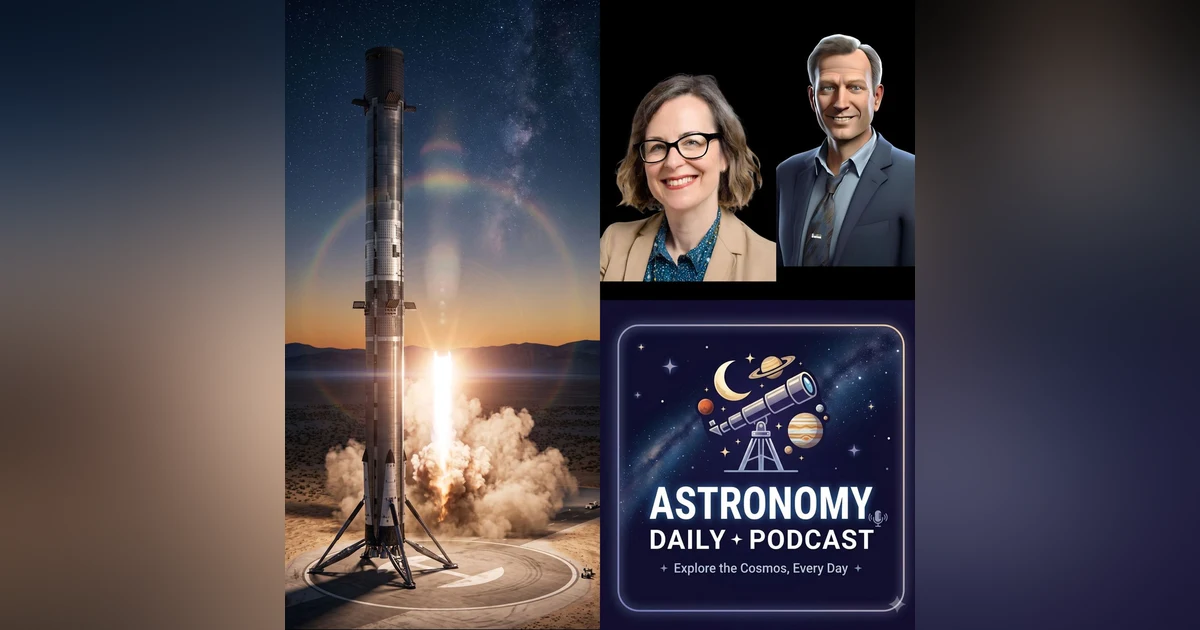
Anna and Avery cover LandSpace becoming the first Chinese commercial company to land an orbital-class rocket booster — a big step for the country's private space sector. Plus: astronomers find a "mega-Earth" 23 times more massive than our planet that shouldn't be able to exist, a star weaving impossibly close to our galaxy's supermassive black hole that could reveal its spin within a decade, and new JWST data showing the early universe's galaxies were hiding roughly four times more mass than we thought. Full show notes: Today's episode — S05E172, Thursday August 20, 2026: Main story: China's private spaceflight sector sticks the landing. On August 19, Chinese commercial launch company LandSpace successfully recovered the first stage of its Zhuque-3 (ZQ-3) rocket after liftoff from the Dongfeng Commercial Space Innovation Pilot Zone in northwestern China — the first time any Chinese commercial company has landed an orbital-class booster. The 76.6-metre, stainless-steel, methane-fueled rocket (taller than a Falcon 9) touched down on four legs roughly 390km downrange in Gansu Province about eight minutes after liftoff, running on a single Tianque-12 engine. It's ZQ-3's second flight — the first, in December 2025, reached orbit but couldn't stick the recovery. The landing puts LandSpace among a very small club of companies with proven booster-reuse technology and marks, in the company's words, a shift "toward the engineering application phase of reusability." A "mega-Earth" that shouldn't be this dense. Astronomers led by Max Kroft (University of Wisconsin–Madison) have identified GJ 523b, a rocky exoplanet 23.5 times more massive than Earth but only 2.5 times its width — extraordinarily dense for its size. Standard planet-formation models say a planet this massive, orbiting its star every 17.75 days in a system just 170 million years old, should have pulled in a thick hydrogen-helium envelope; instead it's stayed almost entirely rocky. Found by TESS and confirmed with the WIYN 3.5-metre telescope at Kitt Peak; submitted to The Astronomical Journal, not yet peer-reviewed. The star that could reveal a black hole's spin. A newly identified star, S301, is orbiting our galaxy's central supermassive black hole, Sagittarius A*, closer and faster than any star found before it — passing within 12 astronomical units at roughly 25,000 kilometres per second and completing a full orbit in just 8.7 years. Led by K. Abd El Dayem (Paris Observatory) with Nobel laureate Reinhard Genzel's group, researchers expect to use S301's orbit to directly measure the black hole's spin within a decade — a first for any supermassive black hole, and a real-world test of Einstein's general relativity. JWST finds the early universe's galaxies were hiding their mass. A team led by Chloe Cheng (Leiden University), using JWST's NIRSpec instrument alongside data from the VLT's LEGA-C survey, found that ancient "quiescent" galaxies contain far more faint, low-mass stars than previously accounted for — potentially raising their true mass estimates by a factor of four. The hidden stars had simply been outshone by brighter ones in the same galaxies. Published in Nature Astronomy; the finding deepens existing tension with current galaxy-formation models. Tonight's sky: the Moon is about 56% illuminated and well-placed for lunar observing — look along the sunrise terminator for the crater Theophilus and its dramatic, shadowed walls. Venus is still blazing at magnitude -4.1 low in the western sky after sunset, and Saturn continues its predawn "moon parade" in the south-southeast for early risers. Links & sources: - Spaceflight Now — LandSpace becomes first commercial Chinese company to land an orbital-class booster - Space.com — Touchdown! Private Chinese rocket aces landing on 2nd-ever flight - NASASpaceFlight.com — Zhuque-3 Completes Second Flight with Successful First-Stage Landing - Space.com — Astronomers discover a giant, rocky 'mega-Earth' 23 times more massive than our planet - Phys.org — Mega-Earth GJ 523b is 23 times as massive as our planet—but only 2.5 times as wide - Universe Today — The Fastest Star in the Milky Way Will Test Relativity - Universe Today — Whoa! The JWST's Ancient Galaxies Are Much More Massive Than Thought - Space.com — Night sky August 2026: what you can see tonight Follow us: @AstronomyDailyPod
Become a supporter of this podcast: https://www.spreaker.com/podcast/astronomy-daily-latest-space-news--5648921/support.
Sponsor Details:
Ensure your online privacy by using NordVPN. To get our special listener deal and save a lot of money, visit www.astronomydaily.io/nordvpn. You'll be glad you did!
Get the best secure and private email on the planet. Stop your Government, google and who knows who else spying on every email you write. Do what we did and use ProtonMail. They beleive in privacy and there are no ads in their business model...yet they still provide a free forever service. Check them out and get out special deal at www.astronomydaily.io/protonmail
Become a supporter of Astronomy Daily by joining our Supporters Club. Commercial free episodes daily are only a click way... Click Here
This episode includes AI-generated content.
0
00:00:00.640 --> 00:00:03.040
Anna: Hey, everyone. Welcome back to Astronomy
1
00:00:03.040 --> 00:00:04.320
Daily. I'm Anna.
2
00:00:04.560 --> 00:00:06.880
Avery: And I'm, um, avery. It's Thursday, August
3
00:00:06.880 --> 00:00:08.960
20th, series five, episode
4
00:00:09.120 --> 00:00:11.960
Anna: 172, and we're leading with a genuine
5
00:00:11.960 --> 00:00:12.880
milestone today.
6
00:00:13.200 --> 00:00:15.760
China's commercial space sector just proved
7
00:00:15.760 --> 00:00:18.640
it can land a rocket, not just launch one.
8
00:00:19.040 --> 00:00:21.920
Avery: Landspace sticks. The landing on Zoo Q3.
9
00:00:22.160 --> 00:00:24.440
First time any Chinese private company has
10
00:00:24.440 --> 00:00:25.200
pulled that off.
11
00:00:25.770 --> 00:00:28.610
Anna: Then a, uh, planet that's somehow 23 times
12
00:00:28.610 --> 00:00:31.290
heavier than Earth while barely being any
13
00:00:31.290 --> 00:00:33.690
bigger, which really shouldn't be possible.
14
00:00:34.250 --> 00:00:36.970
A star doing laps around our galaxy's
15
00:00:36.970 --> 00:00:39.970
supermassive black hole. Faster and closer
16
00:00:39.970 --> 00:00:42.730
than anything we've ever tracked. And new
17
00:00:42.730 --> 00:00:45.450
James Webb data suggesting the early universe
18
00:00:45.530 --> 00:00:48.050
has been hiding a huge chunk of its mass from
19
00:00:48.050 --> 00:00:49.210
us this whole time.
20
00:00:49.610 --> 00:00:52.130
Avery: Plus tonight. Good excuse to actually get the
21
00:00:52.130 --> 00:00:53.930
telescope out and look at some craters.
22
00:00:54.490 --> 00:00:56.730
Anna: Lots to get through. Let's get into it.
23
00:00:57.050 --> 00:00:59.850
Avery: Okay, so China and rockets. We were just
24
00:00:59.850 --> 00:01:01.850
talking about this two episodes ago, right?
25
00:01:02.010 --> 00:01:04.490
The Long March failure and the fast recovery.
26
00:01:05.050 --> 00:01:07.210
Anna: Right. But this is a completely different
27
00:01:07.210 --> 00:01:09.770
story and honestly a bigger one. Long term.
28
00:01:10.169 --> 00:01:12.970
That was China's state space program. Long
29
00:01:12.970 --> 00:01:15.170
March rockets run by the state owned main
30
00:01:15.170 --> 00:01:18.130
contractor. This is China's commercial
31
00:01:18.130 --> 00:01:20.530
sector. And specifically a company called
32
00:01:20.530 --> 00:01:21.370
Landspace.
33
00:01:21.910 --> 00:01:23.270
Avery: Which does what exactly?
34
00:01:23.590 --> 00:01:26.590
Anna: Landspace was founded back in 2015, one of
35
00:01:26.590 --> 00:01:28.670
the first wave of Chinese private launch
36
00:01:28.670 --> 00:01:31.510
companies. Their rocket is called Zhuque 3
37
00:01:31.590 --> 00:01:34.310
or ZQ3, and it's a big one.
38
00:01:34.550 --> 00:01:37.150
Stainless steel construction, liquid methane
39
00:01:37.150 --> 00:01:39.950
propulsion, standing 76.6
40
00:01:39.950 --> 00:01:42.830
meters tall. For comparison, a Falcon 9
41
00:01:42.830 --> 00:01:45.750
is about 70 meters. This thing is taller
42
00:01:45.750 --> 00:01:47.110
than what SpaceX flies.
43
00:01:47.660 --> 00:01:49.940
Avery: So already an ambitious vehicle before you
44
00:01:49.940 --> 00:01:51.100
even get to the landing.
45
00:01:51.500 --> 00:01:54.260
Anna: Exactly. And landing is the part that matters
46
00:01:54.260 --> 00:01:57.260
here. Zoo K3 flew for the first time back in
47
00:01:57.260 --> 00:01:59.980
December 2025. That flight actually
48
00:01:59.980 --> 00:02:02.460
reached orbit successfully, which is already
49
00:02:02.540 --> 00:02:05.140
a big deal for a new rocket. But the landing
50
00:02:05.140 --> 00:02:07.420
attempt on the first stage didn't work out.
51
00:02:07.820 --> 00:02:09.100
Avery: So this was the do over.
52
00:02:09.580 --> 00:02:12.380
Anna: This was the do over. And yesterday, August
53
00:02:12.380 --> 00:02:15.170
19th, they nailed it. Liftoff was from the
54
00:02:15.170 --> 00:02:17.850
Dongfang Commercial Space Innovation Zone in
55
00:02:17.850 --> 00:02:20.410
northwestern China. And about eight minutes
56
00:02:20.410 --> 00:02:23.010
after launch, the first stage came down on
57
00:02:23.010 --> 00:02:24.650
four landing legs, roughly
58
00:02:24.650 --> 00:02:27.530
390km downrange, out
59
00:02:27.530 --> 00:02:30.409
in Minquin County, Gansu Province. It
60
00:02:30.409 --> 00:02:33.250
came in on a single Tiem Kwei 12 engine.
61
00:02:33.330 --> 00:02:36.050
Touched down close to dead center on the pad.
62
00:02:36.290 --> 00:02:38.650
Avery: Eight minutes from launch to landing. That's
63
00:02:38.650 --> 00:02:40.610
a very SpaceX shaped timeline.
64
00:02:40.990 --> 00:02:43.550
Anna: It's the same basic playbook. Yeah. Boost,
65
00:02:43.550 --> 00:02:46.270
separate, flip, come back down under power.
66
00:02:46.590 --> 00:02:49.350
Nobody outside SpaceX had made that work on
67
00:02:49.350 --> 00:02:51.550
an orbital class booster with actual
68
00:02:51.550 --> 00:02:54.270
repeatability. Until now. There have been a
69
00:02:54.270 --> 00:02:56.590
couple of smaller Chinese hop tests and
70
00:02:56.590 --> 00:02:59.030
suborbital attempts from other companies, but
71
00:02:59.030 --> 00:03:01.870
landing an orbital class booster on a real
72
00:03:01.950 --> 00:03:04.190
orbital mission is a different tier of
73
00:03:04.190 --> 00:03:04.750
difficulty.
74
00:03:05.070 --> 00:03:07.710
Avery: What does Landspace actually get from one
75
00:03:07.710 --> 00:03:09.870
successful landing? Is the booster flying
76
00:03:09.870 --> 00:03:10.750
again next week?
77
00:03:11.400 --> 00:03:14.320
Anna: Not next week, no. This is very much a prove
78
00:03:14.320 --> 00:03:16.480
the concept flight rather than a, uh, ready
79
00:03:16.480 --> 00:03:19.000
for daily reuse flight. But it's the step
80
00:03:19.160 --> 00:03:21.480
everything else depends on. Landspace
81
00:03:21.480 --> 00:03:23.440
themselves are, uh, framing it as moving
82
00:03:23.440 --> 00:03:25.840
toward the engineering application phase of
83
00:03:25.840 --> 00:03:28.400
reusability. In other words, this is where
84
00:03:28.400 --> 00:03:31.400
you stop asking can this work at all? And
85
00:03:31.400 --> 00:03:33.800
start asking how do we make this routine?
86
00:03:34.120 --> 00:03:36.520
Avery: Any hiccups? These things usually aren't
87
00:03:36.520 --> 00:03:37.320
perfectly clean.
88
00:03:37.800 --> 00:03:40.240
Anna: The core landing itself was clean, legs
89
00:03:40.240 --> 00:03:42.080
deployed, touched down where it was supposed
90
00:03:42.080 --> 00:03:45.080
to. Some reporting mentioned activity in the
91
00:03:45.080 --> 00:03:47.160
aft section of the booster after landing,
92
00:03:47.240 --> 00:03:49.600
which, given this is methane fueled hardware
93
00:03:49.600 --> 00:03:52.280
coming down hot isn't unheard of even on
94
00:03:52.280 --> 00:03:54.800
successful landings. SpaceX has had post
95
00:03:54.800 --> 00:03:57.400
landing fires on otherwise successful Falcon
96
00:03:57.400 --> 00:04:00.000
9 recoveries too. It doesn't take away from
97
00:04:00.000 --> 00:04:02.480
the fact that the vehicle landed intact and
98
00:04:02.480 --> 00:04:03.160
upright.
99
00:04:03.740 --> 00:04:06.140
Avery: So bottom line, why should our listeners care
100
00:04:06.140 --> 00:04:08.740
about one Chinese company landing one
101
00:04:08.740 --> 00:04:09.260
rocket?
102
00:04:09.740 --> 00:04:11.820
Anna: Because reusability is the thing that
103
00:04:11.820 --> 00:04:13.620
actually changes the economics of
104
00:04:13.620 --> 00:04:16.580
spaceflight. It's why Falcon 9 turned SpaceX
105
00:04:16.580 --> 00:04:19.379
from one very good rocket company into the
106
00:04:19.379 --> 00:04:21.420
company that now launches more than anyone
107
00:04:21.420 --> 00:04:24.340
else multiple times a week. China's had
108
00:04:24.340 --> 00:04:26.500
a state level reusable rocket effort in
109
00:04:26.500 --> 00:04:28.780
progress for years, but this is the first
110
00:04:28.780 --> 00:04:31.060
time a private Chinese company has shown it
111
00:04:31.060 --> 00:04:33.870
can do the hardest part. Landspace just put
112
00:04:33.870 --> 00:04:36.270
itself in what's genuinely a very short list
113
00:04:36.270 --> 00:04:38.710
of organizations on Earth that have landed an
114
00:04:38.710 --> 00:04:40.150
orbital class booster.
115
00:04:40.470 --> 00:04:41.790
Avery: A list that's about to get a
116
00:04:41.790 --> 00:04:43.990
Anna: little more competitive, which is good for
117
00:04:43.990 --> 00:04:45.910
everyone watching prices honestly.
118
00:04:46.310 --> 00:04:49.070
Next up, over to exoplanets and a
119
00:04:49.070 --> 00:04:51.270
planet that's breaking the rules just by
120
00:04:51.270 --> 00:04:51.830
existing.
121
00:04:52.310 --> 00:04:52.870
Avery: Go on.
122
00:04:53.190 --> 00:04:55.990
Anna: It's called GJ523B.
123
00:04:56.550 --> 00:04:59.070
Team led by Max Croft at the University of
124
00:04:59.070 --> 00:05:01.990
Wisconsin Madison, found it using NASA's
125
00:05:01.990 --> 00:05:04.590
TESS spacecraft, then confirmed it with
126
00:05:04.590 --> 00:05:06.990
follow up observations from the Wynn
127
00:05:07.070 --> 00:05:10.070
3.5-meter telescope at Kitt Peak in
128
00:05:10.070 --> 00:05:12.510
Arizona. Here's the number that makes it
129
00:05:12.510 --> 00:05:15.390
interesting. This planet is 23
130
00:05:15.390 --> 00:05:17.790
and a half times the mass of Earth.
131
00:05:18.030 --> 00:05:21.030
Avery: Okay, so a mini Neptune gas envelope
132
00:05:21.030 --> 00:05:21.470
and all.
133
00:05:21.790 --> 00:05:24.150
Anna: That's exactly what you'd expect. And that's
134
00:05:24.150 --> 00:05:27.110
exactly what it isn't. It's only about 2 1/2
135
00:05:27.110 --> 00:05:30.070
times Earth's width. Do that math. 23
136
00:05:30.070 --> 00:05:32.990
times the mass in barely 2 1/2 times the size
137
00:05:33.150 --> 00:05:35.970
and you get something extremely den and
138
00:05:35.970 --> 00:05:38.850
as far as they can tell, mostly rock. Not a
139
00:05:38.850 --> 00:05:40.410
puffed up gas world at all.
140
00:05:40.890 --> 00:05:41.930
Avery: Why is that a problem?
141
00:05:42.490 --> 00:05:44.690
Anna: Because planet formation models are pretty
142
00:05:44.690 --> 00:05:47.250
clear on this. Once a rocky core gets big
143
00:05:47.250 --> 00:05:50.130
enough and 23 earth masses is well past
144
00:05:50.130 --> 00:05:52.570
that threshold, it should have enough gravity
145
00:05:52.570 --> 00:05:55.530
to grab a thick hydrogen helium atmosphere
146
00:05:55.530 --> 00:05:57.690
from the disk of gas around its young star
147
00:05:57.690 --> 00:06:00.610
and balloon outward the way Neptune or Uranus
148
00:06:00.610 --> 00:06:03.520
did. DJ523B had
149
00:06:03.520 --> 00:06:06.120
every opportunity to do that. It orbits its
150
00:06:06.120 --> 00:06:08.760
star every 17.75 days
151
00:06:08.920 --> 00:06:11.800
and the whole system is only about 170
152
00:06:11.800 --> 00:06:14.000
million years old. Young enough that there
153
00:06:14.000 --> 00:06:15.800
should have still been plenty of gas around
154
00:06:15.800 --> 00:06:16.600
when it formed.
155
00:06:17.079 --> 00:06:19.720
Avery: And instead it just didn't bother.
156
00:06:20.200 --> 00:06:23.000
Anna: Instead it just stayed rock all the way up to
157
00:06:23.000 --> 00:06:25.920
23 earth masses. Croft's own quote on
158
00:06:25.920 --> 00:06:28.600
it was this isn't what we expected at all.
159
00:06:28.760 --> 00:06:31.160
Which for a planetary scientist is basically
160
00:06:31.160 --> 00:06:33.850
Avery: shouting, so what's the explanation?
161
00:06:34.330 --> 00:06:36.690
Anna: Honestly, right now they don't fully have
162
00:06:36.690 --> 00:06:39.450
one. Maybe it formed somewhere else closer
163
00:06:39.450 --> 00:06:41.970
in, in a gas poor environment and never had
164
00:06:41.970 --> 00:06:44.450
the chance to accrete an atmosphere. Maybe it
165
00:06:44.450 --> 00:06:46.530
did have one and something stripped it away
166
00:06:46.530 --> 00:06:49.370
early. That's the appeal of finding it. It's
167
00:06:49.370 --> 00:06:51.330
a genuine outlier that doesn't fit the
168
00:06:51.330 --> 00:06:53.450
models, which usually means there's a piece
169
00:06:53.450 --> 00:06:55.450
of planet formation physics we're still
170
00:06:55.450 --> 00:06:57.730
missing. I'll flag this result's been
171
00:06:57.730 --> 00:06:59.490
submitted to the Astronomical Journal, but
172
00:06:59.490 --> 00:07:01.650
hasn't gone through peer review yet. So
173
00:07:01.650 --> 00:07:03.970
consider it an exciting first look rather
174
00:07:03.970 --> 00:07:04.970
than a settled result.
175
00:07:05.530 --> 00:07:07.810
Avery: The universe's way of telling planetary
176
00:07:07.810 --> 00:07:09.530
scientists they're not done yet.
177
00:07:09.770 --> 00:07:10.730
Anna: It never is.
178
00:07:11.210 --> 00:07:13.770
Avery: Alright, this next one is genuinely one of my
179
00:07:13.770 --> 00:07:16.330
favorite kinds of stories. Extreme physics,
180
00:07:16.410 --> 00:07:17.609
extreme numbers.
181
00:07:18.010 --> 00:07:19.970
Anna: You're going to like this. Then there's a
182
00:07:19.970 --> 00:07:22.970
star newly cataloged as S301
183
00:07:22.970 --> 00:07:25.530
that's been found orbiting Sagittarius A,
184
00:07:25.930 --> 00:07:28.290
the supermassive black hole at the center of
185
00:07:28.290 --> 00:07:29.210
our own galaxy.
186
00:07:29.770 --> 00:07:31.770
Avery: We've talked about the S stars before, right?
187
00:07:31.930 --> 00:07:34.610
The ones that whip around Sagittarius A on
188
00:07:34.610 --> 00:07:36.290
tight orbits we have.
189
00:07:36.290 --> 00:07:39.170
Anna: And S301 just took the crown from all
190
00:07:39.170 --> 00:07:41.890
of them. It gets within 12 astronomical
191
00:07:41.890 --> 00:07:43.850
units of the black hole at closest approach.
192
00:07:44.170 --> 00:07:46.690
That's closer than any star ever tracked
193
00:07:46.690 --> 00:07:49.490
around. Sagittarius A, moving at, uh, roughly
194
00:07:49.490 --> 00:07:52.450
25,000 kilometers per second. And
195
00:07:52.450 --> 00:07:54.610
it completes one full orbit in just
196
00:07:54.610 --> 00:07:55.850
8.7 years.
197
00:07:56.090 --> 00:07:58.770
Avery: 8.7 years to loop around the
198
00:07:58.770 --> 00:08:01.430
supermassive black hole. For comparison,
199
00:08:01.590 --> 00:08:04.310
Jupiter takes about 12 years just to go
200
00:08:04.310 --> 00:08:05.910
around our sun, right?
201
00:08:05.910 --> 00:08:08.830
Anna: And Sagittarius a is about 4
202
00:08:08.830 --> 00:08:11.390
million times the mass of our Sun. So The
203
00:08:11.390 --> 00:08:13.990
Physics Environment S301 is living in
204
00:08:14.150 --> 00:08:17.110
is nothing like anything in our solar system.
205
00:08:17.510 --> 00:08:20.150
This was found by a team led by K. Abdel
206
00:08:20.150 --> 00:08:22.710
Diam at the Paris Observatory, working with
207
00:08:22.710 --> 00:08:25.110
Felix Meng and Stephan Gillison at the Max
208
00:08:25.110 --> 00:08:27.700
Planck Institute, Juana Sorno at Paris
209
00:08:27.700 --> 00:08:30.460
psl and the broader collaboration is directed
210
00:08:30.460 --> 00:08:33.220
by Reinhard Genzel, Nobel Laureate for his
211
00:08:33.220 --> 00:08:35.980
work proving Sagittarius A is a
212
00:08:35.980 --> 00:08:38.100
supermassive black hole in the first place.
213
00:08:38.820 --> 00:08:41.540
Avery: So why does one extreme star matter
214
00:08:41.540 --> 00:08:43.780
beyond just being a cool record breaker?
215
00:08:44.260 --> 00:08:47.220
Anna: Because an orbit this tight and this precise
216
00:08:47.220 --> 00:08:49.420
becomes a physics instrument. General
217
00:08:49.420 --> 00:08:51.420
relativity predicts that a, uh, spinning
218
00:08:51.420 --> 00:08:54.380
massive object drags spacetime around with
219
00:08:54.380 --> 00:08:56.980
it. It's called the lens theoring effect,
220
00:08:57.140 --> 00:08:59.940
or frame dragging. We've measured tiny
221
00:08:59.940 --> 00:09:01.980
versions of this effect around Earth with
222
00:09:01.980 --> 00:09:04.900
satellites. Nobody has ever directly
223
00:09:04.900 --> 00:09:07.060
measured it around a, uh, supermassive black
224
00:09:07.060 --> 00:09:09.660
hole because you need a star orbiting close
225
00:09:09.660 --> 00:09:12.580
enough, fast enough and predictably enough
226
00:09:12.660 --> 00:09:15.380
to detect the tiny relativistic wobble it
227
00:09:15.380 --> 00:09:15.860
causes.
228
00:09:16.420 --> 00:09:19.140
Avery: And S301 threads that needle.
229
00:09:19.540 --> 00:09:21.780
Anna: That's the hope. The team thinks that with
230
00:09:21.780 --> 00:09:23.980
continued observation, they could measure
231
00:09:23.980 --> 00:09:26.420
Sagittarius A's actual SP
232
00:09:26.800 --> 00:09:28.960
within a decade. That would be the first
233
00:09:28.960 --> 00:09:31.760
direct spin measurement of any supermassive
234
00:09:31.760 --> 00:09:34.400
black hole anywhere. Not modeled,
235
00:09:34.480 --> 00:09:36.640
not inferred from surrounding gas.
236
00:09:37.040 --> 00:09:39.760
Measured from watching a star get pushed
237
00:09:39.760 --> 00:09:42.679
around by the black hole, literally dragging
238
00:09:42.679 --> 00:09:43.600
space itself.
239
00:09:44.240 --> 00:09:46.640
Avery: A, uh, decade's a long wait, but that's a
240
00:09:46.640 --> 00:09:47.680
hell of a payoff.
241
00:09:48.080 --> 00:09:49.040
Anna: Worth the patience.
242
00:09:49.680 --> 00:09:51.920
Alright, moving on to our last story before
243
00:09:51.920 --> 00:09:54.550
we get to tonight's sky. And this one's a
244
00:09:54.550 --> 00:09:56.710
quiet result that could have a pretty loud
245
00:09:56.710 --> 00:09:57.950
effect on cosmology.
246
00:09:58.590 --> 00:09:59.950
Avery: How loud are we talking?
247
00:10:00.510 --> 00:10:03.470
Anna: Up to four times loud. A team led by
248
00:10:03.470 --> 00:10:06.310
Chloe Chang at Leiden University looked at
249
00:10:06.310 --> 00:10:08.950
nine quiescent galaxies, meaning galaxies
250
00:10:08.950 --> 00:10:10.990
that have basically stopped forming new
251
00:10:10.990 --> 00:10:13.470
stars. Sitting at a redshift of about
252
00:10:13.470 --> 00:10:16.390
0.7, they used James Webb's
253
00:10:16.390 --> 00:10:19.190
NIR SPECT instrument, combined with data from
254
00:10:19.190 --> 00:10:21.990
the Very Large Telescope's LEGA survey to
255
00:10:21.990 --> 00:10:24.630
look really closely at the actual population
256
00:10:24.630 --> 00:10:27.290
of star stars inside these galaxies
257
00:10:27.770 --> 00:10:30.450
and found something we'd been missing. A lot
258
00:10:30.450 --> 00:10:32.890
of something. Turns out these galaxies
259
00:10:32.890 --> 00:10:35.890
contain far more faint, low mass stars
260
00:10:35.890 --> 00:10:38.490
than anyone had accounted for. They'd simply
261
00:10:38.490 --> 00:10:41.249
been outshone and hidden by the smaller
262
00:10:41.249 --> 00:10:43.770
number of bright stars in the same galaxies.
263
00:10:44.170 --> 00:10:46.730
Once you properly count the dim ones, the
264
00:10:46.730 --> 00:10:49.490
true stellar mass of these galaxies goes up
265
00:10:49.490 --> 00:10:50.770
by something like a factor
266
00:10:50.770 --> 00:10:53.360
Avery: of four, four or times the mass.
267
00:10:53.440 --> 00:10:55.200
Just hiding in plain sight.
268
00:10:55.680 --> 00:10:58.560
Anna: Hiding in Plain sight. And it wasn't random.
269
00:10:58.560 --> 00:11:00.800
Which galaxies had the most hidden mass
270
00:11:00.800 --> 00:11:03.440
either. The oldest galaxy in the sample,
271
00:11:03.520 --> 00:11:06.480
one that started forming stars less than 500
272
00:11:06.560 --> 00:11:09.160
million years after the Big Bang, had the
273
00:11:09.160 --> 00:11:12.160
largest hidden population of low mass stars.
274
00:11:12.720 --> 00:11:15.200
Avery: Why would older galaxies hide more mass
275
00:11:15.200 --> 00:11:16.000
specifically?
276
00:11:16.480 --> 00:11:18.680
Anna: That's the open question, and it's a
277
00:11:18.680 --> 00:11:21.320
genuinely important one, because it means the
278
00:11:21.320 --> 00:11:24.140
ratio of small stars to big stars. What
279
00:11:24.140 --> 00:11:26.540
astronomers call the initial mass function
280
00:11:26.780 --> 00:11:29.660
might not be the same constant everywhere and
281
00:11:29.660 --> 00:11:32.020
everywhen, the way models have generally
282
00:11:32.020 --> 00:11:34.140
assumed. If early galaxies
283
00:11:34.220 --> 00:11:37.060
systematically formed proportionally more low
284
00:11:37.060 --> 00:11:40.060
mass stars, every mass estimate we've made
285
00:11:40.060 --> 00:11:42.540
for the early universe using the standard
286
00:11:42.540 --> 00:11:44.060
assumption could be off.
287
00:11:44.620 --> 00:11:46.900
Avery: Which affects a lot more than just these nine
288
00:11:46.900 --> 00:11:47.580
galaxies.
289
00:11:48.140 --> 00:11:50.700
Anna: Right. It touches how we calculate galaxy
290
00:11:50.700 --> 00:11:53.660
masses across basically all of early universe
291
00:11:53.660 --> 00:11:56.140
cosmology. And there's a nice side effect
292
00:11:56.140 --> 00:11:58.820
too. More low mass stars means more
293
00:11:58.820 --> 00:12:01.420
potential hosts for rocky Earth sized
294
00:12:01.420 --> 00:12:03.820
planets in the early universe. This was
295
00:12:03.820 --> 00:12:06.340
published in Nature Astronomy under the very
296
00:12:06.340 --> 00:12:08.980
on the nose title, Hidden Mass in Early
297
00:12:08.980 --> 00:12:11.940
Galaxies Revealed by bottom, Heavy initial
298
00:12:11.940 --> 00:12:12.740
Mass Functions.
299
00:12:12.900 --> 00:12:15.140
Avery: The early universe just got a lot more
300
00:12:15.140 --> 00:12:17.780
crowded and a lot heavier in one paper.
301
00:12:18.100 --> 00:12:20.740
Anna: Webb keeps doing that to cosmology this year.
302
00:12:21.430 --> 00:12:23.310
Avery: All right, let's get people outside tonight.
303
00:12:23.310 --> 00:12:24.310
What are we looking at?
304
00:12:24.470 --> 00:12:26.550
Anna: Grab a telescope if you've got one, because
305
00:12:26.550 --> 00:12:28.790
tonight's, uh, a genuinely good moon night.
306
00:12:29.030 --> 00:12:31.910
It's about 56% illuminated right now, and
307
00:12:31.910 --> 00:12:33.710
if you look right along the sunrise
308
00:12:33.710 --> 00:12:36.190
terminator, that line between lit and
309
00:12:36.190 --> 00:12:38.830
shadowed, you'll find the crater Theophilus
310
00:12:38.830 --> 00:12:40.550
down along Mare Nectaris.
311
00:12:40.870 --> 00:12:42.710
Avery: What makes that one worth hunting down?
312
00:12:42.710 --> 00:12:45.430
Anna: Specifically, with the sun that low on it,
313
00:12:45.430 --> 00:12:47.710
the shadows are dramatic. You get
314
00:12:47.710 --> 00:12:50.550
Theophilus, sharp, heavily terraced walls,
315
00:12:50.590 --> 00:12:53.380
seamless standing out in real relief. Plus a
316
00:12:53.380 --> 00:12:56.180
big multi pointed central peak casting its
317
00:12:56.180 --> 00:12:58.420
own shadow. It's one of those craters that
318
00:12:58.420 --> 00:13:00.460
actually looks three dimensional through a
319
00:13:00.460 --> 00:13:03.060
scope tonight instead of just a flat circle.
320
00:13:03.540 --> 00:13:05.460
Avery: And um, for anyone without a telescope
321
00:13:05.460 --> 00:13:08.340
Anna: handy, step outside right after sunset and
322
00:13:08.340 --> 00:13:10.980
look west. Venus is still an absolute
323
00:13:10.980 --> 00:13:13.940
beacon out there at, ah, magnitude minus 4.1,
324
00:13:14.180 --> 00:13:16.340
easily the brightest thing in the sky besides
325
00:13:16.340 --> 00:13:18.870
the Moon. And if you're an early riser,
326
00:13:18.950 --> 00:13:21.350
Saturn's moon parade that we mentioned last
327
00:13:21.350 --> 00:13:23.550
episode is still running in the south
328
00:13:23.550 --> 00:13:26.470
southeast before dawn. Titan, Rhea,
329
00:13:26.470 --> 00:13:29.270
Tethys, Dion, all still lined up
330
00:13:29.270 --> 00:13:31.990
thanks to those unusually narrow, nearly
331
00:13:31.990 --> 00:13:32.950
edge on rings.
332
00:13:33.510 --> 00:13:35.550
Avery: Good night to actually use the equipment
333
00:13:35.550 --> 00:13:37.190
instead of letting it collect dust.
334
00:13:37.750 --> 00:13:38.550
Anna: Always is.
335
00:13:38.950 --> 00:13:41.670
And that's it for Today's episode. Series
336
00:13:41.750 --> 00:13:44.550
five, episode 172 in the
337
00:13:44.550 --> 00:13:45.030
books.
338
00:13:45.480 --> 00:13:47.800
Avery: Quick recap. Plan space makes history.
339
00:13:47.880 --> 00:13:50.640
Landing Z3's booster, a mega
340
00:13:50.640 --> 00:13:53.360
Earth that refuses to follow the rules, a
341
00:13:53.360 --> 00:13:55.280
star that might let us finally measure a
342
00:13:55.280 --> 00:13:57.920
black hole spin. Um, and James Webb showing
343
00:13:57.920 --> 00:14:00.040
us the early universe was heavier than we
344
00:14:00.040 --> 00:14:00.760
thought all along.
345
00:14:01.239 --> 00:14:03.280
Anna: If you enjoyed the show, the best thing you
346
00:14:03.280 --> 00:14:05.520
can do is tell a friend. Leave us a rating
347
00:14:05.520 --> 00:14:07.680
wherever you listen, and follow us on the
348
00:14:07.680 --> 00:14:10.360
socials at astrodaily Pod for updates between
349
00:14:10.360 --> 00:14:12.790
episodes. And of course, check out our
350
00:14:12.790 --> 00:14:15.750
website at astronomydaily IO for further
351
00:14:15.750 --> 00:14:17.430
details on all of these stories.
352
00:14:17.990 --> 00:14:19.950
Avery: We'll be back tomorrow with more from across
353
00:14:19.950 --> 00:14:20.710
the universe.
354
00:14:20.870 --> 00:14:23.510
Anna: Until then, keep looking up Clear
355
00:14:23.510 --> 00:14:24.230
skies, everyone.
356
00:14:36.800 --> 00:14:38.580
Sam mhm.


