May 11, 2026
Fireballs, UFO Files & Rocket Fire — Is The Universe Sending Us Messages?
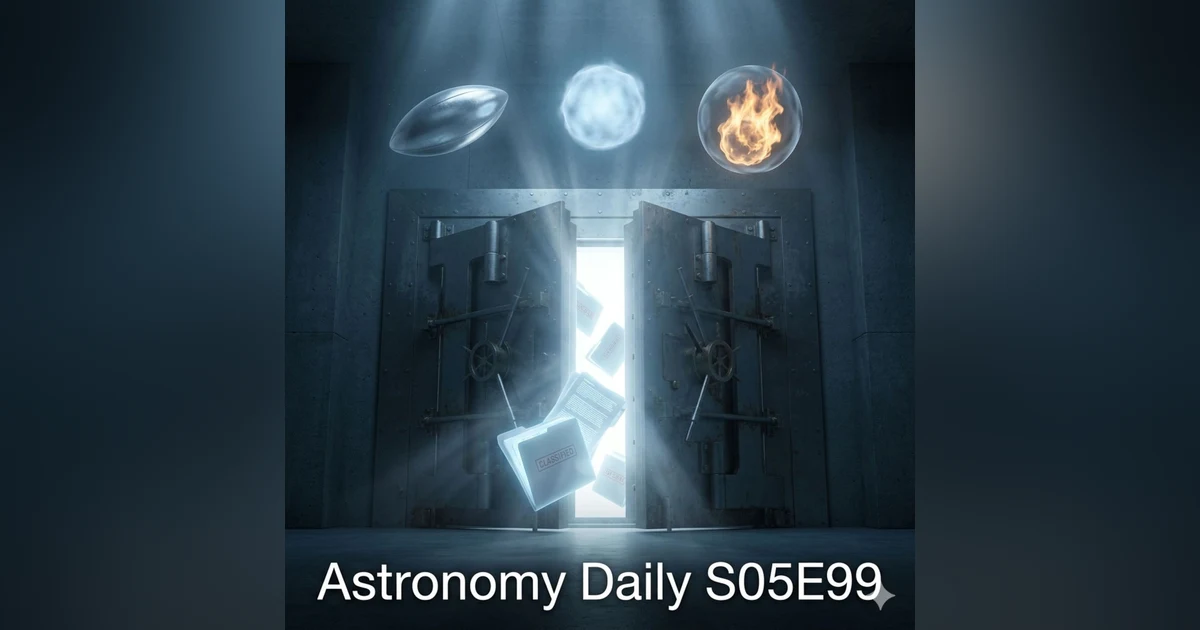
Sponsor Link: To get our secial NordVPN offer and save a heap of money, https://bitesz.com/nordvpn In this milestone episode — one away from our 100th — Anna and Avery cover six extraordinary stories: the Pentagon's unprecedented release of 162...
Sponsor Link:
To get our secial NordVPN offer and save a heap of money, Click Here
In this milestone episode — one away from our 100th — Anna and Avery cover six extraordinary stories: the Pentagon's unprecedented release of 162 declassified UFO/UAP files; SpaceX firing all 33 Raptor V3 engines on the Super Heavy booster ahead of Starship Flight 12; tomorrow's CRS-34 cargo launch to the ISS; JWST's breathtaking new portrait of cosmic buckyballs inside a dying star; never-before-seen mineral maps of the Moon's far side created from Artemis 2 mission photographs; and the American Meteor Society's growing alarm over an unexplained spike in large fireball events across the globe. Stories Covered 1. Pentagon Releases 162 Declassified UAP Files (May 8, 2026) • The Pentagon launched a public portal at war.gov/UFO on Friday 8 May, releasing 162 declassified files on Unidentified Anomalous Phenomena. • Files include 120 PDF documents, 28 videos, and 14 images — spanning sightings from the 1940s to 2025. • The PURSUE program (Presidential Unsealing and Reporting System for UAP Encounters) will release additional files on a rolling basis every few weeks. • The files show no evidence of extraterrestrial contact or government cover-up; they are classified as 'unresolved cases.' • Notable items include footage of a football-shaped UAP near Japan, a white orb over Syria, and Apollo 17 lunar imagery showing unexplained lights. 2. SpaceX Starship V3 Super Heavy — Full 33-Engine Static Fire (May 7, 2026) • SpaceX completed the first successful full-duration, full-thrust static fire of the Super Heavy V3 booster at Starbase, Texas, on 7 May. • All 33 Raptor V3 engines fired simultaneously — the most powerful ground test of any rocket first stage in history. • Previous tests on 15 April ended early due to ground equipment issues; the 7 May test went the full duration. • The Starship V3 Ship upper stage also completed its static fire in April — both vehicle halves now cleared for flight. • SpaceX is targeting 15 May for Starship Flight 12, a suborbital test mission. Starship is central to NASA's Artemis lunar landing system. 3. SpaceX CRS-34 — ISS Resupply Launch (12 May 2026) • Launch: 7:16 PM EDT, Tuesday 12 May from SLC-40, Cape Canaveral Space Force Station. • Cargo: approximately 6,500 pounds, including scientific experiments, food, equipment, and crew supplies. • Autonomous docking scheduled: ~9:50 AM EDT, Thursday 14 May, at Harmony module's forward port. • Key payloads: Laplace (planet formation dust study), STORIE (space weather / ring current monitoring), wooden bone scaffold (osteoporosis research), and red blood cell / spleen change investigation. • Watch live on NASA+, Amazon Prime, YouTube, and NASA's website from 7:00 PM EDT on 12 May. 4. JWST Reveals the Birthplace of Cosmic Buckyballs — Planetary Nebula Tc 1 • Western University astronomers returned to planetary nebula Tc 1 (10,000+ light-years away, constellation Ara) using JWST's Mid-Infrared Instrument (MIRI). • First detected buckyballs (buckminsterfullerene / C60 molecules) in space here in 2010 using Spitzer; now JWST reveals the full structure for the first time. • Buckyballs are concentrated in a thin spherical shell around the central white dwarf — arranged like 'one giant buckyball.' • JWST imagery also reveals an unexplained upside-down question mark feature at the nebula's heart. • Current theoretical models don't fully explain the buckyballs' observed infrared emissions — multiple new papers are in preparation. • Buckyballs found in meteorites on Earth; understanding their space origins provides clues about organic chemistry and possibly life's building blocks. 5. Artemis 2 — Far-Side Moon Images (Published May 2026) • Astrophotographer Andrew McCarthy collaborated pre-mission with Commander Reid Wiseman to plan detailed lunar photography during the Artemis 2 flyby. • McCarthy's image-stacking technique — applied to Wiseman's far-side photographs taken during the 6 April lunar flyby — has produced unprecedented colour mineral maps of the far side. • Colours reveal mineral composition variations (browns, blues, reds) not visible to the naked eye — described as 'cyborg vision' for the Moon. • NASA has released the full Artemis 2 photo archive: 12,217 images now publicly available. • Full archive: NASA astronaut photography public archive (link in episode resources). 6. The 2026 Fireball Surge — AMS Analysis (Published May 2026) • The American Meteor Society reports an anomalous spike in large fireball events in Q1 2026 that 'warrants serious investigation.' • Total Q1 event count (2,046) is only marginally above historical norms; the anomaly is in the SIZE of events — the largest fireballs are happening at roughly double the historical rate. • March 2026: 40+ major events, including a 3,229-witness fireball over Europe (8 Mar), an Ohio sonic boom explosion (17 Mar), and a meteorite through a Houston roof (21 Mar). • 79% of Q1's high-witness fireball events produced confirmed sonic booms — a strong physical indicator of large, dense incoming objects. • Anthelion sporadic source (opposite the Sun) is producing roughly double its normal activity; activity concentrated in a single 1,000-square-degree patch. • Ruling out explanations: not a new shower, not seasonal variation alone, not reporting bias. • AMS calling for expanded automated all-sky camera networks and better cross-referencing with radar, infrasound, and satellite data.
Become a supporter of this podcast: https://www.spreaker.com/podcast/astronomy-daily-space-news-updates--5648921/support.
Sponsor Details:
Ensure your online privacy by using NordVPN. To get our special listener deal and save a lot of money, visit www.bitesz.com/nordvpn. You'll be glad you did!
Become a supporter of Astronomy Daily by joining our Supporters Club. Commercial free episodes daily are only a click way... Click Here
This episode includes AI-generated content.
To get our secial NordVPN offer and save a heap of money, Click Here
In this milestone episode — one away from our 100th — Anna and Avery cover six extraordinary stories: the Pentagon's unprecedented release of 162 declassified UFO/UAP files; SpaceX firing all 33 Raptor V3 engines on the Super Heavy booster ahead of Starship Flight 12; tomorrow's CRS-34 cargo launch to the ISS; JWST's breathtaking new portrait of cosmic buckyballs inside a dying star; never-before-seen mineral maps of the Moon's far side created from Artemis 2 mission photographs; and the American Meteor Society's growing alarm over an unexplained spike in large fireball events across the globe. Stories Covered 1. Pentagon Releases 162 Declassified UAP Files (May 8, 2026) • The Pentagon launched a public portal at war.gov/UFO on Friday 8 May, releasing 162 declassified files on Unidentified Anomalous Phenomena. • Files include 120 PDF documents, 28 videos, and 14 images — spanning sightings from the 1940s to 2025. • The PURSUE program (Presidential Unsealing and Reporting System for UAP Encounters) will release additional files on a rolling basis every few weeks. • The files show no evidence of extraterrestrial contact or government cover-up; they are classified as 'unresolved cases.' • Notable items include footage of a football-shaped UAP near Japan, a white orb over Syria, and Apollo 17 lunar imagery showing unexplained lights. 2. SpaceX Starship V3 Super Heavy — Full 33-Engine Static Fire (May 7, 2026) • SpaceX completed the first successful full-duration, full-thrust static fire of the Super Heavy V3 booster at Starbase, Texas, on 7 May. • All 33 Raptor V3 engines fired simultaneously — the most powerful ground test of any rocket first stage in history. • Previous tests on 15 April ended early due to ground equipment issues; the 7 May test went the full duration. • The Starship V3 Ship upper stage also completed its static fire in April — both vehicle halves now cleared for flight. • SpaceX is targeting 15 May for Starship Flight 12, a suborbital test mission. Starship is central to NASA's Artemis lunar landing system. 3. SpaceX CRS-34 — ISS Resupply Launch (12 May 2026) • Launch: 7:16 PM EDT, Tuesday 12 May from SLC-40, Cape Canaveral Space Force Station. • Cargo: approximately 6,500 pounds, including scientific experiments, food, equipment, and crew supplies. • Autonomous docking scheduled: ~9:50 AM EDT, Thursday 14 May, at Harmony module's forward port. • Key payloads: Laplace (planet formation dust study), STORIE (space weather / ring current monitoring), wooden bone scaffold (osteoporosis research), and red blood cell / spleen change investigation. • Watch live on NASA+, Amazon Prime, YouTube, and NASA's website from 7:00 PM EDT on 12 May. 4. JWST Reveals the Birthplace of Cosmic Buckyballs — Planetary Nebula Tc 1 • Western University astronomers returned to planetary nebula Tc 1 (10,000+ light-years away, constellation Ara) using JWST's Mid-Infrared Instrument (MIRI). • First detected buckyballs (buckminsterfullerene / C60 molecules) in space here in 2010 using Spitzer; now JWST reveals the full structure for the first time. • Buckyballs are concentrated in a thin spherical shell around the central white dwarf — arranged like 'one giant buckyball.' • JWST imagery also reveals an unexplained upside-down question mark feature at the nebula's heart. • Current theoretical models don't fully explain the buckyballs' observed infrared emissions — multiple new papers are in preparation. • Buckyballs found in meteorites on Earth; understanding their space origins provides clues about organic chemistry and possibly life's building blocks. 5. Artemis 2 — Far-Side Moon Images (Published May 2026) • Astrophotographer Andrew McCarthy collaborated pre-mission with Commander Reid Wiseman to plan detailed lunar photography during the Artemis 2 flyby. • McCarthy's image-stacking technique — applied to Wiseman's far-side photographs taken during the 6 April lunar flyby — has produced unprecedented colour mineral maps of the far side. • Colours reveal mineral composition variations (browns, blues, reds) not visible to the naked eye — described as 'cyborg vision' for the Moon. • NASA has released the full Artemis 2 photo archive: 12,217 images now publicly available. • Full archive: NASA astronaut photography public archive (link in episode resources). 6. The 2026 Fireball Surge — AMS Analysis (Published May 2026) • The American Meteor Society reports an anomalous spike in large fireball events in Q1 2026 that 'warrants serious investigation.' • Total Q1 event count (2,046) is only marginally above historical norms; the anomaly is in the SIZE of events — the largest fireballs are happening at roughly double the historical rate. • March 2026: 40+ major events, including a 3,229-witness fireball over Europe (8 Mar), an Ohio sonic boom explosion (17 Mar), and a meteorite through a Houston roof (21 Mar). • 79% of Q1's high-witness fireball events produced confirmed sonic booms — a strong physical indicator of large, dense incoming objects. • Anthelion sporadic source (opposite the Sun) is producing roughly double its normal activity; activity concentrated in a single 1,000-square-degree patch. • Ruling out explanations: not a new shower, not seasonal variation alone, not reporting bias. • AMS calling for expanded automated all-sky camera networks and better cross-referencing with radar, infrasound, and satellite data.
Become a supporter of this podcast: https://www.spreaker.com/podcast/astronomy-daily-space-news-updates--5648921/support.
Sponsor Details:
Ensure your online privacy by using NordVPN. To get our special listener deal and save a lot of money, visit www.bitesz.com/nordvpn. You'll be glad you did!
Become a supporter of Astronomy Daily by joining our Supporters Club. Commercial free episodes daily are only a click way... Click Here
This episode includes AI-generated content.
WEBVTT
0
00:00:00.320 --> 00:00:03.200
Anna: Welcome to Astronomy Daily. I'm Anna.
1
00:00:03.360 --> 00:00:06.056
Avery: And I'm Avery. It is Monday 11th
2
00:00:06.210 --> 00:00:08.880
May 2026 and this is season
3
00:00:08.960 --> 00:00:10.640
5 episode 99.
4
00:00:11.120 --> 00:00:14.040
Anna: One episode away from triple digits, Avery.
5
00:00:14.040 --> 00:00:16.000
And we are not going quietly.
6
00:00:16.400 --> 00:00:17.600
Avery: Absolutely not.
7
00:00:17.840 --> 00:00:20.160
Today we have six stories that run the full
8
00:00:20.160 --> 00:00:23.040
gamut. Mysterious fireballs raining down
9
00:00:23.040 --> 00:00:26.040
across continents. A rocket breathing fire
10
00:00:26.040 --> 00:00:28.910
in Texas. A cargo ship about to head
11
00:00:28.910 --> 00:00:31.830
to the space station. Carbon molecules shaped
12
00:00:31.830 --> 00:00:34.070
like soccer balls appearing inside a dying
13
00:00:34.070 --> 00:00:36.990
star. Ever before seen photographs of
14
00:00:36.990 --> 00:00:39.750
the moon's far side. And brace
15
00:00:39.750 --> 00:00:42.750
yourself. The biggest government UFO file
16
00:00:42.750 --> 00:00:43.830
drop in history.
17
00:00:44.470 --> 00:00:47.430
Anna: That is quite a lineup. Let's get into it.
18
00:00:47.750 --> 00:00:49.710
Avery: We're going to start with the story that had
19
00:00:49.710 --> 00:00:51.790
the Internet absolutely buzzing over the
20
00:00:51.790 --> 00:00:54.390
weekend. And it is one that sits squarely in
21
00:00:54.390 --> 00:00:56.882
our wheelhouse. On Friday 8
22
00:00:57.031 --> 00:00:59.730
May 2026, the Pentagon
23
00:00:59.730 --> 00:01:01.970
released what it called never before seen
24
00:01:01.970 --> 00:01:04.770
files relating to unidentified anomalous
25
00:01:04.770 --> 00:01:07.570
phenomena. UAPs that the government
26
00:01:07.570 --> 00:01:09.490
has been sitting on for decades.
27
00:01:09.890 --> 00:01:12.850
Anna: UAPs, for anyone who just joined us, is
28
00:01:12.850 --> 00:01:15.730
the official modern term for what most people
29
00:01:15.810 --> 00:01:18.610
still call UFOs. And Friday's release
30
00:01:18.610 --> 00:01:20.370
was genuinely historic.
31
00:01:20.690 --> 00:01:23.390
Avery: It really was. The Pentagon launched ah, a
32
00:01:23.390 --> 00:01:26.390
dedicated public portal, war.gov
33
00:01:26.950 --> 00:01:29.910
UFO and dropped an initial tranche of
34
00:01:29.910 --> 00:01:32.910
162 files that includes
35
00:01:32.910 --> 00:01:35.030
120 PDF documents,
36
00:01:35.350 --> 00:01:37.870
28 videos and 14 high
37
00:01:37.870 --> 00:01:40.790
resolution images. Everything from internal
38
00:01:40.790 --> 00:01:43.150
military memos to Apollo mission
39
00:01:43.150 --> 00:01:45.710
photography to recent infrared sensor
40
00:01:45.710 --> 00:01:46.070
footage.
41
00:01:46.470 --> 00:01:49.270
Anna: The program even has an acronym, Persu,
42
00:01:49.430 --> 00:01:52.030
which stands for Presidential Unsealing and
43
00:01:52.030 --> 00:01:54.610
Reporting System for UAP Encounters.
44
00:01:54.770 --> 00:01:57.650
And the files span nearly eight decades
45
00:01:57.730 --> 00:01:59.970
going back to the late 1940s.
46
00:02:00.450 --> 00:02:03.010
Avery: Now, before listeners get too excited or too
47
00:02:03.010 --> 00:02:05.050
skeptical, let's be clear about what the
48
00:02:05.050 --> 00:02:07.530
files do. And don't say the
49
00:02:07.530 --> 00:02:09.970
Pentagon was explicit. These are quote,
50
00:02:10.050 --> 00:02:12.770
unresolved cases, meaning the government was
51
00:02:12.770 --> 00:02:15.290
unable to make a definitive determination on
52
00:02:15.290 --> 00:02:18.130
the nature of the observed phenomena. They do
53
00:02:18.130 --> 00:02:19.970
not prove extraterrestrial contact.
54
00:02:20.130 --> 00:02:20.390
Anna: They do.
55
00:02:20.620 --> 00:02:22.860
Avery: They do not suggest a cover up of alien
56
00:02:22.860 --> 00:02:23.420
visitors.
57
00:02:23.820 --> 00:02:26.540
Anna: But what they do provide is transparency
58
00:02:26.540 --> 00:02:29.180
that researchers, scientists and the public
59
00:02:29.260 --> 00:02:31.820
have been demanding for years. Former
60
00:02:31.820 --> 00:02:33.980
Pentagon UAP office head Sean
61
00:02:33.980 --> 00:02:36.860
Kirkpatrick cautioned that without analysis
62
00:02:36.860 --> 00:02:39.740
and context, the raw files, uh, risk fueling
63
00:02:39.740 --> 00:02:42.060
speculation. And that's a fair point.
64
00:02:42.380 --> 00:02:44.820
Context matters enormously with this
65
00:02:44.820 --> 00:02:45.340
material.
66
00:02:45.740 --> 00:02:48.460
Avery: What astronomers and UAP researchers are most
67
00:02:48.460 --> 00:02:50.860
interested in is the ability to now cross
68
00:02:50.860 --> 00:02:52.880
reference these files with the existing
69
00:02:52.880 --> 00:02:55.720
scientific data. Radar, infrasound,
70
00:02:55.720 --> 00:02:58.720
satellite records to build proper analytical
71
00:02:58.720 --> 00:03:01.240
frameworks around what was actually observed.
72
00:03:01.640 --> 00:03:04.100
Anna: Some of the more striking clips include a,
73
00:03:04.100 --> 00:03:06.600
ah, football shaped object observed by an
74
00:03:06.600 --> 00:03:09.560
infrared sensor near Japan, a, uh, misshapen
75
00:03:09.560 --> 00:03:12.520
ball of white light recorded over Syria and
76
00:03:12.520 --> 00:03:15.280
archival Apollo 17 imagery showing
77
00:03:15.280 --> 00:03:18.040
three lights above the lunar terrain that the
78
00:03:18.040 --> 00:03:20.200
astronauts theorized were ice chunks.
79
00:03:20.740 --> 00:03:23.380
Avery: And this is only the beginning. The Pentagon
80
00:03:23.380 --> 00:03:25.660
says more files will be released on a rolling
81
00:03:25.660 --> 00:03:28.340
basis every few weeks as they are discovered
82
00:03:28.340 --> 00:03:31.060
and declassified. This is an ongoing process
83
00:03:31.220 --> 00:03:33.460
covering tens of millions of records.
84
00:03:33.780 --> 00:03:35.940
Anna: For our listeners who want to explore the
85
00:03:35.940 --> 00:03:38.020
files directly, the portal is
86
00:03:38.020 --> 00:03:40.500
war.gov UFO
87
00:03:40.740 --> 00:03:42.100
no clearance required.
88
00:03:42.500 --> 00:03:45.300
Avery: From government secrets to rocket fire
89
00:03:45.540 --> 00:03:48.540
and what a fire it was on Wednesday
90
00:03:48.700 --> 00:03:51.700
7 May, SpaceX completed
91
00:03:51.700 --> 00:03:54.220
a milestone that the entire space industry
92
00:03:54.380 --> 00:03:56.540
had been watching. The first
93
00:03:56.700 --> 00:03:59.180
successful full duration full
94
00:03:59.180 --> 00:04:01.940
thrust static fire of the Super
95
00:04:01.940 --> 00:04:03.740
Heavy version 3 booster.
96
00:04:04.140 --> 00:04:06.860
Anna: All 33 Raptor V3 engines
97
00:04:06.860 --> 00:04:09.420
firing simultaneously for the full
98
00:04:09.420 --> 00:04:12.380
duration. SpaceX described it simply on
99
00:04:12.380 --> 00:04:14.980
X as full duration and full
100
00:04:14.980 --> 00:04:17.820
thrust 33 engine static fire with
101
00:04:17.820 --> 00:04:20.699
super heavy V3 understated, but
102
00:04:20.699 --> 00:04:22.619
the footage was anything but.
103
00:04:22.859 --> 00:04:25.819
Avery: And this matters enormously because previous
104
00:04:25.819 --> 00:04:28.339
attempts hadn't made it to this point. There
105
00:04:28.339 --> 00:04:31.110
was a 10 engine partial test in March, a
106
00:04:31.110 --> 00:04:33.899
UH33 engine attempt on April 15th.
107
00:04:34.219 --> 00:04:36.699
Both ended early due to issues with ground
108
00:04:36.699 --> 00:04:39.259
equipment. This one went the distance.
109
00:04:39.579 --> 00:04:42.219
Anna: The Raptor V3 engines themselves
110
00:04:42.459 --> 00:04:45.419
are a significant upgrade, each capable
111
00:04:45.419 --> 00:04:47.979
of delivering around 600,000
112
00:04:48.219 --> 00:04:50.859
pounds of thrust with improved reliability
113
00:04:50.859 --> 00:04:52.600
over the previous generation.
114
00:04:53.240 --> 00:04:56.040
33 of them firing together makes the
115
00:04:56.040 --> 00:04:58.920
super heavy booster the most powerful
116
00:04:59.000 --> 00:05:01.240
first stage rocket ever built
117
00:05:01.800 --> 00:05:03.480
and the full Starship stack.
118
00:05:03.480 --> 00:05:05.880
Avery: That's the booster plus the ship upper stage
119
00:05:05.880 --> 00:05:08.600
on top is over 400ft tall,
120
00:05:08.920 --> 00:05:11.800
taller than the Saturn V, designed to carry
121
00:05:11.800 --> 00:05:14.760
more than 100 tons to low Earth orbit and
122
00:05:14.760 --> 00:05:15.880
fully reusable.
123
00:05:16.360 --> 00:05:18.840
Anna: The ship upper stage for Flight 12
124
00:05:19.080 --> 00:05:21.960
already cleared its own static fire earlier,
125
00:05:22.500 --> 00:05:25.100
so both halves of the vehicle have now passed
126
00:05:25.100 --> 00:05:27.820
their pre flight tests. SpaceX is
127
00:05:27.820 --> 00:05:30.500
targeting 15 May for the 12th
128
00:05:30.500 --> 00:05:33.380
Starship test flight, a suborbital mission
129
00:05:33.380 --> 00:05:35.700
designed to further refine the vehicle's
130
00:05:35.700 --> 00:05:36.180
capabilities.
131
00:05:36.900 --> 00:05:39.660
Avery: For context, Starship is central to NASA's
132
00:05:39.660 --> 00:05:42.100
Artemis program. It is the planned human
133
00:05:42.100 --> 00:05:44.620
landing system that would carry astronauts to
134
00:05:44.620 --> 00:05:47.260
the lunar surface. It's also SpaceX's
135
00:05:47.260 --> 00:05:49.500
primary vehicle for their long term Mars
136
00:05:49.500 --> 00:05:50.020
ambitions.
137
00:05:50.980 --> 00:05:53.980
Anna: So May 15th is absolutely one to
138
00:05:53.980 --> 00:05:56.260
watch. We'll have full coverage here on
139
00:05:56.260 --> 00:05:58.660
Astronomy Daily as that date approaches.
140
00:05:58.900 --> 00:06:00.900
Avery: While Starship is preparing for its next
141
00:06:00.900 --> 00:06:03.500
flight, another SpaceX vehicle is heading to
142
00:06:03.500 --> 00:06:06.320
orbit tomorrow. NASA and SpaceX are uh,
143
00:06:06.380 --> 00:06:09.300
targeting 7:16pm Eastern Time on
144
00:06:09.300 --> 00:06:11.900
Tuesday 12 May for the launch of
145
00:06:11.900 --> 00:06:14.420
CRS 34, the 34th
146
00:06:14.420 --> 00:06:16.900
SpaceX Commercial Resupply Services mission
147
00:06:16.980 --> 00:06:18.660
to the International Space Station.
148
00:06:19.600 --> 00:06:22.360
Anna: A Dragon Cargo Spacecraft will ride a Falcon
149
00:06:22.360 --> 00:06:24.880
9 rocket from Space Launch Complex 40
150
00:06:25.120 --> 00:06:27.520
at Cape Canaveral, carrying approximately
151
00:06:27.520 --> 00:06:30.400
6,500 pounds of cargo. If all goes
152
00:06:30.400 --> 00:06:32.560
to plan, Dragon is scheduled to dock
153
00:06:32.560 --> 00:06:35.119
autonomously to the station's Harmony module
154
00:06:35.120 --> 00:06:37.920
at around 9:50am Eastern on, um, Thursday
155
00:06:38.080 --> 00:06:38.960
the 14th.
156
00:06:40.240 --> 00:06:42.760
Avery: Now, the payload on this one is genuinely
157
00:06:42.760 --> 00:06:44.680
interesting. Among the scientific
158
00:06:44.680 --> 00:06:46.600
investigations heading up is something called
159
00:06:46.600 --> 00:06:48.920
the Laplace Experiment, which studies how
160
00:06:48.920 --> 00:06:50.630
dust aggregates grow in prototypes
161
00:06:50.700 --> 00:06:53.380
protoplanetary disks that's directly relevant
162
00:06:53.380 --> 00:06:55.020
to understanding how planets form.
163
00:06:55.980 --> 00:06:57.980
Anna: There's also an instrument called Story
164
00:06:58.540 --> 00:07:00.940
Storm Time O ring Current
165
00:07:01.020 --> 00:07:03.940
Imaging Evolution, which will monitor charged
166
00:07:03.940 --> 00:07:06.859
particles in Earth's magnetosphere. These are
167
00:07:06.859 --> 00:07:08.820
the particles that can affect satellites and
168
00:07:08.820 --> 00:07:11.620
power grids during solar storm events. So
169
00:07:11.620 --> 00:07:13.980
better monitoring has real practical value.
170
00:07:15.500 --> 00:07:17.340
Avery: And then there's one that I find really
171
00:07:17.340 --> 00:07:19.910
charming and a wooden bone scaffold.
172
00:07:20.310 --> 00:07:22.230
Researchers are testing whether a wooden
173
00:07:22.230 --> 00:07:24.030
scaffold structure can support the
174
00:07:24.030 --> 00:07:25.510
development of new treatments for
175
00:07:25.510 --> 00:07:28.510
osteoporosis in microgravity. Base
176
00:07:28.510 --> 00:07:30.390
medicine is endlessly inventive.
177
00:07:31.430 --> 00:07:33.830
Anna: You can watch the Launch live on NASA,
178
00:07:34.149 --> 00:07:36.750
Amazon Prime, YouTubeMusic and NASA's own
179
00:07:36.750 --> 00:07:39.750
website. Coverage begins at 7pm Eastern
180
00:07:39.750 --> 00:07:42.710
tomorrow, Tuesday the 12th. And while I'm
181
00:07:42.710 --> 00:07:44.470
giving a plug to things worth checking out,
182
00:07:44.630 --> 00:07:46.630
make sure you stop by our sponsor site,
183
00:07:46.910 --> 00:07:49.750
NordVPN. They have a truly great deal in
184
00:07:49.750 --> 00:07:51.870
place for our listeners at the moment. Find
185
00:07:51.870 --> 00:07:53.830
all the details by clicking on the link in
186
00:07:53.830 --> 00:07:56.710
the show notes NordVPN. It's the one we use
187
00:07:56.710 --> 00:07:57.870
and highly recommend.
188
00:07:59.310 --> 00:08:01.990
Avery: Now for a story that is equal parts beautiful
189
00:08:01.990 --> 00:08:04.710
and scientifically profound. The James
190
00:08:04.710 --> 00:08:07.150
Webb Space Telescope has delivered stunning
191
00:08:07.150 --> 00:08:09.910
new images and data from a planetary nebula
192
00:08:09.910 --> 00:08:12.390
called TOC 1, located more than
193
00:08:12.390 --> 00:08:14.670
10,000 light years away in the southern
194
00:08:14.670 --> 00:08:17.130
constellation era. And what it found there
195
00:08:17.130 --> 00:08:19.690
will keep astrophysicists busy for years.
196
00:08:21.130 --> 00:08:23.610
Anna: The story begins 15 years ago in
197
00:08:23.610 --> 00:08:26.530
2010, when a team led by Professor Yan
198
00:08:26.530 --> 00:08:29.490
Kami at Western University in Canada made
199
00:08:29.490 --> 00:08:31.890
a remarkable discovery. Using NASA's
200
00:08:31.890 --> 00:08:34.810
Spitzer telescope, they found buckyballs
201
00:08:34.810 --> 00:08:37.690
inside Talk 1, that is molecules of
202
00:08:37.690 --> 00:08:40.130
Buckminster fullerene, named after the
203
00:08:40.130 --> 00:08:42.850
architect Buckminster Fuller, who designed
204
00:08:42.850 --> 00:08:45.810
geodesic domes because the molecules share
205
00:08:45.810 --> 00:08:47.760
exactly the same structural geometry.
206
00:08:47.910 --> 00:08:48.470
Geometry.
207
00:08:49.590 --> 00:08:52.230
Avery: Each buckyball molecule is made of 60
208
00:08:52.230 --> 00:08:54.830
carbon atoms arranged in a perfect pattern of
209
00:08:54.830 --> 00:08:57.710
hexagons and pentagons, like a hollow soccer
210
00:08:57.710 --> 00:09:00.150
ball. At the molecular scale, they were first
211
00:09:00.150 --> 00:09:02.790
synthesized in a Laboratory in 1985,
212
00:09:02.870 --> 00:09:05.750
a breakthrough that earned the 1996 Nobel
213
00:09:05.750 --> 00:09:08.310
Prize in Chemistry. Finding them in space
214
00:09:08.470 --> 00:09:10.990
was extraordinary, but
215
00:09:10.990 --> 00:09:13.550
Anna: Spitzer's resolution wasn't sharp enough to
216
00:09:13.550 --> 00:09:15.630
show where the buckyballs actually were
217
00:09:15.630 --> 00:09:18.360
within the nebula. Now JWST
218
00:09:18.600 --> 00:09:21.240
has returned with its mid infrared instrument
219
00:09:21.240 --> 00:09:24.040
miri, and the result is breathtaking.
220
00:09:24.360 --> 00:09:26.680
The new image reveals delicate rays,
221
00:09:26.920 --> 00:09:29.880
wispy filaments, shimmering shells of gas,
222
00:09:30.200 --> 00:09:32.320
and at the heart of the nebula, a feature
223
00:09:32.320 --> 00:09:35.160
that looks unmistakably like an upside down
224
00:09:35.160 --> 00:09:37.760
Avery: question mark, which the researchers found
225
00:09:37.760 --> 00:09:39.920
rather appropriate given how many questions
226
00:09:39.920 --> 00:09:40.760
the data raised.
227
00:09:41.240 --> 00:09:43.860
Anna: The key scientific finding is the
228
00:09:43.860 --> 00:09:46.020
buckyballs are not scattered randomly
229
00:09:46.020 --> 00:09:48.340
throughout the nebula. They are concentrated
230
00:09:48.340 --> 00:09:50.900
in a thin spherical shell immediately
231
00:09:50.900 --> 00:09:53.340
surrounding this central white dwarf, the
232
00:09:53.340 --> 00:09:55.900
stellar remnant at the heart of TC1.
233
00:09:56.220 --> 00:09:58.540
In the words of the PhD student who mapped
234
00:09:58.540 --> 00:10:01.460
them, buckyballs arranged like one giant
235
00:10:01.460 --> 00:10:02.220
buckyball.
236
00:10:02.620 --> 00:10:05.340
Avery: Why they gather in that specific formation is
237
00:10:05.340 --> 00:10:07.300
now one of the central mysteries the team is
238
00:10:07.300 --> 00:10:09.820
working to solve. And there's another puzzle.
239
00:10:10.230 --> 00:10:12.550
The infrared signals the buckyballs produce
240
00:10:12.630 --> 00:10:14.790
don't match current theoretical models.
241
00:10:15.190 --> 00:10:17.310
Something about their formation or behavior
242
00:10:17.310 --> 00:10:19.550
in this extreme environment isn't fully
243
00:10:19.550 --> 00:10:20.230
understood yet.
244
00:10:20.710 --> 00:10:23.630
Anna: TC1 is what remains after a, uh, star similar
245
00:10:23.630 --> 00:10:26.470
to our sun exhausted its fuel and shed its
246
00:10:26.470 --> 00:10:29.150
outer layers. That process sculpted the
247
00:10:29.150 --> 00:10:31.910
intricate structures JWST is now
248
00:10:31.910 --> 00:10:34.470
revealing because buckyballs have also been
249
00:10:34.470 --> 00:10:36.270
found in meteorites that have landed on
250
00:10:36.270 --> 00:10:38.660
Earth. Understanding how they form in
251
00:10:38.660 --> 00:10:41.500
environments like TC1 gives researchers
252
00:10:41.500 --> 00:10:44.220
clues about how organic chemistry, the
253
00:10:44.220 --> 00:10:46.900
chemistry relevant to life, spreads across
254
00:10:47.060 --> 00:10:47.700
galaxies.
255
00:10:48.260 --> 00:10:50.700
Avery: The image itself was processed by Kaitlyn
256
00:10:50.700 --> 00:10:52.819
Beecroft, a, uh, secondary school science
257
00:10:52.819 --> 00:10:55.260
teacher and amateur astronomer who met
258
00:10:55.260 --> 00:10:58.060
Professor Cammy at outreach events. Her skill
259
00:10:58.060 --> 00:11:00.660
at drawing detail from raw telescope data is
260
00:11:00.660 --> 00:11:03.140
remarkable. It's a lovely reminder that
261
00:11:03.140 --> 00:11:05.380
extraordinary science doesn't always happen
262
00:11:05.460 --> 00:11:06.980
only inside institutions.
263
00:11:07.810 --> 00:11:10.410
Anna: This next story is a beautiful combination of
264
00:11:10.410 --> 00:11:13.130
science and artistry, and it began with a
265
00:11:13.130 --> 00:11:15.890
direct message on social media. Just weeks
266
00:11:15.890 --> 00:11:17.890
before the Artemis II launch window,
267
00:11:18.050 --> 00:11:20.570
astrophotographer Andrew McCarthy had an
268
00:11:20.570 --> 00:11:23.250
idea. What if he could get the Artemis 2
269
00:11:23.250 --> 00:11:25.930
astronauts to photograph the Moon the same
270
00:11:25.930 --> 00:11:27.730
way he photographs the moon?
271
00:11:28.210 --> 00:11:30.650
Avery: So McCarthy slid into the DMs of Commander
272
00:11:30.650 --> 00:11:33.570
Reid Wiseman, and remarkably, Wiseman
273
00:11:33.570 --> 00:11:36.260
was immediately on board. The two developed a
274
00:11:36.260 --> 00:11:38.700
detailed photographic plan with NASA's lunar
275
00:11:38.700 --> 00:11:40.980
photography team, who were already training
276
00:11:40.980 --> 00:11:42.740
the crew on camera techniques for the
277
00:11:42.740 --> 00:11:43.060
mission.
278
00:11:43.540 --> 00:11:46.100
Anna: McCarthy's signature technique is image
279
00:11:46.100 --> 00:11:48.780
stacking, combining multiple exposures to
280
00:11:48.780 --> 00:11:51.700
dramatically reduce noise and reveal subtle
281
00:11:51.700 --> 00:11:54.260
color variations that a single image simply
282
00:11:54.260 --> 00:11:56.700
cannot capture. Those color differences
283
00:11:56.700 --> 00:11:59.220
across the Moon's surface indicate different
284
00:11:59.300 --> 00:12:01.980
mineral compositions. Run enough stacked
285
00:12:01.980 --> 00:12:04.380
images through processing, and you get rich
286
00:12:04.380 --> 00:12:06.980
maps of the lunar geology in browns,
287
00:12:07.060 --> 00:12:09.900
blues and reds, Colors that are really there,
288
00:12:09.900 --> 00:12:12.460
but too subtle for the human eye to detect
289
00:12:12.460 --> 00:12:13.220
unaided.
290
00:12:13.620 --> 00:12:16.140
Avery: The key advantage Wiseman had over any ground
291
00:12:16.140 --> 00:12:18.820
based astrophotographer, including McCarthy
292
00:12:18.820 --> 00:12:21.020
himself, was the absence of Earth's
293
00:12:21.020 --> 00:12:23.620
atmosphere. No distortion, no light
294
00:12:23.620 --> 00:12:26.380
pollution, no interference. The raw data
295
00:12:26.380 --> 00:12:28.860
quality from lunar orbit was in a completely
296
00:12:28.860 --> 00:12:29.460
different league.
297
00:12:30.080 --> 00:12:32.600
Anna: The result is a set of images showing the far
298
00:12:32.600 --> 00:12:35.280
side of the moon in greater detail and color
299
00:12:35.280 --> 00:12:37.680
fidelity than has ever been achieved before.
300
00:12:38.240 --> 00:12:40.640
NASA has now released the full archive from
301
00:12:40.640 --> 00:12:43.280
the Artemis 2 mission. Over 12,000
302
00:12:43.360 --> 00:12:46.000
photographs taken by the crew during their 10
303
00:12:46.000 --> 00:12:48.800
day journey. McCarthy's processed versions of
304
00:12:48.800 --> 00:12:51.640
Wiseman's lunar far side shots stand out
305
00:12:51.640 --> 00:12:54.120
as some of the most stunning in the entire
306
00:12:54.120 --> 00:12:54.720
collection.
307
00:12:55.290 --> 00:12:57.490
Avery: McCarthy described his approach beautifully.
308
00:12:57.490 --> 00:12:59.490
He said, I don't want to show you something
309
00:12:59.490 --> 00:13:01.810
the way your eyes see it. I want to show you
310
00:13:01.810 --> 00:13:04.090
something as if you had superhuman vision.
311
00:13:04.250 --> 00:13:06.770
The camera becomes cyborg eyes for our
312
00:13:06.770 --> 00:13:09.410
vision. And looking at these images, that's
313
00:13:09.410 --> 00:13:10.730
exactly what it feels like.
314
00:13:11.290 --> 00:13:12.850
Anna: For, uh, our listeners interested in
315
00:13:12.850 --> 00:13:15.770
exploring the full Artemis 2 archive, NASA
316
00:13:15.770 --> 00:13:18.570
has made all 12,217
317
00:13:18.650 --> 00:13:21.340
photographs publicly available. The link is
318
00:13:21.340 --> 00:13:22.500
in today's show notes.
319
00:13:22.660 --> 00:13:24.580
Avery: And we close today with something that has
320
00:13:24.580 --> 00:13:26.620
been building across the news landscape for
321
00:13:26.620 --> 00:13:29.220
the past few weeks. A story about rocks
322
00:13:29.220 --> 00:13:31.060
falling from the sky and the growing
323
00:13:31.060 --> 00:13:33.500
scientific alarm about why there seem to be
324
00:13:33.500 --> 00:13:35.060
so many more of them than usual.
325
00:13:35.140 --> 00:13:37.860
Anna: The American Meteor Society, the ams,
326
00:13:37.940 --> 00:13:40.620
has published a detailed analysis of fireball
327
00:13:40.620 --> 00:13:43.380
activity in the first quarter of 2026.
328
00:13:43.620 --> 00:13:46.020
And their conclusion is direct. The data
329
00:13:46.740 --> 00:13:48.580
warrants serious investigation.
330
00:13:48.740 --> 00:13:50.420
Avery: Now let's be precise about what's being
331
00:13:50.420 --> 00:13:52.570
observed because the statistics here are sub
332
00:13:52.640 --> 00:13:54.920
subtle but striking. The total number of
333
00:13:54.920 --> 00:13:57.840
fireball events in Q1 2026 around
334
00:13:57.920 --> 00:14:00.720
2046 is only marginally
335
00:14:00.720 --> 00:14:02.960
above comparable periods in previous years.
336
00:14:03.360 --> 00:14:06.200
The anomaly is not in the raw count, it's in
337
00:14:06.200 --> 00:14:08.240
the size and intensity of the events.
338
00:14:08.240 --> 00:14:10.640
Anna: Bike Henke, operations manager at the
339
00:14:10.640 --> 00:14:13.520
ams, put it this after years of
340
00:14:13.520 --> 00:14:16.280
stable baseline activity, something appears
341
00:14:16.280 --> 00:14:18.800
to have shifted. The signal is consistent
342
00:14:18.800 --> 00:14:21.380
across multiple metrics. The events getting
343
00:14:21.380 --> 00:14:24.140
flagged are the largest, loudest and most
344
00:14:24.140 --> 00:14:26.700
widely witnessed fireballs. Not the small
345
00:14:26.700 --> 00:14:29.420
routine ones, those look normal. The big
346
00:14:29.420 --> 00:14:31.740
ones are happening far more frequently than
347
00:14:31.740 --> 00:14:32.060
expected.
348
00:14:32.300 --> 00:14:35.180
Avery: March 2026 was particularly dramatic.
349
00:14:35.180 --> 00:14:37.980
Over 40 major fireball events were recorded
350
00:14:37.980 --> 00:14:40.460
that month alone. The biggest single event
351
00:14:40.460 --> 00:14:43.300
was on March 8th. A slow long duration
352
00:14:43.300 --> 00:14:46.140
fireball over France, Germany, Switzerland,
353
00:14:46.220 --> 00:14:48.580
Belgium and the Netherlands that generated
354
00:14:48.580 --> 00:14:51.340
3,229 witness reports.
355
00:14:52.110 --> 00:14:54.670
3,229 people
356
00:14:54.830 --> 00:14:56.670
reporting the same fireball.
357
00:14:56.750 --> 00:14:59.390
Anna: Then there was the March 9th fireball seen by
358
00:14:59.390 --> 00:15:02.310
282 people along the eastern US
359
00:15:02.310 --> 00:15:05.230
seaboard. A seven ton asteroid fragment that
360
00:15:05.230 --> 00:15:07.990
exploded over Ohio with the Force of a
361
00:15:07.990 --> 00:15:10.350
sonic boom heard across multiple states.
362
00:15:10.750 --> 00:15:13.670
And on March 21, a fragment crashed through
363
00:15:13.670 --> 00:15:15.550
the roof of a home in north Houston,
364
00:15:15.710 --> 00:15:18.070
ricocheted around a bedroom and landed
365
00:15:18.070 --> 00:15:21.010
intact. Three confirmed meteorite recoveries
366
00:15:21.010 --> 00:15:23.530
in under two weeks, when the global average
367
00:15:23.530 --> 00:15:25.130
is roughly 10 per year.
368
00:15:25.130 --> 00:15:27.770
Avery: The sonic boom data's particularly telling.
369
00:15:27.930 --> 00:15:30.930
In the first quarter of 2026, 30 out
370
00:15:30.930 --> 00:15:33.850
of 38 fireball events with 50 or more witness
371
00:15:33.850 --> 00:15:36.410
reports produced confirmed sonic booms.
372
00:15:36.570 --> 00:15:39.490
That's 79%. Sonic booms
373
00:15:39.490 --> 00:15:42.490
mean large, fast, dense objects penetrating
374
00:15:42.490 --> 00:15:45.050
deep into the atmosphere. That's not camera
375
00:15:45.050 --> 00:15:47.770
bias or reporting enthusiasm. That's physics.
376
00:15:47.930 --> 00:15:50.290
Anna: Researchers have identified two suspicious
377
00:15:50.290 --> 00:15:52.710
clust in the trajectory data. The most
378
00:15:52.710 --> 00:15:55.110
prominent is from the anthelion sporadic
379
00:15:55.110 --> 00:15:57.790
source, a region of space directly opposite
380
00:15:57.790 --> 00:16:00.270
the sun where objects approaching Earth from
381
00:16:00.270 --> 00:16:02.430
behind are penetrating the inner solar
382
00:16:02.430 --> 00:16:05.350
system. Activity from this specific slice of
383
00:16:05.350 --> 00:16:08.150
sky has roughly doubled in 2026.
384
00:16:08.470 --> 00:16:11.430
Nearly 10 major events traced back to a
385
00:16:11.430 --> 00:16:13.830
single 1,000 square degree patch.
386
00:16:13.830 --> 00:16:16.230
Avery: There's also an unusual cluster of meteors
387
00:16:16.230 --> 00:16:18.870
arriving on steeply inclined, almost vertical
388
00:16:18.870 --> 00:16:21.350
orbits, which is characteristic of objects
389
00:16:21.350 --> 00:16:23.490
traveling on trajector. Quite different from
390
00:16:23.490 --> 00:16:25.890
the flat plane of the solar system. Both
391
00:16:25.890 --> 00:16:27.650
clusters are being studied closely.
392
00:16:27.730 --> 00:16:30.610
Anna: What doesn't explain this? The ams, um, has
393
00:16:30.610 --> 00:16:32.930
been thorough in ruling out the easy answers.
394
00:16:33.090 --> 00:16:35.690
It's not a new meteor shower. Anthelion
395
00:16:35.690 --> 00:16:38.569
objects don't form those. It's not seasonal
396
00:16:38.569 --> 00:16:41.490
variation. There is a known fireball season
397
00:16:41.490 --> 00:16:43.850
around the March equinox, but the spike in
398
00:16:43.850 --> 00:16:46.690
2026 is roughly double what that seasonal
399
00:16:46.690 --> 00:16:49.610
effect would predict. It's not reporting bias
400
00:16:49.610 --> 00:16:52.020
from smartphones and doorbell cameras. Those
401
00:16:52.020 --> 00:16:54.460
would boost numbers across the board. Not
402
00:16:54.460 --> 00:16:56.580
specifically at the large fireball end.
403
00:16:56.580 --> 00:16:59.020
Avery: And it's not extraterrestrial. The recovered
404
00:16:59.020 --> 00:17:01.060
fragments from Ohio and Germany have been
405
00:17:01.060 --> 00:17:03.500
identified as achondritic HED
406
00:17:03.500 --> 00:17:06.060
meteorites, one of the most common categories
407
00:17:06.060 --> 00:17:08.900
of space rock. Ordinary meteors, Just
408
00:17:08.980 --> 00:17:10.220
more of them than there should be.
409
00:17:10.220 --> 00:17:13.220
Anna: The AMS is calling for expanded automated all
410
00:17:13.220 --> 00:17:15.780
sky camera networks that can independently
411
00:17:15.780 --> 00:17:18.300
calculate a, uh, rock's mass, velocity and
412
00:17:18.300 --> 00:17:20.580
orbit the moment it strikes the atmosphere.
413
00:17:21.110 --> 00:17:23.110
Better cross referencing with radar and
414
00:17:23.110 --> 00:17:26.070
infrasound data and systematic analysis
415
00:17:26.070 --> 00:17:28.310
of recovered fragments to build a more
416
00:17:28.310 --> 00:17:30.550
complete picture of where these objects are
417
00:17:30.550 --> 00:17:31.030
coming from.
418
00:17:31.190 --> 00:17:33.110
Avery: One thing worth mentioning for our Southern
419
00:17:33.110 --> 00:17:35.150
Hemisphere listeners, including many of you
420
00:17:35.150 --> 00:17:37.790
in Australia and New Zealand. The antelion
421
00:17:37.790 --> 00:17:40.070
source sits opposite the sun, which means
422
00:17:40.070 --> 00:17:42.110
it's observable from both hemispheres
423
00:17:42.110 --> 00:17:44.950
depending on time of year. The phenomenon is
424
00:17:44.950 --> 00:17:47.110
global, not just the Northern Hemisphere
425
00:17:47.110 --> 00:17:49.370
event. Keep your eyes on the sky.
426
00:17:49.610 --> 00:17:52.330
Anna: That is a remarkable episode to land so close
427
00:17:52.330 --> 00:17:55.170
to our hundredth unexplained fireballs, the
428
00:17:55.170 --> 00:17:57.810
biggest rocket fire in history, a cargo
429
00:17:57.810 --> 00:18:00.010
mission to the space station, molecular
430
00:18:00.010 --> 00:18:03.010
soccer balls inside a dying star, the moon as
431
00:18:03.010 --> 00:18:04.730
you've never seen it, and the government
432
00:18:04.890 --> 00:18:07.370
finally opening its UFO filing cabinet.
433
00:18:07.610 --> 00:18:10.290
Avery: Episode 100 is gonna have a lot to live up
434
00:18:10.290 --> 00:18:12.210
to. Thank you for joining us today on
435
00:18:12.210 --> 00:18:14.570
Astronomy Daily. If you enjoyed today's show,
436
00:18:14.570 --> 00:18:16.730
please subscribe, leave a review, and share
437
00:18:16.730 --> 00:18:19.220
it with a fellow space enthusiast. You can
438
00:18:19.220 --> 00:18:21.180
find us on all major platforms through
439
00:18:21.180 --> 00:18:23.580
astronomydaily.IO or search
440
00:18:23.580 --> 00:18:25.580
astronomy Daily. Wherever you get your
441
00:18:25.580 --> 00:18:26.300
podcasts.
442
00:18:26.540 --> 00:18:28.860
Anna: Until next time, keep your eyes on the sky.
443
00:18:29.180 --> 00:18:31.700
Avery: And importantly, your mind's open to what's
444
00:18:31.700 --> 00:18:32.060
out there.
445
00:18:32.140 --> 00:18:33.260
Anna: Weir Skies, everyone.
446
00:18:44.550 --> 00:18:45.270
The stories.
447
00:18:53.110 --> 00:18:53.750
Were told.
0
00:00:00.320 --> 00:00:03.200
Anna: Welcome to Astronomy Daily. I'm Anna.
1
00:00:03.360 --> 00:00:06.056
Avery: And I'm Avery. It is Monday 11th
2
00:00:06.210 --> 00:00:08.880
May 2026 and this is season
3
00:00:08.960 --> 00:00:10.640
5 episode 99.
4
00:00:11.120 --> 00:00:14.040
Anna: One episode away from triple digits, Avery.
5
00:00:14.040 --> 00:00:16.000
And we are not going quietly.
6
00:00:16.400 --> 00:00:17.600
Avery: Absolutely not.
7
00:00:17.840 --> 00:00:20.160
Today we have six stories that run the full
8
00:00:20.160 --> 00:00:23.040
gamut. Mysterious fireballs raining down
9
00:00:23.040 --> 00:00:26.040
across continents. A rocket breathing fire
10
00:00:26.040 --> 00:00:28.910
in Texas. A cargo ship about to head
11
00:00:28.910 --> 00:00:31.830
to the space station. Carbon molecules shaped
12
00:00:31.830 --> 00:00:34.070
like soccer balls appearing inside a dying
13
00:00:34.070 --> 00:00:36.990
star. Ever before seen photographs of
14
00:00:36.990 --> 00:00:39.750
the moon's far side. And brace
15
00:00:39.750 --> 00:00:42.750
yourself. The biggest government UFO file
16
00:00:42.750 --> 00:00:43.830
drop in history.
17
00:00:44.470 --> 00:00:47.430
Anna: That is quite a lineup. Let's get into it.
18
00:00:47.750 --> 00:00:49.710
Avery: We're going to start with the story that had
19
00:00:49.710 --> 00:00:51.790
the Internet absolutely buzzing over the
20
00:00:51.790 --> 00:00:54.390
weekend. And it is one that sits squarely in
21
00:00:54.390 --> 00:00:56.882
our wheelhouse. On Friday 8
22
00:00:57.031 --> 00:00:59.730
May 2026, the Pentagon
23
00:00:59.730 --> 00:01:01.970
released what it called never before seen
24
00:01:01.970 --> 00:01:04.770
files relating to unidentified anomalous
25
00:01:04.770 --> 00:01:07.570
phenomena. UAPs that the government
26
00:01:07.570 --> 00:01:09.490
has been sitting on for decades.
27
00:01:09.890 --> 00:01:12.850
Anna: UAPs, for anyone who just joined us, is
28
00:01:12.850 --> 00:01:15.730
the official modern term for what most people
29
00:01:15.810 --> 00:01:18.610
still call UFOs. And Friday's release
30
00:01:18.610 --> 00:01:20.370
was genuinely historic.
31
00:01:20.690 --> 00:01:23.390
Avery: It really was. The Pentagon launched ah, a
32
00:01:23.390 --> 00:01:26.390
dedicated public portal, war.gov
33
00:01:26.950 --> 00:01:29.910
UFO and dropped an initial tranche of
34
00:01:29.910 --> 00:01:32.910
162 files that includes
35
00:01:32.910 --> 00:01:35.030
120 PDF documents,
36
00:01:35.350 --> 00:01:37.870
28 videos and 14 high
37
00:01:37.870 --> 00:01:40.790
resolution images. Everything from internal
38
00:01:40.790 --> 00:01:43.150
military memos to Apollo mission
39
00:01:43.150 --> 00:01:45.710
photography to recent infrared sensor
40
00:01:45.710 --> 00:01:46.070
footage.
41
00:01:46.470 --> 00:01:49.270
Anna: The program even has an acronym, Persu,
42
00:01:49.430 --> 00:01:52.030
which stands for Presidential Unsealing and
43
00:01:52.030 --> 00:01:54.610
Reporting System for UAP Encounters.
44
00:01:54.770 --> 00:01:57.650
And the files span nearly eight decades
45
00:01:57.730 --> 00:01:59.970
going back to the late 1940s.
46
00:02:00.450 --> 00:02:03.010
Avery: Now, before listeners get too excited or too
47
00:02:03.010 --> 00:02:05.050
skeptical, let's be clear about what the
48
00:02:05.050 --> 00:02:07.530
files do. And don't say the
49
00:02:07.530 --> 00:02:09.970
Pentagon was explicit. These are quote,
50
00:02:10.050 --> 00:02:12.770
unresolved cases, meaning the government was
51
00:02:12.770 --> 00:02:15.290
unable to make a definitive determination on
52
00:02:15.290 --> 00:02:18.130
the nature of the observed phenomena. They do
53
00:02:18.130 --> 00:02:19.970
not prove extraterrestrial contact.
54
00:02:20.130 --> 00:02:20.390
Anna: They do.
55
00:02:20.620 --> 00:02:22.860
Avery: They do not suggest a cover up of alien
56
00:02:22.860 --> 00:02:23.420
visitors.
57
00:02:23.820 --> 00:02:26.540
Anna: But what they do provide is transparency
58
00:02:26.540 --> 00:02:29.180
that researchers, scientists and the public
59
00:02:29.260 --> 00:02:31.820
have been demanding for years. Former
60
00:02:31.820 --> 00:02:33.980
Pentagon UAP office head Sean
61
00:02:33.980 --> 00:02:36.860
Kirkpatrick cautioned that without analysis
62
00:02:36.860 --> 00:02:39.740
and context, the raw files, uh, risk fueling
63
00:02:39.740 --> 00:02:42.060
speculation. And that's a fair point.
64
00:02:42.380 --> 00:02:44.820
Context matters enormously with this
65
00:02:44.820 --> 00:02:45.340
material.
66
00:02:45.740 --> 00:02:48.460
Avery: What astronomers and UAP researchers are most
67
00:02:48.460 --> 00:02:50.860
interested in is the ability to now cross
68
00:02:50.860 --> 00:02:52.880
reference these files with the existing
69
00:02:52.880 --> 00:02:55.720
scientific data. Radar, infrasound,
70
00:02:55.720 --> 00:02:58.720
satellite records to build proper analytical
71
00:02:58.720 --> 00:03:01.240
frameworks around what was actually observed.
72
00:03:01.640 --> 00:03:04.100
Anna: Some of the more striking clips include a,
73
00:03:04.100 --> 00:03:06.600
ah, football shaped object observed by an
74
00:03:06.600 --> 00:03:09.560
infrared sensor near Japan, a, uh, misshapen
75
00:03:09.560 --> 00:03:12.520
ball of white light recorded over Syria and
76
00:03:12.520 --> 00:03:15.280
archival Apollo 17 imagery showing
77
00:03:15.280 --> 00:03:18.040
three lights above the lunar terrain that the
78
00:03:18.040 --> 00:03:20.200
astronauts theorized were ice chunks.
79
00:03:20.740 --> 00:03:23.380
Avery: And this is only the beginning. The Pentagon
80
00:03:23.380 --> 00:03:25.660
says more files will be released on a rolling
81
00:03:25.660 --> 00:03:28.340
basis every few weeks as they are discovered
82
00:03:28.340 --> 00:03:31.060
and declassified. This is an ongoing process
83
00:03:31.220 --> 00:03:33.460
covering tens of millions of records.
84
00:03:33.780 --> 00:03:35.940
Anna: For our listeners who want to explore the
85
00:03:35.940 --> 00:03:38.020
files directly, the portal is
86
00:03:38.020 --> 00:03:40.500
war.gov UFO
87
00:03:40.740 --> 00:03:42.100
no clearance required.
88
00:03:42.500 --> 00:03:45.300
Avery: From government secrets to rocket fire
89
00:03:45.540 --> 00:03:48.540
and what a fire it was on Wednesday
90
00:03:48.700 --> 00:03:51.700
7 May, SpaceX completed
91
00:03:51.700 --> 00:03:54.220
a milestone that the entire space industry
92
00:03:54.380 --> 00:03:56.540
had been watching. The first
93
00:03:56.700 --> 00:03:59.180
successful full duration full
94
00:03:59.180 --> 00:04:01.940
thrust static fire of the Super
95
00:04:01.940 --> 00:04:03.740
Heavy version 3 booster.
96
00:04:04.140 --> 00:04:06.860
Anna: All 33 Raptor V3 engines
97
00:04:06.860 --> 00:04:09.420
firing simultaneously for the full
98
00:04:09.420 --> 00:04:12.380
duration. SpaceX described it simply on
99
00:04:12.380 --> 00:04:14.980
X as full duration and full
100
00:04:14.980 --> 00:04:17.820
thrust 33 engine static fire with
101
00:04:17.820 --> 00:04:20.699
super heavy V3 understated, but
102
00:04:20.699 --> 00:04:22.619
the footage was anything but.
103
00:04:22.859 --> 00:04:25.819
Avery: And this matters enormously because previous
104
00:04:25.819 --> 00:04:28.339
attempts hadn't made it to this point. There
105
00:04:28.339 --> 00:04:31.110
was a 10 engine partial test in March, a
106
00:04:31.110 --> 00:04:33.899
UH33 engine attempt on April 15th.
107
00:04:34.219 --> 00:04:36.699
Both ended early due to issues with ground
108
00:04:36.699 --> 00:04:39.259
equipment. This one went the distance.
109
00:04:39.579 --> 00:04:42.219
Anna: The Raptor V3 engines themselves
110
00:04:42.459 --> 00:04:45.419
are a significant upgrade, each capable
111
00:04:45.419 --> 00:04:47.979
of delivering around 600,000
112
00:04:48.219 --> 00:04:50.859
pounds of thrust with improved reliability
113
00:04:50.859 --> 00:04:52.600
over the previous generation.
114
00:04:53.240 --> 00:04:56.040
33 of them firing together makes the
115
00:04:56.040 --> 00:04:58.920
super heavy booster the most powerful
116
00:04:59.000 --> 00:05:01.240
first stage rocket ever built
117
00:05:01.800 --> 00:05:03.480
and the full Starship stack.
118
00:05:03.480 --> 00:05:05.880
Avery: That's the booster plus the ship upper stage
119
00:05:05.880 --> 00:05:08.600
on top is over 400ft tall,
120
00:05:08.920 --> 00:05:11.800
taller than the Saturn V, designed to carry
121
00:05:11.800 --> 00:05:14.760
more than 100 tons to low Earth orbit and
122
00:05:14.760 --> 00:05:15.880
fully reusable.
123
00:05:16.360 --> 00:05:18.840
Anna: The ship upper stage for Flight 12
124
00:05:19.080 --> 00:05:21.960
already cleared its own static fire earlier,
125
00:05:22.500 --> 00:05:25.100
so both halves of the vehicle have now passed
126
00:05:25.100 --> 00:05:27.820
their pre flight tests. SpaceX is
127
00:05:27.820 --> 00:05:30.500
targeting 15 May for the 12th
128
00:05:30.500 --> 00:05:33.380
Starship test flight, a suborbital mission
129
00:05:33.380 --> 00:05:35.700
designed to further refine the vehicle's
130
00:05:35.700 --> 00:05:36.180
capabilities.
131
00:05:36.900 --> 00:05:39.660
Avery: For context, Starship is central to NASA's
132
00:05:39.660 --> 00:05:42.100
Artemis program. It is the planned human
133
00:05:42.100 --> 00:05:44.620
landing system that would carry astronauts to
134
00:05:44.620 --> 00:05:47.260
the lunar surface. It's also SpaceX's
135
00:05:47.260 --> 00:05:49.500
primary vehicle for their long term Mars
136
00:05:49.500 --> 00:05:50.020
ambitions.
137
00:05:50.980 --> 00:05:53.980
Anna: So May 15th is absolutely one to
138
00:05:53.980 --> 00:05:56.260
watch. We'll have full coverage here on
139
00:05:56.260 --> 00:05:58.660
Astronomy Daily as that date approaches.
140
00:05:58.900 --> 00:06:00.900
Avery: While Starship is preparing for its next
141
00:06:00.900 --> 00:06:03.500
flight, another SpaceX vehicle is heading to
142
00:06:03.500 --> 00:06:06.320
orbit tomorrow. NASA and SpaceX are uh,
143
00:06:06.380 --> 00:06:09.300
targeting 7:16pm Eastern Time on
144
00:06:09.300 --> 00:06:11.900
Tuesday 12 May for the launch of
145
00:06:11.900 --> 00:06:14.420
CRS 34, the 34th
146
00:06:14.420 --> 00:06:16.900
SpaceX Commercial Resupply Services mission
147
00:06:16.980 --> 00:06:18.660
to the International Space Station.
148
00:06:19.600 --> 00:06:22.360
Anna: A Dragon Cargo Spacecraft will ride a Falcon
149
00:06:22.360 --> 00:06:24.880
9 rocket from Space Launch Complex 40
150
00:06:25.120 --> 00:06:27.520
at Cape Canaveral, carrying approximately
151
00:06:27.520 --> 00:06:30.400
6,500 pounds of cargo. If all goes
152
00:06:30.400 --> 00:06:32.560
to plan, Dragon is scheduled to dock
153
00:06:32.560 --> 00:06:35.119
autonomously to the station's Harmony module
154
00:06:35.120 --> 00:06:37.920
at around 9:50am Eastern on, um, Thursday
155
00:06:38.080 --> 00:06:38.960
the 14th.
156
00:06:40.240 --> 00:06:42.760
Avery: Now, the payload on this one is genuinely
157
00:06:42.760 --> 00:06:44.680
interesting. Among the scientific
158
00:06:44.680 --> 00:06:46.600
investigations heading up is something called
159
00:06:46.600 --> 00:06:48.920
the Laplace Experiment, which studies how
160
00:06:48.920 --> 00:06:50.630
dust aggregates grow in prototypes
161
00:06:50.700 --> 00:06:53.380
protoplanetary disks that's directly relevant
162
00:06:53.380 --> 00:06:55.020
to understanding how planets form.
163
00:06:55.980 --> 00:06:57.980
Anna: There's also an instrument called Story
164
00:06:58.540 --> 00:07:00.940
Storm Time O ring Current
165
00:07:01.020 --> 00:07:03.940
Imaging Evolution, which will monitor charged
166
00:07:03.940 --> 00:07:06.859
particles in Earth's magnetosphere. These are
167
00:07:06.859 --> 00:07:08.820
the particles that can affect satellites and
168
00:07:08.820 --> 00:07:11.620
power grids during solar storm events. So
169
00:07:11.620 --> 00:07:13.980
better monitoring has real practical value.
170
00:07:15.500 --> 00:07:17.340
Avery: And then there's one that I find really
171
00:07:17.340 --> 00:07:19.910
charming and a wooden bone scaffold.
172
00:07:20.310 --> 00:07:22.230
Researchers are testing whether a wooden
173
00:07:22.230 --> 00:07:24.030
scaffold structure can support the
174
00:07:24.030 --> 00:07:25.510
development of new treatments for
175
00:07:25.510 --> 00:07:28.510
osteoporosis in microgravity. Base
176
00:07:28.510 --> 00:07:30.390
medicine is endlessly inventive.
177
00:07:31.430 --> 00:07:33.830
Anna: You can watch the Launch live on NASA,
178
00:07:34.149 --> 00:07:36.750
Amazon Prime, YouTubeMusic and NASA's own
179
00:07:36.750 --> 00:07:39.750
website. Coverage begins at 7pm Eastern
180
00:07:39.750 --> 00:07:42.710
tomorrow, Tuesday the 12th. And while I'm
181
00:07:42.710 --> 00:07:44.470
giving a plug to things worth checking out,
182
00:07:44.630 --> 00:07:46.630
make sure you stop by our sponsor site,
183
00:07:46.910 --> 00:07:49.750
NordVPN. They have a truly great deal in
184
00:07:49.750 --> 00:07:51.870
place for our listeners at the moment. Find
185
00:07:51.870 --> 00:07:53.830
all the details by clicking on the link in
186
00:07:53.830 --> 00:07:56.710
the show notes NordVPN. It's the one we use
187
00:07:56.710 --> 00:07:57.870
and highly recommend.
188
00:07:59.310 --> 00:08:01.990
Avery: Now for a story that is equal parts beautiful
189
00:08:01.990 --> 00:08:04.710
and scientifically profound. The James
190
00:08:04.710 --> 00:08:07.150
Webb Space Telescope has delivered stunning
191
00:08:07.150 --> 00:08:09.910
new images and data from a planetary nebula
192
00:08:09.910 --> 00:08:12.390
called TOC 1, located more than
193
00:08:12.390 --> 00:08:14.670
10,000 light years away in the southern
194
00:08:14.670 --> 00:08:17.130
constellation era. And what it found there
195
00:08:17.130 --> 00:08:19.690
will keep astrophysicists busy for years.
196
00:08:21.130 --> 00:08:23.610
Anna: The story begins 15 years ago in
197
00:08:23.610 --> 00:08:26.530
2010, when a team led by Professor Yan
198
00:08:26.530 --> 00:08:29.490
Kami at Western University in Canada made
199
00:08:29.490 --> 00:08:31.890
a remarkable discovery. Using NASA's
200
00:08:31.890 --> 00:08:34.810
Spitzer telescope, they found buckyballs
201
00:08:34.810 --> 00:08:37.690
inside Talk 1, that is molecules of
202
00:08:37.690 --> 00:08:40.130
Buckminster fullerene, named after the
203
00:08:40.130 --> 00:08:42.850
architect Buckminster Fuller, who designed
204
00:08:42.850 --> 00:08:45.810
geodesic domes because the molecules share
205
00:08:45.810 --> 00:08:47.760
exactly the same structural geometry.
206
00:08:47.910 --> 00:08:48.470
Geometry.
207
00:08:49.590 --> 00:08:52.230
Avery: Each buckyball molecule is made of 60
208
00:08:52.230 --> 00:08:54.830
carbon atoms arranged in a perfect pattern of
209
00:08:54.830 --> 00:08:57.710
hexagons and pentagons, like a hollow soccer
210
00:08:57.710 --> 00:09:00.150
ball. At the molecular scale, they were first
211
00:09:00.150 --> 00:09:02.790
synthesized in a Laboratory in 1985,
212
00:09:02.870 --> 00:09:05.750
a breakthrough that earned the 1996 Nobel
213
00:09:05.750 --> 00:09:08.310
Prize in Chemistry. Finding them in space
214
00:09:08.470 --> 00:09:10.990
was extraordinary, but
215
00:09:10.990 --> 00:09:13.550
Anna: Spitzer's resolution wasn't sharp enough to
216
00:09:13.550 --> 00:09:15.630
show where the buckyballs actually were
217
00:09:15.630 --> 00:09:18.360
within the nebula. Now JWST
218
00:09:18.600 --> 00:09:21.240
has returned with its mid infrared instrument
219
00:09:21.240 --> 00:09:24.040
miri, and the result is breathtaking.
220
00:09:24.360 --> 00:09:26.680
The new image reveals delicate rays,
221
00:09:26.920 --> 00:09:29.880
wispy filaments, shimmering shells of gas,
222
00:09:30.200 --> 00:09:32.320
and at the heart of the nebula, a feature
223
00:09:32.320 --> 00:09:35.160
that looks unmistakably like an upside down
224
00:09:35.160 --> 00:09:37.760
Avery: question mark, which the researchers found
225
00:09:37.760 --> 00:09:39.920
rather appropriate given how many questions
226
00:09:39.920 --> 00:09:40.760
the data raised.
227
00:09:41.240 --> 00:09:43.860
Anna: The key scientific finding is the
228
00:09:43.860 --> 00:09:46.020
buckyballs are not scattered randomly
229
00:09:46.020 --> 00:09:48.340
throughout the nebula. They are concentrated
230
00:09:48.340 --> 00:09:50.900
in a thin spherical shell immediately
231
00:09:50.900 --> 00:09:53.340
surrounding this central white dwarf, the
232
00:09:53.340 --> 00:09:55.900
stellar remnant at the heart of TC1.
233
00:09:56.220 --> 00:09:58.540
In the words of the PhD student who mapped
234
00:09:58.540 --> 00:10:01.460
them, buckyballs arranged like one giant
235
00:10:01.460 --> 00:10:02.220
buckyball.
236
00:10:02.620 --> 00:10:05.340
Avery: Why they gather in that specific formation is
237
00:10:05.340 --> 00:10:07.300
now one of the central mysteries the team is
238
00:10:07.300 --> 00:10:09.820
working to solve. And there's another puzzle.
239
00:10:10.230 --> 00:10:12.550
The infrared signals the buckyballs produce
240
00:10:12.630 --> 00:10:14.790
don't match current theoretical models.
241
00:10:15.190 --> 00:10:17.310
Something about their formation or behavior
242
00:10:17.310 --> 00:10:19.550
in this extreme environment isn't fully
243
00:10:19.550 --> 00:10:20.230
understood yet.
244
00:10:20.710 --> 00:10:23.630
Anna: TC1 is what remains after a, uh, star similar
245
00:10:23.630 --> 00:10:26.470
to our sun exhausted its fuel and shed its
246
00:10:26.470 --> 00:10:29.150
outer layers. That process sculpted the
247
00:10:29.150 --> 00:10:31.910
intricate structures JWST is now
248
00:10:31.910 --> 00:10:34.470
revealing because buckyballs have also been
249
00:10:34.470 --> 00:10:36.270
found in meteorites that have landed on
250
00:10:36.270 --> 00:10:38.660
Earth. Understanding how they form in
251
00:10:38.660 --> 00:10:41.500
environments like TC1 gives researchers
252
00:10:41.500 --> 00:10:44.220
clues about how organic chemistry, the
253
00:10:44.220 --> 00:10:46.900
chemistry relevant to life, spreads across
254
00:10:47.060 --> 00:10:47.700
galaxies.
255
00:10:48.260 --> 00:10:50.700
Avery: The image itself was processed by Kaitlyn
256
00:10:50.700 --> 00:10:52.819
Beecroft, a, uh, secondary school science
257
00:10:52.819 --> 00:10:55.260
teacher and amateur astronomer who met
258
00:10:55.260 --> 00:10:58.060
Professor Cammy at outreach events. Her skill
259
00:10:58.060 --> 00:11:00.660
at drawing detail from raw telescope data is
260
00:11:00.660 --> 00:11:03.140
remarkable. It's a lovely reminder that
261
00:11:03.140 --> 00:11:05.380
extraordinary science doesn't always happen
262
00:11:05.460 --> 00:11:06.980
only inside institutions.
263
00:11:07.810 --> 00:11:10.410
Anna: This next story is a beautiful combination of
264
00:11:10.410 --> 00:11:13.130
science and artistry, and it began with a
265
00:11:13.130 --> 00:11:15.890
direct message on social media. Just weeks
266
00:11:15.890 --> 00:11:17.890
before the Artemis II launch window,
267
00:11:18.050 --> 00:11:20.570
astrophotographer Andrew McCarthy had an
268
00:11:20.570 --> 00:11:23.250
idea. What if he could get the Artemis 2
269
00:11:23.250 --> 00:11:25.930
astronauts to photograph the Moon the same
270
00:11:25.930 --> 00:11:27.730
way he photographs the moon?
271
00:11:28.210 --> 00:11:30.650
Avery: So McCarthy slid into the DMs of Commander
272
00:11:30.650 --> 00:11:33.570
Reid Wiseman, and remarkably, Wiseman
273
00:11:33.570 --> 00:11:36.260
was immediately on board. The two developed a
274
00:11:36.260 --> 00:11:38.700
detailed photographic plan with NASA's lunar
275
00:11:38.700 --> 00:11:40.980
photography team, who were already training
276
00:11:40.980 --> 00:11:42.740
the crew on camera techniques for the
277
00:11:42.740 --> 00:11:43.060
mission.
278
00:11:43.540 --> 00:11:46.100
Anna: McCarthy's signature technique is image
279
00:11:46.100 --> 00:11:48.780
stacking, combining multiple exposures to
280
00:11:48.780 --> 00:11:51.700
dramatically reduce noise and reveal subtle
281
00:11:51.700 --> 00:11:54.260
color variations that a single image simply
282
00:11:54.260 --> 00:11:56.700
cannot capture. Those color differences
283
00:11:56.700 --> 00:11:59.220
across the Moon's surface indicate different
284
00:11:59.300 --> 00:12:01.980
mineral compositions. Run enough stacked
285
00:12:01.980 --> 00:12:04.380
images through processing, and you get rich
286
00:12:04.380 --> 00:12:06.980
maps of the lunar geology in browns,
287
00:12:07.060 --> 00:12:09.900
blues and reds, Colors that are really there,
288
00:12:09.900 --> 00:12:12.460
but too subtle for the human eye to detect
289
00:12:12.460 --> 00:12:13.220
unaided.
290
00:12:13.620 --> 00:12:16.140
Avery: The key advantage Wiseman had over any ground
291
00:12:16.140 --> 00:12:18.820
based astrophotographer, including McCarthy
292
00:12:18.820 --> 00:12:21.020
himself, was the absence of Earth's
293
00:12:21.020 --> 00:12:23.620
atmosphere. No distortion, no light
294
00:12:23.620 --> 00:12:26.380
pollution, no interference. The raw data
295
00:12:26.380 --> 00:12:28.860
quality from lunar orbit was in a completely
296
00:12:28.860 --> 00:12:29.460
different league.
297
00:12:30.080 --> 00:12:32.600
Anna: The result is a set of images showing the far
298
00:12:32.600 --> 00:12:35.280
side of the moon in greater detail and color
299
00:12:35.280 --> 00:12:37.680
fidelity than has ever been achieved before.
300
00:12:38.240 --> 00:12:40.640
NASA has now released the full archive from
301
00:12:40.640 --> 00:12:43.280
the Artemis 2 mission. Over 12,000
302
00:12:43.360 --> 00:12:46.000
photographs taken by the crew during their 10
303
00:12:46.000 --> 00:12:48.800
day journey. McCarthy's processed versions of
304
00:12:48.800 --> 00:12:51.640
Wiseman's lunar far side shots stand out
305
00:12:51.640 --> 00:12:54.120
as some of the most stunning in the entire
306
00:12:54.120 --> 00:12:54.720
collection.
307
00:12:55.290 --> 00:12:57.490
Avery: McCarthy described his approach beautifully.
308
00:12:57.490 --> 00:12:59.490
He said, I don't want to show you something
309
00:12:59.490 --> 00:13:01.810
the way your eyes see it. I want to show you
310
00:13:01.810 --> 00:13:04.090
something as if you had superhuman vision.
311
00:13:04.250 --> 00:13:06.770
The camera becomes cyborg eyes for our
312
00:13:06.770 --> 00:13:09.410
vision. And looking at these images, that's
313
00:13:09.410 --> 00:13:10.730
exactly what it feels like.
314
00:13:11.290 --> 00:13:12.850
Anna: For, uh, our listeners interested in
315
00:13:12.850 --> 00:13:15.770
exploring the full Artemis 2 archive, NASA
316
00:13:15.770 --> 00:13:18.570
has made all 12,217
317
00:13:18.650 --> 00:13:21.340
photographs publicly available. The link is
318
00:13:21.340 --> 00:13:22.500
in today's show notes.
319
00:13:22.660 --> 00:13:24.580
Avery: And we close today with something that has
320
00:13:24.580 --> 00:13:26.620
been building across the news landscape for
321
00:13:26.620 --> 00:13:29.220
the past few weeks. A story about rocks
322
00:13:29.220 --> 00:13:31.060
falling from the sky and the growing
323
00:13:31.060 --> 00:13:33.500
scientific alarm about why there seem to be
324
00:13:33.500 --> 00:13:35.060
so many more of them than usual.
325
00:13:35.140 --> 00:13:37.860
Anna: The American Meteor Society, the ams,
326
00:13:37.940 --> 00:13:40.620
has published a detailed analysis of fireball
327
00:13:40.620 --> 00:13:43.380
activity in the first quarter of 2026.
328
00:13:43.620 --> 00:13:46.020
And their conclusion is direct. The data
329
00:13:46.740 --> 00:13:48.580
warrants serious investigation.
330
00:13:48.740 --> 00:13:50.420
Avery: Now let's be precise about what's being
331
00:13:50.420 --> 00:13:52.570
observed because the statistics here are sub
332
00:13:52.640 --> 00:13:54.920
subtle but striking. The total number of
333
00:13:54.920 --> 00:13:57.840
fireball events in Q1 2026 around
334
00:13:57.920 --> 00:14:00.720
2046 is only marginally
335
00:14:00.720 --> 00:14:02.960
above comparable periods in previous years.
336
00:14:03.360 --> 00:14:06.200
The anomaly is not in the raw count, it's in
337
00:14:06.200 --> 00:14:08.240
the size and intensity of the events.
338
00:14:08.240 --> 00:14:10.640
Anna: Bike Henke, operations manager at the
339
00:14:10.640 --> 00:14:13.520
ams, put it this after years of
340
00:14:13.520 --> 00:14:16.280
stable baseline activity, something appears
341
00:14:16.280 --> 00:14:18.800
to have shifted. The signal is consistent
342
00:14:18.800 --> 00:14:21.380
across multiple metrics. The events getting
343
00:14:21.380 --> 00:14:24.140
flagged are the largest, loudest and most
344
00:14:24.140 --> 00:14:26.700
widely witnessed fireballs. Not the small
345
00:14:26.700 --> 00:14:29.420
routine ones, those look normal. The big
346
00:14:29.420 --> 00:14:31.740
ones are happening far more frequently than
347
00:14:31.740 --> 00:14:32.060
expected.
348
00:14:32.300 --> 00:14:35.180
Avery: March 2026 was particularly dramatic.
349
00:14:35.180 --> 00:14:37.980
Over 40 major fireball events were recorded
350
00:14:37.980 --> 00:14:40.460
that month alone. The biggest single event
351
00:14:40.460 --> 00:14:43.300
was on March 8th. A slow long duration
352
00:14:43.300 --> 00:14:46.140
fireball over France, Germany, Switzerland,
353
00:14:46.220 --> 00:14:48.580
Belgium and the Netherlands that generated
354
00:14:48.580 --> 00:14:51.340
3,229 witness reports.
355
00:14:52.110 --> 00:14:54.670
3,229 people
356
00:14:54.830 --> 00:14:56.670
reporting the same fireball.
357
00:14:56.750 --> 00:14:59.390
Anna: Then there was the March 9th fireball seen by
358
00:14:59.390 --> 00:15:02.310
282 people along the eastern US
359
00:15:02.310 --> 00:15:05.230
seaboard. A seven ton asteroid fragment that
360
00:15:05.230 --> 00:15:07.990
exploded over Ohio with the Force of a
361
00:15:07.990 --> 00:15:10.350
sonic boom heard across multiple states.
362
00:15:10.750 --> 00:15:13.670
And on March 21, a fragment crashed through
363
00:15:13.670 --> 00:15:15.550
the roof of a home in north Houston,
364
00:15:15.710 --> 00:15:18.070
ricocheted around a bedroom and landed
365
00:15:18.070 --> 00:15:21.010
intact. Three confirmed meteorite recoveries
366
00:15:21.010 --> 00:15:23.530
in under two weeks, when the global average
367
00:15:23.530 --> 00:15:25.130
is roughly 10 per year.
368
00:15:25.130 --> 00:15:27.770
Avery: The sonic boom data's particularly telling.
369
00:15:27.930 --> 00:15:30.930
In the first quarter of 2026, 30 out
370
00:15:30.930 --> 00:15:33.850
of 38 fireball events with 50 or more witness
371
00:15:33.850 --> 00:15:36.410
reports produced confirmed sonic booms.
372
00:15:36.570 --> 00:15:39.490
That's 79%. Sonic booms
373
00:15:39.490 --> 00:15:42.490
mean large, fast, dense objects penetrating
374
00:15:42.490 --> 00:15:45.050
deep into the atmosphere. That's not camera
375
00:15:45.050 --> 00:15:47.770
bias or reporting enthusiasm. That's physics.
376
00:15:47.930 --> 00:15:50.290
Anna: Researchers have identified two suspicious
377
00:15:50.290 --> 00:15:52.710
clust in the trajectory data. The most
378
00:15:52.710 --> 00:15:55.110
prominent is from the anthelion sporadic
379
00:15:55.110 --> 00:15:57.790
source, a region of space directly opposite
380
00:15:57.790 --> 00:16:00.270
the sun where objects approaching Earth from
381
00:16:00.270 --> 00:16:02.430
behind are penetrating the inner solar
382
00:16:02.430 --> 00:16:05.350
system. Activity from this specific slice of
383
00:16:05.350 --> 00:16:08.150
sky has roughly doubled in 2026.
384
00:16:08.470 --> 00:16:11.430
Nearly 10 major events traced back to a
385
00:16:11.430 --> 00:16:13.830
single 1,000 square degree patch.
386
00:16:13.830 --> 00:16:16.230
Avery: There's also an unusual cluster of meteors
387
00:16:16.230 --> 00:16:18.870
arriving on steeply inclined, almost vertical
388
00:16:18.870 --> 00:16:21.350
orbits, which is characteristic of objects
389
00:16:21.350 --> 00:16:23.490
traveling on trajector. Quite different from
390
00:16:23.490 --> 00:16:25.890
the flat plane of the solar system. Both
391
00:16:25.890 --> 00:16:27.650
clusters are being studied closely.
392
00:16:27.730 --> 00:16:30.610
Anna: What doesn't explain this? The ams, um, has
393
00:16:30.610 --> 00:16:32.930
been thorough in ruling out the easy answers.
394
00:16:33.090 --> 00:16:35.690
It's not a new meteor shower. Anthelion
395
00:16:35.690 --> 00:16:38.569
objects don't form those. It's not seasonal
396
00:16:38.569 --> 00:16:41.490
variation. There is a known fireball season
397
00:16:41.490 --> 00:16:43.850
around the March equinox, but the spike in
398
00:16:43.850 --> 00:16:46.690
2026 is roughly double what that seasonal
399
00:16:46.690 --> 00:16:49.610
effect would predict. It's not reporting bias
400
00:16:49.610 --> 00:16:52.020
from smartphones and doorbell cameras. Those
401
00:16:52.020 --> 00:16:54.460
would boost numbers across the board. Not
402
00:16:54.460 --> 00:16:56.580
specifically at the large fireball end.
403
00:16:56.580 --> 00:16:59.020
Avery: And it's not extraterrestrial. The recovered
404
00:16:59.020 --> 00:17:01.060
fragments from Ohio and Germany have been
405
00:17:01.060 --> 00:17:03.500
identified as achondritic HED
406
00:17:03.500 --> 00:17:06.060
meteorites, one of the most common categories
407
00:17:06.060 --> 00:17:08.900
of space rock. Ordinary meteors, Just
408
00:17:08.980 --> 00:17:10.220
more of them than there should be.
409
00:17:10.220 --> 00:17:13.220
Anna: The AMS is calling for expanded automated all
410
00:17:13.220 --> 00:17:15.780
sky camera networks that can independently
411
00:17:15.780 --> 00:17:18.300
calculate a, uh, rock's mass, velocity and
412
00:17:18.300 --> 00:17:20.580
orbit the moment it strikes the atmosphere.
413
00:17:21.110 --> 00:17:23.110
Better cross referencing with radar and
414
00:17:23.110 --> 00:17:26.070
infrasound data and systematic analysis
415
00:17:26.070 --> 00:17:28.310
of recovered fragments to build a more
416
00:17:28.310 --> 00:17:30.550
complete picture of where these objects are
417
00:17:30.550 --> 00:17:31.030
coming from.
418
00:17:31.190 --> 00:17:33.110
Avery: One thing worth mentioning for our Southern
419
00:17:33.110 --> 00:17:35.150
Hemisphere listeners, including many of you
420
00:17:35.150 --> 00:17:37.790
in Australia and New Zealand. The antelion
421
00:17:37.790 --> 00:17:40.070
source sits opposite the sun, which means
422
00:17:40.070 --> 00:17:42.110
it's observable from both hemispheres
423
00:17:42.110 --> 00:17:44.950
depending on time of year. The phenomenon is
424
00:17:44.950 --> 00:17:47.110
global, not just the Northern Hemisphere
425
00:17:47.110 --> 00:17:49.370
event. Keep your eyes on the sky.
426
00:17:49.610 --> 00:17:52.330
Anna: That is a remarkable episode to land so close
427
00:17:52.330 --> 00:17:55.170
to our hundredth unexplained fireballs, the
428
00:17:55.170 --> 00:17:57.810
biggest rocket fire in history, a cargo
429
00:17:57.810 --> 00:18:00.010
mission to the space station, molecular
430
00:18:00.010 --> 00:18:03.010
soccer balls inside a dying star, the moon as
431
00:18:03.010 --> 00:18:04.730
you've never seen it, and the government
432
00:18:04.890 --> 00:18:07.370
finally opening its UFO filing cabinet.
433
00:18:07.610 --> 00:18:10.290
Avery: Episode 100 is gonna have a lot to live up
434
00:18:10.290 --> 00:18:12.210
to. Thank you for joining us today on
435
00:18:12.210 --> 00:18:14.570
Astronomy Daily. If you enjoyed today's show,
436
00:18:14.570 --> 00:18:16.730
please subscribe, leave a review, and share
437
00:18:16.730 --> 00:18:19.220
it with a fellow space enthusiast. You can
438
00:18:19.220 --> 00:18:21.180
find us on all major platforms through
439
00:18:21.180 --> 00:18:23.580
astronomydaily.IO or search
440
00:18:23.580 --> 00:18:25.580
astronomy Daily. Wherever you get your
441
00:18:25.580 --> 00:18:26.300
podcasts.
442
00:18:26.540 --> 00:18:28.860
Anna: Until next time, keep your eyes on the sky.
443
00:18:29.180 --> 00:18:31.700
Avery: And importantly, your mind's open to what's
444
00:18:31.700 --> 00:18:32.060
out there.
445
00:18:32.140 --> 00:18:33.260
Anna: Weir Skies, everyone.
446
00:18:44.550 --> 00:18:45.270
The stories.
447
00:18:53.110 --> 00:18:53.750
Were told.


