Europe Launches From Europe — And Two White Dwarfs Six Minutes Apart
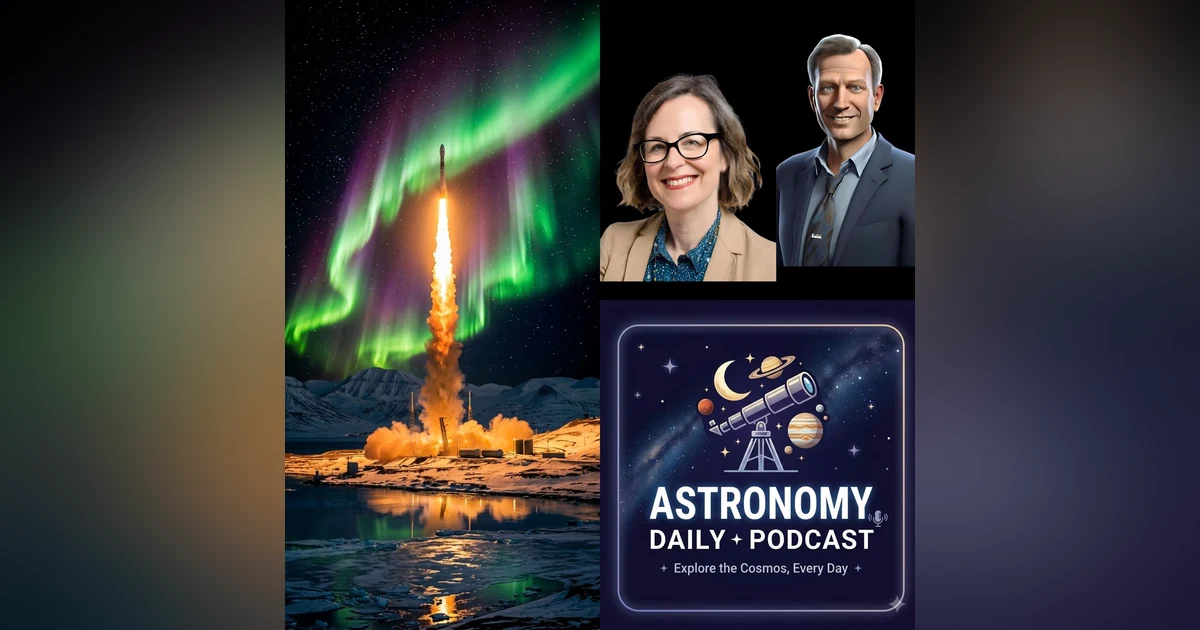
A German rocket lifted off from an Arctic island on Saturday and became the first vehicle ever to reach orbit from Western European soil. Plus: the gaps in stellar streams may not be dark matter after all, two white dwarfs circling every 374 seconds in the far southern sky, peptides that fold in concentrated sulfuric acid, and what Katalyst's LINK is actually doing next to Swift. Both-hemispheres skywatch, and a serious safety warning for tomorrow's daylight Jupiter occultation.
Links & sources · Isar Aerospace — mission updates — https://isaraerospace.com/mission-updates-overview · ESA — Spectrum launches to orbit (imagery) — https://www.esa.int/ESA_Multimedia/Images/2026/09/Spectrum_launches_to_orbit · NASASpaceflight — Isar 'Onward and Upward' — https://www.nasaspaceflight.com/2026/09/isar-onward-and-upward/ · Space.com — Private German rocket makes history — https://www.space.com/space-exploration/launches-spacecraft/isar-aerospace-second-launch-norway-andoya-spaceport-spectrum-rocket · Space.com — Gilmour Space eyes a second orbital attempt — https://www.space.com/space-exploration/launches-spacecraft/australias-gilmour-space-not-going-to-give-up-as-it-eyes-2nd-orbital-launch-attempt-in-2026 · Sky & Telescope — Gaps in stellar streams may be common — https://skyandtelescope.org/astronomy-news/gaps-in-stellar-streams-common-not-sign-dark-matter/ · Arora et al. — Semianalytic modeling of subhalo encounters with thin stellar streams, ApJ — https://iopscience.iop.org/article/10.3847/1538-4357/adf740 · Sharma et al. — Rapid orbital decay in eRASSU J060839.5−704014 (arXiv) — https://arxiv.org/abs/2608.09341 · Maitra et al. — eRASSU J060839.5−704014 discovery paper, A&A (2024) — https://www.aanda.org/articles/aa/ref/2024/03/aa47811-23/aa47811-23.html · MIT News — Peptides can form well-defined structures in Venus-like conditions — https://news.mit.edu/2026/study-peptides-can-form-well-defined-structures-harsh-venus-conditions-0831 · NASA Swift blog — Commercial spacecraft for Swift boost continues tech demo — https://science.nasa.gov/blogs/swift/2026/09/04/commercial-spacecraft-for-nasas-swift-boost-continues-tech-demo/ · NASA Swift blog — LINK spacecraft recovery progressing — https://science.nasa.gov/blogs/swift/2026/08/06/link-spacecraft-recovery-progressing-for-nasas-swift-boost/ · EarthSky — Saturn at opposition, 4 October 2026 — https://earthsky.org/astronomy-essentials/saturn-at-opposition-closest-brightest-best/ · Star Walk — Astronomical events, September 2026 — https://starwalk.space/en/news/night-sky-tonight-september
Become a supporter of this podcast: https://www.spreaker.com/podcast/astronomy-daily-latest-space-news--5648921/support.
Sponsor Details:
Ensure your online privacy by using NordVPN. To get our special listener deal and save a lot of money, visit www.astronomydaily.io/nordvpn. You'll be glad you did!
Get the best secure and private email on the planet. Stop your Government, google and who knows who else spying on every email you write. Do what we did and use ProtonMail. They beleive in privacy and there are no ads in their business model...yet they still provide a free forever service. Check them out and get out special deal at www.astronomydaily.io/protonmail
Become a supporter of Astronomy Daily by joining our Supporters Club. Commercial free episodes daily are only a click way... Click Here
This episode includes AI-generated content.
0
00:00:00.720 --> 00:00:03.160
Anna: Hello and welcome to Astronomy daily. It's
1
00:00:03.160 --> 00:00:06.160
Monday, September 7th, 2026. I'm
2
00:00:06.160 --> 00:00:08.880
Anna and this is series five, episode
3
00:00:08.880 --> 00:00:09.920
187.
4
00:00:10.160 --> 00:00:11.980
Anna: And I'm Avery. Anna.
5
00:00:11.980 --> 00:00:14.000
Uh, we're starting the week with a rocket
6
00:00:14.000 --> 00:00:16.720
that finally worked. And it's not one of the
7
00:00:16.720 --> 00:00:18.000
usual suspects.
8
00:00:18.400 --> 00:00:21.400
Anna: It isn't. On Saturday morning our time, a
9
00:00:21.400 --> 00:00:23.840
German built rocket lifted off from an island
10
00:00:23.920 --> 00:00:26.610
inside the Arctic Circle and put six
11
00:00:26.610 --> 00:00:29.530
payloads into orbit. And in doing so,
12
00:00:29.530 --> 00:00:32.450
it became the first vehicle in history to
13
00:00:32.450 --> 00:00:33.170
reach orbit
14
00:00:33.170 --> 00:00:36.050
Anna: from western European soil 69
15
00:00:36.050 --> 00:00:37.690
years into the space age.
16
00:00:38.410 --> 00:00:41.370
Anna: 69 years into the space age. Europe
17
00:00:41.370 --> 00:00:43.530
has been launching for decades from South
18
00:00:43.530 --> 00:00:46.410
America. On Saturday, it launched from home.
19
00:00:46.890 --> 00:00:49.850
Anna: That's our lead then. Three pieces of
20
00:00:49.850 --> 00:00:52.050
science that all quietly tell you something
21
00:00:52.050 --> 00:00:53.850
about how hard measurement is.
22
00:00:54.750 --> 00:00:56.750
Astronomers have found that the gaps in
23
00:00:56.750 --> 00:00:59.430
stellar streams. One of our best tools for
24
00:00:59.430 --> 00:01:02.430
finding dark matter might not be dark matter
25
00:01:02.430 --> 00:01:02.990
at all.
26
00:01:03.470 --> 00:01:05.790
Anna: A pair of white dwarfs in the far southern
27
00:01:05.790 --> 00:01:08.550
sky are circling each other every six
28
00:01:08.550 --> 00:01:11.070
minutes and we can now watch the orbit
29
00:01:11.070 --> 00:01:13.910
shrinking. That is gravity carrying energy
30
00:01:13.910 --> 00:01:16.590
away as waves measured with X rays.
31
00:01:16.990 --> 00:01:19.940
Anna: And on Venus, proteins, orbital or
32
00:01:19.940 --> 00:01:22.940
the beginnings of them, peptides that fold up
33
00:01:22.940 --> 00:01:25.740
properly and stay folded in concentrated
34
00:01:25.740 --> 00:01:28.700
sulfuric acid. Which is not what anybody
35
00:01:28.700 --> 00:01:30.140
expected then
36
00:01:30.540 --> 00:01:32.140
Anna: because a lot of you have written in about
37
00:01:32.140 --> 00:01:34.980
it. What on earth is Link actually
38
00:01:34.980 --> 00:01:37.620
doing up there? The Swift rescue that didn't
39
00:01:37.620 --> 00:01:39.860
rescue Swift has turned into something more
40
00:01:39.860 --> 00:01:42.100
interesting. And it's got about two weeks
41
00:01:42.100 --> 00:01:42.460
left,
42
00:01:42.860 --> 00:01:45.300
Anna: plus the sky for the week ahead, both
43
00:01:45.300 --> 00:01:47.860
hemispheres. And there's an occultation
44
00:01:47.860 --> 00:01:50.220
tomorrow that comes with a serious safety
45
00:01:50.220 --> 00:01:51.260
warning attached.
46
00:01:51.820 --> 00:01:52.300
Anna: Big Monday.
47
00:01:52.780 --> 00:01:55.780
Anna: Let's go right, set the scene for
48
00:01:55.780 --> 00:01:58.340
me because I want to understand why this is a
49
00:01:58.340 --> 00:02:00.300
first when Europe has been in the launch
50
00:02:00.300 --> 00:02:02.060
business since the 70s.
51
00:02:02.540 --> 00:02:04.820
Anna: That's exactly the right question. And the
52
00:02:04.820 --> 00:02:07.699
answer is geography. Europe's launch site
53
00:02:07.699 --> 00:02:10.420
is Kourou in French Guiana on the
54
00:02:10.420 --> 00:02:13.220
northeast coast of South America. It's been
55
00:02:13.220 --> 00:02:15.420
Europe's spaceport since 1968.
56
00:02:15.980 --> 00:02:18.160
Ariane Vega album, all of it.
57
00:02:18.400 --> 00:02:20.960
Superb location, 5 degrees off the equator.
58
00:02:21.200 --> 00:02:22.760
You get a free kick from the Earth's
59
00:02:22.760 --> 00:02:23.280
rotation.
60
00:02:23.680 --> 00:02:26.400
Anna: But it's 8,000 kilometres from Paris.
61
00:02:26.960 --> 00:02:29.200
Anna: 7,000 odd. And that's the point.
62
00:02:29.760 --> 00:02:32.280
Europe has had access to space for 50 years
63
00:02:32.280 --> 00:02:34.560
without having launch capability on its own
64
00:02:34.560 --> 00:02:37.480
continent. Every European satellite that
65
00:02:37.480 --> 00:02:40.080
went up on a European rocket went up from
66
00:02:40.080 --> 00:02:43.040
South America or from Cape Canaveral
67
00:02:43.600 --> 00:02:46.520
or for a long stretch from Kazakhstan on
68
00:02:46.520 --> 00:02:47.440
a Soyuz.
69
00:02:47.840 --> 00:02:49.920
Anna: And on Saturday that changed.
70
00:02:50.320 --> 00:02:53.160
Anna: On Saturday that changed. The company is
71
00:02:53.160 --> 00:02:56.080
Isar Aerospace, German, founded
72
00:02:56.080 --> 00:02:58.960
2018. Spun out of the technical University of
73
00:02:58.960 --> 00:03:01.760
Munich. The rocket is called Spectrum.
74
00:03:02.000 --> 00:03:04.240
It lifted off at 10:12 in the evening,
75
00:03:04.320 --> 00:03:07.200
Central European Time, on Friday the 5th,
76
00:03:07.360 --> 00:03:09.760
which is 6:12 on Saturday morning for those
77
00:03:09.760 --> 00:03:12.540
of us in Sydney from Andoya spaceport.
78
00:03:12.860 --> 00:03:15.260
Anna: And Andoya is where exactly?
79
00:03:15.340 --> 00:03:18.220
Anna: Northern Norway. An Island about 300
80
00:03:18.220 --> 00:03:20.860
kilometres inside the Arctic Circle. It's
81
00:03:20.860 --> 00:03:23.500
been a sounding rocket range since 1962,
82
00:03:23.900 --> 00:03:26.340
so there's real heritage there. But this is
83
00:03:26.340 --> 00:03:28.900
its first orbital launch pad and it's a
84
00:03:28.900 --> 00:03:31.780
genuinely useful location. You launch north
85
00:03:31.780 --> 00:03:33.940
over open ocean and you get straight into
86
00:03:33.940 --> 00:03:36.750
polar and sun synchronous orbits, which is
87
00:03:36.750 --> 00:03:38.910
where most Earth observation satellites want
88
00:03:38.910 --> 00:03:39.270
to be.
89
00:03:39.350 --> 00:03:40.550
Anna: Tell me about the rocket.
90
00:03:40.870 --> 00:03:43.630
Anna: Spectrum's a two stage vehicle, about 28
91
00:03:43.630 --> 00:03:46.510
metres tall, 2 metres across. Nine
92
00:03:46.510 --> 00:03:49.070
engines on the first stage, one vacuum
93
00:03:49.070 --> 00:03:51.470
optimised engine on the second. And they're
94
00:03:51.470 --> 00:03:53.910
all the same engine. It's called Aquila and
95
00:03:53.910 --> 00:03:56.430
Isar built it in house. The propellant
96
00:03:56.430 --> 00:03:58.830
combination is the interesting bit. Liquid
97
00:03:58.830 --> 00:04:00.230
oxygen and propane.
98
00:04:00.710 --> 00:04:03.310
Anna: Propane, not kerosene, not
99
00:04:03.310 --> 00:04:05.080
methane, propane.
100
00:04:05.400 --> 00:04:08.280
Anna: It sits between the two, denser than methane,
101
00:04:08.440 --> 00:04:10.800
cleaner burning than kerosene, and you can
102
00:04:10.800 --> 00:04:13.760
buy it anywhere. It's an unusual choice. And
103
00:04:13.760 --> 00:04:16.760
it's theirs. The second stage restarts, which
104
00:04:16.760 --> 00:04:18.960
matters in a minute. And the numbers are
105
00:04:18.960 --> 00:04:21.520
small, launcher numbers. About 700
106
00:04:21.520 --> 00:04:23.760
kilogrammes to sun synchronous orbit out of
107
00:04:23.760 --> 00:04:26.640
Andoya, around a tonne to low Earth orbit, if
108
00:04:26.640 --> 00:04:28.520
they ever fly it from French Guiana.
109
00:04:28.920 --> 00:04:31.320
Anna: So this is not an Ariane competitor?
110
00:04:32.020 --> 00:04:34.420
Anna: Not remotely, and nobody's pretending it is.
111
00:04:34.660 --> 00:04:37.580
Ariane 6 lifts 20 tonnes. This is
112
00:04:37.580 --> 00:04:39.980
the small satellite end of the market. The
113
00:04:39.980 --> 00:04:42.660
rocket lab electron end, roughly. But the
114
00:04:42.660 --> 00:04:45.420
strategic question was never about mass. It
115
00:04:45.420 --> 00:04:47.180
was about whether Europe could do this at
116
00:04:47.180 --> 00:04:49.900
all. From Europe, without asking anyone's
117
00:04:49.900 --> 00:04:50.340
permission.
118
00:04:50.980 --> 00:04:53.060
Anna: Now, this wasn't the first attempt.
119
00:04:53.700 --> 00:04:55.940
Anna: No, and I want to be fair about the first
120
00:04:55.940 --> 00:04:58.936
one. Spectrum's maiden flight was 30
121
00:04:59.077 --> 00:05:01.700
March 2025, from the same pad.
122
00:05:02.020 --> 00:05:05.020
It flew for about 30 seconds, lost attitude
123
00:05:05.020 --> 00:05:07.980
control and came down. The cause was a
124
00:05:07.980 --> 00:05:09.940
vent valve that opened when it shouldn't have
125
00:05:09.940 --> 00:05:12.660
during the pitchover manoeuvre. Isar spent
126
00:05:12.660 --> 00:05:15.300
the time since on software changes and on
127
00:05:15.300 --> 00:05:16.820
widening the vehicle's margins.
128
00:05:17.460 --> 00:05:19.300
Anna: 18 months between flights.
129
00:05:19.780 --> 00:05:22.460
Anna: 18 months and a, uh, run of scrubs this year.
130
00:05:22.460 --> 00:05:25.060
On top of that, a pressurisation valve in
131
00:05:25.060 --> 00:05:27.630
January weather, range issues.
132
00:05:28.270 --> 00:05:29.830
There were people writing them off as
133
00:05:29.830 --> 00:05:32.590
Anna: recently as last week and then Friday night.
134
00:05:32.590 --> 00:05:33.550
It just worked.
135
00:05:33.950 --> 00:05:36.830
Anna: It just worked. Nine engines lit clean.
136
00:05:36.830 --> 00:05:39.470
Ascent stage separation fairing away.
137
00:05:39.710 --> 00:05:41.830
And the second stage put itself into an
138
00:05:41.830 --> 00:05:44.590
elliptical orbit. Roughly 180 by
139
00:05:44.590 --> 00:05:47.190
500 kilometres, then restarted and
140
00:05:47.190 --> 00:05:50.150
circularised. That restart is the thing I'd
141
00:05:50.150 --> 00:05:52.750
point to. A lot of small launchers need a
142
00:05:52.750 --> 00:05:55.380
separate kick stage. To do that. Isar built
143
00:05:55.380 --> 00:05:57.140
the capability into the second stage.
144
00:05:57.620 --> 00:05:58.660
Anna: What was on board?
145
00:05:58.900 --> 00:06:01.740
Anna: Six payloads. And I love this manifest
146
00:06:01.740 --> 00:06:04.740
because it's so unglamorous in the best
147
00:06:04.820 --> 00:06:07.740
way. 5 cubesats from the technical
148
00:06:07.740 --> 00:06:09.740
University of Berlin, from
149
00:06:09.740 --> 00:06:12.540
NTNU in Norway, from the
150
00:06:12.540 --> 00:06:15.460
University of Maribor in Slovenia, from
151
00:06:15.460 --> 00:06:18.380
TU Wien in Austria, and one from
152
00:06:18.380 --> 00:06:21.220
endurosat, which is Bulgarian, plus
153
00:06:21.220 --> 00:06:23.420
a non deployable experiment from a German
154
00:06:23.420 --> 00:06:26.420
company called D Cubed that stayed bolted to
155
00:06:26.420 --> 00:06:28.340
the stage. Universities,
156
00:06:28.980 --> 00:06:31.540
Universities mostly. They're testing things
157
00:06:31.540 --> 00:06:34.060
like radiation tolerant perovskite solar
158
00:06:34.060 --> 00:06:36.260
cells and how batteries cope with being
159
00:06:36.260 --> 00:06:39.180
hibernated in orbit. It is exactly the kind
160
00:06:39.180 --> 00:06:41.060
of payload that has spent the last decade
161
00:06:41.060 --> 00:06:43.340
queuing for a rideshare slot on somebody
162
00:06:43.340 --> 00:06:46.020
else's rocket, on somebody else's schedule.
163
00:06:46.590 --> 00:06:49.150
Anna: So the significance isn't the six satellites,
164
00:06:49.230 --> 00:06:50.350
it's the queue.
165
00:06:50.830 --> 00:06:53.670
Anna: The significance is the cue. And
166
00:06:53.670 --> 00:06:56.230
it's sovereignty, which is a word that's
167
00:06:56.230 --> 00:06:58.590
doing a lot of work in European space policy
168
00:06:58.670 --> 00:07:01.390
Right now. ESA has been running a launcher
169
00:07:01.390 --> 00:07:04.030
challenge specifically to get more than one
170
00:07:04.030 --> 00:07:06.910
European company flying precisely because
171
00:07:06.910 --> 00:07:09.830
relying on a single vehicle or on somebody
172
00:07:09.830 --> 00:07:12.430
else's vehicle turned out to be uncomfortable
173
00:07:12.430 --> 00:07:15.190
when the geopolitics moved. Isar has
174
00:07:15.190 --> 00:07:17.270
raised well north of half a billion euros
175
00:07:17.270 --> 00:07:19.790
against that thesis and their Munich factory
176
00:07:19.790 --> 00:07:22.270
is built for more than 30 vehicles a year.
177
00:07:22.910 --> 00:07:25.790
Anna: Explain the geopolitics bit, because I think
178
00:07:25.790 --> 00:07:27.630
that's the piece people underestimate.
179
00:07:28.190 --> 00:07:30.030
Anna: It's not complicated, it's just
180
00:07:30.109 --> 00:07:32.870
uncomfortable. For years, a good
181
00:07:32.870 --> 00:07:35.390
slice of European payloads flew on Russian
182
00:07:35.390 --> 00:07:38.190
Soyuz rockets, including out of Kourou.
183
00:07:38.510 --> 00:07:41.460
That ended abruptly in 2022 at
184
00:07:41.460 --> 00:07:44.220
almost exactly the same moment Ariane 5
185
00:07:44.220 --> 00:07:46.860
retired and Ariane 6 wasn't ready and
186
00:07:46.860 --> 00:07:49.700
Vega C was grounded after a failure. So
187
00:07:49.700 --> 00:07:51.580
Europe spent a stretch of two or three years
188
00:07:51.580 --> 00:07:53.980
in the strange position of being a first rank
189
00:07:53.980 --> 00:07:56.779
space power that had to buy rides from SpaceX
190
00:07:56.779 --> 00:07:59.340
to launch its own science missions, including
191
00:07:59.500 --> 00:08:01.900
missions it built itself, including
192
00:08:01.980 --> 00:08:04.660
flagship missions it built itself. That was
193
00:08:04.660 --> 00:08:07.140
the wake up. And the response wasn't to build
194
00:08:07.140 --> 00:08:09.940
one bigger rocket, it was to stop having a
195
00:08:09.940 --> 00:08:12.300
single point of failure, which is where a
196
00:08:12.300 --> 00:08:14.580
German startup flying from a Norwegian island
197
00:08:14.580 --> 00:08:17.220
fits in. It's not that spectrum replaces
198
00:08:17.220 --> 00:08:19.660
anything. It's that if you have three or four
199
00:08:19.660 --> 00:08:22.660
independent European ways to reach orbit, no
200
00:08:22.660 --> 00:08:25.340
single failure, retirement or foreign policy
201
00:08:25.420 --> 00:08:27.740
decision can ground the continent again.
202
00:08:28.300 --> 00:08:30.260
Anna: And Norway gets something out of this
203
00:08:30.260 --> 00:08:32.860
Anna: too, Norway gets a great deal out of it.
204
00:08:33.020 --> 00:08:35.830
Andoya Space is majority state owned and.
205
00:08:35.900 --> 00:08:37.940
And Norway has just gone from hosting a
206
00:08:37.940 --> 00:08:40.500
sounding rocket range to hosting the only
207
00:08:40.500 --> 00:08:43.060
orbital launch site on the European mainland
208
00:08:43.060 --> 00:08:45.780
side of the Atlantic. There are two more pads
209
00:08:45.780 --> 00:08:48.060
planned there. If you're a European small
210
00:08:48.060 --> 00:08:50.660
satellite operator, that is suddenly a very
211
00:08:50.660 --> 00:08:52.660
short truck ride compared to shipping your
212
00:08:52.660 --> 00:08:54.140
spacecraft to South America.
213
00:08:54.540 --> 00:08:56.540
Anna: Which they now have to actually deliver.
214
00:08:56.940 --> 00:08:59.460
Anna: Which they now have to actually deliver. And
215
00:08:59.460 --> 00:09:02.310
that's the honest caveat. One successful
216
00:09:02.310 --> 00:09:05.310
flight is one successful flight. Vehicles
217
00:09:05.310 --> 00:09:07.710
three through seven are in production. But
218
00:09:07.710 --> 00:09:10.230
Cadence is where small launchers historically
219
00:09:10.230 --> 00:09:12.590
go to die. Ask anyone who's watched that
220
00:09:12.590 --> 00:09:13.590
market for 10 years.
221
00:09:14.310 --> 00:09:17.110
Anna: Alright, Southern hemisphere angle. I
222
00:09:17.110 --> 00:09:18.150
know you have one.
223
00:09:18.550 --> 00:09:21.390
Anna: I do. And it's close to home because the
224
00:09:21.390 --> 00:09:23.670
storey Isar just wrote is the storey Gilmour
225
00:09:23.670 --> 00:09:25.430
Space is trying to write in Queensland.
226
00:09:25.910 --> 00:09:26.630
Anna: Eris.
227
00:09:27.200 --> 00:09:30.040
Anna: Eris, Australia's first home built
228
00:09:30.040 --> 00:09:32.440
orbital rocket, launched from the Bowen
229
00:09:32.440 --> 00:09:34.560
Orbital Spaceport in July last year.
230
00:09:35.040 --> 00:09:37.840
Flew for 14 seconds and came back down.
231
00:09:38.160 --> 00:09:40.480
Adam Gilmour's line about it afterwards was
232
00:09:40.480 --> 00:09:42.560
that most companies need about three attempts
233
00:09:42.560 --> 00:09:44.680
to make orbit and that they're not going to
234
00:09:44.680 --> 00:09:46.640
give up. He said that at the International
235
00:09:46.800 --> 00:09:49.200
Astronautical Congress in Sydney.
236
00:09:49.520 --> 00:09:52.240
Anna: And Isar's second attempt made orbit
237
00:09:52.320 --> 00:09:52.640
after
238
00:09:52.640 --> 00:09:54.800
Anna: a first flight that lasted 30 seconds.
239
00:09:55.440 --> 00:09:58.320
Gilmour's first lasted 14. That is
240
00:09:58.320 --> 00:10:00.720
not a prediction. Rockets don't work by
241
00:10:00.720 --> 00:10:03.160
analogy. But if you want to know what the
242
00:10:03.160 --> 00:10:05.920
road out of a 14 second flight looks like,
243
00:10:06.160 --> 00:10:08.680
Friday night in Norway is a fairly
244
00:10:08.680 --> 00:10:09.920
encouraging map.
245
00:10:10.320 --> 00:10:12.880
Anna: Same problem, opposite ends of the planet,
246
00:10:13.200 --> 00:10:15.920
Anna: and the same underlying argument. A country
247
00:10:15.920 --> 00:10:18.160
or a continent that can build satellites but
248
00:10:18.160 --> 00:10:20.930
can't launch them is a customer, not a
249
00:10:20.930 --> 00:10:23.770
space power. Norway just stopped being only
250
00:10:23.770 --> 00:10:26.250
a customer. Queensland is trying to
251
00:10:26.730 --> 00:10:27.970
Storey 2 and
252
00:10:27.970 --> 00:10:30.370
Anna: it's a bit of a spoiler for a method a lot of
253
00:10:30.370 --> 00:10:31.530
people were counting on.
254
00:10:32.090 --> 00:10:34.810
Anna, uh, remind everyone what a stellar
255
00:10:34.810 --> 00:10:35.530
stream is.
256
00:10:36.170 --> 00:10:38.970
Anna: So a globular cluster or a small
257
00:10:38.970 --> 00:10:41.530
satellite galaxy falls into the Milky Way
258
00:10:41.690 --> 00:10:44.170
and our galaxy's gravity pulls it apart.
259
00:10:44.650 --> 00:10:47.210
What you're left with is a long, thin ribbon
260
00:10:47.210 --> 00:10:49.730
of stars strung out along the orbit the
261
00:10:49.730 --> 00:10:52.130
cluster used to have. There are dozens of
262
00:10:52.130 --> 00:10:54.890
them wrapped around our galaxy. GD1 is the
263
00:10:54.890 --> 00:10:55.570
famous one.
264
00:10:55.970 --> 00:10:58.010
Anna: And the reason people care is that they're
265
00:10:58.010 --> 00:10:58.610
delicate.
266
00:10:59.010 --> 00:11:01.490
Anna: Exactly. They're the most fragile structures
267
00:11:01.490 --> 00:11:04.450
in the galaxy, which makes them a detector.
268
00:11:04.690 --> 00:11:07.450
The idea has been if a clump of dark matter
269
00:11:07.450 --> 00:11:09.810
drifts through a stream, it gives the ribbon
270
00:11:09.810 --> 00:11:12.650
a gravitational kick and you get a gap or a
271
00:11:12.650 --> 00:11:15.410
kink or a little spur of stars. Flung off to
272
00:11:15.410 --> 00:11:18.300
the side. Find the gaps and you've found dark
273
00:11:18.300 --> 00:11:19.860
matter you cannot otherwise see.
274
00:11:20.420 --> 00:11:21.940
Anna: That's a beautiful idea.
275
00:11:22.340 --> 00:11:24.580
Anna: It's a genuinely beautiful idea. And it's
276
00:11:24.580 --> 00:11:26.460
been the great hope for testing what dark
277
00:11:26.460 --> 00:11:27.780
matter is actually made of.
278
00:11:28.100 --> 00:11:30.020
And this is where the new work comes in.
279
00:11:30.340 --> 00:11:33.100
Arpit Aurora with Nora Shipp and colleagues
280
00:11:33.100 --> 00:11:35.540
at the University of Washington published in
281
00:11:35.540 --> 00:11:37.860
the astrophysical journal on the 27th of
282
00:11:37.860 --> 00:11:40.700
August. They simulated four Milky Way
283
00:11:40.700 --> 00:11:43.200
sized galaxies and inside them
284
00:11:43.440 --> 00:11:45.760
about 15,000 stellar streams
285
00:11:45.920 --> 00:11:48.160
evolving over 5 billion years.
286
00:11:48.880 --> 00:11:49.280
Anna: And.
287
00:11:49.760 --> 00:11:52.320
Anna: And roughly 3/4 of the streams developed
288
00:11:52.320 --> 00:11:54.720
gaps, spurs or kinks.
289
00:11:55.040 --> 00:11:57.200
Only about 70 of the 15,000
290
00:11:57.600 --> 00:12:00.480
stayed genuinely smooth from dark matter
291
00:12:00.480 --> 00:12:03.040
clumps. That's the point. No,
292
00:12:03.360 --> 00:12:05.760
from the galaxy itself. The bar in the
293
00:12:05.760 --> 00:12:08.510
middle, the disc, the spiral arms, the
294
00:12:08.510 --> 00:12:11.270
ordinary visible furniture of a spiral galaxy
295
00:12:11.270 --> 00:12:13.670
is enough to chew up a stellar stream all on
296
00:12:13.670 --> 00:12:16.350
its own. Aurora's line is that in their
297
00:12:16.350 --> 00:12:19.030
simulations the host galaxies alone
298
00:12:19.030 --> 00:12:21.350
cause the same kinds of irregularities we
299
00:12:21.350 --> 00:12:23.150
actually observe in real streams.
300
00:12:23.630 --> 00:12:25.630
Anna: So a, uh, gap is not evidence.
301
00:12:26.270 --> 00:12:29.230
Anna: A gap on its own is not evidence.
302
00:12:29.710 --> 00:12:31.590
And they found the effect is worst for
303
00:12:31.590 --> 00:12:33.710
streams that formed closer to the galactic
304
00:12:33.710 --> 00:12:36.090
centre, which is where a lot of the observed
305
00:12:36.090 --> 00:12:38.650
ones are. Their honest conclusion is that at
306
00:12:38.650 --> 00:12:40.650
present we cannot tell you what made any
307
00:12:40.650 --> 00:12:41.650
particular gap.
308
00:12:41.890 --> 00:12:43.570
Anna: Is that the end of the method?
309
00:12:43.970 --> 00:12:46.410
Anna: No, and this is why I like the paper. Rather
310
00:12:46.410 --> 00:12:48.490
than finding it depressing. It's a
311
00:12:48.490 --> 00:12:50.610
recalibration, not a demolition.
312
00:12:51.250 --> 00:12:53.290
What it says is that you can't do this one
313
00:12:53.290 --> 00:12:55.290
stream at a time. You need the whole
314
00:12:55.290 --> 00:12:57.890
population statistically, how many gaps,
315
00:12:58.290 --> 00:13:01.180
how deep distributed how compared
316
00:13:01.180 --> 00:13:03.020
against simulations with dark matter and
317
00:13:03.020 --> 00:13:03.300
without,
318
00:13:03.700 --> 00:13:06.180
Anna: which needs a lot more streams and
319
00:13:06.180 --> 00:13:08.260
Anna: much better motions for the stars in them.
320
00:13:08.740 --> 00:13:10.700
That is more or less a job description for
321
00:13:10.700 --> 00:13:13.660
the Vera Rubin Observatory in Chile, which
322
00:13:13.660 --> 00:13:16.619
is going to find streams by the dozen. And
323
00:13:16.619 --> 00:13:19.060
for the next Gaia class, astrometry.
324
00:13:19.460 --> 00:13:22.180
So the tool isn't broken, it just turns out
325
00:13:22.180 --> 00:13:24.540
to need a much bigger sample before it tells
326
00:13:24.540 --> 00:13:25.140
the truth.
327
00:13:26.670 --> 00:13:29.190
Alright, moving on. And Storey 3 is one of my
328
00:13:29.190 --> 00:13:32.190
favourite kinds of result. An object we
329
00:13:32.190 --> 00:13:34.710
already knew about that just did something we
330
00:13:34.710 --> 00:13:35.310
could measure.
331
00:13:35.470 --> 00:13:36.590
Anna: Give me the object.
332
00:13:36.990 --> 00:13:39.230
Anna: It has a name only a catalogue could love.
333
00:13:39.710 --> 00:13:41.390
Erasu J
334
00:13:41.390 --> 00:13:44.162
060-8395
335
00:13:44.778 --> 00:13:47.550
-704014.
336
00:13:47.950 --> 00:13:50.270
We'll call it J0608.
337
00:13:50.750 --> 00:13:53.410
It's two white dwarfs orbiting each other and
338
00:13:53.410 --> 00:13:55.890
the orbital period is 374
339
00:13:55.890 --> 00:13:56.490
seconds.
340
00:13:57.050 --> 00:13:59.290
Anna: 374 seconds.
341
00:13:59.690 --> 00:14:01.210
That's six minutes and change.
342
00:14:01.930 --> 00:14:04.690
Anna: Six minutes and 14 seconds. A complete
343
00:14:04.690 --> 00:14:07.410
year for that pair in the Time it takes to
344
00:14:07.410 --> 00:14:10.290
boil an egg badly. The whole system would fit
345
00:14:10.290 --> 00:14:11.610
comfortably inside our sun.
346
00:14:12.170 --> 00:14:13.210
Anna: How was it found?
347
00:14:13.610 --> 00:14:16.610
Anna: By Erosita, the German X ray telescope
348
00:14:16.610 --> 00:14:19.540
on the Spectre RG spacecraft. During its all
349
00:14:19.540 --> 00:14:22.500
sky surveys, it showed up as an X ray Source,
350
00:14:22.500 --> 00:14:25.220
pulsing every 374 seconds.
351
00:14:25.380 --> 00:14:28.220
And the pulsing is dramatic. The flux
352
00:14:28.220 --> 00:14:30.940
goes to essentially zero and back about
353
00:14:30.940 --> 00:14:33.300
50% on, 50% off.
354
00:14:33.860 --> 00:14:36.860
Then XMM Newton followed up in X rays and
355
00:14:36.860 --> 00:14:39.220
the Dark Energy Camera in Chile picked it up
356
00:14:39.220 --> 00:14:39.700
optically.
357
00:14:40.260 --> 00:14:41.540
Anna: So what's new this week?
358
00:14:42.020 --> 00:14:44.140
Anna: This week Rahul Sharma and colleagues
359
00:14:44.140 --> 00:14:45.740
published in the Astrophysical Journal
360
00:14:45.740 --> 00:14:47.990
Letters. And what they've measured is that
361
00:14:47.990 --> 00:14:50.430
the orbit is shrinking measurably.
362
00:14:50.990 --> 00:14:52.950
And the rate at which it's shrinking matches
363
00:14:52.950 --> 00:14:55.430
what general relativity says it should be if
364
00:14:55.430 --> 00:14:58.070
the system is radiating away energy as
365
00:14:58.070 --> 00:14:59.150
gravitational waves.
366
00:14:59.790 --> 00:15:02.309
Anna: So we're watching gravitational waves carry
367
00:15:02.309 --> 00:15:04.630
energy off using an X ray
368
00:15:04.630 --> 00:15:05.310
telescope.
369
00:15:05.390 --> 00:15:07.590
Anna: That's precisely what's happening. And I
370
00:15:07.590 --> 00:15:09.670
think it's a lovely thing. We're not
371
00:15:09.670 --> 00:15:12.110
detecting the waves, we're watching the bill
372
00:15:12.110 --> 00:15:14.980
being paid. The energy leaves as
373
00:15:14.980 --> 00:15:17.660
gravitational radiation. The orbit
374
00:15:17.660 --> 00:15:20.220
tightens, the clock speeds up and you can
375
00:15:20.220 --> 00:15:20.700
time it.
376
00:15:21.020 --> 00:15:23.180
Anna: Which makes it useful to Lisa.
377
00:15:23.500 --> 00:15:26.140
Anna: Which makes it very useful to Lisa,
378
00:15:26.460 --> 00:15:28.620
the Space Based Gravitational Wave
379
00:15:28.620 --> 00:15:30.820
Observatory ESA is flying in the
380
00:15:30.820 --> 00:15:33.780
mid-2030s. Lisa is tuned to
381
00:15:33.780 --> 00:15:36.660
low frequencies and tight binaries like
382
00:15:36.660 --> 00:15:39.550
this sit right in its band. The chirp
383
00:15:39.550 --> 00:15:42.190
mass here works out to about 0.43
384
00:15:42.190 --> 00:15:44.030
solar masses, which makes
385
00:15:44.030 --> 00:15:46.510
J0608 one of the
386
00:15:46.510 --> 00:15:48.710
loudest known verification binaries,
387
00:15:49.270 --> 00:15:51.190
a source we already know the position and
388
00:15:51.190 --> 00:15:54.030
period of. So when LISA switches on, it
389
00:15:54.030 --> 00:15:56.950
should hear it. If it doesn't, something is
390
00:15:56.950 --> 00:15:59.350
wrong with the instrument, not the universe.
391
00:15:59.750 --> 00:16:01.030
Anna: A tuning fork.
392
00:16:01.430 --> 00:16:03.430
Anna: A tuning fork you build the observatory
393
00:16:03.430 --> 00:16:05.700
around. And here's our bit.
394
00:16:06.100 --> 00:16:09.020
J0608 sits at declination
395
00:16:09.020 --> 00:16:12.020
minus 70. It's in the direction of the Large
396
00:16:12.100 --> 00:16:15.020
Magellanic Cloud in front of it in our
397
00:16:15.020 --> 00:16:18.020
own galaxy's halo, somewhere between 1 and
398
00:16:18.020 --> 00:16:20.940
5 kiloparsecs out, which means it is
399
00:16:20.940 --> 00:16:23.860
a southern hemisphere object. It never rises
400
00:16:23.860 --> 00:16:26.460
for most of Europe and North America. It was
401
00:16:26.460 --> 00:16:28.780
found by an all sky survey confirmed from
402
00:16:28.780 --> 00:16:31.060
Chile. And if you're listening in Sydney or
403
00:16:31.060 --> 00:16:33.580
uh, Auckland or Cape Town, it is over your
404
00:16:33.580 --> 00:16:34.900
head and nobody else's.
405
00:16:35.460 --> 00:16:38.420
Anna: Storey 4 takes us to Venus and it picks
406
00:16:38.420 --> 00:16:41.300
up a thread. We were on last week, it does.
407
00:16:41.860 --> 00:16:43.940
Anna: On Friday we talked about the Venus Life
408
00:16:43.940 --> 00:16:46.900
Finder mission. MIT and Rocket Lab,
409
00:16:46.980 --> 00:16:49.020
the first privately funded mission to another
410
00:16:49.020 --> 00:16:51.500
planet, which is built and waiting on
411
00:16:51.500 --> 00:16:53.660
Neutron's first flight. This is the
412
00:16:53.660 --> 00:16:55.820
laboratory half of that storey and it lands
413
00:16:55.820 --> 00:16:56.500
very nicely.
414
00:16:56.900 --> 00:16:58.180
Anna: Sara Seeger again.
415
00:16:58.760 --> 00:17:01.120
Anna: Sarah Seager's group at mit, published in the
416
00:17:01.120 --> 00:17:02.960
Proceedings of the National Academy of
417
00:17:02.960 --> 00:17:05.800
sciences released on 31 August.
418
00:17:06.440 --> 00:17:09.320
Here's the setup. Venus's cloud deck at
419
00:17:09.320 --> 00:17:12.280
48 to 60 kilometres up has Earth like
420
00:17:12.280 --> 00:17:14.680
temperatures and pressures. It's the one
421
00:17:14.680 --> 00:17:17.280
genuinely temperate place on the planet. The
422
00:17:17.280 --> 00:17:19.240
problem is that the droplets up there are
423
00:17:19.240 --> 00:17:21.840
concentrated sulfuric acid, which we
424
00:17:21.840 --> 00:17:24.600
assume destroys everything and specifically
425
00:17:24.600 --> 00:17:27.540
destroys the molecules life needs. So the
426
00:17:27.540 --> 00:17:30.100
team took peptides, short chains of amino
427
00:17:30.100 --> 00:17:32.220
acids, the building blocks that fold into
428
00:17:32.220 --> 00:17:34.540
proteins, put three of them into
429
00:17:34.620 --> 00:17:37.540
98% sulfuric acid and watched
430
00:17:37.540 --> 00:17:39.980
them with nuclear magnetic resonance and they
431
00:17:39.980 --> 00:17:42.620
survived. They did better than survive.
432
00:17:42.779 --> 00:17:45.620
They folded, they took up stable, well
433
00:17:45.620 --> 00:17:48.340
defined three dimensional structures and held
434
00:17:48.340 --> 00:17:51.100
them for weeks. And the folding is the part
435
00:17:51.100 --> 00:17:53.230
that matters because. Because a protein that
436
00:17:53.230 --> 00:17:55.750
isn't folded correctly is just a string.
437
00:17:56.150 --> 00:17:58.230
Seeger's framing is that life needs
438
00:17:58.230 --> 00:18:00.830
specifically shaped proteins so they have a
439
00:18:00.830 --> 00:18:03.390
target they can latch onto. Shape is
440
00:18:03.390 --> 00:18:03.910
function.
441
00:18:04.310 --> 00:18:06.150
Anna: Why does the acid not shred them?
442
00:18:06.310 --> 00:18:09.150
Anna: Because there's no water. Our intuition about
443
00:18:09.150 --> 00:18:11.430
acid is really an intuition about acid
444
00:18:11.430 --> 00:18:13.990
dissolved in water. Take the water out
445
00:18:14.150 --> 00:18:16.310
and the chemistry is a different animal.
446
00:18:16.870 --> 00:18:19.390
Concentrated sulfuric acid turns out to be a
447
00:18:19.390 --> 00:18:21.590
solvent that some molecules can be perfectly
448
00:18:21.590 --> 00:18:22.390
comfortable in.
449
00:18:23.300 --> 00:18:26.220
Anna: Now the caveat, because I can hear you
450
00:18:26.220 --> 00:18:28.300
winding up to one, you know
451
00:18:28.300 --> 00:18:31.140
Anna: me too well, this is not life on Venus.
452
00:18:31.380 --> 00:18:33.780
It is not evidence of life on Venus.
453
00:18:34.020 --> 00:18:36.620
Nobody in that group is claiming it is. What
454
00:18:36.620 --> 00:18:39.300
it removes is an objection. The standard
455
00:18:39.300 --> 00:18:41.700
reply to Venus cloud habitability was always
456
00:18:42.020 --> 00:18:44.500
the biochemistry simply cannot hold together
457
00:18:44.500 --> 00:18:47.220
in that environment. This says for one
458
00:18:47.220 --> 00:18:49.540
important class of molecule and it can.
459
00:18:50.020 --> 00:18:52.180
That's a smaller claim and it's a much
460
00:18:52.180 --> 00:18:53.060
sturdier one.
461
00:18:53.540 --> 00:18:55.500
Anna: And it's the sort of thing you'd want to know
462
00:18:55.500 --> 00:18:57.540
before you spend money going there.
463
00:18:57.940 --> 00:18:59.940
Anna: It's exactly the sort of thing you'd want to
464
00:18:59.940 --> 00:19:02.340
know before you go. Which is why the timing
465
00:19:02.340 --> 00:19:04.740
is neat. The mission is sitting on the ground
466
00:19:04.819 --> 00:19:07.460
waiting for a rocket and the case for flying
467
00:19:07.460 --> 00:19:08.740
it just got firmer.
468
00:19:08.820 --> 00:19:11.620
Next storey five is here today because you
469
00:19:11.620 --> 00:19:14.220
asked for it. We've had a run of messages
470
00:19:14.220 --> 00:19:16.760
through the website about link, what happened
471
00:19:16.760 --> 00:19:19.720
to it, what it's doing now and whether Swift
472
00:19:19.720 --> 00:19:22.000
is going to be alright. So let's do the whole
473
00:19:22.000 --> 00:19:22.680
thing properly.
474
00:19:22.760 --> 00:19:24.880
Anna: Start at the beginning. For anyone joining us
475
00:19:24.880 --> 00:19:26.120
late, the Neil
476
00:19:26.120 --> 00:19:28.720
Anna: Garrels Swift Observatory has been NASA's
477
00:19:28.720 --> 00:19:31.160
Rapid Response Gamma Ray Burst telescope
478
00:19:31.240 --> 00:19:34.200
since 2004. Brilliant machine,
479
00:19:34.600 --> 00:19:37.160
22 years of service and one design
480
00:19:37.160 --> 00:19:39.960
limitation, no propulsion, it
481
00:19:39.960 --> 00:19:42.330
cannot raise its own orbit. It launched at
482
00:19:42.330 --> 00:19:45.210
around 600 kilometres and atmospheric drag
483
00:19:45.210 --> 00:19:47.250
has been quietly walking it down ever since.
484
00:19:47.890 --> 00:19:50.610
It's near 400 kilometres now and without
485
00:19:50.610 --> 00:19:52.210
help it re enters.
486
00:19:52.690 --> 00:19:54.130
Anna: So NASA hired someone.
487
00:19:54.690 --> 00:19:57.689
Anna: In September last year, NASA gave Catalyst
488
00:19:57.689 --> 00:20:00.370
Space technologies a uh, $30 million contract
489
00:20:00.450 --> 00:20:03.250
to build a spacecraft, fly it up, grab
490
00:20:03.250 --> 00:20:06.130
Swift and push it higher. That Spacecraft is
491
00:20:06.130 --> 00:20:08.860
linked 425 kilogrammes,
492
00:20:08.940 --> 00:20:11.900
three robotic arms, hall effect thrusters
493
00:20:12.220 --> 00:20:14.980
six metres across when it's deployed. It
494
00:20:14.980 --> 00:20:17.660
launched on 3 July this year on a Pegasus
495
00:20:17.660 --> 00:20:19.340
XL Air launched out
496
00:20:19.340 --> 00:20:22.260
Anna: of Kwajalein Atoll, which was itself
497
00:20:22.260 --> 00:20:25.060
a storey Pegasus hadn't flown in
498
00:20:25.060 --> 00:20:25.420
years.
499
00:20:26.060 --> 00:20:28.460
Anna: Dusted off specially and then
500
00:20:28.860 --> 00:20:31.220
three weeks after launch, on the 25th of
501
00:20:31.220 --> 00:20:34.100
July, link lost attitude control and started
502
00:20:34.100 --> 00:20:36.860
tumbling. When they worked out why it
503
00:20:36.860 --> 00:20:39.860
wasn't good, two of its three reaction wheels
504
00:20:39.860 --> 00:20:42.180
weren't working and the cold gas thruster
505
00:20:42.180 --> 00:20:43.580
system was degraded as well.
506
00:20:44.060 --> 00:20:45.340
Anna: Tumbling. How fast?
507
00:20:45.500 --> 00:20:48.140
Anna: About 9 degrees a second multi
508
00:20:48.140 --> 00:20:50.380
axis, which is fast enough that
509
00:20:50.380 --> 00:20:52.980
communications were dropping in and out. What
510
00:20:52.980 --> 00:20:55.420
the Catalyst team then did is the part of
511
00:20:55.420 --> 00:20:58.380
this storey I genuinely admire. They
512
00:20:58.380 --> 00:21:00.700
used the electric thrusters, which were never
513
00:21:00.700 --> 00:21:03.020
designed for attitude control, to take the
514
00:21:03.020 --> 00:21:05.860
spin down. By 5 August they
515
00:21:05.860 --> 00:21:08.420
had it to 1.47 degrees a second
516
00:21:08.660 --> 00:21:11.340
and then uploaded new flight software with
517
00:21:11.340 --> 00:21:13.660
attitude controllers written for a spacecraft
518
00:21:13.660 --> 00:21:15.380
that had lost half its hardware.
519
00:21:15.780 --> 00:21:17.700
Anna: But they didn't go for the capture
520
00:21:18.180 --> 00:21:20.300
Anna: on the 19th of August they stood down from
521
00:21:20.300 --> 00:21:22.100
it. And that was the right call.
522
00:21:22.740 --> 00:21:25.500
Docking with a tumbling, uncontrolled 22 year
523
00:21:25.500 --> 00:21:28.260
old telescope using a spacecraft that has
524
00:21:28.260 --> 00:21:31.250
itself lost most of its attitude control is a
525
00:21:31.250 --> 00:21:32.930
way to make one problem into two.
526
00:21:33.490 --> 00:21:36.410
Anna: So where does that leave Swift doing science?
527
00:21:36.410 --> 00:21:39.410
Anna: Actually, Swift restarted two of its three
528
00:21:39.410 --> 00:21:42.170
instruments on 26 August and it's
529
00:21:42.170 --> 00:21:44.690
observing, it's just observing on a clock.
530
00:21:44.930 --> 00:21:46.450
It comes down when it comes down
531
00:21:47.010 --> 00:21:49.970
Anna: and Link, this is what people are asking.
532
00:21:50.370 --> 00:21:53.050
Anna: This is the fresh part from NASA's Swift blog
533
00:21:53.050 --> 00:21:55.970
on Friday. Link has raised its own orbit.
534
00:21:56.050 --> 00:21:58.210
It has adjusted its plane to match Swift's.
535
00:21:58.760 --> 00:22:01.200
It has closed to within 12 to 15 kilometres
536
00:22:01.200 --> 00:22:03.840
of the telescope and it is deliberately going
537
00:22:03.840 --> 00:22:06.720
no closer. And in the last few days it has
538
00:22:06.720 --> 00:22:08.680
deployed all three robotic arms
539
00:22:08.680 --> 00:22:11.480
simultaneously and fired all three xenon
540
00:22:11.480 --> 00:22:12.440
thrusters at once.
541
00:22:13.160 --> 00:22:15.400
Anna: So it's running the mission it can run.
542
00:22:15.960 --> 00:22:18.040
Anna: Every one of those is a real in space
543
00:22:18.040 --> 00:22:20.160
servicing test that nobody had data on
544
00:22:20.160 --> 00:22:22.920
before, performed by a damaged spacecraft.
545
00:22:23.160 --> 00:22:25.400
And NASA's framing is that they're collecting
546
00:22:25.400 --> 00:22:27.640
data to inform future servicing technology
547
00:22:27.720 --> 00:22:30.620
and operations. Catalyst Reckon Link
548
00:22:30.620 --> 00:22:32.660
has about two to three more weeks in orbit
549
00:22:32.660 --> 00:22:34.940
before they deorbit it, which is a, ah,
550
00:22:35.060 --> 00:22:35.860
genuinely
551
00:22:35.860 --> 00:22:37.900
Anna: different ending to the one we expected.
552
00:22:38.700 --> 00:22:40.940
Anna: It's uh, a much better ending than it broke.
553
00:22:41.100 --> 00:22:44.060
The rescue failed, the demonstration didn't.
554
00:22:44.060 --> 00:22:46.260
And in space servicing is a field where
555
00:22:46.260 --> 00:22:48.740
almost nobody has flown anything. So a
556
00:22:48.740 --> 00:22:51.060
fortnight of hard data from a wounded vehicle
557
00:22:51.060 --> 00:22:53.580
is worth having. Keep the questions coming.
558
00:22:53.900 --> 00:22:55.780
That's what got this segment into today's
559
00:22:55.780 --> 00:22:56.300
episode.
560
00:22:56.890 --> 00:22:59.130
Anna: And that brings us to the sky for the week
561
00:22:59.130 --> 00:23:01.970
ahead. Anna, uh, this is a dark
562
00:23:01.970 --> 00:23:02.330
week.
563
00:23:02.810 --> 00:23:05.370
Anna: It's a dark week and that's the headline.
564
00:23:05.770 --> 00:23:08.570
New Moon is on Friday the 11th at about 3:30
565
00:23:08.570 --> 00:23:10.770
in the morning Greenwich time. So that's
566
00:23:10.770 --> 00:23:13.290
early Friday afternoon in Sydney and Thursday
567
00:23:13.290 --> 00:23:15.970
evening across North America, which means
568
00:23:15.970 --> 00:23:18.010
from about Tuesday right through to next
569
00:23:18.010 --> 00:23:20.410
Monday you have properly dark skies.
570
00:23:20.890 --> 00:23:22.690
If you have been waiting for a night to go
571
00:23:22.690 --> 00:23:25.410
somewhere without streetlights, this is the
572
00:23:25.410 --> 00:23:25.690
week.
573
00:23:26.170 --> 00:23:28.250
Anna: But before the dark, there's an event
574
00:23:28.250 --> 00:23:31.130
tomorrow and this one comes with a warning.
575
00:23:31.290 --> 00:23:34.090
Anna: It does, and I want to do the warning first.
576
00:23:34.650 --> 00:23:37.290
Tomorrow, 8th September, the
577
00:23:37.290 --> 00:23:40.289
moon passes in front of Jupiter. And for
578
00:23:40.289 --> 00:23:42.410
most of the places that can see it, this
579
00:23:42.410 --> 00:23:44.890
happens in broad daylight. That's parts of
580
00:23:44.890 --> 00:23:47.530
the United States, Canada, Greenland,
581
00:23:48.010 --> 00:23:50.170
eastern Russia and the North Pacific.
582
00:23:51.230 --> 00:23:53.310
Anna: Daylight with the sun in the sky.
583
00:23:53.790 --> 00:23:56.550
Anna: Daylight with the sun in the sky. And that is
584
00:23:56.550 --> 00:23:59.190
the whole safety issue. You will be sweeping
585
00:23:59.190 --> 00:24:01.910
around with binoculars or a telescope looking
586
00:24:01.910 --> 00:24:04.710
for a thin moon in a bright blue sky. And
587
00:24:04.710 --> 00:24:07.710
the sun is not far away. Never
588
00:24:07.790 --> 00:24:10.630
point any optical instrument at or near the
589
00:24:10.630 --> 00:24:13.150
sun. If you want to look at the sun at any
590
00:24:13.150 --> 00:24:15.670
point, you need a proper solar filter that
591
00:24:15.670 --> 00:24:16.750
meets the ISO
592
00:24:16.750 --> 00:24:19.470
123122 standard
593
00:24:19.890 --> 00:24:22.170
fitted over the front of the instrument, not
594
00:24:22.170 --> 00:24:24.530
a filter that screws into the eyepiece. And
595
00:24:24.530 --> 00:24:27.490
not sunglasses, welding glass, exposed film
596
00:24:27.650 --> 00:24:30.650
or a smoked plate. If you are not completely
597
00:24:30.650 --> 00:24:32.730
certain what you are pointing at, put the
598
00:24:32.730 --> 00:24:35.530
equipment down. An eclipse style pair of
599
00:24:35.530 --> 00:24:38.330
ISO 123122
600
00:24:38.330 --> 00:24:40.650
glasses will not protect you when you are
601
00:24:40.650 --> 00:24:43.290
looking through magnifying optics either. The
602
00:24:43.290 --> 00:24:45.880
safe way to do a daytime occultation is, is
603
00:24:45.880 --> 00:24:47.880
to set up in the shadow of a building so the
604
00:24:47.880 --> 00:24:50.440
sun is physically blocked and to know your
605
00:24:50.440 --> 00:24:52.080
Moon's position before you start.
606
00:24:52.800 --> 00:24:54.880
Anna: That said, if you do it safely,
607
00:24:54.960 --> 00:24:57.880
Anna: it's spectacular, it's genuinely
608
00:24:57.880 --> 00:25:00.560
wonderful. Jupiter is a tiny bright
609
00:25:00.560 --> 00:25:03.080
disc and you watch it wink out behind the
610
00:25:03.080 --> 00:25:05.400
Moon's limb and then reappear on the other
611
00:25:05.400 --> 00:25:08.400
side. Cheque the exact timings for your town
612
00:25:08.800 --> 00:25:11.000
because they vary enormously across that
613
00:25:11.000 --> 00:25:11.600
footprint.
614
00:25:12.290 --> 00:25:15.290
Anna: Right. Planets Southern hemisphere first this
615
00:25:15.290 --> 00:25:15.650
week.
616
00:25:16.050 --> 00:25:18.730
Anna: For those of us down south, Venus is the one
617
00:25:18.730 --> 00:25:21.730
to catch, and there's urgency. It's low
618
00:25:21.730 --> 00:25:24.370
in the west after sunset and sinking, but
619
00:25:24.370 --> 00:25:26.570
it's brilliant and it's building toward
620
00:25:26.570 --> 00:25:29.570
Greatest Brilliancy on 18 September at
621
00:25:29.570 --> 00:25:32.570
magnitude -4.8. Find a
622
00:25:32.570 --> 00:25:35.570
clear western horizon. Look about 20 to 30
623
00:25:35.570 --> 00:25:38.340
minutes after sunset from Sydney. That's
624
00:25:38.340 --> 00:25:39.980
around a quarter past six this week.
625
00:25:40.460 --> 00:25:41.500
Anna: And Saturn?
626
00:25:41.980 --> 00:25:44.220
Anna: Saturn is the evening planet for everybody.
627
00:25:44.540 --> 00:25:47.020
It rises in the east not long after dark, and
628
00:25:47.020 --> 00:25:49.580
it's up all night climbing toward opposition
629
00:25:49.580 --> 00:25:52.100
on the 4th of October. So it gets better
630
00:25:52.100 --> 00:25:54.940
every week between now and then. Even a small
631
00:25:54.940 --> 00:25:57.380
telescope will show you the rings and they're
632
00:25:57.380 --> 00:25:59.140
opening back up after the ring plane
633
00:25:59.140 --> 00:26:01.100
crossing, so there's something to see again.
634
00:26:01.740 --> 00:26:03.900
Anna: Anything else worth being outside for down
635
00:26:03.900 --> 00:26:04.220
here?
636
00:26:04.760 --> 00:26:07.360
Anna: The galactic core. It's still high in the
637
00:26:07.360 --> 00:26:09.280
early evening through September from southern
638
00:26:09.280 --> 00:26:11.720
latitudes. And with a new moon on Friday,
639
00:26:12.040 --> 00:26:14.160
you're getting the last really good look at
640
00:26:14.160 --> 00:26:16.040
it for this year before it slides west.
641
00:26:16.600 --> 00:26:19.480
Sagittarius and Scorpius overhead. Dark
642
00:26:19.480 --> 00:26:21.640
sky, no moon. Take the drive.
643
00:26:22.200 --> 00:26:25.160
Northern hemisphere northerners, your planets
644
00:26:25.160 --> 00:26:27.920
are in the morning. Mars and Jupiter are both
645
00:26:27.920 --> 00:26:30.850
well placed before dawn. Jupiter especially.
646
00:26:30.930 --> 00:26:33.170
And it's the same Jupiter the Moon covers
647
00:26:33.170 --> 00:26:35.930
tomorrow. Saturn is the same good evening
648
00:26:35.930 --> 00:26:38.410
object. It is everywhere. Venus is a much
649
00:26:38.410 --> 00:26:40.890
harder catch from the north this month. It's
650
00:26:40.890 --> 00:26:43.810
very low. There's also a minor meteor shower,
651
00:26:43.970 --> 00:26:46.850
the September Epsilon Perseids, peaking
652
00:26:46.850 --> 00:26:49.530
on the 9th at maybe 8 an hour under perfect
653
00:26:49.530 --> 00:26:51.570
skies. Northern favoured
654
00:26:52.130 --> 00:26:54.810
modest, but it's a dark week, so you may as
655
00:26:54.810 --> 00:26:55.410
well look up.
656
00:26:56.300 --> 00:26:58.820
Anna: And one to diarize, one to
657
00:26:58.820 --> 00:26:59.660
diarize.
658
00:26:59.900 --> 00:27:02.620
Anna: On the 14th, the moon occults Venus,
659
00:27:02.860 --> 00:27:05.820
and that one's for Europe, Africa, the Middle
660
00:27:05.820 --> 00:27:08.780
east and southern and Southeast Asia. If
661
00:27:08.780 --> 00:27:11.340
that's you, look it up now. It's the better
662
00:27:11.340 --> 00:27:13.700
of the two occultations this week, and the
663
00:27:13.700 --> 00:27:15.420
same daylight safety rules apply.
664
00:27:16.140 --> 00:27:18.540
Anna: And that's Astronomy daily from Monday
665
00:27:18.540 --> 00:27:19.380
7th
666
00:27:19.380 --> 00:27:22.140
Anna: September, a rocket from an Arctic island
667
00:27:22.140 --> 00:27:24.100
that made Europe a launching continent for
668
00:27:24.100 --> 00:27:26.890
the first time. A dark matter detector that
669
00:27:26.890 --> 00:27:28.650
turned out to be detecting the galaxy
670
00:27:28.650 --> 00:27:31.490
instead. Two white dwarfs six minutes
671
00:27:31.490 --> 00:27:33.810
apart, paying their bill in gravitational
672
00:27:33.810 --> 00:27:35.770
waves over southern skies,
673
00:27:36.250 --> 00:27:39.210
Peptides folding in acid and a broken
674
00:27:39.210 --> 00:27:40.810
repair robot doing good science.
675
00:27:40.810 --> 00:27:43.770
Anna: Anyway, not a bad Monday. If
676
00:27:43.770 --> 00:27:46.090
you want the links to every paper and release
677
00:27:46.090 --> 00:27:48.370
we've talked about, they're all in the show
678
00:27:48.370 --> 00:27:49.930
notes and on the website.
679
00:27:50.660 --> 00:27:53.300
Anna: That's astronomydaily IO. The full back
680
00:27:53.300 --> 00:27:55.260
catalogue is there, along with the newsletter
681
00:27:55.260 --> 00:27:57.620
if you'd like this in your inbox and there's
682
00:27:57.620 --> 00:28:00.060
a contact form, which is how the link segment
683
00:28:00.060 --> 00:28:01.860
happened today. So it does work.
684
00:28:02.340 --> 00:28:05.300
Anna: You'll find us on X at astrodaily Pod
685
00:28:05.460 --> 00:28:08.460
and wherever you get your podcasts, if
686
00:28:08.460 --> 00:28:10.980
you've got a minute. A, uh, rating helps more
687
00:28:10.980 --> 00:28:12.660
people find us than you'd think.
688
00:28:12.980 --> 00:28:15.860
Anna: We're back tomorrow. Until then, clear skies.
689
00:28:15.860 --> 00:28:17.500
And if you're anywhere with a dark one this
690
00:28:17.500 --> 00:28:18.740
week, use it.
691
00:28:19.140 --> 00:28:22.060
Anna: And remember, keep looking up. You
692
00:28:22.060 --> 00:28:24.020
just never know what you might see.
693
00:28:44.030 --> 00:28:44.430
Anna: We told.
694
00:28:51.070 --> 00:28:52.270
Anna: Storeys. We told.
695
00:28:59.070 --> 00:29:00.030
Storeys to.
696
00:29:07.630 --> 00:29:08.030
To
697
00:29:11.370 --> 00:29:11.390
Anna: m.


