Feb. 11, 2026

Crew-12 Spy Scandal, AI on Mars & Interstellar Comet's Last Secret?
Crew-12 Spy Scandal, AI on Mars & Interstellar Comet's Last Secret?

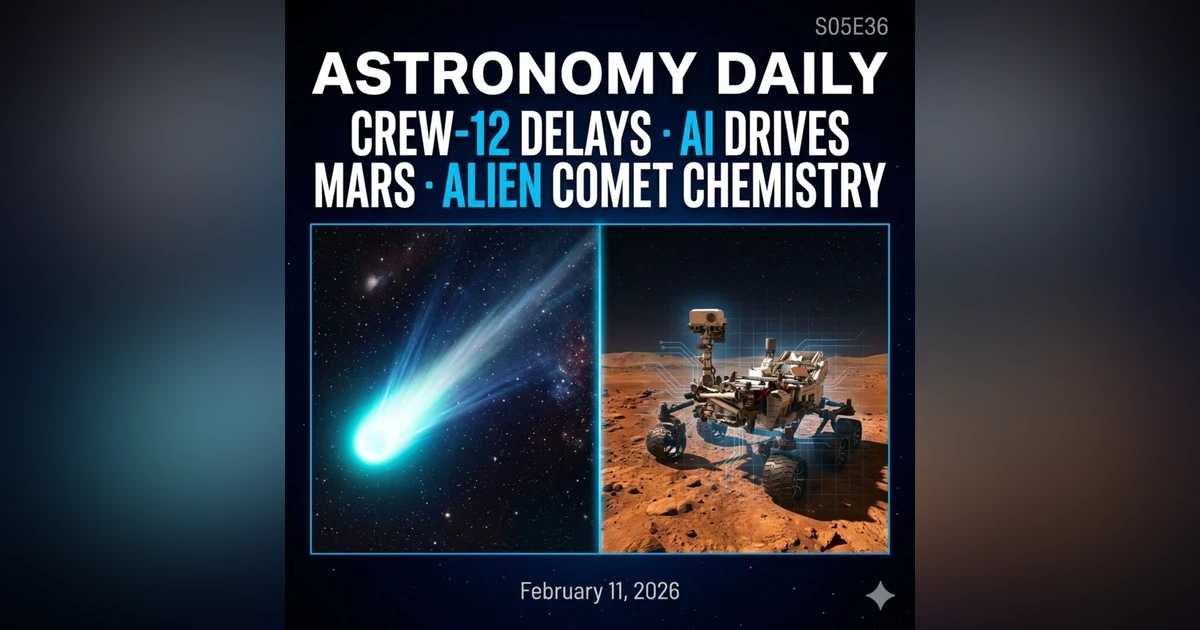
Four astronauts are stuck in quarantine in Florida as weather keeps pushing back the Crew-12 launch — now targeting no earlier than Friday, February 13. We've got the full story, including the remarkable subplot involving a Russian cosmonaut who was quietly removed from the mission in December. Plus: interstellar comet 3I/ATLAS is on its way out of the solar system forever, but new data from NASA's SPHEREx and James Webb telescopes reveals it's been carrying a chemical cocktail from another star system — one that's unlike anything we've seen in our own comets. Also in today's episode: NASA let an AI drive the Perseverance rover on Mars for two days straight; new research suggests Earth may have hit a rare chemical jackpot during formation that made life possible; the Ring of Fire solar eclipse is just one week away; and Starship is back on track after the Booster 18 disaster, with Flight 12 targeting a March launch window. In This Episode • SpaceX Crew-12: Three launch scrubs, skeleton ISS crew, and the cosmonaut spy subplot • 3I/ATLAS farewell: SPHEREx detects alien chemistry; JWST finds record CO2-to-water ratio • AI drives Perseverance on Mars — 456 metres without human control • Earth's lucky chemistry: why phosphorus and nitrogen almost didn't make it to the surface • Ring of Fire annular solar eclipse — February 17 over Antarctica • Starship Flight 12: Booster 19 passes cryo tests, March launch window in sight Key Links • Full show notes & blog: astronomydaily.io • NASA Crew-12 mission blog: nasa.gov • NASA SPHEREx 3I/ATLAS data: science.nasa.gov • Universe Today — AI drives Perseverance: universetoday.com • Nature Astronomy — Earth habitability study: nature.com Subscribe & Connect Subscribe on Apple Podcasts, Spotify, or wherever you listen. New episode every weekday. Full transcripts, blog posts and show notes at astronomydaily.io

Become a supporter of this podcast: https://www.spreaker.com/podcast/astronomy-daily-space-news-updates--5648921/support.

Sponsor Details:
Ensure your online privacy by using NordVPN. To get our special listener deal and save a lot of money, visit www.bitesz.com/nordvpn. You'll be glad you did!

Become a supporter of Astronomy Daily by joining our Supporters Club. Commercial free episodes daily are only a click way... Click Here

This episode includes AI-generated content.

WEBVTT

1
00:00:00.200 --> 00:00:05.639
Four astronauts, one rocket, and weather that just will not cooperate.

2
00:00:06.160 --> 00:00:09.720
The Crew twelve team is in quarantine in Florida, watching

3
00:00:09.759 --> 00:00:11.320
the forecast and waiting.

4
00:00:11.960 --> 00:00:14.800
A visitor from another solar system is heading for the

5
00:00:14.839 --> 00:00:18.440
exit and handing us a chemical blueprint of its home

6
00:00:18.519 --> 00:00:22.199
solar system on the way out. Plus a rover on

7
00:00:22.320 --> 00:00:25.719
Mars just took orders from an AI instead of a

8
00:00:25.800 --> 00:00:27.359
human for the very first time.

9
00:00:28.000 --> 00:00:31.600
All that plus a rare solar eclipse just days away,

10
00:00:32.039 --> 00:00:34.880
new research that could change how we search for life,

11
00:00:35.159 --> 00:00:39.399
and starship making a comeback after a dramatic setback. It's

12
00:00:39.399 --> 00:00:42.240
a big day. Welcome to Astronomy Daily.

13
00:00:42.640 --> 00:00:45.840
Let's get started. Anna take it away.

14
00:00:46.200 --> 00:00:49.960
Hello, and welcome to Astronomy Daily, your daily guide to

15
00:00:50.039 --> 00:00:51.119
what's happening out there.

16
00:00:51.399 --> 00:00:55.679
I'm Anna and I'm Avery. It is Wednesday, February eleventh,

17
00:00:55.840 --> 00:00:59.439
twenty twenty six. We have six stories to get through today,

18
00:00:59.520 --> 00:01:03.079
and it's one of those lineups where every single one

19
00:01:03.079 --> 00:01:04.159
of them earns its place.

20
00:01:04.799 --> 00:01:07.560
We're going to kick off with the ongoing Crew twelve

21
00:01:07.599 --> 00:01:11.120
drama at Cape Canaveral, then swing to deep Space for

22
00:01:11.159 --> 00:01:14.439
the latest from three I Slash Atlas, and then we've

23
00:01:14.480 --> 00:01:17.760
got a mars Ai story that genuinely made me stop

24
00:01:17.799 --> 00:01:21.599
and think, some fascinating new science about why Earth ended

25
00:01:21.680 --> 00:01:25.280
up being habitable at all, a rare solar eclipse just

26
00:01:25.439 --> 00:01:28.239
days away, and a big starship update.

27
00:01:28.879 --> 00:01:31.040
Let's get into it so avery.

28
00:01:31.359 --> 00:01:34.359
As of this morning, the Crew twelve mission has now

29
00:01:34.400 --> 00:01:38.319
been pushed back to no earlier than Friday, February thirteenth.

30
00:01:38.719 --> 00:01:41.439
That is the third attempted launch date in less than

31
00:01:41.480 --> 00:01:41.840
a week.

32
00:01:42.439 --> 00:01:45.599
It really is. Weather has been the culprit each time.

33
00:01:46.040 --> 00:01:49.760
The teams originally had a window on Wednesday, eleventh, today,

34
00:01:50.159 --> 00:01:54.480
but conditions along the Dragon spacecraft flight path just weren't cooperating,

35
00:01:54.560 --> 00:01:58.319
so they waved it off. Then Thursday the twelfth got pushed.

36
00:01:58.920 --> 00:02:02.000
Now they're looking at Friday morning with a planned lift

37
00:02:02.000 --> 00:02:03.760
off at five point fifteen Eastern.

38
00:02:04.439 --> 00:02:07.519
And the reason there's so much urgency here isn't just

39
00:02:07.599 --> 00:02:11.400
that people are impatient. The International Space Station is currently

40
00:02:11.479 --> 00:02:15.000
running on what NASA is calling a skeleton crew. Preue

41
00:02:15.000 --> 00:02:18.360
eleven had to come home early back in January following

42
00:02:18.439 --> 00:02:21.400
a medical issue with one of the astronauts, and since

43
00:02:21.439 --> 00:02:26.080
then the station has been significantly understaffed. Prue twelve is

44
00:02:26.159 --> 00:02:27.719
the relief team.

45
00:02:27.520 --> 00:02:30.680
Which makes every weather delay feel a little more loaded

46
00:02:30.719 --> 00:02:33.439
than usual. The people up there are doing the work

47
00:02:33.439 --> 00:02:36.000
of a full crew with a much smaller team.

48
00:02:36.680 --> 00:02:40.039
So who's making this trip, Well, let's run through them

49
00:02:40.080 --> 00:02:44.439
one more time. Commander is NASA astronaut Jessica Meyer, a

50
00:02:44.520 --> 00:02:48.280
veteran of a previous long duration station mission and well

51
00:02:48.319 --> 00:02:51.800
known for conducting the first all female spacewalk back in

52
00:02:51.879 --> 00:02:56.120
twenty nineteen. Jill be joined by pilot Jack Hathaway, also

53
00:02:56.159 --> 00:02:58.280
from NASA on his first spaceflight.

54
00:02:58.919 --> 00:03:02.479
And then there are two men specialists, Sophie Adnot from

55
00:03:02.520 --> 00:03:07.120
the European Space Agency representing France and Andre Fedjaiyev from

56
00:03:07.199 --> 00:03:10.719
Russia's ros Cosmos. This will be fed Jaiev's second trip

57
00:03:10.759 --> 00:03:13.560
to the station. Once they dock, they're looking at an

58
00:03:13.599 --> 00:03:16.639
eight to nine month stay, longer than usual to cover

59
00:03:16.719 --> 00:03:19.080
the time loss by krue eleven's early departure.

60
00:03:19.680 --> 00:03:22.240
Now, there is a subplot to this mission that I

61
00:03:22.280 --> 00:03:24.520
think a lot of people may not have heard about.

62
00:03:25.000 --> 00:03:29.759
Back in December, Russia's ross Cosmos quietly removed cosmonaut aleg

63
00:03:29.960 --> 00:03:33.479
Artemiev from the Crew twelve mission. The official line was

64
00:03:33.479 --> 00:03:36.719
that he had transitioned to quote other work.

65
00:03:37.080 --> 00:03:39.520
Which is the kind of statement that immediately makes you

66
00:03:39.599 --> 00:03:41.520
want to know what the actual reason is.

67
00:03:42.280 --> 00:03:47.159
Right and investigative outlet The Insider reported that Artemiev was

68
00:03:47.240 --> 00:03:51.240
effectively expelled from the United States by a being accused

69
00:03:51.280 --> 00:03:56.719
of violating international traffic in arms regulations by allegedly photographing

70
00:03:56.879 --> 00:04:01.960
SpaceX engines, documents and other sense technologies with his phone

71
00:04:02.280 --> 00:04:04.039
and then exporting that information.

72
00:04:04.879 --> 00:04:09.360
So he was allegedly taking photos insite SpaceX facilities of

73
00:04:09.439 --> 00:04:13.319
proprietary rocket technology and sending it out of the country.

74
00:04:13.800 --> 00:04:17.000
That appears to be the allegation. He was replaced by

75
00:04:17.040 --> 00:04:21.199
Andre Fadyeev and Ross. Cosmos has said very little publicly,

76
00:04:21.759 --> 00:04:24.920
but it's a striking reminder that even in the cooperative

77
00:04:24.959 --> 00:04:29.120
world of the International Space Station, the geopolitical tensions of

78
00:04:29.120 --> 00:04:32.399
the wider world don't disappear at the door, and it

79
00:04:32.480 --> 00:04:37.040
raises interesting questions about what access international partners are given

80
00:04:37.079 --> 00:04:42.720
to commercial SpaceX facilities. These aren't NASA government sites anyway.

81
00:04:43.000 --> 00:04:45.800
The crew are in quarantine, the rocket is on the pad,

82
00:04:46.240 --> 00:04:48.680
and all eyes are now on the Florida forecast for

83
00:04:48.759 --> 00:04:51.439
Friday will update you the moment there's news.

84
00:04:52.000 --> 00:04:55.319
Our second story takes US to the outer Solar System,

85
00:04:55.399 --> 00:04:59.800
where interstellar comet three I atlass is continuing its fair

86
00:04:59.839 --> 00:05:03.680
way tour. And before it goes, it's been handing scientists

87
00:05:03.759 --> 00:05:06.680
some truly unexpected data just to.

88
00:05:06.639 --> 00:05:09.279
Set the scene. Three I at Lists was discovered in

89
00:05:09.360 --> 00:05:13.439
July twenty twenty five by a telescope in Chile, traveling

90
00:05:13.519 --> 00:05:16.560
far too fast on a trajectory that could impossibly have

91
00:05:16.600 --> 00:05:20.600
originated within our Solar System. It's only the third interstellar

92
00:05:20.639 --> 00:05:24.639
object ever confirmed to have passed through, after Omuamua in

93
00:05:24.680 --> 00:05:27.839
twenty seventeen and Borisov in twenty nineteen.

94
00:05:28.439 --> 00:05:32.839
Dasa's SPEARX telescope observed three I at Lists in December

95
00:05:32.879 --> 00:05:36.839
twenty twenty five, and the results have been remarkable. The

96
00:05:36.920 --> 00:05:41.399
comet's coma has become dramatically more active and chemically complex.

97
00:05:42.040 --> 00:05:48.160
B REX detected water, ice, carbon dioxide, carbon monoxide, organic compounds,

98
00:05:48.399 --> 00:05:52.480
and rocky material being ejected in chunks far larger than

99
00:05:52.480 --> 00:05:56.680
the fine dust grains you'd normally expect. The scientists described

100
00:05:56.680 --> 00:05:59.800
it as a cocktail of chemicals that haven't been exposed

101
00:05:59.800 --> 00:06:01.879
to space for billions of years.

102
00:06:02.360 --> 00:06:05.920
The James Web Space telescope added another layer, finding that

103
00:06:06.000 --> 00:06:09.040
the ratio of carbon dioxide to water in the coma

104
00:06:09.439 --> 00:06:12.240
is approximately eight to one, which is one of the

105
00:06:12.319 --> 00:06:16.319
highest CO two to water ratios ever measured in any comet.

106
00:06:16.879 --> 00:06:20.519
In our solar systems, comets water tends to dominate, so

107
00:06:20.720 --> 00:06:24.040
the implication is three i at lists may have formed

108
00:06:24.160 --> 00:06:27.439
much further from its home star than a typical cometwood

109
00:06:27.920 --> 00:06:31.519
near a CO two ice line. Its chemistry is essentially

110
00:06:31.560 --> 00:06:35.160
telling us something about the architecture of the planetary system

111
00:06:35.279 --> 00:06:35.920
it came from.

112
00:06:36.360 --> 00:06:40.079
There's also data on the comet spin. It rotates once

113
00:06:40.160 --> 00:06:44.279
every sixteen point one six hours, and researchers found it

114
00:06:44.360 --> 00:06:48.920
had strange wobbling jets in a rare sun facing anti tail.

115
00:06:49.480 --> 00:06:52.759
Normally comet tails point away from the Sun, but three

116
00:06:52.800 --> 00:06:56.519
i at lists briefly had one pointing toward it, genuinely

117
00:06:56.600 --> 00:06:57.439
weird behavior.

118
00:06:57.759 --> 00:06:59.959
As of today, three iat list is in the con

119
00:07:00.000 --> 00:07:04.720
installation Gemini, fading beyond naked eye visibility. It's heading towards

120
00:07:04.759 --> 00:07:07.959
a Jupiter flyby in mid March before leaving the Solar

121
00:07:08.000 --> 00:07:11.480
system forever, and there's one more data release to watch for.

122
00:07:11.879 --> 00:07:15.839
Lisa's Juice spacecraft observed three iat lists back in November,

123
00:07:16.199 --> 00:07:19.160
but couldn't transmit the data while using its antenna as

124
00:07:19.160 --> 00:07:22.160
a heat shield. That data is expected to arrive here

125
00:07:22.199 --> 00:07:25.319
on Earth anytime now in February, so there could still

126
00:07:25.360 --> 00:07:26.800
be one more surprise.

127
00:07:26.480 --> 00:07:30.240
Coming when future generations ask what we learned about other

128
00:07:30.360 --> 00:07:33.560
solar systems in twenty twenty five and twenty twenty six,

129
00:07:34.000 --> 00:07:36.439
three I at lists is going to be a big

130
00:07:36.480 --> 00:07:37.279
part of the answer.

131
00:07:37.759 --> 00:07:41.040
Dave travels three IY slash at lists. Don't be a stranger,

132
00:07:41.279 --> 00:07:44.279
although I suppose by definition you always will be.

133
00:07:46.360 --> 00:07:50.560
Now, this next story is one I find genuinely fascinating

134
00:07:50.839 --> 00:07:55.560
because it sits right at the intersection of robotics, artificial intelligence,

135
00:07:55.839 --> 00:08:01.199
and the practical reality of exploring another planet. M NASA

136
00:08:01.240 --> 00:08:04.800
handed the wheel of the Perseverance Mars rover to an AI,

137
00:08:05.439 --> 00:08:11.240
not metaphorically literally, the AI generated the rovers driving waypoints,

138
00:08:11.439 --> 00:08:15.279
and the rover followed them without human control across two

139
00:08:15.399 --> 00:08:18.839
separate days, covering a total of four hundred and fifty

140
00:08:18.959 --> 00:08:19.680
six meters.

141
00:08:20.160 --> 00:08:22.720
And just to be clear, this isn't NASA hopping on

142
00:08:22.759 --> 00:08:26.399
a bandwagon. They have been working on autonomous rover navigation

143
00:08:26.639 --> 00:08:30.360
for years out of sheer necessity. Mars is so far

144
00:08:30.439 --> 00:08:33.559
away that a round trip radio signal takes around twenty

145
00:08:33.600 --> 00:08:37.399
five minutes. That means every driving instruction you send has

146
00:08:37.440 --> 00:08:41.759
a built in delay, and every unexpected obstacle requires another

147
00:08:41.919 --> 00:08:46.360
twenty five minutes to respond to. Autonomous navigation isn't a luxury,

148
00:08:46.519 --> 00:08:48.000
it's a practical requirement.

149
00:08:48.279 --> 00:08:52.720
So in this demonstration, the AI analyzed orbital images from

150
00:08:52.799 --> 00:08:56.840
the Mars Reconnaissance orbiter's high rise camera as well as

151
00:08:56.919 --> 00:09:02.559
digital elevation models. It identified how sand traps, boulder fields,

152
00:09:02.759 --> 00:09:07.720
bedrock rocky outcrops, and then generated a path defined by

153
00:09:07.720 --> 00:09:12.120
a series of waypoints to avoid them. From there, Perseverance's

154
00:09:12.240 --> 00:09:17.200
own onboard auto navigation system took over to actually execute

155
00:09:17.200 --> 00:09:17.879
the drive.

156
00:09:18.000 --> 00:09:22.080
And importantly, before those AI generated waypoints were sent to Mars,

157
00:09:22.279 --> 00:09:26.159
they were tested here on Earth using Perseverance's engineering twin,

158
00:09:26.639 --> 00:09:30.600
a full scale physical replica at JPL's Mars yard, So

159
00:09:30.799 --> 00:09:33.679
this wasn't a blind experiment. There was a safety net

160
00:09:33.720 --> 00:09:34.159
built in.

161
00:09:34.840 --> 00:09:38.679
The AI in question is built on Anthropics Claude, which

162
00:09:38.840 --> 00:09:42.000
regular listeners may know as the same AI that helps

163
00:09:42.039 --> 00:09:45.720
power this show. So there's a certain pleasing symmetry and

164
00:09:45.799 --> 00:09:48.000
reporting on that it really is.

165
00:09:48.200 --> 00:09:51.320
And the engineers are excited about what comes next. One

166
00:09:51.320 --> 00:09:53.840
of the current limitations is that the longer a rover

167
00:09:54.039 --> 00:09:58.879
drives without human relocalization, essentially humans checking in to confirm

168
00:09:58.919 --> 00:10:02.120
where it is on the map, the more positional uncertainty

169
00:10:02.159 --> 00:10:05.639
build up. Over six hundred and fifty five meters, that

170
00:10:05.759 --> 00:10:09.399
uncertainty can grow to around thirty three meters. The goal

171
00:10:09.559 --> 00:10:12.720
is to use AI to solve that relocalization problem too,

172
00:10:13.159 --> 00:10:17.360
so rovers can handle kilometer scaled drives entirely on their own.

173
00:10:17.679 --> 00:10:21.080
And beyond Mars. This matters for the whole future of

174
00:10:21.159 --> 00:10:26.039
deep space exploration. NASA's Dragonfly mission to Saturn's moon Titan

175
00:10:26.320 --> 00:10:30.080
will rely heavily on AI for autonomous navigation as it

176
00:10:30.159 --> 00:10:34.279
flies around in Titan's thick atmosphere. The further from Earth

177
00:10:34.320 --> 00:10:38.759
you go, the more critical autonomous systems become, because waiting

178
00:10:38.799 --> 00:10:41.559
twenty five minutes for a signal is one thing, but

179
00:10:41.679 --> 00:10:44.279
waiting hours or days is quite another.

180
00:10:45.000 --> 00:10:48.440
The vision the JPL team laid out is compelling intelligence

181
00:10:48.480 --> 00:10:51.279
systems not just at mission control here on Earth, but

182
00:10:51.399 --> 00:10:55.679
embedded in the rovers, helicopters, and drones themselves, trained on

183
00:10:55.759 --> 00:10:59.600
the collective knowledge of NASA's engineers and scientists. The Mars

184
00:10:59.679 --> 00:11:03.399
rover of twenty thirty five may look quite different from perseverance.

185
00:11:04.000 --> 00:11:06.679
Our next story is one of those pieces of research

186
00:11:06.759 --> 00:11:10.399
that sounds almost philosophical at first, but turns out to

187
00:11:10.480 --> 00:11:14.879
have very concrete scientific implications. A new study published in

188
00:11:15.000 --> 00:11:18.279
Nature Astronomy has found that life on Earth may be

189
00:11:18.480 --> 00:11:23.000
thanks to an extraordinarily lucky chemical accident during our planet's

190
00:11:23.000 --> 00:11:26.279
formation nearly four point six billion years ago.

191
00:11:27.080 --> 00:11:30.559
And when they say lucky, they mean it. The research

192
00:11:30.639 --> 00:11:34.960
suggests that two elements absolutely essential for life as we

193
00:11:35.039 --> 00:11:39.679
know it, phosphorus and nitrogen, only stayed accessible on Earth's

194
00:11:39.679 --> 00:11:43.799
surface because of a very precise and apparently quite rare

195
00:11:44.279 --> 00:11:47.320
balance of oxygen during the planet's earliest formation.

196
00:11:47.840 --> 00:11:51.120
Here's how it works. When a young rocky planet forms,

197
00:11:51.240 --> 00:11:55.399
it's initially molten, a churning ball of liquid rock. As

198
00:11:55.440 --> 00:11:59.320
heavy metals sink inward to form the core. Lighter materials

199
00:11:59.399 --> 00:12:03.919
stay near the surface during this chaotic stage called core formation.

200
00:12:04.360 --> 00:12:08.279
The amount of oxygen present determines where other elements end up.

201
00:12:08.679 --> 00:12:12.879
The researchers from Etch Zurich found that oxygen levels need

202
00:12:12.960 --> 00:12:16.799
to fall within a surprisingly narrow range for both phosphorus

203
00:12:16.840 --> 00:12:20.639
and nitrogen to remain in the mantle and crust available

204
00:12:20.720 --> 00:12:21.720
for future life.

205
00:12:22.240 --> 00:12:25.679
To little oxygen and phosphorus bonds with iron and gets

206
00:12:25.759 --> 00:12:28.519
dragged into the core, taking away a key ingredient for

207
00:12:28.639 --> 00:12:33.080
DNA sell membranes and energy transfer. Too much oxygen and

208
00:12:33.200 --> 00:12:36.600
nitrogen is more easily lost to space. Either way, the

209
00:12:36.679 --> 00:12:40.639
chemistry needed for life never fully comes together. Earth hit

210
00:12:40.679 --> 00:12:43.600
this sweet spot, what the researchers are calling a chemical

211
00:12:43.639 --> 00:12:45.519
Goldilock zone precisely.

212
00:12:46.200 --> 00:12:49.759
The lead researcher, Craig Walton put it clearly, if Earth

213
00:12:49.759 --> 00:12:52.159
had had just a little more or a little less

214
00:12:52.200 --> 00:12:55.440
oxygen during core formation, there would not have been enough

215
00:12:55.440 --> 00:12:59.240
phosphorus or nitrogen for the development of life. They also

216
00:12:59.360 --> 00:13:03.200
modeled mar and found it likely had the wrong oxygen balance,

217
00:13:03.559 --> 00:13:06.879
more phosphorus in the mantle than Earth but less nitrogen,

218
00:13:07.279 --> 00:13:09.639
challenging conditions for life as we know it.

219
00:13:10.200 --> 00:13:13.480
This is a significant challenge to how we've traditionally thought

220
00:13:13.519 --> 00:13:17.159
about the search for life. The habitable zone, the region

221
00:13:17.200 --> 00:13:20.360
around a star where liquid water can exist on the surface,

222
00:13:20.720 --> 00:13:24.399
has been our go to framework, but this research suggests

223
00:13:24.480 --> 00:13:27.600
that even a planet in the perfect orbital position with

224
00:13:27.759 --> 00:13:32.600
liquid water could be fundamentally incapable of supporting life if

225
00:13:32.600 --> 00:13:35.200
its internal chemistry didn't form correctly.

226
00:13:35.720 --> 00:13:39.960
And here's the hopeful flip side. The oxygen conditions during

227
00:13:40.000 --> 00:13:43.440
planetary formation are linked to the chemistry of the host

228
00:13:43.480 --> 00:13:47.440
star itself, because planets form from the same material as

229
00:13:47.440 --> 00:13:51.519
their stars, So in principle, by looking at stellar chemistry

230
00:13:51.799 --> 00:13:55.240
we might be able to predict which planetary systems had

231
00:13:55.279 --> 00:13:58.399
the right conditions from the start. Walton's advice for the

232
00:13:58.399 --> 00:14:02.279
search look for solars systems with stars that resemble our

233
00:14:02.360 --> 00:14:03.039
own sun.

234
00:14:03.519 --> 00:14:06.399
It makes the Earth feel even more special and the

235
00:14:06.519 --> 00:14:10.720
universe feel a little more vast and empty. All right,

236
00:14:11.000 --> 00:14:15.879
from the philosophical to the spectacular. In exactly one week's time,

237
00:14:16.039 --> 00:14:19.759
on February seventeenth, an annular solar eclipse is going to

238
00:14:19.799 --> 00:14:23.279
sweep across the Southern Hemisphere. This is the so called

239
00:14:23.440 --> 00:14:26.679
ring of fire eclipse, where the Moon passes directly in

240
00:14:26.679 --> 00:14:29.320
front of the Sun, but because it's at a slightly

241
00:14:29.440 --> 00:14:32.799
greater distance from Earth than usual, it appears a little

242
00:14:32.879 --> 00:14:36.120
smaller than the Sun's disk. The result is a thin,

243
00:14:36.320 --> 00:14:40.759
blazing ring of sunlight surrounding the Moon's dark silhouette dunning.

244
00:14:41.519 --> 00:14:44.600
Though this is different from a total solar eclipse where

245
00:14:44.639 --> 00:14:47.279
the Moon completely covers the Sun and you get that

246
00:14:47.440 --> 00:14:50.080
eerie darkness in the middle of the day. In an

247
00:14:50.080 --> 00:14:53.799
annular eclipse, the Moon blocks about ninety six percent of

248
00:14:53.799 --> 00:14:57.480
the Sun's disk, but that remaining sliver stays visible and

249
00:14:57.519 --> 00:15:00.759
the ring effect is only visible for around two minutes

250
00:15:00.799 --> 00:15:03.720
and twenty seconds at any given location. In the past.

251
00:15:04.360 --> 00:15:07.639
The path of annularity for this one is quite remote.

252
00:15:08.000 --> 00:15:12.320
It runs primarily over Antarctica, which means the full ring

253
00:15:12.399 --> 00:15:15.600
of fire experience will be witnessed by the researchers at

254
00:15:15.639 --> 00:15:20.080
places like Concordia Station, the French Italian outpost on the

255
00:15:20.120 --> 00:15:24.240
Dome Sea plateau, and Myrni Station, the Russian base on

256
00:15:24.320 --> 00:15:28.240
the Davis Sea coast. We're talking about teams of maybe

257
00:15:28.440 --> 00:15:32.799
fifty to two hundred people, a very exclusive audience for

258
00:15:32.879 --> 00:15:34.720
one of nature's best shows.

259
00:15:34.879 --> 00:15:37.600
For the rest of US, partial phases will be visible

260
00:15:37.639 --> 00:15:42.399
from the southernmost parts of South America, southern Chile and Argentina,

261
00:15:42.440 --> 00:15:45.279
and from parts of South Africa. Not the full ring,

262
00:15:45.399 --> 00:15:47.879
but still a striking site if you're in the right

263
00:15:47.960 --> 00:15:51.840
location with proper eclipse glasses. And it goes without saying

264
00:15:52.240 --> 00:15:55.480
never look directly at the Sun during an eclipse without

265
00:15:55.559 --> 00:15:59.279
approved eclipse glasses. The ring of fire does not mean

266
00:15:59.320 --> 00:16:01.279
the sun is safe to look at.

267
00:16:01.399 --> 00:16:04.440
There's also something lovely about the timing of this eclipse.

268
00:16:04.879 --> 00:16:08.879
February seventeenth is the start of Chinese New Year, specifically

269
00:16:09.000 --> 00:16:11.960
the Year of the Fire Horse. The new moon that

270
00:16:12.039 --> 00:16:14.919
causes the eclipse is the same new moon that marks

271
00:16:14.960 --> 00:16:17.759
the beginning of the lunar new year, and the crescent

272
00:16:17.840 --> 00:16:21.759
moon visible on February eighteenth will signal the start of Ramadan.

273
00:16:22.279 --> 00:16:25.399
So this one celestial event sits right at the intersection

274
00:16:25.519 --> 00:16:28.399
of multiple major cultural moments around the world.

275
00:16:28.840 --> 00:16:30.960
If you're not in the past and want to watch,

276
00:16:31.159 --> 00:16:34.399
there will almost certainly be live streams from research teams

277
00:16:34.399 --> 00:16:36.799
in Antarctica. We'll keep an eye out and link to

278
00:16:36.840 --> 00:16:39.279
any good ones in the show notes. And we're going

279
00:16:39.320 --> 00:16:42.600
to close out today's main stories with a Starship update,

280
00:16:42.879 --> 00:16:46.639
because after a frustrating lull, things are very much moving

281
00:16:46.679 --> 00:16:50.279
again at SpaceX's star Base facility in South Texas.

282
00:16:50.600 --> 00:16:53.679
Do understand why this is significant, you need a quick

283
00:16:53.759 --> 00:16:58.279
bit of context. The last Starship flight, Flight eleven, was

284
00:16:58.320 --> 00:17:02.360
the final launch of the Block two configuration. BaseX is

285
00:17:02.399 --> 00:17:06.440
now transitioning to Block three, which is a significantly upgraded

286
00:17:06.519 --> 00:17:11.759
architecture featuring new Raptor three engines, enhanced performance, and improved

287
00:17:11.759 --> 00:17:15.680
reusability features. But the development of Block three hit a

288
00:17:15.799 --> 00:17:20.240
serious setback when Booster eighteen, the first Block three booster,

289
00:17:20.759 --> 00:17:25.039
failed during cryogenic pressure testing late last year. Its outer

290
00:17:25.160 --> 00:17:26.160
container cracked.

291
00:17:26.720 --> 00:17:31.920
BaseX moved fast Booster nineteen. The replacement was stacked and

292
00:17:32.000 --> 00:17:34.640
delivered to the test site in record time, and in

293
00:17:34.680 --> 00:17:38.240
the first week of February it successfully completed not one

294
00:17:38.640 --> 00:17:43.559
but two cryogenic pressure tests. The first was on February second,

295
00:17:43.920 --> 00:17:48.799
the second on the fourth. Both passed Darbase watchers described

296
00:17:48.799 --> 00:17:52.319
it as looking like the entire booster had frozen solid

297
00:17:52.640 --> 00:17:56.319
as super chilled liquid oxygen entered it, which is exactly

298
00:17:56.400 --> 00:17:57.359
what it's supposed to do.

299
00:17:57.839 --> 00:18:00.839
Booster nineteen has since been returned to the production site

300
00:18:00.839 --> 00:18:03.559
for further work and all eyes are now on the

301
00:18:03.559 --> 00:18:07.640
flight stack. Booster nineteen paired with Ship thirty nine, which

302
00:18:07.680 --> 00:18:10.240
is being prepared for what will be the debut of

303
00:18:10.319 --> 00:18:13.440
the full Block three vehicle. The current target is a

304
00:18:13.519 --> 00:18:17.400
launch window in the February to March timeframe. THO sources

305
00:18:17.440 --> 00:18:20.200
familiar with the program point to March as the most

306
00:18:20.200 --> 00:18:21.000
realistic date.

307
00:18:21.480 --> 00:18:25.480
Flight twelve is a genuinely significant milestone. It'll be the

308
00:18:25.519 --> 00:18:28.759
first flight of the Block three Starship, the first use

309
00:18:28.799 --> 00:18:32.079
of the new Pad two architecture at Starbase, and the

310
00:18:32.160 --> 00:18:36.640
debut of Raptor three engines at scale. The stakes are high.

311
00:18:36.960 --> 00:18:40.519
NASA needs a successful Block three to progress towards using

312
00:18:40.559 --> 00:18:44.359
Starship as the human landing system for the Artemis program's

313
00:18:44.440 --> 00:18:48.039
crude lunar missions. That timeline is already under pressure.

314
00:18:48.480 --> 00:18:53.079
Meanwhile, infrastructure work continues at a remarkable pace. Pad one

315
00:18:53.119 --> 00:18:57.519
at Starbase is being rebuilt, SpaceX's facility at Kennedy Space

316
00:18:57.559 --> 00:19:01.119
Center at Launch Complex thirty nine A is progressing toward

317
00:19:01.160 --> 00:19:03.880
a first Florida Starship launch in the second half of

318
00:19:03.920 --> 00:19:08.079
twenty twenty six, and environmental approval has been granted for

319
00:19:08.160 --> 00:19:12.039
a brand new Starship complex at Space Launch Complex thirty

320
00:19:12.079 --> 00:19:16.119
seven at Cape Canaveral, which would eventually give the program

321
00:19:16.279 --> 00:19:18.799
five launch pads across Texas and Florida.

322
00:19:19.480 --> 00:19:23.440
Five launch pads for Starship. It's a lot to take in,

323
00:19:23.759 --> 00:19:27.240
but after Booster eighteen's failure and the testing lull, the

324
00:19:27.319 --> 00:19:31.000
fact that Booster nineteen has passed its cryotests and Flight

325
00:19:31.079 --> 00:19:34.160
twelve is back on track. Is genuinely good news for

326
00:19:34.240 --> 00:19:34.799
the program.

327
00:19:35.160 --> 00:19:36.960
We will be watching closely.

328
00:19:37.519 --> 00:19:40.400
That is everything we've got for you today on Astronomy

329
00:19:40.480 --> 00:19:43.799
Daily Fix stories, all of them worth your time. From

330
00:19:43.839 --> 00:19:47.640
astronauts waiting for weather in Florida to a comet carrying

331
00:19:47.759 --> 00:19:51.519
four billion year old secrets from another star, a rover

332
00:19:51.720 --> 00:19:55.160
taking orders from an AI on Mars, new science that

333
00:19:55.240 --> 00:19:58.160
makes life on Earth feel like a cosmic lottery win,

334
00:19:58.599 --> 00:20:02.279
a ring of fire one week away, and starship dusting

335
00:20:02.319 --> 00:20:04.799
itself off for another attempt at history.

336
00:20:05.359 --> 00:20:08.680
A genuinely brilliant day to be following Space news. Thank

337
00:20:08.720 --> 00:20:10.240
you so much for spending part of it with us.

338
00:20:10.720 --> 00:20:14.039
If you enjoyed today's episode, please subscribe wherever you get

339
00:20:14.079 --> 00:20:16.319
your podcasts, and if you want to go deeper on

340
00:20:16.400 --> 00:20:19.319
any of these stories. Full show notes and our blog

341
00:20:19.359 --> 00:20:21.680
are over at Astronomy Daily dot.

342
00:20:21.480 --> 00:20:23.920
Io until tomorrow. Keep looking up.

343
00:20:24.200 --> 00:20:28.880
Take care everyone, Sunny Day Stars

344
00:20:36.359 --> 00:20:37.400
Start all