WEBVTT
1
00:00:00.400 --> 00:00:03.879
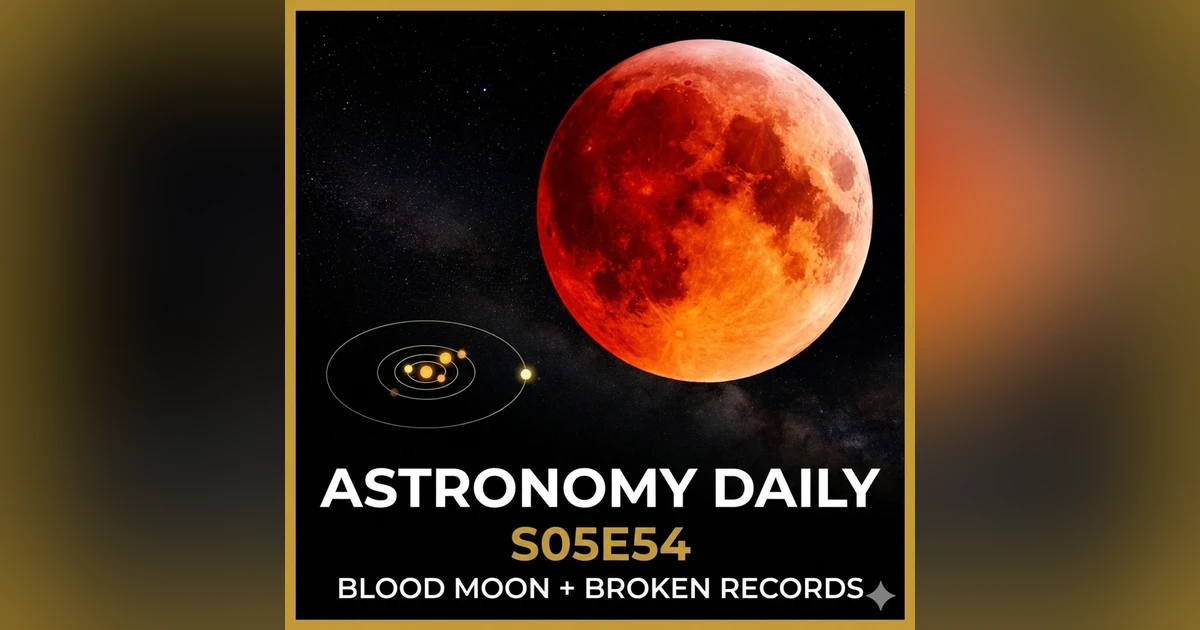
Last night, the moon turned red and bled across the
2
00:00:03.919 --> 00:00:08.039
sky for nearly an hour. A spacecraft is being prepped
3
00:00:08.080 --> 00:00:11.560
for the most daring crude mission in half a century.
4
00:00:12.080 --> 00:00:16.039
And somewhere out there, four stars are dancing together in
5
00:00:16.120 --> 00:00:20.440
a space so tight it would fit inside Mercury's orbit.
6
00:00:20.960 --> 00:00:26.039
And apparently no aliens are coming to visit physiccesso.
7
00:00:25.760 --> 00:00:29.239
Dot even a postcard. This is Astronomy Daily.
8
00:00:29.480 --> 00:00:32.560
I'm Anna and I'm Avery. Let's get into it.
9
00:00:32.880 --> 00:00:37.399
Welcome to Astronomy Daily, the podcast bringing you the universe's
10
00:00:37.560 --> 00:00:41.840
best stories, six days a week. It is Wednesday, March fourth,
11
00:00:41.960 --> 00:00:46.039
twenty twenty six, and we have a genuinely stellar episode
12
00:00:46.039 --> 00:00:48.840
for you today, pun absolutely intended.
13
00:00:49.240 --> 00:00:51.640
We have the aftermath of what many of you stayed
14
00:00:51.719 --> 00:00:55.119
up all night to see, the blood moon, total lunary clips.
15
00:00:55.439 --> 00:00:58.679
We have major Artemis two news, a star system that
16
00:00:58.759 --> 00:01:03.399
honestly shouldn't exist, the solution to one of cosmology's biggest headaches,
17
00:01:03.880 --> 00:01:07.280
the dawn of commercial space astronomy, and the physics based
18
00:01:07.359 --> 00:01:09.560
reality check on alien visitors.
19
00:01:09.920 --> 00:01:12.519
It's a lot. Let's not waste a second.
20
00:01:12.879 --> 00:01:16.680
Okay, First things first, Yesterday morning or the early hours
21
00:01:16.719 --> 00:01:19.920
of yesterday, depending on where you were. The moon turned
22
00:01:20.040 --> 00:01:23.079
blood red, and I need to know, Anna, did you
23
00:01:23.159 --> 00:01:23.560
watch it?
24
00:01:24.000 --> 00:01:28.120
I absolutely did. I dragged a blanket outside and watched
25
00:01:28.120 --> 00:01:31.719
the whole thing from my garden and the moment totality
26
00:01:31.799 --> 00:01:36.640
hit this deep, rusty orange glow, stars suddenly visible that
27
00:01:36.719 --> 00:01:40.120
had been washed out by moonlight. It was genuinely one
28
00:01:40.159 --> 00:01:42.760
of those I love being alive on a planet with
29
00:01:42.799 --> 00:01:44.640
the moon moments right.
30
00:01:45.000 --> 00:01:47.760
For those who missed it, here's what happened. The Moon
31
00:01:47.840 --> 00:01:51.079
passed completely through Earth's shadow. That's what makes it a
32
00:01:51.120 --> 00:01:54.359
total lunar eclipse, and the reason it turns red rather
33
00:01:54.400 --> 00:01:57.359
than just going dark is this beautiful piece of physics.
34
00:01:57.799 --> 00:02:01.120
Every sunrise and every sunset had happening on Earth at
35
00:02:01.120 --> 00:02:04.280
that moment, projects its orange and red light through our
36
00:02:04.280 --> 00:02:07.599
atmosphere and bends it onto the Moon's surface. So what
37
00:02:07.640 --> 00:02:10.360
you're seeing is the light of every dawn and dusk
38
00:02:10.400 --> 00:02:12.240
on the planet, all at once.
39
00:02:12.599 --> 00:02:16.120
Which is one of the most romantic explanations in all
40
00:02:16.159 --> 00:02:16.919
of astronomy.
41
00:02:16.960 --> 00:02:20.960
Honestly, Totality lasted just under an hour fifty nine minutes
42
00:02:21.000 --> 00:02:25.000
to be precise, and it was visible across a US, Canada, Mexico,
43
00:02:25.120 --> 00:02:27.960
and parts of South America in the morning hours and
44
00:02:28.080 --> 00:02:31.919
from Australia, New Zealand and Asia after sunset, so pretty
45
00:02:31.960 --> 00:02:34.479
much anyone who wanted to see it had a shot.
46
00:02:34.800 --> 00:02:37.520
The timing was great for observers in the Mountain and
47
00:02:37.560 --> 00:02:41.120
Pacific time zones. In North America they got totality in
48
00:02:41.280 --> 00:02:45.159
fully dark skies. Eastern time viewers had to contend with
49
00:02:45.240 --> 00:02:48.599
twilight creeping in, but honestly, still spectacular.
50
00:02:49.039 --> 00:02:52.240
And here's the bittersweet part. If you missed this one,
51
00:02:52.319 --> 00:02:54.680
you're going to be waiting a while. This was the
52
00:02:54.759 --> 00:02:58.240
last total lunaric clips visible from North America until New
53
00:02:58.360 --> 00:03:00.000
Year's Eve twenty twenty eight.
54
00:03:00.599 --> 00:03:03.360
So if you watched it, well done. You caught a
55
00:03:03.520 --> 00:03:07.080
rare treat. And if you didn't, mark your calendars now
56
00:03:07.479 --> 00:03:11.280
New Year's Eve twenty twenty eight, great excuse for a party.
57
00:03:11.599 --> 00:03:14.840
We'd love to hear from you. Did you get clear skies?
58
00:03:15.240 --> 00:03:18.319
Drop us a message at Astro Daily Pod.
59
00:03:18.639 --> 00:03:23.039
All right. Next up, huge news for human spaceflight. DASA
60
00:03:23.120 --> 00:03:26.120
has confirmed that repairs to the Artemis two rocket are
61
00:03:26.199 --> 00:03:29.560
complete and in April, launch is still very much on
62
00:03:29.599 --> 00:03:30.080
the table.
63
00:03:30.599 --> 00:03:33.199
This is the one we've all been waiting for. Artemis
64
00:03:33.280 --> 00:03:36.000
two would be the first crude mission to fly around
65
00:03:36.000 --> 00:03:39.680
the Moon in over fifty years. Not a landing, not yet,
66
00:03:39.800 --> 00:03:42.639
but a crude flight that will take four astronauts further
67
00:03:42.719 --> 00:03:45.120
from Earth than any humans have ever been.
68
00:03:45.680 --> 00:03:50.240
The crew is Commander Reid Wiseman, pilot Victor Glover, mission
69
00:03:50.280 --> 00:03:53.879
specialist Christina Koch, who would become the first woman to
70
00:03:53.960 --> 00:03:58.800
travel to the Moon, and Canadian Space Agency astronaut Jeremy Hansen.
71
00:03:59.240 --> 00:04:01.960
The issue that need fixing was a hydrogen leak that
72
00:04:02.080 --> 00:04:05.719
showed up during fueling tests. NASA took it seriously, worked
73
00:04:05.719 --> 00:04:09.159
through it methodically, and they're now satisfied its resolved. The
74
00:04:09.240 --> 00:04:12.159
vehicle is back in the Vehicle Assembly building at Kennedy
75
00:04:12.159 --> 00:04:15.479
Space Center and the teams are working towards an April target.
76
00:04:16.040 --> 00:04:19.720
No exact launch date has been confirmed yet. NASA is
77
00:04:19.759 --> 00:04:22.680
still working through its checklist, but the fact that repairs
78
00:04:22.720 --> 00:04:26.759
are complete and they're still talking April is genuinely encouraging.
79
00:04:27.160 --> 00:04:30.319
To put it in perspective, the last time humans flew
80
00:04:30.360 --> 00:04:34.360
to the Moon was Apollo seventeen in December nineteen seventy two.
81
00:04:34.959 --> 00:04:39.360
That's fifty three years and if Artemis two launches as planned,
82
00:04:39.720 --> 00:04:42.639
we'll be back in lunar space before the spring is out.
83
00:04:42.839 --> 00:04:45.480
We'll keep tracking this one closely as the launch date
84
00:04:45.560 --> 00:04:47.680
firms up. Exciting times.
85
00:04:48.000 --> 00:04:52.000
Okay, I need everyone to picture something. Take our entire
86
00:04:52.040 --> 00:04:55.560
Solar system from the Sun to Mercury. That tiny sliver
87
00:04:55.639 --> 00:05:00.800
of space roughly seventy seven million kilometers now cram three
88
00:05:00.920 --> 00:05:03.519
stars into it. Three stars.
89
00:05:04.199 --> 00:05:09.120
That's I mean, that's insane. Stars are enormous.
90
00:05:09.160 --> 00:05:13.319
They are, And yet astronomers have just confirmed a system
91
00:05:13.439 --> 00:05:17.639
called TIC one two zero three six two one three seven,
92
00:05:18.120 --> 00:05:22.240
where exactly that is happening. Three stars, all bigger and
93
00:05:22.399 --> 00:05:26.199
hotter than our Sun, packed into a volume smaller than
94
00:05:26.279 --> 00:05:30.399
Mercury's orbit around our star. And then, as if that
95
00:05:30.480 --> 00:05:34.000
weren't enough, there's a fourth star orbiting all three of
96
00:05:34.040 --> 00:05:37.279
them at a distance comparable to where Jupiter sits in
97
00:05:37.319 --> 00:05:38.160
our solar system.
98
00:05:38.759 --> 00:05:41.959
So it's a triple star system with a chaperone.
99
00:05:42.319 --> 00:05:45.199
That's genuinely the best way I've heard it described. The
100
00:05:45.279 --> 00:05:48.920
research was published in Nature Communications and led by astronomer
101
00:05:49.000 --> 00:05:52.279
to Maas Borkowitz at the University of Seged in Hungary.
102
00:05:52.879 --> 00:05:56.759
His team used data from NASA's test satellite, originally designed
103
00:05:56.800 --> 00:06:01.879
to hunt four exoplanets alongside ground based telescopes in Hungary, Arizona,
104
00:06:02.079 --> 00:06:06.160
the Czech Republic, and Slovakia. Seventy three spectra from the
105
00:06:06.199 --> 00:06:08.839
Fred Whipple Observatory in Arizona alone.
106
00:06:09.399 --> 00:06:11.519
How do you even spot something like this?
107
00:06:12.120 --> 00:06:15.439
It starts with dips in starlight. The stars eclipse each
108
00:06:15.439 --> 00:06:19.399
other as a orbit, causing tiny periodic drops in brightness.
109
00:06:19.920 --> 00:06:23.199
What initially looked like a simple pair of stars eclipsing
110
00:06:23.240 --> 00:06:26.720
every three point three days turned out on closer inspection
111
00:06:26.920 --> 00:06:29.600
to be hiding a third star. Two and then the
112
00:06:29.720 --> 00:06:33.319
fourth was teased out using a clever algorithm that isolated
113
00:06:33.360 --> 00:06:35.879
each star spectral fingerprints individually.
114
00:06:36.439 --> 00:06:39.839
This system is in the Constellations signess the Swan, and
115
00:06:40.000 --> 00:06:44.279
its technical classification is a three plus one type quadruple
116
00:06:44.720 --> 00:06:47.720
three inner stars in a tight mutual orbit with a
117
00:06:47.800 --> 00:06:51.519
fourth outer companion. The outer stars orbital period is just
118
00:06:51.720 --> 00:06:55.439
one thousand, forty six days, the shortest ever recorded for
119
00:06:55.519 --> 00:06:56.879
this type of system.
120
00:06:56.920 --> 00:06:59.480
And the team was also able to model the system's
121
00:06:59.480 --> 00:07:03.519
eventual fad over billions of years. The heavyweight stars will
122
00:07:03.560 --> 00:07:07.600
exhaust their fuel, swell into giants, and shed their outer layers.
123
00:07:08.040 --> 00:07:10.360
The whole thing will likely end up as a pair
124
00:07:10.399 --> 00:07:14.399
of white dwarfs orbiting each other, a slow, quiet fade
125
00:07:14.399 --> 00:07:16.240
into stellar retirement.
126
00:07:16.319 --> 00:07:21.040
From cosmic chaos to cosmic peace. I find that oddly comforting.
127
00:07:21.560 --> 00:07:26.279
It's a reminder that our own sun, lone solitary planetarily
128
00:07:26.399 --> 00:07:30.680
well behaved, might actually be the weird one. Most stars
129
00:07:30.680 --> 00:07:34.120
in the galaxy have at least one companion, some apparently
130
00:07:34.199 --> 00:07:35.000
have three.
131
00:07:35.439 --> 00:07:38.759
Right. This next one is for the cosmology nerds, but
132
00:07:38.879 --> 00:07:41.439
we're going to make it make sense for everyone because
133
00:07:41.480 --> 00:07:43.160
it is genuinely important.
134
00:07:43.800 --> 00:07:48.160
The Hubble tension. It sounds like a minor bureaucratic disagreement,
135
00:07:48.639 --> 00:07:51.600
but it's actually one of the biggest unsolved problems in
136
00:07:51.639 --> 00:07:52.399
modern physics.
137
00:07:53.000 --> 00:07:56.680
So here's the setup. We know the universe is expanding,
138
00:07:56.879 --> 00:08:00.519
the question is how fast, and when astronomers use two
139
00:08:00.600 --> 00:08:04.439
different methods to measure that expansion rate, called the Hubble constant,
140
00:08:04.720 --> 00:08:08.560
they get two different answers that stubbornly refuse to agree.
141
00:08:08.879 --> 00:08:13.000
One method uses the early universe the cosmic microwave background,
142
00:08:13.199 --> 00:08:16.560
the leftover light from shortly after the Big Bang. Other
143
00:08:16.639 --> 00:08:21.160
methods use nearby cosmic distance markers like cepheed variable stars
144
00:08:21.240 --> 00:08:25.279
and Type ONEA supernovae. Both methods are solid. Both have
145
00:08:25.399 --> 00:08:28.959
been refined for decades, and they still don't match.
146
00:08:29.519 --> 00:08:32.559
The gap between them is only about eight or nine
147
00:08:32.600 --> 00:08:37.120
percent numerically, but that's small. Discrepancy is a massive headache
148
00:08:37.240 --> 00:08:41.360
because it suggests either our measurements are wrong, or more excitingly,
149
00:08:41.679 --> 00:08:44.320
there's new physics we don't understand yet.
150
00:08:44.399 --> 00:08:49.000
And now scientists are proposing a third, completely independent method,
151
00:08:49.320 --> 00:08:53.639
gravitational waves. When two massive objects like black holes or
152
00:08:53.679 --> 00:08:57.639
neutron stars spiral together and merge, they send ripples through
153
00:08:57.679 --> 00:09:01.679
the fabric of space time itself. These gravitational waves carry
154
00:09:01.720 --> 00:09:05.159
precise information about the distance to the event and how
155
00:09:05.200 --> 00:09:07.720
fast the universe is expanding at that point.
156
00:09:07.879 --> 00:09:11.679
The beautiful thing is gravitational wave detectors like LIGO and
157
00:09:11.759 --> 00:09:15.000
virgo don't rely on the same assumptions as the other methods.
158
00:09:15.279 --> 00:09:18.440
So if gravitational wave measurements can pin down the hubble
159
00:09:18.440 --> 00:09:22.399
constant independently, we'll finally have a referee in this argument.
160
00:09:22.759 --> 00:09:26.720
We don't have enough events yet to be definitive. Gravitational
161
00:09:26.759 --> 00:09:30.679
wave astronomy is still young, but as detectors improve and
162
00:09:30.720 --> 00:09:33.919
we observe more mergers, this could be the key that
163
00:09:34.000 --> 00:09:37.559
unlocks one of cosmology's greatest mysteries.
164
00:09:37.399 --> 00:09:40.919
Physics still keeping us humble since always.
165
00:09:40.879 --> 00:09:44.080
A genuine milestone in the history of astronomy. This week,
166
00:09:44.480 --> 00:09:49.279
the MAV telescope, the world's first privately owned commercial space telescope,
167
00:09:49.519 --> 00:09:53.000
has captured its first observation and it's the first star.
168
00:09:53.559 --> 00:09:56.600
This is a big deal. MAV is operated by a
169
00:09:56.639 --> 00:10:00.639
London based startup called Blue Sky's Space, launched back in
170
00:10:00.679 --> 00:10:04.919
November aboard a SpaceX ride share mission. It's a small satellite,
171
00:10:05.000 --> 00:10:08.679
about the size of a suitcase, weighing under nineteen kilograms,
172
00:10:08.919 --> 00:10:11.399
but what it can do is genuinely unique.
173
00:10:11.600 --> 00:10:15.759
BOV is designed to observe stars in ultraviolet light wavelengths
174
00:10:15.799 --> 00:10:19.000
that are completely blocked by earth atmosphere, so you simply
175
00:10:19.080 --> 00:10:22.639
cannot study them from the ground. The last dedicated ultraviolet
176
00:10:22.679 --> 00:10:27.000
space observatory was the International Ultraviolet Explorer, which was retired
177
00:10:27.039 --> 00:10:29.799
back in nineteen ninety six, so there's been a three
178
00:10:29.919 --> 00:10:32.159
decade gap in this kind of science.
179
00:10:32.120 --> 00:10:35.200
And this science it's doing matters enormously for the search
180
00:10:35.240 --> 00:10:38.320
for life. Not every star is as well behaved as
181
00:10:38.360 --> 00:10:42.639
our Sun. Many stars, especially the cooler, more common red dwarfs,
182
00:10:42.919 --> 00:10:46.639
produce intense UV flares that could strip the atmospheres off
183
00:10:46.679 --> 00:10:50.799
nearby planets, making them uninhabitable regardless of their distance from
184
00:10:50.840 --> 00:10:54.360
the star. MOV will survey hundreds of stars to figure
185
00:10:54.360 --> 00:10:57.039
out which ones are genuinely friendly to life.
186
00:10:57.240 --> 00:11:00.960
The commercial model here is also interesting. Data access is
187
00:11:01.000 --> 00:11:04.559
provided through annual subscriptions to research teams, a sort of
188
00:11:04.720 --> 00:11:07.879
Netflix for UV astronomy data. It's a new way of
189
00:11:07.919 --> 00:11:11.159
funding space science, and if it works, Blue Sky Space
190
00:11:11.240 --> 00:11:12.799
plans a whole fleet of these.
191
00:11:13.200 --> 00:11:16.000
The first star observed was one of the brightest stars
192
00:11:16.039 --> 00:11:19.480
in the ursa major constellation. A calibration target to check
193
00:11:19.519 --> 00:11:23.240
the instrument is working correctly, and it is first light achieved.
194
00:11:23.399 --> 00:11:25.080
Science operations underway.
195
00:11:25.440 --> 00:11:29.039
The universe has its first commercial telescope. I for one,
196
00:11:29.360 --> 00:11:32.440
welcome our new private sector stargazers.
197
00:11:32.120 --> 00:11:36.039
And finally our lighter closer, although I'd argue there's nothing
198
00:11:36.120 --> 00:11:37.600
light about the physics involved.
199
00:11:37.960 --> 00:11:40.600
A new piece from the Brighter side of News has
200
00:11:40.639 --> 00:11:42.960
been making the rounds this week, and it takes a
201
00:11:43.000 --> 00:11:46.080
long hard look at why, despite the vastness of the
202
00:11:46.159 --> 00:11:49.519
universe and the billions of potentially habitable worlds out there,
203
00:11:49.960 --> 00:11:53.399
no alien civilization has ever shown up on our doorstep
204
00:11:53.799 --> 00:11:57.399
and The answer, it turns out, isn't conspiracy. It's physics.
205
00:11:57.919 --> 00:12:02.240
Five barriers, that's the argument, Five physical constraints that together
206
00:12:02.440 --> 00:12:06.720
make interstellar contact essentially impossible. Shall we run through them?
207
00:12:07.000 --> 00:12:07.600
Let's do it.
208
00:12:07.960 --> 00:12:12.039
Number one distance The nearest star to us, Proxima Centauri,
209
00:12:12.279 --> 00:12:15.200
is four point two four light years away. The Parker
210
00:12:15.279 --> 00:12:19.039
Solar Probe, the fastest human made object ever built, would
211
00:12:19.080 --> 00:12:22.679
take around sixty six hundred years to reach it, And
212
00:12:22.720 --> 00:12:26.200
that's our closest neighbor. The Milky Way is one hundred
213
00:12:26.320 --> 00:12:27.720
thousand light years across.
214
00:12:28.120 --> 00:12:30.960
Number two, the speed of light. This is not an
215
00:12:31.000 --> 00:12:35.399
engineering problem, it's a law of reality. Einstein's special relativity
216
00:12:35.440 --> 00:12:38.240
tells us that as you accelerate anything with mass toward
217
00:12:38.279 --> 00:12:41.519
the speed of light, it takes ever more energy, forever
218
00:12:41.679 --> 00:12:45.600
smaller gains and speed. To actually reach light speed would
219
00:12:45.639 --> 00:12:48.720
take infinite energy, not a lot of energy, infinite.
220
00:12:48.840 --> 00:12:53.240
Number three propulsion. Even if you accept a much lower target,
221
00:12:53.279 --> 00:12:56.600
say one percent of light speed, you run straight into
222
00:12:56.600 --> 00:13:00.399
what's called the rocket equation. To accelerate, you need fuel,
223
00:13:00.639 --> 00:13:03.879
But fuel has mass, which means you need more fuel
224
00:13:03.919 --> 00:13:07.080
to push the fuel, which adds more mass. It grows
225
00:13:07.200 --> 00:13:11.840
exponentially the fuel required for even a modest interstellar trip
226
00:13:11.919 --> 00:13:13.000
would be staggering.
227
00:13:13.559 --> 00:13:18.039
Number four. Biology, The human body evolved on Earth under
228
00:13:18.080 --> 00:13:23.279
Earth's magnetic field, under Earth's gravity, Deep space is brutal.
229
00:13:23.759 --> 00:13:30.000
Cosmic radiation shreds DNA, microgravity degrades bones and cardiovascular systems,
230
00:13:30.360 --> 00:13:34.799
and we still haven't solved cryogenic preservation. Even robots aren't immune.
231
00:13:35.240 --> 00:13:39.879
Radiation degrades electronics and over the time skills involved entropy wins.
232
00:13:40.360 --> 00:13:44.120
And number five and this is my favorite one. Timing
233
00:13:44.600 --> 00:13:48.399
our civilization has been broadcasting radio signals for about one
234
00:13:48.480 --> 00:13:51.840
hundred years. That creates a bubble roughly one hundred light
235
00:13:51.919 --> 00:13:55.679
years across. The Milky Way is a thousand times wider
236
00:13:55.679 --> 00:13:59.960
than that The universe is thirteen point eight billion years old.
237
00:14:00.360 --> 00:14:05.039
Civilizations might rise, transmit, and fall all before their signals
238
00:14:05.080 --> 00:14:09.120
even reach anyone capable of receiving them. The physicist Richard
239
00:14:09.159 --> 00:14:13.399
Feynman apparently compared it to fireflies blinking on different nights
240
00:14:13.399 --> 00:14:16.039
in a dark forest. They never overlap.
241
00:14:16.559 --> 00:14:20.120
And what about UFOs. The piece applies physics to claims
242
00:14:20.120 --> 00:14:25.559
of craft performing impossible maneuvers, instant acceleration to extreme speeds,