Aug. 26, 2026
Betelgeuse, Up Close: A Star's Boiling Skin, Revealed
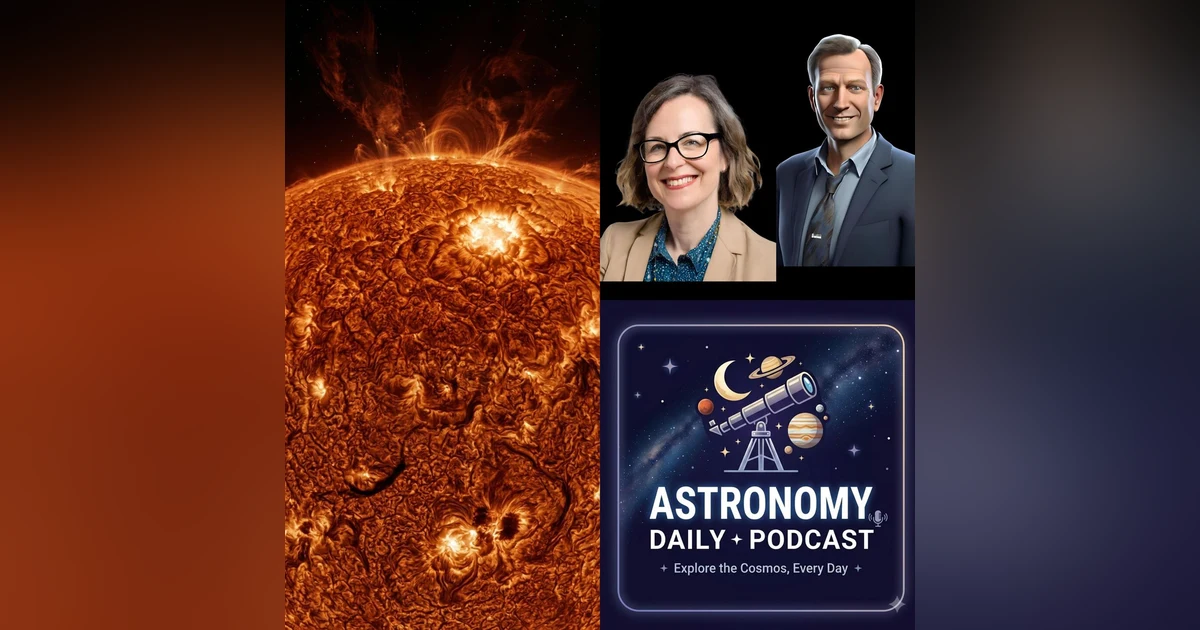
Today's episode — S05E177, Wednesday August 26, 2026: Feature story: Astronomers using the ALMA array in Chile, led by Bill Dent (European Southern Observatory), have released the most detailed picture yet of the actual surface of Betelgeuse, the red...
Today's episode — S05E177, Wednesday August 26, 2026:
Feature story: Astronomers using the ALMA array in Chile, led by Bill Dent (European Southern Observatory), have released the most detailed picture yet of the actual surface of Betelgeuse, the red supergiant marking Orion's shoulder — a corrugated, irregular surface with bright convective hot spots, some nearly 1,000°F hotter than the surrounding plasma. One hot spot in the northeastern region has persisted for more than seven years, far longer than current models predict, and its orientation lines up with the position of Betelgeuse B — a companion star imaged for the first time in July by a separate VLT/SPHERE study — raising the possibility the companion is influencing the giant star's surface. Betelgeuse is one of the closest stars to us expected to eventually go supernova (on a timescale of roughly the next 100,000 years); Dent notes the imagery builds a crucial "before" baseline for whenever that happens.
The rest of the news:
Links & sources:
Follow us: @AstroDailyPod
Become a supporter of this podcast: https://www.spreaker.com/podcast/astronomy-daily-latest-space-news--5648921/support.
Sponsor Details:
Ensure your online privacy by using NordVPN. To get our special listener deal and save a lot of money, visit www.astronomydaily.io/nordvpn. You'll be glad you did!
Get the best secure and private email on the planet. Stop your Government, google and who knows who else spying on every email you write. Do what we did and use ProtonMail. They beleive in privacy and there are no ads in their business model...yet they still provide a free forever service. Check them out and get out special deal at www.astronomydaily.io/protonmail
Become a supporter of Astronomy Daily by joining our Supporters Club. Commercial free episodes daily are only a click way... Click Here
This episode includes AI-generated content.
Feature story: Astronomers using the ALMA array in Chile, led by Bill Dent (European Southern Observatory), have released the most detailed picture yet of the actual surface of Betelgeuse, the red supergiant marking Orion's shoulder — a corrugated, irregular surface with bright convective hot spots, some nearly 1,000°F hotter than the surrounding plasma. One hot spot in the northeastern region has persisted for more than seven years, far longer than current models predict, and its orientation lines up with the position of Betelgeuse B — a companion star imaged for the first time in July by a separate VLT/SPHERE study — raising the possibility the companion is influencing the giant star's surface. Betelgeuse is one of the closest stars to us expected to eventually go supernova (on a timescale of roughly the next 100,000 years); Dent notes the imagery builds a crucial "before" baseline for whenever that happens.
The rest of the news:
- ISS Spacewalk 98: NASA's Anil Menon and ESA's Sophie Adenot finished replacing a Space-to-Ground antenna on the station, six and a half hours outside, restoring communications redundancy that had been running on a backup since November. Adenot's spacewalk record as the first French woman to conduct an EVA is now backed by two completed outings.
- Solar flare/CME: The Sun fired an M6.9 flare from sunspot region 4513, triggering radio blackouts over Africa, Europe and the Arctic; a slow-moving CME is due to graze Earth around Friday, August 28, with an outside chance of minor geomagnetic storming — mostly a Northern Hemisphere aurora story.
- Falcon 9 reuse record: SpaceX's booster B1067 flew for the 37th time — a new single-booster reuse record — on the company's 100th Falcon 9 launch of 2026.
- Tonight's Sky: A 96%-partial lunar eclipse falls the night of August 27-28, spectacular from the Americas but invisible from Australia and the rest of Asia-Pacific (broad daylight here). Venus and Saturn remain good evening/overnight targets locally.
Links & sources:
- Space.com — The bubbling surface of doomed supergiant star Betelgeuse has been revealed like never before
- Space.com — Betelgeuse, Betelgeuse! Astronomers capture clearest image yet of famous star's elusive companion
- Space.com — "You just saved the video dish": Two astronauts complete spacewalk to replace ISS antenna
- NASA — NASA, ESA Spacewalkers Finish Installing High-Speed Antenna
- Space.com — Sun fires powerful M6.9 solar flare and CME toward Earth
- Space.com — SpaceX sets rocket-reuse record on 100th Falcon 9 launch of the year
- Space.com — Partial lunar eclipse Aug. 27-28: stages and visibility
Follow us: @AstroDailyPod
Become a supporter of this podcast: https://www.spreaker.com/podcast/astronomy-daily-latest-space-news--5648921/support.
Sponsor Details:
Ensure your online privacy by using NordVPN. To get our special listener deal and save a lot of money, visit www.astronomydaily.io/nordvpn. You'll be glad you did!
Get the best secure and private email on the planet. Stop your Government, google and who knows who else spying on every email you write. Do what we did and use ProtonMail. They beleive in privacy and there are no ads in their business model...yet they still provide a free forever service. Check them out and get out special deal at www.astronomydaily.io/protonmail
Become a supporter of Astronomy Daily by joining our Supporters Club. Commercial free episodes daily are only a click way... Click Here
This episode includes AI-generated content.
WEBVTT
0
00:00:00.720 --> 00:00:03.400
Anna: Hey, everyone. Welcome to today's edition of
1
00:00:03.400 --> 00:00:05.600
Astronomy AstroDailyPod. I'm Anna.
2
00:00:05.760 --> 00:00:08.280
Avery: And I'm avery. It's Wednesday, August
3
00:00:08.280 --> 00:00:11.280
26th. Series five, episode 177.
4
00:00:11.600 --> 00:00:13.920
Anna: Today, we're pointing the show at one
5
00:00:14.000 --> 00:00:16.760
particular star. And not for a happy
6
00:00:16.760 --> 00:00:19.560
reason, exactly, but a genuinely fascinating
7
00:00:19.560 --> 00:00:22.400
one. Beetlejuice Betelgeuse.
8
00:00:22.560 --> 00:00:24.840
Astronomers have just released the most
9
00:00:24.840 --> 00:00:27.640
detailed picture yet of that star's actual
10
00:00:27.640 --> 00:00:30.360
surface. And bubbling is the word people
11
00:00:30.360 --> 00:00:33.130
keep reaching for. We'll spend some real time
12
00:00:33.130 --> 00:00:35.290
on why that matters and what it's telling us
13
00:00:35.290 --> 00:00:37.490
about how this thing eventually dies.
14
00:00:37.890 --> 00:00:40.170
Avery: Then, um, a spacewalk we left hanging
15
00:00:40.170 --> 00:00:43.090
yesterday has a genuinely satisfying ending.
16
00:00:43.330 --> 00:00:45.810
The sun threw a solid punch at us overnight.
17
00:00:46.130 --> 00:00:48.970
SpaceX quietly broke a reuse record on its
18
00:00:48.970 --> 00:00:51.690
way to its 100th launch of the year. And
19
00:00:51.690 --> 00:00:54.290
there's a near total lunar eclipse just two
20
00:00:54.290 --> 00:00:56.130
nights away that we aren't talking about a
21
00:00:56.130 --> 00:00:57.250
lot, but it is important.
22
00:00:58.070 --> 00:01:00.790
Anna: Also, quick continuity note. Roman
23
00:01:00.790 --> 00:01:03.510
Space Telescope is now mated to its Falcon
24
00:01:03.510 --> 00:01:05.830
Heavy and sitting on pad 39A,
25
00:01:06.230 --> 00:01:08.790
four days out from Sunday's launch. Nothing
26
00:01:08.790 --> 00:01:11.070
new to add today. We'll be all over at this
27
00:01:11.070 --> 00:01:11.510
weekend.
28
00:01:11.750 --> 00:01:12.630
Avery: Let's get started.
29
00:01:13.190 --> 00:01:15.710
First up, set the scene for us. What did
30
00:01:15.710 --> 00:01:17.510
astronomers actually just release?
31
00:01:17.990 --> 00:01:20.830
Anna: The most detailed picture yet of the actual
32
00:01:20.830 --> 00:01:23.590
surface of Betelgeuse, the red supergiant
33
00:01:23.590 --> 00:01:26.100
that marks Orion's shoulder, captured with
34
00:01:26.100 --> 00:01:28.980
the ALMA Array in Chile. That huge network of
35
00:01:28.980 --> 00:01:31.540
radio dishes up on the Atacama Plateau.
36
00:01:31.780 --> 00:01:34.340
A team led by Bill Dent at the European
37
00:01:34.340 --> 00:01:36.780
Southern Observatory put it together, and the
38
00:01:36.780 --> 00:01:39.590
images show something genuinely strange. A,
39
00:01:39.590 --> 00:01:42.580
uh, corrugated, irregular surface with bright
40
00:01:42.580 --> 00:01:45.140
hot spots pushing through, like the star's
41
00:01:45.140 --> 00:01:47.060
outer layers are actively bubbling.
42
00:01:47.540 --> 00:01:50.500
Avery: Bubbling like what, exactly? Boiling water?
43
00:01:50.740 --> 00:01:51.460
Lava.
44
00:01:51.460 --> 00:01:54.070
Anna: Something else closer to boiling, actually.
45
00:01:54.390 --> 00:01:57.350
Convection. Huge cells of plasma rising
46
00:01:57.350 --> 00:02:00.070
and falling. The same basic physics as a pot
47
00:02:00.070 --> 00:02:02.750
on the stove. Just on a scale that's hard to
48
00:02:02.750 --> 00:02:05.750
picture. Betelgeuse itself is enormous,
49
00:02:05.830 --> 00:02:08.429
about 20 times the sun's mass, but
50
00:02:08.429 --> 00:02:10.990
puffed out to roughly 800 times the
51
00:02:10.990 --> 00:02:13.790
sun's diameter. So if you dropped it into our
52
00:02:13.790 --> 00:02:16.270
solar system, it would swallow everything out
53
00:02:16.270 --> 00:02:19.050
past the orbit of Jupiter. It sits around
54
00:02:19.130 --> 00:02:21.850
600 light years away, and its atmosphere
55
00:02:21.850 --> 00:02:23.130
runs somewhere around
56
00:02:23.210 --> 00:02:25.610
3,680 degrees
57
00:02:25.610 --> 00:02:28.370
Fahrenheit, with at least two hotspots the
58
00:02:28.370 --> 00:02:30.850
team measured, running nearly 1,000 degrees
59
00:02:30.850 --> 00:02:33.450
hotter still than the plasma around them.
60
00:02:34.009 --> 00:02:36.130
Avery: Thousand degrees hotter than a star that's
61
00:02:36.130 --> 00:02:38.490
already thousands of degrees. That's a
62
00:02:38.490 --> 00:02:39.530
serious hotspot.
63
00:02:39.610 --> 00:02:42.170
Anna: It is. And here's the detail that actually
64
00:02:42.330 --> 00:02:44.840
surprised the researchers. One particular
65
00:02:45.000 --> 00:02:47.440
hotspot up in the northeastern Part of the
66
00:02:47.440 --> 00:02:50.280
star as we see it has persisted for more than
67
00:02:50.280 --> 00:02:52.800
seven years. Current models of how these
68
00:02:52.800 --> 00:02:55.240
convection cells behave didn't predict
69
00:02:55.240 --> 00:02:57.880
anything holding together that long. They're
70
00:02:57.880 --> 00:03:00.120
supposed to churn and dissolve much faster,
71
00:03:00.520 --> 00:03:03.080
though. Either the models need adjusting or
72
00:03:03.080 --> 00:03:05.240
there's something else going on holding that
73
00:03:05.240 --> 00:03:06.120
structure in place.
74
00:03:06.680 --> 00:03:08.560
Avery: Does that, uh, where the companion star comes
75
00:03:08.560 --> 00:03:11.160
in. You might remember we did a storey back a
76
00:03:11.160 --> 00:03:13.280
few weeks ago about Betelgeuse having a
77
00:03:13.280 --> 00:03:14.120
hidden partner.
78
00:03:14.410 --> 00:03:17.090
Anna: Good pickup. Yes. This ties into a separate
79
00:03:17.090 --> 00:03:19.370
but related result from earlier this year.
80
00:03:19.690 --> 00:03:21.930
Back in July, a team led by Miguel
81
00:03:21.930 --> 00:03:24.490
Montargis at the Observatoire de Paris
82
00:03:24.650 --> 00:03:27.530
used the VLT in Chile, the Very Large
83
00:03:27.530 --> 00:03:29.970
Telescope, with an instrument called sphere
84
00:03:29.970 --> 00:03:31.930
that's built to block out a star's glare.
85
00:03:32.090 --> 00:03:34.570
Originally designed for hunting exoplanets,
86
00:03:34.730 --> 00:03:37.650
to capture the clearest direct image yet of a
87
00:03:37.650 --> 00:03:40.330
faint companion star now generally called
88
00:03:40.330 --> 00:03:43.090
Betelgeuse B. It turned out to be more
89
00:03:43.090 --> 00:03:45.730
massive than expected. Something like two to
90
00:03:45.730 --> 00:03:48.210
three times the sun's mass, rather than the
91
00:03:48.210 --> 00:03:50.810
roughly sun sized object earlier theories
92
00:03:50.810 --> 00:03:53.410
predicted. What Dent's team found in the new
93
00:03:53.410 --> 00:03:55.970
ALMA data is that the orientation of that
94
00:03:55.970 --> 00:03:58.490
stubborn hotspot lines up with where that
95
00:03:58.490 --> 00:04:01.170
companion should be. Which supports the idea
96
00:04:01.170 --> 00:04:03.730
that Betelgeuse B might genuinely be
97
00:04:03.730 --> 00:04:05.850
influencing what's happening on the giant
98
00:04:05.850 --> 00:04:08.330
star's surface, rather than the two objects
99
00:04:08.330 --> 00:04:10.170
just happening to share a neighbourhood.
100
00:04:10.800 --> 00:04:13.640
Avery: So a hotspot on a dying star might actually
101
00:04:13.640 --> 00:04:16.240
be getting stirred by a smaller star orbiting
102
00:04:16.240 --> 00:04:16.300
it?
103
00:04:16.300 --> 00:04:19.040
Anna: Uh, that's the working hypothesis and
104
00:04:19.040 --> 00:04:21.680
it's not confirmed yet. But it's a satisfying
105
00:04:21.760 --> 00:04:24.000
possible answer to something that genuinely
106
00:04:24.000 --> 00:04:24.880
puzzled the team.
107
00:04:25.520 --> 00:04:27.840
Avery: Why does any of this actually matter beyond
108
00:04:28.000 --> 00:04:29.440
cool picture of a star?
109
00:04:29.600 --> 00:04:31.920
Anna: Because Betelgeuse isn't just any red
110
00:04:31.920 --> 00:04:34.600
supergiant. It's one of the closest stars to
111
00:04:34.600 --> 00:04:37.310
us that we expect to go supernova. And when
112
00:04:37.310 --> 00:04:40.110
it does, it'll be an extraordinary once
113
00:04:40.110 --> 00:04:42.950
in a civilization event, visible in
114
00:04:42.950 --> 00:04:45.830
broad daylight for weeks. The honest
115
00:04:45.830 --> 00:04:48.150
scientific answer on timing is
116
00:04:48.390 --> 00:04:51.110
somewhere in the next roughly 100,000
117
00:04:51.110 --> 00:04:54.030
years. Which sounds unsatisfying, but the
118
00:04:54.030 --> 00:04:56.470
point Bill Dent made is the one that actually
119
00:04:56.630 --> 00:04:59.150
matters. Here we don't get to choose when it
120
00:04:59.150 --> 00:05:01.830
happens. So the least we can do is document
121
00:05:01.830 --> 00:05:04.630
exactly what the star looks like right now in
122
00:05:04.630 --> 00:05:07.310
as much detail as possible. So whenever it
123
00:05:07.310 --> 00:05:09.610
does go, we've got a real baseline for
124
00:05:09.610 --> 00:05:12.090
comparison. His own words were that its
125
00:05:12.090 --> 00:05:15.010
eventual fate as a supernova is exactly
126
00:05:15.010 --> 00:05:17.170
what makes it fascinating to know what it
127
00:05:17.170 --> 00:05:18.450
actually looks like today.
128
00:05:19.250 --> 00:05:21.730
Avery: Building the before picture for an event none
129
00:05:21.730 --> 00:05:23.890
of us will necessarily be around to see.
130
00:05:24.370 --> 00:05:27.170
Anna: Maybe, maybe not. Betelgeuse has already
131
00:05:27.170 --> 00:05:29.850
surprised astronomers once this decade with
132
00:05:29.850 --> 00:05:32.490
that dramatic dimming back in 2019 and
133
00:05:32.490 --> 00:05:35.330
2020 that had people genuinely wondering if
134
00:05:35.330 --> 00:05:38.060
it was showing early warning signs. It turned
135
00:05:38.060 --> 00:05:40.340
out to be a dust cloud the star threw off
136
00:05:40.340 --> 00:05:42.700
itself. Not the beginning of the end, but
137
00:05:42.700 --> 00:05:45.140
it's a reminder this star doesn't sit still.
138
00:05:45.540 --> 00:05:47.820
Every time we get a sharper look like this
139
00:05:47.820 --> 00:05:50.220
one, we're a little more ready for whenever
140
00:05:50.220 --> 00:05:51.460
the real thing happens.
141
00:05:51.940 --> 00:05:54.860
Avery: A bubbling surface, a hidden companion star,
142
00:05:54.860 --> 00:05:57.460
and a countdown nobody can actually read.
143
00:05:57.940 --> 00:06:00.540
Anna: That's Beetlejuice for you. Mundane physics
144
00:06:00.540 --> 00:06:03.340
spoiling plasma happening on an object so
145
00:06:03.340 --> 00:06:05.540
extreme it barely fits the description.
146
00:06:06.130 --> 00:06:07.970
Avery: Okay, happier ending on this one.
147
00:06:08.370 --> 00:06:10.890
Yesterday we left you with a spacewalk still
148
00:06:10.890 --> 00:06:13.410
in progress. It's done. And it went well.
149
00:06:13.730 --> 00:06:16.690
Anna: It did. Anil Manon and Sophie Adonout
150
00:06:16.690 --> 00:06:18.850
were outside the station for six and a half
151
00:06:18.850 --> 00:06:21.490
hours yesterday, 8:27am, um to
152
00:06:21.490 --> 00:06:24.450
2:57pm Eastern, finishing the job
153
00:06:24.450 --> 00:06:27.330
they'd started back on the 18th, replacing a
154
00:06:27.330 --> 00:06:29.530
space to ground antenna that had stopped
155
00:06:29.530 --> 00:06:32.410
tracking NASA's data relay satellites all the
156
00:06:32.410 --> 00:06:35.190
way back in November last year. Station's
157
00:06:35.190 --> 00:06:37.310
been running fine on a backup since then, but
158
00:06:37.310 --> 00:06:38.790
redundancy matters up there.
159
00:06:39.350 --> 00:06:41.670
Avery: And, um, this time they actually finished it.
160
00:06:41.670 --> 00:06:43.510
No, running out of time like last time.
161
00:06:43.910 --> 00:06:46.510
Anna: Fully finished. Pulled the spare antenna out
162
00:06:46.510 --> 00:06:49.270
of external storage, mounted it on the Z1
163
00:06:49.270 --> 00:06:52.230
truss, stowed the old faulty one permanently
164
00:06:52.230 --> 00:06:55.110
on the ESP3 platform and got power
165
00:06:55.110 --> 00:06:57.670
and data hooked up and confirmed mission
166
00:06:57.670 --> 00:06:59.950
controls. And McClane gave them the line of
167
00:06:59.950 --> 00:07:02.440
the day once it was done, quoting an old song
168
00:07:02.440 --> 00:07:05.400
at them. You just saved the video dish. You
169
00:07:05.400 --> 00:07:08.160
just saved the video dish, which, if you know
170
00:07:08.160 --> 00:07:10.880
the reference, is a genuinely good spacewalk
171
00:07:10.880 --> 00:07:11.840
call sign moment.
172
00:07:12.480 --> 00:07:14.320
Avery: Numbers wise, where does that leave these
173
00:07:14.320 --> 00:07:14.640
two?
174
00:07:15.040 --> 00:07:18.040
Anna: This was Manon's third career Eva. He's
175
00:07:18.040 --> 00:07:20.720
now up to 19 hours and 20 minutes of total
176
00:07:20.720 --> 00:07:23.720
spacewalk time. And AD announced second at 12
177
00:07:23.720 --> 00:07:26.640
hours, 53 minutes. And it's worth restating,
178
00:07:26.640 --> 00:07:29.200
plainly, because it's a genuine first.
179
00:07:29.580 --> 00:07:32.140
Adenout remains the first French woman ever
180
00:07:32.140 --> 00:07:34.500
to conduct a spacewalk. And that record is
181
00:07:34.500 --> 00:07:37.460
now backed by two completed EVAs, not
182
00:07:37.460 --> 00:07:40.340
one interrupted one stationwide. This was the
183
00:07:40.340 --> 00:07:43.340
283rd spacewalk in support of the ISS,
184
00:07:43.900 --> 00:07:46.820
the 98th flown in US suits, hence
185
00:07:46.820 --> 00:07:49.420
Spacewalk 98 and the 6th of
186
00:07:49.420 --> 00:07:52.140
2026, a, uh, tidy resolution
187
00:07:52.140 --> 00:07:54.220
Avery: to a storey we've been tracking for almost
188
00:07:54.220 --> 00:07:55.180
two weeks now.
189
00:07:55.760 --> 00:07:58.320
Anna: Antenna fixed, record banked on to the next
190
00:07:58.320 --> 00:07:58.640
one.
191
00:07:59.200 --> 00:08:02.080
Avery: Meanwhile, 150 million kilometres
192
00:08:02.080 --> 00:08:04.000
away, the sun's Been busy too.
193
00:08:04.400 --> 00:08:07.360
Anna: It has. Sunspot Region 4513
194
00:08:07.440 --> 00:08:09.480
has been throwing off flares for the better
195
00:08:09.480 --> 00:08:12.280
part of a day now. Five separate M M class
196
00:08:12.280 --> 00:08:14.880
eruptions and the biggest of the batch peaked
197
00:08:14.880 --> 00:08:17.520
Yesterday morning at 6am U.S. eastern.
198
00:08:17.680 --> 00:08:20.600
An M M6.9 just shy of X
199
00:08:20.600 --> 00:08:22.880
class. The strongest category there is.
200
00:08:23.310 --> 00:08:24.750
Avery: Did we feel anything from that one?
201
00:08:25.230 --> 00:08:28.230
Anna: Some people did. That flare triggered R2
202
00:08:28.230 --> 00:08:30.470
level radio blackouts, degrading high
203
00:08:30.470 --> 00:08:33.390
frequency radio communications over parts of
204
00:08:33.390 --> 00:08:36.230
Africa, Europe and the Arctic for a while as
205
00:08:36.230 --> 00:08:38.670
the burst of X rays hit our upper atmosphere.
206
00:08:39.069 --> 00:08:41.190
That part happens at the speed of light, so
207
00:08:41.190 --> 00:08:44.030
it's already over. What's still coming is the
208
00:08:44.030 --> 00:08:44.830
slower moving
209
00:08:44.830 --> 00:08:47.710
Avery: stuff, the coronal mass ejection.
210
00:08:48.350 --> 00:08:51.350
Anna: Right. A uh, CME billowed out alongside that
211
00:08:51.350 --> 00:08:54.110
flare and forecasters have it as a glancing
212
00:08:54.110 --> 00:08:56.810
slow moving hit. Expected to reach Earth
213
00:08:56.810 --> 00:08:59.730
around 6 to 7am Eastern this Friday the
214
00:08:59.730 --> 00:09:02.650
28th, give or take about seven hours either
215
00:09:02.650 --> 00:09:05.330
side. On top of that, there's a
216
00:09:05.330 --> 00:09:07.770
separate high speed solar wind stream
217
00:09:07.770 --> 00:09:10.610
forecast to arrive starting the 27th if
218
00:09:10.610 --> 00:09:12.970
those two overlap. Space weather
219
00:09:12.970 --> 00:09:15.450
forecasters are calling for unsettled to
220
00:09:15.450 --> 00:09:18.250
active geomagnetic conditions with the chance
221
00:09:18.250 --> 00:09:20.250
of reaching minor storm levels.
222
00:09:20.820 --> 00:09:23.340
Avery: Translate that to Will I see an aurora for
223
00:09:23.340 --> 00:09:23.620
people.
224
00:09:24.020 --> 00:09:26.460
Anna: Honestly, mostly a northern hemisphere
225
00:09:26.460 --> 00:09:29.220
storey. At minor storm levels, that tends to
226
00:09:29.220 --> 00:09:31.220
mean higher latitude places like
227
00:09:31.300 --> 00:09:34.260
Scandinavia, Scotland. The northern US
228
00:09:34.260 --> 00:09:36.900
States get a decent shot. Not much farther
229
00:09:36.900 --> 00:09:39.580
south than that for us down here, minor
230
00:09:39.580 --> 00:09:42.500
storms usually don't reach far past Tasmania
231
00:09:42.500 --> 00:09:44.500
on a good night, and we don't have
232
00:09:44.500 --> 00:09:47.130
confirmation this one gets that strong. We
233
00:09:47.130 --> 00:09:49.410
wouldn't set an alarm for it. But if you're
234
00:09:49.410 --> 00:09:51.930
somewhere genuinely far south with a dark sky
235
00:09:51.930 --> 00:09:54.330
this Thursday or Friday night, it costs
236
00:09:54.330 --> 00:09:55.770
nothing to glance at the horizon.
237
00:09:55.930 --> 00:09:58.650
Avery: A flare, a radio blackout and a maybe
238
00:09:58.650 --> 00:10:01.210
aurora all from one cranky sunspot.
239
00:10:01.290 --> 00:10:03.450
Anna: The sun's allowed an active week too.
240
00:10:03.610 --> 00:10:05.530
Avery: Sticking with things that happen so often
241
00:10:05.530 --> 00:10:07.930
they almost stop being news. Except this
242
00:10:07.930 --> 00:10:09.210
one's a genuine record.
243
00:10:09.610 --> 00:10:11.930
Anna: Yesterday's early morning Falcon 9 launch
244
00:10:11.930 --> 00:10:14.490
from Cape Canaveral 5:33am
245
00:10:14.490 --> 00:10:16.970
Eastern 10:29 More Starlink
246
00:10:16.970 --> 00:10:19.730
satellites with SpaceX's 100th
247
00:10:19.730 --> 00:10:22.410
Falcon 9 flight of the year. But the number
248
00:10:22.410 --> 00:10:24.490
that actually caught our eye was on the
249
00:10:24.490 --> 00:10:27.330
booster. B1067
250
00:10:27.490 --> 00:10:30.330
flew for the 37th time, breaking the
251
00:10:30.330 --> 00:10:32.810
previous record for flights on a single first
252
00:10:32.810 --> 00:10:33.250
stage.
253
00:10:33.570 --> 00:10:36.250
Avery: 37 trips to space and back on
254
00:10:36.250 --> 00:10:38.770
Anna: the same piece of hardware, same booster.
255
00:10:38.770 --> 00:10:41.410
37 launches, 37 landings.
256
00:10:41.820 --> 00:10:44.020
This one on the drone ship. A shortfall of
257
00:10:44.020 --> 00:10:46.540
gravitas about 8 1/2 minutes after
258
00:10:46.540 --> 00:10:49.180
liftoff. Business as usual at this point.
259
00:10:49.500 --> 00:10:52.140
It's not alone up there either. Six different
260
00:10:52.220 --> 00:10:54.940
Falcon 9 boosters now have 30 or more
261
00:10:54.940 --> 00:10:56.260
flights each with
262
00:10:56.260 --> 00:10:59.020
B1067 leading the pack.
263
00:10:59.260 --> 00:11:01.660
For context on how routine this has become,
264
00:11:01.980 --> 00:11:03.780
Falcon 9 alone flew
265
00:11:03.780 --> 00:11:06.300
165 successful missions
266
00:11:06.460 --> 00:11:09.260
in all of 2025 more than
267
00:11:09.260 --> 00:11:11.580
every other orbital rocket family on the
268
00:11:11.580 --> 00:11:12.620
planet combined.
269
00:11:12.860 --> 00:11:15.020
Avery: It's funny how 100 launches in a year
270
00:11:15.020 --> 00:11:17.060
milestone almost gets buried under a
271
00:11:17.060 --> 00:11:18.380
booster's personal best.
272
00:11:18.860 --> 00:11:21.700
Anna: That's rocket reusability working exactly as
273
00:11:21.700 --> 00:11:23.980
advertised. It's supposed to stop being
274
00:11:23.980 --> 00:11:24.540
remarkable.
275
00:11:24.860 --> 00:11:27.140
Today's the day the counter clicked over on
276
00:11:27.140 --> 00:11:28.380
both fronts at once.
277
00:11:28.780 --> 00:11:31.340
Avery: Alright, uh, Skywatch and I know we corrected
278
00:11:31.340 --> 00:11:33.340
the record on this one yesterday, so give
279
00:11:33.340 --> 00:11:34.940
people the honest version again,
280
00:11:35.700 --> 00:11:38.500
Anna: Bladly, because it's worth repeating clearly.
281
00:11:38.660 --> 00:11:41.340
The night of August 27th into the
282
00:11:41.340 --> 00:11:44.340
28th brings a, uh, genuinely deep partial
283
00:11:44.340 --> 00:11:47.180
lunar eclipse. 96% of the
284
00:11:47.180 --> 00:11:50.140
moon's disc covered by Earth's shadow. About
285
00:11:50.140 --> 00:11:52.260
as close to total as you can get without
286
00:11:52.260 --> 00:11:55.220
crossing the line. Peak coverage lands around
287
00:11:55.300 --> 00:11:58.060
12:12am um, US Eastern on the
288
00:11:58.060 --> 00:12:00.050
28th, which is 4:12
289
00:12:00.190 --> 00:12:02.970
Avery: UTC and for us that converts
290
00:12:02.970 --> 00:12:03.250
to
291
00:12:03.330 --> 00:12:05.890
Anna: little after 2:00pm on the 28th
292
00:12:05.890 --> 00:12:08.890
Sydney time. Broad daylight moon well
293
00:12:08.890 --> 00:12:11.610
below the horizon. This one belongs to the
294
00:12:11.610 --> 00:12:14.130
Americas. Good views coast to coast,
295
00:12:14.290 --> 00:12:16.770
plus parts of Europe and Africa catching it
296
00:12:16.770 --> 00:12:19.690
low near sunrise. Australia and the
297
00:12:19.690 --> 00:12:22.650
rest of Asia Pacific are simply on the wrong
298
00:12:22.650 --> 00:12:25.650
side of the planet when it happens. Genuinely
299
00:12:25.650 --> 00:12:28.330
sorry again to anyone who was hoping
300
00:12:28.330 --> 00:12:31.310
we'd walked that back. We haven't. It's
301
00:12:31.310 --> 00:12:34.230
just not ours this time. If you've got family
302
00:12:34.230 --> 00:12:37.110
or listeners in the Americas, it's completely
303
00:12:37.110 --> 00:12:39.430
safe to watch with nothing more than your own
304
00:12:39.430 --> 00:12:42.390
eyes. No filters or glasses needed. Like a
305
00:12:42.390 --> 00:12:45.270
solar eclipse, expect the moon to turn a
306
00:12:45.270 --> 00:12:48.270
deep coppery red as it slides through Earth's
307
00:12:48.270 --> 00:12:48.710
shadow.
308
00:12:49.190 --> 00:12:51.190
Avery: And that's the same couple of nights the
309
00:12:51.190 --> 00:12:53.510
possible aurora activity we just talked about
310
00:12:53.510 --> 00:12:54.550
is due to arrive.
311
00:12:55.190 --> 00:12:57.870
Anna: Same window. Yes, Thursday night into
312
00:12:57.870 --> 00:13:00.470
Friday morning is really the stretch to watch
313
00:13:00.630 --> 00:13:02.690
between the eclipse, uh, for one hemisphere
314
00:13:02.690 --> 00:13:05.410
and a, uh, maybe aurora mostly for the other.
315
00:13:05.730 --> 00:13:08.650
Tidy bit of overlap, even if neither's really
316
00:13:08.650 --> 00:13:09.490
for us here.
317
00:13:10.050 --> 00:13:12.010
Avery: So what does that leave for actual southern
318
00:13:12.010 --> 00:13:13.330
hemisphere eyes this week?
319
00:13:13.890 --> 00:13:16.810
Anna: Venus is still the easy win. Bright and
320
00:13:16.810 --> 00:13:19.690
unmistakable in the western sky shortly after
321
00:13:19.690 --> 00:13:22.250
sunset. Hard to miss even from a light
322
00:13:22.250 --> 00:13:25.050
polluted balcony. Saturn's well placed
323
00:13:25.050 --> 00:13:27.930
too, rising in the east as it gets dark and
324
00:13:27.930 --> 00:13:30.250
worth a look through binoculars or a small
325
00:13:30.250 --> 00:13:33.000
scope if you've got one handy. Nothing as
326
00:13:33.000 --> 00:13:35.840
dramatic as a red moon, but a genuinely
327
00:13:35.840 --> 00:13:37.560
nice pair to go find tonight.
328
00:13:37.560 --> 00:13:40.120
Avery: Regardless Venus at dusk,
329
00:13:40.360 --> 00:13:43.120
Saturn overnight, an eclipse for the other
330
00:13:43.120 --> 00:13:45.760
side of the planet, and maybe some aurora for
331
00:13:45.760 --> 00:13:46.440
the far north.
332
00:13:47.000 --> 00:13:49.800
Anna: That's the sky this week. And that's it for
333
00:13:49.800 --> 00:13:52.760
Today's episode. Series 5 Episode
334
00:13:52.760 --> 00:13:55.280
177 Done and
335
00:13:55.280 --> 00:13:55.880
Dusted.
336
00:13:56.440 --> 00:13:58.970
Avery: Quick recap. Astronomers have released the
337
00:13:58.970 --> 00:14:01.570
most detailed picture yet of Betelgeuse's
338
00:14:01.570 --> 00:14:04.250
bubbling surface with a stubborn hotspot that
339
00:14:04.250 --> 00:14:06.610
may be stirred by a newly confirmed companion
340
00:14:06.610 --> 00:14:09.530
star. Astronauts Anil Menon and Sophie
341
00:14:09.530 --> 00:14:11.890
Adeneau successfully finished replacing an
342
00:14:11.890 --> 00:14:14.850
ISS antenna on their second attempt. The
343
00:14:14.850 --> 00:14:17.450
sun fired off an M M 6.9
344
00:14:17.450 --> 00:14:20.370
flare. With a CME due Friday and an
345
00:14:20.370 --> 00:14:22.930
outside chance of Minor Aurora activity,
346
00:14:23.580 --> 00:14:25.820
SpaceX broke a booster reuse record
347
00:14:26.060 --> 00:14:28.820
37 flights on its 100th Falcon 9
348
00:14:28.820 --> 00:14:31.340
launch of the year. And there's a spectacular
349
00:14:31.500 --> 00:14:34.300
near total lunar eclipse two nights from now
350
00:14:34.380 --> 00:14:36.820
that once again isn't for us here in the
351
00:14:36.820 --> 00:14:37.740
Southern Hemisphere.
352
00:14:38.220 --> 00:14:40.580
Anna: If you enjoyed the show, the best thing you
353
00:14:40.580 --> 00:14:42.980
can do is tell a friend, leave us a rating
354
00:14:42.980 --> 00:14:45.580
wherever you listen and follow us. Just
355
00:14:45.580 --> 00:14:47.980
search Astro AstroDailyPod Pod on Facebook,
356
00:14:48.380 --> 00:14:51.230
Instagram, TikTok X, Tumblr and
357
00:14:51.230 --> 00:14:51.790
YouTube.
358
00:14:52.350 --> 00:14:53.710
Avery: And while you're there, head to
359
00:14:53.710 --> 00:14:56.710
astronomydaily IO and sign up for
360
00:14:56.710 --> 00:14:58.950
our free daily newsletter, a summary of the
361
00:14:58.950 --> 00:15:01.190
latest space and astronomy news straight to
362
00:15:01.190 --> 00:15:04.150
your inbox, plus an email alert every time
363
00:15:04.150 --> 00:15:05.310
we post a new episode.
364
00:15:05.630 --> 00:15:07.990
Anna: We'll be back tomorrow with more from across
365
00:15:07.990 --> 00:15:10.790
the universe. Until then, keep looking
366
00:15:10.790 --> 00:15:12.670
up. Clear skies, everyone.
0
00:00:00.720 --> 00:00:03.400
Anna: Hey, everyone. Welcome to today's edition of
1
00:00:03.400 --> 00:00:05.600
Astronomy AstroDailyPod. I'm Anna.
2
00:00:05.760 --> 00:00:08.280
Avery: And I'm avery. It's Wednesday, August
3
00:00:08.280 --> 00:00:11.280
26th. Series five, episode 177.
4
00:00:11.600 --> 00:00:13.920
Anna: Today, we're pointing the show at one
5
00:00:14.000 --> 00:00:16.760
particular star. And not for a happy
6
00:00:16.760 --> 00:00:19.560
reason, exactly, but a genuinely fascinating
7
00:00:19.560 --> 00:00:22.400
one. Beetlejuice Betelgeuse.
8
00:00:22.560 --> 00:00:24.840
Astronomers have just released the most
9
00:00:24.840 --> 00:00:27.640
detailed picture yet of that star's actual
10
00:00:27.640 --> 00:00:30.360
surface. And bubbling is the word people
11
00:00:30.360 --> 00:00:33.130
keep reaching for. We'll spend some real time
12
00:00:33.130 --> 00:00:35.290
on why that matters and what it's telling us
13
00:00:35.290 --> 00:00:37.490
about how this thing eventually dies.
14
00:00:37.890 --> 00:00:40.170
Avery: Then, um, a spacewalk we left hanging
15
00:00:40.170 --> 00:00:43.090
yesterday has a genuinely satisfying ending.
16
00:00:43.330 --> 00:00:45.810
The sun threw a solid punch at us overnight.
17
00:00:46.130 --> 00:00:48.970
SpaceX quietly broke a reuse record on its
18
00:00:48.970 --> 00:00:51.690
way to its 100th launch of the year. And
19
00:00:51.690 --> 00:00:54.290
there's a near total lunar eclipse just two
20
00:00:54.290 --> 00:00:56.130
nights away that we aren't talking about a
21
00:00:56.130 --> 00:00:57.250
lot, but it is important.
22
00:00:58.070 --> 00:01:00.790
Anna: Also, quick continuity note. Roman
23
00:01:00.790 --> 00:01:03.510
Space Telescope is now mated to its Falcon
24
00:01:03.510 --> 00:01:05.830
Heavy and sitting on pad 39A,
25
00:01:06.230 --> 00:01:08.790
four days out from Sunday's launch. Nothing
26
00:01:08.790 --> 00:01:11.070
new to add today. We'll be all over at this
27
00:01:11.070 --> 00:01:11.510
weekend.
28
00:01:11.750 --> 00:01:12.630
Avery: Let's get started.
29
00:01:13.190 --> 00:01:15.710
First up, set the scene for us. What did
30
00:01:15.710 --> 00:01:17.510
astronomers actually just release?
31
00:01:17.990 --> 00:01:20.830
Anna: The most detailed picture yet of the actual
32
00:01:20.830 --> 00:01:23.590
surface of Betelgeuse, the red supergiant
33
00:01:23.590 --> 00:01:26.100
that marks Orion's shoulder, captured with
34
00:01:26.100 --> 00:01:28.980
the ALMA Array in Chile. That huge network of
35
00:01:28.980 --> 00:01:31.540
radio dishes up on the Atacama Plateau.
36
00:01:31.780 --> 00:01:34.340
A team led by Bill Dent at the European
37
00:01:34.340 --> 00:01:36.780
Southern Observatory put it together, and the
38
00:01:36.780 --> 00:01:39.590
images show something genuinely strange. A,
39
00:01:39.590 --> 00:01:42.580
uh, corrugated, irregular surface with bright
40
00:01:42.580 --> 00:01:45.140
hot spots pushing through, like the star's
41
00:01:45.140 --> 00:01:47.060
outer layers are actively bubbling.
42
00:01:47.540 --> 00:01:50.500
Avery: Bubbling like what, exactly? Boiling water?
43
00:01:50.740 --> 00:01:51.460
Lava.
44
00:01:51.460 --> 00:01:54.070
Anna: Something else closer to boiling, actually.
45
00:01:54.390 --> 00:01:57.350
Convection. Huge cells of plasma rising
46
00:01:57.350 --> 00:02:00.070
and falling. The same basic physics as a pot
47
00:02:00.070 --> 00:02:02.750
on the stove. Just on a scale that's hard to
48
00:02:02.750 --> 00:02:05.750
picture. Betelgeuse itself is enormous,
49
00:02:05.830 --> 00:02:08.429
about 20 times the sun's mass, but
50
00:02:08.429 --> 00:02:10.990
puffed out to roughly 800 times the
51
00:02:10.990 --> 00:02:13.790
sun's diameter. So if you dropped it into our
52
00:02:13.790 --> 00:02:16.270
solar system, it would swallow everything out
53
00:02:16.270 --> 00:02:19.050
past the orbit of Jupiter. It sits around
54
00:02:19.130 --> 00:02:21.850
600 light years away, and its atmosphere
55
00:02:21.850 --> 00:02:23.130
runs somewhere around
56
00:02:23.210 --> 00:02:25.610
3,680 degrees
57
00:02:25.610 --> 00:02:28.370
Fahrenheit, with at least two hotspots the
58
00:02:28.370 --> 00:02:30.850
team measured, running nearly 1,000 degrees
59
00:02:30.850 --> 00:02:33.450
hotter still than the plasma around them.
60
00:02:34.009 --> 00:02:36.130
Avery: Thousand degrees hotter than a star that's
61
00:02:36.130 --> 00:02:38.490
already thousands of degrees. That's a
62
00:02:38.490 --> 00:02:39.530
serious hotspot.
63
00:02:39.610 --> 00:02:42.170
Anna: It is. And here's the detail that actually
64
00:02:42.330 --> 00:02:44.840
surprised the researchers. One particular
65
00:02:45.000 --> 00:02:47.440
hotspot up in the northeastern Part of the
66
00:02:47.440 --> 00:02:50.280
star as we see it has persisted for more than
67
00:02:50.280 --> 00:02:52.800
seven years. Current models of how these
68
00:02:52.800 --> 00:02:55.240
convection cells behave didn't predict
69
00:02:55.240 --> 00:02:57.880
anything holding together that long. They're
70
00:02:57.880 --> 00:03:00.120
supposed to churn and dissolve much faster,
71
00:03:00.520 --> 00:03:03.080
though. Either the models need adjusting or
72
00:03:03.080 --> 00:03:05.240
there's something else going on holding that
73
00:03:05.240 --> 00:03:06.120
structure in place.
74
00:03:06.680 --> 00:03:08.560
Avery: Does that, uh, where the companion star comes
75
00:03:08.560 --> 00:03:11.160
in. You might remember we did a storey back a
76
00:03:11.160 --> 00:03:13.280
few weeks ago about Betelgeuse having a
77
00:03:13.280 --> 00:03:14.120
hidden partner.
78
00:03:14.410 --> 00:03:17.090
Anna: Good pickup. Yes. This ties into a separate
79
00:03:17.090 --> 00:03:19.370
but related result from earlier this year.
80
00:03:19.690 --> 00:03:21.930
Back in July, a team led by Miguel
81
00:03:21.930 --> 00:03:24.490
Montargis at the Observatoire de Paris
82
00:03:24.650 --> 00:03:27.530
used the VLT in Chile, the Very Large
83
00:03:27.530 --> 00:03:29.970
Telescope, with an instrument called sphere
84
00:03:29.970 --> 00:03:31.930
that's built to block out a star's glare.
85
00:03:32.090 --> 00:03:34.570
Originally designed for hunting exoplanets,
86
00:03:34.730 --> 00:03:37.650
to capture the clearest direct image yet of a
87
00:03:37.650 --> 00:03:40.330
faint companion star now generally called
88
00:03:40.330 --> 00:03:43.090
Betelgeuse B. It turned out to be more
89
00:03:43.090 --> 00:03:45.730
massive than expected. Something like two to
90
00:03:45.730 --> 00:03:48.210
three times the sun's mass, rather than the
91
00:03:48.210 --> 00:03:50.810
roughly sun sized object earlier theories
92
00:03:50.810 --> 00:03:53.410
predicted. What Dent's team found in the new
93
00:03:53.410 --> 00:03:55.970
ALMA data is that the orientation of that
94
00:03:55.970 --> 00:03:58.490
stubborn hotspot lines up with where that
95
00:03:58.490 --> 00:04:01.170
companion should be. Which supports the idea
96
00:04:01.170 --> 00:04:03.730
that Betelgeuse B might genuinely be
97
00:04:03.730 --> 00:04:05.850
influencing what's happening on the giant
98
00:04:05.850 --> 00:04:08.330
star's surface, rather than the two objects
99
00:04:08.330 --> 00:04:10.170
just happening to share a neighbourhood.
100
00:04:10.800 --> 00:04:13.640
Avery: So a hotspot on a dying star might actually
101
00:04:13.640 --> 00:04:16.240
be getting stirred by a smaller star orbiting
102
00:04:16.240 --> 00:04:16.300
it?
103
00:04:16.300 --> 00:04:19.040
Anna: Uh, that's the working hypothesis and
104
00:04:19.040 --> 00:04:21.680
it's not confirmed yet. But it's a satisfying
105
00:04:21.760 --> 00:04:24.000
possible answer to something that genuinely
106
00:04:24.000 --> 00:04:24.880
puzzled the team.
107
00:04:25.520 --> 00:04:27.840
Avery: Why does any of this actually matter beyond
108
00:04:28.000 --> 00:04:29.440
cool picture of a star?
109
00:04:29.600 --> 00:04:31.920
Anna: Because Betelgeuse isn't just any red
110
00:04:31.920 --> 00:04:34.600
supergiant. It's one of the closest stars to
111
00:04:34.600 --> 00:04:37.310
us that we expect to go supernova. And when
112
00:04:37.310 --> 00:04:40.110
it does, it'll be an extraordinary once
113
00:04:40.110 --> 00:04:42.950
in a civilization event, visible in
114
00:04:42.950 --> 00:04:45.830
broad daylight for weeks. The honest
115
00:04:45.830 --> 00:04:48.150
scientific answer on timing is
116
00:04:48.390 --> 00:04:51.110
somewhere in the next roughly 100,000
117
00:04:51.110 --> 00:04:54.030
years. Which sounds unsatisfying, but the
118
00:04:54.030 --> 00:04:56.470
point Bill Dent made is the one that actually
119
00:04:56.630 --> 00:04:59.150
matters. Here we don't get to choose when it
120
00:04:59.150 --> 00:05:01.830
happens. So the least we can do is document
121
00:05:01.830 --> 00:05:04.630
exactly what the star looks like right now in
122
00:05:04.630 --> 00:05:07.310
as much detail as possible. So whenever it
123
00:05:07.310 --> 00:05:09.610
does go, we've got a real baseline for
124
00:05:09.610 --> 00:05:12.090
comparison. His own words were that its
125
00:05:12.090 --> 00:05:15.010
eventual fate as a supernova is exactly
126
00:05:15.010 --> 00:05:17.170
what makes it fascinating to know what it
127
00:05:17.170 --> 00:05:18.450
actually looks like today.
128
00:05:19.250 --> 00:05:21.730
Avery: Building the before picture for an event none
129
00:05:21.730 --> 00:05:23.890
of us will necessarily be around to see.
130
00:05:24.370 --> 00:05:27.170
Anna: Maybe, maybe not. Betelgeuse has already
131
00:05:27.170 --> 00:05:29.850
surprised astronomers once this decade with
132
00:05:29.850 --> 00:05:32.490
that dramatic dimming back in 2019 and
133
00:05:32.490 --> 00:05:35.330
2020 that had people genuinely wondering if
134
00:05:35.330 --> 00:05:38.060
it was showing early warning signs. It turned
135
00:05:38.060 --> 00:05:40.340
out to be a dust cloud the star threw off
136
00:05:40.340 --> 00:05:42.700
itself. Not the beginning of the end, but
137
00:05:42.700 --> 00:05:45.140
it's a reminder this star doesn't sit still.
138
00:05:45.540 --> 00:05:47.820
Every time we get a sharper look like this
139
00:05:47.820 --> 00:05:50.220
one, we're a little more ready for whenever
140
00:05:50.220 --> 00:05:51.460
the real thing happens.
141
00:05:51.940 --> 00:05:54.860
Avery: A bubbling surface, a hidden companion star,
142
00:05:54.860 --> 00:05:57.460
and a countdown nobody can actually read.
143
00:05:57.940 --> 00:06:00.540
Anna: That's Beetlejuice for you. Mundane physics
144
00:06:00.540 --> 00:06:03.340
spoiling plasma happening on an object so
145
00:06:03.340 --> 00:06:05.540
extreme it barely fits the description.
146
00:06:06.130 --> 00:06:07.970
Avery: Okay, happier ending on this one.
147
00:06:08.370 --> 00:06:10.890
Yesterday we left you with a spacewalk still
148
00:06:10.890 --> 00:06:13.410
in progress. It's done. And it went well.
149
00:06:13.730 --> 00:06:16.690
Anna: It did. Anil Manon and Sophie Adonout
150
00:06:16.690 --> 00:06:18.850
were outside the station for six and a half
151
00:06:18.850 --> 00:06:21.490
hours yesterday, 8:27am, um to
152
00:06:21.490 --> 00:06:24.450
2:57pm Eastern, finishing the job
153
00:06:24.450 --> 00:06:27.330
they'd started back on the 18th, replacing a
154
00:06:27.330 --> 00:06:29.530
space to ground antenna that had stopped
155
00:06:29.530 --> 00:06:32.410
tracking NASA's data relay satellites all the
156
00:06:32.410 --> 00:06:35.190
way back in November last year. Station's
157
00:06:35.190 --> 00:06:37.310
been running fine on a backup since then, but
158
00:06:37.310 --> 00:06:38.790
redundancy matters up there.
159
00:06:39.350 --> 00:06:41.670
Avery: And, um, this time they actually finished it.
160
00:06:41.670 --> 00:06:43.510
No, running out of time like last time.
161
00:06:43.910 --> 00:06:46.510
Anna: Fully finished. Pulled the spare antenna out
162
00:06:46.510 --> 00:06:49.270
of external storage, mounted it on the Z1
163
00:06:49.270 --> 00:06:52.230
truss, stowed the old faulty one permanently
164
00:06:52.230 --> 00:06:55.110
on the ESP3 platform and got power
165
00:06:55.110 --> 00:06:57.670
and data hooked up and confirmed mission
166
00:06:57.670 --> 00:06:59.950
controls. And McClane gave them the line of
167
00:06:59.950 --> 00:07:02.440
the day once it was done, quoting an old song
168
00:07:02.440 --> 00:07:05.400
at them. You just saved the video dish. You
169
00:07:05.400 --> 00:07:08.160
just saved the video dish, which, if you know
170
00:07:08.160 --> 00:07:10.880
the reference, is a genuinely good spacewalk
171
00:07:10.880 --> 00:07:11.840
call sign moment.
172
00:07:12.480 --> 00:07:14.320
Avery: Numbers wise, where does that leave these
173
00:07:14.320 --> 00:07:14.640
two?
174
00:07:15.040 --> 00:07:18.040
Anna: This was Manon's third career Eva. He's
175
00:07:18.040 --> 00:07:20.720
now up to 19 hours and 20 minutes of total
176
00:07:20.720 --> 00:07:23.720
spacewalk time. And AD announced second at 12
177
00:07:23.720 --> 00:07:26.640
hours, 53 minutes. And it's worth restating,
178
00:07:26.640 --> 00:07:29.200
plainly, because it's a genuine first.
179
00:07:29.580 --> 00:07:32.140
Adenout remains the first French woman ever
180
00:07:32.140 --> 00:07:34.500
to conduct a spacewalk. And that record is
181
00:07:34.500 --> 00:07:37.460
now backed by two completed EVAs, not
182
00:07:37.460 --> 00:07:40.340
one interrupted one stationwide. This was the
183
00:07:40.340 --> 00:07:43.340
283rd spacewalk in support of the ISS,
184
00:07:43.900 --> 00:07:46.820
the 98th flown in US suits, hence
185
00:07:46.820 --> 00:07:49.420
Spacewalk 98 and the 6th of
186
00:07:49.420 --> 00:07:52.140
2026, a, uh, tidy resolution
187
00:07:52.140 --> 00:07:54.220
Avery: to a storey we've been tracking for almost
188
00:07:54.220 --> 00:07:55.180
two weeks now.
189
00:07:55.760 --> 00:07:58.320
Anna: Antenna fixed, record banked on to the next
190
00:07:58.320 --> 00:07:58.640
one.
191
00:07:59.200 --> 00:08:02.080
Avery: Meanwhile, 150 million kilometres
192
00:08:02.080 --> 00:08:04.000
away, the sun's Been busy too.
193
00:08:04.400 --> 00:08:07.360
Anna: It has. Sunspot Region 4513
194
00:08:07.440 --> 00:08:09.480
has been throwing off flares for the better
195
00:08:09.480 --> 00:08:12.280
part of a day now. Five separate M M class
196
00:08:12.280 --> 00:08:14.880
eruptions and the biggest of the batch peaked
197
00:08:14.880 --> 00:08:17.520
Yesterday morning at 6am U.S. eastern.
198
00:08:17.680 --> 00:08:20.600
An M M6.9 just shy of X
199
00:08:20.600 --> 00:08:22.880
class. The strongest category there is.
200
00:08:23.310 --> 00:08:24.750
Avery: Did we feel anything from that one?
201
00:08:25.230 --> 00:08:28.230
Anna: Some people did. That flare triggered R2
202
00:08:28.230 --> 00:08:30.470
level radio blackouts, degrading high
203
00:08:30.470 --> 00:08:33.390
frequency radio communications over parts of
204
00:08:33.390 --> 00:08:36.230
Africa, Europe and the Arctic for a while as
205
00:08:36.230 --> 00:08:38.670
the burst of X rays hit our upper atmosphere.
206
00:08:39.069 --> 00:08:41.190
That part happens at the speed of light, so
207
00:08:41.190 --> 00:08:44.030
it's already over. What's still coming is the
208
00:08:44.030 --> 00:08:44.830
slower moving
209
00:08:44.830 --> 00:08:47.710
Avery: stuff, the coronal mass ejection.
210
00:08:48.350 --> 00:08:51.350
Anna: Right. A uh, CME billowed out alongside that
211
00:08:51.350 --> 00:08:54.110
flare and forecasters have it as a glancing
212
00:08:54.110 --> 00:08:56.810
slow moving hit. Expected to reach Earth
213
00:08:56.810 --> 00:08:59.730
around 6 to 7am Eastern this Friday the
214
00:08:59.730 --> 00:09:02.650
28th, give or take about seven hours either
215
00:09:02.650 --> 00:09:05.330
side. On top of that, there's a
216
00:09:05.330 --> 00:09:07.770
separate high speed solar wind stream
217
00:09:07.770 --> 00:09:10.610
forecast to arrive starting the 27th if
218
00:09:10.610 --> 00:09:12.970
those two overlap. Space weather
219
00:09:12.970 --> 00:09:15.450
forecasters are calling for unsettled to
220
00:09:15.450 --> 00:09:18.250
active geomagnetic conditions with the chance
221
00:09:18.250 --> 00:09:20.250
of reaching minor storm levels.
222
00:09:20.820 --> 00:09:23.340
Avery: Translate that to Will I see an aurora for
223
00:09:23.340 --> 00:09:23.620
people.
224
00:09:24.020 --> 00:09:26.460
Anna: Honestly, mostly a northern hemisphere
225
00:09:26.460 --> 00:09:29.220
storey. At minor storm levels, that tends to
226
00:09:29.220 --> 00:09:31.220
mean higher latitude places like
227
00:09:31.300 --> 00:09:34.260
Scandinavia, Scotland. The northern US
228
00:09:34.260 --> 00:09:36.900
States get a decent shot. Not much farther
229
00:09:36.900 --> 00:09:39.580
south than that for us down here, minor
230
00:09:39.580 --> 00:09:42.500
storms usually don't reach far past Tasmania
231
00:09:42.500 --> 00:09:44.500
on a good night, and we don't have
232
00:09:44.500 --> 00:09:47.130
confirmation this one gets that strong. We
233
00:09:47.130 --> 00:09:49.410
wouldn't set an alarm for it. But if you're
234
00:09:49.410 --> 00:09:51.930
somewhere genuinely far south with a dark sky
235
00:09:51.930 --> 00:09:54.330
this Thursday or Friday night, it costs
236
00:09:54.330 --> 00:09:55.770
nothing to glance at the horizon.
237
00:09:55.930 --> 00:09:58.650
Avery: A flare, a radio blackout and a maybe
238
00:09:58.650 --> 00:10:01.210
aurora all from one cranky sunspot.
239
00:10:01.290 --> 00:10:03.450
Anna: The sun's allowed an active week too.
240
00:10:03.610 --> 00:10:05.530
Avery: Sticking with things that happen so often
241
00:10:05.530 --> 00:10:07.930
they almost stop being news. Except this
242
00:10:07.930 --> 00:10:09.210
one's a genuine record.
243
00:10:09.610 --> 00:10:11.930
Anna: Yesterday's early morning Falcon 9 launch
244
00:10:11.930 --> 00:10:14.490
from Cape Canaveral 5:33am
245
00:10:14.490 --> 00:10:16.970
Eastern 10:29 More Starlink
246
00:10:16.970 --> 00:10:19.730
satellites with SpaceX's 100th
247
00:10:19.730 --> 00:10:22.410
Falcon 9 flight of the year. But the number
248
00:10:22.410 --> 00:10:24.490
that actually caught our eye was on the
249
00:10:24.490 --> 00:10:27.330
booster. B1067
250
00:10:27.490 --> 00:10:30.330
flew for the 37th time, breaking the
251
00:10:30.330 --> 00:10:32.810
previous record for flights on a single first
252
00:10:32.810 --> 00:10:33.250
stage.
253
00:10:33.570 --> 00:10:36.250
Avery: 37 trips to space and back on
254
00:10:36.250 --> 00:10:38.770
Anna: the same piece of hardware, same booster.
255
00:10:38.770 --> 00:10:41.410
37 launches, 37 landings.
256
00:10:41.820 --> 00:10:44.020
This one on the drone ship. A shortfall of
257
00:10:44.020 --> 00:10:46.540
gravitas about 8 1/2 minutes after
258
00:10:46.540 --> 00:10:49.180
liftoff. Business as usual at this point.
259
00:10:49.500 --> 00:10:52.140
It's not alone up there either. Six different
260
00:10:52.220 --> 00:10:54.940
Falcon 9 boosters now have 30 or more
261
00:10:54.940 --> 00:10:56.260
flights each with
262
00:10:56.260 --> 00:10:59.020
B1067 leading the pack.
263
00:10:59.260 --> 00:11:01.660
For context on how routine this has become,
264
00:11:01.980 --> 00:11:03.780
Falcon 9 alone flew
265
00:11:03.780 --> 00:11:06.300
165 successful missions
266
00:11:06.460 --> 00:11:09.260
in all of 2025 more than
267
00:11:09.260 --> 00:11:11.580
every other orbital rocket family on the
268
00:11:11.580 --> 00:11:12.620
planet combined.
269
00:11:12.860 --> 00:11:15.020
Avery: It's funny how 100 launches in a year
270
00:11:15.020 --> 00:11:17.060
milestone almost gets buried under a
271
00:11:17.060 --> 00:11:18.380
booster's personal best.
272
00:11:18.860 --> 00:11:21.700
Anna: That's rocket reusability working exactly as
273
00:11:21.700 --> 00:11:23.980
advertised. It's supposed to stop being
274
00:11:23.980 --> 00:11:24.540
remarkable.
275
00:11:24.860 --> 00:11:27.140
Today's the day the counter clicked over on
276
00:11:27.140 --> 00:11:28.380
both fronts at once.
277
00:11:28.780 --> 00:11:31.340
Avery: Alright, uh, Skywatch and I know we corrected
278
00:11:31.340 --> 00:11:33.340
the record on this one yesterday, so give
279
00:11:33.340 --> 00:11:34.940
people the honest version again,
280
00:11:35.700 --> 00:11:38.500
Anna: Bladly, because it's worth repeating clearly.
281
00:11:38.660 --> 00:11:41.340
The night of August 27th into the
282
00:11:41.340 --> 00:11:44.340
28th brings a, uh, genuinely deep partial
283
00:11:44.340 --> 00:11:47.180
lunar eclipse. 96% of the
284
00:11:47.180 --> 00:11:50.140
moon's disc covered by Earth's shadow. About
285
00:11:50.140 --> 00:11:52.260
as close to total as you can get without
286
00:11:52.260 --> 00:11:55.220
crossing the line. Peak coverage lands around
287
00:11:55.300 --> 00:11:58.060
12:12am um, US Eastern on the
288
00:11:58.060 --> 00:12:00.050
28th, which is 4:12
289
00:12:00.190 --> 00:12:02.970
Avery: UTC and for us that converts
290
00:12:02.970 --> 00:12:03.250
to
291
00:12:03.330 --> 00:12:05.890
Anna: little after 2:00pm on the 28th
292
00:12:05.890 --> 00:12:08.890
Sydney time. Broad daylight moon well
293
00:12:08.890 --> 00:12:11.610
below the horizon. This one belongs to the
294
00:12:11.610 --> 00:12:14.130
Americas. Good views coast to coast,
295
00:12:14.290 --> 00:12:16.770
plus parts of Europe and Africa catching it
296
00:12:16.770 --> 00:12:19.690
low near sunrise. Australia and the
297
00:12:19.690 --> 00:12:22.650
rest of Asia Pacific are simply on the wrong
298
00:12:22.650 --> 00:12:25.650
side of the planet when it happens. Genuinely
299
00:12:25.650 --> 00:12:28.330
sorry again to anyone who was hoping
300
00:12:28.330 --> 00:12:31.310
we'd walked that back. We haven't. It's
301
00:12:31.310 --> 00:12:34.230
just not ours this time. If you've got family
302
00:12:34.230 --> 00:12:37.110
or listeners in the Americas, it's completely
303
00:12:37.110 --> 00:12:39.430
safe to watch with nothing more than your own
304
00:12:39.430 --> 00:12:42.390
eyes. No filters or glasses needed. Like a
305
00:12:42.390 --> 00:12:45.270
solar eclipse, expect the moon to turn a
306
00:12:45.270 --> 00:12:48.270
deep coppery red as it slides through Earth's
307
00:12:48.270 --> 00:12:48.710
shadow.
308
00:12:49.190 --> 00:12:51.190
Avery: And that's the same couple of nights the
309
00:12:51.190 --> 00:12:53.510
possible aurora activity we just talked about
310
00:12:53.510 --> 00:12:54.550
is due to arrive.
311
00:12:55.190 --> 00:12:57.870
Anna: Same window. Yes, Thursday night into
312
00:12:57.870 --> 00:13:00.470
Friday morning is really the stretch to watch
313
00:13:00.630 --> 00:13:02.690
between the eclipse, uh, for one hemisphere
314
00:13:02.690 --> 00:13:05.410
and a, uh, maybe aurora mostly for the other.
315
00:13:05.730 --> 00:13:08.650
Tidy bit of overlap, even if neither's really
316
00:13:08.650 --> 00:13:09.490
for us here.
317
00:13:10.050 --> 00:13:12.010
Avery: So what does that leave for actual southern
318
00:13:12.010 --> 00:13:13.330
hemisphere eyes this week?
319
00:13:13.890 --> 00:13:16.810
Anna: Venus is still the easy win. Bright and
320
00:13:16.810 --> 00:13:19.690
unmistakable in the western sky shortly after
321
00:13:19.690 --> 00:13:22.250
sunset. Hard to miss even from a light
322
00:13:22.250 --> 00:13:25.050
polluted balcony. Saturn's well placed
323
00:13:25.050 --> 00:13:27.930
too, rising in the east as it gets dark and
324
00:13:27.930 --> 00:13:30.250
worth a look through binoculars or a small
325
00:13:30.250 --> 00:13:33.000
scope if you've got one handy. Nothing as
326
00:13:33.000 --> 00:13:35.840
dramatic as a red moon, but a genuinely
327
00:13:35.840 --> 00:13:37.560
nice pair to go find tonight.
328
00:13:37.560 --> 00:13:40.120
Avery: Regardless Venus at dusk,
329
00:13:40.360 --> 00:13:43.120
Saturn overnight, an eclipse for the other
330
00:13:43.120 --> 00:13:45.760
side of the planet, and maybe some aurora for
331
00:13:45.760 --> 00:13:46.440
the far north.
332
00:13:47.000 --> 00:13:49.800
Anna: That's the sky this week. And that's it for
333
00:13:49.800 --> 00:13:52.760
Today's episode. Series 5 Episode
334
00:13:52.760 --> 00:13:55.280
177 Done and
335
00:13:55.280 --> 00:13:55.880
Dusted.
336
00:13:56.440 --> 00:13:58.970
Avery: Quick recap. Astronomers have released the
337
00:13:58.970 --> 00:14:01.570
most detailed picture yet of Betelgeuse's
338
00:14:01.570 --> 00:14:04.250
bubbling surface with a stubborn hotspot that
339
00:14:04.250 --> 00:14:06.610
may be stirred by a newly confirmed companion
340
00:14:06.610 --> 00:14:09.530
star. Astronauts Anil Menon and Sophie
341
00:14:09.530 --> 00:14:11.890
Adeneau successfully finished replacing an
342
00:14:11.890 --> 00:14:14.850
ISS antenna on their second attempt. The
343
00:14:14.850 --> 00:14:17.450
sun fired off an M M 6.9
344
00:14:17.450 --> 00:14:20.370
flare. With a CME due Friday and an
345
00:14:20.370 --> 00:14:22.930
outside chance of Minor Aurora activity,
346
00:14:23.580 --> 00:14:25.820
SpaceX broke a booster reuse record
347
00:14:26.060 --> 00:14:28.820
37 flights on its 100th Falcon 9
348
00:14:28.820 --> 00:14:31.340
launch of the year. And there's a spectacular
349
00:14:31.500 --> 00:14:34.300
near total lunar eclipse two nights from now
350
00:14:34.380 --> 00:14:36.820
that once again isn't for us here in the
351
00:14:36.820 --> 00:14:37.740
Southern Hemisphere.
352
00:14:38.220 --> 00:14:40.580
Anna: If you enjoyed the show, the best thing you
353
00:14:40.580 --> 00:14:42.980
can do is tell a friend, leave us a rating
354
00:14:42.980 --> 00:14:45.580
wherever you listen and follow us. Just
355
00:14:45.580 --> 00:14:47.980
search Astro AstroDailyPod Pod on Facebook,
356
00:14:48.380 --> 00:14:51.230
Instagram, TikTok X, Tumblr and
357
00:14:51.230 --> 00:14:51.790
YouTube.
358
00:14:52.350 --> 00:14:53.710
Avery: And while you're there, head to
359
00:14:53.710 --> 00:14:56.710
astronomydaily IO and sign up for
360
00:14:56.710 --> 00:14:58.950
our free daily newsletter, a summary of the
361
00:14:58.950 --> 00:15:01.190
latest space and astronomy news straight to
362
00:15:01.190 --> 00:15:04.150
your inbox, plus an email alert every time
363
00:15:04.150 --> 00:15:05.310
we post a new episode.
364
00:15:05.630 --> 00:15:07.990
Anna: We'll be back tomorrow with more from across
365
00:15:07.990 --> 00:15:10.790
the universe. Until then, keep looking
366
00:15:10.790 --> 00:15:12.670
up. Clear skies, everyone.


