March 30, 2026
Artemis II: Three Days to Go — Plus Mars Sample Return Is Officially Dead
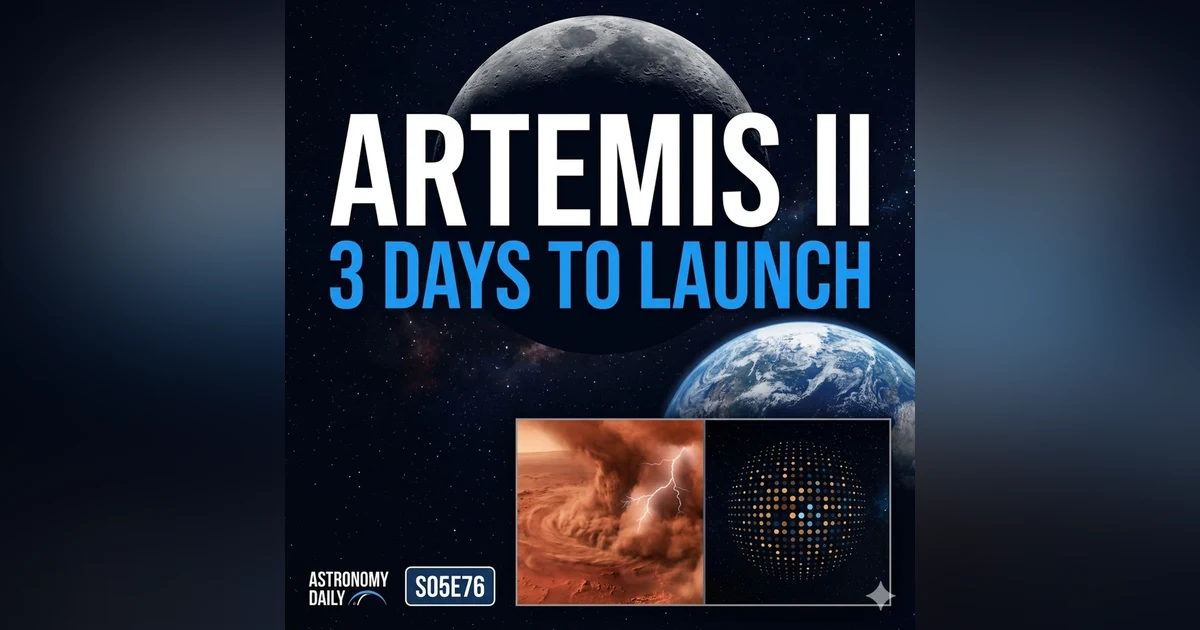
Episode Summary With Artemis II just three days from launch, today's episode delivers a landmark space moment alongside the sad news that Mars Sample Return's Earth Return Orbiter has been formally cancelled by ESA. We also cover SpaceX's enormous Transporter-16 rideshare launch, Cornell's definitive list of 45 best-bet habitable exoplanets, a paradigm-shifting discovery about pulsar radio emissions, and the first confirmed evidence of lightning-like activity on Mars. Stories Covered • Artemis II — NASA confirms zero technical issues, launch on track for April 1 at 6:24 p.m. EDT • ESA Earth Return Orbiter — formally cancelled after ESA member states vote to end the programme; Airbus in transition talks • SpaceX Transporter-16 — 119 payloads launched to Sun-synchronous orbit from Vandenberg this morning • 45 Habitable Exoplanets — Cornell/Carl Sagan Institute catalog published in MNRAS; TRAPPIST-1, Proxima Centauri b among top targets • Millisecond Pulsar Radio Emissions — signals confirmed originating beyond the light cylinder for the first time • Martian Lightning — MAVEN data reveals whistler wave consistent with electrical discharge during a 2015 dust storm Source URLs • Artemis II launch updates: https://www.space.com/news/live/artemis-2-nasa-moon-mission-launch-updates-march-29-2026 • ESA Earth Return Orbiter cancellation: https://europeanspaceflight.com/esa-member-states-call-for-cancellation-of-earth-return-orbiter/ • SpaceX Transporter-16: https://www.nasaspaceflight.com/2026/03/transporter-16/ • 45 Habitable Exoplanets (ScienceDaily): https://www.sciencedaily.com/releases/2026/03/260325005926.htm • Millisecond Pulsar discovery (Phys.org): https://phys.org/news/2026-03-radio-edge-extreme-stars-surfaces.html • Mars Lightning / MAVEN (Phys.org): https://phys.org/news/2026-03-nasa-maven-evidence-lightning-mars.html
Become a supporter of this podcast: https://www.spreaker.com/podcast/astronomy-daily-space-news-updates--5648921/support.
Sponsor Details:
Ensure your online privacy by using NordVPN. To get our special listener deal and save a lot of money, visit www.bitesz.com/nordvpn. You'll be glad you did!
Become a supporter of Astronomy Daily by joining our Supporters Club. Commercial free episodes daily are only a click way... Click Here
This episode includes AI-generated content.
Become a supporter of this podcast: https://www.spreaker.com/podcast/astronomy-daily-space-news-updates--5648921/support.
Sponsor Details:
Ensure your online privacy by using NordVPN. To get our special listener deal and save a lot of money, visit www.bitesz.com/nordvpn. You'll be glad you did!
Become a supporter of Astronomy Daily by joining our Supporters Club. Commercial free episodes daily are only a click way... Click Here
This episode includes AI-generated content.
WEBVTT
1
00:00:00.360 --> 00:00:02.839
Hello, and welcome to Astronomy Daily.
2
00:00:03.120 --> 00:00:06.879
I'm Ana and I'm Avery. It is Monday, the thirtieth
3
00:00:06.919 --> 00:00:10.039
of March twenty twenty six, and this is season five,
4
00:00:10.160 --> 00:00:14.320
episode seventy six of your daily space and astronomy news podcast.
5
00:00:14.880 --> 00:00:18.079
What a day to be paying attention to space news, Avery.
6
00:00:18.519 --> 00:00:21.039
We are three days out from what could be the
7
00:00:21.079 --> 00:00:25.399
most significant human space flight event in over fifty years.
8
00:00:25.679 --> 00:00:29.039
We are absolutely leading with Artemis two today and the
9
00:00:29.120 --> 00:00:32.600
countdown is real. But we've also got a tough story
10
00:00:32.640 --> 00:00:36.039
about a major Mars mission that's now officially off the table,
11
00:00:36.359 --> 00:00:39.920
and the science end is just as compelling, from exoplanet
12
00:00:40.000 --> 00:00:42.799
hunting to the secrets of pulsars and lightning on the
13
00:00:42.840 --> 00:00:43.640
Red planet.
14
00:00:43.799 --> 00:00:46.280
If you've been following along with us this season, you
15
00:00:46.399 --> 00:00:49.719
know this moment has been a long time coming. NASA's
16
00:00:49.840 --> 00:00:53.359
Artemis two mission, the first crude flight to lunar distance
17
00:00:53.439 --> 00:00:57.240
since Apollo seventeen in nineteen seventy two, is now just
18
00:00:57.479 --> 00:00:59.079
three days away from launch.
19
00:01:00.079 --> 00:01:03.759
Person crew held a virtual press conference yesterday, March twenty ninth,
20
00:01:03.880 --> 00:01:07.959
and NASA officials confirmed they are currently tracking zero technical
21
00:01:08.000 --> 00:01:11.599
issues with the rocket or spacecraft. Everything is on track
22
00:01:11.640 --> 00:01:14.799
for liftoff on April first, and know that is not
23
00:01:15.000 --> 00:01:16.040
an April fool's joke.
24
00:01:16.439 --> 00:01:19.959
The launch window opens at six twenty four pm Eastern
25
00:01:20.000 --> 00:01:23.680
Time on Wednesday, with a six day window available if needed.
26
00:01:24.079 --> 00:01:27.359
The Space Launch System rocket and the Orion crew capsule
27
00:01:27.439 --> 00:01:30.920
are sitting at Launch Complex thirty nine B at Kennedy's
28
00:01:30.920 --> 00:01:35.599
Space Center in Florida, having completed that incredible overnight rollout
29
00:01:35.599 --> 00:01:38.239
to the pad back in March twentieth, and.
30
00:01:38.239 --> 00:01:41.680
The mission itself, Artemis two, will send the four person
31
00:01:41.760 --> 00:01:44.799
crew on a ten day voyage around the Moon and back.
32
00:01:45.239 --> 00:01:48.079
It won't land, but it will take humans to lunar
33
00:01:48.120 --> 00:01:51.079
distance for the first time in more than half a century.
34
00:01:51.480 --> 00:01:55.079
The mission's primary purpose is to test Orion's life support
35
00:01:55.120 --> 00:01:58.680
systems in deep space, the critical piece that will eventually
36
00:01:58.799 --> 00:02:00.879
keep crusafe for surface landings.
37
00:02:01.439 --> 00:02:05.640
Fifty four years since Apollo seventeen left the lunar surface
38
00:02:06.040 --> 00:02:09.639
and now here we are three days out. We'll be
39
00:02:09.719 --> 00:02:12.639
watching every second of it, and of course we'll have
40
00:02:12.759 --> 00:02:16.599
full coverage right here on Astronomy Daily Day tuned.
41
00:02:16.719 --> 00:02:19.159
Wednesday's going to be a big day.
42
00:02:19.360 --> 00:02:22.960
From the excitement of what's launching to the sobering reality
43
00:02:23.080 --> 00:02:26.960
of what's not one of the most ambitious planetary science
44
00:02:27.000 --> 00:02:31.520
missions ever conceived, has now effectively collapsed, and this week
45
00:02:31.560 --> 00:02:34.319
we got the final confirmation that the plug has been
46
00:02:34.319 --> 00:02:36.560
pulled on the ESA side.
47
00:02:36.520 --> 00:02:40.680
Essay's Earth Return Orbiter, the agency's primary contribution to the
48
00:02:40.759 --> 00:02:44.759
joint NASA ESA Mars Sample Return Mission, has been formally
49
00:02:44.879 --> 00:02:48.800
canceled after member states voted to end the program. ESA's
50
00:02:48.879 --> 00:02:53.639
Director of Human and Robotic Exploration, Daniel Neinschwunder, confirmed at
51
00:02:53.680 --> 00:02:56.599
a press conference following the three hundred and forty fifth
52
00:02:56.879 --> 00:03:00.520
ESA Council meeting that member states had, in hit words,
53
00:03:00.879 --> 00:03:04.120
asked for the cancelation of the Earth Return Orbiter mission.
54
00:03:04.479 --> 00:03:08.560
For those unfamiliar, the Earth Return Orbiter was the spacecraft
55
00:03:08.680 --> 00:03:12.680
designed to travel to Mars intercept a small rocket launched
56
00:03:12.680 --> 00:03:16.520
from the surface carrying Perseverance's sample tubes, and bring those
57
00:03:16.560 --> 00:03:20.240
samples back to Earth. ESA had awarded a four hundred
58
00:03:20.240 --> 00:03:23.840
and ninety one million euro contract to Airbus Defense and
59
00:03:23.919 --> 00:03:26.639
Space back in October twenty twenty to build it.
60
00:03:27.080 --> 00:03:29.599
The mission had been in trouble for a while. An
61
00:03:29.680 --> 00:03:33.240
independent NASA review board back in September twenty twenty three
62
00:03:33.439 --> 00:03:37.159
describe the budget and schedule expectations as and this is
63
00:03:37.159 --> 00:03:41.319
a direct quote unrealistic. Then in January this year, the
64
00:03:41.439 --> 00:03:44.560
US Senate voted to cut funding for the mission entirely,
65
00:03:45.039 --> 00:03:47.280
effectively killing it on the NASA side.
66
00:03:47.560 --> 00:03:51.560
Now ESA has followed suit. Noin's Fonder said the agency
67
00:03:51.680 --> 00:03:55.199
is working with Airbus to manage the transition and where possible,
68
00:03:55.520 --> 00:03:59.759
salvage technology that can be repurposed. The electric propulsion system
69
00:03:59.840 --> 00:04:02.319
was specifically mentioned as a candidate for reuse.
70
00:04:02.719 --> 00:04:06.680
It's a genuinely difficult moment for planetary science. The Mars
71
00:04:06.719 --> 00:04:10.120
samples Perseverance has been collecting for years were always seen
72
00:04:10.199 --> 00:04:14.280
as potentially the most scientifically valuable material ever returned from
73
00:04:14.280 --> 00:04:17.920
another world, with the potential to answer questions about whether
74
00:04:18.000 --> 00:04:22.439
Mars ever hosted life. That ambition hasn't gone away, but
75
00:04:22.519 --> 00:04:24.920
the pathway to getting those tubes back to Earth is
76
00:04:25.040 --> 00:04:26.240
now very unclear.
77
00:04:26.439 --> 00:04:30.240
It's a story about funding, about priorities, and about just
78
00:04:30.319 --> 00:04:35.720
how difficult and expensive doing science across interplanetary distances really is.
79
00:04:36.000 --> 00:04:39.800
On a brighter note, quite literally, this morning, SpaceX pulled
80
00:04:39.800 --> 00:04:43.600
off another remarkable feat of small satellite logistics with the
81
00:04:43.680 --> 00:04:45.920
launch of the Transporter sixteen mission.
82
00:04:46.040 --> 00:04:49.920
Transporter sixteen lifted off from Space Launch Complex for East
83
00:04:49.959 --> 00:04:53.000
at Vandenberg Space Force Space in California in the early
84
00:04:53.040 --> 00:04:56.480
hours of this morning, March thirtieth. The Falcon nine rocket
85
00:04:56.560 --> 00:04:59.879
carried one hundred and nineteen separate payloads to sun Sink
86
00:05:00.079 --> 00:05:02.800
in his orbit. That's a polar orbit that keeps the
87
00:05:02.839 --> 00:05:07.160
spacecraft in constant sunlight, ideal for Earth observation satellites.
88
00:05:07.360 --> 00:05:11.759
One hundred and nineteen payloads let that sync in the
89
00:05:11.839 --> 00:05:17.680
manifest included CubeSats, microsatellites, hosted payloads, a re entry vehicle,
90
00:05:18.079 --> 00:05:21.720
and eight payloads riding along on orbital transfer vehicles that
91
00:05:21.759 --> 00:05:24.759
will deploy them at a later time to their final orbits.
92
00:05:25.439 --> 00:05:29.240
This is the sixteenth transporter right share mission SpaceX has run,
93
00:05:29.560 --> 00:05:32.959
and it represents the company's third largest small SAT right
94
00:05:32.959 --> 00:05:34.879
share ever by payload count.
95
00:05:34.680 --> 00:05:37.519
And true to form, the Falcon nine's first stage flying
96
00:05:37.560 --> 00:05:40.879
for its twelfth mission landed successfully on the drone ship
97
00:05:40.959 --> 00:05:43.319
of course, I Still Love You in the Pacific Ocean
98
00:05:43.639 --> 00:05:46.759
about eight and a half minutes after launch. SpaceX has
99
00:05:46.800 --> 00:05:49.959
now launched more than sixteen hundred payloads through its ride
100
00:05:49.959 --> 00:05:51.240
share program in total.
101
00:05:51.360 --> 00:05:55.600
What these right share missions represents is something genuinely transformative
102
00:05:56.079 --> 00:06:01.920
affordable access to space for small organizations, university, these research institutions,
103
00:06:01.959 --> 00:06:06.120
and startups that simply couldn't afford a dedicated launch. The
104
00:06:06.199 --> 00:06:08.800
democratization of orbit continues at pace.
105
00:06:09.040 --> 00:06:11.800
Now to the search for life beyond Earth. With the
106
00:06:11.839 --> 00:06:15.439
Project Hail Mary film fresh in everyone's minds, this next
107
00:06:15.439 --> 00:06:17.959
story feels extraordinarily well timed.
108
00:06:18.040 --> 00:06:22.000
Astronomers at Cornell University's Carl Sagan Institute have published what
109
00:06:22.040 --> 00:06:25.920
they're calling a roadmap for finding life elsewhere in the galaxy.
110
00:06:26.439 --> 00:06:29.839
Out of more than six thousand confirmed exoplanets, the team
111
00:06:29.879 --> 00:06:33.279
has identified just forty five rocky worlds as the most
112
00:06:33.360 --> 00:06:37.519
promising candidates, the best bets for potentially hosting life.
113
00:06:37.600 --> 00:06:41.680
The study, published in Monthly Notices of the Royal Mastrological Society,
114
00:06:42.040 --> 00:06:45.519
was led by Professor Lisa Caltngeger and her students. They
115
00:06:45.639 --> 00:06:49.600
used updated measurements from ESA's Guya mission, combined with data
116
00:06:49.600 --> 00:06:53.680
from the NASA Exoplanet Archive to identify planets sitting in
117
00:06:53.680 --> 00:06:56.959
the habitable zone of their stars, the band of distances
118
00:06:57.040 --> 00:07:00.480
where surface temperatures could allow liquid water to exist.
119
00:07:00.720 --> 00:07:02.439
Some of the names on the list will be familiar
120
00:07:02.519 --> 00:07:06.279
to regular listeners Proximus and Tari b our nearest stellar
121
00:07:06.319 --> 00:07:09.040
neighbor at just four point twenty five light years away.
122
00:07:09.720 --> 00:07:12.879
Multiple worlds in the Trappiest One system about forty light
123
00:07:12.959 --> 00:07:17.839
years distant, specifically Trappist one D E, F and G
124
00:07:18.639 --> 00:07:22.480
and LHS one one four B, a dense super earth
125
00:07:22.519 --> 00:07:26.160
about forty eight light years out that some researchers consider
126
00:07:26.199 --> 00:07:29.759
the strongest current candidate for a habitable ocean world now.
127
00:07:29.839 --> 00:07:32.839
The team was deliberate about not just listing the most
128
00:07:32.879 --> 00:07:37.360
obviously habitable worlds. They also included planets that push the limits,
129
00:07:37.759 --> 00:07:41.639
like worlds with elliptical orbits, to help scientists understand just
130
00:07:41.759 --> 00:07:44.319
how much variation life can tolerate.
131
00:07:43.959 --> 00:07:48.000
And the practical application. This list is essentially a prioritized
132
00:07:48.040 --> 00:07:52.519
target list for future telescopes, including the James Webb's based Telescope,
133
00:07:52.560 --> 00:07:56.240
and future ground based giants like the extremely Large Telescope,
134
00:07:56.600 --> 00:08:00.279
helping researchers focus limited observation time on the place is
135
00:08:00.360 --> 00:08:05.120
most likely to yield biosignatures. Professor Kultingeger put it beautifully.
136
00:08:05.480 --> 00:08:07.480
She said, if we ever built a ship like the
137
00:08:07.480 --> 00:08:10.360
one in Project Hail Mary, this is where you'd point it.
138
00:08:10.560 --> 00:08:14.639
Forty five worlds. The universe suddenly feels both vast and
139
00:08:14.759 --> 00:08:16.519
strangely specific.
140
00:08:16.319 --> 00:08:18.800
From the search for life to the physics of some
141
00:08:18.839 --> 00:08:22.680
of the most extreme objects in the universe. Pulsars, those
142
00:08:22.839 --> 00:08:27.480
rapidly spinning, intensely magnetized remnants of dead stars, have been
143
00:08:27.519 --> 00:08:31.199
studied for decades, but a new study has just overturned
144
00:08:31.199 --> 00:08:34.039
a piece of pulsar science that astronomers thought they had
145
00:08:34.039 --> 00:08:34.639
figured out.
146
00:08:35.120 --> 00:08:37.919
For as long as we've been studying pulsars, the assumption
147
00:08:37.960 --> 00:08:40.559
has been that their radio signals are generated close to
148
00:08:40.600 --> 00:08:44.799
the star's surface, near the magnetic poles. These cosmic lighthouses
149
00:08:44.799 --> 00:08:47.320
were thought to beam their energy out from a relatively
150
00:08:47.399 --> 00:08:51.080
compact region close to home. A new study published in
151
00:08:51.159 --> 00:08:55.360
Monthly Notices of the Royal Astronomical Society says that's only
152
00:08:55.480 --> 00:08:58.639
part of the story, and for a specific class of pulsars,
153
00:08:58.759 --> 00:09:00.360
we've been missing something big.
154
00:09:00.799 --> 00:09:04.039
The research was conducted by Professor Michael Kramer from the
155
00:09:04.080 --> 00:09:07.919
Max Planck Institute for Radio Astronomy in Germany and doctor
156
00:09:08.000 --> 00:09:13.320
Simon Johnston from Australia CSIRO. They analyzed radio observations of
157
00:09:13.399 --> 00:09:17.759
nearly two hundred millisecond pulsars, a special class that spends
158
00:09:17.879 --> 00:09:20.879
hundreds of times per second, making them among the most
159
00:09:20.919 --> 00:09:23.080
precise clocks in the known universe.
160
00:09:23.639 --> 00:09:26.759
What they found was striking. About one third of these
161
00:09:26.799 --> 00:09:30.320
millisecond pulsars show radio signals coming from two or more
162
00:09:30.360 --> 00:09:34.360
completely separate regions, with gaps of silence in between and
163
00:09:34.399 --> 00:09:37.960
the key insight. Many of those isolated pulses line up
164
00:09:37.960 --> 00:09:42.159
perfectly with gamma ray flashes detected by NASA's Fermi Space telescope,
165
00:09:42.480 --> 00:09:46.240
suggesting both types of signal originate from the same extreme
166
00:09:46.320 --> 00:09:49.159
region of space far beyond the stars surface.
167
00:09:49.679 --> 00:09:53.039
That region is called the current sheet, a swirling zone
168
00:09:53.080 --> 00:09:56.600
of charged particles just beyond what's known as the light cylinder,
169
00:09:57.039 --> 00:10:00.279
the theoretical boundary where the magnetic field would need to
170
00:10:00.279 --> 00:10:02.679
spin at the speed of light to keep up with
171
00:10:02.720 --> 00:10:06.440
the pulsar's rotation. Radio waves have never been confirmed as
172
00:10:06.480 --> 00:10:08.879
originating from this far out before.
173
00:10:09.039 --> 00:10:13.240
And the implications go beyond pure physics. Millisecond pulsars are
174
00:10:13.320 --> 00:10:17.000
used as ultra precise cosmic clocks in pulsar timing arrays
175
00:10:17.320 --> 00:10:22.279
networks that scientists use to detect gravitational waves. Understanding exactly
176
00:10:22.360 --> 00:10:25.679
where their signals come from matters for calibrating those detections.
177
00:10:26.080 --> 00:10:29.519
These tiny, fast spinning stars, it turns out, are even
178
00:10:29.600 --> 00:10:31.759
more complex and surprising than we thought.
179
00:10:32.039 --> 00:10:35.200
We're ending today with Mars, and with a discovery that
180
00:10:35.279 --> 00:10:39.519
has literally been decades in the making. Scientists have confirmed
181
00:10:39.639 --> 00:10:43.600
the first direct evidence of lightning like electrical activity on
182
00:10:43.639 --> 00:10:44.519
the red planet.
183
00:10:44.960 --> 00:10:48.320
Lightning has been detected on Jupiter, Saturn, and Neptune, but
184
00:10:48.399 --> 00:10:52.279
Mars has been a persistent mystery. Its thin carbon dioxide
185
00:10:52.320 --> 00:10:55.639
atmosphere and the absence of a global magnetic field made
186
00:10:55.639 --> 00:10:59.840
scientists suspect that lightning like discharges could occur, particularly during
187
00:11:00.039 --> 00:11:03.840
dust storms, but no direct electromagnetic evidence had ever been
188
00:11:03.879 --> 00:11:05.399
captured until now.
189
00:11:05.759 --> 00:11:10.279
The detection came from NASA's MAVEN spacecraft, the Mars Atmosphere
190
00:11:10.279 --> 00:11:14.120
and Volatile Evolution Mission, which studied the Martian atmosphere from
191
00:11:14.159 --> 00:11:18.080
twenty fourteen until NASA lost contact with it in December
192
00:11:18.159 --> 00:11:22.200
twenty twenty five. Scientists sifting through more than a decade
193
00:11:22.200 --> 00:11:27.360
of data found one single extraordinary signal, a frequency dispersed
194
00:11:27.399 --> 00:11:31.799
whistler wave, detected in the Martian ionosphere on June twenty first,
195
00:11:31.840 --> 00:11:32.600
twenty fifteen.
196
00:11:33.159 --> 00:11:36.399
A whistler wave is a low frequency radio signal generated
197
00:11:36.399 --> 00:11:40.000
by lightning on Earth, they're well understood. What makes Mars
198
00:11:40.039 --> 00:11:43.039
special is that the planet lacks a global magnetic field,
199
00:11:43.200 --> 00:11:46.799
so these waves can only propagate under very specific conditions
200
00:11:47.080 --> 00:11:51.000
through localized, crustal magnetic fields, mostly in the southern hemisphere.
201
00:11:51.320 --> 00:11:54.879
The Maven spacecraft had to be at exactly the right altitude,
202
00:11:55.120 --> 00:11:58.639
in the right observation mode over exactly the right location
203
00:11:59.080 --> 00:12:00.399
at that one moment.
204
00:12:00.840 --> 00:12:03.600
Out of more than one hundred eight thousand measurements in
205
00:12:03.639 --> 00:12:07.840
the data set, researchers found one clear event. It lasted
206
00:12:07.879 --> 00:12:11.120
er point four seconds and spans frequencies consistent with what
207
00:12:11.159 --> 00:12:14.120
you'd expect from a powerful lightning like dis charge at
208
00:12:14.120 --> 00:12:18.000
the surface. The team, led by Czech researchers from Charles
209
00:12:18.120 --> 00:12:22.639
University modeled the propagation through the Martian ionosphere and confirmed
210
00:12:22.639 --> 00:12:23.600
it matched theory.
211
00:12:24.000 --> 00:12:28.679
Now scientists are careful not to call it definitively lightning.
212
00:12:29.279 --> 00:12:33.679
The Martian version is more likely a static electrical discharge
213
00:12:33.960 --> 00:12:38.279
from charged dust grains colliding in dust storms, rather than
214
00:12:38.279 --> 00:12:42.279
the dramatic bolts we see in thunderstorms on Earth, but
215
00:12:42.519 --> 00:12:45.559
the electromagnetic fingerprint is the same.
216
00:12:45.879 --> 00:12:50.960
And the significance goes beyond the novelty understanding electrical activity
217
00:12:51.000 --> 00:12:55.360
in the Martian atmosphere has implications for atmosphere chemistry, for
218
00:12:55.480 --> 00:12:58.879
the safety of future surface missions and equipment, and for
219
00:12:58.960 --> 00:13:02.120
our broader picture of just how earth like in some
220
00:13:02.279 --> 00:13:04.200
ways Mars truly is.
221
00:13:04.919 --> 00:13:08.840
And that brings us to the end of today's Astronomy Daily,
222
00:13:09.279 --> 00:13:11.759
Season five, episode seventy six.
223
00:13:12.480 --> 00:13:16.120
What a line of today. We're three days from humanity's
224
00:13:16.159 --> 00:13:20.320
return to lunar distance, watching the Mars sample return dream
225
00:13:20.480 --> 00:13:24.399
quietly end, and still finding lightning and new worlds in
226
00:13:24.399 --> 00:13:27.320
the data base never stops delivering.
227
00:13:27.879 --> 00:13:31.360
If you're enjoying the show, please do subscribe, leave us
228
00:13:31.360 --> 00:13:35.120
a review, and tell a fellow space enthusiast to tune in.
229
00:13:35.559 --> 00:13:39.279
We're on all the major podcast platforms and YouTube, and
230
00:13:39.320 --> 00:13:41.960
there's more at Astronomydaily dot io.
231
00:13:42.679 --> 00:13:45.639
We'll be back tomorrow with more from the universe. Until then,
232
00:13:46.000 --> 00:13:46.840
keep looking.
233
00:13:46.639 --> 00:13:54.600
Up from all of us at Astronomy Daily. Clear Skiesday.
234
00:13:53.919 --> 00:14:10.879
Starts. The Store is the Soul. Store is the Soul.
235
00:14:13.840 --> 00:14:13.879
M
1
00:00:00.360 --> 00:00:02.839
2
00:00:03.120 --> 00:00:06.879
3
00:00:06.919 --> 00:00:10.039
4
00:00:10.160 --> 00:00:14.320
5
00:00:14.880 --> 00:00:18.079
6
00:00:18.519 --> 00:00:21.039
7
00:00:21.079 --> 00:00:25.399
8
00:00:25.679 --> 00:00:29.039
9
00:00:29.120 --> 00:00:32.600
10
00:00:32.640 --> 00:00:36.039
11
00:00:36.359 --> 00:00:39.920
12
00:00:40.000 --> 00:00:42.799
13
00:00:42.840 --> 00:00:43.640
14
00:00:43.799 --> 00:00:46.280
15
00:00:46.399 --> 00:00:49.719
16
00:00:49.840 --> 00:00:53.359
17
00:00:53.439 --> 00:00:57.240
18
00:00:57.479 --> 00:00:59.079
19
00:01:00.079 --> 00:01:03.759
20
00:01:03.880 --> 00:01:07.959
21
00:01:08.000 --> 00:01:11.599
22
00:01:11.640 --> 00:01:14.799
23
00:01:15.000 --> 00:01:16.040
24
00:01:16.439 --> 00:01:19.959
25
00:01:20.000 --> 00:01:23.680
26
00:01:24.079 --> 00:01:27.359
27
00:01:27.439 --> 00:01:30.920
28
00:01:30.920 --> 00:01:35.599
29
00:01:35.599 --> 00:01:38.239
30
00:01:38.239 --> 00:01:41.680
31
00:01:41.760 --> 00:01:44.799
32
00:01:45.239 --> 00:01:48.079
33
00:01:48.120 --> 00:01:51.079
34
00:01:51.480 --> 00:01:55.079
35
00:01:55.120 --> 00:01:58.680
36
00:01:58.799 --> 00:02:00.879
37
00:02:01.439 --> 00:02:05.640
38
00:02:06.040 --> 00:02:09.639
39
00:02:09.719 --> 00:02:12.639
40
00:02:12.759 --> 00:02:16.599
41
00:02:16.719 --> 00:02:19.159
42
00:02:19.360 --> 00:02:22.960
43
00:02:23.080 --> 00:02:26.960
44
00:02:27.000 --> 00:02:31.520
45
00:02:31.560 --> 00:02:34.319
46
00:02:34.319 --> 00:02:36.560
47
00:02:36.520 --> 00:02:40.680
48
00:02:40.759 --> 00:02:44.759
49
00:02:44.879 --> 00:02:48.800
50
00:02:48.879 --> 00:02:53.639
51
00:02:53.680 --> 00:02:56.599
52
00:02:56.879 --> 00:03:00.520
53
00:03:00.879 --> 00:03:04.120
54
00:03:04.479 --> 00:03:08.560
55
00:03:08.680 --> 00:03:12.680
56
00:03:12.680 --> 00:03:16.520
57
00:03:16.560 --> 00:03:20.240
58
00:03:20.240 --> 00:03:23.840
59
00:03:23.919 --> 00:03:26.639
60
00:03:27.080 --> 00:03:29.599
61
00:03:29.680 --> 00:03:33.240
62
00:03:33.439 --> 00:03:37.159
63
00:03:37.159 --> 00:03:41.319
64
00:03:41.439 --> 00:03:44.560
65
00:03:45.039 --> 00:03:47.280
66
00:03:47.560 --> 00:03:51.560
67
00:03:51.680 --> 00:03:55.199
68
00:03:55.520 --> 00:03:59.759
69
00:03:59.840 --> 00:04:02.319
70
00:04:02.719 --> 00:04:06.680
71
00:04:06.719 --> 00:04:10.120
72
00:04:10.199 --> 00:04:14.280
73
00:04:14.280 --> 00:04:17.920
74
00:04:18.000 --> 00:04:22.439
75
00:04:22.519 --> 00:04:24.920
76
00:04:25.040 --> 00:04:26.240
77
00:04:26.439 --> 00:04:30.240
78
00:04:30.319 --> 00:04:35.720
79
00:04:36.000 --> 00:04:39.800
80
00:04:39.800 --> 00:04:43.600
81
00:04:43.680 --> 00:04:45.920
82
00:04:46.040 --> 00:04:49.920
83
00:04:49.959 --> 00:04:53.000
84
00:04:53.040 --> 00:04:56.480
85
00:04:56.560 --> 00:04:59.879
86
00:05:00.079 --> 00:05:02.800
87
00:05:02.839 --> 00:05:07.160
88
00:05:07.360 --> 00:05:11.759
89
00:05:11.839 --> 00:05:17.680
90
00:05:18.079 --> 00:05:21.720
91
00:05:21.759 --> 00:05:24.759
92
00:05:25.439 --> 00:05:29.240
93
00:05:29.560 --> 00:05:32.959
94
00:05:32.959 --> 00:05:34.879
95
00:05:34.680 --> 00:05:37.519
96
00:05:37.560 --> 00:05:40.879
97
00:05:40.959 --> 00:05:43.319
98
00:05:43.639 --> 00:05:46.759
99
00:05:46.800 --> 00:05:49.959
100
00:05:49.959 --> 00:05:51.240
101
00:05:51.360 --> 00:05:55.600
102
00:05:56.079 --> 00:06:01.920
103
00:06:01.959 --> 00:06:06.120
104
00:06:06.199 --> 00:06:08.800
105
00:06:09.040 --> 00:06:11.800
106
00:06:11.839 --> 00:06:15.439
107
00:06:15.439 --> 00:06:17.959
108
00:06:18.040 --> 00:06:22.000
109
00:06:22.040 --> 00:06:25.920
110
00:06:26.439 --> 00:06:29.839
111
00:06:29.879 --> 00:06:33.279
112
00:06:33.360 --> 00:06:37.519
113
00:06:37.600 --> 00:06:41.680
114
00:06:42.040 --> 00:06:45.519
115
00:06:45.639 --> 00:06:49.600
116
00:06:49.600 --> 00:06:53.680
117
00:06:53.680 --> 00:06:56.959
118
00:06:57.040 --> 00:07:00.480
119
00:07:00.720 --> 00:07:02.439
120
00:07:02.519 --> 00:07:06.279
121
00:07:06.319 --> 00:07:09.040
122
00:07:09.720 --> 00:07:12.879
123
00:07:12.959 --> 00:07:17.839
124
00:07:18.639 --> 00:07:22.480
125
00:07:22.519 --> 00:07:26.160
126
00:07:26.199 --> 00:07:29.759
127
00:07:29.839 --> 00:07:32.839
128
00:07:32.879 --> 00:07:37.360
129
00:07:37.759 --> 00:07:41.639
130
00:07:41.759 --> 00:07:44.319
131
00:07:43.959 --> 00:07:48.000
132
00:07:48.040 --> 00:07:52.519
133
00:07:52.560 --> 00:07:56.240
134
00:07:56.600 --> 00:08:00.279
135
00:08:00.360 --> 00:08:05.120
136
00:08:05.480 --> 00:08:07.480
137
00:08:07.480 --> 00:08:10.360
138
00:08:10.560 --> 00:08:14.639
139
00:08:14.759 --> 00:08:16.519
140
00:08:16.319 --> 00:08:18.800
141
00:08:18.839 --> 00:08:22.680
142
00:08:22.839 --> 00:08:27.480
143
00:08:27.519 --> 00:08:31.199
144
00:08:31.199 --> 00:08:34.039
145
00:08:34.039 --> 00:08:34.639
146
00:08:35.120 --> 00:08:37.919
147
00:08:37.960 --> 00:08:40.559
148
00:08:40.600 --> 00:08:44.799
149
00:08:44.799 --> 00:08:47.320
150
00:08:47.399 --> 00:08:51.080
151
00:08:51.159 --> 00:08:55.360
152
00:08:55.480 --> 00:08:58.639
153
00:08:58.759 --> 00:09:00.360
154
00:09:00.799 --> 00:09:04.039
155
00:09:04.080 --> 00:09:07.919
156
00:09:08.000 --> 00:09:13.320
157
00:09:13.399 --> 00:09:17.759
158
00:09:17.879 --> 00:09:20.879
159
00:09:20.919 --> 00:09:23.080
160
00:09:23.639 --> 00:09:26.759
161
00:09:26.799 --> 00:09:30.320
162
00:09:30.360 --> 00:09:34.360
163
00:09:34.399 --> 00:09:37.960
164
00:09:37.960 --> 00:09:42.159
165
00:09:42.480 --> 00:09:46.240
166
00:09:46.320 --> 00:09:49.159
167
00:09:49.679 --> 00:09:53.039
168
00:09:53.080 --> 00:09:56.600
169
00:09:57.039 --> 00:10:00.279
170
00:10:00.279 --> 00:10:02.679
171
00:10:02.720 --> 00:10:06.440
172
00:10:06.480 --> 00:10:08.879
173
00:10:09.039 --> 00:10:13.240
174
00:10:13.320 --> 00:10:17.000
175
00:10:17.320 --> 00:10:22.279
176
00:10:22.360 --> 00:10:25.679
177
00:10:26.080 --> 00:10:29.519
178
00:10:29.600 --> 00:10:31.759
179
00:10:32.039 --> 00:10:35.200
180
00:10:35.279 --> 00:10:39.519
181
00:10:39.639 --> 00:10:43.600
182
00:10:43.639 --> 00:10:44.519
183
00:10:44.960 --> 00:10:48.320
184
00:10:48.399 --> 00:10:52.279
185
00:10:52.320 --> 00:10:55.639
186
00:10:55.639 --> 00:10:59.840
187
00:11:00.039 --> 00:11:03.840
188
00:11:03.879 --> 00:11:05.399
189
00:11:05.759 --> 00:11:10.279
190
00:11:10.279 --> 00:11:14.120
191
00:11:14.159 --> 00:11:18.080
192
00:11:18.159 --> 00:11:22.200
193
00:11:22.200 --> 00:11:27.360
194
00:11:27.399 --> 00:11:31.799
195
00:11:31.840 --> 00:11:32.600
196
00:11:33.159 --> 00:11:36.399
197
00:11:36.399 --> 00:11:40.000
198
00:11:40.039 --> 00:11:43.039
199
00:11:43.200 --> 00:11:46.799
200
00:11:47.080 --> 00:11:51.000
201
00:11:51.320 --> 00:11:54.879
202
00:11:55.120 --> 00:11:58.639
203
00:11:59.080 --> 00:12:00.399
204
00:12:00.840 --> 00:12:03.600
205
00:12:03.639 --> 00:12:07.840
206
00:12:07.879 --> 00:12:11.120
207
00:12:11.159 --> 00:12:14.120
208
00:12:14.120 --> 00:12:18.000
209
00:12:18.120 --> 00:12:22.639
210
00:12:22.639 --> 00:12:23.600
211
00:12:24.000 --> 00:12:28.679
212
00:12:29.279 --> 00:12:33.679
213
00:12:33.960 --> 00:12:38.279
214
00:12:38.279 --> 00:12:42.279
215
00:12:42.519 --> 00:12:45.559
216
00:12:45.879 --> 00:12:50.960
217
00:12:51.000 --> 00:12:55.360
218
00:12:55.480 --> 00:12:58.879
219
00:12:58.960 --> 00:13:02.120
220
00:13:02.279 --> 00:13:04.200
221
00:13:04.919 --> 00:13:08.840
222
00:13:09.279 --> 00:13:11.759
223
00:13:12.480 --> 00:13:16.120
224
00:13:16.159 --> 00:13:20.320
225
00:13:20.480 --> 00:13:24.399
226
00:13:24.399 --> 00:13:27.320
227
00:13:27.879 --> 00:13:31.360
228
00:13:31.360 --> 00:13:35.120
229
00:13:35.559 --> 00:13:39.279
230
00:13:39.320 --> 00:13:41.960
231
00:13:42.679 --> 00:13:45.639
232
00:13:46.000 --> 00:13:46.840
233
00:13:46.639 --> 00:13:54.600
234
00:13:53.919 --> 00:14:10.879
235
00:14:13.840 --> 00:14:13.879


