WEBVTT
1
00:00:00.240 --> 00:00:03.359
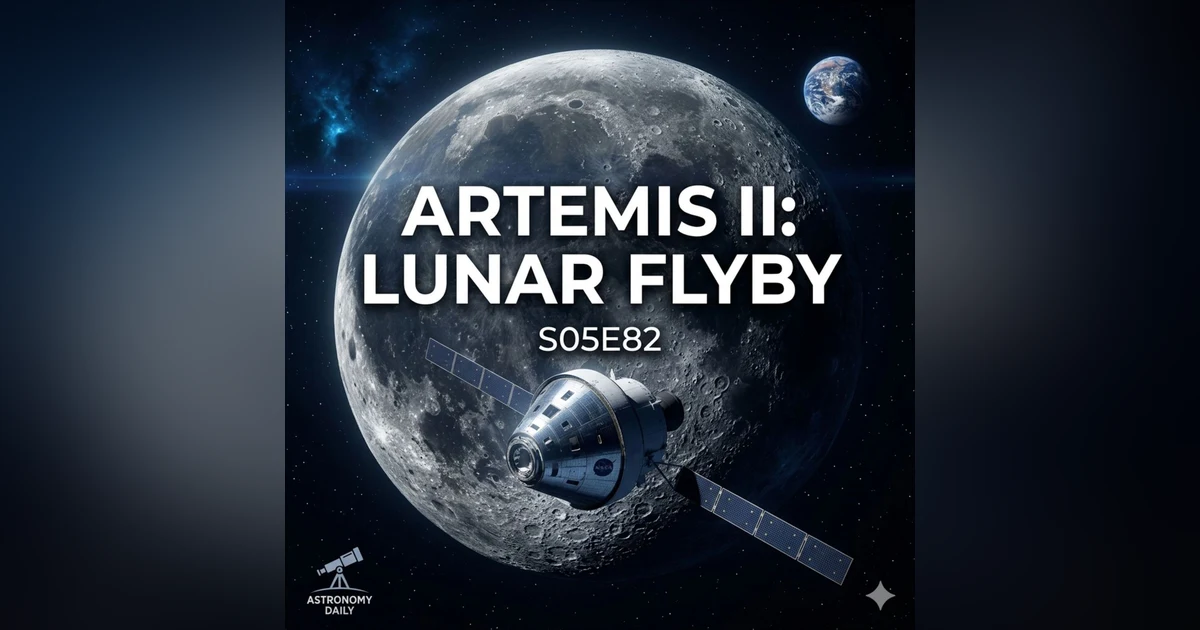
Right now, as you're listening to this, there are four
2
00:00:03.560 --> 00:00:06.280
human beings flying around the Moon.
3
00:00:06.759 --> 00:00:10.960
For the first time since December nineteen seventy two, fifty
4
00:00:11.000 --> 00:00:11.880
three years.
5
00:00:12.199 --> 00:00:17.199
Reed Wiseman, Victor Glover, Christina Koch, and Jeremy Hansen are
6
00:00:17.239 --> 00:00:22.760
aboard NASA's Ryan spacecraft conducting a six hour lunar flyby today,
7
00:00:23.239 --> 00:00:27.760
photographing the far side, breaking the all time human distance
8
00:00:27.800 --> 00:00:31.960
record from Earth, and about to witness a solar eclipse
9
00:00:32.079 --> 00:00:33.359
from beyond the Moon.
10
00:00:34.079 --> 00:00:37.000
We also have the verdict on comet maps, the one
11
00:00:37.039 --> 00:00:40.280
we promised you on Saturday, did it survive its plunge
12
00:00:40.320 --> 00:00:40.960
into the Sun.
13
00:00:41.640 --> 00:00:46.320
Plus a third galaxy with no dark matter, eighty seven
14
00:00:46.479 --> 00:00:50.520
hidden stellar streams discovered in our own galaxy, and a
15
00:00:50.600 --> 00:00:55.719
new telescope that found eleven thousand asteroids in just six weeks.
16
00:00:56.039 --> 00:01:00.719
I'm Avery and I'm Anna. This is Astronomy Daily, Season five,
17
00:01:00.880 --> 00:01:02.880
episode eighty two. Let's go.
18
00:01:03.560 --> 00:01:06.760
Let's start where we left off on Saturday, flight day
19
00:01:06.799 --> 00:01:08.519
four for the Artemis two crew.
20
00:01:09.040 --> 00:01:11.760
At the start of the day, Oriyan and her crew
21
00:01:11.840 --> 00:01:15.719
were approximately one hundred and sixty nine thousand miles from
22
00:01:15.719 --> 00:01:18.760
Earth and one hundred and ten thousand miles from the
23
00:01:18.799 --> 00:01:21.480
Moon halfway there and closing fast.
24
00:01:22.120 --> 00:01:25.799
The big activity on day four was a manual piloting demonstration.
25
00:01:26.359 --> 00:01:29.719
Christina Coke and Jeremy Hansen took turns at the controls
26
00:01:30.079 --> 00:01:33.879
testing two different thruster modes to give engineers real deep
27
00:01:33.920 --> 00:01:35.959
space handling data on the spacecraft.
28
00:01:36.480 --> 00:01:40.280
And this isn't just for show. Commander Wiseman and Victor
29
00:01:40.319 --> 00:01:44.000
Glover are scheduled to repeat the same demonstration on day
30
00:01:44.079 --> 00:01:48.000
eight so mission controllers can compare how different crew members
31
00:01:48.079 --> 00:01:51.640
handle the spacecraft its proper test flight methodology.
32
00:01:52.159 --> 00:01:55.480
The crew also spent time reviewing their lunar science target
33
00:01:55.519 --> 00:01:59.599
list for today's flyby, about thirty five geological features they've
34
00:01:59.599 --> 00:02:02.840
been asked to observe and photograph. Top of that list
35
00:02:03.079 --> 00:02:05.760
is the Orientel Basin, which.
36
00:02:05.680 --> 00:02:08.719
Is for listeners who haven't heard of it, a nearly
37
00:02:08.919 --> 00:02:13.199
six hundred mile wide impact crater that straddles the boundary
38
00:02:13.240 --> 00:02:16.520
between the near and far sides of the Moon three
39
00:02:16.599 --> 00:02:20.680
point eight billion years old. The Artemis two crew will
40
00:02:20.680 --> 00:02:23.759
be the first humans to see it from multiple angles
41
00:02:23.800 --> 00:02:24.840
as they swing around.
42
00:02:25.360 --> 00:02:28.319
They also found time for some cru selfies using one
43
00:02:28.319 --> 00:02:33.080
of Orion's solar array cameras. Very relatable astronauts. They're just
44
00:02:33.199 --> 00:02:36.759
like us. Day five, the crew woke up to see
45
00:02:36.759 --> 00:02:40.639
low Green's working class Heroes, which feels about right for
46
00:02:40.759 --> 00:02:43.759
people who are about to fly around the Moon.
47
00:02:44.479 --> 00:02:47.360
Very appropriate playlist choice from mission control.
48
00:02:47.879 --> 00:02:50.759
The main objective on Sunday was a full evaluation of
49
00:02:50.800 --> 00:02:54.360
the Orion Crue survival suit. All four crew members put
50
00:02:54.400 --> 00:02:59.280
on the suits, pressurized them, did leak checks, simulated seat entry,
51
00:02:59.439 --> 00:03:02.439
and tested whether they could eat and drink while wearing them.
52
00:03:03.039 --> 00:03:06.080
That last one matters more than it might sound. If
53
00:03:06.120 --> 00:03:09.360
there's ever a cabin emergency on a future mission and
54
00:03:09.400 --> 00:03:12.159
the crew has to suit up quickly, they need to
55
00:03:12.199 --> 00:03:14.719
know they can sustain themselves in the suit for an
56
00:03:14.759 --> 00:03:15.759
extended period.
57
00:03:16.159 --> 00:03:20.120
Later on Sunday, mission control completed a short trajectory correction
58
00:03:20.240 --> 00:03:23.240
burn seventeen and a half seconds to fine tune or
59
00:03:23.319 --> 00:03:24.719
Ryan's path to the Moon.
60
00:03:25.000 --> 00:03:28.439
And then just after midnight Eastern Time on Monday morning,
61
00:03:28.639 --> 00:03:33.000
so very early today, the spacecraft entered the Moon's gravitational
62
00:03:33.080 --> 00:03:36.879
sphere of influence. Lunar gravity now has more pull on
63
00:03:36.919 --> 00:03:39.199
Orion than Earth's does, the.
64
00:03:39.000 --> 00:03:41.960
First humans in that position since the Apollo.
65
00:03:41.599 --> 00:03:46.479
Era, and so to today. Flight Day six the main event.
66
00:03:47.159 --> 00:03:50.039
The six hour fly by window runs from two forty
67
00:03:50.080 --> 00:03:53.719
five to nine forty pm Eastern. Depending on when you're
68
00:03:53.759 --> 00:03:56.759
listening to this, the crew may already be deep into it.
69
00:03:57.360 --> 00:04:01.599
Closest approach is at around seven pm Eastern, four thousand
70
00:04:01.639 --> 00:04:05.159
and sixty six miles above the surface, far enough out
71
00:04:05.240 --> 00:04:09.240
to see the entire lunar disc at once, including regions
72
00:04:09.280 --> 00:04:13.360
near both poles that Apollo astronauts never had this view of.
73
00:04:13.960 --> 00:04:17.040
And here's the record that gets broken. Today. At seven
74
00:04:17.079 --> 00:04:21.279
oh five pm Eastern, Orion will reach its maximum distance
75
00:04:21.279 --> 00:04:25.120
from Earth two hundred and fifty two thousand, seven hundred
76
00:04:25.120 --> 00:04:26.759
and fifty seven miles.
77
00:04:26.879 --> 00:04:30.759
Beating Apollo thirteen's record by four thousand, one hundred and
78
00:04:30.839 --> 00:04:35.839
two miles. Apollo thirteen, the mission that survived an explosion
79
00:04:35.959 --> 00:04:39.600
in deep space and used the Moon's gravity to slingshot
80
00:04:39.680 --> 00:04:43.439
back to Earth, held that record for fifty six years.
81
00:04:43.800 --> 00:04:47.519
There will also be a communications blackout when Orion passes
82
00:04:47.519 --> 00:04:51.399
behind the Moon. Signals between the spacecraft and NASA's Deep
83
00:04:51.439 --> 00:04:55.680
Space network are blocked. That blackout begins around five forty
84
00:04:55.720 --> 00:04:59.079
seven pm Eastern and lasts about forty minutes.
85
00:05:00.000 --> 00:05:03.720
Nor Mole expected nothing to worry about. It happened on
86
00:05:03.959 --> 00:05:07.800
Artemis one and on every Apollo mission two, but it
87
00:05:07.839 --> 00:05:11.000
does mean mission control is briefly out of contact with
88
00:05:11.040 --> 00:05:12.920
the crew while they're on the far side.
89
00:05:13.480 --> 00:05:16.319
One more thing for today, the crew are attempting to
90
00:05:16.319 --> 00:05:20.480
recreate one of the most famous photographs in history. Apollo
91
00:05:20.600 --> 00:05:24.160
eates earth Rise, the image of Earth rising above the
92
00:05:24.199 --> 00:05:28.879
Moon's horizon, taken on Christmas Eve nineteen sixty eight, one
93
00:05:28.879 --> 00:05:31.680
of the most iconic images ever made.
94
00:05:32.079 --> 00:05:34.680
Well see if they can match it. My money is
95
00:05:34.720 --> 00:05:35.319
on yes.
96
00:05:36.040 --> 00:05:39.120
We'll be watching splashdown for the full mission is on
97
00:05:39.240 --> 00:05:42.040
track for Friday, April tenth, off San Diego.
98
00:05:42.519 --> 00:05:45.319
All right, we promised you this one on Saturday, and
99
00:05:45.360 --> 00:05:46.360
we're going to deliver.
100
00:05:46.920 --> 00:05:52.680
Comet maps D twenty twenty six A one maps discovered
101
00:05:52.680 --> 00:05:55.920
on the thirteenth of January this year in the AMAX
102
00:05:56.040 --> 00:06:01.519
one Observatory in Chile's Atakama Desert. Why it's Sungrazer, a
103
00:06:01.600 --> 00:06:04.800
family of comets that plunge extremely close to the Sun
104
00:06:04.959 --> 00:06:06.920
on very elongated.
105
00:06:06.360 --> 00:06:10.680
Orbits, and maps was special. Even within that family, it
106
00:06:10.759 --> 00:06:15.079
holds the distinction of being the earliest discovered cruits Sungrazer
107
00:06:15.279 --> 00:06:19.680
ever found spotted more than two astronomical units from the Sun,
108
00:06:20.079 --> 00:06:22.560
giving astronomers months to track its approach.
109
00:06:23.160 --> 00:06:28.160
On Saturday, April fourth, Maps reached Perihelion, its closest point
110
00:06:28.199 --> 00:06:32.439
to the Sun. It passed approximately ninety nine thousand miles
111
00:06:32.439 --> 00:06:35.720
from the solar surface. To put that in perspective, the
112
00:06:35.800 --> 00:06:39.279
diameter of the Sun itself is eight hundred and sixty
113
00:06:39.360 --> 00:06:40.519
five thousand miles.
114
00:06:41.079 --> 00:06:44.000
It was scorchingly impossibly close.
115
00:06:44.800 --> 00:06:47.639
Some were calling it the Easter Comet, hoping it would
116
00:06:47.639 --> 00:06:51.319
emerge from that encounter blazing in the post Perihelian sky.
117
00:06:52.120 --> 00:06:55.600
Comets in this family have done it before. Iks Seki
118
00:06:55.759 --> 00:06:58.759
in nineteen sixty five survived and became one of the
119
00:06:58.759 --> 00:07:02.839
brightest comets of the twin century. Comet Lovejoy in twenty
120
00:07:02.839 --> 00:07:06.399
eleven survived and became a spectacular naked eye.
121
00:07:06.240 --> 00:07:09.199
Object, but Maps didn't make it.
122
00:07:09.800 --> 00:07:13.720
About six hours before pery Helian, coronagraph images from the
123
00:07:13.759 --> 00:07:17.680
Soho spacecraft showed it at a round magnitude negative zero
124
00:07:17.759 --> 00:07:22.920
point six and brightening, Then shortly after it disintegrated. It
125
00:07:23.040 --> 00:07:26.199
never re emerged from behind the Sun, though.
126
00:07:26.040 --> 00:07:30.279
A spectacular death, if not the spectacular survival we were
127
00:07:30.319 --> 00:07:34.839
hoping for. The question now is whether any ghostly debristail remains,
128
00:07:35.199 --> 00:07:38.040
but if it does, it would be faint and short lived.
129
00:07:38.600 --> 00:07:41.279
It's worth sitting with us for a moment. Mapps was
130
00:07:41.319 --> 00:07:43.920
a fragment of a comet that last visited the Inner
131
00:07:43.959 --> 00:07:48.439
Solar System roughly seventeen hundred years ago, possibly connected to
132
00:07:48.439 --> 00:07:51.000
a comet witnessed in broad daylight in the year three
133
00:07:51.040 --> 00:07:56.360
hundred and sixty three AD, documented by the historian Ammanilius Marcellinus.
134
00:07:56.959 --> 00:07:59.439
It made it all the way back, and the sun
135
00:08:00.000 --> 00:08:00.360
hook it.
136
00:08:00.879 --> 00:08:04.519
There is a silver lining, though, Comet C. Twenty twenty
137
00:08:04.519 --> 00:08:07.879
five R three pan Stars is brightening and putting on
138
00:08:07.920 --> 00:08:11.240
its own show. This month, April seventeenth is your best
139
00:08:11.360 --> 00:08:16.040
viewing opportunity. You'll need binoculars. It should reach around magnitude eight,
140
00:08:16.399 --> 00:08:20.680
but look east before dawn in the constellations Pegasus and Pisces.
141
00:08:21.040 --> 00:08:22.079
We'll keep you updated.
142
00:08:22.639 --> 00:08:23.240
Rest well.
143
00:08:23.279 --> 00:08:27.759
Maps Now to some deep cosmology that genuinely shakes the
144
00:08:27.800 --> 00:08:30.120
foundations of how we think galaxies work.
145
00:08:30.879 --> 00:08:34.600
So the standard model of galaxy formation says dark matter
146
00:08:34.720 --> 00:08:38.960
is the invisible scaffolding that holds galaxies together without its
147
00:08:39.000 --> 00:08:43.159
gravitational pool. The rotational forces of a galaxy stars would
148
00:08:43.200 --> 00:08:44.799
simply cause it to fly apart.
149
00:08:45.399 --> 00:08:49.200
Dark matter makes up the vast majority of a galaxy's mass.
150
00:08:49.639 --> 00:08:52.919
We can't see it, it doesn't interact with light, but
151
00:08:53.039 --> 00:08:57.399
we infer it everywhere we look. Until in twenty eighteen,
152
00:08:57.799 --> 00:09:01.399
a team at Yale led by astronomer Peter von Dockam
153
00:09:01.799 --> 00:09:04.720
found something that shouldn't exist.
154
00:09:04.360 --> 00:09:08.840
A galaxy with virtually no dark matter NGC ten fifty
155
00:09:08.840 --> 00:09:14.279
two DASH DF two, an ultra diffuse galaxy faint spread
156
00:09:14.279 --> 00:09:17.720
out c through almost and the stars inside it were
157
00:09:17.799 --> 00:09:21.799
moving far too slowly. There wasn't enough mass the dark
158
00:09:21.879 --> 00:09:22.799
matter was missing.
159
00:09:23.360 --> 00:09:27.360
Then they found a second one, NNGC ten fifty two
160
00:09:27.679 --> 00:09:32.240
DASH DF four, same thing, and both galaxies appeared to
161
00:09:32.279 --> 00:09:35.399
lie along the same trail in space, and.
162
00:09:35.360 --> 00:09:39.399
Now announced this week a third NNGC ten fifty two
163
00:09:39.600 --> 00:09:43.519
DASH DF nine, which falls directly on that same trail
164
00:09:43.679 --> 00:09:47.080
between DF two and DF four. The team used a
165
00:09:47.159 --> 00:09:50.639
Keck observatory in Hawaii to measure how fast the stars
166
00:09:50.639 --> 00:09:54.080
inside DF nine are moving, and the result was the same.
167
00:09:54.440 --> 00:09:57.679
No dark matter required to explain the dynamics.
168
00:09:57.759 --> 00:10:01.000
Three in a row on the same lene, that is
169
00:10:01.120 --> 00:10:02.200
not a coincidence.
170
00:10:02.440 --> 00:10:06.720
The explanation the team favors is the bullet dwarf collision theory.
171
00:10:07.159 --> 00:10:10.759
Imagine two gas rich dwarf galaxies hurtling toward each other
172
00:10:10.799 --> 00:10:15.919
at enormous speed. They collide. The stars, which interact electromagnetically,
173
00:10:16.000 --> 00:10:19.639
get tangled up and slow down, but dark matter only
174
00:10:19.639 --> 00:10:23.519
interacts via gravity. The dark matter halos of each galaxy
175
00:10:23.720 --> 00:10:26.399
just passed straight through each other, like ghosts.
176
00:10:26.720 --> 00:10:29.919
What's left behind is a trail of star rich galaxies
177
00:10:29.919 --> 00:10:33.399
that have been completely stripped of their dark matter DF two,
178
00:10:33.639 --> 00:10:37.600
D four, DF nine, all born from the same catastrophic
179
00:10:37.639 --> 00:10:38.480
ancient collision.
180
00:10:38.879 --> 00:10:41.480
The team wants to measure a fourth and fifth galaxy
181
00:10:41.559 --> 00:10:44.679
on the same trail. The farther out they go, the
182
00:10:44.759 --> 00:10:48.240
fainter the targets get. But if they find the same signature,
183
00:10:48.440 --> 00:10:52.200
that's about as close to a smoking gun as cosmology.
184
00:10:51.480 --> 00:10:55.919
Gets, and what it tells us is profound dark matter exists,
185
00:10:56.000 --> 00:10:59.279
but it doesn't have to be everywhere. Galaxies can form
186
00:10:59.320 --> 00:11:02.799
and persist without it under the right or rather the
187
00:11:02.960 --> 00:11:05.120
extremely violent circumstances.
188
00:11:05.480 --> 00:11:08.960
Our next two stories today share something in common. Both
189
00:11:09.000 --> 00:11:13.240
involve new tools and new algorithms revealing hitting populations of
190
00:11:13.279 --> 00:11:17.440
objects at a scale that simply wasn't possible before. The universe,
191
00:11:17.480 --> 00:11:19.639
it turns out, has been holding out on.
192
00:11:19.679 --> 00:11:23.840
Us, starting with our own galaxy. Astronomers at the University
193
00:11:23.840 --> 00:11:26.879
of Michigan have just announced the discovery of eighty seven
194
00:11:26.960 --> 00:11:30.279
new stellar stream candidates in the outskirts of the Milky Way.
195
00:11:30.480 --> 00:11:34.440
Now stellar streams for listeners who haven't come across them before.
196
00:11:34.919 --> 00:11:38.519
Stellar streams are when a compact cluster of stars travels
197
00:11:38.559 --> 00:11:42.879
through the Milky Way's gravitational field. The galaxy slowly pulls
198
00:11:42.879 --> 00:11:46.799
stars away from it. Those stars get stretched out into long,
199
00:11:46.960 --> 00:11:51.519
trailing ribbons, barking threads of light following the cluster's orbital path.
200
00:11:51.879 --> 00:11:55.039
Study co author Oleg Neettin put it beautifully. He said,
201
00:11:55.080 --> 00:11:57.000
it's like riding a bike with a bag of sand,
202
00:11:57.240 --> 00:11:59.480
where the bag has a hole in it, the sand
203
00:11:59.519 --> 00:12:01.960
spilling out behind you. That's the stellar stream.
204
00:12:02.399 --> 00:12:05.480
Before the study, fewer than twenty of these streams had
205
00:12:05.519 --> 00:12:08.480
been found, and most of those were discovered by chance
206
00:12:08.759 --> 00:12:12.000
astronomer stumbling across them in Gaya data while looking for
207
00:12:12.080 --> 00:12:12.639
other things.
208
00:12:13.080 --> 00:12:16.440
Lead researcher Yin Tanchen, who goes by Bill, took a
209
00:12:16.440 --> 00:12:20.240
more systematic approach. He developed a new algorithm called star
210
00:12:20.320 --> 00:12:23.440
stream which uses a physics based model of how these
211
00:12:23.440 --> 00:12:27.080
streams actually form rather than just looking for visual patterns
212
00:12:27.120 --> 00:12:29.240
in the data, and he turned it loose on the
213
00:12:29.279 --> 00:12:30.480
full Gaya data set.
214
00:12:30.759 --> 00:12:35.039
The result eighty seven candidates, more than quadrupling the known
215
00:12:35.080 --> 00:12:38.799
population in one go, and these are the rarest kind
216
00:12:39.080 --> 00:12:42.840
streams from globular clusters that are still intact. You can
217
00:12:42.879 --> 00:12:46.279
compare the stream directly to its parent cluster, which makes
218
00:12:46.320 --> 00:12:49.080
them enormously scientifically valuable.
219
00:12:48.879 --> 00:12:52.279
Because the shapes and sizes of these streams encode information
220
00:12:52.399 --> 00:12:55.519
about the forces they've experienced, and that tells you about
221
00:12:55.519 --> 00:12:58.919
the Milky Way's mass distribution, including how its dark matter
222
00:12:59.000 --> 00:13:00.000
halo is structured.
223
00:13:00.279 --> 00:13:04.200
So these ribbons of stars are essentially a map of
224
00:13:04.279 --> 00:13:08.200
invisible matter. The next step is follow up with more
225
00:13:08.320 --> 00:13:14.679
powerful instruments NASA's Roman Space Telescope, Ruben Observatory, and DIESI
226
00:13:14.960 --> 00:13:18.519
to verify which of the eighty seven are real streams
227
00:13:18.799 --> 00:13:20.600
and which might be background.
228
00:13:20.240 --> 00:13:24.320
Noise, which brings us rather neatly to Ruben Observatory.
229
00:13:24.639 --> 00:13:27.919
The via C Reuben Observatory, which we've mentioned a few
230
00:13:27.919 --> 00:13:30.159
times in the last couple of months as it was
231
00:13:30.200 --> 00:13:34.279
coming online, has just released its first major data set,
232
00:13:34.679 --> 00:13:36.600
and the numbers are staggering.
233
00:13:37.039 --> 00:13:41.000
In six weeks, six weeks of early engineering quality data,
234
00:13:41.080 --> 00:13:44.840
not even full science operations, yet, Rubin found over eleven
235
00:13:44.919 --> 00:13:49.360
thousand new asteroids, generated nearly a million measurements, and refine
236
00:13:49.399 --> 00:13:53.000
the orbits of more than eighty thousand previously cataloged objects.
237
00:13:53.320 --> 00:13:57.399
Some of those eighty thousand had effectively vanished from tracking
238
00:13:57.440 --> 00:14:01.919
systems because their orbits were two uncertain Ruben recovered them
239
00:14:01.960 --> 00:14:06.000
with far greater precision. Objects that were lost found again.
240
00:14:06.600 --> 00:14:09.960
Mario Jerrich, the Ruben Solar System lead scientists to the
241
00:14:10.039 --> 00:14:13.399
University of Washington, summed it up well, he said, and
242
00:14:13.480 --> 00:14:16.919
I'm paraphrasing. This first submission is just the tip of