March 27, 2026

Artemis II Crew Lands in Florida — Launch Countdown Is On
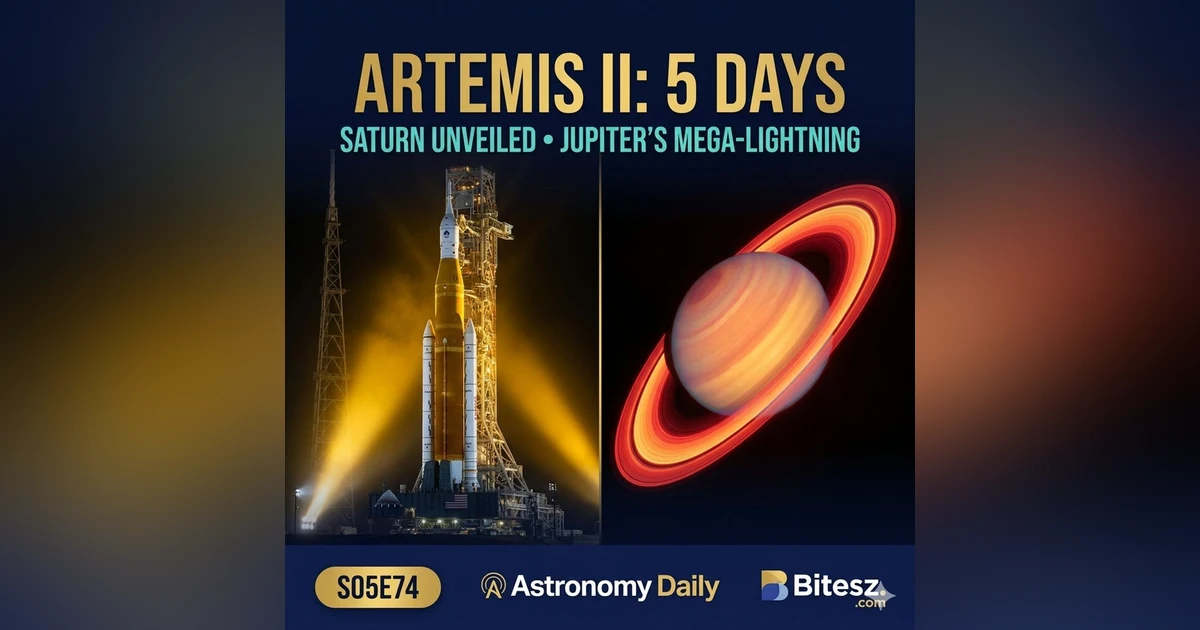
Artemis II Crew Lands in Florida — Launch Countdown Is On

Welcome to Astronomy Daily, Season 5, Episode 74 — your daily briefing on the most exciting developments in space and astronomy, hosted by Anna and Avery. IN TODAY'S EPISODE • Artemis II crew arrives at Kennedy Space Center — launch just 5 days away • Webb and Hubble combine for the most detailed Saturn portrait ever captured • New research reveals Jupiter's lightning may be up to a million times more powerful than Earth's • Japan's XRISM telescope solves a 50-year X-ray mystery surrounding naked-eye star Gamma Cassiopeiae • Cornell astronomers publish a shortlist of 45 exoplanets most likely to host alien life • The Isar Aerospace Spectrum scrub mystery is solved — it was an unauthorised boat STORY SOURCES & LINKS Story 1 — Artemis II: NASA Kennedy Space Center / NASA.gov https://www.nasa.gov/blogs/missions/2026/03/25/nasa-teams-continue-artemis-ii-preparations-at-launch-pad/ https://www.nasa.gov/missions/artemis/artemis-ii/nasa-sets-coverage-for-artemis-ii-moon-mission/ Story 2 — Saturn Images: NASA Science / Scientific American https://science.nasa.gov/missions/webb/nasa-webb-hubble-share-most-comprehensive-view-of-saturn-to-date/ Story 3 — Jupiter Lightning: Berkeley News / AGU Advances https://news.berkeley.edu/2026/03/23/lightning-bolts-on-jupiter-pack-more-than-100-times-the-power-of-earths-flashes/ Story 4 — Gamma Cassiopeiae: ScienceDaily / Astronomy & Astrophysics https://www.sciencedaily.com/releases/2026/03/260325041723.htm Story 5 — 45 Exoplanets: Royal Astronomical Society / ScienceDaily https://ras.ac.uk/news-and-press/research-highlights/best-places-look-alien-life-scientists-identify-45-earth-worlds Story 6 — Isar Aerospace: NASASpaceFlight.com / Bloomberg https://www.nasaspaceflight.com/2026/03/isar-onward-and-upward/ CONNECT WITH US • Website: astronomydaily.io • Twitter/X: @AstroDailyPod • Instagram: @AstroDailyPod • TikTok: @AstroDailyPod • YouTube: @AstroDailyPod • Tumblr: @AstroDailyPod • Network: Bitesz.com Podcast Network

Become a supporter of this podcast: https://www.spreaker.com/podcast/astronomy-daily-space-news-updates--5648921/support.

Sponsor Details:
Ensure your online privacy by using NordVPN. To get our special listener deal and save a lot of money, visit www.bitesz.com/nordvpn. You'll be glad you did!

Become a supporter of Astronomy Daily by joining our Supporters Club. Commercial free episodes daily are only a click way... Click Here

This episode includes AI-generated content.

WEBVTT

1
00:00:00.200 --> 00:00:02.680
Hello, and welcome to Astronomy Daily.

2
00:00:02.960 --> 00:00:07.839
I'm Anna and I'm Avery. It is Friday, March twenty seventh,

3
00:00:07.960 --> 00:00:10.800
twenty twenty six, and our producer has given us an

4
00:00:10.839 --> 00:00:12.839
absolutely stacked show. Today.

5
00:00:13.279 --> 00:00:16.519
We are literally five days from a crew of four

6
00:00:16.600 --> 00:00:19.600
astronauts launching around the Moon for the first time in

7
00:00:19.679 --> 00:00:23.679
over fifty years, and today those four people touched down

8
00:00:23.760 --> 00:00:24.399
in Florida.

9
00:00:24.719 --> 00:00:27.320
We've also got the most detailed look at Saturn ever,

10
00:00:27.440 --> 00:00:30.879
captured lightning on Jupiter that makes Earth storms look like

11
00:00:30.960 --> 00:00:34.880
a birthday sparkler, and a fifty year stellar mystery finally

12
00:00:34.960 --> 00:00:37.479
cracked open by a Japanese space telescope.

13
00:00:37.640 --> 00:00:41.759
Plus, we're narrowing down the shortlist of exoplanets most likely

14
00:00:41.840 --> 00:00:45.039
to harbor alien life. And we have a juicy update

15
00:00:45.079 --> 00:00:47.439
on that dramatic rocket scrub from yesterday.

16
00:00:47.880 --> 00:00:49.439
Boiler, it was a boat.

17
00:00:49.759 --> 00:00:53.159
It was absolutely a boat. Let's get into it. Let's

18
00:00:53.200 --> 00:00:56.719
go then, all right, story one and Avery, this one

19
00:00:56.799 --> 00:01:00.320
is really happening today as we record the art Miss

20
00:01:00.320 --> 00:01:02.840
two crew is flying into Kennedy's Space Center.

21
00:01:03.240 --> 00:01:08.200
Commander Reid Wiseman, pilot Victor Glover, mission specialist Christina coach

22
00:01:08.400 --> 00:01:12.599
All from NASA and Canadian Space Agency astronaut Jeremy Hansen,

23
00:01:13.159 --> 00:01:17.239
four people, one rocket, and they are now officially on site.

24
00:01:17.560 --> 00:01:22.400
NASA Administrator Jarrett Isaacman and Canadian Space Agency President Lisa

25
00:01:22.480 --> 00:01:25.680
Campbell were there to greet them on the tarmac this afternoon.

26
00:01:26.000 --> 00:01:28.400
The crew also answered questions from the media.

27
00:01:28.879 --> 00:01:31.680
Now, just to set the scene, the SLS rocket and

28
00:01:31.719 --> 00:01:35.319
the Orion capsule are already sitting on launch Pad thirty

29
00:01:35.400 --> 00:01:38.319
nine B at Kennedy Space Center. They rolled out on

30
00:01:38.400 --> 00:01:42.519
March twentieth. Everything is in place. The target launch window

31
00:01:42.560 --> 00:01:46.680
opens Wednesday, April first, at six twenty four pm Eastern Time.

32
00:01:47.079 --> 00:01:50.799
And April first is not a joke. This is genuinely happening,

33
00:01:51.159 --> 00:01:53.480
a two hour window on the first, and if they

34
00:01:53.560 --> 00:01:56.560
need it, opportunities continue through April sixth.

35
00:01:56.920 --> 00:01:59.719
The crew has been in quarantine since March eighteenth, keeping

36
00:01:59.719 --> 00:02:02.239
their head health locked down. Before this ten day mission.

37
00:02:02.680 --> 00:02:06.200
They spent the quarantine reviewing procedures at Johnson Space Center

38
00:02:06.200 --> 00:02:09.400
in Houston, Texas, and now the rest of the countdown

39
00:02:09.479 --> 00:02:10.919
happens here in Florida.

40
00:02:11.319 --> 00:02:13.960
This mission is going to take them farther than Earth

41
00:02:14.039 --> 00:02:17.960
than any human has been since Apollo thirteen in nineteen seventy,

42
00:02:18.240 --> 00:02:21.800
about five thousand miles beyond the Moon. It won't land,

43
00:02:21.919 --> 00:02:23.919
but it will swing around the back of the Moon

44
00:02:24.000 --> 00:02:27.240
on a free return trajectory and come screaming back to

45
00:02:27.280 --> 00:02:30.199
Earth at around twenty five thousand miles per hour.

46
00:02:30.639 --> 00:02:34.199
Victor Glover will become the first person of color, Christina

47
00:02:34.240 --> 00:02:37.800
Coach the first woman, and Jeremy Hanson the first non

48
00:02:37.879 --> 00:02:42.439
American to travel beyond Low Earth orbit. And for Canadians listening,

49
00:02:42.719 --> 00:02:45.919
Jeremy Hanson arrives in Florida today for what is going

50
00:02:45.960 --> 00:02:47.520
to be the ride of his life.

51
00:02:47.960 --> 00:02:50.879
We are going to be covering this story right through launch.

52
00:02:51.199 --> 00:02:54.479
Stick with US Astronomy Daily is your front row seat

53
00:02:54.520 --> 00:02:57.800
to the most exciting human spacelight moment in a generation.

54
00:02:58.439 --> 00:03:02.159
Dory two, and this one is visually stunning. NASA has

55
00:03:02.240 --> 00:03:04.800
released a new set of Saturn images and they are

56
00:03:04.919 --> 00:03:08.560
genuinely the most comprehensive view of Saturn ever created.

57
00:03:08.960 --> 00:03:12.960
This is a collaboration between two of humanity's greatest telescopes,

58
00:03:13.240 --> 00:03:17.240
the James Web Space Telescope and Hubble Space Telescope. Now,

59
00:03:17.319 --> 00:03:21.319
these two observatories were launched thirty one years apart. Hubble

60
00:03:21.360 --> 00:03:24.560
went up in nineteen ninety web in late twenty twenty one.

61
00:03:24.879 --> 00:03:28.879
But when you combine their observations you get something extraordinary.

62
00:03:29.280 --> 00:03:32.759
Hubble observes Saturn invisible light in August twenty twenty four,

63
00:03:33.240 --> 00:03:37.280
capturing all those familiar golden cloud bands and the iconic rings.

64
00:03:37.719 --> 00:03:41.560
You get the colors, the subtle atmospheric variations, the sheer

65
00:03:41.719 --> 00:03:42.560
beauty of the thing.

66
00:03:43.039 --> 00:03:46.319
Then Webb looked at it in infrared in November twenty

67
00:03:46.360 --> 00:03:51.360
twenty four, just fourteen weeks later, and the picture completely transforms.

68
00:03:51.719 --> 00:03:55.319
The rings glow brilliantly because they're made of highly reflective

69
00:03:55.439 --> 00:03:59.719
water ice. You can see deep atmospheric storms, jet streams,

70
00:03:59.759 --> 00:04:03.240
and a mysterious gray green glow at the poles that

71
00:04:03.319 --> 00:04:06.960
scientists think may be linked to auroral activity or hide

72
00:04:07.000 --> 00:04:08.159
altitude aerosols.

73
00:04:08.800 --> 00:04:12.520
One of the most poignant details in this release, Saturn's

74
00:04:12.560 --> 00:04:15.919
famous hexagonal jet stream at the north pole is just

75
00:04:16.079 --> 00:04:19.839
barely visible in these images, and sciences say this could

76
00:04:19.839 --> 00:04:22.720
be among the last clear views of it for decades,

77
00:04:23.079 --> 00:04:26.240
because the pole is heading into a long winter darkness

78
00:04:26.319 --> 00:04:28.480
that won't lift until the twenty forties.

79
00:04:29.199 --> 00:04:32.800
NASA describes what the two telescopes together can do as

80
00:04:33.000 --> 00:04:37.839
slicing through Saturn's atmosphere at multiple altitudes. Like peeling back

81
00:04:37.879 --> 00:04:41.240
the layers of an onion, Hubble covers the upper clouds

82
00:04:41.560 --> 00:04:45.800
web dives deeper into the chemistry. Together, they give researchers

83
00:04:45.879 --> 00:04:49.560
a three dimensional picture of how this whole system works.

84
00:04:50.160 --> 00:04:53.800
And Webb's wide angle view captured six of Saturn's moons

85
00:04:53.800 --> 00:04:58.000
in the same frame, including Titan, which is massive and hazy,

86
00:04:58.319 --> 00:05:01.959
and Enceladus, that little world with a subservice ocean that

87
00:05:02.079 --> 00:05:04.519
astrobiologists find so tantalizing.

88
00:05:05.079 --> 00:05:07.360
We will link to these images in the show notes.

89
00:05:07.439 --> 00:05:10.519
They are genuinely worth five minutes of your time just

90
00:05:10.560 --> 00:05:15.160
to look at them. Saturn is out there looking absolutely magnificent.

91
00:05:15.959 --> 00:05:19.639
Story three and I want everyone to picture the most

92
00:05:19.720 --> 00:05:23.240
dramatic lightning storm you have ever seen on Earth, A

93
00:05:23.319 --> 00:05:28.399
real cracker thunder rattling the windows. Now imagine that but

94
00:05:28.519 --> 00:05:30.560
a million times more powerful.

95
00:05:31.199 --> 00:05:35.160
That is potentially what is happening in Jupiter's atmosphere, according

96
00:05:35.240 --> 00:05:39.439
to new research from the University of California, Berkeley published

97
00:05:39.519 --> 00:05:42.199
this week in the journal AGU Advances.

98
00:05:42.920 --> 00:05:46.480
The study used data from NASA's Juno spacecraft, which has

99
00:05:46.519 --> 00:05:51.800
been orbiting Jupiter since twenty sixteen. Specifically, it's microwave radiometer.

100
00:05:52.319 --> 00:05:55.920
That instrument was designed for studying the planet's atmosphere, but

101
00:05:56.000 --> 00:05:59.279
it turns out it's also brilliant at detecting the radio

102
00:05:59.319 --> 00:06:00.600
signatures of lightning.

103
00:06:01.199 --> 00:06:03.600
The clever bit was that the team focused on a

104
00:06:03.639 --> 00:06:06.959
period in twenty twenty one and twenty twenty two when

105
00:06:07.000 --> 00:06:11.480
a normally storm filled belt on Jupiter went unusually quiet.

106
00:06:11.920 --> 00:06:16.639
That meant JUNO could pinpoint individual isolated storm systems, what

107
00:06:16.680 --> 00:06:21.240
the researchers call stealth superstorms, and directly measure the power

108
00:06:21.319 --> 00:06:22.680
of lightning within them.

109
00:06:23.000 --> 00:06:27.279
The results are remarkable. From six hundred and thirteen detected

110
00:06:27.360 --> 00:06:31.319
lightning pulses, the power rains from roughly comparable to an

111
00:06:31.360 --> 00:06:34.240
Earth lightning bolt all the way up to one hundred

112
00:06:34.279 --> 00:06:38.160
times more powerful. But because of uncertainties and how radio

113
00:06:38.160 --> 00:06:41.720
frequencies compare across the two planets, some of those bolts

114
00:06:41.720 --> 00:06:44.759
could be up to a million times stronger than anything

115
00:06:44.759 --> 00:06:45.600
on Earth.

116
00:06:45.800 --> 00:06:50.079
And these storms were generating around three lightning flashes per second.

117
00:06:50.560 --> 00:06:54.800
On one flyover, JUNO detected two hundred and six separate

118
00:06:54.879 --> 00:06:57.240
microwave pulses in a single pass.

119
00:06:57.959 --> 00:07:01.839
Lead researcher Michael Wong described it really well On Earth,

120
00:07:02.120 --> 00:07:05.439
moist air rises because water makes it more buoyant in

121
00:07:05.439 --> 00:07:09.920
a nitrogen atmosphere. On Jupiter, the atmosphere is mostly hydrogen,

122
00:07:10.079 --> 00:07:13.879
so moist air is actually heavier and sinks. It takes

123
00:07:14.160 --> 00:07:17.439
enormous energy to push it upward, and when those storms

124
00:07:17.519 --> 00:07:20.920
finally break loose, they release all of that stored energy

125
00:07:20.959 --> 00:07:22.399
in extraordinary ways.

126
00:07:23.000 --> 00:07:25.519
What I love about this is that the Juno mission

127
00:07:25.560 --> 00:07:29.399
has been delivering incredible science for a decade now, and

128
00:07:29.480 --> 00:07:32.920
even as the spacecraft ages, it's still finding ways to

129
00:07:33.040 --> 00:07:36.920
rewrite our understanding of the Solar System's biggest planet.

130
00:07:37.519 --> 00:07:40.199
Okay, onto our next story today.

131
00:07:40.519 --> 00:07:43.240
Story four, and this is one of those stories where

132
00:07:43.279 --> 00:07:47.480
astronomers get to say we finally did it after fifty years.

133
00:07:48.120 --> 00:07:51.959
The star in question is Gamma Cassiopeia. If you look

134
00:07:52.040 --> 00:07:55.600
up at the distinctive W shape of the constellation Cassiopeia

135
00:07:55.680 --> 00:07:58.240
on a clear night, the middle star of that W

136
00:07:58.759 --> 00:08:02.399
that's it visible to the naked eye about five hundred

137
00:08:02.439 --> 00:08:05.839
and fifty light years away, and since nineteen seventy six

138
00:08:06.040 --> 00:08:09.199
it has been blasting out X rays around forty times

139
00:08:09.199 --> 00:08:11.920
more powerful than you'd ever expect from a star like that.

140
00:08:12.519 --> 00:08:15.720
The plasma generating those X rays was hotter than one

141
00:08:15.800 --> 00:08:19.959
hundred million degrees, and for decades nobody could agree. Why

142
00:08:20.439 --> 00:08:23.639
was it magnetic activity on the star itself? Was there

143
00:08:23.680 --> 00:08:27.319
a hidden companion pulling in material? The debate has raged

144
00:08:27.360 --> 00:08:30.560
it across multiple research groups for half a century.

145
00:08:31.279 --> 00:08:35.720
Now, thanks to Japan's XRIISM space telescope that stands for

146
00:08:35.960 --> 00:08:39.879
X Ray Imaging and Spectroscopy Mission, developed by JAXA in

147
00:08:39.960 --> 00:08:43.960
collaboration with NASA and ESA, the answer is finally in

148
00:08:44.519 --> 00:08:47.240
the culprit is a hidden white dwarf companion.

149
00:08:47.600 --> 00:08:52.559
The key instrument is called Resolve, a high precision microclorimeter

150
00:08:52.720 --> 00:08:58.000
on XRIISM that can measure X ray spectra with extraordinary accuracy.

151
00:08:58.559 --> 00:09:02.919
The team observed Gamma Capia three times in December twenty

152
00:09:02.960 --> 00:09:06.879
twenty four, February twenty twenty five, and June twenty twenty five,

153
00:09:07.279 --> 00:09:09.840
covering the full two hundred and three day orbit of

154
00:09:09.840 --> 00:09:10.919
the binary system.

155
00:09:11.240 --> 00:09:14.600
What they found was that the superheated plasma generating the

156
00:09:14.759 --> 00:09:17.559
X rays was moving in sync with the hidden companion,

157
00:09:18.080 --> 00:09:21.440
not with the bright b star. Everyone could see. That's

158
00:09:21.559 --> 00:09:25.159
the clincher, first direct proof that it's the white dwarf

159
00:09:25.399 --> 00:09:29.080
not the star. Itself driving all that high energy activity.

160
00:09:29.320 --> 00:09:32.879
And it turns out this white dwarf is magnetic. Its

161
00:09:32.919 --> 00:09:36.600
field is funneling material from the star's surrounding disc toward

162
00:09:36.639 --> 00:09:39.679
its pulls, where it releases all that energy as X

163
00:09:39.759 --> 00:09:43.399
rays like a tiny but ferocious cosmic vacuum cleaner.

164
00:09:43.720 --> 00:09:47.759
The implications go well beyond this one star. Astronomers have

165
00:09:47.879 --> 00:09:50.919
long predicted that about fifty to seventy percent of B

166
00:09:51.080 --> 00:09:55.279
type binary stars might have white dwarf companions, but solid

167
00:09:55.320 --> 00:09:58.879
evidence has been hard to pin down. This result confirms

168
00:09:58.919 --> 00:10:02.639
a whole new clas of binary systems that had previously

169
00:10:02.679 --> 00:10:04.039
only existed in theory.

170
00:10:04.399 --> 00:10:07.960
Lead researcher Yayel Naz at the University of Liege put

171
00:10:08.000 --> 00:10:11.480
it beautifully. There has been an intense effort to solve

172
00:10:11.559 --> 00:10:15.720
the mystery of gamma cassiopeia across many research groups for

173
00:10:15.879 --> 00:10:20.559
many decades, and now, thanks to XRIIM, we have finally

174
00:10:20.639 --> 00:10:24.679
done it. A very good Friday for Stellar Astrophysics.

175
00:10:24.399 --> 00:10:27.440
Story five, and this one comes with a movie tie

176
00:10:27.519 --> 00:10:29.519
in which I am absolutely here for.

177
00:10:29.879 --> 00:10:32.639
If you haven't seen Project Hail Mary yet, the Ryan

178
00:10:32.639 --> 00:10:36.519
Gosling film based on Andy Weir's novel. It's currently in cinemas,

179
00:10:36.559 --> 00:10:40.559
and it is excellent. The premise is that humanity discovers

180
00:10:40.600 --> 00:10:45.360
a tiny micro organism called astrophage is consuming the Sun's energy,

181
00:10:45.679 --> 00:10:48.759
and one scientist is sent on a desperate solo mission

182
00:10:48.840 --> 00:10:50.879
to find the answer at a distant star.

183
00:10:51.399 --> 00:10:55.639
And this week, real astronomers at Cornell University's Carl Sagan

184
00:10:55.720 --> 00:10:59.440
Institute have published the paper that asks essentially the same

185
00:10:59.519 --> 00:11:02.840
question the movie poses. If we were building a real

186
00:11:02.919 --> 00:11:05.240
Hail Mary spacecraft, where would we send it?

187
00:11:05.559 --> 00:11:10.559
Lead researcher Professor Lisa Koltngeger, alongside a team of undergraduate students,

188
00:11:10.919 --> 00:11:14.600
comb through data from the European Space Agency's Gaya mission

189
00:11:14.879 --> 00:11:19.080
and the NASA Exoplanet Archive. There are over six thousand

190
00:11:19.200 --> 00:11:22.879
known exoplanets. From that enormous list, they've narrowed it down

191
00:11:22.919 --> 00:11:26.519
to forty five rocky worlds sitting in their star's habitable

192
00:11:26.600 --> 00:11:30.080
zones where liquid water could potentially exist on the surface.

193
00:11:30.440 --> 00:11:33.600
The list includes some names that will be familiar to

194
00:11:33.679 --> 00:11:40.639
our regular listeners. Trappist one DEFNG about forty light years away,

195
00:11:41.360 --> 00:11:45.960
Proxima Centauri b our nearest stellar neighbor at just four

196
00:11:46.000 --> 00:11:50.759
point twenty five light years LHS one one four zero B,

197
00:11:51.320 --> 00:11:54.919
a dense super earth about forty eight light years out,

198
00:11:55.440 --> 00:11:58.639
and quite a few lesser known candidates that could prove

199
00:11:59.000 --> 00:11:59.799
just as interesting.

200
00:12:00.240 --> 00:12:03.080
What's powerful about this paper is that it's not just

201
00:12:03.120 --> 00:12:06.679
a list, it's a strategic roadmap. It tells you which

202
00:12:06.720 --> 00:12:11.559
worlds are best suited for transmission spectroscopy with JWST, which

203
00:12:11.600 --> 00:12:14.919
worlds are targets for future direct imaging missions, and which

204
00:12:14.960 --> 00:12:17.200
have the tightest constraints on habitability.

205
00:12:17.519 --> 00:12:20.480
There's also a more conservative list of just twenty four

206
00:12:20.519 --> 00:12:24.240
world within a tighter three dimensional habitable zone, and if

207
00:12:24.279 --> 00:12:27.559
you account for the uncertainties in stellar measurements, the forty

208
00:12:27.600 --> 00:12:30.159
five could expand to as many as seventy three.

209
00:12:30.519 --> 00:12:34.399
Haltenngeger summed it up perfectly. Our paper reveals where you

210
00:12:34.440 --> 00:12:37.159
should travel to to find life if we ever build

211
00:12:37.200 --> 00:12:40.799
a hail Mary spacecraft. The search for alien life just

212
00:12:40.879 --> 00:12:43.840
got a short list. I find that genuinely thrilling.

213
00:12:44.279 --> 00:12:47.080
Finally, today, the boat story we tease at the beginning

214
00:12:47.120 --> 00:12:47.919
of the show.

215
00:12:48.000 --> 00:12:52.240
Story six, and yesterday we told you about that extraordinary

216
00:12:52.240 --> 00:12:57.080
scrub at t minus three seconds for Esar Aerospace's Spectrum rocket,

217
00:12:57.399 --> 00:13:00.879
the most dramatic last second halt you could imagine right

218
00:13:00.960 --> 00:13:04.360
on the edge of potentially making European space history.

219
00:13:04.840 --> 00:13:07.679
And we didn't know why the countdown got all the

220
00:13:07.679 --> 00:13:12.120
way to three seconds before engine ignition. Then nothing. Controllers

221
00:13:12.159 --> 00:13:14.399
called the scrub. We knew there was a hold in

222
00:13:14.440 --> 00:13:17.399
the countdown, but the exact cause wasn't confirmed when we

223
00:13:17.480 --> 00:13:18.440
recorded yesterday.

224
00:13:18.720 --> 00:13:21.480
Well, now we know it was a boat.

225
00:13:21.960 --> 00:13:25.480
An unauthorized vessel entered the danger zone around and Doya

226
00:13:25.559 --> 00:13:29.159
Spaceport in northern Norway during the countdown. The range had

227
00:13:29.159 --> 00:13:31.759
already been delayed when the boat first appeared, and by

228
00:13:31.799 --> 00:13:34.679
the time the boat cleared and the range was reopened,

229
00:13:35.080 --> 00:13:38.440
the propellant temperatures on board the rocket had shifted, the

230
00:13:38.480 --> 00:13:39.320
window was gone.

231
00:13:39.679 --> 00:13:43.399
To add insult to injury, the countdown had actually cleared

232
00:13:43.559 --> 00:13:47.559
t minus three seconds the engines were moments from igniting.

233
00:13:48.240 --> 00:13:51.840
ESAR Aerospace would have potentially become the first company ever

234
00:13:51.960 --> 00:13:55.039
to launch a rocket to orbit from European soil and

235
00:13:55.159 --> 00:13:56.840
a boat said no.

236
00:13:56.840 --> 00:13:59.080
No new launch date has been announced as of now.

237
00:13:59.519 --> 00:14:02.399
ESAR has said they're working to determine a suitable window

238
00:14:02.559 --> 00:14:05.440
and they'll need to assess the propellant situation and any

239
00:14:05.480 --> 00:14:08.600
technical reviews before they can reset for another attempt.

240
00:14:08.799 --> 00:14:11.919
Now we should note this kind of range safety protocol

241
00:14:12.039 --> 00:14:15.360
exists for a reason. Keeping people out of danger zones

242
00:14:15.399 --> 00:14:19.159
during rocket launches is genuinely critical. No one is blaming

243
00:14:19.279 --> 00:14:22.080
range control here, but the timing could not have been

244
00:14:22.240 --> 00:14:23.000
more painful.

245
00:14:23.360 --> 00:14:26.360
We'll keep tracking this one. Esar's Spectrum rocket is a

246
00:14:26.480 --> 00:14:30.879
genuinely significant vehicle twenty eight meters tall, capable of carrying

247
00:14:30.960 --> 00:14:33.360
up to a ton of payload to low Earth orbit,

248
00:14:33.759 --> 00:14:38.000
designed and built almost entirely in house near Munich. When

249
00:14:38.000 --> 00:14:40.759
it does reach orbit, it will be a historic moment

250
00:14:40.840 --> 00:14:42.639
for European space capability.

251
00:14:42.960 --> 00:14:46.200
The mission is called onward and Upward, and that is

252
00:14:46.279 --> 00:14:49.639
exactly what ESAR will have to be. We're rooting for them.

253
00:14:49.799 --> 00:14:53.720
And that is your Astronomy Daily for Friday, March twenty seventh.

254
00:14:54.159 --> 00:14:57.200
What a week it has been, and honestly, with Artemis

255
00:14:57.200 --> 00:15:00.080
two five days from launch, next week is going to

256
00:15:00.159 --> 00:15:01.000
be even bigger.

257
00:15:01.440 --> 00:15:04.240
We will be covering every step of the countdown right

258
00:15:04.279 --> 00:15:07.200
through to lift off and beyond. Make sure you're subscribed

259
00:15:07.279 --> 00:15:09.159
so you don't miss a single episode.

260
00:15:09.360 --> 00:15:11.639
You can find us on all the usual platforms at

261
00:15:11.639 --> 00:15:15.559
Astronomy Daily, dot io and across social media at astro

262
00:15:15.679 --> 00:15:21.159
Daily Pod on x, Instagram, TikTok, YouTube, Facebook, Rumble, and Tumblr.

263
00:15:21.480 --> 00:15:25.320
And if today's episode sparked something for you, a question, thought,

264
00:15:25.519 --> 00:15:28.240
a theory about whether that rogue boat was actually a

265
00:15:28.279 --> 00:15:31.799
disgruntled rocket enthusiast, drop us a message we love hearing

266
00:15:31.840 --> 00:15:32.200
from you.

267
00:15:32.480 --> 00:15:35.559
From all of us here at Astronomy Daily, keep looking up.

268
00:15:35.679 --> 00:15:37.759
The universe is not done surprising us.

269
00:15:38.039 --> 00:15:38.679
See you tomorrow

270
00:15:39.320 --> 00:15:50.440
Sunday Star Star