A Rocket Just Hit the Moon — And Telescopes Caught It
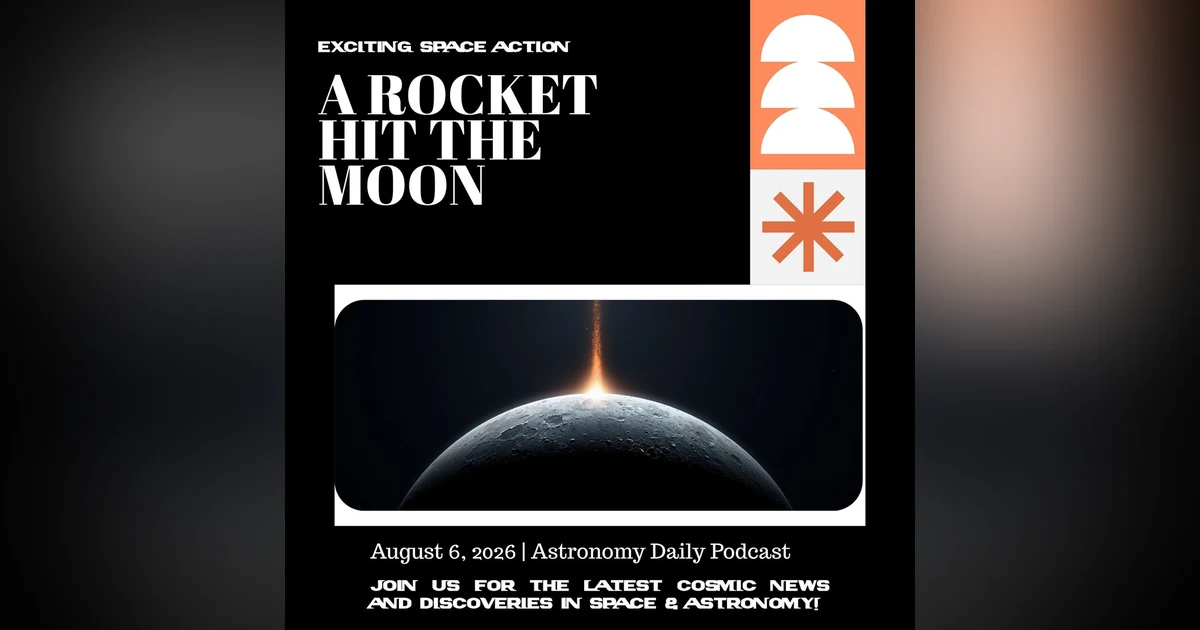
Astronomy Daily · S05E160 · 6 August 2026. In this episode: a Falcon 9 upper stage confirmed to have struck the Moon; a live ISS spacewalk; supernova SN 2026gzf caught at first light; SpaceX Crew-13 previewed; and a both-hemispheres guide to the 12 August eclipse and Perseids. FALCON 9 LUNAR IMPACT (LEAD) ● Spent upper stage 2025-010D struck near Einstein Crater (~19.4°N, 93.3°W) at ~06:35 UTC, 5 Aug 2026 — matching Bill Gray / Project Pluto predictions. ● ESO’s Very Large Telescope (Paranal) detected sodium and lithium in the impact plume for ~5–10 minutes — sodium from lunar soil, lithium likely from the rocket. ● NASA’s Lunar Reconnaissance Orbiter holds a pre-impact baseline and will image the fresh crater, giving a rare before-and-after dataset to validate hollow-body impact models for future landers. ● Origin: Falcon 9 launched 15 Jan 2025 with Firefly Blue Ghost 1 and ispace Resilience; the stage was left adrift and returned unplanned via solar activity and gravity. ● Sources: NASA; ESO / VLT; CNN; Project Pluto (projectpluto.com); Fernando et al., arXiv:2607.14625. ISS SPACEWALK — U.S. EVA 96 ● NASA’s Jessica Meir (Expedition 75 commander) and Anil Menon; ~6.5 h EVA beginning ~08:35 EDT, 6 Aug; live on NASA+. ● Task: reconfigure the 3B power channel to accept a seventh roll-out solar array later in 2026 — part of station upkeep ahead of the planned 2030 deorbit. ● Menon’s first spacewalk; two further EVAs scheduled 13 and 25 Aug. ● Sources: NASA / NASA+ ; NASA ISS blog. SUPERNOVA SN 2026GZF ● X-ray “shock breakout” (EP260321a) detected by China’s Einstein Probe on 21 Mar 2026 from a galaxy ~500 million light-years away; follow-up revealed a broad-lined Type Ic supernova. ● Unusually, no gamma-ray burst and no lasting relativistic jet — and the faintest shock breakout yet linked to this class; a possible missing link between ordinary and GRB-producing supernovae. ● Follow-up used NSF NOIRLab facilities including DECam and the Vera C. Rubin Observatory. Two teams: O’Connor et al. (CMU) and Rastinejad et al. (UMD), in ApJL. ● Sources: NSF NOIRLab; Carnegie Mellon University; The Astrophysical Journal Letters. SPACEX CREW-13 ● Targeting NET 12 Sep 2026 aboard Crew Dragon Grace from SLC-40, Cape Canaveral. ● Crew: Jessica Watkins (NASA, cmdr — first NASA astronaut to fly Dragon twice), Luke Delaney (NASA, pilot), Joshua Kutryk (CSA), Sergey Teteryatnikov (Roscosmos). 180-day stay; moved up from November. ● Sources: NASA; SpaceX; Houston Public Media. SKYWATCH — 12 AUGUST & BEYOND ● Total solar eclipse 12 Aug: totality across E Greenland, W Iceland, N Spain and NE Portugal (max 2m18s). Partial across northern US (Alaska–N Carolina), most of Canada, much of Europe and NW Africa. NASA livestream from 1:15 pm EDT. ● US partial highlights: Presque Isle ME ~29% (contiguous-US max); NYC ~9% from ~1:07 pm EDT; Boston ~16%; Toronto ~8%; Montreal ~18%; St John’s ~53%. ● Perseids peak 12–13 Aug under a new Moon (northern-favoured, up to ~100/hr from dark northern sites). ● Southern Hemisphere: pre-dawn planet parade (Saturn best, near opposition; Mars, Mercury, Uranus, Neptune), brilliant Venus in the evening west, and the winter Milky Way high overhead. ● Look-ahead: deep partial lunar eclipse 28 Aug (96% umbral), favouring the Americas. ● SAFETY: use only ISO 12312-2 certified eclipse glasses / solar filters during any partial phase. ● Sources: NASA; ESA; Sky & Telescope; BBC Sky at Night; EarthSky; timeanddate.com; The Planetary Society.
Become a supporter of this podcast: https://www.spreaker.com/podcast/astronomy-daily-latest-space-news--5648921/support.
Sponsor Details:
Ensure your online privacy by using NordVPN. To get our special listener deal and save a lot of money, visit www.astronomydaily.io/nordvpn. You'll be glad you did!
Get the best secure and private email on the planet. Stop your Government, google and who knows who else spying on every email you write. Do what we did and use ProtonMail. They beleive in privacy and there are no ads in their business model...yet they still provide a free forever service. Check them out and get out special deal at www.astronomydaily.io/protonmail
Become a supporter of Astronomy Daily by joining our Supporters Club. Commercial free episodes daily are only a click way... Click Here
This episode includes AI-generated content.
0
00:00:00.400 --> 00:00:03.160
Anna: A 4 ton piece of rocket has just
1
00:00:03.160 --> 00:00:06.160
carved a fresh crater into the Moon. And for
2
00:00:06.160 --> 00:00:08.600
once we had the telescopes pointed right at
3
00:00:08.600 --> 00:00:08.880
it.
4
00:00:09.440 --> 00:00:12.280
Avery: Sodium and lithium glowing in the plume. A
5
00:00:12.280 --> 00:00:14.920
spacewalk happening as we speak, and a star
6
00:00:14.920 --> 00:00:17.040
that died in a way nobody expected.
7
00:00:17.840 --> 00:00:20.560
Anna: Good day and welcome to Astronomy Daily.
8
00:00:20.720 --> 00:00:21.680
I'm Anna.
9
00:00:22.000 --> 00:00:24.520
Avery: And I'm avery. It's Thursday the 6th of
10
00:00:24.520 --> 00:00:27.210
August, 2026, and there is a lot of
11
00:00:27.210 --> 00:00:28.170
sky to get through.
12
00:00:28.570 --> 00:00:31.410
Anna: We lead on the Moon, we go live to the space
13
00:00:31.410 --> 00:00:34.090
station, we witness a supernova at
14
00:00:34.090 --> 00:00:36.770
first light and we meet the crew heading up
15
00:00:36.770 --> 00:00:39.530
next month. Then we point you at the sky
16
00:00:39.610 --> 00:00:42.370
north and south for what is shaping up to be
17
00:00:42.370 --> 00:00:43.930
the biggest week of the year.
18
00:00:44.650 --> 00:00:45.690
Avery: Let's get into it.
19
00:00:46.090 --> 00:00:48.530
Yesterday morning at about half past six
20
00:00:48.530 --> 00:00:51.530
Universal Time, a spent SpaceX Falcon
21
00:00:51.530 --> 00:00:53.950
9 upper stage, catalog number
22
00:00:53.950 --> 00:00:55.462
2025
23
00:00:55.798 --> 00:00:58.710
010D, slammed into the
24
00:00:58.710 --> 00:01:01.190
far western edge of the Moon, close to
25
00:01:01.190 --> 00:01:04.150
Einstein Crater, at somewhere near five and a
26
00:01:04.150 --> 00:01:06.110
half thousand kilometers an hour.
27
00:01:06.430 --> 00:01:08.430
Anna: And this is the one we flagged for you
28
00:01:08.430 --> 00:01:11.110
yesterday and said, come back tomorrow. Well,
29
00:01:11.110 --> 00:01:13.310
it's confirmed. It hit almost
30
00:01:13.470 --> 00:01:15.950
exactly where and when the independent
31
00:01:15.950 --> 00:01:17.870
tracker Bill Gray of Project
32
00:01:17.950 --> 00:01:20.760
Avery: Pluto said it would, which is the first
33
00:01:20.760 --> 00:01:23.400
remarkable thing. This wasn't a planned
34
00:01:23.400 --> 00:01:26.120
impact. Nobody steered it in. A, uh, private
35
00:01:26.200 --> 00:01:28.600
citizen with orbital mechanics software
36
00:01:28.600 --> 00:01:31.000
called the shot to within a minute or two
37
00:01:31.160 --> 00:01:33.240
days ahead, though, where
38
00:01:33.240 --> 00:01:36.040
Anna: did this thing come from? Rewind to January
39
00:01:36.280 --> 00:01:39.200
2025. A Falcon 9 lifts
40
00:01:39.200 --> 00:01:41.800
off carrying two commercial moon landers.
41
00:01:41.880 --> 00:01:44.840
Firefly's Blue Ghost, which went on to make
42
00:01:44.840 --> 00:01:47.600
the first fully successful commercial soft
43
00:01:47.600 --> 00:01:50.120
landing that March and ispace's
44
00:01:50.120 --> 00:01:51.080
resilience land.
45
00:01:51.940 --> 00:01:54.740
Avery: The upper stage does its job, flings both
46
00:01:54.740 --> 00:01:57.340
landers onto a lunar trajectory, and then
47
00:01:57.340 --> 00:01:59.780
it's just left there, out of fuel,
48
00:01:59.780 --> 00:02:02.020
adrift, and that messy gravitational
49
00:02:02.020 --> 00:02:04.420
neighborhood between the Earth and the Moon.
50
00:02:04.900 --> 00:02:07.460
Anna: And here's the physics that traps it, because
51
00:02:07.460 --> 00:02:10.260
it surprised me. For a normal mission close
52
00:02:10.260 --> 00:02:13.060
to Earth, you nudge the stage down and it
53
00:02:13.060 --> 00:02:16.020
burns up in the atmosphere. Cheap, tidy.
54
00:02:16.020 --> 00:02:18.780
But a stage that's already been flung toward
55
00:02:18.780 --> 00:02:21.340
the Moon would need almost as much fuel to
56
00:02:21.340 --> 00:02:23.800
come home safely as it took took to get out
57
00:02:23.800 --> 00:02:24.880
there in the first place.
58
00:02:25.360 --> 00:02:28.320
Avery: And that feel is long gone. So it
59
00:02:28.320 --> 00:02:31.120
drifts for 18 months until a
60
00:02:31.120 --> 00:02:33.800
mixture of solar activity and plain old
61
00:02:33.800 --> 00:02:36.760
gravity bends its path just enough to put
62
00:02:36.760 --> 00:02:39.720
it on a collision course. Now, normally,
63
00:02:39.720 --> 00:02:42.080
that's the end of the story. A dead rocket
64
00:02:42.080 --> 00:02:44.760
hits the Moon, nobody sees it, we all move
65
00:02:44.760 --> 00:02:47.640
on. But this time, astronomers turned
66
00:02:47.640 --> 00:02:48.880
it into an experiment.
67
00:02:49.120 --> 00:02:51.620
Anna: This is the part I love. The European
68
00:02:51.620 --> 00:02:54.340
Southern Observatory pointed Its Very Large
69
00:02:54.340 --> 00:02:57.060
Telescope in Chile at the impact site. And it
70
00:02:57.060 --> 00:02:59.580
caught the flash chemically in the plume
71
00:02:59.580 --> 00:03:01.740
thrown up by the collision. The telescope
72
00:03:01.740 --> 00:03:04.700
detected glowing sodium and lithium for
73
00:03:04.700 --> 00:03:07.100
something like five to ten minutes afterward.
74
00:03:07.340 --> 00:03:09.340
Avery: And the two elements tell two different
75
00:03:09.340 --> 00:03:12.140
stories. The sodium almost certainly came
76
00:03:12.140 --> 00:03:15.060
from the lunar soil, itself vaporized on
77
00:03:15.060 --> 00:03:17.740
impact, but the lithium, that most likely
78
00:03:17.740 --> 00:03:18.940
came from the rocket.
79
00:03:19.580 --> 00:03:22.140
Anna: So the telescope is effectively reading the
80
00:03:22.140 --> 00:03:24.700
wreck's chemistry from 400,000
81
00:03:24.780 --> 00:03:27.620
kilometers away. You're watching a rocket
82
00:03:27.620 --> 00:03:30.420
cremate itself into the moon and picking out
83
00:03:30.420 --> 00:03:31.980
the ingredients in the smoke.
84
00:03:32.540 --> 00:03:34.940
Avery: And then NASA steps in for the long game.
85
00:03:35.179 --> 00:03:37.420
Their Lunar Reconnaissance Orbiter had
86
00:03:37.420 --> 00:03:39.420
already photographed this patch of ground
87
00:03:39.500 --> 00:03:41.980
before the impact. A clean before
88
00:03:42.140 --> 00:03:42.620
shot.
89
00:03:43.020 --> 00:03:45.540
Anna: And over the coming weeks, it'll go back and
90
00:03:45.540 --> 00:03:48.140
photograph the fresh crater, maybe 20
91
00:03:48.140 --> 00:03:50.020
meters across for the after.
92
00:03:50.820 --> 00:03:52.900
Avery: Which gives scientists something they almost
93
00:03:52.980 --> 00:03:55.860
never get. A known object of known
94
00:03:55.860 --> 00:03:58.700
mass hitting at known speed in
95
00:03:58.700 --> 00:04:01.540
known spot with pictures of the ground before
96
00:04:01.540 --> 00:04:02.340
and after.
97
00:04:02.980 --> 00:04:05.780
Anna: And that matters well beyond this one rock.
98
00:04:06.100 --> 00:04:08.540
Engineers have computer models that predict
99
00:04:08.540 --> 00:04:11.460
how a hollow human made object deforms
100
00:04:11.460 --> 00:04:14.370
the ground when it hits. Up to now, those
101
00:04:14.370 --> 00:04:17.130
models have been mostly untested against a
102
00:04:17.130 --> 00:04:18.570
real measured impact.
103
00:04:18.970 --> 00:04:21.850
Avery: This is the calibration. Every future lunar
104
00:04:21.850 --> 00:04:24.490
lander team, NASA's Artemis crews, the
105
00:04:24.490 --> 00:04:26.970
commercial landers, they all need to know how
106
00:04:26.970 --> 00:04:29.970
the surface behaves and how far debris flies
107
00:04:29.970 --> 00:04:32.930
to work out safe landing margins. This crater
108
00:04:32.930 --> 00:04:34.490
helps write those numbers down.
109
00:04:34.650 --> 00:04:36.930
Anna: There's a bigger conversation underneath it
110
00:04:36.930 --> 00:04:39.870
too, isn't there? The space junk. One this
111
00:04:39.870 --> 00:04:42.070
was accidental, harmless in the sense that
112
00:04:42.070 --> 00:04:43.990
nobody was hurt and no satellites were
113
00:04:43.990 --> 00:04:46.230
threatened. But it's a reminder that we are
114
00:04:46.230 --> 00:04:48.150
now leaving hardware scattered through the
115
00:04:48.150 --> 00:04:49.470
whole Earth Moon system.
116
00:04:49.710 --> 00:04:52.350
Avery: It even nudges into space law and believe it
117
00:04:52.350 --> 00:04:55.030
or not, space archaeology, how we treat what
118
00:04:55.030 --> 00:04:57.230
we leave up there. But for today, the
119
00:04:57.230 --> 00:04:59.670
headline is the good news version. A piece of
120
00:04:59.670 --> 00:05:02.310
junk became a free science experiment and the
121
00:05:02.310 --> 00:05:03.630
observatories were ready.
122
00:05:03.710 --> 00:05:06.070
Anna: A rocket that delivered two landers to the
123
00:05:06.070 --> 00:05:08.750
moon 18 months ago finally arrived itself
124
00:05:09.310 --> 00:05:10.990
the hard way, right on schedule,
125
00:05:11.150 --> 00:05:13.350
Avery: from the moon back to low Earth orbit.
126
00:05:13.350 --> 00:05:15.630
Because as we speak, two astronauts are
127
00:05:15.630 --> 00:05:17.790
outside the International Space Station.
128
00:05:17.870 --> 00:05:20.270
Anna: This is US Spacewalk 96,
129
00:05:20.510 --> 00:05:22.990
NASA's Jessica Mair, the station commander,
130
00:05:22.990 --> 00:05:25.430
and Anil Menon went out the hatch this
131
00:05:25.430 --> 00:05:28.110
morning around 8:35 Eastern in the United
132
00:05:28.110 --> 00:05:30.870
States for a spacewalk expected to run about
133
00:05:30.870 --> 00:05:33.870
six and a half hours, streaming live on NASA
134
00:05:34.030 --> 00:05:34.990
as we go to air.
135
00:05:34.990 --> 00:05:37.630
Avery: And the job is genuinely important, if not
136
00:05:37.630 --> 00:05:39.590
glamorous. They're modifying one of the
137
00:05:39.590 --> 00:05:41.810
station's power channels so it can accept A
138
00:05:41.810 --> 00:05:44.250
new rollout solar array later this year,
139
00:05:44.330 --> 00:05:46.690
which is the station investing in itself for
140
00:05:46.690 --> 00:05:49.650
its final act. The ISS is now slated for
141
00:05:49.650 --> 00:05:52.650
a controlled D orbit around 2030. And
142
00:05:52.650 --> 00:05:54.770
these power upgrades keep it healthy and
143
00:05:54.770 --> 00:05:56.170
productive right to the end.
144
00:05:56.170 --> 00:05:58.930
Anna: Now, the human story here is lovely for Anil
145
00:05:58.930 --> 00:06:01.730
Menon. This is his very first spacewalk, and
146
00:06:01.730 --> 00:06:03.810
Avery: his path here is remarkable. He's a
147
00:06:03.810 --> 00:06:06.170
physician, an emergency medicine doctor who
148
00:06:06.170 --> 00:06:08.250
was a first responder after the earthquakes
149
00:06:08.250 --> 00:06:10.600
in Haiti and in Nepal. He was also
150
00:06:10.600 --> 00:06:13.600
SpaceX's very first flight surgeon before he
151
00:06:13.600 --> 00:06:16.320
joined NASA's astronaut class. The person who
152
00:06:16.320 --> 00:06:18.560
signed off that crews were medically fit to
153
00:06:18.560 --> 00:06:19.360
fly, and he
154
00:06:19.360 --> 00:06:21.400
Anna: only arrived at the station a few weeks ago
155
00:06:21.400 --> 00:06:24.160
on a Soyuz in mid July. And there's a
156
00:06:24.160 --> 00:06:26.840
nice family footnote. His wife, Anna Menon,
157
00:06:26.840 --> 00:06:28.880
flew on the Polaris dawn mission back in
158
00:06:28.880 --> 00:06:31.520
2024, the flight that carried out the first
159
00:06:31.520 --> 00:06:32.680
commercial spacewalk.
160
00:06:32.760 --> 00:06:35.240
Avery: So spaceflight really is the family business.
161
00:06:35.480 --> 00:06:37.800
We'll keep an eye on how the EVA wraps up.
162
00:06:38.110 --> 00:06:39.990
And there are two more of these spacewalks
163
00:06:39.990 --> 00:06:42.750
coming this month on the 13th and the 25th.
164
00:06:43.230 --> 00:06:45.430
Now to something that only happens if you're
165
00:06:45.430 --> 00:06:48.070
very quick and a little lucky. Astronomers
166
00:06:48.070 --> 00:06:50.750
have caught a massive star at the very first
167
00:06:50.750 --> 00:06:51.950
instant of its death.
168
00:06:52.030 --> 00:06:54.630
Anna: This dropped today, two research teams
169
00:06:54.630 --> 00:06:56.990
publishing together. And it starts back in
170
00:06:56.990 --> 00:06:59.950
March, when China's Einstein probe and X ray
171
00:06:59.950 --> 00:07:02.750
telescope spotted a brief flash of soft X
172
00:07:02.750 --> 00:07:05.510
rays from a galaxy about 500 million light
173
00:07:05.510 --> 00:07:06.030
years away.
174
00:07:06.190 --> 00:07:08.190
Avery: Within the hour, telescopes on the ground
175
00:07:08.190 --> 00:07:10.290
swung around to look and watch watched a
176
00:07:10.290 --> 00:07:12.770
supernova rapidly brighten. It's now
177
00:07:12.770 --> 00:07:14.010
cataloged as SN
178
00:07:14.070 --> 00:07:16.570
M2026GZF.
179
00:07:16.730 --> 00:07:19.610
Anna: And that opening X ray flash has a name,
180
00:07:19.850 --> 00:07:22.810
the Shock Breakout. Picture the core
181
00:07:22.810 --> 00:07:25.410
of a giant star collapsing. That
182
00:07:25.410 --> 00:07:27.930
launches a shock wave that tears outward
183
00:07:27.930 --> 00:07:30.330
through the star. And the breakout is the
184
00:07:30.330 --> 00:07:33.010
instant that wave finally bursts through the
185
00:07:33.010 --> 00:07:36.010
surface. First light the starting gun,
186
00:07:36.340 --> 00:07:36.820
and it's
187
00:07:36.820 --> 00:07:39.700
Avery: fiendishly hard to catch. It lasts seconds to
188
00:07:39.700 --> 00:07:42.500
hours. And in 20 years, astronomers have only
189
00:07:42.500 --> 00:07:45.340
clearly bagged a couple in X rays. So
190
00:07:45.340 --> 00:07:47.500
having two teams capture this one from the
191
00:07:47.500 --> 00:07:49.620
first flash onward is a real event.
192
00:07:49.700 --> 00:07:52.020
Anna: But here's the twist, and it's a good one.
193
00:07:52.179 --> 00:07:54.830
This was a particular kind of supernova, A,
194
00:07:54.830 --> 00:07:57.540
uh, broad, lined type 1C. That
195
00:07:57.540 --> 00:08:00.340
family usually comes with fireworks. Narrow
196
00:08:00.340 --> 00:08:02.540
jets of material moving near the speed of
197
00:08:02.540 --> 00:08:05.180
light and often a, uh, gamma ray burst. The
198
00:08:05.180 --> 00:08:07.060
brightest explosions in the universe.
199
00:08:07.340 --> 00:08:10.100
Avery: This one had none of that. No gamma ray
200
00:08:10.100 --> 00:08:13.060
burst, no lasting jet, and the faintest
201
00:08:13.060 --> 00:08:15.900
opening X ray flash ever tied to this type.
202
00:08:15.980 --> 00:08:17.940
Even though the explosion itself was
203
00:08:17.940 --> 00:08:18.460
Powerful,
204
00:08:18.620 --> 00:08:21.500
Anna: which makes it uh, a kind of missing link. An
205
00:08:21.500 --> 00:08:23.940
explosion that looks like the jet and gamma
206
00:08:23.940 --> 00:08:26.700
ray crowd in visible light but behaves like a
207
00:08:26.700 --> 00:08:29.660
quieter cousin at higher energies. It hints
208
00:08:29.660 --> 00:08:31.820
there's more than one way for a massive star
209
00:08:31.820 --> 00:08:32.300
to go.
210
00:08:32.540 --> 00:08:34.780
Avery: And a nice detail for the telescope nerds
211
00:08:34.780 --> 00:08:37.569
among us. The follow up leaned on the big US
212
00:08:37.649 --> 00:08:39.969
survey facilities, including the brand new
213
00:08:39.969 --> 00:08:42.809
Vera Rubin Observatory. Exactly the kind
214
00:08:42.809 --> 00:08:45.649
of fast all sky work these observatories
215
00:08:45.649 --> 00:08:46.369
were built for.
216
00:08:46.449 --> 00:08:48.929
Anna: For our next story, let's head Back to the
217
00:08:48.929 --> 00:08:51.889
ISS. Let's meet the crew heading up next.
218
00:08:52.289 --> 00:08:55.203
NASA and SpaceX are now targeting 12
219
00:08:55.335 --> 00:08:58.249
September for Crew 13 flying up on
220
00:08:58.249 --> 00:09:00.929
the Dragon capsule named Grace or
221
00:09:00.929 --> 00:09:01.409
aboard
222
00:09:01.730 --> 00:09:03.880
Avery: Commander Jessica Watkins of NASA, a uh,
223
00:09:03.930 --> 00:09:06.330
geologist. And this is a milestone for her.
224
00:09:06.330 --> 00:09:08.930
She becomes the first NASA astronaut to fly
225
00:09:08.930 --> 00:09:11.570
on Dragon twice alongside her
226
00:09:11.570 --> 00:09:12.050
pilot
227
00:09:12.050 --> 00:09:14.930
Anna: Luke Delaney, a uh, former naval aviator
228
00:09:15.010 --> 00:09:17.410
and this will be his first trip to space.
229
00:09:18.130 --> 00:09:20.930
Then Joshua Kutryk of the Canadian Space
230
00:09:20.930 --> 00:09:23.850
Agency, a fighter pilot, and Sergey
231
00:09:23.850 --> 00:09:26.770
Tetteryatnikov of Roscosmos, a former
232
00:09:26.850 --> 00:09:29.810
submariner, both also flying for the very
233
00:09:29.810 --> 00:09:30.450
first time.
234
00:09:30.530 --> 00:09:33.500
Avery: It's a 180 day stay and it's worth
235
00:09:33.500 --> 00:09:35.540
noting the mission was actually moved earlier
236
00:09:35.700 --> 00:09:38.580
from November into September as NASA
237
00:09:38.580 --> 00:09:40.820
pushes to lift its launch cadence across the
238
00:09:40.820 --> 00:09:41.140
board.
239
00:09:41.300 --> 00:09:43.700
Anna: And for our North American listeners, one
240
00:09:43.700 --> 00:09:46.540
very on brand detail from the briefing. When
241
00:09:46.540 --> 00:09:48.540
the crew rolls out to the pad, they'll be
242
00:09:48.540 --> 00:09:50.620
riding in cybertrucks only
243
00:09:50.620 --> 00:09:53.060
Avery: in this era of spaceflight. We'll bring you
244
00:09:53.060 --> 00:09:54.180
the launch when it's locked.
245
00:09:54.500 --> 00:09:57.060
And that brings us to the sky because next
246
00:09:57.060 --> 00:09:59.500
Wednesday 12 August is the biggest, biggest
247
00:09:59.500 --> 00:10:02.020
sky watching day of the year. And it deserves
248
00:10:02.020 --> 00:10:04.140
a proper look for both halves of the planet.
249
00:10:04.220 --> 00:10:05.980
Anna: Two headline events land almost
250
00:10:06.940 --> 00:10:09.780
first, a uh, total solar eclipse. The moon's
251
00:10:09.780 --> 00:10:12.260
shadow sweeps down over the Arctic, across
252
00:10:12.260 --> 00:10:14.700
eastern Greenland and western Iceland and
253
00:10:14.700 --> 00:10:17.180
then across northern Spain and a corner of
254
00:10:17.180 --> 00:10:20.020
Portugal. That narrow path of totality is
255
00:10:20.020 --> 00:10:22.980
the only place the sun goes fully dark, up to
256
00:10:22.980 --> 00:10:25.680
2 minutes and 18 seconds of it. It's the
257
00:10:25.680 --> 00:10:27.960
first total eclipse over mainland Europe
258
00:10:28.040 --> 00:10:29.320
since 1999.
259
00:10:29.640 --> 00:10:31.960
Avery: Now for our audience in North America, you
260
00:10:31.960 --> 00:10:34.560
are not in the path of totality but much of
261
00:10:34.560 --> 00:10:36.440
the north gets ah, a partial eclipse. And
262
00:10:36.440 --> 00:10:38.840
here are your details. It runs across the
263
00:10:38.840 --> 00:10:41.400
afternoon of the 12th. The deepest bite in
264
00:10:41.400 --> 00:10:44.200
the lower 48 is up in northern Maine, around
265
00:10:44.200 --> 00:10:47.040
29% of the sun covered near Presque Isle
266
00:10:47.040 --> 00:10:49.680
just after 2pm Eastern New York sees
267
00:10:49.680 --> 00:10:52.040
Anna: a uh, modest partial, roughly 9%
268
00:10:52.570 --> 00:10:55.410
starting near 1:07 in the afternoon Eastern
269
00:10:55.410 --> 00:10:57.930
Time. Boston about 16%
270
00:10:58.250 --> 00:11:00.930
Bangor, around 24%. Head into
271
00:11:00.930 --> 00:11:03.410
Canada and it grows Montreal near
272
00:11:03.410 --> 00:11:06.250
18%, and St. John's in Newfoundland,
273
00:11:06.250 --> 00:11:08.890
over half the sun covered. West of the Great
274
00:11:08.890 --> 00:11:11.810
Lakes, though Chicago and beyond, it fades
275
00:11:11.810 --> 00:11:13.050
to essentially nothing.
276
00:11:13.290 --> 00:11:15.410
Avery: And, um, if you're not in the partial zone at
277
00:11:15.410 --> 00:11:18.330
all, NASA streams the whole thing live from
278
00:11:18.330 --> 00:11:19.930
1:15pm Eastern.
279
00:11:20.230 --> 00:11:23.230
Anna: And this is the line we never cut. A partial
280
00:11:23.230 --> 00:11:25.350
eclipse is never safe to look at with the
281
00:11:25.350 --> 00:11:28.110
naked eye. You must use certified eclipse
282
00:11:28.110 --> 00:11:30.750
glasses or a safe solar filter that meets the
283
00:11:30.750 --> 00:11:33.550
ISO 123122
284
00:11:33.550 --> 00:11:36.430
standard. Every moment the sun is even partly
285
00:11:36.430 --> 00:11:39.190
uncovered, a, um, 99% covered sun
286
00:11:39.190 --> 00:11:42.110
can still burn your eyes. Only inside the
287
00:11:42.110 --> 00:11:44.830
path of totality. And only during those brief
288
00:11:44.830 --> 00:11:46.950
seconds of total darkness can you look
289
00:11:46.950 --> 00:11:47.670
unaided.
290
00:11:48.030 --> 00:11:50.310
Avery: The second headline is a gift to the whole
291
00:11:50.310 --> 00:11:53.070
planet. Though it leans north, the Perseid
292
00:11:53.070 --> 00:11:55.390
meteor shower peaks the Same night, the 12th
293
00:11:55.390 --> 00:11:58.390
into the 13th. And this year it peaks under a
294
00:11:58.390 --> 00:12:00.910
new moon. No moonlight to wash them out.
295
00:12:01.070 --> 00:12:03.510
Anna: Dark, perfect skies for the northern
296
00:12:03.510 --> 00:12:06.310
hemisphere. That could mean up to 100 meteors
297
00:12:06.310 --> 00:12:09.030
an hour from a dark site. Now, honestly,
298
00:12:09.030 --> 00:12:11.590
southern friends, the Perseids are a northern
299
00:12:11.590 --> 00:12:14.110
shower. The point they radiate from barely
300
00:12:14.110 --> 00:12:16.590
clears our horizon, so we see very few.
301
00:12:17.100 --> 00:12:18.300
I won't oversell it.
302
00:12:18.540 --> 00:12:20.620
Avery: So what does the southern hemisphere get?
303
00:12:20.860 --> 00:12:23.380
Quite a lot, actually. Look before dawn and
304
00:12:23.380 --> 00:12:25.740
there's a planet parade strung along the sky.
305
00:12:25.980 --> 00:12:28.340
Saturn is superb right now, riding high and
306
00:12:28.340 --> 00:12:30.940
heading towards opposition. Mars is up there
307
00:12:30.940 --> 00:12:33.820
too, with Mercury low and Uranus and Neptune
308
00:12:33.820 --> 00:12:36.300
for those with binoculars and a telescope.
309
00:12:36.460 --> 00:12:38.940
Anna: And Venus is the jewel of the evening,
310
00:12:39.180 --> 00:12:41.260
brilliant in the western twilight after
311
00:12:41.260 --> 00:12:44.180
sunset and actually better placed for us in
312
00:12:44.180 --> 00:12:46.540
the south than for far northern viewers.
313
00:12:47.170 --> 00:12:49.650
Add the winter Milky Way overhead here in
314
00:12:49.650 --> 00:12:52.450
Australia, Scorpius and Sagittarius
315
00:12:52.450 --> 00:12:55.290
blazing, and it's a glorious few weeks of
316
00:12:55.290 --> 00:12:56.050
stargazing
317
00:12:56.450 --> 00:12:58.650
Avery: and one to circle for the Americas,
318
00:12:58.650 --> 00:13:01.130
especially north and south. On
319
00:13:01.130 --> 00:13:03.850
28 August, a deep partial lunar
320
00:13:03.850 --> 00:13:06.850
eclipse with 96% of the moon sliding
321
00:13:06.850 --> 00:13:09.730
into Earth's shadow. Very nearly a total
322
00:13:09.810 --> 00:13:12.170
blood moon. And it favors the whole of the
323
00:13:12.170 --> 00:13:12.690
Americas.
324
00:13:13.470 --> 00:13:16.190
Anna: So wherever you are, get outside this week.
325
00:13:16.590 --> 00:13:18.910
And that's the show for today. A rocket
326
00:13:18.910 --> 00:13:21.550
arrived at the moon, a star showed us its
327
00:13:21.550 --> 00:13:24.110
first light, and there are astronauts outside
328
00:13:24.190 --> 00:13:25.790
the station as you listen.
329
00:13:26.190 --> 00:13:28.470
Avery: Full links and sources are in your show notes
330
00:13:28.470 --> 00:13:31.430
and over at astronomydaily IO and you
331
00:13:31.430 --> 00:13:33.430
can find us anywhere you get your podcasts
332
00:13:33.430 --> 00:13:36.190
and on socials. Astrodaily Pod,
333
00:13:36.430 --> 00:13:37.630
we're back tomorrow.
334
00:13:37.710 --> 00:13:40.520
Anna: Until then, from Anna and Avery
335
00:13:40.840 --> 00:13:42.680
and clear, uh, skies.


