#73: Think Like a CEO 🧠 – The Science Behind Smart Business Decisions
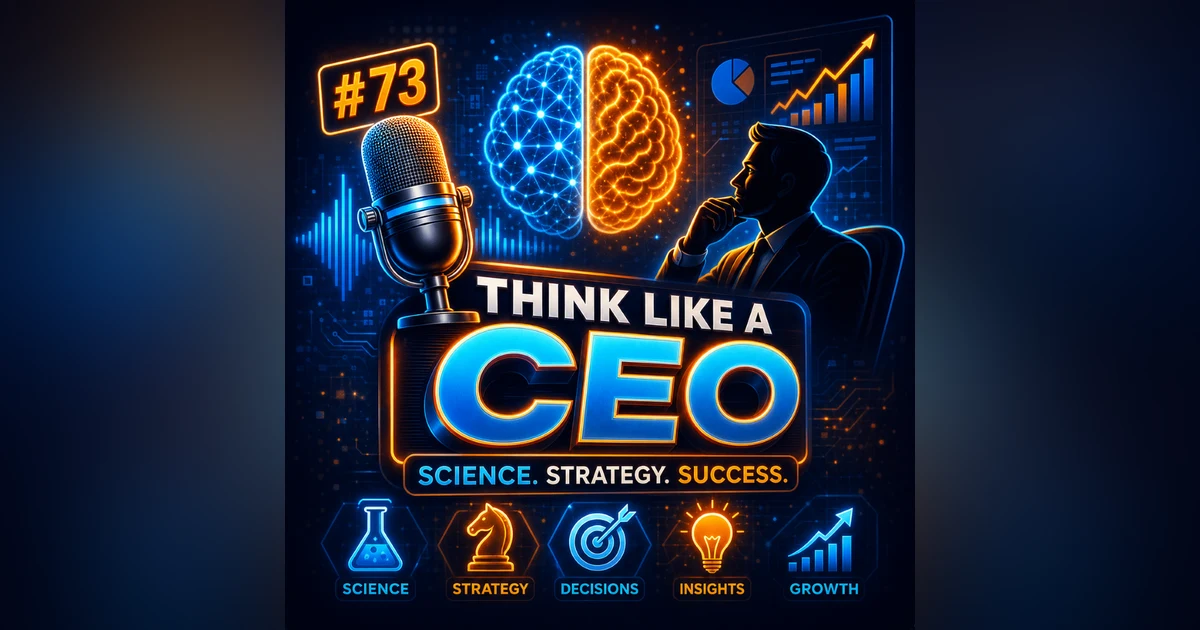


Every single business outcome you can point to — whether it's a spike in revenue or a failed product launch — started as a choice. But despite the myth of the perfectly rational entrepreneur, our decisions are heavily influenced by a complex web of emotions, cognitive biases, and past experiences. In this episode of the Smart Entrepreneur Show, we dive deep into the science of decision-making. We explore why "intuition" is actually just rapid pattern recognition, how the desire for perfect certainty leads directly to analysis paralysis, and how you can use a simple 5-question framework to strip the emotion out of your highest-stakes choices. Timestamps Timestamp Topic 00:00 Introduction — why business success is determined by the quality of your decisions 00:44 The myth of the perfectly rational entrepreneur: emotions, biases, and past experience 02:37 Data vs. intuition — why they aren't opposing forces but complementary tools 03:39 The GPS analogy: data is the map, intuition navigates the unexpected road closure 04:20 Intuition as rapid pattern recognition: your brain doing the math without you knowing 05:49 Analysis paralysis: when the desire for perfect certainty becomes a paralyzing force 06:31 The pilot analogy: you are losing altitude while waiting for the perfect weather report 07:51 When does research become productive procrastination? The utility test 08:50 Using research as a hiding place — the uncomfortable truth 09:03 The 80/20 rule for cognitive bandwidth: protect your mental energy for the 20% that matters 10:14 The three psychological traps: confirmation bias, loss aversion, and short-term thinking 12:37 How awareness interrupts bias: naming the trap out loud forces it into your prefrontal cortex 13:47 The 5-question framework: a practical toolkit for high-stakes decisions 14:07 Q1 — What is the goal? (defining the North Star before you move) 14:38 Q2 — What are the possible outcomes? (mapping best, realistic, and worst case) 14:52 Q3 — What is the downside risk? (reversible vs. irreversible choices) 15:26 Q4 — What information am I missing? (the "murder board" technique) 16:09 Q5 — What happens if I wait? (strategic waiting vs. fear-based delay) 17:39 Post-decision mindset: reframing failure as pristine empirical data 18:27 The scientist metaphor: hypothesis disproven is not a moral failure 19:15 The singular philosophy: the goal is not perfection — the goal is momentum 19:55 Final thought: what if you actively tried to make a wrong decision faster? Contact & Resources Listen to this episode on Podbean: smartentrepreneur.podbean.com Explore more podcasts: Find all podcasts at the PodFather Network Website: RoyCoughlan.com Need help running your business? If you are looking for a Virtual Assistant and get reliable support for your daily operations. Virtual Assistants: VA.world Communities: BrainGym.fitness Learn about a Private Networking Group in 50 US States & 39 Countries with 640+ Members: connectedleaders.academy #SmartEntrepreneurShow #DecisionMaking #BusinessStrategy #Entrepreneurship #CEO #Leadership #CognitiveBias #Productivity #BusinessGrowth #StartupTips #RoyCoughlan #PodFatherNetwork #VAWorld #BrainGymFitness #SmartEntrepreneur
Welcome to the smart entrepreneurs show the podcast, where we share smart ideas, strategies, and lessons to help entrepreneurs build better businesses. Every day in business, we make decisions. Some are small, what content to post, what tasks to prioritize or which meeting to attend.
Others are life-changing, launching a new product, hiring a team member, investing money, or entering a new market. The truth is that business success is often determined not by how hard you work, but by the quality of the decisions you make. In today's episode, we're diving into the science of decision-making in business and exploring how successful entrepreneurs make smarter, faster, and more effective decisions.
Let's get started. Yeah. And to really get into this, we're doing a deep dive into a really fascinating source today.
Exactly. We're looking at the entrepreneur's blueprint for strategic decision-making. And I mean, the mission for you listen today is really to decode how we make choices.
Like how do we actually build a practical toolkit so you can make better ones? Because it really is the bedrock of everything. I mean, every single business outcome you can point to, you know, whether it's on a balance sheet or a quarterly review, it all starts with a choice. Right.
It's the starting line. Exactly. And the source makes it clear that good decisions are basically the ultimate force multiplier.
They save time, they drastically reduce your risk, and they open up entirely new avenues for growth. While the bad ones do the exact opposite. Oh, absolutely.
Poor or delayed decisions just lead to this, like, cascade of wasted resources, missed opportunities that your competitors will just easily scoop up. So if we accept that every outcome hinges on our choices, we first have to, you know, look at the mechanics of how we're actually making them. Right.
The actual process. Yeah. Because there is this enduring myth in business culture of the perfectly rational entrepreneur.
I mean, we all picture someone sitting in this pristine glass boardroom armed with giant spreadsheets, right? Oh, yeah. Just calculating the exact mathematical probability of success, like some kind of emotionless machine. Right.
And it is a comforting image because it implies that we have total control. But cognitive psychology paints a vastly different picture of what's actually happening in that boardroom. The reality is that our decisions are heavily influenced by, well, a really complex web of emotions, cognitive biases and deeply ingrained past experiences.
We aren't robots. No, not at all. And the most successful founders aren't the ones who pretend they operate entirely on pure logic.
They're the ones who actually recognize their own biological hardware and actively strive to inject objectivity into their processes. Which naturally introduces, you know, one of the oldest debates in business. Do you trust the hard data or do you trust your gut? The classic showdown, data versus intuition.
Exactly. Because we constantly hear about founders who followed a hunch and built an empire, right? But we equally hear about founders who totally ignored the data and crashed their companies into the ground. Yeah.
And the blueprint points out that framing them as opposing forces is actually the very first mistake we make. Oh, really? So they aren't opposites? Not at all. They serve entirely different complementary functions.
So data is basically a tool to reduce uncertainty. OK. It provides the parameters of reality like your cash flow, your customer acquisition cost, your market size.
But the thing is, perfect, comprehensive data almost never exists in a dynamic market. Right. You're always missing something.
Exactly. So experience and intuition have to step in to bridge the gap when that information is incomplete. That makes total sense.
It's kind of like a GPS system in your car. Oh, I like that. How so? Well, the data is the map and the traffic report, right? It tells you where the roads are.
But your intuition is your actual ability to take the wheel and navigate the back roads when an unexpected road closure suddenly happens and the GPS is just buffering. That is a perfect way to look at it. Top entrepreneurs combine the facts with that informed judgment.
Well, wait, let me push back on that for a second. Because aren't founders constantly told to, you know, do their homework and know their numbers? If intuition is just taking the wheel when the numbers run out, how do we know we aren't just using the word intuition as a fancy, socially acceptable justification for just guessing? Ah, yeah, that is the line between a seasoned professional and a reckless gambler. Because real intuition is not random guessing.
And it's not mystical either. It's not just a magic feeling. No, from a neurological standpoint, intuition is just rapid pattern recognition.
OK, unpack that a bit. So it's your brain instantaneously accessing this massive subconscious database of your past experiences, your past failures, market observations, interactions you've had. Wow.
All running in the background. Right. Before your conscious prefrontal cortex can even put a sentence together, your deeper brain structures are already matching the current situation to a known pattern.
So it's basically doing the math without you knowing it. Exactly. So when an experienced entrepreneur gets a bad feeling about a seemingly perfect partnership, it's often their brain recognizing subtle red flags.
Like what? Maybe a slight discrepancy in how the potential partner answers a question. And that mirrors a toxic deal they experienced like a decade ago. Wow.
So intuition is essentially compressed experience acting as an early warning system. Yes, exactly. That shifts the perspective entirely.
So for you listening right now, think about the last major pivotal choice you made in your business. Were you actually driven by that financial model you spent three days building? Or was there a past success or maybe a particularly painful failure that was secretly guiding your hand the entire time? It's crucial to recognize that hidden influence, because once we realize we're relying on a mix of incomplete data and subconscious pattern recognition, a new vulnerability pops up, which is we become deeply uncomfortable with the uncertainty of that combination. We want the data to be 100 percent conclusive and we want our gut to feel 100 percent confident.
Oh, I know that feeling. And when neither of those things hit 100 percent, we freeze. Yeah.
The blueprint identifies this as analysis paralysis. The desire for perfect certainty literally becomes a paralyzing force. And what's the real cost of that? The cost of this paralysis is often far worse than the cost of a flawed decision.
Founders will delay taking action out of this deep seated fear of making a mistake. What does that look like in practice? Oh, the symptoms are easily recognizable. Endless overthinking, requesting just, you know, one more market report, scheduling another round of focus groups, basically using information gathering as a shield.
Yeah, it reminds me of a pilot dealing with an emergency in the air. OK, yeah. If a flashing warning light comes on and the plane is actively losing altitude, the pilot cannot spend three hours cross-referencing maintenance manuals to diagnose the exact electrical fault.
Right. They just don't have the time. Exactly.
They have to make a choice to land based on imperfect data. Business moves the exact same way. You are losing altitude while you wait for the perfect weather report.
Or it's like standing at a crosswalk waiting for every single traffic light in the entire city to turn green before you take your first step. You'll literally never cross the street. That analogy perfectly captures the stakes.
The business landscape shifts constantly. The blueprint emphasizes that perfect information is just an illusion. Because things change too fast.
Right. By the time you gather all the data on a market trend, the trend has already passed. The biggest risk is not making a bad choice.
It's making no choice at all and letting the market decide your fate for you. But wait, let's get real for a second. How do we operationalize that? Founders are explicitly trained to do their due diligence, right? So at what exact point does responsible research cross the line and become analysis paralysis? That's a great question.
The distinction lies entirely in the utility of the new information you're seeking. The utility, meaning how useful it is. Exactly.
Research crosses the line into paralysis when the new data no longer has the power to fundamentally change your available options. Oh, interesting. Can you give me an example? Sure.
Imagine you're deciding between two software platforms to run your company. You've gathered enough data to know they're both viable. They both fit the budget and, you know, they both have minor flaws.
The usual pros and cons. Right. Reading 20 more user reviews on some forum isn't going to suddenly introduce a magical third platform, nor will it drastically alter the profiles of the first two.
It won't change the baseline facts. Nope. So at that point, you are no longer researching.
You are practicing productive procrastination. You're basically using the act of gathering information to delay the psychological discomfort of actually committing to a path. Wow.
You were using research as a hiding place. Exactly. That is an uncomfortable truth for a lot of us.
So if we acknowledge we are hiding, how do we step out? How do we actually break this cycle of paralysis? Well, it begins with rationing our cognitive resources. We have to filter the noise. Okay.
How so? The blueprint argues that a massive source of decision fatigue comes from treating all decisions as if they carry equal weight. We need to apply a concept most founders already know, but they rarely apply it to their own psychology. Let me guess.
The 80-20 rule. You got it. The Pareto principle.
Okay. We all know the 80-20 rule for our sales pipelines, right? Yeah. Like 80 percent of revenue comes from 20 percent of clients.
But applying it to cognitive bandwidth, that is a really fascinating pivot. But it's essential for survival. Look, your brain has a finite amount of energy to expend on decision making each day.
You need to fiercely protect that energy for the 20 percent of decisions that will actually dictate 80 percent of your business results. That makes sense. Agonizing over the color scheme of a new marketing flyer depletes the exact same cognitive reserves you need to negotiate a commercial lease.
Wow. The brain doesn't know the difference. It really doesn't.
If you don't ruthlessly filter out the minor choices by delegating them, automating them, or just making a fast, good enough call, you will literally have nothing left in the tank for the choices that actually move the needle. Okay. So we aggressively clear our plates of the low stakes decisions.
But even when we successfully focus our mental energy exclusively on those high stakes 20 percent decisions, our brains are still actively trying to trick us. Right. Oh, absolutely.
We're still vulnerable to the psychological traps the blueprint lays out. For sure. The blueprint highlights three major cognitive biases that derail strategic choices.
And the first one is confirmation bias. Oh, the classic. Yeah.
This occurs when you make a subconscious decision based on that intuition we discussed earlier, but then you exclusively seek out data that supports that existing belief. Simultaneously, you actively ignore, dismiss or rationalize away any information that contradicts you. It's the equivalent of Googling a highly specific phrase until you finally find a single article on page four of the search results that agrees with your terrible idea.
And then you proudly declare to your team that the research backs me up. Yes, we've all seen that happen. And we do this because the brain is a cognitive miser.
Yeah. It literally burns biological calories to update our worldview or admit we're wrong. It is far more energy efficient for the brain to just filter out contradictory data than to process it and change course.
That's wild. OK, what's the second trap? The second trap is the fear of failure, which in behavioral economics is tied to loss aversion. The psychological pain of losing $10,000 is mathematically proven to feel significantly more intense than the joy of gaining $10,000.
So the sting of a loss is worse than the high of a win. Exactly. Because of this, founders will actively avoid high potential opportunities, opting to just maintain the status quo just to avoid the possibility of a misstep.
They end up playing not to lose instead of playing to win. Man, that leads directly into the third trap, doesn't it? Short term thinking. The tendency to choose an immediate quick win over sustainable long term growth.
Oh, I have a question about this one. Go for it. If humans naturally seek immediate relief, like we want the dopamine hit right now, we want the quarterly stress to vanish right now.
Aren't we biologically hardwired for this? How can a founder reasonably fight their own evolutionary programming in the middle of a chaotic Tuesday? That is the million dollar question. We are indeed fighting millennia of evolutionary programming designed for immediate survival rather than long term strategic planning. Right.
However, cognitive science suggests that awareness is actually the most effective override. Just being aware of it. Yeah.
You cannot out evolve your brain's automatic responses, but you can interrupt them. The blueprint suggests that simply naming the bias out loud when it happens strips it of its subconscious power. Give me an example of how that sounds.
Sure. If you're about to discount your premium product just to hit a monthly quota, saying out loud, I am leaning toward this discount for immediate stress relief, but it will permanently damage our brand equity. This is short term thinking.
Doing that forces the decision out of your reactive amygdala and into your logical prefrontal cortex. It artificially creates the space you need for rational thought. It's a mechanism for catching yourself in the act.
So for you listening, try auditing your day to day. Are you accidentally burning 80 percent of your precious mental energy on trivial decisions? And when a big choice does cross your desk, are you actively filtering out the data that tells you you might be wrong? And, you know, once you've audited that energy and cleared out the minor decisions and neutralize those biases as well, then you're left staring down the actual high stakes choice. A big one.
The big one. And this is where the blueprint transitions from theory to a highly practical toolkit. It provides a five question framework.
Nice. Yeah. Before committing to any major strategic move, founders should pause and run the scenario through these five specific filters.
Let's break down the mechanics of this framework, because this is where the actual work happens. What's question one? Question one is, what is the goal? That seems almost too basic. It sounds almost insultingly simple, I know.
But the number of complex business decisions made without explicitly defining the desired outcome is staggering. People just move without a target. Exactly.
Are you launching a new feature to acquire new users or to retain existing ones? Because those are two completely different goals that require entirely different strategies. If you don't define the North Star, you will drift. Got it.
And question two. Question two. What are the possible outcomes? This forces you out of best case scenario thinking.
You have to map out the best case, the realistic case and the absolute worst case. Which ties directly into question three, right? What is the downside risk? Downside risk is the ultimate stress test, it asks. If this entire initiative blows up in my face, what is the exact cost? And can the business actually survive it? Oh, that's heavy.
It is. But it helps you categorize decisions into reversible and irreversible choices. If it's a reversible choice, like, say, testing a new pricing tier, the downside risk is low.
You can just change it back. Right. No big deal.
But if it's an irreversible choice, like giving up 30 percent of your company to an investor, the downside risk is existential. OK, then we hit question four. What information am I missing? This is clearly the direct antidote to the confirmation bias we just unpacked.
But how does a founder practically execute this question? Do they just sit there, stare at their notes and try to guess what they don't know? No, you can't just guess. This requires active external friction. You have to actively seek out disconfirming evidence.
How? Top entrepreneurs will often assign someone on their team the specific role of the dissenter. They essentially murder board the idea. Murder board.
Yeah. You ask your team, assume this fails catastrophically in six months. Why did it fail? By forcing your brain to work backward from failure, you uncover the blind spots and missing data points you were subconsciously ignoring.
That is brilliant. OK, that brings us to the final piece of the framework. Question five.
What happens if I wait? Wait, we need to clarify. Oh, what is it? We spent a significant portion of this discussion establishing that delaying decisions is terrible and that analysis paralysis is a silent killer. Why is what happens if I wait? A critical part of the strategic framework isn't waiting, just another form of hiding.
Ah, that is a critical nuance and it requires defining the profound difference between strategic waiting and fear based delay. OK, lay it on me. Strategic waiting is a highly conscious, calculated decision to pause because you are waiting for a very specific, defined event to occur.
Like what? You're saying, I am pausing this product launch until the new regulatory guidelines are published on the 15th of next month. You have a trigger and you have a deadline. That is strategy.
And fear based delay is just hoping the problem miraculously solves itself. Exactly. Fear based delay is open ended.
It has no trigger and no deadline. It is just a lingering hesitation by asking, what happens if I wait? You force yourself to quantify the actual cost of a delay. So you ask, do we lose market share? Do we burn through another month of runway? Right.
It forces you to either attach a strategic deadline to the pause or realize that waiting is actively harming the business and you must act immediately. This framework really outlines a profound behavioral shift. You gather the relevant data.
You stress test the downside risk. You actively invite dissenting opinions. You check your timeline and then you execute.
Yep. But there is one final, crucial element to the blueprint and it deals with what happens after the decision is made, because no matter how rigorous this framework is, you are still going to make wrong choices. Inevitably, you will launch a product that the market completely rejects or you will hire an executive who fractures your company culture.
But the blueprint reveals that elite entrepreneurs do not view these outcomes through the lens of personal failure. They don't take it personally. No.
They understand that business progress is generated by a consistency of informed decisions over time, not a flawless streak of perfect ones. They possess this remarkable ability to completely reframe failure, reframe it. They view a misstep purely as feedback.
When an initiative fails, they detach their ego from the outcome and look at the wreckage simply as a new data set. It is treating your business like a rigorous scientific experiment, like if a scientist in a lab mixes chemical A and chemical B, hoping they turn blue and instead they turn violently red and melt the beaker. The scientist does not sit on the floor and question their self-worth.
They don't cry over it. They do not view it as a moral failure. They simply pick up their clipboard and note, mixing A and B creates a corrosive red reaction.
Hypothesis disproven. Yeah. It is pristine, factual data that illuminates exactly what not to do on the next attempt.
That is the exact mindset. The outcome, regardless of whether it was a soaring success or a painful disappointment, immediately becomes the empirical data that informs the very next decision. Wow.
And the blueprint synthesizes all of this into a singular philosophy. Better businesses are undeniably built on better decisions, but the goal is not perfection. The goal is momentum.
Momentum. You recognize the biases of your own brain. You filter out the noise of minor choices.
You apply a rigorous framework to the choices that matter, and you extract every ounce of feedback from the results. You keep the plane flying, even if the warning lights are blinking. Precisely.
You adjust your course based on the new reality, and you make the next choice. If you enjoyed this episode of The Smart Entrepreneur Show, make sure to follow the podcast so you don't miss future episodes. And feel free to share your thoughts or experiences in the comments.
Yeah, we'd love to hear how you apply this. Before we wrap up, I want to leave you with one final thought to process on your own. We just explored how every negative outcome is actually just highly valuable feedback disguised as a mistake.
If that is scientifically true, what happens if you actively try to make a wrong decision faster? If you completely redefine the concept of failure in your own mind as simply the speed of feedback, how might that radically shift the way you operate your business tomorrow? Keep moving, keep experimenting, and we'll catch you on the next deep dive.
PodFather
I am a serial entrepreneur who has founded 21 companies across 6 countries. Known in the industry as “The PodFather,” I am a business podcast coach and host who has launched eight successful podcasts—6 ranking in the Top 5%, with four reaching the coveted Top 0.5% globally.
Beyond podcasting, I co-founded brainupgrade.org a platform designed to boost cognitive performance and unlock peak mental potential. I am also the co-founder of VA.World, connecting businesses with exceptional Virtual Assistants tailored to their unique needs.
I also have Sponsorship ads available that are Dynamically inserted into my 8 shows