#123 How Great Brands Attract Customers Without Selling
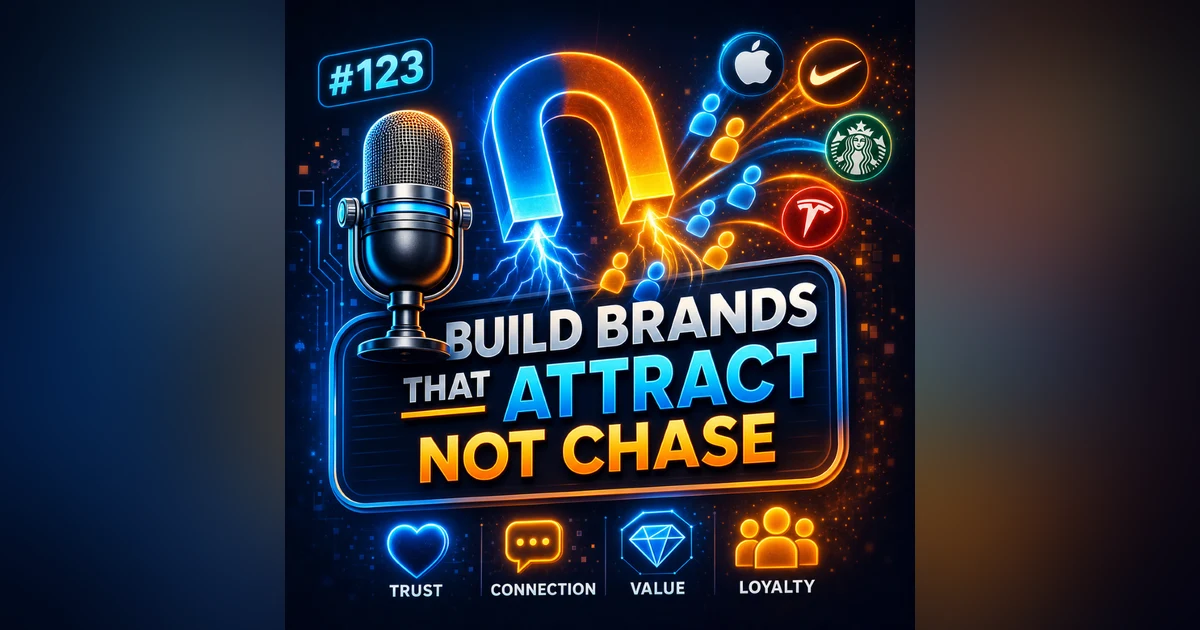


In this episode of the Smart Entrepreneur Show, we unpack one of the most counterintuitive but powerful strategies in modern business — invisible marketing. The best brands in the world don't chase customers. They build so much value, trust and credibility that customers naturally come to them. This episode breaks down exactly how they do it and how you can too.
What You'll Learn in This Episode
- What invisible marketing actually means — and why it's the opposite of everything most entrepreneurs are taught
- The psychology of reciprocity and why giving value upfront with zero strings attached is the most powerful sales tool you have
- Why the fear of giving away your best ideas is the single biggest roadblock to building a trusted brand
- The Michelin Guide — how a tyre company built one of the most powerful brands in history without selling tyres
- Why your customer support team is actually your most powerful marketing department
- The service recovery paradox — why a customer who has a problem resolved quickly often becomes more loyal than one who never had a problem at all
- Why consistency is the compounding asset that separates businesses that last from those that fade
Key Takeaways
- Invisible marketing shifts your energy from chasing to attracting — you build gravitational pull, not a rocket ship to chase people down
- People don't pay for information anymore — they pay for implementation, speed and the relief of outsourcing cognitive load
- Giving away the recipe doesn't make you obsolete — it makes you the only person they trust to bake the cake
- Radical transparency — admitting flaws and being honest about who your service is NOT for — actually increases conversion among your ideal customers
- A referred customer skips the entire trust-building phase — your support team generates referrals every single time they solve a problem with grace
- If you only show up in your customer's inbox when you want a sale, you are the friend who only calls when they need help moving — nobody likes that friend
- Stop asking "how can I sell more today?" and start asking "how can I help more people today?" — the revenue follows naturally
🔗 About Your Host (Roy Coughlan)
- Explore more podcasts: Find all podcasts at the PodFather Network
- Website: https://roycoughlan.com/
- Virtual Assistants: https://va.world/
- Private Networking Group: Learn about a Private Networking Group in 50 US States & 44+ Countries with 675+ Members https://connectedleaders.academy
- Brain Upgrade: https://brainupgrade.org/
#SmartEntrepreneurShow #InvisibleMarketing #ContentMarketing #BrandBuilding #Entrepreneurship #CustomerTrust #WordOfMouth #MarketingStrategy #BusinessGrowth #RoyCoughlan
#123 How Great Brands Attract Customers Without Selling
Welcome to The Smart Entrepreneur Show, the podcast where we share smart ideas, strategies, and lessons to help entrepreneurs build better businesses. Today we're going to talk about one of the smartest marketing strategies successful businesses use in visible marketing. And it is, it's honestly such a fascinating topic to dig into.
It really is. When most people think of marketing, they imagine advertisements, discounts, and constant promotions. But the truth is, the best brands don't always chase customers.
Right. They actually do the exact opposite in most cases. Instead, they create so much value, trust, and credibility that customers naturally come to them.
So how do they achieve this? That is the big question, isn't it? Exactly. In today's episode, we'll explore the concept of invisible marketing and discover how you can attract customers without relying on aggressive selling or expensive advertising. Let's get started.
Yeah. I mean, when you first hear the term invisible marketing, it sounds almost like an oxymoron, right? Because if you're marketing, you inherently want to be seen. You want people to look at you.
Right. You want the billboard. You want the flashy banner ad.
Imagine trying to build a multi-million dollar business without spending like a single cent on outbound advertising. No pop-ups disrupting what you're reading. No pushy cold emails flooding your inbox every morning.
Exactly. It sounds impossible. But if you think about, well, think about the last major purchase you made.
Did you buy it because a banner ad just chased you around the internet for three weeks? Or did you finally pull the trigger because, I don't know, someone you deeply trust swore by it? Or maybe because you read a wildly helpful guide from the company itself. It's almost always the latter. And this is a fundamental rewiring of how most of us are taught to do business.
Because traditional marketing operates on this baseline of friction. What do you mean by friction? Well, it's an extraction mindset. The business wants the consumer's money, right? And the consumer wants to keep their money.
So the marketing is basically the lever trying to pry that money out of their hands. Pushy. Yeah, that makes sense.
It's a tug of war. Exactly. But invisible marketing removes that friction entirely.
It's this major shift from outbound interruption to inbound attraction. You aren't, you know, building a rocket ship to chase people down. You are building a planet with enough gravitational pull that customers just naturally fall into your orbit.
I love that gravity metaphor. Because, you know, the source documents we're looking at for this deep dive, they define this whole concept as shifting the focus entirely away from the hard sell. It's all about educating and building trust long before a transaction ever happens.
Yeah. And the underlying psychological mechanism there is reciprocity. In a normal high-friction sales funnel, a brand asks you for something first.
Usually it's your time, your email address, or, you know, your money before they give you any real value. Oh, right. Enter your email to read the rest of this article.
That kind of thing. Exactly. But invisible marketing flips that timeline.
The brand provides immense actionable value up front. Zero strings attached. And when a business takes the time to answer common industry questions without hiding the answers behind a paywall, human psychology kicks in.
The consumer feels this subtle, almost subconscious social debt. Okay. Let's ground this for the listener.
I'm thinking about, like, a local neighborhood mechanic versus a massive high-pressure car dealership. Oh, that's a great example. Right.
Because if you walk onto a dealership lot, someone is immediately hovering over you. They're pushing the undercoating. They're rushing you toward financing.
It's stressful. Very high friction. But if you hear a weird rattle in your engine and you just drop by your local mechanic, they might just, you know, listen to it, tell you it's just a loose heat shield, and then literally tell you how to tighten the bolt yourself for free.
Yeah. And they didn't make a dime off you that day. Not a single cent.
But that psychological debt you mentioned, it is firmly established. And we all know how that plays out long-term. Six months later, when the transmission actually drops out of that same car, who are you calling? You aren't shopping around for quotes online.
You're going straight back to that mechanic. Because they already proved their competence. Yeah.
And their integrity, honestly. Exactly. The trust they established eliminated the need for a sales pitch later on.
They don't have to sell you on fixing the transmission. You just trust them to do it. Wait.
Okay. I buy the mechanic analogy for a local service-based business that totally tracks. But let's scale this up for a second.
If a brand just educates and helps without ever actively asking for the sale, how do they actually survive the initial growth phase? That's the tricky part. Yeah. Because isn't the goal of any business still to generate revenue? Building a planet, as you said, takes a long time.
A startup needs cash now just to keep the lights on. And that tension right there is exactly why so many companies abandon this strategy and just revert to buying ads. Invisible marketing is not, and this is crucial, is not a replacement for short-term cashflow strategies in your first three months of business.
So it's not a magic bullet for overnight sales. Not at all. It is a compounding asset.
Think of it like compounding interest in a retirement account. Early on, the returns look completely negligible. You're putting out helpful content, you're answering questions, and it feels like you were just shouting into the void.
Getting like two views on a video, right? Exactly. But as that reputation builds, it creates a massive moat around the business. The goal is absolutely to make money, but the mechanism changes.
Instead of spending your capital on aggressive rising customer acquisition costs, because let's be real, ads get more expensive every single year, you're investing in an asset you actually own, your reputation as an undeniable authority. So the actual selling required drops to near zero because the trust is doing all the heavy lifting. When the customer is finally ready to buy, there's no decision fatigue.
You are just the only logical choice. Precisely. You're the default option.
But that brings us to the actual mechanics of this. How exactly does a business project that expertise out into the real world for people to find? Because you can't just sit in your office being a secret genius, right? No, definitely not. You have to put it out there.
And our sources point heavily toward the actual assets a brand creates. Specifically, highly valuable content and radical transparency. So this is where the philosophy has to become tangible.
Yeah, it's about publishing content that solves real, immediate problems. We're talking about comprehensive guides, detailed video breakdowns, podcasts, blogs. And the crucial differentiator here, and people mess this up all the time, is that it cannot be fluffy, high-level theory.
It has to be the actual, actionable steps. OK, I see this a lot in the B2B space or with independent consultants, but this is exactly where I see entrepreneurs freeze up. The fear of giving it all away.
Yes, if I am a brilliant tax consultant and I publish the ultimate step-by-step guide on how to navigate this complex new tax loophole, haven't I just made myself obsolete? Like if I give away the recipe, why would anyone buy the cake from me? That fear is the single biggest roadblock to invisible marketing, hands down. But it fundamentally misunderstands what modern consumers are actually paying for. We live in an era of infinite information.
The what and how are already out there for free on the internet anyway. That's true. You can Google pretty much anything.
Right. So people do not pay for raw information anymore. They pay for implementation.
They pay for speed. They pay for customization to their specific, nuanced situation. And most importantly, they pay to outsource cognitive load.
Outsource cognitive load. That is a really interesting way to phrase it. Well, I mean, think about your tax consultant example for a second.
A small business owner read that incredibly detailed free tax guide you published. They now know exactly what steps to take. Do you honestly think their reaction is, great, I'm going to spend 50 hours this weekend doing my own complex corporate taxes? Oh, definitely not.
I would run the other way. Right. Their reaction is, wow, this is incredibly complex.
But this consultant clearly knows exactly what they are doing. The free content was just the vehicle to prove competence. The customer buys because they trust the execution.
They want the person who wrote the playbook to run the play for them. That makes total sense. You aren't selling the information.
You are selling the assurance that the job will be done right by the best person. Exactly. It actually reminds me of one of the most famous historical examples of this.
It isn't in our current source stack for today, but it perfectly illustrates this exact mechanism, the Michelin Guide. Oh, that is a perfect example. Right.
Because Michelin sold tires. But 100 years ago, they didn't just run ads saying, hey, buy our tires. They created a free, highly valuable guide to the best restaurants in France.
Which is just brilliant second order marketing. They gave people a reason to drive their cars. Exactly.
They provided immense value, a map of great places to eat and psychological results. People drove more, they wore down their tires faster, and they felt a massive brand affinity for Michelin. They didn't sell the tire.
They sold the destination. And the tires basically sold themselves. And that ties directly into the transparency aspect that is highlighted in the research too.
Invisible marketing only works if the content is authentic. Meaning no hidden agendas. Right.
The sources emphasize being brutally honest, keeping your promises, and having a very clear mission. In a digital economy that is characterized by really low trust and high skepticism, transparency is a massive competitive advantage. How so? Like giving away your flaws.
Yeah, literally. Yeah. Admitting a flaw in your product or explicitly stating who your service is not for actually increases conversion rates among your ideal customers, because it signals that you are prioritizing their outcome over your immediate sale.
Wow. Okay. So we've built the gravity, we've attracted the customer with radically helpful content, we've established trust through transparency, and they finally made a purchase.
The hardest part is done, right? Well, in a traditional outbound model, the marketing department's job is over at that point. High five, ring the bell, move on to the next lead. But the source material pivots pretty hard here.
It frames the post-purchase experience like the literal second after the credit card is swiped, as an even more powerful marketing engine. Which is often the most neglected part of a business. We tend to view customer acquisition and customer retention as two entirely separate silos.
Marketing gets this huge budget, and customer service gets treated as a cost center. Just a necessary evil to deal with complaints. Exactly.
But if you are practicing invisible marketing, your support team is your marketing team. Delivering an exceptional customer experience, responding rapidly, solving problems effectively, that is what fuels the network effect. Let's unpack that network effect a bit.
Because it's really easy to just say, hey, be nice to your customers. But how does a fast, polite email reply from a support desk actually function as a marketing tool? It all comes down to the math of a referral. The strongest marketing asset in existence, bar none, is a recommendation from a trusted friend or colleague.
A referred customer has a dramatically lower acquisition cost, a much shorter sales cycle, higher retention rates, and way lower price sensitivity. Why is that? Because the trust didn't have to be built from scratch. It was transferred from the referrer directly to you.
Oh, I see. You essentially bypass the entire trust-building phase we just spent 20 minutes talking about. Precisely.
You get to skip the line. And how do you generate referrals? By treating every single customer service interaction as an audition. The research points out this fascinating psychological phenomenon known as the service recovery paradox.
Oh, I've heard of this. This is the idea that a customer who has a problem that is successfully and swiftly resolved actually ends up more loyal than a customer who never had a problem in the first place. Yes.
Which sounds crazy, but it's true. Because a flawless transaction is invisible. It's just expected.
You bought a thing. It arrived. End of story.
But a problem introduces friction. If your brand steps in and removes that friction with grace, professionalism, and speed, you create an emotional spike. You demonstrate exactly who you are when things go wrong.
Exactly. That emotional spike is what compels people to talk about you. You don't just retain a customer in that moment.
You create an active advocate. So when a customer emails you with a complaint about a delayed shipment or, you know, a software bug, it isn't a nuisance. It is a literal opportunity to deploy invisible marketing.
And the sources specifically note that brands must actively leverage this. You don't just sit back and hope they talk about you. You intentionally encourage satisfied customers to leave reviews.
You build mechanisms to capture that goodwill. Right. You make it incredibly easy for them to share their experience.
Your happy customers become your outbound marketing department. And they do it for free, simply because you provided an experience worth sharing. Which honestly takes a massive amount of pressure off the business owner.
You don't have to constantly brainstorm some viral catchy slogan. You just have to be fundamentally excellent at what you do and communicate that excellence clearly. Yeah.
Just do good work and let it speak for itself. But this leads us to the final major theme discussed in the research, which is the marathon. This is all about consistency.
It's the reality check of the entire strategy, honestly. You cannot just publish one brilliant, comprehensive guide, sit back and expect this invisible marketing engine to run forever on autopilot. Because the internet has a very short memory.
A very, very short memory. The sources highlight the absolute necessity of staying visible consistently. You have to show up regularly where your audience spends their time, constantly reinforcing the idea that you are still the authority.
It makes me think about how we manage personal relationships. Think about your own circle of friends. If you have a friend who ignores you for six months, never calls, never texts, never checks in, and then suddenly shows up at your door only when they need you to help them move a heavy couch.
Oh, we all have that friend. Right. And you see right through that.
It feels transactional and manipulative. You can't just show up when you want a favor. Or in a business context, when you want a sale.
Right. To build a true friendship, you have to be present consistently. You have to check in when you don't need anything at all.
You have to be the one offering to help them move their couch first. That translates perfectly to how a brand builds familiarity. Consistency builds familiarity, and familiarity cements trust.
If you are only showing up in your customer's inbox when you are running a 20% off sale, you are the friend asking to move the couch. Nobody likes that friend. Nobody.
But if you are showing up weekly with insights, industry news, or genuinely helpful tips, you are building relational equity. Which requires a complete mindset shift for whoever is running the business. It really is the ultimate so what of this entire methodology.
Yeah. Traditional outbound marketing asks a very specific question every single morning. How can I sell more today? It's an extraction question.
Exactly. Invisible marketing requires you to flip that script and obsessively ask, how can I help more people today? Which sounds almost too altruistic to be a real business strategy. It does sound like a self-help book, I know.
But the data and the case studies in our sources back it up completely. When you genuinely consistently focus on solving problems at scale, the revenue follows naturally. Because you become indispensable to them.
So let's synthesize this journey we've been on for you listening. We started by redefining the core philosophy. Invisible marketing isn't about hiding your products in the dark.
It's about shifting your energy from chasing to attracting. You build a gravitational pull by offering undeniable value up front, asking for nothing in return. Then you prove your confidence by giving away the recipe.
You share your best information to prove that you are the exact expert they want to hire for the implementation. You solidify that relationship through radical transparency. And once they are in your ecosystem, you weaponize the customer experience.
You turn your support desk into an advocacy engine, recognizing that a successfully resolved problem is the fastest path to a word-of-mouth referral. And you do all of that with relentless consistency, recognizing that trust is a compounding asset that takes time to build, but it pays dividends long after an ad campaign would have just dried up. And for you listening, this applies regardless of your scale.
Whether you are an entrepreneur trying to bootstrap a startup, a freelancer looking for higher quality clients, or just a professional navigating the corporate ladder, helping others genuinely and consistently is the ultimate shortcut. When you are the one who freely tells people how to fix the easy stuff, you are the only one they call when the engine actually blows. But before we wrap up today, there was a fascinating edge case that I want to leave you with.
Something for you to ponder on your own. Oh, I love a good edge case. We've talked extensively today about how invisible marketing relies on long-term relationship building, compounding trust, and repeat interactions.
Right. Right. But what if your business model inherently defies that? What do you mean by that? Well, if invisible marketing relies so heavily on long-term relationship building to foster trust, how might a brand apply these exact same principles if they sell a once-in-a-lifetime product? Or, say, an emergency service where they only get one single interaction with a customer in their entire life.
Think of a specialized emergency surgeon or a company that repairs severe storm damage. Oh, wow. That is a fantastic puzzle to chew on.
Because how do you build a long-term reputation for a one-time crisis when the customer isn't looking for you until the exact second they desperately need you? I love that. It really tests the limits of the theory. It does.
Well, thank you so much for joining us on this deep dive into the mechanics of invisible marketing. We hope you take these insights, stop chasing your audience, and start attracting them. If you enjoyed this episode of the Smart Entrepreneur Show, make sure to follow the podcast so you don't miss future episodes.
And feel free to share your thoughts or experiences in the comments.

PodFather
I am a serial entrepreneur who has founded 21 companies across 6 countries. Known in the industry as “The PodFather,” I am a business podcast coach and host who has launched eight successful podcasts—6 ranking in the Top 5%, with four reaching the coveted Top 0.5% globally.
Beyond podcasting, I co-founded brainupgrade.org a platform designed to boost cognitive performance and unlock peak mental potential. I am also the co-founder of VA.World, connecting businesses with exceptional Virtual Assistants tailored to their unique needs.
I also have Sponsorship ads available that are Dynamically inserted into my 8 shows