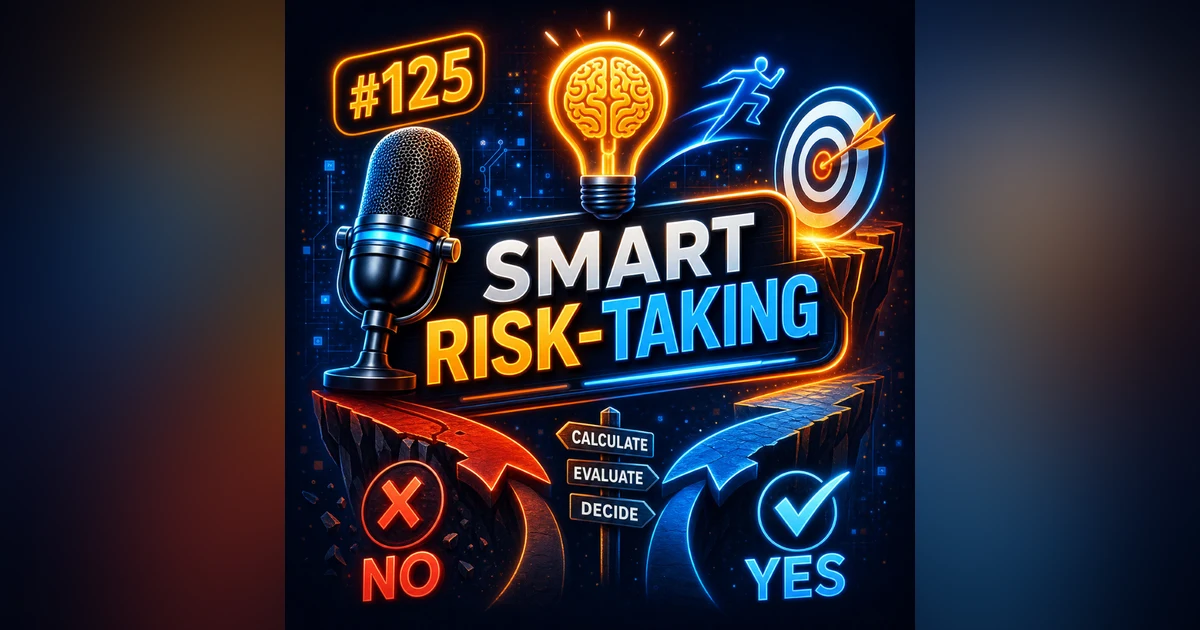
#125 Smart Risk-Taking — Knowing When to Say Yes or No in Business


In this episode of the Smart Entrepreneur Show, we dismantle one of the most destructive myths in entrepreneurship — the Hollywood-fuelled idea that the boldest risk takers are the most successful. The truth is that the entrepreneurs who build wealth over decades are not riverboat gamblers. They are calculated, cold-blooded strategists who know exactly when to jump, when to test and when to walk away entirely.
What You'll Learn in This Episode
- Why the Hollywood myth of the blind leap of faith is not just unhelpful — it is actively destructive
- The crucial difference between a smart risk and a reckless risk — and why reckless risks rarely announce themselves
- The five-question checklist that forces you out of emotional decision-making and into analytical clarity
- What asymmetric risk actually means — and how to structure bets where the downside is capped but the upside is unlimited
- Why saying no is not a rejection of success — it is a highly calibrated protective mechanism
- The beaker test — how to run micro experiments that give you real-world data without risking the survival of your business
- The neuroscience of why financial guardrails are not just spreadsheets — they are psychological lifesavers
Key Takeaways
- Successful entrepreneurs do not take the biggest risks — they take the smartest risks
- True intuition is pattern recognition trained by years of experience and data — everything else is emotion masquerading as intuition
- You are not looking for perfect information before you act — you are looking for enough information to validate your core assumptions
- Every time you say yes to the wrong thing, you drain the reserves that would have funded the right thing
- Test before you invest — put one drop in the beaker before you order 2,000 gallons
- Never risk more than you can afford to lose — if you cannot make payroll after a failure, your amygdala takes over and objective thinking becomes impossible
- Playing it perfectly safe in a world that never stops changing may be the most reckless risk you could ever take
The Five Questions Before Every Major Decision
- Does this opportunity align with my long-term goals?
- What is the worst possible outcome?
- Can my business recover if that worst case actually happens?
- Do I have enough information to decide — not perfect, but enough?
- Does the potential reward justify the risk?
🔗 About Your Host (Roy Coughlan)
- Explore more podcasts: Find all podcasts at the PodFather Network
- Website: https://roycoughlan.com/
- Virtual Assistants: https://va.world/
- Private Networking Group: Learn about a Private Networking Group in 50 US States & 44+ Countries with 675+ Members https://connectedleaders.academy
- Brain Upgrade: https://brainupgrade.org/
#SmartEntrepreneurShow #SmartRiskTaking #Entrepreneurship #BusinessStrategy #DecisionMaking #RiskManagement #BusinessGrowth #Mindset #Asymmetric Risk #RoyCoughlan
#125 Smart Risk-Taking 🚀 – Knowing When to Say Yes or No in Business
Welcome to the smart entrepreneurs show the podcast where we share smart ideas strategies and you know lessons to help entrepreneurs build better businesses Absolutely, every entrepreneur faces difficult decisions. I mean, yeah, should you launch a new product? Should you invest more money? Should you hire a new team member or? Should you walk away from an opportunity that seems just a little too risky? Yeah, those are the big ones exactly because successful entrepreneurs are not people who take the biggest risks They're people who take the smartest risks. So in today's episode, we'll discuss how to evaluate opportunities wisely When to confidently say yes When to confidently say no and how smart risk-taking can become one of your greatest competitive advantages It really is a massive advantage when you get it, right it is let's get started today We're doing a deep dive into an incredibly insightful guide a real foundational transcript from our source material on smart Entrepreneurship and our mission today is to completely dismantle this This Hollywood myth of the blind leap of faith.
Oh the visionary myth. Yes, you know what I mean, right like You look at movies or sensational business biographies and we're sold this image of the reckless visionary the person who? Dramatically pushes all their chips to the center of the table remortgages the house, right? they remortgage the house close their eyes and take this massive terrifying leap of faith into the unknown and We're conditioned to believe that well, if you aren't risking absolute ruin, you just don't have what it takes which is so toxic Yeah, and honestly in those moments where you actually have to make a choice that Hollywood myth is not just unhelpful It is actively destructive. Yeah, every creator every leader every builder faces these friction points But if you look closely at the entrepreneurs who actually survived the ones who you know compound their wealth over decades They rarely operate like riverboat gamblers exactly and you know right now at this exact moment You listening to this might be standing at a real-world crossroads.
You're facing a genuinely daunting decision today maybe you're agonizing over whether to launch a new product line or Invest a massive chunk of capital into an unproven marketing channel or maybe walking away from something that looks great on paper Which just feels a little too dangerous. Okay, let's unpack this because the very first reality check we get from today's material Is that risk itself is non-negotiable? You literally cannot start a company launch a feature or enter a new market without Inviting some level of uncertainty into your life. That is the foundational truth.
We really have to build on today a lot of Novice business owners think the ultimate goal of a strategy is to eliminate risk entirely which is impossible, right? Mathematically impossible and frankly if a venture carries absolutely zero risk there is zero margin for profit The market rewards navigation of uncertainty So the framework we're looking at draws this massive line in the sand between two very different animals Smart risk and reckless risk and confusing the two is exactly how intelligent people end up losing everything exactly Let's clearly define that boundary because to me the best way to visualize this distinction is skydiving Okay, I like where this is going so a reckless risk is like jumping out of an airplane at 10,000 feet with like a Needle some heavy-duty thread and a bundle of silk and you're just hoping you can somehow sew a parachute on the way down before You hit the earth. That sounds terrifying. It is you are operating on pure adrenaline Ego and hope it's a vivid picture, but unfortunately, it's how a lot of businesses are run Reckless risk is driven almost entirely by untested assumptions and you know emotional momentum, right? But a smart risk doesn't mean you stay on the ground.
You're still jumping out of the plane Gravity is still in effect. The risk of hitting the ground is very present But in the smart risk scenario you pack the parachute yourself in a controlled environment. You check the weather Yes, you check the wind the weather conditions You took hundreds of hours of lessons and you are strapped into a reserve chute Just in case the primary one fails, so you're still taking the leap, but you have fundamentally engineered your own survival That's spot-on and what we really need to examine is the psychology of why people choose the first option over the second because reckless risks Very rarely announce themselves as reckless in our own minds.
Well for sure. They usually disguise themselves as gut feelings You'll hear leaders say I just have a really strong gut feeling about this investment. I need to move on it now But we have to recognize what is actually happening in the brain, right? It's not always intuition Exactly.
If that gut feeling isn't backed by market data if it isn't backed by financial modeling It is simply emotion masquerading as intuition. Wow. I love that distinction emotion masquerading as intuition True intuition is pattern recognition is trained by years of empirical experience and hard data Emotion on the other hand is a primal reaction It's usually just a rush of dopamine associated with the thrill of the gamble or you know Fear of missing out right when you rely solely on an unchecked gut feeling you aren't managing a business risk You're just seeking a neurochemical high which perfectly transitions us into the actual mechanics of avoiding that trap because Knowing we need our risks to be smart is a great, you know philosophical starting point But how do we mathematically calculate that in the heat of the moment? That's the real challenge Yeah, when an opportunity is sitting right in front of you and the clock is ticking How do you strip the emotion out of it the framework provided in our source material outlines five crucial questions? These are essentially your parachute packing checklist before you ever say yes to an opportunity and they're designed Specifically to force you out of the emotional center of your brain and into the executive analytical center Let's walk through them question number one.
Does this opportunity align with my long-term goals? Which sounds simple, but it's really a question about opportunity cost, isn't it? Absolutely, like is this a stepping stone to where I want to be in five years or is it just a really shiny distraction? that is the perfect way to frame it an opportunity can be highly profitable and still be a Massive mistake if it pulls your core team's focus away from your primary engine of growth. Yeah Then we hit question two, which is where things get uncomfortable. What is the worst possible outcome? You have to actually look the monster in the face, which ties directly into question three Can my business recover if that worst-case scenario actually happens if we connect this to the bigger picture? Questions two and three are really about calculating asymmetric risk break that down for us.
What does asymmetric risk look like in practice? so asymmetric risk means the potential upside and the potential downside are Drastically out of proportion and you know You want that proportion in your favor right if a decision has a downside that could completely bankrupt your company That is a symmetric or even negatively asymmetric risk the risk equals or exceeds the reward But a smart entrepreneur structures their bets. So the downside is strictly capped. So they limit the bleeding exactly They look for opportunities where the absolute worst-case scenario cost them say $10,000 and a bruised ego But the upside potential is a million dollars in new recurring revenue if you ask can my business recover and the answer is no You are taking a reckless risk No matter how good the upside looks that makes total sense You are capping the downside at 1x so you can safely expose yourself to a hundred X upside But I want to push back pretty hard on question number four.
Okay, let's hear it The question is do I have enough information to decide in today's landscape? What if you never feel like you have enough? I mean we live in an era of infinite data You could research a market trend for five years run endless focus groups read every white paper and still find new data points How does an entrepreneur avoid absolute analysis paralysis? That is the trap of the perfectionist right waiting for absolute certainty before moving but the transcript introduces a vital principle here balancing confidence with caution The operational word in that fourth question is enough. It explicitly does not ask Do I have perfect information or do I have all the information? So how does it build or practically define enough because one person's enough is another person's reckless You define enough by validating your core assumptions not by predicting the future in any new venture You generally have three or four foundational pillars usually it's does this specific problem exist will this specific demographic pay to solve it and You know, can we technically deliver the solution at a margin that makes sense? Yeah, once you have concrete data validating those core assumptions acquiring more information offers severely diminishing returns You're just procrastinating at that point precisely you are using research as a shield against execution Good analytical questions naturally lead to better more informed decisions, but they will never lead to perfect certainty You have to accept that a smart risk still inherently contains unknowns If you refuse to leave your driveway until every single traffic light in the city turns green, you're never gonna reach your destination okay, that clears it up you're hunting for sufficient data to justify the attempt not a crystal ball and That leads us to the final filter question 5 does the potential reward justify the risks which brings us back to your point about Asymmetric bets. Yeah, but let's play this out.
Let's say you run an exciting opportunity through these five questions and the answers come back Murky the alignment is a bit off or the worst-case scenario is a little too catastrophic for the balance sheet to absorb right now If we can't get to a clear resounding. Yes. What is the alternative the alternative is? Incredibly powerful but very difficult for ambitious people you say no this might be the single hardest Conceptual hurdle for early stage builders There is a pervasive almost toxic myth in startup culture that when you're trying to grow you must say yes to every single Opportunity that crosses your desk.
Oh, absolutely a client wants a highly customized feature that falls outside your roadmap Yes, a partner wants to co-host an expensive event that has very little to do with your core demographic Yes, and that behavior stems entirely from a scarcity mindset It's the deep-seated fear that if you decline this one mediocre opportunity The universe will close the tap and another one will never arrive But the framework we're analyzing flips this entirely saying no is not a rejection of success It's a highly calibrated Protective mechanism protecting what exactly your optionality when you say no You're actively defending your finite resources your operating capital your team's cognitive bandwidth your brand's reputation and your time Every single time you say yes to the wrong thing You are draining those reserves, which means every no is actively creating space for a much better. Yes Absolutely think of your business capacity like an investment portfolio If your portfolio is a hundred percent locked up in low reward high maintenance high risk projects Simply because you were too afraid to say no you have zero liquidity You're stuck right when a truly brilliant highly asymmetric strategic opportunity finally comes along You won't have the capital the bandwidth to take it you killed your own growth by saying yes too often But what if you find yourself in the gray area? What if an opportunity looks like it could be that brilliant highly asymmetric bet but pulling the trigger right now Requires a level of capital or focus that feels too risky The material offers a really elegant alternative to just walking away entirely Instead of abandoning the idea you test before you invest. This is the ultimate antidote to the reckless massive Leap of faith.
Here's where it gets really interesting to me because this perfectly mirrors the scientific method Think about a chemist developing a new compound in a laboratory if they have a theory about two highly volatile chemicals reacting to create a new energy source They don't order 2,000 gallon of bats of the chemicals mix them together in the center of the room and just hope the entire facility Doesn't detonate right they isolate the variables on a microscopic scale exactly they put one single drop of chemical a into a tiny beaker with one drop of chemical B and they do it behind two Inches of reinforced safety glass if it blows up the beaker that is actually a massive success They gathered incredibly valuable empirical data about the volatility and it only costs them a 50 cent piece of glassware The laboratory is still standing the team is safe and they can adjust the formula Testing before investing in business is just doing a beaker test. That is a phenomenal way to conceptualize it Yeah, you are fundamentally changing your relationship with failure instead of signing a five-year Unbreakable commercial lease on a massive retail space in a new city You rent a 10 by 10 pop-up tent for a weekend at a local market to see if foot traffic even cares about your product Wow, yeah instead of burning a hundred thousand dollars in runway developing a complex software platform You build a simple interactive landing page Drive a few hundred dollars of ad traffic to it and see if anyone actually clicks the buy button You are actively hunting for the fatal flaws in your brilliant idea while those flaws are still incredibly cheap to fix You're buying real-world data with a very small Strictly capped amount of time and money rather than betting the survival of your entire company on an unproven theoretical hypothesis small experiments neutralize big risks But even with the best micro testing and even with ruthlessly saying no to the obvious distractions. We have to live in reality Sometimes a smart mathematically sound carefully calculated risk still goes completely wrong The macroeconomic environment shifts overnight a new competitor pivots and eats your market share or you know A global supply chain breaks down the beaker still shatters, but maybe this time it cracks the safety glass, too That is the nature of business.
You just cannot control every variable which brings us to the operational guardrails How do you ensure your company survives the fallout of a calculated risk gone wrong? The absolute golden rule here is never risk more than you can afford to lose You had to insulate the core engine of your business for the experimental bets you make on the periphery The framework lays out three specific financial guardrails to build that insulation first emergency savings You need a cash buffer. That is completely untouchable Second healthy cash flow You cannot fund a highly speculative new venture using the operating capital required to keep the lights on and your current employees paid Definitely not and third Realistic budgeting if we connect this to the bigger picture and look closely at the mechanism of that second point cash flow It's vital to understand how it protects you Healthy cash flow acts as a moat around your core business Okay I like that visual if you siphon water out of that moat to water a new garden you just planted outside the castle walls and that garden dies You haven't just lost some seeds. You have actively lowered the defenses of your castle The smartest most enduring entrepreneurs are rarely the ones who had one massive explosive overnight success They are the ones who structure their finances so they could survive long enough to let compounding take effect the game of endurance Completely they survive because they mathematically ensure that a single failure or even a string of three failures Cannot wipe them off the board if you have ten chips and you bet all ten on one hand and the market turns against you You are out of the game entirely, right? But if you bet one chip ten separate times on ten separate micro tests You get ten chances to gather data adapt your strategy and eventually find the asymmetric win, which brings us to the aftermath Surviving the failure financially is step one But the real value is in the postmortem the material stresses that failure must be transmuted into feedback Not accepted as defeat they suggest asking three specific questions after any setback what worked what didn't and what can I improve next time? This is a mechanism for growth you extract the educational value from the financial loss Okay But I want to interject with some heavy reality here Asking those three postmortem questions sounds incredibly clean and clinical when we're sitting here analyzing a script Ah, yes, the q3 product launch failed.
Let us evaluate the metrics But in reality when you've poured six months of your life your creative energy and your team's morale into a project and it face plants It physically hurts. Oh, it's devastating. You're actively stressing over the lost capital You're embarrassed in front of your peers and your ego is deeply bruised How on earth is a human being supposed to objectively sit down in a boardroom and ask what worked? When their primal instinct is to crawl under a desk and hide it is incredibly difficult And it's the exact reason why so many businesses repeat the same mistakes for a decade The emotional toll of a failed initiative is profound But this is exactly why those financial guardrails we just dissected are not just spreadsheets.
They are psychological lifesavers how do you mean think about the neuroscience of loss if a product launch fails and Because of that failure you literally cannot make payroll on Friday or pay your own mortgage You cannot access the objective analytical part of your brain you are thrust immediately into Primal fight-or-flight mode because you're in danger right your amygdala takes over because your literal survival is threatened You cannot conduct a post-mortem when you are bleeding out Wow Okay, that is a massive distinction But if you follow the guardrails if you only risk the capital you could mathematically afford to lose without breaching your operational moat The failure is just a bruised ego It's a disappointment not a mortal wound and that changes the entire dynamic that makes a lot of sense You can give yourself and your team 48 hours to be frustrated to mourn the expectation of what could have been But then because your survival isn't threatened your Executive function comes back online you put the scientists lab code back on you look at the shattered beaker and you say okay the glass Broke hmm, but did the temperature rise before it broke did we see a 10% increase in email open rates before the supply chain failed? You compartmentalize the emotional sting from the empirical data that reframes the entire concept of the Entrepreneurs Balancing Act We are really talking about managing the daily psychology required to lead a venture The overarching theme here is that long-term success requires this constant delicate tension between extreme optimism and paranoid Careful planning they serve two totally different functions Optimism is your engine. It's the raw fuel that moves you forward You have to genuinely believe the future can be better and that you have the agency to shape it or you would never endure the pain of building anything but careful planning the financial guardrails the asymmetric risk models that is your steering wheel and your brakes a Powerful engine without brakes just means you're gonna drive off a cliff at a hundred miles an hour to bring all these tools together The framework synthesizes the most common mistakes that throw this delicate balance out of alignment. Let's look at the big ones First making emotional decisions.
We covered that heavily the danger of mistaking the dopamine hit of a gamble for true intuition Second blindly following trends without doing the underlying research, which is incredibly common today, right? I mean just because every brand on earth is suddenly pivoting to short-form video or Integrating artificial intelligence doesn't mean it's a smart calculated risk for your specific b2b logistics company Following a trend is often a lazy substitute for strategic thinking then there is ignoring financial risks which is what happens when you let the engine overpower the brakes and bet the farm on a single idea and Saying yes to every opportunity which dilutes your focus in capital until you are aggressively mediocre at a dozen things and excellent at absolutely Nothing, but the final mistake they list is the one that I find the most fascinating It's the ultimate psychological trap for a conscientious builder who just spent 20 minutes studying Frameworks about managing risk and building financial moats. The biggest mistake of all is fearing all risks and never taking action This is the crux of the entire philosophy Everything we've unpacked today the five analytical questions the beaker testing the downside risk modeling Absolutely, none of it is designed to make you afraid of taking a risk It's designed to make you highly capable of taking more risks safely Wow Enduring success comes from taking high-volume calculated asymmetric risks It does not come from avoiding risk entirely if you weaponize this decision framework just to find Hyperlogical reasons to say no to every single opportunity that crosses your path. You aren't being a smart entrepreneur You are just paralyzed by fear hiding behind the spreadsheet It goes right back to the skydiving analogy It's like meticulously packing your parachute checking the Doppler radar for wind speed putting on a reinforced helmet Strapping into your reserve chute boarding the plane and then just sitting in your seat on the tarmac While the engine idles until you run out of gas You never actually jump exactly all the preparation all the modeling and all the guardrails are Completely useless without the courage to execute so bringing this all home directly to you listening right now The paradigm shift from today's deep dive is clear The smartest entrepreneurs are not adrenaline junkies rolling the dice and praying to the market gods.
They are calculated cold-blooded Strategists. Yes, they know exactly when to move forward with aggressive confidence They know when to hold back and run a micro test in a beaker and they have the immense Discipline to walk away entirely when the math the downside risk and the mission do not align This raises one final crucial point though, and I want to leave you with this thought to ponder We just established the profound danger of fearing all risk and sitting on the tarmac Think about the sheer velocity at which our global landscape is moving right now technology macroeconomics and Consumer behaviors are mutating faster than at any point in recorded human history. It's dizzying It really is So if you build your entire business strategy around avoiding risk Around maintaining the status quo and protecting what you already have Are you actually just guaranteeing your own irrelevance in a world that fundamentally never stops changing is playing it perfectly safe Actually the most reckless risk you could ever take man That is a heavy brilliant question to chew on playing it safe as the ultimate reckless risk I love that framing and that brings us to the end of our time today The playbook is in your hands now keep applying these frameworks to your daily decisions Ruthlessly question your own assumptions about what constitutes a risk and most importantly keep making those calculated Asymmetric bets that actually move you forward if you enjoyed this episode of the smart entrepreneurs show make sure to follow the podcast So you don't miss future episodes and feel free to share your thoughts or experiences in the comments Thanks for joining us on this deep dive and we'll catch you next time
PodFather
I am a serial entrepreneur who has founded 21 companies across 6 countries. Known in the industry as “The PodFather,” I am a business podcast coach and host who has launched eight successful podcasts—6 ranking in the Top 5%, with four reaching the coveted Top 0.5% globally.
Beyond podcasting, I co-founded brainupgrade.org a platform designed to boost cognitive performance and unlock peak mental potential. I am also the co-founder of VA.World, connecting businesses with exceptional Virtual Assistants tailored to their unique needs.
I also have Sponsorship ads available that are Dynamically inserted into my 8 shows