#122 Building a Premium Brand That Customers Love and Recommend
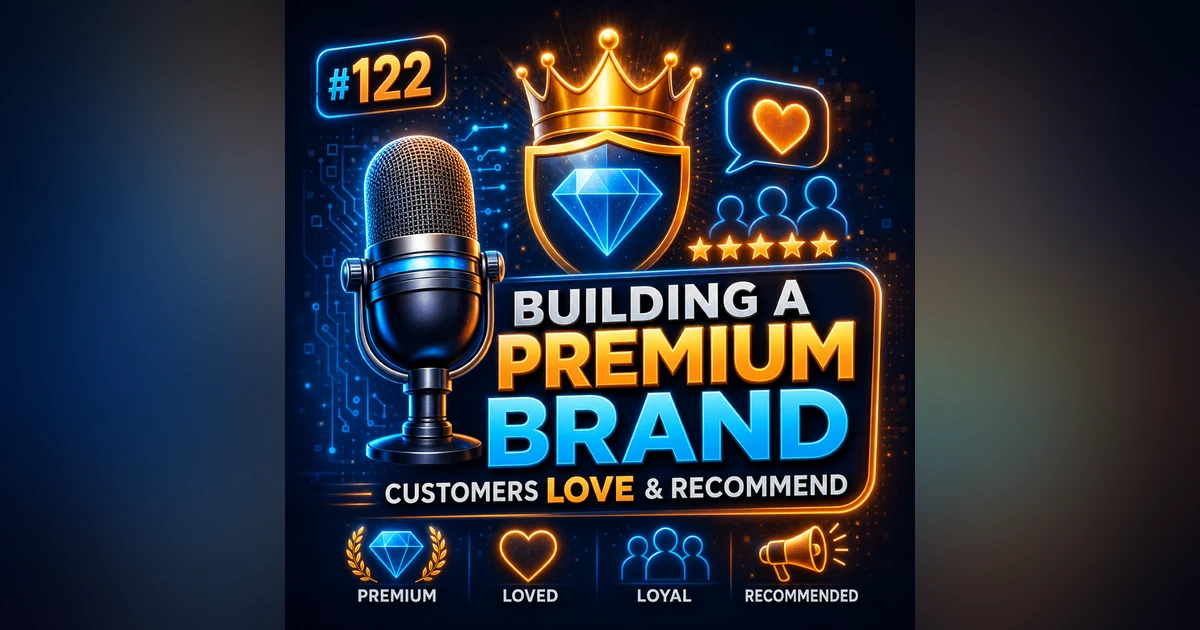


In this episode of the Smart Entrepreneur Show, we break down one of the most powerful transformations any entrepreneur can make — stepping off the price competition treadmill and building a brand that commands genuine loyalty and premium pricing. This is not about charging more for the same thing. It is about becoming the most trusted, reliable and valuable choice in your market.
What You'll Learn in This Episode
- Why customers happily pay $5,000 for a watch that tells time less accurately than a $15 Casio — and what that tells us about premium brands
- The trifecta that every successful premium brand shares — uncompromising quality, radical trust and ruthless consistency
- Why trying to sell to everyone is the fastest way to become average — and why shrinking your market actually expands your margins
- How signalling theory and the halo effect work in your favour when your visual identity is dialled in
- Why a single friction point — a slow email reply, a chatbot doom loop — can instantly destroy a premium brand's illusion
- The psychology of premium pricing, Veblen goods, and why a higher price tag can literally make your product work better in the customer's mind
- Why community is the only truly uncloneable competitive moat left
Key Takeaways
- A premium brand is not a price point — it is a promise. The price is a byproduct of the ecosystem, not the starting point
- Build the bespoke suit, not the mass-produced t-shirt — specificity creates loyalty, broad appeal creates commodities
- Visual identity is a down payment on the promise of quality — it puts the customer's brain at ease before they ever swipe their card
- A premium purchase is an exercise in risk management — eliminate friction and you eliminate buyer's remorse
- Consistency is the invisible glue that transforms a good product into a deeply trusted lifelong brand — you cannot have off days
- Treat your brand as a living ecosystem, not a statue in the town square — it must breathe, evolve and grow with its community
- The switching costs that lock in premium customers are not financial — they are emotional. That is the ultimate moat
🔗 About Your Host (Roy Coughlan)
- Explore more podcasts: Find all podcasts at the PodFather Network
- Website: https://roycoughlan.com/
- Virtual Assistants: https://va.world/
- Private Networking Group: Learn about a Private Networking Group in 50 US States & 44+ Countries with 675+ Members https://connectedleaders.academy
- Brain Upgrade: https://brainupgrade.org/
#SmartEntrepreneurShow #PremiumBrand #BrandBuilding #Entrepreneurship #BusinessGrowth #CustomerLoyalty #Pricing #BrandStrategy #Marketing #Mindset #RoyCoughlan
#122 Building a Premium Brand That Customers
Welcome to The Smart Entrepreneur Show, the podcast where we share smart ideas, strategies, and lessons to help entrepreneurs build better businesses. Yeah, and today's topic is, uh, it's a really exciting one. It totally is.
Today we're talking about something that can completely transform your business, a premium brand. Absolutely. Have you ever noticed that some brands can charge 2, 5, or even 10 times more than their competitors, yet customers happily pay the higher price? It's wild to see, but it happens everywhere.
Right. It's not just because of the product. It's because people trust the brand, value the experience, and believe they're getting something exceptional.
Which is exactly what we are going to unpack today. Exactly. So how can you build a brand that customers not only buy from, but genuinely love and recommend to others? That is the million dollar question.
In today's episode, we'll explore the key principles behind creating a premium brand that stands out, builds loyalty, and commands higher prices. Let's get started. I am so ready to dive into this.
So to kick off this deep dive, let's look at the psychology here. Like, why is a customer perfectly happy to drop, um, say, $5,000 on a mechanical watch? Right, a watch that actually tells time less accurately than, you know, a $15 digital Casio. Yeah, exactly.
Or, uh, why do we gladly wait in a line that wraps around the block for a $6 cup of coffee? When you could just brew a perfectly fine cup at home for like 50 cents. Right. So we are dismantling the psychology of the premium brand today.
We are looking at the underlying mechanisms that allow certain companies to just totally step off that treadmill of competing on price. And instead they command this intense loyalty and, frankly, massive markups. It is honestly one of the most fascinating phenomena in consumer behavior.
It really is. You see it across every sector too. Yeah.
Like B2B software, automotive, consulting, hospitality. And the secret is that it is almost never about the raw utility of the physical product itself. Because the person buying the $5,000 watch isn't just buying a tool to track the time.
Exactly. They are buying an ecosystem of trust. Yeah.
It's a feeling of exclusivity and this highly engineered experience that signals something fundamentally different to the market. Which is exactly our mission today. We are exploring the roadmap for entrepreneurs who want to start fighting in the bargain bin.
And start building in that premium space. Yeah. And when you look at the source material on businesses that actually pull this off, they all share a specific trifecta.
Uncompromising quality, radical trust, and ruthless consistency. Those three are non-negotiable. But I think we really need to define our terms right out of the gate here.
Because premium is a highly misunderstood concept, you know? Oh, totally. A lot of founders seem to think it just means slapping a luxury price tag on an average product. Yeah.
Like, I'll just raise my prices and run some moody, high contrast Instagram ads. Right. And that is a recipe for a very fast bankruptcy.
A true premium brand is not just a price point. It is a promise. A promise of what, exactly? Well, when a customer interacts with a premium brand, they are buying into an identity.
It's a guarantee that this specific transaction will elevate their life or, you know, solve their complex problem with zero friction. So the price tag is actually a byproduct of the ecosystem, not the starting point. Exactly.
You don't start with the price. You start with the ecosystem. Okay.
So let's talk about the foundational step of building that ecosystem. Because the sources insist that you have to build this brand for a highly specific, singular, ideal customer. Yes.
You really have to know their pain points, their aspirations, their deepest frustrations. But I have to play devil's advocate here for a second. Go for it.
If I'm an entrepreneur and I'm staring at my quarterly revenue targets, intentionally shrinking my addressable market feels like financial self-sabotage. It absolutely feels like sabotage at first. Right.
Like, if I build something highly specific, aren't I alienating 99% of people who might otherwise give me money? I mean, yes, but you have to examine the margins and the psychology of loyalty. Think about the difference between a mass-produced, one-size-fits-all t-shirt and a bespoke, custom-tailored suit. Okay.
Let's unpack this. The t-shirt is designed for mass volume. Exactly.
The t-shirt theoretically appeals to millions of people, but because it has to fit everyone, it doesn't fit anyone perfectly. That makes sense. It has no specific identity, which means it has to compete with every other cheap t-shirt on the list or race to the bottom based on price.
But the bespoke suit... The bespoke suit is crafted for one person's exact shoulder width, their posture, their specific style preferences. And because it is engineered perfectly for them, they are entirely willing to pay a massive premium. Okay.
Wow. So the broad appeal actually dilutes the brand's power. Doesn't an entrepreneur lose money by not trying to sell to everyone? Not at all.
If you try to be everything to everyone, you end up being average and nobody pays a premium for average. Nobody. Precisely.
When a customer encounters a product that feels like it was engineered exclusively to solve their unique, highly specific pain points, it creates a profound psychological reaction. They feel like seen by the brand. Exactly.
That feeling of being deeply understood is the exact mechanism that justifies a premium status in their mind. So you shrink your total addressable market, but you massively expand your profit margin and your customer retention. You find your specific people and you build the suit perfectly for them.
Okay. So let's look at how that actually translates to the tangibles. Once we know who this hyper-specific customer is, we have to actually deliver what they want.
Right. You have to back it up. The data points to quality as the non-negotiable baseline.
Meeting expectations just keeps you out of court. Exceeding them is what generates the premium reputation. And generates the repeat business and referrals.
Yeah, but there's a disconnect here for me. We're talking about uncompromised product quality, but so much of a brand is visual. True.
The logo, the packaging, the typography, the mission statement. Right. So quality can sometimes feel invisible until after the purchase.
How does a clear identity help communicate that quality before the customer even clicks by? Well, how does a clean sans-serif font or a heavy matte black box prove to you that the B2B software works? Or that a physical product won't break down? Yeah. Because objectively, a box doesn't prove the product is good. It doesn't prove it objectively.
It proves it psychologically. It's through something called signaling theory. Signaling theory.
Yeah. You have to remember that human brains are incredibly lazy. We are constantly overwhelmed by choices.
Oh, for sure. Decision fatigue is real. So we rely on cognitive shortcuts, heuristics, to make decisions.
When a customer is browsing your website or holding your product box, they can't fast forward time to test the durability of the materials. Or the long-term ROI of the software. Exactly.
So they look for clues. They look for signals. Yes.
A cohesive color palette, a flawless user interface, an incredibly clear and confident mission statement. All of these act as a cognitive shorthand. It triggers the halo effect, right? Exactly.
The buyer's brain subconsciously processes the clean professional design and says, well, if this company is obsessed enough to perfect their typography and their packaging, they must be equally obsessed with their supply chain. And their code base and their product engineering. Yep.
When the visuals and mission are dialed in, the customer's brain immediately signals this is a premium space. So the visual identity is essentially a down payment on the promise of quality. You are putting the customer's brain at ease before they ever swipe their credit card.
Exactly. And this is a massive, but a gorgeous visual identity, is completely useless if the operational follow-through isn't there. Right.
The research transitions heavily from the visual signaling to the actual customer interaction, the intangibles. And honestly, this is the graveyard where thousands of aspiring premium brands go to die. Because they have a brilliant product and a stunning logo, but the moment the customer interacts with the company.
The machinery just grinds and screeches. Every interaction must be smooth and professional. Quick responses to questions and concerns.
We see this all the time. Companies pour millions into the product, but then they outsource their customer support to a chatbot that traps you in a doom loop. Or they take four days to respond to a simple email.
Why does that single friction point completely destroy the premium illusion? I mean, it's just an email, right? Because a premium purchase is fundamentally an exercise in risk management. This brings to mind the function of a luxury concierge at a high-end five-star hotel. Oh, I like this analogy.
Here's where it gets really interesting. The premium hotel experience isn't just about having high thread count sheets or a nice view. It's about how fast the front desk answers the phone when you need extra towels.
Exactly. If you have a complicated request about a dinner reservation, and the front desk acts annoyed, or they take 20 minutes to answer the phone, the illusion shatters instantly. Because the premium status is actually rooted in how the concierge anticipates your needs.
It's the speed at which they answer the phone. It's the absolute absence of friction. Great experiences equal loyal customers.
And this relies heavily on transparency too, right? Oh, absolutely. Brands must deliver what they promise. You leverage testimonials, reviews, case studies.
All of that strengthens credibility. Because when a customer spends a significant amount of money, they are experiencing cognitive dissonance. They have buyer's remorse knocking at the door.
They're thinking, did I overpay? Am I going to look foolish for trusting this company? That is exactly the psychological state of the buyer. Financial risk is obvious, but the emotional risk is much higher. And that's why transparency and seamless experiences reduce the perceived risk for the buyer.
When you eliminate friction, you soothe that cognitive dissonance. You make the customer feel incredibly safe. Yes.
And when you combine that flawless interaction with transparent case studies and verifiable testimonials, you prove your claims. The customer feels safe investing in a premium choice. A customer will gladly pay double if they know they will never be left hanging.
The concierge is always there. So we've reduced the risk. We've established the cognitive shorthand for quality.
And we have the flawless experience. This brings us to the most terrifying part of this entire process for any business owner. The price itself.
Yes. Because the brand has now established trust and reduced risk, it's time to talk about price. The sources are clear on this.
Avoid competing only on price. Entrepreneurs must show customers why the product is worth the investment. Stepping out of the bargain wars means raising your rates.
But so what does this all mean for the business owner? Is it terrifying to raise prices and completely step away from the bargain wars? Like you are actively telling the market, yes, I am more expensive than the other guy. It is a terrifying leap without a parachute. But you have to fundamentally shift how you view pricing.
How so? You have to realize that for a premium brand, the price is actually a feature of the product. It's the placebo effect applied to commerce. Wait, explain that.
The price makes the product work better. In the mind of the consumer, yes. There are robust psychological studies on this, particularly with wine.
Oh, the wine study. Yeah. If you give a group of people the exact same wine, but tell half of them it costs $10 and the other half it costs $100.
The group drinking the quote unquote expensive wine will actually report higher levels of pleasure. Their brain chemistry literally arters based on the price tag. In economics, these are known as Veblen goods.
Veblen goods. Right. It's where demand actually increases as the price goes up.
The price signals status and quality. Premium pricing must reflect premium value. So if your only competitive advantage is that you are the cheapest option, you are playing a losing game.
Someone else can always cut more corners, offshore more labor, or accept a thinner margin to undercut you. Competing on price is a race to the bottom, a death spiral for quality. Because you literally cannot afford to deliver the luxury concierge experience if you are charging bargain bin prices.
No, you won't have the capital to invest in exceptional customer service or superior materials or continuous product evolution. So the premium price isn't just about padding the founder's bank account. If you've built the foundation correctly, the price becomes a reflection of the brand's worth.
It is the necessary fuel that powers the premium ecosystem, not just the cost of materials. You are charging for the peace of mind, the cognitive shorthand, and the safety net. But there is a massive catch here that the data highlights over and over.
Oh, the consistency piece. Yes, ironclad consistency. If you are charging that premium, you cannot have off days.
Trust takes years to build and seconds to destroy. Consistency is the ultimate proof that your premium status isn't just a clever marketing campaign. The brand must maintain the same quality across every customer interaction.
And keep messaging and standards uniform. Think about a high-end restaurant. If you go there for an anniversary and have an incredible life-changing meal, you are thrilled.
Right. But if you return six months later and the steak is overcooked and the waiter is inattentive, that trust evaporates permanently. You aren't just disappointed.
You feel betrayed because you paid a premium and received average. Trust only grows through consistency over time. It is the invisible glue that transforms a good product into a deeply trusted lifelong brand reputation.
Which sets us up to examine the long-term survival of this ecosystem. You've built the bespoke suit. You're delivering the concierge experience.
And you're maintaining the consistency. Now you have to protect it. Right.
How do you protect this brand from competitors over the long haul? The sources highlight the need to build a community. Engaging with customers regularly? Yeah, encouraging feedback and conversations and turning loyal buyers into active brand advocates. But I want to push back on this too.
Okay, let's hear it. We hear the phrase, community is a competitive moat constantly in business circles. But let's be real, in a digital landscape where your competitor can clone your software features, copy your website layout, and reverse engineer your entire supply chain in a matter of weeks.
Yeah. Is a community actually a defensible moat? Or is that just a feel-good buzzword? It is arguably the only defensible moat left. Really? The only one? Because everything else you just mentioned, code, design, supply chain is ultimately a commodity.
Anyone with enough venture capital can replicate your tangibles. That is true. What they cannot replicate is the relational equity you have built with your users.
A strong community is a competitive moat. So how does a brand actually build that unclonable equity? Because the sources talk about keeping improving, right? Listening to customer feedback and continuously innovating. Yes.
The strongest brands never stop learning and evolving. You build that equity by treating the brand not as a static monument, but as a living ecosystem. Okay, I love this analogy.
Comparing the brand to a living ecosystem rather than a static monument. Right. It has to breathe and grow with its audience.
A lot of founders build a great product, set the premium price, and then treat their business like a statue in the town square. There it is. Admire it.
Buy it. But a statue doesn't adapt to the weather. It just slowly erodes over time.
Exactly. A living ecosystem breathes. It requires a feedback loop.
When you actively engage with your community, listen to their specific frustrations, and rapidly iterate your product based on their feedback, you create a dynamic relationship. The customer isn't just buying a tool anymore. They're participating in the evolution of the tool.
Exactly. And you do not abandon a trusted, collaborative relationship just to save 10% on a cheaper, cloned competitor. Wow.
So when a brand never stops evolving based on community feedback, it remains the most trusted, reliable, and valuable choice. Effectively locking out cheaper competitors. The switching costs for the consumer become entirely too high, not financially, but emotionally.
That is the ultimate payoff. The relationship is the bespoke suit. It's the luxury concierge.
It's the living ecosystem. That is what elevates a company out of the commodity track and into the premium tier. Could not have said it better myself.
Let's pull all of these threads together and summarize the core mechanics for you. What we've uncovered today is that building a premium brand isn't about simply being the most expensive. Not at all.
It's about becoming the most trusted, reliable, and valuable choice. By consistently delivering quality, building trust, and creating exceptional experiences, customers transform into loyal supporters. They gladly pay a premium for the peace of mind you provide.
It really is a complete transformation of how you do business. If you enjoyed this episode of the Smart Entrepreneur Show, make sure to follow the podcast so you don't miss future episodes. And feel free to share your thoughts or experiences in the comments.
PodFather
I am a serial entrepreneur who has founded 21 companies across 6 countries. Known in the industry as “The PodFather,” I am a business podcast coach and host who has launched eight successful podcasts—6 ranking in the Top 5%, with four reaching the coveted Top 0.5% globally.
Beyond podcasting, I co-founded brainupgrade.org a platform designed to boost cognitive performance and unlock peak mental potential. I am also the co-founder of VA.World, connecting businesses with exceptional Virtual Assistants tailored to their unique needs.
I also have Sponsorship ads available that are Dynamically inserted into my 8 shows