#121 The New Rules of Entrepreneurship in the AI Era – How to Build a Future-Ready Business
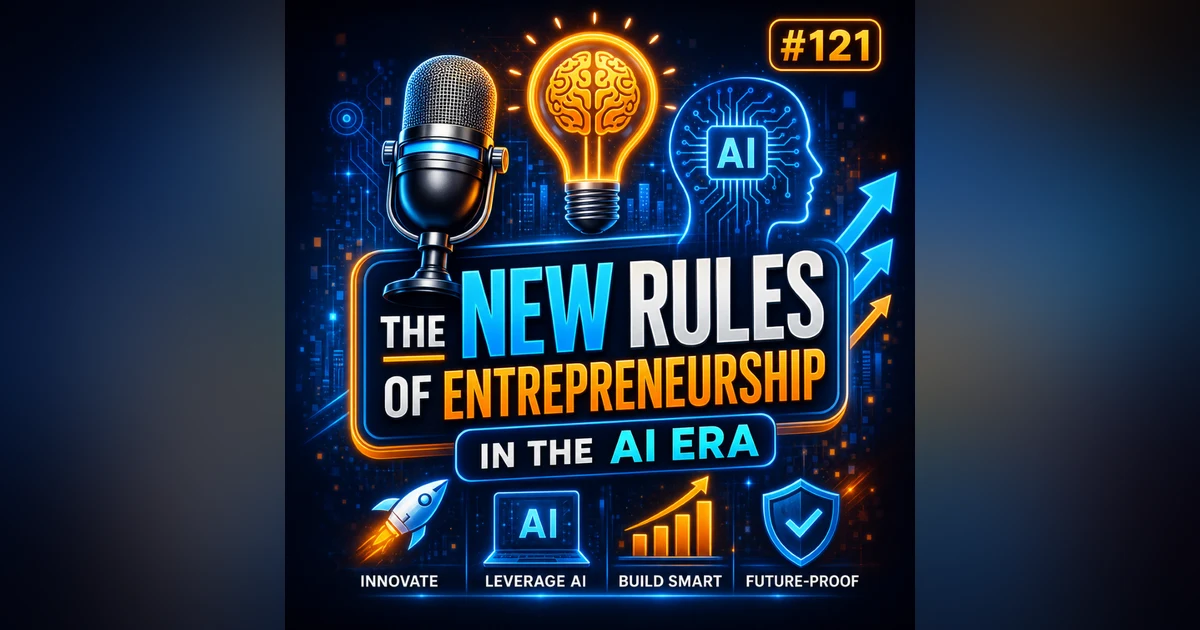


In this episode of the Smart Entrepreneur Show, we do a deep dive into one of the most important shifts facing any founder today. AI has not changed why we build businesses — but it has completely rewritten how. This is a practical, no-nonsense breakdown of what modern entrepreneurship actually looks like, and what separates the founders who will thrive from those who will be left behind.
What You'll Learn in This Episode
- Why AI is a tool, not a replacement — and why confusing the two is the most dangerous mistake a founder can make
- How the cost of failure has dropped so dramatically that speed of execution is now a genuine competitive advantage
- Why continuous learning is no longer optional — and how to use AI itself as your learning engine
- How data-driven decisions have replaced gut feeling — and what that means for how you run your business day to day
- Why authenticity and human connection are becoming the scarcest and most valuable commodities in an AI-saturated market
Key Takeaways
- Think of AI as a highly caffeinated but inexperienced intern — it executes tactics brilliantly, but you still provide the vision, ethics and strategy
- Launching quickly isn't recklessness — it's rapid hypothesis testing, and AI makes the feedback loops nearly instant
- Standing still in a fast-moving market isn't neutral — it is actively falling behind
- When synthetic perfection becomes a commodity, authenticity becomes the premium — your human story, your failures, your real voice are your moat
- The entrepreneurs who will dominate the next decade are not the ones who know the most answers — they are the ones wise enough to ask the right human questions
🔗 About Your Host (Roy Coughlan)
- Explore more podcasts: Find all podcasts at the PodFather Network
- Website: https://roycoughlan.com/
- Need help running your business? If you are looking for a Virtual Assistant and get reliable support for your daily operations.
- Virtual Assistants: https://va.world/
- Private Networking Group: Learn about a Private Networking Group in 50 US States & 44+ Countries with 675+ Members https://connectedleaders.academy
- Brain Upgrade: https://brainupgrade.org/
#SmartEntrepreneurShow #AIEntrepreneurship #FutureReadyBusiness #ArtificialIntelligence #Entrepreneurship #BusinessGrowth #Mindset #Authenticity #PersonalBrand #Innovation #RoyCoughlan
#121 The New Rules of Entrepreneurship in the AI Era 🚀 – How to Build a Future-Ready Business
Welcome to the Smart Entrepreneur Show, where we share smart ideas, strategies, and lessons to help you build better businesses. Today we are doing a deep dive into the new rules of entrepreneurship in the AI era. And we have a really fascinating mission today with this material.
We are unpacking a comprehensive guide on these new realities. And the core thesis we're exploring, it's, well, it's basically a massive wake-up call for anyone building a company right now. Yeah, a wake-up call in what sense? Well, the heart of entrepreneurship, you know, solving genuine human problems, taking calculated risks, offering real value, that hasn't changed a bit.
But AI has entirely rewritten the operational mechanics of how we build, how we market, and how we scale. The strategies that reliably kept a business afloat even just 5 or 10 years ago are, frankly, obsolete today. Obsolete is one of those words that instantly spikes a lot of people's blood pressure.
I mean, especially founders. Oh, absolutely. It's terrifying if you don't understand the mechanics of it.
But that's exactly why we're doing this deep dive. We want to bypass the tech anxiety and give you, the listener, highly practical, problem-solving value. We need to look at how to stay competitive without feeling completely overwhelmed by the sheer pace of innovation.
Which is key. So, let's unpack this from the ground up. Before we can talk about the speed of the modern market, we have to define the actual role AI plays in a business today.
Our source material is really unequivocal on this. AI is a tool, not a replacement. And internalizing that distinction is the foundational step for any modern entrepreneur.
It dictates how you divide the labor within your company. AI's primary function is to ingest massive amounts of data, automate repetitive workflows, and just drastically improve your baseline operational efficiency. So it's doing the grunt work.
Exactly. But the human entrepreneur is still the sole source of strategic vision, empathetic leadership, and genuine creativity. You have to bring the humanity.
I really like thinking about AI as a highly caffeinated, incredibly fast, but ultimately inexperienced intern. That is a great way to put it. Right.
I mean, this intern is phenomenally productive. If you tell them to run a sentiment analysis on 50,000 scattered customer reviews to identify a micro-trend in why people are returning a specific product, or if you ask them to generate dynamic pricing arrays for your e-commerce store, they do it in three seconds flat. Without breaking a sweat.
Without breaking a sweat. Yeah. But if you turn to that same intern and say, hey, what should our company's 10-year vision be? Yeah.
What are our core ethical values? Why does our brand actually matter to people? That intern is just going to stare at you blankly. Or worse, they'll hallucinate a very confident, entirely synthetic answer that sounds plausible, but means absolutely nothing. Yes, exactly.
It sounds so good until you realize it's completely hollow. That is the perfect distinction though. The intern executes the tactical maneuvers, but you direct the overarching strategy.
The smartest, most competitive entrepreneurs are utilizing AI to give themselves operational superpowers, not to outsource their core vision. But the source highlights a very dangerous trap here, regarding how people integrate this tech. It usually swings to one of two extremes, right? It does, yeah.
On one end of the spectrum, you have founders who completely ignore AI out of fear, stubbornness, or just a false sense of traditional pride. We've always done it this way, crowd. Precisely.
They are still doing data entry by hand while their competitors are automating it instantly. But on the other end, which is arguably much more dangerous, you have founders who depend entirely on AI without any human oversight. Oh man, just letting the intern run the company.
Exactly. They put that hyper-fast intern in the CEO's chair, turn on autopilot, and walk away. They generate thousands of SEO blog posts with absolutely no editorial review.
They automate all their customer service to a rigid bot, and then they wonder why their brand suddenly loses its soul. Or why their customer attention completely tanks. Right, because they completely abdicated human judgment.
But let's look at what happens when you do strike that balance. You know, when you keep the visionary control, but let the intern handle the heavy lifting. By removing those operational bottlenecks, the actual pace of business has fundamentally accelerated.
Which brings us to a massive thematic shift in our sources, which is the new necessity for speed and smart adaptability. It's faster than ever. Yeah, the barrier to entry has never been lower.
Launching a product, spitting up a targeted marketing campaign, or analyzing a new demographic used to require months of focus groups and expensive external agencies. Today, all of that can happen in an afternoon. Which completely changes the math of failure.
In the past, a mistake was incredibly expensive because it took six months of runaway and capital to build a product before you even knew if anyone wanted it. You were just guessing for half a year? You really were. And you can spin up a digital prototype or a wireframe in six hours, put it in front of a hundred targeted users, and gauge their reaction immediately.
Because the cost of being wrong has plummeted so drastically, the value of launching quickly to get real-world feedback has skyrocketed. You improve continuously based on market reality, not on theoretical assumptions cooked up in a boardroom. Okay, let me push on that a bit, because I think a lot of founders struggle here.
If we're prioritizing moving at warp speed, doesn't that inevitably lead to sloppy mistakes? Like how do you balance moving incredibly fast without releasing a garbage product and permanently alienating your early adopters? That is the pivotal question, and it really comes down to the difference between sheer recklessness and what the source material refers to as smart execution. Smart execution. Okay.
Yeah. Successful entrepreneurs today aren't just throwing half-baked garbage at the wall to see what sticks. They are prioritizing rapid hypothesis testing.
When you launch quickly, you aren't releasing a final perfect product, you are releasing a targeted test. And because you are using AI's real-time data analysis, the feedback loops are practically instant. So you launch the hypothesis, and the AI tells you immediately where the holes are.
Precisely. You don't need an impenetrable, rigid five-year business plan anymore. If markets are changing rapidly, and if customer expectations are constantly evolving, your greatest strategic advantage is flexibility.
It makes sense. Think of it less like charting a static course across an ocean using a centuries-old map, and more like navigating a sailboat using a live, hyper-accurate weather radar. You don't need to know exactly what the weather will be in three years.
You need the capacity to read the radar today and adjust your sales faster than your competitors. But to be able to read that live radar, your internal knowledge base has to be constantly updating. I mean, it feels like trying to navigate a city where the streets are literally shifting underneath you while you drive.
It really does. And that brings up a really daunting point from the guide. Continuous learning is absolutely non-negotiable now.
If you stop aggressively updating your skills, you don't just stagnate. Because the baseline of the market is moving forward so quickly, standing still means you are actively falling behind. It is a relentlessly moving treadmill.
The material is very clear about the specific domains a modern founder needs to grasp, like the underlying capabilities of new AI tools, advanced digital marketing mechanics, workflow automation, modern sales psychology, and macro business trends. OK, I can practically hear the listener's anxiety spiking again. Yeah, it's a lot.
That is a towering list of requirements. As an entrepreneur, you are already wearing 20 different hats. You're balancing the books, managing client relationships, fixing the office Wi-Fi, designing pitch decks.
How on earth does a founder avoid total information overload when they're told they also need to simultaneously master AI, data analytics, and global marketing trends? It's a completely valid fear if you approach learning the traditional way. But the paradigm of acquiring knowledge has shifted entirely. You don't have to go back to university and get a master's degree in data science.
You actually use AI as your primary learning engine. So you learn with the tool itself. Exactly.
You don't need to learn how to write Python code to build a machine learning model. You use an AI tool to ingest unstructured data for you. Wait, let's define unstructured data for the listener just so we are totally clear on the mechanism here.
We are talking about data that doesn't fit neatly into a spreadsheet row or column, right? Like angry tweets or a long, messy customer service email or industry press releases. That is exactly it. Historically, making sense of a thousand messy customer service emails required a team of human analysts reading them one by one.
Now, instead of spending your weekend reading 50 different industry blogs to figure out what your competitors are doing, you feed that unstructured data into an AI tool and ask it to find the intersecting anomalies. That saves so much time. Unbelievable amounts of time.
You ask it to synthesize the macro trends in your highly specific niche. You use AI to distill incredibly complex digital marketing strategies into a simple checklist of actionable steps tailored to your current budget. You are learning the application of the technology, not the underlying engineering.
So you aren't learning how to build the combustion engine from scratch, you're just learning how to drive the car really, really well. Yes. And the dashboard of that modern car is entirely powered by data.
We have access to more granular, actionable information than any generation of entrepreneurs before us, which is why the source emphasizes leaning heavily into data-driven decision-making. But raw data by itself is just noise, right? Having a dashboard with 50 flashing numbers doesn't actually help you if you don't know what they mean. Which is where your AI co-pilot shines again.
You deploy analytics to understand the exact mechanics happening under the hood of your business. Rather than looking at top-level vanity metrics, you are monitoring very specific behavioral flows. Like how customers actually behave on your site.
Exactly. How are they moving through your sales funnel? What are the micro-shifts in market trends? Which specific marketing channels are yielding the highest lifetime value, not just the cheapest initial clicks? Look at the downstream effects of that on a founder's daily life. It means the era of the pure gut feeling is largely over.
It really is. Or at the very least, that gut feeling is now heavily subsidized by empirical facts. Data-driven decisions take the emotional guesswork completely out of the equation.
Say you have an e-commerce store and sales suddenly dip. You don't have to sit in a room and guess if people hate the new product colors or if the price is too high. Right.
You don't form a committee to guess. Exactly. You look at the AI analytics, and maybe you see through session recordings, that mobile users are experiencing a friction point on page 2 of the checkout process because a specific form field is glitching.
You don't guess. You identify the exact point of friction, and you fix it today. You are reacting to documented reality, not some vague assumption.
And that leads to tangibly better, faster business outcomes. But we have to address the elephant in the room here. Please do, because I think I know exactly where you're going.
If every single entrepreneur has access to this same super-fast intern, and if everyone is testing products at the speed of light, and everyone is making flawlessly logical decisions backed by mountains of AI-crunched data, how do you actually win? Right. It's a level playing field again. Exactly.
If operational execution becomes perfectly identical across the board, business just becomes a giant, cold algorithm. But the source material takes a really fascinating tivet here. It focuses on what actually makes someone pull out their credit card, and more importantly, what makes them stay fiercely loyal to your brand for a decade.
And it turns out, that requires something AI fundamentally absolutely cannot fake. Exactly. This is undoubtedly the most critical insight from our sources today.
We are talking about the unautomated advantage, the deeply human elements of commerce. Let's look at the directive to focus on solving real, tangible problems. Look, AI is fantastic at generating infinite ideas.
You can open a prompt right now and ask it to output 200 startup concepts for the fitness industry and it will do it in 10 seconds. It's effortless. But customers do not pay for generated ideas.
They pay for meaningful solutions to real, painful problems they are experiencing in their actual lives. Because an algorithm doesn't have a nervous system. It does not know what a tension headache actually feels like.
It doesn't know the visceral, not-in-your-stomach anxiety of trying to pay a mortgage during a recession. Or the desire to feel confident when walking into a high-stakes job interview. Right.
It can mimic the words describing those feelings, but it cannot experience them. Businesses that leverage empathy to create genuine, tangible value in the real world will always command a premium, regardless of how sophisticated the underlying code gets. Let me play devil's etiquette here, though, because this is where the debate gets really heated in the tech world.
Let's imagine an AI customer service chatbot gets so incredibly advanced that it can perfectly simulate empathy. It analyzes the customer's tone, it responds with the perfect, polite language, it resolves their complex shipping issue in four seconds flat, and it even throws in a warm, digital chuckle. A digital chuckle, yep.
If the friction is completely removed and the problem is solved instantly, why does the actual messy human connection still matter to a company's bottom line? Like, why do I need to build a personal brand if my robot is flawlessly polite and efficient? Because you have to account for the scarcity principle in economics. When any resource becomes infinite and effectively free, it loses its premium value. We are rapidly entering a marketplace that is absolutely drowning in synthetic, AI-generated perfection.
It's everywhere. It is. Flawless grammar, perfectly optimized graphics, instantly polite customer service responses These things used to be hard to achieve.
Now they are just a commodity. Because synthetic perfection is now incredibly cheap, authenticity becomes the ultimate premium commodity. So it's the contrast.
The messy, vulnerable, lived experience of a real human being stands out against a backdrop of endless algorithmic perfection. Authenticity cannot be manufactured at scale. If a consumer knows they are being managed by a perfectly polite machine, the transaction might be efficient, but it does not build emotional loyalty.
It just builds utility. And utility is easily replaced by a slightly faster machine. Exactly.
Loyalties build when a customer connects with the human struggles, the core values, and the real-world narrative behind a company. The source urges entrepreneurs to lean heavily into their personal brand to share their hard-won knowledge, their failures, their unique points of view. That makes total sense when you apply it to the real world.
If my inbox is flooded with a hundred perfectly polished, AI-generated corporate newsletters, my eyes just glaze over. Same here. But if I get one email from a founder that, I don't know, maybe has a typo in the second paragraph, but it tells a raw, honest story about a massive failure they had last week and what they learned from it, that is the only email I'm actually going to read all the way through.
Because that founder signaled their humanity. And that drives home a core directive from our guide, never, ever ignore the human element in your operations. Yes, deploy technology to support your infrastructure, to analyze your data, to speed up your growth, but recognize that trust, deep empathy, transparent communication, and genuine relationships are your ultimate defensive moat.
It's the wall they can't climb. Right. They are the walls around your business that a competitor's algorithm simply cannot breach.
Because if a new competitor enters your space and uses the exact same sophisticated AI tools you do, they might match your efficiency. But if you have spent years building deep, empathetic, reciprocal relationships with your client base, the competitor cannot scrape that with an algorithm. You win.
Which brings us to the ultimate synthesis of all these concepts. Resisting technological change and failing to adapt your skills will certainly kill a modern business. But automating away your customer relationships and losing your human touch will kill it just as thoroughly.
It's a dual threat. It is. The goal for the modern entrepreneur is a radical intentional balance.
You must balance the incredible unprecedented leverage of AI technology with the irreplaceable scarce value of human judgment, empathy, and connection. It really is a dynamic balancing act. You have to keep one foot firmly pressed on the accelerator of this massive technological engine to ensure you aren't left behind by the market, while keeping your other foot planted firmly in the bedrock of human ethics, genuine connection, and real-world value.
Which perfectly encapsulates the overarching takeaway from all our sources today. The arrival of the AI era is not the end of entrepreneurship. It isn't a signal that human ingenuity is suddenly obsolete in the business world.
Quite the opposite, really. It is simply the beginning of a vastly more capable chapter. A chapter where the tedious, soul-crushing busywork is finally stripped away.
The data entry, the blind guessing, the slow execution that all gets handed to the intern, and the real work, the deeply human work of creating value and building relationships, takes center stage. The entrepreneurs who are going to dominate this next decade are the ones who relentlessly embrace innovation, who use AI to aggressively update their internal map, but who never compromise their core humanities. Exactly.
Because the fundamental principles of business, identifying a painful problem, offering a reliable solution, and building trust, they haven't changed, they've just been amplified by better tools. I like to think about the historical context of this shift too. For the last century, a massive percentage of an entrepreneur's daily energy was spent simply figuring out how to do something.
How to code the website, how to format the marketing newsletter, how to run the statistical analysis on the spreadsheet. So much time wasted on the how. Exactly.
AI is rapidly, systematically answering all those hows. The mechanical execution of business is becoming flawless, instant, and universally accessible. Which raises a genuinely provocative question about the future of commerce.
Oh, I like where this is going. What happens when everyone knows how? Think about it. If AI eventually makes everyone's operational execution perfectly equal, will the most successful entrepreneurs of tomorrow actually be the philosophers? Oh, wow.
When the machine beside you knows how to execute any task and answer any technical question instantly, the true premium in business won't be having the answers. It will be having the wisdom to know which deeply human questions to ask in the first place. Wow.
The entrepreneur is the philosopher. Asking the right questions about what people are actually afraid of, what they secretly hope for, what brings them genuine joy, navigating the messy reality of the human condition, that is something a language model can simulate, but it is something an algorithm can never truly comprehend. That is a brilliant thought to chew on as we navigate this transition.
If you enjoyed this deep dive on The Smart Entrepreneur Show, make sure to follow us so you don't miss future deep dives. And feel free to share your thoughts or experiences in the comments.

PodFather
I am a serial entrepreneur who has founded 21 companies across 6 countries. Known in the industry as “The PodFather,” I am a business podcast coach and host who has launched eight successful podcasts—6 ranking in the Top 5%, with four reaching the coveted Top 0.5% globally.
Beyond podcasting, I co-founded brainupgrade.org a platform designed to boost cognitive performance and unlock peak mental potential. I am also the co-founder of VA.World, connecting businesses with exceptional Virtual Assistants tailored to their unique needs.
I also have Sponsorship ads available that are Dynamically inserted into my 8 shows