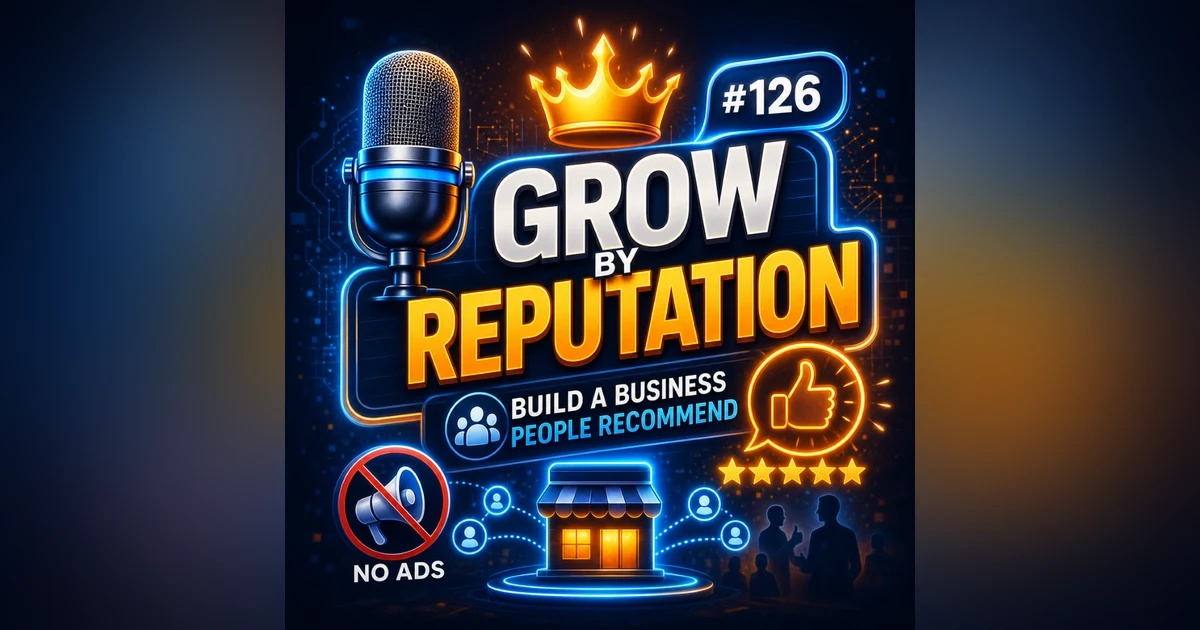
#126 Grow by Reputation — Build a Business People Recommend Without Advertising


In this episode of the Smart Entrepreneur Show, we start with a terrifying thought experiment — what if your entire marketing budget was frozen tomorrow and you had to grow purely on reputation? This deep dive breaks down the exact mechanics of word-of-mouth growth, why trust beats attention every time, and how to engineer a business that your customers actively sell for you.
What You'll Learn in This Episode
- Why an advertising budget is essentially a tax you pay for not being remarkable enough yet
- The psychology of risk and why a personal recommendation bypasses your customer's skeptical filter entirely
- The neuroscience of habituation — why the human brain is literally wired to ignore ordinary businesses
- Why niching down turns you from a flashlight into a laser — and why the laser cuts through steel
- The secret engine of word of mouth — how specialisation hands your customers the exact script they need to recommend you
- The peak end rule and the golden window — the precise moment to ask for a review or referral
- The evolutionary biology behind why negative reviews spread automatically but positive ones need a nudge
Key Takeaways
- Attention does not inherently carry trust — ads put your name in front of eyeballs, but trust closes the sale
- Companies like Apple use ads as accelerators, not trust builders — the trust was already established by the product working for decades
- A recommendation is like a trusted co-pilot in the passenger seat — you take the exit every single time without questioning it
- To become talkable, you have to break the pattern — the spikes that generate word of mouth happen in the margins of the transaction
- Be the taco stand, not the 50-page menu diner — solve one specific problem so well that recommending you becomes intellectually effortless
- Trust is not a merit badge you earn once — it is an ongoing real-time evaluation you have to keep passing
- You can scale relationships without burning out — predictable reliability and frictionless systems operationalise empathy at any size
- Ask for the review at the peak of satisfaction, not three weeks later in a generic newsletter
- You cannot out-advertise a leaky bucket — fix the friction in your customer experience before you spend another cent on ads
🔗 About Your Host (Roy Coughlan)
- Explore more podcasts: Find all podcasts at the PodFather Network
- Website: https://roycoughlan.com/
- Virtual Assistants: https://va.world/
- Private Networking Group: Learn about a Private Networking Group in 50 US States & 44+ Countries with 675+ Members https://connectedleaders.academy
- Brain Upgrade: https://brainupgrade.org/
#SmartEntrepreneurShow #WordOfMouth #ReputationMarketing #BusinessGrowth #Entrepreneurship #CustomerTrust #BrandBuilding #MarketingStrategy #Referrals #RoyCoughlan
#126 Grow by Reputation 🚀 – Build a Business People Recommend Without Advertising
Welcome to the Smart Entrepreneur Show, the podcast where we share smart ideas, strategies, and lessons to help entrepreneurs build better businesses. And today, we are actually getting into a deep dive that starts with a pretty terrifying thought experiment. Yeah, it really is.
So I want you to imagine, just for a second, that you wake up tomorrow morning and your entire marketing budget has been legally frozen. Just completely gone. Exactly.
$0. You cannot spend a single cent on Facebook ads. You can't buy Google keywords.
You can't sponsor a newsletter. Your ad account is at absolute zero. It's a nightmare scenario for most people.
Right. If that happened, would your business survive the year? Or would it just completely flatline? Because today, we are tearing into the mechanics of how you can engineer a business that grows purely on reputation and word of mouth. Which is really the ultimate stress test for your product's actual value.
We're so conditioned to think that growth is directly and exclusively tied to how much attention we can buy. Right, like the megaphone approach. Yeah, exactly.
But we forget that attention is completely useless if it doesn't actually convert into trust. Okay, let's unpack this. Because before we get into the practical tactics of how to build this unpaid marketing team out of your everyday customers, we have to talk about the economics.
The economics of trust versus the economics of attention. Right, and we have to fundamentally separate those two concepts. I mean, structurally, advertising is just a mechanism for buying attention.
That's it. It just puts your name in front of eyeballs. Yes, but attention does not inherently carry trust.
Think about the psychology of risk for a second. Every single time you, as a consumer, buy a product from a new company, you are taking on a cognitive and financial risk. You're asking yourself, is this gonna break? Will it actually solve my problem? Am I gonna look stupid for wasting my money? Yeah, eh.
When you see an advertisement, you are bearing 100% of that risk alone. Because, I mean, I know the company paid to put that ad in front of me. Their motivation isn't a secret.
They want my money, so of course they're gonna tell me the product is flawless, right? My internal filter just immediately blocks it. Exactly, you know they're biased. But, let me push back on this just a little bit.
If advertising doesn't build trust, why do companies like Apple or Nike spend billions of dollars on it? Are we saying ads are entirely useless, or are we just looking at them the wrong way? No, that's a really important question about the life cycle of a brand. Companies like Apple, they aren't using ads to build baseline trust from scratch anymore. Oh, because the trust is already there.
Right, they use ads as accelerators, or for cultural positioning. The trust was already established by the product actually working for decades. So, for a growing entrepreneur, spending money on ads before you have a product that generates natural word of mouth is basically a tax you pay for not being remarkable yet.
Oh wow, that is a sharp way to put it. An ad budget can become a tax for an unremarkable product. Exactly, what's fascinating here is how a personal recommendation completely rewires that psychology of risk we were just talking about.
Right, because someone else is stepping in. Yeah, when a friend says to you, hey, I use this accountant, she is amazing, that friend is essentially absorbing the risk for you. They've navigated the minefield already.
Right, they're saying, it's safe, I am putting my own social currency on the line to vouch for this. A recommendation bypasses your skeptical filter entirely because the motivation is pure. It's like the difference between a billboard and a co-pilot.
I mean, an ad is a billboard on the highway. You glance at it, but you don't inherently trust it to navigate your car. Right.
But a word of mouth recommendation is like a trusted co-pilot sitting in the passenger seat, looking at the map and saying, hey, take this exit, I know a shortcut. You take the exit every single time without questioning it. I love that analogy.
You don't question the co-pilot because you trust their alignment with your goals. So the foundational premise of this deep dive is shifting your obsession from how do I buy more billboards to how do I become the co-pilot. Which requires a really surgical look at what actually triggers a human being to talk about a business in the first place.
Yes, and that brings us to the product itself. The core argument is that people do not recommend ordinary businesses. No, exceeding expectations sounds like one of those hollow corporate buzzwords printed on a motivational poster in a break room.
Totally. But behaviorally, what does that actually mean? Because if I order a pair of shoes and they arrive in three days, exactly as pictured, my expectations were met. But I'm not calling my mom to talk about it.
No, of course not, because the human brain is literally wired to ignore the expected. It's a biological process called habituation. Habituation, okay.
Yeah, we filter out ordinary things to conserve cognitive energy. If a business just does what it promised to do for the price it asked, it is invisible. It just blends into the background.
Exactly. To become talkable, you have to break the pattern. You have to create a spike in the data.
And these spikes usually happen in the margins of the transaction. Right, so it's not necessarily about fundamentally reinventing the shoe. It's the friction you remove that the customer didn't even know was there.
Yes, exactly. Like unexpectedly fast communication or the customer support rep who speaks like a normal human being instead of just reading from a robotic script. Precisely.
And this ties directly into the most critical strategic move an entrepreneur can make, which is narrowing their focus. To be recommendable, you cannot be a generalist. You have to be the absolute best at solving one specific, highly important problem.
I really wanna dive into this because I think the fear of missing out, the FOMO of niching down is probably the biggest psychological hurdle for entrepreneurs. Oh, absolutely. We think, if I only offer one service, I'm turning away all these other paying customers, but I like to think about it like light.
Think about a standard flashlight. You turn it on and it gently illuminates an entire room. It's helpful, sure, but it doesn't leave a permanent mark.
Right. Now take that exact same amount of light, that exact same energy, and focus it down to a single millimeter. It becomes a laser.
It can cut through solid steel. That's a great way to look at it. Yeah.
When you try to serve everyone with 20 different features, you're a flashlight. You're mildly helpful to a broad audience, but nobody is going to enthusiastically advocate for mild warmth. That is a perfect visualization.
The laser focus is what actually cuts through the market noise. Think about a diner with a 50-page menu versus a tiny food stand that just makes the best tacos in town. Oh, right.
The taco stand is the laser. Exactly. Let's look at a totally boring industry as an example.
Yeah. Let's say you are a freelance graphic designer looking for someone to do your taxes. You could go to a massive generalist accounting firm.
They can technically do the job, but if you find an accountant whose entire website says, I only do taxes for freelance graphic designers. I know all your specific deductions and I speak your language. That accountant is a laser.
And more importantly, that accountant has given you a script. Yes. That is the secret engine of word of mouth.
When you solve a specific problem flawlessly, you hand your customers the exact vocabulary they need to pitch you to their friends. Because if the accountant is a generalist, the graphic designer doesn't really know how to bring them up in conversation. Exactly.
What are they going to say? My accountant does math well. Right. But if the accountant is highly specialized, the moment that graphic designer hears another creative complaining about taxes, the script practically writes itself.
Oh, you have to use my guy. He specializes in exactly what we do. So if you want people to talk about you, you have to make it intellectually effortless for them to explain why you are great.
You have to write the script for them through your niche. Which connects to the bigger picture of brand identity, right? Yes. A memorable brand that clearly communicates its values gives the customer a narrative to attach to their own identity.
Recommending a specialized, high quality brand makes the recommender look smart. You can't underestimate the social currency someone gains by introducing their network to a hidden gem. Never.
It's a huge motivator. Okay, so let's say we've done it. We built the laser.
We delivered that amazing pattern breaking, expectation exceeding experience for the first transaction. We got them. Awesome.
But solving the problem perfectly once only gets you a one-time buyer. The real friction for a scaling business is turning that one-time buyer into a permanent vocal evangelist. And this is achieved through consistency and relationships.
Right. Trust is not a merit badge you earn once and stick on your jacket forever. It is an ongoing real-time evaluation.
You have to keep earning it. Every single time. You maintain it by keeping promises, being radically honest, and delivering that same quality every single time they interact with you.
But hold on. I have to play devil's advocate here. Because this is where the advice always starts to feel a bit disconnected from reality.
Fair enough. Late army. We talk about building relationships and staying connected.
If I am an entrepreneur with 50 clients, sure, I can send them all personalized emails. But what if I have 5,000 customers? Or 50,000 users on an app? Right, the scale problem. Yeah.
It is physically impossible to maintain a deep personal relationship with every single one without completely burning out. How is this actually actionable? It's completely fair critique. And it requires us to redefine what relationship actually means in a commercial context.
Okay, redefine it how? Well, a business relationship doesn't mean you are best friends with the buyer. It doesn't require deep emotional intimacy. In this context, building a relationship simply means predictable reliability.
Predictable reliability. Yes, the most important word here is consistency. So it's more about operationalizing empathy than it is about being their pen pal.
Exactly. You scale the relationship by removing friction at scale. When we talk about following up or providing helpful content, you can systemize that without it feeling robotic.
Give me an example of that. Okay, think about a post-purchase automated email. If the email says, dear customer, buy more stuff, that's bam.
Right, instant delete. But if the email says, hey, we noticed you just bought this specific espresso machine. Here's a two-minute video on the biggest mistake people make when they first plug it in.
That is massive value. Oh, wow. It's automated, but it feels highly personal because it anticipates their exact context.
Here's where it gets really interesting because what you're saying is that a good system scales trust better than a human trying to do it manually. Yes, a customer service protocol that ensures every single complaint is addressed respectfully within two hours is a system. Treating people with respect scales perfectly.
You don't need face-to-face interaction to make a customer feel valued. Exactly. You just need to ensure that every single touchpoint, whether it's a refund policy, a website FAQ, or an email response, is consistently excellent.
That predictability is what makes them comfortable attaching their reputation to yours. Because if they recommend you to their boss and you drop the ball, they look terrible. Exactly, you made them look bad.
So predictability is the ultimate safety net. Okay, so we have the laser focus, we have the predictably excellent systems, we have essentially loaded the word-of-mouth cannon, but potential doesn't pay the bills. No, it does not.
How do you actually get people to fire? How do you trigger the recommendation? You have to ask. And you have to understand why people leave reviews in the first place. Satisfied customers usually wanna help, but they're busy and they simply need a gentle reminder.
But let's dig into the behavioral economics of this for a second because I find human nature so wonderfully hypocritical here. Oh, totally. Think about how heavily you rely on reviews.
If I'm buying a $20 phone charger, I will scroll through 40 reviews to make sure it doesn't catch fire. We consume social proof constantly. All the time.
Yet as consumers, we rarely mint that currency ourselves unless something goes wrong, right? Right. We have to look at the asymmetric psychology of feedback. Why do people leave negative reviews completely unprompted? Yeah, why is that? It's rooted in evolutionary biology.
It's tribal protection. If you eat a poisonous berry, you run back to the tribe and scream, don't eat the red berries. Oh, wow.
Like a survival instinct? Exactly. It's loss aversion. You wanna protect your peers from a threat.
So negative word of mouth happens automatically. Yeah, don't hire that contractor. He destroyed my kitchen.
We think we're performing a public service. But positive word of mouth is driven by a completely different mechanism, status elevation and altruism. Finding the best berry patch and sharing it makes you look like a skilled gatherer.
But it's not a threat. Exactly. Because a positive experience isn't a threat to the tribe.
The biological urgency to share it just isn't there. That is why the business has to artificially create the urgency. So how does a smart entrepreneur create that urgency without sounding desperate or annoying? By understanding the golden window.
The golden window. Yeah. There is a specific psychological concept called the peak end rule, which suggests people judge an experience largely based on how they felt at its peak and at its end.
Okay. If you have just delivered an exceptional result, say you just handed over the keys to a beautifully repaired car, or you just delivered a flawless website redesign, the customer's dopamine and satisfaction are at their absolute peak. Right.
That is the exact moment you ask. Not three weeks later in a generic monthly newsletter. No.
You ask when the relief and joy are fresh. Yeah. And you frame it around helping others.
We are thrilled we could get this launched for you. If you have two minutes, sharing your experience helps other freelancers find the same solution. You give them a clear frictionless call to action when their emotional state is highest.
Exactly. And obviously, all of this architecture collapses if you commit the fatal flaws. Oh, right, the trust killers.
Things like ignoring customer service, breaking promises, delivering inconsistent quality. Taking your loyal customers for granted while chasing new ones. Yeah.
This brings us right back to the reality of that tribal protection mechanism. It does. We talked about how negative reviews spread automatically.
If you focus purely on ads and ignore your product quality, you are effectively paying money to accelerate your own demise. You are buying attention for a broken promise. Exactly.
Your reputation is an active daily byproduct of how you operate, not something you can just buy your way out of. So what does this all mean for you, the listener, trying to build something sustainable? Let's distill this deep dive into the absolute essentials. First, you have to accept that an ad budget is not a substitute for customer trust.
Right. Ads buy eyeballs, but trust buys conversions. Second, you have to become the laser, not the flashlight.
Solve one specific problem so exceptionally well that your customers are handed the exact script they need to recommend you. Be the taco stand. Yes, be the taco stand.
Third, scale your relationships through predictable reliability. Operationalize your empathy so that every touch point is frictionless. Systematize it.
Exactly. And finally, don't be afraid to ask for the recommendation during that golden window of peak satisfaction. It fundamentally changes your job description from marketer to experienced engineer.
I love that, experienced engineer. And to bring this full circle, I wanna leave you with a thought experiment to mull over as you evaluate your own operations this week. Okay, let's hear it.
If that nightmare scenario we talked about at the top actually happened, if you woke up tomorrow and your ability to buy any form of advertising was permanently revoked, what is the very first friction point in your customer experience you would fix today to ensure you survive purely on your reputation? That is a phenomenal question. It forces you to stop looking at the top of the funnel and start looking at the actual engine of your business because you really can't out-advertise a leaky bucket. Absolutely not.
Well, thank you for joining us on this deep dive into the mechanics of word of mouth. Take these practical ideas, ruthlessly examine your own customer journey, and start transforming your buyers into your most powerful marketing team. If you enjoyed this episode of the Smart Entrepreneur Show, make sure to follow the podcast so you don't miss future episodes.
And feel free to share your thoughts or experiences in the comments. We'll catch you next time.

PodFather
I am a serial entrepreneur who has founded 21 companies across 6 countries. Known in the industry as “The PodFather,” I am a business podcast coach and host who has launched eight successful podcasts—6 ranking in the Top 5%, with four reaching the coveted Top 0.5% globally.
Beyond podcasting, I co-founded brainupgrade.org a platform designed to boost cognitive performance and unlock peak mental potential. I am also the co-founder of VA.World, connecting businesses with exceptional Virtual Assistants tailored to their unique needs.
I also have Sponsorship ads available that are Dynamically inserted into my 8 shows